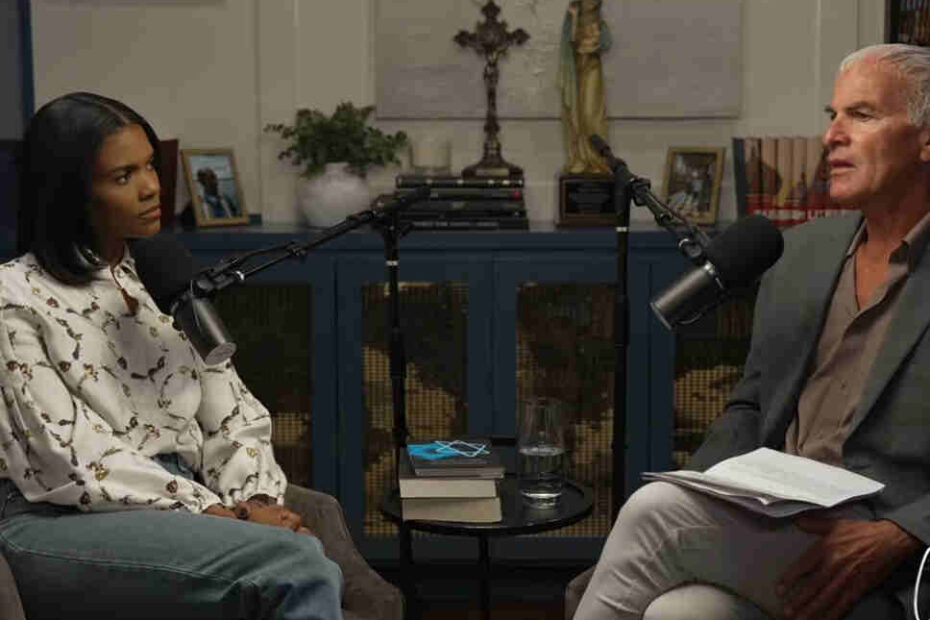
Here is the full transcript of American political scientist and activist Norman Finkelstein’s interview on Candace Owens Podcast, October 31, 2025.
Introduction: Breaking Through the Pressure
CANDACE OWENS: All right, you guys, I am super excited about this conversation. Where do I begin? I’ll just begin with my personal experience.
October 7th took place and I remember immediately after there was sort of this peer pressure campaign to get everybody to make a statement about what had happened in Israel. And frankly, I was happy to make a statement about how tragic those events were, but I didn’t, I couldn’t actually make a statement regarding why these events took place. I didn’t know what had happened prior to that day. I didn’t know the history of the modern state of Israel.
And when I began what I would call an honest inquiry into the history of the modern state of Israel, I felt that I was basically in a pressure cooker. People that I thought were my friends were telling me not to pursue this route. I didn’t comprehend what they meant when they said not to pursue this route. They were calling me names, saying that I was flirting with antisemitism by wanting to read books and speak to people that were on the opposite side of that issue.
And I got into a lot of trouble, and I mean a lot of trouble from people that I thought were my friends when I hosted the person who is now sitting across from me, Norm Finkelstein, on my previous show. And the things that he told me about Gaza were shocking. It was especially shocking because this wasn’t from someone that they could easily describe as anti-Semitic, giving us history, which he’s going to tell you about today. Very important discussion.
And he’s also an individual that I thought, quite strangely, none of the people who were peer pressuring me were willing to debate. If Norm Finkelstein is wrong, and he could be, why wouldn’t the most prominent voices of the pro-Israel debate be willing to sit down with him and have that discussion? We’re going to figure out why. Norm Finkelstein, welcome to my show. Actually mine, totally owned by me. I can host you here.
NORMAN FINKELSTEIN: Oh, thank you so much for having me on the show.
Finkelstein’s Background and Credentials
CANDACE OWENS: So just in case my audience has not been introduced to you, I would first just sort of like you to—and we’re going to get to your books, which are amazing—to kind of tell them your backstory and your credentials and what happened despite the fact that you were so credentialed.
NORMAN FINKELSTEIN: The backstory is there’s a personal element and there is a professional element.
The personal element is that I am the son of survivors of the Nazi Holocaust. Both my parents were in what was called the Warsaw Ghetto. The Warsaw Ghetto was repressed after an uprising in April 1943. There were about 20 to 30,000 survivors of the Warsaw Ghetto uprising. And they were deported to Majdanek concentration camp. And both my father and my mother were deported to Majdanek.
My mother ended up in two slave labor camps after Majdanek. And my father ended up in Auschwitz and he was in the Auschwitz death march. Every member of my family, apart from my mother and father on both sides, everybody was exterminated. There were no aunts, there were no uncles, there were no grandparents, there was nothing.
And my parents were, for reasons not worth going into now, they were decidedly on the left politically. And it had a very deep impact on me growing up. And in a way, even though I grew up in the lower middle class Jewish neighborhood, I never quite fit in because of my family background and a totally different mindset. I think, partially different mindset than my peers because of my parents’ experience.
In June 1982, we’re fast forwarding—June 1982, Israel invaded Lebanon and I got involved in the Israel-Palestine conflict. In my youth, it was mostly the war in Vietnam, the civil rights movement. In 1982 it became Israel-Palestine. I end up writing my doctoral dissertation at Princeton University on the theory of Zionism.
And then in 1984 there was a kind of big national bestseller called “From Time Immemorial,” which claimed to reveal new aspects of the Israel-Palestine conflict that proved Israel was in the right and the Palestinians were in the wrong. I was still a graduate student at the time and I approved to demonstrate that this book, which had the endorsement of the who’s who of the Jewish intellectual community back then—people like Barbara Tuchman, who you wouldn’t know, Saul Bellow, the novelist—they all endorsed the book.
And I am widely credited with the one exposing that it was a hoax. And from there on in, I would say after having demonstrated that this kind of humble graduate student, proving that all the luminaries were either promoting a threadbare hoax—from there on in, I would say I encountered difficulties in my professional life.
Academic Blacklisting and Career Destruction
CANDACE OWENS: Amazing. So despite—and you did achieve your PhD?
NORMAN FINKELSTEIN: Yes.
CANDACE OWENS: Despite this, wasn’t there sort of some fracas that happened where they didn’t allow you back or what happened at sort of the end of your career? Well, academic career.
NORMAN FINKELSTEIN: Right. I would say, speaking frankly, and believe me, at my age, I have no interest whatsoever in invoking pity. It’s water under the bridge. I never had an academic career. I was in academia. It’s called being an adjunct. And an adjunct basically means you’re hired from semester to semester. It’s the equivalent of literally the equivalent of a substitute teacher in a public school system, except a substitute teacher is paid significantly more than an adjunct.
And I was never able to get beyond the adjunct status except one brief period at DePaul University in Chicago where by a concatenation of events, I managed to get on a tenure track job.
After that, that was 2007, 2008. After that I was completely unemployed. Not even adjunct after that. Actually, I know this will come as a—it will seem kind of unbelievable—I literally couldn’t volunteer to teach. There were places where in high schools, a charter school, for example, in East Harlem, where the father of the principal was a friend of mine and his daughter, the principal, was really wonderful and she ran a tight ship. That was a darn good school. You could see just walking through the hallways. I said, “I’ll volunteer.”
So at that point, after the DePaul incident, I was completely blacklisted. But I never got started. I never got the plane, never left the tarmac.
Soviet-Style Academic Indoctrination
CANDACE OWENS: Well, I do want to stress here, as I have been stressing on my show, that these schools are Soviet indoctrination camps. I implore people to read Thomas Sowell’s book about inside the American education system. And what he is saying fits perfectly into there. The point is to indoctrinate your children. And if you do not have a doctor, so to speak, that is willing to go into the classrooms and do that indoctrination, they won’t let them in. And this is absolutely proof of that.
Okay, so I want to sort of give the same background because you were a major piece of me waking up and realizing that I knew nothing about Gaza. Could you just unpack for people who are perhaps hearing this for the first time? I think a lot of people—we’ve seen Israel support has virtually collapsed. And that’s because of the behavior that’s going on with the censorship has become so extreme in America.
But let’s actually give these people a background education, like you gave me when you came on my show, of what actually Gaza is. What is the history there? What happened to these people in 1948?
Understanding Gaza’s History
NORMAN FINKELSTEIN: Obviously, within the limits of an interview, it’s very hard to go through that history with any kind of—
CANDACE OWENS: Well, you have a book for it. So I am going to be a shameless promoter of this because we’re going to give you the spark notes here. But “Gaza: An Inquest Into Its Martyrdom” is the title of the book that will be relevant for this. But here we’re going to give you some spark notes.
The Reality of Gaza: From 1948 to October 7th
NORMAN FINKELSTEIN: Basically, if I were to try to summarize it for the purposes of this conversation, I believe the place to begin is 1948. The state of Israel is created. In the course of its creation, about 90% of the indigenous Palestinian population of Israel was expelled, about 750,000 people. Of those 750,000, about 300,000 were expelled to Gaza. And that’s when Gaza kind of became Gaza.
Right now, of the population of Gaza, about 80% are refugees from the 1948 war or descendants of those refugees. Under international law, a descendant of a refugee is still counted as a refugee. So it’s 80% a refugee population. And it’s also about 50% a child population.
Now, from the moment Gaza came under Egyptian administration after the 1948 war, Gaza comes under Egyptian administration. It’s a very interesting fact when you start going through the history. There are all these outside observers who go into Gaza either to work there, like under the auspices of the UN or just to see the situation. And one of the things that struck me was each time somebody goes to Gaza, they describe Gaza as a huge concentration camp. Now, this is still under Egyptian rule.
So Elm Burns, the main UN official in Gaza, he writes a book “Between Arab and Jew.” How does he describe Gaza? He described it as a huge concentration camp. In 1967, during the June 1967 war, Gaza comes under Israeli control. In July 1967, the father of Al Gore, the presidential candidate, his father was also a senator. So Al Gore or Senator Gore, meaning the father, he goes to Gaza, he comes back and he testifies before the U.S. Congress. How does he describe Gaza? He says Gaza is, quote, “a huge concentration camp on the sand, if you will.”
You now fast forward to 2002. One of Israel’s leading sociologists, his name was Baruch Kimmerling. He writes a little book. Little book is called “Politicite.” How does he describe Gaza? He describes Gaza as, quote, “the biggest concentration camp ever.” 2004, the head of Israel’s National Security Council. His name is Giora Island. He’s still around. He’s active now behind the scenes in the Netanyahu government. How does he describe Gaza? He describes Gaza as a huge concentration camp.
Now, bear in mind, bear in mind, this is before Israel imposed a blockade of Gaza. It was already a horror show. It’s been a horror show since 1948.
The Blockade and Humanitarian Crisis
In 2006, Israel imposes a blockade on Gaza. It decides what goes in, it decides what goes out. It decides who goes in, it decides who goes out. They put Gaza on what they call a humanitarian minimum diet. You know what that meant? It meant they calculated, literally. We’re not talking about hyperbole now, poetry. They calculated the caloric diet of everyone living in Gaza and they admitted just enough food to avoid scenes of starvation. That was 2006. We’re not talking about after October 7th.
They prohibited baby chicks from going into Gaza. They prohibited chocolate from going into Gaza. They prohibited potato chips from going into Gaza. They prohibited condiments from going into Gaza. No cinnamon allowed in Gaza. Why? They wanted to create such intolerable conditions that the population of Gaza would overthrow the government that they elected. So that was Gaza.
Now you come to 2006, October 6th. The Economist magazine, which you know, is not a flaming liberal magazine, it describes Gaza as, quote, “a human rubbish heap.” The leading UN official on Gaza describes it as, quote, “a toxic dump.” 60% of the young people in Gaza, the people who burst the gates of Gaza on October 7, 60% of them are unemployed. All they have to look forward to when they get up each morning is to pace the perimeter of this tiny parcel of land, 26 miles long, the length of a marathon, five miles wide.
That was Gaza. It was exactly what the UN officials said, exactly what Al Gore’s father said, exactly what the head of the Israeli National Security Council said they were born into. They were born into. They languished in. And they were destined to die in a concentration camp. It was like an elephant burial ground, really.
Understanding October 7th Through Historical Context
And when I struggled after October 7th, I’ve said this many times, but it’s a fact. It’s not a drama point. You know, what happened October 7th was awful. There’s no doubt in my mind about that. The magnitude was significant. 1,200 people killed. About estimates. It’s not an estimates. Close to 800 of them civilians, 400 combatants, Israeli IDF, members of the Israeli Defense Forces. So significant number can’t get around that.
I know there are all sorts of stories about Israel having killed a large number. I’ve investigated as best I can. And I’ll admit, you know, there’s still room on the margins for error, but I think it was overwhelmingly committed by Hamas. And so how do you reckon something like that?
But in politics there are many levels. There’s the facts, there’s your political judgment, there’s your legal judgment, there’s your moral judgment. And they don’t come directly from the facts. They do not. They go through many filters or sieves before you get a moral judgment.
The Nat Turner Parallel
And when I started to try to think it through, I latched, I came upon in my mind the Nat Turner Rebellion. So those of your listeners who are unaware, it was the largest slave revolt in American history. And Nat Turner, he gave the order. All the historians agree on this. There isn’t a huge literature in Nat Turner, but there is a literature they all agree on. One point, he gave the order, which he never denied. He did a famous confession. We don’t know how much of the confession is actually him and how much is the person who’s writing it. But this part seemed real. The order was kill all white people. Kill all white people.
And that’s what they proceed to do. They went on what you might call a 48 hour rampage, less than 48 hours actually, and hacked men, women, babies. It was brutal. It was brutal.
But then something struck me. One historian, his name is Stephen Oaks, and he’s trying to understand Nat Turner’s motivation. Why did he do it? And he said Nat Turner was a very smart guy. There was no question about that. The person who took down his confession, he said he was white. He said white or black. Everybody agreed. Nat Turner was a very smart guy.
And then he said, the historian now, he said there was this huge gulf for Nat Turner, very smart guy, between what he aspired to be in life and what he was destined to be because he was a slave. That huge gulf. He knew he was smart and yet he also knew, as the historian Stephen Oakes put it, that this is only earthly existence. He was born into, languish in, and would die a slave.
And that was the people, the young people in Gaza. They knew. You see, now Gaza is in the news, but by October 6, 2023, Gaza had vanished from the news.
Gaza’s Disappearance from Public Consciousness
I have made the point because I do believe it’s relevant. I had spent about 15 years just chronicling the details of what’s happening in Gaza. I began roughly in the early 2000s, and by 2020, I gave up. That’s a fact. And it was not a fact I was proud of because I was writing books. They were getting more and more detailed, I mean, so micro detail and nobody was reading them.
The last book I wrote was called “I Accuse.” My publisher not happily informed me it sold 370 copies of those 370. I purchased half of them. No, it’s a fact, because it was about a case related to Gaza in the International Criminal Court. And I was hoping to influence the court through my research. So I was going to present it to the ICC.
But by 2020, I said, Norm, you know, you have only one life to live and am I just going to stubbornly persist in the face of the fact that nobody cares? And that was the situation in Gaza. Gaza had vanished from the political scene by October 6, 2023. All the talk was about whether Saudi Arabia would join the Abraham Accords. Nobody was talking about Gaza anymore.
And so the people of Gaza basically did what Nat Turner did. Now here’s the thing. Imagine an account of Nat Turner that doesn’t mention he was a slave, just this crazy religious fanatic. He was a religious fanatic. No question about that. Nat Turner was a religious fanatic. He used the language of the Bible to try to make sense of his condition. That’s what a religious fanatic meant.
You know, John Brown, who led the insurrection before the Civil War, he also was a religious fanatic. He deeply, fanatically believed slavery was an abomination. To the point that, you know, I don’t want to get off on a digression, but when Frederick Douglass, the great abolitionist, when he went to meet John Brown, Douglas comments in one of his, he had three autobiographies. When one of them, he comments, he just wouldn’t stop talking about slavery. He said he was boring. He was a fanatic. He was Johnny One note. John Brown only about slavery and Nat Turner too. He was a religious fanatic.
But imagine if you tried to make sense of the Nat Turner rebellion by focusing only on his religious fanaticism, like the religiously fanatical Hamas, only focus on that and not mention the guy who’s a slave.
Questions About October 7th
CANDACE OWENS: Or mention if it were the circumstance for Nat Turner, and it isn’t. Or mentioned the fact that Nat Turner actually the rebellion was funded by money that one of the slave owners gave him. That would be something that would be important if there was the Bibi Netanyahu circumstance there or that, you know, the slave owners received multiple warnings and for some reason just decided to ignore the fact that this rebellion was brewing.
I mean, there’s a lot of things. I’ve been to Israel and it is, Charlie Kirk said it best immediately after because he had been many, many times. Truly unbelievable. It’s actually quite scary because every 15 feet there’s an armed person. They take their security very seriously.
They were, I mean, now people are speaking out and a lot more is going to come out because they have been censoring. Bibi has been lying, censoring, editing transcripts. I’ve been following the case against him pretty closely because there are Israeli publications that have been documenting everything. Obviously, he’s not well liked by the people in Israel. They were taking to the streets to protest him.
But it is almost unbelievable that that circumstance, plus when you add to the fact they intercepted a document right way earlier that said 200 hostages were going to be taken by Hamas, it’s almost unbelievable that they ignored everything plus Egypt warning him that something was happening on the border.
I have never bought that there was not, not that it took place, of course it took place, and it was terrible, but that it wasn’t intentionally allowed. And I truly believe that in my soul after I saw the footage prior to October 7th of Bibi Netanyahu. I’m not sure if you’ve seen this, but he thinks he’s off record. He says, you know, put the cameras down, off record. And he starts detailing a plan where he’s like, we got to hit Gaza so hard that they can’t go back. And so they sort of needed a pretext of sorts.
And do I think Bibi Netanyahu is evil enough to sacrifice his own people? Yes, a million times over. What’s been happening in Gaza is a tremendous evil. And I don’t think we will truly know the full picture of how evil it was until Bibi Netanyahu is removed from power and we’re able to see the transcripts that he’s blocking of the conversations he had that day with his cabinet.
NORMAN FINKELSTEIN: Look, there are obviously areas of interpretation here, and I don’t want to pretend as if I have a monopoly in the truth. If you look back at 9/11, our own September 11th, if you look back and there are many people who wrote at the time, there were a lot of people in the national security establishment who had reports that there was going to be an attack. They came in, the reports came in. No question about that.
You have to remember when you are a state the size of the United States and the power of the United States, you’re going to be getting each day 10,000 intelligence reports about possible terrorist attack here, possible terrorist attack there. The United States has huge number of bases around the world, so you’re always getting reports. But an intelligence establishment has to rank threats and they ranked the Osama bin Laden threat low or lower than it should have been ranked.
In the case of Israel here, we’re free to disagree. Israel is a Jewish supremacist state. That’s not my opinion. The head of Israel’s main human rights organization, it’s called B’Tselem, and the head of Israel’s human rights B’Tselem, this is a few years ago, it’s a guy named Hagai El-Ad, very decent guy. I’ve never met him, I’m not sure if he ever wanted to meet me, but decent guy. He was a Harvard trained PhD in physics, serious fellow.
And he put out a little report or he was the executive director when B’Tselem put out a report. It was probably 10, 15 years ago now. And he said, here are the basic facts. There’s one state from the Mediterranean to the Jordan, there’s no Israel and occupied territories. There’s just one state. And he said that state, its foundation is Jewish supremacy.
There are different levels of Jewish supremacy. It’s different for the situation of Arabs, the Palestinians living in Israel, Palestinians living in the West Bank, Palestinians living in Gaza and Palestinian refugees. It’s different levels, but the foundation is it’s a Jewish supremacist state.
Now why do I mention it? Because for the people of Israel, Gazans are vermin. They’re garbage, they’re human refuse. And so when you’re getting intelligence reports from Gaza that they’re going to launch an operation, the Israeli intelligence establishment thinks, what are you talking about? They’re going to outsmart us? They are going to trick us with our surveillance, with our technology, with our IDF? This vermin is going to be able to pull this off?
So I think they did the same thing as our Bush administration did with Osama bin Laden. They put it on a low priority. They were shocked that Hamas was able, after October 7, they were shocked that Hamas was able to pull it off.
CANDACE OWENS: Dave Smith, who’s a good friend of mine, believes, yeah, has your perspective. He does have your perspective.
Netanyahu and Israeli Society
NORMAN FINKELSTEIN: Yeah. One last point on this because, and I want to hear you out, you said the Israelis hate Netanyahu. I don’t think that’s true at all. Netanyahu is the longest sitting prime minister in Israeli history. If you follow it as I do, and you’re not obliged to, that’s not your niche. Every few years they report, Netanyahu is going. Netanyahu is going. Netanyahu is out. Netanyahu is finished. No, he’s not.
And you know why? Because he’s an obnoxious, narcissistic Jewish supremacist. And that’s Israeli society. Obnoxious, narcissistic, Jewish supremacist. When they see him, they see themselves. So there may be quarrels on this policy issue and that policy issue, but at the end of the day, they keep voting for him. And they vote for him because Netanyahu is not just the face of, he’s the reality of Israeli society.
When they try so hard, they try so hard. The people who are critical of Israel, people like Bernie Sanders, who’s been not bad in recent years, he has his limits, but he’s been okay. He always tries to laser beam Netanyahu. That’s not true. The problem is not Netanyahu. The problem is the whole of Israeli society.
If you look at the polls, half of Israeli Jews believe Israel should commit a genocide in Gaza. That’s what the polls show. About 70 to 75% say there are no innocents in Gaza. No innocents.
CANDACE OWENS: There’s nothing but children.
NORMAN FINKELSTEIN: Yeah, no innocents in Gaza. Half of the population being Jewish. The former Israeli or the current Israeli opposition leader, he said that the IDF, the Israeli Defense Forces, they kill children as a hobby. As a hobby.
Psychological Conditioning and Propaganda
CANDACE OWENS: I’ve seen some videos of how proud they are when they kill a child. And it’s really dark. But also, I will say you can see psychological conditioning as in their viewpoints on the Palestinians, you can tell is being nurtured from the time that they’re a child.
And I ran into somebody who left Israel, moved to Tennessee recently, and I ran into him at a farmer’s market, and he said, I absolutely love you. And I want you to know that we learn this stuff from the time we are children.
NORMAN FINKELSTEIN: I totally agree with that.
CANDACE OWENS: So he left and he said, from the time we are children, we learn to hate. So he kind of broke a psychological barrier to get there, obviously, as an Israeli. But you are correct. I mean, and that’s why psychology really is the name of the game. You’re talking about religious fanaticism or any other fanaticism.
I want to say also there is an element of psychology, and that is why in my capacity now, that’s actually got a lot of trouble talking about the history of Sigmund Freud. But if you want to really speak about what is happening with psychology, propaganda, PR, he’s the father of all of that. And going back and tracing those roots, it’s very scary. I mean, these were really deeply dark people who were trying to cover up their own crimes. And that is the reality.
Without going off on a tangent here, but you are correct, and I think I would like to hear your perspective on how the tentacles of that Jewish supremacy have manifested. And you are actually, and I’m sure you wouldn’t for yourself as a victim. But I’m saying what happened to you in your life, the circumstances around what happened in your academic career, is actually reflected in the Jewish supremacist. These are the perspectives that you have to have if you’re going to be welcome into these spaces that we control. How did that happen?
American Jewish Opinion on Gaza
NORMAN FINKELSTEIN: Well, I would want to make the following points. Number one, the Jewish showing since October 7th, it’s actually, I’m talking about broadly American Jewish showing, it’s actually not been bad. I’m actually very surprised.
So, for example, somebody sent me this. Let’s see. The most recent poll from the Washington Post. It found that 61% of American Jews say Israel has committed war crimes in Gaza, 40% say Israel has committed genocide there. And about half, about half are opposing what Israel is doing in Gaza. It’s a little, it’s about 10% less than the American people in general. But it’s not a bad showing. And we should recognize that.
CANDACE OWENS: And I say it on my show all the time. I say when we are, it’s important to recognize that. Not only that, because I grew up in Stamford, Connecticut, so I grew up in a very Jewish area. And I always remark, these are not the Jewish people that you went to school with. Right. We’re talking about these hubs of power, D.C., Hollywood. And so it sounds like when you’re reading the news, every Jewish person must hold this perspective. And that is not reality.
NORMAN FINKELSTEIN: I want to say, Candace, I’m grateful that you say that. I believe that’s factually correct.
CANDACE OWENS: Yeah.
NORMAN FINKELSTEIN: If you remember the first demonstrations against the genocide in Gaza, the biggest ones were led by Jews at Grand Central Station at the Statue of Liberty. It was deeply moving and they were very active. Jewish students were very active in the encampments around the country.
CANDACE OWENS: They were. And they didn’t get the same showcasing in the media. They tried to pretty much squash it, but it was there. And that’s important to state within that.
The Jewish Supremacist Billionaire Class
NORMAN FINKELSTEIN: Within that context where, as I say, the results of the polls aren’t bad, in my opinion. Within that context, you use the word hubs. It is a fact. And one has to, in my opinion, face it, because it’s having real consequences. There’s a Jewish supremacist billionaire class which is exerting a huge amount of power and muscle up front and behind the scenes. So I would just go through a few examples.
CANDACE OWENS: Can I throw one at you? Bari Weiss becoming the president of CBS News, where I am telling you she, I mean, if she actually sat an IQ test, she would be below average intelligence.
NORMAN FINKELSTEIN: I would call that, and I’ll get to that. Yeah. I would call that Jewish supremacist affirmative action.
CANDACE OWENS: Correct. Beyond affirmative action. Yeah.
NORMAN FINKELSTEIN: She has no competence.
CANDACE OWENS: She can’t even hold a conversation. You don’t even want to listen to her.
NORMAN FINKELSTEIN: She is so lacking in gray matter that she couldn’t pass the test to be on the View.
CANDACE OWENS: How, I mean, how is she not embarrassed to show up for work every day knowing that probably the majority, everybody knows the majority of people that are probably everyone is smarter than her, they’ve worked harder than her, they would be better in that position. And everyone’s looking at you going, this is an affirmative action hire. And I call this the Children of B’nai B’rith. And people that are reading the books that I’m reading will learn a bit more about that. But she, it’s so obvious. Went to, did a year at Tel Aviv University. She’s in the club. So she was.
NORMAN FINKELSTEIN: She was in the club from a quite young age.
CANDACE OWENS: She was born in a group.
NORMAN FINKELSTEIN: She led the campaign at Columbia University when she was an undergraduate to try to rid the faculty of professors critical of the state of Israel. She lost that battle. But now she’s obviously, I would.
CANDACE OWENS: Die of embarrassment if I showed up every day and everyone knew that I did not belong there. But like, daddy made a phone call, sort of a feeling. I’ve been speaking a lot about Riverbend Ranch because I absolutely love their steaks.
The Lex Fridman Debate Setup
NORMAN FINKELSTEIN: So when, very shortly into October 7th, I’m asked to do a debate. And I said, fine, by Lex Fridman. He asks me to do a debate. He says, who do you want me to debate? I said, this thing called Destiny. I didn’t know what that person was. Something called Destiny.
CANDACE OWENS: He’s got a date with Destiny.
NORMAN FINKELSTEIN: Yeah, exactly. Yeah, you are my destiny. You know, I don’t claim to a distinguished academic pedigree, but at this point in my life, I’m not debating a thing called Destiny. So I said to Lex Fridman, thanks, but no thanks.
And then, by the way, I didn’t know who Lex Friedman was either. I don’t follow podcasts or things like that. I’m a book person. Old fashioned. And then he gets back to me about three weeks later and he says, how would you like to debate Benny Morris? I said, sure. Benny Morris is Israel’s senior historian. I know his work very well. And it would be exciting for me actually from an intellectual level, to actually face him because I’d written a lot on him.
And then Lex Friedman says, and Destiny. I’m wondering, why are you harping on Destiny?
CANDACE OWENS: This random streamer, it was so strange.
NORMAN FINKELSTEIN: Exactly. It was so strange. I then thought to myself, if I refused, then it would look like I’m afraid to debate Benny Morris because he’s his real senior historian and very smart. He knows his stuff for sure. And I didn’t want that to be broadcast far and wide. Finkelstein afraid to debate Benny Morris.
So I said, okay, if he wants to come along with Benny Morris, this thing called Destiny, I said, okay, I’ll do it. And I said, I’ll debate with my good friend, very smart guy, Moim Rabani. Top of the line. And we share, we have the same political outlook.
So why do I mention it? A few months later, I’m having a conversation with a friend of mine, and he says to me, you know, Destiny was paid to be on with you. I said, no, nobody told me that. He said, yeah, he was. And he described it because he was discreet. He described it as an Israeli advocacy group had groomed him to debate me and had, I’m using the words he said, paid him handsomely to debate me. And it’s an unimpeachable source, by the way. The person who told me this is not political at all, just by coincidence, he could say with absolute certainty. And I know it.
The Assault on Academic Freedom
Why do I mention it? Because at that time, this was like this first month into October 7th. It was a kind of a revelation. But now we’re two years later. We’re two years later in the time that’s elapsed. Not one, not two, three Ivy League presidents were toppled. There’s never been, I know the history of academic freedom in our country. I’ve written on it. There’s never been anything like it. This massive assault, how was it conducted?
It started with people like Bill Ackman, the billionaire. He threatens Harvard. You don’t crush the encampments. You don’t get alumni money. That was very, very straightforward. It was pure blackmail, which is, by—
CANDACE OWENS: The way, their favorite tactic. Financial blackmail comes first.
NORMAN FINKELSTEIN: It was financial blackmail. If you look at the Harvard report on antisemitism, one alumni, one Jewish alumni gave Harvard $200 million. One alumni gave Harvard $300 million, Ackman $50 million. And then there was a petition organized. My memory is that the number probably increased vastly. The original version of the petition, 1,200 Jewish alumni from Harvard threatened to withhold the contributor alumni contributions.
And so systematically, these college presidents are being ousted. I can quote to you, but I can’t tell you the source. But I could tell you, you have to judge people by their track record, whether I have a track record of being accurate or inaccurate. When President McGill was deposed from the University of Pennsylvania, a person approached her who knew her to express commiseration with her situation. And she replied with two words: money talks.
The Mechanics of Financial Blackmail
CANDACE OWENS: I can speak to that. I mean, I’ve lived it. And that is the first thing that happens, which is financial blackmail. And a lot of people want to know, why is this person doing this? Or why are they not saying it? And at the end of the day, they let you know you’ll lose everything. And some people go, well, it’s not risk. I’d rather just toe the line so that I can keep life as I know it.
And so, yeah, the majority of people are facing that. They have families to feed and they don’t know how to restart because in most circumstances it’s all they’ve ever known. Right. So you’re talking about someone who’s maybe been in the academia for a very long time and they’re going, not only will we forcefully kick you out, we’ll also slap a tag on you and call our friends in the media like a Bari Weiss when she was at New York Times to smear you and libel you as an anti-Semite.
And so you’re asking for a type of bravery that I would say most people don’t have. And they just go, I’m going to shut up. But the answer to that for people that are listening is take your kids out of the schools. You don’t need these schools. I mean, what is the upside? You’re paying an absolute fortune for your children to go into debt. The system is rigged anyway. Right?
You think they’re going to have the same jobs they want their children to go on? What does it say about our society that Norm Finkelstein can’t achieve tenure, but an admitted child rapist like Jeffrey Epstein had an office at Harvard University? That wasn’t what caused the billionaire backlash, which would have made sense. We’re all pulling our money unless you get this person who doesn’t have any sort of an academic career, by the way, off of our campus. No. And this was after he admitted and served time in jail, Jeffrey Epstein still had an office at Harvard University campus.
And that’s why I say to people, that’s a Mossad operation, no matter which way you look at it. Harvard University, in my view, is running a Mossad operation. But again, don’t want to get lost on another tangent, you are absolutely correct that that is a stunning example of how the mechanics are when we’re speaking about their system of financial blackmail.
NORMAN FINKELSTEIN: There are many aspects to it and a lot of it has come out in recent months to paying people $7,000 for each post in support of Israel.
CANDACE OWENS: Life changing money for most influencers. Imagine that you can tweet 10 times a day and have $70,000. And I know for a fact, you’re saying you can’t speak to your source, I know for a fact because I know someone who took the money and they wouldn’t tell me what billionaire it was.
But I can tell you, around May of this year, whenever I termed it, Operation Mockingbird was happening. Pastors, it seemed, started, jumped on stage one Sunday and said don’t follow Candace Owens and Tucker Carlson, a very weird sermon to preach all on the same day. It was right after Ted Cruz and Tucker Carlson had debated. There was a billionaire that went out and offered what they said to me was an obscene amount of money for people to begin influencing by creating anti-Candace and Tucker videos.
So that’s how it works. I mean that is just how it works. But I think before they were a little less arrogant and they wanted to be less obvious that that’s how it worked. And now there’s a panic happening. And so in their desperation, and this is what’s happened over the last two years, they’ve just been sort of in your face. We’re throwing money at the cause. We control everything and we don’t care if you know about it.
NORMAN FINKELSTEIN: Yeah, I totally agree with that. That now it’s become as I said it operates on two levels. Part of it is remarkably in your face. Bill Ackman, a hedge fund manager decides on his own who is going to be president of Harvard University. You know there’s nothing like that in our history. Just the brazenness of it.
Netanyahu’s Admission on Camera
CANDACE OWENS: And recently how about Bibi Netanyahu on camera? Yes, with American influencers. This is, I said commentary about this a couple of years ago. If you said that Jewish people held power in media you’d be referred to as an anti-Semite. Fast forward to today and you have Bibi Netanyahu sitting down saying that we, I need this deal to go through on TikTok because that is a weapon that we need to be able to use in a room on camera with American influencers.
So that is just, and they’re saying how do we combat Candace Owens, Tucker Carlson, we don’t have any power. I shoot the show in my basement. You know, there’s no, I’m not feeding into some web and getting paid from foreign influencers or being funded by Qatar. I mean all smears and libels. And so what does that say when you have a foreign country leader who’s saying that on camera?
NORMAN FINKELSTEIN: Well I totally agree with that. The fact that he just blatantly says we have to control the media. I would say in response to what you said a few moments ago, you said it does take a lot of courage to resist this. I would say there are levels of courage that it requires.
Van Jones and the Yellow Ribbon
So we’ll take the most recent case that came out, was public, of Van Jones. Van Jones is not a poor man.
CANDACE OWENS: Certainly not.
NORMAN FINKELSTEIN: He got $100 million from Jeff Bezos. These are, Jeff Bezos, these are insurance policies. He gave Obama $100 million. He gave Van Jones $100 million. Why? It’s perfectly obvious. Because he knows at some point there’s going to be a major strike at Amazon because it’s a huge operation with a large number of people who are paid substandard wages.
So he has an insurance policy. Make sure if and when that moment comes, Obama will be on his team. Van Jones will be on his team. That’s a straightforward transaction, business transaction, but it’s money. $100 million.
So why does he do this? Why does he come on TV with his yellow ribbon? I live in an old Jewish neighborhood in Ocean Parkway, Brooklyn. There’s literally a synagogue on every block. In some blocks there are two synagogues. You walk up and down Ocean Parkway, it’s all Jewish. I don’t see anyone wearing a yellow ribbon.
CANDACE OWENS: No, I know.
NORMAN FINKELSTEIN: I don’t see anyone wearing a yellow ribbon. Why is Van Jones advertising the flag? He’s just advertising I’m a slave. That’s what he’s saying.
CANDACE OWENS: Used to brand slaves.
NORMAN FINKELSTEIN: And he’s just a slave.
CANDACE OWENS: This is how I feel when I see people in Congress. I mean, think of a presidential debate wearing a flag pinned from a flag that it’s not American. It’s like, you’re just a slave.
NORMAN FINKELSTEIN: And he’s wearing the yellow ribbon here. If there were any, what you call truth in advertising, he would wear a dollar sign here, a dollar gold pin over here because it’s just money. It’s such a revolting sight.
And he goes on with Bill Maher and Tom Friedman, two Jewish supremacists, and they’re laughing about dead Gazan babies. You know, very funny. They’re laughing about. And the thing is, Van Jones knows they’re not just laughing with him, they’re laughing at him. Yeah, he’s our slave. And he doesn’t have even that minimum, that minimum self-respect and dignity. He makes jokes about dead Palestinian babies.
CANDACE OWENS: So, gosh, I didn’t hear whatever joke that he said. And so that makes my skin crawl.
Dead Palestinian Babies
NORMAN FINKELSTEIN: He said that if you open up TikTok, all you see is dead Palestinian babies. Dead Palestinian babies. Dead Palestinian babies. Dead Palestinian babies. And he says, do you know why you only see that? He says because the Iranians and Qatar are behind it. They are manipulating the media.
But there’s another possible explanation. You know what the possible explanation is? Maybe there are a lot of dead Palestinian babies. In fact, just the very first month, just October 2023. Do you know more Palestinian children were killed just that first month than all the other war zones in the world combined in 2019, 2020, or 2021? If you combine each year, every other war zone, this tiny parcel of land called Gaza, more children were killed.
Now, it’s about the minimum estimate. The minimum estimate is 20,000 children killed. Now, if you look at the human rights reports, it’ll probably come as a surprise to you. You look at the most recent one, it’s put out by the UN, the Navi Pillay Commission. Navi Pillay was the former human rights chief in the UN and then she was on the tribunal, the president of the tribunal on Rwanda. She’s from South Africa.
They report Israel targets children. Targets them in the head and in the chest. Israel targets toddlers. That’s the word they use, targets toddlers in Gaza. They said in the report, in order for children who are suffering from malnutrition, you, I know you have four children, so you’ll be much more knowledgeable than me. They need a special infant baby formula. I guess it’s a high protein infant baby formula. Israel bans it.
But for Van Jones with his frat boys, Tom Friedman, it’s all Qatari and Iranian propaganda.
And what’s interesting about that is they cannot produce a shred of proof that anybody is funded by Qatar. It’s just a literal talking point that has been fictionalized by Bibi Netanyahu’s agents. You have to register under FARA every time you take a meeting. They cannot produce one shred of proof to that effect.
And yet all of the proof is here that actually everyone is funded by Israel in America. And so for Van Jones, I mean, I can’t imagine going to bed every night and just realizing it doesn’t matter how nice your house is, you’re still a slave. You’re still a slave.
NORMAN FINKELSTEIN: And to advertise it. The yellow ribbon.
CANDACE OWENS: Yeah.
NORMAN FINKELSTEIN: Who wears the yellow ribbon? Does Ben Shapiro still wear it?
CANDACE OWENS: Did he used to wear it?
NORMAN FINKELSTEIN: I think he used to.
CANDACE OWENS: I’m not sure.
NORMAN FINKELSTEIN: But currently, this is two years later. I don’t know anyone who. But he still wears it. Just to show, I’m sure it’s in his contract, if you wear the yellow ribbon, an extra thousand, a bonus. A thousand dollars.
CANDACE OWENS: And that is, it’s really important for people to know how the dynamics work, because they do this through charity. And I know that there are other people that are working on a report on this now because it’s become so obvious of how they will even give people the permission, these influencers, to say, well, I’m not taking any foreign money.
Okay? Nobody expected that you were receiving a check from Bibi Netanyahu. What they do is they’ll flood the zone and they’ll give money to, like, the International Fellowship of Christian and Jews or put money into a church, and then those individuals will then give money to influencers. It’s such an obvious game.
And I will say, on the quote, unquote, Christian side of things, we’re seeing that people are awakening to these pastors that are going on these multiple trips to Israel and coming back and telling their congregants that no matter what, they have to support Bibi Netanyahu. I mean, it’s nutty.
But I’m happy because it does seem as though we are reaching this inflection point where the correct people, and the honest people, rather, who have been telling the truth for a very long time, are finally getting their day.
The Shift in Public Opinion
NORMAN FINKELSTEIN: I would say public opinion is shifting, for sure. As I said, there’s such a complete unwillingness to see the situation you’re in, you’re placed in. When you are just a slave for these folks.
So you take the case of Bari Weiss, okay? And there are people who work in her outfit who are not Jewish. She wrote a little book. It was a stupid book. It was a comic. It wasn’t a book. It’s sort of something you’d get from a freshman paper. And how does she end the book? Let me just quote. This is how. It’s a book about antisemitism and how to fight it. Like she knows about fighting antisemitism.
Here she writes, “This is the force of who we are. We are a people descended from slaves who brought the world ideas that changed the course of history. One God, human dignity, the sanctity of life, freedom itself. This is our inheritance, that is our legacy. We are the people commanded to bring light into this world.”
I mean, these are just, that’s a passage you would, if you replace the proper noun, it’s something you’d read in Mein Kampf. That’s their mentality. These are Jewish supremacists. And what did they think of a Van Jones? What’s going through their head when they see a Coleman Hughes?
CANDACE OWENS: They’ll never be us?
NORMAN FINKELSTEIN: Complete contempt. Complete contempt. Our slaves.
CANDACE OWENS: 100%. Yeah.
NORMAN FINKELSTEIN: It’s pitiful, really.
The Reality of Being Controlled
CANDACE OWENS: And they could ruin those people in four seconds. It’s like you are literally our property. And I sensed that because I do want to add this one element. Like, before October 7th, there were tons of people who were on the quote, unquote, pro-Israel side, like me, meaning never cared to look at the issue. Sounds okay. Basic. I’m not going to speak about this issue because I don’t really know about it and it’s not relevant to speak about.
I really entered in the scene of politics really intent on sort of waking up black America to other layers of slavery. Like, what we learned in the classroom. And constantly thinking that we have to marry ourselves to one party. And now I’m kind of through both and being like, actually, both sides are really bad.
So it’s very, I do want people to be forgiving and know that some people genuinely just don’t know. But now we’re not there. We’re not at that point anymore. People don’t know. They very much know. And they are making a conscious decision that the cash means more to them than the truth.
That they are willing to allow children to be murdered and killed every day, plucked off in God’s house and joke about it and to tell jokes about it and to spread lies about the condition that is happening. When you see, if you do not have a spiritual reaction to seeing those children that are starving every day, they will always pluck the one example of this guy wasn’t actually starving and so therefore nobody’s starving.
And it is so plainly obvious that that is untrue. Again, before October 7th, that would have been untrue. That you just wonder if these, I just don’t know how they do it. I genuinely don’t know how they do it. Because I would rather lose everything, as I’ve proven, take it all, than to speak something that is untrue. Because I know that my soul will pay a consequence for that.
NORMAN FINKELSTEIN: As I said, 40% of American Jews are convinced Israel is committing genocide. But Coleman Hughes doesn’t see it. Van Jones doesn’t see it. There is a British proverb, there are none so blind as those who will not see. And if you know the Bob Dylan song for my generation, “Blowing in the Wind.” How many times can a man turn his head and pretend that he just doesn’t see? Well, if the remuneration is enough, many times.
The Case of Charlie Kirk
CANDACE OWENS: Well, I think that’s also, I know that you don’t engage much on social media and you also don’t even have a cell phone, but I released this week, I sort of waited for everybody to lie, which they did. Of course, they love lying about Charlie Kirk and what he was going through in the end.
And I released the text message chain 48 hours before he died, where he said, “They’ve left me no choice but to abandon the pro-Israel cause.” And I really think that the best person that put it very plainly, like if you lost Charlie Kirk, who was actually so committed to Israel for him as a started Evangelical Christian and then he couldn’t unsee and he said explicitly in his message because of Jewish behavior.
And we know what he meant. He didn’t mean all Jews in America. It’s like that power that we are talking about that happened. And the way they were treating him, as if he was suddenly he woke up and realized like I did. Oh, I thought that you guys were supporting me because you were my friend. I thought you supported me because I will pursue the facts. I thought you supported me because you want me to have a platform, because I will speak truth to power.
And then when you turned around and realized, well, wow, I was just a slave to you, you view me as something other. And for Charlie, I think he was realizing at the end, or maybe he never understood it, that if you take the king’s shilling, you fight the king’s war.
NORMAN FINKELSTEIN: Well, there’s a proverb. I’m not familiar with that proverb, but there is. He who pays the piper calls the tune.
CANDACE OWENS: And what do you do when you have a not for profit 501c3 that has taken millions of dollars. And Bob Shulman was one person who took $2 million away from him instantly if he didn’t start peddling the correct talking points about Israel. And he was just done in the end. And then he died. So it was no longer a problem.
But they then rushed to misrepresent and to pretend that that period didn’t happen. He literally told Bibi Netanyahu on the phone no, because they were panicked about losing Charlie. He called and invites him to Israel, and Charlie said no. And yet Bibi then rushed to lie or I guess to not tell the whole truth when he says, “I called him two weeks ago and invited him to Israel.” It’s like, and what did he say, Bibi? What did Charlie say back to you?
So it is, yeah, we see that story playing out right now where you see the fight to make sure that they control people. People that genuinely like me and Charlie believe that they were just our friends and believed in our mission to just tell the truth no matter what that truth is. Which means that naturally, if you’re interested in committed to truth, your perspectives will change with more information, which is what happened to me.
My perspective changed because, well, not even more information, just information in general, in large part thanks to the work that you’re doing and people like Dave Smith. And yeah, it really woke me up to what happened there.
The Assault on Academic Freedom
NORMAN FINKELSTEIN: There is the money issue, and then the money issue is combined with the wholesale assault on academic freedom and on freedom of speech. So we’ll just take a recent example. There were several young people. They were what’s called non-citizen immigrants. People like Mahmoud Khalil at Columbia University.
And they were rounded up, sent off to strange places. In some cases were things like literally writing an op-ed in the school newspaper. School newspaper, that’s it. Critical of the administration because of its support of Israel. De facto support of Israel.
And it was a week and two weeks ago, a decision came down in Eastern District Court on this whole case with these guys, who were arrested by ICE in strange places. The guy who wrote the decision, his name is Judge Young. He was a Reagan appointee. So we’re not talking about Hamas supporter, a Reagan appointee.
And he wrote 161 page decision. And he said, non-citizen immigrants, they have the right to free speech. That’s in our jurisprudence. They have that right. Number two, he said, they didn’t say anything that crossed any line. They supported the Palestinians. They didn’t support Israel. That doesn’t, this is America. You have the right to free speech.
You yourself might be surprised. Our Supreme Court has ruled you have the right to advocate the violent overthrow of our government. The violent overthrow of our government. You have that right. That’s what our Supreme Court ruled. Our Supreme Court ruled you have the right to burn the American flag during the war in Vietnam.
There are a large number of demonstrators, myself included. You may not like it. I’m talking about our laws. We chanted “Ho Ho, Ho Chi Minh. The NLF, National Liberation Front is going to win.” Nobody got arrested for that. Nobody got pulled up off the street for that. There were literally millions of people chanting things like that.
Now, these young people in the encampments, you’re chanting things like, “From the river to the sea, Palestine will be free.” I don’t like that slogan personally, but that’s their right. This is America.
And the judge ruled. Reagan appointee, he’s 85 years old. He says by not letting them speak, rounding them up, sending them off to strange places, he says, quote, “You’re terrorizing.” That’s the word he used. “You’re terrorizing people’s right to free speech.” He said, when ICE puts on the masks, you know what he said? I’m quoting him word for word. “These are cowardly desperados acting like the Ku Klux Klan.” That’s the words he used.
Who was behind this assault on our freedom of speech?
CANDACE OWENS: The Trump administration?
NORMAN FINKELSTEIN: No, the Trump administration, you could say broadly. But on the specific issue of the encampments and Israel and Palestine, that was the Jewish billionaire class, the Trump administration.
CANDACE OWENS: So we’re in radical agreement.
NORMAN FINKELSTEIN: But remember, it began under Biden.
CANDACE OWENS: Yeah, yeah. I’m talking about when he actually, Mahmoud Khalil. They followed that case.
NORMAN FINKELSTEIN: Right.
CANDACE OWENS: And they were, I was looking at, I was, because I believed in Trump and I voted for Trump. And I agree with that part. They got up there and they pretended he was some terrorist and they lied. And I’m like, but he wasn’t. And we were the ones that said that we would fight for free speech.
NORMAN FINKELSTEIN: He was actually the mediator.
CANDACE OWENS: I know, I know. He followed it. Yeah.
NORMAN FINKELSTEIN: So it’s a wholesale assault on freedom of speech in our society. And it was led by these people, the same billionaire class that cut checks.
CANDACE OWENS: And this is the problem. When you take the money, which I said, you fight the king’s wars. How did Trump get into office? Who cut him the checks? Who cut him a $100 million check? Miriam Adelson. And so the presidency can be bought. Okay. There’s no question.
The Price of Principle
CANDACE OWENS: I think as all things in America, there is a certain level where you can purchase outright, purchase influence, and it’s hard for us to recognize that. And I had to really come to terms with that. This has been hard for me as someone who has been a vocal supporter of Trump, truly believed that he sort of beat the billionaire class to get into office.
And to see him so radically in this term specifically shift on his perspectives of speech. I actually feel, watching him pains me to see this administration play Twister, to explain while we’re free speech. But, you know, this is different. These are Hamas supporters. All of these psychological games.
And, you know, you’re not instantly a Hamas supporter if you have questions about what’s going on over there. And by the way, they also gaslight us where they’re like, then they get to the “you’re obsessed with us.” It’s like, no, you guys were the ones that insisted, totally agree, that we all have a perspective on October 7th.
And so when some of us actually said, okay, well, let me get educated, because maybe let me roll my sleeves up and be radically pro Israel, then we looked and we pierced that veil. We went, oh, my goodness, how was I ever pro Israel? And now you want us to shut up. Now you want our influence gone. Now you want to smear us as anti-Semites and Hamas supporters. And it really is telling.
NORMAN FINKELSTEIN: Well, there are two aspects. Number one, this is America. You’re allowed to be a Hamas supporter. That’s our freedom. I am not a flag waver. But facts are facts. That’s what was determined by our Supreme Court. And secondly, they’re not. I mean, you’re correct.
CANDACE OWENS: They’re not. Even if they were.
NORMAN FINKELSTEIN: Yeah, exactly. They’re not.
CANDACE OWENS: And even if they were, you have.
NORMAN FINKELSTEIN: That was what the judge said. The judge said, I disagree with a lot of the things these people say, but that’s their right.
The Hypocrisy of Selective Support
CANDACE OWENS: And I just also want to say this to just kind of get this off of my chest, because this is what deeply troubles me the most, going back to your slave analogy, which is actually not an analogy. What it feels like to me when these, and now I recognize Jewish supremacists supported me and platformed me when I was attacking BLM, because I recognized this altogether Marxist strand.
And I was saying, and I stood up to my own people. Right. My own people and said, let me tell you why this is not going to work out. Let me tell you Granddad’s lessons. I wrote an entire book. “You’re amazing, Candace. Let me get you this platform, that platform, fly you here.”
And then when I was like, oh, yeah, and I know this is going to be hard for you, but you guys are now going to have to stand up to the Jew. “Get out of here. Get out of here. You are gone.” You were banned from Australia for speech. I mean, think about this. This is crazy.
And I’m going to, so what was I to you? Actually, I was never. There was something. There was a difference here. We didn’t believe. We didn’t. You didn’t agree with me principally on BLM stuff. You did. Because if the principles held. If you said, I believe in free speech, and you have to sometimes stand up in your own identity box and say, something is wrong. They didn’t agree with me principally. That troubles me.
Glenn Loury and the Cancel Culture Betrayal
NORMAN FINKELSTEIN: Yeah, it should trouble you. That’s what happened to Glenn Loury. I’ll just tell you an anecdote that’s called an October 7th and thereafter anecdote. So I wrote a book having nothing to do with Israel, Palestine. It was on Cancel Culture, this book. And Glenn and I was very critical of the Cancel Culture, the woke phenomenon. I didn’t agree with it. I strongly disagreed with it.
So Glenn Loury has me on. Now, remember I said I had given up on Gaza, and one of the things I did after I had given up in Gaza was write this book on Cancel Culture. Totally different subject. So Glenn Loury has me up. Truth be told, I didn’t want to talk about Gaza. I didn’t want to talk about Israel, Palestine. I had left it behind. Speaking factually, not proudly, I had left it behind.
So Glenn Loury says, he begins to show, it’s on the YouTube. You could see it. He begins to show by saying, I would be remiss in my responsibility if I didn’t ask you about your views on Israel, Palestine. I didn’t bring up the subject. He brought up the subject. Anybody curious, go watch the program. I had no intention whatsoever of talking about it. He brought it up.
So he asked me my opinions, I expressed them, and then we went on to talk about the book. Next week, he does a program, doesn’t tell me anything. He and John McWhorter, they devote about 20 or 30 minutes. I didn’t watch the whole thing. It was kind of too painful. Not because of what they said about me, but the smarminess, the fact that they didn’t alert me to what they were going to do.
You know, the African American spiritual “scandalized my name.” I gave my brother my right hand, and as soon as ever my back was turned, he scandalized my name.
CANDACE OWENS: That’s how I feel.
NORMAN FINKELSTEIN: Do you call that a brother? No, no. Behind my back, they start to psychoanalyze me. John McWhorter, I mean, he knew me for the length and breadth of the program.
And what happens after October 7th? Glen Murray gets pressure. You have to talk about what’s happening here. And he has on Omer Bartov, who’s a senior scholar, says Israel is committing genocide. What happens? The Manhattan Institute pulls the plug.
CANDACE OWENS: Wow, you didn’t know that?
NORMAN FINKELSTEIN: Oh, I’m surprised he didn’t have you on. Yeah. They pulled the plug, lost all the money.
So on this, you know, John McWhorter, he says, every day, these poor Jewish students, they have to hear all of this anti-Semitism at Columbia University. So just as a factual matter, all this anti-Semitism, first of all, legally, even if they were being anti-Semitic, they have the right. But is there any truth to it?
The Harvard Anti-Semitism Report: A Nothing Burger
So the most substantial report on the subject came out from Harvard. 314 pages alleging anti-Semitism. I read the report. I don’t see anything. I said, you know, probably missed something. That happens. I reread it. Actually, I see less. It’s what Brianna Joy Gray would call a nothing burger. There’s nothing there.
So you try to figure out. Here’s the question. How could you fill 314 pages in anti-Semitism at Harvard when, if you actually read the report, there’s nothing there. Evidence of anti-Semitism, there’s nothing.
So then you see the trick. There’s a little verbal trick. The trick is they say, quote, “for the purposes of this report, we are going to define anti-Semitism as anytime Jews, Jewish students in particular,” they said, “Israeli Jewish students, every time they feel that they’re being excluded in the classroom or being excluded in extracurricular activities or they’re being excluded in social life, that’s going to be the definition of anti-Semitism.”
Well, what does that mean, de facto? So there are all these Israelis who are coming over to Harvard after serving in Gaza. Right. And you are commanded now by Harvard in the name of what they call inclusiveness and pluralism. You have to pal around with them. And if you don’t pal around with them, you’re an anti-Semite. That’s literally. I am not exaggerating.
CANDACE OWENS: If you don’t. So you don’t want to be friends with murderers.
NORMAN FINKELSTEIN: Exactly.
CANDACE OWENS: You’re an anti-Semite.
NORMAN FINKELSTEIN: If you don’t.
CANDACE OWENS: Well, maybe if that’s the new definition.
NORMAN FINKELSTEIN: If you don’t want to hang out.
CANDACE OWENS: Maybe I’ve been an anti-Semite my whole life.
NORMAN FINKELSTEIN: I guess I’m saying if you don’t want to hang around with child killers, you’re an anti-Semite.
CANDACE OWENS: If you don’t like Jeffrey Epstein. I mean, if you don’t like Jeffrey Epstein, you’re an anti-Semite. I feel like you abuse children also. I get what we’re doing off definition. Okay?
Normalizing Child Killers in the Name of Inclusiveness
NORMAN FINKELSTEIN: So it’s essentially a command coming from the top down that we have to normalize child killers. We have to say, okay, Candace is, when she applied to Harvard, she had worked in a food kitchen. And she put that in her personal statement. And Joe here, he helped build a sanitation system in the Congo. And then there is Yaakov. Yaakov killed children in Gaza. No, really. And we’re supposed to treat all three as the same in the name of inclusiveness and pluralism.
Now that to me is a dictionary definition of insanity. I had a long exchange with a person I count as a friend. I like him very much. Cornel West. It was a public exchange. And another woman who I absolutely like, her name is Nadine Strossen, the former executive director of the ACLU.
And we got into, I wouldn’t. There was no animus. Hostility, but was intense because Dr. West’s argument was if we excluded everybody who had blood in their hands or who propagated ideas that cause blood to be on your hands, he said that would include, exclude a large part of the Harvard faculty. You know, they’re advisors to governments and they write books which influence public opinion. He said that’s a slippery slope if you start that kind of exclusion.
And Nadine Strossen, she said that we have to invite everybody because the only way you can get a truth is hearing out all opinions. And I, I have to say that they can defend themselves, and they did in the course of the exchange. But to me, because I do tend to like yourself, I gather I do tend to personalize things.
So let’s say after World War II, there’s a Nazi concentration camp guard, because those are perfectly ordinary people who were guards in the camp, and one of them is an exchange student at Harvard. Perfectly possible. Okay, now you’re telling me I should pal around with him?
CANDACE OWENS: If you don’t want to be called an anti-German.
NORMAN FINKELSTEIN: Yeah, yeah. I should be inclusive.
CANDACE OWENS: Well, nobody was more inclusive of the Nazis and the American CIA with Operation Paperclip and just giving them new identities. But, yeah, well, when it’s convenient. They want you to forget everything someone does when it’s not convenient. Don’t ever forget what this person has done or who their family and grandfather is. A drop of a hat. They decide.
NORMAN FINKELSTEIN: Totally agree. But you know what? That’s not me. And I don’t believe that’s Dr. West, and I don’t believe it’s Nadine Strossen. I believe that in the real world, if they had to confront that situation, they wouldn’t pal around with him.
CANDACE OWENS: No, you know, of course they wouldn’t.
NORMAN FINKELSTEIN: And that was the command at the end of this 314 page report that you have to be inclusive of the Israeli Jewish students, we have to be pluralistic. No.
CANDACE OWENS: Which, by the way, one of the most offensive.
NORMAN FINKELSTEIN: They called it. You have to stop shunning them. That’s the word.
CANDACE OWENS: I’m actually comfortable shunning murderers. I am. Call me whatever you need to call me. That’s why I always say you got to get over their game of ad hominem attacks. Because if we’ve got to be called names, it’s not hang out with murderers. We got to get comfortable with that real fast.
NORMAN FINKELSTEIN: That’s exactly. You got to get comfortable real fast with murderers. No, no, that was the anti-Semitism. A large, large. I wouldn’t. Certainly not a majority, but a significant number of the campus protesters were Jewish. How is it that they didn’t detect this rampant anti-Semitism?
The Holocaust Industry and Identity Theft
CANDACE OWENS: So I wanted to actually, because one of your books and this one I have not read is called the Holocaust Industry. I want to talk to you about the Holocaust. And please allow me to be offensive as I’ve been learning a lot about the Holocaust and why it is such a precious area where you are not allowed. There’s no incursion. There’s no you can’t ask a question. You can’t. Even if I said, you know what I think it was 5 million, forget it. I mean, it is very precious and protective.
And as I’ve sort of began reading more books, I do have a theory and you may be offended by this theory. You can push back on it. But particularly I felt even more confirmed in this theory. Are you familiar with Nicholas Gruner?
NORMAN FINKELSTEIN: No.
CANDACE OWENS: Okay, so Nicholas Gruner was an actual Auschwitz camp survivor. He was on the march, same march as your parents were on. Your father was on. And he wrote a book in Yiddish about his experiences. And there was a, I’m sorry, his friend who was with him on this walk, who he wanted to reunite. Walk, wrote this book in Yiddish.
And when he found out that his friend had wrote this book and it had been translated into English, he went to go meet him, right. And it was like, I’m going to be reunited with somebody who’s in this camp with me. He gets to up to shaking this person’s hand, and he’s like, you’ve taken on the identity. You’re not the real survivor.
That person whose hand he shocked was Elie Wiesel. You might be familiar with him because he wrote the book “Night.” And it was proven that he lied about certain parts of it. Nobody knew why, what this was. And so he then spent the rest of his life, Nicholas Gruner, dedicated to telling people that this man was effectively a gypsy who stole the identity of a real person.
And he said, he rolled up. Nicholas rolled up his sleeve. He’s like, we all have tattoos. He’s not going to have one. Because he’s not the real guy. This guy took his identity. Well, it turns out that Elie Wiesel was a cousin to Robert Maxwell. Right? Fascinating. Right? Absolutely fascinating. Robert Maxwell wrote about it in his own book, his authorized biography. And we know Robert Maxwell, obviously, who everything about there is know about him.
And I was fascinated by this idea that there were people who were stealing the identity, whether dead or alive, of people who had actually been in the Auschwitz camps, building on their stories in whatever way. And it’s sad that nobody knows Nicholas Bruner’s name. People should know his name because he was a, it was a valiant fight.
And he, to the very end, said, there are people who are stealing our identities. And I go, I’ve got this feeling that that happened a lot more than we think it happened. This is one guy. And by the way, Robert Maxwell then purchased a massive stake early on in McGraw Publishing, McGraw Hill, which means that, and then his wife was traveling around with Elie Wiesel, and this guy was like, this was not prisoner number whatever it was, he took his identity.
And that’s a really terrifying thing to think about, that people with power saw, okay, these people were in camps. Maybe they perished. We can take their identities, take their stories, whatever it is. He never found out what happened to his friend. He assumes he died sometime after the camp. And he did write. It was his friend who wrote the manuscript in Yiddish. And then Elie Wiesel adopted that.
And now we have today, as you determine it, a Holocaust industry. I’d like you to describe that. But just what I’m telling you, I mean, isn’t that just the most terrifying thing ever?
Parsing the Facts: Survivors and Numbers
NORMAN FINKELSTEIN: We don’t really know each other and we’re having a serious conversation now. And we should try to parse it, just means analyze it carefully.
CANDACE OWENS: Yeah.
NORMAN FINKELSTEIN: So let me give you, as I understand it, the situation not just from family history, but from having read quite a lot in the subject. At a certain point in my life, having read quite a lot, I would say almost obsessively because of my family history and having written on aspects of it.
The estimates are there was an extermination campaign by the Nazis. We don’t know. Two main questions remain open. Two questions remain open. The two questions that remain open are when, when did it begin? That still is an ambiguous area. When did this Nazi extermination can be actually begin? Nazi extermination plan and we still don’t know with any kind of certainty why. What was Hitler’s exact motive at that point.
So the when and the why they remain gray areas. Now, I have to be, for people who are listening, I have to be careful. I stopped reading about the subject about 20 years ago. So there may be new scholarship which supersedes what I have just said, but that’s it.
Here are the two crucial facts. One, I don’t consider it crucial. The estimates by the best historians are between 5.2 and 5.4 million Jews were killed. It doesn’t make much of a difference. Let’s say it was, it wasn’t, but let’s say it was 3 million. That doesn’t make it better, obviously. Okay, but the estimates are between 5.2 and 5.4.
Now, coming to Europe, a question. The Nazi extermination was very efficient. You can use a slur and say it was done with German efficiency. And to some extent there’s a truth to that. You know what makes a cliche a cliche is it’s most of the time true. What is a generalization? A generalization is something that’s generally true. What’s a stereotype? A stereotype is a generalization that you don’t like.
If you say Jews are smart people, Jews like that generalization. If you say something else about you, that’s a stereotype. But the Germans carried out the Nazi extermination with great efficiency. Why is that important? There were very few survivors.
Now, Candace, I’m not trying to, I don’t have an ax to grind. I’m just telling you factually. You take my mother. She had two sisters and a brother. They were exterminated. She had a mother and father. They were exterminated. My father, I don’t know the details, but I know for sure he had one sister and one brother. These were taboo subjects in my home. Can’t talk about that. So I don’t know the details, but I know they were wiped out.
One of the reasons I wasn’t bar mitzvahed, I did not have a bar mitzvah. And do you know why? I mean, there are many reasons. Some people, my parents are resolute atheists, but one of the reasons was there was no one to invite. You see, a bar mitzvah is a big family event. The cousins, the aunts, the uncles, and so forth. Of course, the person being bar mitzvahed invites his or her friends with his friends being the person being bar mitzvahed or bat mitzvah.
But the big thing, it’s a family occasion. There was no one to invite. There was no one to invite because the Nazi extermination was very efficient. So the estimates are, at the end of World War II, the estimates are less than a hundred thousand. Less than 100,000 Jews survived the Nazi Holocaust. Less than 100,000.
So that means where did all these survivors come from? Everybody claims there was a period when the Holocaust industry was in full, was very lucrative. There was a period where everybody claimed to be a Holocaust survivor.
CANDACE OWENS: Yeah, that’s kind of what I’m getting at.
NORMAN FINKELSTEIN: Yeah. They all claimed to be Holocaust survivors. They weren’t Holocaust survivors. There was a person who I actually…
The Bolshevik Connection Theory
CANDACE OWENS: Think they were, but I fear they were survivors of another Holocaust that was going on at the same time, and they may have been, in part, executing it, which is a question that Aleksandr Solzhenitsyn writes, which is, where did all the Bolsheviks go?
And I think, and this is, again, a theory, while we’re allowed to think, well, this is a good opportunity right now to take on the identity of people who perished and just rewrite history of ourselves as the victims. And when I saw that Nicholas Gruner story, I was like, that’s so terrifying because it’s required reading coming up in schools.
You have to read the story. There’s tons of Holocaust people that we could be reading your books, talking about your parents and what they lived through. And they picked this man.
NORMAN FINKELSTEIN: And there was, look, book. I will get to the Elie Wiesel I know. Well, in fact, I’m not trying to promote the book. It came out 25 years ago. But I write a lot about Elie Wiesel in the book. Okay?
So I remember my father, we both knew a person who had that tattoo. The only place there were tattoos were Auschwitz.
CANDACE OWENS: Auschwitz.
NORMAN FINKELSTEIN: It was the only camp where they had the tattoos. And I said to my father about this person, and my father had a tattoo. I always knew the number. It was like 028128, something like that. I had memorized the number, but now I’ve forgotten.
I said to my father, I said, do you think he was in Auschwitz? And my father said, no. And my father was not a conspiracy person. Yeah, no, he just said, very matter of factly, non-judgmentally, he just said, no. And I said to my father, I asked my father, so where’d he get the number?
And my father said, and I’m calling him now. He said, well, after the war, some people took it off and some people put it on. But he didn’t say it’s the truth.
CANDACE OWENS: The incentive here is to have one. Yeah, it’s bad. It’s incentives. It’s incentive culture. Obviously, that’s what this is. Welfare isn’t going to incentive bad behavior. People are going to do it.
# The Holocaust Industry and Historical Truth
Personal Family History and Holocaust Survivors
NORMAN FINKELSTEIN: Yes, without going into that, because I was untangled. But yes. And my father said, very matter of factly, so my mother used to get very frustrated because even more so than my father, she could never let go of what happened to her family. She couldn’t let go.
And there was something that really more than grated on her when people who didn’t pass through what she passed through claimed to have passed through it. And she once exclaimed, in a kind of bitter irony, she said, “If everybody who claims to be a Holocaust survivor actually is one, who did Hitler kill?”
Because everybody’s claiming to be a Holocaust survivor, there are very few. A handful survived that ordeal.
CANDACE OWENS: Now, especially particularly in Auschwitz, because there’s so many were like, well, I was. You said the tattoo.
NORMAN FINKELSTEIN: There were all the death camps, and then there were the concentration camp death camps. They were both work camps and Auschwitz and Maidanik.
I once spoke to the world’s leading authority in the Nazi Holocaust. Raul Hilberg was very kind to me. He was like, he was of your political persuasion. He was a right wing Republican. He swore by the Wall Street Journal. I was at the other end of the spectrum and I was a total pariah.
However, don’t ask me why, because I’ve never really understood it. He kept defending me. I was always very nervous around him. I didn’t want to say anything wrong because he was kind of my savior. He was saying that what Finkelstein is writing is true.
And when the 10 year battle erupted at DePaul University, he gave this very moving defense of me. And he said that I told the truth. It was at a very big price, he said. But he said in the history of those writing about history, Finkelstein’s place is secure.
In any event, I once asked him. He lived in Vermont. He taught at the University of Vermont. He was very much his own person. So he could never get a job at a top university. He said very few women survived Maidenck. That’s where my mother was. Very few people. So it was worse. Actually, the women’s section was worse than at Auschwitz.
The Case of Elie Wiesel
In any event, once the Holocaust industry became an industry, they were very picky about who they promoted. Now, Elie Wiesel was a fanatical supporter of Israel. He was fanatically pro anything that any American government would say. And so he became the spokesperson for the Holocaust.
As to his personal history, I’m just going to give you the details as I understand them, okay? He claims he was in Auschwitz. He claimed that he was in Auschwitz. And he describes, in the book Night, he describes some scenes which Raul Hilberg, the person I mentioned to you from the person who defended me and for reasons which still remain, except integrity, you know, which is so rare.
He was the chief historian for the Holocaust Memorial in Washington. Elie Wiesel personally picked him because Wiesel knew he knew his stuff.
CANDACE OWENS: And.
NORMAN FINKELSTEIN: He said there were certain scenes that Wiesel describes in Night that occurred at Auschwitz. Hilberg said they could not have happened. They could not.
CANDACE OWENS: Without question, it didn’t happen. You read Nicholas Bruner. Yeah.
NORMAN FINKELSTEIN: When Wiesel was confronted with Hilberg saying they happened, he doubled down and said they did happen. Wiesel, I speak to, I knew some, not many. I knew some first rank Holocaust historians and they told me he was deported in 1944 from Hungary. That was one of the last deportations from Hungary.
And he may be passed through Auschwitz en route to a labor camp. That may have happened according to the people I talk to. But there is clearly, if you, I discuss it at some length in that little book. Wiesel figures not in a cameo role, but he has a major, he’s a star of the Holocaust industry.
The Nicholas Gruner Account
CANDACE OWENS: Yeah, I mean, I’m glad that I put Nicholas Gruner on your radar because he just knew the guy. He literally stole his identity. I mean, it’s a crazy. You knew him because, you know, obviously when you’re in a camp together and he was so excited to meet, to re-meet this someone who had this experience with him and describe the march, everything, and you know, the soles of his feet.
And he just was like, what he did was the real person wrote the manuscript and this gypsy just took on his identity. And when he describes that moment of being on the plane, what am I going to say to him? Like, we haven’t seen each other. And then like, could you imagine being confronted and going, you’re not, wait a second, you’re not Norm Finkelstein. You’re not Norm. That is.
And he said, but he had cameras ready and they shook hands. And then he even said, what’s even crazier is the real Holocaust survivor spoke Hungarian. And Ely couldn’t speak Hungarian at this time when this happened. And so he starts, he’s like, he says, let’s speak in English.
It’s an incredible, it’s just an incredible thing to comprehend that. And I think the best that I can guess is that you had these psychopaths, true Bolshevik psychopaths who were like, well, we can’t just walk in and be like, well, you know, I was just kind of running the Bolshevik camp over here, mass murdering Christians.
So what better way to reinstate yourself into society than to be like, I’m the ultimate victim. I survived the Auschwitz camp. I think that’s what happened. I think they laundered, they laundered through and that’s why there’s so much confusion and people like you’re denying any, that people died here because there’s some people that are like, well, nothing ever happened, you know, and it’s like, no, something, definitely.
You read this guy, Nicholas Gruner, and you’re like, this happened. And there are some people who never lived a day in their lives of that. And I say Ellie Wiesel is one of them who took their personalities, took their identities. Full on, gypsy.
Historical Evidence and Responsibility
NORMAN FINKELSTEIN: I actually regrettably, I read a lot on the Elie Wiesel case and I tend to defer to Hilberg’s judgment. And I think the judgment that there were in his so-called memoir, there were fabricated scenes is correct.
However, I also believe that, you know, when you explore any concrete situation, any concrete situation, there are going to be things that are inexplicable. You just can’t explain how or why that happened. And you have to accept that in any historical reconstruction there are going to be inexplicable, enigmatic phenomenon.
And I think in the case of the Nazi Holocaust, it’s sort of like the Flat Earth Society. When you want to deny a certain phenomenon, of course you have the right to deny it. That’s as to deny a person. The right to deny is what the great British philosopher John Stuart Mill called the presumption of infallibility, that you know the truth and nobody else can know the truth.
No, we’re fallible creatures, we’re capable of error. And we always have to leave some corner of our mind open to the possibility that our deepest, most sacred beliefs, our foundational beliefs, could be wrong. Could be wrong, could be wrong.
However, if you’re like in the Flat Earth Society and you say the world is not round, in order to be credible, you have to respond to the mountain of evidence that’s accumulated that shows the world is round. You have the right to say the earth is flat, but you also, if you’re responsible, have to respond to a massive accumulation of evidence to the contrary.
If you can’t respond to it or don’t respond to it, in my opinion, you’re not entitled to be taken seriously.
CANDACE OWENS: You’re just a fraud.
NORMAN FINKELSTEIN: Yeah, fine, you’re just a fraud. We agree. So my parents could be iconoclastic. They could be very bitter. By the way, the Nazi Holocaust has been not just misused, but weaponized to justify all sorts of things which in many places are not just deplorable, but abominations.
However, in all their anger and indignation which was transmitted to me, it never would have occurred to them to deny the horror that they endured. So when I wrote the little book, The Holocaust Industry, which caused me a lot of public grief and defamation, which.
CANDACE OWENS: Means it’s a must read. I know what that means. It’s a must read.
The Holocaust Industry Book
NORMAN FINKELSTEIN: When I wrote the book, I was always very clear from day one, I am not writing about the Nazi Holocaust. That’s not what this book is about. There are many people with a vast knowledge of the subject. I have only a tiny, by comparison, a tiny amount of knowledge of the subject. This book is about how the Nazi Holocaust was. As if you can read the subtitle.
CANDACE OWENS: “Reflections on the Exploitation of Jewish Suffering.”
NORMAN FINKELSTEIN: Yes, it’s about how a horrendous event was exploited. And the exploitation now has reached the point that it makes people so angry at how it’s being exploited in the most, in the cheapest, most vulgar. And also not speaking as a person who’s not religious, but sinful ways to say, justify the genocide, justifying the genocide in Gaza, that it causes people to then want to deny it ever happened.
I believe we have to make the distinction: it happened, but also the way has been manipulated, exploited, weaponized, has also happened. Both of those things happened.
Just like as I discussed with people, I was on the program with Breonda Joy Gray a few days ago, I said, when you start talking about Jews and money, it very easily feeds a stereotype. However, it’s also true there is a problem here. A billion billionaire class of Jewish supremacists are now flagrantly, brazenly, using money as a blackmail weapon to silence not just criticism of Jews, but silence criticism of an ongoing genocide as we speak.
And we have to address that also now. It’s very hard to address it without feeding the stereotype.
Identity Politics and Zionism
CANDACE OWENS: But I think it’s, and that’s why it’s so important for me to constantly be addressing Jewish Americans because something that they’re very good at doing is pretending that there’s no differences. Like, that’s identity politics. Like you’re Jewish, therefore, this is your history, therefore this is how you should be responding to this. And that gives them so much power.
So it’s very important to study the Bolsheviks, right, because that means at the same time you had Jewish people who were suffering actually and legitimately, and you had Jewish psychopaths, okay, who were mass murdering Henrik Yagoda, okay, mass murdering Christians.
The same thing is happening right now, okay? You have literal psychopaths, and I would describe them as Zionists, okay? Zionist psychopaths who are happy to oversee the slaughter of children. Some people, I think, actually look happy when you talk about it. It’s so disturbing spiritually to see people who can joke about suffering and things of that nature.
And then you have people who are dealing with the kickback of those people who don’t have platforms, who are being treated as if. And it’s because both of everybody around the world needs to understand it is possible for you, you can be any identity and to have multiple things going on at once.
And I truly believe that the Zionist ideology is an evil. It is this idea that you are. It’s an evil because it’s a supremacist ideology that says you can trample over anybody’s rights as long as it is like, you know, you serve Israel.
And that’s what I have seen in my experience, is that even people who I thought were fundamentally good, when it came down to it, turned into and celebrated the death of children because those children were Palestinian and we’re not Israeli. And it’s shocking. It still continues to shock me to recognize that.
Political Differences and Common Ground
NORMAN FINKELSTEIN: I want to just say a couple of things, Candace. You don’t know me from a hole in the wall, and I barely know you. It’s just a fact. I’m not a web person. I’ve said that I am from the left tradition. You are from the right. The right. And my reading of, say, Russian history is going to be radically different than your own.
And I have to say that because there’ll be people who, after watching this, say, why didn’t Finkelstein say that he is actually a supporter of Lenin and.
CANDACE OWENS: Trotsky and all those things, right?
NORMAN FINKELSTEIN: I wasn’t a Trotsky, but I wasn’t certainly within that trajectory for sure. And I still am. I’m an old man, but I still am. But having said that and setting the record straight, I think you are correct that there are aspects of what’s going on now that are just hugely ugly.
You know, take a simple example. A simple example. You use a computer, right? And sometimes, I don’t know nowadays with computers, but sometimes you can work on something for three hours, you remember the day, and then you can lose everything. You press the wrong key, everything is gone. Now they have backups and backups, but I don’t know how to use them. So I lose. Whenever, okay?
And then you lose something that you worked on for three hours, okay? And you think it’s the end of the world. Oh, my God. Oh, my God.
CANDACE OWENS: I lost.
The Reality in Gaza
NORMAN FINKELSTEIN: I worked on it for three hours. Oh, my God. You lose three hours worth of information, of work and information, and then you’re in Gaza. This is not being done behind the scenes. These are Israeli soldiers posting on the social media, their ecstasy and their euphoria when they blow up Palestinian homes.
Not three hours on your computer. Your whole life is vaporized. And they’re thrilled. They’re thrilled. You know, they have what’s called in Gaza, controlled demolitions.
The Controlled Demolition of Gaza
CANDACE OWENS: That’s what’s. Everything has happened since October 7th has been a controlled demolition.
NORMAN FINKELSTEIN: I agree with you. Everything has been with intent, to use the words of the 1948 Genocide Convention. It’s intent to destroy a people.
Just one step further. They go into neighborhoods where there’s no Hamas, there’s no nothing, and they just calmly rope off the area and then detonate whole neighborhoods now, because they’re going to—
CANDACE OWENS: Turn it into a beach town.
NORMAN FINKELSTEIN: Well, they want to. They said over and over again, Jared—
CANDACE OWENS: Kushner’s on camera saying it, yeah, we’re—
NORMAN FINKELSTEIN: Going to make Gaza. This is. They said over and over again, we’re going to make Gaza unlivable. So you will have two choices, to stay and starve or to leave.
That’s why all this talk now about the Trump plant is so silly. There’s nothing there. Do you know 95% of the homes, 95, have been vaporized?
CANDACE OWENS: I thought that it was 85. So it’s up to 95.
NORMAN FINKELSTEIN: It was 92% before the assaults on Rafah and Gaza City. So now it’s about 95%. There is 50 million tons of rubble.
The main agencies, UN and international humanitarian agencies, they say that it’ll take until the year 2050 to clear away the rubble because the rubble is mixed in with all of these toxic substances like asbestos and also unexploded ordinance.
So they did. Everyone says, well, Netanyahu didn’t achieve his goal. Actually, he did achieve his goal.
CANDACE OWENS: He did. Of course he did.
NORMAN FINKELSTEIN: I mean, he said we would. We will make Gaza unlivable. Stay and starve or leave. He achieved his fundamental goal.
Now he was hoping for a stampede of them leaving or incentivized to leave by the relentless bombing and artillery firing. But now they’ll leave in a trickle because there’s nothing to go back to. There’s nothing there. It’s been pulverized.
Evidence Posted on Social Media
CANDACE OWENS: One of the things I want to say that I find to be especially dark about the Gaza situation, I—
NORMAN FINKELSTEIN: Just wanted to complete the thought. So what you’re saying, when you say that they’re actually happy about it, that’s not a speculative pronouncement by you? They posted it and they still do.
They post it on their social media. What they’re doing as they do it, that’s a fact you can’t get. When you read a lot of the human rights reports and the reports by genocide experts, a lot of their evidence is they’re citing the social media, what the—
CANDACE OWENS: Israelis post, it’s really dark, the videos.
NORMAN FINKELSTEIN: It’s very dark.
CANDACE OWENS: It’s very dark. And you see something in their eyes. That’s what I always say. The eyes are the window to the soul. There is a. That’s why I say it’s a demonic force that rules that nothing.
I don’t care who the child was. If I saw a child suffering, I have a natural spiritual response to that. I don’t care if that child is Arab, Jewish, black, white, it doesn’t matter. They don’t have that.
Instead, they’re. It’s like. And you see it even in the commentators or Zionists. It’s like they’re trying not to crack a smile and a joke about how many of these kids have been killed. It’s really disturbing.
But I have to see God in this. Which is just to say that what is happening in Gaza has awakened the world. And America is the best evidence of that, because we were the most asleep and we were like zombies on the Israel issue. Yeah, of course we support Israel. It’s the size of New Jersey. Why can’t, you know, all the talking points?
And there has been this sort of radical reaction. And so that tells us that people, when they are armed with facts and knowledge, are fundamentally good. You know, they’re fundamentally good. And we’re fighting back, and it’s hard, and there are people that are selling out. But I think. I think truth is winning.
Truth Is Winning
NORMAN FINKELSTEIN: I believe truth is winning. And we have to, I think, credit it to two reasons. One is a horrible reason to credit. Israel is conducting a genocide in broad daylight.
CANDACE OWENS: Right.
NORMAN FINKELSTEIN: It was very hard to conceal. But number two, it was because a large number of media outlets, in particular on the web, were out of control.
And now there’s a retrenchment, an attempt to control TikTok, control CBS News, control CNN. They’re trying to now methodically gain control again of, as the expression has it, gain control of the narrative.
And there’s a real problem on our college campuses right now. There are students, professors, in fact, tenured professors, are terrified of saying anything supportive of the Palestinians or critical of Israel.
You remember in the spring of 2024, there were all the encampments. And you know what? The next. A whole academic. A whole academic year passed without anything. It was like this eerie silence had descended on the college campuses because the students were terrified.
And so the media, academia, they’re trying to regain control right now. And so I believe that people have, in particular on the college campuses, have to find, you know, as you said earlier, it takes a lot of courage.
You know, there were a lot of students who were suspended because of the encampments. They weren’t allowed to attend graduation because of the encampments. And then if you were foreign students, you were rounded up because of the encampment. That’s. It does require courage.
The Price of Speaking Truth
CANDACE OWENS: But I also want to remind people, when you think that that requires courage is imagine being someone in Gaza right now. It’s such a small price to pay, in my opinion.
And was it scary? Yeah. I’m not going to pretend like last year was easy for me and my family, but we were. Me and my husband were so committed to truth that we were just like, whatever comes, whatever cost comes.
You are now in that challenge and people say, what would you have done? We are finding out right now what people would have done when faced with the genocide. You know, do you turn the other way? Do you accept the money? Do you continue to be a part of the apparatus of the academia which lies routinely?
That’s why I say people should read Thomas Sowell and he will tell you that every bad idea comes from academia. It comes from the cult of academia. They will always publish the books and lie about what’s happening. And it’s because actually it’s always been controlled.
So we’re trying to achieve academics when in reality it’s a small club. And you’ve got to have the right perspectives if you want to stay in it, no matter how accomplished, or if you’re brighter. And I really challenge people to recognize that.
So you are talking about maybe losing, you know, money, you know, for a young person.
NORMAN FINKELSTEIN: I try to be sympathetic for a young person. It is a big price. No, it’s not the price of Gaza, but your parents are shelling out a large amount of money. You know, places. Traveling school costs about $80,000 a year now for a student.
And then if you saw places like Harvard, it wasn’t just your college. They were blacklisting them at law firms, as in, they said, literally, we’re not talking again, poetry. We are going to get a list of names of everybody in those encampments. They will never get a job at our law firm. That’s what they were being told. They will never get a job, which is good.
CANDACE OWENS: Well, I think I’m going to tell you I put the pressure on their parents, not on the kids. I say if this is happening, we have to be ahead of them. So we need to establish our own law firms.
If your kid got into Harvard, they’re the cream of the crop. Great. The problem is, is that we are stepping into where they can control the entire plantation. When we have what it takes to create our own stuff, we have to be innovative.
NORMAN FINKELSTEIN: It’s not for me to tell them. You see, they have the right to choose their own future, and they’re being denied it.
You know what they did at Harvard, these creepy organizations, they did not only have what were called doxing trucks where they went around Harvard and they posted pictures of the students and calling them terrorists.
CANDACE OWENS: And then it was crazy.
NORMAN FINKELSTEIN: You know what else they did? You wouldn’t even believe it if I—
CANDACE OWENS: Told you I would.
NORMAN FINKELSTEIN: They took the trucks and they went to their parents’ homes.
CANDACE OWENS: Yeah, I did hear that. And I commented that like 500 miles away.
NORMAN FINKELSTEIN: So I have to put. No, we have to try to step in the shoes of others.
CANDACE OWENS: I’m not saying they don’t have a right to be traumatized by those events.
NORMAN FINKELSTEIN: No. But I’m saying my parents. If a truck was going up and down their block saying, Norman Finkelstein is a terrorist, my parents would kill me. They would kill me.
CANDACE OWENS: Yeah.
NORMAN FINKELSTEIN: What are you doing?
Toughen Up and Fight Back
CANDACE OWENS: Yeah. But I think now the point of this, that I, and I. What you do, my platform to say is, parents, toughen up. Okay?
Because the people that are doing this are psychological terrorists. That’s the reason they’re doing this, is to give you that embarrassment. They have the money to embarrass you. They had the money to blacklist you.
But what that actually reveals is a fundamental problem in the system that you can be punished for doing and saying the right thing. It means we’ve got to change it.
I say to parents, pull your kids out of these schools. And I’m so happy that homeschooling is happening. Why do your kids want to go to Harvard? Right. Well, because they say, this is the best school. We’ll give you all these networks. And they do. They have access. They have a network. You’re more likely to get a job.
But I’m saying that, it’s going to take us being bold for us to crash this system that says Norm Finkelstein can’t be tenured. Okay. But Bari Weiss can be the president of CBS.
We are going to have to be the radicals. This is what I say about. We have. We have a very small window of opportunity here right before they start coming for speech in America, which they’re trying to do.
NORMAN FINKELSTEIN: I believe that.
CANDACE OWENS: And so we have to be. Literally, I said that I pulled my—
NORMAN FINKELSTEIN: Kids out of school. I totally agree with you. There is an assault right now going on against freedom of speech, which is a real problem.
CANDACE OWENS: So when I see a kid that’s being put on one of their lists, there’s this account where they say anti-Semite of the week and now they’re doing 22 year olds. I said, hey guys, this is now Forbes 30 under 30.
We should be hiring. As soon as we see these kids that are being put on this list and this Harvard person did this, I’m like, can I hire her? That’s my mindset, right? You have a business. That’s our Forbes 30 under 30. And that’s the best way to look at it.
NORMAN FINKELSTEIN: You recognize that’s a very minority mindset.
CANDACE OWENS: I don’t think it is anymore. I mean, looking at the staggering rates of people and that’s why they’re now trying to pass laws. People are listening.
I’m telling you, we’re going to be encouraged. You always have to be encouraged by the fight that they’re putting up. And I’m not, I’m not throwing in a towel. I think, I think we’re, I think we’re winning and they’re scared. That’s why they’re becoming more irrational.
NORMAN FINKELSTEIN: That part I agree with.
CANDACE OWENS: So we say, okay, we’ll adapt. You say our kids can’t go to that school. You say our kids are going to be put on lists. We’re going to treat these lists as, you’re highlighting these students.
Not the actual ones that are, you know, radical and beating people up, but I’m saying the ones who are harmless and using their right of free speech and getting buses outside, I want to hire that kid.
The Campus Protests and Allegations of Antisemitism
NORMAN FINKELSTEIN: They’re really. Look, I totally agree with you. I have looked very carefully. There were beatings going on in places like UCLA. That’s when UCLA supporters of Israel attacked the encampments. It wasn’t the students. You know, a lot of the students, they were from abroad. They recognize there are limits here and they recognize don’t cross certain lines.
So I was at places like MIT, they were just so decent. And a lot of the professors, you know, the professors wanted, they were too old to sit in encampments. You know, Woodstock is over, we’re heading towards Social Security. So they sent food, so much food. You know, there was such a festive, warm feeling there.
And then when I hear John McWhorter, who teaches at Columbia, saying, “Oh, the poor Jewish students, they had to hear day in and day out, antisemitism.” What are you talking about? That never happened.
Harvard, a 314 page report. They said the clearest example of antisemitism, the clearest was a student who was trying to, who was at an encampment and got beaten up. That’s what they write in the report. And then if you read in yesterday’s New York Times, you know what actually happened.
There was an Israeli student who came up to the encampment and he was photographing it and videotaping it. And the folks in the encampment got nervous that they were going to be, you know, it’s the younger people’s expression. I don’t use it. Doxing. They were afraid because of those trucks going around that he was filming them to dox them. We called in my day to blacklist them. But your generation, yours in the younger generation called doxing.
And so they held up their keffiyehs to block him from filming. And then there was some moment where he might have been tapped. He might have been tapped, one of the demonstrators said on the back of his book bag. And he did not file police charges for assault or anything like that. He did not.
Then his father, who’s the Israeli consul in Atlanta, he got into the picture and then you see how everything is being orchestrated. And that became the main piece of evidence. They said he was assaulted. Somebody in the congress said he was pushed to the ground. Never happened. And then Bill Ackman used, exploited, weaponized that non-incident to demand Harvard close down the encampments.
CANDACE OWENS: I mean, it’s a propagandist effort backed by a lot of money. And by the way, that’s exactly what happened to that. I think she was in Florida. We got to see he’s wearing an IDF T-shirt. She says, like, “F* you” to him. And I pushed his phone out of the face.
And within hours, Pam Bondi responded. Wow, that’s amazing. I could not know that you could reach the upper echelons of government. Like, I’m like, oh, a federal response to what a puny little kid? I mean, are you kidding me? Like, you put this up there, you pretend you’re a victim. We will not allow people to be. You would have thought they tarred and feathered this kid with the response that it received from the.
NORMAN FINKELSTEIN: How many times do you push people out of your face?
CANDACE OWENS: I mean, learn. Toughen up, kid. It’s a girl.
NORMAN FINKELSTEIN: But yeah.
CANDACE OWENS: And I’m not saying it’s okay. I’m saying what’s not okay is that they achieved a federal response within hours. It’s completely ridiculous.
NORMAN FINKELSTEIN: Totally weaponized becomes totally weaponized.
Gaza’s Gravediggers: An Inquiry into Corruption in High Places
CANDACE OWENS: I think we’ve, I do want to get to your forthcoming book because we. I actually don’t have a copy of it but it is coming out and it is called “Gaza’s Gravediggers: An Inquiry into Corruption in High Places.” Tell me what that book is about.
NORMAN FINKELSTEIN: In my opinion the truth about Gaza is. No, no. There is so much human rights material on it about maybe already four months ago, South Africa which has been prosecuting the genocide case. It’s submitted to the International Court of Justice. A 700 page memorial. That’s basically your brief with believe it or not, 4,000 pages of documentation.
So it’s I, I felt when I wrote “The Gaza: An Inquest into Its Martyrdom,” nobody knew anything about what was going on in Gaza. I sat down and I read through all the human rights reports, all the available information and I tried to reconstruct the picture of what has happened to that God forsaken place.
But that’s not needed anymore. Like you said, most people have a general knowledge of it and then for from a scholarly, academic point of view there’s such a vast amount of information available I didn’t feel I need to repeat it. I didn’t have to do what I did with the Gaza book.
So instead what I did was I looked at key figures in the international institutions, people like Pramila Patten, she was head of what was called conflict related sexual violence. They use the abbreviation CRSV, a very clunky abbreviation. And Secretary General Guterres of the UN Security Council, UN system Secretary General Guterres, he has her go over to Israel to document sexual violence against Israelis on October 7th.
And she says, she comes back and she says there’s clear and convincing evidence or there is reasonable, reasonable grounds to suppose Hamas committed rape on October 7th. And as of course you know and your camera people and your team know that Israel ran with it. They ran with it, the Hamas rapists.
The Sexual Violence Claims and Evidence
So you look at the evidence, I look at what she has in her report and apart from witnesses in quotes, Israeli witnesses, there is no evidence. Now you might say well, it could still have happened without witnesses. Excuse me. It could still have happened without evidence. But here’s the thing.
Towards the end of her report, she says, there’s no medical evidence of rape. There is no forensic evidence of rape. And then she has this revealing tidbit, and I hope all of your listeners will process it. She says, “We have 5,000 photographs from October 7th.” She said we looked at. Her team looked at 5,000 photographs. She said we looked at 50 hours of digital footage. That’s not a small amount. 50 hours of digital footage.
They said we looked at CCTV, we looked at traffic cams, we looked at body cams, we looked at dash cams. Okay? Now she says, not me, not you. Pramila Patten says we saw no photographic or digital evidence of sexual violence. She didn’t even limit it to rape. She said, we saw no direct photographic or digital violence. Digital evidence of rape. But did that stop her from concluding we have reasonable evidence. We have clear and convincing evidence. There was no evidence.
CANDACE OWENS: It was money.
NORMAN FINKELSTEIN: It was what? Whether was money. I can. I honestly can’t say.
CANDACE OWENS: In her particular, it’s a guess for me that usually when somebody comes to a conclusion like that, I kind of. There’s a fellowship. There’s just something there that you’ll find. But then the whole.
NORMAN FINKELSTEIN: I’m not disputing that. I say as a factual thing, I can prove it. Okay. I’m not saying it’s not true what you said.
CANDACE OWENS: I’m guessing and I don’t know it’s true.
NORMAN FINKELSTEIN: Yeah, yeah. But then, as you know, Israel ran with it. And you know why they ran with it? Israelis did not need the incentive of rape to commit genocide in Gaza. They ran it with it for here because of our own history. They knew it would resonate here because of the. Our own history of slavery and the lynchings and so forth.
CANDACE OWENS: That was also behind the babies were put in ovens, which got debunked. The idea here is actually what you’re trying to exploit is Jewish American emotion when you hear the concept of ovens at all. And so that’s. I think that’s very clear.
And he did get caught, by the way, that he did specifically share. And this was a part of the, you know, the Netanyahu trials, which are now. I don’t know the update on that is. But that he, a team of propagandists moved to spread lies to the Western public so that it’s this. Exactly.
NORMAN FINKELSTEIN: And it got weaponized here. And then another Jewish supremacist billionaire, this was Sheryl Sandberg, the former COO, chief operating officer of Meta. She makes a documentary called “Screams Before Silence.” Now, Sheryl Sandberg, as a factual manner. You know her?
CANDACE OWENS: I don’t know her.
NORMAN FINKELSTEIN: Oh, I’m surprised. She’s very smart.
CANDACE OWENS: I know who she is, but I know what she wrote. Her book and, you know.
NORMAN FINKELSTEIN: Yeah, whatever.
CANDACE OWENS: About women. “Lean In.” Yeah.
The Evidence Question
NORMAN FINKELSTEIN: She was the top student in her class in economics at Harvard. She’s no fool. She knows. She knows. Evidence. There was, by their own admission, there was no evidence. There was no material evidence of rape. There was not. In fact, I think the evidence, it’s not just an absence of evidence. The fact that there’s no photographic or digital evidence. None. Now, if it were the case, there were only three pictures, but 5,000.
Now, Candace, I don’t know how old you are, but obviously you’re several generations younger than myself. They said that the rapes, Israel said that the rapes occurred in public. Broad public space. Okay? And they said the witnesses were in hiding as they observed these gang rapes. They said.
Now, I’m not of the younger generation, but I certainly observe the younger generation. You know, they take pictures of everything. Everything they photograph. You’re walking along the street, you see a dead pigeon, out comes the iPhone. You see a bee in the air, out comes the iPhone. You’re telling me not one of these witnesses thought to photograph a gang rape? They say they’re in the safety of a hiding place. None of these.
So I think rather than cast it as no evidence of rape, I think it should be cast as overwhelming evidence that there was no rape. But that doesn’t stop the top student in her year in the Harvard economics department from making a documentary claiming there was mass rape on October 7th by Hamas.
The Cause Above Facts
Why does she do it? It’s very simple. Why she does it. There are the little facts, like the ones we just spoke of, the pictures, the absence of medical evidence, absence of forensic evidence. There are the little facts. And then, as you well know, there is the cause. There is the cause. And all the uncomfortable little facts like there’s no evidence, they pale in comparison to the cause. The cause is “Am Israel Chai.” Israel must live. They’re complete supremacists.
Now, I am not going to quarrel with your deep-seated belief. I will not quarrel with it. Israel must live. If that’s your belief, I won’t quarrel with it. But it says if a German during World War II were making propaganda films on the pretense, and they did. They made films saying the concentration camps weren’t bad. They went into some of them, they had this newsreel footage, made it look like a summer home, you know.
CANDACE OWENS: Now.
NORMAN FINKELSTEIN: The issue now, or I should say the issue then during World War II is not whether Germany should live at that point. The issue was the mass extermination of people. Nobody was denying Germany’s right to live. What they were denying was Germany’s execution of a genocide.
And it’s the same thing now. You could say “Am Israel Chai,” Israel must live or Israel will live to the end of time. Fine, you could say it. And I grant you your belief. I don’t happen to agree with it, but I’m not going to deny you that. I can understand that sentiment.
But when that sentiment in the midst of what’s happening in Gaza now, and that part of it is, it’s not just morally unacceptable. You’re just a propagandist for genocide. She’s no different, and I’ll say it than Ms. Sandberg. And I’m not going to deny you your achievements and your accomplishments. I will not. I recognize it’s hard work and she was not, she wasn’t born rich. She was, I know, I’ve heard people who know her. She was a hard worker. It’s not Barry Weiss. No, it’s not.
Propaganda for Genocide
So I’m not going to deny you your achievements, but you’re no different than Leni Riefenstahl. That was the famous film propagandist for Hitler. And she was a, she did a very famous, she was, happened to be very gifted in film. She used it for the wrong purpose. She had made a famous film called “Triumph of the Will” glorifying Hitler. You’re no different. Okay, you’re not on the scale of Leni Riefenstahl, but you’re a propagandist.
This is not about let Israel live. The issue is let Palestine live. That’s the issue right now. And you’ve just, you have self-recruited yourself as a propagandist for a genocide. And by the way, Ms. Sandberg, that’s just not my opinion. It’s as the most recent Washington poll showed, 40% of American Jews believe it’s a genocide. You have self-recruited yourself as a propagandist for genocide as does, as does Mr. Van Jones. That’s your job title as of now.
CANDACE OWENS: You know, it’s something that I want to reiterate as we close here and I want to basically direct people where they can find your book. But I have said this over and over again and I think it’s starting to register with people. If you side with evil, you should remember that evil is always an orphan.
If you’re finding someone that feels nothing when they kill a child, you are dealing with somebody that has a capacity for evil that you mean nothing. They won’t even flinch if they have to kill you too. And this is something that I have really taken the time to explain to people, if you will. And that includes you Jewish Americans, right when we’re speaking about Bibi Netanyahu. And people with that capacity for evil. There is nothing to those individuals but themselves. And you have to be very careful when you’re allying with evil to realize that it will snap in two seconds and take you out. Evil’s always an orphan.
Compartmentalized Evil
NORMAN FINKELSTEIN: I would just comment on that. You know, I think it cuts both ways. One of the questions that’s always been asked is, is it possible for a person to be evil, a mass murderer, in, so to speak, one compartment of his or her life, and then be just a very—
CANDACE OWENS: Okay, absolutely not.
NORMAN FINKELSTEIN: I agree it’s an open question, but if you ever have time. One film which very much struck me nobody’s ever heard of it. You should watch it. It’s called “The Music Box,” and it’s about a young woman, a lawyer, she lives in Chicago. Her father sacrificed everything in his life so she can get through law school. Okay. And the film begins. She loves her father to death. The father loves her to death. Okay. He was a wonderful father to her.
And the film begins with the US Government presenting her father with papers that he was a mass murderer during World War II in Hungary. Okay. Her father asks her to defend him. I don’t want to give away the ending because some people may watch it.
CANDACE OWENS: “The Music Box,” but it explores that theme.
NORMAN FINKELSTEIN: And you will be, I think you will be touched and moved by how that whole story unfolds, whether you can be a monster in one compartment of your life and a loving family member in the other. Now, I’m not saying you’re wrong, because I think it is a complicated question, but it’s worth pondering.
Book Recommendations
CANDACE OWENS: Yeah, it definitely is worth pondering. And so I want to point them in the direction, by the way, where can they get your forthcoming book? Is that out now?
NORMAN FINKELSTEIN: No, it’ll be out hopefully in January.
CANDACE OWENS: So in the interim, you guys, if you all of these topics that we covered, say, are really important. So “The Holocaust Industry,” we all know it’s happening finally, we were at a circumstance where the people can go backwards and understand more about how that happened also. “Gaza: An Inquest into Its Martyrdom.” If you are just starting to realize something is very wrong and you need to independently educate yourself, that is a good place to start.
And lastly, “I’ll Burn That Bridge When I Get to It.” And these are his heretical thoughts on identity politics, cancel culture and academic freedom. I’m sure some of this he and I disagree on and agree on. But what I will say is that one of my favorite things is that this issue is bringing people together from other sides and that that needs to happen.
We need to start allying ourselves and recognize whether you view yourself on the left or the right doesn’t matter. Do you follow goodness or do you follow evil at your core? Anything that you would like to add before we get you out of here?
The Importance of Listening
NORMAN FINKELSTEIN: No. I want to say, first of all, when I was first on your program, which is about two years ago now, I appreciate the fact that you listened. You listened. And I was on with Jordan Peterson’s daughter. I forgot her name.
CANDACE OWENS: Michaela Peterson.
NORMAN FINKELSTEIN: Yeah. And she listened. You don’t have to agree with me. And there are many things I said today we didn’t agree on, but I respect the fact that you were a good listener.
And I would also say that if you disagree with me, Mr. Shapiro, Ben Shapiro, Sam Harris, Van Jones, if you disagree with me, stop trying to. Not the case of Van Jones, but the others come up and just talk about, try to be Candace Owens, listen, and then you can respond just like she did. What’s the fear? Why are you so afraid?
You’ve received countless requests to debate me, and each and every one of them you’ve turned down. I sent a list, a very long list to Piers Morgan of people. They say, who would you like to debate? And all of them turned it down. I put Ben Shapiro on the list. I put Sam Harris on the list. I would be happy to debate Bill Maher, even though I believe he’s a moron. I’d be happy to debate him. Defend yourself.
So I believe you should have the courage of your convictions. Ms. Sandberg, let’s debate it. Let’s debate what happened on October 7th and whether there’s any material evidence of rape. Any material evidence of rape. Let’s look, let’s examine it.
Character Over Ideology
And I’m appreciative, even though we come from very different corners of the political universe, that you gave me the time. And I remember somebody once said to me, she’s a senior historian of Nazi Holocaust. He says in judging a person, character is much more significance than ideology. You can have nasty people across the political spectrum. Character is a much better indicator of a person than his or her ideology.
And I discovered that with Raul Hilberg. Ideologically polar ends of the spectrum. But the guy, he came out slugging for me, and that was a real, it was an epiphany for me. And I’m grateful that you gave me the time as well.
CANDACE OWENS: And I’m grateful that we were able to do this in person. And I think there’s going to be so many people who challenge themselves and make sure that they have the courage of their own convictions. So, you guys, so much to learn, so much to process. All of us just trying to make sure we know what we are saying and that the facts are on our side. So thank you for joining us in this discussion. We’ll see you next time.
Related Posts
- Transcript: World’s First AI Actress Interview on Piers Morgan Show: ft. Tom Conti, Tom Bilyeu & Prof Jiang
- In Vivo Podcast: w/ Cathy Tie and Prof. Jiang on Editing Embryos (Transcript)
- Transcript of Evy Poumpouras Interview: Read People, Spot Lies & More – FO563 Raj Shamani
- DOAC AI Emergency Debate: ft. Ed Zitron, Andrew McAfee, Nate Soares & Roman Yampolskiy (Transcript)
- Transcript of Norman Finkelstein Interview: Tucker Carlson Show