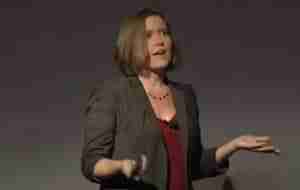
Here is the full transcript of Amy Baxter’s TEDx Talk: Pain, Empathy and Public Health at TEDxPeachtree conference.
Amy Baxter – Pediatrician and entrepreneur
As a doctor, I’ve come to accept that some pain in life is unavoidable. I got used to this idea in medical school because sometimes I had to cause pain.
But making something painful that doesn’t have to be is just wrong, so as part of my practice, I research how to prevent unnecessary pain, and I teach other doctors why patients’ pain matters. When my four-year old had to go for his shots, it was the pain management marathon I’d been training for my whole career. Numbing cream an hour in advance, check Distraction tools at the ready, totally. The check-up went great and after the doctor left the room was our big moment.
An utterly indifferent shot-giver, bore down on her tray, glared at my son and said: “You better sit there and be still or it’s really going to hurt.” I started to educate about numbing cream and “that stuff don’t work”; boom, boom, boom, boom! Uhh, so that didn’t go as expected. How do you respond when the place that you trust to keep you healthy hurts you? Or ignores your plan, or ignores you? I couldn’t even pretend to my son that this was how I intended for him to get his shots. It was obvious that this person and I did not have the same goals to keep him healthy. So I left feeling unsettled and ashamed, I guess.
Over the next couple of years, I responded to this experience by inventing a device called Buzzy that my kids could take to the doctor to block needle pain. While I developed the device, my son developed a fear of going to the doctors. Like puke on the floor, phobia-caliber fear. As I pivoted my research from preventing unnecessary pain to understanding needle fear, I realized that we have had an erosion of empathy in medicine. Somehow, we’ve decided to ignore the fact that shots hurt.
And it’s kind of not even cool to say that out loud, because then you’re a wimp, and as a pediatrician, shots are how we keep kids safe. But parents today watching their kids get stuck don’t feel safe. They feel unsettled. By allowing indifference, and by ignoring that shots hurt, health care has created an environment where parents are questioning whether they and their doctors have the same goals. They’re questioning vaccinating itself and by ignoring pain, we’re endangering the future of health care.
Doctors need to own the problem of pain and patients need to become empowered in ways that matter. OK, this is a TEDx empathy check. This is why we need to work on this. The fact that we’re laughing is because as a nation, we value strength, we don’t want to be wimps, and we’re proud of dealing well with pain, so we’re proud of dealing well with shots. But the opposite of pride is shame and we make fun of what we’re ashamed of.
We don’t talk about it. Until recently, we didn’t even research it. In 1995, a study was done that found that 10% of adults and 25% of kids had a severe fear of needles. This was groundbreaking. More adults feared needles than had insomnia. More kids feared needles than had asthma. Turns out that 5% of this fear is physiologic. You get light-headed or pass out. But the paper suggested that the rest of this fear, above that 5%, was caused by health care.
In my training, I never heard about needle phobia. It didn’t hit my radar. Logically, how would it? If you’re afraid of needles and you’re embarrassed, do you go and talk to your doctor about it, or do you just not go? If a fear of needles were growing, and if it were pervasive enough to threaten preventative health care, how would we know? We have a blind spot and to understand it, let’s go back to this picture again.
All right, so, if it were a wasp stinging him, would we laugh? I mean it’s the same sensation, but we’d probably have more empathy. We’d probably give him a cold pack, let him hang out and recover. Why are shots different? Shots are preventable pain.
In the US, we prescribe 80% of the world’s prescriptions for pain medicines for adults. But only 6% of pediatricians give pain medication for shots and that includes Tylenol. How have we suppressed our empathy that we decide that the most painful event in a kid’s life up to that point isn’t worth treating? It isn’t even worth acknowledging? So, I think that the reason we have this blind spot is we actually can’t have empathy for this.
Empathy is putting yourself in someone else’s place and imagining how it feels, but we think we’ve been in that place and we got shots, and we’re not wimps about it. Toughen up, right? The truth is you can’t have been in these kids’ place if you were born before 1983. Before 1983, children got 6 shots before they were 6 years old. Never more than 2 at a time and most of them were before age 2 when you didn’t remember the same way.
Since the year 2000, children now get between 30 and 36 shots before they are 6 years old. Sometimes 5 on one day. And they remember. It turns out that it doesn’t really matter how many shots you get before age 2. It’s between ages 4 and 6 that this conditioning of it happens. Even at that, it’s not how many total shots you get, it’s how many you get on one day. That’s what overwhelms you.
If you would like to really understand, we haven’t done this yet, let’s have a TEDx moment, an empathy exercise, close your eyes; no for reals, close them, and imagine that you’re sitting on your front porch in a comfy chair, and there’s a warm breeze blowing, the pollen count is low and as you take a deep breath and relax, ouch!
Your butt is burning from being stung by a wasp. Now open your eyes. You keep getting stung. The wasps keep coming at you.
They don’t stop stinging you, and maybe you’re even being held down. Are you ever going to feel fully safe on that porch again? And if you didn’t do my close-your-eyes exercise, if you go to the doctor and it takes them 5 times to draw blood, I don’t care how good you are with shots, you’re going to remember that visit. The rise of needle phobia isn’t theoretical. Last year a paper came out and now 23% of adults, and 2 out of 3 children have a severe fear of needles. This means that you or the person sitting next to you has a kid who’s terrified of shots and maybe you’re embarrassed, but have you thought about what happens when they grow up? The fear of needles doesn’t usually go away by itself.
Adults who are afraid of needles are less likely to get healthcare, they’re less likely to donate blood, and they’re even less likely to vaccinate their own kids. So when these children, who are born in 2000 or later, are old enough to drive themselves to the doctor, what if they don’t? What if they simply don’t find out that they have high blood pressure? What if they don’t catch cancer early? Don’t get me wrong, from an individual disease standpoint, vaccines rock. We have reduced preventable diseases by 98%. I personally saw kids die in residency from things that we can prevent now. But the number of shots that we’re giving is causing parents to question if they have the same goals.
Parents aren’t happy with the number of shots, and honestly, doctors aren’t either. Since 2000, the number of shots we have added has caused pediatricians to have to add a full-time person just to stick kids and keep track. Now look at the rise in needle fear, and the rise in the number of shots. Coincidence? I mean vaccines are the shining beacon of public health, but if we don’t question the number of shots, when does it stop? And if doctors don’t care about vaccination pain, it empowers parents to care less about vaccinating.
In the US there’s a trend away from vaccinating. It seems like preventing measles and pertussis isn’t as amazing as it used to be. What’s up with that? Well, research. In 2005, Dan Salmon asked the parents opinions. He asked parents who fully vaccinated, in blue, versus parents who partially or completely refused vaccines, in red, what they thought about shots. The biggest differences were that the people who partially vaccinated were more likely to think that the vaccine itself could cause problems, or that too many shots would overload their kid’s immune system.
Now, even if they refused some shots, the vaccine that was least refused was polio. The paper didn’t say why. But if you know about vaccines, well that’s peculiar. See, here’s how vaccines work. Imagine polio is a Lego death star.
Now, for the vaccine back then we just destroyed the death star and gave all the pieces for your body to recognize. Now with modern vaccines, we know that you can just find one unique part and give that as the vaccine. But back then, a lot of legos, huge immune system load. It turns out, particularly with polio, that if your immune system was already weak, then by getting the vaccine, there’s a tiny, tiny chance that you could develop polio itself.
So why were parents already skeptical about vaccinating, already worried about the safety of the vaccines, but OK with the one vaccine that caused the disease? Looking back, I realized that when these parents were surveyed, the polio vaccine was oral. Maybe it wasn’t the vaccine, maybe it was the shot. Even today, the least refused vaccine is rotavirus, which is oral. Something dangerous and powerful is happening in public health.
Parents are refusing vaccines and diseases like measles and pertussis that are preventable are spreading. Is the problem really mercury, or fear of autism, or any of the things that get blamed for this? Or are these rationalizations for something more simple? Watching your kid get stuck over and over and over feels wrong. I mean, duh, you’re not supposed to hurt kids on purpose. As it becomes harder to remember the dangers and deaths from these diseases, it’s becoming socially easier for parents to just refuse. At the time, refusing a vaccine has no consequences.
You don’t watch your kid get stuck, they don’t develop measles overnight, and if you feel a little bit guilty, you can go on the Internet and find lots of reasons why you made the right call. After that, it’s hard to logic yourself out of a position that you didn’t logic yourself into. The number and the way we’re giving shots is causing needle fear. Needle fear causes people to avoid healthcare as adults. And the number and the way we’re giving shots is causing parents to question whether they and their doctors have the same goal.
But parents and doctors are on the same side. We both want to keep our kids and our communities healthy and safe. So, shots hurt, but vaccines don’t hurt kids. In order to keep our communities safe, doctors need to own the problem of needle pain. The solution is not to stop vaccinating.
It’s to partner to start making the 4-to 6-year-old shots better. It’s not OK for shots to hurt because you’re in a hurry. But in addition to pain control, doctors and insurers could work together to space out shots so that they’re not so overwhelming all at once. The drug companies are already working to put more vaccines into a single shot, but more vocal support from parents and doctors could accelerate the policies that will reimburse for that kind of shot. It’s possible now to give painless shots with micro-needles, but we need more research to make this affordable. Right now it’s super expensive.
We also clearly need to research exactly how much adult needle phobia costs society, because how else are we going to evaluate the risk-benefit of new vaccines? And, we need to study how to make kids who are afraid of needles get over it. Because otherwise, we do have a public health tsunami that’s going to crush us. Finally, we need to quit treating fear as failure. Medicine caused this. But we can fix it.
Parents, right now, can learn how to distract, they can learn how to advocate with their pediatrician for pain control, and they can have an open dialogue about pain and fear at any age to make health care more acceptable. To flash forward to Max, who is now 16, our new pediatrician understands that needle fear is both legitimate and important, and for our shots two weeks ago, he told the nurse to take her cues from us so she waited the 15 seconds for Buzzy to become effective, and my formerly phobic child demonstrated how he can distract himself by counting fish on the wallpaper, and when he didn’t notice his shot, he was so proud, and now he’s protected from flu and cancer. I have no doubt, when he’s old enough, he will drive himself to the doctor. He’s no longer afraid.
Vaccines shouldn’t have to hurt. Let’s work together and give it a shot.