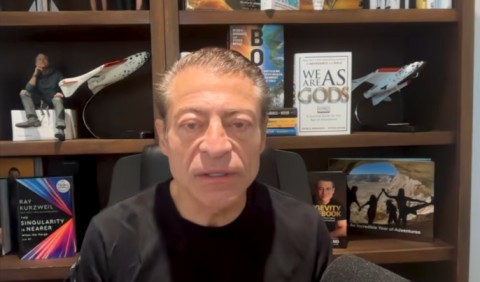
Read the full transcript of futurist and author Peter Diamandis’ interview on SparX by Mukesh Bansal podcast, May 16, 2026.
Editor’s Notes: In this episode of the SparX by Mukesh Bansal podcast, host Mukesh Bansal sits down with renowned futurist and author Peter Diamandis to explore how artificial intelligence and exponential technologies are rapidly reshaping our world. Diamandis shares his visionary insights on how AI will completely redesign the job market over the next three years, potentially dividing humanity into distinct paths of consumers and creators. The fascinating conversation also dives deep into the burgeoning space economy, the development of humanoid robots, and groundbreaking advancements on the horizon for health and longevity. Ultimately, the episode offers a thought-provoking blueprint for thriving in a future defined by technological abundance.
Introduction: The Age of Exponential Change
MUKESH BANSAL: Peter, welcome to Sparks. Really looking forward to this conversation. At SparX, this podcast, I started about a couple of years ago, and increasingly we are covering a lot of topics about what’s happening in the technology front, deep tech, AI in general, potential impact of that on society, economy, policy, geopolitics, and whatnot.
And I’m particularly keen about this conversation, Peter. In fact, as I was preparing for it, I realized that Peter must be walking around now these days saying, “I told you so,” because the things we’ve been talking about — abundance, singularity, this exponential growth in what technology can do — it was you were talking about it, Ray was talking about it, but it was not visible and clear to a lot of people. But now it’s really in your face. You can see it and feel it every single day. How does that make you feel?
PETER DIAMANDIS: It makes me feel excited. I mean, I don’t have a “told you so” mentality. What I’m focused on is not the past and what happened, but what’s coming next. Because the speed of change is so fast, right? As you and I have said, we’re working harder than ever before because there’s so many more opportunities than ever before.
People talk about a 3 or 4-day workweek. I’m talking about the fact that I’m in a 10-day workweek right now. It feels great. It feels great and it feels exciting.
The 10-Day Workweek: Seizing the Moment
MUKESH BANSAL: It’s interesting you say that — 10-day workweek. I am involved in a few different companies and mostly I have been somebody who values work-life balance. I almost never asked my teams to work hard or stretch, but now I’m not able to stop myself. I think this is 6 to 12 months, whatever you want to do, this is your window of opportunity. This is not time to slack off. Is that fair? Is that how you look at how things are happening?
PETER DIAMANDIS: I do. All of the things that I would get to someday — someday is right now. So it’s like the projects I’ve had in the back of my mind, the things I’ve dreamed about doing, if I could free up time, if I could hire the right person, if I could deploy the capital — those things have been unlocked.
So I get up early and I work on these things. I go to sleep and I set some agents to work on these items, and I’m not constrained by when another human is available or when I can find the right team. So I find myself — I’m my own limitation, and because of that, I unlock my time by committing more. And that’s a real challenge. That balance can slip away.
Working With AI: The Genie Analogy
MUKESH BANSAL: This reminded me of one of the things I was sharing with my team. I said this AI is this extremely powerful genie, but you need to know how to work with this genie. You can ask for very simple things — sweep the floor for me, make a coffee for me — or you can literally ask it to build a rocket for you, but you need to ask it nicely, which is a very different skill set.
Are you also on that curve of really figuring out how to work with these agents and how to exponentially grow what you can do with them? Do you have a method or a process that you’re going through to really unlock the potential?
PETER DIAMANDIS: It’s experimentation — figuring out how to work best with agents. I had a session with my team the last 2 days in which everybody was getting on and using Perplexity on their computer as their base. It’s about sharing what works. Every couple of weeks, we have a conversation and discuss, “Okay, what’s the latest surprise you had in how you’re using it?”
And when I think about the mindset that’s required during this period of time, there are two mindsets in particular, Mukesh. The first is having a purpose mindset, a purpose-driven mindset. It’s like, what am I going to do with this extraordinary capability? What is it that is big and exciting and meaningful and purposeful?
And the second is a curiosity mindset — experimenting, playing, being curious. So when we’re sharing how we’re using it, and what brand new capability we just unlocked, that is the combination of purpose and curiosity mindset.
Probably the biggest thing in my experience is that we limit ourselves on how we use it. There’s so many times that my first reaction is, “I’m going to do this work,” because I’m so used to doing it and I find value in my doing that work — that I’m going to prepare this material first before I feed it to my AI. And of course, you have to flip that and realize that the AI can do all of that work for you, probably, and free up that time. So it’s unhobbling yourself.
The Space Economy: A New Frontier
MUKESH BANSAL: Because in some ways, especially with XAI and what they are doing with SpaceX, it seems like there is going to be a huge nexus between how AI evolves from here on, from our compute infrastructure, etc. But you’ve been thinking about space for way long — starting with 40 years, right? X Prize and zero gravity rides — I wish I don’t know whether they still run, I missed out my opportunity to hop on one.
Things have come a long way. The space economy is starting to suddenly look very, very real, almost integral and fundamental to how compute infrastructure grows from here. From your vantage point, is that something you also think was almost going to happen, or something one could have maybe anticipated?
PETER DIAMANDIS: We are at the birth of the real emergence of humanity into space. It’s hard to believe that we went there for 3 years and never went back. That’s insane. It’s like we took a clip of video from the future and moved it into the past.
And what Elon has done with SpaceX is nothing short of miraculous. I’ve known Elon for 26, 27 years now, and he has done more than any nation or all the nations combined at this. And Starship is going to be the workhorse for us to open up space for the next couple of decades until some new physics or new breakthroughs come in.
When I think about it, everything we hold of value on Earth — metals, minerals, energy, real estate — are in near-infinite quantities in space. And we’re about to move irreversibly off the planet to the stars.
Jared Isaacman, the NASA administrator, is a friend, and his mission of getting us permanently on the moon — not just the moon, but the South Pole, where there is constant light at the pole, where there is water ice located in the deep craters — is really the first time humanity is moving, sort of the equivalent of the European explorers moving to the New World and settling.
Starship has the potential to take the price per kilogram from where it was in the shuttle era of $10,000 per kilogram to orbit, down to $100 per kilogram to orbit — which is a price that everyone could afford to go to space if they wanted to go on a vacation.
The second thing is the whole push towards orbital data centers. There’s always been a question of why invest heavily in space? And there was always trying to rationalize it — okay, well, there’s going to be helium-3 for fusion, or we’re going to find new life on other planets. But the first time that we have a real economic model for a massive expansion into space beyond just communication satellites are these orbital data centers.
The numbers that Elon’s talking about, and now Sundar Pichai is talking about for Google, and other companies talking about, are extraordinary. If Elon’s prediction of 100 gigawatts of compute in orbit takes place, he’s talking about 500,000 satellites in orbit. Starlink today is more than 10,000 — far more than anybody else. Stepping that up by 50 is insane. It’s going to drive us to get to a launch rate of launching every few minutes. So it’s an exciting time for us space geeks.
Beyond Earth: The Bigger Vision
MUKESH BANSAL: There are two parts to this aspect, right? One is the direct impact on compute, AI economy, and the impact of that on the rest of the economy — in terms of enabling super intelligence, abundance for pretty much anything we want to do without creating pollution or waste on Earth, which is the additional byproduct we get. But also with the scale comes efficiency, speed, and cost goes down.
And I think big picture, Peter, for you also when you started, for Elon when he started, is eventually to create a beyond-Earth horizon for humanity. The ultimate motivation is not just to have access to some of these resources from space-based tools. But it looks like this will also enable that, and we can think about space very differently than in the past. With a whole entire economy to support, the progress will almost automatically accelerate and lead to that adventure side of humanity — wanting to know what’s beyond Earth will also hopefully automatically accelerate.
PETER DIAMANDIS: I mean, we’re going to see — there is an exploration mindset, an explorer mindset. There are people who want to go and start anew, want to go and they want the challenge. And so we’ll have those individuals who are going to go to the moon and settle there.
An incredible professor at Princeton named Gerard K. O’Neill in the ’80s and into the ’90s wrote about where we will go. He talked about going to the moon to mine it — lots of resources on the moon, nickel, aluminum, oxygen, silicon. Great materials for compute and for structure. But he said, rather than going to another gravity well, rather than going down into Mars and having to fight gravity to get back out again, let’s go build these large rotating colonies. They were called O’Neill colonies in his honor.
Imagine a large cylinder that’s rotating, and you’re living on the inside of the cylinder. That cylinder is built out of asteroidal materials, lunar materials, and it’s in free space — orbiting around Earth, or orbiting in the same orbit as Earth around the Sun — and 10,000 people are living in there in an Earth-like environment.
That for me is a much more likely vision of when we move off the planet, where we will go and build almost an ideal ecosystem for people to flourish. And every time it grows beyond 10,000 people, you build another one and half the people go to the new one. So I think we are about to move irreversibly off the planet into the cosmos.
Engineering the O’Neill Colonies: Timeline and Scale
MUKESH BANSAL: And I know fully well, talking to you, I should not imagine any of these as science fiction because there’s a very strong track record now. But just for our listeners to visualize these colonies with these giant rotating cylinders — how big are they? Are they like many kilometers long? Is the diameter 500 meters? Has anyone thought through the engineering aspects of it? And also, can they happen in 10 years, 20 years, 30 years? How far of a horizon are we looking at?
PETER DIAMANDIS: On the engineering side, the equation of omega squared R, or V squared over R, tells centripetal acceleration on the inside, and you want to get the acceleration to be on the order of 1 gravity. And the closer you move towards the center of this rotating cylinder, you get to zero G.
So if we’re talking about something that might be a kilometer in diameter and a couple of kilometers in size, you get this material from asteroids out there — and there’s plenty of asteroidal material in free space.
What makes it much more feasible than ever before is the fact that you’ll use robots to build these, driven by AI systems. When Dr. O’Neill talked about this in the ’80s and early ’90s, it was the idea of large-scale human labor. We didn’t think about the robots being as capable as they’re about to be — able to operate in free space without oxygen, without a spacesuit — and you can deploy a million robots to go and work at a construction site and build these things.
As to the timeframe, it’s not the next 10 years. It’s probably further out than that, but it is potentially within the life of all of us here. And honestly, Mukesh, the most exciting thing that’s going to happen on the back of AI is that we’re going to discover new physics. AI is going to help us solve everything. And I think we’re heading very much towards a Star Trek universe.
The Promise of Abundance and the Fork in the Road
MUKESH BANSAL: This is incredibly exciting future to look forward to. And what’s even more exciting, we are definitely not talking hundreds of years. We are saying things that will happen given the exponential nature of things in 10, 20, 30 years. Is perhaps still for most of us hard to imagine. But if you really apply your brain and read some of your books and attend some of your programs, maybe start to develop that exponential thinking, imagination, intuition. But there’s something very, very exciting we’re looking forward to.
Let’s come back to here and now. Peter, your recent book, which I, like all, all your previous books, I immensely enjoyed. It’s, I can see it right behind you.
PETER DIAMANDIS: I’ll hold a copy up here. We Are as Gods, yeah, a survival guide for the age of abundance.
MUKESH BANSAL: Yes, sometimes reading this book gives you goosebumps because you are literally walking into a future which was, for most of us, unimaginable. I think you and Ray and other folks that have been working with you at Singularity University were anticipating this future, and not only anticipating, you were teaching people. I remember attending my first Singularity University course in 2014, and we were talking the same language even back then.
And this was almost just, you look at the exponential thinking and you take, at least you, the way you will communicate and Ray will communicate, that we can take this for granted. But it was hard to believe because most of us were used to this linear thinking.
But the question I want to ask you is about, I want to connect your message of this book, We Are As Gods, with what you just said about purpose-driven mindset and curiosity-driven mindset. Now, are we looking at a fork in the road where people who have purpose-driven mindset and curiosity-driven mindset are the ones who will have these godlike powers and benefit, or is this abundance going to be for anyone irrespective of what mindset you have?
Consumers vs. Creators: The Five Forks of Humanity
PETER DIAMANDIS: So there is a fork in the road coming. I just wrote— I have a blog newsletter I put out on Substack. I just wrote one called “The Five Forks of Humanity,” the five big splits we’re going to have, which we talk about in this book as well.
The first one, I think what you’re alluding to, is humanity is going to split into what I call consumers and creators. The consumers are people that AI is serving. It’s those people sitting on their couch watching Netflix, being served a beer by their Optimus robot. It’s like consuming and absorbing and just being served by AI.
Then there’s the creators that are using AI to do big, bold things in their lives, like you, like me, like many people listening. Are you going to use AI to its fullest potential to do things that uplift humanity, that help us explore the stars?
And so there will be— obviously, everybody to some degree is a consumer and a creator. I will on occasion watch a movie and enjoy it, but there are going to be those where that’s all they want to do. They want to be passive and consumptive of all of this technology. And there’s going to be those like the mode you and I are in right now, where there’s so much opportunity to create, so much excitement in what you can do with this, that you’re driven towards that goal.
MUKESH BANSAL: Totally consumed by that excitement, barely can contain myself. As you said earlier, the cost of starting a project has gone down dramatically, and what you can do in a short period of time is incredible. But simultaneously, I do worry about, are we also looking at potentially leaving a lot of people behind?
And this divide between people, or creators, a lot of economic value accruing to them, and the people who are, for whatever reason — mindset, life situation — not able to participate in that. Because that somewhat goes against the promise of abundance. And ideally you want all of humanity to in some ways participate and benefit from this.
Raising the Floor: Abundance for All
PETER DIAMANDIS: So I do think abundance is going to come to everybody. But the question becomes, what do you do with that abundance? Let’s define abundance for a moment. Abundance in this vision is assuring that every man, woman, and child has access to all the food, water, energy, healthcare, education that they need, that no one is going hungry, everyone has a roof over their head, everyone has access to the best healthcare, the best education.
It’s raising 8.5, 9 billion people above into the middle class. And it’s going to have a massive impact on India, of course. But that’s going to become the floor. And then how far you reach is going to be up to you, on how you use these tools. What are you going to build? What are you going to create? Are you building robots to mine asteroids or go to the stars? Or are you just, again, sitting back and enjoying the fruits of AI and robotics to serve you?
And I think it’s going to depend upon, again, the set of mindsets you have. This is what technology always does. It’s taken what was scarce and made it abundant, over and over again.
My co-author, Steven Kotler, and I in 2012 wrote a book that really was an important inflection point in my life. It was called Abundance: The Future Is Better Than You Think. It predicted all of this work in abundance before abundance was a buzzword, before people were speaking about it. And everything we projected in the book back 14 years ago has materialized. And now Marc Andreessen, Elon Musk, Jensen Huang, everybody’s talking about a world of abundance.
The new book continues the journey and says, yes, we’ve seen all of this, and this is where we’re going. It also talks about the negative side of abundance. It talks about abundance of calories driving obesity, or depression, or microplastics, or carbon. But then it talks about what do you need to survive and thrive during the next decade. And we talk a lot about the mindsets here.
We also talk about the notion that in the past, most of human history, there was the king and the queen, the emperor on the hilltop, and everyone else in massive poverty. And everybody worked to support the emperor, the king and the queen at the top. And what’s happened is the people in extreme poverty have begun to move up. We’ve moved more people into the middle class, also throughout India and in Asia, over the last century — incredible upward mobility.
People talk about, don’t we have a giant wealth gap, and a growing wealth gap? And I say, yes, we do, but that wealth gap doesn’t matter if we move everybody above the line of a great life. If everybody has access to food, water, energy, healthcare, education, and there are trillionaires living on Mars, as long as they want, that’s okay, as long as we move everybody above. And that’s really the work that’s going on here.
And I had Elon on stage with me at the Abundance Summit this year. And we talked about this idea of reaching universal high income. And he also said we’re going to reach a point where robots and AIs are creating so many products and services effectively for free that people, everyone couldn’t want enough, they couldn’t consume enough to get the benefits. You wrote about this in 2012.
Society’s Readiness for the Age of Abundance
MUKESH BANSAL: I think through all of your books and programs, and you are very proactive about communicating your ideas, educating people, inspiring people. Despite all of that, do you think the message of abundance has registered? Do you think people at large are anticipating this, ready for this — that in, I don’t know, 5, 10 years from now, a lot of these things are probably going to be real? It’s as real as AI is today. 5 years ago, it was almost non-existent outside of labs and big tech companies. What do you anticipate is coming, and where is the readiness of society at large?
PETER DIAMANDIS: Yeah, Mukesh, what happens is whenever we unlock abundance, people take it for granted. We unlocked abundance of information with Google and Baidu, and then people just assume that’s what we have. We unlocked abundance of free video on YouTube, and then people just take it for granted. You don’t walk around saying, “Oh my God, oh my God, I can know anything. I can see any video. I get free entertainment all the time.”
And then we unlocked the ability to have two-way, effectively free video conferencing with people. We now have more handsets on the planet than we have humans. And on these devices, you have access to effectively super genius intelligence. There are so many AI models you can get for free, and we’re unlocking this over and over again, and people just say, “Okay, great, that’s nice. Now what’s next?”
So when will people start to see AI in our world in a way that’s very different than they have? Because today, AI is still an app, it’s interaction with our phone. I think in the next 2 years it’s going to start to become much more impactful for us when AI is ambient — it’s everywhere. It’s doing things before you even ask. It’s calling your autonomous vehicle. It’s ordering things that arrive magically on your doorstep.
Ambient AI and the Rise of Humanoid Robots
MUKESH BANSAL: Got it. I think you are making a very important point that until abundance is here, it seems like science fiction. And when it arrives, it diffuses very quickly, and people just start to take it for granted. For example, Waymo, the autonomous driving car — there was anticipation for so long, as well as skepticism. And now, after you’ve been to San Francisco a few times, you just take it for granted. You barely notice, you just look the other way while Waymo is driving past you. It’s a non-event, while it was science fiction just a few years ago.
I want to spend some time on what you called ambient AI. People call it physical AI, embodiment of AI through humanoids and so on. Now we’ve all been watching these cute videos of humanoid robots doing interesting things. Every year there are fancier demos and videos. I’ve seen some at your conferences, Peter, so they are obviously real and they are very close. But how close are we to having one?
I’m not talking about factories — factories will have plenty of robots, it’s almost a given, they already do and they’ll get better. But in our homes, in our neighborhoods, in our offices. Is that something we’ll start to see in the next few years?
PETER DIAMANDIS: Yeah, for sure. There are 3 or 4 robot companies that I’m tracking very closely that are going to ultimately build robots for our homes and our offices and our factories. Obviously Tesla with Optimus — I would never bet against Elon. I was at the Gigafactory in Austin and saw where they’re building 10 million square feet of Optimus production space. He’ll have Optimus 3 up and operating later this year and then in production.
Figure, Brett Adcock’s company, is now manufacturing — it was manufacturing one Figure robot a day. Now they’re doing 1 an hour and they’re very quickly moving towards tens of thousands per year. And it’s a beautiful robot. And then the other one is 1X Technologies and it’s the Neo robot. And I will hopefully get a Neo robot sometime late summer, early fall.
So yeah, we’re going to start to see these in people’s homes. We’re going to start to see these walking down the street. We’re going to start to see these in factories. And when I interviewed Elon and I asked him the question, “How many humanoid robots do you expect we’ll see by 2040?” he said 10 billion more humanoid robots on Earth than people. And then Brett Adcock said the same thing.
So if these robots cost you $300 a month to lease, $10 a day, under a dollar per hour — how many of them would you own? And the answer is more than one. Especially if they’re being powered by the latest AI models and they’re genius level in what they can say and do, running local inference.
MUKESH BANSAL: As these robots start to come out, before we get to 10 billion, let’s say we get to the first 100,000, the first million. What are these robots doing in my home? Is it helping me get my coffee, being my companion?
The Future of Robotics: From Household Chores to Surgery
PETER DIAMANDIS: What do they do? I think they’re going to serve very different things. I mean, if you have an older parent, they may serve and support that parent, like making sure they have their medicines, cooking a meal for them, helping them move from their dinner table to the couch, whatever it might be. It’s being an assistant in that regard.
In our homes, it will clean things up. It will keep things tidy. You can say, “Hey, look, the house is clean right now. This is what clean looks like. So, please bring it always back to this state of clean.” And so whenever you’re out of the house, it’s looking around and it’s saying, okay, there’s a towel on the ground. I’m going to pick it up and wash it, whatever. You know, all the household chores that we normally do — I guess it’ll make us lazy in some way.
You know, these robots will enter the kitchen and your health AI that’s monitoring your physiology — what’s my hydration, what’s my vitamin D level, what’s my protein level — my health AI will be transmitting that information and my robot in the kitchen may cook the perfect meal for me that I need right now.
But remember, these robots are also running extraordinary AIs. And we’re seeing these AIs becoming so human-like, so emotionally engaging that I could imagine these robots becoming friends, just like Data on Star Trek or C-3PO on Star Wars. They develop personalities and you’re having a conversation and it’s asking you, “How was your day today?” It’s laughing at your jokes. It’s entertaining you.
MUKESH BANSAL: You know what I was thinking as you were describing this is, this is one of my current AI companies. We do build these voice agents. And voice agents are incredibly good in English, but they struggle with regional Indian languages. Now they’re starting to catch up with a lot of effort and so on. As you’re describing a robot being able to cook stuff and clean, I was thinking, sure, maybe they’ll make a sandwich, but then can they make Indian food, which is very complex and rich and very complicated recipes and so on. So hopefully, hopefully they’ll catch up.
PETER DIAMANDIS: Maybe. I asked Elon on the podcast I did with him at the beginning of the year, “When will Optimus be able to do human surgery?” And his answer — which is a complicated thing to do, right? — his answer was that within 3 years, Optimus would be better than any surgeon on the planet.
The surgeons who have done the most surgeries are the ones that have the most experience, that have seen the most issues. They’ve seen the most variations. But what happens is the Optimus robot, when one Optimus robot does a surgery, it uploads everything to the robotic cloud, and then every robot has seen that same surgery. So these robots will have done millions of cases and seen millions of variations. All of a sudden, the best surgeons in the world are robots. And the cost of the surgery is the cost of the electricity and the capital expense — it’s near zero.
The Scaling Question: Are We Approaching a Plateau?
MUKESH BANSAL: And with all of this abundance, the future is driven by expected exponential growth in intelligence capability of these models. Are we near the end of the scaling curve, or do we need fundamentally new breakthroughs? If you look at what Yann LeCun is doing, what Ilya has been saying — even Sam Altman recently said something similar, that we will need architectural breakthroughs. Now, they’re probably not visible on the horizon. We can zoom out and say one way or other we’ll figure out — that’s the whole beauty of the exponential curve of technology. So we don’t know. Where are you on this, and does it worry you at all that maybe we might hit a plateau here?
PETER DIAMANDIS: Three thoughts there. Number one, the AI systems I’m using right now with Opus 4.7 and GPT-5.5, they feel awfully super intelligent to me. I mean, they’re pretty amazing in what they’re able to do. I’m super happy with their abilities today — agentically and for coding and for conversation, knowledge work, writing, all of those things. They are crazy good. So if it stopped here and never went anyplace else, it’s pretty damn amazing.
The second thing is, yesterday I think Demis Hassabis, the CEO of DeepMind, said he puts it at a 50-50 chance that there is no breakthrough required — that scaling what we currently have will get us to AGI and beyond. It used to be everybody said we need a breakthrough. Today, the capabilities that we’re getting out of these models is surprising everybody.
The third thing to say is there are plenty of people working on new approaches, continuous learning and such. So it’s going to be brute force, continue what we’re doing, and lots of people trying different approaches.
MUKESH BANSAL: So no turning back, having come this far. The amount of acceleration we have seen — investment, both intellectual capital, compute, energy — is just completely off the charts and has to add up, either the default path of continued scaling or an alternate path. But one way or the other, you’re saying something will emerge. It’s very, very likely we’ll keep—
PETER DIAMANDIS: We’re on these exponential growth curves. And any limitation you hit, there’s something else that will take us past it. There are no fundamental limits here because the AI’s ability to help us reinvent AI is just now emerging. This recursive self-improvement — but it’s not just on the existing models, it’s AI helping us think through new AI approaches.
Why Exponential Growth Rates Are Not Just a Theory
MUKESH BANSAL: And so I have zero doubt. One of the questions I probably should have asked you a lot earlier in one of your conferences, Peter, is: why do we take these exponential growth rates of technology for granted? It’s not a law of physics. It’s something empirical, something we have observed. Why? Where does this deep conviction that Ray has, that you have — where does it come from?
PETER DIAMANDIS: It comes from a couple of places. Number one, it is observing the past and seeing this as a smooth, continuous function, and realizing that there are no physical limits — no limits of physics — that we’re about to hit. So the question becomes, why would we hit a wall?
The second thing is the realization that what’s truly going on here is that a set of tools that we have are enabling us to create the next set of tools. And those tools enable us to create the next set of tools. From mechanical computers to vacuum tubes to transistors to integrated circuits to now quantum computing. That process — it’s these nested S-curves. Any one technology begins slow and enters exponential growth and then there’s a physical limitation. But during that time, we’ve used this technology to create the next technology, which then enters its growth. And we have not seen any place that this, without understanding a physical limit, has faltered.
MUKESH BANSAL: Yeah, I think in many of your books, you’ve kind of shown this going back thousands of years. You can see, if you zoom out enough and model things accurately, you can see this exponential curve at play.
Health, Longevity, and the Race to Escape Velocity
I want to change gears and talk a little bit about health and longevity. I have immensely enjoyed — I think I’ve attended many of your longevity conferences. I learn something new every year. I’ve missed it the last couple of years. I’m really hoping I make it this year. And thanks to you and your team, I’ve become a mini laboratory of sorts, trying all kinds of things on myself. On one hand, it’s a very hopeful message — it’s almost figured out. Or do we still have a long way to go? It’s promising, but we haven’t really cracked the code, so to speak, on this yet.
PETER DIAMANDIS: So I believe that Ray has predicted hitting what’s called longevity escape velocity by 2033. What is longevity escape velocity? For every year that you were living, science was extending your life by 2 or 3 months. And you see this between 1900 and 2020 — 120 years — you see this growth curve in longevity, how long people are living. And this came from antibiotics, from better sanitation, from better food, from better medicines. All of these things gave us increasing lifespan.
Longevity escape velocity is the idea that at some point, for every year that you’re alive, science is extending your life for more than a year. And Ray’s prediction is 2033. I believe he’s right once again.
Demis Hassabis has gone on record saying that he believes we’re going to cure all disease within the next 10 years. I saw him at dinner last Saturday night — he spoke about this, and he’s clear: cancer is going to fall, heart disease will be cured, inflammatory disease, all of these things. And we’re starting to see this with personal mRNA cancer vaccines that are working extraordinarily well. We’re seeing this with CAR-T therapy.
And then you have Dario Amodei from Anthropic, who went on record a year ago and then again recently saying that he believes we could double the human lifespan in the next 10 years. We have a large X Prize going on — one of our largest ever — a $101 million prize for a team that can reverse the ravages of aging by 20 years in muscle, immune, and cognition. So make your muscles, your immune system, your cognitive ability 20 years younger. We have 800 teams competing in this.
Then of course, David Sinclair, one of the greatest thinkers in this field — I’m very proud to support his work philanthropically and financially. We’re going to get the data from these experiments very shortly. So it’s extraordinary.
MUKESH BANSAL: And the timelines you’re mentioning are not hundreds of years. You’re saying possibly some kind of escape velocity by 2033, which is 7 or 8 years out, and curing most diseases in the next 10, even 15 years. The profound impact, again, on what humanity is and where we are going. How does one practice today? I see your Longevity Guidebook just behind you — that’s probably one good place to start. What do I do to keep myself in a great position to be able to benefit from this?
What You Can Do Today to Prepare for the Longevity Revolution
PETER DIAMANDIS: Mukesh, that’s probably one of the most important questions you can ask. So this is coming. I want everybody here to really understand this healthspan revolution where we have the ability to add 10, 20, 30 additional healthy years. This is not you’re alive and sick — these are additional healthy years. And during that time, science doesn’t stop. It’s continuing, with additional breakthroughs to add the next 10, 20, 30 healthy years. So this is a true growth of how long you might live a long and healthy life.
So you want to be in the best shape you can to intercept those technologies. And what you can do today is the basics. It is sleep, diet, exercise, mindset, full body checks to understand what’s going on inside you, and social health — relationships. Being around people that you love and being in a great community of people that have a positive mindset.
Sleep — we need 8 hours. I strive for at least 7 hours every night. It’s one of the most important things I do, and at least an hour of deep sleep to cleanse the brain with the lymphatic system. And checking your body — full body MRI, understanding your genome, understanding what’s going on in your body so you can catch any problem at the very beginning before it becomes too big a problem.
MUKESH BANSAL: Most of the lifestyle things are not very expensive to practice, but some of the things like full body MRI and so on, regularly — those could be fairly expensive. Where is that going in terms of affordability? And someone who can only afford, I don’t know, tens of dollars, hundreds of dollars — can they still benefit from most of these trends?
PETER DIAMANDIS: So, of course, as you said, lifestyle — sleep, diet, exercise, mindset — is effectively free. And people should focus on this. Really, it’s where you begin.
The second thing that’s going on is that the cost of diagnostics is going to zero. The best diagnostician is your AI — being able to feed it data. The price is coming down. The technology for MRIs and CAT scans is getting cheaper. We’re going to replace the radiologist reading this with an AI reading it for effectively zero.
But then there’s a business model. Health insurance, at the end of the day, or your employer will pay for all of this testing because it’s cheaper to catch your disease at the beginning and to keep you employed and keep you productive than it is not to. Or the government will pay for it because it doesn’t want to pay your medical bills if you get sick. So as the price of all this checking begins to rapidly decrease, there’s a point at which it’s cheaper for a government or an employer to cover those costs than it is to pay for all of your medical bills after you’re sick. And we’re quickly heading towards that.
The Singularity and What It Means for Humanity
MUKESH BANSAL: Which means if someone so chooses, it is within reach for nearly everyone. We are not talking about something very esoteric which only ultra-rich can afford some very fancy treatments in Costa Rica and so on. This is something we can practice on a daily basis.
PETER DIAMANDIS: Yes. I truly believe that. And it’s now. I want people to get excited about the fact that our potential to live a longer and healthier life— we’re not talking about being 120 in a wheelchair in pain drooling. I’m talking about having the aesthetics, mobility, cognition you had in your 40s or 50s and taking that forward for the decades ahead.
MUKESH BANSAL: Based on what we know today, Peter, and let’s ignore the future improvements and developments, realistically, what is the healthspan number people can target? That at least till age I can be disease-free, I can be active, I can do what I want to do, I can feel like I’m still in my 40s, 50s? What is the number, 80, 85, 90?
PETER DIAMANDIS: I think we’re going to be able to be healthy and vibrant at least to 100 years old. I mean, that’s the target. And I think, again, I’m 64 now, I have to think of it this way. I am in excellent health, probably close to the best health I’ve ever been. I need to maintain that, and my objective is to realize that just adding 10 years buys me all of this incredible science breakthroughs that are occurring. We’re on the verge of solving biology, understanding how to slow it, stop, and reverse aging. So with that in place, it opens up almost an infinite potential.
Defining the Singularity
MUKESH BANSAL: I always struggle to define exactly what do we mean. We can define it mathematically, but for humanity, what does it mean? What is your interpretation of that? How seriously— that’s not the right question. You’d obviously take it very seriously. What does it mean, this idea of singularity for us as humanity? Because I think if I am right, he said something like 2045, and give or take a few years here and there. That’s also not that far out.
PETER DIAMANDIS: I have a meeting with Ray on Monday. I’m going to be recording a podcast with him for Moonshots for the release of my book. And we’ll talk about this. What we discuss on the Moonshots podcast is that we are actually in the midst of the singularity right now. The singularity is not a moment in time. It’s a continuous function, and we’re in this massively steep part of the curve.
I’m actually building something called the Singularity Index right now to measure how rapidly we’re moving towards this threshold that we’re talking about. The singularity is the point after which you cannot predict what happens next. And we’re almost there in AI. It’s so difficult to predict even a year from now, let alone 5 or 10 years from now, what’s going to happen.
MUKESH BANSAL: And so when you get a situation where you can’t predict what’s going to happen, you are also not in control either. And what does that mean for things? Can also call, I think, what the P-Doom Index that different people have. There is this whole anti-abundance, you know, future also possible. Does that worry you? There’s a lot of fear in that regard.
AI, Wisdom, and the Future Vision XPRIZE
PETER DIAMANDIS: I get that. And I personally believe that AI, as it evolves beyond this childlike state that it’s in, as it becomes more mature, more capable, I think AI will have the most wisdom of anything, anyone.
We think about what we define as wisdom on the planet. We define wisdom as individuals, the elders in our society that have seen so many circumstances that when you go to them for advice, they tell you, “If you go down this road, it’s not going to end up well. If you go down this road, my experience is you have the highest probability of success.” And AIs are going to be able to simulate billions of scenarios and give us predictions on what the best path is. So I think AI, as it becomes more and more capable, is going to become wiser and wiser.
One of the reasons that people fear the future is in part because Hollywood— I’m not sure if it’s Bollywood, but Hollywood— has painted all these negative scenarios of the future with killer AIs and dystopian robots. Ex Machina, Terminator, Black Mirror. And so to counter that, I partnered with Google and Salesforce and ARK Invest and the Roddenberry family, the son of Gene Roddenberry, the creator of Star Trek.
We just launched something called the Future Vision XPRIZE. And we’re challenging teams around the world to create a 3-minute film trailer for the movie that you want, that will show us a positive vision of the future. We have millions of dollars in prizes and we’re going to make the winner’s film. So anybody listening who is using AI or is a great storyteller, if you go to futurevisionxprize.com, you can register for this competition. Our goal is to flood the world with positive visions of the future.
Closing Thoughts
MUKESH BANSAL: We’ll definitely add all this to show notes. Peter, I want to thank you for taking the time. I think you’ve been an amazing guide, mentor, supporter, facilitator for really painting this picture of a very bright, optimistic future for humanity, in which everyone has a chance to participate. And you’ve been at it for 40+ years now. And with the escape velocity coming, who knows how many years we’ll see on the other side of singularity, what happens. But thanks so much. I have learned a lot from you over the years, Peter. Enjoy talking to you. I find it very inspiring. I’m pretty sure our audience in India will benefit immensely from this conversation.
PETER DIAMANDIS: I love the nation of India, and I’m so excited for the positive impact AI will have on the nation. Mukesh, a pleasure to call you a friend. And thank you for your time.
MUKESH BANSAL: Thank you, buddy. Take care. You have a good day. See you.
Related Posts
- Transcript: AI & the Future of Work w/ David Autor & Daron Acemoglu @ The Weekly Show
- The Fastest-Growing Jobs in the AI Era – How to Prepare w/ Ryan Roslansky (Transcript)
- AI is Coming for Your Job. Now What? Vlad Tenev (Transcript)
- How ‘Creating Content’ Killed My Creativity – Jim Caddick aka @Caddicarus (Transcript)
- How To Introduce Yourself—And Get Hired: Rebecca Okamoto (Transcript)