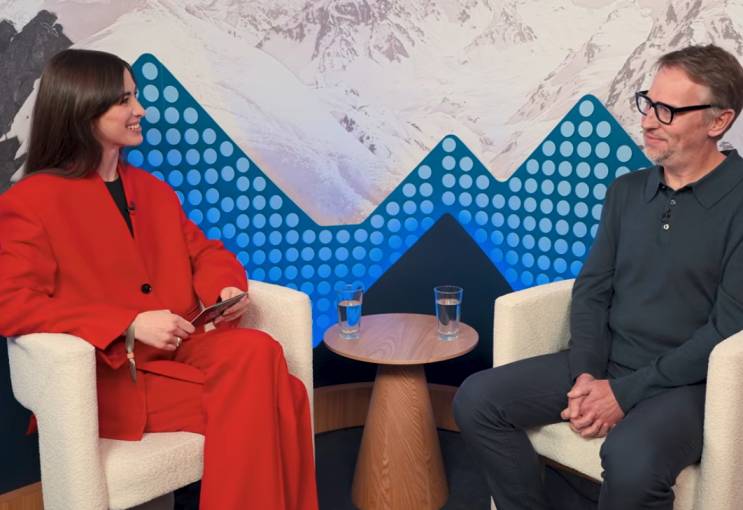
Editor’s Notes: In this insightful interview from Davos, LinkedIn CEO Ryan Roslansky joins Silicon Valley Girl Podcast to discuss the rapidly evolving global labor market and why AI is currently a net positive for job creation. Roslansky identifies the fastest-growing roles in the AI era, such as data annotators and forward-deployed engineers, while emphasizing the critical need for “human skills” like curiosity and creativity. He also shares advice on future-proofing your career through skills-based matching and effectively leveraging LinkedIn to showcase your professional identity through content. This conversation provides a data-driven guide for anyone looking to navigate the uncertainty of today’s job market and succeed in an AI-first world. (Feb 20, 2026)
TRANSCRIPT:
Welcome to Silicon Valley Girl: Ryan Roslansky on the Fastest-Growing Jobs in the AI Era
MARINA MOGILKO: Ryan, thank you so much and welcome to Silicon Valley Girl.
RYAN ROSLANSKY: Great to be here.
MARINA MOGILKO: I am so happy to have you. So you are the CEO of LinkedIn and also Executive Vice President of Microsoft Copilot and Microsoft Office. And we’re at Davos today. So what is everyone talking about?
The Rise of the Creator Economy at Davos
RYAN ROSLANSKY: I think there are a lot of things that I’m seeing, but one of the things that’s probably most interesting to you is that if we were here maybe three years ago, a lot of the conversations we would be having would be with traditional media. And this year it’s amazing to see the creator influence up and down the promenade and the role that creators are playing in this new economy. We see it on LinkedIn — there are 4 million members now whose official job title is “creator.” It’s just amazing to watch this new industry explode to where it is today and be recognized at Davos, for example.
MARINA MOGILKO: That is amazing and I’m happy to be part of it. It’s amazing to see — starting 12 years ago and being a creator now is just a huge, huge difference. What do people say about AI? Do you think people here are more positive or negative?
AI and the Job Market: What the LinkedIn Data Actually Shows
RYAN ROSLANSKY: It’s interesting. I think people are all over the place because their opinions are based on what they heard from the last conversation. What I love about LinkedIn is that as the definitive labor market platform of the world, we have amazing insights into what is actually happening across the world.
It’s interesting — while we see that hiring is sluggish across most markets, the reason that it’s sluggish doesn’t have anything to do with AI in our opinion. It’s actually more due to macro conditions and interest rates, not AI.
As it relates to AI, we see something totally different. There have actually been almost 1.3 million brand new net jobs on LinkedIn for AI roles like data annotators. Over 600,000 new data center jobs exist on LinkedIn for deployed engineers. Companies need to understand AI. So at least in terms of what we’re seeing in the LinkedIn data right now, AI is a net positive addition to the job market, not something that’s detracting jobs.
MARINA MOGILKO: That’s great, but what about entry-level jobs?
Entry-Level Jobs, Trade Roles, and the Shift Toward Micro-Entrepreneurship
RYAN ROSLANSKY: Entry-level jobs across the world right now — the hiring rate that we see — are down roughly 12%. But they are not disproportionate to any of the other jobs. They’re down just as much as all the other jobs in the world. A lot of that contraction is due in large part to macroeconomic climate, interest rates, and companies investing less in general.
So then the question becomes, what should any professional — even entry-level professionals — do? We’re seeing two trends emerge.
One is what I mentioned, which is micro-entrepreneurship and rising creators. The idea that if the traditional path doesn’t exist, “I need to take my career into my own hands.”
And number two, a real affinity now towards trade roles. If you go back a couple of years ago, people weren’t as drawn to these trade roles as they are right now. But especially Gen Z sees them as a much safer option — first-line jobs, typical trade roles, not office jobs. They see those as more resilient in an AI world. These are the types of jobs that AI probably won’t take. So we’re seeing more affinity towards that as well.
MARINA MOGILKO: Interesting. Have you seen a huge uptick in people putting “creator” as their job title?
RYAN ROSLANSKY: Right now there are 75 million people on LinkedIn who somewhere in their profile say they’re a creator, and there are 4 million people who say their complete, 100% full-time job is “creator.” So it’s fantastic. And look at what you started.
Career Paths Are No Longer Linear
MARINA MOGILKO: How do career paths change? Because you also track people through their career inside a company. You start as, I don’t know, an assistant and go up and up. But I think I heard you at one of the conferences talking about how a lot of people are hiring generalists now. So you don’t necessarily climb up the ladder — you expand horizontally, acquiring new skills. Do you see that trend as well?
RYAN ROSLANSKY: First and foremost, the really important thing — since the beginning of LinkedIn, the feature that is requested most from members is: “Show me what a typical career path is supposed to look like. LinkedIn, you have all this data. So if I want to become a CFO, a CEO, an accountant, or whatever, what is the path that people take?”
And the reality is, in the data, there is no such thing as a linear career path. It’s all over the place. So the more that people recognize that you have to take your career into your own hands — that there’s no natural path that exists — I think that’s really, really important right now.
It’s more important than ever, because skills are changing.
The types of skills necessary for a specific role on LinkedIn have changed by more than 25% over the last couple of years alone. We expect they’ll change by 70% by 2030, largely influenced by AI and new tools and new ways of doing these professions.
So when I talk to people about what they should do with their career, it’s less about “Where do you want to be in five years?” and more about “Over the next few months, what new skills do you want to learn?” Because, to your point, these roles are flattening. Generalists are more and more where people are going these days.
The Top Skills to Add to Your LinkedIn Profile Right Now
MARINA MOGILKO: So what are the top skills people should be adding to their LinkedIn right now?
RYAN ROSLANSKY: There’s a huge demand on both sides of the spectrum. Obviously, AI literacy is important. No matter what your role or profession, familiarizing yourself with these tools is a really, really smart investment in your own career. You don’t have to love them, you don’t have to use them all the time, but just familiarizing yourself — putting yourself in the mindset of “I’m going to figure out how I can be better at my job through AI” — is one thing. So, a set of AI skills.
But just as important on the other side are human skills. Curiosity, creativity, courage, communication, compassion — the ability to work with other people, the ability to sit down with someone and actually have a conversation. You can’t just be mired in using technology in a bubble and be successful in a lot of work settings.
Being able to disagree and commit with someone, to communicate with someone, to help galvanize people to get something done — these matter enormously. So I think the key right now is that combination: learn those AI skills, and then figure out a way to be strong on those more human skills.
They’re typically called “soft skills,” but I think that’s a misnomer. “Soft” feels like it’s less important. I think they’re more important than ever.
How Content on LinkedIn Is Changing the Hiring Process
MARINA MOGILKO: When you talk about soft skills — as someone who hires on LinkedIn, I don’t really sort people by “creative” or whatever, but I do read their posts. What I found really helpful in hiring is that now we hire based on the content that people post, because it shows their personality and how deep they are in the subject. We just hired a YouTube strategist who’s amazing, and we hired him purely based on what he was posting about building a YouTube channel.
RYAN ROSLANSKY: I love that. We always thought that the extension of your LinkedIn profile isn’t just where you went to school, where you’ve worked, or what skills you have — but the ability to demonstrate the actual knowledge that you have in your head by posting on LinkedIn. It’s awesome to hear that you use that as a way to understand someone’s identity better.
MARINA MOGILKO: Yeah. You don’t have to jump on a call, you don’t have to do anything. You just read the posts.
RYAN ROSLANSKY: Yeah.
MARINA MOGILKO: Saves a lot of time.
RYAN ROSLANSKY: So people should post more on LinkedIn.
MARINA MOGILKO: That’s what I’ve found too. As someone who started posting actively on LinkedIn last year — we made something equal to a full-time salary just on LinkedIn. We grew from about 10,000 to almost 50,000 followers in a year.
RYAN ROSLANSKY: Wow. Congratulations.
MARINA MOGILKO: So LinkedIn is definitely the social network right now.
RYAN ROSLANSKY: Thank you.
MARINA MOGILKO: Thank you for that. By the way, any tips to grow on LinkedIn?
Tips for Growing on LinkedIn: Authenticity Over Virality
RYAN ROSLANSKY: LinkedIn is unique because our platform exists to create economic opportunity for every member of the global workforce. Our feed exists as a mechanism to showcase your identity — exactly the story that you just told. So if I’m trying to get hired or I want to make a name for myself in a specific field, the content that I share is a way to do that.
Other platforms tend to stem from a vision around entertainment or large engagement. Our largest business is in recruiting, so we don’t come at it from a perspective of trying to help you get a gazillion likes or 10 billion views. We’re trying to help you create authentic content that only you can do — based on the skills you have, what you have in your head — and get that on the platform to the right people who may be able to learn from it, do something with it, or hire you because of it. That’s where we find success.
So it’s just a different mindset that we tell people about when using LinkedIn. You may not get the views you get on so many other platforms, but the people you reach, the quality of the audience, and the opportunities that come — that’s what we’re really trying to deliver.
MARINA MOGILKO: You get the right views. Also, what I notice as a creator is that telling your personal stories, especially if they’re tied to current events, really, really helps you grow.
RYAN ROSLANSKY: I think it’s interesting. Especially in the younger generation, it always kind of felt taboo to talk about anything that didn’t feel buttoned-up and professional on LinkedIn. But more and more, I think the next generation — not only are they okay with it, but it actually tells a lot more about who they are: their personality, what they know, how they think. It’s really refreshing to see that happen on LinkedIn.
Does a College Degree Still Matter?
MARINA MOGILKO: Absolutely. Let’s go back to our LinkedIn profiles. There’s a huge section for education. A lot of people would take top university courses just to have that name on their profile, because it meant a lot. Do you think college means as much these days? Because we can acquire any skill online — is it just kind of fading away?
The Value of College in the AI Era
RYAN ROSLANSKY: So two things. One, I dropped out of college very early on and was really focused on the skills that I needed to start a company and be an entrepreneur. So I had kind of a mixed view on that.
I do know right now, at least in the U.S., 50% of college graduates this year will graduate either unemployed or underemployed. And credit card debt is being outpaced by student loan debt for the first time in history. So there’s something that’s not really working in the current system.
I am nowhere close to going so far as to say college isn’t worth it. The social experience, the learning of soft skills, and being able to be around people and communicate — I think are critical. And if you’re fortunate enough to be in a college environment to have that experience, I think it’s really, really worth it.
But I think it’s really more about a lot of those soft skills for most professions than the typical hard skills that we always thought about from college in the past. And more importantly, more and more now, when recruiters or anyone looking to hire on LinkedIn starts their process, they aren’t looking at what school did you go to. They’re looking at what skills do you have, or what did your last post look like. So it’s mattering less than it has in the past — what school you went to.
MARINA MOGILKO: Are you still betting on college for your daughters? Because now I have three daughters.
RYAN ROSLANSKY: Absolutely. And I think, again, a lot of the social components of that are critical. It’s a great place to learn how to grow up, to learn how to interact with other people, to form a network, to make mistakes. And so, while I would never mandate anything that any of my children do, so far, at least my oldest one — that’s the career path that she’s taken, and she’s having a wonderful time.
MARINA MOGILKO: Have you ever regretted dropping out?
RYAN ROSLANSKY: I think I missed a lot of really fun years by leaving college early, that’s for sure.
MARINA MOGILKO: Still a big question.
RYAN ROSLANSKY: Yeah.
Ryan’s New Book: Open to Work
MARINA MOGILKO: So you are releasing a book, Open to Work. Can you talk about how someone can use this book to navigate their future? I feel like you’re the best person to write this book, by the way, because you have all the data, you’re seeing what’s happening on the market. I’m looking forward to reading it.
RYAN ROSLANSKY: Thank you. It’s been actually kind of unique, because I’ve spent 25 years building Internet products where you can build a product, test it out with people, see what happens, and then change it really quickly. When you write a book, you write it and it’s kind of final, and you hope and pray that it goes out there and people find value in it. So we’re excited to release it soon.
But it’s a book that was written to help people really understand and bring some clarity to what career paths look like in an AI-first world. There’s a lot of uncertainty. I think people are scared. They don’t know where to start. They don’t know where to turn. This book acts as a guide to help you understand how to think through it — what AI can do, what it can’t do, the importance of the human skills that we just talked about, and how you can pull those two things together and figure out what you want to do with your career and make the best career path for yourself.
It’s not a crystal ball, but we try and leverage a lot of the things that we know and see on LinkedIn to help people make the right career decisions. Because it’s so difficult, especially when you’re starting out, to know what to do or how to think. And right now, there’s just so much unique craziness in the world around what AI means for jobs, roles, and skills.
At the end of the day, if we can help more people make smarter career decisions — that’s what we’re aiming to do. We do that every day through LinkedIn, but we wanted to try a different approach as well, for people who maybe aren’t on LinkedIn or just want to see it in book form.
The Five Cs: Human Skills That Will Set You Apart
MARINA MOGILKO: Is there a principle from that book that you can share that people can use to guide their careers?
RYAN ROSLANSKY: I think most importantly, a lot of what I see on LinkedIn are people who are just absolutely hyper-focused on the hard skills — the AI skills, the technical skills — and they’re completely dismissing the human skills.
So we talk about it in five Cs that we think are critical for you to learn and to master, that will make you stand out in the future: curiosity, courage, creativity, compassion, and communication. Learning and understanding the importance of those five skills is where I would invest the majority of my time right now as a professional.
MARINA MOGILKO: It’s interesting, because we have a lot of tools on how to develop our hard skills, but when it comes to curiosity, how do you even acquire that?
RYAN ROSLANSKY: It’s hard. Some people are fortunate enough to be born with it. But we do a lot through LinkedIn Learning to help — through the data that we have — teach techniques and how to think about a lot of these soft skills. People think they can’t be learned, but they actually really can be learned. They need to be practiced like any other skill.
I think it’s kind of that misnomer that “soft skills” means they weren’t as important. Just bringing that to the forefront, I think, is the most important thing right now.
The Future of Entrepreneurship in the AI Age
MARINA MOGILKO: I’ve heard someone say that in the next five to ten years, you either become an entrepreneur — maybe with a new niche — or you die. What would you say? I hope that’s not the case.
RYAN ROSLANSKY: I absolutely expect that AI is going to democratize access to opportunity in a way that so many people who have always wanted to create something, start something, build a business, or be an entrepreneur will have the tools to do it. I don’t think it’s going to be the only path, but I do think we will see many, many more entrepreneurs — and I think that’s a really, really good thing.
Top Jobs for the Next Three to Five Years
MARINA MOGILKO: Can you give me the top three jobs for the next three to five years?
RYAN ROSLANSKY: Top three as defined how?
MARINA MOGILKO: Most in demand.
RYAN ROSLANSKY: So right now there’s a role called data annotator. Do you know what this is?
MARINA MOGILKO: No.
RYAN ROSLANSKY: It’s fascinating. Anytime you use a large language model, the way those models keep getting better and better is that there are many human beings being paid to evaluate the output of those models based on their expertise.
So, maybe you’re a cardiologist as your full-time job in the real world. But a large language model company is trying to make their model better for people who are asking questions around heart health. They will take the response that the model is giving, hand it to the cardiologist, and pay them to mark it up — is this right or wrong, what do you think? — and then take that feedback and put it back into the model.
MARINA MOGILKO: And there are companies sourcing those people?
RYAN ROSLANSKY: Exactly. And that role — I mean, if you think about every topic, every niche topic, every language that has to be covered through these models — there’s so much knowledge in people’s heads. I think that’s going to be a really, really hot job moving forward.
I also think anything that has to do with building out data centers — and these are all types of jobs: trade jobs, hyper-technical jobs, maintenance jobs — building the infrastructure of data centers moving forward is going to be critical. Because in order for anything AI-related to actually flourish, there’s a foundation that needs to be put in place.
And then the last one I’m paying a lot of attention to is something called a forward deployed engineer. That sounds like a really odd term, but basically what it means is — when a company decides they want to pull AI into their business and better use AI, it’s a really tricky thing to figure out. Historically, that was kind of up to the IT department. But this new role — a forward deployed engineer — is someone who sits in the actual business, in the marketing department, in the product department, who is really skilled at both business needs and understanding how AI works, to make that connection inside a company.
Companies are frequently hiring these people right now to help — not just make AI a cool thing they put in their company — but actually help it return real value to the business.
MARINA MOGILKO: I love that.
RYAN ROSLANSKY: And creator — that’s my fourth really important job. Sorry.
MARINA MOGILKO: Thank you! I feel like we’re on the rise. That’s awesome.
Jobs That Are Disappearing
MARINA MOGILKO: And do you think there are any jobs — maybe three — that you think are disappearing?
RYAN ROSLANSKY: If you think about everyone’s job — your job, my job, anybody’s job — ultimately it’s a set of skills and tasks. If you break your job down like that, and then think about the ability for each task to be automated by AI, you can quickly see that if your job is just a set of tasks that can be automated, you need to start finding a new job.
AI right now is really good at things like summarizing, rewriting, or translating. So those types of jobs — where AI is good at those skills — are the types of jobs where, through our data, we try to help LinkedIn members realize: “Hey, here are some more skills you should be adding to future-proof yourself.” That’s kind of the framework to think through when considering where jobs will be more impacted.
MARINA MOGILKO: I love that. Thank you so much, Ryan. That was so insightful. And I hope everybody who just watched this goes and starts posting on LinkedIn. I’ve been telling this to everyone around me — my husband started posting and got a few thousand followers right away, so the algorithm is really working.
RYAN ROSLANSKY: Thank you so much again for being here.
MARINA MOGILKO: Thank you.
Related Posts