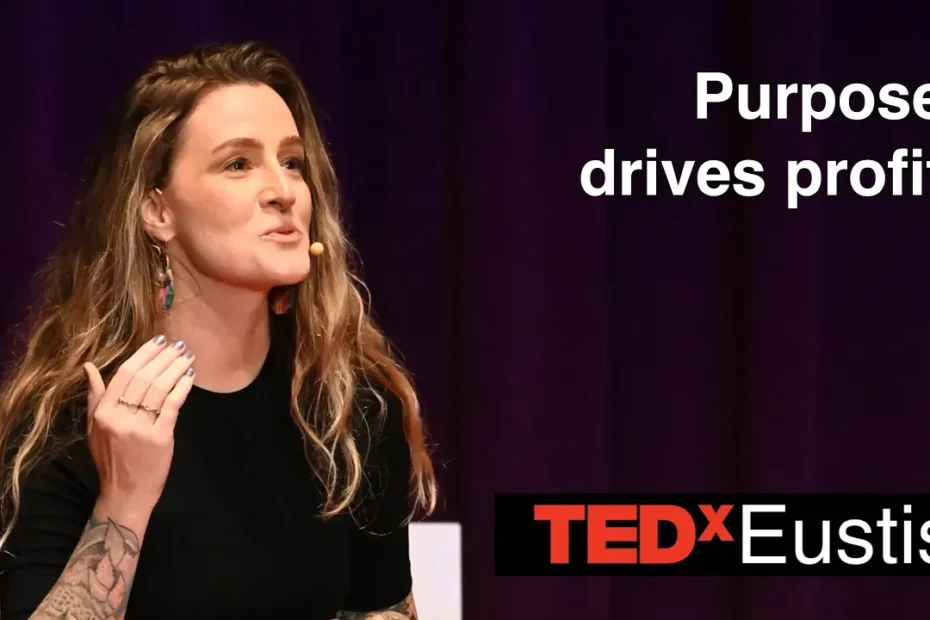
Read the full transcript of Anti-Career Coach Danielle Roberts’s fact-filled and insightful talk titled “Why Working Harder Isn’t Working” at TEDxEustis, April 4, 2025.
Listen to the audio version here:
A Personal Wake-Up Call
Danielle Roberts: Picture this. It’s 2013 and I’m sitting on the floor of a hospital waiting room. I have my laptop open and I’m working while my mom slowly dies from cancer a few doors down. I convince myself that I will put my computer away, that I have just one more email to send, but the emails keep coming and time just keeps slipping away.
90,000 hours, that’s how much time we’ll spend at work over the course of our lifetime. Unfortunately, they don’t teach you how to process grief in school, but they sure do teach you how to be productive, don’t they? So productive, in fact, that I had to process all seven stages of grief within my allotted three days of bereavement leave time before being expected back at my desk ready to work at my dream job, but didn’t feel so dreamy anymore.
Of course, I didn’t know what to do with myself and I had deadlines to hit, so I threw myself into the one thing I felt like I could control, which was to work even harder. And that’s what I did until 2021, when a different company that had considered me indispensable throughout the pandemic decided I was actually disposable and I was laid off one month after moving a thousand miles away from all of my friends and my family.
It took me losing my job, my income, and my support system for me to finally see what I couldn’t when my mom passed away. No job can ever fill the void of a half-lived life. I truly believed that if I put work first and sacrificed enough, I’d eventually arrive at this place where I felt happy and fulfilled, but I wasn’t. The goalpost never stopped moving because I was chasing a definition of success that was never mine to begin with, a definition that I had inherited from hustle culture.
Understanding Hustle Culture
I define hustle culture as the relentless and seemingly endless pursuit of external accomplishment at the expense of our internal and collective well-being. We’ve all been hustling hard for the past several hundred years or so, especially since the Industrial Revolution, when the assembly line optimized our output for speed and volume and we shifted focus from craftsmanship to consumerism.
With advancements in technology since then, we’re more productive than ever. So in theory, we should have time back now to slow down, work less, enjoy our lives, but hustle culture pressures us to stay hyper-connected and move even faster. In this manufactured urgency, this constant rush to have more, do more, be more, prove more is causing massive decay.
The Three Types of Decay
There’s the decay in trust. Fewer than one in five of those currently in management positions display a high ability to lead. Those same managers account for a 70% variance in employee engagement. We’re promoting people who, yes, can hit their performance targets, but struggle to connect with their employees on an individual human level. That’s one of the reasons why we see adult mental health and emotional well-being at work at all time lows.
There is a decay in quality of life. Nearly half of all millennials and Gen Z are working multiple jobs to make ends meet, and twice as many people over the age of 65 are still working compared to 35 years ago. So is it any wonder that 82% of the workforce is at risk of burning out? Because people are working for more hours for more years to maintain the same or lesser semblance of survivability.
And then there’s the decay of purpose itself. We work first and foremost because, for whatever reason, we need money to pay our bills and afford our basic human needs. Yet young workers rank meaningful work just as important as their paycheck. Six in 10 of these same young workers, however, believe that companies care about nothing other than profit. And can we blame them? Considering that it would take the average worker five career lifetimes to make what a CEO makes in just one year.
From Decay to Regeneration
We have a moral obligation to admit that expecting people to work harder isn’t working. It’s only accelerating the decay. But do you know what’s fascinating about decay? In nature, it’s actually part of regeneration. So when leaves fall from trees, they create conditions in the soil for new growth to occur. We need to be thinking about building our company cultures like this as a living, interconnected, intentional ecosystem where each of us serves a purpose that benefits something larger than ourselves.
When we talk about purpose at work, we often do it with company mission, vision, or value statements. But we can’t dictate purpose from the top down like this because work means something different to each of us. We have to reimagine it as a playbook that we actively co-create instead.
Rethinking Maslow’s Hierarchy
There’s a theory in psychology called Maslow’s Hierarchy of Needs, and it organizes our human needs into a pyramid. Our physiological needs sit at the bottom, and self-actualization or purpose sits at the top like a prize that we need to climb toward only after our other needs have been met. I was fascinated, but unsurprised, to learn that before Maslow westernized this idea, he studied with indigenous people who taught him something that we all need to be reminded of.
We were all born already self-actualized and with purpose because we are alive in the same way that nature is. Purpose is not something we need to find, achieve, or reach as a final destination. Purpose is something that we practice daily through the decisions that we make.
Building a Human-First Future of Work
So here’s how we can start making different decisions to regenerate our company cultures and build a more human-first future of work, where trust has decayed.