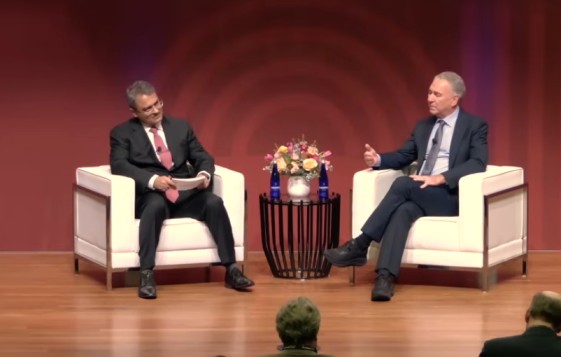
Read the full transcript of Citadel CEO Ken Griffin’s conversation with Professor Amit Seru at Stanford Leadership Forum 2026, May 5, 2026.
Editor’s Notes: Featured at the Stanford Leadership Forum 2026, this compelling conversation between Citadel founder and CEO Ken Griffin and Professor Amit Seru offers masterclass insights into navigating modern business leadership under uncertainty. Griffin delivers candid perspectives on building organizational resilience, surviving near-death financial crises like the 2008 collapse, and leveraging the disruptive potential of AI as an entrepreneur. He concludes by challenging the next generation of graduates to embrace this unique era with profound optimism, urging them to surround themselves with diverse viewpoints and pursue true passion over wealth.
Opening Remarks
KEN GRIFFIN: Good morning.
AMIT SERU: Good morning. Thank you, Ken, for doing this. Good morning, everyone. It’s a pleasure to welcome everybody here. I heard the conversation from the green room, and it was terrific. Thank you, Sarah, for starting us off. So Ken, I thought I’ll set the context, and then we can get going on the conversation, which is going to be very pleasant. We are—
KEN GRIFFIN: I’m being lured into a false sense of complacency.
AMIT SERU: You know, that’s what we do in classrooms. So we are, I think, in an environment of fragmentation across markets, I would say policy regimes, even the rules that govern capital allocation. And that naturally raises a question when the system itself is shifting. Markets are volatile. Politics is polarized. Institutions are under pressure. What’s effective leadership and what does it look like?
So Ken, you have built institutions at the center of global markets and also have been direct about your views on policy, competition, and responsibilities that come with influence. So what I thought is that have a conversation about leadership in that context. And like you guessed, luring you in with a very simple question. When the environment itself is uncertain, or I would say adversarial even, what matters most in leadership?
Leadership Under Uncertainty
KEN GRIFFIN: So, when you’re in— I mean, it’s a— to be right to the point, that’s a really open-ended question.
AMIT SERU: Yes.
KEN GRIFFIN: And the bottom line is that every business is constantly making decisions under uncertainty. The only question is how in-your-face is that moment of uncertainty? So right now, for example, it’s very much front and center that every business is dealing with a number of new trends. De-globalization, for example, is a profound shift in the commercial landscape from 20 years ago.
But let’s go back to roughly 2004, 2005. How many retailers in the United States had a mobile marketing strategy? Not one. And yet 10 years later, if you didn’t, you were probably fighting for your very existence. So in ’04, sort of this very tranquil moment, the best of times, businesses were just in some sense naively believing that they were in a world of certainty, when in fact we were right at the pinnacle of an incredibly important pivot, a revolution, in how marketing and retail is done in America.
So every business leader needs to just be constantly aware that irrespective of what’s front and center, you are making decisions under uncertainty. You’re going to have to make your best guesses as to where to take your business, and you’re going to have to be flexible and willing to pivot as information unfolds in front of you.
AMIT SERU: That’s deep.
KEN GRIFFIN: I’m not sure that’s all that deep. I think it’s important. I think that there’s a— one of my colleagues said that— he was my partner for years. We worked together for 30 years. And he said, “Let me tell you what it was like to work with you every day. Get into a roller coaster. And go as fast as you can. And then when you least expect it, you stop and change direction.”
And what’s happening is we’re going as fast as we can in the direction in which we think we need to travel. And he goes, “And there’s many times you snapped my neck when you would decide, and rightfully so, that we were going in the wrong direction.”
But I think the important thing is that businesses that commit to a direction of travel, and that keep an open mind, are businesses that actually have a chance to succeed, whereas many large businesses find themselves unable to commit at all and end up going nowhere. And I think that is actually how large businesses fail — they lose the ability to move in a direction.
And great businesses do not suffer from sunk cost fallacy. My partner worked at one of the largest global banks, and he’s phenomenal. And we were talking once about the biggest difference between Citadel and where he was at. And he goes, “Look, here’s what I struggle with the most. There’s no sunk cost here. Where I worked, everyone would sort of try to figure out who to blame for the mistake and how to bury the mistake in a pile of paperwork. Here, it’s just like, ah, screwed that up — next.”
And I think really successful businesses know when they need to change direction. And you only get there if you have an open mind and honest dialogue with one another about when you’re going in the wrong direction. This month we’ve underperformed some of our competitors in the marketplace and it’s like, dial in — what did we do wrong over the last 6 weeks that caused us to underperform? And don’t sugarcoat it. It wasn’t like we got beat by one competitor. We got beat by several competitors. What did we do wrong? How do we learn from that? How do we not repeat that mistake? How do we get better?
Developing Judgment: Early Experiences and Instincts
AMIT SERU: Okay, so that’s very helpful. Let me try to make it more concrete for myself. I want to understand where that instinct that you have comes from as a leader.
So when many people see success, they assume things. I think what’s less visible, especially in the kind of business you are, is how did you develop that instinct? The feedback that’s coming to you from the markets is noisy. Information is incomplete, uncertain, but the downside is real. So were there any early experiences that shaped your judgment as a leader where you developed that style?
KEN GRIFFIN: Well, let me first open with — history is written by the winners. Like, history is written by the winners. And so every single success story in business is biased towards the chapters in which they won. And those who failed are long since forgotten in the footnotes of history, if they even make it into a footnote.
So I think it’s very important just to take a step back and realize that in every great success story, there are countless chapters in that book of where things went off the rails. People forget that Steve Jobs went back to Apple back in the mid-’90s, and they were down to having just weeks of cash on hand. And he had to make some profoundly painful decisions to right Apple’s trajectory, which was a trajectory heading right to bankruptcy. And then people forget that Apple had a number of really major failures under Steve. The Newton handheld — I mean, who’s even heard of it? We got a few people in this room that are my age, and they’re like, “Yeah, I remember that.” But people forget this.
So number one is, when you think about success stories in business, just remember that really good CEOs will also tell you about where they had very difficult times, because you need to learn from both sides of the book. You need to learn from what works and you also need to have an appreciation of what doesn’t work. And then what you need to understand is that great businesses are businesses that actually demonstrate resilience. They’re able to face their darkest moments, keep those moments in perspective, and then move forward again.
The 2008 Crisis: A Near-Death Experience
AMIT SERU: And can I ask — obviously, going from your individual style to building organizations requires what you just said, that the whole organization needs to be in that mindset of resilience. Are there any episodes — like, I know the 2008 episode for your firm was an interesting one. Did that shape in any way how you thought about the world going forward?
KEN GRIFFIN: “Interesting one” would lose the narrative. It was a near-death experience. There was nothing interesting about it. I was in the elevator going to work, and I literally, on one day in the elevator going down to my apartment, I’m like, “I hope at the end of the day that we’re still in business.” And I must tell you, that thought rarely crossed my mind in 35 years, but on that day, it was very poignant that it’s not clear to me that I will be in this elevator coming home tonight and we will still be in business.
The turbulence and chaos in the US financial system was unimaginable. We lost a number of our major investment banks in just a few weeks. Bear Stearns was acquired by JPMorgan in a weekend fire sale. Lehman Brothers actually just flat out failed. Merrill Lynch was one of the best sales ever by a corporation — Bank of America had to be basically bailed out on the back of that purchase. I mean, that’s how bad Merrill Lynch was. And Goldman and Morgan Stanley will both have their story of survival, but Morgan Stanley was saved by a large investment from the Japanese, and Goldman Sachs was largely saved by a large investment from Berkshire Hathaway, and then the government’s general support of the overall financial system at that point in time. So this was just an absolutely horrific moment in American finance.
So that was a really dark moment for us back in ’08, and the biggest takeaway for us was — in essence, the government put in place a paradigm. If you were a bank, you had access to the Fed, you had access to a much broader safety net. If you were not a bank, you were much more left on your own. And the key was — and this is going to sound very simple — don’t pretend to be a bank unless you are a bank.
And what people forget is that the large firms like us, like Goldman pre-’08, like Lehman Brothers pre-’08, we actually had many characteristics of a bank. We had access to the wholesale funding market. We could fund at pricing near or sub-LIBOR. We had incredibly great access to credit. And what none of us appreciated was that in a period of crisis, that access to credit would actually not just slow down or fall a bit — it would cease. It would end. And that’s what really took down the American investment banks of 2008 — they lost the ability to fund the assets on their balance sheet. All their commercial paper would come due and nobody would buy new CP.
Pro-Market vs. Pro-Business: Distinguishing the Two
AMIT SERU: What I want to do from some of the things you said is to move to a topic which I think is pretty important, at least in my mind, and we’ll see if the audience will agree. At some point, I think a firm like yours, post-2008, I would certainly say that you were not just a participant — you were a part of the broader infrastructure, broader system, if you will, and as a result, you have a position or say on the rules of the game, like many times it’s happened.
And in the recent years we’ve seen policies on tariffs, immigration restrictions, industrial policy, and broad swings in regulation on both sides of the political aisle, I would say. And the way I see it is that some of these measures may help some firms in the short run, but they distort competition over time. You said, for example, recently that tariffs and immigration restrictions can be inflationary, which is a position to take. You’ve also been critical when policies, again, on both sides, start to look more like favoritism rather than leveling the playing field — pro-business, if you will.
So how do you — when you’re looking at things and you’re in the trenches — how do you distinguish what is genuinely pro-market and what is merely pro-business? Because politicians seem to get that wrong all the time.
Crony Capitalism vs. Meritocracy
KEN GRIFFIN: Well, it’s— what’s interesting is in a world of crony capitalism, many of you who are in this room on merit will actually be the losers. That’s just how it works. Crony capitalism is a world where you curry favoritism through, frankly, often very inappropriate or distasteful ways to favor your commercial interests. And American business works best for the American people when it is subject to the forces of competition.
Competition— we just go back a few minutes ago. We underperformed our competitors in the last 6 weeks. What do we need to do better? That’s the ethos of a competitive market. That’s an ethos of continuous improvement. That’s an ethos of having to fight to do better. And businesses that are subject to that pressure deliver better goods and services to their consumers.
Crony capitalism replaces the world of merit and earned success with the world of who is better connected to those who are in power at any point in time, and often leads to a very dark world where state capitalism is really the world of truly like an oligarch-like society. And one of the things that has made America so great is we are so far away from that.
Look at the largest companies in America. Think about how many of these businesses were started by entrepreneurs in the last 30 years. Jeff Bezos at Amazon, the story of Nvidia. What’s happened to AMD? What’s happening at Facebook? It’s just unbelievable how much of America’s commercial success— Google has been written by people who are first-generation entrepreneurs who came to this country often with nothing and who have built these incredibly successful businesses that have transformed our lives for the better. It’s the antithesis of a world of crony capitalism.
Apple would be a great narrative in that. How much do you begrudge Apple for their success when you use their products unfortunately too many hours a day, right? And when you end up in a world of crony capitalism, you end up in inferior products, lower innovation, lower standards of living, and rightful reasons for the population to be angry. Because they see the benefits of business occurring to those who don’t earn those benefits by any stretch of the imagination.
I may look at how successful Elon Musk is and go, wow, that’s unbelievable. But when I use Starlink, I appreciate his willingness to just keep stepping up and just keep innovating.
When to Speak Publicly
AMIT SERU: That’s great. So that’s one piece of what I wanted to have a conversation with you. So this is about substance of policy, but I think a harder question for leaders in my mind is whether they are going to be willing to say things publicly on exactly the kind of things that we are talking about. Many executives, I’m sure, have views on things like these. But in a polarized environment, the cost of saying things loudly is real. It’s political, it’s reputational, it’s commercial. I really admire you for the positions you’ve taken. So how do you decide when to speak publicly and when to stay silent?
KEN GRIFFIN: So I think corporate executives should use their voice in areas in which they will be viewed to have a credible opinion. I think it’s an important statement. Where people would look at you as somebody who is speaking to a problem, will they think of you as having a credible opinion?
So generally speaking, for example, I think corporate executives should stay out of social issues. You’re going to anger half of the American people, and frankly, why do you have a distinguished point of view on this versus other individuals who are thought leaders in the field. But when it comes to matters like immigration, like tariffs, like antitrust policy, like regulation, people would look at the business community as having a voice.
Now clearly they think we’re going to act in our self-interest, but to be clear, I think thankfully we’re in a country where most Americans still want to know what does Elon Musk think or what does Jeff Bezos think? I may agree or disagree. I may have some innate cynicism, but I still want to know from people who have built trillion-dollar businesses, what’s it take for American business to be successful?
AI and the Future of Work
AMIT SERU: So let’s shift from this point that you just said and I’ll come back to one thing in a while. I wanted to chat a little bit about going from external environment to what’s happening inside firms, especially with a point that you raised earlier about talent and merit, but AI. I had to use AI because we are on Stanford campus. How can I have a fireside chat without that conversation? But it’s something that’s changing the way the work gets done, how talent might be evaluated, which skills might matter. Or not matter.
You have suggested that much of this AI panic might be overstated and the bigger change may be how tasks and workflows are reorganized rather than jobs just disappearing. So what do you think AI changes most for the next generation of business leaders? I mean, I have some candidates like I’ve heard of speed, judgment, definition of merit. But you may have some other views.
KEN GRIFFIN: So, AI. Okay, here we go. Let’s go down the— I feel like we’re in— what was that movie? The Matrix?
AMIT SERU: Yes.
KEN GRIFFIN: And it was the blue pill or the red pill?
AMIT SERU: It’s one of the two. I don’t know which one.
KEN GRIFFIN: And I’m not sure which one we’re all about to take as society, right? Like, where is AI going to actually lead? I was with Neil Ferguson yesterday. This is like one of those really unsettling conversations. He’s talking about the advancements over the decades of humanity. So, for example, the horse and buggy being replaced by the car. And then you sort of know where this narrative is going. And he goes, “But the issue here with AI is that in the world of AI, humans were the horses.” And I was like, wow, that’s a really depressing way to start the day.
So let me just share a few thoughts with you on this. Number one is in the last few months, there has been a step change function in the productivity of the AI toolkit. It is profoundly more powerful than it was just 9 months ago. And for us at Citadel, that has allowed us to unleash a much broader array of use cases for AI.
And it has been really interesting to watch, to be blunt, work that we would usually do with people with master’s and PhDs in finance over the course of weeks or months, being done by AI agents over the course of hours or days. So these are not mid-tier white-collar jobs. These are like extraordinarily high-skilled jobs being— I’m going to pick a word— being automated by a GenAI.
I got to tell you, I went home one Friday, actually fairly depressed by this because you could just see how this was going to have such a dramatic impact on society. And when you witness it in your own four walls, when you see work that used to be man years of work being done in days or weeks, it’s like, wow, that’s the first time I’ve seen real impact in our four walls.
Software engineering, you get a 15 or 20% boost or 25% boost, I just go like, thank God I can get more software written now. Like, there’s so much software we need to write. Every step change in productivity is just a win. Like, there’s no shortage of code we need to write. But when you’re seeing really high-level research being done by AI engines, it’s quite eye-opening.
So big picture, everybody in this room is going to be in a world where certain forms of work are going to all of a sudden be done through AI systems that we had not anticipated in the past. And again, this goes back to the earlier points. Not only do companies need to be more flexible and resilient, but our workforce needs to be more flexible and resilient.
And in particular, one of the reasons that you came to Stanford was to both learn a body of knowledge, but also to continue to learn how to learn. And that will be forever important over the journey of your career. I tell all of our new hires, “You think you just finished business school. You think you just finished college. You think you just finished the journey of learning. You have just started. Everything that you’ve been taught thus far, what matters is have you been taught how to learn? Because the success in your career will be defined as to whether or not you will be a lifelong learner or not.” And AI will just make this all the more important.
So I don’t know where we’re going to be in 20 years with respect to AI. What I do know is that American entrepreneurs are really talented at using new technologies to create new lines of commerce, new businesses, to innovate and to grow. And I really do believe that it’s a bit of a race between job destruction, which will happen at some clip, and job creation, which will happen hopefully at the same or a faster clip.
Of note, competitive moats that large companies have depended upon are going to be filled in with AI tools. So the ability for small companies to take on incumbents will be higher than ever. Like, this is a bit of a fantasyland for entrepreneurs because the ability to take on the incumbents will be higher than ever. Cloud computing was the first part of this narrative. If you go back 10 years ago, for example, in finance, a startup could take us on in terms of having access to compute. We used to have data centers full of 9 figures of hardware. We now use data centers full of billions of dollars of hardware, but a startup can lease the same hardware footprint if it wanted to. So these moats to competition continually get eroded. It’s a really incredible time to be an entrepreneur.
A friend of mine had— this is a great story— a pet insurance business, and he turned the keys of the business over to his 25-year-old son to run. The son’s like, “You know what, I can use social media. I can find when somebody posts a photo of a puppy on Facebook. I can determine the breed of dog through an AI image generation scanning mechanism. I can deliver a custom message to that consumer. If it’s a woman, male, age demographic, yes, congratulations on your new golden retriever. You will love your dog for the rest of its life, and it will love you. Be there for it when it needs you. Buy Spot Pet Insurance.” They sold the business a few weeks ago for a billion dollars. Just keep that in mind.
So the point of this is that there are going to be a tremendous number of new companies started around the world and hopefully disproportionately in America, where people are going to harness AI in completely different ways to create completely different experiences for American consumers. Like, here’s a fun one. You and I watch a movie and it ends differently for the both of us. I like to think in my movie the superheroes win. I hope that happens in yours, but you know, might be a different ending. Like, there will be a world of incredibly greater personalization in experiences that we have. And it’ll be an entertaining, different, new world.
And there will be a group of entrepreneurs that really craft and create that world. They will be the Elon Musks of the next generation, the Jeff Bezos of the next generation. Some of them are in this room today, and it will be incredible to see what you build over the years to come.
Restoring Trust in Capitalism and Institutions
AMIT SERU: So let me connect a few things that you have said, which I agree with, but help me think through this. We need markets, we need competition. Behind that is rules and regulation and other things. We are also living at times, and I think this is over the last 20 years probably, that trust in institutions has become really fragile. There are many surveys that show that people are skeptical about how capitalism works, especially for ordinary people. You referenced that earlier. And at the same time, high-performance institutions like yours still depend on merit. They depend on discipline and clear standards. We need that for this whole machinery to work. So what gives capitalism and high-performance institutions like yours legitimacy with the general public that they start believing in this machinery yet again?
KEN GRIFFIN: I’m at Stanford Business School, right?
AMIT SERU: Yes.
KEN GRIFFIN: Yeah, I’m just making sure. Yes. Yes, this is like Harvard’s government department.
AMIT SERU: Anti-government, but yes.
The Importance of Education and Informed Citizenship
KEN GRIFFIN: So let’s take a huge step back. Institutional trust in America has gone into free fall over the last several decades. And it’s really painful to watch because honestly, there’s few countries in which justice is available to its citizens like there is in America. There’s just few countries. Like if you actually had a problem, which countries in the world would you feel confident in the court system that you have a fair shot? Which countries in the world do you think that you will actually enjoy a lifetime of freedom and the opportunity to pursue your dreams?
It’s so limited to a handful of Western countries, and the United States, for all of our shortcomings, is still one of the pinnacle stories in the world of individual rights, personal liberty, and freedom. A friend of mine, one of my partners who grew up in mainland China, I think the world of him. Topics of freedom and liberty are very near and dear to him. And he makes the point that this is the last beach in the world that we actually can defend these rights on. Like, this is it. This is the one country in the world. This is the last beachhead and we must protect it.
So if we look at the challenges of skepticism over capitalism, I’ll sum it up as follows. I was with my children, my son must have been roughly, gosh, 10 years old, 11 years old, and there was a photograph of a stadium of people listening to Bernie Sanders. And I said to my son, “Do you know what this represents? This is 70,000 people who have never been taught history. They do not appreciate how socialism both crushes the souls of humans and deprives people of a meaningful and rich life.” They do not appreciate— we have tried this experiment of socialism countless times in the history of mankind around the world over the last 100 years. It always ends in tears.
Now, I live in Miami. One of the greatest parts of Miami is the rich Cuban immigrant community. Rich in values, rich in appreciation for the value of freedom and the value of a capitalist society. They gave up everything, everything to leave Cuba over the course of the last 60 years to come to America to live the American dream. They have no interest in socialism. They’ve seen how it leaves its people destitute and poor.
But we need to do a much better job in America — K-12 education and in American higher education — not just to bash socialism, but to inform students about world affairs over the last 100 years: what different forms of government have been tried, what have been the successes, what have been the setbacks. And even within our own history, what have been our successes and our setbacks. But an informed student population will make thoughtful decisions around our form of economy.
How bad is this state of affairs? And it’s hard to imagine this when you’re at Stanford. But one of my partners was at a New York public school 2 years ago. The question was posed to a group of sophomores: to whom did the United States go to war with for our independence? 30 kids, not one answer. And one of the kids finally said, “Europe.” And he’s like, “Well, okay, we’re on the right continent. Let’s go from there.” And then another kid said, “Was it Germany?” And he’s like, “Well, different war, but let’s go again.”
I mean, how do you think you’re going to have a functioning democracy? Forget capitalism versus socialism. How do you have a functioning democracy when your students are not taught the basics of both your form of government or the history of your country? And this is a problem writ large across the United States. It’s not a New York public school system problem.
In rough strokes, roughly a quarter of American graduates from high school are proficient in math. Roughly a third are proficient in reading. In Illinois a couple years ago, there were 53 public schools without a single student at grade level in math. Not one child at grade level in math.
So we desperately need to fix our K-12 education system. And this is not a battle between the states. This is a battle for the very soul of our country. If we can’t fix K-12 education, we will have a populace that will struggle in an AI-empowered world. And an AI-empowered world where we’re competing with the best and brightest in Europe and more importantly in China, in India, in countries that place a real, profound and deep priority on the importance of education.
The Role of Business Leaders Beyond the Firm
AMIT SERU: So let me circle back on something you said and connect with what you’ve just ended with — which maybe it’s a trick question. Where you ended with raises the question of whether leadership should extend beyond the firm itself or the expertise itself. I have seen this in conversation all around the U.S. now — that leadership extends beyond the firm into cities, into institutions, education, civic life. Some of the things you’re saying do need strong voices, and yet at the same time I think you said that on social issues leaders should be a bit more careful. So what responsibilities in the end do you think business leaders have beyond just building great companies, and how or where do you draw the line, given that we are at a moment where we do need the community to rise up, and the community rises up when they see heroes or someone that they can look up to?
KEN GRIFFIN: On the issue of education, I do think the business community is very aligned on the importance of improving education. I was actually on a panel with Reed Hastings just a few weeks ago because Miami was grappling with — we’re going to have a new superintendent. What’s the best process to picking that new superintendent? And Miami is really embracing competition both between public schools and between public schools and charter schools or other various forms of private schools. In rough strokes, it’s not quite half, but roughly half the kids in Miami go to a school different than the public school down the street from their backyard. So they’ve really tried to embrace how do we increase competition within the school system in Miami.
And here Reed Hastings made a really powerful point. The average superintendent in the United States in a major city survives for 3 years. It took me a few minutes to digest that. That means that the CEO in charge of these very complex organizations with very large constituencies survives on average for 3 years. How much meaningful change can you create? How much continuity can you create in a world where you step into the job and you lose it in just over 1,000 days? No wonder the teachers union thinks they’re going to outlast you, because they’re going to. It’s not even close.
So there was an example — and this one was profound — of how do we think about the United States creating more continuity in leadership for our public school systems? And of course I still think that goes hand in hand with how do you increase competition.
One of the things I’m very excited about is Success Academies is opening 5 new campuses in South Florida, and that will create hundreds of new seats for students to have access to a world-class education. In New York, Success Academies, if it was its own school system in New York, would be the single highest-performing school system in the entire state, and their student body comes exclusively from the inner city of New York. So Eva Moskowitz, who runs Success Academies, does an amazing job of demonstrating the power of curriculum, committed and dedicated teachers, and high expectations. And kids will rise to high expectations.
So I do think the business community, in particular since we need an educated workforce, has an important role to be involved in public education, in supporting charter schools, in supporting those institutional structures that will create a better educated American population.
Leadership for the Next Decade
AMIT SERU: Thank you, Ken. We are almost at the end of a session which I could keep going on. I’m sure that’s true for all of you. But let me end with a forward-looking question, and you can take it in any direction you want. What kind of leadership will society therefore need the most over the next decade?
KEN GRIFFIN: I could answer that question, or I think I could say something differently. I think all of you who are here at Stanford Business School are graduating at the best of times. Forget all the crap you read in the papers every day. There is no better time in the history of this country than this moment in time, and in particular, in this moment in time, to step out and to change the world.
Access to capital has never been as straightforward as it is today. In fact, you’re at the epicenter of one of the great stories in global finance right here in Silicon Valley — the venture capital community is unbelievably efficient at providing capital to entrepreneurs that have great ideas. Once you’ve got a great idea, the barriers to competition have come down dramatically, whether it’s generative AI, whether it’s access to cloud compute, access to the internet. If you have a product, you can now touch 100 million-plus American consumers in the blink of an eye, billions of people around the world in the blink of an eye.
This was not possible a century ago. If you had an idea, you could open a local storefront, you could sell your product. Today you have an idea, you could actually have that in front of hundreds of millions or billions of people in the blink of an eye. This is the best of times. Forget everything you read in the mainstream media. I do not know why they continue to wake up every day and take depressants.
And then as you step into the world, the one thing that I will say, looking back on the 35-year history of Citadel — always try to surround yourself with the best and brightest people. And don’t try to clone yourself. Try to find people who are really bright but are really different than you are, because the tension between you and debate and dialogue will make you much more effective as a leader, much more effective in running your business.
People talk about diversity and equity inclusion. Let me tell you, those words actually matter. They don’t matter as a checklist on a piece of paper to fill in some blank for some government body. They matter because you want to have people in the room who have different life experiences, different perspectives, different insights, and they’re going to push you and make you better.
The head of my commodities business grew up in Australia. My co-CEO grew up in Ecuador. The head of my fixed income business grew up in Taiwan. His parents came to America. The parents told the two sons, “We will be temporarily poor.” And they were dirt poor. And both sons are at least centimillionaires today. That’s the American dream. That’s the story that you will help write for your firm and for the people that work with you.
So I would like to end on that note instead, because I think it speaks to the opportunity that you have ahead of you. And then as you embrace that opportunity and you walk through life, one of the great things about the United States is our intergenerational spirit of giving back.
Remember, I was in my 30s in Chicago, and Annie McKenna, who was deeply involved in the success story of McDonald’s, took me to lunch and said, “I understand you’ve done well in business. You’re early in the journey of life. But to be clear, high expectations that you will give back and contribute to this great city, because what made Chicago great for a century was the business community giving back to the city.”
We give back our time in different ways, whether it’s supporting nonprofits, whether it’s being here at Stanford today to speak with you and share my life lessons. And one day you will pay that back to somebody who’s 20 or 30 years younger than you are. You will give somebody career advice. Over the years, people give me their cards, they’ve flown to Chicago just to talk about their careers. I keep in touch with a number of these people. They’ve never worked at Citadel and yet they’re like family to me.
And for the people at Citadel, one of the most important things that I always tell our young graduates is: make the most of this experience, but decide if this is where your passion lies. If it doesn’t lie here, go somewhere else. In life, you will only be great if you’re both talented and passionate. If you think you’re going to pursue just wealth for the sake of wealth, you’ll be profoundly disappointed on the course of that journey. But if the work you do inspires inner passion and excitement, and you have the gifts that you have, that will be an incredibly powerful force in your life to achieve what you want to achieve. And that intrinsic motivation is far more lasting, far more durable than any form of extrinsic motivation.
So find what resonates with you deep in your soul and pursue that with passion. Amit, thank you so much for having the opportunity to be here today.
AMIT SERU: And Ken, you asked me how the movie should end that I like. I like your way of ending it much better than the way I posed it. So thank you for taking us there.
KEN GRIFFIN: Thank you.
AMIT SERU: Really a pleasure.
Related Posts