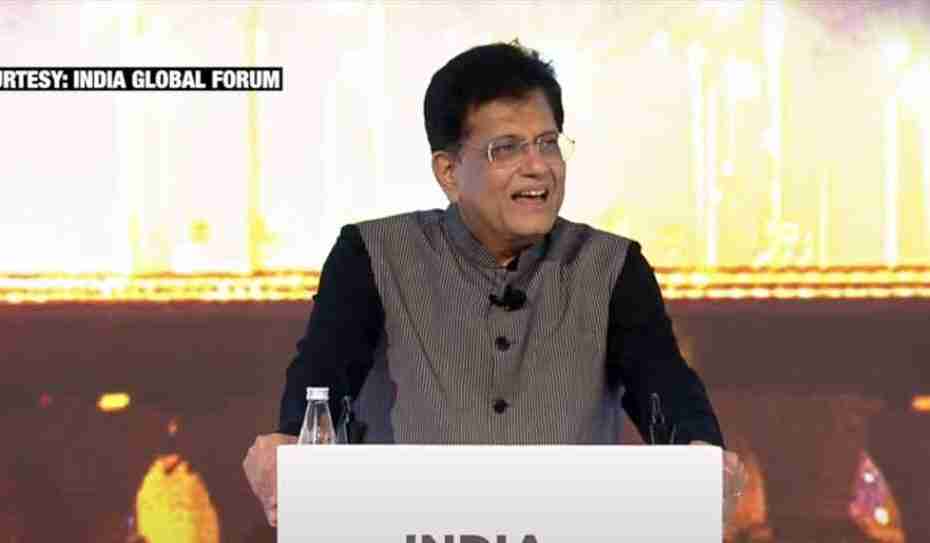
Read the full transcript of India’s Commerce Minister Piyush Goyal’s remarks at the India Global Forum, (Apr 8, 2025). In the address, he took exception with China’s unfair trading practices and its impact on the Indian economy. Goyal also spoke about Donald Trump’s tariffs and their impact on India.
Listen to the audio version here:
India’s Vision for Growth and Global Challenges
COMMERCE MINISTER PIYUSH GOYAL: I am absolutely delighted to be amongst such an illustrious group of well-meaning persons who care for India, who are engaged with the India growth story and who believe in the vision of Prime Minister Narendra Modi for a dream of 1.4 billion people to make India a prosperous nation, a developed nation by 2047.
I have been a part of Manoj’s events for now more than 10 years, even before I became a minister for that matter, even more than 11 years now. And I still remember I was just telling [Mr. Kang] at one of our events when I was Chief Guest at the IGF in London. I was rubbing shoulders with future Prime Ministers. And it was truly a delight to see the traction that IGF was able to garner in UK and I am even more delighted that IGF has arrived in India, is helping catalyze conversations, is helping build the narrative of the India of tomorrow and will of course provoke a lot of new ideas, new thoughts, new ways to take the India story forward.
And a warm welcome to all of you from across the world, from across the nation who have come for this two-day event here and I hope you go back satisfied and much more knowledgeable about the India story.
Global Economic Turbulence
We stand in very difficult times. The world is going through a turbulence. I just saw a chart earlier in the day giving me the last 24 hours of stock market performance across the world. Fortunately India was right at the bottom, some 3% down or something compared to the chart starting from about 9% plus or rather 9% down to put it more correctly.
These are going to be challenging times. These are reflective of a world in turmoil which has over the past many decades built itself to reach this stage. Obviously these things don’t happen overnight. These things are a culmination of several factors at play.
China’s WTO Membership and Unfair Trade Practices
If somebody was to ask me what would be the trigger point of where we are today, why the world is going through this churn. And what I believe and I have been able to assess the starting point of this actually goes back to the beginning of maybe 2000 or 3 or 4 years before that when China was admitted as a member of the WTO and maybe around late 90s or mid 90s when they got into conversation with the WTO and collectively everybody in the world accepted China as a member of the WTO.
Many parts of the world were convinced that China will reform itself, China will transform its processes, will bring transparency to their economy, will work on fair terms in the global economy and that being a large economy and emerging economy and economy growing by leaps and bounds and we have seen that growth over the last 25-30 years almost relentless growth to become the second largest economy in the world.
But what everybody closed their eyes to was that this growth was fuelled by unfair trade practices, this growth happened at the cost of fair play, this growth had its foundation on every action which in the rules of the game would be considered improper. And the result of those actions caused a situation where I think large parts of the world got carried into the narrative of low cost manufacturing, low cost goods coming from one particular geography but did not realize the long term impact that it would have at the global stage.
I have often been misunderstood for my comments on several issues when I talk about the potential threat that countries and nations face because of predatory pricing, the nations being affected because of large subsidies, very often hidden subsidies, subsidies which never get into public domain, targeted to attack certain nations, targeted to attack certain economies.
When I talk about labour practices in certain countries, when I often bring to light how there is an effort to demolish industries, one after the other like literally like a pincer attack on sectors. Very often the message gets lost in the desire to have low cost goods serve industry or serve business or serve consumers with a very short term myopic perspective.
The Economic Attack on National Industries
I think the current state of play in some way is a culmination of almost three decades of this attack on several economies. We in India, I remember when about 25 or 30 years ago the first example that came to play was a watch company from Gujarat who kept pleading that unless government takes some action at that point of time, the entire watch ecosystem in the country will be lost and because we played by the rules of the game, because India remained true to our commitments at the World Trade Organization as did most other well-meaning countries around the world.
Starting from there, one after the other, we have seen an era of unprecedented damage to national economies, to the manufacturing ecosystem in large parts of the world, loss of jobs, loss of fair economic opportunities, irrational pricing on a variety of goods, killing sector by sector the nation’s self-reliance.
Our pharma industry, once upon a time the pharmaceuticals used to be very much self-reliant and the attack was just to get one sector of the value chain under your control. Moment you had that, you were able to dictate terms on that sector. Agrochemicals is going through a similar phase even as we speak.
The Need for Fair Play in Global Trade
I think it is this recognition that the world today has to come to terms with, has to act wherever possible in a concerted manner so that we can once again bring back fair play, bring back rules of engagement which are working towards equity, towards pricing of goods and services at honest values.
Unless we bring back this balance and this order, I see the world either facing even more turbulence or the multilateral trading system coming under threat.
Therefore it is very appropriate that the India Global Forum has brought all of us together to discuss areas of mutual interest.
We are all in it together, all well-meaning countries, all well-meaning businesses will have to address this challenge.
Converting Challenges into Opportunities
One way to really make sure that the country is prepared to meet this challenge and convert this challenge into an opportunity, into a better future for the country, just like they converted a lot of the challenges during COVID into an opportunity, just like in the year ’99 when the world thought the sky is going to fall on their head, remember the Y2K bug, how that converted into an opportunity for the Indian IT industry and we never look back from there.
I think we stand at a moment in history where India is well poised to convert the current situation into an opportunity. We need to support each other, we need to have a nationalist outlook.
I was at a FICCI program earlier today and Mahatma Gandhi in 1931 while addressing the FICCI AGM, nearly 94 years ago, in 1931 had given the message that Indian industry should keep nationalism at the core of their work.
Prime Minister Narendra Modi today when he talks about nation first, when he talks about Viksit Bharat by 2047, when he focuses on inclusive and sustainable growth, when he talks about self-reliance, Atma Nirbharta, when he talks about ensuring the benefits of a growing economy, reaching the last man at the bottom of the pyramid, I think truly embodies that spirit, that nationalist spirit.
Call for Collaboration and Long-term Vision
If Indian industry, Indian businesses join hands, support each other, work together as a team, ensure that our only criteria is not going to be a cent or two cents saved in our value chain, but thinking in the long run, worried that today what I am doing may come home to bite me tomorrow, through my actions, if I do not support my downstream stakeholder, there may be a point of time where my upstream fellow lets me down and I need protection and at that point of time it may become too late.
Therefore all of us have to reflect on what our role will be, how we will move out of this protectionist framework that we have been enjoying in different sectors for far too long, how we are willing to absorb good quality as our mantra and on the back of high quality products and services at scale.
And we have the huge advantage of 1.4 billion people consumer base, the world’s fastest growing economy, possibly the only economy which will grow from a 4 trillion dollar GDP value today to a 30, 35 trillion dollar value in the next two, two and a half decades.
We have an opportunity of a lifetime and I appeal to all of you, be a part of the solution, be a part of this moment in history …and if each one of us seizes this moment, India is unstoppable. Thank you very much.
UNIDENTIFIED SPEAKER: Piyush Goyal, thank you so much, it is such an important point isn’t it, that idea that we can all work together and that absolutely is the reason we are all here today, please take a seat there and I know you are going to stick around, we are not going to let you go without talking to you about some of those issues.
I am delighted to welcome the person who will sit down and talk to you, so please put your hands together, please welcome Haslinda Amin, Chief International Correspondent at Bloomberg Asia to talk about some of those issues. Thank you.
The Impact of Trump’s Tariffs on Global Trade
INTERVIEWER: The biggest change we have seen in about a hundred years. At the crux of it is that 10% tariffs imposed on friends and foes, and for those countries with a trade surplus with the US, they’re hit even harder. India, 26%. We have China at 34%. Vietnam, 46%. And then for a country like Lesotho, a small country in Africa, one of the poorest in the continent, slapped with 50%.
Now all this coming at a time when global growth is slowing, inflation remains sticky, and for India, it comes despite having made concessions to US companies like Tesla. So what gives? What does it mean for India? What does it mean for global trade? And where do we go from here?
Mr. Goyal, such a pleasure to have you with us. 26% tariffs for a friend who stood by the US and possibly helped to counter China’s growing dominance in the world. How do you feel about that? How does India feel about that?
PIYUSH GOYAL: I think we all know that it’s a formula-based tariff, and based on that formula, friend or foe, everybody fit into that formula and had a tariff imposed on them. So it’s nothing to do with the fact that we are friends. Clearly, Prime Minister Modi and President Trump are very good friends, as are the administrations of the US and India, and as are the businesspersons and people of the two countries. So I think let’s not conflict issues. There’s nothing to do with, for that matter, UK is a very good friend, EU is a very good friend, friends onward. But I think this is just a formula-based tariff.
INTERVIEWER: So are you in conversations? Are you hoping that perhaps you’ll get an exemption or perhaps a delay in the implementation?
PIYUSH GOYAL: Well, I think what we discussed in the boardroom is not discussed in a public forum.
INTERVIEWER: But you are in conversations then?
PIYUSH GOYAL: That is a matter of public record. I think when the Prime Minister and President Trump met in February, they had both announced that we shall enter into discussions for a bilateral trade agreement by the fall of 2025. Both countries are old friends, old allies, trusted partners. Our businesses work seamlessly with each other.
India opened their arms to all the tech giants, be it Google, be it Meta. All of them were welcome in India, even when many other developed countries, and certainly China, did not allow them to operate in their countries. We have hundreds of thousands of students in the United States. We have a strategic partnership which transcends the economy. So there’s lots that we are working together on. This will also be something that will add luster to our relationship.
INTERVIEWER: So that trade deal is coming, and you’re confident it will happen by year-end, including the other trade deals that you’re working on, including the UK as well as Europe, which you have just indicated are friends.
PIYUSH GOYAL: You know, I’m not going to give Bloomberg a headline.
Re-Globalization: A New Era of Fair Trade
INTERVIEWER: Put this in perspective for us. With what’s going on right now, are we at the start of de-globalization? We’ve been throwing this word de-globalization for a while now.
PIYUSH GOYAL: I don’t think so. I think this is re-globalization with honest terms of trade and countries which believe in the rule of law, like India, working in partnership with like nations who also would like to have an orderly framework. In the short run, there could be some turmoil. But as I mentioned earlier, India believes in converting every crisis into an opportunity.
INTERVIEWER: So how do you seize the opportunities? What opportunities do you see? How does India play a bigger role in the shifting supply chains?
PIYUSH GOYAL: Ms. Amin, we are a democracy. We believe in the rule of law. There’s fair play. We don’t discriminate between Indian or foreign investment. All are welcome. The rules of the game are equal. Everything we do is transparent. And we have a very, very independent judiciary and ferociously ruthless media. And add to that the social media now. Unforgiving.
So obviously, in India, we offer a conducive environment to work with. We have the world’s largest population, 1.4 billion Indians, providing demand. And that local demand itself, sometimes I often worry that the local demand is growing so rapidly. And our businesses are quite comfortable to grow and meet the local demand.
And despite that, we are not able, we still need imports because there’s so much demand in a growing, fastest growing economy, large economy in the world. That we are not focused enough on even exports, which is why I feel that we have to leverage on all these free trade agreements. Otherwise, it’s no good to do all of this.
INTERVIEWER: But talk to us about how global trade will change on the back of what we’re seeing right now. An environment with tariffs being imposed on all countries.
The Challenge of Trade Diversion
PIYUSH GOYAL: It’ll be a very different world. They have to figure out how it will be administered. I, for the life of me, have not yet been able to understand how they will administer.
For example, I don’t know if you’ve observed the trade deficit of the United States with Vietnam over the years. 20 years ago, it was close to zero, maybe a billion, two, three billion dollars. Five years ago, it was probably 30 odd billion dollars. Or seven years ago.
During the Trump administration first term, they slapped tariffs on China. And everybody thought their trade deficit with China has come down as a result of those tariffs. What we only found was that there was a trade diversion. And the deficit from Vietnam has grown by the equal amount by which the deficit fell from China.
So I think we’ve not heard the end of the story. We still need to see how trade diversion from countries who do not believe in fair play or transparency can be safeguarded against. We in India believe very strongly that we will stick to the rules of the game. And we believe that in the long run, ethics and honesty in operations always pays off.
India’s Approach to Tariffs and Trade Protection
INTERVIEWER: A country like the US says that India still practices protectionism. 17% tariffs, which is among the highest in the world. Is this an opportunity for India to rethink how it does trade and who it does trade with?
PIYUSH GOYAL: You know, I’m on record on this on several occasions. A little bit of research would have given you that background.
INTERVIEWER: Shed some light anyway.
PIYUSH GOYAL: I think our tariffs are a protection against these unfair trade practices. Or countries, let’s take the RCEP region. Countries which cross subsidize, which subsidize in one geography, move to another and from there, ship goods to a third. There’s several ways which we are continuously finding. And it’s like trying to remain abreast with new ways of beating the system. And a lot of our tariffs are to do with such protection against such economies.
If you look at the United States, for example, while our overall tariff may be 17%, but a lot of it is products which we don’t import at all. Our applied tariff to the United States is probably 7% or 8%. It’s not humongous.
So really, it’s a question of understanding India’s tariff story. We’ve done an FTA with Australia a couple of years, three years ago, with UAE, with the four EFTA countries. We’re in active dialogue with many other countries and group of countries.
So we are a country that believes that bilaterally, we can work together with countries which have fair trade practices. And then we don’t need this kind of protection. Indian industry is very competent. They can beat any competition in the world if everybody sticks to the rules of the game. It’s the irregularities or the unfair trade practices where we need to protect through tariffs.
So I have absolutely no hesitation in saying that bilaterally, we have a lot of elbow room in working with developed countries and countries where we find equal opportunity to do business.
INTERVIEWER: You made a lot of reference to China. Do you see that trade relationship with China evolving? I mean, if you’re laying the red carpet for the likes of Tesla,
INTERVIEWER: Why not accept a company like BYD, which is looking for a domestic partner in India to do EV?
PIYUSH GOYAL: Well, we need to be convinced that they will work by the rules of the game. And several unfair practices which are gradually coming to light as more and more companies come to us with what’s happening, the kind of dumping that’s happening in steel, for example. As we understand how they’re doing third country subsidization, so country A is where the subsidies provided, whatever you know which country I’m referring to. It goes to country B in the RCEP region where they do the requisite value addition which becomes simpler because the basic raw material is moving at very low prices. So value addition norms are easier to meet and that subsidized product is being dumped on other countries like us.
I mean, as these practices come to light, we have to be cautious in whom we allow to invest in the country. We have to be cautious about our strategic interests, our security interests. So it’s a mix of many issues before we are able to take that decision.
INTERVIEWER: So it’s not a definite no for BYD. It depends on whether it can convince you.
PIYUSH GOYAL: As of now, it’s a no.
Concerns About Chinese Dumping
INTERVIEWER: You talked about dumping and I know that a lot of countries are concerned that China may be dumping more of its products, its cheap products on countries around the region. We know that the Philippines has made reference to it, Thailand, Vietnam. With the tariffs being imposed on China by the US, do you see a lot more dumping by China to countries like India?
PIYUSH GOYAL: It’s quite possible and we will all have to be cautious and through you and through this medium, I can request Indian industry to be on top of it, on top of what’s happening in your different sectors and please keep the government informed so that we can proactively take action. Of course, with data and solid information.
The Indian Growth Story
INTERVIEWER: Let’s talk about the Indian growth story. You made reference to it. Right now, estimated at 6.5% for the year but with the tariffs, some say it could knock off about 1%. Is that not a fair assumption?
PIYUSH GOYAL: No estimate is talking of knocking off 1%. Bear in mind, India is not export dependent economy. We value exports, value them immensely. We have crossed $800 billion of exports, goods and services in the year just gone by, 31st March 2025. And of course, I value our service exports as much as I value our goods export because every country has their own USP.
Michael Porter’s theory of comparative advantage of nations. We may have a competitive edge over others in our services sector. We’ll grow that faster. Whenever we see an opportunity, we are growing that.
Having said that, the large domestic demand has kind of kept India full up and any trade disruption or global slowing of trade or economies may really not have that large an impact on the Indian economy.
INTERVIEWER: If it’s not 1%, what would it be? Half a percent?
PIYUSH GOYAL: I am no economist. I am no astrologer.
INTERVIEWER: But if you were to hazard a guess, being a trade minister, commerce minister.
PIYUSH GOYAL: Too early to say. Our year has just begun. We are on the 7th day of our year. On the 7th day of the year, suddenly I am not competent enough to predict what the next 358 days are going to be.
The Indian Rupee
INTERVIEWER: How concerned are you about the volatility in the Indian rupee?
PIYUSH GOYAL: I don’t think it’s very volatile. On the contrary, we have outperformed our peers. We perform better than most competition emerging markets. We do not interfere.
INTERVIEWER: Of late, of course, we saw how the Indian rupee actually slumped to close to record levels.
PIYUSH GOYAL: The whole world’s currency slumped to record levels. We slumped a little less than the others. So it is an evolving situation, the uncertainty always causes distress to the currency and from what we are seeing in the last 4 or 5 days, today probably was a reversal but 4 or 5 days we have seen a rapid rise in the economy, some of my exporters have been really worried because I can’t do anything about it, it is market forces.
Future Challenges and Outlook
INTERVIEWER: You seem pretty optimistic about the prospects for the country, what do you see as the biggest challenge for India in the next 12, 24 months or even 4 years? I think it was mentioned that there is a lot of uncertainty in the next 4 years.
PIYUSH GOYAL: Four years is a very long period, I don’t think I see any kind of global disruption for such a long period.
INTERVIEWER: People talk about geo-economic fragmentation, a tri-polar world.
PIYUSH GOYAL: Some countries deserve to be fragmented and thrown out.
So I think fair trade partners coming closer together is good for India and will help us grow faster and we will be able to contribute to the growth of and the economies of the developed world which is currently going through this turmoil.
We are open to do business with partners who mean well for us as long as they also do not give us a bad deal, it has to be a win-win situation. Every relationship has to be fair, equitable and balanced. If I find the right balance which works for India with my mission of India first, should be the vision of the other country to protect their interests. I recognize and respect that and as long as both partners respect each other’s sensitivities, we can’t go wrong.
So I do believe that we are on a sweet spot. There could be a short term challenge but I think we need to stay strong, we need to believe in ourselves and we need to have a positive mindset and trust that we are in safe hands, something which the people of India have demonstrated now for the third time by electing Prime Minister Modi back in government, that trust is leadership and I believe that the country is in safe hands.
INTERVIEWER: You talk about how the country is in a sweet spot, currently about 6.5% growth. Is that the sweet spot in terms of growth for the country? Is that the sustainable growth trajectory?
PIYUSH GOYAL: You know when Prime Minister Modi was contesting the 2014 election 11 years ago when he was elected to become Prime Minister, he was at a ladies event, a FICCI FLO event, if some of you may remember, it was widely telecast all over the country and to a similar question he had raised his glass of water which was half full, mine is a little below half full and this question, the response is like half full glass.
I think an aspirational 1.4 billion people and Prime Minister Modi is always nudging the people of India, particularly the youth of India to aim big, to dream big, to aspire for big things in life, not to rest on our laurels, we have a lot we can do, a lot to achieve and collectively 1.4 billion people make it their mission in life to make India a great country, a prosperous country, to provide for 1.4 billion people’s prosperity. We are, as I said earlier, India is unstoppable.
INTERVIEWER: Minister Piyush Goyal, we thank you so much for your time today.
PIYUSH GOYAL: Thank you.
INTERVIEWER: And if I could invite you to stay in the seat as we have a thank you address right now.