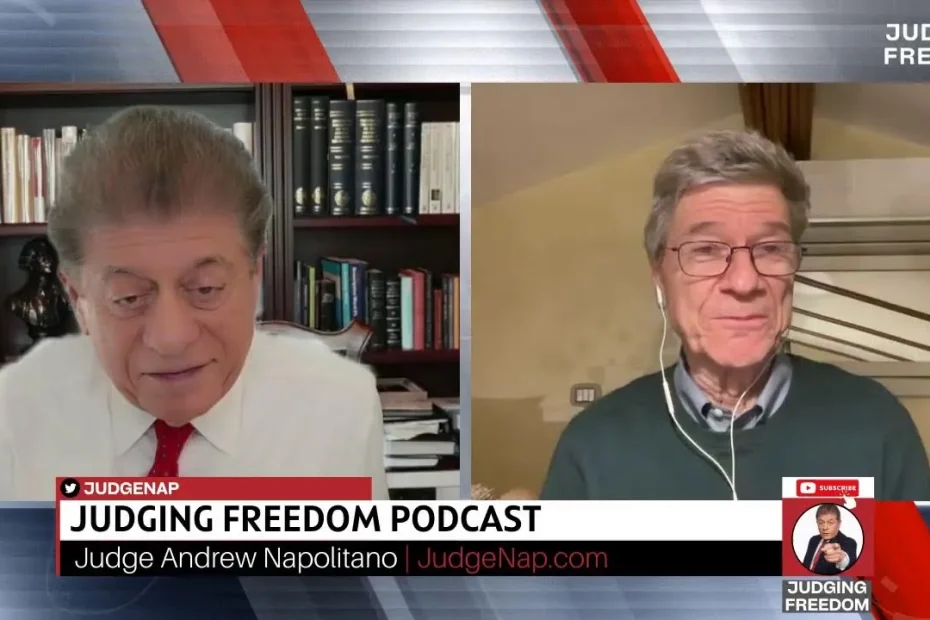
Read the full transcript of a conversation between Judge Andrew Napolitano and economist and public policy analyst Prof. Jeffrey Sachs on Judging Freedom Podcast titled “Does Trump Understand Basic Economics?” premiered March 31, 2025.
Listen to the audio version here:
TRANSCRIPT:
Opening Remarks
JUDGE ANDREW NAPOLITANO: Hi everyone, Judge Andrew Napolitano here for Judging Freedom. Today is Monday, March 31st, 2025. Professor Jeffrey Sachs is here with us on, does the President really understand Economics 101 when it comes to tariffs? And of course, maybe a few other topics that I want to ask the professor about.
Foreign Policy and International Relations
JUDGE ANDREW NAPOLITANO: Professor Sachs, welcome here. Before we get to your field of economics and explanation, I’m dying to hear from you about tariffs. How do you account for the bellicosity, and maybe this is related to economics, I don’t know, of Prime Minister Starmer, President Macron, Ursula von der Leyen toward Russia?
PROF. JEFFREY SACHS: I think in a sense it’s unaccountable because it’s profoundly irresponsible. I would say with the British, it is a long tradition of Russophobia, a tradition that actually dates back almost two centuries. After all, Britain fought the first Crimean War, essentially like our current Ukraine War, which I call the second Crimean War. That was a war in which the British Empire fought Russia to try to push Russia out of the Black Sea region because the British Empire thought that Russia was a competitor.
The British concocted fairy tales about the Russian intention to invade British India, the so-called great game of Central Asia. So for Britain, a kind of craziness goes back a long time. Starmer is utterly irresponsible, talking about war, talking about planes in the sky, boots on the ground in a way which could get a lot of people killed, including his countrymen. Totally reckless.
Macron, I have to say, I know him personally, and I just find him inconsistent. I’ve spoken with him about these issues and heard in private things that are different from what he says in public. I really resent that when we’re dealing with life and death issues.
And so I think to an extent, they’re politicians being politicians. Of course, Von der Leyen based her whole presidency of the European Commission on war with Russia. She also tried to become head of NATO, which says a lot because NATO and the European Union became so hopelessly intertwined that one could not distinguish the one from the other. And this was another reason why even issues like Ukraine’s participation in the European Union got totally entangled with the US-led military alliance.
All in all, it’s to say that European positions, to my mind, make no sense. I’ve told European leaders that for years. They have succeeded in getting Ukraine to the point of destruction. And they continue on in this way. So I can’t give you a real answer because I regard all of it as so utterly irrational and dangerous and irresponsible that it is hard to account.
U.S. Foreign Policy Under Trump
JUDGE ANDREW NAPOLITANO: Coming to this side of the Atlantic, the president of the United States who says he wants to be a president of peace last weekend bombed the Houthis who are 10,000 miles away from us and pose no threat whatsoever to the national security of the United States 65 times in 48 hours. And he sent B-52s, the largest bombing jets we have to ostentatiously fly around the Indian Ocean. What’s with his bellicosity?
PROF. JEFFREY SACHS: Look, people should understand. We have three conflict zones in the world right now involving the United States. One is Ukraine. The second is Israel’s wars in the Middle East. I’ll call them wars because Israel is in Gaza, in the West Bank, in Lebanon, in Syria. And the United States is right there with Israel on everything, including, as you say, the bombing of Yemen and the threats to bomb Iran.
The third conflict area, so far, Cold War, if you could put it that way, is with China. But there, too, the administration’s rhetoric is utterly bellicose, talking about preparing for a possible coming war in most irresponsible and reckless ways.
So I had hoped when Trump came into office that he would be a person of peace. I think what he’s doing in Ukraine is positive and noteworthy, although a bit clumsy and inconsistent. What he’s doing in the Middle East is doubling down on Israel’s massacres and complete reckless behavior and war crimes and venality and viciousness, the likes of which we have not seen for a very long time.
And what is happening inside the administration, apparently, vis-a-vis China, is a lot of war talk, preparing for war. This is not yet the public face. This is what is apparently being said in semi-private. There seems nothing to be completely private in this administration, but at least this is what the scuttlebutt in Washington is, that there’s war talk, war drums beating vis-a-vis China.
So, no, this is not an administration of peace. This is an administration that is pursuing, I’d say, multiple and contradictory approaches to American foreign policy. By the way, when it comes to issues in the Western Hemisphere, there’s no language of peace. The rhetoric about Canada is disgusting. The rhetoric about Greenland is as bellicose as it can get to claim that another country or territory of another country is going to become America’s. The rhetoric vis-a-vis much of South America is similar in Central America regarding Panama and other countries.
So, this is not peace talk. This is all mixed up. But in Ukraine, okay, good progress to some extent. But in the rest of the world, a lot of bellicosity.
Freedom of Speech Concerns
JUDGE ANDREW NAPOLITANO: One last subject matter before we get to tariffs, and that is President Trump’s domestic policies with respect to the freedom of speech. I’m just going to offer for you two tapes. One is of David Friedman, the former United States ambassador to Israel.
The United States ambassador to Israel in President Trump’s first term. And the second is Prime Minister Netanyahu at his very aggressive and anti-free speech worst.
VIDEO CLIP STARTS:
DAVID FRIEDMAN: A government can do in two months more than any organization can do in its lifetime. And so, when we talk about the importance of a bipartisan fight against anti-Semitism, which of course I endorse, and I, as my predecessor said, I condemn anti-Semitism on the right and on the left. I’m an equal opportunity condemner of anti-Semitism.
You’re alluding to Candace Owens and Tucker Carlson. Yeah, none of them are any good on the right, on the left. I don’t like any of these anti-Semites, and I’m not shy about it. But the government, a government, the United States government or the government of France or the government of any other country has the power to rein in anti-Semitism in a much more effective way.
And, you know, people say, well, you know, the governments are not in the business of changing the way people think. That’s true. But, you know, to my thinking, most people who are, you know, anti-Semites, most of these people running around, we’re not going to win their hearts and minds because they don’t have hearts and they don’t have minds. So, you know, how are we going to? There’s no reason to think we’re ever going to convince them, but we can deport them. We can put them in jail. We can make their lives miserable. We can cut off their funding. And that’s what the Trump administration is doing for the first time.
PRIME MINISTER NETANYAHU: These ignorant demonstrators, who are they demonstrating for, for these murderers, these rapists, these mass killers? This is a reflection of a deep rot that has pervaded the intellectual hub of free societies. And this vilification of Israel, the Jewish people, and Western values has been propagated by a systemic alliance between the ultra-progressive left and radical Islam. It must be resolutely fought by civilized societies to safeguard their future. This is why we must all commend President Trump’s decisive actions against anti-Semitism. And we must pressure other governments to do the same.
[VIDEO ENDS]
JUDGE ANDREW NAPOLITANO: Well, this is at root of the government’s evaluation of the content of speech and finding it wanting and punishing it.
JEFFREY SACHS: A man with an international arrest warrant for war crimes and crimes against humanity. I’m speaking of Netanyahu. He is a mass murderer. He is a killer. He commits war crimes. And he has control over American foreign policy and over American domestic policy now. That’s the fact. The US government is run by Israel, by the Israeli government. Why and how? It’s a little hard to say. But it is the unbelievable fact that this brazenness, this recklessness, this cruelty, this arrogance from this extremist Israeli government controls American policy vis-a-vis speech in the United States now. It’s shocking, but true. We see it now every day with arrests and deportations, like Friedman said. He gloated. We shudder. Unbelievable.
JUDGE ANDREW NAPOLITANO: Professor Sachs, aren’t tariffs taxes on consumers, and aren’t they going to cause massive inflation here in the United States?
JEFFREY SACHS: Yes, tariffs are going to lower living standards. They’re going to wreck the US economy, and they’re being put on for unbelievably bizarre and mistaken reasons that are completely fallacious. Let me explain.
The United States runs a large deficit in its trade in goods and services, what’s called the current account of the United States, and that deficit is about a trillion dollars. Trump says, “Oh, that’s because other countries are ripping off the United States.” I can’t even begin to say how absurd that line is. The word is childish.
Having a current account deficit means, and it means precisely, that the United States is spending more than it’s producing. That’s what leads to a deficit. You spend more than you produce, and we spend more than we produce because we have very low saving in this country because we have an enormous budget deficit.
So the government is like the national credit card. It runs on credit, transfers money, pays for wars, pays for Israel’s wars, pays for military bases in 80 countries around the world, pays for that more than a trillion dollar a year military establishment and hundreds of billions of dollars more of associated spending on the military industrial complex, and it gives tax cuts for the richest Americans and it allows for tax evasion by the richest Americans. And I mean evasion because it doesn’t do audits and it guts enforcement of the tax laws.
And so we hemorrhage deficits and have rising public debt and because of all of that, the spending of our country is much larger than our national income. It’s a trillion dollars more than our national income. It is exactly the imbalance of our imports of goods and services over our exports of goods and services.
So all of this is to say that what Trump calls a ripoff is just the absolute irresponsibility of the political class in Washington. It’s a corrupt, plutocratic gangsterism that gives away the taxes and tax cuts to the richest people and goes on war after war on credit. And that leads to these large deficits that Trump then blames on the other countries.
Now he’s going to correct these deficits, he thinks, by raising tariffs. And of course, it’s going to do nothing of the kind. The deficits are going to continue because they come from the profligacy of Washington. They don’t come from the fact that other countries are ripping us off.
So he’ll raise the tariffs. Americans will shift their spending, say, from an imported automobile to domestic automobiles. That’s true. They’ll pay higher prices for those domestic automobiles. And our auto industry will export less abroad. So, yes, there will be fewer imports and fewer exports. And the balance won’t budge.
So none of it’s going to change the fiscal recklessness, because what’s Trump’s highest aspiration? It is to continue tax cuts for the richest Americans, which is going to cost another $4 trillion over the next 10 years in the budget, because these tax cuts are supposed to end. But he says, “No, no, no, these are taxes for my rich donors. So they’re going to continue.”
So he’s not going to solve the budget crisis. He’s not going to solve the trade deficit, because that comes from the budget crisis. But what he’s going to do is lower the living standards of our country and the world, because trade is beneficial in living standards. It’s called gains from trade. We buy more cheaply. We sell goods that we have a comparative advantage. And both sides gain from trade. Of course, we overdo it because we overspend. But that’s a completely different thing. No one’s ripping off the United States by these numbers.
So I don’t know whether it’s just rhetoric or ignorance or confusion, but it’s unbelievably bad economic policy. It will come to no good. And incidentally, you mentioned rightly that tariffs are, of course, a tax. So who’s supposed to have authority over taxes? Congress. And Congress has nothing to say in this. This is a one-person show.
What did we become in this country? Even King George wouldn’t levy taxes without the British Parliament in the 18th century. So what happened to this country? Trump just says, “Oh, it’s an emergency.” And now we have one-person rule and one-person rule on completely fallacious premises that don’t pass the first day of study of what a trade deficit is.
I taught that for more than 20 years at Harvard University. What is a trade deficit? How does it relate to the excess of spending over production? How does it relate to the excess of investment in a country over a low saving rate? Well, none of this seems to register. No one asks a question. There isn’t a day of hearings. There isn’t any analysis. It’s a one-person show based on economic fallacies that are going to wreck our economy, wreck the world trading system. And I can tell you all over the world, because I am talking with leaders all over the world and recently in Asia, the words to describe this, you can’t say in polite company.
Secondary Tariffs and Foreign Policy
JUDGE ANDREW NAPOLITANO: Yesterday, it’s a great explanation, Professor Sachs. Yesterday on his way back from playing golf in Florida on Air Force One, the president said he’s considering punishing President Putin by putting some sort of a tariff on oil that the Russians sell to China and to India. This is truly mind-boggling if he thinks he can interfere in the economic relationships that China and India have with Russia for something as vital as oil.
JEFFREY SACHS: Things are not under control, please. Let’s understand this. There’s no analysis. There’s no systematic policy. There’s no law. There is no review. There is no scrutiny. There is one person with his beliefs, his whims, his claims on all of this.
And we designed in 1787 in Philadelphia a constitution based on responsibility of three parts of government assigned tax authority to the Congress and particularly to the lower house of Congress where tax legislation has to originate. And our system is being trashed and it’s being trashed for completely erroneous reasons.
So, yes, we’re hearing lots of things every day. It’s not policy. It is making the entire rest of the world view what’s happening in the United States with kind of utter shock at the moment.
JUDGE ANDREW NAPOLITANO: I want to play one more clip for you. This is President Trump yesterday on Air Force One saying how disappointed he is in President Putin. I don’t know how this advances the ball in negotiating either for peace in Ukraine or for a large reset. But here he is yesterday on Air Force One talking about punishing the Russians.
VIDEO CLIP STARTS:
DONALD TRUMP: I was disappointed in a certain way. Some of the things that were said over the last day or two having to do with Zelensky because when he considers Zelensky not credible, he’s supposed to be making a deal with him whether you like him or you don’t like him. So I wasn’t happy with that. But I think he’s going to be good. And I certainly wouldn’t want to put secondary tariffs on Russia. But if they were put on, it would not be very good for that.
[VIDEO ENDS]
JEFFREY SACHS: Secondary tariffs. It’s a new concept. Run the world. Decide who trades with whom. Tax any third party transactions. You name it. Doesn’t matter. Whatever comes to mind. That was the afternoon. There’ll be a morning. There’ll be a new day. There’ll be a new policy. There’ll be a new idea.
This is a $30 trillion economy running minute to minute. Real economics, real well-being, real economic growth and other things that people desire requires hard work, some foresight, rule of law, systems, predictability, governance. This is extraordinary.
JUDGE ANDREW NAPOLITANO: Professor Sachs, thank you very much. I know it’s late in the day where you are. And as always, we deeply appreciate your time and your insight. I look forward to seeing you again soon.
JEFFREY SACHS: All the best. Thanks a lot.
JUDGE ANDREW NAPOLITANO: Of course.
JUDGE ANDREW NAPOLITANO: Coming up tomorrow, on April 1st at 8 in the morning is Ambassador Charles Freeman. At 11 in the morning, Colonel Douglas McGregor. At 2 in the afternoon, Scott Ritter. And at 3 in the afternoon, Colonel Karen Kwiatkowski. Judge Napolitano for Judging Freedom.