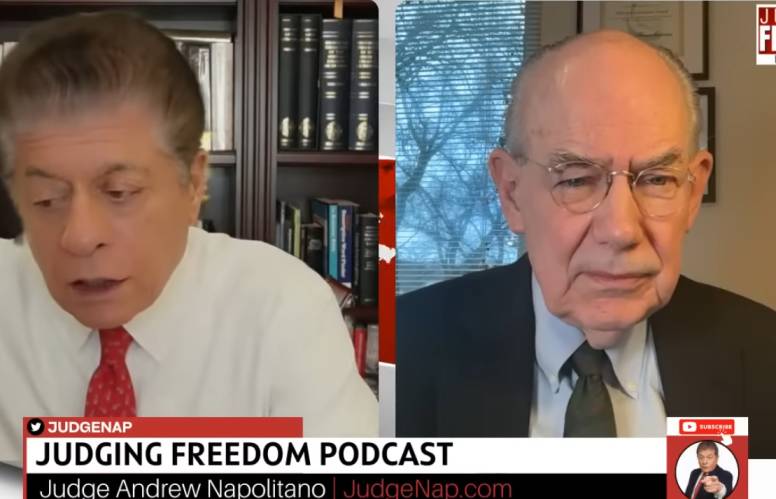
Editor’s Notes: In this episode of Judging Freedom, Judge Andrew Napolitano is joined by Professor John Mearsheimer to provide a critical analysis of the escalating conflict between the United States, Israel, and Iran. Mearsheimer explores the lack of clear strategic objectives from the Trump administration and discusses the profound influence of the Israel lobby on current military decisions. The conversation warns of the catastrophic potential for a wider regional war and questions the feasibility of achieving meaningful regime change in Tehran. This deep dive offers a sobering look at the risks of modern military intervention and the potential for a “forever war” beyond control. (March 3, 2026)
TRANSCRIPT:
“Undeclared wars are commonplace. Tragically, our government engages in preemptive war, otherwise known as aggression, with no complaints from the American people. Sadly, we have become accustomed to living with the illegitimate use of force by government. To develop a truly free society, the issue of initiating force must be understood and rejected.”
JUDGE ANDREW NAPOLITANO: What if sometimes to love your country, you had to alter or abolish the government? What if Jefferson was right? What if that government is best which governs least? What if it is dangerous to be right when the government is wrong? What if it is better to perish fighting for freedom than to live as a slave? What if freedom’s greatest hour of danger is now?
Hi, everyone. Judge Andrew Napolitano here for Judging Freedom. Today is Tuesday, March 3, 2026. Professor John Mearsheimer joins us now.
Professor Mearsheimer, welcome here. My dear friend, we have not spoken since the onset of the war in Iran, and I and the viewers have longed to hear your view. And here we are.
Before we get into anything granular about the causes and justifications, what’s your view, big picture, of the US-Israeli attack on Iran that commenced on Saturday morning?
The Big Picture: Can the US and Israel Win This War?
JOHN MEARSHEIMER: Well, when I think about this war, I almost quickly go to the big picture. And the question you have to ask yourself is, what are our goals? What do we have to do to achieve those goals? In other words, what does winning mean for us — the United States and Israel? And then what does winning mean for the Iranians? What’s their ultimate goal here and what’s the likelihood that they will achieve it?
And my sense is, just looking at this, that we have unachievable goals here, that there’s no way we can win this war in any meaningful way. And all the Iranians have to do is survive and they win. And I think they will survive. So all of that’s a way of saying I think we’re in deep trouble.
Has the Trump Administration Articulated a Clear Goal?
JUDGE ANDREW NAPOLITANO: Has the government, the Trump administration, been able to articulate — it’s a three-part question, so we’ll break it up — a morally grounded, legally sound, or militarily achievable goal?
JOHN MEARSHEIMER: They’ve not been able to explain what the goal is here in any coherent way. President Trump has been all over the place. It’s breathtaking how fast he moves from saying we’re doing this war for this reason, then onto that reason and onto another reason.
But I think your question is largely irrelevant, to be honest, because your question assumes that we’re driving the train. In other words, what are our goals here? As if the United States had clear-cut goals that we were pursuing on our own.
The fact is the Israelis are in the driver’s seat. That’s very clear. Tucker Carlson met with President Trump and President Trump told him he had no choice but to go to war. And what Tucker is being told is that the Israelis are driving the train and that Trump is effectively following orders. So what our goals are is largely irrelevant. The question you want to ask yourself is, what are Israeli goals? And it’s quite clear what Israeli goals are.
Netanyahu Forces Trump’s Hand
JUDGE ANDREW NAPOLITANO: Here is Tucker Carlson yesterday. I want to talk to you about this. Did the United States and Israel agree back in December, right around New Year’s Eve, to attack? Or did Netanyahu force Trump’s hand?
VIDEO CLIP BEGINS:
TUCKER CARLSON: Bibi told the President of the United States, “You can join me or not, but I’m going.” And the Secretary of State, Marco Rubio, said this in a call to congressional leaders yesterday. He said Israel said they were going. And at that point, you really only have two choices. You can get on board and try and help or contain Israel’s war. That’s part of the calculation here. Israel’s going. Let’s try and keep this within bounds. Let’s try to be a moderating force on this adventure, whatever it turns out to be.
VIDEO CLIP ENDS:
JUDGE ANDREW NAPOLITANO: Or you can tell Israel no?
JOHN MEARSHEIMER: But that was not even on the table. That’s never been on the table. No one has ever, in the last 63 years, considered doing that.
The last president to do that was John F. Kennedy in 1962, when he got into a — not as famous as it should be — dispute with the founding prime minister of Israel, David Ben-Gurion, over Israel’s nuclear program at Dimona. President Kennedy said, “No, I don’t believe in nuclear proliferation. This is one of the pillars of my administration and you can’t keep testing. I’m demanding inspections.”
And of course, he was not able to make good on those promises because he was killed in November of 1963. And the person who took his place, his vice president Lyndon Johnson, gave a green light to the Israeli nuclear program. So that was the last time an American president said a hard no to Israel and tried to restrain its core ambitions.
Biden vs.
Trump: Two Different Approaches to Iran
JUDGE ANDREW NAPOLITANO: That last statement is probably true, isn’t it?
JOHN MEARSHEIMER: It’s true, I think. But I would note that the Israelis tried to trap Joe Biden into going to war against Iran twice in 2024.
You remember in April of that year, they attacked the Iranian embassy in Syria, in Damascus. And then in October, they attacked inside of Tehran. They killed the Palestinian leader in Tehran. And the end result of both of those Israeli attacks was that you had a missile exchange between Israel and Iran. The Israelis wanted to pull us into that war. They wanted to pull the Biden administration in.
And the Biden administration did not take the bait. We stayed out. We helped defend Israel when the Iranians attacked Israel and the missile exchanges between the two countries were taking place. But the Biden administration was smart enough not to get involved in attacking Iran itself.
And then you have the Trump administration, which has now twice gotten involved in attacking Iran itself, not simply defending Israel. You remember in the 12-day war in June of 2025 — that’s last year — we bombed Iran on June 22nd. And in this case, we’re now involved in a full-scale bombing campaign against Iran.
So the point I would make to you is that although the Biden administration helped defend Israel in 2024, it did not go to war, although the Israelis wanted to drag us into war.
Is There a Moral or Legal Basis for This Invasion?
JUDGE ANDREW NAPOLITANO: Is there a morally sound basis for this invasion?
JOHN MEARSHEIMER: No. Nor is there a legally sound basis for this invasion, both in terms of domestic law and in terms of international law.
JUDGE ANDREW NAPOLITANO: International law, of course, would not justify the Americans deciding, “We don’t like President Pezeshkian and we don’t like the now-deceased Ayatollah, and therefore we’re going to commence regime change.” Put aside the politics of that. That’s not a basis for an invasion.
JOHN MEARSHEIMER: No, absolutely not. I think almost everybody agrees on that. But President Trump doesn’t care about international law, and he doesn’t care about law here in the United States. He’s a unilateralist. He just does whatever he wants, and he feels that the law is just something that can be ignored whenever he thinks it’s convenient to do so.
Contradictory Justifications and the Question of Military Achievability
JUDGE ANDREW NAPOLITANO: Well, how about militarily achievable? The information that we get is so contradictory.
The Director of National Intelligence states — truthfully, I think — that the intelligence community assesses that Iran has not been working on a nuclear weapon since 2003, 23 years ago, because of one man who stopped them, who they have since murdered. The Secretary of Defense himself says it’s not about regime change. The President says, “Oh, come out into the streets, we’ll tell you when. Stay home, we’ll tell you when to come out in the streets and take over your government.” Therefore, it is about regime change.
The Secretary of State says they were building weapons that someday could harm us. Building weapons that someday could harm us — that is hardly an imminent danger.
JOHN MEARSHEIMER: But again, there’s no imminent threat to the United States. And we, as I said at the top of the show, don’t have clear-cut goals of our own. This is why President Trump is all over the map when he explains why we’re doing this. It’s the Israelis who are in the driver’s seat. And the Israelis have made it unequivocally clear that their goal is regime change.
Let me just say a bit more about this. People talk about eliminating the ballistic missiles that the Iranians have. They talk about eliminating once and for all Iran’s nuclear enrichment capability, and finally Iran’s ability to support Hamas, Hezbollah, and the Houthis.
But you can’t do any of these things unless you have regime change. There has to be a story here that you change the regime and that new regime then decides it’s not going to build ballistic missiles, it’s not going to support the Houthis and Hamas, and it’s not going to pursue nuclear enrichment. You have to get rid of the regime. The Israelis understand this.
And you have to believe that, number one, you can get rid of the regime, and number two, that you can put a new regime in place that will decide to never go down the nuclear enrichment road, to never build ballistic missiles, and to never support the Houthis, Hamas, and Hezbollah. That’s what you have to believe.
So regime change has to be the goal here, because it’s the only way of solving those other problems. If you go in and destroy the missiles or you go in and eliminate the nuclear enrichment capability, they’ll just rebuild those assets. So you have to get regime change and you have to believe that the new regime will not be interested in all of those military options.
That’s the issue here. And I ask anybody who thinks this military operation is going to work: do you think you’re going to get regime change? Is that going to be the end result? And if you do think we’re going to get regime change, do you think that that new regime is going to not want missiles, nuclear enrichment, and not want to support the Houthis, Hamas, and Hezbollah? I find it impossible to come up with a plausible story that tells me how you get regime change and you get a new regime that has no interest in doing those three things.
The Israel Lobby and the Planning of the Attack
JUDGE ANDREW NAPOLITANO: Did Netanyahu force Trump’s hand by saying, as Tucker says, Rubio told the Gang of Eight? And I think that is what Rubio told the Gang of Eight, because he revealed part of what he told them.
This whole Gang of Eight thing is so profoundly unconstitutional. The law requires notifying Congress, not a select eight members. And you don’t tell those eight members under a vow of secrecy so they can’t tell the other members of Congress, they can’t tell their constituents, they can’t tell the press. That’s not a democracy. But we can put that aside for the moment.
Did Netanyahu force Trump’s hand, or was this joint attack planned all along for the day on which the attack began?
JOHN MEARSHEIMER: Look, it’s not just Israel. It’s Israel plus the lobby — the Zionist lobby, the Israel lobby here in the United States. Trump has been under tremendous pressure from the lobby.
Furthermore, if you look at his negotiating team, he has his son-in-law Jared Kushner and Steve Witkoff as his two principal negotiators. These are the two principal representatives of the United States who deal with the Iranians. These are arch-Zionists. These are two people who are deeply committed to Israel. These are Israel’s lawyers.
This tells you that it’s not just Israel itself that’s putting pressure on the United States. It’s Israel plus the lobby. If you didn’t have this enormously powerful lobby here in the United States putting pressure on President Trump and his predecessors, we would have had, over time, and we would have today, a fundamentally different approach to dealing with Israel. We treat it like a normal country, but we don’t treat it like a normal country. We treat it specially. We have a relationship with Israel that has no parallel in recorded history. And that’s what’s driving the train here.
So it’s not just Israel alone. Now, the question of what happened in the planning process — it’s just very hard to say. I find it hard to believe that they decided in late December of last year that they were going to attack at some point and it was only a matter of when. I’m sure that they had significant contingency plans and I’m sure they were talking about the likelihood of attacking, but whether they actually had planned to attack when they did over the weekend, it’s hard to say.
The Cost of Amassing Military Hardware
JUDGE ANDREW NAPOLITANO: Can you get your arms around, as a veteran of the Air Force, the cost of amassing all of that military hardware there — the hundreds of planes, the dozens of ships, the thousands of troops —
The Cost of War and America’s Weapons Inventory
JOHN MEARSHEIMER: I can’t. And the truth is that we have to wait till the whole operation is over before we can really get a good sense of how much this is going to cost. But it’s obviously going to be an enormous sum of money. I mean, President Trump is now talking about this war going on for four or five weeks. I think it’s probably going to go on longer than that, but who knows for sure?
But it’s going to cost us an enormous amount of money. I think as important as the question of how much it costs us is what it does to our inventory of weapons. To what extent are we going to run down our inventory of weapons, and what are the consequences of that for the Ukraine war and for the war or a possible war in East Asia against China?
I mean, the Chinese must be licking their chops at the thought that we’re not only pinned down in Ukraine, we’re now pinned down in the Middle East, and that we’re expending huge amounts of ammunitions, and we’re not exactly a country that has a potent manufacturing base that can easily replace all these munitions that we’re expending.
China, Iran, and the Window of Opportunity
JUDGE ANDREW NAPOLITANO: China buys a lot of oil from Iran. Would China allow the Iranian government to go under and be replaced by someone totally subservient to Trump who might affect that oil relationship in a way that’s not in China’s best interest?
JOHN MEARSHEIMER: Well, I don’t think it’s feasible that the United States could get that kind of government. I mean, I think that’s a pipe dream. The Trump administration, the Israelis may think that’s the case, but that’s not going to happen. So I don’t think the Chinese are going to have to worry much about that. Whatever government takes over in Tehran is going to be hostile to the United States. The idea that any government in Iran that takes over is going to be subservient to the United States is a pipe dream.
But nevertheless, there’s no question the Chinese now and over time will go to great lengths to prop up the Iranian regime and help the Iranian regime stay in a position where it can fend off the United States down the road.
I think, by the way, one of the reasons that the Israelis are so anxious to attack now is because they understand that this is a window of opportunity, that as you move forward, over time, the Iranians will develop a much larger inventory of missiles and drones, and the end result of that will be that it’ll be impossible for Israel to attack Iran without getting clobbered badly. So they better go now, especially given the fact that they have the United States in their hip pocket.
But as I said, I don’t think they’re going to end up winning this war in any meaningful way. I think all the Iranians have to do is survive. I was thinking before I came on the show this morning of a situation where let’s say the United States launches a few massive attacks over the next week or two, and let’s say that the United States eliminates all of the missiles and all of the drones that the Iranians have. This is not going to happen. But let’s just assume that that happens, and then we declare victory. Where does that leave us?
The regime is still intact, and they’ll just rebuild the missiles, they’ll rebuild the nuclear enrichment capability, they’ll rebuild their drone capability. So how do we win the war? Iran is not going away, and I don’t think this regime is going away. But even if this regime goes away, the regime that’s going to replace it is not going to be a friendly regime.
And furthermore, that regime, I would bet, will be tempted to develop nuclear weapons in ways that the regime that was dominated by Ayatollah Khomeini was not interested in developing nuclear weapons. We just assassinated the Iranian leader who was really the main block on Iran going nuclear. And now that he’s gone and given what’s happening in this war, I think the incentives and the potential for Iran to develop nuclear weapons are much greater. So I think this is going to be an even bigger problem moving forward than it is now.
Trump’s Claim of “Unlimited Weapons”
JUDGE ANDREW NAPOLITANO: Here’s a headline from our friends at the Quincy Institute for Responsible Statecraft. President Trump, “We have unlimited weapons to fight a forever war.” No, you don’t. General Dan Caine told you so just before you launched this war on Iran. Could Trump possibly be so misinformed, so moved by his own hubris, whatever was going on in his brain, that he doesn’t understand that we don’t have unlimited weapons, that not only are they limited, but the supply is short?
JOHN MEARSHEIMER: Well, Caine told him that, there’s no question about it. There was a whole flurry of stories in the media on this. And all you have to do is look at the Ukraine war and the rhetoric surrounding the Ukraine war over the past year or so, where we have talked about the fact that there are limits to what we can give the Ukrainians because we’re beginning to draw down the stockpiles of ammunition and weaponry that we have to dangerous levels. And then you go to war in the Middle East, the way we’re executing this war now, and you’re going to further draw down those stockpiles.
So I think that President Trump is just blowing smoke here. I mean, as we know, President Trump says all sorts of outrageous things that have little relationship to the basic facts. And this is just another one of those cases.
And again, this is why the Iranians, they just have to hang in there, right? They just have to hang in there and keep pounding away at Israel, keep pounding away at the American bases in the region and the Gulf states, and make sure that they do everything they can to close down the Red Sea and the Persian Gulf.
The Shah’s Son and the Illusion of Regime Change
JUDGE ANDREW NAPOLITANO: The person that they want to put in charge of the government has been living in the United States for the past 45 years. That’s the Shah’s son, who has the same name as the Shah, Reza Pahlavi. I can’t imagine after 40 years he would be welcomed and embraced by the Iranian people. He would just be, for however long he lived, a puppet of the Americans who are despised. After the murder of Khomeini, the murder of 160 schoolgirls, the bombing of a neonatal unit in a hospital in downtown Tehran.
JOHN MEARSHEIMER: I agree 100%. But let me just add something to that. The fact that the administration and its acolytes are making the argument that he is the viable alternative tells you that they have no organization or individuals inside of Iran who can run the country after you get regime change and run the country in a pro-American way.
Remember, the name of the game here is regime change. The first question you want to ask yourself is, are you going to get regime change? And then the second question you want to ask yourself is, if you get regime change, are you going to get a friendly regime? And we have nobody on the ground inside of Iran who is friendly to the United States, who’s a plausible candidate to run the country if we get regime change, which we’re not going to get in all likelihood.
So what do we end up doing? We end up talking about putting the Shah’s son in charge, flying him back in. This is 1953 all over again.
JUDGE ANDREW NAPOLITANO: We’re going to go right to 1953, just to remind the audience — when the CIA and MI6 orchestrated a coup that threw out Muhammad Mossadegh, a popularly elected president, and they installed the Shah. The father of this guy — he’s not a young man anymore, he’s about my age. He was a young man when his father was deposed and he and his mother and siblings fled to Maryland, USA.
JOHN MEARSHEIMER: And you want to remember, Judge, his father was hated. It’s not like his father was deposed by the ayatollahs and his father was a beloved leader in Iran. Exactly the opposite was the case. Most Iranians were glad to see him go.
Turkey’s Role and the Threat of Nuclear Proliferation
JUDGE ANDREW NAPOLITANO: Let me ask you about Turkey. Professor Mearsheimer, Naftali Bennett, who’s the former Israeli prime minister, is quoted as saying, “Better for worse, Turkey poses a greater threat to the stability of Israel than Iran does.” Do you expect to see Turkey taking advantage of the bombardment of Israel in some way?
JOHN MEARSHEIMER: I’m not sure what you mean by taking advantage of the bombardment of Israel. You mean, in other words, you expect —
JUDGE ANDREW NAPOLITANO: Turkey to do anything now while Israel is being attacked?
JOHN MEARSHEIMER: No, not at all. I think the Turks have a deep-seated interest in seeing Iran survive because the Turks understand that Turkey and Iran are the two big countries in the greater Middle East that the Israelis would like to finish off. Israel wants to dominate the Middle East, and as we’ve talked about on numerous occasions, what they’d really like to do in Iran is break it apart — do to Iran what’s been done to Syria. And they’d like to do a similar thing with regard to Turkey. They’d like to make Turkey as weak as possible. And the Turks are fully aware of this.
I believe that what you’re going to see is the Turks begin to talk about nuclear weapons more and more. You already see evidence of that. I’ve seen a few articles over the past two or three months where the Turks are beginning to talk seriously about acquiring nuclear weapons. And that’s because they view Israel as a threat, just as the Iranians view Israel as a threat. And the Turks’ great fear is that if the Israelis and the Americans finish off the Iranians, they’ll put their gun sights on Turkey. That’s what’s going on here.
How Does This War End?
JUDGE ANDREW NAPOLITANO: Wow. How do you see this war progressing? I know it’s an unfair question. It’s becoming a regional war. Trump says at one point it’ll be over in four weeks. And at the other point, he and Hegseth say we don’t rule out boots on the ground. My own view is that boots on the ground would be catastrophic for America.
JOHN MEARSHEIMER: It’s very hard to say. I mean, what if the war goes on for four weeks, the regime survives in Tehran and they’re continuing to fire ballistic missiles at American bases, at Israel, and fire drones as well. And there appears to be no end in sight. And we’re running out of munitions. And public opinion in the United States is shifting against Trump. What is he going to do then?
It’s very hard to say. Again, the question you have to ask yourself is, if I’m right and that we don’t have a winning strategy, that we can’t win this war, what do we do? Do we accept defeat? Can President Trump do with Iran what he did with the Houthis last year?
You remember, President Trump moved into the White House in January of 2025. In March, he said that he was going to finish off the Houthis once and for all, and he went to war against the Houthis. By May, he quit. He couldn’t beat the Houthis. By the way, if he couldn’t beat the Houthis, how’s he going to beat Iran?
But anyway, he didn’t beat the Houthis. He accepted defeat. He said, “The Houthis are tough hombres. I didn’t realize how tough they were. I’ve had enough.” And we walked away. Can you do that with Iran, especially since we’re joined at the hip with the Israelis on this enterprise? I don’t know if he can just walk away.
So then the question is, what does he do? He puts boots on the ground? That would just make a bad situation worse. So he’s in real trouble.
And then there is the Iranian side of the equation. Let’s assume that we are very successful at tearing apart Iran and damaging the regime, and it looks like, from the Iranian point of view, that they believe they’re going down. You’re in what I would call a Götterdämmerung moment. If you’re the Iranians and you think you’re going down, you bring everybody down with you. And maybe what they’ll then do is take their remaining ballistic missiles and drones and tear apart all of the oil infrastructure in the Gulf region and do enormous damage to the world economy. Shut down the Straits of Hormuz for a long period.
So you’re talking about two countries that are deeply involved in a war where, from an Iranian point of view, this is an existential threat that they’re facing, and where the Israelis think they’re facing an existential threat, and they are in the driver’s seat. When you talk about our relationship with them and you just sort of say, how do you walk back down the escalation ladder here? Maybe you can do it. Maybe both sides will have an incentive to do so at a certain point in time.
But again, if you start walking down the escalation ladder, the United States loses, right? And President Trump has bet that he can beat Iran here. This is not June 22nd of last year when he did a one-and-done, when he went in and attacked those three nuclear sites at Natanz, Isfahan, and Fordow. This is a very different situation. He’s in the regime change business, and he’s in the regime change business without boots on the ground. And again, even if he gets regime change, what does that buy you?
So I do not see what the happy ending is for President Trump. Almost every story he can tell, I think I can knock down quite easily.
The Administration’s Varying Explanations for War
JUDGE ANDREW NAPOLITANO: Here’s a montage compiled by our friends at CNN of the varying explanations for war from the administration.
The Absurdity of Bold War Statements
VIDEO CLIP ENDS:
JUDGE ANDREW NAPOLITANO: We haven’t declared war. The secretary of defense, who calls himself
JOHN MEARSHEIMER: the Secretary of War, said today, this is a war. We set the terms of this war from start to finish.
JUDGE ANDREW NAPOLITANO: Nobody should classify this as war. It is combat operations.
JOHN MEARSHEIMER: War is hell and always will be. Strategic strikes are not war.
JUDGE ANDREW NAPOLITANO: I mean, some of this is absurd. Pete…
JOHN MEARSHEIMER: I like the Pete Hegseth comments the most. First of all, “we didn’t start this war.” I mean, is this guy serious? Really? Then, “we set the terms. We’ll win this war.”
I believe that anybody who seriously studies war, or even semi-seriously studies war, understands that when you go into a war, you never want to make those kinds of bold statements. War is an incredibly complicated enterprise. It’s filled with unintended consequences. And predicting how everything ends is a very tricky business.
And when you look at the enterprise that we’re engaged in in Iran, I think it’s not the sort of situation where you want to make bold statements. You want to acknowledge the fact that you may be wrong, that you may end up losing. This happens a lot of times when countries go to war.
So when you listen to Pete Hegseth talk, you understand, number one, why we went to war. The mere fact that someone like that is in the room whispering in President Trump’s ear gives you a good indication of why we went to war. But number two, it makes it clear, when you see the hubris in that guy’s commentary, that he doesn’t know what he’s talking about. And if anything, there’s a good chance we’ll end up on the short end of the stick when this war is over.
JUDGE ANDREW NAPOLITANO: With Professor John Mearsheimer, a pleasure, my dear friend, no matter what we talk about. Thank you so much. Thanks for accommodating my schedule. I must tell you, your audience has been enormous. And to the audience, like and subscribe so it’s easier for us to get Professor Mearsheimer up on that algorithm. They all know what I’m talking about. Thank you, Professor. All the best.
JOHN MEARSHEIMER: My pleasure. And all the best to you, Judge.
Related Posts