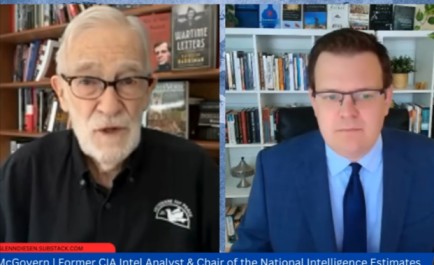
Read the full transcript of veteran CIA analyst Ray McGovern’s interview on Greater Eurasia Podcast, May 27, 2026.
Editor’s Note: In this conversation, host Glenn Diesen speaks with veteran CIA analyst Ray McGovern to break down the latest geopolitical tensions between Russia, NATO, and the United States. McGovern details the major shift toward closer ties between Russia and China, while analyzing President Vladimir Putin’s strategic caution in navigating interactions with the U.S. and Europe. They explore the delicate balance of deterrence in Ukraine, the changing landscape of modern warfare, and the shifting dynamics of global military power.
INTRODUCTION
GLENN DIESEN: Welcome back. We have the great pleasure of being joined again by Ray McGovern, a CIA analyst for 27 years who chaired the National Intelligence Estimates and prepared the president’s daily brief. So, thank you as always for coming back on the program. I’ve been looking forward to speak to you now.
RAY MCGOVERN: Thank you for inviting me, Glenn.
NATO Involvement and Russian Escalation
GLENN DIESEN: So you, for decades, kept a very close eye on Moscow and I therefore wanted to ask you how you’re assessing where we seem to be heading, because a lot of what we’re seeing now has been — well, it was quite unthinkable, I think, during the Cold War.
That is, we see NATO now being, well, I would say directly involved in attacks on Russia, especially from the territory of the Baltic States. Seems to become normalised. Also, the Russians appear to be responding with quite a radical escalation. We see the Oreshniks being used. This is also normalised. And Kiev, which had been, well, not spared, but had been treated more kindly by the Russians, which is now — we’ve seen some of the most, well, the most brutal attack probably on Kiev. So where is all of this headed?
Tectonic Shifts: Russia, China, and the Changing Balance of Power
RAY MCGOVERN: Glenn, let me talk a little bit first about the tectonic shifts that I’ve noticed, and I’ve been around for 6 decades, watching this very closely. My first portfolio was the Sino-Soviet conflict. Suffice it to recall that China was claiming 1.5 million square kilometers of Russian Siberia, taken by unjust treaties in the 17th century. Did they have a leg to stand on? They sure as hell did. The Russians sent explorers out there with a Russian flag, stuck it in Siberia and said, “This is ours.” Okay, so there was that. They were shooting across the border.
Here’s a little thing that most people don’t know. Uyghur. Now, in Xinjiang, they have the Uyghurs, right? They are conceived, or were conceived, to be a threat to the Chinese. Okay. Now we decided — we analysts — I wonder, are the Russians trying to exploit the Uyghurs? And we found a Uyghur speaker in the United States and we said, “Hey, there are these broadcasts going, we can’t figure out what they are. They’re in Uyghur.” And it came back — they were inciting insurrection. That is, the Kremlin was inciting insurrection in China.
That, plus the fact that Soviet divisions were amassing on their common border — I mean, it was clear that they hated each other and they were very ripe for somebody intelligent to take advantage of their preoccupation with fighting each other and the draining of resources that they were expending in that way. And long story short, Nixon and Kissinger were smart enough to do that. And when we saw the effects of their initial attempts, we said, “Looks like it’s working.” And we had the SALT agreements in May of 1972. I was privileged to be there. And we had a thaw, and then we had détente, and we had a real movement towards closeness with the United States.
Now, how about Russia and China? Well, as you know, I used to brief Secretary of State George Shultz every other morning with the president’s daily brief. After I was removed from that position, I kept in touch with him at his request. And I remember taking him little essays written by people I could trust on Russian foreign policy, saying, “Look, you know, we told you 2 years ago that they would hate each other forever, but it looks like they’re wising up to how they’ve been taken advantage of by the U.S. They’re not going to hate each other. And when more enlightened leadership comes in, we expect there’ll be a thaw in those relationships.”
Well, we never dreamed that Russia and China would be so close — never closer. And that was indicated when Putin went to see Xi just last week. So that’s the tectonic shift. Two against one, clear as a bell. It’s Russia and China against what’s left of the Western alliance, principally the United States.
The Military Balance Has Shifted
The other tectonic shift that I think needs to be mentioned right up front is that Trump may say our armed forces are the strongest in the world, the most expert, blah, blah, blah. It ain’t true anymore. Now, for an analyst of U.S.-Russian relations for so many decades, I still hear myself now, like — can you be saying that, Ray? Yeah. The Russians not only outmatch us in conventional forces, but they have the kind of nuclear deterrent that just won’t quit.
And they did that because Biden, Obama, the whole rest of them wouldn’t talk to the Russians. And so Putin said, “Well, look, all right, we’re not going to waste a lot of money on an ABM system. We’re going to find more clever ways of defeating or at least deterring what you have in mind.” He made that explicit in June, 10 years ago. And then in his State of the Nation address in 2018, he said, “Okay, look, I’m going to have a show and tell here. It’s a little unusual in the State of the Nation address, but here — watch these 6 videos.” And he forecasted what the Russians had just developed or were developing.
So we’re talking about the Oreshnik, we’re talking about the Burevestnik, we’re talking about Poseidon — a missile that goes around the South Pole, a missile that stays up powered by a nuclear power pack.
Putin’s Strategy: Placating Trump, Dissing Europe
So the only thing I just want to finish up here by saying — not only are Russia and China together as never before, but also the U.S. no longer has the advantage in terms of either strategic or conventional weaponry. The saving grace here, and I say this deliberately, the saving grace is a very perspicacious, very cautious, very level-headed Putin in Moscow and Xi in Beijing. And they’re not going to be provoked into letting a very irascible, very unpredictable person with his fingers on the nuclear codes — I speak of Donald Trump, of course — they’re not going to be put in a position where they give him no other option than to even think about nuclear weapons or something really more drastic.
So the way I see it — and this is different from many of my colleagues — Putin especially has set for years, especially since Trump came in, the primary objective of placating Trump, giving him all the praise, massaging his ego, and making sure that they differentiate from the crazy — I use the term advisedly — the crazy Europeans and the Americans who have now left NATO in effect. So you placate the Americans. You diss the Europeans.
This happened very quickly. Trump decided that he would talk to Putin, and Putin welcomed that up the kazoo and said, “Hi, we’ll keep talking. The talks continue.” And when Putin wants something from Trump, he calls him up and they spend 2.5 hours on the phone, or 1.5 hours as more recently.
What was it — 2.5 hours? That was last year when Trump was saying things like, “Oh, Zelensky’s coming to town and I think I’ll give him Tomahawk missiles. I think that’s on the agenda.” What happens? Putin takes the initiative, calls Trump and says, “Very bad idea. Very, very bad idea.” Okay. The next day, Zelensky shows up in the White House and Trump says, “Well, you know, we really need those Tomahawks for ourselves. Sorry. We’re not going to give you a Tomahawk.”
The most recent thing was Putin calling up Trump again and saying, “Look, you know, Iran is a real problem. Let me just put it this way,” says Putin, “we say in Russia, ‘altogether unacceptable.’ Okay. That’s about as strong as you can get. If you restart this war — the more so if you land troops in Iran — that’s totally unacceptable.”
Last thing I’ll say on that. It took 2 days for Wang Yi, the Foreign Minister of China, to repeat that warning in exactly the same words: “Totally unacceptable.” So there’s a concrete manifestation of how together they are, and how Putin, when he calls Trump — it was only 1.5 hours this time — when he wants Trump to do something or not to do something, he calls him up, takes the initiative, 2.5 hours a year ago, 1.5 hours now, and Trump relented. So Putin’s priority is to cool him — make sure that he doesn’t excite Trump into doing something that we all would regret.
China and Russia: A Relationship Built on Mutual Interest
GLENN DIESEN: Yeah, well, the China and Russia coming closer together — I agree, if you were sitting there in the ’60s observing it, it would have been difficult to predict. But the unfair treaties — I think the Russians dealt with them in a good way, because in 1858 and 1860 when the Russians acquired about 1 million square kilometres from the Chinese, the Chinese obviously were never really happy about this. But you see the consequences have continued because of this sliver of land the Russians also took, whereas Vladivostok now — the northeastern parts of China became less developed than other parts of the country simply because they’re landlocked. So this of course then builds some tensions towards the future. Will the Chinese at some point want this territory, try to conquer it, because of domestic problems with uneven development — all of these issues.
But instead of building up a powerful army and beginning to trigger a security competition along the border, the Russians instead did the opposite. They began to modernize a lot of their ports. They’ve developed railroads, bridges to connect with the Chinese region. So instead of having this as a security threat hanging over them, they’re making money off it — connecting these Chinese regions to the sea. So it’s a good way of dealing with this issue.
And I think beyond this, both sides see the U.S. as well as the European maritime powers as having a long history of keeping all the Eurasian powers divided so they can rule from the periphery. And while, you know, if you want to integrate the Eurasian continent by physical transportation corridors, new banks, trading currencies, tech hubs — all of this is fine and well, but of course they have different formats. However, both the Chinese and Russians recognize they need each other, so there is this incentive to cooperate.
So it shouldn’t have been that unpredictable, I guess, that at some point they could come together if some wiser, less ideological people were in power. But this is also why I, for the life of me, can’t understand why there are still analysts across the West arguing that this is a marriage of convenience and they will start fighting over who can dominate Kazakhstan in the future. But it doesn’t matter who can dominate Kazakhstan because if they don’t get along, then the whole Eurasian format begins to fragment. So I don’t know.
Nixon, Kissinger, and the Origins of the Sino-Soviet Split
RAY MCGOVERN: That’s exactly right, Glenn. I’m really — you know, I’m reminded now that you know a lot about this stuff. You’re a historian. You’ve studied these things academically. You mentioned the unequal treaties. You didn’t mention the Treaty of Nerchinsk, 1689, if memory serves, which was the supreme indignity which took all this territory from what China had a legitimate claim to, and was concretized in this treaty itself.
As I said before, we always put a last paragraph in our essays on how much the Russians and Chinese hated each other, because that last paragraph needed to say: “When more enlightened leadership comes in — when Zhou Enlai and suddenly Mao dies and other people — well, you know, they will have to see how stupid this is and they will combine together or have a thaw in their relationships.”
The big thing was Nixon and Kissinger deciding to exploit this difference, this conflict. And Chas Freeman was doing the Chinese side of this. He was with Nixon in Beijing, January 1972. Kissinger had been there the year before, and Freeman was translating for Nixon and developing this One China policy, which would do away with the Taiwan issue, at least temporarily. And I was watching it from the Russian side.
What I didn’t know was that, as Chas mentioned, there were not 15 Soviet divisions on the Chinese border, but 40. I was overseas at the time, so I didn’t follow this closely. Chas said there were 40, and that’s when Kissinger and Nixon said, “Oh my God, the Chinese must be a little bit afraid of the Russians, so let’s work with the Chinese.” The Chinese gave us the possibility to collect really good information on the Russians, and there was this little entente coming in, and that changed everything.
After we did the Russians and the Chinese the favor of driving them together against this common enemy — now it is a common enemy, and this enemy is unpredictable — that’s why I say that we should be grateful for cautious people at the top who are not going to let Trump have any pretext to use nuclear weapons or something of that sort.
Russia’s Restraint and European Escalation
GLENN DIESEN: But how cautious do you think they will be on the Russian side now? Because I think that they were cautious for quite some time now. Not just 4 years, I think since 2014. And the impression I get from Moscow these days is that they perceive their restraint as having been interpreted by the West as weakness. And it’s hard to deny this.
I mean, anyone looking up in a newspaper, they’re essentially mocking the idea that Russia would ever dare to retaliate against a NATO country. They’re too afraid. Not just attack a NATO country, but to retaliate. That is, we can launch a missile straight into their capital and they wouldn’t do anything. Even as the Europeans are escalating and Americans are now signaling that they’re checking out, or at least handing this over to the Europeans, and still there’s this assumption that they won’t retaliate.
And I don’t know, I’m just getting the impression these days that the Russians are planning to bring some fear into the hearts of the Europeans again. Because this is, as I said, this was unthinkable during the Cold War. Who would talk in the way they talk now? We have leaders openly saying, “Oh, we are very proud of making drones, they’re going to go deep into Russia, blow up their energy infrastructure.” No one talked like this in the past. It’s a very strange thing to watch.
So do you think, I mean, where do you see it heading from here? Because we can’t be at the end station. Is this going to escalate more? Do you think Europeans have the common sense or the rationality to begin to stop the escalation and at least pick up the phone and talk to the other side?
Putin’s Distinction Between the U.S. and Europe
RAY McGOVERN: Well, one interesting aspect of this, Glenn, which not many people refer to, is that in that extraordinary Q&A that Putin held after the victory celebrations on Red Square, 9th of May, he very clearly differentiated the U.S. from those crazy Europeans. And he said, “The U.S. and we Russians see Ukraine the same way.” Huh?
GLENN DIESEN: Wow.
RAY McGOVERN: That’s a biggie. That’s what he said. So that’s the important thing. He’s making a distinction between what he sees as Trump’s policy, which is destroying NATO in effect — NATO not having any power without the United States — and the Europeans are doing these crazy things.
Now, again, his primary vision here is to make sure that Trump doesn’t do something really stupid. So they see this common thing. Now, Medvedev says it’s crazy to try to negotiate with people that kidnap leaders of countries and all that stuff, but — Medvedev now — “We believe the United States is sincere,” his word, “in trying to tamp down the Ukrainian situation, and that once we get rid of Iran, it’ll be possible to work out something sensible.” Medvedev.
So what am I saying here? I’m saying that number one, NATO is nothing without the United States. They can bluster. They can actually fire long-range drones into deep Russia. And the last one, of course, which killed so many young women in that college there — well, that was a bridge too far for Putin. And Putin retaliated with Oreshnik, for God’s sake. You know, you can’t defend against Oreshnik. And it was very clear that he was provoked into doing that.
Will Russia Strike NATO Countries?
Well, will he be provoked into hitting NATO countries? I don’t think so. Why? Because there is still Article 5 of the NATO Treaty. And even if there’s only a 5% chance — as I read Putin — even if there’s only a 5% chance that Trump would irascibly say, “My God, we are part of NATO still, we’re going to zap them,” he doesn’t want to take that chance.
So with the Oreshnik strike, I believe that Putin has sort of defused a lot of this popular sentiment that’s saying, “My God, can’t we get this war over?” And the notion that the Russians are not winning in Ukraine, which is going roundabout, I’m sure, in Norway and elsewhere — the Economist and somewhere else I saw it today — that the Russians are stymied and have no possibility to move forward because of the powerful Ukrainian forces with drones and stuff. Well, with drones and stuff, the Russians have air defense. They have a drone defense. Some of them would get through, but unlike Ukraine, as was just shown with that big Oreshnik attack, they can defend themselves from these missiles.
I used to call them pinpricks, to include the attack on that airfield with bombers, part of the triad. They’re no longer pinpricks when they kill what, 18 or so young women studying to be teachers in this village. And so when that happens, Putin retaliates. I don’t think that he’s going to be too much incited to do more.
Polyanskiy’s Warning on European Strikes
Now, there have been people — was it Karaganov? No, no, it was Polyanskiy. Polyanskiy was the deputy head of the UN mission in New York. I know him. He’s now chief Russian representative of the OECD in Vienna. He was interviewed by Danny Davis. And Danny Davis kind of said — well, what he told us was, “Yeah, it’s already too late to avert Russian strikes in Europe.”
Well, I understand how that can be obfuscated, and Danny Davis is great, but what Polyanskiy really said — and I’ll read it to you — was: “If Russia is provoked into striking in the future” — that’s talking about striking against Europe — “people will wonder why it happened, but by then it will have been too late.”
Now, that’s a distinction with a difference. “It will have been” — if I remember correctly, the future perfect tense — depends on this “if,” and that’s a big if. So again, going back to my frame of reference here, where Putin sees, number one, he’s got a guy he can talk to, and number two, he’s got a guy he can call up and dissuade from doing really stupid things — he’s going to try to prevent the situation where it will have been too late.
Shifting Russian Attitudes Toward Deterrence
GLENN DIESEN: Yeah, well, I spoke to Polyanskiy as well, and he did mention that it’s becoming less — well, I think almost a direct quote — “the talk about nuclear war or striking with a tactical nuke is becoming less taboo.” That’s very different from claiming that the government is considering the option. But this was in reference to an interview I did with Karaganov when he said that his views on retaliating against Europe — well, he used to represent a small minority, and now he said that the overwhelming majority believes that the time has come to focus on restoring deterrence, as opposed to turning the other cheek, essentially.
I’m not sure, again, as you said, there’s a lot at stake here, but it feels like we’re reaching a point where they can’t turn the other cheek yet again. I often think about George Beebe — he gave an interview in December of ’21 — and he made the point that the Russians didn’t want to start a war, but they were reaching the point where inaction was more dangerous than action. In other words, if they waited much longer, the NATO countries would entrench themselves too heavily in Ukraine, and it would be too late to dislodge them. So essentially, it was now or never. And 2 months later, the Russians invaded.
So I’m wondering if we’re reaching some dangerous point here.
Russian Pragmatism Toward the U.S. vs. Hostility Toward Europe
By the way, when you spoke, I was thinking that the pragmatism the Russians have towards the U.S. now — that it’s possible to work with them versus the hostility towards Europeans — that’s very different from when Biden was in government. And it fills me with some optimism, the hatred of Europe instead of the U.S., because it signals that the Russians are pragmatic. That is, as soon as the U.S. began to say, “Listen, we can get along with Russia, we can talk,” even if they’re still fighting in Ukraine against the Russians, the Russians are showing, “Well, we can work with this, perhaps we can end this.” At least it shows that there’s a lot of room for manoeuvre if the West wants to open up diplomacy.
Sorry, I was going to get to my last question, which was Germany. How do you make sense of this? Because this came as a bit of a surprise to many people — how they have essentially put themselves on the forefront of anti-Russian rhetoric and actions indeed. How do you make sense of this?
Russia’s Nuclear Calculus and the Baltic Warning
Ray McGovern: Glenn, I don’t know if I showed you this before, but here’s a little button here. It says “Putin Raster.” Yeah. Okay. Now, 6 or 7 years ago, I was in Germany on one of my visits and I saw this. I said, oh my God. Get me one of those buttons. I got to put it on here. And my friend said, no, no, no, don’t do that. Why? Well, because that’s a pejorative. For understanding is a pejorative? Yeah. Oh, people say you’re in Putin’s camp.
Now, here’s sort of a literal manifestation of the mood in Germany. Very intelligent, cultured people have once again been brainwashed, okay? Their entire media is worse than ours, and that’s saying something. I don’t know how it is in Norway, but most intelligent people who know which end is up in Germany are afraid to speak out, for God’s sake. That’s how bad it is.
Now, that’s one thing, and that’s bad. But the Germans are going to spend hundreds of thousands of euro on weapons that will not defend them against anyone and risk the social safety net that has made German democracy so secure and so admired around the world. I don’t think so. And that’s what it will come to. There’s a limited amount of money. Mertz is as unpopular as any German chancellor in the history of chancellorhood in Germany. He’s going to be gone pretty soon. So will Macron, and Starmer is on its way out. These guys are looked on advisedly as superannuated vestiges of what’s good, trying to hang on as long as they can.
Russia’s Warning to Latvia
So again, cool hand Luke Putin is playing the long game here. He realized, I said, oh, the U.S. has decided not to put intermediate range ballistic missiles in Germany as they undertook with Chancellor Scholz back at the NATO meeting in Washington 2 years ago. Oh, they’re not going to do that anymore. So without the U.S., NATO is nothing. Okay. So let’s keep calm here.
Now, one thing I wanted to mention here is that the Russian equivalent of the CIA, the SVR, has a press office. I didn’t know that. Yeah, they made a statement 5 days ago. And what did they say? Well, they were talking about tactics that will significantly reduce the time of approach of these missiles if they’re put in Latvia. And Latvia is said to be willing to accept these missiles, and the SVR says there are 5 sites that they could be fired from.
Now, here’s the bottom line. It would be useful to recall that the coordinates of decision-making in Riga, in Latvia, are well known. And the country — here it is — “the country’s membership in NATO will not protect the accomplices of terrorists from fair retribution.”
Now, this is May 19th, 6 days ago. Very unusual statement. And it’s just warning the Latvians, look, if you fire missiles or drones into deep Russia, just realize that your membership in NATO will not protect you from retribution. Now, I haven’t kept up on whether the Latvians have taken that seriously or not, but I’m like 80% sure that they will. The retribution sites have been named.
The Russians made fun of the Latvians who, as the Russians say, lack critical thinking. How so? Well, the Ukrainians were able to persuade them that the Russians would never retaliate because they couldn’t tell where the missiles come from. The SVR said, “We know, we can tell where the missiles come from, so don’t do it.”
Now, that’s an example of how the upstart Baltic states would let themselves be drawn into this unless the Russian intelligence service warns the world, look, membership in NATO might not save you from this kind of retaliation. So my prediction is that if this happens, it could be that the Russians could send a strike into a NATO member state, namely Latvia. But I think on balance, that’s unlikely because as Putin weighs the cost-benefit analysis here, if there’s only a 5% chance that Trump would go off half-cocked and say, “No, Article 5, I never rescinded Article 5, I’m on here, we’re going to do” — even if there’s just a 5% chance of that, it’s not worth it. The game is not worth the candle.
Putin’s Caution and the China Factor
Now, take that for what it’s worth. Many of my colleagues disagree. When Karaganov or Mityaev, these people speak out — well, they’ve been saying this for a long, long time, Karaganov especially, forever. And yeah, Karaganov can interview Putin at these big meetings at Valdai and elsewhere, but I never had the thought that Karaganov was fully persuasive with Putin. I’m persuaded that Putin is too cautious for that kind of thing. And I may be completely wrong, but I do draw on 6 decades of watching Russian and Soviet leaders. And this one is different.
I will say this: we should be grateful for his caution, for his perspicaciousness, and for his foresight in developing the kind of relationship with Beijing, with Xi personally. Let’s add one thing here. When Putin was leaving Beijing, Xi walked with him and, you know, the camaraderie — Xi is a little bit inscrutable, right? Doesn’t smile much. But this time it was almost a smile. They’re standing next to each other and Putin is waiting. Oh, what’s going to happen here? Will he give me the great big bear hug that Trump advertised was going to be given to him when he went? And never got.
And he’s standing there and then Xi goes like this. It wasn’t a great big bear hug, but it was very, very symptomatic of their relationship. And then as Putin wanders off to the plane or train or whatever it was, Xi looks at him and says — now, I usually rely on more reliable indicators of such things, but that spoke volumes to me. No big bear hug for Trump, just a cursory warning about Taiwan, nothing else. They’re together as never before. That is the tectonic shift that I think gives Putin the latitude to bear with some of these indignities without going off half-cocked. I hope I’m right.
Glenn Diesen: I hope you’re right as well. It just seems — if I’ve been a bit pessimistic about the possibility of peace — but of course, usually in history you see that countries get all the way up to the edge of catastrophe, and that’s usually when leaders begin to wake up. My concern is that many of our leaders now are essentially condemning and arguing that, well, this is pressure tactics, we will not yield to pressure, we will go off that cliff essentially.
And I’m hoping that, yeah, when the Mertzes and Macrons, Starmers — these kind of people go away, perhaps we’ll get some common sense again. Again, it seems that we’re at a very dangerous point. Either we will go to war or we’ll have some reopening of diplomacy. At the moment, it appears that the Europeans at least are speaking both about starting perhaps to talk to the Russians again after boycotting diplomacy for all these years, but they’re also talking about fighting Russia in war. So I’m hoping the peace comes first. So yeah, any final thoughts?
Kennedy’s Warning and the Ukraine Shift
Ray McGovern: Well, just — it takes two to tango, right? To make war. Yeah, one final thought is this. As you know, I came down to Washington under John F. Kennedy. And just two months after I joined the CIA, he made that wonderful speech at American University, 10 June 1963. And one of the things he said there was, look, unique among great powers, Russia and the United States have never been in a frontal war, one against the other. Now, bear in mind, this is 8 months after the Cuban Missile Crisis, when it almost happened, okay? When you and I might not be making this nice little discussion today.
So he said, look, the thing we have to avoid at all costs, given what almost happened 8 months ago — we have to avoid the possibility of challenging another nuclear-armed country with a choice between humiliating retreat and using nuclear weapons. My God. Okay. Now, Khrushchev was himself chastened and wondering about how this all went down and made the right decisions. Thank the Lord, right?
But since then, ever since then, up until Ukraine, when the U.S. took it into its head — Biden and the rest of them — to challenge a nuclear-armed power by moving Ukraine into NATO, that’s when this all changed, okay? So you’re right, Glenn. This is a new shift and it’s happened.
Now the question is, do the Russians have the upper hand in Ukraine to the degree that they’re really not worried too much about these pinpricks — or even, well, they will retaliate for killing a whole bunch of girls in a school. But are they willing to attrit, attrit, attrit the Ukrainian forces and defend themselves against these drones — a defense that the Ukrainians do not have against drones — and bide their time and see how long it takes Mariupol to fall, Bakhmut, Avdiivka? And the U.S. for the nonce is pretty much on the side of Russia on this, and Putin has said explicitly that at that May 9th press conference. One ought to read that. It’s full of gems also having to do with Ukraine, also having to do with Iran.
Glenn Diesen: Well, when the Europeans talk about increasing the pressure on the Russians, I always make the point that all these pinpricks — we should be happy it’s not having more effect, because if it was having an important effect to the extent that Russia now sees it as an existential threat, they would react in a very different way.
My concern is that a lot of these attacks on the energy infrastructure are starting to get an impact on the Russian economy. And while the Europeans are celebrating, they should be aware that if this means that Russia can’t afford to absorb this pain anymore, that means the considerations are changing. Now they have to strike back. And this is what keeps me up at night, essentially.
Ray McGovern: I understand. Yeah, I agree with you. The only thing is how you proportion — the way I come at it is that as Putin looks at what he’s done the last 25 years, how he’s brought Russia back, how Russia can defend itself, how his people are prospering — just like those 700,000 peasants that were brought out of poverty in China — he’s not going to risk that at all.
And so he’s going to say, look, these guys, some of them are crazy. We’ve got the U.S. separated from them, and so they’re nothing without the U.S. And so in other words, it’s how you proportion the priorities that Putin has in the back of his head. No one can be sure, perhaps not even Putin, but that’s my read on it and it’s different from others. But I think that’s the bottom line, at least for me. We’ll see what happens.
Glenn Diesen: Well, at least your optimism will make me sleep better at night. So I hope you’re right on this one. So thank you so much for taking the time.
Ray McGovern: You’re most welcome. Thanks for having me.
Glenn Diesen: Bye.
Related Posts