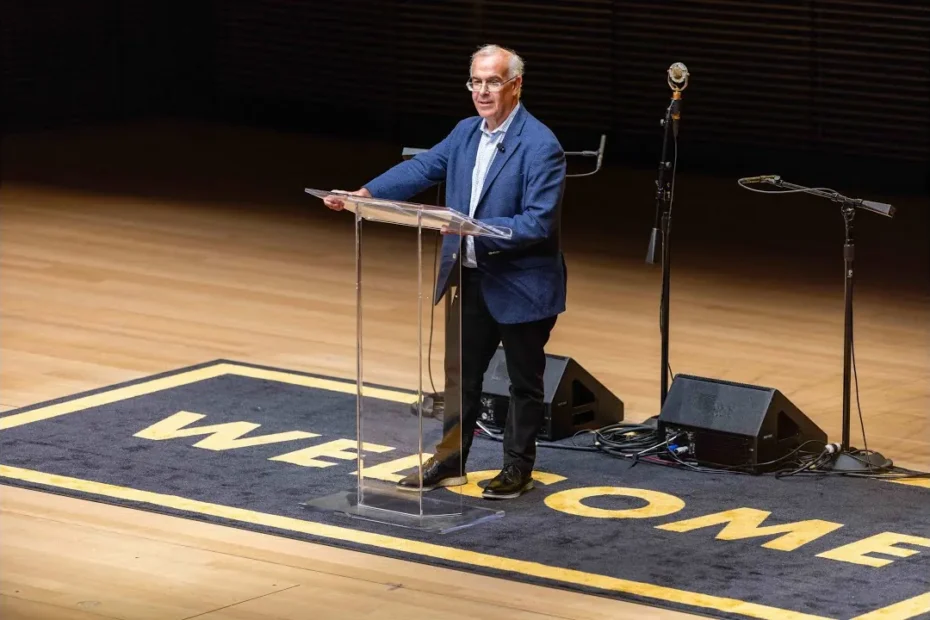
Read the full transcript of author David Brooks’ talk at 2024 Welcome Conference, September 16th, 2024.
Editor’s Note: In this insightful presentation from The Welcome Conference, renowned journalist and author David Brooks explores the profound impact of truly connecting with those around us. Addressing a growing epidemic of societal loneliness and fragmentation, he outlines the essential moral skills required to move past superficial interactions and become “illuminators” who light up others. Ultimately, Brooks offers a powerful guide on how to master the apex art of making people feel deeply seen, heard, and understood.
Not Naturally Warm and Hospitable
DAVID BROOKS: It’s crazy that I’m here at a hospitality conference because I am not naturally warm and hospitable. If you ever saw that movie, Fiddler on the Roof, you know how warm and huggy and emotional Jewish families can be, always singing and dancing. I come from the other kind of Jewish family. The phrase in my home was, “Think Yiddish, act British.” And so we were stiff upper lip, unemotional.
And then when I was seven, living down here in Stuyvesant Town, I read a book called Paddington the Bear and decided I should become a writer. And that was central to my identity right away. And I remember in high school, I wanted to date this woman named Bernice. She didn’t want to date me. And I remember she dated somebody else. And I remember thinking, what is she thinking? I write way better than that guy. So that was core to my values.
So it’s a little solitary. Every morning between seven and noon, I’m writing all alone. My Fitbit thinks I’m sleeping, but apparently I’m doing what God wants me to do. And so I was living up in my head.
The University of Chicago: Where Fun Goes to Die
And then when I was 18, the admissions officers at Columbia, Wesleyan and Brown decided I should go to the University of Chicago. And if you know about Chicago, the famous phrase is, it’s where fun goes to die. My favorite phrase is, “It’s a Baptist school where atheist professors teach Jewish students St. Thomas Aquinas.” So it’s super cerebral, super intellectual place. And I fit right in. I had a double major in history and celibacy while I was there at Chicago. And so again, too much in my head.
A Career Built in the Head, Not the Heart
And then 21 years ago, I was hired by the New York Times to be the conservative columnist at the Times, a job I liked to compare to being the chief rabbi at Mecca. Not always a lot of company there. And then I got a job on TV. And you would have thought that would have emotionally loosened me up a little, because TV is an emotional medium. But I got a job at the most intellectual version of TV, which is the PBS NewsHour. And so we have 14-minute sessions on the discussions of fiscal policy. And we have a wonderful audience. It’s somewhat older. So if a 93-year-old lady comes up to me in the airport, I know what she’s going to say: “I don’t watch your program, but my mother loves it.” And so none of this got me into being a full human being.
Opening Up: Becoming More Human
But you get older, you have failures, you become a parent, and you get a little more emotionally open. And so I really worked on it to be a little more like people in the hospitality business. And I was at a conference in Nantucket a couple of years ago. And the speaker gave us a little song sheet. And on it were lyrics to a love song. And he told us, “OK, find somebody in the crowd that you don’t know, gaze into their eyes, and sing to them.” And if you’d asked me to do that 20 years ago, I would have spontaneously combusted. But I found some guy, and I sang the love song into his eyes. There were no sparks. It was sad. Nothing happened between us.
A Society Growing Sadder and More Isolated
But the sad thing is, as I was becoming a more human person, American society was getting a little more dehumanized. And I don’t need to tell you all the statistics. Rising depression, rising suicide, 54% of Americans say that no one knows them well. The number of Americans who say they have no close personal friends is up by fourfold since 2000. The number of people not in a romantic relationship is up by a third since 2000. The number of Americans who rate themselves in the lowest happiness category is up by 50% since 2000. So we’ve just become sadder and meaner as a society.
And so why? What’s going on? Well, there’s a technology story to be told, which is social media is driving us all crazy. There’s a sociology story.
We’re less active in our communities. There’s an economic story, which is widening income inequality means we’re less like each other. I tell the most direct story, which is we’ve gone several generations in a row not teaching people the skills they need to be considerate to people in the concrete circumstances of life.
Like, think of Dr. Becky up here earlier. Being a parent, that’s a bunch of skills. How do I have this conversation? How do I ask for an offer of forgiveness? How do I sit with someone who’s depressed? How do I break up with someone without breaking their heart? How do I criticize with care? These are just basic moral skills. And the apex skill is, as Will said, the ability to see others and make them feel seen.
You’re Not as Good at This as You Think
Now you’re all probably pretty awesome at this, but I can still say with great confidence you’re not as good as you think you are. There’s a guy at the University of Texas who studies these things, and he finds that when people or strangers are first talking to each other, they accurately understand what’s going on in the other person’s mind about 22% of the time.
For some people, it’s 55. For some people, it’s 0%, and they think it’s 100%. And those are the people missing all your social cues.
So in any group of people, there are diminishers and there are illuminators. Diminishers are not curious about you. They don’t ask questions. Sometimes I leave a party and I think, you know, that whole time nobody asked me a question. I’ve come to think only about 30 or 40% of humanity are question askers. They stereotype. They make you feel small. There are people being attention on you and make you feel lit up.
There was a woman named Jenny Jerome who would later go on to become Winston Churchill’s mom. But when she was a young woman in Victorian England, she was seated next to the Prime Minister of England at a dinner party, William Gladstone. And she left that dinner thinking that he was the cleverest person in England. A couple weeks later, she’s at another dinner seated next to Benjamin Disraeli, Gladstone’s great political rival. And she left that dinner thinking that she was the cleverest person in England. So it’s good to be Gladstone, better be Disraeli.
The Stages of Making People Feel Seen
So how do you do it? What are the stages? I’ll just walk us through a few of the stages of being good at getting to know other people and making them feel seen.
The first is the gaze. When you first meet someone, they’re unconsciously asking themselves the questions you are unconsciously asking yourself. Is this person going to be nice to me? Is this person going to treat me like a person or am I just an object to this person? And the answers to those questions will be expressed in your eyes before any words come out of your mouth.
I was at a diner in Waco, Texas. I was interviewing a 93-year-old lady named LaRue Dorsey, who had been a teacher and was a tough disciplinarian. And I was intimidated by her, she was a little formidable. Into the diner walks a pastor friend of ours, he knew both of us, named Jimmy Durrell. And Jimmy walks up to our table, grabs Mrs. Dorsey by the shoulders, and shakes her way harder than you should ever shake a 93-year-old. And says to her, “Mrs. Dorsey, Mrs. Dorsey, you’re the best, you’re the best, I love you, I love you.” And that stern disciplinarian I’d been talking to turned into a bright, eye-shining 9-year-old girl. The power of his gaze, the power of his attention changes what she was. So that’s the first step.
The Second Stage: Accompaniment
The second step is accompaniment. And accompaniment is like a pianist accompanying a singer. It’s an other-centered way of being in the daily circumstances of life. Just paying attention more to the other than to yourself. And sometimes you become aware of what they’re going through rather than focusing on your own life. So I had a student, a grad student, named Jillian Sawyer.
Accompaniment: Being There Without Words
Jillian’s dad, when she was in college, got pancreatic cancer. And they had the conversation he would probably not be around for a lot of her big events. And he died after college. And she was invited to be a bridesmaid at a friend’s wedding. And she watched the father of the bride give a toast, a beautiful toast to his daughter. Then it came time for the father-daughter dance. And Jillian thought, that’s just too much, too soon. So she went to the ladies’ room to go have a cry.
And when she came out of the ladies’ room, all the people at her table at the reception and the adjacent table were standing there in the hallway. And I had Jillian as a grad student, and she gave me permission to quote her description of what happened next.
“What I will remember forever is that no one said a word. Each person, including newer boyfriends who I knew less well, gave me a reaffirming hug and headed back to their table. No one lingered or awkwardly tried to validate my grief. They were there for me, just for a moment, and it was exactly what I needed.”
Somebody at the table said, “Let’s go to the hallway to be there for Jillian.” That’s accompaniment.
The Art of Great Conversation
The third phase, and most important, is conversation, just being a really good conversationalist. So for the book, I asked conversation experts to tell me how do you get really good at conversation. And they gave me some tips.
One is, be a loud listener. I have a buddy, when you’re talking to him, it’s like talking to a Pentecostal church. He’s like, “Amen, yes, yes, preach that, preach that, preach that.” Love talking to that guy.
Don’t fear the pause. If we’re having an important conversation, I begin a comment at my shoulder and I talk to my fingertips, at what point have you stopped listening so you can think of what to say in response? Probably here. So let me talk to my fingertips, pause, and then respond.
Don’t be a topper. If you say to me, “Oh, I had a horrible flight, we were on the tarmac for two hours,” I’m likely to say, “Oh, I know what you were going through. I was on a horrible flight, and we were on the tarmac for six hours.” And it seems like I’m trying to relate to you. But what I’m really saying is, “Let’s pay less attention to your inferior set of experiences and more attention to my superior set.” So don’t be a topper.
Finally, keep the gem statement in the center. If you’re disagreeing with somebody, there’s probably something deep down you both agree upon. If my brother and I are fighting over our dad’s health care, we both want what’s best for our dad. And if you keep the gem statement in the center among a disagreement, you preserve the relationship.
The Power of Great Questions
Finally, the quality of your conversations depends on the quality of your questions. Now, everybody in this room was once a phenomenal question asker. I know that because you were all once four years old. Kids are great at question asking.
I have a friend named Naomi Way who teaches here in New York. She teaches eighth grade boys how to be interviewers, how to ask questions. And the first time she did this, she went in front of the class and said, “Okay, ask me anything, I’ll answer honestly.” First boy said, “Are you married?” She said no. Second boy said, “Are you divorced?” She said yes. Third boy said, “Do you still love him?” She was like, whoa, whoa, whoa. And she started crying and said yes. And the next boy said, “Does he know?” And the next kid said, “Do your kids know?” Like they just kept coming at her and at her with questions.
And so when I ask questions now, I make them storytelling questions. As a political journalist, I don’t ask people, “What do you believe?” I ask people, “How did you come to believe that?”
It’s just a better way to get them to tell me a story. There’s a passage in a book called You’re Not Listening by Kate Murphy where she talks about a focus group leader who was asking — she was hired to figure out why people go to the grocery store late at night. And instead of just asking, “Why do people go to the grocery store late at night?” she asked a story question: “Tell me about the last time you went to the grocery store late at night.” And one woman in the focus group who hadn’t said anything said, “Well, I’d smoked a joint and I needed a ménage à trois with me, Ben and Jerry.” And that’s a story.
The Best Questions to Ask
My favorite questions — I start with asking people what they’re proud of or where they’re from. But then my favorite questions, once you get to know somebody, are 30,000 feet questions. You get them thinking about their own life. Like, “If this five years is a chapter in your life, what’s the chapter about?” “If we met a year from now, what would we be celebrating?” “What would you do if you weren’t afraid?”
I had a buddy who was being interviewed for a job. After the interview, he turned around and asked the interviewer, “What would you do if you weren’t afraid?” And she started crying, because she wouldn’t be doing HR at that company, but she’s too afraid to leave.
There’s a guy named Peter Block who has really deep questions, but you really have to know people well to ask these. “What is the no or refusal you keep postponing?” “What commitments have you made that you no longer believe in?” “What is the gift you currently hold in exile?” “What talent do you have that you’re not using?” These are all questions that are ways to get to know other people.
Stories of Feeling Seen
Now when I’m around, I ask people, “Tell me about a time you felt seen.” And some of them are ordinary. A lot have to do with teachers. People say — my friend said his second grade daughter was struggling, and the teacher said to her one day, “You know, you’re really good at thinking before you speak.” And that turned the girl’s whole year around, because what she thought was her weakness — social awkwardness — was now perceived as a strength.
When he told me that story, I remember thinking of my 11th grade teacher, Mrs. Doosnap. I said something smartass in class — which is my mode, and has now become a career. And she said to me, “David, you’re trying to get by on glibness. Stop it.” And once I was humiliated in front of the whole class, on the other hand, I thought, “Wow, she really knows me. I’m so honored.”
Sometimes the stories are a little more impressive. I was reading a biography of Franklin Roosevelt, and in the early days of the New Deal, he had a 28-year-old congressman come into his office. And the congressman was named Lyndon Johnson. And after the meeting, FDR turned to his aide, Harold Ickes, and said, “You know, Harold, that’s the kind of uninhibited young pro I might have been as a young man if I hadn’t gone to Harvard.” And then he said, “In the next couple of generations, the balance of power in this country is going to shift to the South and West. And that kid, Lyndon Johnson, could well be the first Southwestern president.” That’s pretty accurate perception on the part of FDR.
Getting Down on the Floor
I have a rabbi — a guy I read named Rabbi Elliot Kula. He tells of a woman in his congregation who had a brain injury, and sometimes she would just fall to the ground. And people rushed to lift her up. And she told Kula, “I think people rush to help me because they are so uncomfortable with seeing an adult lying on the floor. But what I really need is for someone to get down on the ground with me.”
And that to me is a one-sentence description of empathy. Not doing what makes you comfortable, but getting down on the floor with someone.
Some of the times when I come across people who have been seen are just very moving. I read a book called Lost and Found by a New Yorker writer named Katherine Schultz, a beautiful book. It’s about her dad, a guy named Isaac, who sounds like a wonderful guy. He had opinions on everything. He was an entertaining storyteller. Just sounds like the light of a room.
At the very end of his life he went mute. He stopped talking and they couldn’t figure out because talking was what he did. And at the very end of his life, a family gathered around and decided to say the things they didn’t want to leave unsaid.
And Schultz describes the scene. “My father, mute but seemingly alert, looked from one face to the next as we spoke. His brown eyes shining with tears. I had always hated to see him cry and seldom did, but for once I was grateful. It gave me hope that for what may have been the last time in his life, and perhaps the most important, he understood. If nothing else, I knew that everywhere he looked that evening, he found himself where he had always been with his family. The center of the circle. The source and subject of our abiding love.”
So that was a guy who died well seen.
The Joy of Being the Seer
And if it’s good to feel seen, it’s also good to be the seer. I was at my home in DC and I was sitting at the dining room table reading a boring book, which is what I do for a living. And my wife walks in and you can see our front door from the dining room table. And she pauses at the threshold. And she leaves the door open. The summer sun is coming in behind her. And she doesn’t even notice that I’m there. Because that’s the kind of charisma I have.
And her eyes rest upon an orchid we keep on the table by the door. And she’s just thinking about something. And I look up at her and I say to myself, I really know her. I just know her through and through. And if you had asked me what it was I was knowing about her at that instant, that moment of deep connection, it wasn’t like her personality type. It wasn’t the words I would use to describe her to a person. It was sort of the whole flow of her being. The lifts and harmonies of her music. Just the incandescence of her personality. The occasional flashes of fierceness. The insecurities. There’s a whole way of beating her music.
And it was as if I wasn’t looking at her, I was looking out from her. And when you really know somebody well, you know a little how they see the world. And if you had asked me to describe how I was looking at her, I wasn’t observing her. I wasn’t inspecting her, God knows. The only word in the English language I could think of to describe that way of looking at her was the word beholding. I was just beholding her. And it was a moment that comes when you really get inside someone and just look at them with such appreciation and love.
And after it happened I told some friends of mine about the story and they said, “Yeah, that’s what we do with our grandkids. We just behold.” And it’s the nicest way of seeing.
Leading With Curiosity in a Distrustful Age
So we live in a brutal age. The famous dates of our century are bad dates. September 11th, January 6th, October 7th. And there is a tendency to want to cover up and be distrustful. An American is a much less trusting society. Two generations ago, 60% of Americans say they could trust their neighbors. Now it’s down to 30%. And 19% of millennial and Gen Z.
So there’s a tendency to want to protect yourself. But I found it’s not naive to lead with curiosity. It’s not naive to lead with vulnerability. That you will be betrayed. But that it’s better to trust people and be betrayed occasionally than to distrust people.
Defiant Humanism
And so I just think I go out and lead with more vulnerability than I would have been capable of years ago. And I learned a lesson about this last November. I was in a hotel bar and if you had seen me there, you would have thought, sad guy drinking alone. But I call it reporting.
And I’m scrolling through all these horrible images and suddenly there’s a video of James Baldwin that comes up in interview with him. And he says, There may not be as much humanity in the world as one would like to see. But there is some. There’s more than one would think. Walk down the street of any city any afternoon and look around you. What you’ve got to remember is what you’re looking at is also you. You could be that person. You could be that wonderful person. You could be that monster. And you’ve got to decide for yourself what you want to be.
Now American society treated James Baldwin terribly. And he had every reason to be bitter and closed off. And yet that concept that you could be that person, everybody you see, you could be that person. The phrase that leapt into my mind is defiant humanism.
And it seems to me in times like these, and especially in election season like that, that’s what we’re called upon to do. Thank you very much.
Related Posts