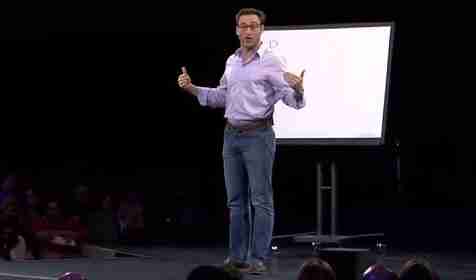
Read here the full transcript of Simon Sinek’s talk titled “30 Minutes for the NEXT 30 Years of Your LIFE.”
Listen to the audio version here:
TRANSCRIPT:
The Experiment with Giving
I did a little experiment with a homeless person. Not like on them, it’s not like electrodes. With them, voluntarily helped me. Because the whole idea of giving, right?
You’ve all walked down the street and you’ve all seen someone begging and you either have or haven’t thrown a few pennies in their cup. When you do, you feel good. You bought that feeling. That is a legitimate commercial transaction.
Commercial transactions are defined as the exchange of consideration. There was an exchange of consideration here. You gave money, you got the feeling of goodwill. You paid for that feeling.
If you didn’t give money, you either feel nothing or you feel bad. You can’t feel good by not giving. You paid for that feeling. So now the question is, how is that person encouraging us to give?
The Corporate Approach to Begging
The joke is, they act like every corporation in the world. They talk about themselves. Me, me, me, me, me, me, me, right? Like they sit there with their little outdoor advertising. Little sign, right? And it says, “I’m homeless, I’m hungry, I’ve got 12 kids, I’m a veteran, God bless.” They got it all in there. Trying to appeal to somebody.
The religious vote, the veteran vote, you know, the child sympathizer. Surround yourself with lots of pets, go for that one too. All in an attempt to get something from someone. Takers, not givers, right? All about me.
Well, what do corporations do? We’ve added more RAM, we’ve added more ROM, we’ve added more speed. This one’s number one. We’re the biggest, we’re the best. We’ve been around since 1969. We’re better than them, we’re faster than them. We’re more efficient than that one. Me, me, me, me, me, me, me, me, me, me. And so even if we buy their product, guess what? Eh, we don’t feel much.
The Revolutionary Sign
So I did this little experiment. I found a nice homeless lady on the streets of New York who was willing to help out. And I learned that with her sign, which was pretty typical, “I’m homeless, I’m hungry, blah, blah, blah,” she makes between $20 and $30 a day for a day’s worth of work. Eight to ten hours of sitting there selling goodwill.
Eight to ten hours, she’ll make $20 to $30. $30 is considered a good day. I changed her sign, and the new sign made her $40 in two hours. And then she left. It’s one of the reasons she’s homeless, is because she’s decided that she only needs $20 to $30 a day to live. If she stayed, she would have made $150. The point is, she made $40 in two hours. What did the sign say?
The sign said, “If you only give once a month, please think of me next time.” It has nothing to do with the taker. It has everything to do with the giver. And what are the objections people give when they don’t give?
“I can’t give to everyone. How do I know that they really need it?” And so I address both those concerns. I know you can’t give to everyone, so if you only give once a month, my cause is legitimate. I will still be here when you’re ready to give. $40, two hours. Make it about them, not about you.
The Importance of Understanding People
The fact of the matter is 100% of customers are people. And 100% of clients are people. And 100% of employees are people. I don’t care how good your product is. I don’t care how good your marketing is. I don’t care how good your design is. If you don’t understand people, you don’t understand business.
We are social animals. We are human beings. And our survival depends on our ability to form trusting relationships.
The Deadliest Catch: A Lesson in Human Connection
Did you ever watch “Deadliest Catch” on the Discovery Channel? I was flipping through the channels one night and “Deadliest Catch” came on. And on this episode, just random, they were in a huge storm.
Now, for those of you who don’t know “Deadliest Catch,” they take these crab fishing boats out in the Bering Sea, which is, like, terrible, and they put cameras on them and we watch. Right? The reason that’s, I guess, significant is because these crab fishermen have, I think, one of the top five deadliest jobs in the world. You know, I don’t know what the exact number is, but dozens of fishermen die every year doing this.
So they have cameras only on five or six of the ships, even though there are many, many, many ships that go out fishing every season. And they don’t really come into proximity with each other, because, you know, the ocean’s huge. And they usually sabotage each other and give each other false information because they’re all competitors. They’re all looking to get the crabs and, you know, make sure that they find them and somebody else doesn’t.
And, you know, it’s business, right? It’s just business. It’s okay. We all do the same thing in our own company.
And in this one episode, this big, huge storm was so violent that they had to bring all the pots, which are the big cages that they catch the crabs in, they had to bring all the pots back on the boat and wait out the storm. And just by dumb luck, one of the boats that had cameras on it was in proximity of a boat that didn’t have cameras on it. And so they filmed. They had secured all their pots on the deck, and so they started filming the other boat.
And they filmed a guy climbing on the outside of the cage, securing the pots.
And all of a sudden, a huge wave hit the side of the boat, and the guy’s not there anymore. And the people on the boat with the cameras start screaming, “Man overboard, man overboard, man overboard!” And they turn their boat towards where they think he might be.
He’s a stranger. They don’t know him. They don’t know the crew members of the other boat. And yet they react, and they turn towards him.
And they find him in the drink. And for those of you who don’t understand how dangerous this is, if the water is so cold that if you’re in the water for, I think that it’s a minute or a minute thirty, hypothermia will set in and you die. And they come upon him, and he’s screaming, “Don’t let me die, don’t let me die.” And they pull him on board, not out of the woods yet.
They strip off his clothes, because it’s wet and cold, and they wrap blankets around him to prevent hypothermia from setting in. And he survives. And it’s overwhelming. And the captain comes down, and this is, oh, I mean, you can go watch it on TV.
The camera comes, the captain comes down, and he hugs this stranger, this young man, his competitor. He hugs this guy as if he’s his own son. I lost it. Everybody is crying.
And you realize what happened here was a human interaction. And the reason that they risk their own lives to help this other person, even though they spend every other day trying to get ahead and sabotage, is because at the end of the day they’re all crab fishermen. And they know something about each other. And they know something about the risk that they all take to do this.
And when push comes to shove, they will put themselves out there to help each other for no other reason than they get it. They’re one of the same. I will promise you that every single member of that crew that day went home with a feeling of fulfillment. I promise you that every single person on that crew that day felt more good in their hearts and in their jobs than the richest day they’ve ever pulled in.
The Power of Helping Others
My question is, is what are you doing to help the person next to you? Don’t you want to wake up and go to work for the only reason that you can do something good for someone else? Wouldn’t you want them to do that for you? By ourselves as individuals, we are not very good.
We cannot lift heavy weights by ourselves and we cannot solve complex problems by ourselves. But in groups we are remarkable. And so all of this stuff, whether it’s life, whether it’s whatever your job was in the service, whatever your job is out of the service, whether it’s finding a new job, whether it’s making your way, finding out sort of what your passion is, all of these things are incredibly difficult. They’re all incredibly complicated.
And the person who thinks that they can tackle any of these problems by themselves is a fool. Plain old, you’re a fool. You cannot. I’m going to tell you, you cannot do it alone.
The Importance of Asking for Help
And so asking for help is perhaps the greatest single thing anyone can ever learn, especially where everything is new and the stresses are different and often feel overwhelming and scary, totally unfamiliar. And the longer you are in the service, the scarier it is. Because you had 15 years doing one thing, knowing one thing, learning a culture, and now not only is it new, people don’t even understand what you did and what you know. The military is one of the most misunderstood cultures in the world.
It’s so closed and insular that people just don’t know it. So you’re dealing with that as well. And so to ask for help in any form is brilliant. This is the single thing that completely transformed my own culture.
I had a small business. I quit my job and started my own marketing consultancy a bunch of years ago. And for a few years, I ran on force of personality, and it was great. But then if you have a little bit of success, force of personality doesn’t work anymore.
And all of a sudden, things started crashing in around me because I couldn’t do it all. And I thought I had to know all the answers, and if I didn’t, I pretended that I did because I thought that’s what I had to do. And I learned the very, very hard way where I came… It was a dark period that I had to learn to ask for help.
And it turns out I was surrounded by people who wanted to help me. They just didn’t because they didn’t know I wanted it or needed it. And it was the willingness to ask for it or accept it that transformed my life. And put me on the path that I’m on now.
Now I’m really open about it. I can tell you stuff I’m really good at, and I’ll tell you I’m good at that. And I’ll tell you I am not good at that. I need help with that.
If I’m struggling or if I’m stuck, if I’m confused, I say, can I ask you? I call up friends, I call up people, mentors, and say, I need your help. Can you help me? And here’s what I’ve learned about the building of trust.
We don’t build trust by offering people our help. We build trust by asking people for help. That’s what actually creates trust, because it’s an expression of vulnerability, right? It allows people to offer us safety and protection.
And that’s an act of service for the other person. Listening is a trust-building exercise, right? Take it down to a personal relationship. If you’ve ever had romantic relationships, a loved one, right?
Making someone feel heard doesn’t mean you’re wrong. Saying sorry doesn’t mean you’re wrong. It just means you take accountability for your actions. And I think it is important that when somebody objects to vaccination, that we don’t demonize or villainize them, but we attempt to hear them, make them feel heard.
The Art of Listening
It doesn’t mean we have to agree, but they have to feel heard. And, you know, listening is not hearing the words. It’s making the other person feel that they were heard. We don’t get to decide when hearing has happened, when listening has happened.
They do. And, by the way, it’s not 100% successful either, you know, because some people are just hell-bent on… But that’s a minority. And so I think the exercise is sitting down with people and say, “Tell me what you’re going through, tell me what you’re afraid of.”
I want to understand, because we’re trying to make everyone safe. I want to hear what your thing is. And let them tell their story. We have no answers. We’re not there to object. We’re not there to react. We’re not there to fix or tell them that they’re wrong. Women are better at this than men.
And I think that has to happen, and it can happen simultaneously. They’re not mutually exclusive. I’ll give you one example, which is I have a friend who refused to get vaccinated. And I sat down with her and I said, “Tell me your reasoning, right?”
She goes, “Well, this new technology, like, I don’t want to… We don’t know if it hasn’t been out long enough. Like, we don’t know.” So what I hear is fear of the unknown.
I go, “Go on.” And I let her talk and say her thing and explain all the things. And I simply said, “So you’re afraid of the mRNA technology, right?” “Yes.”
“I don’t want them screwing with my DNA.” I said, “Well, just so you know, it’s 20-year-old technology. But then I found something I could agree with her. But you’re right.”
“It is the first time it’s been commercialized. You’re absolutely right. It’s the first time we’ve put it in the market.” So I affirmed her fear.
And then I said, “Do you get flu shots every year?” She goes, “I do.” I said, “OK, Johnson & Johnson is a good old-fashioned flu shot. It’s a different technology. It’s not mRNA. So you’re 100% right. If you’re afraid of the new technology, don’t get Moderna or Pfizer. But Johnson & Johnson is just like a flu shot, the same old tech.”
And she went, “It is?” I said, “It is.” She went and got a Moderna shot. Because she just wanted to be heard.
Because most of her friends, when she said, “I’m not getting vaccinated,” yelled at her, told her she was stupid, told her she’s an idiot, told her she’s letting her friends down, told her she’s making other people sick, told her she’s a risk to society. That doesn’t make somebody’s mind open up. All I did was let her feel heard. I think we do.
Emotional Professionalism in the Workplace
If we can’t, we have to do that. I think some people turn off the humanity when they go to work. They may be loving parents and loving friends and loving children to their own parents, and yet, for some reason, there’s a switch that they think that that’s irresponsible to do at work. Now, I’m not talking about necessarily wearing your heart on your sleeve every day.
There is something called emotional professionalism. If you’re having a bad day, you can say, “Listen, I’m a little off my game today,” but you can’t sit in a meeting with your arms folded and be grumpy and give one-word answers. That’s emotionally unprofessional. You can have hard feelings, but you can’t go around screaming and yelling at people.
So I think there is emotional professionalism, but I think for some reason, especially as people make their way up the ranks, they think that expressing any kind of emotion is a sign of weakness. Even that word vulnerability, it’s such a common word now being talked about in the business world that you have to be vulnerable. To this day, it makes some people feel very uncomfortable. I don’t want to be vulnerable.
Well, all vulnerability means is saying things like, “I don’t know,” or “I need help,” or “I’m overwhelmed,” or “Can you help me do this because I don’t know how to do this,” or “I’ve been promoted to a position where maybe I need more training.” And the reason we’re afraid of saying that is for fear that it makes us look weak, which will then damage our careers. The reality is the total opposite. By saying, “I don’t know,” means someone can help us.
But instead, we choose to lie, hide, and fake very often, which eventually gets revealed. Enough stress piled on in that lying, hiding, and faking collapses either professionally or personally. We either feel the stress or the projects that we’re working on start to go haywire. And very often when we get to those points, everybody knows anyway.
The Power of Asking for Help
And the amazing thing that I’ve learned is when you say, “Can somebody help me?” we’re surrounded by people who would love to help us. They just didn’t think we needed it because we acted as if we didn’t. I think a large part of it is, quite frankly, fear. Fear that if I express these things that people will think I’m not qualified for my job.
The opposite is true. And remember, when you are in a position of leadership, you don’t actually have to be better at doing the job than the people you lead. You have to be responsible for taking care of them to make sure they’re good at their job. But for some reason we think that I have to be better than you at your own job because I’m the leader.
Completely false. I just have to make sure that you’re equipped, you have the tools, the training, and the psychological safety to be the best you can be, even if it’s better than me.
Defining Success
Success is an elusive thing, right? What is it? And I think it’s very interesting that if most people can’t define success, well, it means you made X amount of dollars. But if you make X amount of dollars but you spend more, are you successful? Or, well, it means you come home happy every day. Okay, how do you know when you’re happy, you know?
So I think success is a funny thing, which is we all seem to pursue it, but we don’t know how to measure it or actually how to define it. So how do you pursue something that you can’t measure? Fascinating. So when people say to me, “How do you measure success?”
The question we all have to ask ourselves, am I successful? I don’t know. I mean, I had a good year last year. And what does that mean? Does that mean I made a lot of money? Does that mean I was really happy? Oh, I’ll let you decide, right? Maybe neither, maybe both.
I had a good year last year, but am I successful? And the answer is no. I don’t feel I am because I’m trying to build a world that doesn’t exist yet. I’m trying to build a world in which 90% of people go home at the end of the day feeling fulfilled by the work that they do.
So I definitely took a big step forward towards that goal, but I’m still so far away. So somebody said to me, “Then how do you know if you’re successful?” And the answer is if it can go by itself.
Measuring Momentum
And so what is more interesting to me as a measurement of success is not the markers, per se. It’s not the financial goal or the size of the house that you want to buy. Those are nice things. Go for it. But those are not measurements of success.
Those are just nice things to collect along the way. For me, it’s momentum. I want to measure momentum, which is, you know, when something is moving and you start to see it lose momentum, you’re like, “Uh-oh, give it a push.” Because if you don’t give it a push, it’s going to stop.
And an object in stasis is much harder to get going. It requires a lot more energy to get something started than it does to keep it going, right? And so if you don’t let it stop and you can keep it going, you know, it still might slow down down there, but you can get it going again much easier. And for me, the opportunity is to get the ball rolling faster and faster and faster and faster and faster and bigger and bigger and bigger.
It’s like a snowball. And my responsibility is, because it’s not rolling downhill yet, it’s not on automatic yet, I need to still keep it going to find that critical mass where it can go. And at the point it can go by itself without me, then I will find something else to do. And that may not happen in my lifetime.
I think we must all stop measuring promotions, salaries, and these things, but rather measure the momentum of your career. Does my career have momentum? Can I see it moving in the right direction? Can I see it gathering moss, you know?
Can I see that it’s becoming easier for me to keep the momentum? It’s becoming easier for me to grow. The size of this thing, it’s requiring less effort. That’s the thing we need to measure.
That’s the thing that we need to be cognizant of, which is the momentum of our career is not just the markers that we think define our success.
Understanding Dopamine
Dopamine is the feeling that you’ve found something you’re looking for, but you accomplished something you set out to accomplish. So you know that feeling you get when you cross something off your to-do list? That’s dopamine.
It feels awesome. You know when you have a goal to hit and you achieve that goal and you’re like, “Yes!” You feel like you’ve won something, right? That’s dopamine.
The whole purpose of dopamine is to make sure that we get stuff done, right? The historical reason for dopamine, we would never eat if we only waited to get until we got hungry because there’s no guarantee that we would find food. So dopamine exists to help us go looking for food. We get dopamine when we eat, which is one of the reasons we like eating.
And so when you see something that reminds you of something that feels good, we want to do the behavior that helps us get that feeling, right? So let’s say you’re out there going for a walk and you see an apple tree in the distance. You get a small hit of dopamine. And then what it does is it focuses us on our goals.
And now we start walking towards the apple tree. And as the apple tree starts to get a little bigger, we feel like we’re making progress. You get another little shot of dopamine and another little shot of dopamine until you get to the tree and you’re like, “Yes!” Okay? This is why we’re told you must write down your goals. Your goals must be tangible. There’s a biological reason for that. We’re very, very visually oriented animals.
You have to be able to see the goal for it to biologically stay focused, right? If you don’t write down your goals, if you can’t see your goals, it’s very hard to get motivated, to get inspired. For example, think about corporate visions, right? A corporate vision has to be something we can see. That’s why it’s called a vision. You can see it, right? To be the biggest, most respected, to be the fastest growing are not visions. They’re nothing, right?
What does that even look like? Respected by whom? Your mother? Yourself? Your friends? Your shareholders? Who knows? What’s the metric? Dunno. Being amorphous doesn’t motivate us. Just like I can’t tell you, you will get a bonus if you achieve more. You’re going to ask me, how much more?
I’m going to say, more. Doesn’t work. You need a tangible goal. You need a tangible goal, right?
Here’s a great vision. Martin Luther King. “I have a dream that one day, little black children and little white children will play on the playground together and hold hands together.” We can imagine that.
We can set our sights on that. And every time we achieve a goal and achieve a metric and achieve a milestone that makes us feel like we’re making progress to the vision we can see, we keep going and going and going until we achieve something remarkable. You have to be able to see it. Dopamine.
The Dopamine Addiction
Like I said, dopamine is the feeling you get when you set out to find something you’re looking for as well. Talked about the to-do list. I came home from a trip just a couple days ago and I had a bunch of errands to run and I wrote down a little list of things I had to do and off I went, right? And I was walking past something.
I remembered, oh, I have to do that and I hadn’t written it down on my to-do list. So I went in and finished what I needed to do and then when I came out, I then wrote it on my to-do list and then crossed it out. Because I wanted the dopamine. Feels good.
Dopamine comes with a warning. Dopamine is highly, highly, highly highly addictive. Here’s some other things that release dopamine. Alcohol. Nicotine. Gambling. Your cell phone. Oh, you think I’m joking.
Okay, we’ve all been told that if you wake up in the morning and you crave a drink, you might be an alcoholic. Well, if you wake up in the morning, the first thing you do is check your phone before you even get out of bed. Might be an addict. If you walk from room to room in your own apartment holding your telephone, you might be an addict.
When you’re driving in your car and you get a text and your phone goes beep. We hate email, true. We love the beep, the buzz, the ding. Right?
You’ll be there in ten minutes and yet you have to look at it right now. You might be an addict. And even if you read it and it says are you free for dinner next Thursday and you have to reply immediately, you can’t wait the ten minutes, you might be an addict. And for all you Gen Ys out there who like to think that you’re better at multitasking because you grew up with the technology, then why do you keep crashing your cars when you’re texting?
You’re not better at multitasking. You’re better at getting distracted. In fact, if you look at the statistics, ADD and ADHD have, diagnoses of ADD and ADHD have risen 66% in the past ten years. Okay, ADD and ADHD is a frontal lobe disorder, right?
Are you telling me out of nowhere 66% of our youth has a frontal lobe problem? Where did that come from? No, it’s a misdiagnosis. Right?
What are the symptoms of a dopamine addiction to technology? Distractibility. Inability to get things done. Easily distracted, you know? Shortness of attention. It’s all the same things that we misdiagnose things. It’s this. It’s the addictive quality of dopamine.
We can also get addicted to performance in our companies when all they do is give us numbers to hit, numbers to hit, numbers to hit. And a bonus you get, and a bonus you get, and a bonus you get. All they’re doing is feeding us with dopamine and we can’t help ourselves. All we do is want more, more, more.
It’s no surprise that the banks destroy the economy because one of the things we know about dopamine addicts is they will do anything to get another hit, sometimes at the sacrifice of their own resources and their relationships. Ask any alcoholic gambling addict or drug addict. Ask them how their relationships are doing and if they’ve squandered their own resources. It’s an addiction.
Dopamine is dangerous if it is unbalanced. It is hugely helpful when in a comfortable and balanced system, but when unbalanced, it’s dangerous and it’s destructive.
The Importance of Failure in Innovation
You cannot have innovation or progress without failure. It doesn’t exist. And if you truly aren’t failing as you’re trying to innovate, then you’re probably not pushing very hard because you haven’t broken anything. You’re making very, very safe choices. You could never put a person on the moon without a bunch of rockets blowing up first. Like, of course.
I met a CFO once. I asked him the priorities of the company and he said, efficiency and innovation. And I laughed and said, well, good luck with that. You know, innovation is inherently inefficient because it requires experimentation and experimentation requires failure.
Much is said about failed fast. I actually don’t like the term that we, I think we overuse the term failure. You know, the problem with the word failure is it’s like the word cancer. It’s too broad.
Like, if you have stage four liver cancer or you have a mild melanoma, those things are both called cancer. But they are clearly not the same thing. And the same thing is when we hear the word failure. Some people think failure means experimentation but a lot of people think failure means catastrophe.
And so when we tell our company, failure is good fail fast, that literally scares people. We don’t want to fail. So I think we need a new word. Right?
We want to avoid failure. Failure is catastrophic and it should be avoided. But falling, I think we should encourage. You know, when a kid falls off a bicycle, we didn’t tell them they failed.
We tell them they fell. And what do we tell them? Get back up and try again. So I don’t want to tell people they fail.
I want to tell people they fell. And I want to encourage them to try again and brush up their knees. So I think we should fall and fall often and I will judge the quality of innovation not necessarily by if you fell but how quickly you can pick yourself back up and try again.
The External Nature of Courage
I think courage is external. Right? The reason someone has courage to jump out of an airplane is because there’s a parachute on their back. It’s the external thing. A world famous trapeze artist would never try a brand new death defying act for the first time without a net.
It’s the net that gives them the courage. The Navy SEALs are considered one of the highest performing organizations on the planet. And a former SEAL was asked what kind of person makes it into the SEALs? And he said I can’t tell you the kind of person that makes it in but I can tell you the kind of person that doesn’t make it in.
He said the star college athletes who have never really been tested to the core of their being none of them make it in. He said the preening leaders who like to delegate everything none of them make it in. He said the guys who show up with hulking muscles covered in tattoos because they want to show you how tough they are none of them make it in. He said some of the guys who make it in are skinny and scrawny.
He said they’re physically shivering out of fear. He said but every single one of the guys who makes it in when they’re emotionally exhausted when they’re physically exhausted when they have absolutely nothing left to give somehow, some way they’re able to dig down deep inside themselves to find the energy to help the guy next to them. In other words the reason these organizations and these people have the courage to do remarkable things is not because of their internal strength. It’s because they have the absolute confidence that there is someone to the left of them and someone to the right of them that cares about them and they all know that and it’s the quality of the relationships that we maintain professionally and personally that give us the courage to do difficult things.
Building Trust in the Workplace
Isaac Stern the famous violinist said music is what happens between the notes. Well, something like trust happens between the meetings. You know, few people think about the importance of building trust when they go to work or the what I need to do today to build trust with somebody. Like, this doesn’t really go through people’s minds.
But we have chitchat as we walk into the meeting. We chitchat when we walk out of the meeting and we see somebody in the hall they’re like, “Oh meant to tell you something” or you knock on someone’s door and be like, “Got a minute?” And all those little innocuous interactions over the course of time like any relationship build trust. It’s about setting up the computer and setting up Zoom and having a work session with somebody.
You know, like we’re not working on the same thing but we’re trying to work with somebody, a work buddy or having a lunch with somebody over Zoom or a Monday morning huddle where we talk about what’s on our heart and mind but we do not talk business on purpose or Friday cocktails that are just voluntary. But the most important one is to just pick up the phone and call people and say how are you? That level of empathy. Just check in on someone.
And I think we neglect it because we get mired in the day to day. But, you know, if you’re organized or disorganized, you know, literally keep a list of your team on a little card next to your computer and just, you know, go through it and have I called this person in a while and told him I’m just going to call and check in. It doesn’t matter if something’s wrong or not wrong. Just check in on them.
You know, don’t wait for something to break and let people know that there’s connection and there’s a way to reach out and say I need help. And the most important thing is for leaders to be honest and open about their need to ask for help.