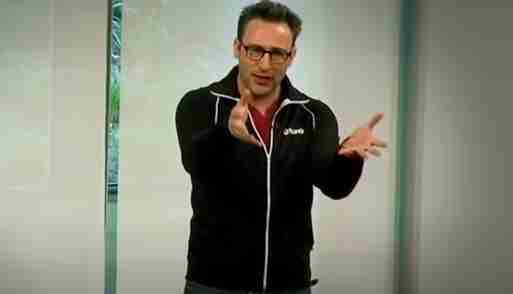
Read the full transcript of ethnographer and leadership expert Simon Sinek’s talk titled “If You Don’t Understand People, You Don’t Understand Business.”
Listen to the audio version here:
TRANSCRIPT:
The Power of Design in Human Progress
SIMON SINEK: Over the next couple of days, you’ll probably hear a lot about how to make better design, how to execute better, how to consider your clients or the end user when you’re doing what you have to do. And I’d like to add another item to the list to consider as you sit here for the next two days, which is how can you help the human race? How can you help the human species progress? I’m not joking either.
This is something I think we all have to be aware of. At the end of the day, the human animal is a social animal. And our very survival depends on our ability to form communities, to form cultures. What’s a community? What’s a culture? It’s a group of people with a common set of values and beliefs, right? What’s a country? It’s a group of people with a common set of values and beliefs. What’s a company? It should be a group of people with a common set of values and beliefs.
The Emergence of Trust
When we’re surrounded by people who believe what we believe, something remarkable happens. Trust emerges. And make no mistake of it, trust is a feeling, a distinctly human feeling. We all have friends who are total screw-ups and yet we still trust them, right? Trust is not a checklist. Simply doing everything you say you’re going to do does not mean people will inherently trust you. It just means you’re reliable.
We need trust, right? We need trust. When we’re surrounded by people who believe what we believe and trust starts to emerge and we trust them and they trust us, we’re more willing to take risks. We’re more willing to experiment, which requires failure. We’re more willing to explore and go somewhere that no one has ever gone before with the confidence that if we fail, if we trip over, if we turn our backs, that those within our community, those who we trust and who trust us, will look after us while we’re gone, will pick us up when we fall over, will help us when we’re hurt.
Our very survival depends on it. We’re not good at everything. We’re not good by ourselves.
The Strength of Community
You know, if I send you out to go fight a saber-toothed tiger by yourself, odds are tiger one, you zero, it’s not going to go very well. But if you go out as a group, we’re pretty damn amazing. And the reason is, is because we all have our strengths and we all have our certain weaknesses. And the goal is not to fix your weaknesses. The goal is to amplify your strengths and surround yourself with the people who can do what you can’t do.
But it’s not just based on skills and application and experience. It’s based on what you believe. It’s based on what you believe. You see, simply being good at something and having somebody else being good at what you’re no good at does not mean you will trust each other. Trust. The sense of trust comes from the sense of common values and common beliefs.
The Power of Shared Values
I can prove it. How many of you are from New York? Okay. A bunch of you. Are you friends with everybody in New York? Why not? Why not? But when you go to Los Angeles and you meet someone from New York, you’re like, “Hey, I’m from New York,” and you’re best friends, right?
And when you go to France, there you are in the Paris metro minding your own business, and you hear an American accent behind you, and you turn around, and you say, “Hey, where are you from?” They say, “Los Angeles.” You’re like, “Hey, I’m from New York,” and you’re best friends. Because when you’re surrounded by people who don’t believe what you believe, when you’re in a strange environment where you don’t feel comfortable, you look for anyone who may share some of the same values and beliefs that you have, and you start to form a very real and very intense bond with them, simply because you know that they have a basic understanding of how you grew up, of the things that you care about, of the life that you live back home.
Shared Values in the Workplace
Well, the same is true when we go to work. Do we want to go to work with people who understand us, who believe what we believe, who have a similar view of the world that has nothing to do with their opinions and the differences that we share? That’s good. That’s called diversity. That’s called advantages to problem-solving, which is we can all look at the same thing from a different angle and come up with solutions. What I’m talking about is why should you help each other in the first place? What are you in pursuit of?
Now, the question is what creates that sense of values and beliefs? What creates that sense of trust? Our very human instinct. We know how to find people who believe what we believe. Our survival depends on it. We’re biologically gifted with this idea.
Finding Like-Minded People
If I ask you to go out on the street and find all the people who believe what you believe, you know exactly what to do. You’re going to strike up conversations. You’re going to start talking to people, and either you’ll have a good feeling about them or you won’t. Either you’ll have chemistry, whatever that means, or you don’t. Sometimes it’s quick, sometimes it’s slow, but we know how to do it. It’s called making friends.
It’s called dating. It’s called networking. We have the innate ability to do it.
The problem is it’s not scalable. The problem is you’re the only one who had that gut feeling. But if you know the symbols to look for, if you know how to see the things that people are doing and seeing, that you can find them. If I tell you to go out on the street and find all the people wearing red hats, it’s easy. There’s one. There’s one. There’s one. There’s one. There’s one. There’s one. They’re easy to spot, simply because they have a symbol. They have something that they’re giving off that says something about who they are and what they believe.
Symbols and Trust
When you were standing on that Paris Metro, that American accent that you heard was a symbol. It was a sign. You don’t know these people, and yet you trust them. They will say to you, “You guys have to go to this restaurant.” And you’ll go, “Okay,” and you’ll go to that restaurant because they told you to. Now, what if you were walking down the street and some stranger just said, “Hey, you’ve got to go to this restaurant.” You’d be like, “Crackpot.” Right? You’re going to ignore them.
This is what trust does. This is why we don’t research everything. We don’t need access to all information. Let’s say you want to go buy a new television, right? So you do all your research, consumer reports, look it all up, right? I know what I’m going to buy. I know what I’m going to do. I’m getting the LG. It’s the best on the market. Can’t wait to get it. Right? That’s what you’ve decided to do this weekend.
That Friday night, you go over to a friend’s house, your friend, the gadget guy, the guy who has the first of everything, right? And you go to his house, and you can’t wait to show up and share with him what you’re going to do with all your research. And you say, “I’m getting the new LG.” And he says, “Nah, man. Get the Sony. It’s so much better.”
In that one instant, either he’s completely turned all of your research on its head, and you’re going to have to go back and do all the research again. Is he right? Should I trust him? Should I believe him? Or you just bought a Sony. All that marketing, all that research, out the tube, down the drain. It doesn’t matter. Because the person that you trust, the person from within your community told you that you should get the Sony. And you trust him. He knows more than you. He must be right. I trust him. I don’t have to know everything.
Again, you’re walking down the street. You accidentally bump shoulders with somebody, and they say, “Where are you going?” And you say, “Oh, I’m going to Best Buy to get the new LG.” They go, “Don’t get the new LG. I know everything about this stuff. Get the Sony.” Crackpot. Right? You’re going to ignore the person. We don’t trust everyone. We trust people from within our community.
But you have to know what to look for. Just as I said before, when you find the people with the red hats, every single piece of communication we make, sorry, every single piece of, every decision we make in our lives is a piece of communication. Every decision we make in our lives as individuals or as organizations is a piece of communication. It’s our way of saying something about who we are and what we believe.
This is why authenticity matters. This is why you have to say and do the things you actually believe. Because the things you say and do are symbols of who you are.
And we look for those symbols so we can find people who believe what we believe. Our very survival depends on it. So if you’re putting out false symbols, you will attract people to those symbols. But you won’t be able to form trust with them.
This is what Tiger Woods did to us. He lied. He lied. He told us what he thought we wanted to hear. And it was great. And we were drawn to it. And all of us who kind of liked that idea of sort of the good guy, we’re drawn to it. Until we found out it was a lie. He could have been the bad boy of golf. He could have had all the same endorsements and had a fantastic career and still been hailed as one of the great athletes of our day, but he didn’t. He chose to lie. Good luck forming trust again, Tiger. We don’t believe you. We don’t trust you.
Attracting Like-Minded People
The goal of putting something out there, if you say what you believe and you do what you believe, you will attract people who believe what you believe. If you go to one of your friends and you say to one of your friends, “How would you like me to dress so that you’ll like me better? How would you want me to address you? How do you want me to speak so that you’ll like me more?” Your friends are going to look at you and be like, “What are you talking about? Come on. Come on. Come on. What should I wear so that you’ll find me more appealing? And how would you like me to speak to you so that you’ll like me more?” And your friends are going to tell you, “Just be yourself. That’s why I like you. I don’t care. Just be yourself.”
So think about what we do in industry. What do we do? We do market research. And we go out and we ask the customers, “What kind of things, what style should we speak to you? How should we decorate ourselves? What kind of things are you drawn to so that we can do those things so you’ll like us more?” It’s just as ridiculous. It’s just as ridiculous.
Organizations should say and do the things they actually believe and they will attract people who believe what they believe. Or they can choose to lie and at the slightest hint that they might be lying, cynicism sets in and people start saying, “I’m not sure I can trust these guys because there’s not a lot of consistency in all the things they say and do,” which means they can’t have a very strong belief set or they’re lying to me. And we call them inauthentic.
The entire process of asking other people who we should be is inauthentic. That’s hilarious to me. All these positioning studies we do are inherent. We’re going to do a study to find out from people so we can be more authentic. That’s hilarious. Say and do what you actually believe and the symbols you put out there, the things you say and the things you do, those red hats are ways that people can find you.
The Role of Designers
What you have the ability to do as designers is create those symbols and allow people to use those things to say something about who they are. Work for companies, work for clients, work for people who you believe what they believe. Show up and feel a part of something bigger than yourself and your part is to put what they believe into pictures and words and symbols and graphics so that other people can use those things to say something about who they are.
People put Harley Davidson logos on their body to say something about who they are. Corporate logo. Ain’t no Procter & Gamble tattooed on anybody’s arm. Because Harley means something, they stand for something. People put that tattoo on there not to tell you that they own a motorcycle, they put that tattoo there to tell you something about themselves.
You ever see anybody with a Mac laptop put a sticker over that beautiful shining apple? Ain’t never going to happen. Then how will you know who I am? You ever see anybody with a PC break out the Windex to clean out their computer? Mac people? Have you ever seen a dirty Mac? Doesn’t exist. Does not exist. Why? Because it’s who I am.
These are symbols we use. The companies that are crystal clear in what they believe and they’re disciplined in how they do it and they’re consistent in what they do and everything they say and everything they do serves as a symbol of the set of values and beliefs. We use those symbols to say something about who we are. We surround ourselves with the people and the products and the brands that say something about who we are.
The Power of Human Connection
And when we can find the people who believe what we believe, we’re weirdly drawn to them because our very survival depends on it. We need it. And so the more you can give of yourself, the more you can give of what you believe, the more you can discipline with discipline, say and do the things you actually believe, strange things start to happen.
Just like on that metro in Paris, simply because of one tiny little symbol that was put out there that we are from the same place, we may have the same values, we may have the same beliefs, we’re drawn to each other and we legitimately trust each other and more importantly, we’ll look out for each other. And that’s the key to all of this.
We go to work every day and we sit at our computers and we sit at our desks and we solve problems by sending emails. Get up and go talk to somebody. It’s called human interaction and it’s a beautiful, beautiful thing.
A Personal Anecdote
I’ll tell you a quick story. I was on a plane about a week ago actually, it was only about a week ago, and I was coming down the aisle and my seatmate, I guess, my companion for the next five hours, was already sitting down, she was in the aisle and I had the window seat. And you know, we’ve all had this experience where you’re the one who gets there first and you look down and you hope that it’s that one, please, please, please, no, you know, praying that that becomes your seatmate.
I’ve had many fantasies about wives and girlfriends that never sat down next to me. I, you know, it’s better than an icebreaker, right? “Hi, right? Sitting next to you.” And equally, we’ve seen people coming down the aisle saying, “Please don’t sit next to me, please don’t sit next to me.” We’ve all done that.
Well, she ignored me entirely, so I could only assume that she was praying that I wouldn’t sit next to her. I somehow think that she was hoping that no one would sit next to her. So you know what it’s like, we’ve all been on planes, you travel and you go to the aisle and custom dictates, you know, just general politeness that the person looks up to you and says, “You sitting here?” You know, she didn’t. She completely ignored me, had her face in her book and put my bag in the overhead compartment. She still ignored me to the point where I actually had to say, “Excuse me, I’m sitting there.” And she sort of begrudgingly moved, she didn’t stand up, she begrudgingly moved her legs to the side and went, “Right?” Like this was something she didn’t expect would happen, right?
So I sat down, I knew exactly what this flight was going to be like. I would have my headphones on for five hours and I would ignore the person sitting next to me and be afraid every time I had to go to the bathroom. And when I’m on a plane, the pressure, I have to go more often, it’s very embarrassing. And so I sit down, as soon as I’ve gone, I have to go immediately again. I’m going to have a bladder infection because, anyway, different story.
And so we got into flight, we sort of reached altitude and the flight attendant came around to ask us if we wanted breakfast. And she came over to us and she said, “Would you like cereal, would you like the omelet?” she said to me. And I said, “I’ll have the cereal.”
And she turns to my seatmate and she says, “Do you want the omelet or do you want the cereal?” And she says, “I’ll also have the cereal, two cereals.” Four minutes later, the flight attendant comes back and says, “I only have one cereal.”
So now I’ve already decided in my mind that I was going to say to my seatmate, “You have the cereal,” right? That was, I had already decided. But before the words could even come out of my mouth, she turns to the flight attendant and says, “I’ll have the cereal.” And at that point, I hated her.
And here’s the joke. She lacks a spirit of generosity. No matter what option she would have chosen, she would have gotten the cereal. For one, if she’d waited for three seconds and heard that I was about to offer it to her, she would have got the cereal, right? If she absolutely had to have the cereal, she could have turned to me and said, “Do you mind if I have the cereal?” And I would have said, “Go right ahead,” right? She couldn’t even apologize. She said, “Thank you” to me. “I’m really sorry, allergic to eggs, can I have the cereal?”
In other words, no matter what option she chose, she would have got the cereal. But the one option she went with was to take a selfish perspective, to go for what she wanted and ignore the wants, desires, or needs of anyone around her, even including just being polite. In other words, she didn’t have to give me the cereal. She could have just been polite about it, right?
Now from that point on, I really hated her. And I wrote an article about this little experience while I was on the plane sitting next to her and made no attempt to turn the screen so she couldn’t read it, secretly hoping she was. Salt and pepper hair, glasses, I’m good, thank you.
The Importance of Generosity
And more importantly now, I had no desire to do anything for her anymore, right? Now when we got done, when the flight landed, perhaps as a nice person, if she had just established some sort of rapport with me, just because I’m a nice guy, I would have taken her case down, here you go, you know? But I didn’t, and I wasn’t going to. Or if I did, it wouldn’t have been with a spirit of generosity.
If I did, it would have been as a sort of a smug remark like, “Hmm, there you go, I’m still nice.” It would have been as a, you know, one of those deals. Or I would have done it simply as some sort of positive reinforcement to myself that despite this horrible person, I’m still a nice guy, right? No matter which one would have motivated me to take that case down, it wouldn’t have been with a spirit of generosity. It would have been some sort of selfish act or some sort of aggressive act, right?
It’s the spirit of generosity. If we’re willing to give to the person next to us, it’s amazing what they’ll be willing to give to us, right? And again, our very survival depends on this. We need to trust each other and we’re more willing to trust somebody who’s willing to help us.
The Problem with Self-Help
I hate the whole self-help industry, right? How can you be happy? What are the five steps you can follow to be a millionaire? What are the seven steps that you need to get the career that you want? You know, me, me, me, me, me, me, me, me, me. What about helping the guy next to you? What are the five steps that you can do to help the person next to you lose some weight? What are the seven steps that you can follow to help the person next to you find the job that they want?
Do you know how we get fulfillment? You can be happy because you did things at work. You can be proud because you did things at work. You can be excited because you had a big success at work. But do you know how you feel fulfilled at work? When you do something for someone else. The only way we get that feeling. It’s the only way we get that feeling.
You know why the statistics say that over 90% of people don’t feel fulfilled by the work they do? It’s not because of the job. It’s not because of the pay. It’s not because of the benefits. It’s because we don’t help each other anymore.
We sit in our cubes and we work. And anything that we turn to anybody is because we need something. We need to get something. And yet we don’t put ourselves out there simply for no other reason than to help somebody else.
Do you know what generosity is? Generosity is doing something for someone else expecting nothing in return, at no point ever. “I did something for him. Why won’t he help me?” It’s not an equation. It’s designed to help you feel good.
And Mother Nature has given us this feeling when we do something for someone else to encourage us to do it. Because when we are in groups, when we are surrounded by people who believe what we believe, trust emerges and our very survival and progress goes up. Sex feels good. It’s why we do it. And Mother Nature has provided that it will feel good so that we can do it more, so that we can procreate. That was not an accident, right? Well the same goes here. That sense of fulfillment that we get was designed so that we’ll do it more, so not only will we procreate, but we’ll create strong senses of bonds and cultures amongst each other.
An Experiment with Generosity
I did a little experiment with a homeless person. Not like on them. It’s not like electrodes. With them. Voluntarily helped me. There’s the whole idea of giving, right? You’ve all walked down the street and you’ve all seen someone begging and you either have or haven’t thrown a few pennies in their cup. When you do, you feel good. You bought that feeling. That is a legitimate commercial transaction. Commercial transactions are defined as the exchange of consideration. It was an exchange of consideration here. You gave money. You got the feeling of goodwill. You paid for that feeling. If you didn’t give money, you either feel nothing or you feel bad. You can’t feel good by not giving. You paid for that feeling.
So now the question is, how is that person encouraging us to give? The joke is, they act like every corporation in the world. They talk about themselves. Me, me, me, me, me, me, me. They sit there with their little outdoor advertising, little sign, right? And it says, “I’m homeless, I’m hungry, I’ve got 12 kids, I’m a veteran, God bless.” They got it all in there. Trying to appeal to somebody. The religious vote, the veteran vote, you know, the child sympathizer, surround yourself with lots of pets, go for that one too, right? All in an attempt to get something from someone. Takers, not givers, right? All about me.
Well, what do corporations do? We’ve added more RAM, we’ve added more ROM, we’ve added more speed. This one’s number one. We’re the biggest, we’re the best. We’ve been around since 1969. We’re better than them. We’re faster than them. We’re more efficient than that one. Me, me, me, me, me, me, me, me, me, me. And so even if we buy their product, guess what? Eh, we don’t feel much.
So I did this little experiment. I found a nice homeless lady on the streets of New York who’s willing to help out. And I learned that with her sign, which was pretty typical, “I’m homeless, I’m hungry,” she makes between $20 and $30 a day for her day’s worth of work, 8 to 10 hours of sitting there selling Goodwill. 8 to 10 hours, she’ll make $20 to $30, $30 is considered a good day.
I changed her sign and the new sign made her $40 in two hours. And then she left. It’s one of the reasons she’s homeless is because she’s decided that she only needs $20 to $30 a day to live. If she stayed, she would have made $150. The point is she made $40 in two hours. What did the sign say? The sign said, “If you only give once a month, please think of me next time.”
It has nothing to do with the taker. It has everything to do with the giver.
And what are the objections people give when they don’t give? “I can’t give to everyone. How do I know that they really need it?” And so I addressed both those concerns. I know you can’t give to everyone, so if you only give once a month, my cause is legitimate. I will still be here when you’re ready to give. $40, two hours. Make it about them, not about you.
Understanding People in Business
The fact of the matter is 100% of customers are people. And 100% of clients are people. And 100% of employees are people. I don’t care how good your product is. I don’t care how good your marketing is. I don’t care how good your design is. If you don’t understand people, you don’t understand business. We are social animals. We are human beings. And our survival depends on our ability to form trusting relationships.
We could have had this conference online. I could have given the same talk sitting behind my computer. We could have all turned on our WebEx. We could have all sat at our terminals, and I would have given you the exact same information. Would it have been the same? No. I’m not there. I’m not there.
There’s this weird thing about human interaction, right? We can’t form trust without—you can like what I say, but you wouldn’t be able to form trust without it. In fact, simply being here, we all say the same thing. You could have all, for two days, absolutely boring, abysmal speakers. Boring, boring, boring, right? We’ve all been to those. Maybe there’s one shining star. You’re like, “I like him,” you know? And what do we say when we leave? “The speaker sucked, but I’m glad I went, because I met some great people.”
It’s this. This is what the conference is all about. You showed up, not because you’re in an industry. You showed up because you have a common set of values and beliefs. There’s a million design conferences. You’ve got to take time out of your day. You’ve got to pay money. It’s called sacrifice. It’s called payment. It’s called risk. But you’re here simply because you know something about each other.
When you go out on the street, in an area where you don’t belong, where you’re not amongst people who believe what you believe, and you see somebody with the same badge as you and you haven’t met them yet, you’re going to go, “Hey, why?” They’re just as much of a stranger as any other person on the street. But because they have that little symbol that says that I believe what you believe, I’m a little bit like you, we can form a bond very quickly and instantly. You do. You do. It’s called human beings.
The Power of Human Connection: A Deadliest Catch Story
Did you ever watch Deadliest Catch on the Discovery Channel? I was flipping through the channels one night and Deadliest Catch came on. And on this episode, just random, they were in a huge storm. Now for those of you who don’t know Deadliest Catch, they take these crab fishing boats out in the Bering Sea, which is like terrible, and they put cameras on them and we watch. Right?
And the reason that’s, I guess, significant is because these crab fishermen have, I think, one of the top five deadliest jobs in the world. I don’t know what the exact number is, but dozens of fishermen die every year doing this. We apparently find that entertaining, which it actually is. So they have cameras only on five or six of the ships, even though there are many, many, many ships that go out fishing every season.
And they don’t really come into proximity with each other because the ocean’s huge. They usually sabotage each other and give each other false information because they’re all competitors. They’re all looking to get the crabs and make sure that they find them and somebody else doesn’t. And it’s business. It’s just business. It’s okay. We all do the same thing in our own company.
And in this one episode, this big, huge storm was so violent that they had to bring all the pots, which are the big cages that they catch the crabs in, they had to bring all the pots back on the boat and wait out the storm. And just by dumb luck, one of the boats that had cameras on it was in proximity of a boat that didn’t have cameras on it. And so they filmed. They had secured all their pots on the deck, and so they started filming the other boat. And they filmed a guy climbing on the outside of the cage, securing the pots.
And all of a sudden, a huge wave hit the side of the boat, and the guy’s not there anymore. And the people on the boat with the cameras start screaming, “Man overboard, man overboard, man overboard.” And they turn their boat towards where they think he might be. He’s a stranger. They don’t know him. They don’t know the crew members of the other boat. And yet they react. And they turn towards him.
And they find him in the drink. And for those of you who don’t understand how dangerous this is, if the water is so cold that if you’re in the water for, I think it’s a minute or a minute thirty, hypothermia will set in and you die. And they come upon him, and he’s screaming, “Don’t let me die, don’t let me die.” And they pull him on board, not out of the woods yet. They strip off his clothes, because it’s wet and cold, and they wrap blankets around him to prevent hypothermia from setting in. And he survives. And it’s overwhelming.
And the captain comes down, and this is, oh, I mean, you can go watch it on TV. The camera comes, the captain comes down, and he hugs this stranger, this young man, his competitor. He hugs this guy as if he’s his own son. I lost it. Everybody is crying.
And you realize what happened here was a human interaction. And the reason that they risk their own lives to help this other person, even though they spend every other day trying to get ahead and sabotage, is because at the end of the day, they’re all crab fishermen. And they know something about each other. And they know something about the risk that they all take to do this. And when push comes to shove, they will put themselves out there to help each other for no other reason than they get it. They’re one of the same.
I will promise you that every single member of that crew that day went home with a feeling of fulfillment. I promise you that every single person on that crew that day felt more good in their hearts and in their jobs than the richest day they’ve ever pulled in.
My question is, is what are you doing to help the person next to you? Don’t you want to wake up and go to work for the only reason that you can do something good for someone else? Wouldn’t you want them to do that for you?