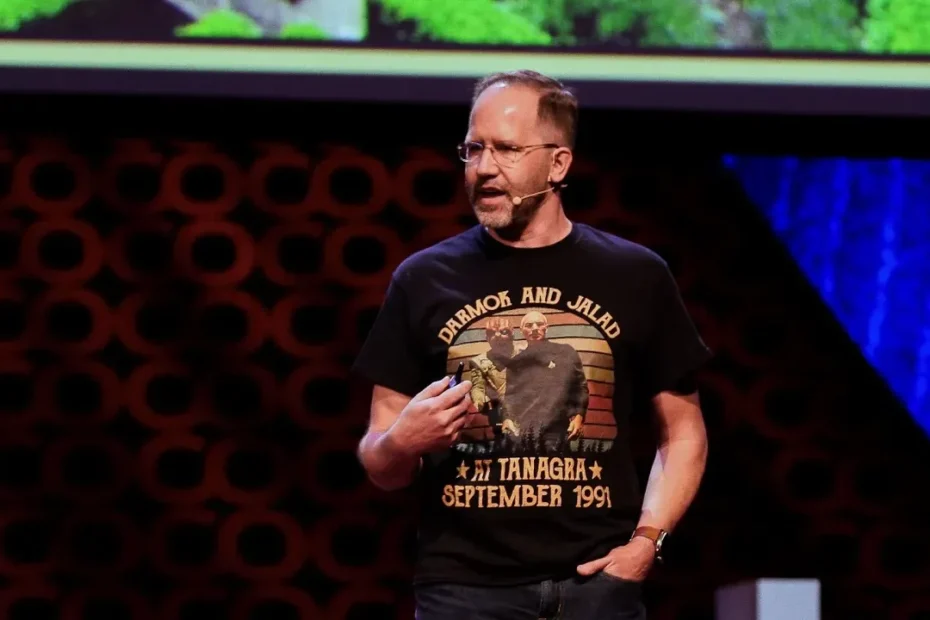
Read the full transcript of Scott Hanselman’s talk titled “Tech Promised Everything. Did It Deliver?” at TEDxPortland, July 17, 2025.
Listen to the audio version here:
Introduction
SCOTT HANSELMAN: Hi, friends. In 1984, a teacher made a promise to me that tech was going to change everything. Her name was Mrs. Marion Mayfield Hill. She was a Portland jazz legend and my fifth grade homeroom teacher. And one day when I was around 10, she brought a computer into my life. She showed us an Apple II. She brought it into our space. She told us we could create. “This is the tool that’s going to change everything,” she said. “We’re going to make things with this.”
And this fit neatly into my life as a family of makers. My dad was an avid woodworker when he wasn’t a Portland firefighter. My mom made all the leather for the Birds of Prey program at the Washington Park Zoo when she wasn’t a zookeeper. So we made things. This fit neatly in our lives and it kicked off a 30-year love affair with tech. And Mrs. Hill believed in tech and she believed in us.
And you may feel that tech has made some promises. It’s promised a lot. You may feel that some of those promises were kept and you may feel that some of them we may have been lied to. I think tech promised these three things. It promised connection, real human connection. We’re going to connect everyone. It promised convenience, a life made easier, not harder. And it promised creativity and freedom of expression.
My Life in Tech
I’m not just a random guy. I have a day job. I’m a vice president at Microsoft, which is a crazy thing. I went to Glenhaven. And at night, I’m also doing tech because I can’t stop. I’m so excited about it. I made an Apple One computer from original parts and my dad made the wooden board on that one because I don’t have the ability to do that. That’s too technical for me. I make tiny arcade games. I’ve made a 3D printed dark saber that runs Python because why not, right? I have an open source artificial pancreas.
I have a deep and profound enthusiasm for technology. And my parents believed this as well. They believed in me and they believed in Mrs. Hill. And Mrs. Hill enabled something unbelievable. My dad and I took our 1972 blue Ford Econoline van and we drove it to Glenhaven every Friday night and we borrowed the Apple Two. I don’t know why Mrs. Hill let me do this. It was a gift. She saw something and she made it happen. And as long as we had the Apple Two back by Sunday night, it was a victimless crime. And we would go back and forth every week and I would get to enjoy this Apple Two and I would make things and I would sit in the garage and I would think and I would create.
Now when you’re poor, you don’t have a lot of money in the bank, but you do have cars in your front yard in various states of repair or disrepair. And one day I showed up at my house walking home from school and the van was gone. They had sold the van and they bought a Commodore 64 for $299 from Sears. What a gift. What a gift those early days in tech were. This was a science fiction filled future. We were going to connect everyone. Like where’s my jet pack? It’s 2025. Can we get the guys at Leica on that?
The Promise of Connection
Tech promised us connection. Connect everyone. I’ve got 800 friends and no one to call. We have isolation bubbles. We have information bubbles. We have depression. We have bullying. There was a report by the American Enterprise Institute that said that 17% of Americans have no close friends. Zero. That’s up from 1% in 1980.
Now Ray Oldenburg in his book The Great Good Place coined the term the third place. The third place is an incredibly powerful concept. In order to be a fully formed human being you need three places. Home, work, and a third place. Somewhere that you belong. Somewhere that you can go to to find your community. Your third place is community. The church, the mosque, the mall, the arcade. Somewhere to be and belong.
In those early days of tech, for me that was the internet. Yeah. It was the internet, but it was a different internet. It was an internet of sharing. It was an internet of belonging. It was a place where we sorted ourselves and decided who we wanted to be. The information was just sorted by date descending. Today’s internet is a series of walled gardens controlled by billionaires, not humans. And the billionaires and the algorithm decide who we are and it sorts us into our spots and it decides what we see and it decides how we behave and the cycle continues.
Now when COVID happened, we saw the collapse of two places. Home and work became Teams and Zoom. Now that is an amazing thing for people with mobility challenges, but for a lot of us we saw another collapse which was home, work, and the third place just turned into us at home, alone, on the internet. And the algorithm is designed algorithmically to make you feel bad. It is designed to make you feel less than. You’re not in first class? Here’s a picture of someone who is. You don’t like your job? Here’s someone who found their dream job on LinkedIn. You don’t want to get scammed? Send me $5 and I’ll tell you how.
We have to start listening to ourselves and how these things make us feel and make decisions that are comfortable for our own psychology. My 17-year-old didn’t like the way the internet was making him feel and on his own he came to me and he says, “Dad, I need an internet detox.
Can you get me an old-timey flip phone?” And once I got over the emotional hit of “old-timey,” I taught him how to move his SIM card from his iPhone to his flip phone and we had Google Maps and some mp3s. A lot of mp3s and we’re not going to talk about where they came from, but there’s a lot.
Now we were promised connection, but are we richer for it? Are we better people for it? Is our lives easier?
The Promise of Convenience
Tech promised us convenience. We wanted instant answers and we got infinite scrolling. We have pocket supercomputers with connectivity to the world brain to solve the world’s great problems and I know you’re all using it every day to ask hard questions like, how tall is Brad Pitt?
This was the gift that we were given, but we were not designed for this. We did not evolve in this way. We were not built for a world that is infinite information. We were built for a world that was information scarce.
But hang on, Scott, I’m built different. I’m a good multitasker. I’m always multitasking. Linda Stone coined this wonderful term, continuous partial attention. It’s that feeling that you have where you’re getting pulled in multiple directions and you have this to think about and that to think about. Oh, hang on. Oh, hello. And then your boss emails you at 2 a.m. on a Sunday and then you reply and you just taught your boss that you’re checking email at 2 a.m. on a Sunday and the cycle continues.
Now, unless your job is checking email at Sunday at 2 a.m., then that is a problem. That is a cultural fundamental issue because we as a collective have decided to have always-on culture. Hey, the internet lets you work anywhere, so now you can work everywhere. Other more advanced cultures like Australia have actually made laws with the right to disconnect. They’ve made a law to not answer your boss’s email. And you get back- Yeah. Because the right to disconnect is the right to your own peace. It is the right to a reduced cognitive load. It is a reduction of the psychic weight that presses on you of the unread messages and notifications and slacks and discords and teams and zooms. I could use a reduced cognitive load.
A couple of years after Mrs. Hill and my parents enabled me to have a computer, I was diagnosed with type 1 diabetes. I was told that I would have to have insulin shots 5 to 10 times a day and prick my fingers 10 times a day, and that sucked. Not super convenient. It’s like having a background process on your computer that you don’t know what it is, but it’s taking up 20% of your brain at all times. And I was like, I want the latest tech, and they handed me a pencil and a spiral notebook. It said, track your
I wanted to look into the latest tech, and I found the latest insulin pump. That’s a pretty cool thing. It’s actually the first insulin pump. I didn’t get to use that. It wasn’t my gift. I wouldn’t know how to make the wooden box. I would have to ask my dad. But I did know about computers, so I did the only thing that I could. I made a small, portable blood sugar management system on a PalmPilot.
I’d like to think that you’re applauding for the hair, because I miss it too.
Tech is supposed to serve us. It is supposed to reduce the cognitive load. It’s supposed to be truly convenient and make us feel better. And today, I have an open-source artificial pancreas that is running my blood sugar for the last 12 years on autopilot. It doesn’t reduce the cognitive load to zero, but it makes cruise control feel much, much nicer.
The paradox here is that we get promised convenience, and then we’re delivered a crushing load that presses us down. It makes it hard to create when you have this kind of stress and background things going on in your life, which brings me to the third promise, because tech promised us creativity.
The Promise of Creativity
I thought AI was going to give us Fridays off. Not really sure how that’s going.
This is my iPhone compared to the computer that my parents bought me. It has 12 million times more compute power. People like to do this. Technology presenters will go, “Look, 12 million. It’s a big number. Wow, 12 million? I didn’t know that. We’ll talk about it at lunch.”
12 million. You can understand 10x. You can understand 100x. This is seven orders of magnitude. “That was a very scientific thing he just said. Seven orders of magnitude. That’s also big. We’ll talk about it at lunch.”
How much power is that? I have more power on my left arm with my smart ring, my smart watch, my smartphone, my insulin pump, and my sensor than existed on the planet in 1980. This cannot be overstated, how much power you have in your pockets.
Surely, this is going to usher in a golden age, a final frontier of creativity. Is our society ready? I know our society is 12 million times more advanced and fully prepared for the ramifications of technology and artificial intelligence.
They call them frontier models. The artificial open AI models are called frontier models. This is the final frontier. I know that we all are hitting the rent and paying for food and everyone’s bills on auto pay, right? “Tea, Earl Grey, hot.” Everyone’s got a food replicator at their house, right? Didn’t you pick one up? No? Okay.
Let’s talk a little bit about AI for a second because this is happening and it’s big. This is a little app that I wrote. I’m asking the AI to say, what’s the next word? “It’s a beautiful day. Let’s go to the…” This is a kind of spicy autocomplete because statistically, it’s been trained on the corpus of all the text on the internet. So it knows that when people talk about beautiful days, they typically want to go to the park. So it’s 90% a reasonable answer.
This isn’t a fact creator. It’s a statistical family feud. Show me park. Fantastic. 90% of people said they were going to park. All right. Now you win. Oh, beach is also an acceptable answer. 10% of people want to go to the beach unless you feed the AI more context. “I live at the coast. It’s a beautiful day. Let’s go to the beach.” This context made it a fait accompli. We’re going to the beach.
This is not correct. It’s not creative. It’s rolling the dice. That’s not bad. It’s not good. It simply is. But rolling the dice is not creative. It’s computer Mad Libs.
So now we’ll give this technology to Mrs. Hill and an educator and they’ll generate a syllabus, right? And then your kids will cheat on their homework and generate a five paragraph essay. And maybe they can just go to the beach and then everyone else can just have the AIs talk to themselves.
That’s not what we should be using this technology for. That’s not the gift of technology and creativity and artificial intelligence.
Creative Uses of Technology
What’s something that we could do? What would Mrs. Hill do that would be more advanced and more thoughtful? Maybe we could have an oral report and we could talk to the AI in the voice of someone who can’t speak for themselves. You could interview Einstein or Maya Angelou. You could talk to Nelson Mandela and then give a report about the time you did a podcast with Nelson Mandela and suddenly tech is alive and interesting and creative in ways that were not possible before.
The whole point is to do things that weren’t possible before while maintaining connection, convenience, and creativity. Those promises matter. Those were the things we were promised.
Mrs. Hill’s Homework
Now Mrs. Hill has homework for you.
We were promised connection. Call out manipulative algorithms that try to sort you into different places. Seek out human connection. And if it pleases you, put down your phone.
We were promised convenience but we got a crushing cognitive load. Set boundaries on your technology. Demand a right to disconnect and prioritize your mental health over the ping of a notification that you can always check later.
We were promised creativity but now we risk algorithmic control and the devaluation of human art. Support human artists. Learn how AI works below the surface. Do a little research, more than they tell you on the news, and make conscious and educated choices about the technologies that you choose to bring into our lives.
Conclusion
They sold the van. They sold the van for the gift of technology and the promise of a future with true connection, with convenience, and with creativity, and with community. They did this for us. They believe in us. They have given us world-changing tools. Are these tools going to change us or are we going to change the world with them?