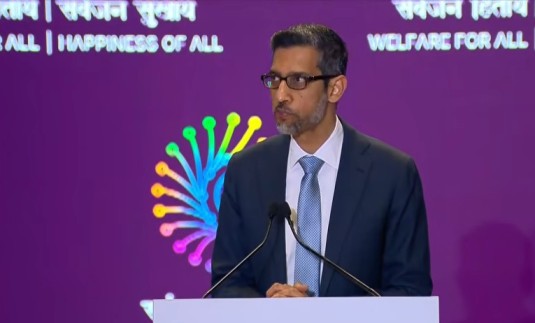
Editor’s Notes: Google CEO Sundar Pichai addresses the India AI Summit, outlining how artificial intelligence can accelerate growth and innovation across the Global South. Speaking from Bharat Mandapam, he highlights India’s unique strengths in talent, digital infrastructure, and policy as it positions itself as a global AI hub. The session focuses on using AI responsibly to boost development, bridge opportunity gaps, and shape a more inclusive digital future for billions. (Feb 19, 2026)
TRANSCRIPT:
SUNDAR PICHAI: Namaste. Thank you, Prime Minister Modi and distinguished leaders. It’s wonderful to be back in India.
Every time I visit, I’m struck by the pace of change, and today is no different. Back when I was a student, I often took the Coromandel Express train from Chennai up to IIT Kharagpur. To get there, we passed through Visakhapatnam, Vizag. I remember it being a quiet and modest coastal city brimming with potential.
Now, in that same city, Google is establishing a full stack AI hub, part of our $15 billion infrastructure investment in India. When finished, this hub will house gigawatt scale compute and a new international subsea cable gateway, bringing jobs and cutting edge AI to people and businesses across India.
Sitting on that train, I never imagined Vizag becoming a global AI hub. Just as I couldn’t have imagined that one day I’d be spending time with teams figuring out how to put data centers into space, or taking my parents for a fully autonomous car ride in San Francisco. Seeing a Waymo through my 83-year-old dad’s eyes, I saw the progress in a whole new light. Of course, he said he’d be more impressed if it worked on India’s busy roads. Still working on that one, dad.
—
The Promise of Bold AI
The progress shows what’s possible when humanity dreams big, and no technology has me dreaming bigger than AI. But that outcome is neither guaranteed nor automatic. To build AI that is truly helpful for everyone, we must pursue it boldly, approach it responsibly, and work through this defining moment together.
Why bold? Because AI can improve billions of lives and solve some of the hardest problems in science. For 50 years, predicting protein structures was a grand challenge and a blind spot that stalled drug discovery.
Demis Hassabis and his team at Google DeepMind asked an audacious question: “How could we use AI to solve this?” That question led to AlphaFold. This breakthrough didn’t just win a Nobel Prize — it compressed decades of research into a database that is now open to the world. Today, over three million researchers in more than 190 countries are using it to develop malaria vaccines, fight antibiotic resistance, and much more.
Asking similarly bold questions across the scientific stack — from cataloging DNA disease markers to building AI agents that act as true partners in the scientific method — is how we move forward.
—
AI for the Underserved
We must be equally bold in tackling problems in regions that have lacked access to technology. Take El Salvador, where Google has partnered with the government to bring affordable AI-powered diagnosis and treatment to thousands who could never afford to see a doctor. Or in India, where our work together is helping farmers protect their livelihoods in the face of monsoons.
Last summer, for the first time, the Indian government sent AI-powered forecasts to millions of farmers — possible in part because of our Neural GCM model.
I see language inclusion as another exciting ambition. In Ghana, we are collaborating with universities and NGOs to expand research and open source tools across more than 20 African languages. We need this bold thinking in more places to tackle more problems across health, education, economic opportunity, and more.
—
Bridging the AI Divide
Technology brings incredible benefits, but we must ensure everyone has access to them. We cannot allow the digital divide to become an AI divide. That means investing in compute infrastructure and connectivity.
I mentioned our Vizag investment, and we have others in Thailand, Malaysia, and more. We’re also building a vast network of subsea fiber optic cables, including four new systems between the U.S. and India, as part of our America India Connect initiative announced yesterday.
Responsibility also means navigating profound economic shifts. AI will undeniably reshape the workforce — automating some roles, evolving others, and creating entirely new careers. 20 years ago, the concept of a professional YouTube creator didn’t exist. Today, there are millions around the world.
—
Building Trust Through Responsibility
Finally, trust is the bedrock of adoption. We have created tools like SynthID, used by journalists and citizen fact checkers globally, to help verify the authenticity of the content you read and see.
But no matter how bold we are, or how responsible, we won’t realize AI’s full benefits unless we work together.
—
A Call to Collaborate
Governments have a vital role — that includes regulators setting important rules of the road and addressing key risks, and importantly, also as innovators, bringing AI to public services that improve lives and accelerating adoption of these technologies for people and businesses.
There are glimmers of this from around the globe — from the Ugandan government using AI and satellite imagery to locate priority areas for electrification, to getting potholes fixed for residents more efficiently in Memphis, Tennessee, by using AI scans of road surfaces from buses.
Tech companies must also step up, building products that boost knowledge, creativity, and productivity to help people achieve their dreams. And we also need companies of all sizes thinking about this — harnessing AI to innovate and transform their businesses and sectors, and to scale up and empower workers.
We have the opportunity to improve lives at a once-in-a-generation scale. I know we have the capability to do this, and looking at the leaders here today, I believe we also have the will. Now we must do the work together.
Thank you.