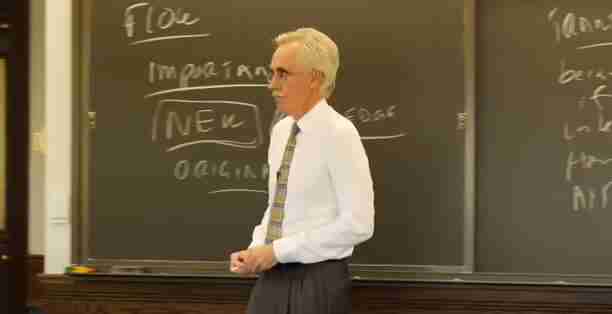
Read the full transcript of Larry McEnerney’s lecture titled “The Craft of Writing Effectively” on May 9, 2024 at University of Chicago.
Listen to the audio version here:
TRANSCRIPT:
The University of Chicago’s Unique Writing Program
LARRY MCENERNEY: Let me immediately clarify things a bit by telling you a little bit about the difference of the University of Chicago’s writing program. We’re one of, as far as we know, two in the country who takes what we call a top-down approach to writing rather than bottom-up. Every other school in the country, their primary constituency is freshmen. So most every school has something like freshman composition, freshman writing, freshman seminars, et cetera.
We don’t actually have that course here. As I remind people, Chicago is, I don’t know if it’s the only university in the country, but one of the few that has more faculty than we have freshmen. That’s because our program teaches throughout the medical school, and they don’t usually count those faculty when they’re talking about faculty ratios to students, but we teach in the medical school all the time. And they’re chock-a-block with faculty because most of their doctors are also faculty members.
So when this program got started in the late 70s, early 80s, our task was not to help the students, it was to help the faculty. This writing program got created because the people on this campus, as the guy who started used to say, “You know, our freshmen write pretty well. By the time they’re third and fourth year students, they don’t write as well. Our graduate students struggle, but the people with the real writing problems are the faculty.” It just turns on its head the standard notion that writing is a basic skill.
Challenging the Conventional Approach to Writing
The standard notion in the U.S. and around the world is reading, writing, arithmetic. You’re supposed to learn it in grammar school, high school, maybe a little bit of college. But if you have to learn it after that, there’s something wrong with you, and therefore there’s something remedial about programs like this.
I’ve been talking to people for 30 years who their main reaction to any program I teach is that they do not want to be there, and they think there’s something a little bit, you know, offensive. I teach a lot in London. Let me tell you, you get a whole bunch of Oxford and Cambridge educated professionals or academics in a room and say, “We’ve brought in this guy to help you with your writing, and by the way, he’s from Chicago.” You know, waves of hostility coming at me across the room.
So I need you to know that this is not a remedial writing course. This is not a course in anything that you should have learned earlier on and didn’t. It is overwhelmingly not a course in rules. I am not going to give you rules for writing. In fact, I’m going to spend a lot of time attacking the fact that your training has been rule-governed training. We think that is very bad for people who are operating at the level that you’re operating.
Rule-governed training is very useful for people who are, and forgive me for saying this, who are churning out a lot of writing, each of which is of relatively low value. So if you’re working at a business where you have to write a short memo every day or two to convey some information to somebody, it’s fine to have a rule. It’s fine to say, this is what it’s going to look like, here’s what your sentences should look like, get it out. But that is not what you’re doing. That is not the level of value your work has to generate.
And so one of the things that I’m going to be saying to you is you need to stop thinking about rules and start thinking about readers.
The Challenge of Expert Writers
So here’s the problem that experts have. You are, in our vocabulary, you are what we call expert writers. What this means is not that you are necessarily expert at writing, although you may be extremely good at writers, but what it means is that you are writing about a subject at which you have expert knowledge.
You are not like high school students who are using their writing to introduce themselves to something at a fairly basic level. You are operating at the most sophisticated levels. When I work with faculty on this and other campus, I am working with people who are, after all, on the frontiers of knowledge. They’re thinking stuff nobody’s thought before. This is very hard stuff.
So here’s what you’re doing. You are thinking about your world in very difficult ways. This is a terrifically good thing, and it’s the source of most of the value of your work. Now you are also writing about that world, and this is where the problem starts arising.
Like a journalist, almost surely you are using your writing process to help yourself think. In other words, the thinking that you’re doing is at such a level of complexity that you have to use writing to help yourself do your thinking. This is quite different from high school students.
The Myth of Separate Thinking and Writing Processes
My high school teachers told me, “Larry, there are two different processes. First there’s a thinking process, then there’s a writing process.” I had a teacher who said to me, “You are not ready to write your first word until you are finished thinking.” And she said to me, “To prove this to you, I’m going to have you, whenever you turn in a paper, I’m going to have you turn in the outline you used to do your thinking.”
This was not a problem for me. First I wrote the paper, then I wrote the outline. But I thought I was the only one. I thought everybody else, when they did this thinking, just, you know, thought it till they were done, and then their essay-like Athena burst from their foreheads onto the page.
Nobody works that way! It doesn’t mean you don’t have outlines, it’s a good idea. It doesn’t mean you don’t take notes, it’s a good idea. It doesn’t mean you don’t have other ways of thinking, but you are using your writing to help yourself think. If you don’t do this, for most people, you cannot think at the level you need to think.
Quite different, say, from a journalist who’s sitting down writing. A journalist is not using the writing process to think up new ideas about the world. You are. This means you have a very different set of writing challenges than anybody else has. This is a course about those challenges. Our program is about those challenges.
The Disconnect Between Writing and Reading
Because here’s the challenge. You write this text, this grant proposal, this article, this dissertation proposal, this book. You actually generate it on the horizontal axis. You actually generate the text while you are doing your thinking.
But then, you’re going to send this text out to readers. And the readers are going to look through that text, and if you’ve done your job, they’re going to change the way they see the world. So here’s the problem, symbolically. You actually generate a text on the horizontal axis, but whether it does its job depends on the vertical axis.
And here’s the problem. Very predictably, experts use language in one set of patterns to do their thinking, but those very same experts read with a different pattern. So here’s what happens. You have used your text as you must use it to help yourself think, but you’re going to use writing patterns and language patterns that interfere with the way your readers read when they read.
Even when those readers are also other experts. So you are interfering with their reading process when you’re writing. I promise you, you are. What happens to readers when you do that?
The last thing they’re going to do is they’re just going to stop. What happens before that? What leads up to that stopping? You’re absolutely right, they stop. But let’s talk a little bit about what leads up to it. You’re writing like this, they’re reading like this. What’s the first thing that happens to them? This has never happened to you.
So they misunderstand. That’s the second thing that happens. The second thing that happens is you interfere, they do not understand. What’s the first thing that happens? They’re skipping stuff, I’m going to put that in the bucket of stopping. They just stop. Either in little ways or big ways, they stop. What’s the first thing that happens?
This has never happened to you? You’ve never tried to read something which was clearly not written in the way you’re trying to read it? I bet that in the last week you’ve read stuff that was not written in the way you are seeking to read it. What’s the first thing that happens to you?
I’m going to put that in the doesn’t understand bucket. See what I mean? The first thing that happens is you slow down. And re-reading is a version of slowing down. You either read more slowly the first time or you have to read and re-read and re-read and re-read. You slow down. We’re going to get back to why this matters in a minute. Second, you don’t understand. Third, come on. You get aggravated. Then, you’re done. Right? Done.
Now, when this happens to you and you re-read and re-read, why did you do that? Why didn’t you just stop? Because I need to read the content. That’s exactly right. What do you suppose happens if they don’t need to read it? They don’t.
The Real-World Writing Challenge
The problem is, forgive me for saying this, you have no idea how to handle that problem. You don’t. You really don’t. Why not? How many things have you written in your life? Imagine the number of academic-y stuff. Forget the letters and all that kind of stuff. Academic-y stuff. Order of magnitude.
I don’t know. 300? 300 texts, let’s make it up. 500? 1,000? I don’t know how many it is. I’ll make it up. 200. 100? How about 100? She’s better with 100.
You’ve written 100 academic texts in your life. Did the readers stop reading them? Did they? Never. No. Why not? They were grading it. They were grading it. Let’s be a little more crude about it. They were paid.
Oh my gosh, guys. Academics get all freaked out when I talk about money. I said, “Guys, I got news for you. Your teachers read your stuff because they were paid to what?” Were your teachers reading your text to think about the world? That’s not what they’re paid to do. Why were your teachers reading your text? Why were people paying them to do it? To change the way they see the world? No. Why?
Teachers read text because they are paid to care about the students. You’ve learned to write in a system where you’re writing to readers who are paid to care about you. That will stop. That will stop. Right? That will stop.
The rules that you’ve learned about writing were rules that were generated in the system where you are writing to somebody who’s paid to care about you. That’s over.
In the world beyond school, I’ll call it a real world, but I’m not sure it’s real. It’s just the world beyond school. They’re not paid to care about you. Why are they reading? Why are they reading your stuff? Why will they read it? The journals? Your colleagues? Because they think it’s valuable to them.
How much of student work is valuable to the faculty to which the students are writing? And, by the way, some faculty who said to you, “Oh, your work was so valuable.” Thank you. They were lying. No. They were lying. It was valuable to them. It was valuable to them because they learned that people misunderstood things in ways they had no idea people could misunderstand.
Faculty sometimes look at me and say, “Oh, no, no, Larry, you’re wrong. No, student writing is actually professionally valuable.” I say, “Then, did you publish it? And if you didn’t, it’s plagiarism.” And they say, “Well, no, actually, it’s valuable.”
The Importance of Valuable Writing
Look, here’s the problem you’ve got. Yeah, your writing needs to be clear. Sure, your writing needs to be organized. The rules that govern this are not what you think they are. In fact, they’re not rules. Yes, your writing needs to be persuasive. This is way more important than this, but more than anything else from now on, your writing needs to be valuable. Because if it’s not that, nothing else matters. It makes zero difference.
Faculty come into my office and forgive me for the drama, but in my office, there’s two chairs in the writing corner. I have a chair at my desk and then there’s two chairs over here. There’s my chair and then there’s a writer’s chair. And next to the writer’s chair is a box of Kleenex.
And I’m not kidding. Because I have people coming to me saying, “I’m not getting, they’re not accepting my proposal, they’re not accepting my draft.” I get faculty who come in and say they’re not publishing my work. And of course there’s Kleenex there because, you know, careers are depending on it.
And sometimes it’s because it’s not clear and sometimes it’s because it’s not organized and sometimes it’s because it’s not persuasive, but overwhelmingly it’s because it’s not valuable. And the other stuff doesn’t matter. If it’s clear and useless, it’s useless. If it’s organized and useless, it’s useless.
If it’s persuasive and useless, it’s useless. That’s the way it is. Now, this terrifies people because they make the mistake, fortunately I’m talking to social scientists, physical scientists don’t have this mistake, they think value lies here. They think, “Oh my God, what if my ideas just aren’t valuable?”
That’s a dopey thing. There’s no such thing as value here. Value is here. The question is whether this particular community of readers values it, which is why it’s so much about readers and not about content.
Can you imagine writing a text which one group of readers thinks is terrifically useful and another group of readers thinks is useless? Well, yeah. I got to tell you, sometimes PhD students come into my office and say, “I really got to get this article published. I’m under so much pressure to publish. I got to publish.” And I say, “Okay, what journals are you going to submit it to?” And they look at me and say, “What does that matter?”
Because they think it needs to be clear. It needs to be organized. It needs to be persuasive. And those are just sort of in the thing itself. Or anybody could look at it and decide it’s clear. That’s crazy wrong. But most importantly, it’s valuable. Value lies in readers, right? Not in the thing.
And so how people can think about their writing without thinking about readers is probably the biggest challenge you face. You’ve been trained to think about writing formally, rule governed. Then you have to think about readers. Not generic readers.
God help you if you came up in a system with standardized tests where you had to write papers for a standardized reader, like on an AP test or an SAT test. That’s disastrous because it specifically teaches you not to think about any differences between readers. We are going to be talking about differences between readers and thinking about those differences. And that’s what I think is how writing actually works, except in the bizarre world of standardized testing.
Comparing Writing Styles: A Practical Example
So I’m going to pass these out. Okay, turn to the first page. And here’s what I want to do. Very quickly, I want to imagine that this is a group of… By the way, any biologists in the group? Wonderful, because biologists have to leave. This is a test that has to do with content, has to do with biology. I don’t want you to know anything about it, because I want you to be responding to the language, the writing of it.
So here’s what I’m going to ask you to do. We’re going to read two imagined contenders for a grant or publication, and we’re going to decide which of these two we’re going to publish. I’m going to read. You stay with me as I read.
1A. “As a consequence of the cost of sex, the theoretical probability of clonal and sexual coexistence is low.” This is not sociology. This is biology.
“As a consequence of the cost of sex, the theoretical probability of clonal and sexual coexistence is low. Observation of coexistence in vertebrate taxa has been reported. Within the frozen niche variation model, a relevant parameter is difference in overall niche breadth. A wider niche breadth for the sexuals and for the clones is predicted in performances in monocultures. Performances in mixtures do not indicate such a relationship. Switching of behaviors or resource use patterns between mixed and pure cultures may be the cause. Post-study will examine the predictions of the FNV model.”
Okay, again, I hope you didn’t understand any of that.
1B. “As a consequence of the cost of sex, the theoretical probability of clonal and sexual coexistence is low. Nonetheless, observation of coexistence in vertebrate taxa has been widely reported. Within the accepted model of frozen niche variation, coexistence is explained by difference in overall niche breadth. However, although the FNV model correctly predicts wider niche breadth for the sexuals and for the clones, its predictions are inconsistent with reported performances in mixtures. Proposed study will examine whether the anomaly may be explained by the switching of behaviors or resource use patterns between mixed and pure cultures.”
Which of these we’re going to be more likely to fund? Second one, of course, why?
Now tell me why. Okay, I’m going to be really big on particular words. Right? Important, right? First thing he said. Now, imagine if you’re the writer of 1A. And we said to her, your work doesn’t seem important. What’s her likely response?
“You obviously didn’t understand it.” “You obviously didn’t understand it.” All right, fix it. Make it better.
This is crucial. What is that writer likely to do? If we said, it’s not important, and the writer thinks you didn’t understand it. They’re about to make a gigantic mistake. Because they would do what? What do you do when somebody says to you, I don’t understand? You explain. Do not do that.
You think I’m kidding. Why do I not want you to explain? And by the way, why did your teachers want you to explain? Why did your teachers want you to explain stuff? Because they wanted to know whether you understood it.
The Problem with Explanation in Professional Writing
You guys don’t know how to explain stuff. You explain stuff under the model of demonstrating to somebody that you understand it. That’s how you’ve learned to explain. You don’t even know you’ve done this. You have learned that what explaining is, it’s revealing to the world the inside of your head. No one cares about the inside of your head. At least, not unless you pay us.
If you pay us to care, we will care. Right? But in the real world, you’re going to stop paying your readers to care about the inside of your head. Here’s a shock. You think writing is conveying your ideas. It’s not. Let me say that again. You think that writing is communicating your ideas to your readers. It is not.
What is professional writing? What is it? It’s not conveying your ideas to your readers. It’s changing their ideas. Nobody cares what ideas you have. This is way more radical than it sounds.
I used to make the mistake of saying to students who came in, I teach argument a lot, and I say to students who make an argument, “Why do you think that?” And then I realize, this is a horrible question. It’s a teacherly question. A teacher says, “Why do you think that?” Because a teacher wants to know what? What’s in his head?
I said, “Oh my God, I’m doing the same thing.” So now I don’t say to him, “Why do you think that?” I say now, “Why should I think that?” Because I think that. And guess what? That doesn’t work. Which is interesting.
Why does it work in academia? Why doesn’t it work in academia? Why doesn’t that work? A professional… This is a great question, right? Why is it that I don’t say, “OK, you think it, I’ll think it?” Why does it not work in, I mean, at least it’s not supposed to work. Sometimes it works.
Why is it not supposed to work in an academic realm? Because we all double… Because what? We all double. Well, that’s probably why it does work. But that’s not why it’s supposed to work. Because there’s a rule of Western academia. It’s a rule that’s, of course, broken in the breach of a million times.
But the rule says, nothing will be accepted as knowledge or understanding until it has been challenged by someone competent to challenge it. That’s the rule. This is very important. Because it changes your readers.
The Role of Readers in Academic Writing
Look, teachers read because they’re paid to care about writers. Some readers in the world, in many cases, read to find out information they need. If you go to somebody on the quad and say, “Excuse me,” if somebody stops you on the quad and says, “Excuse me, can you tell me how to get to the library?” And you say, “OK, yeah, go over there and turn right and go up there.”
They don’t say, “Well, I doubt that.” Because they’re not… They don’t, as readers, have the function of challenging what you say. But at least in theory and in a lot of practice, your readers are different from those readers on the quad. And they’re way different from teachers. Your readers have the professional function of challenging what you say.
So explaining turns out only to happen inside of these two functions. You only explain inside of value having been generated and persuasion having begun. It is an enormous mistake of Ph.D. level writers that they try to explain first. And I know why you try to explain first. Because in school, they just wanted you to explain first because the whole thing was just about seeing what you know. Start explaining.
Line one, classic thing. Begin with a definition. Teachers love this. Begin with a definition. Because it tells the teachers that you, what? You know the definition. Don’t begin with definition, guys.
So, back to B. How are you going to make it important? How do you make it important? Now, the second word you said. Oh, no, that’s a terrible word. Do me a favor. Do me a favor. Take the word new or worse, original. If you think that you’re here to do new and original work, if you would find the synapse in your brain that is storing those words, kill it.
And people say to me, “Oh, does that mean I’m here to do non-original work?” No. But you are not here to do original work. You are here to do valuable work. What’s the difference? You think you’re here to create new knowledge?
The Myth of New Knowledge
Well, you know how hard it is to create new knowledge? We can create new knowledge in the next 30 seconds. All we have to do is count up the number of people who are in this room. Because nobody in the world knows how many people are in this room. No one knows. And we will create new knowledge right now. We’ll just count people in this room. We’ll say, okay, now we know.
Is anybody going to read that paper? Why not? They’re going to say, who cares how many people are in that room?
A dear friend of mine, when I was a Ph.D. student here, discovered journals written by a woman in the late part of the 19th century in England. She traveled around the world and every year she wrote a journal. And somehow they ended up in a library in Norwich. And she was over in Norwich one day and she stumbled into a back room and there was all these journals with tons of dust on them. She blew off the dust and she said, “My gosh, it’s amazing. This woman traveled the world for 30 years and wrote a journal every time she traveled.”
She came back here, wrote up a grant and said, “Whoa, I want to spend three months studying this.” And she got her money and she went over to Norwich and she spent three months and she read the whole thing and she wrote it all up and she handed it to her committee and in an hour and a half they sent it back and they said, “You’ve got to be kidding.”
She said, “Well, I’m going to get my dissertation, I’m going to get green now, right?” They said, “You’ve got to be kidding. We’re not going to give you your PhD.” And she said, “But, but, but, but nobody in the world knew what this woman said.” “Right,” they said. “And we still wish we didn’t know what she said. Because we do not care.”
And she said, “But it’s original research.” She said, “I guarantee you it’s new.” And they said, “That’s right. It’s new and it’s original. But it is not knowledge.” And she said, “That’s ridiculous. It has to be knowledge.” No, it’s not ridiculous.
The Changing Nature of Knowledge
She was living in a positivistic world where knowledge looks like this. In a positivistic world, knowledge is just built up over time. And any time you find out something that people didn’t know, you get to just add up to this model. And knowledge just keeps on growing and everybody’s happy.
And that is dead, dead. Here’s the model now. Sorry, these are people. They’re human beings. There are conversations moving through time. There’s a bunch of people and they get to say what knowledge is. And that horrifies you. Why would those people get to say? Why do they get to say?
Especially because historically, of course, they’ve looked just like me. As my niece says to me every time she sees me, “Too male, too pale, too stale.” Why on earth would these people get to say what knowledge is?
I get it. I get it. Big problem. But they do. And that’s a fact. These people get to say what counts as knowledge. The good news is they are changing. Way too long. Way too late. Way too slow. But they’re changing. But the point is, that’s the way it works.
I like it, but that’s the way it works. They get to say. So, they get to say, “Yep, you’re right. That was new. I didn’t know how many people were in 302. But it doesn’t count as knowledge. It doesn’t have any value to us. Doesn’t count.”
The good news is this thing does move through time. The other good news is this boundary is permeable. And unlike this model, stuff goes out. I like to think of academic conversations as sort of excreting as they go. Stuff gets left behind. It’s not like this. Where everything gets added up is always there forever. That’s not the way it works.
They go along for a while. They think of things for a while. And then they say, “Whoop, that was dumb. Don’t think that anymore.” They go along for a while and they say, “Whoa, we were doing that. Don’t do that anymore.” It’s not this build-up model. This build-up model assumed that everything was right.
We don’t think that. We think a lot of what we think right now is wrong. We just don’t know what the wrong is. And we don’t know what better is. We want to know. We do. We want to get better at it. But in order for us to do that, you have to be dealing with the stuff we say is knowledge.
It might not feel good, but that’s how it works. So, important isn’t going to do it. New isn’t going to do it. Original isn’t going to do it.
The Language of Value in Academic Writing
Because I talk to people and they say, “You know, people don’t think there’s a value. They’re not publishing it.” Well, somebody says they don’t think it’s important. So you know what they do? They say, “This important study…”
What is it about B that makes it feel important? What is it? Tell me the words. On the page.
Here’s what I literally want you to do. I want you to literally, everybody in the room, I want you to literally go through 1B and circle the words, the specific words that are making it valuable to the audience, to the readers. What’s the first word you see that makes it valuable? “Nonetheless.”
Next. “Accepted” is, but actually, “widely.” “Accepted.” Next. “However.” Next. “Although.” “Although.” Next. “Inconsistent.” Next. “Reported.” Next. “Anomaly.”
Here’s my first piece of advice to you that you can use to make your writing better starting this afternoon. Spend 15 minutes a week for the rest of this year taking articles in your field, print them out so you have a hard copy, go through and circle every word in the writing that is creating value to the readers.
If you see an article that you think doesn’t have any of those words, send it to me. I’ll give you my email. Send me your email and say, “Larry, I found an article that doesn’t do it.” Here’s what I bet. You will see none. I will see 10. No, 10’s a five. I’ll give it to you five. Likely, 10.
What’s going on? How come you don’t see them and I see five or 10? You missed them here. I see them. I know the code. Every community has its own codes. The communities you’re entering have their own codes.
A set of words that communicates value. You must know the codes of the communities you’re working in. Particular to communities. Some codes are shared among a bunch of communities. Some aren’t. You’ve got to know. You’ve got to know.
You spend 15 minutes a week for the rest of this year, you’ll be doing two things. One, you’ll be training yourself to look for the code of creating value. The other thing you’ll be doing, if you’re smart, is you’ll be writing down each of those words and you’ll be creating an invaluable word list. So that when it’s a week before something is done and you’re doing one of your revisions, you’re going to do what? You’re going to do the same thing on your own work and if you can’t underline 10 words in the first two paragraphs, you’re going to do what? You’re going to go to the word list and you’re going to jump them in.
Right. Sometimes, sometimes it’s that simple. Sometimes we take articles that wouldn’t get published and in an hour we do things and they get published. Sometimes, weeks. I’m not suggesting this is always magic, but sometimes it’s magic. Sometimes the problems are pretty simple. The problems have to do with these people.
The Importance of Knowing Your Readers
You have to know them. As I say to undergraduates who look at me and they say, “Why does it take six years or five years or even four years to get a PhD? Aren’t they just learning more stuff?” No. Half their time is spent learning more stuff. The other half is learning their readers.
I will say this again. If you do not know your readers, the particular people in a community, if you do not know these people, you are very unlikely to create value and you are very unlikely to be persuasive because persuasion depends on what they doubt. If you don’t know what they doubt, how on earth are you going to overcome those doubts? You must know them. It’s not enough to know your subject matter. You’ve got to know your readers.
Okay. So what is it about… There’s two things going on here then. One of them has to go on with the community of readers. Tell me the words you underline that have to do with the community. Of the words you underline in B. Which words have to do with the community? “Widely.” “Accepted.” “Reported.” Those are words that cue that there was a community of people who want to understand this. You don’t have those words? You’re not signaling any community.
The Function of Transitional Words
What do the other words do? “Nonetheless.” “However.” “Although.” What do they do? They do. And find the synapse in your head that has that word and kill it.
Here’s what’s going on. He has been told or taught or learned that in order to have persuasive, clear, organized prose you had to have what are sometimes called flow words or are sometimes called transition words. Words like because and if and unless and however and although and and and but. Are those words bad? Those words aren’t bad. Is it bad to have flow? It’s not bad to have flow. They have nothing to do with value.
What’s the difference between “and” and “but” in creating value? Imagine if you go to your readers and say “Hey readers. Hey community. Hey community. I’ve read your stuff. I’ve thought about what you think. And I have something to say.” Hey readers. I’ve read your stuff. I know what you think. But you’re wrong. Which one are they going to pay attention to?
It’s hard when you try to publish in journals because if you say that people are wrong those are your editors. Here’s what I will say. And if somebody wants to do it right now, check it. He can name a journal. We will go to every edition of that journal in the last 20 years and every paper will say that somebody’s wrong. Everyone.
Now he just said wait, wait, wait. What’s the difference? He says and I understand it. I can’t go to these editors and say they’re wrong. And I am telling you that every article published in that journal in the last 20 years has opened by saying readers are wrong. He’s looking at me like I don’t believe it. Don’t look. What’s the difference?
The Code of Academic Discourse
One way to put it is you have to know the code. You have to know the code. If you say to the people who are the dominant figures in your field, “You know what? I’ve read all your stuff and you’re idiots.” It’s not going to go well. Right? Don’t say that. What should you say to them? The dominant figures in the field. I say, what do you say to them? What do you say to them?
But if you want to learn the code, what do you suppose the code is? But the code is, “Wow, are you smart. Wow. Whoa, I’m just amazed. You are so smart. And you’ve contributed and you’ve advanced this community through in fabulous ways. But there’s this little thing you’ve got here.”
Thank you for appreciating that. What do you think we have wrong? And then you better have an argument. Not an explanation. Do not explain. Argue. You’re talking to people who wrote this stuff. You don’t have to explain it to them.
You have to predict what they’re going to doubt when you say they’re wrong. So you say to them, “You’re wrong about this.” And they say, “Why should I agree that I’m wrong?” And you say, “Well, here’s why.”
That’s what introductions do. They give a quick version of why these people should think that they’re wrong. And they say, “Well, OK. Preliminarily, I’ve read your first two pages. Now I’ll start reading the rest of it.” Why? Because you’ve caused them to think that your work might be valuable for them.
Imagine if you go to them and say, “Wow, your work has been really great, and now here’s something new that you didn’t know.” See, here’s what happens. People say to me, “Man, if I say that they’ve done something wrong, I’m taking a huge risk.” True. You think you’re not taking a risk if you do this?
What’s the risk you run if you do this? “You’re really smart people. I’ve done all your work. I’ve studied all your stuff. And I have something I want to add.” No, no, no. That’s actually a really good reaction. What’s the risk you run there when you say, here’s something I want to add? We don’t care. Or worse, “I’d like to put my voice into the conversation.” We don’t have any reason to listen to it.
The University of Chicago Writing Program Approach
Let’s pause on that one for a minute. The University of Chicago writing program is not real popular in the world of writing programs. And you can see why. A lot of people think we’re fascists. I don’t dispute it.
Here’s what we teach people to do. We say, identify the people with power in your community and give them what they want. That’s what we teach people to do. Lots of people have said to us in some version or another, “You’re supposed to teach people to challenge the existing community.”
Well, actually, I just did. But notice that I did it inside the terms of the community. I’m not going to say, “Why don’t you teach people to have their own individual voice?” I’m going to say, I get that argument. I get the moral and ethical pressure to teach people to have their individual voices. But when I sit with somebody up in my office who’s worried about their career not going anywhere, it can’t be about their individual voice. It’s about what’s going to make it valuable to their readers.
You need to understand that this program that we have is motivated by those people who have come to us and said, our writing is not succeeding and the whole program is aimed at them. How do you make them, help them succeed? There’s a ton of ethical issues involved in that. You don’t really care. I just want to put them out there.
This is a personal at-risk issue. You want me to go to this really important person, the editors of this journal, and tell them they’re wrong. Yeah, I do. I need you to do it under the code. You want to do it under the code. There’s polite ways to do it. There’s insulting ways to do it. You need to learn how they do it in that community. If you don’t do it in the way they code it, you’re going to get slapped down. What if you don’t do it at all? You’re going to get rejected.
Redefining the Essay
So, alright. Sorry for the drama. Oh my gosh, especially because we’re on page one of a 30-page handout. Alright, page two. Page three, sorry. Technically, we were on page two because there was no page one. Let me just show you a couple of things quickly from these two paragraphs.
The top paragraph, why people write essays. This is a caricature, I admit. This is a caricature, it’s come from something trying to explain to high school students why people write essays. And I just want to show you how wrong this is, how dangerous this is, and how much some of it is actually, you’ve adopted without knowing you’ve adopted it.
“By definition, an essay is a structured, creative, written composition dealing with a specific subject from a more or less personal point of view.” That’s wrong. You notice it says nothing about readers and it says nothing about value.
By definition, anything you write has the function of helping your readers understand better something they want to understand well. That’s what it is because that’s what it does. I’m Dickonstinian on this point. What something means is what it does. Here’s what your writing does. It helps a particular set of readers understand better something they want to understand well. That’s what its job is.
Redefining the Function of Academic Writing
All this other stuff, being structured, being creative, being written, dealing with subjects is how you fulfill the function. Sometimes you do it this way and sometimes you don’t. What is immediately lost is that sense of function. People write essays because it gives them an opportunity to analyze ideas, situations, and people and to preserve them indefinitely.
Can you see how this is all about the writer? It’s why people write essays, so that they can think. I’ve got no problem with somebody writing an essay because they want to think. What I have a problem with is that they come to my office and say my readers don’t appreciate me.
Well, why did you write it? I wrote it so I could think. They don’t owe you their appreciation. They’re not going to appreciate it just because you wrote it.
And this is very different. You can make the case, you can make a very important case. Homie Baba and I used to argue about it when he would not argue, Homie, you’re right. There’s really moral problems with this.
I want to be clear about that. Preserve them indefinitely. Very, very dangerous idea. Can you see how that’s this model? This notion that your writing preserves your ideas indefinitely? No, it does not.
The Purpose of Writing: Moving Conversations Forward
A student of mine, who’s now the chair of a philosophy department, had a lot of trouble getting his first book out. He wrote this book and he was working on it, kept working on it, working on it, and he sent it to me. He was actually a student of mine in his first year here, and he used to write me two-page papers and I would give him six pages of comments. So now he sends me a 400-page book and he says, “Oh, this is cool, Larry. I’m going to get 800 pages of comments.” I sent him two words.
I said, “You’re done.” And he came back to me and said, “No, I’m not done. I can make it better.” I said, “You’re done.” He said, “But Larry, this is ridiculous. I look at myself and I say, I can make it better.” I said, “Jonathan, you’re done.” He said, “But somebody’s going to read this in 500 years and I don’t want to find the fakes.”
Nobody’s going to read it in 500 years. The function of your writing is to move this conversation forward. It cannot do that if it’s in your desk drawer. Your function is to move a conversation forward.
It’s not to preserve indefinitely. Because guess what? You could be some of the stuff, count on it, you’re going to be some of the stuff at some point that gets left behind. This is not a bad thing.
If you think it’s going to be preserved indefinitely, you’re just wrong. It’s really not. And he looked at me and he says, “But Aristotle,” I said, “Come on, Jonathan. Not only does it ensure permanence of ideas for the right of permanence of ideas.” No, it doesn’t. It also ensures a degree of permanence for the writer. No, it doesn’t. If you have that in your head, of course you cannot write.
That’s a standard none of us can meet, except like Aristotle. Don’t, don’t let yourself go there. It is a way for the writer to understand more clearly ideas and concepts. Horizontal axis, horizontal axis, horizontal axis.
It’s a way for the writer to participate in the world by sharing his feelings. Is it a way for you, is your writing a way for you to participate in the world? Yes. But not by sharing your feelings or your thoughts, but by changing other people’s thoughts.
That’s how you participate. It’s a way for the writer to sharpen thinking and organizational skills. Can you see how skewed this is towards students? There’s a way for the writer to enjoy the personal thrill and satisfaction of communicating his own personal ideas and feelings.
I will say it again, your writing is not communicating anything about you. That’s not its job. Its job is to change the way your readers think. Now people look at me and say, well that must mean you’re lying. No. It’s not like there’s only two options in the world. Right? Communicating your inner thoughts or lying.
The Multiple Functions of Language
There’s not. You don’t understand the function. Sometimes, sometimes, the function of something I say is to communicate my inner beliefs. I’m on trial. And somebody says, I literally had an FBI agent in my office this morning. That’s kind of freaky, but it’s actually the truth. So sometimes I sort of have this, okay I need to know about the inner part of you. Sometimes I’m sitting with a friend who’s just gotten some really bad health news and my language is not about me.
It’s about her. The idea that language has only one function seems to me impoverished beyond measure. You have to think, I urge you to think of language as having many different functions. The function of an academic piece is not to communicate your ideas. It’s to change the ideas of an existing community. Now sometimes you do that by communicating your ideas. Sometimes you don’t. But understand what it’s for and understand that your training has been all about revealing your head.
It’s been trained. It’s in your blood. But that’s how you’re supposed to do when you write. And that’s just not the case.
The Changing Nature of Knowledge and Expertise
So, go to the bottom one. Welcome to the world. The new world. “We may thus expect a thorough exteriorization of knowledge with respect to the knower at whatever point he or she may occupy in the knowledge process. The old principle that the acquisition of knowledge is indissociable from the training of minds or even of individuals becoming obsolete. And will it become ever more so?”
The relationship. Here’s what he’s talking about. When I was in school and somebody said, “Oh, she’s amazing. This professor, Professor so-and-so, She’s amazing!” What we talked about? We talked about how much she had in her head. We said, “She knows more about this. She’s forgotten more than I will ever learn.” And what Lyotard is saying here is that knowledge no longer has anything to do with the inside of individual heads.
Now, you talk about somebody being a great professor. What are you talking about? You’re talking about what they have, he or she has done in this exterior space between heads. Now, it’s not how smart they are, how much they know. It’s what they’ve done in the space between heads.
What they’ve exteriorized. What they’ve done out there. That’s your job. It’s not to reveal the interior of your head. It’s to change what’s going on in the spaces between heads. Or however much you want to talk about the construction of knowledge. This is very unpleasant to lots of people.
The relationship between the suppliers and users of knowledge to the knowledge they supply and use. That is your relationship to your own knowledge is now tending and will increasingly tend to assume the form already taken by the relationship of commodity producers and consumers to the commodities they produce and consume. That is the form of value. Your relationship to your own knowledge is the same as a relationship of a farmer to the wheat or a miner to the coal. The relationship is the form of value.
And I bet for many of you that doesn’t feel very good. People don’t like that. I get that they don’t like it. But I can tell you that’s the way it is.
The Nuts and Bolts of Writing: Creating Tension and Value
All right. Now, let’s get out of the stratosphere and get down to some nuts and bolts. The next few pages just summarize what I’ve been talking about. Go to page 8.
So now, I want to go back to the difference between because, if and unless and and and talk about words like but, although, however, inconsistent and anomaly. These words are all serving the same function in this text. These are transition words, as he rightly said, or flow words. These are not.
Anomaly is a noun. Inconsistent is an adjective. But can you see what all these have in common? Anomaly, inconsistent, but, however, although. These are flow words, but these are not. So what does this list have in common? However, but, although, inconsistent, anomaly. It creates tension.
It’s a good word for it. Tension. Which other words? Challenge. Good. Contradiction. We use the word for all of this. We use two words.
First of all, we use instability. There’s not magic. I have no trouble at all if you want to use the words like tension. I can’t read my own handwriting. Challenge. Contradiction. Red flag. We find the word instability to be helpful.
Because here’s what we think is one general way to talk about it. It’s not magic. It’s just helpful. And that is, a lot of people come out of school with a model for writing at the beginning of a text that’s basically in the mode of explanation.
And that is, they think that what you should do is give background or something like definitions and then move to something like a thesis. Notice this is all very much on the positivistic model. That is, knowledge starts by a solid foundation. You have a solid foundation of previous knowledge.
You have a solid foundation of a definition. You have a solid foundation of, here’s the worst one of all, generalizations. Right? So many people have been taught this model. They don’t even know they’re using it. You open with a generalization. You move to a specific thesis. Then you talk about the thesis.
Then you move out to a generalization. At the end we call it the martini glass model of writing. Wow, you don’t want to do this. You really don’t want to do this.
The Problem-Solution Model of Writing
All right? Instead, you open with What I show you on page 8 is a problem. Whose problem? Readers. Got it. A specific set of readers. Not, which is what you’re doing right now, very likely, your problem. I see all kinds of texts that have the language of, “Dear reader, I have this problem that really interests me.”
Sometimes you have this sense of, “Ever since I was young, I’ve been fascinated by fill in the blank. And now, I want you to fund me for a year of solving my problem. Of not knowing enough about blank.” Right? Wrong problem. Wrong location of the problem. Problem needs to be located, not in necessarily in the readers, but in something the readers care about. For academics, it’s something the readers want to understand.
If they’re not academics, it’s something the readers, a problem that the readers want to fix. So, for example, I know nobody’s probably here in education, but if you want to get funding and a grant for studying something in education, you start with a problem in the world. We’ve got an education system that’s clearly broken. That’s a problem.
That’s a problem your readers care about. Probably not the reader’s problem. They actually probably have pretty good educations. They probably are sending their kids to pretty good schools. But they care about that problem. Alright? You locate problems in specific reading communities. This is very different from general background or definition.
Then, you move to a solution. And of course, notice your thesis can be in a solution only if the readers perceive the problem. Sometimes, I’ll say to people, this thesis, is it a solution to a problem? They say, yeah, of course it is. Okay, so where did you say what the problem is? It’s not there! It’s not there. It’s got to be there.
It’s got to be there. Nine times out of ten, 99 times out of 100, it’s got to be there. So that the readers can see it’s a solution to that problem. Now, in very general terms, and I’m just going to sketch this out quickly, we find that problems have two chief characteristics.
The Language of Instability and Value
One is, the situation has to be unstable. That is, you have to generate a sense of instability. Words like, but, however, inconsistent, although, anomaly, show the situation to be unstable. Can you see the crucial difference in why so many writers are so bad at this?
Look at this language. Look at this model. This model is a model of stability and continuity. This model is a model that says, this thesis validity, its validity is established by it being continuous with something that we already know to be valid.
So the language that people use is a language of continuity and consistency. The horrible irony is, your readers are actually searching for a language of instability, inconsistency, and tension. So, the crucial point I want to make is we’re back to this interference pattern. People say, well, look, I just want to talk at this point about inconsistency.
I want to show the continuity between what I’m saying and what comes before. That’s what I want to do at this part of my text. What happens if the readers are looking at that moment of your text for a problem? What if they’re looking to decide whether it’s valuable by whether or not they have a problem?
It’s not neutral. They’re looking for something that shows them inconsistency. You are giving them language of continuity. You are interfering with their reading process. They’re slowing down. They’re getting confused. They’re getting aggravated. And they can stop two paragraphs into your text.
Two paragraphs. They’re done. Because what they’re looking for is value. And you’re using language that’s not neutral. It is contradicting, interfering with their sense of identifying value.
The Language of Costs and Benefits
Okay. There’s a second point, which a lot of academics really dislike. Some don’t mind it at all. Which we call the language of costs and benefits. And we differentiate that for a reason. What we mean is, not always, but very often, you need to code, use code language to your readers to show them that the instability imposes a cost on them. Not on you.
On them. Or, conversely, that the instability, if it’s solved, offers a benefit to them. The language is different. There’s a language of cost and a language of benefit.
There’s a version of saying, “Dear readers, dear important readers, you are brilliant. You’ve advanced us enormously. We’re so grateful. But there’s this little inconsistency in your work.”
Now, they want to know, well, does that inconsistency cost us anything? Because guess what? You know what about my work? It’s got tons of inconsistency in it. Much of it doesn’t make any difference. Is the inconsistency you’re pointing out costing us anything? Or you can say to them, “Hey, there’s inconsistency in your work. If you improve it, you get this benefit from it.”
Those are different coded languages. I urge you to pay attention to the actual journals that you’re imagining publishing in and see whether or not there’s a pattern of language of benefit and language of cost. There may not be a pattern. You may see both.
But if there’s a pattern, you know what my advice is going to be. Use it. Follow it. The published articles will show you the language that works right there in front of you. If you just look at it.
So skip past page nine, page 10. This is just some… This is some explanations of some bad habits.
The Literature Review: A Crucial Component
Oh, yes, please. Oh, the literature review. Yeah. OK, sure. Right. OK, no, I’m happy to talk talking about the lit review. Let’s start by doing this. I specifically talk about a… sorry, literature review.
I just did a terrible thing to whoever poor people who are actually going to watch this. All right. Let’s talk about that. First of all, writing a lit review as a PhD student is one of the hardest things there is to do.
It’s incredibly hard because you don’t know who your readers are. Let’s talk about a straight teacher reading a lit review. What is the function of a lit review for the teacher who is not reading it to change her view about the world, but is reading it to judge you? What’s the function of a lit review for that reader?
To show that you understood it. Right? That’s perfectly clear. Is that its function in a professional text? Is that its function in a professional text? You think they’re reading this to find out whether you know the stuff about anything? What’s its function in a professional text? It has several.
What’s one? What’s the function of a lit review in a professional text? Ego massaging. Ego massaging? That’s a real function. I got no problem with that. Ego massaging is a function. Credibility is a function. Credibility is a function. Yeah, but I hate the language of moving forward, right? There you go. You see the difference?
Here’s what professional good lit reviews and I didn’t include them in this handout, but you send me an email, I’ll send you some. Really good professional lit reviews will use the lit review to enrich the problem. Instead of saying, here’s what a student lit review says. In 1998, he said this. In 2000, he said this. In 2002, he said this. In 2005, he said, sorry for the he’s, but I’m looking at a bunch of he’s here, right?
A professional lit review says what? In 2001, he said this, but in 2004, he said something which if we’re smart, we realize what’s intention. And then in 2005, he said this, which complicates the situation here, but even more complicated if we put that in motion with what he said back in 2001. Now we have layers of complexity, complication, and tension. Now, can we say I’m moving forward?
Yeah, but you notice I’m not moving forward from stability. I’ve now enhanced their sense of instability. And if you’re really good, you’re hyped at the cost. You start saying, wow, not only is there a little tension there, but it’s a tension that matters as this community as we go forward because it suggests that not only were they wrong, but we’re wrong as we move forward based on their ideas.
So it’s not just them, it’s the rest of us. Are we moving forward? Yes, but from instability, not from stability. That’s a big difference.
Examples of Effective Writing Techniques
So, for example, let’s take a couple of examples of this because we can use these examples to talk more about lit reviews. Page 12. Here’s an instance from Bill Sewell who was just a terrific writer. “Ever since Herodotus, historians have written about events. Battles, alliances, scandals, conquests, conspiracies, revolts, royal successions, reforms, elections, religious revivals, assassinations, discoveries. Momentous events have always been the bread and butter of narrative history.”
Now, if you talk to some high school teachers and you’ll say to them, what is he doing there? They will say to you, oh, he’s giving background. No, he’s really not. When do we find out that he’s not giving background? The next word is “but.” He’s not giving background. He’s building a problem. And the differences are enormous.
So many faculty members will say to students, you know what? This paper really isn’t working very well. This introduction doesn’t work. And the student says, what do I need to do? And they’ll say something like, well, you need to give me more background here. Oh, my God.
When you say background to people, they usually say, OK, I guess we have more history of this subject or something. They don’t mean that. They mean, I can’t figure out why this matters. The background they need is a problem.
“But, despite the prominence of events in historical narratives, the event has rarely been scrutinized as a theoretical category.” Now, is that a problem? Is it coded as a problem? It’s undoubtedly an instability. But, is it a problem?
The Gap vs. Error Approach
I’m going to cut to something that I want to just be able to put on the table for you. Later on in this handout, you’re going to see a couple of pages on the difference between what we call gap and what we call error. A lot of, especially young academics, very worried about telling these important people that they’re wrong.
Instead, they use the language of gap. That is, they say, we’ve studied this stuff for a long time, but we haven’t looked at this. There’s a gap in our knowledge. And, the truth is that that sometimes works, but way more often than not, it does not work.
Why not? A gap in knowledge. We have a gap in our knowledge. Why wouldn’t that work? Pardon me? There’s usually a small gap. That’s sure. But, why wouldn’t it work? Pardon? Well, that’s… But, perhaps you’re the first one who’s been able to fill it. It still isn’t going to work.
It often doesn’t work. Here’s what gap assumes. Another model of knowledge that is now dead. This is supposed to look like a crossword puzzle. Can you imagine that this is a crossword puzzle? Here’s what the gap model assumes. It assumes that knowledge is bounded. It assumes that knowledge is like a crossword puzzle with a fixed number of pieces.
And, you say, “Oh, oh, oh, look. I filled in this piece.” This only makes sense in a bounded model of knowledge. Go back to this model. What if we think this is wrong, and that knowledge is infinite? It’s just going to keep on being infinite. Now, what happens to the gap? Think of it this way.
If knowledge is infinite, and you filled in a gap, how many gaps are left? You have done nothing. Because there’s still an infinite number of gaps left. I’m not saying gap can never work. I’m saying gap is very dangerous. Is Bill talking about a gap here? When he says it’s rarely… See the word rarely? That’s usually… That’s often code for gap. Oops. Gap. Haven’t done something. Gap. Is this a gap? No.
It’s rarely been scrutinized as a theoretical category. Why is that a problem? And for whom is it a problem? For whom is it a problem if you say, Ever since Herodotus, historians have talked about events, but nobody’s ever asked what they mean by that.
Oh, that’s a gap? Not for some communities. For some communities it’s what? It’s a gigantic problem if the community is using categories that they do not understand. Right? In some communities they went, Whoa! This is a problem. Because we’re taking for granted that we understand some fundamental category for our field and we don’t even know what the hell we’re talking about. Dangerous.
Defining Communities in Writing
So what is he doing in the next sentence? “Traditional narrative historians who reveled in the contingency and particularity of events generally refused on principle to engage in explicit theorizing.” Background? No. What? What? No. Community. What community are you talking about here? Narrative historians. You people have a problem, narrative historians.
Next sentence. “Meanwhile, historical sociologists, along with a minority of historians, turned into social sciences in order to escape the hegemony of political narrative, generally disdained the study of mere events and sought instead to discover general causal patterns underlying historical change.” What’s he doing there? Another community.
He’s defining his communities. Here are the two communities who have problems. Traditional narrative historians and basically every other historian. Two sentences. He’s described his community, the people who have a problem.
You want to know a very extended version of this? Read the introduction of Said’s Orientalism where he constructs, I think, nine communities. People say to me, “Oh my God, I have this huge problem. I’m writing interdisciplinary stuff.” Interdisciplinary stuff is extremely difficult to write. People come to this campus because we proclaim that you can do interdisciplinary studies here. We scorn traditional disciplinary boundaries.
Here’s the problem you’re going to have when you do interdisciplinary work. Who’s in your community of readers? Go ahead, put that committee together that has somebody, three people on it, and they’re from three different committees. Be very careful.
You got the right three people, amazing. You got the wrong three people, you’re going to have a writing nightmare. Because those are three different communities who are not only going to define problems differently, they’re going to see arguments differently.
So, what Bill is doing here, is he’s saying there’s two communities of people I’m writing to, and he lays them out in the first paragraph of the text. This is first rate functional writing. You’ve got to understand the function, not what it looks like. Not the rules, not the formal, but the function.
Concluding Thoughts and Examples
I will shut up in one minute. So, page 13 summarizes the model from this point. Let me just tell you what’s left in the handout. Page 16. One of the best pieces of problem construction I’ve ever seen. A couple of economists, writing a very long introduction that establishes layer upon layer upon layer of problem.
On page 17, they do something which I have virtually never seen done before. See this chart? See this graph at the bottom of page 17? You don’t usually see charts in introductions, because they usually, what are you thinking charts are for? Either to explain, or to give evidence for something. You know what this chart is? It’s wrong.
How cool is that? It’s a problem. Right? Using a chart as a problem constructing technique? Wow. And by the way, watch their codes. You’ll see how they do this in a very deferential. Everybody’s really smart. But gosh. You know? Really, really nice piece of writing.
Page 20 talks about something that I’ve already mentioned. The danger of gap. Page 22 goes to gap and error. I look at Bill again. Bill’s work on page 23.
I said one more minute, but I’m going to take two more. The last thing I’ll look at is this, I think, quite useful article on page 24 from John Tutino, whom I’ve never met. But I think this is such a great example of cycling all the way back to where we started. The revolution in Mexican independence.
First paragraph. “The Hidalgo revolts of 1810 marked the commencement of conflicts that brought independence to Mexico in 1920 and led to a series of revolutionary changes that endured for decades into the national era. As colonial rule ended, the contested processes.” What is that?
You look at anybody, they’re going to say, oh, that’s background. He’s giving a little historical background. Right? No. Look at the beginning of the next paragraph. “The interpretation just given challenges and entrenched vision of Mexican history.” This is really, really open. John Tutino was strong enough professionally that he could say, hey, all you people, you’re all wrong.
He talks about the view that’s wrong in the second paragraph. Look at the beginning of the third paragraph. “This essay argues for a different interpretation.” So what he’s done is, he first said, here’s a view of history, and then it said, this challenges what all you people think.
The Evolution of an Academic Paper
Now he says, “In this essay, here’s what I’m going to do.” Here’s what I want you to notice. The footnote. “This essay was first presented in a seminar organized by Eric Van Young at the University of California, San Diego.”
Look at the next page, page 25. Here’s what I’m quite sure John Tutino presented in that seminar at the University of California, San Diego. He presented this data, which he had spent a lot of time in Mexico, generating. Tenant renteros at Puerto de Nieto, 1820 to 1825. Rents in pesos. Table 2. Maze plot rentals at Puerto de Nieto, 1820 to 1825. You know, because in 1820 it was 60, and in 1821 it was 33, and in 1822 it was 30.
This, I’m quite sure, is what he presented at the workshop. What do you suppose people thought to themselves at the workshop? Why would I care? What happened in the rents of maze plots at Puerto de Nieto from 1820 to 1825?
Go back to the footnote. “Discussion there helped to clarify the importance and the uncertainties of the issues explored here. More recently, several HAHR [that’s the journal] readers asked that I make the larger significance of the case study more explicit.” Who the hell cares what happened in Puerto de Nieto, John?
I mean, you went down there, you got a grant, you looked through a lot of books, and you came up with a lot of numbers. Why would we care? A final reader, and see why I love this so much, he’s probably been working on this essay, article for what, three years maybe? “A final reader suggested that my interpretations appear controversial.”
Like, hey John, you see this work you’ve been doing? It suggests that everything the people in this community think about the Hidalgo revolt is wrong. He didn’t even know that until the end of his process. In his thinking process, it was probably three years into a final reader told him what problem he was actually engaging.
Where does that come in his article? It’s the first sentence. The difference between this process and this process. To the extent that you are embedded in making your writing handed to the reader on this process, you are very likely to interfere with their reading process.
The more you can, you’ve got to do this guys, you’ve got to do this process to do your thinking. But the more that you can learn how to alter it for these people, the more successful you’re likely to be and the less painful this whole reading, this painful writing process is going to be for you.
Closing Remarks
Okay, I apologize for two things. One, for being longer than I intended and two, for being ridiculously theatrical about this. My only excuse for that is I’m not kidding when I say I have people in my office using the Kleenex. This stuff can be brutally hard and just plain brutal. I am dramatic here in the hope that you will not end up in my office. But let me say you are welcome.
I’m the director of the writing program on campus. I welcome anyone who wants to come and talk to me about writing. If you send me an email and say can we make an appointment, the answer will be yes. It may be a while.
I should warn you. Larry McInerney, my email is lmce at UChicago. Sometimes I’m not in residence. Sometimes I am, but it may be a couple of weeks before we can meet.
So just to warn you, sometimes people, if you say “Larry, can we meet and I’ve got to turn this paper in at the end of the week,” the answer is usually I can’t do it, then I’ll try. But if you give me time, then we’ll do it and I will welcome it because no one on campus more than I appreciate just how hard how hard is the stuff that you’re doing.
OK, let’s stop and we’re done. If anybody wants to hang around, you’re welcome to do so. Don’t do that. I just get more dramatic when people do that.
Related Posts
- Neil deGrasse Tyson on UFO Files, Trump & Alien Existence (Transcript)
- Professor John Lennox: AI Is Humanity’s Attempt to Make God (Transcript)
- What’s Changing, What Kids Must Learn w/ Sinead Bovell @ SXSW (Transcript)
- How Emotions Are Made: The Secret Life of the Brain – Dr Lisa Feldman Barrett (Transcript)
- The AI-Generated Intimacy Crisis – Bryony Cole (Transcript)