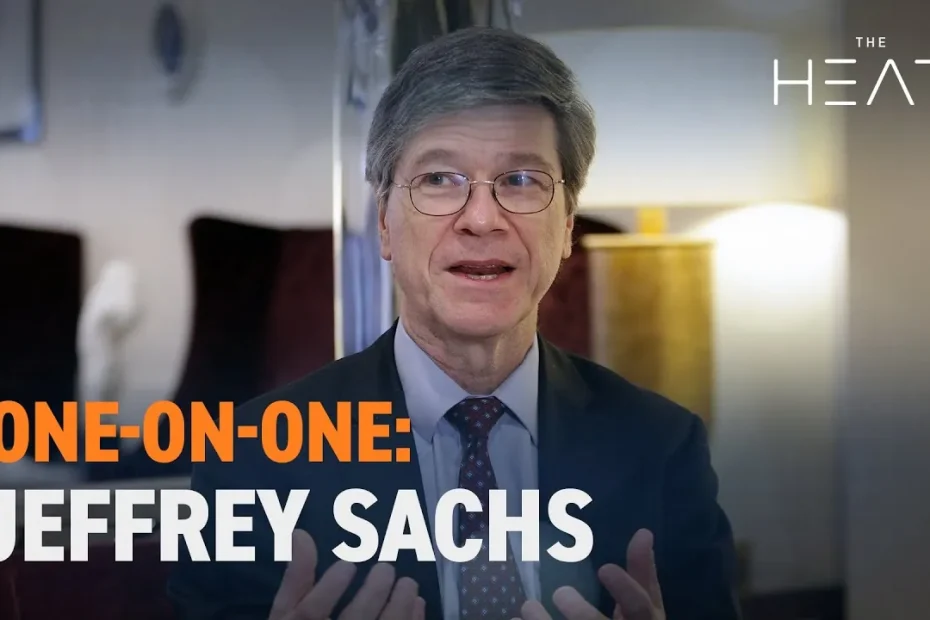
Read the full transcript of host of CGTN America Anand Naidoo interviews acclaimed economist and global analyst Jeffrey Sachs on The Heat, March 10, 2025.
Listen to the audio version here:
TRANSCRIPT:
Introduction
ANAND NAIDOO: World-renowned economist, professor, author and global analyst, Jeffrey Sachs joins me one-on-one to discuss some of the world’s major issues. Hello, I’m Anand Naidoo and this is The Heat. With so many big stories making news across the world, it is my pleasure to be joined by the acclaimed economist and global analyst, Jeffrey Sachs, for his insight and perspective. We will discuss China, its economy and Beijing’s relations with Washington. I will also get his views on the Trump presidency, efforts to end the Russia-Ukraine conflict and the ongoing crisis in Gaza.
Jeffrey Sachs is Director of the Center for Sustainable Development at Columbia University. He is also President of the UN Sustainable Development Solutions Network and has served as a Special Advisor to three UN Secretaries General.
[ANAND NAIDOO:] Jeffrey, welcome to the show.
[JEFFREY SACHS:] Great to be with you. Thank you so much.
Global Conflicts and Economic Challenges
[ANAND NAIDOO:] Well, as I said, the world is beset by many conflicts right now. We see the conflict in Ukraine. We see what is going on in Gaza. We have traditional alliances that are fraying right now. We see protectionist barriers going up, tariffs being introduced, there have been retaliations. It is placing heavy burdens on the global economy. Before we get into some specifics, how would you describe these extraordinary times and are we at some sort of inflection point right now?
[JEFFREY SACHS:] We are certainly at an inflection point. We are in a new multipolar world. Actually we have been in a multipolar world for quite a while, but the United States hasn’t recognized it. So many of the crises that you mentioned, the Ukraine war, the ongoing wars in the Middle East, the tensions between the U.S. and China, in my opinion, have resulted from the failure of the U.S. leadership for many years to understand multipolarity.
The U.S. idea, dating back at least to 1991, arguably dating back to 1945, in some sense dating back to the founding of the United States, is that the U.S. is exceptional, and at least since 1991 that the U.S. runs the show. This is not a very realistic view of the world.
The U.S. leadership doesn’t understand China. The U.S. leadership greatly underestimated Russia. The United States does not understand its isolation vis-a-vis the Middle East and the conflict between Israel and Palestine. The United States still to this moment doesn’t understand the global environmental crisis or doesn’t want to understand it.
And so a lot of the problems, sad to say, emerge from one very powerful country, the United States, which has greatly overestimated its power and greatly underappreciated the importance of diplomacy to address global issues, thinking that somehow go it alone is the right strategy. It’s not, and it’s led to a cascade of crises.
[JEFFREY SACHS:] It’s a little bit complicated. America first doesn’t quite mean what America has pursued since 1992, which is American dominance. The phrase America first means primarily American self-interest. Okay, that’s one version. But American primacy has been the dominant foreign policy since the end of the Soviet Union, meaning the belief by the American leadership that the U.S. dominates the world and sets the rules of the game. Of course, this is a delusional idea.
China is very big, very powerful, doesn’t want to have the United States set the rules, but wants a multilateral system in which the rules are set cooperatively and in mutual respect. For a long time, the United States thought, well, China is a subsidiary to us. China will be helpful in our confrontation with the Soviet Union or with Russia, but it’s not a competitor.
And then it suddenly dawned on the United States leaders sometime around 2010, whoa, look at China’s success, look at its scale, look at its technological innovations, look at its industrial power. And the United States quickly swung from a kind of complacence to a kind of panic about China. And the panic was, we’re number one, but China’s a threat to our primacy.
And so immediately, roughly around 2014, America swung to a kind of, quote unquote, “containment strategy.” We have to limit China’s rise. We have to prevent China from threatening American primacy. I would say this was also wrongheaded and delusional. China’s rise is not a threat to the United States. And at least as I, as an economist, think about it, there’s no ranking one, two, three, the question is human well-being and advancement of China, advancement of the United States. And China’s rise, in my view, was not in any way a threat to the United States because we’re not in a zero-sum game.
Well, that’s not the way the American strategists have thought about it. And for the last 10 years, they’ve been trying to think about ways to limit China’s growth. What they came up with already starting a decade ago was to try to create alternative trading systems in which China would be excluded, to put on barriers to trade with China, to add in tariffs against China, to put on bans of exports of technology that would hinder China. This is a playbook that was actually spelled out about 10 years ago.
It’s a very regrettable playbook. It’s a very naive playbook.
The United States cannot, quote, “contain China.” It’s not doing so. It’s not succeeding. But it does raise a lot of tensions. And moreover, it creates problems for China, not fundamental problems. But the U.S. market was very important for China’s growth. The U.S. market is increasingly closed to Chinese exports. Chinese exports are down from their peak several years ago by 25% or so in dollar terms. That’s a lot. It’s not going to crush China. China will reorient its trade to other markets. But it’s a hindrance. It’s a nuisance. It’s unnecessarily hostile. It’s costly, by the way, to the United States. This is not a zero-sum game. This is a net-net loss when the U.S. becomes protectionist. But that is likely to be the continued approach of the Trump administration, at least for a while.
China’s Economic Growth and Global Impact
[ANAND NAIDOO:] At the two sessions meetings in Beijing, we heard from the Premier in his government work report. And China has set a GDP target of around 5% for 2025. And as you pointed out, China has made significant progress in technology, especially in things like artificial intelligence, in robotics, as well as in electric vehicles. It’s now the biggest exporter of electric vehicles. It is also steering away from its dependence on exports and focusing on domestic consumption. What does this tell you about China’s continued growth and how that in turn will drive global growth?
[JEFFREY SACHS:] First, China can achieve 5% growth for the coming years. China has a lot of goods, a lot of services that the emerging and developing economies urgently need, zero-carbon energy sources, fast rail, in some cases fourth-generation nuclear power, long-distance power transmission, electric vehicles, 5.5G data systems, artificial intelligence with DeepSeek and others.
China is at the cutting edge of the green and digital technologies of the future. It ought to be exporting those technologies. I wish the United States market would stay open. I wish we would be competing, not protectionist. But China should be exporting those critical digital and green technologies to the rest of the world, not letting the United States stop China’s export-led growth, because that should continue.
Merely going to consumption means unnecessarily slowing growth and unnecessarily depriving the world of the benefits of Chinese technology and Chinese investments. So I would like to see an expanded Belt and Road program, for example, in which China is helping developing countries to finance essentially the importation of all of this advanced infrastructure, which would build those partner economies, and then those partner economies would repay the financing through their own rapid economic growth in the coming years.
In other words, I’m not convinced that the fundamental idea is to shift from exports to consumption. That’s an American approach. We’re very good at consumption, not so good at investment and exports. I’d like to see China continue its success story with the rapid growth of exports, but helping the emerging and developing economies and recognizing the American economy is going to be pretty protectionist for a while.
[ANAND NAIDOO:] Right. You mentioned the Belt and Road initiative. That is now just over 10 years old. What do you make of the progress
[ANAND NAIDOO:] …that’s been made so far with this initiative?
[JEFFREY SACHS:] I think it’s a phenomenally positive and important initiative. That’s one of the reasons I can say only semi-facetiously that the United States bad mouths it all the time, because it’s very good and very important. It’s helping to finance the infrastructure and the connectivity of the world economy, and it is a source of exports by China to the rest of the world, a source of loans and now increasingly equity capital, meaning foreign direct investment by Chinese companies that are producing in partner countries as well.
Now, it’s created a so-called challenge of debt repayments by recipient countries, and that has been called a debt trap by the United States and so forth. This is not at all true. The main point is China should be providing financing to the emerging economies. They can repay these loans.
The only change I would make in the Belt and Road program, in addition to expanding it, would be to lengthen the maturity of the loans that are given from roughly 10-year finance to 20- or 25-year finance, because developing countries need 20 or 25 years to reap the benefits in terms of increased output that then repays the loans. But aside from that footnote of a lengthening maturity, expand BRI. This is the way that the whole world gets interconnected with advanced 21st century green and digital technologies.
The Trump Administration’s Policies
[ANAND NAIDOO:] I want to turn now to what is going on in the United States. President Trump, of course, took office a few weeks ago. He’s instituting significant changes domestically as well as in foreign policy. Domestically, we see these cuts to the federal workforce. We see the crackdown on illegal immigration. And then, of course, in terms of foreign policy, we see the imposition of tariffs, additional tariffs on China. And now we see tariffs being imposed on the neighboring countries, Mexico as well as Canada. And the Democrats are struggling to find a response to all of this. What is your view of these first few weeks of the Trump administration?
[JEFFREY SACHS:] I think that there’s one good sign, which is that Trump is aiming to bring an end to the war in Ukraine, which is a useless war that should have ended a long time ago. That’s very positive.
On the economic side, I’m underwhelmed, if I could put it that way. It’s a lot of chaos. Our financial situation in the United States is not good. The budget deficit is around 7% of GDP. But as is a bad habit of U.S. politics, the politicians want to cut taxes, even though there’s a huge budget deficit. In other words, the United States is fiscally irresponsible.
And Trump is proposing, he says, cuts in spending. But these cuts in spending either will be very small or will be made on the most vulnerable Americans’ basic access to health care and so forth, which would be devastating. And why? To give tax cuts to the richest Americans. So I’m really not impressed by the fiscal framework that Trump is proposing.
The tariff barriers seem to me to be utterly self-defeating. They’ll just make the United States economy uncompetitive while annoying the rest of the world. Not crippling the rest of the world because the U.S. is just not a big enough market to determine the fate of the world economy, but it is big enough to annoy the rest of the world and that’s what these tariffs are going to do.
They will not lead to any kind of recovery of the United States of its manufacturing and so forth because after all the basis of an economy and its competitiveness is its innovation, the quality of education, the quality of the skills of the workforce, the scientific and technological advancement. It’s not based on tariffs and so Trump has the wrong model for how to address America’s many economic ills which include, by the way, basically two societies. One doing okay if you have an advanced degree, if you have high skills, and one really suffering a lot because incomes are stagnant and jobs are being lost to robotics and artificial intelligence and Trump does not have a structural answer at all to what ails the U.S. economy.
The Russia-Ukraine Conflict
[ANAND NAIDOO:] You mentioned the Russia-Ukraine conflict and the search for a peace deal, the effort that’s being made by the Trump administration. Well that recent Oval Office meeting between President Trump as well as Vice President Vance and the Ukrainian President Zelensky did not go well and I’m being charitable about that. But do you see an end to the conflict soon? What’s it going to take?
[JEFFREY SACHS:] I do see an end to the conflict because the conflict depends on financing and arming of Ukraine by the United States. In other words, this is a proxy war of the United States fighting Russia. It’s doing it by hundreds of thousands of Ukrainians being killed. It’s a terrible war.
But from the U.S. point of view, it was kind of a game. Sad to say, the game was expand NATO to surround Russia. Well anyone sensible, and there were many sensible American diplomats, knew that this was a provocative and dangerous approach. But believe me, the American leaders have been arrogant and ignorant for 30 years and they kept saying, “We don’t have to listen to Russia, we can do what we want, NATO can go where it wants.” We ended up with the Ukraine war.
Trump is, to his wisdom on this, trying to end it. He doesn’t want to hold a losing hand. He knows that this war is lost on the battlefield, destroying Ukraine and completely unnecessary because it was based on the whole idea that the United States would push NATO to Ukraine and to Georgia, surround Russia in the Black Sea, and that Russia couldn’t do anything about it. But Russia said, no, we’re not accepting that. That’s why we have this war.
I think Trump is going to end it because, frankly, Americans don’t like this war, don’t want to pay for it. Trump doesn’t want to hold a losing hand and the Europeans, who are very warmongering these days, cannot substitute for US finance and US armaments. So the war is going to end soon.
[ANAND NAIDOO:] And if we look at Ukraine’s point of view, I want to reference that bruising encounter in the Oval Office again. What President Zelensky said is that Ukraine wants peace but it wants security guarantees before a ceasefire leading to what would be a comprehensive and just agreement. Is that not a reasonable request?
[JEFFREY SACHS:] Well, there was an agreement on the table, April 15, 2022, which people can find online, which was essentially a way to end the war. And it was with security arrangements for Ukraine. It was with some territorial concessions or adjustments. For example, Crimea’s no way going back to Ukraine because of Russian security needs. And at this point, after several years of war, parts of the eastern and southern Ukraine are not going back.
But the framework of the agreement was already there, April 15, 2022. The United States and UK told the Ukrainians on that date, don’t sign, fight on. And probably a million Ukrainians since then have been killed or gravely wounded because of that stupid advice from the U.S. But the purpose for the U.S. was actually to have Ukraine fight. They thought Russia would back down. They thought Russia would lose. They thought that American sanctions would kill the Russian economy. All very, very bad miscalculations by the Biden administration.
Trump has a more accurate understanding that the war has to end on that basis. So yes, of course, there can be security guarantees. But Zelensky has to negotiate. He says, “I’m not giving any territory.” Well, okay, good luck. The U.S. isn’t going to fund this war. And you, Mr. Zelensky, you are ruling by martial law. Your own people want peace right now. They want peace even with territorial adjustments. That’s what the opinion surveys show. But we have a president who rules by martial law. Maybe for his own personal reasons, he doesn’t want to make any peace deal. But the fact of the matter is, the Ukrainian people want a peace deal.
[ANAND NAIDOO:] Well, there is something else as well. I mean, there are many people who feel that President Trump is aligning more with the Russian president, Putin, rather than with Ukraine or with European allies. And this is putting a strain on the transatlantic alliance. What advice would you have for the Europeans and what role they could play in bringing peace to Ukraine?
[JEFFREY SACHS:] Well, I don’t see it that way. I think Trump is actually saving Ukraine, not harming Ukraine, because continuation of the war is not saving Ukraine. That’s the basic reality. If Ukraine were going to win the war, and no way that…
[JEFFREY SACHS:] If Ukraine were actually somehow with NATO winning the war, there would be a terribly dangerous escalation on the Russian side. For Russia, this is existential. So I don’t believe in any way this narrative or rhetoric that Trump is against Ukraine. I think he’s actually saving Ukraine.
When it comes to the European side, I wish the Europeans would understand the 30-year background to all of this better than they at least profess to do right now. The European narrative, if I could put it that way, is that the war began on February 24th, 2022. That’s absurd. The war began with NATO enlargement. The war began intensified with the U.S. participation in a coup that overthrew a neutralist Ukrainian president, Yanukovych, on February 22nd, 2014. The war escalated further when the United States and Ukraine failed to implement the Minsk agreements, and on and on.
So the Europeans need to get their… they need to understand a little bit of history. Now what should they do? They should open up their own security negotiations with Russia, stop the Russophobia, and negotiate directly with Russia. This is very clear.
The Crisis in Gaza
[ANAND NAIDOO:] I want to move now to the other big crisis that is preoccupying the world, and that is what is taking place in Gaza, what the United Nations has called, plausibly, genocide. We’ve seen 48,000 people who have been killed there, tens of thousands of others who have been wounded, and the territory has been wholly demolished. What is your view of what is going on there, and the U.S. continuing to support Israel financially, militarily, diplomatically?
[JEFFREY SACHS:] What’s going on is essentially a hundred years war. How will two groups, the Israeli Jewish state, as they call it, and Palestine, live together? What the Israeli government says, very explicitly, is there will be one country, that’s Israel, dominated by… it will be a Jewish state, and it will rule over the Palestinian people. There are roughly eight million Jews in Israel, and eight million Palestinian Arabs.
And Israel, which has what I regard as an extremist government, after all its prime minister has an arrest warrant on him by the International Criminal Court, and his government, as you say, is in the dock at the International Court of Justice for the crime of genocide, so I regard it as a very extremist government. That extremist government says, one state, ours, never a state of Palestine.
But the only way to peace is what we call the two state solution. There needs to be a Palestinian state for the Palestinian people. There needs to be a Jewish state for the Israelis. This is obvious. This has been what international law and UN Security Council resolutions and UN General Assembly resolutions have said for decades. This is the opinion of the vast majority of humanity.
But the Israeli government has opposed it, and the United States government has backed Israel. And Israel’s approach is, you don’t like it, we’ll go to war with you. And so there are wars all over the Middle East, but who actually arms these wars and pays for them? It’s the United States. So my view is the United States needs to understand what an American based foreign policy is, and that is two states, and then there’s peace.
The Climate Crisis
[ANAND NAIDOO:] I want to conclude now with the one other issue, big challenge for the world, and that is the climate crisis. The last climate conference had some distressing news for us. Experts told us that we have actually reached the point of no return as far as the rate of the temperature increase across the world. We have President Trump who’s withdrawn again from the Paris Accord. What is the impact of all of this?
[JEFFREY SACHS:] We reached 1.5 degrees Celsius warming compared to the pre-industrial level. In other words, Earth is already warmed by more than we committed to stop in the Paris Agreement that was reached in December 2015. We’ve already broken the limit that we set at that agreement, the 1.5 degrees C. And the warming, as you rightly note, has accelerated to probably more than 0.3 degrees Celsius each decade. We’re in an extremely dangerous situation.
Trump is so irresponsible on this, one doesn’t know where to start. Fortunately, American states continue to move towards zero-carbon energy systems. China has a huge role in the world to play because China is the low-cost provider of just about every technology we need to end this huge, huge crisis. China’s the low-cost provider of electric vehicles, of batteries, of solar power, of wind turbines, of fourth-generation nuclear, of battery supply chains, of hydrogen economy.
So China has this mass production at low cost of all the key technologies. That’s one of the reasons I say expand the Belt and Road Initiative because that’s the green digital transformation that the world needs. I would like China to accelerate its own transformation. China is by far installing the most zero-carbon power capacity of any country in the world. I want it to go even faster because it’s so good. I’d like it to reach net zero by 2050 rather than 2060 and through BRI and other programs to help the rest of the world do that.
Now the United States is it’s going to squander some time again. It’s going to lose its global competitiveness in these key industries but the United States is actually going to have to turn around and decarbonize as well as the rest of the world.
Conclusion
[ANAND NAIDOO:] Jeffrey Sachs, thanks so much for being with us.
[JEFFREY SACHS:] My pleasure, thank you.
[ANAND NAIDOO:] And we need to leave it there. Thanks for watching another edition of The Heat.