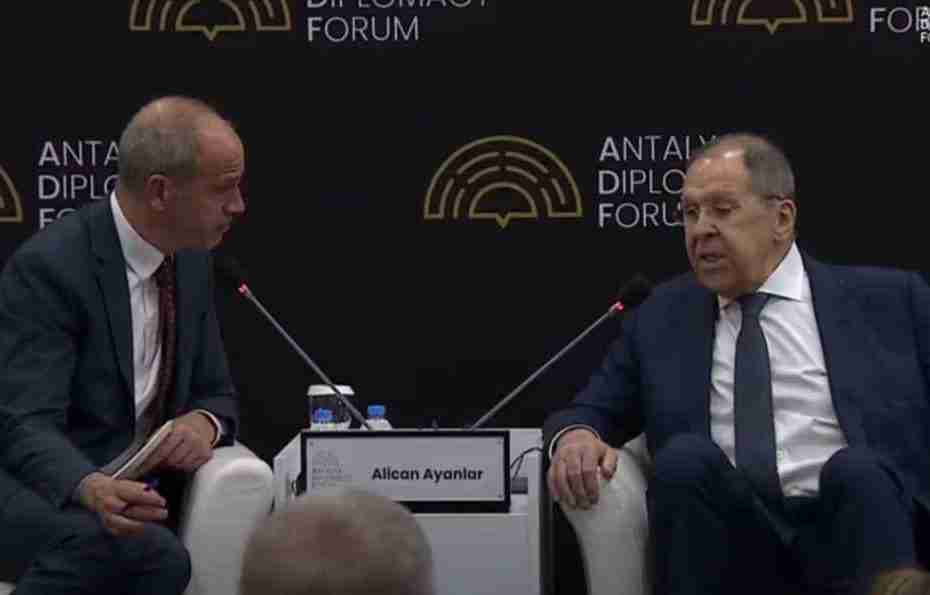
Read the full transcript of Russian Foreign Minister Sergey Lavrov’s special interview at the Antalya Diplomacy Forum, Turkey on April 12, 2025.
The interview starts here:
Introduction and Welcome
INTERVIEWER: Today, with Europe’s security architecture and infrastructure under immense strain and the global order fragmenting into competing visions, we’re wondering about Russia’s posture, its strategy, its alliances and worldview. We’ll be exploring over the next hour or so Minister Lavrov’s perspective on this evolving geopolitical reality. What does Russia want? What role does it see for itself in an emerging multipolar world? And how does it define peace, power and diplomacy in the 21st century? So let’s begin. Minister Lavrov, welcome to Antalya once again. I know that you’re likely to respond in your mother tongue of Russian, but if I could ask this one question in English, you see a full room out here. I think after President Recep Tayyip Erdogan, you are by far the most popular figure here. How does it feel to be a diplomatic rock star?
SERGEY LAVROV: Well, I think if we have heads of state being a real rock star, then there is nothing wrong with diplomats to be what they are. And if people like it, if people believe this is fun, so be it.
The Rise of Multipolarity
INTERVIEWER: Well, I think, as they say, the proof is in the pudding. It’s a full room. Next year we should be asking for maybe the Aspendos ancient theater just about 14 kilometers from here. It can fit 14,000 people, I think. Anyway, last year I had the privilege and honor to share the same stage with you, and one of the things that you tried to emphasize was the rise of the multipolar world. 12 months on. How do you assess the current state of this transition and how do you feel this trajectory has met your country’s expectations?
SERGEY LAVROV: Well, I think the trend became even stronger. More and more countries, big countries, medium sized countries, small countries, would like to have an equal say in the world affairs, in full conformity with the United Nations Charter, which says that the United Nations is based on sovereign equality of states. And more and more countries want to determine their life themselves, to have fair treatment, to have fair competition in economy, trade in other areas, just in line with the principles of globalization which were promoted by our Western friends, especially by the United States, for so many decades.
And when everybody became persuaded, the globalization stopped. And what we observe is fragmentation of the world economy. This is the time of uncertainty. I would say nobody knows how the situation with world trade and investment is going to evolve, because there would be new twists in this situation.
But generally speaking about multipolarity, it is gaining ground, no doubt about this. Not only big countries like China, India, Brazil, Turkey, Indonesia, Egypt, South Africa, many others. They believe that they deserve a say in world affairs. And therefore multipolarity is a chance for the United Nations Charter principles to be materialized. Because before, during this globalization, during, especially during Cold War, the sovereign equality of states was never respected by our Western colleagues.
If you retrospectively consider history after World War II and creation of the United Nations, there was no single conflict where the West, the leaders of the West, would be treating parties to air conflict as equals. And I understand that this might sound idealistic and maybe this equality would never be brought to life. But the principles of the Charter drafted by the founding Fathers, they already provided for multipolarity, just like they provided for respect for human rights, respect for the right of nations to determine their fate themselves.
Russia’s Vision of Multipolarity
And this is also on the rise. Manifestations are plentiful. And it is very important to underline that in our vision of multipolarity as we promote this concept with our partners in Shanghai Cooperation Organization, in BRICS, in the Eurasian Economic Union. The concept of multipolarity does not exclude the West. It embraces everybody, just like Duchetta instructed us. I see no reason why China and the US shouldn’t have good relations, why Russia and the US shouldn’t have good relations, why everybody shouldn’t be treated with respect and with understanding of national interests.
I had some contacts with the members of the Washington administration and I liked the message which they were carrying. I’m not quoting, but in essence the message was that the foreign policy of the United States is based on national interests of the United States. At the same time, the United States recognizes that other countries also have their national interests. And those interests would never coincide fully. Maybe even half of this interest would not be similar. But when the interests, especially the interests of big countries coincide, it is essential for them to find ways to materialize them into mutually beneficial economic, logistical and other projects. While when these interests contradict each other, it is the responsibility and duty of countries, especially we speak about big powers, not to allow these differences to degenerate into confrontation, especially the hot confrontation.
And this is something which we absolutely support. We have been acting the same way throughout our history.
Failure of Euro-Atlantic Security Architecture
And the last element of this multipolarity in our common region. The security issues after World War II have been addressed from the Euro Atlantic logic. The NATO, of course, EU was European per se, but lately the European Union signed a deal, a treaty with NATO. European Union is now part of Euro Atlantic policies, no doubt about it, including the provision of its territory for NATO plans to move eastward, southward. OSCE was created as an obviously Euro Atlantic creature.
And all of these Euro Atlantic constructions, I think they failed.
They failed to consolidate security and stability. What they succeeded in is igniting tension and remilitarizing Europe, including Germany, in spite of the fact that the economic and social situation is degrading. But all efforts of this Euro Atlantic community are concentrated on getting ready for a new war. And Germany together with France and Britain are in the lead of this.
Toward a Greater Eurasian Partnership
If you think about how the world looks now, Africa, well, everywhere there are sub regional organizations, many of them. Organization of Turkish States here, Eurasian Economic Union, ASEAN, Shanghai Cooperation, many. The same is true for Africa. Many sub regional groupings and in Latin America. But Africa and Latin America, they do have their all continental structures. African Union and CELAC in Eurasia there was never anything like this. And as I said, the attempts to bring some big unifying projects were only made on the basis of Euro Atlantic concept.
President Putin last year when he spoke in the Foreign Ministry, he suggested to consider the discussion of potential security architecture in Eurasia as a continent architecture where all countries without exceptions, including the western part of the continent will be invited to participate, where all regional arrangements would be invited to join.
And actually we have some years ago started building bridges between Shanghai Cooperation and Eurasian Economic Union, Eurasian Economic Union and ASEAN, Shanghai-ASEAN. We have been also planning contacts between these groups and for example Gulf Cooperation Council which is also a security but also an economic organization.
And about 10 years ago we started building these bridges without having anything in mind in the security area. But economically, logistically finding ways to cooperate, to join efforts to harmonize plans. And this is a promising process. We call it Great Eurasian Partnership. And this is something like potential material foundation for the future security system open to all countries and organizations representing Eurasia continent. So I think we are in favor of interactive discussion.
Assessing Western Institutions
INTERVIEWER: No, no, please, by all means. Do you feel that it’s perhaps the West’s failure? Some of the institutions and bodies that they have set up after World War II, you’ve described it as a failure. That’s how you said. And the fact that you’re talking about a greater Eurasia partnership aside, the military aside, the strategic perspective, is that a success in the 21st century?
SERGEY LAVROV: No, we cannot call a success something which is just being born in the minds of people. But the process of analyzing the situation is based on the failures of the Euro Atlantic models of Security. NATO should have been dissolved in the first place after the Soviet Union ceased to exist, after the Warsaw Treaty ceased to exist. And there were voices in the West saying guys, let’s now concentrate on OSCE. Let’s give it some push and let’s be all in one organization NATO.
You know the promises given to Gorbachev 1991 then to Yeltsin and there are memoirs where some people ask why didn’t you insisted on a written guarantee when Jim Baker said NATO would not move an inch to the west, to the East. My answer it just occurred to me, you know, in the Russian history since 17-18th century when the trade was booming, nobody signed any contracts. They shook hands.
INTERVIEWER: Was that word of honor?
Broken Promises and NATO Expansion
SERGEY LAVROV: They shook hands, the word of honor. And it was never violated. So probably those who were running NATO at the time of we are discussing didn’t have any relatives in the former Tsarist empire, which is not my fault and did not inherit those traditions.
But NATO not only stayed, it was basically announced that this would be the only organization which can guarantee your security. 1999 Istanbul summit of OSCE, the solemn declaration is adopted which among other things said security is equal and indivisible. Everybody has the right to choose security alliances. But this cannot be done at the expense of diminishing of security of others. Then it was even blunter when it said no country, no group of countries, no organizations in the Euro Atlantic OSCE area can claim dominance. And NATO was doing exactly this.
And when Putin came to power, was elected president, he was repeatedly warning about very dangerous nature of this course. 2007 in Munich if you re-listen it now, it was very far-sighted unfortunately. Then 2008 NATO summit in Bucharest, which was also followed by Russian-NATO summit. I was there with President Putin. And when it was announced that Germany and France did not allow to pass a decision formally launching negotiating process for Georgia and Ukraine to be admitted to NATO. The Germans and the French were proud, they said, but they included in the declaration the statement that Georgia and Ukraine will be in NATO.
When Putin asked Merkel what is the difference? She said, no, no, no, no. This is just a political statement. And what we managed to avoid was the legal process to be launched. But it’s frankly it’s childish because Saakashvili lost his brains a few months after Bucharest when he ordered the attack of the Russian peacekeepers in South Ossetia, violated the OSCE endorsed agreement and so on and so forth.
Then in 2010 in Astana, this was the last summit of OSCE so far, the Istanbul formula was repeated verbatim. No organization can claim dominance. No one strengthened his security at the expense of security of others.
The Pattern of Deception
And then when this NATO expansion continued and when it was clear that these principles promulgated in OSCE about equal and indivisible security, that they were not being implemented, then we suggested to have the same language and codify it in a legally binding agreement. We were told it was during Obama administration. We were told, no, no, no, guys, you don’t understand legally binding guarantees. One can only get at NATO. We said, but your president signed this OSCE declaration. They said, this is political, political.
Cheating is the key word for what was happening and our last attempt. But we still, in 2008 and 2010 were proposing the draft agreements between Russia and NATO. Russia and the United States, the same we did in 2021 in December, to no avail.
And so, yes, my point is that NATO did not, or rather NATO failed to strengthen security because NATO was manipulated by those who did not want to share security benefits and they wanted to leave all the benefits for themselves, for others to listen and get instructions. OSCE, another Euro Atlantic creature has failed. Few years ago when the principle, the basic principle of consensus was grossly violated by the people who replaced each other at the position of the chair in office, at the Secretary General position, all the institutions, national minorities, freedom of media, what else? You see, I even forget about some institutions, which means that OSCE is not on anybody’s mind anymore. Yes, they fail.
We’re not suggesting to have another closed club. All continents have their own continental roofs, if you wish. Not in Eurasia. And Eurasia is the biggest, the richest, I would say. Well, Africa is also very, very rich. But it is not yet opening up this potential. And if you speak from civilizational point of view, the number of great civilizations coming from that area, coming from Eurasia, including this one, including China, including India. Russia is younger. But you would forgive me if I also say that it’s a great weapon. Indeed.
INTERVIEWER: Minister Lavrov, you’ve stated here quite… like some water, sir. Is that what you’re looking for?
SERGEY LAVROV: Okay.
INTERVIEWER: NATO’s desire for eastward expansion is the root problem. And then you went on to say that the OSCE is another chapter in this cheating. Do you feel that there is a viable path, I’m not saying return, a viable path to cooperative security on the European continent?
Russia’s Vision for Eurasian Security
SERGEY LAVROV: Cooperative security is one of the terms used in NATO, European Union and OSCE. Frankly, we are just at the beginning of the process. We don’t want to rush things. We want everybody to join in free discussions to present his or her views. I mentioned repeatedly that a couple of years ago President Lukashenko of Belarus convened a first conference on Eurasian security. The second one was last fall. I participated in both. And the third, it is an annual feature.
Invited to this conference were not only like-minded countries, but also members of NATO and European Union. Some other Europeans, like Serbia, Hungary, of course participated in both of them, Slovakia. And the list of invitees would be growing. It is not against anybody, it is not against NATO. I think the biggest enemy of NATO is NATO itself and those who were trying to use it to dominate in violation of their own pledges.
The fragmentation process which I mentioned, which is taking place in the world economy, is also reflected in the security area, the discussions of NATO, the scares of Europeans, that they would be left to their own devices. We don’t interfere if they believe that they are still relevant in the form which failed many times. This is their right. This is their right to decide. Our right is to make sure that the matters of the Eurasian continent are discussed and resolved by the countries located on this continent.
This is not to close the door for outsiders. Take for example Central Asia. The five plus one format is I think mushrooming. 10 or 12 groups like this with us, with European Union, separately with France, with Germany, Japan, South Korea, Turkey, Russia. Of course, I just had yesterday the meeting with five foreign ministers of Central Asian countries.
So outsiders always are participating in something which they believe is of interest to them. And if they can find a form of cooperation which would be mutually beneficial. We cooperate with many countries in Africa, in Latin America, so do Western countries. Turkey in Africa is very much present, so do the Arab countries. The matter is, when you come to somebody’s region, you should respect the views of the regional host countries if you wish, and not impose. And not impose your rules like our European and British colleagues are running all over the world.
It used to be also Biden administration involved in this, running all over the world, saying don’t trade with Russia, don’t sell to Russia, don’t buy from Russia, don’t meet with Russia. I know, because those are the facts. And this is not multipolarity. This is obsession with your global role which you invented yourself and which worked during colonialism, during post-colonial times for some period.
The Global South’s Second Awakening
But now there is a second awakening of the Global South. After the decolonization process, the Global South was happy with freedom. But now they understand that the global economy was crafted the way which left them with peanuts from the use of the natural resources which they inherited from God and history.
I remember during the second Russia-Africa Summit in 2023 in St. Petersburg, President Museveni of Uganda was giving statistics of the world coffee market. All in all, assessed at about 450 billion euros, of which Africans were left with 40 – less than 10% because their contribution was raw beans harvested and sent for roasting, packaging, advertising. Germany alone was getting more from the world coffee market than all African countries together. So this awakening is inevitable.
Yes, the tariff war which we witness now is going to change many things. We hear that many countries would like to sit down with the United States and negotiate. Fine. We would only be happy if people reach some deals peacefully and to their mutual satisfaction. World Trade Organization unfortunately is paralyzed. It was paralyzed by previous American administrations for many, many years. And there is no global institution which would be authoritative enough for everybody to accept its ruling.
So I believe we just must have these discussions about security, Eurasian security, but in the context of the multipolarity movement, which is shaping itself up objectively.
On Relations with the Trump Administration
INTERVIEWER: You’ve mentioned on many occasions that your country’s relationship with Western neighbors essentially depends on their willingness to acknowledge and rectify some mistakes. You’ve gone over some of them in the past 15, 20 minutes. But I want to ask, and we talked about the US Administration. How is it like to have Donald Trump on the other side? Is it easier? Because in the last 48 hours where all of a sudden we’re talking about the possible lifting of sanctions against your country’s flagship airline, Aeroflot, with the release of Seneca Carolina the ballerina, is there a potential for more movement?
SERGEY LAVROV: There is always a potential. And as I said in my opening remarks, nothing wrong if the US and Russia have good relations, if US and China have good relations, and what is going on between us and the Trump administration is really a very banal thing. Countries talk to each other without dictating to each other, without asking for any precondition. They just talk to each other.
China and the United States, they have many differences, many differences. Russia was doctrinated by Biden administration as the immediate threat. China is the long term, biggest challenge to the American dominance. So competition in the world of economy, you see what kind of forms it acquires. And Taiwan, the situation in the Strait of Taiwan, the situation in South China Sea, who is going to have more influence with countries of East South Asia.
And they exchange statements China and the United States, which are not very pleasant to each other, including on Taiwan, when the West headed by the United States and other Western countries, they say we recognize, we follow one China policy. But they immediately say “but don’t even think of touching the status quo.” And what is the status quo? It is not one China policy. And from time to time we hear from Washington the threats to Beijing. Don’t even think of using force. This would be catastrophic.
So they exchanged niceties publicly. But they never stopped talking to each other at the level of foreign ministers, ministers of defense, national security advisors and presidents. And somehow Biden administration decided that with Russia it should be different. Russia must learn a lesson. And this lesson, this punishment would be in the form of isolation, stupid, to put it very politely and not talking to each other.
So Trump, what Trump has suggested is come back to normalcy to stop this idiotic posture, which was, I think, a disgrace for the American role in the world affairs. Let me put it this way. And yes, we discuss bilateral relations, starting with the normalization of the work of the conditions in which our embassies work.
Obama administration started throwing out diplomats. He stole five pieces of diplomatic property which are still under arrest. Just like Biden administration has stolen the Russian assets and they are now thinking what to do with it. So, so that not to create a precedent. They created precedent already. And if they believe that they should not touch the body of the stolen money, but they can steal the interest and spend it on Ukraine. This is disgusting logic. And it shows that neocolonial thinking never left these people.
Diplomatic Relations and Ukraine
But the embassy activities, issuing visas in certain time frame, not waiting. So the diplomats don’t wait for years to get a visa to normalize the issuance of the US Visas to the Russians who are admitted to the United Nations. There were also problems. And yes, we want to see what joint project we can concede and discuss together.
This was the proposal from the Americans we never rejected proposals to cooperate in economy, in conflict resolution. Never. And when we met with Marco Rubio and Mike Waltz together with president’s advisor Ushakov in Riyadh, we touched upon some regional issues, Middle East, the situation with the Iranian nuclear program, some other issues. And of course we discussed Ukraine.
And I will repeat again what I said then and I repeated this publicly also, when we speak about eliminating root causes of any conflict, including Ukrainian conflict, this is the only way to resolve the problem and to establish lifelong lasting peace. Remove root causes. President Trump was the first and so far I think almost the only one among the Western leaders who repeatedly with conviction several times stated that it was a huge mistake to pull Ukraine into NATO. And this is one of the root causes which we quoted so many times.
They also mention now another thing which related to the root causes, namely territorial issue. They publicly, including Steve Witkoff, they recognize that the territorial issues would have to be handled in the context of the long lasting settlement. And this is the Americans.
By the way, when Ukrainians and the US delegations in Riyadh agreed on some paper in favor of 30 day cease fire, this was done in the context of the Americans saying NATO and territories inevitable, no NATO and discussion on the status of territories. Ukrainians and the people like Macron, Starmer and Ursula von der Leyen, now they say Ukraine is in favor and Russia is against the ceasefire. But they lose sight, I think on purpose, from the nuances as Putin called them, NATO and territories.
Because it is in the context of these aspects that the American proposal was put forward immediately after this was mentioned by the Americans. Zelensky administration said NATO is none of your business. Territories we don’t discuss, we need arms, arms and arms. And then since it was in time of discussions of this peacekeeping thing, Zelensky said we don’t need peacekeepers, we need fighting units. So the schizophrenia of these mutually exclusive statements is very obvious.
The Issue of Territories and Russian-Speaking Populations
But on territories I want to make a very important point. We are not about territories. We are about people who live on these lands, whose ancestors lived there for centuries, who founded cities like Odessa, Catherine the Great who built factories, who built roads, ports. And these people by twist of history during the Soviet days became not part of Russia, but part of Ukraine. Because this was considered a consolidating factor to neutralize the ultra radicals living in the western part of Ukraine when it joined the Soviet Union after the war.
The people who live there, they are being deprived of all human rights. I quoted the UN Charter which in Article 1 says everybody must respect the human rights of every individual, irrespective of race, gender, language or religion. The religious and language rights of anybody who is ethnic Russian and lives on the territory which used to be Ukrainian Soviet Socialist Republic. They were deprived of their basic rights. The Russian language has been prohibited at all stages of education in the areas of culture media. Russian books have been thrown out of the libraries. The Nazis in Germany were burning them. But Ukrainians are much more smart. They utilize them and get money for this.
But everybody is happy. And recently the canonical Ukrainian Orthodox Church was prohibited by law. They literally exterminate anything Russian. In 2021 in September, long before the operation which we had to launch, Zelensky was asked in an interview what he thought. And at that time the Minsk agreement was still valid. Though later Germans, the French and the Ukrainian president before Zelensky admitted that they never intended to implement them. They needed more time to arm Ukraine. Speaking of the ceasefire for 30 days, logic is the same.
But in September 2021, Zelensky was asked what he thought about the people on the other side of the line of contact in Donbass. And he said, trying to sound clever, “you know, there are people and there are species. And my advice to those who live with Ukraine, but feel associated with the Russian culture, for the sake of your kids, for the sake of your grandchildren, get out to Russia.”
And just couple of weeks ago, in another interview, when he was asked what is driving him, he said hatred to Russia. The interviewer wanted to clarify to Putin. He said no to all Russians. And this is said by the person who during his artistic days was defending the right of Ukrainians to speak Russian. And he said, get lost. Don’t even think about touching the Russian language. It’s our history, so this is where we are. Hatred is not the best guide.
By the way, I want to ask – maybe somebody knows. Israel never prohibited Arab language? No, I don’t think so. So I think Ukraine is the only country on earth which is multinational and the language of one huge ethnic group is prohibited.
And if you read and listen to what the West is saying, EU, NATO, especially EU human rights is on top of everything. When they discuss Israel, Russia, Serbia, Turkey, human rights, they never forget about human rights. Czech Republic, what they’re saying on the situation in Ukraine. They say Zelensky and his team defend European values.
If your value is exterminating the language of those who founded the country, if your value is to glorify Nazis and their collaborators who were convicted by the Nuremberg tribunal, to whom you put monuments, whose birthdays you celebrate as national holiday while ruining, toppling the monuments to those who saved Europe from Nazism, toppling the monument in Odessa, which I mentioned already to Catherine the Great, who founded that city, by the way, after, soon after this monument to Catherine the Great, the Empress was toppled, UNESCO granted the, I guess central region where the monument was located the status of the world heritage. It’s such a shame to the lady who happens to be French and happens, I think, by default to become Director General of this respected organization.
Ukraine’s Position on Territory
INTERVIEWER: Minister Lavrov. All right, so you eliminate the root cause. And you talked about territory. I was just in a session talking about the European security structure. And on there was the Ukrainian foreign minister and he says, when it comes to territory, I hear your concept, your idea, your position on territory, but they’re not going to accept anything less than the 1991 borders.
SERGEY LAVROV: It’s not about them accepting it. It’s about making hundred percent certain that the people who have been living there for centuries are not deprived of their inherent right. And if Ukrainian Nazi regime, I cannot describe it otherwise, enjoys the cover from the European Union, which, as I just mentioned, never dropped a word about the situation with human rights in Ukraine, then this is not our problem. We listen to those people who voted at referendum to join Russia to restore all their rights which belong to them by international law and by history, by justice.
On Peacekeeping Forces
INTERVIEWER: Okay? You have stated on numerous occasions that it is a hostile act to even entertain the idea of foreign peacekeepers. Would under any circumstance, the Russian Federation, think about neutral peacekeepers in the territory?
SERGEY LAVROV: The biggest advocates of something like stability force, sustainability force are Macron and Starmer, and they are not thinking about any neutral force. They say we, Macron and Starmer would be the countries who would provide the most of the contingent. They talk, by the way, to countries outside European Union, including Turkey. They talk, according to the rumors. They said that they are talking to China, which is India, Indonesia, they mention.
My question is first, President Trump, who, as I mentioned, already seems to understand much, much, much more about what is going on than any European leader. Except I would highlight Hungary and Slovakia. These leaders are quite thoughtful. But it was President Trump who said first many things on NATO and territories, and he said that when asked about this idea of a contingent, a force group, whatever you call it, there should be some discussion between the parties, they say.
I think Macron said no discussion with Russians. Ukraine is a sovereign country. It has the right to invite anybody, and they are inviting us in brackets. I would repeat what Zelensky said. We don’t need peacekeepers, we need fighting units. So make your own conclusion.
But Keith Kellogg, by the way, yesterday said that why don’t we divide Ukraine like we divided Berlin after World War II? Then he said he was misunderstood, misspoken. But everybody is missing the key point. Imagine, yes, the leaders of Brussels bureaucracy. They say we must reach a deal which at the end of the day must guarantee Ukraine sovereignty. They, by the way, didn’t mention territorial integrity, but sovereignty.
My question is to them, you mean you want to have peacekeepers to keep the same regime which is now headed by Zelensky. You don’t want to ask this regime whether it would be interested in implementing the international commitments, including UN Charter regarding the rights of minorities for national minorities, language and religious rights. Nobody is raising the issue.
So my conclusion is that by ignoring the gross violation of all the international norms about human beings, by ignoring these norms and violations by Zelensky of these norms, and at the same time by discussing deployment of something military, call it peacekeeping, call it stabilization force on the remaining part of Ukraine, they want to use this force not to keep peace, but to keep and protect the Nazi regime. And this is key. Everything else is smoke screen.
Black Sea Navigation Agreements
INTERVIEWER: You mentioned the important talks that were going on in Riyadh and some of the conversations you had with the American delegation. Also what was talked about is safe navigation in the Black Sea. We know that there was a process going on in building this with the Turkish side, with the Republic of Turkey. What is your stance in terms of developing this?
SERGEY LAVROV: It was one of the proposals mentioned by President Trump in his latest phone conversation with President Putin. And President Putin said, okay, but we have to specify the deal the way which would not allow the failure of the first one to be repeated.
And the first one was in 2022. It was a package, guarantees for Ukrainian exports. And the second part of the package was memorandum between the UN and Russia to guarantee the exports from Russia by ensuring normal freight rates, insurance rates, by ensuring the right of the Russian bulkers with fertilizers, with grain to call on European in Mediterranean ports, and so on and so forth. Just the normal terms of trade, no concessions.
And the Ukrainian part of the deal was implemented. The Russian not even started. We don’t blame the United Nations, whose representatives were trying, and they continue to try because formally the Russian-UN deal lasts until July this year. It was three year deal. While deal on Ukraine was one year. And of course, after the first year elapsed, we said, thank you very much, we don’t want to play one way.
And then Secretary General Guterres was trying, Secretary General of UNCTAD, Rebecca Greenspan was trying. But the UN position, the UN Secretariat position was very tricky. Basically they were saying we cannot touch sanctions. The fact that they recognized unilateral sanctions as legitimate. So they told us we will try to find a way by passing sanctions so that we don’t violate them. And they have been trying to do this for almost three years and to no avail.
So when it is not for the first time that this Black Sea topic is popping up again, last year, President Erdogan, I think in March proposed to President Putin to resume the deal. He said that Zelensky is ready to cooperate. The proposal was different from the original deal because the original deal provided for inspections of the Ukrainian cargo vessels going back to Ukrainian ports to make sure that they don’t carry any weapons.
Last year, the proposal by President Erdogan to President Putin was to trust me, it would be an announcement that there are no weapons on board and it would be allowed to go. It was not an easy situation. But President Putin said that he will support it, provided President Erdogan used his good offices to discipline Ukrainians so that they don’t fail. And then at the last moment, Zelensky refused even that.
Actually, he first added, President Erdogan called President Putin and said Zelensky also wants to add commitment not to attack nuclear power stations. Putin said, okay, it has nothing to do with Black Sea traffic, but okay. And then when he agreed to this addition, Zelensky refused. So we are coming again and again to this situation.
In the meantime, Ukrainians, frankly speaking, I don’t think they complain about difficult for their grain being exported. They send a lot on dumping prices to European Union. European Union is not happy. And instead of doing something about this situation for the sake of their citizens, Brussels people threaten to stop importing any grain from Russia.
They’re very specific leaders. They say that Kaja Kallas, Baerbock, they were saying yes when criticized by the people who saying, we live worse than before. Yes, we understand, but our electorate should suffer for the sake of Ukraine, while at the same time thousands and thousands of Ukrainians living there in Europe in luxury, buying very expensive vehicles. But this is what European elite calls European values, which they defend in the person of Zelensky regime.
So this time when President Trump suggested another Black Sea deal, Putin said, yeah, we are ready, but we need to draw lessons from the past and let’s make sure before we launch it, let’s resolve the things on freight, insurance, calling on the ports. The miracle Ukrainians took this and they are considering they didn’t come back to us after this.
Energy Infrastructure Moratorium
Another initiative of President Trump was 30 day moratorium. Not a total ceasefire, but 30 day moratorium on attacking energy infrastructure. During this phone conversation, President Putin immediately agreed and he authorized gave orders to the Chief of General Staff to stop attacking Ukrainian energy infrastructure, even infrastructure related to the military.
And at that moment, seven drones, Russian drones were airborne and Putin gave order to shut them down, which was done. Since then we have been keeping the word and Ukrainians have been attacking us from the very beginning every passing day maybe with two or three exceptions.
And I gave to our colleagues from Turkey to Minister Fidan what we give to Americans to UN to OSCE the list of facts listing the attacks by Ukraine during the last three weeks against Russian energy infrastructure. We understand he hates all Russians so he give orders. Either he gives orders and they are not taken or he is lying that he is giving this order. It’s a tragedy. It’s a tragedy.
INTERVIEWER: Has there been any direct or indirect contact by the Ukrainian side here in Antalya?
SERGEY LAVROV: Not to my knowledge. I came here to work.
Related Posts