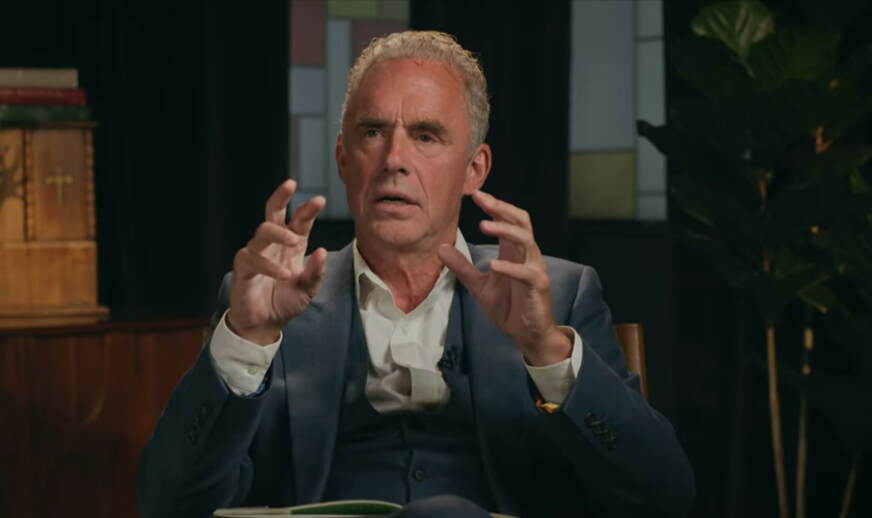
Read the full transcript of Dr. Jordan B. Peterson’s psychological and cultural analysis of “There’s No Such Thing as a Dragon” by Jack Kent, drawing connections to ancient Egyptian mythology, the Exodus narrative, and the crucifixion of Christ. This episode was filmed on June 28th, 2025.
Introduction to Children’s Story Analysis
DR. JORDAN B. PETERSON: So recently, I recorded some analysis of children’s stories once again. I had done this years ago with Pinocchio and The Lion King. That was part and parcel of the lectures that I did at Harvard and at the University of Toronto.
More recently, I recorded an analysis of Snow White, the Grimm’s brother version, and also of Hansel and Gretel. I’m going to continue that today with a more recent book, a much more recent book called “There’s No Such Thing as a Dragon,” The Story and Pictures by Jack Kent.
I used to read this to my Maps of Meaning class often as the first lecture because it touches on themes that are very relevant to a narrative understanding of the world. A description of the structure through which we see the world is a story. And the motifs in stories represent cardinal elements of all of the environments that we encounter. And I’ll try to make that clear today in the discussion of “There’s No Such Thing as a Dragon.”
The Dragon as Archetypal Symbol
I want to show you a dragon that I have in my office here. This is a sculpture from Mexico, which I got several years ago. It’s a circle, basically, and it has the head of a bird, kind of a monstrous bird, and it has wings like a dragon or like a bird, and it has a snake wrapped around the bird’s neck, but it’s an analog of a dragon.
There’s a book that I found very useful in my analysis of such things called “An Instinct for Dragons” by a man named David E. Jones. And David Jones offers, essentially an evolutionary explanation for the concept of dragon. He described a dragon as a tree, cat, snake, bird—like an amalgam of the features of tree, cat, snake, bird.
And those and, of course, there’s the element of fire as well. And so those are all elements of predator, you might say, the kind of predators that have been preying on us or our evolutionary ancestors for millions of years. We had tree dwelling ancestors sixty million years ago. And so the dragon is an amalgam of the motifs of predator. That’s a good way of thinking about it or of danger.
And the dragon battle is a narrative condensation of the drama of human beings. The fact that we have to encounter the terrible predatory unknown and to try to gather what’s valuable that’s hidden in it and to transform ourselves in that pursuit and to make our way forward as heroes. And part of that is the ability to pay attention, to careful attention to the things that we might want to put aside and avoid. And that’s what this little story is about.
The Story Begins: Billy’s Discovery
“Billy Bixby was rather surprised when he woke up one morning and found a dragon in his room. It was a small dragon about the size of a kitten.”
Well, so let’s delve into the idea of dragon again. So the book’s title is “There’s No Such Thing as a Dragon.” And whether or not something is real depends to some degree on your level of analysis. So, obviously, bears are real and lions are real and Komodo dragons are real and crocodiles are real and fire is real.
Is an amalgam of all those things real? Well, it’s real in the way that an abstraction is real. It’s real in the way that the word predator or danger is real. Right? Because there’s many diverse phenomena that are aggregated together in the notion—the conceptual notion of, say, predator or danger—but that has very little to do with the reality of the concept.
Dragon is as real as predator. Let’s put it that way. Now the dragon concept is broader than mere predator because the dragon really stands for everything that lurks in the unknown as such. And everything would be the danger that’s part and parcel of the unknown, which is the place that the predators aggregate, let’s say, but also the promise. So out in the unknown, which is the land of dragons, there are terrible dangers and great benefit.
Hence, the treasure that’s associated with the dragon. And the dragon contact story—the dragon fight story—is really among the oldest narratives that we possess. So it’s an ancient motif, and it makes itself manifest in all sorts of stories.
The Hero’s Initial Response
“Billy Bixby was rather surprised when he woke up one morning and found a dragon in his room. It was a small dragon about the size of a kitten.”
So why is that relevant? Well, Billy wakes up and there’s something that’s different about his environment. And the difference makes itself manifest as something that’s tiny to begin with. Right? And he’s attending to it.
“The dragon wagged its tail happily when Billy patted its head.”
So there’s a moral already in the story there, which is that this little boy wakes up and something unexpected occurs, and it’s in principle, he could pretend it wasn’t there or he could be afraid, but he interacts with it voluntarily. And in consequence, this dragon is pleased.
The Authority’s Denial
“Billy went downstairs to tell his mother. ‘There’s no such thing as a dragon,’ said Billy’s mother. And she said it like she meant it.”
Okay. So Billy’s awake, and so he’s playing the role of hero, and he’s detected something anomalous and different. And he, in his juvenile heroic manner, has decided to interact with it voluntarily, and that’s already tamed it to some degree. And now he brings it to the attention of the authorities. And the authorities essentially have already decided how the world is constituted, and their verdict is that there’s no such thing as a dragon.
And Billy’s mother is insistent upon this.
“Billy went back to his room and began to dress.
The dragon came close to Billy and wagged its tail, but Billy didn’t pat it. If there’s no such thing as something, it’s silly to pat it on the head.”
The Psychology of Willful Blindness
Okay. So what’s the psychological significance of this? Well, there are things that aren’t to be talked about in many families and in many households. And the attitude that reigns in households like that is that if we just pretend that the terrible thing doesn’t exist, that it will go away. And that’s a form of willful blindness.
I can tell you a story about willful blindness. So in the Egyptian creation myth of Horus, Osiris, Isis, and Seth, there is a characterization of willful blindness as the cardinal danger that presents itself to the state. So here’s how the story goes.
Egypt is founded by a god hero named Osiris. And Osiris is a great awake hero like Billy when he was young, and he is the force or the spirit or the process that establishes the state. He ventures out into the unknown wilderness and renders it habitable, like God does in Genesis at the beginning of the biblical story.
Now, Osiris establishes the state and becomes the ruler god of Egypt, but he has a brother named Seth. And Seth becomes Satan through the Egyptian Coptic Christians as the centuries progress. And Seth is the dragon like force, you might say, that always emerges to threaten the state. And Seth wants to overthrow Osiris so that he can become a ruler. And Osiris is willfully blind.
And so he turns a blind eye to the machinations of his evil brother, and in consequence, is overthrown by Seth. And so why is that relevant? Well, it’s because malevolence can make itself manifest in unexpected forms, in your personal life, in your family life, in the community, in the state, in the nation at every level. But the proclivity to turn a blind eye to the emergence of what’s unknown and malevolent is part of the causal pathway to the devastation of the stable and productive state. So that’s all underneath this little story.
The Dragon Grows
“Billy went back to his room and began to dress. The dragon came close to Billy and wagged its tail.”
So now, you know, as a small dragon, it’s also indicating its relatively benevolent intent. And so one of the lessons you might derive from this is the notion that if you deal with a problem when it first wags its tail, then there’s every reason to assume that it can be dealt with forthrightly and straightforwardly and maybe productively as well. And so that’s why the dragon in its small form here is still a benevolent force.
Right? Something unknown can make itself manifest as a mere matter of interest. And if it’s not ignored, it can be dealt with appropriately.
“But Billy didn’t pat it. If there’s no such thing as something, it’s silly to pat it on the head.”
Okay. So now Billy has adopted his mother’s stance of willful blindness and is applying it to the realities of his own experience.
“Billy washed his face and hands and went down to breakfast. The dragon went along. It was bigger now, almost the size of a dog.”
The Consequences of Ignoring Problems
Okay. So now what’s happening? Well, apparently, or hypothetically, because the dragon, which is the anomaly, the predator, and also the place of possibility, because it’s being ignored, it’s growing. And so what’s the moral of that story? Well, it’s the same moral that you can derive from the Egyptian myth of Osiris and Seth.
If you turn a blind eye to something, then it can grow until it becomes an overwhelming and demolishing force. Imagine here’s an example. Imagine that you get a tax notification in the mail from your local municipal authorities, and instead of dealing with it, you ignore it. You throw it in the garbage or you file it in some filing cabinet or in some file folder that you never plan to open. It’s not like it just sits there maintaining its form.
It mutates and shifts across time and grows into something that can be quite monstrous. And all the anomalies, the unexpected occurrences that could turn themselves into predators with time, have the proclivity to grow if they’re ignored. And so this little book is a story about the danger of willful blindness.
Disruption of Domestic Order
“Billy sat down at the table. The dragon sat down on the table. This sort of thing was not usually permitted.”
So now you can see that the anomalous occurrence, the unexpected occurrence, the emergence of the predator or the unknown is starting to disrupt the stable subroutines of the family that make up tranquil domestic life and peace.
“The dragon sat down on the table. This sort of thing was not usually permitted, but there wasn’t much Billy’s mother could do about it. She’d already said there was no such thing as a dragon. And if there’s no such thing, you can’t tell it to get down off the table.”
You see that sort of thing happening in families where a child has a behavioral problem that’s being ignored by the parents. It’s that the assertion is that there’s nothing wrong with the child, let’s say, or the child’s behavior. And so that assertion is perceived as the reality, and then the problem has the proclivity to develop until it gets entirely out of hand. And once the decision has been made that there’s no problem there, then no amount of evidence about the problem is sufficient to shift the circumstances.
The Dragon Consumes Resources
“Mother made some pancakes for Billy, but the dragon ate them all. Mother made some more, but the dragon ate those too.”
That’s another indication, let’s say, that the dragon is associated symbolically with potential behavior problem on the part of Billy. This anomalous occurrence, whatever it might be, is not only breaking the domestic rules with regards to its purchase on the table, but is also interfering with Billy’s ability to eat. But, mother has to ignore that.
“Mother kept making pancakes until she ran out of batter. Billy only got one of them, but he said that’s all he really wanted. Anyway.”
So now Billy is lying about the problem that’s interfering with him even being able to eat to maintain his mother’s fiction that there’s no problem in the house.
The Dragon Becomes Overwhelming
“Billy went upstairs to brush his teeth. Mother started clearing the table. The dragon who was quite as big as mother by this time made himself comfortable on the hall rug and went to sleep.”
So now the dragon has grown to the point because it’s being ignored where it’s more than a match for mother herself. Had she admitted to the existence of the problem to begin with and dealt with it when it first made itself manifest, it could have stayed small and friendly, but now it’s large enough to be a match for her.
“By the time Billy came back downstairs, the dragon had grown so much, he filled the hall. Billy had to go around by way of living room to get to where his mother was.”
The Dragon’s Rapid Growth and Household Denial
“I didn’t know dragons grew so fast,” said Billy. “There’s no such thing as a dragon,” said mother firmly.
So now we have the situation where something unexpected and forbidden has made itself manifest in the house. But everyone has decided to act as if it doesn’t exist. And the consequence of that is it’s growing to the point where it dominates the house and is making all normal activity exceedingly difficult.
I’m sure you’ve been in households like that. Hopefully, yours isn’t one of them.
“Cleaning the downstairs took mother all morning, what with the dragon in the way and having to climb in and out of windows to get from room to room.”
The Psychology of Willful Blindness
This is a humorous way of dealing with the fact that if a problem emerges in a household and it’s not dealt with, it can become so all consuming that it makes all activity that should otherwise be simple and straightforward, virtually impossible.
So a behavioral problem that’s emerged in the course of a child’s development can have exactly that aspect where there’s denial, which is more like willful blindness. Willful blindness is a better way of thinking about denial. It’s just refusal to attend and modify perception and conception in face of new evidence. The problem can get so large that nothing simple is simple anymore.
If there’s unresolved conflict between a husband and a wife, for example, it can get to the point where it’s impossible for them to have a simple conversation about day to day things because of the catastrophe, the dragon, that no one will speak about. Maybe the suspicion of an affair, for example, or some other fundamental manifestation of mistrust that’s polluting and paralyzing the relationship to the point where nothing can be done in a simple manner.
The Dragon Consumes the House
“Cleaning the downstairs took mother all morning, what with the dragon in the way, and having to climb in and out of windows to get from room to room.”
So now mother, who’s a somewhat tyrannical and rigid sort, has decided so emphatically that the dragon doesn’t exist, that she’s willing to put up with a tremendous amount of unnecessary trouble to maintain her delusion. She won’t attend to the anomaly, let’s say, to the trouble, even though it’s beginning to interfere with everything that she does.
“By noon, the dragon filled the house. Its head hung out the front door, its tail hung out the back door, and there wasn’t a room in the house that didn’t have some part of the dragon in it.”
If you’ve lived in a street with a household that has a substantial amount of trouble, you’ve seen exactly this phenomena where the house is dilapidated and unkempt and the lawn is abandoned. And there’s a miasma of negativity that surrounds the household. And you know that there’s something monstrous going on inside it that’s pathologizing not only the inhabitants of the house, but beginning to spread out into the neighborhood itself, then you’ve experienced exactly the situation that’s being described in this book.
That’s exactly the kind of household that people will walk across the street to avoid if they’re going somewhere.
Chaos Takes Control
“When the dragon awoke from his nap, he was hungry. A bakery truck went by. The smell of fresh bread was more than the dragon could resist. The dragon ran down the street after the bakery truck. The house went along, of course, like the shell on a snail.”
So now because the dragon’s been ignored, because the problem has been ignored, because the household is rigid and tyrannical in its presuppositions, the dragon has got so large that chaos rules the house instead of order. And the trajectory of the family is being determined by the emergent property that no one has the courage to deal with.
“The mailman was just coming up the path with some mail for the Bixby’s when their house rushed past him and headed down the street. He chased the Bixby’s house for a few blocks, but he couldn’t catch it.”
Well, there’s plenty in that too. So the mailman is a representation of the order of the state, let’s say. And the household has become so chaotic at this point that the state itself can’t deliver its message to the inhabitants. And so you can imagine what happens if your household becomes so chaotic that it runs away, so to speak, and so you don’t get your mail and you don’t get your notifications. And all that does is aggregate a lot more chaos around you and cause all sorts of long term trouble and turn into this vicious self devouring spiral that’s like a dragon that eats its own tail, which is a symbol of exactly that, and all hell breaks loose.
The Father Returns to Find His House Gone
“When mister Bixby came home for lunch, the first thing he noticed was that the house was gone. Luckily, one of the neighbors was able to tell him which way it went.”
So there’s a real tragedy brewing in this story because well, this happens to people, doesn’t it? When a father, let’s say, comes home from work and finds that the locks have been changed and his wife has gone with the kids. And the question is exactly what happened? And the answer is invariably, there was a terrible dragon in the house that could have hypothetically been attended to when it was still small, but that was ignored studiously by all who were involved and grew to the point where it dominated the entire house so that everything became cataclysmically difficult.
And then it ran off with the house itself, and the man comes home and the house is gone, so to speak, because the dragon ran away with it. And his response is, “I never saw it coming.” And the first question that you might ask about that kind of response is, maybe that’s because you didn’t look. Right? There were warning signs of a thousand different kinds, making themselves manifest in a thousand different directions, parts of the dragon scattered all over hell and all over hell’s half acre.
But never underestimate the insistence that someone who does not want to see brings to bear on the maintenance of their blind delusion. And so mister Bixby’s house ran away because he wasn’t paying enough attention to what was going on inside it.
The Confrontation and Recognition
“Mister Bixby got in his car and went looking for the house. He studied all the houses as he drove along. Finally, he saw one that looked familiar. Billy and missus Bixby were waving from an upstairs window. Mister Bixby climbed over the dragon’s head onto the porch roof and through the upstairs window. ‘How did this happen?’ Mister Bixby asked. ‘It was the dragon,’ said Billy. ‘There is no such thing,’ mother started to say. ‘There is a dragon,’ Billy insisted, ‘a very big dragon.’ And Billy patted the dragon on the head.”
The Exodus Narrative and the Brazen Serpent
Now I want to tell another story that’s associated with this. So this is from the Exodus narrative near the end of it. The Exodus narrative. This is the story of Moses leading the Israelites away from tyranny through the desert to the promised land, and it extends over a number of Old Testament books, Exodus, Numbers, and Leviticus. If I remember correctly, this story takes place when the Israelites are just on the cusp of their movement into from the desert to the promised land.
So they go from tyranny, which is the rigidity, let’s say, that missus Bixby makes manifest in this story to the desert, which is a descent into chaos before moving towards the promised land, which is the better future. Now it’s the fact of the intermediary desert that makes the tyrant who won’t awaken, that motivates the stubbornness of the tyrant who won’t awaken.
Missus Bixby doesn’t want to contend with the dragon because she would have to abandon some of her presuppositions about the state of the household and the world. And that would throw her into a state of at least temporary confusion and perhaps serious confusion. So you don’t go from conviction to new learning like this. You go from conviction to chaos and confusion to new learning. And the fact of the intermediary chaos and confusion is enough to dissuade people from attending, let’s say, to the dragons when they make themselves manifest.
The Poisonous Serpents
So the Israelites are on the cusp of moving to the promised land. They’re close to getting where they’re close to finishing the voyage in the manner that’s been promised, but they lose faith and they get whiny and complain and they get bitter and resentful. And they lose faith in the voyage forward to the promised land. And they carp and complain and they criticize Moses and they turn away from the divine intuition that’s leading them forward. And because of that, God sends poisonous snakes to bite them.
Now poisonous snakes are dragons for all intents and purposes. Their bite is the bite of fire, although fire is also a predator. And so the emergence of the poisonous snakes is a narrative representation of the manifestation of dragons in consequence of the Israelites’ faithlessness. And so their refusal to walk the proper path dooms them to encounter with the poisonous serpents.
So now there’s poisonous serpents, let’s call them small dragons, everywhere, and they’re getting bit, and that’s not good. And so they go to Moses because they know he has a pipeline to the divine, and they say, “We know you can talk to God, and we’re sick and tired of being bit by these poisonous snakes, and we’re willing to do what’s necessary to deal with them. Maybe you could we’re willing to do what’s necessary to put us back in God’s good graces. Maybe you could ask him to call off the snakes.”
The Bronze Serpent Solution
And so Moses has a chat with God, and God, who sent the snakes, decides that he’s not going to get rid of them. Instead, he does something very unexpected. He asks the Israelites to gather all their bronze together, like they gathered gold together in an earlier episode to make the golden calf, which they drunkenly and orgiastically worship.
They gather all their bronze together, and they’re to cast a stake like Moses’ staff, a tree, a flagpole, a center of the world, a foundation pole, and to put a serpent on it, cast in bronze, that’s large enough so that the Israelites can see it at some distance. And then so they’re to cast that, and then they’re all to go look at it. And if they look at it, then they won’t be affected by the poison.
And so the Israelites all go they gather up their bronze and they cast this staff tree flagpole, and they put a serpent on it, and they all look at it voluntarily. And in consequence, they’re no longer affected by the poison. So the snakes don’t disappear. But now the Israelites are fortified enough so that they’re immune from the poison.
And then that’s a symbol, that steak with a serpent wrapped around it. It’s a symbol of healing. It’s the staff of Asclepius. It’s the symbol that pharmacists and physicians use. And the upshot of the story is that voluntary confrontation in measured doses with what might otherwise poison you, strengthens and redeems you.
The Principle of Redemptive Confrontation
And so that’s the principle, let’s say, of a vaccine where you take a small amount of what would otherwise kill you and that fortifies you. But it’s also the principle of learning itself because when you learn, you encounter something that is challenging and difficult, and that might reshape you dramatically, and that might even knock you into the desert before it takes you to the promised land, and you stand on that edge of discovery voluntarily. And in consequence, you become much stronger, which is what Billy was trying to do at the beginning of this story and what his mother dissuaded him from in her willfully blind and tyrannical manner that led to the dissolution of the entire house.
The Crucifixion as Ultimate Brazen Serpent
Now later, it turns out that and this is very complicated, that Christ tells his followers in the gospels that unless he’s lifted up like the brazen serpent was lifted up in the desert, that there’ll be no hope of redemption for mankind. And that’s a very strange narrative segue. And what does it mean?
Well, the crucifix, this is a very profound thing to understand. It’s almost unutterably profound, and it’s surprising that it might emerge in the midst of a discussion about this little kid’s book. So the motif of the brazen serpent is it’s the presentation of the fact that voluntary encounter with what is frightening or even poisonous, paralyzing, can be redemptive.
And so then you might ask yourself, what’s the ultimate exemplar of that? What’s the worst of all poisonous serpents on a staff or a flagpole? And the answer to that biblically is the crucifixion. Because death by poison can be amplified, you might say, into the worst form of death brought about by the most toxic form of poison.
And the worst form of death is the suffering of someone who’s not only innocent but positively good or even sinless, the most painful and humiliating possible death of the best possible person. That’s the most poisonous serpent. And so Christ is making the point in this symbolic manner that the crucifix is the ultimate exemplar of the brazen serpent and that gazing upon that, which is the full voluntary confrontation not only with death, but with hell, with malevolence, which is part of the crucifixion and resurrection story, is the pathway to redemption.
That in order to make peace with life, that all of its aspects, no matter how terrible and dark, have to be confronted voluntarily. And the consequence of that is universal redemption. And the alternative theory is that one that missus Bixby seems to be clinging to and her husband as well, which is that the best way to establish the order that’s good in your household is to ignore problems when they make themselves manifest. And that’s definitely not how you learn, and it’s certainly how your household ends up disappearing down the street when you’re at work, and you don’t expect it.
“How did this happen?” Mister Bixby asked. “It was the dragon,” said Billy. “There’s no such thing,” mother started to say. “There is a dragon,” Billy insisted. Two thumbs up for Billy. “A very big dragon.”
The Hero’s Journey: Billy as Avatar of Horus
That makes him a hero. And Billy patted the dragon on the head. So finally, someone has called attention to the problem, and that’s Billy. And so that makes him the hero of the story.
See, in the Egyptian creation myth that I described earlier, so Billy is the son of the man who’s blind to the dragon in this story.
The Egyptian Creation Myth: Osiris, Seth, and the Birth of Horus
In the Egyptian creation myth that I described earlier, Osiris is willfully blind about Seth, who’s his evil brother, the spirit of malevolence itself. And Seth chops Osiris up and into bits. He can’t really kill him because he’s a god. Chops him into bits and distributes him all around Egypt.
And the queen of the underworld, Isis, makes herself manifest and makes herself pregnant with the relevant part of Osiris, and she gives birth to Horus.
And Horus is the redeeming Egyptian god, and Horus is the famous Egyptian eye and the open eye that can see. And Horus differs from Osiris in that he’s willing to look upon the dragon of malevolence, that would be Seth, and admit to its existence.
So Horus goes back to Egypt, and he has a terrible—Horus is Isis makes herself pregnant. Horus develops outside of Egypt, alienated from the kingdom that’s now ruled by his evil uncle. When he matures, he goes back to Egypt voluntarily, and he takes on Seth.
The Battle with Malevolence
And he has a terrible battle with Seth because Seth is a terrifying force, the force of malevolence itself. And Seth tears out one of Horus’s eyes, which is an indication of just how catastrophic the full encounter with malevolence can be.
But Horus defeats Seth, banishes him to the nether regions of the kingdom, and gets his eye back. Now he could rule Egypt in consequence of his victory, but that isn’t what he does. He goes down to the underworld where Osiris is languishing in his half dead state, and he gives Osiris his eye.
And now his father can see, and he joins forces with his father who can now see, and the conjoined union of Horus, whose vision—the vision that’s willing to admit to the existence of malevolence, and the tradition that can now see—that Osiris that becomes the ruling spirit of Egypt and is the model for the Egyptian pharaohs when they’re ruling properly.
And so Billy is an avatar of Horus, and he’s willing to cast a brave eye on the existence of the dragon and to interact with it. And Billy patted the dragon on the head. The dragon wagged its tail happily. Then even faster than it had grown, the dragon started getting smaller. Soon, it was kitten sized again.
The Serpent in the Garden
Well, you know, in the Garden of Eden, there’s a serpent. And you might ask, well, why would there be a serpent in a garden that God had created? And the answer is, well, when you bind a space, you can’t completely separate it from what’s outside of it. The fact of what isn’t in the space is going to make itself manifest inside the space.
So for example, you can’t keep your children completely protected from outside influences. They’re going to come into your house one way or another. And if you’re so protective that you don’t let your children have any contact with the outside world, then you become the malevolence that you’re trying to protect them from.
And so there’s no way of binding a space without having some anomaly or some inconsistency or some of what’s unexpected inside that space. And so then the question is, how do you deal with the fact of the eternal serpent in the garden, let’s say?
The Path of Courage: Exodus and Crucifixion
And the answer is laid out in the Exodus story and in the crucifixion narrative, which is that you don’t attempt to make the space secure. You attempt to make yourself brave and forthright enough to admit to and attend to the trouble in your household and in your psyche and in your state and to contend with it.
And in consequence, you get braver and more well constituted. And then chaos and order can coexist happily and productive peace and interesting adventure—interesting playful adventure—can make themselves manifest.
The dragon wagged its tail happily. Then even faster than it had grown, the dragon started getting smaller. Soon, it was kitten sized again.
“I don’t mind dragons this size,” said mother. “Why did it have to grow so big?”
“I’m not sure,” said Billy. “But I think it just wanted to be noticed.”
The Moral of the Story
So what’s the moral of the story? Don’t be thinking that dragons aren’t real. That’s the first moral. And what’s the second moral? If you attend to them when they first make themselves manifest, then they won’t run away with your house.
And that’s story hour with JBP today. Thanks very much for your time and attention. Bye bye.
Related Posts