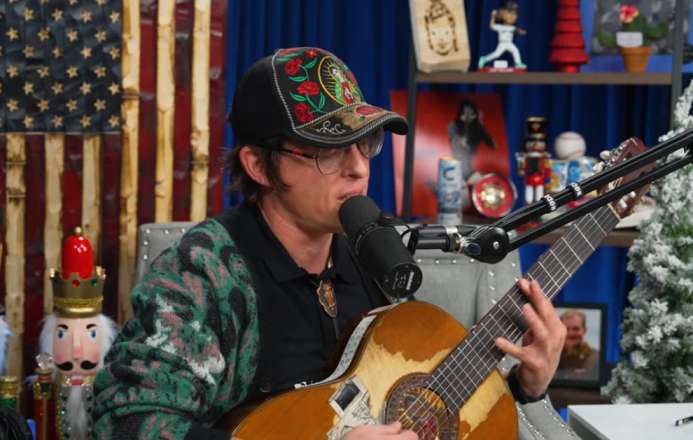
Here is the full transcript of country artist Stephen Wilson Jr.’s interview on This Past Weekend w/ Theo Von, #630, December 23, 2025.
Brief Notes: In this deeply moving episode of This Past Weekend, country artist Stephen Wilson Jr. joins Theo Von for an emotional conversation about growing up in southern Indiana, being raised by a single father who was a boxer, and how those roots shaped his life and music. He reflects on hunting for food as a kid, finding his voice through country and classic rock, and carrying forward his dad’s fighting spirit after being nominated for “New Artist of the Year” at the CMAs.
The two also dive into Stephen’s complex relationship with faith, wild Pentecostal church memories, and why he believes it’s never too late to rewrite your story, no matter where you start. Along the way, there are plenty of Midwestern food tangents, small-town characters, and darkly funny stories that keep the conversation as entertaining as it is heartfelt.
Introduction
THEO VON: Today’s guest is a musician and a songwriter originally by way of Southern Indiana. He’s got that voice in him. He’s got that power in him. He’s got it. He’s got it. He has a new single, “Gary,” that’s out now and a sold out tour in the spring. I’m thankful to finally get to sit down with Mr. Stephen Wilson Jr. Man.
STEPHEN WILSON JR.: I’m just such a fan of yours on all levels. Your podcast and your comedy and thanks. And your humanity. So yeah, it’s an honor to be here.
THEO VON: I appreciate it. Stephen Wilson Jr., thank you so much. Dude, it’s really cool. I think this is one of those moments where I feel, yeah, like just so lucky that I get to. That some of this job has ended up like this, like getting to talk to people that, that yes, some people would love to sit down with, you know. So thanks so much, man. I appreciate it.
You have, you just had, you had a pretty decent run at the CMAs this year.
STEPHEN WILSON JR.: Yeah, it was a, you know, new—
CMA Nomination
THEO VON: Artist of the year.
STEPHEN WILSON JR.: Yes, I was nominated for new artist of the year, which blew my mind.
THEO VON: And did you win? Red Clay Strays won? Who? Zach.
STEPHEN WILSON JR.: Top won.
THEO VON: Zach. Top won.
STEPHEN WILSON JR.: Very well deserved. That man has had a big year and I’m a big fan of his and yes, that’s very happy for him. And I was really rooting for everybody but myself. I didn’t really think I even had a prayer’s chance in hell of winning, but I was just like, honestly being nominated was a huge win for me because, you know, I wasn’t supposed to be there on paper.
You know, like there’s a lot of, there’s a lot of things that like I contradict. And so just being there, you know, it meant a lot just to be out there. And it was really wild when I remember when they said my name and it didn’t feel like that’s somebody else. Oh yeah, that’s not me.
THEO VON: That’s like a— Oh, for sure. Well, do you think of yourself as country music?
Growing Up Country
STEPHEN WILSON JR.: I do, yeah. I am a country boy. I grew up in the country, so I am very country just by, by culture. And I cannot help but write country songs. I grew up listening to country music and classic rock. I grew up in body shops and it was all classic rock and country music, old school and 90s and so that was kind of my pedigree, my listening pedigree.
And then I grew up very country, very agrarian, kind of hunting for our own food. And I ate a lot of squirrels growing up. And rabbits and— Yeah, we just grew up very country. Wasn’t trendy at all either. It was like, just a means of survival.
My dad was raising three kids on his own, and so he just went out and killed food. It was a lot cheaper than buying it at the grocery store. Like, you know, one slug, one deer slug could feed you for, like, three months. So, like, that’s the way he looked at it.
THEO VON: Oh, there’s a beautiful group right there. You guys kids, huh?
STEPHEN WILSON JR.: That’s my dad and his three little ones, and that’s me.
THEO VON: That you on the bottom left there? Kind of middle?
STEPHEN WILSON JR.: Yeah, in the middle, yeah.
THEO VON: And who’s that dime on his lap? Huh? And I mean that respectfully as a child. Who’s that beautiful young lady?
Family Portrait
STEPHEN WILSON JR.: Yeah, that’s my little sister, Lacy J. Lacey J. Lacey J. Yeah, Named after Lacy J. Dalton, another country singer. And, yeah, she’s his little girl. And she is. She is beautiful, and she’s a beautiful person in general. She’s really kept our family.
Like, me and my brother right there, we’re like Irish twins. We’re only like, a year and a few months apart, so we’re like— We were. We grew up beating the hell out of each other. We were both boxers.
My dad right there in this picture, he had just won, you know, the Golden Gloves for, like, the third or fourth time in a row. And, you know, he was probably just running over to, like, Owen Mills or somewhere at Walmart, grabbing this picture real quick. So just so, like, just so there’s proof that we existed and proof that he did this.
And I always find it wild that he had time to even snap, snip, snap that picture amidst his life, it was so crazy.
THEO VON: Well, and for a dad to put that together, that didn’t, you know, that wasn’t really the dad world. So he was a single dad raising you guys?
A Single Dad’s Sacrifice
STEPHEN WILSON JR.: Yeah, he was driving a bus in the morning and then working at a body shop and training to be a boxer.
And so a lot of my dreams, I live kind of, you know, for him and myself, but because he put a lot of his dreams on the back burner to raise me, like, he also created me, so, like, he, like, he kind of had to do that if, you know, like, so. But, you know, a lot of people don’t take that responsibility. And when I see that picture, I have, like you said, a memory.
THEO VON: Well, he either got the— He’s got great dimples or somebody caught him with two good dimples.
STEPHEN WILSON JR.: No, yeah, he’s got great dimples.
THEO VON: He does.
STEPHEN WILSON JR.: My sister in the gift has the same ones. But yeah, I see that guy right there. And about a year from that picture, he would have been curling my little sister’s hair and getting her ready for kindergarten. And even though his eyes were swollen shut from sparring the night before, I have distinct memories of him getting her ready for school and being like a dad to a very young little girl.
Like, and like, you know, crimping her hair and curling it and you know, being, being a dad. Also doing feminine things, like, because there was no one to do the feminine thing. So he was like, “I got to be dad.” And he was really good and he knew how to do the dude, the dad dude part.
Like, he had me and my brother boxing every night and we were hunting and fishing and doing all the dude things. But he also had to be a dad to a little girl that was like the light of his life. Wow, that was like quite the responsibility.
And I look back on that and I have like, like I said, just such a distinct memory of him curling her hair while morning cartoons are playing right before we got on the school bus. And yeah, he was quite the dude.
THEO VON: What was his name?
STEPHEN WILSON JR.: Stephen Wilson.
THEO VON: Oh, he was senior. Yes. You just never know. Sometimes they’ll throw a junior on somebody just because they don’t know what’s going on. Yeah, you know, or they’re just NASCAR fan. They’ll tack it onto the back of—
STEPHEN WILSON JR.: Their kids neck like a donkey tail. They just put it on there like—
THEO VON: A junior, like, yeah, we’ll pin the tail on this child.
The Name Stephen
STEPHEN WILSON JR.: You know, I’m very much a junior. It’s very much a thing in boxing especially like, you know, I, I joke around that, you know, my, you know, my dad, you know, he was, he was named after a martyr in the Bible. Like my grandmother named him after a guy that was, had rocks thrown at him until he died. In the Bible, Stephen. With a “ph,” by the way, and which makes a lot of sense because I’m pretty sure my dad was stoned when I was born. Was he the joke?
THEO VON: Oh, the pH level of his brain was probably weed. Probably then it might have been plus 40 then. Depends on if he was on some serious gas or not.
STEPHEN WILSON JR.: He did like perhaps the—
THEO VON: Oh, you had to back then.
STEPHEN WILSON JR.: Yeah, country cabbage.
THEO VON: The story of Stephen from the Bible. Stephen, the first Christian martyr. Oh, the first Christian martyr was stoned to death outside Jerusalem for his faith as described in Acts 7 of the Bible. His executioners, including a young Saul, threw rocks at him after he testified about Jesus.
STEPHEN WILSON JR.: Yep.
THEO VON: Why did Saul not want him to testify? Did he not believe him? Or did he just not want him sharing the truth?
Biblical History
STEPHEN WILSON JR.: Well, Saul at the time, this is pre-Paul, because Saul turned into Paul once he saw Christ, like the spirit of Christ appeared before him. And that’s when he became Paul. But at that point, Saul was very much a figure of the Jewish religion. He was a very high ranking Jewish official. So he was kind of like a high ranking individual.
And so he was really in his mind at that time, probably just doing his job, not really knowing why he was doing it. But then he had a very much a come to Jesus moment, no pun intended. That’s when he became Paul. And he wrote literally probably two-thirds of the New Testament, or at least a lot of it.
THEO VON: Half of it, at least. This says here, and we use perplexity AI, and it says, “Before his conversion, Saul was a zealous Pharisaic Jew.”
STEPHEN WILSON JR.: He’s a Pharisee.
THEO VON: “Pharisee was a zealous Pharisee who believed followers of Jesus were dangerous heretics. So from his perspective, Stephen’s preaching against their rejection of Jesus and his criticism of their misuse of was blasphemous and deserved death under the understanding of the law. That zeal led him to participate by giving approval and overseeing the execution, which he later remembered with deep sorrow when he became the apostle Paul.”
STEPHEN WILSON JR.: Wow.
THEO VON: Yeah, gosh, dude, that’s got to be a lot to carry. Because if Stephen was the first Christian martyr and you had him stoned because your faith wasn’t there yet, and then to look back through a different perspective.
STEPHEN WILSON JR.: Not much longer after that, for him to be like, “Oh, now I’m preaching the same gospel without rocks being thrown at me.” And now that has to be quite the thing to come to terms with. And I think that’s what motivated him to write, you know, so many epistles of the New Testament and became such a huge figure of the New Testament.
There’s a lot of books that they believe were written by Paul, like the Book of Hebrews. There’s like no author, but they believe even he wrote like books that nobody has any author to. They just, they can identify his style of writing and be like, “It had to be Paul.”
THEO VON: So, yeah, people love your style of writing, man.
Religious Upbringing
STEPHEN WILSON JR.: Speaking of that, I grew up very religious. That’s why I talk about— I grew up in a Pentecostal, Nazarene kind of church. A lot of holy rolling. And I read a lot of the Bible growing up.
THEO VON: Well, yeah, I just started going to a Bible study. That’s the first time I’ve ever been to a Bible study in my life. And so it’s been interesting to start to just learn about different characters from the Bible and just different stories and stuff. So, yeah, I’m just glad that we even got to talk about that. And—
STEPHEN WILSON JR.: And—
THEO VON: Yeah. And that that’s how your father was named, from Steven. I didn’t know that story now or remember it.
STEPHEN WILSON JR.: Yeah.
THEO VON: So that’s pretty cool. What was that? Yeah, the church you went to. Because you’re from the Midwest, you’re from Indiana.
Southern Indiana
STEPHEN WILSON JR.: Yeah, I’m from where— I’m from Southern Indiana. Kentuckiana, they call that area, like, just north of Louisville, Kentucky, just close to where Trevin’s from. And—
THEO VON: Okay, I would say that’s where the—
STEPHEN WILSON JR.: Midwest and the south kind of chest bump or shake hands. It is literally a collision of two cultures. So people have Southern accents and watch NASCAR, but they also put noodles in their chili, which is a very Midwestern thing. So, yeah, there it is. Jackson County, Indiana, right there in this Southern part.
THEO VON: Oh, yeah, the Midwest, they’ll starch up a protein in a second. They don’t give a dang brother. They’ll put a starch right in the middle of a protein. Yeah, that’s how they are there. They love that. I mean, I was—
STEPHEN WILSON JR.: Long winters.
THEO VON: It gets cold.
STEPHEN WILSON JR.: You need them starches.
Church Culture and Dessert Priorities
THEO VON: Oh, yeah. I would grow. I mean, I would go. We used to go to the AC. It was an Apostolic Christian church with my grandparents and some of their neighbors. And it was in Illinois, like, in pretty much southern Illinois. And that was just part of the culture.
Like, people would eat their dessert at the beginning of dinner sometimes. So they made sure they got their dessert in, like, it was just kind of some of that culture.
STEPHEN WILSON JR.: Yeah, you don’t want to miss that, like, get too full, getting too excited on mashed potatoes, and they’re like, “Damn, I ain’t got nothing.”
THEO VON: It was almost a shame if you couldn’t make. If you didn’t have space available in your body for a beautiful dessert. Somebody had made you almost felt a bit ashamed in a way.
STEPHEN WILSON JR.: Yeah, you should be. I think how much work was put into that cobbler compared to those mashed potatoes. Like, you. Yeah, you ate the, like, the easy stuff.
THEO VON: Oh. And sometimes you’d have somebody, you know, you’d have such skilled labor in there. You’d have a real cobbler making the cobbler. You’d have a damn shoelace going through a. Going through a peach. You know, you’d be in there.
STEPHEN WILSON JR.: Bootleg cobbler.
THEO VON: Yeah. You’d find. Yeah, you’d find half a soul. And, you know, you’d be like, “Oh, is this. Is this crust or is this a, you know, part of an eleven and a half?”
STEPHEN WILSON JR.: Yeah. What is this cobbler?
THEO VON: Soulless? Yeah. Yeah. Like. No, not so much. He’s got real, real heels in the corner. You know, it was just. But there was so much value, I remember, in my grandmother’s town on cooking and on having people over for meals.
Just that Midwestern culture, you on hard work. And religion was a big part of it. You know, even their neighbors. If my grandparents couldn’t take us to church, their neighbors would offer, “We’ll take them to church,” you know, and we go in and just get to see what some of the different churches were like. And that was one of the bigger religions in the area was Apostolic Christian over there.
Exorcisms and Speaking in Tongues
STEPHEN WILSON JR.: You see any exorcisms or any speaking in tongues or movements of the spirit?
THEO VON: Let me think. No, they had good donuts. They braided their hair. The women did, like, one big braid. They didn’t show a lot. You know, it was very kind of covered up. With some of the females.
STEPHEN WILSON JR.: Female culture, they braid their donuts.
THEO VON: They did have those. One.
STEPHEN WILSON JR.: Yeah.
THEO VON: What is that one? That’s great.
STEPHEN WILSON JR.: No, it’s. It’s. I don’t know what it’s called. I don’t love it.
THEO VON: I don’t either. Yeah, it’s too much bread, and I don’t think there’s filling in. You think there is when you’re a kid.
STEPHEN WILSON JR.: It’s very deceiving. Yeah. Twisted donut. No, there’s a word for it, and it’s.
THEO VON: Crawler was one that I loved. But a cr. I don’t think this was a crawler. Well, cruller often made from choux pastry, French cruller, or yeast dough with a distinctive twisted shape. Or maybe it was a cruller.
STEPHEN WILSON JR.: Yeah, maybe it was. But I. Yeah, there’s something else, though.
THEO VON: It looked good as a kid, but it was. It was deceased.
STEPHEN WILSON JR.: Yeah. It was always like, “Oh, I want that.” And then you would eat it and you’re like, “Man, there wasn’t trash.” Yeah, I should have went with that Bavarian cream. Yeah.
THEO VON: Or I should have went with the one with the frosting on it. You know, but we had a beautiful time. Yeah, I didn’t meet any. There was no seancery, really.
I do remember there was a mentally handicapped fellow who said he could drive. And he was a driver, that instructor, and he wasn’t. He was just, you know, and some people believe he was mentally handicapped. Some were like, “He’s possessed by the devil.”
I’m like, “Well, he’s not possessed by like a devil who just, you know, is sitting around his pick in his nose and just, you know.” Yeah, he was just a little bit off, this dude named Brandon. And he was awesome, actually. He was kind of this special guy between an adult and a kid. And he never left that zone, you know, so there was something kind of very approachable to him about kids because he was bigger than us, but he was just like us.
And he taught me how to. He said he could drive. And we drove right into a snowbank and the police came and everything. But it was just exciting though.
STEPHEN WILSON JR.: He was a liar.
THEO VON: Yeah, he was a liar.
STEPHEN WILSON JR.: Which is a good place for him to be at church.
THEO VON: He was a Bears fan, I think it was a tough time for everybody.
STEPHEN WILSON JR.: I mean, I got to say, I saw quite a few demon possessed Brandons. Where I grew up, I saw a lot of Brandons get demons cast out of them.
THEO VON: Really? So you would see that at your church? Yeah. And what was that kind of like? Like, because some. Someplace that’s a part of a culture and I believe that. I believe in that type of stuff. Do you believe in it?
STEPHEN WILSON JR.: I do. You know, I have a, you know that I’ve tried to deconstruct a lot of that through because I have a science background. I’ve had to really try to understand a lot of that and understand what is real and what is not.
But there was a lot of it that was 100% real and there was a lot of it that was 100% not. And you know, I believe there’s theatrics, but I also believe, you know, God is everywhere. And I believe God did show up in those places. Just like God will show up in any place.
But yeah, I did see a lot of, you know, grown a drywall dudes get like demons cast out of them before lunch. And I’d be like sitting there with half a Pop Tart in my stomach watching this dude literally like throwing deuce around and like exhibiting some superhuman strength.
THEO VON: Oh, they’re popping the tart right out of that dude. Yeah, yeah, you know, that’s the original pop Tartar dude. He’s a Damn.
STEPHEN WILSON JR.: Exercise. Yeah, he just created the original pop Tart. That cherry flavored pop tart was from a demon exorcism. That’s why it’s red.
THEO VON: Yeah, you just know they could have gone with a lot darker flavors, but they’re like, “Let’s make this available to children.” But, dude, a pop Tarts and exorcism. S*, I’m. I’m there, dude.
Revival Meetings and Being Slain in the Spirit
STEPHEN WILSON JR.: I’m sitting on your lap speaking in tongues. I actually went we, you know, some, you know, in our town, like, an evangelist could, like, show up to your church and, like, a traveling evangelist and be like, “We’re having revival here this week.”
And literally the church would shut down and be like, “We’re having revival, y’all. This is what we’re doing.” And the whole week would be a revival just because this dude showed up and said, “God told me to have a revival here,” and they would have a huge, like, big tent revival.
THEO VON: No way.
STEPHEN WILSON JR.: Absolutely.
THEO VON: It’s always been my dream to be a part of something like that. Leap of Faith was my favorite movie growing up.
STEPHEN WILSON JR.: Dude, that movie changed my life.
THEO VON: Nobody knows about it.
STEPHEN WILSON JR.: It’s one of the greatest movies ever made. Literally changed my life. Oh, my gosh, I’m so glad you know about that movie. Like, very few people I’ve been able to talk to about that movie, because it has one of the most profound impacts on me, really, as a kid, just because of how I grew up and the music business and seeing performance and theatrics and, you know, where is God and where isn’t God? And that movie is just brilliantly done.
But I remember I went up, this dude showed up, and he said, “Tonight, everybody’s getting slain in the spirit. You come up, you’re getting slain.” And I don’t know if you know what slain means. Like, you stand up there and the dude hits you and you fall down and you just out for however long. And, yeah, everybody lined up, and I was like, “I’m getting slain tonight. I’ve never been.”
THEO VON: That’s a freaking religious Percocet right there.
STEPHEN WILSON JR.: Yeah, I wanted it bad. And he just knocking people over left and right. Boom, boom, boom. I’d seen him go down. It’s like, he’s coming to me. He got to me, and he started speaking in tongues. And I remember he tapped me right in the forehead. Boom. Like that. I was like, “That was kind of hard.”
I was, like, training for the Golden Gloves at that time. So I was like, a little bit like, “What’s up?” Like, he just, like, hit me right in the forehead with his fingers.
THEO VON: Yeah.
STEPHEN WILSON JR.: And then he started, you know, it didn’t work. Like it didn’t take. And so he did it again even harder and I was like kind of like mad about it at that point because it actually kind of hurt. I was like, “Is this dude trying to knock me out?”
THEO VON: Yeah.
STEPHEN WILSON JR.: Or like he’s trying to slay me in the spirit.
THEO VON: And anyway, yeah, let’s look at the.
STEPHEN WILSON JR.: Judges cards and I’m just like getting hit in the forehead by him. And then he just moved on. It was one of the most heartbreaking things. He went to the next guy and knocked him out. Next guy down, down.
THEO VON: Were you being defiant do you think?
STEPHEN WILSON JR.: I don’t know. I thought like, “Man, I guess I don’t believe. Did I like snap out of it? Was I, you know, was I not in the moment?” I didn’t, I didn’t really know what to think because I was like a 19 year old kid just trying to feel God and try to get closer to God. And everybody seemed to be doing that.
And what was wild is like he knocked everybody up and there was all these bodies all over the floor. People like putting modesty cloths all over him and stuff and, and they’re just out there asleep. So I had to like walk all over all these bodies to get back to my like, oh yeah, it’s kind of embarrassing.
THEO VON: It’s almost a walk of shame.
STEPHEN WILSON JR.: It was the most shameful walk I’ve ever taken at church.
THEO VON: No, I guess I’m not yet.
STEPHEN WILSON JR.: I guess I’m not. And I, what really made me laugh at least kind of helped break me out of it. I remember thinking like, “What if I step on because everybody had their hands out just kind of like laid on, right? What if I step on someone’s hand? Will I snap them out of it and then be like, ‘Ah.’ And then they’ll go back in or would they be out like ‘Oh, you stepped on my hand and now I’m no longer slain.'”
THEO VON: I was like, how did. Or they’re like, “Stephen the sinner.” You know, old Steven Wilson Jr. Who can’t even get the dark arts exercise out of him. He’s over here waking up people who.
STEPHEN WILSON JR.: Are doing well, breaking fingers with his, with his steel toed boots, shamefully walking back to his pew.
THEO VON: I never thought about the walk of shame at church. What is a, what is a modesty cloth?
Modesty Cloths and Church Humor
STEPHEN WILSON JR.: Well like sometimes a lady would get slain and she’s wearing a skirt. You know, it’s a Pentecostal church and they cover and make sure, like, oh.
THEO VON: That’s a lot of skirt, dude. We used to call them skirtings because they were so long, you know? And some of them would be actual curtains that they had taken off of a window somewhere. Some of them, you’d even see, like, that stick. You know the stick that’s on the edge of a curtain that you can. Like, if you turn it, it’ll go up. Some of them, yeah, you’re just sitting over there, but, dude. Yeah, you’re trying to get a pin. You got to spin that thing for.
STEPHEN WILSON JR.: A whole blinds underneath.
THEO VON: Yeah, they got those vertical blinds.
STEPHEN WILSON JR.: Really? Yeah, they cure you from blindness, dude.
THEO VON: That’s pretty funny, dude. Thinking about something like that. We’re thinking about something that’s funny together with somebody is something. That’s awesome, dude.
STEPHEN WILSON JR.: Yeah, it was like. It helped me get through it, like, the. Because, like you said, there was a shamefulness to it, but it actually was kind of funny when I.
THEO VON: So they put that modesty blanket on them.
STEPHEN WILSON JR.: There’s a modesty cloth that’s good for that. Yeah, good for that.
THEO VON: That at least. Yeah. Because there’s some guys and lurkers that would just be up there.
Yeah. You never know. And like I said in those churches, nothing. You didn’t even show below the knee. So if your skirt, when it started to show some knee, they better get a cloth over that. Can’t be seen, that kneecap.
THEO VON: Oh, yeah, boy, those. Oh. I remember being young and just. God, I was kind of like a little bit of a peeping Tom or whatever. I was visually stimulated, I called it, and had a step stool. But I remember for Christmas, when you’re, I wanted a ladder. My mom was like, what do you want a ladder for? Like, why do you want this little ladder?
And I wanted to go. I’d go watch people and just watch in their houses. And I wasn’t always looking for perverse stuff. I was just looking. I liked watching people live. Right. Like, I think I hated being at our house. It was like, it wasn’t fun. It was just painful kind of a lot. And it was always aggressive and defensive. Like, the second you were around, you had to be defensive.
And so I would go watch as other people live. Like, watch somebody just be, you know, or just watch some dad sit there in a chair, some mom make something or some kid just uses like a living room or something. I wasn’t getting real weird, but I love that kind of stuff. Man, I love just kind of absorbing how other people operated. Yeah, that kind of stuff was interesting.
STEPHEN WILSON JR.: You’re an OG People watcher.
THEO VON: Yeah, I was a bit of a.
STEPHEN WILSON JR.: Yeah, I mean that’s, I mean if get your ladder together, you know.
THEO VON: Yeah, but get half a Pop Tart and get over there.
STEPHEN WILSON JR.: I find comedians or and songwriters in general are just like they’re people watchers and then they watch so much people that they end up, these narratives start to show up and so you were probably just harnessing your skills for what was to come.
The Generational Relay Race
THEO VON: Yeah, I think sometimes. Yeah, you look back in your life and you’re like, oh, so much of that was ammo to provide something. One thing you said that was interesting a little bit ago is you said that your dad, like, your dad was a boxer and he did these things, and then sometimes you’re living out some of your dad’s dreams.
And I find that to be interesting that we feel like that as sons or that some sons feel that way. And then also that some dads will make sacrifices, like you’re saying. Like, you know, and it wasn’t like it was his choice that he made. You know, it wasn’t like a sacrifice. But sometimes even with choices, then come sacrifices that you don’t see, and then you have to make another choice then as to what do I do here?
But that, like, by giving, by giving birth to a son, by having an offspring, you are creating something that can go the next leg. Almost like it’s one of those races where they pass the baton. What is that called?
STEPHEN WILSON JR.: Yeah, I think a baton race.
THEO VON: Yeah, a baton race. And, yeah. So, yeah, it’s not hard. It’s not as hard as this.
STEPHEN WILSON JR.: I’m not sure. It may not be called that. It may be something way more complex. There it is, a baton. A relay race.
THEO VON: It’s our race. Relay race. But it’s like, I can’t, this is as far as I can get. And let me put this into you with. But then it’s interesting, as the next runner, as the next generation is, what do I, like, how much do I owe to this previous generation to carry on their dream? Do I owe anything? You know, what does it mean to be a son? Like, all those things kind of were popping into my head as you were saying that.
STEPHEN WILSON JR.: A generational relay race is not something I’ve put, you know, to thought regarding all that. But that is very, very accurate observation there. Because when you see a relay race, like the first runner or whatever, the runner before you. The runners before you, like, dictate how fast you’re going to run and they dictate your position in the race.
THEO VON: Yeah.
STEPHEN WILSON JR.: So, like, if they’re running with everything they got, well, then you’re only doing a disservice to their effort by not running with everything you got.
THEO VON: Right.
STEPHEN WILSON JR.: And so, yeah, that baton becomes something bigger than just this thing you’re holding in your hand. It’s like the sum of all their efforts.
THEO VON: Yeah.
STEPHEN WILSON JR.: And, you know.
THEO VON: Yeah, I think we used to hear a lot more, I think, when families, and this is a hypothetical, but when families seemed closer and we needed more entertainment from our fathers and forefathers and we got lore passed down and family history when there was more, when you couldn’t get as much storytelling from like phones and television and stuff as we can in the past few generations, but when it came from like those, the predecessors of ours and our forefathers and mothers, that kind of stuff, it like beat inside of us like a drum, you know?
Yeah. What kind of, did you feel a pressure, like, and did something happen? Your father passed away?
Losing His Father
STEPHEN WILSON JR.: Yeah, he passed away seven years ago at the age of 59. And it happened. And yeah, he was very young and it was a sudden thing.
THEO VON: Was he sick?
STEPHEN WILSON JR.: Well, he had like this pulmonary fibrosis thing that was starting, but he ended up dying of a pulmonary embolism, like a blood clot in his lungs. So, yeah, it was a very sudden thing that I don’t think anybody really expected.
THEO VON: He was living in Indiana.
STEPHEN WILSON JR.: He was living in southern Indiana and he was, you know, he was doing quite well. And like, you know, everything kind of changed in about six months. And then he, you know, suddenly this embolism showed up and I tried to get there because he, it was his, his body was like shutting down.
THEO VON: What do you mean? So an embolism, can you bring it up just so I know? Trevin. Sorry to interrupt you, Stephen.
STEPHEN WILSON JR.: No, don’t.
THEO VON: I just like sometimes I let information fly and I don’t know what it is. An embolism. A pulmonary embolism is a blood clot that travels to and blocks an artery in the lungs, cutting off normal blood flow and oxygen exchange and creating a potentially life threatening emergency. So had this been happening for a while and then it got bad?
STEPHEN WILSON JR.: Yeah, and so he had had some, obviously some things going on that he never knew was happening and then, yeah, it got to that life threatening emergency point and then there is a point where they can only do so much and you know, he was a bit of a cowboy and you know those kind of classic dudes that don’t want to go to the doctor and “I’ll tough it out” kind of thing. I’m sure there was a lot of that mentality going into it.
Also there was poor health care. You know, that’s, he was a victim of the American health care system too, in that regard. I won’t get into all that, but yeah, like that was a big part of it.
THEO VON: We’ve talked about that a lot over the years. It’s a nightmare. And the stress they put people through trying to deal with their own taking care of themselves. It’s like, yeah, it’s a nightmare.
STEPHEN WILSON JR.: Especially at his age, at 59, he was starting to feel like you’re just like a forgotten human. They don’t, you know, like, they don’t really want to take care of you. They want to do everything but that. Like, you got to fight tooth and nail to take care of yourself in that. At least where he was at that time.
And, yeah, I got a really panicked call from my sister that morning. Said, “You need to get here, like, now. Dad is very sick and we don’t know what’s happening.” And they rushed him to the emergency room, and I jumped in my car and sped up there and I said goodbye to him in the middle of Kentucky on the side of I-65, on an iPhone 8 on the side of a highway. And that was over.
THEO VON: To make it quieter.
STEPHEN WILSON JR.: Yeah. And just so I didn’t lose signal. I was so worried that because, you know, the middle of Kentucky is the middle of nowhere and, like, what if I dropped the call? Like, yeah. And, you know, there was, so I just pulled over. Just, I mean, it was insane. I just, the sound of, like, semis flying by me at, like, 90 miles an hour, but literally being in a, I felt like I was in a bubble.
Like, not like the world was, like the world stopped around me in that little car. Like, a semi could have taken the side of that car off. I wouldn’t even had known it or, you know, I would have just, I was in a state of absolute shock and horror. It was a very traumatizing experience, but.
THEO VON: And you were on a FaceTime call?
STEPHEN WILSON JR.: No, it was just on a video or a normal phone call.
THEO VON: Was he able to speak to you?
STEPHEN WILSON JR.: He was. And he did.
THEO VON: He know that it could be, like, his last moment.
STEPHEN WILSON JR.: He knew he was dead.
THEO VON: He was bothering you by asking you.
The Final Goodbye
STEPHEN WILSON JR.: No, I talk about it a lot on stage. I kind of relive it every night. And that’s been a challenge for me, like, mentally kind of. But it’s been, but it’s also been, like, the beautiful part of unpacking trauma and grief because, you know, I’m not, our music, like, really, it finds the grieving, and I think it’s important for me to grieve as well.
Like, I go through grief every night and, but, you know, he was such a gangster in that moment. He knew he had maybe 90 seconds left on this earth. He knew he was going. Not just going, but going fast. He even told me. He’s like, “I’m going, Stephen.” And sorry. But, yeah, he was, he was so calm about it. He said everything was going to be okay. That was his first thing he said. Like, such a dad thing to say.
And he said, “Write a good song for me, Stephen.” And he said, “I love you, I love you, I love you, I love you” four times.
THEO VON: He wanted you to know for sure.
STEPHEN WILSON JR.: Yeah. Like, he wanted there to be no doubt. And so I say it more than once all the time now, because.
THEO VON: From.
A Father’s Final Words
That experience, I kind of realized that people are counting, and I was counting, and it was weird. Like, on that last “I love you,” it’s almost like his voice got quieter, like he was literally being pulled. Like God was snatching him from the universe in that last “I love you.” And he was gone 30 seconds later. And that was it.
I was the last person he spoke to. And I’m really grateful that I got to speak to him. And in that moment in that car, I was so angry at God. I was so angry at him. Even my dad. I was like, how dare you die on me like this? Like, that’s. It wasn’t supposed to happen. Like, none of it was supposed to happen like that.
Like, I was under the impression he was invincible, first of all. And he was just so young, and he was just such a lively, such a bright light, so it just didn’t seem possible. And even to people in my hometown, they were in disbelief when he died. Like, it was like, because his life force was so big that people were in denial. It’s like, that’s impossible. There’s no way he could be dead. And I was like, no, he really is.
And it was a tough thing to really come to terms with, but with any great reaction or any chemical reaction, there is a catalyst. I have to say everything. The reason I’m here and the reason I’m anywhere right now is because of that conversation. It was, you know, you have a product and a reactant, and then there’s a catalyst. And that conversation is what catalyzed my whole career, really.
And yeah, that “write a good song for me, Stephen” was like a lifetime’s worth of jet fuel for me to charge across the galaxy and do everything I could to try and keep him alive, to try and just tell the world about him, to carry out his wish.
Yeah. I mean, what I found out is, like, carrying out his wish and keeping him alive was keeping so many other people that other folks have lost, other humans have lost alive. He was resurrecting other people at the same time. And these people were coming to shows with this bounty of love that had no place to go. And that’s what grief is, essentially.
And I gave them these songs, have given them a home for at least maybe three and a half or four minutes.
THEO VON: Oh, yeah.
STEPHEN WILSON JR.: And that’s really been the charge of all of this. That’s been the mission statement is, you know, at the very beginning was just, keep dad alive. Keep him alive at all costs. And, you know, like, kind of a psychotic denial for the first couple years that he was even gone. I was like, no, he’s still around.
And a lot of times I felt him on my shoulders like a little kid. It was really weird. It was like this weird reversal of roles. And, well, now that he’s free, he—
THEO VON: Kind of could do as he wants, you know, he can be on your shoulders.
STEPHEN WILSON JR.: Yeah, he would show up like that. And the reason why I play this song, “Stand By Me,” it’s just literally, I have—two weeks after he died, I was scheduled to play this songwriter festival in Deadwood, South Dakota. And it’s a, you know, it’s in the Black Hills, and it’s a very spiritually charged area, just in general.
THEO VON: Yeah, for sure it is.
The Song That Haunted Him
STEPHEN WILSON JR.: And the guy that runs it says, you don’t have to play any music. I know you’re in a bad, bad spot. I hadn’t slept in a week. And he’s like, just come here and, you know, see what happens. You know, just be around people. Like, there’s nothing but love for you here, and we know you’ve gone through it.
And at the end of the festival, they asked, you know, all the writers and stuff there if you wanted to play a cover. What’s your favorite cover that you love? And they did this big finale. I had been, for some reason, for about a year prior to my dad’s death, I’d been singing the song “Stand By Me” in my living room, the exact way I play it now.
THEO VON: It just popped in your head to come. It just kind of came in you.
STEPHEN WILSON JR.: Yeah. And like, for some reason, I was like, that song has haunted me my whole life because of the movie Stand By Me.
THEO VON: Oh, that’s a big part of a lot of people’s. That movie was huge in people’s lives for so many little moments.
STEPHEN WILSON JR.: Yeah. Like, I very much saw myself in the kid on the left.
THEO VON: The Gordy.
STEPHEN WILSON JR.: The Gordy Lachance? No. Oh, was his name Will Wheaton? Like, the writer. The writer that was trying to find a voice. The nerdy little writer kid on the left. And that song was threaded so brilliantly throughout that film, and it’s obviously the title, but because of that movie, which is also a Stephen King story. That movie is based off a Stephen King novella called The Body.
So, you know, it was obviously a very haunting and dark theme. But, you know, that song really haunted me because of that movie. And I just started playing it. I was trying to, I don’t know, kind of deconstruct it, try to process it in a different way.
And when my dad died, fast forward to Deadwood. All I could play was “Stand By Me.” And I started playing it, and I’d really never played it for anybody like that. And the whole place just went crazy. And at that point, I was not an artist. I just quit my job as a scientist. I’ve been a published writer for maybe two years at that point, just trying to get other artists to sing my songs.
And I never really saw myself as an artist, even though my dad did. Like, he would always be like, why don’t you just sing these songs? You sound great singing them. But I would always argue with him, like, no, I don’t do that. I write them, someone else sings them.
But when I went up there to sing “Stand By Me,” I swear to God, he was on my shoulders like a little kid. And I got so addicted to that feeling again, because he, I mean, he was there. He showed up, and I truly believe he showed up at Bridgestone at the CMAs. Like, he did. He showed up that night.
THEO VON: Oh, I bet he was so proud of you. Do you feel like he’s proud of you?
STEPHEN WILSON JR.: Yeah, I think so. Yeah. He was so proud of me before he died, before any of this happened. And I think, yeah, he would be very proud. I’ve been trying to make him proud my whole life, but what did he say?
THEO VON: Write a song for me or make us. What did he say?
STEPHEN WILSON JR.: Sorry, I’m leaking over here.
THEO VON: No, I leak all the time. Yeah, dude, I listen to stuff that makes me cry all the time because I think I’m just full of tears. And I got to get these b*tches out, even though I’m dehydrated half the time. So I’m like, I don’t even know what’s going on here, dude.
STEPHEN WILSON JR.: No, it’s good for you. Like, when my dad died, I swear, all I did was cry for two years. Like, it’s all I did.
THEO VON: Get it out.
STEPHEN WILSON JR.: If you can find the tears, find them. Right now, I can’t find them. I mean, even though I get emotional, don’t get me wrong. But—
THEO VON: Yeah, sometimes you have tears and sometimes you don’t. It’s almost like seasons, you know, it’s almost like an ocean. Sometimes it comes up on the shore, and sometimes it’s out to sea, you know. Even though it lives, right?
Yeah. So it’s like, and especially, I think people that have had a lot of things in their life that have happened that haven’t been processed, you know, it takes a long time, and I think I’ve gotten grateful in my life over time where if I find something that helps me process, I’ll sit there and process it.
My brother says a lot of times he’s like, yeah, getting rid of grief and trauma, like that old stuff. And people use trauma as a buzzword, but getting rid of grief and stuff in the past, he’s like, it’s like taking pennies out of a bathtub one at a time. He’s like, you know, it just takes a long time and it’s slow and it’s just kind of arduous work, but you just be grateful that it can kind of happen over time.
What he said, make a good song for me.
STEPHEN WILSON JR.: Write a good song.
THEO VON: Write a good song.
STEPHEN WILSON JR.: Yeah. Because he knew that’s what I was. That’s all I could think about.
THEO VON: And that’s the baton, man. That’s the baton.
His First Fan
STEPHEN WILSON JR.: Yeah. He used to come to my shows. When I say shows, like, playing for seven people at Writers Round or like—and he came to the Bluebird Cafe, remember, he had his giant—when they had those giant phones that were like the size of laptops, you know?
THEO VON: Oh, the T-Mobile side kids. Yeah, baby, them was beautiful.
STEPHEN WILSON JR.: Yeah. He had one of those bad boys, and he would just hold it up and record the whole show. But he used to drive me crazy.
THEO VON: Oh, dude, there’s nothing crazier than watching a boomer kind of record something or even just somebody from a generation above or just—we went to the UFC fights the other day, and some guy was recording every single fight. I’m like, he had a front row seat, and he was recording, and there was a TV right next to him playing the fights. I’m like, you can just go home and watch.
Like, I just didn’t understand what was going on. But the fact that he was there and that he cared so much about it and that he loved watching you do it.
STEPHEN WILSON JR.: Yeah. There was this one song that’s on the record called “I’m A Song.”
THEO VON: Oh, yeah.
STEPHEN WILSON JR.: And he watched me play that for the first time at Bluebird Cafe. I just written that that week.
THEO VON: Right over here.
STEPHEN WILSON JR.: Yeah, Cafe. And he had his giant, gigantic phone. I’ll never forget. And I was like, dad, please put your phone down. But he recorded that whole song. And then he called me, you know, a week later, kept talking about that song.
And about a month before he died, it was Father’s Day weekend, I came up to see him, and we went to a tractor pull, and then we went home and watched some fights. And he goes, hey, Stephen, you know that song you played at the Bluebird a month ago? It’s called “I’m A Song.”
And I was like, whoa. How do you even know that? Like, you know, because I was in that point of writing, you know, 200 songs a year. I was writing, you know, 10 songs a week. So a month ago, like, that “I’m A Song” was like 50 songs ago. So I was like, oh, yeah, yeah, I know that.
And he’s like, yeah, you played at the Bluebird Cafe. And he’s like, that’s my favorite song. And I was like, oh, thank you, dad. And you’re like, I thought he meant it’s my favorite song, his favorite song of mine. And he was like, no, you listen to me. That’s my favorite song ever.
And I was like, how are you even listening to it? He’d been listening to me play it at the Bluebird on his gigantic T-Mobile, whatever that thing is. And that’s how he was. He was actually my first fan. And he was the, you know, he would breathe so much life into me. He believed in me so much more than I ever believed in myself.
THEO VON: And—
STEPHEN WILSON JR.: And I remember him saying, you should sing that song. And when he died, I sang it at his funeral, and it was one of the hardest songs I’ve ever sang. But in that moment, that was when I knew things were about to change.
But, yeah, and that song has helped so many people, and, I don’t know, it’s been a bit of a thesis statement for me, so when he said “write a good song for me,” he knew I was—he knew I had already written one, at least in his eyes, because it was his favorite song ever.
So he knew, at least he had proof on his phone that I was capable of writing something great. And he, I guess his last charge was to please keep going and don’t stop. And as a, you know, it’s got to feel good.
The Gift of Music
THEO VON: For him to be like, even in a moment, like, I mean, that’s crazy to say this. What am I talking about? But in a moment of leaving the earth to know that you have a son or someone who can, who, you know, you’ve created, that’s capable, you know, you have a child that you believe is capable. I wonder what, you know what I’m saying? Or something like that.
STEPHEN WILSON JR.: No. Yeah. And my other siblings are also very capable. He’s very proud of all of us equally. But I think he knew something about me was different very young. I was a very quiet kid, a very nerdy kid. I had his name and his eyes, but, you know, outside of that, we were so different. So I think he just knew I was going to do something different.
THEO VON: He just probably intrigued, I bet.
STEPHEN WILSON JR.: Yeah. And I picked up guitar and taught myself, and he was just always mesmerized by my musical ability because it seemed like magic to him, because it was. It was God given. Like, I, nobody taught me how to do this.
THEO VON: Really?
STEPHEN WILSON JR.: Yeah.
THEO VON: Oh, you just picked up and started playing?
STEPHEN WILSON JR.: Yeah, for the most part. Yeah. I learned some tablature and, but, you know, I sucked real bad then.
THEO VON: But that was you right here?
STEPHEN WILSON JR.: Yeah. That’s probably like a week after I got my first guitar. And if that even a couple. They were watching her mom’s family. Yep. Yeah, that’s lithium.
THEO VON: Yeah.
STEPHEN WILSON JR.: Yeah.
THEO VON: Who is that? Is that your dad now?
STEPHEN WILSON JR.: No, that’s just some random old dude. And this is after my dad had passed away. Like, none of this stuff, like, on my whole music, none. I didn’t have any music out when he was alive.
THEO VON: Oh, okay. So they’re just packaging this all up?
STEPHEN WILSON JR.: Yeah, this is all old VHS footage from when I was a kid. That’s me getting my first guitar, 16th birthday. Even though I look like I’m 12.
THEO VON: Look how hot. Look, go back. Look. Hold on. Yeah, hold on. Right, a little more. Right there. Look how you can see, though, how happy it.
STEPHEN WILSON JR.: Cool. Yeah.
THEO VON: You can see for a second. See if you can catch his face a second earlier. Maybe a second later, it was. You could see right there. You can just see how happy he is, you know? That’s cool, dude. Thank you. I’m going to be cool now. It’s so fun, dude.
STEPHEN WILSON JR.: Yeah, I might actually have, you know, I might actually be able to talk to a girl now.
THEO VON: Oh, dude. Yeah. At least if you walk up with a guitar, at least you’re not going to say, hey. At least they’ll be like, hey, what, what do you do? You know what I’m saying?
STEPHEN WILSON JR.: At least you have some sort of…
THEO VON: Semblance instead of hiding, putting hair in…
STEPHEN WILSON JR.: Your eyes and hiding behind it. That’s what I did. I said nothing to nobody.
Responsibilities of a Son
THEO VON: Oh, dude. That was most of my childhood. When I was growing up, I was thinking about, what do you, what are the responsibilities of a son? You know, people don’t think about that a lot. I think about what, do my parents owe me a lot as a kid? Or I have probably, you know, like, my parents didn’t do this or my parents didn’t do that. You know, that’s been, you know, or some things didn’t happen and should have happened. That’s fair.
But when I start to harp on the other stuff and it gets into this, like, oh, woe is me or pity me type of thing, you know, that can be kind of an unsafe area to go into. But the two can be easily connected. Like things that, yes, a parent should do these things, or those things should be. A child’s life should include these things, and they don’t happen. And then, well, a parent, they don’t owe you these things, but attaching those together.
But I never think about, like, what is it? What are my responsibilities as a son, you know, or as a child, you know, I’m saying you don’t think that because at a certain point, you do have some responsibility in it yourself, you know.
STEPHEN WILSON JR.: Yeah, I mean, I’ve had a lot of thought about that. And, you know, I grew up thinking the same thing as you, like, maybe, you know, things should have been different or. But at the same time, I tend to think about my parents as children because they had me as children. They were like, it was a shotgun wedding. My mama was six months pregnant. They were teenagers having babies.
And so I also think about them like, oh, my gosh. Like, I have a lot of sympathy for them as I was older, but, you know, growing up, I had, you know, anger and resentment towards certain things that I did not understand. But I’ve kind of tried to, you know, understand that, you know, it’s very biological about how fathers and sons are, just children and their parents.
Idolize, Demonize, Humanize
STEPHEN WILSON JR.: In the beginning of your father is like superhuman or he’s a superhero. Like humanize, demonize and idolize is kind of how I put it down. So in the beginning, you idolized your father, and you idolize everything they do. I remember idolizing my father, wanting to be a boxer just like him, wanting to do so many things like him, and I would hide in his shadow, and I idolized him my whole childhood.
And then once I got into my teen years, that’s when that separation starts to begin and you start to demonize your parents, and you go through this whole demonization of your father or your parents, and it’s actually very biological. This is how genetic diversity was spread, because we’re a tribal species. So the young boy, the young man in his reproductive years would start to demonize the parents and get away from the tribe and go join another tribe.
THEO VON: So he can procreate.
STEPHEN WILSON JR.: So he can procreate and create genetic diversity. Right.
THEO VON: Because if he procreates too close to his own tribe, he also risks, like…
STEPHEN WILSON JR.: Yeah. Inbreeding.
THEO VON: Yeah, like the guy that taught me how to drive.
STEPHEN WILSON JR.: Yeah, exactly.
THEO VON: No shade, Brandon. I think he was bred properly. It was just, you know, God put some odd paint in his palate.
STEPHEN WILSON JR.: We love you, Brandon.
THEO VON: Yeah, we do. We do love you. And actually, he passed away a few years ago, and we do love you. He’s a special guy.
STEPHEN WILSON JR.: Sorry, Brandon. But yeah. And then, as you know, I think eventually you come back home, there’s always like this prodigal son kind of moment, and that’s where you humanize your father because that’s what happened with me. Like, you know, you start off as a kid idolizing it. You get to teenage years, those years that I, you know, he got me that guitar. I was probably going to start demonizing him soon, and he wanted to at…
THEO VON: Least have a backbeat for it.
STEPHEN WILSON JR.: Yeah, exactly. Something that was, put all those, those angsty lyrics.
THEO VON: Put those, put that anger to lyrics.
STEPHEN WILSON JR.: Yeah, let’s make it a bop. And then, and then I remember when I was 25, like, I was sitting on the porch with my dad, and I just remembered. I was like, “you’re just a dude.”
THEO VON: Oh, yeah.
STEPHEN WILSON JR.: And that’s when I, the humanization hit, and I was like, “you’re just another dude doing the best you can.” And, and I could see it in his eyes. And we were just kind of like, we were, you know, the father and son dynamic was still there, but he was now a friend and something bigger than a father, he’s another human. Like you’re just another human.
THEO VON: And that’s a tough moment. It’s an interesting moment too to look at because it’s almost, it almost breaks down the wars you were fighting or the whatever, you know, it breaks down like a lot, right? It breaks down the pedestal you held this person on. In a way. In a way, some of it. But it also breaks down if you’ve been demonizing it. Like, well, who am I fighting?
I’m not fighting against, you know, the 20, the 32 year old dad, the guy that I knew who like walked by me and didn’t glance or whatever your thoughts are, whatever your, whatever like you’re envisioning, that’s not there anymore, you know, and it’s like, then what? Then this whole like baton that I’m still carrying of anger, it’s not even real.
STEPHEN WILSON JR.: Yeah.
THEO VON: So what’s really happening here with me? And that’s like a moment you kind of have to look at yourself as well. And that’s kind of painful.
STEPHEN WILSON JR.: Yeah, it was, it’s very much a self reflective moment. And you kind of start to see, kind of like, man, I was a selfish little shit or I was, you know, maybe you were just justified in certain areas but, or yeah, at the end of the day they’re just another human doing the best they can, just like you.
Growing Up and Leading
THEO VON: And who am I going to be now? That’s the thing too. And sometimes I go back and I put on my old, my, sometimes I go back and I’m the same person. But more often than not, these days I do a decent job of like, well, let me be the leader. Instead of saying, you should have led me or you should let me, let me grow up.
It’s like, how many times do, am I going to fing miss the grow up bus? You know, like, I’m on it, but still sometimes I’ll stop, be there at the stop in the morning and I’ll be like, nah, I’m going to let that go today. You know what I’m saying? I ain’t getting on that b* today. So some of that’s interesting and it’s interesting to look at and you’re still just a human looking at it and trying to figure it out.
STEPHEN WILSON JR.: Yeah, yeah, well, it’s, it’s, I think all part of the journey. And like, yeah, it all, it’s, it’s rooted in something very old. Like I always thought like that teen angst thing was like something created in the 90s or something. It’s like, no, this is pre biblical. This is, this is something that’s been going on for a long time.
If you study primates enough and you, you, you can really kind of see a lot of, you can learn a lot about humans by studying primates because they’re also, you know, we’re technically primates too.
THEO VON: Yeah, there’s rumors.
STEPHEN WILSON JR.: There’s rumors. Yeah. I mean, we’re all part of the animal kingdom. Kingdom Animalia. And we are of the, we are technically of the greater apes.
THEO VON: What do you think happened? Do you think, do you think we, what do you think there about evolution? Because it’s so tricky, you know, it’s so like, because we’re the only people that are out here, it feels like suffering like this sometimes.
STEPHEN WILSON JR.: Can I take a piss and get back to this question? Because this is going to, this has got an answer here.
Taking a Break
THEO VON: Let’s take a break and piss, man. With the new year upon us, sometimes you got to think about your new moves. How you going to do things different. Especially if you’re running an online business or considering it.
THEO VON: Whether it’s dropping new stuff or looking over how you did and strategizing from there or just figuring out why the heck those pocket T-shirts sold out. Shopify is like your co-founder that doesn’t ask for a cut, helps you plan, keeps the whole situation rolling smooth, and lets you keep building your empire without pulling your hair out over spreadsheets.
THEO VON: Shopify makes it easy. That’s why we use them. It’s just less chaos, more, hey, I can actually do this. You don’t need to be a coder or a designer. Shopify’s got templates galore. Pick what fits your vibe, make your shop look smart. No sweat.
THEO VON: So whether you’ve got an idea rattling around or you’re really just about to launch your own brand, there’s never been an easier way to do it. Check out shopify.com/theo and see just how simple it is to get your thing out there. Let’s see what you can build with Shopify.
STEPHEN WILSON JR.: There you go, brother.
THEO VON: Popping into that Celsius, brother. I’ll have a little with you.
STEPHEN WILSON JR.: Let’s do it.
THEO VON: There you go. Stephen Wilson Jr.
STEPHEN WILSON JR.: Right there.
Midwest Memories and Baseball Cards
THEO VON: Yeah. Remember, I came to and we just took a bathroom break and Stephen put on a nice sweater.
STEPHEN WILSON JR.: Yeah, I did. It’s nice. It looks like my grandma’s curtain. So it feels…
THEO VON: Oh, yeah, dude. My grandmother, she… My grandfather worked at a factory in their town. It was a small town called Wyoming, Illinois. It was real small and, but it was nice when we went there because it just, the world kind of made sense there a little more. It was like a safe place to be.
THEO VON: They had a park right across the street, and they had a garden where most people had gardens where they grew strawberries and tomatoes. Everybody had tomato plants, cherry tomato plants. And the summers, the roads would bubble in the summer from the tar.
THEO VON: And so it was kind of crazy because every now and then you’d somehow, you’d be an idiot at least once a year and you would run across to the park, but you would not have your shoes on. And you would hit that road, and you would literally, you would have what we called NAACP feet, you know, and it was… I don’t know if that’s a racially charged terminology. I don’t think it is. I think it’s safe.
THEO VON: But, yeah, you would get… You would just… And, but the crazy part is once you got the NAACP, you’d be faster at the park. And that was the craziest part, too.
STEPHEN WILSON JR.: Yeah, we got that extra soul now.
THEO VON: That’s what it was.
STEPHEN WILSON JR.: Yeah, you’re like, you got something to grip now.
THEO VON: Oh, you win. Oh, my grandmother knew Birkenstocks. Yeah. You were locked.
STEPHEN WILSON JR.: Like, you got a free pair of Nikes.
THEO VON: Yeah, you did, bro. But there was so many fun things just about being like a small Midwestern community. The safety of it, the bike riding, the baseball cards, dude, we would…
STEPHEN WILSON JR.: Go to this place.
THEO VON: They had a dime smell of them.
STEPHEN WILSON JR.: The sh*y chewing gum in the pack that was so stale, it was still gross. You’d eat it into it every time. Yeah, I’d be like, every time. I don’t care how big about it.
THEO VON: Is, sometimes it would just disintegrate.
STEPHEN WILSON JR.: Yeah, somebody like, break off and you could, you could open a box with it and…
THEO VON: Yeah, you could, dude. And every card was Mark Grace. I felt like every card was Mark Grace or Shawon Dunston or Chris Sabo. They were all Wade Boggs. Yes.
STEPHEN WILSON JR.: Yeah, Sabo. Gosh, man, you’re dropping heat.
Nostalgia and Imagination
THEO VON: Well, dude, I mean, your song “1994” was like, it’s just one of the best pieces of nostalgia. I remember, yeah, I remember when I was a kid, my mom had this rug in her room, and it was like a, I think it was a cow. I don’t know where she got it from or something. It was kind of like a prized possession. It was just like a cow skin rug.
THEO VON: It could have been a d* Dalmatian or something. I don’t know. It looked like it could have been a big Dalmatian. It could have been, it could have been a Great Dane. And we got swinging handled. But anyway, she said it was a cow.
THEO VON: And I would lay there and I would put my face right, and I would inhale it and because I didn’t get to spend a lot of time with my mom, but sometimes at night, she would put on hand cream or something. And that was like a big thing. When I was a kid, hand cream came out for women. And so women were always just put… I mean, God. I’d be like, mom, do you love me? And she’d be like, well, hold on, let me put this hand cream on. You know, it was…
THEO VON: Yeah, yeah. It was just, it, she had, every woman at the time had to have hand cream. It’s like they couldn’t even cook anymore because they couldn’t open the cupboards because they just were too, they would slip out of their hands. I think women were just looking for an excuse to get out of the kitchen. I can’t pick up a pot. Yeah, I’ll drop it. I have too much hand cream.
STEPHEN WILSON JR.: Everything’s cast iron back then.
THEO VON: It was like we came. Yeah, we can’t afford to lose any of this. But I would lay in there and I would put my face on the carpet, like on the rug, and I would inhale that smell of leather. And I would just kind of pretend that I lived in a different world or that, like we didn’t have a dad around.
THEO VON: So I, I don’t know if I’d pretend like there was this manly energy or just something, you know, it would kind of, the smell would fuel my imagination. And I would just fantasize that we lived on a Ponderosa or that we lived out in New Mexico or Texas or something, you know, or I don’t know, just that things were different.
THEO VON: But there was something about when you were a kid or when you were young and just putting your face on the carpet. It was like we used to do. There wasn’t, you weren’t on your phone all the time. And TV, you couldn’t just have whatever you wanted. So you, you would just do kind of crazy things.
STEPHEN WILSON JR.: You look into the couch just to see what was under there. Nobody does that anymore.
THEO VON: Yeah, that was exciting. That was almost like taking a vacation or whatever. Looking under there.
STEPHEN WILSON JR.: Flashlight, man. Blow your mind. There’s a whole other world under here. Spiders. There’s…
THEO VON: You’d be curious. You were curious about the things you had in your own world. And you’d ask, mama, what is this for? Why do we have this? There was just a lot more, the storytelling you needed. It was more prevalent, you know, and you had to tell a story. You had to have some value.
THEO VON: We created the stories. There wasn’t the Internet where you could just go and, oh, share this link. You know, we, that’s why the storytellers were so valuable then, because it was like, oh, you got to ask him. The only way you’re going to hear this is if you ask him, you know, or her, and they’re going to tell you about it. And, man, that was the best.
The Lost Art of Storytelling
STEPHEN WILSON JR.: Do you think it’s maybe, maybe out of place here? But, you know, because I feel like stand-up comedy and songwriting is kind of our last kind of, that’s our, that’s our, that is our storytelling now. Because, yeah, you’re right, people don’t pass down those stories generally anymore like they used to.
STEPHEN WILSON JR.: And I wonder if people are craving comedy and creating songwriting. Craving songwriting in the same way that, you know, we used to. Because there maybe is a lack of that. Those stories being passed down and that, because I feel like, you know, great comedians are great storytellers and great songwriters are great storytellers.
STEPHEN WILSON JR.: And that is something that our culture is really not latching onto is telling stories even, like a good joke. It’s hard to find somebody. You know, when I was growing up, there would always be somebody that would just have a thousand jokes. And they weren’t comedians. They weren’t professional comedians, and they weren’t wanting to be and, but they just had a myriad of jokes which are basically stories.
STEPHEN WILSON JR.: They would go, you know, they would infuse the jokes into the stories. You wouldn’t know if they were telling the truth or not.
THEO VON: Oh, yeah.
STEPHEN WILSON JR.: And I was like, it’s kind of a lost art that you don’t really see happening a lot anymore.
THEO VON: And yeah, they had good storyteller. Well, storytelling was a big thing. Well, I think this is a disaster is a more general way to look at it. I think we’ve lost some creativity, and I think we’ve lost creativity in a lot of ways.
THEO VON: I think it’s one of the reasons why Los Angeles has struggled in some ways. Because in the beginning, Hollywood, Hollywood has kind of struggled in some ways. And I say this in the sense that it started to feel super uncreative out there. Right. And I don’t mean to speak bad on that, but I just think it’s a note for that we just, we’re missing some creativity in the world.
THEO VON: And I think the gatekeepers of creativity are starting to fall. So I think you are, I think we’re in a desperate place for creativity and for authenticity, where creativity, you feel like it’s, there’s something genuine about it. Yeah, maybe. I don’t know. That’s a great question, man.
Authenticity in Songwriting
STEPHEN WILSON JR.: You know, I think authentic is, like you said, is because it’s really hard to authenticate anything anymore. It’s kind of hard to find out what is real and what is not. And, you know, I tend to authenticate things with emotions and experience. If I write a song, I kind of have to write it from, I can’t write or perform anything that I cannot authenticate from my own experiences and my own emotions.
THEO VON: So did that make it tough for you to write songs for other people?
STEPHEN WILSON JR.: I think that was a big challenge for me, trying to get other people to see the authentic authentication of my emotions and, and finding that authenticity within themselves, perhaps.
THEO VON: And…
STEPHEN WILSON JR.: And that alignment happening for sure, was a difficult challenge. And…
THEO VON: And for you, say you write a song, you, somebody takes it or somebody accepts it, you know, as a, and they’re going to cut it. And then you’re like, it doesn’t really fit that person. That’s a nightmare, too, that you don’t think about. And then it’s really tough. Did it ever happen to you?
STEPHEN WILSON JR.: Yeah, it did. And, I mean, and, but, you know, I think a lot of it is they weren’t able to authenticate the emotion that I, that the music had come from, that it had originated from. And that’s not their fault, and it’s really not mine. It was just kind of the nature of the business.
STEPHEN WILSON JR.: But, yeah, I think, you know, it’s tough. If I’ve had any advantage is the only way I can create a song is, is I have to authenticate it in something truly real. I can’t, I can’t do fantasy music. I can’t, I can’t be something. I can’t be Superman. I can’t be a Marvel character, and I can’t play something I’m not.
Science Meets Songwriting
THEO VON: I think it’s because there’s too much of you already, who you are, that I don’t even think, you know, it would fit. You’re just a rare foot. You know what I’m saying? So it’s like a rare foot. It’s like, yeah, some feet, it can be like, oh, we’ll put it in something. It’ll look good here. It’ll look good here. But I think we’re like, no, that’s that.
STEPHEN WILSON JR.: Yeah. I was called different a lot as a kid. It was not a compliment most of the time, really. But I have to say, it has been an advantage as of late. And like, being the weirdo finally helped out.
THEO VON: Oh, for sure. You know, for so long, you’re Clark Kent, and you’re in there just changing clothes in a phone booth or whatever, and people like, this guy is a pervert or whatever. And then eventually you come out and things start to fit.
I’ve heard you say, I’ve heard you say that songwriting kind of was like a survival tool for you. That’s the right words, no?
STEPHEN WILSON JR.: Yeah, it was like, it was my therapy, especially in those first couple years after my dad died. Like, I kind of, I used science and songwriting at the same time because I have a lot of training in science. I went and got a science degree. I worked—
THEO VON: Would you go to Purdue?
STEPHEN WILSON JR.: No, I went to MTSU.
THEO VON: Oh, you did?
STEPHEN WILSON JR.: Yeah. And I worked at Mars, the food company, in R&D for them as a food scientist.
Working at Mars
THEO VON: Mars Candies research and development for them. Yeah, they’re based Snickers.
STEPHEN WILSON JR.: Huh? They do. But I actually worked in pet food for them, which is based out here in Nashville. The Nashville area, at least.
THEO VON: Snacking on that, huh?
STEPHEN WILSON JR.: Yep, that’s me right there.
THEO VON: Sh*t, I wouldn’t even go to work if that’s all they had in the damn snack hall.
STEPHEN WILSON JR.: Yep. And they had like buckets of Snickers. I put on like 30 pounds.
THEO VON: Oh, I took my pet food.
STEPHEN WILSON JR.: No. Oh, yeah.
THEO VON: I’m like, I’d wear, if I ate that much pet food, I’d wear a damn, I’d wear a damn helmet too.
STEPHEN WILSON JR.: That’s insane. People did eat pet food there. I saw it.
THEO VON: Would they, would some people try a little, get used to it?
STEPHEN WILSON JR.: Yeah, I’d see some people do it.
THEO VON: Like some—
STEPHEN WILSON JR.: Sometimes like, you know, you’d see some high level people do it too. Like, it’s like, you don’t need to do this, dude.
THEO VON: Oh, that’s just Cracker Jack Russell.
STEPHEN WILSON JR.: You know, they’re just trying to like, you know, get down, you know, get down with us a little bit.
THEO VON: Oh yeah. Some people love animals so much they’ll have a, you know, there’s people that even videos of people that will snack with them and have those little treats.
STEPHEN WILSON JR.: Yeah. I don’t advise it from a microbiological perspective, really, because I have a micro degree as well. I wouldn’t eat raw cat food. Like wet cat food. I mean, it does go through like—
THEO VON: A wiener salt, brother. I’ll tell you that out the gate.
STEPHEN WILSON JR.: But I did see dudes eat—
THEO VON: Eat it. Would you?
STEPHEN WILSON JR.: Yeah, with a spoon. Like wet cat food.
THEO VON: Why?
STEPHEN WILSON JR.: I think there’s a flex.
THEO VON: No, there’s a flex.
STEPHEN WILSON JR.: Yeah.
THEO VON: Is there one type that’s the good type? Take me through some of that.
STEPHEN WILSON JR.: No, it’s all, as far as like cat food to eat—
THEO VON: Yeah. Gets a little snack.
STEPHEN WILSON JR.: No, I don’t want to try none of it because I knew what was in that and I knew like what was in like, like proteins and all that that goes into those foods. And I understood all the kill steps and stuff were there. But I also know that my digestive tract is far different from felines or canines and we ain’t made to eat what they’re made to eat.
So yeah, I didn’t really, I did not partake. But yeah, you’d see a dude like take a big spoonful of cat food and then like drive off in his Lamborghini because, you know, it was usually like a high level person.
THEO VON: Yes.
STEPHEN WILSON JR.: Like, it wasn’t, it was, it was a power move. Yeah, it was impressive, though.
Power Moves and Pet Food Products
THEO VON: Dude, I was just talking to my friend this morning at breakfast about things that the powerful do and why they operate certain ways. Because it’s like, yeah, what can I do? How weirder could this get if you have everything?
If the, if the basic, like, I need to make money to survive, I need to feed my family, or once you have, like, I have seven wives living in different cities, I’m going to live in a jet or I live in, in a, some people might be living on other planets now. They don’t even know.
STEPHEN WILSON JR.: Got their own islands.
THEO VON: Yes. Yeah. At this point. Yes, I’m having cat food, but I’m with the greatest cat food ever. I want cat food that cats can’t even afford to eat.
STEPHEN WILSON JR.: Yeah. And sometimes they pretend like they could discern between. Be like, they’re not going to like this. I was like, you’re not a cat. Like, how do you—
THEO VON: That’s for cats.
STEPHEN WILSON JR.: He’s like saying, like, he’s basically stating he’s eaten so much this food, he can now discern between what will work and what will not. That’s good. Yeah, this is—
THEO VON: Oh, that’s good, huh?
STEPHEN WILSON JR.: Oh, that’s good. They’re going to love this.
THEO VON: Yeah, Himalayan cats are going to love this tilapia aftertaste. What, what was a product that you guys made while you were there? Do you remember one product that kind of came through?
STEPHEN WILSON JR.: Yeah, it’s called Dentastix Fresh. It’s still on the market. I see it out there.
THEO VON: And it’s for animals.
STEPHEN WILSON JR.: Yeah, it’s for dogs. It’s a, it’s a, basically a, a teeth cleaning, dental chew.
THEO VON: Oh, it’s pretty cool.
STEPHEN WILSON JR.: Very digestible. There it is. That’s my baby right there.
THEO VON: Oh, yeah, I’ve seen that before.
STEPHEN WILSON JR.: Yeah, that was one of my products that I launched from start to finish.
THEO VON: And—
STEPHEN WILSON JR.: Yeah, it’s cool. It’s cool. It’s cool to see it kind of out there still. Still doing its thing.
THEO VON: Yeah. At the end of a show, you hum, hum some of those out in the audience.
STEPHEN WILSON JR.: Yeah. I probably need to start chucking them out there.
THEO VON: Like, take a bite out, catch one in my mouth.
STEPHEN WILSON JR.: I would eat one of those if I had to, but I wouldn’t eat none of that cat food.
THEO VON: That’s fair. And look, I love to eat.
STEPHEN WILSON JR.: That’s mostly, like, flour. That’s mostly wheat flour and got, you know, it ain’t got the same ingredients as cats.
THEO VON: Did you ever pitch a product that they didn’t like? Are you allowed to pitch products?
STEPHEN WILSON JR.: Yeah, I did. I pitched a lot of products. But at the end of the day, I was the geeky scientist. And they were like, you need to make what you need to make. And they have a much, I think, a greater understanding of what the market requires than some of us geeky scientists do.
I had my own lab and I would come up with these new things and new designs and pitch them in my free time. There was a lot of creativity to it. And that was, there’s actually a lot more creativity to analysis than you think. And there’s a lot more analysis to creativity than you think. I think the two can work very well together.
And like, back to what I was saying, but like, when my dad died, I was able to kind of apply science and songwriting because I was like, so devastated. But like, I was kind of able to metaphorically put a lab coat on and go into researcher mode and that’s kind of where the songs came from.
I just started like, looking at my pain from another perspective, like trying to look at it from the outside in as an observer, and then just kind of documenting my findings as I went. Like, I spent four years making this record, “Son of Dad.” And like two or three of those years were research years. Just me documenting everything I was going through and keeping meticulous records like scientists do.
But I was channeling that into songs instead of like a pet food product. But I was still using the same methodology because I had to be true to it. Because that’s the thing about science. It’s just a truth detection tool. It’s not an ideology or a paradigm. It’s just an effective tool if it’s used correctly.
Science as a Truth Detection Tool
THEO VON: It’s like a metal detector you need to use.
STEPHEN WILSON JR.: Exactly. Or a chainsaw even. If you use it great, it can be great. But you use it right, it can be great. If you use it wrong, it might cut your damn hand off. Like, science created the atomic bomb. It’s also created cures for incurable diseases that we thought.
It’s a beautiful thing, but at the end of the day, it’s just a tool for detecting truth. And I used it like that. So I would have this question and I’d have my observations, then I would create a hypothesis, as you would say, which would basically be a song, a song title, an idea.
And I would go out and test it in the world. I’d play in front of seven people here, 10 people there, seven people here, seven people there. And I would get instant data, feedback. Feedback, which is data that in the scientific field we can spend six months before we, it can be six months before you get your first result from an experiment.
So I was getting instant results. So I love that part of it, you know.
THEO VON: Yeah, I think that instant feedback is, I mean, yeah, it helps, you know, what’s going on. It’s even like working with the jokes, you know, and getting them out there.
STEPHEN WILSON JR.: Absolutely.
THEO VON: Pretty fascinating how like, the parts of your life, like to be a scientist, to have like, a methodology, to then use it to channel your emotions and look at them. You look at your emotions, look at your life, look at the path of things, you know, to put like, to almost like, take a template of science and apply it to something as emotional as music.
STEPHEN WILSON JR.: Yeah, I kind of joke around calling myself a song scientist, but that’s essentially what it is. I mean, because, you know, user bias is like, it can so easily contaminate your results and contaminate your entire experiment and experience.
And so I really was trying to use user bias because I was trying to authenticate something in one of my own emotions and experiences, but also take user bias out of it, because at the end of the day, you got to find the truth.
And just because you don’t like the results doesn’t mean they’re not true. And that’s where user bias gets in the way, because you want the results to be different. Maybe you really like this song, but you’re not getting the results that you thought it was going to get.
So you start adjusting your formula, and then before you know it, you got conclusive results. Results either conclusively, this is not the truth, or conclusively, this is the truth. And then you run with the truth whether it’s good for you or bad for you. And that’s—
THEO VON: Yeah, I was just looking at this right here. It says user bias refers to cognitive tendencies that distort how individuals perceive, interpret, or respond during research. What are examples of user bias?
The Craft of Songwriting
STEPHEN WILSON JR.: For example, you think that this is going to work for whatever reason. You have a hunch like, that this whatever thing is going to work, and you’ve now attached an emotion to it because you almost need it to work now. It’s more about you than it is about the truth.
So when you go into an experiment, it doesn’t need to work out for you. Like, your feelings have to be completely separate from this if you’re doing true research, if you’re going to be a true researcher and using the scientific method the proper way.
So, you know, that’s, I guess when you get into a song, especially a song about your dad, or a song about loss, it’s easy to be like, well, it needs to be like this. It needs to say this or say that, because that’s what’s going to make me feel good. But that may not be the truth.
THEO VON: Yeah, I think your songs don’t really take me on like a, they don’t take me on a typical journey of like a beginning, middle and end, I guess. And some of them are different than others, of course. But, yeah, I guess sometimes you think of a song, especially if it’s a country song, I think of having like a beginning, middle and end, almost like a journey.
Whereas yours sometimes sort of like take me on a ride down, a ride past something or through something.
STEPHEN WILSON JR.: Yeah.
THEO VON: And it’s not as much of like you’re giving me this story as much as you are providing some things. And I’m the store, I’m remembering the story of mine that pertain, that associates with it sometimes. And I’m not trying to, like, what the f* do I know? But some of that happens with your music. That’s what I’m saying.
STEPHEN WILSON JR.: Well, that’s if, if there’s any goal I’ve ever had as a songwriter is to basically do that, because I remember I heard this song called “Don’t Take the Girl” on a school bus when I was a kid. It made a mess out of me.
THEO VON: Yeah. Because everything, it’s like, and this is, now he’s 20 years older, and then now it’s the end of the time.
STEPHEN WILSON JR.: But I was able in the weirdest way because my mama was, you know, my mom and dad divorced when I was really young, and she was with some abusive men. And she lived in Tennessee when I was a kid. And I was always, I spent most of my childhood very worried about her. Like, really very worried about her getting killed or hurt really badly.
THEO VON: Why did she like abusive men, do you think?
STEPHEN WILSON JR.: I think probably a lot. Her childhood was very, very hard.
THEO VON: Oh. So maybe something happened and then she…
STEPHEN WILSON JR.: I think, oh, she’s a beautiful lady.
THEO VON: What’s her name?
STEPHEN WILSON JR.: Kathy. Kathy Lynn.
THEO VON: Kathy Lynn.
Family Struggles and Grace
STEPHEN WILSON JR.: There she is. Yep. And, you know, she was just a baby having a baby and, you know, trying to, and my dad was, you know, a great, a great man, but they were also teenagers and they were kind of like forced to wed because of religion, you know, like, she was six months pregnant when they got married with me. There’s no way they were going to have a child out of wedlock.
THEO VON: Right. That was in…
STEPHEN WILSON JR.: Not going to happen. And then they ended up having two more kids. And before they know it, they’re 22 years old and they got three kids and that crazy.
And so that, you know, I have to, you know, give her a lot of, you know, a lot of grace because of, you know, her life was very hard and she was very young and I don’t understand a lot of the, you know, some of those choices she made, but I remember, you know, spending most of my childhood in fear of her, of getting that call that she was, she was gone. Yeah.
THEO VON: Your mother’s still alive.
STEPHEN WILSON JR.: Yes, she is.
THEO VON: Oh, beautiful.
STEPHEN WILSON JR.: Yeah. And she’s had a wild year and she’s very much with us.
THEO VON: She’s had a wild year.
STEPHEN WILSON JR.: Yeah, she almost got killed this year on an ATV accident. It’s wild that you brought that picture up. But she literally, yeah, she had very much a near death experience. She spent two months in the ICU and yeah, it’s been a wild year for all of us, especially her.
THEO VON: ATV deaths happen to so many people.
STEPHEN WILSON JR.: Yeah, I don’t, people don’t realize how popular it is. I don’t want one of them damn things anywhere around.
THEO VON: Not saying we’re getting you one this year.
STEPHEN WILSON JR.: No, please don’t. Saying, yeah, sell it on eBay.
THEO VON: Yeah, yeah, yeah, skip, go with that one. You know, that one can go on to the next. In United States, ATV related deaths typically range from 300 to 900 annually. But yeah, it’s, I don’t know why we’re even talking about this. And I’m sorry, but I’m glad to know that she’s doing well. When you guys were young, what kind of stuff was she struggling with?
STEPHEN WILSON JR.: Stuff?
THEO VON: Her?
STEPHEN WILSON JR.: Yeah, yeah, she had a lot of struggles at a young age. It’s so tough.
THEO VON: Can you imagine that when your mother, can you imagine? Like when I was 22, I was just concerned if I had enough, you know, time in my day to jerk off without somebody bothering me. And here there were people feeding children.
STEPHEN WILSON JR.: Like, I mean, she had no business having children and, but yeah, they had these, you know, they very much had these children and, and she was going through some really tough stuff and you know, like my dad got custody of us, which was kind of rare at the time.
But I remember hearing that song and I was able to put her in that song, you know, as daddy. And it was like, and it didn’t make no sense that, you know, like, why is my mom in this song? She shouldn’t be like, it doesn’t follow the storyline.
THEO VON: Oh, but your head put her in there.
The Power of Music
STEPHEN WILSON JR.: But my head put her in there. And I was able to copy and paste all of my emotions into that song. And three and a half minutes later I was a wreck. Like, like, not because of the song, but because of my mom being in the song.
THEO VON: Right.
STEPHEN WILSON JR.: And I was like, okay. That’s like, to me, that’s what the, the wizardry of songwriting is like. Craig Martin and Larry Johnson wrote that song, not knowing that some southern Indiana boy was going to, like, you know, be bawling on a school bus around a bunch of FFA kids. Wasn’t a good look. And…
THEO VON: Yeah.
STEPHEN WILSON JR.: And so, yeah, I mean, that’s really what I mean. I would say that was the moment that I really got bitten by or like song bit, so to speak. Because I realized that music was more than just beats and sounds and making words rhyme.
It was literally taking a, like taking someone’s life and making it part of a piece of art and wow. And that’s really what a great song does. And I think the real great songs out there and me as a songwriter, the only thing I’ve tried to pay forward was that.
So when you said that, like I was, you’re able to put yourself in those songs, that’s really all I’ve ever hoped to achieve. Not so much to just put myself in those songs. I want to put other people in those songs and let them be the star of it, not me.
THEO VON: Got it.
STEPHEN WILSON JR.: And I feel like that’s, if it’s anything, that’s how people respond to the music. It’s about them. It has nothing to do with me up there. I’m just a vessel.
THEO VON: Yeah. No, I think, and I think there’s a lot of guys that are trying to feel. I think especially for a lot of young men, it’s been like, there’s a lot of feeling and processing that we’ve missed somehow or we haven’t found a way to do it.
I think it’s the same thing that I noticed with some of Red Clay Strays’ music. And it’s different, you guys’ stuff is totally different. But if you go to their show, they’re great. Their show, it’s a lot of men, probably kind of adult men who are trying to find ways to process stuff. That’s what I believe anyway.
And it’s interesting to see that. It’s interesting to see, like where do we go to process stuff and how do we do it? And yeah, I think your music does a lot of that for people. Yeah. And that’s why I was saying that.
Yeah. It would be hard for you to write for somebody, which makes it a little bit tougher to have a career in some ways, because you don’t have, like, you’re you and, and you can write some songs and, but, man, that with your stuff is so personal. It feels like to your brain and perspective and attitude that it’d be hard for a regular foot to fit into it, you know?
STEPHEN WILSON JR.: Yeah, that was the challenge, you know, like, there’s, there’s, you know, this sounds so much like you. That was right. And, you know…
THEO VON: But at the same time, hurts at the time because you’re like, well, f*, I’m just trying to do this. But then in the end, end, it’s like, oh, well, I’m the, I’m the instrument.
STEPHEN WILSON JR.: Yeah.
THEO VON: And that just takes, yeah. And then that’s a, it’s a, that’s a gift that you are. Because if you’d have got, found this other avenue that was for songwriting, and I know you’ve had some success in it, but if you found this other avenue that was hugely successful, then you may not have continued to nurture, or the energy may not have been on the seed that was you. You know, the sunlight might have not focused on you to keep that growing.
STEPHEN WILSON JR.: Honestly, if my dad was still alive, I mean, none of this, this would have happened. I mean, really, if, you know, I’d probably be just writing songs, trying to get cuts, and probably still, still failing at it.
THEO VON: And your dad would be selling merch for you. Be nice, though.
STEPHEN WILSON JR.: Yeah, he might. He would be. He would still be there with his giant phone, probably recording every bit of it. Proud as hell, man.
Fear and Family
THEO VON: My, my, I was just thinking about my dad. So my dad was very old when I was born, and so I remember, like, I was ashamed of my dad, so I had a lot of shame about him, you know? But I grew up in a lot of fear, too, in our household.
Like, my sister was real sick, and so I was always scared that she was going to pass away. And then my dad was old, so he was in his 70s when I got to know him. And so I was always afraid he was going to pass away. So it was like this constant thing of, like, you know, it just felt like somebody was just going to dang die, you know?
So it made everything kind of dour, I think, or, I don’t know. It made it like the perspective was dim. That’s what it was. And my brother would mess with me. He’d come in the room and he’d be like, “Dude, dad’s dead.” And like, what? He’d, like, go in there, “Dude, go in there right now.”
And my dad would fall asleep all the time because he was, like, 76 or 77. And those people like to sleep a decent amount during the day. And I don’t know if he’d be asleep or he’d just be laying there with his eyes closed. You know what I’m saying?
A lot of old people are like, “I’m awake. I’m at work.” You know, they’re f*ing, yeah, yeah, “I’m married.” You know, they’re not forgetting the things that are important, you know?
But I would go up and I would have to go, like, and he would be alive, and I would be like, “F* you. You’re full of shit.” So then it got to this weird part where my brother would come through, and he’d be like, “Dude, dad’s dead.” And I’m like, “Dude, he better be dead when I go in there, or I’m going to beat your ass.”
So it became, and it flipped its whole perspective of, like, what was normal in the world. So my friend would be like, “Dude, what do you mean, he better be dead? Are you going to fight your brother?” You know? But no, he does this all the time, dude. He’s not freaking dead.
STEPHEN WILSON JR.: You were like, I don’t know. You were combating the dark arts with other dark arts. Yeah.
Growing Up with an Aging Father
THEO VON: Or my mom would be like, “Go spend time with your dad because he’s probably going to die soon.” He’d be like, “All right,” you know, and s like that. But she was just doing it to get us out of the room so she could tidy up or something, you know, some trick. But it was just weird s, you know?
And it was true, too. He probably was going to die soon. So I was like, “Well, get in there and spend some time with him or draw a picture of him.” We probably have like 70 pictures of him we drew in crayons. But it’s like, “Go in there and draw a picture of him, you know, you’re going to want it,” you know, and it’s horrible pictures, you know, and sometimes we’d draw him like as a black God. It’s like, you know, just like, because it would seem more exciting or whatever.
STEPHEN WILSON JR.: But were you quiet as a kid?
THEO VON: No, I don’t think that I was. I think I was like kind of curious.
STEPHEN WILSON JR.: Yeah.
THEO VON: And I like to make excitement somehow. Like, I like to create ambiance for things.
STEPHEN WILSON JR.: Mmm.
THEO VON: But I think I was probably, I don’t know. My mom says she didn’t tend to me that much because it seemed like I was doing fine.
STEPHEN WILSON JR.: Yeah.
THEO VON: So she didn’t think I needed like a lot of attention because she felt like I was doing okay, you know, because we’ve had like some conversations about that stuff. But yeah, I think that was a big regret I had was that I had like a lot of shame about my dad’s age. And so I didn’t even embrace him really that much, you know, because I just, I was ashamed of it.
STEPHEN WILSON JR.: Wow.
THEO VON: But it’s just, life’s just harrowing like that.
Polar Opposite Fathers
STEPHEN WILSON JR.: You and I had like polar opposite dads. My dad was like a baby and I was like, I guess I was kind of, I wouldn’t say I was a, I was, yeah, it was, yeah. They were just kind of totally different perspectives to think about. Like my dad was like a child. Like honestly, like a big brother really a lot of ways because he was only 18 years older than me.
THEO VON: Oh yeah, that’s pretty normal.
STEPHEN WILSON JR.: I mean, there’s actually siblings out there that are like 15 years older than their siblings, you know.
THEO VON: Yeah.
STEPHEN WILSON JR.: So yeah, I mean that had to be, that had to be tough. I find that people that are, that’s why I asked, you know, people that spend, I know I spent my whole childhood in a state of fear of loss. Fear of losing someone really unlosable at that time.
THEO VON: Like, what would make that happen? Oh, because your mom.
STEPHEN WILSON JR.: Yeah. I was like, losing her was not like something I was willing to bear, but it seemed like it was inevitable and like something that was like just around the corner too. So like it made me like retreat as a kid. It made me like really quiet and observant, like observe everything.
THEO VON: You got to make sure everything’s okay.
STEPHEN WILSON JR.: Yeah. And keep my mouth shut because like I didn’t want to say something or, you know, that could cost me her. Yeah, it could cost me her or, you know, I didn’t want to draw any attention, draw attention to it or speak anything into existence about it. And I didn’t want anybody to know about it either. So it was like my own little, you know, my own little thing.
And my dad didn’t know about a lot of her, what she was going through with her other husbands. Like I, that was something that I knew about.
THEO VON: Yeah.
STEPHEN WILSON JR.: And that was a tough secret to carry because, you know, it was, you know, he would have never, he wouldn’t have wanted me around that and God knows what he would have done to those dudes. And he probably would have killed them or something. And so I was, I was always worried. I was always trying to protect my dad from himself and I was trying to protect my mom from herself. It made me grow up real quick. And I bet your dad’s situation probably made you grow up quicker.
The Weight of Awareness
THEO VON: Makes you aware. That’s the thing, the worst thing to be as a young kid. In some ways it’s just so aware because you’re living on this different timeline. You’re living on this other thing.
STEPHEN WILSON JR.: It’s good to be oblivious in those years.
THEO VON: Yeah.
STEPHEN WILSON JR.: And really ignorant to like the pain and, you know, the magnitude of that is the weight of loss as a kid. Like we insulate and protect, we protect children from that.
THEO VON: Yes.
STEPHEN WILSON JR.: We don’t even bring them to funerals because we don’t want them to see that. That’s something my dad, I got to say, I could give him a lot of credit because I’ve been, I’ve seen people die from a young age, from grandparents to family members. Like he would bring me to funerals probably because he couldn’t find a babysitter. Like what’s he going to do? Like get a babysitter or have us wait in the car? He’s like, “No, you’re going to come and…”
THEO VON: Look at this body.
STEPHEN WILSON JR.: You’re going to see this dead person. Because one day it could be me.
Wild Childhood Stories
THEO VON: My dad would drop us off at funerals in our town if there was one, in order to get time away from us. He dropped me off at two funerals in our town. I didn’t know anybody at them. And he would take us to leave us at Burger King for eight hours like they were a babysitter. He had no, I’m like, and every time he’s like, “Dad, they do not want us there anymore.” Like we ate like 11 French toast sticks that people gave us and they don’t even have a play place. He enjoyed the play place. And he’d be like, “It’s the wrong one.” Burger King doesn’t have…
STEPHEN WILSON JR.: You don’t have it everywhere.
THEO VON: No. So this lady named Ms. Wanda, she was always like the lady that would take care of us in there. And we would just drink those syrups when people left them there. But we’d be at the Burger King for like eight hours talking to people, me and my sisters. And it would just be bizarre, but you’d end up in bizarre situations like that, you know.
My dad would take, he’d be like, “Drive me over to the post office” because I was kind of tall when I was 10 or 11, maybe 12. So I’d drive him over there, but I didn’t have a driver’s license or anything. And there’d be no parking spots. He’s like, “We’ll just do a couple laps around the block while I’m in here.” And I’d be like, and there was this huge Cutlass, this Delta 88. And so I was like, “I can’t drive this” and it didn’t have power steering, dude. I would hit, and the car was so banged up, I hit probably seven cars going around that block.
STEPHEN WILSON JR.: Totaling cars with that.
THEO VON: Oh dude, just hitting all kinds of, because…
STEPHEN WILSON JR.: Yeah, because those things are solid.
THEO VON: There was no mirrors or anything.
STEPHEN WILSON JR.: There was no house around.
THEO VON: There was no mirrors for sure after I hit the street. But there was no cameras. Nobody knew what had happened, you know. And I would just be in there and if dad had to wait to buy stamps, I’d be out there. I’d f*ing hit 50 cars, dude.
But dude, it was just, you would be in crazy scenarios. Odd environments put you in crazy scenarios that other people couldn’t fathom. And then it would just kind of get your brain to like a different place.
STEPHEN WILSON JR.: Yeah.
THEO VON: So your brain was kind of operating in some wild territory. One of the things you said, yeah, I wonder how many kids are quiet because they’re worried if they just talk, if they affect the world in some way that it could alter, that they could, you know, because when you’re a child, things are very balanced in your head.
Like I remember I would swallow on both sides of my mouth. I would be careful how I stepped. If I counted one, I had to count one on the other side of my brain. I always had like these two sides inside of me. And I’d be like, “One over here, one over here.” Like these little things I had to do.
STEPHEN WILSON JR.: Right, right. And I did the same thing.
THEO VON: Yeah.
STEPHEN WILSON JR.: Ticks, little ticks.
THEO VON: And it was because I had to keep things even. Everything had to be even. And so I wonder how many times kids operate in this space where it’s like, “I just can’t affect anything too much because things as far as I recognize them are already like kind of on an uncertain fulcrum, on a one footed fulcrum. And it’s going to get weird,” you know?
Fear of Affecting the World
STEPHEN WILSON JR.: No, I think you just hit, you hit the nail on the head right there.
THEO VON: It’s interesting.
STEPHEN WILSON JR.: Yeah, I think that was, I think you articulated it far better than I did or could have. Yeah. You were afraid to affect the world because you might change it for the worse. So like, “I’m going to stay Switzerland and keep my mouth shut.” Yeah. And I did that for most of my childhood. And then…
THEO VON: But then a lot of the world happens inside of you, then if it’s not happening outside of you, a lot of the conversations and stuff, they happen inside of you, which is interesting. And I think it can be painful and scary, but also kind of fascinating.
STEPHEN WILSON JR.: It allows you to be by yourself a lot, and it teaches you and trains you to be alone and thrive in loneliness. And if there’s anything like with boxing, songwriting, I’m assuming comedy, you know, there’s a lot of loneliness to it. You got to be inside your own head a lot in order to do it properly. Like it’s not like, you know, you just go up and play a baseball game and hit a homer and then, you know, it’s…
THEO VON: It’s this…
STEPHEN WILSON JR.: It’s this thing you got to stay in all the time.
THEO VON: Yeah.
STEPHEN WILSON JR.: It’s not event based. It’s just kind of this state of mentality.
THEO VON: That’s a good point. Especially with boxing, because boxing, most of it is the training. Yeah, the fights are very rare.
STEPHEN WILSON JR.: Yeah, the fights are rare and short compared to the training.
Stephen’s Father: The Boxer
THEO VON: So your father was a boxer. How did he get into it? Do you know how?
STEPHEN WILSON JR.: Yeah, well, he started probably a year before I was born. He saw Muhammad Ali fight. Muhammad Ali was like his hero. He’s from Louisville, Kentucky, so very, almost like a local dude. Yeah, my dad just idolized him. He just watched all his fights, loved everything about him in and out of the ring.
And I think, yeah, he was just really inspired by Ali’s story. And he literally just wanted to start boxing. And I think the movie Rocky probably just came out around that time, too. I bet that probably had something to do with it.
THEO VON: A lot of whites got caught up in that.
STEPHEN WILSON JR.: Yep. And, but I think with the combination of Muhammad Ali and Rocky Balboa, yeah, my dad said, “Hey, I want to put on some gloves.” And before he knew it, he was, he was fighting. And he started on his own, just like literally fighting anybody, like signing up for Tough Man competitions.
And then he ended up finding this great gym up in Indianapolis and fighting under this coach named Champ Cheney. That’s what, that was his name. And Champ Cheney.
THEO VON: Bring him up. Let’s get a gander at him. I’d like to see this man today.
STEPHEN WILSON JR.: I can still smell the cigar smoke. That’s him, dude.
THEO VON: There you go, champ.
STEPHEN WILSON JR.: Oh dude, I haven’t seen him in forever. Let him have that second picture right there. That’s exactly how I remember. He’d have that same sweater on every time I’d see him.
THEO VON: Oh yeah, yeah.
STEPHEN WILSON JR.: Police Athletic League.
THEO VON: That was the…
STEPHEN WILSON JR.: The PAL clubs we’d fight at. Like we would open up for our dad’s fights. Like when he got into, like, Champ’s tutelage, that’s when he started like really doing well.
THEO VON: Okay.
Boxing Memories and Training
STEPHEN WILSON JR.: Because he didn’t have any really good training. And very much like how Apollo trained Rocky, Champ trained my dad. He reformatted his whole style. He taught him footwork. He taught him head movement. He taught him all the things that he lacked fundamentally, because my dad was just a tough guy with a mean punch and a heart of a lion, and he could just train, train, train.
He loved to train. He loved to work, and Champ loved that about him, his work ethic. He’d show up to Indianapolis, he’d spar anybody. I remember him getting up in the morning and literally having to peel his eyes open to see us because of just sparring. Not from a fight, just sparring those dudes in Champ’s gym.
THEO VON: Dude. Mike, go ahead.
STEPHEN WILSON JR.: I was just going to say, I mean, he had a lot of guys that didn’t care for him. And I remember him talking about that, like, he really had to fight for his spot at that gym.
THEO VON: Your dad did.
STEPHEN WILSON JR.: He did.
THEO VON: What would they have not to care about him or care for him?
STEPHEN WILSON JR.: I think he just—I think Champ maybe favored him because he really put in a lot of work. Got it. And I think Champ saw what he was going through. He was bringing his kids to the gym, and he was very much out of sorts there culturally. And he was fighting an uphill battle, and the wind was in his face, and he just still kept going forward. And I feel like that’s what Champ saw in him.
And so when we started boxing as a kid, I mean, my first memories are the sounds of these fights. Like that right there. Like, I can smell that picture. Like, I can smell the room. It’s cigar smoke and isopropyl alcohol with menthol in it. And it’s all those and a lot of sweat and leather and the sound of cops under the table gambling, screaming, “red and blue.”
Because that’s where you’d be, like, red and blue. They have red headgear. Like, this was an exhibition fight. Me and my brother were fighting each other in this one, so we didn’t have an opponent. So they’d just have us fight each other. So that was one of the fights we—that was one of the fights we opened up for my dad.
THEO VON: They gave both y’all a trophy.
STEPHEN WILSON JR.: Too, which is like a participation trophy.
THEO VON: An exhibition fight, if you both get one. Yeah, I could see that. Just tell them both are the winner.
STEPHEN WILSON JR.: There’s exhibition fights and then there’s competition. These are exhibitions. So in an exhibition fight, you both get a trophy.
THEO VON: Got it.
STEPHEN WILSON JR.: You’re just exhibiting the sport of boxing. Not really. It’s not going—nothing’s going on your amateur record or anything like that. But then we ended up fighting other kids, and when they could find a boy our size to fight, we’d fight him. And so we would open up, like, the first two or three fights on the card would be kid fighting fights.
THEO VON: Oh, that’s fun.
STEPHEN WILSON JR.: So I’ve—I joke around. I’ve been an opener for a long time, and, yeah, I really have nothing.
THEO VON: Fun of them watching a kid smoke cigarettes or fight another kid, a little kid.
STEPHEN WILSON JR.: I did both of those things. Hell, yeah.
THEO VON: Yeah, there’s something about that. I think they should have a zoo where you get to watch people do unique—
STEPHEN WILSON JR.: Yeah.
THEO VON: If they had a section where a couple kids are sitting there smoking, like, don’t have them smoke all day because—
STEPHEN WILSON JR.: I know it’s bad for them.
THEO VON: But they get two cigarettes a day each, and it’s like at a certain time they smoke. And you all get to watch it.
STEPHEN WILSON JR.: Like 15 minutes a day, come and watch it.
THEO VON: And you could stream it, too. If you didn’t want to go in person, you could stream it. But you’re telling me some kid’s smoking it on my lunch break at 12:15 p.m. today. Gary or Robert or whatever is going to smoke, and you find—
STEPHEN WILSON JR.: A little Gary, let me know. Yeah, bubble wrap him, protect him.
THEO VON: That’s a—
STEPHEN WILSON JR.: That’s a precious. That’s a Gary breed right there.
THEO VON: Oh, that’s—yeah, Gary, Indiana. Gary, Indiana is a wild place, I’ve heard. But, yeah, I would watch a kid. I would love to watch a kid smoke.
STEPHEN WILSON JR.: Yeah. So.
THEO VON: And that’s—maybe that sounds very Russian. I mean, I don’t know. I’ve been online a lot.
STEPHEN WILSON JR.: No, I think it—smoking’s a very American thing too.
The Power of Nostalgia
THEO VON: But, yeah, I just love—I don’t know, I love nostalgia, too. That’s something that I love. Dude. I remember the first—yeah. Going to funeral. Like, I just—I love the first of everything because after the first time of everything, everything lost a lot of luster for me in life, I think a lot of times.
And I don’t know why that is. And I don’t mean it like super negatively, like I’m not down in the dumps or anything, but I just—it’s the first. It’s like there’s something fascinating about the first time of everything.
STEPHEN WILSON JR.: Yeah. Yeah. Nostalgia is a—it’s a really effective tool as far as making people go back to memories. Like, whether it’s when you get in—
THEO VON: Your own memory, you’re attached.
STEPHEN WILSON JR.: Yeah.
THEO VON: It’s like—yeah, there’s just something that attaches you there. Yeah.
STEPHEN WILSON JR.: And you can use senses to like a—like, as an appendage to nostalgia. Like a sense of smell, a sense of sight or sound and touch all. And I think if you kind of use those senses and appendage them to a certain type of nostalgia, you can unlock a memory within any human, like all humans.
It doesn’t have to be your memory. You suddenly have a key to so many memories, so many minds, and you open up these memories that people have had vaulted for years. And when they come out, it’s almost like seeing that toy that you got for Christmas when you were 7 years old that you were so excited about, but seeing it again for the first time when you’re in your 30s or 40s and you kind of relive that excitement for at least a second.
Like, oh, man, I remember that feeling. I haven’t seen that in 30 years. And when you can unleash that memory, it’s such a beautiful thing. You see it on people’s eyes. You see them traveling through time and—yeah, it’s—
Music That Changed Everything
THEO VON: Yeah, it’s like the first time you hear a song kind of that really touches you. Like, it’s a human thing. “Why I got a new complaint.” Yeah, whoever. And that—who sang that song.
STEPHEN WILSON JR.: Yeah, Nirvana. It’s “Heart-Shaped Box.”
THEO VON: God, that song was good.
STEPHEN WILSON JR.: Oh, it’s incredible. Yeah, I hear that.
THEO VON: Home from school to listen to that song. Dude.
STEPHEN WILSON JR.: And watch the video. Like, I remember watching the video and like, I remember like Kurt rocking back and forth in that chair. Just everything about it, like that whole record “In Utero” was just like life changing for me. That was “Scentless Apprentice.” Oh, my God. Yeah, this is the video.
THEO VON: Oh, I do remember some of this now. Dude. “I’ve been locked inside your heart-shaped—” Oh, dude.
STEPHEN WILSON JR.: Yeah.
THEO VON: When Soundgarden came, bro.
STEPHEN WILSON JR.: Bro, Soundgarden changed my life.
THEO VON: Stone Temple Pilots, bro.
STEPHEN WILSON JR.: I actually learned how to play guitar from Soundgarden people. If they’re like, if I could give anybody, like, who taught you how to play guitar? It literally, like, if I could credit anybody, it would be the band Soundgarden.
THEO VON: And I feel—is that Soundgarden?
STEPHEN WILSON JR.: Temple Pilots, they were also good.
THEO VON: What was Soundgarden? Soundgarden. What’s a Soundgarden song?
STEPHEN WILSON JR.: There’s so many, like, as far as hits, you got like, “Black Hole Sun,” “Fell on Black Days,” “Fell On,” “I Blow Up the Outside World.” One of my favorites, “Rusty Cage.” “Pretty Noose.” “The Day I Tried to Live.” “The 4th of July” is heavy as hell. I love “4th of July.” “Limo Wreck.” Oh, that slaps super heavy. Well, that’s “4th of July.”
THEO VON: Dude.
STEPHEN WILSON JR.: One of the greatest rock and roll vocal performances ever is “Blow Up the Outside World.” Like, listen to that Chris Cornell vocal and just talk to me after. It is like a clinic.
THEO VON: Is it pretty good? Put these on.
STEPHEN WILSON JR.: Let’s play it real quick.
THEO VON: We got to get—you’re going to play a couple songs for us today. What do you think, Stephen?
STEPHEN WILSON JR.: Yeah, let’s do it.
THEO VON: Come on.
STEPHEN WILSON JR.: I ain’t scared. I want to—
THEO VON: Let’s listen to this together if we can.
STEPHEN WILSON JR.: A lot. A lot of those high singers would lose you when they go down like that. They kind of—
THEO VON: Yeah, it’s all it. I mean, just so enveloped. Like, you just like you wanted to be in their world. Smashing Pumpkins together. There was a lot of good. And I always—one thing I’ve never liked. I don’t like music where you can’t hear the words. Right.
STEPHEN WILSON JR.: Yeah.
THEO VON: Sometimes the way they do mix or something, it loses me if I can’t hear the words. That’s the part that I need the most. Right. Because I need to feel something. Like the beat and stuff helps. It’s cool for me, but for me, I’ve always been like, what are the words telling us?
STEPHEN WILSON JR.: I know the story.
THEO VON: Yes. I want to feel something from it.
STEPHEN WILSON JR.: Yeah.
THEO VON: You know.
STEPHEN WILSON JR.: Now I’m with you. That—I mean, that’s—I’m a word nerd. So. Yeah, I’m assuming you are, too.
Writing and Future Goals
THEO VON: Oh, I love to write. That was, like, my favorite thing. I think, like, one of my goals maybe the next couple years would be to finally get a book done. Like, I’ve written a lot of stuff, and I’ve written probably half of maybe two books, but I would like to finally get it done.
But once video became so popular, it was just like—and once podcasting became busier, it was hard to focus on that. Is there anything good in the news right now that we want to check out? Dude, I did. Will you look up an article? Trevin? I saw something about Facebook. It did research, and then they canceled it after it started to find beliefs that they didn’t want. We were talking about that. We’re talking about a few minutes ago. About research.
STEPHEN WILSON JR.: Yeah. What kind of user bias?
THEO VON: Oh, about user bias on boxing.
STEPHEN WILSON JR.: Have you done any boxing?
THEO VON: No, I’ve never done. I’ve go to a lot of MMA. I go to a lot of MMA stuff. I love it. As soon—
STEPHEN WILSON JR.: You know what?
THEO VON: I wouldn’t mind getting into something more. The past year has been tough for me. I didn’t invest in a—like, the past couple years with touring. I kind of should have invested more of, like, having a trainer with me on the road or things like that. I kind of took some of that for granted, and I think in the future that I’ll do it differently.
But this year, I’d like to get more into focusing more on my health and stuff like that. I really burned myself out pretty good.
STEPHEN WILSON JR.: Good.
THEO VON: But I used to take MMA classes, and I have a feeling that I’ll get back into it. I’ve also had traveled. I was moving a lot, too, but now I’m going to be here more, and so I need to put some roots more in some places like that, so it’s like, I’ll be able to have more of a system, like a pattern. And so it’s been tough for me to have that.
STEPHEN WILSON JR.: It’s so hard to find that. I mean, I box a lot here in town. Well, a lot lot. When I’m in town, I try to as much as I can, but it’s—it’s helped me so much. Just try to—even if it’s two days a week, I—I only brought it up. I went to the UFC Performance Institute in Las Vegas.
THEO VON: Oh. That’s what I—last week.
STEPHEN WILSON JR.: And because we played in Vegas last week and they invited me in, it was—
THEO VON: So we had the fights.
STEPHEN WILSON JR.: No, no, it was after the fights. But I saw Sean Strickland there.
THEO VON: Oh, you did?
STEPHEN WILSON JR.: Yeah.
THEO VON: Like, oh, dude, he’s a really amazing guy. He’s interesting guy.
STEPHEN WILSON JR.: Incredible.
THEO VON: He’s a deep soul.
STEPHEN WILSON JR.: He is a deep soul. And just such a nice guy. Everybody there was so nice. They’re so great.
THEO VON: Did you get to work out there or train there at all?
STEPHEN WILSON JR.: No. Yeah, I did. I trained with Brandon Jenkins there and—You did? Yeah.
THEO VON: Dude, bring up Brandon Jenkins. I went to—I tried.
STEPHEN WILSON JR.: Yeah. Forest Griffin basically gave me the tour, and like, he met me there and I was like, holy—Inhale. There he is.
THEO VON: Nice, dude.
STEPHEN WILSON JR.: Yep. Yeah, he put some work on me and that’s awesome. I was really out of shape, but it was cool. I got to learn some new things like he, you know, because I only trained with boxing guys and he’s an MMA guy.
So like it was just—there was a lot of different angles, a lot of new things I had to learn and take it, you know, kind of slow and kind of start from scratch. It was humbling and I was like four weeks on the road and very like four weeks having not trained is too much time off to like go back. I felt like a total piece of crap. Yeah, I looked real bad and I felt like I looked real bad.
THEO VON: That’s the tough thing as you get older too. It’s like you got to catch me. Give me a couple days to prepare for anything. I can do it. But do not catch me if I’ve had four or five Diet Cokes and you want me to box or whatever. Bitch. I’m saying in the Coke, you know what I’m saying?
STEPHEN WILSON JR.: Like way too much aspect.
THEO VON: Yeah, that’s what it is, dude. It’s like I look like a damn teddy bear or something, you know, because also my body style, my God given body style is I’m built kind of like a gingerbread cookie a little bit, you know, like I’m sturdy. Bring up a good gingerbread on me, daddy.
STEPHEN WILSON JR.: It’s seasonal anyway, I bet you can throw.
THEO VON: You know what? I can survive, dude. I’ll do okay. Put me, give me a couple weeks of—of imh. That’s how I’m built right there now. Sturdy. I got a sturdy base on me.
STEPHEN WILSON JR.: Yeah, I think bow legged like that. No, they’re—
THEO VON: This one, this one had a bad—this one might have been in a bad oven. But yeah, I got a little bit more frosting on me than that one. But yes. Anyway, maybe the one—they don’t really make a perfect cookie, dude.
But we should do—you know, it would be interesting. What if we made cookies of like people that have been on this show and we sold—it was like a fun—like we could do part of it as like a fundraiser or something for moms or something good.
STEPHEN WILSON JR.: We eat each other’s cookies and you—
THEO VON: Just get a batch of them or something. Yeah, you can get a batch of the Steven Wilson.
STEPHEN WILSON JR.: Like I can bite my head off.
THEO VON: Get you a batch of them Stephen.
STEPHEN WILSON JR.: Wilson and chew his head off.
Training at the UFC Performance Institute
THEO VON: So that’s pretty crazy. So Brandon Jenkins met you out there. There. Yeah. Forest Griffin met you out there.
STEPHEN WILSON JR.: Yeah. And they gave me a tour of the whole facility. Oh, man. It was like I was a kid at a candy shop.
THEO VON: Did they take you through, like, not just the gym part, but also the UFC building and stuff?
STEPHEN WILSON JR.: Yeah, yeah. I got to go into, like, the lunchroom and—
THEO VON: Yeah, dude, it’s nice.
STEPHEN WILSON JR.: Yeah. I was like, this is so nice. And yeah, like, you don’t—this is like the most dangerous lunchroom you’ll ever walk into.
THEO VON: Yeah.
STEPHEN WILSON JR.: Seriously, like—like, everybody was so nice and so friendly, but it was like, you’ll never walk into a cafeteria that could hurt you so bad.
THEO VON: Yeah. Oh, even the line cooks will have, like, cauliflower. He’s like, “You want cauliflower?”
STEPHEN WILSON JR.: And you’re like, “I’m good.”
THEO VON: Yeah, dude. Even like, yeah, I think like the head chef in there last week was like Brandon Roy Valley. So I’m like, they got some gangsters in here. I’m being careful what I asked for in here. Yeah, that’s hilarious.
Meta’s Buried Research on Social Media Harm
Meta buried casual evidence of social media harm, U.S. court filings allege. Oh, yeah, this was it. This was about information about somebody. This Meta shut down internal research into the mental health effects of Facebook after finding causal evidence that its products harmed users’ mental health, according to unredacted filings in a lawsuit by US school districts against Meta and other social media platforms. So would that be information bias?
STEPHEN WILSON JR.: Terminal research in the middle of the—
THEO VON: In a 2020 research project codenamed Project Mercury, scientists worked with survey firm Nielsen to gauge the effects of deactivating Facebook, according to Meta documents obtained via discovery. To the company’s disappointment, people who stopped using Facebook for a week reported lower feelings of depression, anxiety, loneliness, and social comparison.
STEPHEN WILSON JR.: Yeah.
THEO VON: Rather than publishing those findings or pursuing additional research, the filings are states. Meta called off further work and internally declared that the negative study findings were tainted by the existing media narrative around the company.
Privately, however, a staffer insisted the conclusions of the research were valid, according to the filing. Is that user bias?
STEPHEN WILSON JR.: I’d say it definitely could be user bias, but I would actually have to see the research. There’s so many other variables. Like, you want to know how many participants were involved? Like, what’s your statistical N meaning? Like, how many participants were there?
Therefore, you know, your bell curve is going to be a lot more, I guess, a lot more valid. You’re going to have more statistical significance. The higher number of participants are involved in the research. For all we know, there’s 20 people that they did research on on Facebook.
THEO VON: Right.
STEPHEN WILSON JR.: But if they said like, “No, we did research on 200,000,” okay, now you got statistical validity. But I need to see this research paper. And because one person’s saying that there’s user bias and then there’s another person saying, “No, the results are actually scientifically valid.”
So that person may actually have bias because they’re like emotionally attached to all the research they did. Who knows?
THEO VON: That’s what you’re saying.
STEPHEN WILSON JR.: This could be like a user bias on top of user bias. A user bias sandwich. Yeah. Oh, bias the sandwich. User bias.
THEO VON: It’s the new bond me, dude. Bring it back up. I want to see a little bit more information. Let me see if it tells us. Because it is interesting to think though that I noticed after only a week people were getting better.
This is allegedly the full record will show that for over a decade we have listened to parents research issues that matter most and made real changes to protect teens.
STEPHEN WILSON JR.: Go further.
THEO VON: See. Okay, the allegation of Meta burying evidence on social media harms is just one of the many in late Friday filing by Motley Rice, a law firm suing Meta, Google, TikTok and Snapchat on behalf of school districts around the country.
Wonder if we get in touch with them. Sounds like kind of an interesting lawsuit, doesn’t it? Just to see, like, what are they learning and what information have they learned? Broadly, the plaintiffs argue the companies have intentionally hidden the internally recognized risks of their products from users, parents and teachers.
STEPHEN WILSON JR.: I want to see the research and I want to see if they conducted it or if it was conducted by a second party or third party. That’s going to be a huge part of it. And I mean, Australia just recently did a social media ban. I saw that kids under 18—age is 16, I believe.
Australia’s Social Media Ban for Children
THEO VON: Why is the Australian government banning social media for under 16? The government says it will reduce the negative impact of social media’s design features that encourage young people to spend more time on screens.
Ten platforms are currently included in the ban: Facebook, Instagram, Snapchat, Threads, TikTok, X, YouTube, Reddit, and streaming platforms like Kick and Twitch. A study it commissioned earlier in 2025 found that 96% of children aged 10 to 15 use social media and that 7 out of 10 of them have been exposed to harmful content.
This includes misogynistic and violent material, as well as content promoting eating disorders and suicide. One in seven also reported experiencing grooming type behavior from adults or other children, and more than half said they’ve been the victim of cyberbullying. I think—s*. I’m not even a child. And all that’s happened to me on there.
STEPHEN WILSON JR.: Yeah.
THEO VON: I’m a damn adult. And some of that hurts.
STEPHEN WILSON JR.: Yeah. What do—
THEO VON: Will it say? How will it work? Or when they’re imposing it? I just want to get that information out in this. Dude. Go back up. It takes Meta about an hour and 52 minutes to make a—to make $50 million in revenue. That’s Australian revenue. That’s crazy.
STEPHEN WILSON JR.: Wow.
THEO VON: Australia’s social media ban for children under 16 officially started on December 10th, so—they’re in it.
STEPHEN WILSON JR.: They’re in it.
THEO VON: If you’re an Australian kid, I don’t think this is legal to have kids.
STEPHEN WILSON JR.: Call.
THEO VON: But call and tell me honestly, what do you think? Do you think it’s good? Are you pissed about it? What are the feelings right now? Yeah. Hit me with a couple. Hit the hotline 985-664-9503. And just let it drop. Drop. And don’t be some fake weirdo pretending with an Australian accent.
STEPHEN WILSON JR.: Yeah.
THEO VON: Who’s obviously a pervert or whatever. We want—we want real kids to call in. Okay.
STEPHEN WILSON JR.: No, I mean Australia, when it comes to science and research, they—they are very thorough. I went to school there for a year.
THEO VON: I did.
STEPHEN WILSON JR.: I did my junior year. And like, they have like, I went there for their science programs. Their research programs are some of the best in the world. So if they’ve actually done proper research to back this up, I believe that it’s probably valid science.
THEO VON: And was that in Sydney?
STEPHEN WILSON JR.: It was in Brisbane.
THEO VON: Oh, yeah.
STEPHEN WILSON JR.: Get out of Brizzy and—
THEO VON: Yeah, dude. The Brisbane Lions, dude.
STEPHEN WILSON JR.: Yeah, yeah.
THEO VON: Yeah.
STEPHEN WILSON JR.: I love the Lions, dude.
THEO VON: The Brisbane Lions. Bring them up.
STEPHEN WILSON JR.: And the Wallabies.
THEO VON: Oh, yeah, The Brizzy Lions, dude.
STEPHEN WILSON JR.: Legend, dude.
THEO VON: Bring up Mitch.
STEPHEN WILSON JR.: There he is.
THEO VON: Boys class.
STEPHEN WILSON JR.: Yeah, dude.
THEO VON: Yeah. I love the Brisbane Lions, dude. I went over there one night with Mitch. Had a good time. I love Australia, brother.
STEPHEN WILSON JR.: Yes, it’s great. I miss it. I’m going to go back some, hopefully next year.
Family Life
THEO VON: Did you find—are you married?
STEPHEN WILSON JR.: Yes.
THEO VON: Okay.
STEPHEN WILSON JR.: Yeah.
THEO VON: Is there a Stephen Wilson III?
STEPHEN WILSON JR.: No, there isn’t. No, there isn’t. I don’t have any biological children. I have a stepson named Henry. Okay. I’ve been helping raise since he was about 4 years old, and—
THEO VON: Oh, nice.
STEPHEN WILSON JR.: He’s my boy. And—
THEO VON: Yeah. Pretty cool kid.
STEPHEN WILSON JR.: Incredibly cool kid. He’s such a great kid. I’m very, very blessed.
THEO VON: What do you admire about him?
Stepfatherhood and Family
STEPHEN WILSON JR.: Well, he’s so different from me in the best ways. He’s very, very intelligent and very collected and calm. I would say he’s more ordered than I am in a lot of ways. He’s got, I think, this incredible constitution about him, and he’s got a very calm constitution, which is not what I grew up around.
I grew up around a lot of noise and a lot of chaos and a lot of energy, and he’s like a rock in a raging river that will not move. I just love that about him. And he’s a very strong and smart young man, very much into Muay Thai kickboxing. And we started in boxing. And yeah, he’s my dude.
And my dad was a stepfather, not just a father. He remarried after my mother, and a couple times he didn’t have the best luck with the ladies, but a couple of his wives had stepchildren. And he really taught me how to be a good stepfather, I got to say. Well, not by teaching me, but just by example. Like, his faith was led by his works, not his words.
THEO VON: What’s one of the toughest things about being a stepfather that people don’t really see or that they may see, and you may have your own, that you may have some specific thoughts about?
STEPHEN WILSON JR.: Well, I mean, I was not just a stepfather. I’m not just a stepfather. I was a stepchild. So I remember the perspective as a stepchild. So I go into my step parenthood as a stepchild.
THEO VON: Oh, okay.
STEPHEN WILSON JR.: So I have something that a lot of step parents don’t have. I have, like, a really unique perspective of what it was like to grow up with step R and D.
THEO VON: You’ve done the R and D?
STEPHEN WILSON JR.: Yeah, I’ve done the R and D. I’ve had the experience. I’ve had multiple stepparents. I didn’t just have one set.
THEO VON: I have a trial sample.
STEPHEN WILSON JR.: Yeah. Had a lot of variability variables.
THEO VON: Yeah. Okay, there we go.
STEPHEN WILSON JR.: So I got some good data there. And one thing I just remember, and this was never a conversation, my dad just loved his stepchildren like us. There was never, like, I feel like a lot of step parents, if they have biological children and stepchildren, they will like, “Well, I love you just like I love him,” and they’ll say that.
He never said that that I can remember. He just did that. That was what his, that’s the lesson that I learned, is that it has nothing to do with words, has everything to do with your actions. And so I’ve really just tried to be the best stepfather I can, not talk about being a stepfather or talk about anything.
THEO VON: Just like, just be.
STEPHEN WILSON JR.: And…
THEO VON: Yeah, I think it’s tough. It’s like, sometimes easier for me to love a stranger than it is, like, somebody close to me. I feel like, in a weird way.
STEPHEN WILSON JR.: Yeah. I mean, there’s, you know, “familiarity breeds contempt.” That’s an old saying. And, you know, the more familiar you become with somebody, the more contemptuous you can become.
THEO VON: Oh, yes, naturally. Disputes.
STEPHEN WILSON JR.: Yeah. So like a stranger is without contempt because there’s no familiarity there. And, you know, that’s, I guess, the kind of the battle of love because the more you love somebody, the more familiar you become with them.
And like, I guess that is, I know, like, how do you balance contempt and love? Because contempt is going to kind of creep its way in or somehow resentment, something will get in there. Something negative will come in there the more and more you love somebody.
And, you know, maybe that’s just, you know, the darkness balancing out the light. But, you know, I think just acknowledging it and knowing that it’s there is really the big part of it because, like, the fear or the panic behind it is a lack of understanding behind it. Really, fear is most of the time just a lack of understanding.
Fear and Understanding
THEO VON: And fear, sometimes they’re standing there and you don’t, it’s like if you really looked at it for a bit. But sometimes I’ll just feel a fear and react. I’ll do that for decades without really looking at what’s going on here. What’s really got me here? What am I really, you know, and sometimes just you could figure it out and you’re free of it.
You can at least have a see when it’s standing there, you know. But I’ll let a damn thing Michael Myers me out there forever. And I won’t even go out there and realize, oh, this is just a damn cardboard cutout of some old bullshit. This isn’t even f*ing, nothing’s even in this costume anymore.
And I’ve still been acting this way because part of me, I get something out of pretending that that’s still real too. I get an excuse, you know, I get to keep living my life a certain way when I pretend that that old boogeyman is still new. You know, not saying that that happens a lot, but I’m just saying that that hasn’t not been a part of my story at times, probably. And sometimes I didn’t realize.
STEPHEN WILSON JR.: It’s wild what the mind can do. Like, my dad took me deer hunting, and I think that was the best thing he could have done for me. Not, it’s just the boxing. You know, you deal with a lot of fear in boxing because you don’t understand certain things.
But I remember, like, you know, when you go deer hunting, you go out, especially if you morning hunt, you go out about an hour before sunrise into a pitch black woods. And you’ll walk a quarter mile into a pitch black woods. And my dad would post me up against a tree with a shotgun in my hand. Not even a tree stand or anything. Post me up against a tree.
And then he would go off about 500 yards other way because he’d have to be far away because I could shoot him or he could shoot me. Like, you got to be, you can’t be in range of each other’s shot because we’re shooting slow.
But I just remember, like, okay, getting out there an hour before sunrise, it would be pitch black, and he would walk me out to this tree and you couldn’t see nothing. And like, I remember thinking, like, he would walk out here by himself all the time, and I was like, man, that’s crazy.
And he would sit me up against a tree in the pitch black, and it would just be pitch black. And then he would go off into his tree and I would be there for at least 45 minutes. And in the darkest woods you can imagine, hearing everything crackle and, you know, move around, shuffle through leaves. Is that a wild boar? Is that, you know, is it a…
THEO VON: Is that a hooker? Is that a cougar? You’d hope it was a hooker, but it never was. Dude.
STEPHEN WILSON JR.: It was like a boar or just a squirrel.
THEO VON: Yeah. Or a raccoon. Like it had gotten shoes somewhere.
STEPHEN WILSON JR.: Like a, yeah, rabid raccoon.
THEO VON: Yeah.
STEPHEN WILSON JR.: But no, I just remember then, then the sun would slowly start to come up and the light, you would start to understand the woods that you didn’t have understanding of like 45 minutes ago. And you’d start to see it and then it was like, okay. It become literally, as the more and more light crept into the woods, the more understanding you got of the woods and what it looked like, what it was made of, what kind of trees, what kind of animals, animals that were making all these sounds.
And by, you know, by the time the sun was up, there was nothing in that woods that was scaring you anymore. So it was really, you know, your fear was what you didn’t understand and what you couldn’t see. The woods did not change in the presence of light, the lack thereof. It was the exact same woods that it was 45 minutes ago. Because the squirrels don’t care about dark and light. You know, they…
THEO VON: They just…
STEPHEN WILSON JR.: They live, you know?
THEO VON: Oh, yeah. They’re always up to some or whatever.
STEPHEN WILSON JR.: They ain’t afraid of the dark.
THEO VON: Yeah. They ain’t afraid of other men, either. Apparently. Some of these young bucks. I’ve seen a lot of squirrels.
STEPHEN WILSON JR.: Gerbils. Gosh.
THEO VON: Oh, you catch me a little craziest.
STEPHEN WILSON JR.: Richard Geres, baby.
Wild Rumors and Memories
THEO VON: Oh, those are the old days, dude. Remember how there was crazy rumors?
STEPHEN WILSON JR.: Yeah, I know.
THEO VON: We were just talking about that Richard Gere. He used to put squirrels up his butt or whatever, and people like, what? But somehow that made it around society.
STEPHEN WILSON JR.: Now I know.
THEO VON: Yeah.
STEPHEN WILSON JR.: I don’t know. Yeah, that was, that made it to my tiny, little small town in Southern Indiana.
THEO VON: We were just like, what are we talking about?
STEPHEN WILSON JR.: I guess maybe that is the downside of social media, is that those old bullshit rumors don’t come up anymore, because they would shoot it down immediately. It would be all over TikTok in a day. And then someone would be like, yeah. Someone would be like, “This is a bunch of…”
THEO VON: Yeah.
STEPHEN WILSON JR.: And then be like…
THEO VON: Used to be on a lot of people.
STEPHEN WILSON JR.: Yeah. My dad’s a skydiver.
THEO VON: Yeah.
STEPHEN WILSON JR.: Like…
THEO VON: Like, oh, he’ll be home any minute. Lie to people all the time. You’d be like, “I’m a lawyer.” They’re like, “You’re in seventh grade. What are you talking about?” You’re like, “Yeah, whatever. The defense rest was good, huh?”
STEPHEN WILSON JR.: You could become a doctor at, like, age 12. Yeah. Like, man, the world is wild. They just did whatever they want to in the 90s. Richard Gere, Gerbils, children, doctors. Doogie Howser.
THEO VON: To be young, huh?
STEPHEN WILSON JR.: Yeah. Saved by the Bell.
THEO VON: Oh, I saw, I was at the UFC fights the other day, and I saw Mario Lopez.
STEPHEN WILSON JR.: Oh, wow.
THEO VON: He looks younger than when he was, when he was working on…
STEPHEN WILSON JR.: He’s got, like, his mullet back.
THEO VON: What grade this, he’s, like, in seventh, eighth grade now.
STEPHEN WILSON JR.: Still wearing, like, those leotards and stuff.
THEO VON: The unitard.
STEPHEN WILSON JR.: Yeah, the unitard.
THEO VON: Yeah, bro. He looked even better than that now. I don’t even know what happened.
STEPHEN WILSON JR.: He’s incredible.
THEO VON: Yeah. He was like, yeah, he’s every ethnicity, too.
STEPHEN WILSON JR.: Looks like he’s still captain of the wrestling team.
THEO VON: Oh, dude. Dude. Oh, God. Yeah. Oh, geez. Sorry. But, yeah, guy looks healthy. What I’m saying is this, whatever, dude. I like women. But what I’m, what I’m telling you is…
STEPHEN WILSON JR.: Will you…
THEO VON: Have, will you have the kids? You’re on your think?
Future Plans and Family
STEPHEN WILSON JR.: I don’t know. I’m pretty good, I think. You know, we’ve talked about it. We’ve also talked about adopting kids, but, but, you know, I don’t know. I’ve, I got a lot going on. I got Henry, I’ve raised, I mean, I know what it’s like to raise a child. I know what it’s like to love a child. I know what it’s like for a child to love me. I’m not missing anything.
But you never know. You know, you never know. We could have a child. But right now my life is very, very busy, and I think I have other things that I’m supposed to be doing right now rather than raising a baby at this particular moment in my life. And I have a lot of work to do right now.
And maybe, maybe, maybe a child will be in the future. That’s fair. But you asked about nieces and nephews. Yes, I do. I have quite a, like, all my siblings have children. And yep, I’m wild Uncle Stephen that goes around the world singing his songs. They’re a little bit, I’m sure they’re like, “What the hell is this, dude?”
Because all my family, like, are still in my hometown. They work on cars and they’re very, it’s very much a small town life. And then my weird a does what he does. But they, they love it, though.
THEO VON: Oh, I bet they’re so proud of you.
Living Multiple Lives
STEPHEN WILSON JR.: It’s cool. Oh, yeah, they don’t think they know what to think about any of it because they’ve seen me kind of live multiple lives in front of them. That’s been one wild thing to see because my siblings had their children very young, just like my parents did. And so my niece, a lot of my nieces and nephews are older now, so they remember me when I was a scientist and that’s all I was doing.
And then they remember when I quit my science job and I was waiting tables and bartending and just trying to get a publishing deal. And then they remember the guy that got a publishing deal and was writing songs for other people and my dad recording them on the big phone and all that. And now there’s this chapter, so they’ve kind of got to see their uncle go through multiple identities.
If anything, I hope it’s been helpful for them to see that you’re not stuck in any particular life. Like, you can live multiple lives. You can do all kinds of things.
THEO VON: Amen, man.
STEPHEN WILSON JR.: And I think it’s important for them to see that life has chapters. It’s not one chapter, and you’re writing your own book and you can make the chapters as long as you want, but there are only so many pages.
THEO VON: Amen.
STEPHEN WILSON JR.: Amen indeed.
Gratitude and Future Conversations
THEO VON: Well, thank you for helping us think about stuff, man, for giving us some of your music over the years. Dude, I’d love to get together and we could talk again sometime. I feel like there’s other avenues of things we could talk about. And sometimes I realize it’s better to just get together and talk again sometime.
STEPHEN WILSON JR.: Yeah.
THEO VON: So that way we could go down different roads and think about other stuff. I think today it’s been nice to just talk about familiar relationships and how some things can influence you and what it’s like living like your father’s dream out. We never talked about the theory of evolution. We can get to that next time maybe.
STEPHEN WILSON JR.: Yeah, we can. I’ll put a whole presentation for you together.
THEO VON: Well, I’ll do more R&D while you’re gone. I think I might hit a petting zoo or something while you’re gone and see if I can get a little bit more research done, dude.
STEPHEN WILSON JR.: Come on.
A Paradigm Shift
STEPHEN WILSON JR.: Well, I got to say, I probably owe you money because I feel like I could have paid a therapist a lot of money. I’ve never had therapy in my life, but I probably do need it. But you said something that was so insane earlier about the quiet part, about do you think you were quiet because you didn’t want to affect the world around you?
I think, like I said, that really rocked my world, so to speak. I’ll be thinking about that for a long time. There’s certain things that we as songwriters say sometimes to somebody, and it kind of flips a switch or it makes them think about something they’ve thought about for a long time totally differently. And that was a paradigm shift, and I thank you for it.
So if anything, I walked away with an incredible piece of knowledge that, like I said, I could have never even found in therapy. And if I had, it would have cost a lot of money. So thank you.
THEO VON: You’re welcome, man. No, you’ve already paid me. You’ve paid in advance, dude. So many times I’ve listened to your songs in moments where I needed something or to process something or just to remember my father.
One thing about my dad, I remember he liked to whistle and he had change in his pockets all the time. So if I hear change, you don’t hear change in people’s pockets anymore. That used to be a thing, like an older man with change and his keys in his pockets. And now, like, a lot of car doors are just auto entry and it’s hooked to your phone, and people don’t have change anymore.
But that, like, when I want to think about my dad, I’ll, that’s one of the first things I’ll lay there and think about is the sound of change in somebody’s pocket.
STEPHEN WILSON JR.: But that was his song. Yeah.
THEO VON: Yeah, that was his song.
Songs Without Words
STEPHEN WILSON JR.: That was like, my dad always whistled. He always had a song in his head. He was always whistling a song or humming a song or singing a song. He was a song. He was either riding a song wave or just being a song without being one.
THEO VON: Yeah.
STEPHEN WILSON JR.: So there was always like a sound to him. It sounds like your dad had the same sound.
THEO VON: Oh, yeah, he was in joyous hence. But yeah, if we think of ourselves as a song, it’s like, what song am I when I go into the room with people? And you can be different songs. Sometimes you’re a separate song. Maybe when it’s just you by yourself or your music’s kind of off and you’re just sort of listening.
But yeah, it’s like, what kind of song do I bring into the world? And then do I just play the same song over and over again? And maybe I do that because it’s therapeutic to myself.
STEPHEN WILSON JR.: Yeah.
THEO VON: I don’t know, but it’s been fascinating, man. It’s been fascinating to be a fan of yours. It’s been fascinating to get to share your music with other people. I’ve done that a bunch to connect with them. Tell my brother, like, hey, man, I love this song, and then he can call me back and be like, I see why you like it, and just things like that that can bring people closer together. So thank you so much, man.
STEPHEN WILSON JR.: Thank you. You’ve shared this music, our music, my music, a lot on your show and you talked about it a lot.
THEO VON: I remember Miranda Lambert was in and we both loved it. Yeah, well, everybody loves to talk about you behind your back, Stephen, so I figured we would do it in front of you.
STEPHEN WILSON JR.: Well, I’m grateful either way that anybody is talking about this music. And you’ve been an early champion, Theo.
THEO VON: Oh, well, I don’t know if that’s true, but thank you, dude. And Evan Bartels is another great guy if you’re listening to his music. I mean, there’s just some people that can just make me feel something. And so thank you, dude. Thank you for helping us feel. Would you honor us and play a song or two before you leave?
STEPHEN WILSON JR.: All right. Let’s do it. Play some Gary.
THEO VON: Let’s do it, man. Ladies and gentlemen, Stephen Wilson Jr.
Performance: “Gary”
STEPHEN WILSON JR.: Thank you, sir.
(Stephen performs “Gary”)
Working on the same car Going on a day Scribbles on junk mail don’t draw attention I never really noticed but now that I’m mentioning Ain’t a lot of boys named Gary these days
Born with a cigarette glued to their face Fixing down anything a hammer can handle Saving on the money ’cause a Gary don’t gamble Ain’t a lot of girls going by Debbie anymore But they got the same nicotine pouring out the pores Time leaves town but the minute ain’t stayed there Ain’t a lot of boys named Gary these days
Gary these days Been worried about the bad news There ain’t a lot of teenagers filling up the church Barnum bus twice don’t talk to his brother The people even still say he graced the poor submerged
There ain’t a lot of boys named Gary these days Born with a cigarette glued to their face Fixing down anything a hammer can’t handle Saving on the money ’cause the Gary don’t gamble Ain’t a lot of girls going by Debbie But they got the same nicotine pouring out the pores Time leaves town but the minute answers Ain’t a lot of boys ain’t getting these days
I had a weird suspicion with the ladder on the front Hard medication poured down where the drain pours He holds his left arm with his hair keep praying Has anybody seen much of Gary? Anybody seen much of Gary these days?
No there ain’t a lot of boys Ain’t a lot of boys Ain’t a lot of boys named Gary
Reflections on Gary
THEO VON: It’s just fun, huh? It’s almost like the door closes on it or something.
STEPHEN WILSON JR.: Like the, Gary dies and it’s almost like the door closes on Gary.
THEO VON: It’s…
STEPHEN WILSON JR.: Gary said it is.
THEO VON: And there’s enough Garys out there.
STEPHEN WILSON JR.: There’s not. I mean, they’re a rare breed, dude.
THEO VON: Well, they should have a museum that has Garys in it.
STEPHEN WILSON JR.: I agree. I always thought there would be a great idea for a Gary Busey museum called the Gary Busey Museum.
THEO VON: Oh, I like that. Yeah, the museum.
STEPHEN WILSON JR.: Yeah.
THEO VON: Yeah, he should have that.
STEPHEN WILSON JR.: I think so. And you go in and it’s just like a bunch of Point Break memorabilia.
THEO VON: Yeah.
STEPHEN WILSON JR.: And like, just…
THEO VON: A lot of good beauty stuff. He was in a lot of movies and some of his cameos even now could be…
STEPHEN WILSON JR.: Yeah. Yeah. He breaks the fourth wall. I love that about him.
THEO VON: He…
STEPHEN WILSON JR.: He looks at the camera. You notice that, like in movies, he looks at the camera, but…
THEO VON: Now that you say it. He breaks the fourth order of existence of being human.
STEPHEN WILSON JR.: He does. Yeah.
THEO VON: He shatters right through it.
STEPHEN WILSON JR.: He speaks in acronyms.
Memories of Robin
THEO VON: And it reminds me of a rare name, dude, that they, or Debbie we had. Was that Debbie in the song Debbie? Yeah, we had, what was our Ms. Robin? That was our lady at our kindergarten. And I would not sleep. I couldn’t. Nap time or whatever. So she started to notice it. And she’d let me go outside and watch her smoke when we were kids. And her hair. She goes, “If you can’t sleep, you can come watch me smoke.” And sometimes that was your…
STEPHEN WILSON JR.: That was your Debbie.
THEO VON: And sometimes I would need some sleep, so I’d be like, I’m going to sleep today or whatever. But then probably two days out of the week, I’d go out there and watch Robin smoke.
STEPHEN WILSON JR.: Tell me about her husband and stuff like that. And her hair was kind of like this feathered sort of color.
THEO VON: That’s a total Robin.
STEPHEN WILSON JR.: I think she looked exactly like a man. But she was beautiful, though. To me, she was probably one of the hottest. She was a woman that talked to me so she was stunning.
THEO VON: It was incredible.
STEPHEN WILSON JR.: It was something like that.
THEO VON: Watch her Robin smoke. Not the bird. Yeah, the human. A human Robin.
One More Song
THEO VON: We talk a lot about your quote. I know it’s not your quote, but “grief is only love that’s got no place to go.” We talk a lot about that man on here. We’ve mentioned it a few times. You think you could play that for us?
STEPHEN WILSON JR.: I could, yeah. I’d be happy to.
THEO VON: Would you mind?
STEPHEN WILSON JR.: Take just a second for me to tune up for it.
THEO VON: Okay.
A Performance of “Grief is Only Love”
STEPHEN WILSON JR.: (singing) Life is a battlefield and it’ll drag you right through hell. I slag a rattlesnake, the kind that you just don’t see on the trail. I miss my father. The kind of pain I pray don’t fade away. You’re the one guiding me down a road, yeah.
Grief is only love that’s got no place to go. My great granddad in the ground. All the ghosts in my hometown, yeah. They’re the ones that find me down the road, yeah. Grief is only love. Got no place to go, yeah. And grief is only love.
The world is cannonball so deal with the feelings you can’t hurt. God gave us our home when we need to leave. I’m all inside. I don’t feel like trying to. I am. For the ones above to guide me down a road. I grew only love but got no place to go. My great granddad in the town. To find me down. Oh, yeah.
Grief is only love but got no place to go, yeah. Grief is only love. Grief is only love. Grief is only love. I just keep trying hold on. Guide me down a road and grief is only long. Got no place to go. Only thing for certain, it’s out of my control.
And grief is only love but got no place to go there. Grief is only love but got no place to go there. Grief is only love. Grief is only love. Grief is only love. Grief is only love.
THEO VON: That’s awesome, man.
STEPHEN WILSON JR.: Thank you. How we feel? Sound okay?
THEO VON: It sounds great, dude. Yeah. Just, thank you. Yeah, it’s just nice.
STEPHEN WILSON JR.: Thank you, Theo, for everything, man. Thank you, Trevin. Was that okay?
THEO VON: He’s never used profanity in here.
STEPHEN WILSON JR.: Here, so he’s going to get every life.
THEO VON: Hey, that’s what’s going on, dude.
STEPHEN WILSON JR.: Thank you so much.
THEO VON: Thank you so much, dude.
STEPHEN WILSON JR.: You’re awesome. Thank you.
The Power of Feeling
THEO VON: And I love it. And thank you for sharing and helping us feel and making it okay for people to feel stuff and, yeah.
STEPHEN WILSON JR.: Yeah, I think, yeah. It’s time to feel things because what else do we have if we ain’t got feelings? I think it’s the only thing that separates us from the robots at this point.
THEO VON: Yeah.
STEPHEN WILSON JR.: So let’s lean into what we got.
THEO VON: Amen. Lean in what makes us real.
STEPHEN WILSON JR.: Yes, sir.
THEO VON: Stephen Wilson Jr. Thank you so much, brother.
STEPHEN WILSON JR.: Thank you. God bless you, too. Thank you.
THEO VON: Amen.
STEPHEN WILSON JR.: (singing) Now I’m just floating on the breeze and I feel I’m falling like these leaves. I must be cornerstone.
THEO VON: Oh.
STEPHEN WILSON JR.: (singing) But when I reach that ground I’ll share this peace of mind I found. I can feel it in my bones but it’s going to take.
Related Posts
- Seyed M. Marandi: Israel & U.S. Launch Surprise Attack on Iran (Transcript)
- Joe Rogan Podcast: #2461 w/ Robert F. Kennedy, Jr. (Transcript)
- Tucker Carlson Show: w/ Catherine Fitts on Control Grid, Banks’ Role in War (Transcript)
- Megyn Kelly Show: w/ Tucker Carlson on Epstein, Iran, America’s Gender Divide (Transcript)
- This Past Weekend: #642 with James Li (Transcript)