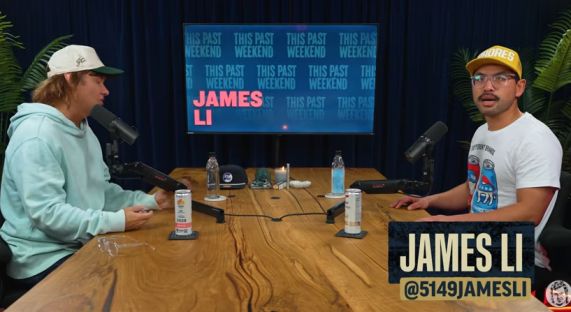
Editor’s Notes: In this episode of This Past Weekend, Theo Von sits down with independent journalist and content creator James Li to discuss his journey from the corporate world to investigative journalism. Li, known for his show 5149, shares fascinating stories about his transition from a supply chain role in big pharma to a mission of exposing the powerful and providing alternative media perspectives. Together, they explore the complexities of social media censorship, political maneuvers, and why Li believes it’s crucial to remain curious in an increasingly dystopian landscape. This engaging conversation offers a deep dive into the motivations behind Li’s work and the challenges of being a rogue voice in today’s media. (Feb 26, 2026)
TRANSCRIPT:
THEO VON: Reminder guys that you can get video versions of our episodes now on Spotify as well. Today’s guest is an independent journalist. He’s a content creator. He has his own show, 5149, that’s on YouTube. We got into a lot. I’m grateful to sit down today with Mr. James Li. Good, good as I’m going to look today. Dude.
Hats, Beekeepers, and The Beekeeper Movie
JAMES LI: Yeah. I thought about wearing the bucket hat, but I’m like, I gotta switch up the hats. You know what I’m saying? I always. Usually I’m wearing the bucket hat. Do you know what I’m talking about?
THEO VON: Oh, yeah, dude. I almost wore this beekeeper’s hat that I got. Yeah, yeah. Whitney Cummings, one night at the Comedy Store, I think she was going through something and she gave me a full beekeepers outfit.
JAMES LI: Really?
THEO VON: Yeah. For no reason. It was like, she’s like, “I got something for you.” And then she went and got a beekeeper’s full. Yeah, like beekeeper’s outfit out of her trunk or whatever.
JAMES LI: The last beekeeper scene that I saw was like from that movie Begonia. Did you see that movie?
THEO VON: I haven’t seen it yet. Is it good?
JAMES LI: It’s dark. Really, like really dark. Like I’m like this. I was not ready for this.
THEO VON: I was not like, you mean perversion or sensuality or like. What are you talking about, dark? It’s just like.
JAMES LI: I mean, the plot line, just like humanity. Just like the. What are they called or whatever. Well, they’re trying to do like cultural commentary.
THEO VON: Okay.
JAMES LI: And so I’m like, wow, this is not a. It’s like. Because I deal in it all day long. So I’m like, I don’t need a movie. I like my movies to be like chill, right? Like rom coms and comedy.
THEO VON: Madagascar.
JAMES LI: Yeah, yeah, those kinds of things. Yeah, yeah.
THEO VON: Sierra Leone or whatever. Some of that.
JAMES LI: I don’t know what that is.
THEO VON: Well, I was just thinking of other African countries. It’s crazy because there’s like Madagascar and then there’s Hotel Rwanda. So that’s the only thing like Africa, it gives you, like, some polar opposites if you pick the wrong African area.
JAMES LI: Yeah.
The Euro Trip and Deal With It
JAMES LI: You know, I’ve never been to Africa. Oh, there. Actually, can I tell you this story before we get going?
THEO VON: Yeah, for sure.
JAMES LI: Just a real quick story. Okay, so no worries.
THEO VON: James Li, good to see you today.
JAMES LI: Yes.
THEO VON: Okay, good. James Li, tell me your story, then I’m going to ask you a question.
JAMES LI: Okay. Okay, so just quick story. Before we start, I just have to tell you the story. Okay, so this is like a few years ago, me and my buddies were in Europe. We’re on this Euro trip. And this is like two of my best friends. And this is like the type of people you meet at your first job. Like, it’s a really, really sh*y job where you’re like. We’re literally like call center with the headset. Everybody’s yelling at us all day. So we’re like, “Hey, one day when we get out of here, we’re going to go to Europe.”
THEO VON: Yeah.
JAMES LI: We’re going to do this Euro trip type of thing, like the movie. And we did do that. So finally, a few, years and years later, we had a chance to do that, and we were just going out and partying every single night.
THEO VON: In what country?
JAMES LI: This is in like, Spain and Portugal. But after like seven to ten days of this, we’re like, “Dude, I think my liver’s shutting down. Like, we have to stay in for a night. Like, we’re going to die here.” So then we stayed in that night. So we were just scrolling around whatever it was like Netflix or some streaming thing that I don’t remember. And that night we ended up binge watching this show called Deal With It. Do you remember that show?
THEO VON: Oh, yeah. I was a host on it.
JAMES LI: Yeah, I know. That’s. That’s how I had to tell you the story. Oh, that’s. We literally watched like 10 episodes of Deal With It.
THEO VON: How stoned were you guys? I mean, I scared person in that picture, which is crazy.
JAMES LI: And so then we made a pact right there. We’re like, “Hey, if anybody starts doing weird, like, you just gotta go with it for a little while, like, just to see what happens, you know, don’t shut it down right away.” But that was so. It’s a full circle moment from, like, many years ago. I was like, watching this show that was my first introduction to Theo Von.
THEO VON: Yeah.
JAMES LI: Was this show. I don’t know how proud of you are on the work on the show. But it was very. It saved my life.
THEO VON: Oh, really? Kept you off the.
JAMES LI: Yeah.
THEO VON: Off the streets of. Yeah. That’s beautiful. Some beautiful streets they have there too, though.
JAMES LI: They do.
Deal With It — Behind the Scenes
THEO VON: This one’s so nice.
JAMES LI: Oh, the Rascal Flatts.
THEO VON: Yes. I look like that lesbian lady from Rascal Flatts. Actually, pull me back up.
JAMES LI: I was not aware there was a lesbian lady in Rascal Flatts.
THEO VON: And now maybe that’s rude to say that. Yeah. Pull her up pretty close, huh?
JAMES LI: I mean.
THEO VON: Oh, there is not a lady in Rascal.
JAMES LI: I was like, is that the lesbian?
THEO VON: I don’t know, dude. My bad. I have no. I think. I think I’ll take it as somebody else. Dude, whatever. All right.
JAMES LI: Okay. Anyways, that was. Yeah, so then that was. That was like, the first time I ever saw who you were.
THEO VON: Oh, interesting, bro.
JAMES LI: I don’t know how far along in your career at that point that was.
THEO VON: That was probably 13 years into my career, probably. And yeah, Howie Mandel gave me a job there. And thank you so much, Howie. That was fun.
JAMES LI: Yeah. For people who didn’t watch the show, it was like a hidden camera show where there’s, like, contestants, and then one of them has, like, an earpiece, and you’re telling them what to do, and the other person has to, like, go along with it.
THEO VON: Right.
JAMES LI: Like, doing weird. Just like, “Hey, floss at the restaurant table, you know.”
THEO VON: Yes.
JAMES LI: And then, like. Or, like, go eat somebody else’s food. And there’s these challenges that you would have to pass. And if you make it, if the other person is, like, dealing with it, then they would earn money.
THEO VON: Yeah.
JAMES LI: And so that’s when me and my buddies were like, “All right, hey, man, just. Just in case we’re in that situation, you just go with it for a little while.”
THEO VON: I can’t believe you guys stayed in and watched that. But yeah, yeah, you’d find two strangers walking down the street. You’d have already pre set up at a restaurant.
JAMES LI: Was that real, though, or were the contestants really, like, “Hey, I wanted those two people,” or were they, like, pre-screened?
THEO VON: And then we would pick people that were just kind of going in or coming by. A lot of times you try to get people and they wouldn’t come. They just wouldn’t understand or whatever.
JAMES LI: Yeah, yeah.
THEO VON: You’d always want them to go to the bathroom. And then you’d go ask the other person who’s at the table, like, “Hey, will you be on this game show? We’re doing a game show in here today.”
JAMES LI: Yeah.
THEO VON: And so it was a lot of craziness. The craziest thing that ever happened on that show was one time there was a couple walking down the street and we invited them in because you’d be like, “Hey, we’re giving away free appetizers or something.” So they come and sit down and then one of them would go to the restroom and that’s when we’d ask the other one, “Hey, we’re going to put an earpiece in your ear. We’re going to start telling you things to do. If your friend that you’re here with, when they come back from the bathroom, if they don’t notice that you’re doing weird sh, like, the more you can get them to deal with, the more money you make.”
JAMES LI: Yeah, okay.
THEO VON: But one time we put the earpiece in this lady’s ear. The guy going to the restroom, he comes back and sits down. And the guy was a pimp, and she was a working girl, really. So she starts doing this crazy sh and the pimp starts getting like, threatening this lady, like, “I’m going to whoop y’all.”
JAMES LI: And that episode didn’t air, right?
THEO VON: No, at a certain. And that’s when we should have aired.
JAMES LI: Oh, you know, that’s in the vault somewhere. Maybe Howie can pull that back up or what?
THEO VON: I mean, it would be wild if he did. I think if we aired the ones that didn’t air, though, that would be pretty wild. But yeah, there was definitely some ridiculous moments on there that were pretty great, but that was one of the wildest ones. And we just had to shut it down because it was like an endangerment to the lady or so.
JAMES LI: Yeah.
THEO VON: But anyway, James Li, good to see you.
JAMES LI: Thank you. Thank you for having me on the show.
Decentralized Journalism and Exposing the Elites
THEO VON: Thanks for coming, man. I appreciate it, man. I really appreciate it. You live in. Do you say where you live? California?
JAMES LI: Yes. I mean, I tell people I live in San Diego. Okay. That’s as about as specific as I’ll get, you know?
THEO VON: Yeah. Thanks for coming on, man. I first learned about you like just in some clips online, I was like, “Yeah, look at this.” Like investigator, you. I feel like a lot of investigators now and a lot of people are getting kind of their news from guys like you. Nick Shirley, Hassan Piker, Candace Owens clips. I just feel like it’s becoming a lot more from social clips that people even get their news.
JAMES LI: And I would even say that I’m not like an investigator. I think that is like really generous of what I do. Like, I like to expose rich and powerful people, but there’s like a network of investigators. Like we’re all leaning on each other. Like somebody finds something, I’m like, “Oh, that’s great. I’m going to put that in my video.” So there’s a lot of information sharing that goes on. So I don’t want to take credit for being like, you know, a guy that’s like. There are like real, real investigators that are literally going through like document after document and sometimes I’ll do that, but it’s just like it’s just me, so I don’t have the resources to be able to do that a lot of times. So it’s like there’s like a collective network of like decentralized journalists or creators in that space.
THEO VON: Decentralized journalists.
JAMES LI: Yeah, yeah. Like, we don’t work for one particular news organization of course, so like we all have our own editorial freedom, but there’s like alignment in terms of we want to just expose rich and powerful people.
THEO VON: Yeah. Or like, so that feels like your theme is the exposure of the elites.
Private Equity, Investigative Journalism, and a Big Pharma Wake-Up Call
JAMES LI: Elites or businesses. Right. I talk a lot about private equity and how they’re basically buying up all the houses or they’re taking over certain industries, like the hospital industry. Or I did one recently that was on their buying. There’s a private equity company buying all the sports rinks in the Northeast. And because they want to make more money, they were making rules in their contract.
When you sign your kids — it’s like youth hockey. It’s not like elite hockey. It’s like kids playing hockey — and they’re making the parents sign this contract saying you can’t film your kids while they play hockey, because they want you to sign up for this $50-a-month subscription service that they own. It’s like, if you want footage of your kids playing hockey, you got to sign up for this.
THEO VON: Oh, like, it’s a Max Preps thing or something?
JAMES LI: It’s just a company called Black Bear Sports. Black Bear Sports Group. And they own a ton of ice rinks in the Northeast. Yeah, this one right here. Wow.
THEO VON: They banned parents from recording kids’ hockey. We changed that. Okay, so.
JAMES LI: So, yeah. I saw this article and I’m like, I got to blow this up, right? Because a lot of people aren’t going to read this article. So I feel like it’s my responsibility to say, hey, this is a big deal, because this is just them price gouging parents. Like, you’re taking a moment of joy from these parents. Like, they just want to —
THEO VON: — watch your kid practice. You’re watching him.
JAMES LI: Exactly. And then now you want to paywall that and make them sign up for $50 a month, which is more expensive than Netflix and all these other companies. So you’re basically taking advantage of these parents.
THEO VON: Love.
JAMES LI: It’s like, yes, of course we want our kids recorded — a record of our kids scoring a goal. So I’m going to pay for that. But is that good? Is that the right thing to do?
THEO VON: Yeah. Like, at what point do we decide, hey, we don’t need to make a dollar off of this? There’s human value here that’s worth more than some ownership, or that’s worth more than the rights to something. And then how weird does it get once you start giving away the rights to film your own kids?
How long before a drone is in the sky, and if you want footage of your kid playing in your yard, you have to email the drone and pay a fee to get a certain clip of your child on a swing? Because if you pull your own phone out in your backyard, it won’t work anymore because you didn’t pay a subscription fee.
JAMES LI: Dystopian.
THEO VON: It sounds dystopian, but where we’re getting now sounds dystopian in some places anyway, and in some ways for sure. How did you get into investigative journalism? What spurred you to become someone who wanted to expose?
James Li’s Origin Story
JAMES LI: So, I can give you a short version or a slightly longer version. I’ll try to make it as succinct as possible.
When I was a kid growing up, I think I was in elementary school. My mom asked me, “Hey, what do you want to do when you grow up?” And I said, “Teacher.” She’s like, “What?” I said, “Yeah.” And she’s like, “Why?” And I said, “Well, summer breaks, duh.”
But that wasn’t the real reason. Really, I have this natural curiosity for things. I love learning about stuff and I love telling other people about stuff. To me, that’s a teacher. What I do right now is like teaching in a sense — I’m reading basically one chapter ahead, learning about stuff, and I’m like, wow, this is really cool, I want to share that with the world. And hopefully you can use that information to better your life. That’s my hope.
I never obviously did that. I worked a bunch of different things. I was working at a call center, just random startups. I didn’t go anywhere. So then maybe about 10 years ago, I was talked into applying to business school. So I went to NYU. I went to the full-time MBA program at NYU.
THEO VON: You lived in New York a couple years, yeah. Cool.
JAMES LI: It was cool for a little while. I actually didn’t like living in New York. It was just too much for me. The stimulus was — it’s a lot. Yeah, it was better back then. Now I go back probably a couple times a year because I still have friends out there, and when I go there now I’m like, whoa, this is like sensory overload for me at this point.
But anyway, so I went to business school. And that was when I was applying to business school — when Bernie first started running his 2016 campaign for president. And I was a big Bernie guy. That’s when I first learned, oh wow, the Democratic Party is not so democratic. I’m sure you know some of the stories about him getting screwed over by the DNC. He got railroaded.
THEO VON: He won some primaries and then they pulled him out.
JAMES LI: Well, they gave Hillary access to the debate questions ahead of time. They were rigging all the rules against Bernie. And then they were creating smear campaigns that originated from the DNC — like the “Bernie Bros” — that was a DNC-manufactured smear campaign to say, oh, Bernie Sanders is racist and a sexist. That came from the DNC themselves. That wasn’t an outside group saying that. It could be — it was never an official DNC statement. Nobody said it was an official DNC contract. It was a leak that came out later on.
THEO VON: I would not be surprised. Either way, his home party railroaded him. His own party did not give him — people wanted him, and they did not give the people what they wanted. Which is really the most undemocratic thing.
JAMES LI: That was the race we were supposed to have. Populist right, Trump. Populist left, Bernie. That was supposed to be the election.
THEO VON: Yeah.
JAMES LI: That would have been — imagine that fight right there. That’s what the soul of America is all about. Instead, the Democrats got the most establishment candidate, Hillary Clinton. Nobody wanted her.
But anyway, so around that time, I was applying to business school. I’d seen all that happen. So I wrote my essay going to business school — “Hey, I want to work in the news business because I want to improve the way we report the news.” So I went to business school, and immediately they’re like, “I don’t think you’re going to be able to get a job at a news agency because you don’t have any experience. So why don’t you do consulting instead?” Apparently anybody can be a consultant.
THEO VON: That’s true.
JAMES LI: Seriously. I have none of this background. But credited consulting firms — if you go to the right school, they will hire you as long as you do well in the interviews and things like that. So I became a management consultant for four and a half, five years at a big four consulting firm.
The Big Pharma Wake-Up Call
JAMES LI: And it just so happened, coincidentally, that COVID hit maybe a year after I started working in consulting. And it just so happened that I was working for a big pharma client at the time.
COVID was a big awakening for, I think, a lot of us. At first I was one of the people who was like, all right, we got to stay inside. We got to lock down. We got to stop the spread, right? Who doesn’t want to stop the spread? Let’s do that. And then it was the masks, and then eventually the vaccines. But then over the next year, year and a half, things started coming out that were weird. Like, what the heck is this? They seem to be contradicting themselves.
And you had that whole Joe Rogan debacle with the Ivermectin, when they said it was horse paste — when there’s a human version of it that obviously he’s not taking the veterinary medicine. So I saw that, and I was on the inside. Something weird was going on.
So this is the year — I think it was 2022, right at the beginning of 2022.
THEO VON: So you’re working for a big pharma company at that time as a consultant.
JAMES LI: As a consultant, yeah. My specialization was supply chain. So I was doing projects like optimizing inventory — how much product you have based on how much you’re going to sell and how much you’re making, because you want to have the right amount.
THEO VON: Right.
JAMES LI: If you have too much, there’s going to be leftover, it’s going to expire, you’re going to have to throw it away. If it’s not enough, you run out of stock and you can’t make money. So you have to have the perfect amount. That was my job. And a lot of it was making PowerPoints, spreadsheet work.
THEO VON: Yeah.
JAMES LI: So we did this project at the beginning of 2022 for this big pharmacy — I can’t say which one for legal reasons — but it was one of the manufacturers of the COVID-19 vaccine. One of the projects we did was looking at the totality of the inventory they had within this product.
And we went to them with this report saying that by the end of this year — and this is 2022, so everybody who wanted to get the vaccine had taken it by this point, because 2021 is where it came out — we let them know, “Hey, it looks like you’re going to have a few hundred million dollars’ worth of inventory at the very least, depending on how you calculate it, could be worth more than that. That’s going to be left over at the end of the year that has no demand against it. Meaning you’re not going to be able to sell it. Nobody’s buying it.”
THEO VON: You’re going to have product left on the shelves.
JAMES LI: Exactly. Nobody’s buying this. And then a few weeks later, I see the CEO of this company go on CNBC or one of these news shows, and he says, “Well, I think it’s time to do another booster shot.” And to me, I was like, “Holy f*. This whole thing — I can’t do this anymore.” I was like, I’m out.
THEO VON: So they created the booster because, oh, we have extra leftover?
JAMES LI: I mean, people say that, but then they’ll call you a conspiracy theorist for saying that, because it’s like, “No, there’s scientific backing to this and that.” But I’m on the inside. I’m like, this seems like a pure financial decision, dude.
THEO VON: Magellan was a conspiracy theorist, wasn’t he?
JAMES LI: What, for going around the world?
THEO VON: Well, who’s the guy that prophesied that there was another place to go, to sail to?
JAMES LI: Well, Columbus was the guy that said the world is round and I’m going to go the other way. People going one direction, he’s like, “I think I can get around to the other side.” That was Columbus.
THEO VON: Oh, yeah, Columbus. That’s the original reach around right there. Yeah. First of all, let’s just say that, dude.
JAMES LI: But at that point, I thought, man, I think I’m contributing to evil and I don’t want to do this anymore.
THEO VON: Wow.
Getting Let Go From Corporate
JAMES LI: And eventually I got out. There’s a whole story of me getting let go because I was saying — I started getting more rogue at work, just saying stuff you’re not supposed to say.
THEO VON: Oh, yeah. Milling around the water cooler. Yeah.
JAMES LI: Well, to powerful — the elites of the company, the people who are really high up. And I started saying stuff that I think was correct, but it was uncomfortable for them to hear.
THEO VON: Yeah.
JAMES LI: And then I get brought into a meeting. It’s like, “Hey, what’s your future look like here at this company? Where do you see yourself?” That kind of thing. And then I was put on a performance improvement plan shortly thereafter. People who work in corporate America will know what that is, right. It’s basically their way of firing somebody without legal right.
THEO VON: They try to show that there’s steps.
JAMES LI: Yeah. They say, “Oh, we’re not firing this person for any other reason other than poor performance.” Except they said I was doing typos. And it was like, really?
THEO VON: First of all, what Asian is doing typos? I mean, to make it racial. There are —
JAMES LI: I’m not going to say there aren’t typos. Sometimes there were typos. Yeah, but —
THEO VON: That’s certainly more of a general Caucasian problem.
JAMES LI: You talking about Epstein with the typos on the emails or —
THEO VON: Oh, that’s a good point.
JAMES LI: The whole thing is typos.
THEO VON: You didn’t want to commit to completing a word, you know.
JAMES LI: Yeah, it was very bizarre. I mean, this is getting off track, but very bizarre. How he typed was — there’s commas, but then there’s three spaces after that.
THEO VON: It’s almost like he wanted to show that if the case ever tried to show this, it wouldn’t match up with anything else. And that’s when you’re in such a state of protecting yourself, like outsmarting the world.
Starting to Make Content
So then at what point do you start — because you started making clips first and then you started 5149. That’s your podcast.
JAMES LI: So I started — when Covid hit, I actually just started doing videos on YouTube just because I had more time on my hands. I was just like, let me look into some of this stuff. So I started doing like one video a week on the weekends. They’re still up. People can look for them. They’re not very good, but it’s just me looking into stuff. So then after that, I started doing more and more of that, putting stuff on — making content. So I was on YouTube and then I started posting on TikTok and then Instagram. And Rogan shared something —
THEO VON: As I mentioned, at one time, he —
JAMES LI: Yeah, he shared something. It was actually a really funny clip because I was wearing my bucket hat. And I think it was like Shane Gillis or somebody. He was like, “Yo.” Oh, that’s the clip right there.
THEO VON: Yeah, let’s see it.
VIDEO CLIP BEGINS:
UNIDENTIFIED SPEAKER: Is not a reliable — my number one source of news. What I sent Jamie yesterday. You want to get mad? Yeah, let’s get mad. The LA Fire Fund, you know, they had this big fundraiser. They raised $100 million. James Li did a thing about it on Instagram. The way they distribute the money is so crazy. You’re going to read this and you’re never going to want to donate to charity again.
VIDEO CLIP ENDS:
JAMES LI: Listen to this.
THEO VON: I watched it. I looked into it a little bit. We’ll watch it.
JAMES LI: But it —
THEO VON: I would —
JAMES LI: What they say, though, is that within —
THEO VON: The first month, they distributed half of that money. Hold on. Before you press play. So that’s the whole thing. Yeah. That’s awesome, though. But I remember this thing. I remember, like, oh, so this guy’s catching on. People are curious about this guy. People are adapting to — I think what they feel like is genuine, even if it’s just genuine curiosity.
JAMES LI: Yeah.
THEO VON: I think people are attracted — you know, there’s something inside of you that will attract to it. And people also are — I think they’re truth seekers. It’s like water seeks a comfortable level. So that’s how people work, kind of finding you and being like, “Oh, there’s something here that’s real.”
JAMES LI: Well, for me, I’m literally the definition of a person who is just a regular guy. I don’t think I’m smarter than regular people. I was a decent student, but never the top student. I’m not a good reader. But what I had was this kind of curiosity. And one thing that I do think I’m good at is just recognizing patterns — like, this, this, this, this — and I’m like, “Oh, these kind of all fit together. There’s a logical pattern that’s happening here.”
So I’m just a literal definition of a guy who — imagine just, “Hey, we’re going to make you an anchor in the news, and you’re going to be able to say whatever you want.” And that’s just me. I have no editorial control from other people. It’s just whatever I’m interested in, I’ll do a video on that. And there’s nobody really to tell me, “You can’t do this, you can’t do that.” Other than, of course, getting deplatformed.
THEO VON: Right. Which happened.
JAMES LI: Yeah. Which did happen. But, yeah.
THEO VON: Happened recently on TikTok.
JAMES LI: Yeah.
The LA Fires
THEO VON: We’ll come back to why that happened. What about the fires? Have you noticed anything about it? Like, have there been some rabbit holes you’ve gone down with the LA —
JAMES LI: Well, the LA — so the Palisades fire specifically — now it’s very much proven with facts that it originated from another fire that started 10 days earlier. I don’t know if you’ve heard about this. There’s another fire that started on New Year’s Day. They said it was like fireworks. Somebody was there and there was a smoldering. So the firefighters had come and technically put it out. But the residents there — and I’ve talked to a couple of residents there — they’re saying, “No, there was still smoke emanating from the brushes.” And then seven or eight days later, that’s when the big fire came in with the wind and it whipped everything back up.
THEO VON: That’s the same thing that happened in Maui. A fire was put out. The police stayed there all night with it, thought it was out. They waited there all night until, like, 4am or something. And then they went home. They said, “There’s nothing left.” In the morning, the winds kicked up and —
JAMES LI: Right.
THEO VON: That’s when it got to another level anyway.
JAMES LI: And Gavin Newsom was saying stuff like, “Oh, we couldn’t have done that because of vegetation.” There’s some environmental reason why they couldn’t go back in. It was kind of bullshit. So now the state’s getting sued because they’re culpable for it. And they even said — this was like a couple weeks after the fire had started — the deputy fire chief said, “There’s no way this big fire was started from the other fire because we put that fire out. That fire was dead out.” And now it’s not dead out. Spencer Pratt has been really big on this. He’s running for mayor of LA and he’s all over this.
THEO VON: Yeah, I’m seeing that. So who says the small fire caused the big fire? And what do we know about what really happened?
JAMES LI: Yeah, there’s now evidence that it definitely came from the first fire. So now the state is getting sued by — I can’t remember who.
THEO VON: I don’t know, because what did they do?
JAMES LI: Well, what they did was negligent because they didn’t follow the procedures to put out the fire.
THEO VON: Got it.
JAMES LI: Because they knew that there was still smoldering. I think there’s records of this, but they couldn’t go in for vegetative reasons or whatever it is. And so now they’re in trouble because of the damage that’s been caused to the entire Palisades community. Yeah, see, there it is.
VIDEO CLIP BEGINS:
UNIDENTIFIED SPEAKER: One year ago, just after midnight on New Year’s Eve, a small brush fire broke out in Topanga State Park above the Pacific Palisades outside Los Angeles. Within hours, the Los Angeles Fire Department arrived on scene, began digging hand lines to stop its spread. The eight acre fire, ignited by a 29 year old former Palisades resident who has since been charged with arson, was quickly brought under control. By 4:46am the department declared it fully contained with no further updates anticipated. But the fire was never fully extinguished. A week later, on January 7, it reignited and burned more than 23,000 acres, destroyed 6,800 structures and killed 12 people in what became LA’s worst urban wildfire catastrophe.
VIDEO CLIP ENDS:
THEO VON: And I’m guessing that was the Palisades fire.
JAMES LI: That’s the Palisades. There’s another big fire, the Eaton fire, which is in Altadena. And that one was caused by PG&E because one of the power lines fell down. And so they’re getting sued right now for that.
THEO VON: Wow. But can a fire smolder for that long?
JAMES LI: I’ve been told yes. It could smolder for a number of days, even weeks. It’s because it’s really dry there. There hadn’t been rain for a long time. I even looked — there was literally NASA satellite imagery where you could see the hotspot. And it doesn’t necessarily have to be smoking. From my understanding, it could be under the earth, it could be like hot.
THEO VON: Right.
The LA Fires: Liability, Fundraising, and Corporate Land Grabs
JAMES LI: And then any kind of wind condition, I don’t know how it really works from a scientific perspective, but it’s like starting a fire in a campsite. Under the right conditions, the fire will start. So I think the issue here in terms of the liability is that the fire department is supposed to go back in and check it to make sure that it has been put out.
THEO VON: Got it.
JAMES LI: And because they didn’t do that, the liability is now on them. In terms of the damage, I mean, there’s billions of dollars of damage now, which is contradictory to what they said, which is like, “The fire is dead out. We did our job.”
THEO VON: What were they saying was the original cause of the fire?
JAMES LI: Well, they said it was just an act of God. It was like, there’s no way to stop this because it was so crazy.
THEO VON: The wind and Poseidon or whatever.
JAMES LI: Yeah, yeah.
THEO VON: Zeus did it.
JAMES LI: Yeah, exactly. And this is what Spencer Pratt’s been going on about. He’s like, “This is not just some crazy thing. It could have been easily preventable if you guys had done your job.”
THEO VON: Well, what was the issue with the fundraising? Were they giving—
JAMES LI: Oh, the fundraising. So there’s actually — I think they’re getting sued as well now, because that was from like six or eight months ago when I was doing that video. But what happened was they collected a bunch of money from this benefit concert, right. And it’s supposed to go to the fire victims. But then when you partner with the nonprofits, a lot of that money first just gets absorbed by the nonprofit for administrative things.
THEO VON: Yeah. Holiday parties like that or whatever.
JAMES LI: Exactly. And then, from what I understand, I’ve talked to a few residents, like, “We didn’t see any of the money. How do we get this?” And then there are people or organizations that can sign up to get that money distributed to them. And there would be other companies, like diaper companies or whatever, like services.
THEO VON: Diaper companies.
JAMES LI: So, for example, these companies come in and say, “Well, we can help distribute diapers to residents that have lost their homes.” But then that creates another bureaucratic step. If you’ve lost your home, you just want a check. Just give me some money so I can survive. I don’t want to go to this organization to collect a diaper because I have a child. It just makes things way more complicated that way.
THEO VON: Understand. So it’s a lot of — they’ll donate it to these other places, maybe a friend’s charity, whatever.
JAMES LI: This is exactly it.
THEO VON: The next thing you know, it’s been distributed to all these different spots, and there’s not any—
JAMES LI: And then the residents, they don’t know where the spots are. So it’s a lot easier for them to say, “Hey, this is the deed to my house. It burned down. Can I collect my $5,000?” Or whatever the distribution was.
THEO VON: Right.
JAMES LI: It would be a lot easier to do it that way. But the people who organized it is the Ballmer Group, which owns the Clippers and the stadium in LA.
THEO VON: But you think they would want to do the most human thing, then, if they’re owning the Clippers. I’m saying they want the fans to come to their games.
JAMES LI: Well, I think they thought they were doing the humane thing, but it’s like the corruption of the system — it’s like, “Well, we have all these charities that we already work with, so let’s bring them into the fold of this.” But it’s not the best solution. The best solution is just to give people the money that they need.
THEO VON: Yeah.
JAMES LI: But then now they’re just enriching the people who are their friends, like all their partners that are doing all these nonprofits. They get a little bit of a cut as well through this process. You just want a little cut.
THEO VON: Yeah. In its report, the House Judiciary Committee stated money went to left-leaning pet projects, illegal aliens, and the administrative costs related to running nonprofit organizations. This is from CBS News. You had examples of funds used for voter outreach efforts, towards political advocacy groups, towards podcasters, fungus planting. Those examples are pretty troubling. I do want to be clear — there were many organizations that got funds, nonprofits that are certainly very worthy nonprofits.
JAMES LI: I think there was one — I was talking to Alo Black. He was involved. His house burned down and he was like, “I don’t understand why the community college of Pasadena is getting money for this. Like, why do they need money?”
THEO VON: Right.
JAMES LI: We don’t know. So I think it’s more of like, hey, if you wanted to maximally benefit the people, you would do the right thing and just give the money to the people. Show the record that you own this house.
THEO VON: Right.
JAMES LI: And then come and collect your check, versus all this bureaucratic mess where people can just stick their hand in the cookie jar and take a cut here, take a cut there. And then by the time the money goes to the people who need it, there’s a lot less of it.
THEO VON: Yeah. Actually, there’s no dessert left, really.
JAMES LI: Yeah.
THEO VON: For the people that need it most. Oh, wait — Robertson is an attorney representing Palisades fire victims in a civil case against the city. He says public records obtained by the LA Times add credibility to his claim that the Lock fire was not properly extinguished. Okay. A new report from the LA Times claims the Los Angeles Fire Department tried to protect Mayor Karen Bass from reputational harm. “It was smoldering right on the top of the ground and we have numerous hikers that took video, that called 911, that still took photographs.”
Finger-Pointing, Lawsuits, and Corporate Land Grabs
JAMES LI: So they’re definitely — there’s so much evidence that the fire was improperly put out. The state of California is getting sued because technically I think it’s state land. And I think now — it’s funny, I heard Spencer talking about this — Karen Bass is like trying to join that lawsuit against Gavin Newsom. She’s like trying to, you know, she’s like, “Whoa, I’ve also been wronged in this situation as well. It was Gavin Newsom.” They’re all pointing fingers at this point.
THEO VON: I mean, that’s Malibu.
JAMES LI: But then, okay, so the outcome of this is many homes being burned down and then corporations coming in to buy these homes.
THEO VON: Yeah.
JAMES LI: If you look up the stat, I think more than 50% of houses that have been purchased in LA after the fires were purchased by corporations.
THEO VON: In fire districts or just anywhere?
JAMES LI: No, no, in the fire areas that burned down. I saw that there was a headline for this for sure. Like the houses that have burned. I think not of just regular under homes. I think—
THEO VON: Let me see if we got to fact-check that. “Investors are buying close to half the empty lots in LA burn zones,” the report says. That’s the conclusion researchers with the online real estate listings platform Redfin reached in a new report published Tuesday, analyzing transactions in LA County burn zones during July, August, and September. They found that about 40% of Pacific Palisades vacant lots went to corporate buyers. In both Altadena and Malibu, about 44% of such vacant lot sales went to investors. Huh. I wonder though, is there some benefit? Maybe they’re putting it into just a business or an LLC. I wonder if there’s some other benefit of doing it that way, you know what I’m saying? Like maybe there’s a different — maybe it’s insurable that way and maybe regular homes, you know what I’m saying? Like I wonder if there’s something else—
JAMES LI: That adjusts that. I don’t know. I mean, it seems like at the very least you can argue the size of the investor. Are they BlackRock, or is it like some person who owns like five homes?
THEO VON: Got it.
JAMES LI: That could be something to discuss, but it’s certainly not people who live there. If you want your home and you live there, it’s not like that. It’s not like it’s for your family. It’s like this guy’s buying the home to rent it out or to flip it or something like that. Which isn’t ideal for home ownership. You want people to live in the home.
THEO VON: Yeah. And you can get a homestead exemption that way. I mean, or there’s different things, like if it’s your primary residence. Oh, before I forget — what got you de-platformed? Let’s talk about that. And then let’s get into the Epstein stuff because that’s kind of current. We’ll go down some rabbit holes here with one of the lead hairs here for sure.
Getting De-Platformed
JAMES LI: Well, so TikTok — they never tell you why you’re banned.
THEO VON: Yeah, none of these places kind of do.
JAMES LI: No, you don’t know. They just — one day you’re banned. Some people have warnings and strikes before they’re banned. I wasn’t in that situation. I had a good standing account with no issues, and all of a sudden I was banned. I was banned twice, actually.
You can only go by context clues. The first time was when I did a video about how our FBI director, Kash Patel, might be getting honey potted. People have been talking about that. I don’t know. I never said — I was just reading other people’s reporting and who she was. And it’s like, “Hey, this seems like kind of a weird relationship. Does she work — she’s working closely with PragerU, which is basically like an Israeli-run outlet. There’s an intelligence officer that runs PragerU. So is she involved in that?”
And then I got banned after that, but then I was able to get that restored through a friend who knew somebody at TikTok. They’re like, “Okay, I think we can help get you back on.” So then I was back. And then the next time happened very shortly after I was named Anti-Semite of the Week by that group, Stop Antisemitism.
THEO VON: Oh, yeah. The week. They’re doing the weekly. I didn’t even know that they’re doing it weekly now.
JAMES LI: Yeah, yeah, there you go.
THEO VON: Oh, yeah, there you go. I remember Tucker Carlson was on this too.
JAMES LI: Yeah.
THEO VON: Who won? Did you get into — would you—
JAMES LI: Tucker won.
THEO VON: Tucker won.
JAMES LI: Yeah. He was just in Israel. I don’t know if you saw some of that interview with him and Huckabee.
THEO VON: Oh, yeah, I did. Dude, it’s definitely pretty baffling.
JAMES LI: Yeah.
THEO VON: What was one of the takeaways from the Huckabee interview that you found interesting?
JAMES LI: Well, I thought it was really interesting how Huckabee was just being so open about what the project is there. He’s like, “Yeah, I want Israel to take the whole thing.” Because Tucker was saying — not about Gaza, but the whole Middle East, basically. He was talking about how, based on scripture, this whole land is like the Greater Israel Project.
THEO VON: Yeah.
JAMES LI: He’s like, “Oh, yeah, you have a biblical right to do this.” And, “Are you okay with Israel taking the whole thing, which includes other countries like Jordan and Lebanon and Saudi Arabia, all these countries?” And Huckabee’s like, “Yeah, I’m good with that.”
THEO VON: Yeah. I mean, it’s pretty baffling. I mean, Huckabee just really — it feels like he’s more of a politician for Israel than America.
JAMES LI: Well, that’s certainly the case.
THEO VON: I mean, he’s the ambassador, right?
Tucker Carlson as a Release Valve
JAMES LI: He is the ambassador, but he also met with Jonathan Pollard, who’s the spy, convicted spy, you know, traitor to America. And he met him at the American Embassy in Jerusalem, which is, you know, I mean, it’s pretty up.
THEO VON: I mean. Yeah. Unless he was.
JAMES LI: Yeah, there’s actually a clip and he was like, “I didn’t meet with…” There was not a meeting. Or he was like, “It wasn’t a meeting, but I meet with people all the time.” It was more of like, “I was there with him.” Okay.
THEO VON: Call it what you will.
JAMES LI: Yeah. So, but I have a theory around this because I was like, why would he even want to do this? Why would they want to telegraph it so nakedly to people and basically say that, yeah, Israel controls American foreign policy. That’s a kind of crazy thing to do. And then why was Tucker even allowed to do this interview?
And I have this theory of like, basically both parties, the Democrat and the Republicans, they need to create these release valves for the base in order to keep it intact. Like, they have that on the left with like Bernie Sanders and AOC. I see them as kind of like a release valve to get people back in the Democratic Party fold.
THEO VON: Right.
JAMES LI: Instead of going to a third party, something else. Like, the last election in Michigan, they had this uncommitted vote in Michigan where people, because they didn’t want to vote for a Democrat because they’re supporting the genocide in Gaza, voted for this uncommitted party line, like, “I’m not going to vote for anybody.” And that was actually a Democratic Party move to insert that in because if they didn’t vote uncommitted, they would have voted Green Party. And they didn’t want people to vote Green Party.
THEO VON: I see. So they created this other thing that made them feel some type of way, but really it was owned by the Democratic Party.
JAMES LI: So it was.
THEO VON: Right. And they both do that. I think you’re right on both sides. There’s like.
JAMES LI: And Tucker is the release valve, I think on the right, where it’s like people are kind of fed up with the whole prioritizing Israel before everything else. So Tucker creates this, like, “Okay, at least somebody’s saying this stuff.” So we feel a little bit better.
THEO VON: But do you think he’s an instrument of the Republican Party to do that?
JAMES LI: That’s the. I mean, I wouldn’t know. You would have to ask him about that. I think he’s. From my understanding, I only know people who know him. I don’t, I’ve never spoken to Tucker, so I don’t really know anything about him. But I think in general, he seems to me, from the outside looking in, sort of a guy who wants to do the right thing, reporting the right stuff. I think he really feels bad about the Iraq war. I mean, you’ve spoken to him, so you can tell me more. Like, it seems like he’s remorseful for the fact that he was such a big champion of a war that got like a million Iraqis killed, thousands of Americans, created geopolitical chaos.
THEO VON: He mentioned that in the Huckabee interview. Some of that. He mentions that kind of stuff a lot.
JAMES LI: Yeah.
THEO VON: To me he seems genuine.
JAMES LI: I mean, but he could still be used by the party apparatus.
THEO VON: Right. Sure.
JAMES LI: It’s like, “Oh, you want to do this interview? We’ll allow you to do this interview.”
THEO VON: Right. Oh, I see what you’re saying. Right. Like, even that might be a way of being used that you don’t even realize it.
JAMES LI: Exactly.
THEO VON: Because you give somebody up. Like, okay, you can interview this guy of ours. We know he’ll say some things. Yeah, it’ll let people. Some will be like, “Oh, I was right.” And it lets a little bit of steam out of the kettle.
JAMES LI: Exactly, exactly.
The Theater of Politics
THEO VON: That’s one thing I realized about when I was sitting with Bernie recently. Yeah, he just kind of yells these things. And I’ve been a Bernie guy. I wanted Trump and Bernie to be on the same ticket years ago.
JAMES LI: That would have been wild, huh?
THEO VON: It would have been great. Because I feel like you need to have two people that have different views on the same ticket.
JAMES LI: Yeah.
THEO VON: Like a president and a vice president. Then whoever loses becomes the vice president in the election.
JAMES LI: That’s how they used to do it. The first three elections were done that way.
THEO VON: That’s how it should be done. Because then you have somebody that has differing opinions than you, and you guys are in the same office, and you guys have to figure things out. Right. Like, to me, that makes sense. It seems like the most democratic way to go about it.
What I realized is, yeah, he’s coming here and yelling things. He’s been yelling the same things for 30 years. And nothing is really getting done. And then when you look at everything, it’s like, “Oh, wait, we’ve all been yelling the same things for 30 years.” Nothing is getting done. It’s all like, you start to realize that the politicians and the people, like, politicians are coming on a regular podcast. We’re just yelling at the people like, “We’ve got to do this.” We voted you to go do it. Don’t. Don’t vote on. To send you up the mountain. And then you just come back down and be like, “We gotta do it.” Like, we just sent you to say, “We gotta do it.” So that’s when I realized, oh, it’s just this. And I think everybody realized that.
JAMES LI: That it’s a little bit like theater.
THEO VON: It’s a shell game.
JAMES LI: Yeah.
THEO VON: Yes. It’s theater. And I think everybody’s starting to see that. And so I think it’s getting very interesting right now, which in some ways also is kind of exciting.
Trump’s Naked Foreign Policy
JAMES LI: Well, I think that’s one of the things I do appreciate about Trump, is that they are saying some of these things just very nakedly. So then we could just have the conversation about the real thing. Right. It’s like when we go take Maduro in Venezuela, it’s not like some bulls* about democracy or this and that. It’s like, “Oh, yeah, no, we do want the oil.” That is a primary reason why we’re going over there. So then we don’t have to do this whole rigmarole, this dance around why we’re actually there. It’s like, “Oh, we want the oil.” So then we can decide, is this really good? Do you really want to be the country that everybody hates, that just, you know, “I want to take Greenland, so I’m going to have it. I’m going to take Venezuela. I’m going to take Cuba.” Is that really good, or is it better for our standing in the world to do more diplomacy to get what we want versus just straight up sending aircraft carriers or the SEAL team to go in there and do the thing?
THEO VON: I agree. I mean, and I think there’s a part of us now that, like, you’re even looking back at historic. Like, I’ll watch old movies, like war movies now, and I remember as a child, I’d be like, “Oh, yeah, America, we did it!” And then you watch now and you’re
JAMES LI: like, “What are we doing there?” Well, that’s. Top Gun was basically the Iran strike. It was literally. The plot is the same. The new Top Gun.
THEO VON: Oh, I blame Miles Teller for that and he knows it. I’m just checking Miles, but. Oh, you mean the new Top Gun?
JAMES LI: The new Top Gun with Miles Teller.
THEO VON: Yeah. Oh, so you’re saying that that was
JAMES LI: a strike on a uranium facility in Iran? That was the plot of the movie.
Venezuela, Sanctions, and the Western Financial System
THEO VON: Oh, wow. And do you think that they knew, like. Okay, hold on. There’s a couple of rabbit holes here that we’re kind of burying ourselves in. But first, you mentioned Venezuela, right? What do you think happened in Venezuela? Because here are things that just a regular person. I heard there were minerals that we wanted over there. They were one of the few programs that had their own financial system, so they weren’t on the world financial system. And then that they had done something with voting machines. That was something I kept seeing online, that they had some part to do with the voting machines. In hindsight, what did you see about Venezuela, or what were some of the kind of the conspiracy holes you were in?
JAMES LI: Well, I think Venezuela is really interesting in the sense that, yeah, like you said, they weren’t a part of this system, but they were kind of forced into that position.
THEO VON: But they weren’t a part of what system?
JAMES LI: The financial system, the Western financial system. Because they’ve been sanctioned by the United States for like 20 years, roughly. And I only learned about this when I was digging into this because I don’t know much about Venezuela, but I wanted to learn about the history. So I was like, “Okay, let me do some searches on the Internet and see what they’re telling us in the news versus what the history books are saying.”
And so it was like, well, Hugo Chavez came to power as the Socialist Party in Venezuela, and he started nationalizing the oil and he started doing programs to improve life expectancy and other important metrics in the country, like making people earn more money, all this stuff. So people’s quality of life was improving in Venezuela, but the US didn’t like the fact that they were socialists. So then the Obama administration actually deemed Venezuela an enemy to America. So then we started sanctioning them.
So once we started sanctioning them, they had to start doing deals with other countries that weren’t a part of the US system. So they started doing deals with Russia and China. And now, fast forward 20 years later, we’re like, “These guys are selling oil to China. They’re selling oil to Russia. We don’t like this.” But then you look back, like, well, you forced them to sell to those countries. Those are the only countries that aren’t a part of your block. So those are the only countries they could sell it to.
So then they’re like, “Oh, the Venezuelan economy is so bad. Everybody lives in poverty.” It’s like, part of the reason for that is you don’t allow them to trade with any of our allies.
THEO VON: Right. We cut them off at a time when they were growing.
JAMES LI: Yeah, exactly.
THEO VON: So we wanted to stop them from growing stronger. Do you feel like.
JAMES LI: Well, because their government was socialist. So now all of a sudden, you have a socialist regime that’s doing well right in sort of your backyard area, which is not ideal for our capitalist kind of style. Like, you don’t want an example of that here. That’s just my opinion.
So then they started sanctioning. So it’s a bipartisan thing. It’s not a Trump government thing. The Obama government started this with the sanctioning. Trump added on, made the sanctions more robust. And then all of a sudden, “Wow, we’ve got to get this guy out of power, because he’s smuggling drugs or something like that.” But also he was very open about the oil. Like, he’s like, “We’ve got to get the oil.” But then part of it also, I think, is there’s an Israel part that is a side piece, but it does play an important role. Basically.
THEO VON: What do you mean, the Israel part?
Media Control and Independent Voices
JAMES LI: Basically, whatever country that opposes Israel, they basically tell us we got to take that country out, we got to do a regime change. A lot of that is in the Middle East, but there’s some other countries. For example, in Venezuela, they are very opposed to the Israeli government. Maduro was very open about calling what’s happening in Gaza a genocide. So they’re like, “We got to get rid of this.”
This is something I learned 20 years ago. There was an opposition guy — I can’t remember his name — but he was running for president. And the media kind of slandered him, or they smeared him as a homosexual and a Zionist. So to me that’s like, okay, that means within the Venezuelan culture, Zionism is a bad thing they’re ascribing to this guy. So I think Israel comes in and says, “This is a country that doesn’t really support our existence. We should do a regime change.”
THEO VON: I see. So you’re thinking that part of this was that Israel wanted to come in and have some effect on a country that doesn’t support them.
JAMES LI: Exactly. And you see that happening with other countries that are not — I mean, Iran is probably the main one right now. That’s like the last of their list. I saw you talking to Dave Smith about this, right? There’s like a list of seven countries —
THEO VON: — from like the neocons and stuff like that. Take over.
JAMES LI: Yeah, exactly. So Iran is on that list. So it’s like, that’s why we got to take it out. Even though we have no nuclear weapons at this point. Supposedly they told us they did.
THEO VON: Well, I mean, one of the things is Henry Capriles.
JAMES LI: Thank you. Yes, this is the guy I was talking about.
THEO VON: Enrique Capriles Radonsky is a Venezuelan politician lawyer who served as governor of Miranda. He ran against Nicolas Maduro in Venezuela’s 2013 presidential election. Maduro and his supporters spread rumors about Capriles’ homosexuality as a smear tactic, including public slurs. Enrique Capriles Radonsky was labeled a Zionist by Venezuelan state media and Chavez-Maduro allies. These accusations framed him as tied to international Zionism, often alongside his Jewish heritage. Oh, so he was a Jewish guy despite his Catholic faith, huh? Well, it seemed like they shouldn’t have done that to him. But I guess that’s how the media works, right?
JAMES LI: How the media works. Yeah.
State-Controlled Media and the Decline of Legacy News
JAMES LI: If the state-controlled media — which we have a lot of nowadays — with like CBS News, I would say it’s sort of state-controlled media since it was sold off to Larry Ellison.
THEO VON: Yeah. Bari Weiss started controlling over there. How do you feel about that? That’s been since she took over, kind of.
JAMES LI: Well, it hasn’t really worked out. I think once she took it over, it was very overtly clear what they were trying to do. They were doing pieces that were saying good stuff about Marco Rubio. They’re hailing him as some kind of genius guy. They were also doing pro-Israel propaganda. So I think it’s very clear to people who consume the news what was going on.
And it’s actually, I think, a playbook that’s maybe a little bit outdated, because not that many people get their news directly from CBS News anymore. That crowd is decreasing. It’s like old people — I don’t want to say.
THEO VON: Yeah, no. Well, a lot of people don’t even have cable anymore. I don’t even know where you would — I know where you’d find it. It’s like it used to be newer than News Channel.
JAMES LI: It used to be like you knew who the nightly news anchor was at all these — like the Walter Cronkites or the —
THEO VON: And now you have like Don Lemon, like tickling some guy in a church or whatever. Just trying to tickle the holy water out of some honky or whatever. And you’re like, what is even happening anymore?
JAMES LI: So I think it’s just an outdated strategy. They think, “Oh, I want to buy the news so I can control the news.” But it turns out people don’t really like that. People know that. And that’s the same thing that happened to the Washington Post too. Jeff Bezos bought the Washington Post. He thought they were going to be able to do kind of Bezos propaganda for him. Turns out all his viewers or readers hated that, they canceled. And now they’re doing — I think they just laid off like a third of their staff.
THEO VON: Wow. And a lot of that media, it’s just older media.
JAMES LI: Yeah.
THEO VON: So it’s just kind of like — you know, some of that realm is changing. It’s just like, not a changing of the guard, but it’s like people want to come and just listen to something in a place where they feel like it’s not being controlled anyway.
JAMES LI: Yeah. And I think there’s other ways they’re trying to subversively control independent media as well. And we can get into that —
Deplatforming and the Control of Independent Media
JAMES LI: There’s other ways they’re trying to subversively control independent media as well. And we can get into that if you want later on.
THEO VON: Well, yeah, I mean, you got deplatformed. So that was from TikTok, you said, and it was from something that was —
JAMES LI: Well, I think it was related to me being named anti-Semite of the week.
THEO VON: Okay.
JAMES LI: And I think they have tight connections because TikTok’s moderation team is run by an IDF soldier. Ex. Yeah, she was hired recently to run moderation at TikTok. She’s an American who moved to Israel, then got Israeli citizenship. There it is.
THEO VON: Erica Mindell. That’s a pretty name. IDF soldier, public policy manager of hate speech at TikTok. Well, did you say something that was hate speech?
JAMES LI: Well, according to them, yes. Because I’ve been really critical of the Israeli government, the genocide, all these subversive tactics. They’ve lied to us about all kinds of stuff. So I do report on that. And that is now considered hate speech at TikTok.
So I’m criticizing the Netanyahu government for what they’ve done. That is now considered — because of the definition — they’re basically saying anti-Zionism is anti-Semitism. That is the definition that they’re all adopting, including the ADL. So if I criticize the government, that’s sort of a proxy for criticism of Jewish people.
THEO VON: Well, that seems bizarre to me. I mean, I’m at the Comedy Store last night and people are having jokes that are anti-Israel and the crowd is going nuts. The entire crowd is cheering in those moments. It seems to be a very popular sentiment that people aren’t going to support a government that’s doing what — what I believe is largely believed by most people these days to be a genocide, or some people will call it a new holocaust, or whatever people call it — different things. But most people believe that it’s wrong.
You can’t trick my heart. You know what I’m saying? It’s just like, if the media has been telling me for years with a Holocaust definition that this is wrong, then you can’t show me the same thing and say it’s now not wrong for some reason. But also, to not attach that to my Jewish friends — like I had Jewish friends who are in the audience this weekend and I make anti-Israel jokes and none of my friends have a problem with it.
So I don’t know how one really connects to the other. And I don’t know if that’s a problem of someone who’s just trying to have a voice, or is that an Israel problem that they need to figure out with their own behavior? Does that make any sense to you?
The Strategy Behind Anti-Semitism and the ADL
JAMES LI: Yeah, I know exactly what you’re saying. I think part of it is a little bit dark, what I’m about to say. But I think part of them wants to create more anti-Semitism. That’s sort of the goal. Like, you are not anti-Semitic at all. You don’t have any hatred towards Jewish people. You think everybody should be treated the same regardless of their creed or color, race, immutable traits, whatever. And they want to make it so that you actually don’t like them.
Because part of the Israel Project is getting Jewish people to move to Israel. This is what I’ve been told. This is what I’ve been researching for the last couple of years. There was a very famous Israeli podcaster who was like, “Oh, I love Mamdani.” And like, “Why do you love Mamdani? He’s an anti-Semite.” That’s — I don’t believe that’s true. But they’re saying, “Hey, Mamdani is really anti-Israel.” He’s like, “This is great because this is going to get people to move to Israel. That’s what I want.”
So I think that’s part of the strategy. There’s also another thing with a group like the Anti-Defamation League — their whole job is to reduce anti-Semitism. Their job is combating anti-Semitism.
THEO VON: Well, that makes sense. Like, you think you want to be able to protect people.
JAMES LI: So the crux of that is then you get —
THEO VON: Has the ADL spoken out against the Israeli government?
JAMES LI: No, they’re pretty much run by the Israeli guys. So that’s the problem with the —
THEO VON: That would seem like something they should do — speak out against the leader.
JAMES LI: No, the ADL has long been — I did a whole mini documentary —
THEO VON: Does it make sense what I’m saying? Like, why wouldn’t you speak out against the bad guy?
JAMES LI: Because the ADL is acting on behalf of the Israeli government as sort of a spy organization in America. I mean, you can look at that.
THEO VON: So they’re not a free-thinking group. They’re a group that — that is —
JAMES LI: They call themselves a civil rights group. But what they’re actually doing is trying to create more anti-Semitic behavior in the United States. Because if you think about it this way — you have an organization whose whole thing is combating anti-Semitism. So let’s say one day there’s no more anti-Semitism. What happens to this organization?
THEO VON: You’re out of work.
The ADL and the Industrial Complex
JAMES LI: You’re out of work. So then they got to create more answers. So every year, the ADL is crazy, dude. Every year the ADL has published the anti-Semitism report. It’s gone up. Every single year, the same guy is still there. I’m like, if you were the CEO of a company and your job, you’re doing a shittier and shittier job, wouldn’t you get fired? Wouldn’t somebody else go in there? You would need that number to come down. But every year the number’s going up. The donations are going up. They’re in a very nice building in New York City on Park Avenue.
So there’s a whole industrial complex. Same thing with the homeless. I make the analogy of the homeless industrial complex in California, where so much money is pouring in, the homelessness. But what happens if we actually solve this problem for all these organizations? You need this to continue, so then nothing gets done.
THEO VON: It’s the same thing. You need all these things to continue, right? You need the racism to continue.
JAMES LI: You need—
THEO VON: Need crime. Because then you have people living in fear, right? You need all these things, right? Because it does start to feel like we’re living in a theater that’s sort of controlled.
JAMES LI: Yes.
Being Labeled an Anti-Semite
THEO VON: Well, let’s get into some stuff that’s kind of current. Do you feel like an anti-Semite? Did you feel like that was fair that they said that?
JAMES LI: Well, no, absolutely not. You can go to that article. There’s nothing in there that I said. Look, first of all, speaking personally, I don’t have any problem. I have a lot of Jewish friends. I went to school in New York. I’m very sort of connected in that community. And the bagel belt — I mean, I would never sort of… I try to be like, I’m so scared of even saying anything like that. You know what I’m saying?
THEO VON: What, the bagel belt?
JAMES LI: Yeah.
THEO VON: That’s funny, dude. Who doesn’t love good bagels? Anyway, my friend Max is opening a bagel shop in Florida right now.
JAMES LI: Oh, I know. I love it. I mean, every time I’m in New York, I’m eating bagels like every other meal.
THEO VON: Dude. What I don’t like is when you go there and they don’t have cinnamon raisin baked bagels.
JAMES LI: Is that your thing?
THEO VON: Well, I just like to have it as an option. If you’re not giving that as an option, it makes me question you. It’s like, what if a kid comes in here? What if somebody who wants to have a little bit of a sweeter day comes in?
JAMES LI: Well, they got the blueberry for that.
THEO VON: Yeah, I don’t believe in that one. Anyway. What is a… “James Li is a conspiracist who brands himself as a champion of independent thought. He uses persona to spread long-standing anti-Semitic tropes and conspiracy theories. His commentary distorts the nature of anti-Semitism and vilifies Jewish communities.” Damn, James.
JAMES LI: Well, I challenge them to find an example of me vilifying a Jewish community, you know?
Israel, America, and the Question of Allegiance
THEO VON: Yeah, well, it says right here, “They aren’t even hiding it anymore. Israel owns America.”
JAMES LI: Well, I mean, that’s—
THEO VON: They do. Well, let’s talk about that for a second, man. So much now, there’s like, why are we giving money to Israel? You hear that all the time, right? It’s not even something that people are scared to even talk about anymore. It’s like, what are we sending all this money for? And really, just why is there the connection? And there’s not like a clear answer sometimes. It’s never like, “Hey, this is our ally, this is why.” But yeah, you’re like, we can’t pay our nurses. We don’t have, like, we have issues in our public schools. More people are choosing to homeschool than ever, which is just another burden on the family, really.
Our food supply has been deemed toxic. That’s something that we’re battling right now. 70% of young men can’t serve in the military because of the physical shape that they’re in. So you start to wonder, why do we have this extra money to just send to a place? That I think is a very fair question. And I’ve been thinking about it a lot, and I do think — I don’t think we’re just sending money to a place. I do believe that our country’s owned by Israel, and so you just give the money to the boss. They’re just getting the money. That’s—
JAMES LI: That’s theirs. That’s theirs. Yeah.
THEO VON: That’s what I started to realize. I’m like, yeah, because if you do this for so long and it doesn’t make any sense — it’s like, oh, well, that’s just the boss coming in, just getting his money. And so, yeah, I just think that that’s kind of where we’re at. And I don’t mean that in an un-American way. I think there’s still a lot of strength and heart in the idea of America. But I’ve thought for a long time that we’re just like an LLC. Like, we’re a shell company that’s owned by Israel, and that’s honestly just what it feels like, more and more.
JAMES LI: Yeah. Well, part of it is like, we’re supposed to be allies. So there’s supposed to be cooperation. You get something out of it, we get something out of it. But then I recently was listening to a podcast with that CIA guy. I don’t know if you’ve talked to him.
THEO VON: John Kiriakou, the long guy with the curly hair?
JAMES LI: No. John Kiriakou. Looks like that. Yep.
THEO VON: And is he a good guy?
JAMES LI: He’s a good — so he was the one that whistleblew the torture program after Iraq and in Guantanamo and those places. And he went to jail for two years because he violated some statute or whatever for telling us about that, that we were torturing people.
THEO VON: He told it.
JAMES LI: Yeah.
THEO VON: “CIA whistleblower John Kiriakou, who exposed the treatment of al-Qaeda suspects held in secret prisons, told the bureau today it was now down to journalists to tell the full story about the intelligence agency torture program because politicians did not have the will.” Okay, got it. So I just want to get some clarity on who he is.
Mossad, Spying, and an Abusive Relationship
JAMES LI: So anyways, he was asked, is there one particular intelligence agency that you just did not trust? He was like, “Yeah, it was Mossad.” And he was telling the story about how every time Mossad comes into the CIA headquarters, they try to drop off some gift that has a bug in it, a listening device. And every single time, they would catch them. Like, “Guys, you have to stop bringing these bugging devices into our headquarters.” And eventually, I think the Mossad is no longer allowed at CIA headquarters because they keep trying to bug our conference rooms.
THEO VON: They have access to our conference rooms. Do you think that’s — oh, this was in the past. You mean a recently past. Okay, got it.
JAMES LI: Yeah.
THEO VON: So he was the one who was kind of — he was just saying that those were some stories.
JAMES LI: Yeah. So I’m like, this is not how an ally should act, right? Because we’re supposed to be partners. Why are you trying to bug us, spy on us?
THEO VON: Right, right.
JAMES LI: That’s one thing. I think Tucker was talking to Ted Cruz — like, should Israel spy on us? Is that something that they should do as an ally? So that’s what I’m saying. It’s like this relationship is like—
THEO VON: Like a little bit, like, monitoring their employees.
JAMES LI: Yeah. A little bit of an abusive relationship is what is going on.
THEO VON: Right?
JAMES LI: That’s kind of how I would view it in a more layman’s way of putting it. I think this is an abusive relationship. They keep kicking us, and then we keep going back to them and saying, “Please, we’ll do better next time, and we’ll help you,” and this and that.
October 7th and the Question of a Stand-Down Order
THEO VON: Well, what spurred this? I mean, the thing that spurred this is the stuff in Gaza. That’s what spurred so much of this. People looking at Israel and being like, what is going on here?
JAMES LI: Right. That’s why it broke for the regular American public. I probably was — I was definitely not looking at Israel before. The only weird thing that I saw that kind of got my red flags raised was about a year before that, Israel had killed a journalist, an Al Jazeera journalist who was, I believe, an American Palestinian. And they said, no, she was caught in the line of fire or something like that. But then it later came out that, yeah, they just executed her. And I’m like, what’s going on here? This is very bizarre. Why are they able to just kill journalists without any kind of international condemnation or anything like that, without any accountability? So there’s something weird going on here.
And then October 7th happened. And that’s when I think everybody started looking in. And you do one search and like, oh, this is — you know, this is what I mean. Charlie Kirk was one of the first ones. Like, I think two days after, he was like, “Why did this even happen? Was there a stand-down order kind of situation? How were they even able to come across the border? This is one of the most secure borders in the world. How did it take them six hours? It takes 45 minutes to fly from Jerusalem to the border. Why?” He’s like, “Was there something to then create this excuse to then now launch a counter-offensive?” Quote, unquote, counter-offensive, and basically turn Gaza into rubble.
THEO VON: And do you think that that’s what happened? What do you feel like about it?
JAMES LI: Well, I mean, this is based on my conjecture. Yeah, I do think that.
THEO VON: What does conjecture mean?
JAMES LI: Conjecture is like just me sort of coming up with a claim without knowing all the information, because of course I’m not in the security briefing or whatever. I’m guessing a little bit.
THEO VON: But Asian guessing has got to be better than just regular white guessing.
JAMES LI: Yeah, some would say that.
THEO VON: When you guys guess, dude, I bet it’s — look, I got—
JAMES LI: I got a pretty good track record of my conjectures. I’ll just put it that way.
THEO VON: Got it.
JAMES LI: So there’s no other explanation. Why would it take at most one hour for them to respond? It took them six hours to respond. Doesn’t make any sense. So then it’s kind of like 9/11. Somebody knew something, right? There was the shorting of the airline stocks. There were people taking insurance out on the building. Somebody knew something. In this situation, it seemed like there were people in the Israeli government who knew that this was about to come and they just kind of let it happen, therefore creating the pretense to then destroy Gaza.
Gaza, Real Estate, and What Comes Next
THEO VON: Well, there was interesting — there were allegedly plans to build buildings and that sort of thing in Gaza years earlier. I don’t know if that’s true or not, but I’ve heard that somewhere.
JAMES LI: Allegedly. That’s not the new thing with Jared Kushner and the new Gaza—
THEO VON: Well, yeah, it was like, let’s do the mall. Or they were going to build a Five Guys, you know. But who’s going to go eat on top of the—
JAMES LI: That’s what I’m saying.
THEO VON: Haunted burial site of hundreds of thousands of people.
JAMES LI: That’s what I’m saying. And it’s like, do you really want a vacation there with your family? Would you take your kids? It’s like, “Oh, we’re going to go to—” I mean, I guess good real estate.
THEO VON: But what if you’re playing on the beach and there’s just a bunch of bones in the sand? I’m saying, like—
The Epstein Files
JAMES LI: Yeah, you know, I mean, I wouldn’t want to go there, let’s put it that way.
THEO VON: Let’s go down some of the rabbit holes, because these are things you like to investigate or get curious about. Let’s start with Epstein and the files release. What do you think’s happening with the document release? Because it seems very odd as a regular guy that we’re getting documents. They’re coming this years later. Both parties have been in — Democratic and Republican have been in office since then. More than ever, it seems like both parties are just the same party with a different name.
JAMES LI: That’s literally my shirt.
THEO VON: Oh, yeah. “Different brands, same ingredients.” Oh, that’s hilarious. So true. Oh, it’s almost like that Cola, Pepsi war a little bit.
JAMES LI: That’s what I’m saying.
THEO VON: Oh, that’s great. And so it’s just an interesting time. And the names that are redacted aren’t the names of the victims. There’s so much going on there. What do you think about it?
JAMES LI: Well, I don’t think they thought these files would ever come out. Neither party, really. I think they were going to bury this forever.
THEO VON: So you don’t think it’s a strategic release right now?
JAMES LI: No, I think right now this is what we’re going to offer. Because they were forced through that vote that Thomas Massey and Ro Khanna — big credit to them to have the political courage to keep going.
THEO VON: We had them both on here. Shout out, bro. But anyway, go on. So what are some of the things that you feel like — yeah, so you don’t think it’s strategic?
JAMES LI: I think this is a release they didn’t want to do.
THEO VON: So you think it’s an effect that they didn’t want to do.
JAMES LI: They didn’t want to do this. And so that’s why you have all the names of the perpetrators being redacted. They’re only supposed to redact the victim’s names. A lot of the perpetrators’ names are redacted, and now they’re forcing them to unredact them. There’s a whole process here, but I think this is like, “Here, we’ll put something out because we’re legally compelled to do it by the vote.”
It passed almost unanimously — I think there’s one person who voted present. Because they were forced, you don’t want to be on the record voting against disclosure, against putting pedophiles in jail. You don’t want to be that guy or gal. So they were all forced to vote for it. They did not want it to get to the House floor or the Senate, but once it was there, you don’t want to be voting against it. Like, what — you’re trying to cover up for billionaire pedophiles? You don’t want to be on the record doing that.
So I think this release was a result of that. And in terms of the Epstein stuff, I just want to say there are a lot of people that have looked into Epstein for decades. If you want to do a whole episode on Epstein, you’ve got to bring in somebody like Whitney Webb or Julie Brown — she’s from the Miami Herald, she’s been covering Epstein since, like, 2005.
THEO VON: Yeah, we’re trying to get her in, actually.
JAMES LI: So I’m just prefacing — hey, we’re going to look into Epstein stuff, but I want to give credit to those people. They are the Epstein experts. I’m just a regular dude looking at the files.
THEO VON: Yeah, they’ve been digging. You just came to kind of till the soil a little.
JAMES LI: Exactly. So one big thing I wanted to start out looking at was to answer the big question. Do you remember when Cash Patel went in front of Congress and he said we have zero evidence that Epstein trafficked any young girls to anybody?
THEO VON: Right.
JAMES LI: And everybody was like, “What? How is that possible? You were railing about the Epstein files for years, and now you go in and say you found nothing.” So that was one of the first things — do you want to play that first?
THEO VON: And this is my boy from Louisiana right here. Shout out.
VIDEO CLIP BEGINS:
JAMES LI: “You’ve seen most of the files. Who, if anyone, did Epstein traffic these young women to besides himself?”
THEO VON: “Himself?”
JAMES LI: “There is no credible information. None. If there were, I would bring the case yesterday — that he trafficked to other individuals. And the information we have, again, is limited. So the answer is no one, for the information that we have in the files, in the case file.”
VIDEO CLIP ENDS:
THEO VON: I believe — I’m not joking — there are people that say they created a fake office and everything for Patel and were only giving him certain information.
JAMES LI: Oh, so he didn’t see the stuff that was —
THEO VON: Well, even what he said — if you listen there — he said, “From the limited…” Did he say “limited stuff I’ve seen” or “from what I’ve seen, which has been limited”? So who knows if he even saw everything, or anything.
JAMES LI: Right. So you’re saying that somebody’s even hiding something from him. That means there’s another person above — a shadow figure.
THEO VON: Like, he goes into an office and has this perception that everything is a certain way, and he doesn’t know. So of course he’s going to show up and what he’s saying is the truth to him. Because he even said, “From the limited…” What did he say, Nick?
JAMES LI: “For the information that we have.” Well, they have it.
THEO VON: Right now he’s denoting that — “from the information that we have.” I bet he didn’t even see all this stuff.
JAMES LI: Well, I bet he saw some of it. Because the stuff that has been released — some say it’s half, some say Channel 4 News in the UK say it’s 2% of what the total is. We don’t know what the real number is.
Epstein’s Emails: Evidence of Trafficking?
So one of the things I want to look at is: is there anything in the files that suggests that Epstein trafficked young girls to other people other than himself? That’s a big question that we should all have answered.
Within the files, there are emails between Epstein and a bunch of other people. But there’s also FBI tip stuff where people are saying crazy things — this is where you see a lot of the Trump stuff, like people calling the tip line saying, “I saw Trump do this, I saw Trump do that.” So I’m removing that stuff. I’m just going off the emails to say, does it look like — and there’s one email chain between Epstein and Steve Tisch. Steve Tisch is the owner of the New York Giants.
THEO VON: Is he really?
JAMES LI: Yeah.
THEO VON: Shout out Jackson Dart.
JAMES LI: Let’s do it in chronological order.
THEO VON: Okay. I’ll be Tisch, and you’ll be Epstein.
JAMES LI: All right.
THEO VON: “Hi Jeffrey, I just had lunch with your assistant’s friend [Blank], who I met at your house Wednesday morning. Very sweet girl. Do you know anything about her? Thanks, Steve.”
JAMES LI: And then Epstein says: “No, but I will ask [Blank]. All confidential. I will get all info. Did you contact the great fake ass tit [Blank]? She’s a character, short term, has an older boyfriend, going to acting school, a 10 ass. I am happy to have you as a new but obviously shared interest friend.”
THEO VON: “Thanks, Jeffrey. Curious to know about [redacted]. I will contact [redacted] — pro or civilian.” So it probably means sex worker or just a regular non-sex worker.
JAMES LI: Right. And then the next thing is: “Send me a number to call. I don’t like records of these conversations, obviously.”
THEO VON: “310-779-8969.” I wonder if I already have it in my phone. Dude, if I already have it in my phone, somebody’s going to win a winter coat. That’s what we’re giving away this year. 7, 9, 8, 9…
JAMES LI: If you call, tell them we’re live to tape.
THEO VON: Nope, nothing.
JAMES LI: Okay, close call.
THEO VON: Okay, sorry. So then Tisch writes: “310-779-8969.”
JAMES LI: “I’ve reached out to [Blank]. She’s not on this trip.”
THEO VON: “Okay, thanks.”
JAMES LI: And this is Epstein: “Report just in. You did very well. She wants to go to the play. She’s a little freaked out by the age difference, but go slow and wait. I will try to convince her not to return to Ukraine. Having her crying worked.”
THEO VON: “Okay, nice report. Funny comment on crying.” So he’s trying to seem like he’s not involved.
JAMES LI: Well, it seems a little bit disturbing with the crying. Like, what? Why are you having her cry? Was there some pressure involved?
THEO VON: Right, but it could have just been that she was upset about something as well.
JAMES LI: Could have been, yes. There are, I guess, innocent explanations for this, but at the very least, this looks like he’s trafficking somebody to somebody else. The subject line is “Ukrainian girl.”
THEO VON: Oh, that’s a good point. So it doesn’t say that she’s an adult in this. It says that she’s younger.
JAMES LI: It doesn’t say the age.
THEO VON: Got it.
JAMES LI: But it says she’s young.
THEO VON: Got it. But she says she has a boyfriend at some point too. But that could still be anything. I’m not defending, I’m just trying to look at things openly. So you’re saying that this justifies some form of trafficking?
JAMES LI: Well, I think it justifies some form of investigation at the very least. Like, you should look into what the hell this was.
THEO VON: Got it. And is it being investigated?
JAMES LI: I don’t know for sure. I think the NFL hasn’t done anything yet. There are people — journalists — writing articles who said this should be looked at. Steve Tisch should be investigated, because you imagine this is just an email, and in that email it says, “I don’t like talking about this over email.” So there are probably more conversations that are not documented.
THEO VON: And also, I mean, watch them just end up making them kick off from the five yard line or something like that. Things are so merged and weird these days. Who knows?
JAMES LI: So I think there are some other emails that I sent to Zach that were like evidence of this kind of thing.
THEO VON: Can we look at some of those? Here we go. “Organize [blank] place for you. [Blank] each girl. Nice. Will do.”
JAMES LI: So this seems like he’s organizing some meetup with some women with this redacted person. We don’t know who that is. I feel like, from the outside looking in, you’re obviously not going to write, “Yes, I am trafficking young girls to you, ages 5 to…” — you’re not going to say that. You’re probably going to be a little more subtle about it.
THEO VON: “Do you know any girls that are into girls who might be into me?” And that’s from someone. Epstein: “Going to dancing again starting Tuesday. Let me know if you are in town next week and I’ll try to see if some of the girls are interested.”
JAMES LI: And what does “dancing” mean?
The Epstein Files: Spies, Passports, and Power
THEO VON: Any news? Oh, I see you’re saying going to be dancing again starting Thursday.
JAMES LI: So to me these are just cursory searches from a nobody. I’m just like, hey, is there something here? It seems like at the very least there should be some investigation happening. I mean, you’re seeing in other countries people are getting arrested. Like Prince Andrew’s getting arrested. Lord Mandelson just got arrested.
THEO VON: Lord Mandelson did?
JAMES LI: Yeah.
THEO VON: Oh, my God. Who is it?
JAMES LI: Who is Lord Mandelson? Yeah, he’s like some British, you know, Peter Mandelson. Pete. Sorry. Yeah, Peter. Lord Mandelson.
THEO VON: The British are popping off on him, huh? Watch him get Paddington Bear for something, dude. He always looked a little suspicious, you know. What are some of the other most suspicious things that you’ve seen from the Epstein files?
Epstein as a Spy
JAMES LI: Well, so the other thing that I wanted to look into, too, was the big conspiracy is like, oh, Epstein was running a blackmail operation. He’s a spy running a blackmail operation on behalf of Israel. Right? You probably heard that.
THEO VON: Yes. Do you think he was a spy, or do you think he was just a guy that was, obviously, a perverted pedophile type of dude who was just, you know, just a bad dude into some dark, and had a lot of money?
JAMES LI: He was definitely a spy. I mean, if you could pull up — he was issued in the 80s an Austrian passport. So I don’t know how you can get an Austrian passport. Well, this is a — okay, so fake Austrian passport, right? So you have his name.
THEO VON: Go.
JAMES LI: Go up there to the top, right? Marius.
THEO VON: He looks like a —
JAMES LI: Look at him. Right? So then how do you get one of these things?
THEO VON: Marius Robert was his name. First of all, that’s cultural appropriation. I’m going to go ahead and say that right now, bro. Shout out all the real Mariuses out there. And he said he was Saudi Arabian.
JAMES LI: Yeah. This is a real passport that was used. So it’s fake in the sense that Epstein obviously was not Austrian.
THEO VON: Right? So he got a passport from somebody.
JAMES LI: He got a passport from somebody in the 1980s. And this is before he even met Les Wexner.
THEO VON: Okay.
JAMES LI: And so to me, this is some indication that — okay, so he maybe was tied up with the State Department or Intelligence. Right. He was an asset of some sort that they wanted to issue this to. So you could travel around Europe using an alias, right?
THEO VON: There could have been a thousand, a hundred different versions of him. And he’s one that, over time, just worked well enough, you know, that — or that had enough success. I think that, you know, because with anything you do, like a seed kind of program, you do, like — let’s see, you know. Yeah, let’s see what’s going on here.
The Church Committee and the CIA
JAMES LI: Well, so based on my cursory historical knowledge, this is done by the CIA. So in the 1970s, there’s a thing called the Church Committee. Have you looked into the Church Committee at all? But that’s when all the crazy came out with like COINTELPRO and MK Ultra, where they basically exposed the CIA for all these covert operations, regime change in the Middle East and Iran. All this stuff came out because prior to the 1970s, the CIA would just be doing this stuff — just on CIA records, they’re doing this stuff. And then after the Church Committee, they basically had to go through various channels of like mobsters or shady characters in order to still continue to do what they do.
THEO VON: I see. But have it off the books.
JAMES LI: Have it off the books. So then they need guys like Epstein to carry out some of the stuff, who’s not officially a CIA agent. Before, they just had agents.
THEO VON: Was it coming out of Vietnam that that energy just started to change things? Kind of.
JAMES LI: I’m sure — I mean, people started —
THEO VON: — not just believing what we were doing was good.
JAMES LI: I think it was like the JFK assassination was a big thing, right? Everybody was like, this is really bizarre. Like, how did this happen? There were the bullets that went in these three directions. And then there was, you know, the RFK assassination was also very bizarre. MLK. If you looked at every single one of those, they’re all very weird.
I think people started losing trust in the American government. And then on top of that, you had this massive war in Vietnam, like you were saying. So then there was that political will to like, hey, we need to expose — similar to right now. I think with Epstein, it’s like, hey, we need to expose some of these billionaires that are running the country.
THEO VON: Right?
JAMES LI: It’s gone too far.
THEO VON: Right?
JAMES LI: It’s not like, you know, we’re supporting Israel, but we’re still building nice bridges and we’re fixing the roads and the hospitals. It’s like — if they did some — I mean, this is a little bit cynical, but if they did some of that stuff, I think people would probably pay less attention to Israel. Like, they’d be like, okay, sure, whatever, do that over there.
THEO VON: Why don’t they do that stuff in addition to it then? I wonder.
JAMES LI: That’s the big question. It’s like, why? I think it’s because everything is so — this is my take going to business school, just my background — everything is so siloed in the sense that you’re only thinking about your own company. So it’s like, I just want to maximize everything for myself. So they’re not really thinking about the collective. Like, hey, if we do this in conjunction with everybody else, we could, you know, take over the world. They’re just like, everybody’s kind of getting their own piece of the pie. They’re trying to just get their cut.
And there’s not — I think there’s less collaboration than people think in terms of the conspiracy world, but there’s a lot of various conspiracies out there that are very real. That’s my take as a normie.
Les Wexner and the Rothschilds
THEO VON: Yeah. Do you — you mentioned Les Wexner. Is that the guy’s name?
JAMES LI: So Les Wexner. So he was the —
THEO VON: Who is he?
JAMES LI: He is the billionaire owner of L Brands. So he owned a bunch of retail stores like Victoria’s Secret, Abercrombie and Fitch, Bath and Body Works. And he signed over — so this is his — because everybody — so that’s when Epstein, like, went to another level.
But then he was actually just deposed because he didn’t speak about Epstein for a very, very long time. He always said, “I regret my association with Epstein.” And he didn’t say much. He just recently got deposed by the U.S. Congress. And he gave this long — I think it was like six hours. But there’s some really interesting clips that came out of it because people asked him, like, why did you trust Jeffrey Epstein with all your money? Because he literally signed over power of attorney of his entire financial estate.
THEO VON: Is that true?
JAMES LI: Over to him? Yeah. And people were asking why, you know, what gave you the confidence that you could trust — like, did you — how did you meet him? He’s like, “Oh, I was introduced by a friend of mine.” And then so, like, what did he tell you that he did to have you give over basically control of all of your money? And he said that Epstein was working for the Rothschilds as their money manager.
So I’m like, this is even before Wexner, which is where we think he got all his money. So even before that, somehow Jeffrey Epstein, like a high school math teacher, was working for the Rothschilds. Like, how did that happen?
THEO VON: Yeah.
JAMES LI: Which is — then to me, it’s like back to the spy thing. It’s like, was he some sort of intelligence asset that was positioned within these, you know, people who are pulling the strings, like powerful families, institutions around the world? That’s my hypothesis around it.
THEO VON: Got it. So that’s who he is. And we don’t know any crimes that he did. He’s just associated with them. Right. There’s no accusations against this Mr. Wexner, is there?
The Abercrombie CEO and Sex Trafficking
JAMES LI: I don’t think there’s any specific accusation. I do know there’s a famous documentary that came out where the CEO of Abercrombie was using Abercrombie to recruit young men into prostitution.
THEO VON: Oh, really?
JAMES LI: Yeah.
THEO VON: The CEO of Abercrombie. Pull that up.
JAMES LI: Yeah. Mike Jeffries.
THEO VON: Yeah, let’s get a look at him.
JAMES LI: Mike Jeffries, sex trafficking. Yeah, right here. “Former Abercrombie and Fitch CEO charged with operating sex trafficking ring.”
THEO VON: Mike Jeffries, former CEO of US clothing company Abercrombie and Fitch, has been arrested for alleged sex trafficking and interstate prostitution following weeks of speculation of allegations of professional misconduct. Jeffries’ romantic partner Matthew Smith, who is also a man, and associate James Jacobson were arrested for alleged role in the enterprise. Huh. Did they ever convict him or was it just alleged?
JAMES LI: I think he’s in jail.
THEO VON: I don’t — let me see. The U.S. attorney Breon Pierce said, “Powerful individuals for too long have trafficked and abused for their own sexual pleasure young people with few resources.”
JAMES LI: Is he in jail? I’m very curious if he’s in jail. Like, where is he right now? This is a perplexity question.
THEO VON: It is, huh? Leave this open and scroll down for a little bit and go look at perplexity separately so I can keep reading. Just want to see whether it describes sexual schemes spanning from New York to Morocco in which recruited men were given drugs, lubricants, condoms, costumes, and sometimes erection-inducing penile injections that caused painful hours-long reactions — boners, probably.
JAMES LI: Oh, I looked it up. He’s not in jail. He’s set to go on trial. They just found that he’s fit to stand trial. This was in December. Oh, they’re trying to go with the insanity plea.
THEO VON: Well, I mean, that’s not ideal.
JAMES LI: I mean —
THEO VON: Yeah, so he’s set to go on trial.
Wexner, Zionism, and CIA Operations
JAMES LI: So the thing about Les Wexner — I keep saying Wesner — Les Wexner, hard to say his name — is that he’s also involved in that whole Israeli Zionist, you know, money-moving operation from Israel to the United States back and forth to support various Zionist causes. Like, he’s one of the big funders of the Birthright trips to Israel. Right. I don’t know how much you know about that, but I’ve talked to a few people. The purpose of that — they’re describing it like that’s another crazy sex party type of thing where they get —
THEO VON: Really?
JAMES LI: Yes.
THEO VON: I never heard that. I have heard that.
JAMES LI: Yeah. There’s this one as well. “Epstein, Israel, and the CIA: How the Iran-Contra Planes Landed at Les Wexner’s Base.” So they’re running some kind of CIA operation using Wexner’s airport in Ohio. And Jeffrey Epstein was facilitating something within there — very complicated. But it’s like, okay, so these guys are not just normal people.
THEO VON: Got it. So we’re saying that that guy is an example of somebody that worked under Les Wexner and one of his companies.
JAMES LI: Well, that Les Wexner hired him to run Abercrombie.
Howard Lutnick and Epstein
THEO VON: Who’s Howard Lutnick? That’s a name that you hear a lot.
JAMES LI: Well, Howard Lutnick is the Commerce Secretary right now.
THEO VON: Okay. The Commerce Secretary. U.S. Commerce, yes. Okay.
JAMES LI: And he was on record — he gave this whole melodramatic interview where he said he lived right next door to Jeffrey Epstein, by the way. Literally next-door neighbors. 9 and 11 — that’ll come back later — East 72nd Street.
THEO VON: 9, 11.
JAMES LI: Yeah. So he was right next door to Jeffrey Epstein, and he was asked, you know, what was your relationship with Jeffrey Epstein? He said, “Well, I went over to his house once with my wife. I saw a massage table on the counter. I turned — I was like, oh, what is this disgusting man? And we left immediately. We never spoke to him. I was never in another room with him ever again, because this is a disgusting human being.”
And then the emails come out and there’s all kinds of correspondence with Jeffrey Epstein about visiting the island. There’s emails about them investing in a company together. So they were very much closer than he let on.
Lutnick, Insider Trading, and 9/11 Connections
THEO VON: Then Lutnick let.
JAMES LI: Yeah, so he just basically straight up bold faced lie to the American people.
THEO VON: So is he being held on charges or anything?
JAMES LI: No, but he should be held on charges for another thing, which he just did the other day, which is the Trump tariffs, they just voted against him.
THEO VON: SCOTUS just voted against him. Right.
JAMES LI: So he was out there publicly telling the American people prior to the SCOTUS voting saying, “Oh yeah, I think SCOTUS will side with President Trump on this one.” But his firm that’s run by his sons now was like shorting these tariffs. Basically, they’re buying insurance against the tariffs.
THEO VON: Where were they doing that? Like on some of these, like poly market sites and stuff like that?
JAMES LI: No, it’s through some kind of financial instrument that’s way, way more complex than I could probably explain.
THEO VON: So Howard Lutnick’s family firm bought up the rights to tariff refunds for 20 to 30 cents on the dollar after Liberation Day last year. Today, the Supreme Court struck the tariffs down for every hundred dollars invested. Lutnick’s sons just made 3 to 5x. Welcome to crony corruption, America.
JAMES LI: So that’s like inside. That’s just classic insider trading. He’s basically. He probably knew that they weren’t going to.
THEO VON: Right.
JAMES LI: But he says that, he says on TV saying, “Oh, no, I think they’re going to side with him.”
THEO VON: Allegedly.
JAMES LI: Allegedly. Yes. Well, yeah.
THEO VON: Yes.
JAMES LI: I don’t feel like I use that word enough today. But he. There’s another connection with him and 9/11.
THEO VON: So he was profiting off of Trump’s tariffs.
JAMES LI: Yes.
THEO VON: Right. So then allegedly, he would have known then that the Supreme Court was going to do that.
JAMES LI: And then. So he’s basically creating buzz in one direction, but then he’s trading in the opposite direction. Right. Because if he felt that they were going to vote in favor of President Trump, why would he be executing the trades on the opposite side?
THEO VON: Right.
JAMES LI: Doesn’t make sense.
THEO VON: Unless it doesn’t make sense. Right.
JAMES LI: So that’s classic insider trading.
THEO VON: Yeah, but that’s the thing about so many people. They look at the leaky faucet. They’re like, “Who’s causing this leaky faucet?” But what they don’t realize is the true player are the people that bought the stream up from the city, up from the water department. And they’re doing things there that eventually, years later, will cause the leaky faucet. And they’ve set up all these businesses and things along the way. Like, some people don’t realize the strategy. Sometimes it goes into things. Right?
JAMES LI: Absolutely.
Lutnick, Cantor Fitzgerald, and 9/11
JAMES LI: Well, he is the. So there’s some crazy. We got to get into it because he is a CEO of Cantor Fitzgerald, which is. They were the tenant of, I think, floors 105 to 107 of the World Trade Center building.
THEO VON: Okay.
JAMES LI: And he did not go to work that day because his wife. This is. Trump said this last week. There’s a clip of him like, “Hey, your wife begged you not to go to work that day. You never missed a day of work in 20 years. Aren’t you glad that you didn’t go to work?”
So he, like, most of his employees died. And then he did this whole thing where. I don’t know if you want to play this clip or I could just talk through some of the stuff where he basically took all the insurance. So the company was paid insurance money from the airlines, and then he pocketed most of that money instead of giving it to the employees.
THEO VON: Really?
JAMES LI: Then you get past, okay, so it’s like, did he know something? Like, what was going. So play this clip, though. The clip that I sent Zach. There’s a lady. Like, how he got his home right next to Epstein.
VIDEO CLIP BEGINS:
UNIDENTIFIED SPEAKER: It’s insane. Tell me, what are the odds that the notary to the deed of what was both Epstein and Howard Lutnick’s property at 11 East 71st Street? Because, yes, Epstein owned that property before Lutnick owned that property. It was transferred to Epstein for just $10 in 1990. Epstein passed the deed to a Comet Trust in 1996, again for just $10, of which a Guido Goldman was a trustee, the son of one of the founders of the World Jewish Congress. And then it was passed to Lutnick in 1996 for, again, just $10. Who notarized the deed, transferring this property from Jeffrey Epstein to the Comet Trust in 1996? A Gary Pollard. A Gary Pollard just so happened to be in the perfect spot at the perfect time to record the perfect shot of the south tower collapsing on September 11, 2001. Is it just a weird coincidence that Jeffrey Epstein and Howard Lutnick owned 9/11 East 71st Street?
VIDEO CLIP ENDS:
JAMES LI: Oh, wow. I mean, kudos to her. She was, like, digging up, like, documents.
THEO VON: Yeah. She’s petting a cat, too, at the same time. Which heavily reminds you of the person from Inspector Gadget.
JAMES LI: Remember that guy? Well, I’ve never seen Inspector Gadget.
THEO VON: Was it Inspector Gadget the bad guy, or the person who was like, the dark guy would always be petting the cat?
JAMES LI: Dr. Claw.
THEO VON: Yeah. So what was she saying there? To sum it up, I think what
JAMES LI: she’s insinuating there is that there’s some kind of foreknowledge of 9/11, that these things. How did Lutnick even get this property in the first place, right next to Jeffrey Epstein? There’s some kind of collusive action taking place here. There’s something shady happening behind the scenes, obviously. All coincidences, as she’s saying.
THEO VON: Yeah.
JAMES LI: But it should be examined a little bit further, especially with the context that somebody did time stamps and all the emails that were in the Epstein files, and there’s a huge chunk that’s, like, missing between 1999 and 2001 that’s all not there. So it’s like, was something. And Ghislaine Maxwell was also asked to be on the 9/11 shadow commission. Like, why was she asked to be on the 9/11 shadow commission? Like, did she know some stuff? Like, she was reached out to. She said no. So it seemed like they knew that. Yeah. Here it is.
VIDEO CLIP BEGINS:
UNIDENTIFIED SPEAKER: This is from @ChrisMartinson. It’s just a complete coincidence that the DOJ has completely withheld all the Epstein documents immediately from before, during, and after 9/11. Is that right? Wow. The gap. 25,000 missing serial numbers.
VIDEO CLIP ENDS:
Predictive Programming, Psyops, and Political Theater
THEO VON: I mean, how much do you believe. We talked about this a little bit earlier. Like, that some things feel like theater. Right. It almost feels like. You hear all these things that. Like the Simpsons and they predicted this. And every week now it’s like it was written here and. Look at this. Do you believe. And then it starts, like, what do you believe about that? Like, how much of stuff like this, like, they lived at 9 and 11 and this next door. Do you think any of that’s real or we’re all just reading into this stuff? Have you seen enough things where you’re like, there could be something here?
JAMES LI: I think so. Okay. So I think some of it is coincidence, but some of it is like predictive programming and that they want. So, for example, the Top Gun example, I would say, is they want the American public comfortable with this kind of attack, this style of attack. It’s going to be awesome. Look how great the firefighters, the fighter jet pilots are going in, bombing the uranium site, pulling out. Great stunt.
THEO VON: So that Top Gun was in Iran. That’s where that happened. It was a uranium site in Iran that was.
JAMES LI: Yeah.
THEO VON: You’re saying, let’s put it in a movie before we do it so that it’ll feel more comfortable to people.
JAMES LI: Exactly. So some of that stuff, I think, is predictive programming where they do that. Some of the stuff is coincidence. And then some of the stuff I think is like full psyop stuff where they try to get you distracted with another issue so they can maybe brush this real stuff.
Because I do believe the Epstein stuff is real stuff. Like this is like, there’s real crimes taking place behind the scenes. Like, people should be investigated, all that stuff.
So I’ll give you an example which may be controversial, maybe not, but like, for example, I think the ICE riots are a little bit of a psyop.
THEO VON: Yeah.
JAMES LI: Like, that stuff is. I don’t know how much you’ve talked about that, but I think it’s purposely created to be a divisive issue.
THEO VON: It reminds me of the stuff of the Portland, like, in the park. There’s antifa in the park riots and stuff. You had Renaissance Fair people battling Bernie Sanders activists and some of that. And it was like, what the hell is even. A Star Wars vs. Game of Thrones characters. Someone. We’re like, what is even happening here?
I could see some of that because there was. There’s videos of them, like, finding a guy who, like, started up, like, put a Molotov cocktail on the street or something.
JAMES LI: Yeah.
THEO VON: And they follow him. They’re like, interviewing. And the guy was, like, obviously just stopping by to do this. Not really involved. I could. I think there’s more of that that happens than we even know. Right. I think a lot of the videos you see, like, “Oh, look at this.” This seems real, but you don’t realize somebody could stage that, put the video out, or it could be AI and you don’t even know.
Immigration, ICE, and the Surveillance State
JAMES LI: Right. And they particularly pick this issue where there’s no agreement because immigration is one of those issues like abortion. There’s really not a right answer. It’s, like, based on your morality. Like, some countries are great. Like, Japan’s great because they’re all Japanese. They have their own customs and cultures. Really cool. Or Scotland or whatever. America just happens to be, like, kind of a melting pot. That’s kind of what we’re known for. But there’s no, like, right answer to the amount of immigration you should have. So they pick this issue that nobody can really come together on.
THEO VON: Right.
JAMES LI: And then they send people on the streets. Because I’m, like, thinking, why aren’t you sending people on the streets for, like, Epstein? Why are you sending people on the streets for, like, spraying pesticides in all our food? Why is that? Because that’s a unifying issue. People will actually demand something out. This is like, there’s no answer. Because you could look at the same video. This happened with the Renee Good and the other guy, Alex Predi. Right. People look at the same video and they’re seeing different things, and they’re like, “Oh, perfect. Let’s amplify this more. Let’s send more people out there.”
And now also they create. Because I think there’s something weird happening here where I don’t think Trump is that serious about deporting people because there’s, like, a business interest in, like, keeping them here because you have, like, depressed wages. A lot of them work in hospitality. A lot of them work in farming. And Trump said, “Oh, those are exempt.” Like, well, those are where a lot of illegal immigrants are at. So why aren’t you doing that? Well, because your donors don’t want you to do that.
So then you create this nice show for people, a show of force on the streets. I think the MAGA people really love the ICE agents going out there and having that presence. It gets them fired up. And then on the other side, the Democrats are sending their people on the streets and all of a sudden both sides have created sort of a pretense to like, “Now we got to surveil people, we got to go police state.” And so you get the best of everything. You get, you still get the indentured slavery for the corporations. Now you have chaos in the streets. So then you could bring about like the Palantir mass surveillance.
THEO VON: That’s what’s heading. Yeah, so that’s the big thing I say. Yeah, for me I believe that even. Well, it’s also funny that one political party lets a ton of people in,
JAMES LI: Yeah, yeah.
THEO VON: and they’re the bad guys. And then the next political party is they’re the ones who are trying to get everybody out and they’re the bad guys. Right. It’s like, don’t you see that though? We’re just watching the show. Like, don’t you realize at a certain point you’re just watching.
The Role of Independent Media
JAMES LI: That’s what I’ve been trying to get people to wake up. I’ve been on for the ICE thing because my audience is pretty split. A lot of times I focus just on corruption and just, you know, this guy is doing something bad. I don’t really do party politics and stuff like that. So I have people on both sides depending on the issue.
Because I went hard at the COVID issue, which is like a right-leaning issue — against the vaccines, I’m like these pharmaceutical companies are very corrupt, and that’s a right-leaning issue. But then there’s other issues that people side with more on the left, which is like the pro-Palestine stuff, anti-Israel — that’s more of a left issue. So whenever I comment on something that I think is really divisive, I get hate on both sides. I’ve been called a communist, a libtard, a right-wing Nazi — like everything.
THEO VON: But if you’re getting called both things, you’re probably doing a good job.
JAMES LI: I’ve been called everything — a CCP spy, which obviously, you know —
THEO VON: I’ve been called a couple of things too, like wigger. So, you know.
JAMES LI: Well, I think once you’re in the game long enough, it’s not possible to not be hated by somebody.
THEO VON: Yeah, I think then you’re probably doing something right. And you just have to do your best. It’s like, you don’t know what you’re doing, but —
JAMES LI: Neither do those guys wearing the suits and everything. That’s my thing. Those guys don’t know what the f* they’re doing either. They just look like they know what they’re doing. And I’m very open about it — it’s like, hey, I’m just giving you what I see. I’m reading one chapter ahead. My job is to inform you of what I found, and then you can take that for what it’s worth.
I mean, that’s the tie back to what we talked about in the beginning. That’s the role of a teacher — I’m trying to just give you information, and hopefully that inspires you to do something that you want to do. A teacher’s not supposed to say, “Hey, you need to become X, Y, and Z in your life.” It’s to give you information and then let you go out there and explore the world. To inspire you to do something else.
THEO VON: That’s what I get from your content. When I see stuff, it’s like, that’s interesting, or that’s curious. I just get a curiosity about it. And this is kind of one of the first times where media has been open enough to say what they want. Media has been vastly controlled by a couple of corporations over the past, what, 50 years, 100 years maybe.
JAMES LI: Yeah. And you’re going to see a co-opting — they’re going to try to co-opt people like myself. I’m already seeing it happen. Because now they can get people to say exactly what they’ve said in mainstream media, but through the lens of a TikToker who’s just wearing regular clothes. So you’re going to see that battle — information warfare will continue.
And that’s why I’ve always stayed very, very diligent about making sure that I’m not taking money from anybody that I don’t want to. I’m basically fully independent. I want to say that’s why I got in the game. I could have made a lot more money doing consulting work — that was easy, straightforward. But here, I’m just hopefully on more of a spiritual mission, you know.
Good and Evil in the World
THEO VON: Yeah, well, I think — if Earth exists and we’re all going to live here, and America was this thing that you believe in, or that you knew your grandparents believed in — a lot of people are like, I’m trying to believe in what America stands for, the best parts of it, the most moral parts of it. Or what being a human stands for.
Because I had a family member that died for these goals — a family member who sacrificed their life to work here in this country under these rules so that I could go to school in a place that was free and democratic. I think people just want to have a life. They want to have a chance to live, and for their children to do so.
And if you start to think that there are all these dark, controlling forces out there — which mostly are probably elites and people that are extreme capitalists or power hungry — that’s very scary. And you start to realize, oh, there is a battle of good and evil at a certain point. Absolutely. And we’re in that.
Maybe sometimes you don’t want to think, “Hey, maybe I’m a character in something.” But maybe you are. Maybe this is a battle of good and evil, and you are supposed to have a role in it — you and everybody. Sometimes we sit at home and we’re like, “Man, I wish I’d have been picked to be a hero or something.” Maybe you’ve got to tap yourself on the shoulder, you know what I’m saying? Because I do feel like there’s good and evil in the world right now. And I don’t know how it plays out, but it feels scary and alarming. And I just feel like a lot of people feel that.
JAMES LI: Yeah. I completely agree with you, and I would just, to spin it on a positive note — there have been a lot of times through history where things were dark. I don’t think we’re living through the worst of times by any stretch of the imagination. It can feel that way sometimes, maybe with social media and things like that. But even in dark times, even when people are really struggling, I think there definitely can be happiness found in dark times.
THEO VON: Oh, yeah. Chocolate. Look at that. You know what I’m saying?
JAMES LI: Yeah, there you go.
Stepping Away from the Rabbit Holes
THEO VON: Well, I noticed for sure — if I want to get my head out of some of the rabbit holes, because your algorithm will take you down some crazy spots where it just repeats information, and you can feel little bits of indoctrination coming out. You smell a little indoctrination smoke sometimes and you’re like, “I’ve got to quit doing this.” But if you separate yourself from your phone sometimes, and from any of the things that are edgier or darker in the world, then things get light again pretty quick, I feel like.
JAMES LI: I think so. You have to step away from this kind of stuff from time to time. You know your own body better than everybody else. If you think you need to turn it off, you’ve got to turn it off.
And that’s why I try to do that with some of my content — the natural path, if you start looking down these conspiracies, is to get darker and darker and darker. And some people are okay with that. For me, I still want to provide videos for people where they can take action. Because some of those things — like, okay, there’s some dark lizard family that’s running the world — there’s nothing you can really do about that.
But if I give you information on, like, “Hey, Amazon Ring cameras are spying on your family through this old dog thing at the Super Bowl — you should probably get rid of your Ring camera” — that’s something you can actually do. It’s like, I don’t want to be a part of that Ring camera thing.
THEO VON: Do you feel like they’re doing that?
JAMES LI: Yeah, they are.
THEO VON: They —
JAMES LI: Well, they were connected to that company Flock, which is giving the footage to the police. And they thought the dog video would work — they honestly did. Because I looked into it, and they thought the dog video was a good video. There was this whole PR campaign pre-Super Bowl, but then people saw that weird thing at the Super Bowl with all the lights going out. It’s like, “Whoa, hold on a second.”
And they said 10 million dogs are lost a year — this is going to find 300 dogs a year. 300 out of 10 million dogs. I don’t think that’s a worthy trade-off.
THEO VON: Right. It seems like a scam.
JAMES LI: It seems like a scam. That video went decently viral, and I think that’s something that people can gravitate to because they can actually do something about it.
THEO VON: Right.
JAMES LI: And that’s why I’m trying to play a line with my editorialization — some videos are going to be about more of the conspiracy digs, but some of it is going to be things that you can do something about. Like, which banks are good, which banks are bad — you can choose your bank.
THEO VON: Right.
JAMES LI: You can’t choose whether we’re going to bomb Iran tomorrow or not.
THEO VON: Right.
JAMES LI: That’s something that’s totally out of your control.
THEO VON: Yeah, I agree. Keeping stuff in your control. What is a good bank, man?
Choosing the Right Bank
JAMES LI: What is a good bank? I mean, local banks, honestly — credit unions that are in your local community, small regional banks are probably the best banks because they’re tied to the community. They’re not some kind of giant conglomerate like JP Morgan Chase or Bank of America. That’s what I would look for in terms of where you should go.
There’s some new fintech stuff. I’m making a video about this company named Chime, which has been sponsoring a lot of content creators — the ones that are all about giving money, like they find some homeless person and say, “Oh, let me help you out for the day.” Really heartwarming content, but it’s sponsored by Chime, which is pretty nefarious. I don’t have all the information quite yet because I’m still starting to dig. But it seems like kind of a semi-scam that they’re running, and they’re advertising through all these good content creators making heartwarming content. There’s a little bit of shadiness to that.
THEO VON: Well, maybe they’re trying to rebrand themselves too, you know.
JAMES LI: Well, it’s new — it’s a fintech, a new company.
THEO VON: Interesting.
JAMES LI: So that’s something I’m still digging into, allegedly. I’m not insinuating that they’ve committed crimes or anything like that, but I think people should know. Because they could see that video and think, “Oh, I should sign up for Chime to do my banking.” But then they could be taken advantage of because Chime is not under regular FDIC protection and all the regular banking authorities — they’re outside of that.
THEO VON: Got it.
JAMES LI: So that’s the kind of stuff — it’s a bit of a balance for me between digging into conspiracies and digging into actionable things. I’m very much a generalist in that sense. Maybe it’s just my brain, like an ADD, ADHD kind of thing — I’m not diagnosed or anything like that. But I see something and I’m like, “Oh yeah, I’m going to do that for a little bit,” and then something else catches my eye. That’s a little bit of a weakness of mine, but also could be a strength in that I do videos about a lot of different things.
THEO VON: Yeah, well, I think we’ve got to have a gopher. You’ve got to have something that goes in there and digs over here, chews on this vegetable, then goes over there for a radish, then goes underground and looks at the roots. I think that’s something we need more than ever. And it’s interesting — it’s just freelance. You’re trying your best to work in freelance. 5149 — that’s your podcast. How often is it out, and do you still have a co-host on it?
Where to Find James Li
JAMES LI: So, yeah, I do a show called 5149. That’s when I do more of like the investigative digs on my YouTube channel.
THEO VON: Okay.
JAMES LI: And I also host a show called the Todayish podcast with my co-host, Danny Love. That’s sort of like more of a fun podcast where we’re just having conversations about what went on during the week. She’s like much more of a tin head than I am. So she’s, you know, I’m having a conversation, I’m talking about Peter Thiel, Palantir, you know, they’re taking over surveillance. And then she’d be like, “I think Peter Thiel’s a lizard.”
THEO VON: Right?
JAMES LI: And I’m like, okay, all right, cool. So she gets a little bit more weird than I do. But it’s like a fun dynamic where we’re trying to give you important stuff but packaged in more of a fun and lighthearted way. So I also do that show called the Todayish. It’s more of like a two-hour live podcast that we do every single week. And then if you want the digs, that’s on my channel 5149. James Li, you could also find me on Instagram still as well as Facebook. RIP to the TikTok.
THEO VON: Then we’ll get you back on there, huh?
JAMES LI: No, not as of right now. I think they’re fully under the Israeli regime at the moment.
THEO VON: Do you think so? Huh?
JAMES LI: Yeah, I know.
THEO VON: Yeah. A lot of our stuff got shadow banned on there. It seems like we’ve had stuff go down.
JAMES LI: But they can’t ban you because you’re so big, right? Because me, I think I was around 300,000 followers. So some of my videos would be popping off into the millions, but I’m not so big that it’s like, “Oh, James Li is deleted, there’s going to be a huge outroar.” Like if you got deleted off of TikTok, there’d probably be a huge, huge backlash. So I’m in that perfect place where it’s like, “Let’s get rid of this guy because he has enough influence, it’s pissing us off. But he’s not so big that we have to…” They find other ways to deal with bigger people, I think. Like, I heard this guy, Guy Christensen, he goes by Your Favorite Guy on TikTok. They basically said they just demonetize him, or they’ll do weird shadow banning stuff where he still has his account but they limit the reach in other ways.
Wrapping Up
THEO VON: Yeah, I think that happens, man. I think it happens a lot. James Li, thanks for coming in, man. I’m sorry we got caught up on time. You know, I got to get to the airport, so that’s the reason why we’re kind of caught up on time.
JAMES LI: Thank you for giving me a chance to speak.
THEO VON: Yeah, dude.
JAMES LI: The little truth, things like that, or my truth at the very least. I’m just trying to hopefully provide a voice out there that people can maybe turn to. Maybe they don’t like me, then you can go watch something else, but at least provide that media an alternative to what’s going on with the world, you know?
THEO VON: Yeah, well, we’ve always been able to be curious. I mean, it would be wild if we couldn’t be, and I think more than ever it’s like, yeah, people are trying to figure things out and just want to feel okay, you know. James Li, thank you so much, man. How we doing, brother?
Related Posts
- Seyed M. Marandi: Israel & U.S. Launch Surprise Attack on Iran (Transcript)
- Joe Rogan Podcast: #2461 w/ Robert F. Kennedy, Jr. (Transcript)
- Tucker Carlson Show: w/ Catherine Fitts on Control Grid, Banks’ Role in War (Transcript)
- Megyn Kelly Show: w/ Tucker Carlson on Epstein, Iran, America’s Gender Divide (Transcript)
- Joe Rogan Podcast: #2460 w/ Rachel Wilson (Transcript)