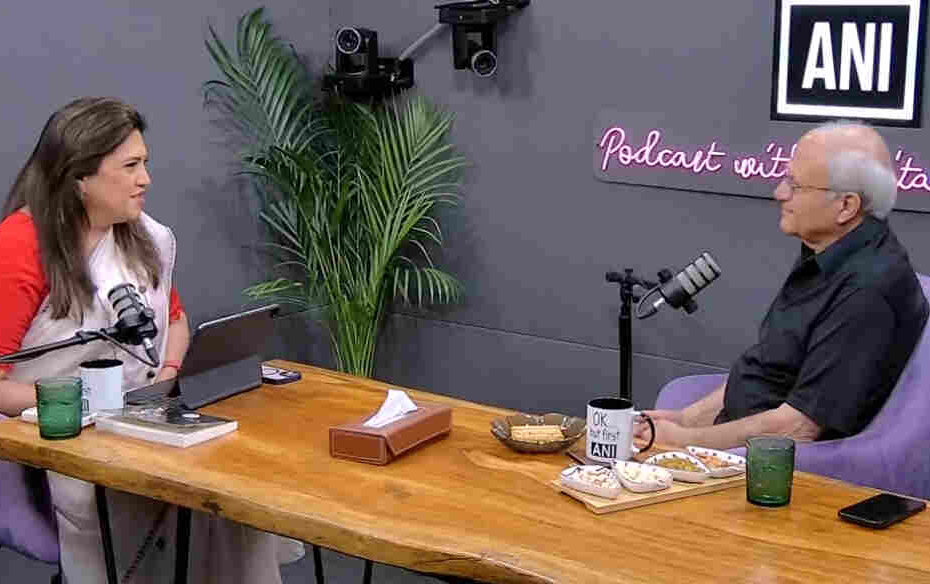
Read the full transcript of co-founder of HCL Ajai Chowdhry’s interview on ANI Podcast with Smita Prakash on “Make in India, Tech Sovereignty, AI, Rare Earths & Semiconductors”, Premiered October 29, 2025.
India’s Tech Product Challenge
SMITA PRAKASH: Namaste. Jai Hind. You’re watching or listening to another edition of the ANI podcast with Smita Prakash. My guest today is Dr. Ajai Chowdhry, co-founder of Hindustan Computers Limited. He has played a leading role in the establishment of the electronics industry in India, serving on government committees since 1999. In fact, Ajai Chowdhry is regarded by his peers as the father of Indian hardware.
He’s currently the chairman of the National Quantum Mission, an Indian government initiative to establish India as a leader in quantum technology. Ajaiji, thank you so much for coming on the podcast. Seven questions that I want to ask you.
First let’s start with the contentious issues and then we can go on to the other stuff. I want to know firstly, why is it that most people these days when having conversations are saying that India has not been able to create world class tech product? We don’t have a Google, we haven’t created a Meta or an Apple.
So we both are using these high tech phones and they’re being made here. But why is it that we don’t have that one tech product that we can say is something which is Indian? Is it that we lack talent, is it infrastructure, or have the successive governments in the country not promoted an India made high tech product?
AJAI CHOWDHRY: I think the only product that we are proud of is DPI and UPI within that. So that is one world class product that we created. But that was not created by just the government. It was created by a group of people who actually felt India should have something like this. And it was an organization called iSpirit in Bangalore that actually took that thing forward.
From Aadhaar to UPI is the journey that they traveled. And so today we have this great India stack, but beyond that we have nothing. So if you look at hardware, what do we have? Zero.
I started my business with HCL in 1976. We used to design and make computers. The successive governments did not support that whole concept and as a result we signed a WTO agreement and the whole electronics industry died. So today if you look at it.
SMITA PRAKASH: When was that signed and when did it?
The WTO Agreement That Killed India’s Electronics Industry
AJAI CHOWDHRY: 1999 it was signed. 2005 it was implemented without talking to the industry. So as a result the whole electronics industry died. I mean as HCL we continued with hardware till I think 2011, 2012. But then it became extremely difficult because there was really no support from the government.
SMITA PRAKASH: Why did we sign at that time? Was it pressure on us to sign the WTO at that stage? Even though we were making strides. What do you think was the reason?
AJAI CHOWDHRY: I think we got pushed into it and the Western world wanted to open up India’s market and as a result of that we really destroyed our electronics industry. China didn’t sign, Brazil didn’t sign. And that’s how they succeeded. So it’s a very sad thing.
SMITA PRAKASH: And then as a founder, did you speak with the government of the day then not to do this because it’s going to kill industry?
AJAI CHOWDHRY: They never even asked us. They just went and implemented it. And before implementation we actually wrote a document working together with a gentleman called Dr. Sesha Giri. Under Atal Bihari Vajpayee, a task force was set up for software.
I approached that task force and said why are you only looking at software? Why not look at hardware? So they said, okay, why don’t we have a look? I made a presentation, the team agreed. Jaswant Singh was the chairman at that time and he asked Dr. Sesha Giri to actually put together a task force which I was a member of.
We wrote a complete plan of how to handle WTO because it had already got done. So we created that plan. Never saw the light of day. Very sad because a hell of a lot of work was done on it. But they didn’t implement it.
SMITA PRAKASH: So those countries which got a head start, those who didn’t sign it, who were not party to it, they got a head start.
China’s Dominance and India’s Import Dependency
AJAI CHOWDHRY: Absolutely. China completely dominates electronics today. And we are an import country 100%. We do not make anything.
And so for the last so many years after leaving HCL, I decided that I’ve done a lot of work with the government in the past. Every report that you can think of on electronics, I kept saying create the industry differently, design products, make products in India, not just manufacture.
Design to manufacture is very important because unless you add value in the country there’s no sense in doing zero value added manufacturing which is what’s happening today. It’s all services. It’s not value added product development.
So two years ago I finally approached the honorable minister Ashwini Vaishnav and I said sir, we are creating the fabs but we are not looking at design and making our own products. So he set up a task force under Professor Rajiv Sood. I was part of that task force.
We’ve given the recommendations that we now need systems, chips, fabs and packaging. And then creating the market. See, how do you create a market? How did China do it? The way China did it is they banned everything else. So that market automatically got created.
So the strategy that I have suggested to the government is ban Chinese chips. And the reason why we should ban Chinese chips is because it’s very dangerous to import them. Each of those Chinese chips will have backdoors and these backdoors can transmit data back to China.
So this whole strategy of system to chip to fab to packaging and market is essential.
SMITA PRAKASH: But if we ban first and then start fabricating and stuff like that, so first we have to create the industry.
AJAI CHOWDHRY: No, I have no problem with creating fab because it takes time to create fabs.
For the fab, we will have no Indian market. Although the requirement for semiconductors in the country is very large. But it’s 100% imported. We have great capability in design. We are the second largest design capability of chips in the world. But we don’t use it for ourselves.
SMITA PRAKASH: But it will take what, 15 years more they’re saying, right, for semiconductors and stuff?
AJAI CHOWDHRY: I think if we do the system to chip piece, we can do it faster because we have design capability, not manufacturing capability.
India’s Design Capability vs Manufacturing
SMITA PRAKASH: Why would we have design capability but not manufacturing capability? All right, let’s go both ways. When you say we have design capability, there also when I speak with industry, they say all the design capability has left Indian shores because it didn’t get that kind of support.
AJAI CHOWDHRY: No, that’s not correct. A lot of offshore work is going on in India. So if you look at all the top companies of the world who design chips or make chips, they design in India. You look at Nvidia, you look at AMD, you look at Intel, you look at any company, MediaTek, all of them have design centers in India.
HCL has a huge design capability for semiconductors and it’s always been a leader in that. We would have nothing less than 30,000 to 40,000 people. So the capability exists with TCS, HCL, Infosys, Wipro, you name it. And all of these capabilities are actually meant for exports. We do nothing for India.
SMITA PRAKASH: You are saying that we have to shut the doors and we have to become more protectionist and only then will this work?
AJAI CHOWDHRY: I think we should do it step by step. We should be smart. So the way it should be done, we should decide these are the 20 systems we must have in the country that we need to design. Then each of those 20 systems will have subsystems and then the chips for the subsystems.
So as each chip gets developed, we should stop the import door. Because when the chip is ready, then only we should stop importing. If the chip is not ready, what’s the sense in stopping imports?
SMITA PRAKASH: Okay, so if we have the talent, we have the wherewithal. Where was the problem? Was it not being sure about oneself? Was it lack of ambition on our part not doing this?
The Design Linked Incentive Scheme
AJAI CHOWDHRY: Actually the schemes that were created in the past were terrible. They never encouraged domestic design. This government has done a major change. They started recognizing that design is also essential. So ISM 1.0, which I am also an advisor to ISM.
SMITA PRAKASH: What is ISM?
AJAI CHOWDHRY: India Semiconductor Mission. So inside that there is a scheme called Design Linked Incentive scheme. But that is very, very small. What they were doing is giving 30 crores per chip in which a startup had to invest 15 crores. Government gave 15 crores.
A lot of startups didn’t have 15 crores to invest. So as a result, 17 to 20 companies actually managed to get that money. But to design a chip, 30 crores is not good enough.
So what we have suggested is take it from 30 to 50 to 100 to 200 and for advanced chips put out an RFP and give more. And if they can do that, then in the next five years we will at least create 30 to 40 chips. And these 30 to 40 chips, when they get created, we can manufacture them in India.
We can also stop imports that we are doing today and be safe because security wise, having Chinese chips in every product, every product that you see around you today has Chinese chips.
The Security Threat of Chinese Chips
SMITA PRAKASH: Yeah.
AJAI CHOWDHRY: Two years ago actually, if you remember, when Modi Ji came in, he said, “I want an attendance machine in every central government office.”
SMITA PRAKASH: Correct.
AJAI CHOWDHRY: Each of those attendance machines were Chinese. Each of them had Chinese chips. Two years ago an intelligence agency was asked to look at them and they found all the data has gone back to China.
What does that mean? All central government officers and their wives and everybody whose information was available on that attendance machine has gone back to China. And the same is true for CCTVs. All CCTVs all over the country, every street, everything is known to the Chinese today because every CCTV has Chinese chips.
So it’s a very serious situation. Most of the world has banned Chinese products. The US does not allow CCTVs from China. Europe doesn’t allow Chinese products.
SMITA PRAKASH: So where are they buying it from then?
AJAI CHOWDHRY: They’re domestic. Everybody has created their own capability and we can today design for ourselves and export, but we have not done it.
Tech Layoffs and the Future of Indian Engineers
SMITA PRAKASH: Very interesting. I’ve done several podcasts on this about the dangers of this and I hope people wake up to it. Before I circle back on this issue which you’re talking about, one more controversy which these days everybody’s talking about is this panic situation that global tech firms have started laying off people in 2025.
How should Indian engineers see this? What’s it going to, how is it going to impact on engineers? One, two on the startups and three on the firms which are already existing in India. How is it going to impact on all these three?
AJAI CHOWDHRY: It’s not just the global tech firms. It’s Indian tech firms also. TCS has also laid off people. So it’s happening. It is bound to happen. The reason for it is for too long as a country we have been dependent on services. 60% of our economy is based on services, which is very, very dangerous.
We should now move towards being a product nation in everything that we do. Whether it’s semiconductors, whether it’s drones, whether it’s EVs, whether it’s whatever product you can think of. We must become a product nation.
SMITA PRAKASH: Manufacture on a war footing?
AJAI CHOWDHRY: Design and manufacture. What happened was that in the past when Modi Ji talked about Make in India everybody assumed it was manufacturing only. That’s wrong. We must design and make in India.
If we design and make in India, we are using our capability as a design country. We have great design capability. We don’t have manufacturing capability. Manufacturing has been created in the last few years for electronics. Semiconductor manufacturing we are still learning.
So I think this is really where the change has to come. We need to move towards being a product nation. And we need to be a product nation in every way we can.
SMITA PRAKASH: What’s going to happen with all those engineers who are losing their jobs? Do we have the ability to absorb it? Does our industry have the ability to absorb those job losses?
The Research and Development Fund
AJAI CHOWDHRY: Now a very interesting thing has happened in the last one year, two years. We were a think tank and we went to the government and we said move towards being a product nation. Government listened.
And the good news is that Modi Ji sanctioned 1 lakh crore for 50 years interest free as a research and development fund.
SMITA PRAKASH: Okay.
The RDI Fund and Product Development
AJAI CHOWDHRY: Now this RDI fund is now under implementation. I think this is where these engineers can be absorbed. Because this kind of money has never been put into private sector before. For the first time in the history of the country we are having government money going into private. So this money of 1 lakh crore, 50 for 50 years interest free. That means much bigger than 1 lakh crore. So this money is now going into great products that India must create.
SMITA PRAKASH: For example, like what?
AJAI CHOWDHRY: Like for example, whatever we do in drones today, everything is China. We are assembling drones. We don’t design anything. We have none of the inside of the drone today is made by us. Very few companies are doing it.
SMITA PRAKASH: But isn’t there a firewall where these drones, especially for the defense sector, which aren’t the drone manufacturers supposed to give it in writing that these drones do not have any Chinese?
AJAI CHOWDHRY: I’ll tell you what the Chinese are doing, okay? They rebrand their products as Singapore products. Even the chips are rebranded. They put a new stamp on it in Singapore and say it’s made in Singapore. Actually, it’s Chinese. They don’t even know.
So this situation of moving from services to products is absolutely essential as a country because number one, it will employ more engineers and scientists. As a matter of fact, with this RDI fund, there is a strategy by the government to actually get diaspora back into the country and work on designing products for India. So this is something, those who left.
SMITA PRAKASH: In the 90s, which you were talking about, and they are losing their jobs.
AJAI CHOWDHRY: There, they come back here. So as a matter of fact, a lot of new technology that we need to create can be created through the help of all these great diaspora that we have. These diaspora have product management capability. Our engineers in India have design capability. You combine the two, it makes a whole.
SMITA PRAKASH: A happy marriage. Interesting. Another thing, sir, which I want to talk to you about, which many speak, is that with all these tariffs happening and with China on the other hand, so here is India, where America is imposing tariffs on us. On the other side is China. Are we getting squeezed between these two?
Software Dependency and Product Development
AJAI CHOWDHRY: Absolutely. See, China is hardware. America has software. You are totally dependent on American software. I mean, your mail systems, your data centers, your accounting systems, your ERP systems, your databases, everything is American. We have done nothing in this country.
See, this is where I’m saying we need to move from services to products. All of our companies that are there, all capability exists in the country. If we now take a view, we need to make these 10 software products in the next three years, that list is available. It’s not a big deal. Bernstein recently wrote a report on it. I don’t know whether you saw it. In that he listed the products that he said India must make. And inside that all products are made by Americans. And on the other end, China is all those products. We have none except DPI. We have really done nothing.
SMITA PRAKASH: How long do you think it will be from that list if we were to start today?
AJAI CHOWDHRY: Three to five years. That’s it. Because some of those, some of those products at some stage are already available. You see like Zoho has been adopted by the government now. If we go to various kinds of startups and companies, we will find that inside that list some products are at 60% stage, some products are at 75%. Let’s put money into them and fund them and then take them forward and adopt them.
See this adoption of, see the biggest challenge that we face in this country, which is where America succeeded, is when DARPA was created. The strategy of DARPA was give a challenge to the industry, make this product. If they made this product, they filled them with orders. Here we are so scared of WTO. How can we place orders on Indian companies? I think this ridiculous situation of saying how can we place orders on Indian companies is a ridiculous situation. Of course you must give more business to Indian companies than Chinese companies and American companies.
SMITA PRAKASH: When we do that, then we invite these kind of reactions which we are facing today. I mean it requires a lot of spine to push back.
AJAI CHOWDHRY: Well, that’s what China did.
SMITA PRAKASH: Yeah.
AJAI CHOWDHRY: And what did Biden do? Three years ago he put out a 600 billion Make in America plan and said do not buy imports, make in America. So all countries are doing it. We are stupid not doing it.
Challenges Facing Indian Startups
SMITA PRAKASH: You were talking about startups. So let me come to that. You say that many of the startups are just copying ideas and it’s about time to create IPs for our products. Can you expand on that?
AJAI CHOWDHRY: You see, a lot of startups that got created in the first generation were mainly in commerce, they were not in products. So they created great companies. I can’t say that Zomato is bad. I can’t say Flipkart is bad. They were all created, they did great work, they created great business, they created lot of employment.
See, employment and innovation only happens in startups. Big companies don’t take risks. This is a great thing that America understood many years ago. So you have to encourage startups now. The other thing that has happened in the country is that we have not really created good strategies for startups. Okay, I’ll tell you three, four problems that startups face. Because I am an investor into startups. I’ve invested in our own 75 startups and I know what they feel.
SMITA PRAKASH: Okay?
AJAI CHOWDHRY: The first problem that is there is that I have a startup, beautiful company. They have a product by which you can actually put a layer on top of a tank and the tank becomes invisible to radar. They were given an 11 crore order by the defense. What did the defense ask them to do? Okay, give me, they gave an 11 crore order. They said give me a 9 crore bank guarantee. I mean tell me, how is a startup going to get bank guarantee? They don’t have limits. So how do they manage? They take money from equity they’ve got from VCs, put that 9 crores in the bank and the bank gives them a 9 crore BG. First problem.
The second problem is that when they get a large order, they need credit, they need to have money to actually have working capital. There is no policy for working capital for startups. So they really die in creating, in delivering large projects. So what do they do? They go to VCs, they take equity money and they lose their ownership of the company. See, because by selling their equity, instead of having 60% as a founder, he goes down to 30%. What is the initiative for him to take the company forward? He’ll finally sell it or flip it to America. This is what’s happening. So I think we need to create credit also for them.
The other problem that they face is that the reason why people join startups, they look forward to stock options.
SMITA PRAKASH: Correct.
AJAI CHOWDHRY: The stock option program in India is pathetic. For 10 years from Indian Angel Network and all the VCs, we have been telling the government, for God’s sake, change the ESOP program taxation. You know what happens today if a person joins my company, I said, okay, I’ll give you 100 shares one year later or two years later, two years later, that shares get allocated to him, vested, as it’s called. At vesting time they have to pay tax based on the valuation of the stock. Then they have no cash flow to pay for the stock.
So what we have suggested to the government and the Finance Ministry is that change this rule, follow what America and the UK and everybody else does, ask for taxation when they sell the stock, then they have the cash. So if they have 100 shares and it’s going to be sold at 2 lakhs per share, they’ll have the money to pay tax. But at vesting time they don’t have the money. So we are really crippling the startups in terms of growth.
Technology Sovereignty and Sanctions
SMITA PRAKASH: So explain to me how is Zoho’s alternative to WhatsApp that is happening? How is that moving ahead?
AJAI CHOWDHRY: You will be surprised. It’s moving at blazing speed because a lot of people are adopting it and everybody’s understanding that they will face a situation two years later. Suddenly somebody will wake up in America or wherever the product is coming from and they will say shut it off. That’s what happened to SAP implemented in Russia. SAP is a German company. They were told you can’t give to any company that is connected to Russia.
SMITA PRAKASH: Finished. Or what about TikTok in America? That’s the same, similar kind of a situation. Find an American buyer, you find all kinds of…
AJAI CHOWDHRY: See, sanctions are going to happen today. There are many sanctions which the country is not aware of. U.S. has put a lot of sanctions. China has put lot of sanctions. Europe has put a lot of sanctions. For example, in quantum computing you cannot import more than 34 qubits into the country. Therefore we need to make our own.
SMITA PRAKASH: Yeah.
AJAI CHOWDHRY: So this is where the sanctions are going to happen. Sanctions are very good for us. Why? Because ISRO got created out of sanctions. Atomic energy created out of sanctions. So I always look at it. This country responds well when there is a crisis. Today there is a serious technology sovereignty crisis both in hardware and software. So we now need to put together a next five year plan to create our own hardware, create our own software and become independent.
SMITA PRAKASH: That kick on the backside was necessary.
AJAI CHOWDHRY: Yes. Actually I fear and this is something which is controversial but I’ll still say it. We are going to have another East India company. How did East India company get started? Trading and taking us over. That’s what will happen to us.
SMITA PRAKASH: It was happening to us you say. But this thing is going to propel now.
AJAI CHOWDHRY: I hope if we rise to the occasion. Yes. This is the time when private sector and government and research institutions have to work together. Inside this RDI fund of 1 lakh crore that has been created, they can even give to a corporate 500 crores for a product or a thousand crores for a product. And if the product will take 2000 crores, government will give 1000 crores. The corporate has to put 1000 crores. 50% they will give. It’s a fantastic scheme for corporates to wake up and do R&D. R&D is a major problem of this country. We do not do enough R&D. That is why government wants private sector to do R&D and it’s a nudge towards that.
Data Security and Privacy Concerns
SMITA PRAKASH: Let me come to what you had mentioned earlier about data centers that they are all based in America. Now explain to me that what happens with AI data centers. Now all the data is going to America. It’s sitting out there. We are told by WhatsApp and the others have end to end encryption.
AJAI CHOWDHRY: Data is still sitting outside. All are, see till the time data centers were not important, cloud was not important. SaaS was what was important. SaaS meant that you actually kept data inside your company. Moment everything became cloud, all data sits with the vendor. So all our data is sitting with vendor.
Today America has severe restrictions on data. You cannot use data without permission. There are a lot of issues there. In India it’s open sesame. So American companies can happily have our data. Chinese companies can happily have our data. They can create. Why are they able to create AI models today is using our data because our data is humongous. They don’t have that kind of data available anywhere else.
SMITA PRAKASH: Okay, and what are the dangers of our data going to these countries which have been going?
AJAI CHOWDHRY: You know, then they know when you’re going to the loo. Just imagine. You know, for God’s sake, never put on one of these Bluetooth speakers in your room. If you actually just connect them on and you ask Alexa, Alexa knows everything you’re doing in that room. So switch it off, take it off from, plug it off. I don’t use Alexa at home because all my data goes back whenever Alexa is sleeping. It’s still sending data.
SMITA PRAKASH: Okay. For example, armed forces personnel, medical personnel, people who use these phones don’t realize, I guess that you know, that data is going in. So they can just be conversing that I’m being posted here randomly. And if they’re sitting in China or America, wherever the data center is, they get the information that there’s some large scale movement. Absolutely not difficult to find.
AJAI CHOWDHRY: All information is available to them. As a matter of fact, if your desktop is a foreign desktop sitting on your desk through the mic and through the camera, they know everything that’s happening in your office.
The Challenge of Data Security and Chinese Dominance in Smartphones
SMITA PRAKASH: It’s not necessarily hooked up.
AJAI CHOWDHRY: Like for example, anything that’s connected to the Internet, the data is not with you. It’s all gone. And I think phone is a very important point you made today. The total market of phones in this country is 190 million a year. A large country. Out of that, 150 million are smartphones, right?
Out of that 150 million, 60% are Chinese. So what do you do? Balance is Samsung and Apple, but the Chinese are happily having this market. We have no single Indian phone in this country. Very sad state of affairs. Even though they’re manufactured here, those manufacturing is all nonsense.
SMITA PRAKASH: It’s just putting it together.
AJAI CHOWDHRY: That is all screwdriver technology. You know, what happens is when an Apple phone or a Samsung phone is made in India, the kits come from China, they are screwdriver and sent.
SMITA PRAKASH: What if Trump so upset, he told Apple not to make their computers here, not to make their cell phones here. And they are setting up all these offices in India, all these tech companies.
AJAI CHOWDHRY: You see, I think a lot of that is posturing. Trump is a master at posturing. He’s outstanding. He knows how to catch people. He’s a businessman, you know, so he’s very, very smart. People think that he’s some kind of an idiot. No, sorry. He’s very smart. He knows what he’s doing and he knows where to push and where to pull. So that’s what he does beautifully.
So I have been telling the government for a while, we must have an India phone and the India phone that we must create has to have deep security so that the data cannot go back. And it’s possible to do so. Right at this moment, couple of us are actually putting together proposal for the government to create an India phone.
SMITA PRAKASH: Fine, create an India phone. But for example, if I use an Apple product, I’m using my iPad, my phone, my desktop, it’s all connected, right. If I have India phone, how safe am I? Because my laptop is still. So unless there’s a manufacturer who can make the entire…
AJAI CHOWDHRY: It’s possible. HCL used to do it.
SMITA PRAKASH: Yes, correct. Everybody used your computers.
AJAI CHOWDHRY: People were born…
SMITA PRAKASH: All are first users of computers.
The HCL Story: From Hardware to Software
AJAI CHOWDHRY: People were born using HCL. So we just didn’t take care of companies like HCL. We allowed them to get killed by hardware. And HCL moved from hardware to software because it was easy to do. My board said, why are we in hardware? For seven years I opposed it. And then when I left HCL, a new CEO took over. He succumbed to the pressure from the board to say forget about hardware because market forces.
Yeah, but I was willing to fight and I fought and we were number one, number two in the country all the time.
SMITA PRAKASH: Yeah.
AJAI CHOWDHRY: So it’s all about having the… At the end of the day, as my book is called, “Just Aspire,” for example.
SMITA PRAKASH: This book.
AJAI CHOWDHRY: Now what do I…
SMITA PRAKASH: All youngsters who want to know the story, please pick this up.
AJAI CHOWDHRY: So now why am I saying “Just Aspire”? It’s all about aspiration. When we started HCL, what did we have? 1.86 lakhs between six people. What is the size of HCL today? $14 billion. 70 countries. 300,000 employees.
So all the time I tell startups, A is greater than R. If you have aspiration, resources will happen. That’s what HCL story is all about. We had nothing, we needed a license to make. We found a license with UP government, formed a joint sector company and got started.
Job Security and R&D Investment
SMITA PRAKASH: You know companies like yours, HCL, Wipro, Infosys, lakhs of engineers are employed by your companies. Can engineers who are coming out today, are they secure that you know, once we come out there’s these new data centers which are coming up. The new, the old, you know, companies which were existing that there are jobs for our engineers.
AJAI CHOWDHRY: As long as we take a very serious view of R&D, there are enough jobs that will get created. This RDI fund itself will create a lot of jobs because the kind of money that the government is going to put into private sector, private sector can employ PhDs and high end engineers and scientists to make products in India.
So the thinking is very strong. There are 12, 14 areas that the government has identified where R&D money will be put into. Startups, SMEs and corporates. And there a lot of people can be employed. As a matter of fact it could be great for India if these guys come back.
SMITA PRAKASH: You know there’s one question. OpenAI is investing in AMD which makes chips for OpenAI. But once Nvidia decides that it wants a stake in OpenAI, it rents cloud space from Oracle which buys chips from Nvidia. So now all these companies, they’re just passing around their money to each other and they will have a stranglehold.
AJAI CHOWDHRY: Exactly.
SMITA PRAKASH: So just tell me where is, how does one break this nexus?
Breaking the Tech Monopoly: Indigenous Solutions
AJAI CHOWDHRY: I think as I said, make our own hardware, make our own software. In the software we must have our own cloud software. We cannot be dependent on Azure, etc. We have to have our own cloud software.
We are very happy when people start saying I will invest $500 billion or $300 billion in data centers in India. What does India get? Nothing. All the hardware is American, all the software is American. So a data center getting set up in UP, data center doesn’t employ people. Manufacturing of today is robot oriented. It doesn’t employ people in that large numbers that we think.
It’s the design that employs people and it’s the market that will create jobs. So if we open up the market, stop useless imports, replace them with Indian products, they’ll be lots of jobs that will get created. And you know when a hardware job, hardware product is made, it creates five times the maintenance jobs. So in small cities you will find people being able to repair products.
See the strategy that I have advised the government is that we must make products that are repairable and reusable.
SMITA PRAKASH: Not the junky one.
AJAI CHOWDHRY: Not the kind of stuff that Apple and others do. Apple makes sure that after two years you replace the product.
SMITA PRAKASH: Yeah.
AJAI CHOWDHRY: Apple after lot of fight in the US and Europe have opened up their product for repairs. But the opening up is also a little bit of a badmashi. The reality is that no fellow sitting in Junjuna can actually repair an Apple. Everything will have to come from Apple. All parts will have to come from Apple. All those things are there.
So you know this whole idea of repairability will create huge jobs for India. As a matter of fact I have a view that if we become the global repair center for the world we’ll create a $20 billion industry.
The Right to Repair Movement
SMITA PRAKASH: But when we talk about this, I mean when I say this I’m always called a dinosaur. Come on in these days it’s all use and throw. Repairability is something which is a 90s generation talks about. It’s a dead industry. Whether it is your press or iron, your refrigerator or whatever, it is junked after that.
AJAI CHOWDHRY: But what happens to that junk?
SMITA PRAKASH: Yeah, environment disaster.
AJAI CHOWDHRY: Yeah. The e-waste is phenomenal. We are the second largest e-waste country in the world. So I have been telling the government, Consumer Affairs Ministry came up with the whole idea that we must follow repair in India as a policy. Right to repair as a policy. Europe and America have all created right to repair.
SMITA PRAKASH: We haven’t. Why? It was called our jugaad.
AJAI CHOWDHRY: That culture is Indian. Why have we adopted the global culture? It’s a sad state of affairs. We should go into making repair happen in this country. So when Consumer Affairs Ministry came up with this whole idea of right to repair, every global company opposed it. As a result they’ve stopped. It’s very sad state of affairs.
SMITA PRAKASH: Yeah.
AJAI CHOWDHRY: Although the current secretary Nidhi Khare is very pro, but she’s bound because these Apples and Samsungs who have put up huge manufacturing plants here are putting so much pressure on the country. Why should we do repairs in this country? So junk the product, junk.
The Shift from Hardware to Software at HCL
SMITA PRAKASH: I get that. Explain to me when you were talking about the pressures that came in when you were with HCL at that time and went into software, at what point of time did you feel frustrated and said you know laptops and IT, you know you became a service oriented and software. Did you explain to me that feeling at that stage that you had.
AJAI CHOWDHRY: I never gave up till I left HCL. The guy who took over from me gave up.
SMITA PRAKASH: But you were a founder of HCL.
AJAI CHOWDHRY: Yeah, but what could I do? Because we are a board run company, we are a listed company. I as a shareholder has no control on that when I leave the company. So it all is a question of support. The government never gives support.
You know, when we wrote that two, three proposals for the government, we created a concept called preferential market access. I wrote that word 25 years ago in a report to the country. And I said all Indian products must be preferential market access in the government. Government may say 50, 60 Indian companies, everybody flouted that.
HCL-Foxconn Chip Manufacturing Initiative
SMITA PRAKASH: What about this HCL Foxconn chip manufacturing plant which has been revived or it’s received union cabinet approval for setting up the plant. Explain to me what’s happening there.
AJAI CHOWDHRY: I don’t know that many details because I’m absolutely out of HCL. But from what I know is that they are going to be setting up a OSAT facility which is basically for assembly. But they’re looking at high end of the OSAT.
SMITA PRAKASH: Okay.
AJAI CHOWDHRY: So till now it was more importantly design, fab and packaging. Most of the high end stuff was in the fab. Everything is changing because of technology changes, because of the way products are designed. So now packaging has become very, very, very advanced.
SMITA PRAKASH: Why?
AJAI CHOWDHRY: What reason is that? Let’s say, I’ll give you a simple example. Let’s say a chip is to be designed. You can design it in two ways. Design everything ground up or design using existing modules. So these existing modules are called chiplets.
So if you want to design a chip you can say existing four modules I will use, let us say one is an RF module. RF module is designed already. We’ll pick it up, add that inside the chip and six chiplets will form the chip. Okay, so packaging these is a very advanced job. It is not something that a fab does. It is done in the packaging area.
So HCL’s Foxconn facility, which I have read about, I don’t know great details, but they are actually going to be creating an advanced packaging facility and for usage where for example display drivers, all kinds of things like that. So they are going to design for, make for high end applications.
SMITA PRAKASH: And when will that roll out?
AJAI CHOWDHRY: No, but I think it’s a… See, OSAT is a one and a half year journey. So moment they break ground, it will be one and a half years.
Government’s Role in Building Global Tech Champions
SMITA PRAKASH: Okay. Another question which has been which my research team has been asking is that how big a role can government play in helping homegrown Indian tech product go global and what are the immediate steps that the Indian government should take?
AJAI CHOWDHRY: Demand aggregation. What I suggest is that we should aggregate all the government demand and give it to Indian companies. You may decide to give 50% or 75%. But if this demand aggregation gets done, three or four companies can be selected. Each of them are given government business. They can scale and become big in India. And once they become big in India, they must go abroad.
SMITA PRAKASH: Okay.
AJAI CHOWDHRY: So that opportunity exists for us to become a product nation just the way China did. China became a product nation only because of this. Today which is the largest networking company in the world? Huawei.
SMITA PRAKASH: Yeah.
AJAI CHOWDHRY: Why? Because all the telecom business of China was given to Huawei. Then what they did, they went to every country in Africa. Chinese, they give great credit to every African country to buy Huawei. So you could take a one year credit. They were given credit limits by the Chinese government so that Huawei can go and sell it based on credit rather than paying immediately.
SMITA PRAKASH: Which companies in India can do that on this scale?
The Government’s Role in Supporting Indian Tech Companies
AJAI CHOWDHRY: Because the government does not support like this at all to anybody. For example, today 4G, 5G, complete capability is ours. Today Tejas Networks, which is bought over by Tatas, was given the 4G order by BSNL, 13,000 crores. I think the minister at that time took a very strong view that I will only allow Indian companies to get this deal. Foreign companies were not allowed.
So four companies bid for it. Tejas and Tatas won it because they were the most successful test that they did with BSNL. Immediately a 13,000 crore order was placed on Tejas Networks. Now what happens to Tejas? Tejas can buy components at the lowest price. They become competitive all over the world. But we have sat down after that and done nothing. What we should be doing is what China did. We should go out and market our products globally.
SMITA PRAKASH: Even domestically.
AJAI CHOWDHRY: Domestically the community is using Huawei, which is so risky also.
SMITA PRAKASH: Which is so risky also.
AJAI CHOWDHRY: Which is very risky. So what we are saying is that do the demand aggregation in India. Every product can be created and designed in India. Scale them in India and take them global. But when you go global, give them support.
I have even written in my book also that you need to make sure that all the foreign embassies have salespeople sitting there selling Indian products, which is what UK does. UK has a trade marketing organization. We have none. So we need to market our products. Marketing doesn’t happen on its own. I mean, look at what China did all over Africa and Latin America. Huawei is the standard in all these countries.
SMITA PRAKASH: Yes.
AJAI CHOWDHRY: Huawei has been banned in Europe and UK and the US. China’s all orders go to Huawei and then all business in Africa and Latin America goes to Huawei. So Huawei is the largest networking company. Why can’t we make Tejas and Tata the largest company in the world?
We can, because Americans will trust us, Europeans will trust us. They will not trust the Chinese. It’s a great opportunity to go and rip and replace Huawei in all these countries. As a matter of fact, when Biden came four years ago, he said I want rip and replace, but we have done nothing about it.
SMITA PRAKASH: Yeah, it’s kind of frustrating when you’re telling me this.
AJAI CHOWDHRY: I get very frustrated.
AI Adoption in Industry and Education
SMITA PRAKASH: Also, since we are moving into policy sphere, I want to ask a question about AI. Are our industries equipped to use AI, to take the challenges of AI? And one industry, two, is our education system using AI as it should? Tech education system.
AJAI CHOWDHRY: Beautiful question. Because if I look at industry, they have no choice. They better know how to use AI because if they don’t, all their competitors will use and they’ll get beaten. Because we are so dependent on the domestic market today, why is India still doing okay in the world despite all kinds of sanctions? Is because 80% of our business comes from domestic.
But within domestic itself, the company that uses AI and the company that doesn’t use AI, the company that uses AI will beat the hell out of the guys who don’t use AI. So I think 15 years, 20 years ago, I always used to say you have to have a CTO in the board, Chief Technology Officer on your board who should know IT.
Today I say you should have a Chief AI Officer in your board and your CEO, your marketing people, your manufacturing people must understand how to use AI because they can dramatically increase their efficiency and they can do the same thing in less time. So this is something that domestic companies must do.
The second point you talked about education. Education is gingerly getting into AI. They are still a little behind, but I think things are starting to happen. But if you stick to the old pedagogy, it’s not going to work. You need to start using AI inside your pedagogy of how to teach people using AI.
SMITA PRAKASH: Yeah.
AJAI CHOWDHRY: And students also will, you know, students are going to get totally dependent on ChatGPT, which is a disaster.
SMITA PRAKASH: Yeah.
AJAI CHOWDHRY: You know, because it’s terrifying. Because young kids are using ChatGPT to give all their homework now. That is not a good situation to be in. We need to think very seriously about how to prevent that. And we now need to be very careful of having ethical AI also. Ethics in AI are becoming the most critical issue because if it is not used ethically and used non-ethically, it can be a danger for you as a country. So I think this is a very important area that the government is looking at today. The AI mission is definitely very seriously looking at it.
The ChatGPT Challenge and Information Reliability
SMITA PRAKASH: You know, I get what you’re saying that using ChatGPT for homework and stuff like that, but I remember 25 years ago when Google came first into our newsroom, it was this thing that journalists are not going to go and do their research on the ground. They’re going to use Google instead of going and finding out on the ground what’s happening. Google the information, you’ll get the information.
And so the older guard was like, this is very wrong what’s going to happen because you’re not going to check facts for yourself. You’re going to rely on Google’s ability. And Google is just a platform. They are not news, they’re not reporters, they’re not journalists on the ground. So this started happening the same way as today with ChatGPT.
So one is a fact thing and two is the ethical and the moral issue which comes in because they are just sourcing information from various places. Who knows whether that primary source is right or wrong.
AJAI CHOWDHRY: Absolutely correct. That is why ChatGPT is worse than Google. See, ChatGPT can give you very deep answers. You ask a question from ChatGPT and they’ll keep on asking you, what do you want more? What do you want more? What do you want more? You want this, you want that.
But remember one thing. Everything comes from data that’s already available. There’s nothing new that is coming. So sometimes you will find ChatGPT giving very, very wrong answers.
SMITA PRAKASH: So that hallucination was there, but that’s becoming lesser.
AJAI CHOWDHRY: No, no, no, no. More data going in, hallucination will stay. Hallucination will stay. It is not going away even today. And I’ll tell you, recently a Big Four gave a project report to Australian government, 100% written by ChatGPT. The government found out and there were all kinds of useless stuff in it. They have been fined and they’ve been asked to return that money. So this is something that is a wrong usage of ChatGPT.
SMITA PRAKASH: Authors are saying that what’s going to happen is that people are going to write novels, everything with these mechanics which are available now. They’re not going to, I mean, you can actually write out there that, okay, write me a plot for a suspense novel, write me a plot for a film that I want to make on science fiction, and you’re going to get all that. So what’s going to happen to the writers? Everybody’s worried. Or musicians?
The Irreplaceable Human Element
AJAI CHOWDHRY: Let me tell you one thing. Human brain is phenomenal. It cannot be beaten because it’s got billions of neurons inside our brain. The computers are far away from that. Today, even when quantum computing comes in, it is going to be far away.
Reason for it is that there’s one particular area which a computer or an AI cannot do, which is emotions, right? So if I have to sing a song, AI can sing a song. But can AI sing the song with emotions? The emotion I will put in singing a song will be totally different from the emotion that AI will put. It can’t even put emotion. So this kind of situation is going to stay because this is what differentiates humans from AI.
SMITA PRAKASH: Human can make an error. Does a machine make an error too? I’ll just give you an example. If somebody has blood pressure or, you know, has the cholesterols are out, you put the information in one of these modules and it tells you whether to go on statins or not. Just an example, random example I’m giving you.
The doctor has a, you go to the doctor with the same blood reports and the doctor has maybe seven minutes or max 10 minutes he spends with you. He may just recommend something, but give another two months, diet control. Whereas that machine or that module tells you go on statins. Now people are wondering whether to believe the human doctor who tells you control, or to believe that module.
AJAI CHOWDHRY: For God’s sake, don’t believe the module. Reason for it is that the feel that a GP has, the feel that a specialist has about you as a person, is what makes the difference. By touching your wrist, they know. By talking to you, they know. By communicating with you, they know what is good for you and what is not good for you.
Yes, AI assist can be there, but the final decision has to be a human. The human must be in the loop.
SMITA PRAKASH: And for you, who has worked on factory floors with computers, for you to say that is amazing.
AJAI CHOWDHRY: It’s important. You’ve got to understand the difference. Okay? You know, one of the things that I’ve always followed is futurology. And it’s a very crazy habit of mine, but I followed it.
SMITA PRAKASH: What’s that?
Futurology and the Coming Singularity
AJAI CHOWDHRY: You know, there is this futurologist called Ray Kurzweil, and I talk about it in my book also. Ray Kurzweil I met about 15, 20 years ago. He was the originator of AI in lots of ways. But then he started to do a lot of research on where the future will be of computing. And he wrote many, many classical books. One of them was called “Singularity.”
And once I was invited to Bill Gates’ home, and me and my wife were put on a boat which then went to shore on Bill Gates’ home, because Bill Gates has created this home on the sands, on the river, and he’s actually imported sand from globally. So we actually landed there. And on the way, I was looking at some person and I saw him hanging around in one corner.
So I walked up to him and said, I’m so and so. Who are you? And I didn’t know that it was Ray Kurzweil, because Ray Kurzweil I’ve always looked up to. So he says, I’m Ray Kurzweil. So I started chatting. I’ve read all your books. This, that, what are you doing?
You know, he predicted many, many years ago that singularity will happen. What is singularity? Singularity is a physics word, but actually it describes that when computing and the brain will join together, when singularity will happen. Now, it is currently predicted by him that singularity will happen in 2045, but with AI, it will happen earlier because his latest book says singularity will happen with AI and it’s closer to you now. So what happens with that?
SMITA PRAKASH: What happens when it merges? You’re saying the brain and the computing, what happens?
AJAI CHOWDHRY: You won’t have to learn anything. Everything will get downloaded into your brain.
SMITA PRAKASH: Okay, it’s a little frightening.
AJAI CHOWDHRY: It is frightening. And you may also live forever because a lot of these technologies will cure diseases which are not possible to cure today.
SMITA PRAKASH: That’s also good.
AJAI CHOWDHRY: So, for example, you’ll have nanobots. I don’t know whether you ever read science fiction.
SMITA PRAKASH: No.
AJAI CHOWDHRY: It’s terrifying because science fiction book that was written by this guy who was in Ceylon, I don’t remember his name, very famous guy. He actually said, a ship will enter inside your body and go through the blood and enter your body. Now nanobots are getting created which can enter your body and fix every cell that has got spoiled. So cancer can be treated 10, 15 years from now.
SMITA PRAKASH: Correct, because those nanobots are being used now, if I’m not mistaken, to detect cancer cells.
AJAI CHOWDHRY: Yes, but now they will give curative. They will actually fix the cell in your body, which has got spoiled. So these kind of experiments are going on in a lot of countries, including Korea.
SMITA PRAKASH: It could happen.
The Turing Test and Beyond
AJAI CHOWDHRY: So I think this whole idea of futurology is something I’m very fascinated with. And I’ve always told people that someday Turing Test will be passed. What does that mean? Turing was the famous mathematician in UK who actually broke the Enigma during the World War II.
And Turing said, at some stage, computing will overtake the brain, and that is when Turing Test will be passed. It’s not yet happened, but I believe Turing Test will get passed in the next five to seven years.
SMITA PRAKASH: Okay.
AJAI CHOWDHRY: But beyond that, singularity, when it happens, will be the next level.
Quantum Mission and India’s Technological Future
SMITA PRAKASH: Next level. So interesting. You are chairman of the mission governing board of the Quantum Mission of India, right? Explain what that means. What does the quantum mission do for the country?
AJAI CHOWDHRY: You see, the government realized many years ago that we need to have capability in quantum technologies. So a plan was created by the country in writing a plan for having development of quantum technologies in India. And so based on that, a quantum mission was created.
2023 is when the government approved 4,000 crores for the budget for the quantum mission. And then another 2 to 3,000 crores will be spent by Space Atomic Energy, DRDO and Metis. So each of them are also participating in this program. As a matter of fact, my board consists of all the scientific secretaries.
SMITA PRAKASH: Okay.
AJAI CHOWDHRY: So whether it’s Metis Secretary, DST Secretary, ISRO Secretary, Defense Secretary, all of them are part of my board. Why we are doing that is because we want to make sure that quantum technology, we want to make sure that India has of its own.
So today, classical computing is what we use today. Your laptop, etc., is using classical computing. And what is classical computing? Classical computing is based on 0 or 1, which is binary. That’s what is called binary arithmetic. In quantum computing, instead of 0 or 1, you can have 0 and 1, two states together.
SMITA PRAKASH: Okay.
AJAI CHOWDHRY: What that fundamentally means is that’s much, much faster than classical computing. So that area is something that we are working on. We have created four hubs in the country. One for quantum computers, one for quantum communication, one for quantum sensing, and one for materials and devices.
SMITA PRAKASH: Okay.
AJAI CHOWDHRY: Each of them have been created in different institutes, like IISc’s head of where we run the quantum computing.
SMITA PRAKASH: Bangalore.
AJAI CHOWDHRY: Yeah, Bangalore. Now, many scientists are working together from different institutes with the IISc. Today we have close to 650, 700 scientists working on this program, just on NQM. In addition, ISRO Defense and others are also working.
What do we want to achieve? What we want to achieve is that in the next five to six years, we must have a thousand qubit quantum computer. In communication, we must have quantum secure communication.
See, today if a powerful quantum computer is sitting in China, they can crack all your cyber security. So if your financial systems and your defense systems and your space communication is dependent on old technology, you’ll get destroyed. Because overnight, if a computer like that comes up, it will crack the cyber security completely.
So to prepare against that, we decided to create our own products for cyber, for quantum security. The good news is that as a country we are far ahead in quantum communication rather than quantum computing. But quantum communication, many startups have created products, global level products.
SMITA PRAKASH: Is it only for national security purposes, quantum computing?
AJAI CHOWDHRY: No, any.
SMITA PRAKASH: The mission I’m talking about.
AJAI CHOWDHRY: No, no, no. Mission is about computing and communication and sensing.
SMITA PRAKASH: Not just for national security, can be for…
AJAI CHOWDHRY: Yes, yes. See, quantum computing can be used for drug discovery. So for example, today a drug takes 15 years of research to create a drug. Quantum computers will bring it down to five years or seven years.
What does it do for you? Number one, for humankind you’ll have drugs which are cheaper because R&D money that was to be spent for 15 years would be reduced to seven years. Then the cost of drugs will come down and faster development of drugs will happen. So areas like cancer and things that are today not possible to solve are going to get solved with quantum computing.
SMITA PRAKASH: Also the resources, right? The country spends so much on research, on saving its population, inoculation, all those things will change.
AJAI CHOWDHRY: The other area that will happen is that all high end work will get done by quantum computers. Normal accounting, finance, etc. will be done by classical computers. But as we go forward, classical computers and quantum computers will work together in a data center to give you much better solution.
For AI, for example, AI will become much, much faster. So this is the way quantum computing will happen. Now in communication we are doing very well. In sensing also we are doing pretty well. Sensing, for example, today we use GPS.
SMITA PRAKASH: Yeah, right.
AJAI CHOWDHRY: Tomorrow America shuts off GPS. What will you do? But GPS can also be spoofed. You may think you are using GPS, but it is not GPS because some fellow can spoof the GPS. So what quantum sensing will do is that it will create its own products for making sure it does not happen.
SMITA PRAKASH: We should also learn how to spoof also.
AJAI CHOWDHRY: No, of course we know. We are not idiots. We know. But the point I’m trying to tell you is that for national security…
SMITA PRAKASH: I’m saying, suppose Pakistan is using GPS coordinates.
AJAI CHOWDHRY: We can crack them. We can crack them. See, Pakistan will find it damn difficult to keep up with us on quantum technologies because they don’t have the funding or the research capability. So they will import everything. But we can create our own. But my concern at this moment, these…
SMITA PRAKASH: Digital imperialists will be supplying them, right?
AJAI CHOWDHRY: They will get controlled. See, today for example, I told you, beyond 34 qubits, export of computers is not allowed by the US and Europe also does the same. They don’t want those technologies going to anybody because quantum is such a dramatic change on technology that everybody wants to control it totally.
Rare Earths: The New Geopolitical Weapon
SMITA PRAKASH: I want to come to the point about rare earths. That’s supposed to be the new gold or the new chip. Global wars are going to be fought on that. They say we’ve got Trump saying that there’s rare earth in Pakistan. They’re going to be mining that on the eastern sector.
We’re seeing that Myanmar has supposedly got huge deposits. There’s something in India. So just tell me what is happening in this region. And there’s also, which you offline, we were talking about and you said that rare earth is being weaponized. So explain all these aspects to me.
AJAI CHOWDHRY: Now you see, rare earths are absolutely essential for many, many products. EVs, for example, and batteries, all these products are using rare earth. What China did in the last 10 years or 15 years, actually they started sourcing from all over the world and they bought over the mines.
So today, 90% of the world’s rare earth they control and that they can weaponize. So if they don’t supply rare earth, a lot of our products cannot be developed, whether they are in India and America or Europe.
SMITA PRAKASH: Which is why they didn’t invite as much tariffs from America as India did.
AJAI CHOWDHRY: Yes. Now because they decided to pose serious exports on rare earth, America has put in 100% extra duty. Now what should we do? Rare earth mining is a very dirty job. It creates a lot of stuff that is not good for health. So the mining is a very tough job. That’s the part one of that. But of course in China it doesn’t matter. Nobody gets to know. In any case, they can manage that, we can’t.
The second thing is we have never thought about it earlier as a country so we are pretty late in this. But yes, now a rare earth plan has been put together by the government. NITI Aayog has worked on it. All that is going on but it will take us five years to seven years to get there.
But there’s a faster way. The faster way is that a lot of that E-waste that we were talking about earlier has rare earth. So what we should do is that take all of that E-waste, convert it to rare earth materials that we need. Tons and tons of that can be created.
So I have given a paper, working together with a person who’s actually done research on it and I’ve given that paper to NITI Aayog and said non-mined rare earth, tons and tons of it is available if we just pick up E-waste. So we should use that right away rather than wait for our mines to come up.
So I think that solution to some extent is there. I can’t say it’s going to replace everything but let us say 30% or 40% of our requirement can be met just from E-waste.
SMITA PRAKASH: Very interesting. And do you think that this is something which is going to impact on our international relations also with China stopping exports on America, America putting tariffs, America’s interest in Northeast India, on Myanmar, all this is going to be impacting naturally.
AJAI CHOWDHRY: Interesting situation. This geopolitics is something that nobody thought mining is going to be…
SMITA PRAKASH: It’s like going back to the 18th century or 19th century and things like that with a new kind of…
AJAI CHOWDHRY: Product, weaponization of anything that you can think of. Software, hardware, rare earths, EVs, batteries, all of these are being weaponized now.
Nurturing Talent and Building a Product Nation
SMITA PRAKASH: So as we conclude, I just want to speak to you about nurturing of talent that is very close to your heart. You’ve been mentoring and nurturing talent in all these startup companies. So explain to me how much of your time goes in that and why did you get into that field?
AJAI CHOWDHRY: You see when I decided to get off the treadmill in HCL, in 2011 I became part of something called the Indian Angel Network. It was created by some friends of mine. They wanted me to be founding member four years before that but I said no, no, I don’t have time, I mean HCL. But one year before I decided to go off I said let me start going back to that area and I started becoming angel investor.
Currently I’ve invested in about 70, 75 startups. A lot of them, I mentor some of them. I just help connect and do all kinds of things and help them. But what I have seen in the last few years, and which is what I have been talking about earlier with you as well as what I’ve written in my book, is that India needs to be a product nation.
So how can we be a product nation when making a product is not taught in our universities? Not a single university teaches you how to make a product. I’ve been to many engineering colleges. They do the theory and that’s it. After that, no hands are used to make anything. In my old days when I did my engineering last year, I had to make a product. All of that has been forgotten.
So I went to the chairman of AICTE one year ago and I said, I think what we need is you need to look at your curriculum all over again. So he said, sure. So I said, what should we do? I said, introduce making a product in every engineering stream.
So initially he said, let me think about it. But then he created a program called Productization which has received phenomenal response. Now, hopefully they will work on integrating it into the curriculum. But whichever university I go to, I tell them, you must do that.
I have a friend, Hemant Kanakia, he’s created a foundation which is specifically working on this area. So he has gone to 30 institutes and each of these 30 institutes he’s created maker spaces. And these maker spaces in every engineering stream are actually created to make products.
SMITA PRAKASH: You know, it’s interesting what you’re saying because a couple of weeks back when all this thing happened about H-1B and all that, so I tweeted something, I put something on X and a couple of American people replied back to me. And first I thought, this is just trolling. I just ignored it or I got irritated with it.
But then it stayed in my mind because one or two of them said, “Indians are no good at making stuff.” Another person said, “Indians are no good. We’ve got so many people out here. I’ve been working with so many companies, I’ve mentored so many companies, tech companies in America. Indians are no good at making things. They’re no good at repairing things. They’re not good with their hands.”
And I was like, what nonsense is this? Why are they talking like this? It annoyed me. And there were others who replied back with pictures of buildings and pictures of, see, Indians made this and all that. But it kept ranking. Why are they talking like this?
Education and Product Development in India
AJAI CHOWDHRY: They are, right? Because we don’t teach people how to make things. On the other hand, our capability is very obvious. All the chips designed in the world are made by Indians, 60% of them. So we have the capability but we don’t do it. And it’s not taught in schools how to make products.
So for example, you look at Microsoft, let’s take Microsoft. Today, an Indian is running it. It’s become more successful since the time the Indian came. So you can’t say he doesn’t know how to make products. He knows, that’s why he’s done so well. He’s taken Microsoft to the cloud, which had never happened before. They were going down. He’s brought them back.
So that capability exists in Indians globally but doesn’t exist in Indian India because we don’t teach people how to make products. So I am very clear that AICT and all engineering schools and private universities must have make areas for students to actually experiment and make things.
Personal History: Partition and Migration
SMITA PRAKASH: Ajai, tell me your story. I read somewhere that your parents came in from when partition happened. They came in from undivided India into India. Tell me that story about how they came in, what happened and how they decided to make this part of India their home.
AJAI CHOWDHRY: Well, actually my father was a criminal lawyer in Abbottabad and my mother and they have. There were six siblings of mine who were there. I was not born. So when they wanted to actually stay back because they had friends all around in their home next to them. And even the Muslims, they said we are all friends, what’s the problem? And they never thought they would have to leave.
Suddenly one day they realized when the riots broke out all over, they realized it’s time to move. So my father just picked up my mother and the six siblings with nothing on them. No baggage, no nothing, no luggage, nothing. Whatever they could carry is what they brought. Everything got left behind and they got onto pretty much the last train out of Pakistan.
And the train was actually so crowded that my siblings got separated in different dabbas. So my parents did not even know which daughter is where. Can you imagine? Out of them are five girls and one son. They all got separated.
Anyway, they came up to Firozabad and that is where currently Uttar Pradesh. And then my grandmother was there with them. My grandmother died in Firozabad. So I lost my grandmother there. Now what happened was that after they did all the rites in there, they moved to Delhi.
When they moved to Delhi, there was no place to stay. They didn’t know anybody. So typically what happened during those days is that the Muslims took over the Hindu homes in Pakistan. And the Indian Hindus took over the Pakistani homes. So my father located a Gandhasa building which was actually owned by a coal trader, Muslim coal trader. And my mother and father, eight of them inside that dirty home.
SMITA PRAKASH: They found those. They found the children when they got off inside.
AJAI CHOWDHRY: Yes, they found everybody finally. So that happened. But they get into this Gandhasa house, which was full of coal. So they had to clean it and stay and do whatever they could. Finally, they decided they would move to the refugee colony. So they moved to the refugee colony where they were living. All of them were living there.
And since he was a very qualified person, everybody said, you should be the head of the refugee colony. So he became head of the refugee colony. So he was looking after everything, managing everything, helping everybody. And suddenly one day, an old friend of his called Mr. Pillai appeared.
SMITA PRAKASH: He says.
AJAI CHOWDHRY: So he says, I am managing the refugee colony. He said, you’re so qualified. Why are you sitting here? So he says, what am I supposed to do? So he says, don’t worry. I’ll come back to you in a few weeks. In a few weeks he gave him an offer which he could not refuse.
He says, move to Mount Abu. Become part of Sardar Patel’s team to integrate the Princes of Rajasthan into India. That was his job. So Mount Abu, from that Gandhasa ghar and refugee colony, they went into this beautiful home on the banks of a lake called Nikki Lake, was very famous. And it was actually the local British residence home. So it was fabulously taken care of. So they all moved there from that whole place to this place. That’s where I was born.
And then his journey started in India, where he decided that at that late age he got all the work done for include getting all the Jaipur and all the gharanas into India. That was his job. And then he said, if I am able to do this, why don’t I appear for IAS? So then in 1955, he appeared for the IAS program which was specially created because all ICS had left India. So they needed replacement and they opened up the age bracket. So he joined IAS and we went to Madhya Pradesh.
Reconnecting with Abbottabad
SMITA PRAKASH: Okay. Did you ever go back or did your family ever go back to Abbottabad to see the house which you left?
AJAI CHOWDHRY: Not really.
SMITA PRAKASH: Okay.
AJAI CHOWDHRY: No. We never managed to do that. But something very interesting happened. I was living in Singapore for about nine years, starting HCL in Singapore. And one day I went to a party and somebody had come from Abbottabad. So my host, not OBL no, no, no, I’m talking about 30 years ago, 40 years ago.
So then this guy was introduced to me by my host who was a Pakistani and he said, so I started chatting with him. It just turned out that his father and my father were great friends. And then he says, okay, I’ll go back to Abbottabad, your house is still there. I’ll take a picture and send it to you. So he was very sweet, he sent all the pictures. So I sent it to all my siblings and said, look, we now have, we know where we used to live.
SMITA PRAKASH: There’s no sense of, that your siblings have gone through that trauma. There are many people who just erase that trauma out of their minds. Is your family one of them?
AJAI CHOWDHRY: No, my sister and my brother in law did go back to Pakistan, but they never managed to get to Abbottabad. They went to a place called Murree which is closed, which is a hill station which is close to Abbottabad. Didn’t manage to go there. And by the time they would have gone, the house was destroyed. But luckily we got a picture of it before it got destroyed.
India’s Future: Optimism and Opportunities
SMITA PRAKASH: Ajai, finally I want to ask you one thing. What makes you bullish about certain sectors in India and what makes you pessimistic about certain sectors in India?
AJAI CHOWDHRY: I’m an eternal optimist, so I’m not about pessimistic about anything. You know what I mean?
SMITA PRAKASH: Nice.
AJAI CHOWDHRY: I think we have a very good future in electronics and semiconductors if we follow the design part very, very well. And that is true of every area you can think of. We have to put more effort on design and R and D. And this RDI fund will be a great jump start for us as a country.
Because Prime Minister having authorized 1 lakh crore is not a small amount and it’s not 1 lakh crore. It’s 1 lakh crore, 50 years, no interest. So it’s much, much more than 1 lakh crore and get multiplied 10 times. So when corporates put 50%, the government puts 50%, you can see what will happen to that fund.
So I have lot of faith that this RDI fund will be a terrific opportunity for India to create products and become a product nation. And I believe that India has one major benefit which is that it’s got its own large market of its own. So we must use that market, we must use the government market to help startups create more products, give them government business, what I called as demand aggregation.
SMITA PRAKASH: Demand aggregation, right. Thank you so much sir for coming on the podcast and explaining things to me, especially for an absolute novice who doesn’t understand much of it, but you simplify things and explain it in real terms. So it’s been great talking to you. Thank you so much.
AJAI CHOWDHRY: It’s very nice talking to you too. Thank you.
Related Posts
- Scott Ritter: Full-Scale War as Iran Attacks All U.S. Targets (Transcript)
- Seyed M. Marandi: Israel & U.S. Launch Surprise Attack on Iran (Transcript)
- Joe Rogan Podcast: #2461 w/ Robert F. Kennedy, Jr. (Transcript)
- Tucker Carlson Show: w/ Catherine Fitts on Control Grid, Banks’ Role in War (Transcript)
- Megyn Kelly Show: w/ Tucker Carlson on Epstein, Iran, America’s Gender Divide (Transcript)