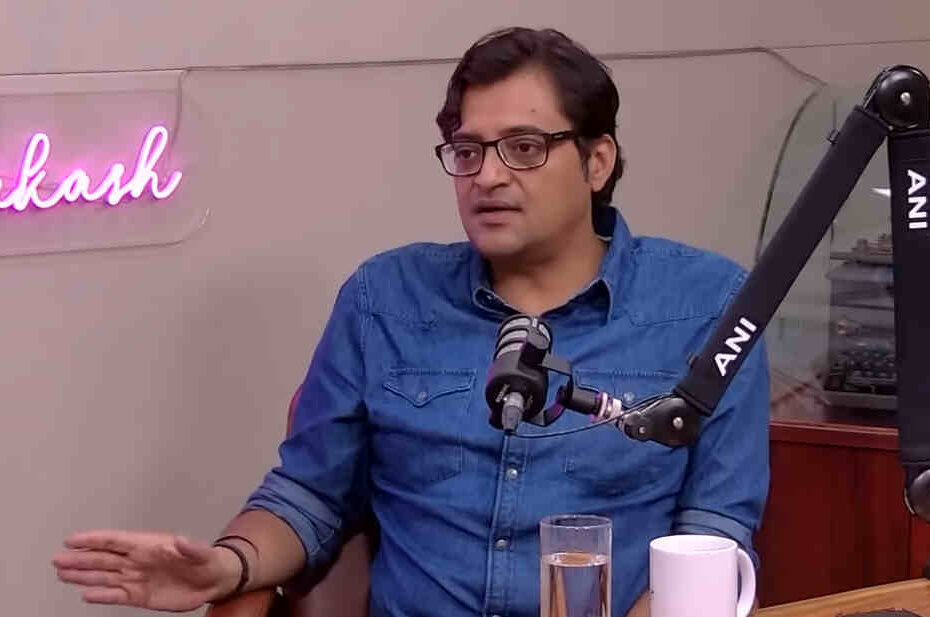
Read the full transcript of Editor-in-chief of the Republic Media Network Arnab Goswami’s interview on ANI Podcast with Smita Prakash (EP-8), Premiered October 20, 2022. Ishaan Prakash is also the co-host of the podcast show.
Welcome and Introduction
SMITA PRAKASH: Namaste, Jai Hind. Welcome to another edition of ANI Podcast with Smita Prakash. Today my guest is controversy’s favorite child, Arnab Goswami. Joining me in this podcast is my colleague Ishaan Prakash who began his career 12 years ago in Tribune and then under Arnab Goswami in Times Now.
Arnab, thank you very much for coming to our studio. It feels a little odd, me asking you the questions. You are the one who’s always asking questions. But when we started this podcast, it was everybody’s first comment on YouTube and on all the other channels. When are you getting Arnab? When are you getting Arnab?
Remember, even when I was starting it, I was like, okay, so now you are this journalist who I have not seen anybody having such a huge fan following. At the same time there is so much of envy, hate, jealousy and adoration. How does that rest on your shoulders?
ARNAB GOSWAMI: It’s not resting. I don’t know. I’ve been away for too long from Lutyens, Delhi. So I left the city in 2004. Been 18 years, long time. So when I come back, I come back like today, once a month, once in two months. I hear these things here because when I’m in Mumbai, I don’t hear anything. I’m literally in my newsroom.
So the conversation does not happen where I am, so it doesn’t affect me. And where I am, it’s home and studio, home and studio. So I don’t have much time to think about all these things. These are the things I hear about when I come here. But you do know, you do know.
SMITA PRAKASH: That, I mean, wherever you go, there are so many people who come around you asking for selfies. And then you are in social media also, hero worshipped as well as the man who broke the news.
ARNAB GOSWAMI: There’s been a lot of conversation. When it first happened, around 2007, 2008, when the conversation sort of began to increase around me. Not where I was working for, it was a new thing. But 2009, 2010, sort of, it settled and then I realized that I don’t need to think much about the conversation. I need to do my job. So I do my job and yeah, that’s it. There’s not much to think about.
Early Life and Career Beginnings
SMITA PRAKASH: So let me start from the beginning. Did you ever think, a young lad in Guwahati growing up and then after that Cantonment life and then Delhi University. You even written about it, about your life in Delhi University. Did you think that you would reach the pinnacle of television news in India?
ARNAB GOSWAMI: No way. No, no way. I never thought I’d reached the pinnacle of anything. It was more about doing well enough, I guess, being above average and then just plodding along, plodding along. These things are accidental. This, what you call success is ephemeral, accidental, occasional. And one shouldn’t take it too seriously.
Then you begin to have what I call an exaggerated sense of self importance. You believe you are born for success. I have no such pretensions. So I think it’s okay. I have never planned anything. I didn’t even plan to be a journalist. It’s just one thing leads to the other and you sort of move along. You do the best.
SMITA PRAKASH: When I first met you 27, 28 years ago, you and your wife, both of you and I were young journalists, starting out in life and things. Even then I didn’t even in my wildest dreams, I didn’t think you were one of those ambitious ones. You were kind of going through life, both of you, getting your understanding what TV journalism was. You joined Star NDTV, thought that this is it, like other journalists in NDTV, 25, 26 years.
ARNAB GOSWAMI: No, I never thought of that. It is that I have always just been the kind who sort of has moved from one thing to the other. I did want to learn how to run a TV channel because I thought, how complicated is it really? What goes into it? So I was a keen observer. I used to observe how things go beyond what I do. I was interested in the bigger picture.
So I wasn’t very taken with my byline, I wasn’t very taken with my piece to camera. So I was interested in the big picture. So I’ve always been eager to understand how the operations run, how the organization runs, how the back end runs. And that is where I actually learned a lot and where I picked up a lot.
But nothing extraordinary, Smita. There is no narrative to my story. It is just that I came into Delhi after my college. I came back to Delhi, I did my job, stayed here nine years, left, went to Bombay in the 18 years. That’s it.
SMITA PRAKASH: Can I say something? I want to see this humility. I mean, like…
ARNAB GOSWAMI: No, no, no, no, no, no.
ISHAAN PRAKASH: Once you want to, can you give us a timeline?
ARNAB GOSWAMI: Timeline of what?
ISHAAN PRAKASH: Of just your career, how it began. Because there are a lot of people who just know you in this iteration or that way. So from the beginning, how did it start? And how you moved into television, how you took a leadership role in television. If you can just expand on that.
ARNAB GOSWAMI: No, no, I’m getting it. And Smita is getting it wrong. She’s thinking I’m trying to be unnecessarily humble. I’m just trying to figure out if there is a narrative of the kind she’s trying to seek.
ISHAAN PRAKASH: There is one.
ARNAB GOSWAMI: She was asking me, is there a grand plan or was there, as you call it, a grand strategy?
SMITA PRAKASH: No, I don’t think…
The Journey Through Journalism
ARNAB GOSWAMI: Yeah, so what I’m telling you, there wasn’t. There wasn’t one. Good things happen sometimes, bad things happen and you go along with it. And sometimes you are also in the right place at the right time. It’s a function of all of that.
So you were telling me about the chronology. Yes, chronology is simple. See, I’ll take you even further beyond. My father was in the army. He was from the Madras Sappers. And so I grew up in various cantonments, non-cantonments, changed seven schools. Finally I was in Delhi in Mount St Mary’s, did my ICSC, did my CBSE from Kendriya Vidyalaya Jabalpur, came back here, did three years in Hindu College, stayed in North Campus, two years in the hostel, got lucky, got a scholarship, went to Oxford, did a Masters in Social Anthropology.
Came back in 1994 and didn’t quite figure what one needs to do. Realized that I was not, I didn’t have the qualifications for academic job, for a full time academic job. So I had options of doing a PhD. I was in that track to do a PhD but that would require me to commit five, six years. So I thought I’d be in my late 20s by the time I finished. So I opted out of that, kept it on hold.
Came back, came to Delhi, couldn’t find the right job. Met Swapan Dasgupta in Express, met Chandan Mitra in Hindustan Times. Very helpful, very nice.
ISHAAN PRAKASH: So you had an inkling that journalism is your calling?
ARNAB GOSWAMI: No, it was the only thing I thought I could do. I mean it’s the, I wasn’t qualified for anything else at that time. I had a postgraduate degree in social anthropology. So there wasn’t any, there’s no career track to being a social anthropology degree. So I didn’t have a track. So, yeah. So I mean then I thought that okay, we’ll try out in journalism. Print journalism was the only thing.
ISHAAN PRAKASH: Right.
ARNAB GOSWAMI: Couldn’t get the right job in Delhi. I hung around here for two to three months, went around almost to all the offices, got through some places, but didn’t get the break. So then I went to Calcutta. I remember Swapan Dasgupta told me sitting in the Express office, he was deputy editor. He said, you won’t get the right break here, you go there.
And Chandan Mitra told me that son, what have you studied? I said I’ve studied social anthropology. So he said you write a piece for me, op-ed or editorial piece on your interpretation of caste, which was at that point of time a big issue in politics. So I wrote a piece. I remember him telling me it’s very academic because I had, I had…
SMITA PRAKASH: That was your background.
ARNAB GOSWAMI: It was my background. So if someone told me about caste, I would think about Louis Dumont, French structural theory. My whole interpretive understanding of caste was academic. And as a young person, you are what you are. You’ve come straight from the campus.
So then he said that with all of this you go to Telegraph because he said you’ll get a job. I got a job in Telegraph. I was put in the editorial page. And so I hung around there for about a year, little under a year. Then I came back here. I started looking for opportunities here. The one option was to go back into academia. That has always been my life story, go back to academia. But again I came back here, I got a couple of jobs and…
ISHAAN PRAKASH: What date are we looking at right now?
ARNAB GOSWAMI: 1993, I think or 1994, 1995. By now it’s 1995. And I got a job same day in two places. One was Outlook where I met Padmanabha Jha. I didn’t get to meet Vinod Mehta. I met Padmanabha Jha. It was a virtual offer. Not a letter I got. But he said, I’ll give you an offer.
And then I met Aapan Menon at NDTV and somehow I liked Aapan a lot. He was very nice. So I was not sure. I didn’t know Delhi much. So I felt very, I found him very warm and he took a great interest in me. So I met him. I met Prannoy and Radhika, I think very briefly.
SMITA PRAKASH: And you were on beats journalism immediately.
ARNAB GOSWAMI: Yeah, yeah. I didn’t even know what I was doing.
SMITA PRAKASH: No desk.
ARNAB GOSWAMI: I remember I, no, no, no, nothing. I remember I was taken to do, as an assistant, some reporters to go and see how stories happened.
ISHAAN PRAKASH: Yeah, yeah, I did that. But could you tell that TV was going to be the future? Was that conversation being had because Zee TV had entered, we had entered the market in the mid to late 90s.
ARNAB GOSWAMI: At that time, NDTV was already there.
SMITA PRAKASH: NDTV was there.
ISHAAN PRAKASH: Aaj Tak was also there.
SMITA PRAKASH: NDTV was in English. It was already established by then.
ARNAB GOSWAMI: I occasionally felt that the stories have impact occasionally. Television, occasionally. So I found the occasion when the stories had impact. But the stories were not aimed at having any impact. The stories were aimed at completing 24 minutes on a bulletin. There was no passion, there was no heart. It was structure, if you know what I mean. Rundown, it was a standard rundown.
So I wasn’t, if you ask me, was I very thrilled at what I was doing? I wasn’t. But I liked the chase. I like meeting people. I like going to party offices. I like meeting people. I liked having chats.
Reimagining Television News
SMITA PRAKASH: You reimagined news when you went to Times Now. The entire model that you created did not exist at all. There were several channels then already. And when you did Times Now we saw a different kind of news bulletin. A news bulletin not seen so far on any Hindi or English channel. So what did you want to do? I mean, here was this, the anchor who was a participant. Everything you changed.
# The Birth of Debate-Style Journalism
ARNAB GOSWAMI: Actually, if you look back, Smita, at my last nine months at NDTV, it was a time when I was first given my own show. It was called News Night. It was at 8:30. And that show, if you check with anyone in that time, because viewership, I think, had started getting measured somewhere. But it had a compelling audience because what I did was I just did a debate and there was no debate.
There was this easy kind of consensus. We all like each other. Let’s meet tomorrow. What do you think? What do I think? This rather fake and artificial attempt at putting people like us in a studio and then having a chat. I have come from an academic world, so I find that the fakeness of it, the fake intellectual pretensions, I’m not very fond of them.
So I had taken a break to go back to Cambridge. After I was at Oxford, I spent time. I wrote a book. By 2003, when NDTV started, I got a show. Otherwise I would have quit by then. But that show did exceptionally well because I realized that there needs to be conflict for any conversation to be true.
SMITA PRAKASH: And ideas generation and whatever.
ARNAB GOSWAMI: No, there needs to be different perspectives. And the perspectives need not coalesce into something. There needs to be a diversity of opinion. And we must not be afraid of that. It’s just like when I was in school, I was a very good debater. And I always found debating far more exciting than elocution. And I found, if you ask me what I really did to television, I turned a constant elocution competition into a debate. That’s what I did.
But those last nine months on Newsnight was very exciting for me because Smita, I would get the guests, I would write the script, I would think it through. I would think of the structure of the debate, I would think of the four or five high points of the debate. Because you see, Smita, I’m a professional debater. I have been one of the best debaters in school and college. That’s all I do well. I do nothing else well. My academic degrees are just now an entrepreneur as well.
So the point is I turned my passion into a subject. But again, after the sheer process of launching Times Now, raising investment for Times Now, building a channel from scratch, construction stage onwards, recruiting, it was thrilling from an organizational learning point of view. But I didn’t quite start off with the debate. For the debate to come into Times Now, it needed an ambiance.
And that ambience happened somewhere around 2007, 2008, when there were subjects which came up accidentally, as I say, in the course of the debate, in the course of the news coverage which provoked one to think. So actually what happened was that between my leaving NDTV in 2004, my launching Times Now in 2006, January, and the format of the debate appearing in its incipient form somewhere in 2007, there was a period of a lull because I was too caught up in building an organization, or rather say founding an organization and breaking news.
Disrupting the News Business
SMITA PRAKASH: I know that you caused everybody, you caused a disruption in the business in a way, because we all were suddenly competing with each other. Like you said, you know, this consensus period was over. It was like, Times Now is going to break it. Times Now report is going to be there. So other channels were like, okay. I mean, there was this understanding. Sade che baje sadhe aarath bajai.
ARNAB GOSWAMI: We’ll do the news.
SMITA PRAKASH: You know that the big news will come in around that time. But you were like, you had put your reporters everywhere. That aggressive brand of journalism is what you brought in. And you were fighting in your newsroom. Why? So and so got this thing first.
ISHAAN PRAKASH: You know, like, yeah, the rumors of him fighting are true.
ARNAB GOSWAMI: Yeah, he’s been. Let me ask you, Smita. Wait, wait. Okay, so if I can say that when you wanted, you know, Ishaan to get an experience of a newsroom I sent him to, why did you send him to me?
SMITA PRAKASH: So exactly.
ARNAB GOSWAMI: Did Lutyens’ media not have enough places for Ishaan to learn? Why did you send him to me?
SMITA PRAKASH: I think Ishaan, I sent because when my reporters were coming back and when I asked them, who are we being beaten by for a news agency? I want to know which channel is beating ANI. When I know that my news is being beaten by somebody else, then that means that that person deserves my respect or that channel deserves my respect.
So you guys were beating us. Nobody else was beating us at that stage. Right. It’s not the packaging or the way you’re speaking it or the way you’re presenting it that matters for me. It was who’s beating and what is this model? So when I said, if there’s somebody who’s beating me, I need to know that that is the kind of journalism that is going to be our next step forward.
So I thought that Ishaan will learn a lot and we will learn a lot. And I think we learned what you needed from a news agency, what you were doing with your competitors and how you were beating. I think phenomenally you changed because I saw other channels replicating what you were doing in Times Now. See, we are sitting here and watching what all channels are doing. And I saw that happening with what you were doing. I don’t know whether you were seeing that.
The Missing Heart in Delhi Journalism
ARNAB GOSWAMI: No, I tell you there’s another dimension to it. And having observed the way news is done in Delhi for about a decade and little short of a decade, I realized that what was missing in the news was the heart. And I want to just explain this a little in detail to you.
In Delhi news, the way I saw it, I’m talking late 90s, early 2000s, was the quest of four or five things, Smita. One, political relevance. Political and bureaucratic relevance. That was the high point that journalists and editors really worked for.
Second, some kind of patronage, some kind of political and bureaucratic patronage. That is something which journalists really sought and delighted in. It is the be all and end all of your life, you know.
Third, and I’ll tell you, disproportionate wealth, corruption in media circles was rampant up to a point where it became embarrassing to watch. People used to boast about it. Oh, I’ve got this farmhouse here, I’ve got this farmhouse there. There’s no known source of income. Every several people, bureau chief upwards, the designation was a pretense, as was their salary.
So I saw deep rot, corruption and no commitment to society and most importantly, no commitment to the nation. Absolutely zero commitment to the country. It became a form of individual aggrandizement. And I saw it up close. I’m not naming people but anybody watching this knows who I’m talking about. And Smita, I despised it.
So I think it was necessary to give this media reality check. And I think what I seriously gave them, have given them and continue to give them and will give them in the future is a reality check of how the people in this country really think. What media they want, what media they deserve. The form of media that will serve the people’s interests, the form of media that will serve the national interest.
And zero sense of self importance here when I’m saying it, Smita, because when you said, and I told you that there was only in my early phase at NDTV the only occasional stories where I saw impact but I saw the impact potential of the medium, of the visual medium, I’m not calling it television, the visual medium to create impact.
And then I saw the colossal selfishness and waste of people who control the levers of that medium here in this city. And so I felt that sitting 2,000 kilometers away, it was time to give them a reality check. And I can tell you with absolute conviction today as I felt then that I was, I have been closer to the hearts of the people then and now.
The Mumbai Decision
SMITA PRAKASH: Is there a reason that you deliberately moved from Delhi to Mumbai? Because all TV news channels were based in Delhi in those days. Even now they are Delhi, Noida, whatever.
ARNAB GOSWAMI: So NDTV gave me a job in Delhi. And by the time we raised the investment from Reuters, I was in Delhi. My family. Well, sorry, I was in Mumbai. They called me to Mumbai. So they said, do you want to launch in Mumbai? I said, why not?
I remember first going to Kamala Mills the day we got the investment check. And we said, we do build a building. I remember going to Kamala Mills at that time. And we went to the second floor of this building and said, this is a big enough place. 20,000. Let’s build a studio. That I saw the bricks being laid. We constructed the studio from scratch.
So why was I in Bombay? Bombay. I still call it Bombay. Why was I in Bombay? I just happened to be there and it was okay. And I felt, you can do it from here. But we kept a center in Shriram Center. But over a period of time, I began to enjoy being in Mumbai and enjoy the distance of it all.
Taking News to Real India
ISHAAN PRAKASH: You know, this is my two cents. I mean, bit of an upstart between both you giants, but I should say it’s been a decade also since I was with you. So also in that time, we saw a lot of the channels, the prime time and the bulletins before that were primarily your Delhi beats and your metropolitan cities and all.
Times Now, at that time, under him was the first channel that actually went with live assets to, you know, villages, to towns, and show what the real people are going through on a daily basis. You know, if a kid fell into a bore well, a live feed of, you know, to make sure that the NDRF go there and rescue that kid. It was them that started it, and then we all ran towards it.
ARNAB GOSWAMI: No, it was also conviction. You’re totally right. Yeah. Ishaan, our profession, especially in India, has lacked a sense of purpose. And along with the sense of purpose comes with a sense of conviction. See, why am I doing this job? Why am I a journalist? Why am I an editor? What purpose do I serve? Is it going to be only for myself and my career progression? To a certain extent, yes. All of us do that.
But I think that my true professional satisfaction came around the time the Prince story happened, around 2006, 2007, when I began to observe, almost like a student, that if you actually use the impact of the medium, you have a larger purpose. And the larger purpose when you’re convinced of your larger purpose in anything, in television, then you do it with greater passion, right?
And not that this can be taught in a school of journalism. But if you see a small child’s life being saved and you see that the entire country’s attention in that period went to those visuals. And then you ask yourself in an ordinary news day, the story of a child falling into a manhole would have been a small item, a diary item, a 30 second wrap, a page three, single column, hundred page. That’s the most buried inside. And perhaps the child’s life would not have been saved, right? And so then, you know, and also at some time I saw overall awakening happen right before my eyes.
SMITA PRAKASH: I’ll tell you why.
ARNAB GOSWAMI: Because the first time you do the story there are a lot of people who raise their eyebrows, say you’re sensational, say that you’re overhyping things. Say this is tabloid journalism. But then if it is so bad then why is everybody following it? Why is it that through an entire decade and more and even now the editorial agenda that we set is followed by others, we are so bad. Obviously there is an awakening. Awakening.
And that awakening was very opportune. Because let me ask you, Ishaan and Smita, around the time I was doing this, I was doing Prince. We covered 26/11 in a different way. With greater passion. We questioned the country’s foreign policy. And by the time we were doing the scam switches, CWG scam around May, June 2010. Right up to the Prime Minister’s press conference in February 2011. Approximately that time till the Devas ISRO scam and then the Anna agitation. And then Nirbhaya 2012. This entire period was an exponential of the return of news.
ISHAAN PRAKASH: Yes.
The Return of Serious News on Television
ARNAB GOSWAMI: Of the absolute and unquestioned return of news in the medium of television. You know what purpose it served? It was a reality check for all these Hindi channels operating in Delhi who by then had descended television into Saab, Siri, Ludo, Nagin, dance, virtual videos. Videos of people dying on camera. You know the kind of rubbish. Bhootpret, Kaldunya, Kathari, Occult. You know, Sansani, right? And all of these forms I despise.
They say to me, you are the one who is after ratings. I’m not after ratings. Ratings follow me. Because what we do is out of our conviction. I’m doing service to my country now. Whether it be the coverage of Monkey Gate as a test series or cricket series in 2007 or 26/11 or the Corruption cases, somewhere serious news came back. We are the people who brought back news on television.
You run India’s biggest news agency. You know that how many channels at that point of time were running pure news? Whatever I have done, people may like or dislike what I have done. I can confidently say that in my last 16 years as an editor of a channel, channels, network, whatever I have done only news. You can describe what I have done. But I have not compromised on the news.
SMITA PRAKASH: No, it’s the form of news.
ARNAB GOSWAMI: So what we did was we actually Smita brought a lot of conviction back. We were doing things because we believed in it. And when we do something you believe in you don’t think of the consequences. You know, you don’t think of who’s going to be upset, who’s going to be hurt. Which political party will like it or not like it. Who is Suresh Kalmadi close to? Who is Suresh Kalmadi fronting for what happens to A Raja? We don’t think of the consequences.
You don’t even think that when you’re doing Devas ISRO scam which by the way there was an arbitration case in the high courts two months back and the verdict after all these years proves me correct. And that was the scam. At which point of time I’m sure Dr. Manmohan Singh realized he couldn’t quote unquote, handle us with his political managers. We were to be fair and to be honest, out of control, you know.
And we did it. Taking those risks at a time when all these players in Lutyens media who now give me lectures in journalism one doing nothing but sort of being the most obsequious before the establishment at that point of time. So we took those risks. We did it with our conviction. And I think the people of the country appreciated it. I think they did. I think they appreciate it.
On Taking Risks
SMITA PRAKASH: Taking risk is something of course you’ve done several times over.
ARNAB GOSWAMI: Too much of it. Too much of it.
SMITA PRAKASH: But many times I’ve been sitting, you know, saying why does he do this? Why? So many times I feel that. Mat kar yaar, please. You know, especially when you. When that thing that. Okay, I want to get to the part of what happened with the whole Vaze Parambir before that.
ISHAAN PRAKASH: I just want to ask one thing. You’re right about the conviction that you had. I mean we all followed it.
ARNAB GOSWAMI: No doubt about which conviction?
ISHAAN PRAKASH: Your conviction of your editorial sort of stance and everything. No doubt about it. Everyone did. But kabhi kabhi sir, I say lakhtaay ki. You know, maybe on a certain story we go overboard sometimes. Did any story give you a doubt that you know, maybe I said a little too much and I need to start backtracking or probably bring it back on track that you’ve sort of ventured, veered away from a story?
I’ll give you a small example and what I’m talking about specifically this Aryan Khan story that happened, all channels sort of had one similar line. Initially as they went on and as the aspects of the story started tumbling out, then we realized that, listen, there’s more to the story than what has been put on record or what’s come out in the investigations. And then sort of people sort of figured out and tone their coverage more aligned to what the truth of the matter was. So in just using that example, do you think that sometimes in a particular story you’ve gone overboard?
Never Backtracking on Stories
ARNAB GOSWAMI: Everybody has different views on the truth. I have not been part of the herd. So who knows what the truth is in any case. So I would go by my conviction. And I’m not forcing anyone to follow what I believe in. I won’t go into details of that case.
ISHAAN PRAKASH: Sure.
ARNAB GOSWAMI: But I don’t sit on the fence, Ishaan, in anything. And I think, A, it’s not in my nature. B, it should not be in Indian journalism, obviously, with facts at hand. Now as far as backtracking, which you said earlier, I’ve truly not backtracked on anything. I have not backtracked on any story. I do. And I have found sometimes that in the moment, if you backtrack, you may regret it later. Sometimes the truth takes time. Nishant, I give you two examples. I just told you about Devas ISRO.
ISHAAN PRAKASH: Yes.
ARNAB GOSWAMI: Now it has taken all these years for a court verdict to come. 12 years. Palghar.
ISHAAN PRAKASH: Yes.
ARNAB GOSWAMI: Okay. At that time it was seen to be done and dusted in two months.
ISHAAN PRAKASH: Right.
ARNAB GOSWAMI: And the entire media went with whatever the Maharashtra government said. Why didn’t they raise questions? I didn’t backtrack on Palghar. I didn’t backtrack on Devas CISRO. I wouldn’t even backtrack on 2G. And these are stories I have done. And sometimes it’s a question of emphasis. There are two ways of doing a story. You want to do a story to give yourself enough leeway for an escape route later. Example being Adarsh.
ISHAAN PRAKASH: Yes. Housing scam.
ARNAB GOSWAMI: If a journalist wants to kill a story, he can kill a story. You can call it a housing scam. And that’s a sure way to kill a story.
ISHAAN PRAKASH: You name it.
ARNAB GOSWAMI: No. No. Because if you call it an environmental issue housing scam and coverage in page three, part of the environment page, you’re killing the story. I was the only person who called it Kargil for profit. I didn’t break the story. I rebranded the story deliberately. And a lot of journalists were upset with me. He’s trying to take ownership for a story we broke. And I tell them what? What impact did your coverage have for six months? Because you were covering it without conviction, without passion. You are making it a story of a building that has broken environmental rules. We made it a story of politicians using deceit and falsehood.
ISHAAN PRAKASH: Yeah.
ARNAB GOSWAMI: And shooting off the shoulders of supposed allocations which were meant for families of Kargil widows. And taking that money and that property in Benami assets for yourself. So we actually went to the nub of the matter. Nub of the matter. And you can ask the then Chief Minister, if you ever interview him. You ask the then Chief Minister of Maharashtra whether he called me. And I told him I’m not backtracking.
You think Ishaan and your people know this? Who are watching this? You think over the last 15 years of my life, hundreds, thousands of politicians have called me to backtrack. Now they’ve stopped calling because they’re convinced that I’m a madman. Now the point here is.
ISHAAN PRAKASH: You want to share one conversation?
ARNAB GOSWAMI: I will. Many on and off record. I said I’ll write a book one day. But the point is, all you have to tell the politician is. Sir, my OB van is outside. I’ll pull the camera. You speak. Speak on camera. Yeah, speak on camera. But even the politician, by the way, he lost his job two days later. Right? We have broken stories that have upset people.
ISHAAN PRAKASH: Yeah.
ARNAB GOSWAMI: And we are not in the business of making people happy. When I first did IPL, you know, so many people lost their job. Did I do it to make people lose their job? No. That was the accidental part. There is no thought in it. I went with my conviction. There was something hanky panky with the Kochi IPL. I thought then it cost people their job. It cost people their franchise. We’re not in a popularity race.
But since you use the word backtrack, I’ll tell you confidently. From then to now, I have never backtracked. I’ve gone to jail and back. But I’ve not backtracked. Sometimes I am sure that in the fullness of time the truth will come out. It did right. With this whole thing in the fullness of time, it does. But what happens at that moment? There are so many other influences. If you want to be open to the influences then you’ll think and maybe you will be forced to backtrack.
I tell journalists and reporters, don’t do the story if you have to backtrack later. Go by your conviction. Think it through in your mind.
The Sachin Vaze Episode and Arrest
SMITA PRAKASH: When you did this whole thing, I mean when that whole Sachin Vaze episode happened, I was on air with you, with your team when that team came in to pick you up and I seriously didn’t think that they’d drag you through jail. I thought it’s going to stop, it’s going to stop now, now. And you know, I mean even your anchors were like, no, it’s not stopping ma’am, it’s going to continue. I said I didn’t believe when I saw those machine gun carrying guys coming and your family out there being pushed and shoved.
It was terrifying, at least for viewers. And I had so many people calling me up and said, are you watching? Yes, I’m watching. What’s happening. It was terrifying. And then they sent you to jail. What was that like? Or not that period? I mean you didn’t talk about it for quite some time. You didn’t say what you went through. Those jails, Taloja jail and all is there terrorists are there, mafia accused are in that jail. What was it like for a journalist and an army officer’s son, you grew up in Cantonments.
ISHAAN PRAKASH: All that, no godfathers.
ARNAB GOSWAMI: It’s a very. Yeah, that’s a period of my life I have not spoken about in detail what you are asking. I have spoken about the fact that we were right. What we’ve done is right. There’s no backtracking, that we’ll be proven correct in the court of law which we have been working. We’ve spoken about the legal side of it because the charges that were put against us were outrageous. Outrageous.
But before I come into what happened in jail, let me ask you today, if the commissioner of police of Delhi holds a press conference and says that everything in ANI is the proceeds of crime. And says that there is another news agency I was investigating. I have completed the investigation in four hours against that agency. That is a very good agency. This is the bad agency. I found out. And we will confiscate the assets, arrest Smita Prakash, arrest the family, lock up this premises. These are the proceeds of crime.
And if on that day outside your house or your home, all of the media in Delhi were to come stand outside and accept the press commissioner of police’s claim and paint you as a financial criminal, how would you respond? And if it so happened. And then my mind thinks so what you are asking me about the date of my arrest, which I think is the 5th of November 2020.
SMITA PRAKASH: Yeah.
ARNAB GOSWAMI: But what you must. And I would like to tell the viewers of your podcast, they must look at the events that happened a month earlier. In fact, around 8 October 2020, exactly a month earlier, Parambir did a press conference in which he said that I was buying the viewership of people of this country by paying them 500 rupees each. And everybody lapped it up. Everybody lapped it up.
You’re the journalist. Ishaan. I’ll ask you two questions. How is it that there were dozens of journalists and camera crew outside my house two hours before the press conference?
SMITA PRAKASH: They’ve been tipped off.
ARNAB GOSWAMI: Of course. That’s question. That’s question number one. How come the. He. That fellow, that commissioner who now has so many cases against him, he and the entire. They did. They did innumerable press conferences. Innumerable interviews on that day.
ISHAAN PRAKASH: Yeah.
The Media Establishment’s Unfair Tactics
ARNAB GOSWAMI: Right. And the third question which I want to raise before you is if a person works hard, works hard as a journalist for over 20 years, breaks out from very limited capital with intense hard work, builds an organization and dreams of scale, as in the clear dream was to build India’s largest news organization, which Smita, I want to tell you, Republic is destined to be the largest news organization in India and through hard work and if it so happens that as part of that growth story, we launch a Hindi news channel, a Hindi news channel which becomes number one, beats everybody hollow through editorial coverage. Right.
I am obviously upsetting the apple cart of a lot of media corporate players in Lutyens Delhi who have had it too good for too long. But however, is this the way to fight me, joining hands with politicians I have upset and policemen who have their own axe to grind? The way to honestly battle a competitor in a media industry where entrepreneurship should be welcomed. I don’t like people who use unfair means to fight me. I very much welcome anybody who battles it out on the basis of stories, coverage, marketing, distribution, anything but that.
That press conference, by the way, happened a day after we completed eight weeks as India’s leading network in both English and Hindi, which is in the history. No, no, what I’m trying to say is that by October 2020, Republic had reached a unique position where no media organization in the history of India in print or television has been numero uno in both English and Hindi since 1947 to now. Name one media organization in India which has held numero uno position in terms of viewership audience share in English and Hindi.
So obviously people saw it as a threat. Now I’m not suggesting a conspiracy. What I’m saying is that maybe it was a fortuitous turn of events for my enemies who thought that they would join hands together and this is the right moment. You know, the organization and the individual is doing too well. Let’s beat him down using a combination of factors.
And I think that it is a curse for the Lutyens media that they have chosen unfair means at a time when they should have sharpened their editorial objectives. And their lesson for them forever should be do not use unfair means to get ahead. Today Republic is even more powerful and stronger, influential in terms of viewership. We have a destiny ahead of us. What has all this led to?
The Biggest Blot in Indian Media History
So I wanted to bring you back from the arrest because see what happens Smita, if I talk about my arrest, what happened to me in jail, what I went through, I will talk about it. I have no problems talking about it. But I want people to understand the background in this country when someone from a middle class background aspires for greater dreams, then the existing establishment which wants the status quo to continue sharpens their knives and can’t fight me individually.
But they must not join hands with criminals either in uniform or in politics because then you are bringing the profession down. It is the biggest blot in the history of Indian media. Smita, I’m not telling you an ordinary thing forever. For the next hundred years I hope there will be nothing worse than what happened. It is the biggest blot in the history of Indian media that the media got together with politicians, policemen, murderers and convicts.
Look at the people they joined hands with. Now they can say we didn’t contractually join hands but they opportunistically did join hands to bring me down and to bring Republic down. Is it not a fact when I’m saying this today? And those people watching it, if they are watching it, can they really look at me eye to eye and say no, no we did not do it?
ISHAAN PRAKASH: Yeah.
ARNAB GOSWAMI: The fact is they know we did it. Why did you do it? Why could you not work harder? Why could you not have the pulse of the people with you? Why don’t you believe in the future of this country like I do? So these are questions anyway that part is over.
The Physical Ordeal
So what happened to me in November 2020 is extraordinary because I’m asking you who in the Indian media, which editor-in-chief has gone through what I went through? But the moral of the story is if the idea was to crush me and to crush me in various ways by physically assaulting me and bringing 111, 120 strong group of people, hundred of them, fully armed, 26, 27 of them inside my flat, pushing me with the butt of their weapons, hitting me in the crotch, physically assaulting me, thrashing me through the way, right? Not even letting me wear my shoes, right.
Locking me up, locking me up in the loo of a jail doing things which are unbelievable. We talk about human rights abuses, I don’t talk about it. Putting me, shifting me from one jail to the other, dragging me through my hair, right? Unspeakable offenses. Making me open my wounded hand with my own left hand to open my stitched hand which had eight stitches on it, right? And making me open my stitches in front of me, which I have said, doing things like that, why, what were they?
And then telling me, “Why don’t you chill out a little bit? We’ll chill out.” Picking me up from my jail cell at six o’clock in the morning and taking me for quote unquote interrogation for eight hours, ten hours.
ISHAAN PRAKASH: What did, what do you think this “chill out” means?
ARNAB GOSWAMI: Chill out?
ISHAAN PRAKASH: Is that tone down your editorial?
ARNAB GOSWAMI: No.
ISHAAN PRAKASH: Tone down you at that point in the jail or you or your editorial of your channel?
ARNAB GOSWAMI: Tone down, tone down in every way, obviously. What was this all about? It was an attempt to make me tone down. It was an attempt at getting me on a table to compromise. And I can proudly say that I did not compromise. I did not tone down. I did not seek a rapprochement. Right? I am convinced of what my work is, what my ethics are, what my values are. I didn’t tone down. But again, to cut the long story short, and I’ll answer your question later.
SMITA PRAKASH: You said that you saw Sachin Vaze, aren’t you?
Maintaining Dignity Through the Experience
ARNAB GOSWAMI: No, no. I knew. I see. Sachin, the fact is, encounter specialist. The fact is that again, not going back to the arrest, but I am going back to what purpose all that served. I’m asking today sitting in your office, what purpose did it, what difference did it make? But what I’m saying today, I’m sure they are, is that in the history of independent India, which editor has gone through this? Which editor has gone through this?
And I know I was a spectacle for a lot of people in the Lutyens media. But I think they had an opportunity to redeem themselves by raising their voice there. Not that I needed them to. Let me make it very clear I can fight my own battles. I don’t need them, but for themselves, they should have done it.
Now, as far as the absolute incident which you are speaking about, which is the moment of the arrest, you have seen about it, you’ve seen it on television, I’m sure, but you’ve seen perhaps 1% of it. And when a person goes through in those circumstances, it’s an experience. If you want me to detail the experience, I will. But it’s a different experience. But I would not say that it’s a degrading experience.
SMITA PRAKASH: How can you say that? Your family was also involved.
ARNAB GOSWAMI: No, no, it’s not a degrading experience. It’s not a degrading experience because it depends on the way you go through the experience. I can tell you, Smita, I went through the experience with absolute dignity. I went through it with dignity. And I don’t think you can be degraded if you don’t want to.
The Arrest: A Reporter’s Perspective
But yes, you know, I have never been to jail before. I have never been shifted in jails before. I have never been treated like a terrorist before. I remember on the day when I was arrested, they created a green corridor from my house in Lower Parel down through to Alibaug and in the middle of traffic, the only thing that was going through in my mind was what nonsense. Why, why are they disrupting Mumbai traffic for me?
They created a green corridor for the vans and there were black curtains on the back. Could see beyond that they created a green corridor about 50, 60 kilometers so that I could be moved through, right? I could be moved through the traffic. And when I reached Alibaug, when I reached Alibaug and I went to the police station and when I came out and they said that it’s time for you to go to the court because you have to be produced there as a convict, as an accused.
I came out of the police station and I saw that there were dozens of drones flying over the police station, the entire city, if you could. The town of Alibaug had been cordoned off and there were drones flying because they were capturing every moment of mine. So I want to know who was getting the CCTV footage of me. They were obviously providing live footage of me to their political masters.
And I looked above and I saw the drones. And there were crowds outside, hundreds of people outside. I remember I met Shamu. I met my wife. I asked for her to come, and she came forth. But I was shocked at the level of preparation they had for my arrest. Did you feel like they had caught Chhota Shakil or Dawood Ibrahim and brought him in then? It was crazy.
I was, you know, the funny thing is, at that point of time, I was looking at it as a reporter. I put myself in—
SMITA PRAKASH: I said that.
ARNAB GOSWAMI: Now, let me look at this as a reporter.
SMITA PRAKASH: That’s a reflex action.
ARNAB GOSWAMI: It’s a reflex action. There’s this great criminal being caught inside and, oh, the way he’s being protected, not being, nobody around. There were 30, 40 people around me, all armed and ready to push me back if I moved a little bit.
SMITA PRAKASH: Did you fear for your life at that stage? Because, you know, everybody knows that some of them were encounter specialists out there. Did you fear that you could be eliminated at that stage?
The Jail Experience
ARNAB GOSWAMI: See, when all of this stuff is happening, you’re not thinking that far. You’re not thinking that far. I know that a lot of people were. Now, if I look back, there were so many things which happened which, you know, it’s good I didn’t overthink at that moment.
Because when you’re in a jail cell and there are 60, 70 people in the cell with you, and there are about 1200 very, very, very, very hardened criminals sharing the place with you, and there are people from the D gang right next to you and in your cell, and there are people who are pedophiles and murderers, and there are people who are deep into narcotics who are with you.
And there was, you know, the people I exposed for in narcotics were there in the cell next to me, and they were people who had a significant play in the Dawood gang, who were made to meet me in jail. And I met them. And when people from the underworld were sent to my cell and I met them and I spoke to them.
And, you know, at that moment, at that moment, when you’re in that situation, you don’t really think, because you’re thinking of the next thing. You can’t think. When you stand in a phone line and there are 50 people ahead of you, you get two minutes to speak to someone. And I always used to call my lawyer, you know, first thing. And, you know, and when I used to speak to my lawyer, there’s been five policemen wanting to hear what I was saying.
So, but, so you know, when you’re going through so much, you’re not really thinking because you’re in a cell, you’re in a big cell and there are several cells, so you’re in one of the largest of them and there are too many people. So the only thing that you’re thinking about when you’re being taken for the interrogation is when this is going to finish, you know, and there are moments when the interrogation is getting too tedious and these guys, they are having a whale of a time.
They’re eating in front of you, they are talking in front of you, they’re gossiping and then they’re going in and out and then they are going to the washroom and back and you’re simply going through three rounds of interrogation and it’s never ending and it’s really stupid, but you go through it.
And at some point of time you almost feel like, what are these police people doing? And it was seeming to me that they were constantly taking instructions and there were attempts made to try and break me. You know, break him, drag the interrogation, make it personal, hit them hard, take him from one place, wake him up at 4 o’clock in the morning, hit him, put him into one cell, take him to another police station, make him stand there at the entrance of the police station, let him be unguarded, all that stuff.
But the truth is, truth is I have always, I look at it far removed. I was not, I was looking at it from the other perspective, what they are trying to do. And it was apparent to me that it’s a very predictable attempt to break me. And those who are trying to do it don’t know what stuff I’m made of.
ISHAAN PRAKASH: Were you hit?
Physical Assault in Custody
ARNAB GOSWAMI: Pardon me? Oh, of course, of course. I showed my wounds to the judge. You see, none of all this was ever reported. I asked for physical examination and I told the lady judge out there, I showed her, I opened my shirt, I lifted my shirt and I showed my shoulders. And I was totally bruised through and through, totally bruised through and through.
On the way to the police station out there, I told the police cop, this is what I’ve been through. I’ve been badly assaulted physically. In the pretext of moving me from one van to the other. I mean, let me be, I’m coming into the van with you. There’s no need to assault me.
The judge sent me for physical examination. I was physically examined. The doctor completely saw that I was bruised, but there was a lot of pressure, I believe, on the medical, on the doctors that, and they said that I have self inflicted injuries. Can you beat yourself? Can you bruise yourself right down your spine at the back? Your hand won’t reach. So it’s bizarre, but that’s what it is.
SMITA PRAKASH: Did you at that time regret or think that maybe I shouldn’t have? Maybe I can compromise at any point of time. Did you feel that, maybe my journalism could have been a little less aggressive maybe?
ARNAB GOSWAMI: Absolutely not.
SMITA PRAKASH: Never.
No Regrets, No Compromise
ARNAB GOSWAMI: If you see, if I did not compromise in 2011 when the entire Congress government tried to put pressure on me when I was the editor of Times Now, then why would I compromise now? This was physical. I have had cabinet ministers warn me personally of consequences. I have written letters back to cabinet ministers describing my phone conversation with them. They have gone complaining to my bosses. This has been the story of my life. So I really don’t care about the consequences.
Should the consequences go so far? I mean, at one point of time, when you’re exposed to all kinds of people, when you’re in jail, you do think about what’s going to happen at night. And so I wouldn’t sleep at night. I would just remain awake the whole night.
So I remember in my jail cell, I would lie next to the window and there’s a big cell and there were the bars and I would keep looking at the ceiling. And anyway, I couldn’t sleep because there were these gigantic reptiles on the ceiling which was very high. And I mean, not gigantic reptiles, they were not lizards, but there’s some larger form of lizards and different colors. They were on the ceiling. So I would, anyway, my adrenaline was running very high.
SMITA PRAKASH: Did you have a mat or a bed or what was it that you had in the cell?
Life Inside the Cell
ARNAB GOSWAMI: I had a very, very thin mat. That’s it. I had a thin mat. And so I would roll that up and I would then lie down at the end of the day because you’re too fatigued. You’ve come back from interrogation. You don’t know what’s going on in the outside world. And it’s just endless. It’s going on.
And I thought that I had been, they had denied police custody for me because the judge realized the first day that this wasn’t much of a case. So legally speaking, the judge in the Alibaba court denied police custody. It’s only accidental that the High Court kept hearing, we have kept going up and down that it went on endlessly. I’m sure the state government enjoyed it.
But I would, as I was saying, when I come back from there at about 12, one o’clock and all, everybody in the cell would be sleeping and I would then just look at this. I said, I don’t want to sleep because what if that falls on me? I would sort of, not that I’m, I would use these excuses to stay awake. So I don’t think I slept for two, three days, actually.
ISHAAN PRAKASH: How many people were there in your cell initially?
ARNAB GOSWAMI: About 25, 30. Then there were more brought in. There were 40, 45, 50, maybe. 50, 50, 55.
ISHAAN PRAKASH: But tying it back, coming back. Let’s go to the motive again. You said…
Sharing and Solidarity
ARNAB GOSWAMI: But I must tell you that I was okay. Yeah, of course I was okay. Inside, inside the cell I was okay. I shared my food and I must tell you that towards the end of my period in jail, I’m not a big fussy eater. I wouldn’t eat too much. So they would give four rotis each or something. So I would have one roti, I would share the rest with the others.
So I became quite popular because whatever food I got, I said, let us all eat together. I remember two days before my release, 30 of us, I think, in the cell, we sat and we made a circle and we sat and had dinner and I served them and they served me. So I went and took my food, I had some and everything else. I gave them dessert or biscuits. So I was very popular because I was sharing my food. I didn’t, I was constantly sort of moving around. So it was fine. I got to meet a lot of people.
ISHAAN PRAKASH: And when finally you got bail, what was that like?
The Day of Release
ARNAB GOSWAMI: They would, for the, because I had such long hours of interrogation at that time that even the fellow inmates would feel bad for me because, you know this. I mean, at the end of the day, see, I’m not a terrorist, I’m not a murderer. I have not committed a capital offense. There is nothing to interrogate me for.
So they would feel sorry for me because they would take me early in the morning and they would bring me late at night. So when I would come back about 8:30 or so, I would go past each, you know, each cell and they would talk to me. And then somebody would say, we were praying for you. And there was this man, he was a Sufi. He was a Sufi religious person in one of the cells and they actually, they were praying for me.
So when the day of my release, you know, there were people clapping in the nearby cells because I would constantly bother them. I would not let the guys sleep on the other side because I had no access to news on what was happening on my case. So I would keep asking the person in the next cell. There was a TV, small TV, about four cells away, and I couldn’t hear or see. So anybody who would pass that way, I said, please put it Republic Bharat.
So they, after some time, they would pass on the information and they would do their own legal interpretation of it, whatever, but we became friendly. We became friendly. So everybody knew about it. So the day I got bail, it became sort of breaking news.
ISHAAN PRAKASH: Yeah.
ARNAB GOSWAMI: And everybody put on Republic. So everybody was watching Republic Bharat in Taloja jail, in that distant thing. And I got the breaking news from them.
SMITA PRAKASH: When you came out, Arnab, that huge crowd, did you expect that crowd, that there’d be so many people lining the streets when you got out of jail, when that, you know, when you came out with that fist, fist bump that you did.
ISHAAN PRAKASH: And you can’t blame the media because pretty much everyone was there.
The Moment of Release
ARNAB GOSWAMI: Yeah, selectively I’m not the popular person in the media. But be that as it may, I was getting late and the release order had been signed and we got bail. I was standing there, I was having a casual chat with the jailers. Then somebody said, you should launch a Marathi channel. They were talking to me nicely. I said, yeah, I will. So we are having a pleasant chat. And Shammu came, I came out.
And then the tone changed because just as I was about to leave, the tone changed. And I remember Shamo said, get into the car. I saw her and she said, get in the car. And so I sat. And then the cop or two wanted to sit in the car. And so she said, you can’t sit in the car. I’m taking him home. And they said, no, we’re going to sit in the car.
And they insisted actually on putting me in a police van and driving me to Washi. And then the cops, one of the cops came and told me that there is a huge crowd outside which is waiting to lynch you because you have upset their political favorites and that mob is waiting to lynch you. Your security is at risk. You will not come out safe. Your life is at risk. We need to take you to Washi Bridge, and then you can go from there whichever you want.
So Shamo insisted and I sat in the car and I came out. But the reason I was coming out was because my car had been surrounded by the police and all armed and they were not letting me come out. And I don’t think I’m so unpopular or so hated in this country that people will want to kill me right outside a police station. Right.
So I came out and I couldn’t believe what I saw. I had written it out many times what I will say when I came out. I had a small notebook and I used to sketch the jail cell and I used to sketch things and I used to make notes. So I remember stuff. And I remember I would distract myself by thinking of other things and about the television medium stuff and about people I met, the experiences I had. And when I came out, I would often talk about, think about what I would say when I came out.
But when I came out, I was not being allowed to meet anyone. I was not being allowed to meet my colleagues. My people from my channel were outside. There was a distance kept between me and them, and they just wanted me out from sight. It is as if the Maharashtra government had said, make sure that he doesn’t get to talk to the people or talk to the media.
So I had a sunroof, so I stood up. And what I saw, Smita, I will never forget in my life, Ishaan. Because I saw it on the other side of the road because they’d been pushed back and they were like the policemen were pushing the people back. And I saw hundreds, thousands of people.
What they decided to do at that moment, all of them, maybe they thought in planning there was no way for them to communicate to me. They switched on the lights on their phones. So all I saw when I came out was just a sea of spotlights, spotlights on me. And people were waving it. Oh, it was a very emotional moment for me. I was, of course, very charged up because it had been a long time. But when I saw that, you don’t need to say anything in words.
And I remember from there because I was going to the hospital to get myself bandaged again because the blood was oozing and it had been bad. I was worried about just getting septic or getting a bad infection because of my wounds, open wounds in jail. And so I was going to the hospital, but I couldn’t literally drive because there were hundreds of people following me with their bikes and their cars.
And it was very heartwarming. And I realized at that moment that we had won. We had won at that very moment. We did not need, of course the law and everything will follow. But in your heart, in my heart, I only live, and we all should live only for public, what the public thinks. And the attempt was then to crush us. And I knew that when I came out, we had won. And that was important for me. It was important for all of us.
Competition and Ethics in Media
SMITA PRAKASH: Even now, Arnab, these days when people are watching your channel and watching the other channels, I mean, you’ve talked about how your competitors got together with the Maharashtra government to put you down and things.
ARNAB GOSWAMI: It’s my assumption.
SMITA PRAKASH: Assumption. And we’re watching as viewers. Everybody’s watching this. And it makes people feel a little bit uneasy that competition between channels has got to this dirt level where there are personal attacks on each other. And, you know, viewers would like to think, but it’s become very vicious.
ARNAB GOSWAMI: Yeah. I mean, yeah. You know, Smita, I’m not competing. I’m just doing my job. They are competing. I am not competing. I’m just doing my job. I’m doing it well. And I’m not in a rat race with them. They are competing. My livelihood is not at stake. Their livelihoods are at stake.
They look at me as a commercial threat. I am just doing my editorial job. I sleep well at night. I feel I’m independent. I don’t owe anyone anything. I’m not doing anything bad. I truly believe in the future of this country. I truly want to do something that makes a difference to the country. That’s all I want to do.
They are all fighting me. They should not do that. And as far as what you said, the demise of any ethics in this profession, some things are not necessary, you know, surrounding where I live with cameras, chasing me. I was living in a private house in Delhi for a few days, surrounding my house with cameras, you know, following my car.
SMITA PRAKASH: This is after you came out?
ARNAB GOSWAMI: No, after I came out. After I came out, when my case was going on in court and surrounding my house with cameras, then doing shows on me, you know, calling me names. It was endless. Because I think what happened was they realized that I had won, but they were giving it one more shot.
ISHAAN PRAKASH: But boss, compete career. I mean, I have to interject here because, see, you also say Republic is number one. Number one big banners on your channel. Your channel also sometimes tweets out and calls out those editors as well. Competition.
SMITA PRAKASH: Not channel, himself does it.
ARNAB GOSWAMI: I’m not on Twitter.
ISHAAN PRAKASH: Your channel is. That’s why I said your channel takes names, calls them out by name. That we are number one, not you, you know. So to say that you’re not competing, you are as well competing. You are also there, very much so in the ratings.
ARNAB GOSWAMI: No, I’m reminding people. We don’t troll people on social media, but if anybody wants to give lectures, we remind them. You know the thing is that if you did a show on me calling me names two years back, then have the spine or the courage to do a show when you are named. I’m not even being indirect or subtle about it.
I’m saying that if there is a channel which is now the subject of an investigation by the agency which was making claims against me, why don’t you do a show on the charges against you? I’m asking a question and by the way, I’m asking the question very politely. Not in their tone, not in their nature. I’m not putting my cameras outside their houses.
But I’m reminding them and I am only reminding them so they realize their fault. We are far beyond all this. But it is necessary to remind them. It is necessary for people to remember the episode of what has ever happened to Republic between 2000 and 2022. I don’t do it constantly. As far as competing is concerned, of course we are competing, but we are not competing unethically. Right? Unethically, we are not.
ISHAAN PRAKASH: But I want to go back to ascribing motive. This luthien’s media ganged up with all these people, powerful people.
ARNAB GOSWAMI: It is my feeling. It is your assumption or assumption. No, I am saying that I believe and let me rephrase this. What I have said that if you look at the combination of circumstances, a number of people felt it was a God given opportunity to get us down. That’s it. I’m not saying they entered into a criminal conspiracy, but I’m saying that it was an opportunity for them.
26/11 and the Question of Nationalism
SMITA PRAKASH: Arnab, just to move away from this. I’ll come back to this whole Godi Media vs Khanmarket gang and all which several programs we’ve done on this on your show when you do this about foreign media and all. But before that I want to come to this. You know you were mentioning 26/11. For many people that was a watershed moment on how terrorism, nationalism, all this should be covered by news media.
You know, Kargil was one episode on how it was, that was a watershed moment for people before us. It was, you know, the ’71 war and then for many after that because they hadn’t seen war post Kargil. It was that whole moment of what happened, how Bombay was covered, 26/11 was covered. And to a large extent, what you did at that time, I mean, you wore nationalism. You wear it on your shoulder, collar, everything.
ARNAB GOSWAMI: No, no.
SMITA PRAKASH: Your nationalism is…
ARNAB GOSWAMI: Come on. No, I don’t, I don’t.
SMITA PRAKASH: You are very, very in there.
ARNAB GOSWAMI: No, I…
SMITA PRAKASH: You’re very Bharatiya.
ARNAB GOSWAMI: No, I think I wouldn’t have done it had I not feel the urgent need to do it. I feel, this is my own perspective, that there are a lot of people who are working against the country’s interests. And what you are calling wearing nationalism on your sleeve is the only way to put them down. You can’t.
Given the nature of the threats this country faces and we get a very close grasshopper’s view of it in the media, given the number of people who are willing to sell this country, given the number of people who are willing to be fake, present one thing and do another, given the number of people who are not talking about why there were protests against the Kudankulam nuclear power plant. I’m not a fan of nuclear power. But the fact of the matter is I believe there were corporate foreign powers who were engineering it.
And given the fact that it’s very easy in this country to give two people fake fellowships and three people fake foreign assignments and give three people sponsored tours abroad to get them to turn, quote unquote, activist, to create NGOs and then work against the country’s development interests, these are one of the many facets of it.
So I feel that since there are so many people who are working as in my country’s internal security interests, therefore it is necessary for a media house to strongly oppose them. Now these guys say you’re wearing nationalism on your sleeve. But it is my purpose. Putting the news out first is not my only purpose. I can’t constantly try and tell you I put the news out first.
I would rather say that I put nation first. Somebody else may have their own motto or purpose for being in, you know, but if I feel that my work as a journalist or whatever I have done has to have a larger purpose, I believe in it. It’s not a slogan for me. It’s not a slogan for me. It’s not a marketing tool. It is what I live for.
The Anti-National Label
SMITA PRAKASH: And then there are many who say that because nationalism is so important to you, you are very quick to label people anti-national without going into the… I mean these are seasoned politicians who have cultivated their image, they have their politics and suddenly you turn around and say, “You are anti-national.”
ARNAB GOSWAMI: Which seasoned politician are you talking about?
SMITA PRAKASH: You know, I’m not going to name, you know, which…
ARNAB GOSWAMI: Politician.
SMITA PRAKASH: From Farooq Abdullah to Mehbooba Mufti to everybody you say. And it could be just one aspect of it, of course. Even the Hurriyat, you know, you did that whole benakaab thing of the Hurriyat much before everybody else. We’ve all seen it, right? How the Hurriyat was feted in Delhi. But nobody would say it. Why wouldn’t they say?
ARNAB GOSWAMI: Yeah, exactly.
ARNAB GOSWAMI: Why wouldn’t they say it? I’m asking you, why wouldn’t they say it? I have only asked the contrary question. Why wouldn’t they say it, Smita? Why wouldn’t they acknowledge that? Did they not know? Do people not know? Do we trust people?
For years in Delhi it was said the Hurriyat takes money from both sides. I’ll be very direct about it. You know, Smita, these are people who are on the payrolls of Pakistan, India, both. First of all, there is no proof of anything. But the fact is, how could you trust them? Essentially we’re saying that there was some form of political mercenaries but nobody said it.
Why are we fearful of bad people? For me the questions are very simple. In life there are good people and bad people. Bad people must be fought. Good people must be supported. My journalism is very simple, Smita. There is no complexity to this. You know, they are bad people. Bad people must be questioned.
SMITA PRAKASH: It’s a very…
ARNAB GOSWAMI: It’s as simple as that. And coming from, you know, and this is what the purpose of journalism should be.
SMITA PRAKASH: And it’s your cantonment upbringing, I’m convinced of this, that you’re like, there is no compromise with nationalism. I think I’ve seen that with anybody with a slight bit of army background or whatever services background is that, you know, how can you even think that it is. You can gloss over these things in life?
Values and Idealism in Journalism
ARNAB GOSWAMI: Yes, to a great extent. Army background, seeing my father in uniform, seeing a lot of people in my family serve the country, being brought up with values. But it is also values. It is also values. And it’s my entire family. My mother, my father, my family, my upbringing, you know.
But Smita, why are these things so complex to understand? You know why? Because we all enter this profession as idealists. At least I would say 60% of us.
SMITA PRAKASH: Yeah.
ARNAB GOSWAMI: And 90% of people lose their idealism. And I am fortunate to be surrounded by people who remind me of idealism and purpose on a daily basis. And therefore I disagree with people openly and I look at the clearest and simplest way to define them. And sometimes that is by coining phrases like the “tukde tukde gang.” I’m so proud to be the author of that phrase. And then it is such a…
SMITA PRAKASH: It was kind of shocking. First I say, you know, when you use… I will not respond to this. I’m not going to tell. I was really annoyed with you, Arnab.
ARNAB GOSWAMI: When I heard the video. And this is… What do you call them? Do you call them the Tukde Tukde Club? Gang is a phrase, is an epithet which they deserve. And somewhere consider this, Smita, that the more direct we are, the more sense we make.
Media Rivalries and Former Colleagues
SMITA PRAKASH: You were the first one, I think, who would do complete shows on Khan Market Gang, on Lutyens Gang. And the other side would do this on Godi Media. And you know, and these are former colleagues of yours. I’ve heard Ravish and the others saying that, you know, we got trained by the same person who came from London. He came and trained us in journalism and he taught us.
ARNAB GOSWAMI: Somebody from London came and taught? And he says that?
SMITA PRAKASH: So then this blogger asked him that. And he said, but then what is the point? Now here is a person who probably is in same batch as us or whatever, you know, when we were doing journalism, has gone so far away that will openly say that your brand of journalism is not journalism, completely not journalism. You may turn around and say that that is not…
ARNAB GOSWAMI: No, I’m not turning around and saying anything. I’m saying that if there are people in this country who are making a living by calling me names, good luck to them. I truly believe that there are a whole lot of people… I’m not naming names for these worthies you are mentioning. But there are people who are making a living even today by calling me names. So good luck to them. I don’t need to give it much importance. That’s all. Good for them. Good for them.
SMITA PRAKASH: But does it rest easy or what?
ARNAB GOSWAMI: Rest easy?
SMITA PRAKASH: Doesn’t it trouble you that, you know, these are people who you worked with for so many years?
ARNAB GOSWAMI: No, absolutely. Please understand. We are all on our journeys. Yeah, I’m on an exciting journey. And can I tell you what my exciting journey is? I am in a fortunate position to still have a few years and I hope a few decades ahead of me where I can contribute to my form of journalism which will serve the country’s interest.
So I am very excited and I am positive. And I’m seeing someone younger than me like Ishaan. And I’m saying, okay, I’m seeing some energy in this guy. Right? I’m seeing you. You’re doing a new show. You’re reinventing yourself. I’m seeing people who are doing new things. And I truly believe, like you asked me about my entire jail experience, there could have been a person who’s been through one tenth of what I’ve been through who would come out like a very bitter person.
SMITA PRAKASH: Yeah, exactly.
ARNAB GOSWAMI: But I would only advise these people who call others names, don’t be so bitter.
ISHAAN PRAKASH: Cynicism didn’t creep in.
ARNAB GOSWAMI: I want people to experience the joy of doing something purposeful with journalism. Right? By calling each other names, calling this Modi media, Godi media, this, that, etc., you know, you’ll become like a broken record very soon. You think about it.
I am today thinking right now, after I finish this show, I’ve done three calls with my three channels. I’ve had an extended discussion with my digital team. We are bringing out a new product. I’m understanding technology. I’m going to use technology to reach the people of this country. I’m so happy when I go to my newsroom and I don’t want the future of Indian media or future journalists who are wanting to be journalists to keep listening to these bitter people.
SMITA PRAKASH: Yeah, foreign media. I want to get to foreign…
ARNAB GOSWAMI: Bitterness. Bitterness is generally an emotion I don’t like.
Advice for Future Journalists
ISHAAN PRAKASH: Now what about the future television journalist? If he or she is entering this profession, what’s your advice to them?
ARNAB GOSWAMI: See, they used to call me to journalism school. Earlier they stopped calling me because every journalism school I went to, I would go and say, please don’t do a course in journalism. They never called me again.
ISHAAN PRAKASH: Yeah, because reason why I say this, my question is because, see, in the end, a channel’s entire news coverage boils down to the 9pm debate. These days, 9pm debates unfortunately take a very, you know, binary. There’s no in between over there. It’s completely polarized, the topics that they choose. In that sense, do they lose out on actually covering the news or are they essentially parroting one channel’s agenda and they’ll go for that only?
ARNAB GOSWAMI: So actually see, I like what I do. So this debate is something I have done. The 9pm debate I have done because this is what I do. And I think on a comparative sense, unless I go back on the field, start reporting or enjoying being a reporter again, which I hope at some point of time I will do, or do journalism in the more field sense, I enjoy what I do.
But my advice to both my other colleagues in the media and to future journalists is you don’t have to do the same thing. I see no reason why other channels are compelled to do a debate because there must be other forms of journalism. You know, I was just talking to someone on the flight as I came and I said, you know, there need to be long form, there need to be stories, there need to be other forms of presenting the news. And I’m sure there’ll be variety of news you can follow. And if I could, I would do it myself. And in fact, I want to experiment with new forms of journalism.
So I think my advice to budding journalists would be this: this profession is going to explode in the next 10 years, you know, and you must experiment with everything, do what you enjoy. There is no set formula of what you need to do. But whatever you do, if you feel that it can help your country, it will give you a larger purpose. You will have a longer and more satisfying career if you do that.
And then you will not look at yourself as a cog in the wheel because see, there is a mechanics of journalism. You run an organization. There are people who will log tapes, there are people who will edit. Yeah, but at the end of the day, there is something that must bind them together which is greater than even your organization itself.
ISHAAN PRAKASH: Right.
ARNAB GOSWAMI: You know, so that’s what I look at.
The Credibility Crisis in Television News
ISHAAN PRAKASH: Do you think that, I mean, the past few years there’s been a certain credibility crisis in the television news business, which is not there in say, the print media and all because they have… I mean they write it down. Written word doesn’t sort of… It’s not as rough edged as television media. Exactly. Yeah, yeah.
ARNAB GOSWAMI: Complete nonsense. I’ll tell you why. Okay, please. I said print is dead. And I was almost thrown out of an industry conclave. But I said it. I said it three years back when people called me for an industry conclave. I didn’t realize that the sponsors of the conclave were newspaper houses. And then the event organizers told me and I went on stage and I said that there’s going to be a Black Swan event.
And when the Black Swan event happens, your existing empires that you’ve built on print will not be able to survive because they’re just too overloaded. And I said I don’t feel people will read the newspaper in the way they do it now. And Covid happened. And Covid was that Black Swan event. Yes. And I said this. I said this in… I’ll send you the copy of that. I said this. And people thought I was hallucinating when I said that. But the fact is that I had said something which was quite relevant.
So my answer to the question on print is print had a chance to reinvent 10 years back in India. They refused to. There is not one big story of national significance that print is breaking. That print has broken which the whole country has followed. Yeah. Isn’t that tragic? Yeah, that’s true. People call me names, but I’ll tell you. But I can name a thousand stories I have done or exclusive stories I’ve done or coverage I’ve done, whether the IPL, Lalit Gate, CWG, which have set the news agenda. But print has not set the news agenda.
ISHAAN PRAKASH: Yeah.
ARNAB GOSWAMI: And I think it may be a bit too late for print to catch up.
SMITA PRAKASH: Also I think more of…
ARNAB GOSWAMI: But no disrespect, there are a lot of great journalists in print. I started out in print myself. It’s just the reality that I think that print should have recalibrated its journalism somewhere around the time that we were redefining the rules of the business in 2007 and 2008, when we brought in a lot of heart and feeling and emotion and sense of national pride into our coverage in the later years of the 2000s, the early decade of 2010.
Print had an opportunity to then compete by setting the news agenda on its own. But it did not. I have a bit of a difference.
SMITA PRAKASH: In the Western world already, print is a thing of the past. Right. It’s all digital that they are accessing news, mostly.
The Future of Media
ISHAAN PRAKASH: I have a different opinion. I think now we also see a lot of television journalists who are part of print newsrooms as well, and they are sort of reimagining what a print, traditional print product has to be.
ARNAB GOSWAMI: You have…
ISHAAN PRAKASH: We have newspapers which have fantastic YouTube following, they have fantastic social media. They’ve embraced it and they’re doing a sort of mixed medium now. So to silo it completely into print or…
ARNAB GOSWAMI: No, I actually don’t believe in print television and I look at it as video and text.
SMITA PRAKASH: Yeah, they’re morphing, actually.
The Future of Media and Global Ambitions
ARNAB GOSWAMI: And in the future, there’ll be video and there’ll be text and there’ll be streaming and there’ll be video on demand and then there’ll be text. So, and the text will appear in various forms. So in the future, our own imagination for Republic in the future will have a lot of these forms.
So please don’t misunderstand. I love the written word. I read a lot myself. Not as much as I would want to, but when I’m saying print, I’m talking about the news publishing business in our country, which should have redefined itself and its goals and objectives and shaken itself out of its state of inertia about a decade back.
SMITA PRAKASH: When we’re talking about boundaries, let’s now talk about geographical boundaries. You know, many of your TV debates where you speak about foreign media having agenda when it comes to India, you know, doing agenda journalism in it, and you’ve often said that Indian journalists or Indian journalism has to rise up to this challenge and we have to have a global voice.
Do you still believe that? You know, we haven’t. India hasn’t managed to have that, you know, like a CNN or a BBC or internationally or even an Al Jazeera, for that matter. We’ve not managed to have that as yet.
ARNAB GOSWAMI: As yet. We don’t have as yet. We don’t have it. We’ve been insular. We’ve been insular. And private news organizations have not crossed the Rubicon. You know, there’s always that moment of indecision on whether you’re going to cross the Rubicon.
You know, historically, when you take this metaphor from Roman times, it’s all about that moment of decisiveness, whether you realize that you want to get out of the comfort zone in which you are and then move into an uncertain territory. But you need to cross the Rubicon.
And I said it. I had been invited to Moscow 2015, and I was on this sort of what they call a global panel. And I found myself as an odd exception. And there were a few sniggers initially when I said that, you know, the next global news revolution will come from India.
But I supported it statistically by giving examples of the number of newspapers in India and then proving my case that we are the most, we are the least insular society and America is the most insular society. And the most insular society has the greatest presence in global media. But that was 2015. In 2022, given what CNN has done for itself, I wouldn’t say that about American media.
ISHAAN PRAKASH: Sure.
ARNAB GOSWAMI: And I wouldn’t say that about the United Kingdom also. And I do know that the BBC will not be able to survive the day British taxpayers don’t give money as part of their forced license fees. These are hugely subsidized organizations, usually subsidized organizations.
And I’m committed to it. I have said it and we are about a year away from doing it. We are going to set up in Republic the first global news organization. I don’t know how I’ll do it. I don’t know how I’ll fund it. I don’t know to what extent it will be effective. But that’s how we built every part of it.
SMITA PRAKASH: That’s how you always move that I’m.
ARNAB GOSWAMI: Going to do this and we’ll see the rest later. We’ll see the rest later. Yeah, that’s been, that’s. See, when you’re convinced about something, then it happens, it falls through. When we started our Hindi channel, we started it with insignificant amounts of money.
SMITA PRAKASH: Hindi wasn’t even your language.
Building Republic’s Regional Presence
ARNAB GOSWAMI: Hindi isn’t my language. We instantly. Significant amounts of money, massive commitments out there. If the Hindi channel would not have worked, then Republic would not have survived. Similarly with Bangla.
But somewhere I believe the people are behind as a carry on, carry on. You know, you do it well. But I also believe it’s not just a carry on moment. It is the fact that demographically we need to have a foothold. We need to have a foothold for a sea.
And now about this balancing question which you’ve asked about coverage and all that. You know, I’ve spent a lot of time in the United Kingdom as a student, first at Oxford, then as a fellow at Cambridge. I’ve traveled on there, a lot of friends there. Can you imagine the disproportionate clout that the United Kingdom gets because of the BBC?
Oh, yes, it’s disproportionate to its economy, to everything. And I think we need to think about that as a country. So I always look at larger projects which will serve a larger national goal. And I think this could be it. This could be it. You know.
And when we started out with Reuters in Times Now, I had this newsroom full of people. I don’t know, it was where in your time we had the newsroom full of Americans and British and Chinese and it was wonderful.
ISHAAN PRAKASH: World Bulletin.
ARNAB GOSWAMI: Yeah, yeah. People were even abusing each other in Hindi in the newsroom. And it was quite wonderful. So I realized that news is this ever flowing thing, you know, ever flowing thing.
No Political Ambitions
SMITA PRAKASH: But your ambitions and everything that you want to do centers around just journalism, isn’t it? You wouldn’t want to do anything beyond journalism.
ARNAB GOSWAMI: Never. Of course not. No.
ISHAAN PRAKASH: Rajya Sabha sit.
ARNAB GOSWAMI: Oh, crazy, crazy. You’ll be better with a Lok Sabha seat. Forget Rajya Sabha. Let me tell you, let me tell you, let me tell you.
SMITA PRAKASH: Why not public service?
ARNAB GOSWAMI: Please don’t put that question. I’ll tell you one thing. There at the height of the scams, there was this minister who said, let’s have lunch, okay? And he chased me. So I said, we’ll have lunch. And over the lunch, after some time he asked this question as we were heading to dessert and I was not coming to the point. He said, what about public service? You know, a person like you should serve the country. I said, I’m paying the bill and leaving.
SMITA PRAKASH: It’s a it.
ARNAB GOSWAMI: Come on. We are. I’m terribly happy with what I do. I’m terribly happy about what I do. I’m terribly excited about the next day and I think this is, if I can do this for the rest of my life, it’ll be a very fulfilling. So I can be a very fulfilling career. I think I can’t in life. Can you imagine me as a politician? No, no. I can. I’d be a pain for everyone.
SMITA PRAKASH: It would be difficult to imagine you. I can imagine a politician, but not within a political party. I don’t think anybody can control you.
ARNAB GOSWAMI: In a political party. I just love what I do. And I think that natural career progression that in Lutyens, you know, people like to have. You know, now I need to be in the Rajya Sabha. But there are enough worthy people to be in the Rajya Sabha. No disrespect. Why do I, why do I need to be there? I’m very happy where I am.
SMITA PRAKASH: Okay.
ARNAB GOSWAMI: And by the way, I mean the media is going to go through such a dramatic series of events and where can you serve your country best is what I ask. I’ve already got an opportunity. I’m so lucky. You know, I’m maybe one among ten thousand or a million who is in this position today to play a role.
And of late when we recruit young journalists, when they come into our newsrooms, it’s such a joy to meet a 22 year old who’s come in and then they ask you questions and I think I have the next 10 years, 20 years to guide people, do new stuff. So.
SMITA PRAKASH: But before I even try to conclude.
ARNAB GOSWAMI: Did you, did you know that question?
ISHAAN PRAKASH: Completely organic.
ARNAB GOSWAMI: Organic.
ISHAAN PRAKASH: Completely organic.
ARNAB GOSWAMI: Where did you learn these words?
ISHAAN PRAKASH: These are sort of keywords in the digital world. Organic growth.
The High Energy Debates
SMITA PRAKASH: Everybody wants to know that when you do these debates, it’s so high octane I really like.
ARNAB GOSWAMI: I look at him as my protege. Yes, of course I take pride in him.
SMITA PRAKASH: High energy debate. You know when Santoshi calls me up or when your team calls me up and say 10pm debate and you know Arnab sir is asking for you and all that. I was like, I can’t do this 10pm debate. I can’t sleep at night. How do you sleep at night after that high energy debate?
So everybody’s screaming over each other. You’re also screaming. And then they come on your show and they abuse you on your show and you don’t get ruffled.
ARNAB GOSWAMI: I love doing it. And of late I’ve been taking everything with a lot of humor.
SMITA PRAKASH: You’re smiling, you’re.
ARNAB GOSWAMI: Yeah. You’re cracking about the time.
SMITA PRAKASH: Yeah, I know. Like why isn’t he shouting back at them? They’re saying all kinds of things. How do you sleep? What do you. It doesn’t.
ARNAB GOSWAMI: It’s the only time in the day I really let my head down. Everything is done. I look forward to about 7:30, 8. It’s like the time of the day when you know everything is done. You know, administrative, financial, HR, organizational, legal meetings and yeah, now legal, legal, legal, legal. More legal, more FIR, more case. The state governments never tire of filing FIRs against us and me.
So 7:30 is the time when you feel like, okay, now my time is coming. It’s my me time. It’s my me time and I feel very happy. I mean there are days when I felt stressed before going in but at the end of 11 o’clock I feel very happy. So I really enjoy it.
Journalists and Political Proximity
SMITA PRAKASH: Arnab another question which many viewers, listeners have is that journalists are often very close to politicians. You know the proximity. And then journalists start getting this aura about them that we are also important. And then people start believing that oh these guys can get things done.
ISHAAN PRAKASH: That’s why we moved to Bombay to be away from the politicians at least.
ARNAB GOSWAMI: I don’t want your question.
SMITA PRAKASH: So that’s what I want to ask you. Is that, is it, is it true? Does one get this larger than life.
ARNAB GOSWAMI: Ego that, you know, I can’t even get everything done in Republic. I have to get 10 permissions from all our senior colleagues to get things done. So it doesn’t apply to me. And he’s right. I’ve been sitting in Mumbai for the last 17 years. So I’m okay.
And I mean, I don’t know. Yeah, maybe these are, this is the kind of stuff that I used to hear when I was here. But I think the country has changed. I’m so happy and I feel this country is going through a liberating experience where that kind of stuff where media persons could open doors does not happen in Delhi now. And I think that’s a lot of discomfort that some old fashioned journalists have with this present government that you can’t open doors.
SMITA PRAKASH: Yeah, it’s not important to be seen anymore neither.
ARNAB GOSWAMI: And I think it’s good.
SMITA PRAKASH: Yeah.
The Distance Between Government and Media
ARNAB GOSWAMI: It’s not disdain. Sometimes some journalists see this as, oh, the government has disdain for us. I think there needs to be, what would I call it, church-state divide or equivalent of that. There needs to be little distance, right? And the proximity is not necessary. That kind of proximity. Proximity is not necessary. You are reporting the news.
Why do you need to be carried around in a government plane? Why do you need bottles of champagne to be pulled out? And then you’re asking questions on who is going to fund the losses of Kingfisher and the Prime Minister is saying we have a responsibility towards Mr. Vijay Mallya’s airline. While you are sipping taxpayer-paid champagne, having a ball, asking a Prime Minister why he’s not funding Kingfisher and then coming and writing articles about it, not once asking about whether this is state-sponsored corruption.
So, I’m just giving one example. That one question to Manmohan Singh that was asked, you should go back in the ANI archives and see his answer. Yeah, I was and I pinched myself that how is a Prime Minister promising committed taxpayer revenues to save a struggling airline? Yeah, right. And an airline that had proximity at that point of time. Vijay Mallya was very close to the Congress establishment.
So what did that proximity serve the people of this country? Ask a counter question way before we came and we changed the narrative over the last 10 years. Because for 60 years before us, before I was an editor, this proximity that journalists and editors and media organizations had with governments. What good did it do to the people of this country? It got them nothing. It is the greatest disservice in the name of proximity.
Now the same people who were used to that level of proximity are now complaining that the government is not giving us access. Is it the government’s job to give access to journalists? When necessary, yes. If you’re unveiling a light combat helicopter, yes. But why on a daily, day-to-day basis do you need proximity to Ministry of Commerce, Ministry of Finance, Ministry of Corporate Affairs, Ministry of Railways, Defense?
I ask you, Smita. I was horrified. The beat reporters would only be there to get jobs done to a point to which, Ishaan, I’m telling you and you should share this with. I thought I’ll quit the profession. The levels of proximity I saw, proximity at all levels. Proximity to a joint secretary, proximity to a minister, proximity to a prime minister. It was something to actually, in the 2000s, it was something to be proud of, not be ashamed about.
SMITA PRAKASH: Not to do by connections.
ARNAB GOSWAMI: Connections. It was so disgraceful. So rotten. So rotten. So rotten. Please don’t remind me about it. But I feel answer to the question is I think this great. Right now the journalists are being told, you do your job, you fund your bills, you find the hotel to stay in. In New York, if you want to sip the champagne, you do, you pay for your flight tickets. It’s very good. So I think this distance is very good. Very, very good.
Letting Off Steam
SMITA PRAKASH: What does Arnab do to let off steam? You said it is your debate. But, everybody has something or the other, music, cricket, something, sports, gym. What do you do?
ARNAB GOSWAMI: I walk. I walk a lot. And music all the time. All the time. The only time I’m listening to music is when I’m on the move.
SMITA PRAKASH: What music do you listen?
ARNAB GOSWAMI: I listen to everything except Ghazals. Everything. Ghazal sort of make me very slow, me down a lot. And so I listen to everything. I listen to soft rock, I listen to Sufi. I listen to everything. My generation, present generation, every generation, 50s, the whole jazz.
SMITA PRAKASH: Anything that gives you that sense of balance that one needs. The reason I’m asking is I remember that one incident when this stand-up artist came and harassed you on the flight and you just did not react. You just sat. And I was like, you will swat it. Anybody was sorted. And you just sat there without reacting at all. How did you get that equanimity?
ARNAB GOSWAMI: Because I was watching a very interesting film called Two Popes.
ISHAAN PRAKASH: That was a lovely movie.
ARNAB GOSWAMI: Who were the actors there in that film?
ISHAAN PRAKASH: Now I’m forgetting it too, but absolutely.
ARNAB GOSWAMI: I know I had never watched a film in which two performers hold the film throughout. And I never get the time to watch a film. And if you’re very honest, very often people want to interact with me on the flight. So the first thing I do is put on my headphones and I watch a film. It also allows me to introspect.
So I had just begun watching a film and I don’t recognize the individual you’re speaking about. I thought there was a condition the individual had, and I felt that it is not my job. It is the job of the security people there to do it. And I finally thought he was shouting at someone else.
And truly, to be very honest with you, I had my headphones on. I like to watch at, like, if there’s a scale of 0 to 100, I watch it about 90. So my volumes are high. I cut off and I watch the film. I did not realize much about this whole episode till I actually landed because I was on my way, I think, to interview Yogi for something. So I was more focused. By the time I reached my hotel, I wanted my notes on the interview. And through the flight, I was watching the film. It’s only when my reporters told me there was some social media traffic on it.
The Rahul Gandhi Interview
ISHAAN PRAKASH: There’s the fact interview. It just struck me, I have to ask you on this.
ARNAB GOSWAMI: What really put you.
ISHAAN PRAKASH: Well, we were always on the map, but really, like, solidified it and the other person’s political career plummeted was your Rahul Gandhi interview 2014. What did you, what went through your head when you were interviewing him? And when you, want my head? Your head. I want to know what you went through.
ARNAB GOSWAMI: What I went through? I’ll tell you after. But I mean, the thing is that, see, sometimes things drag.
ISHAAN PRAKASH: Yeah.
ARNAB GOSWAMI: Yeah. So I felt it was dragging because, because women empowerment. It was repetitive and it’s not easy as well. Pardon me?
ISHAAN PRAKASH: It wasn’t easy for you. I mean, I’m just talking as a journey.
ARNAB GOSWAMI: What was not easy?
ISHAAN PRAKASH: Yeah, probing the, probing the man for an answer and repeating your questions in different iterations.
ARNAB GOSWAMI: I sort of assessed him well in the green room before that, because he had come up very excitedly walking up with me, up the staircase, telling me about my Wikipedia background. And I realized that he was doing research on me and wanted to impress me about how much he knew about me.
And in the green room then he told me, asked me how old I was and I said, I’m so, this is my age. He said, oh, you’re much younger than me. And I said, yes, but I have 19 years of work experience. And I told him, because, he didn’t get it.
ISHAAN PRAKASH: He’s just staring at you.
ARNAB GOSWAMI: He didn’t get what I was trying to tell him. And then in the interview also, I don’t think he got it. And I felt, I mean, you have seen the interview now.
ISHAAN PRAKASH: Yeah.
ARNAB GOSWAMI: I think he blanked out after some time. And the other thing is that you shouldn’t try to impress. I’m not impressed by any interviewer anyway. You know, Smita, when I do interviews, there is one thing. I tell myself that if this is my last conversation with the person, so be it. I never do an interview in the expectation of a second one.
And that is what I feel. You said, what should you tell journalism students? I tell them this. Let this be the last one, but let me not embarrass my profession by doing it in a way that I would not like the postscript of the interview to be read.
So I think it was a very simple conversation which he could not handle appropriately. Appropriately. And I feel that he and his party should not take it personally. After all, we are children of merit. We are people who have educated ourselves. We are worthy citizens of this country. We know. I’m not here to give someone a walkover.
Political Boycotts and Independence
SMITA PRAKASH: They’ve boycotted your channel and one or two other channels and they don’t come on your debates. And it continues. They said that because it’s very personal, your attack on them.
ARNAB GOSWAMI: Rubbish. I think there are many people in these parties who want to ingratiate themselves to their bosses by trying to pretend that they are going to be the people who will save them from the attack of our network, Republic. And these self-appointed custodians in these parties are the biggest enemies of these parties. And they present the things like that. Yeah.
And let me tell you this, people aren’t quite missing them on TV. It’s fine. People aren’t writing to us to ask them to come. Yes, it’s okay. We don’t miss them. And we don’t have this. See, Smita, we don’t have anything to gain or lose by a political party coming. I have at one point of time been boycotted by all parties.
When I did the story on 21 parliamentary secretaries being appointed wrongly by the Aam Aadmi Party, I was boycotted by them. I was boycotted by the BJP when I questioned the late Sushma Swaraj and, at that point of time, Vasundhara Raje and Lalit Modi during Lalit Gate. I have highest respect for individuals but I was only doing a story and even a PMO.
SMITA PRAKASH: When you asked that question during Musharraf visit. When you asked that question, I mean in the PMO I know they said never again will we invite or, no, it’s okay.
ARNAB GOSWAMI: I got invited once to a Prime Minister’s press conference in 2011 and that is when I asked Manmohan Singh about the scams and he spoke about the compulsions of coalition politics. So I was looking at it as a reporter. I got news points out of all my interviews. About the Rahul Gandhi interview, the interview became a news point. Yeah, the interview became a newspoint which was not the intention. I was just simply doing a straightforward.
ISHAAN PRAKASH: So, so you’ve been in this rarefied air where you were in, you met him and all. None. I haven’t met him.
ARNAB GOSWAMI: So not rarefied air.
ISHAAN PRAKASH: Yes, yes. How many, who’s rarefied air, interviewed the first family. So of the Congress you have interviewed.
SMITA PRAKASH: Sonia Gandhi and Rahul Gandhi.
ISHAAN PRAKASH: Few people can boast of that.
ARNAB GOSWAMI: So no, no, just. But I object to the use of.
ISHAAN PRAKASH: It’s rarefied here, it’s rarefied there. So, so you, you’ve seen him, you’ve seen him right? In this sort of new relaunching that they’re trying to do with this Bharat Jodo and etc. Do you think he can, I mean he’s a credible opposition. Can he put up a real fight against the BJP election machinery?
ARNAB GOSWAMI: Now this is a conversation only in Lutyens Delhi. This whole conversation can the Congress do it, can it be done? Is a conversation that is happening within a 10 to 10 square kilometer area in this city. I can assure you that. And it is a conversation which is obsessing them. And I think that people in Delhi media should go out of the city and then experience outside. This is not a conversation outside. Not a conversation outside.
Any party, any individual can transform themselves but they have to be connected to this country in spirit, in spirit. Not through social media campaigns, not through what you call minders. If we want to have a political party with its 53 year old debutants and 70, 75 year old minders, good for them. They can keep relaunching themselves. I have no problem with it. But it is not a matter which I spend too much time thinking about. In this country there are so many things to do.
I totally don’t have an opinion on it. If you’re asking me for my guess, no, not in this way. Not in this carefully manicured way. Ishaan, anything that is true is always, it comes out as raw. Anything which is true is not manicured, is not well planned. It does not need minders. If you are true and you are going to be accepted by the people of this country, any political leader who rises from the masses will be accepted by the people of India in the future. And anyone who goes through a political finishing school, done by people who’ve lost themselves will never be successful in this country. That is what I am observing. It’s not that I need to be right. But that’s my sense of it.
Country has moved on. The country has moved on. And people are very aware of, very aware. They don’t look up anymore to any individual. They don’t look at anybody as a first family. They don’t look at anyone having, being first among equals anymore. There is a competitive spirit which the Prime Minister alluded to in his speech when he spoke about an aspirational country.
ISHAAN PRAKASH: Right?
ARNAB GOSWAMI: An aspirational country will not look up to someone because they are from a family. This is my view and I love that aspirational aspect of India. But the narrative in Delhi is still stuck 20 years back. They’re still asking in 2022 the questions which became irrelevant somewhere around 2006, 2007.
The Desperate Need for Western Validation
ISHAAN PRAKASH: And this narrative, these people from Delhi that you like to put it, there’s desperate need for validation from the west and Western media especially. You still see that we desperately, people in the power circles of old who aren’t in the charm lot anymore, you think they still crave that sort of Western sort of yes to what they’re doing?
ARNAB GOSWAMI: I have not come enough to this city to feel it. Fact is, Ishaan, trust me. I’ll do an analysis of this and give you an answer. But answer roughly again, guesstimate to your very straightforward question is I presume yes. I presume yes.
But you know what happens? Things take time to change, Ishaan. There is something called a domino effect. There’s something called the trickle down effect. Things change at the top. People tell us corruption goes at the top. Why doesn’t it go at the bottom? It will take time because it will take a whole value system. And sometimes that can take half a generation to go through.
The changes that we brought about in the Indian media around 2010, the fullness of these changes will be evident around 2025. This is my sense of it. If it has taken me and people who worked with me a decade and a half to bring about a cyclical change in journalism, then as a country, it will take equally long. Changes in countries, economy, culture, society, ways of thinking, media sometimes take a period of time and it will not need one individual or one organization or one political party to do. It will have to be an overall effort.
So when I look at the country, people say, you know, 100 years, 2047, I somewhere look around the country, 2030, 2032. Because in my own sense, I’m looking at it in terms of generations.
ISHAAN PRAKASH: Yeah.
India’s Transformation Timeline
ARNAB GOSWAMI: See, I’ll tell you a simple answer to your question, Ishaan. When people who were born in the cell phone age become the principal wage earners in their families, which means, I’m saying people born around 1996, when they turn 30, say approximately, which is about 2026, that is when you’ll see the fullness of the change.
So I’m very optimistic about India 2025, 2026, because, you know, it’s a combination of things. And I don’t know if I’m communicating this well enough. I’m a student of sociology, and the reason I tell you is because economic sociology, people, everything is linked to. We are going through a digital revolution. Your generation, I’m talking of your generation is fully a digital generation. Your approach to life will be very different, your responses will be very different.
But the challenge for us is to put in your generation the strong values of nationalism and for you to believe in nation first. So when we talk about media, when we talk about political parties, when we talk about things changing, I can equally sit here and tell you, oh, you know what? People in Lutyens are cut off or insulated. But I’m not saying that, I’m making it as a sociological observation that if you come to Delhi five years from now, you’ll see a change in thinking.
There are still a lot of people who are living in a sense of nostalgia. They are looking for the return of the past. I can understand. It is true everywhere. You think that there aren’t enough people who are looking for the return of the left in Bengal, for example? People look back at the glory days and say, we associate with that, with our good times. But I would say that your good times are gone. The good times for the people should come.
What I’m seeing overall is a sense of decentralization in this country. And media, society, everything is a reflection of that. So there is no easy answer to your question. But I would say that there’s going to be a hockey stick change in this country after 2025. By 2030, we’ll be living in a different country. By 2035, this country would truly have been transformed. I would say confidently today, you will not wait for 2047 for India to be a superpower. The period of superpower will come quicker than people expect and you will see it happening quicker, if we have political stability, social stability over the next few years.
Western Media’s Resistance to an Assertive India
ISHAAN PRAKASH: This aspirational, assertive sort of population that you’re talking about, they will, I mean, there will be roadblocks. I mean, this is what it is, right? In my opinion, the Western media and all that, at least some parts of the Western media, I mean, they don’t like this assertive India. I think over there, this is happening and you can see it in the echo chamber of the, say, the Foreign Correspondence Club. They have a similar sort of news angle to every story that comes out of India. You know, so, I mean, you have worked with a foreign partner in the past as well. We work with a foreign partner too. We see it over there. I mean, how do you look at it?
ARNAB GOSWAMI: You know, there’s this newspaper called the Financial Times in London. They did an interview with me as part of this “Lunch with the FT” series. And I had spoken about my aspirations to go global at that point of time. And I found that when they finally published a full page with my interview, they presented me as this sort of, you know, slightly right of center person who is not very grounded in reality on what can be done. And that was because they felt that what I said at that point of time about Indian media going global is an impossibility.
Now, I tell you today, if I say the same thing in London today, if I say the same thing in Moscow today that I said in 2013, 14, 15, they would take me more seriously.
SMITA PRAKASH: Correct.
ARNAB GOSWAMI: And not just true of me, Smita. I would say true of a lot of people, because India is being taken seriously. India is being truly taken seriously. And I think that it’s very important for the Indian media to go out of this crabbish mentality of fighting with each other, to look about what is the purpose that they want to serve towards the country. So I am very excited. That’s why I say, Smita, that I don’t like the sense of bitterness. I hate you. You hate me. Oh, you are this party, that party.
ISHAAN PRAKASH: Come on.
ARNAB GOSWAMI: I think we are not serving the country well.
ISHAAN PRAKASH: True, we can coexist, but we can have different ideas as well.
ARNAB GOSWAMI: Of course.
Closing Remarks
SMITA PRAKASH: Exactly on that point. Thank you so much, Arnab, for your time. Thank you very much.
ARNAB GOSWAMI: And I wish you and your podcast all the very best.
SMITA PRAKASH: Thank you.
ARNAB GOSWAMI: And I hope I didn’t say anything out of turn.
SMITA PRAKASH: No, absolutely not. It’s been very illuminating.
ARNAB GOSWAMI: Illuminating, yes. That is the last thing that people say to me.
SMITA PRAKASH: It’s been very interesting and we’ve not quarrelled, we’ve not fought, we’ve not disagreed on anything. Different points of view at times. But yeah, very interesting conversation, especially about where media is going, where it’s headed. And an interesting insight as to what you went through during that trying period from 2020 to 2022. And hoping for better times for you ahead. All the best.
ARNAB GOSWAMI: Thank you, Smita. And thank you, Ishaan.
ISHAAN PRAKASH: Thank you.
SMITA PRAKASH: Thank you for watching or listening in to ANI podcast with Smita Prakash. Do rate, like or subscribe on whichever channel you heard this or watched it. Namaste, Jai Hind.
Related Posts
- Transcript of Elizabeth Lane Interview on Propaganda Network: Tucker Carlson Show
- Transcript of Justice Ketanji Brown Jackson Interview: IMO Podcast
- Transcript: Mary Talley Bowden Interview on Tony Fauci’s Diary @ Tucker Carlson Show
- Transcript of CIA Whistleblower Jim Erdman Interview: Tucker Carlson Show
- Transcript of Shawn Ryan Interview: Trump’s Betrayal – Tucker Carlson Show