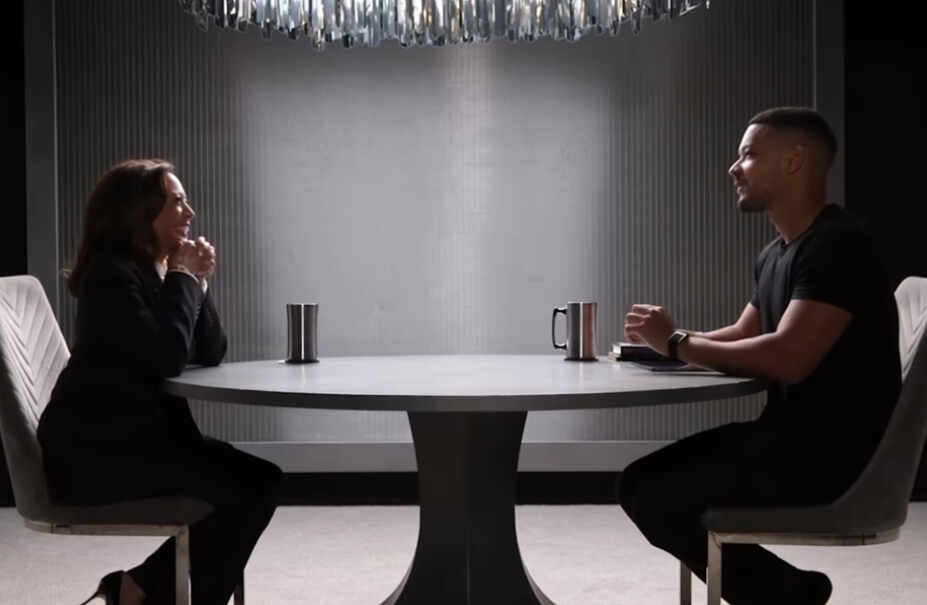
Read the full transcript of former US Vice President Kamala Harris’ interview on The Diary Of A CEO with host Steven Bartlett, October 30, 2025.
Opening Reflections
STEVEN BARTLETT: Madame Vice President, how are you doing?
KAMALA HARRIS: I am well. I am well. I mean, all things considered, I am well. My family is in good health, so I start there, but otherwise, it’s a troubling time.
STEVEN BARTLETT: What are the full range of emotions? When you said all things considered, what’s the full picture there?
KAMALA HARRIS: Everything from grateful and feeling very blessed to extremely troubled, disappointed, concerned about the state of our country and by extension, the world. Like a lot of people who are watching the news and reading the news, there’s a state of anxiety. What will happen next?
I often have found myself saying to people, it may get worse before it gets better. And so the knowledge of that, perhaps the anticipation of that, I think, keeps me and many others on edge.
STEVEN BARTLETT: Do you believe that? Do you believe it could get worse before it gets better?
KAMALA HARRIS: I think it’s very possible every day because actually during the book tour I’ve said it to audiences in one city and then the next day something happens. There’s a lot that’s very unpredictable about this administration, although there is almost all of it that I did predict.
STEVEN BARTLETT: Now, I know you only had 107 days to potentially intervene in the course of history, but when you see these things playing out that you’re referring to that incite those feelings you have of frustration, a little bit of anxiety, etc. Do you feel a sense of responsibility in a weird way? Because there was a percentage chance of sort of intervening in these things. This is a complex question to ask, but…
KAMALA HARRIS: I do think about how different it could have been. I do think about it in the context of the number of people who are being impacted in such a horrible way. I think of it in terms of the number of people who are existing and living in utter fear right now. Afraid of being attacked or afraid of being targeted with hate, much less misinformation.
Yeah, I do. And I know that the race that I ran for President of the United States, the outcome of that election is what has happened. And it would have been different, would have been very different. I try not to allow myself to think too much this way, I will tell you that, because I, for better and worse, really do like to be centered on the present.
Early Life and Influences
STEVEN BARTLETT: So I want to understand the set of circumstances that created someone like you. Because you’re an anomaly. There’s a lot of firsts that appear in your career. But if we start at the beginning, what is the context that shapes someone to become such an anomaly in their professional career?
KAMALA HARRIS: My parents and the community that raised me. My mother arrived from India in the United States at the age of 19 by herself. My mother, naturally, at that young age, became aligned with the civil rights movement in Berkeley, in Oakland, California, met my father, who had been a national scholar in Jamaica. They fell in love. And here I am.
My sister and I were born, and we were born in an environment where everyone was fighting for justice and for freedom and for equality. Every message we got was, you are important and you have a duty to figure out how you’re going to participate.
STEVEN BARTLETT: I noticed this as I was reading through your story. How service and helping others seems to be so interwoven into your DNA. And even we spoke to Doug, your husband, and he was telling me a story about your first date with him.
KAMALA HARRIS: Uh huh. What did he tell you?
STEVEN BARTLETT: Well, apparently you made a remark on that first date, that you’re here to help people and to serve people. He told me many things. I have many pages of what Doug said. Very fascinating. He’s very in love with you, by the way.
KAMALA HARRIS: I’m very in love with my husband. And he’s very funny. I hope you got a sense of that too.
STEVEN BARTLETT: He’s a hilarious guy.
KAMALA HARRIS: Yeah, well, he and I had such different careers, both of us being lawyers. Right. He went immediately into private practice. I never wanted to be in private practice. It was never about money for me. It was always about people. And how could I do the work that was about protecting people and giving people dignity.
STEVEN BARTLETT: Why protecting people?
KAMALA HARRIS: I think there’s a lot that has to do also, maybe with birth order. I’m the eldest and from the age of 2 years old, my mother told me, “Take care of your sister. Look out for your sister.” You’ve got all kinds of pictures.
STEVEN BARTLETT: All the pictures. I’ve been through everything.
KAMALA HARRIS: Yeah. This is my sister Maya.
STEVEN BARTLETT: That’s you protecting her.
KAMALA HARRIS: And that’s me protecting her. I grew up also seeing my mother, who was a 5 foot tall brown woman with an accent, would be treated. She taught me this. My extended family taught me. But then I also witnessed the importance of making sure that all people, that their dignity is respected and protected. And because I have lived a life to see where that doesn’t always happen.
Career in Public Service
STEVEN BARTLETT: So you decide to focus on law in public practice. You have a phenomenal career from that point onwards. It’s really remarkable what you’re able to accomplish. And this is, I guess, where a lot of the firsts come in, because from the age of 24 to 51, you rise from deputy district attorney to California attorney general, becoming the first woman and first black person to hold both roles.
And you led major reforms in that time, including securing $25 billion in homeowner relief after the 2008 crisis, launching the Back on Track LA rehabilitation program and making California the first state to mandate body cameras for justice agents and much more.
KAMALA HARRIS: There’s so much more to be done. There’s so much more to be done. I think one of my strengths and weaknesses is I like to solve problems. But that means that I tend to, once a problem has been addressed, move on to the next one without maybe taking the time to pat myself on the back, because now it’s time to move on to the next issue.
STEVEN BARTLETT: During your career, you saw some horrific things. That’s the nature of your job. You deal with the darkest parts of…
KAMALA HARRIS: Parts of human behavior in nature, I’ve seen. Yeah, you’re right.
STEVEN BARTLETT: Give me some context there. What does that mean in reality?
KAMALA HARRIS: Well, for a while, I specialized in child sexual assault, which is about the most horrendous of abuse and crime, which is an adult abusing a child. And those cases were so difficult for so many reasons. I mean, there’s a couple that I remember in particular where I just… where the children were so young that they were… they wouldn’t be able to testify.
One was an elementary school little girl. And I mean, I remember going into the bathroom of the courthouse and crying because I knew a jury would not have enough to convict. And it broke my heart. I mean, and I have thought about that little girl years and years and years later.
But those cases, it’s the worst of human behavior, which is we as a society should be in the business of protecting children and protecting their vulnerability so that they can thrive. But I’ve prosecuted homicide cases. I’ve prosecuted fraud cases.
Dealing with Pressure and Responsibility
STEVEN BARTLETT: How does one deal with all of this stress and responsibility? And I’m not just referring to your time as Attorney General, but even thereafter with running for president and the ups and downs of that, the public feedback, the pressure, the responsibility of potentially running the free world, basically, and becoming the most powerful person on earth. And the ups, the downs, the attacks, the child abuses. How does one… Is there a framework you’ve built? Is there other ideas or principles that you’ve developed to deal with such pressure?
KAMALA HARRIS: Well, this may sound trite, but I work out every day. Yeah, I work out every morning. No matter how little sleep I’ve had, I just find it to be just mind, body and soul.
STEVEN BARTLETT: Have you changed over time?
KAMALA HARRIS: Oh, for sure. I’ve changed over time. The pressure has changed in magnitude, but the pressure that I feel in terms of my sense of personal responsibility has not changed. I put a lot of… I hold myself to a very high standard and I tend to be a perfectionist, even though I am far from perfect.
I mean, even during the 107 days, every night I would stay awake thinking, what more could I have done with that one day?
STEVEN BARTLETT: 24 year old Kamala Harris, who starts as that sort of becomes, eventually becomes a deputy district attorney. If I sat her there…
KAMALA HARRIS: Uh huh.
STEVEN BARTLETT: And you’re sat there now as Madam Vice President, what would be the notable differences in personality, mentality, in perspective?
KAMALA HARRIS: Oh, that’s interesting. Well, I mean, I don’t know if it’s changed, but she was fearless.
STEVEN BARTLETT: She was fearless.
KAMALA HARRIS: She was fearless. She didn’t hear, “No, it can’t be done.” And whether it was the first case that I had, and I was a young prosecutor and I was going through the files and it was a Friday evening and I realized that the person who had been arrested had young children at home, a woman, and all the courts were shutting down.
And I went to the courtroom and I asked the judge, “Please take the bench again, she has young children, she can’t stay in over the weekend.” And the clerk was like, “Nope, he’s gone for the day, he’s leaving for the day.” And I would not leave. And they called the case, but not hearing no.
I just… That has been probably a through line of my life. I don’t rest easy with the idea that something is not possible. At least I don’t rest easy with it without trying to show that it is possible. And that’s probably not changed. I also have started to sit better with the idea that you can’t change everyone.
STEVEN BARTLETT: How does that change your approach, knowing that you can’t change everybody?
KAMALA HARRIS: I’m better able to assess a situation, to figure out what is the potential there.
STEVEN BARTLETT: Okay. Yeah.
KAMALA HARRIS: And be perhaps a bit more realistic without being, I think, jaded about it.
STEVEN BARTLETT: Yeah, no, I guess that’s wisdom and experience.
KAMALA HARRIS: Yeah. It comes with, I think, a bit of experience.
STEVEN BARTLETT: Which allows you to be more efficient and effective.
KAMALA HARRIS: That’s right. Yeah, that’s exactly right. That’s exactly right. Because that is how I reconcile it, which is the effort is better placed somewhere else. Yeah, yeah.
The Decision to Run for President
STEVEN BARTLETT: And at what point in this journey did you realize that you wanted to be President of the United States? Was there a lunch or a dinner you had with Doug? When does that decision get made in your career?
KAMALA HARRIS: It was when I was in the Senate. Yeah, I ran into a friend who came up. Doug and I were at a, basically a family table in a local restaurant eating. And he said to me, “You should run for President.” And it had not occurred to me until then. It had not occurred to me to run for President.
There are people who are born thinking they’re going to be president. There are people who look in the mirror every day and see a president. I was not one of those people. But then the thought, it kind of germinated.
And then, of course, being vice president and doing the work of Vice President of the United States. I’ve met with over 150 world leaders, presidents, prime ministers, chancellors and kings. I’ve negotiated very important deals and issues on behalf of the American people. I’ve spent countless hours not only in the Oval Office, but the Situation Room and traveling around the world.
And so in those hundred and seven days, I was fully aware of not only the importance of the job, but fully aware that I had the experience and knowledge to be able to do it effectively.
STEVEN BARTLETT: I mean, this is one of the things, I was actually talking to a friend of mine downstairs, Lucy Mangini, who sat out there and we were talking about this idea of like, does imposter syndrome ever leave you? And imposter syndrome is a bit of a loaded term, but you kind of assume that people in higher places than you have some genetic or mental or some gift. They have all the answers. But the higher you climb, with your own continued naivety, you start to suspect that no one really is genetically gifted or has some superpower that you don’t have.
KAMALA HARRIS: Right.
The Higher You Climb
STEVEN BARTLETT: And I’m wondering if you’ve experienced that in your career where the higher you’ve climbed, you’ve realized that actually everybody up here is like, I’m like that. Like, oh, I’m at least on their level. Have you had that experience in your career?
KAMALA HARRIS: Yes, I have. But I’ve also had the imposter syndrome experience. And that was when I was first elected DA. And I challenged then the incumbent. I started out at six points in the polls, which is six out of 100. You know, people recently asked me, how about polls? Polls? Well, you know, if I listened to polls, I would have never run for my first office and therefore we wouldn’t be having this interview probably.
And I won. And it was not expected that I would at least when I jumped in the race. And there I was sitting in the office and I thought, oh, my God, I’m now the elected DA of a major city in the United States.
In hindsight, maybe it’s we call it imposter syndrome, to your point. Maybe it is a very loaded term because I think there is nothing wrong with having, and I think there’s a lot that is good with having a certain level of humility. And in particular, when the people have vested you with great power. Right. To understand it’s not about you.
I think that is part and parcel of what we call imposter syndrome, or who has it. I think often it is because they understand how serious the job is on behalf of others.
STEVEN BARTLETT: Yeah, yeah.
KAMALA HARRIS: And I applaud a bit of humility. Honest humility, not feigned humility.
STEVEN BARTLETT: Yeah, yeah.
KAMALA HARRIS: Right. Because there are plenty of people that are self-deprecating for the sake of the shtick of it all.
STEVEN BARTLETT: Yeah.
KAMALA HARRIS: But yes, to your point, the higher you go, it does. Because the more you’re exposed to being, the more you’re in the rooms with the people who are, who otherwise feel untouchable, the more you understand that they are not untouchable.
STEVEN BARTLETT: That’s a polite way of putting it.
KAMALA HARRIS: The more you understand everyone’s got a little dust on them and they’re not, everyone’s shiny.
STEVEN BARTLETT: But it’s liberating to know that, that that’s the case because, you know, we all put the ceiling above us and we think, no, that’s my level. And everyone above that has some gift that I will never be able to attain. So I won’t even strive to break that ceiling because, you know, I don’t deserve to be up there.
KAMALA HARRIS: But, and also, don’t discount the signals that many people are sent that you don’t belong there.
STEVEN BARTLETT: Yeah.
KAMALA HARRIS: And you know, especially when I’m mentoring people will often say to them, don’t ever limit yourself based on other people’s limited ability to see who you are. That’s their limitations. To see who you are in your capacity. Don’t impose those limitations on yourself.
Breaking the Pattern
STEVEN BARTLETT: Well, I mean, this, that photo I showed you before we started recording that LeBron posted is a pretty iconic example. I’ll put it on the screen. But it just goes to show, I think all the vice presidents that came before you, and frankly, they all look the same.
So one might fall into the trap of thinking that if I don’t look like this, then I can’t do this job. You know, that’s what I think. The human mind, logically might arrive at that conclusion. It looks for pattern recognition. It might think, if I’m not one of these here, one of these men here with this suit on and this kind of hair and this age, then that’s not a position I can thrive in.
KAMALA HARRIS: I’ll see you and add one.
STEVEN BARTLETT: Okay.
KAMALA HARRIS: And everyone else thinks that this is the image of who can do the job.
STEVEN BARTLETT: Yeah.
KAMALA HARRIS: So the added challenge is not only the limitations one puts on themselves, but the limitations one might be met with around other people’s perceptions about who can do what.
STEVEN BARTLETT: And have you had that through your career?
KAMALA HARRIS: Yes.
STEVEN BARTLETT: Is there any particular examples that always sit at the front of your mind where you really, really felt that the room you were in, people were discounting you purely based on appearance or gender or race or anything like that?
KAMALA HARRIS: I think there were times in my career when I walked in the room and someone said, you know, something along, if they didn’t know me, if they didn’t know what they were walking into, you know, they were waiting for my boss.
STEVEN BARTLETT: And how did you deal with that? How do you stop that suppressing you? Because it’s very easy to feel that and go, and to shrink.
Walking Into the Room
KAMALA HARRIS: You will often be, you may often be the only one who walks into a boardroom, a courtroom, a meeting room who looks like yourself or has had your life experiences. But when you walk in that room, walk in that room, chin up, shoulders back, knowing there are so many people who are not in that room who are so proud of you walking in that room and expect that you will use the voice that you carry.
And there are tools that one has to employ when you otherwise are aware that you might be presenting the unfamiliar. But what I also would caution is don’t walk in that room with the assumption that your value will not be recognized. Right.
And so, again, this gets back to my point about we all have to moderate. What limitations are we putting on ourselves with what limitations are being sent our way? And when you see tools, well, just like that, don’t, when you walk into that room, see all the people?
I think sometimes of Mrs. Frances Wilson, who was my first grade teacher, who attended my law school graduation. I think of my mother who would say to me, “Kamala, don’t you ever let anyone tell you who you are. You tell them who you are.” Right.
STEVEN BARTLETT: And you think of these people when you walk into these important rooms?
KAMALA HARRIS: To remind you, it’s a tool I have used over a period of time and it has served me well. Yes, there’s Mrs. Wilson. That’s at my law school graduation. And that’s my mother. That’s exactly right. How about that? Yeah. Where’d you get all these pictures?
STEVEN BARTLETT: Well, stoking it.
KAMALA HARRIS: Yeah. That’s Mrs. Wilson.
STEVEN BARTLETT: And so why is thinking of Mrs. Wilson helping you when you walk into those rooms?
Someone Who Believed in You
KAMALA HARRIS: Because there is, I think, a key to success that each of us who has achieved success probably shares, which is there has been someone, at least, and it could be a parent, it could be a teacher, it could be a neighbor, it could be a pastor. Someone who convinced you you were special.
You may not have been particularly special, but they told you you were and you believed them. I know that’s true for me. I may not have been particularly special, but I had a few people who told me I was, and I believed them.
But with that came, therefore, don’t do this thing, because you’re, you know, shouldn’t be doing that thing, but go in that room. I think, you know, when we talk about mentorship, when we think about the signals that we as a society send to children, and I mean all of our children, our own children, the children of a community which we should think of as our children, to send them signals that tell them they are special and then back that up with giving them the resources would make us a much stronger society.
STEVEN BARTLETT: As you said that, I was reflecting on little passing comments people in my life made at certain points that at the time I was suspicious about, like, you know, them telling you that you’re going to be special, do something great one day, that I might have not fully believed myself, but I believe they believed it.
KAMALA HARRIS: Right.
STEVEN BARTLETT: And that was enough for me.
KAMALA HARRIS: But that’s what I’m saying. They told me and I believed them. I didn’t think of it, and maybe that’s why I don’t look in the mirror and see all these things. But yes.
Tools for Commanding Respect
STEVEN BARTLETT: Have you got any tools around how you’ve learned to hold yourself? Thinking back to 24-year-old Kamala versus this Kamala, is there a certain way you hold yourself in those rooms that also garners that respect? I noticed when you speak, you don’t rush. And I think people that are younger in their career, they tend to.
KAMALA HARRIS: Yeah, right.
STEVEN BARTLETT: Because they’re kind of almost trying to excuse the amount of time they’re taking. And they kind of are a bit more. I’m just wondering if there’s anything you’ve, any tools in that regard that have helped.
KAMALA HARRIS: It’s important to have some sense of conceptually what you mean to say and not that you have to rehearse what you’re going to speak before you speak it, but do have a sense of what you intend to communicate. And I think it’s also important to, especially with complex issues in the context of a discussion, deconstruct in your mind what the issue is so you can speak logically.
STEVEN BARTLETT: And what about appearance generally? Do you think much about that? So do you think much about, because you’re, I mean, you look very, your outfit’s stunning today.
KAMALA HARRIS: You’re very.
STEVEN BARTLETT: Does it matter?
KAMALA HARRIS: Sadly, it does.
STEVEN BARTLETT: It does.
KAMALA HARRIS: I mean, depending on context. Sadly, it does. We are still, I think, in a world where the way you appear when you walk in the room impacts first impressions, including, just for example, again, even in mentoring people, people will look at their watch or their phone to see if you’ve walked in the room on time and will judge something about your character.
The piece of how you look that is going to suggest the pride that one has in themselves as a matter of self-respect. I mean, I’ve always, this is, you know, I grew up in the black church. You dress up, and it’s a reflection of your dignity and the respect you have for the place that you may be.
The 2019 Presidential Campaign
STEVEN BARTLETT: And in January 2019, you launched your presidential campaign for the first time, which was up until you dropped out later that year, in December.
KAMALA HARRIS: Correct.
STEVEN BARTLETT: Why did you drop out of that presidential race? What’s the full context behind the scenes?
KAMALA HARRIS: There was a lot there. Mostly we ran out of money.
STEVEN BARTLETT: Yeah.
KAMALA HARRIS: But I learned a lot of lessons, obviously, about running, but that was, that was the main reason.
STEVEN BARTLETT: And at some point, you get a call from Mr. President.
KAMALA HARRIS: I got a call from then nominee, Democratic nominee Joe Biden. We FaceTimed. It was during the height of COVID. And he asked me to be his running mate. And it was a great honor, and I was honored to do it.
STEVEN BARTLETT: Did you have any inclination before that moment that he was going to ask you? Had there been like a side conversation?
The Interview Process
KAMALA HARRIS: No. I had an interview. I had an interview, and it was like something out of a spy movie where my assistant drove me to one location. This was in D.C., and then it was a mall. And then I got out of that car to get in another car. That was because the press were watching everything to see who. There was a short list that was out who was going to be.
So we had to do this whole clandestine thing. And then I got into another car being driven by one of his assistants. And then we went to this very circuitous route to a house and then through the back door. The windows were closed, the shades were closed, and I had my interview.
Went back because Doug and I were in our apartment in D.C. because I was senator at the time. And again, height of COVID-19. Then the vans, the press vans were parked out front and we would just want to go for a walk. Remember during COVID everyone just wanted to get some fresh air. They must have thought we couldn’t see them. They were like in unmarked vans.
So from time to time I just walked up to them and say, look, we’re going to get some coffee. Can’t bring anything back. We’ll be right back. Right. The day I actually got the call from Joe Biden asking me to run with him was the same day earlier where one of my girlfriends has a house in Virginia. And it was the end of summer and she had all these beautiful end of summer tomatoes. I like to cook. She brought me this big box of tomatoes and I was going to make a bunch of marinara and freeze it.
Then I get the call from him. I said, yes, of course. And I don’t know, it felt like within seconds, a parade of people walk into our apartment with a parade of binders, sit down, everyone’s in masks to tell us, okay, this is what the campaign is going to be. And because I hate to waste food, every one of them walked out with me handing them tomatoes as they left.
STEVEN BARTLETT: I’m so intrigued to know. I’ve done many interviews in my life. I’ve been in a couple of interviews myself. How does someone get interviewed to be the vice president? Like, what are the questions one is asked?
KAMALA HARRIS: Well, having been in the position of both being the interviewer and the interviewee, it really, as much as anything, comes down to chemistry.
STEVEN BARTLETT: Oh, okay.
KAMALA HARRIS: Because by the time that that interview is happening, it’s usually narrowed down to about three people. So all the vetting has been done. I mean, the vetting. I had such a truncated experience when I was running for president of just a couple of weeks, but I think Joe Biden took like nine weeks to make a decision.
And so there’s vetting. When I was being vetted for vice president, I had a, I don’t know, nine hour interview with a lawyer, going through everything, everything, my taxes, my professional record, everything. That was everything, everything, everything. I mean, talk about a colonoscopy, just virtually, that’s kind of what it was.
And so when all of that has been done and it’s kind of green light, green light through that, then it’s about sitting down and just deciding, because it is going to be a partnership. Right. And it has to be. It has to be where you feel that you can trust someone. You could work with them. You’re doing it for the same reasons.
STEVEN BARTLETT: Was it what you thought it was going to be, being vice President?
The Reality of Being Vice President
KAMALA HARRIS: Yeah, I didn’t know exactly what it would be because there’s nothing that can compare to it. I mean, I was the 49th vice president of the United States. There have only been 48 before me. Right. And I don’t think anything can truly prepare you for what it is because it is a very unique position where you are, again, you are number two in command.
So the seriousness of the responsibility is that I give all credit to now, the late President Jimmy Carter, who decided when he was President, having come off of Kennedy and Nixon and everything, he decided that the Vice President should be given greater responsibilities than had been the case, because God forbid something happens to the President, there should be a smooth succession.
And so Walter Mondale was his vice president and was the first to have an office in the West Wing. The responsibilities were, again, to meet with world leaders. The responsibilities were to travel the country on behalf of our administration and our policies. It’s an incredible responsibility and meeting with the variety of people who, for the most part, just want us to achieve good things.
Navigating Internal Politics
STEVEN BARTLETT: When I was reading your book 107 Days, one of the really surprising things was, but also makes sense when I understand human nature, was that you talk about how some of the President’s staff were basically suppressing you a little bit, suppressing your accomplishments because you’re a threat to them. And I think you were told pretty early on, or you’d heard pretty early on from a chief of staff, that the vice President is kind of seen as a threat to the President.
KAMALA HARRIS: So the lore has it that the outgoing chief of staff to the President will tell the incoming chief of staff to the incoming president, regardless of political party, “Rule number one, watch the vice president.” Lore has it that that’s the case. And then I had, of course, run against Joe Biden. I was very acutely aware that I would have to over and over again prove my loyalty, that it wouldn’t be assumed.
STEVEN BARTLETT: You say in the book the President’s staff was adding fuel to negative narratives that sprung up about me. Yeah, the President’s inner circle seemed fine with it. Indeed, it seemed as if they decided I should be knocked down a little bit more. Yeah, I was shocked when I read that, but at the same time understood it because it’s human nature, but also shocked because one wouldn’t expect.
KAMALA HARRIS: And it was counterproductive. Was absolutely counterproductive.
STEVEN BARTLETT: Was there a particular moment where you realized that this was happening for the first time?
KAMALA HARRIS: To be candid with you, I had a sense of it for quite some time, but it was after the election that I really started to hear the stories about it. I mean, I had a sense of it. It was clear to me in terms of just the challenges with getting them to uplift, getting them to defend, especially when there were inaccurate, unfair attacks. And then I started to hear more stories after.
STEVEN BARTLETT: And what you mean by that is when there were unfair media attacks on you that could quite easily have been debunked or debunked, there was no desire to debunk them.
KAMALA HARRIS: There was. The staff and the resources under the President as compared to the vice President, are enormous. And to the extent that the vice President is being attacked, resources were available but not used to defend the vice President in the way that they could have. That would have inured to the benefit of everyone involved.
STEVEN BARTLETT: Because that’s what I think there was an argument to say it was in their interests. Because if you and Joe Biden are strong, Joe Biden’s more likely to then win the next election.
KAMALA HARRIS: Exactly. That’s my point. We rose and fell together.
STEVEN BARTLETT: Yeah. And did Joe Biden know that that was happening?
KAMALA HARRIS: I don’t know if he did, but…
STEVEN BARTLETT: It’s the staff underneath him that are in charge of that.
KAMALA HARRIS: Yeah.
STEVEN BARTLETT: Okay. So they, would they, so you’re saying that you think that they wanted you to be weaker in public perception because that kind of keeps you in your place.
KAMALA HARRIS: I think that that was part of it. I do. I think that they decided that there are far too many people in this world and in professional life who approach things with a zero sum game.
STEVEN BARTLETT: Yeah, yeah.
KAMALA HARRIS: If I have more, you have less. And it is incredibly shortsighted. And I think it’s actually quite provincial thinking when you’re talking about the stakes that were at play in our administration and of course, in the election.
STEVEN BARTLETT: And they, you talk about in the book as well on page 47 of 107 Days, that they also didn’t promote your accomplishments because when I read through all the research of the things that you had accomplished, I wasn’t aware.
KAMALA HARRIS: I know.
STEVEN BARTLETT: There doesn’t seem to be a megaphone shouting about the things you accomplished.
KAMALA HARRIS: So it’s very frustrating. I can’t even tell you. Frustrating and painful, really. And, well, and also not just for me, but for the people who knew my career and knew what was not being said. And what was being said, what wasn’t being said, the accomplishments, the credibility of my leadership.
STEVEN BARTLETT: They thought that, you say this on page 51, if you were shining, then Joe Biden was dimmed. So it was very much in their interests to make sure you were dimmed. One could argue then, so that Joe Biden was shining.
KAMALA HARRIS: Yeah. And that was, again, it was very short sighted.
The Complicated Relationship with Joe Biden
STEVEN BARTLETT: Are you friends with Joe Biden?
KAMALA HARRIS: Yes.
STEVEN BARTLETT: Is the relationship good?
KAMALA HARRIS: It’s a good relationship. I just talked to him two days ago. He called me for my birthday.
STEVEN BARTLETT: Is it complicated?
KAMALA HARRIS: Yes, it’s very complicated. It is. And as I write in the book, it is very complicated. I have a great deal of affection for him and there were times that I’ve been quite candid about where he greatly disappointed me and frankly, angered me. Yeah.
STEVEN BARTLETT: Can you give me context on that? Where he disappointed and angered you?
The Debate Day Phone Call
KAMALA HARRIS: So I write and I thought about this. Was I going to write about it or not? And I decided in writing this book, I was going to just be honest and these are the facts and the reader can take what they want from it.
On the day of the debate, my debate with Trump, and so going into a presidential debate is an incredibly intense and intensive project, including what has historically happened that we even called debate camp. Can you imagine? And it’s no camp at all. It’s going into where you basically are sequestered for a period of time immediately before the debate. Where did you get all of these? This is Philippe, who played Donald Trump.
STEVEN BARTLETT: In your debate camp.
KAMALA HARRIS: In my debate camp. And he never broke character, ever.
STEVEN BARTLETT: So this is a fake Trump that was brought in.
KAMALA HARRIS: This is the fake. He would do the makeup, the orange makeup, the long red tie. He was just awful, awful, awful in the best way, trying to get me prepared. And there were a lot of people like Philippe. There were a lot of people who are, I’m very fortunate. I have people who have been with me for years and years and years through these various offices.
And even if they go on to different positions, they always come back when needed. And so debate camp was this intense, basically a preparation process where your team will basically try to, they’ll break you and then build you back up.
So the day of the debate was after that intense period of preparation. And then that morning I had a meeting with my team. I thought it was going to be more prep. But they actually were wonderful. And just basically said to me, “You’re ready.” So, okay.
Then being a woman running for president and many women in various high level positions get their hair and makeup done. Back to your point about presentation. And it can take hours. Hair and makeup got done. I’m in the hotel room with Doug, with my husband, and the President calls and I was told that he wanted to call me so that I’d be ready.
And I was so sure it was to buck me up and go, “Go get him.” And he did say that for the first beat. And then he went on to talk about a group of people in Pennsylvania who were saying bad things about me because they heard I was saying bad things about him.
And when I hung up the phone, I was just, I was, it was unbelievable. And I was, yes, I was angry and deeply disappointed. It just was so unnecessary. There are only two people in the world other than me that has debated this guy, Hillary Clinton and him.
And it’s like it’s going into a debate with the stakes being that high. And Trump hadn’t agreed to another debate. The stakes were so high. So that’s an example of what I mean.
STEVEN BARTLETT: You took something from that. You took an underlying message about one’s intentions from that. Because I would, if someone called me in the lead up to debate prep and said something like that to me, I would assume that they don’t want the best for me.
KAMALA HARRIS: My takeaway is his motivation was all about himself.
STEVEN BARTLETT: That’s what I would assume from that. I would assume that.
KAMALA HARRIS: Yeah, right. Obviously. Right. Yeah. It wasn’t about my performance at the debate.
STEVEN BARTLETT: Do you think he wanted you to win the election?
KAMALA HARRIS: I do, because I was the only one who would be able to preserve his legacy.
STEVEN BARTLETT: But even that’s about him.
KAMALA HARRIS: Well, if I had to assume one of the reasons why he’d want me to win. Yeah. And of course, you know that this all wouldn’t be happening. I don’t think anybody who cares about the future of the country, the democracy, or even just protecting the Constitution of the United States would have wanted this. Yeah.
STEVEN BARTLETT: Just a bit of a reminder to me that a lot of people in the highest places in power are maybe a little bit self-focused.
KAMALA HARRIS: Yeah. That is the case. I think that is the case. I’ve seen it. I’ve seen it.
STEVEN BARTLETT: Maybe, dare I say that it, that’s how they get there.
KAMALA HARRIS: I think that may be a big part of it. If they don’t have something else that is the pull or the push.
The Authenticity of Service
STEVEN BARTLETT: Yeah. Because I look at your life and your career, and I see a dedication to the same thing, which is like serving people, and it’s at the expense of financial opportunities and other opportunities you could have pursued. And it seems to be really, really authentic to me that your agenda was to serve people.
I can’t say that about everybody else that I’ve studied or interviewed in the political environment. And the other thing that, so I watch all these debates. I’ve been, I’m such a big fan of American politics. So I was up at 12 years old watching Obama get inaugurated, or whenever it was. I was roughly, I was a young kid at the time.
I stay up and watch all the debates. I always have, since I was a kid. I watched that debate. But the debate that came before with Biden and Trump, it was so apparently clear that this was not okay. And it felt like, it felt like the whole of the Democratic side of politics was pretending everything was okay.
That’s kind of my observation from the UK. I was like, why are they all pretending everything’s fine? But this was clearly an individual that was very much struggling with articulation, with ideas, and in the face of someone like Trump, who, to his credit, is able to pounce on that, to be very clear.
The Biden-Trump Debate
KAMALA HARRIS: And he, interestingly enough, because, of course, I watched that debate very closely for many, many reasons, including I had four interviews right after his debate.
STEVEN BARTLETT: Okay.
KAMALA HARRIS: To speak on behalf of the president during the debate. And what was interesting in that debate was also to watch how it’s a very rare circumstance that you see Donald Trump actually moderate. It was fascinating.
STEVEN BARTLETT: You must have known. You must have. You sat there. You were in LA at the time, right?
KAMALA HARRIS: I was in LA at the Fairmont Hotel, watching, watching.
STEVEN BARTLETT: And what was going on?
KAMALA HARRIS: Vigorous notes. I had ordered, you know, like, they had a little crudité plate. And I was like, no, this is a pizza night. I ordered pizza for everyone. I had my, a number of people with me, but I had a tight group of people with me in the room.
He called me from debate camp. The president did. Biden did. And I could tell something was a little off. And I was concerned about, I just, I don’t think he wanted to debate is my point. He didn’t want that debate. And, you know, it’s like any competition you go in, whether it’s, you’re bidding for something, you’re, if it’s sports, you got to want it, right?
If you don’t want to be in the competition, it will absolutely have an impact on your performance. And I don’t think he, I’m pretty sure he did not want to debate.
STEVEN BARTLETT: How’d you know? What were the signs?
KAMALA HARRIS: Well, we had conversations about it. I think he got talked into it. And in any event, so I’m watching the debate with my tight team. I wanted it to be a small team so I could just be candid. And as it’s happening, because I know I have four interviews right after.
And, you know, in every debate, I don’t care who you are, there will be statistic wrong or, you know, you name this country, but it was that country. That always happens. There is no such thing as a perfect debate. So there will be something to clean up.
STEVEN BARTLETT: Yeah.
KAMALA HARRIS: And I expected that. And then, you know, we saw what we all saw.
STEVEN BARTLETT: It was a car crash. It was a historic car crash. I actually can’t think of a, I’m a little bit of a historian of these debates because I think they’re fascinating sort of experiments and demonstrations of human psychology and how these zingers emerge and the binders full of women thing.
KAMALA HARRIS: And, you know, Obama’s whole thing about.
STEVEN BARTLETT: The Romney and Obama in that debate where they talked about the earth, the military was no longer horses and bayonets. I just think it’s so interesting because it’s funny how a sentence or a phrase can sway the general public in such a profound way.
KAMALA HARRIS: And stick.
STEVEN BARTLETT: And stick. And as a marketer, spent 10 years in marketing, I think about this a lot. How like that, horses and bayonets. The fact that I can remember that, but I can’t remember anything else.
KAMALA HARRIS: Right. That’s interesting.
STEVEN BARTLETT: You know, the power of the word. So that in my view.
KAMALA HARRIS: And the delivery. Right, the delivery combined with the delivery and the timing.
STEVEN BARTLETT: Yeah. And this is what you learn. Right.
KAMALA HARRIS: That all has to coincide.
Debate Strategy: Having Fun
STEVEN BARTLETT: So what was your strategy going into that debate with Trump? Because you had those same moments where the cats and the dogs and all those, all that unbelievable stuff. And also you at home, I was thinking, oh, she’s trying to trigger him. And it’s working.
KAMALA HARRIS: Yeah, because he’s so predictable that way.
STEVEN BARTLETT: What were those things for you?
KAMALA HARRIS: Well, the first thing is that we had empty pads on our podium and in the debate camp. And then therefore, when I walked on stage, after I shook his hand and went back to my podium, I wrote a smiley face.
STEVEN BARTLETT: And.
KAMALA HARRIS: Because I just decided I was going to have fun. Because one of the things about these kinds of debates in particular is the person who’s having fun wins.
STEVEN BARTLETT: That’s so true. We watched it back the other day, and you’re smiling and you look like you’re enjoying it and he looks frustrated. So that was intentional. Was that if you look like you’re having fun, well, have fun.
KAMALA HARRIS: But though not just look. Because I think it’s very difficult to look like you’re having fun if you’re not. Right?
STEVEN BARTLETT: Yeah.
KAMALA HARRIS: Yeah. So you’ve got to find, you have to find, you have to, this isn’t true for life. You got to see the humor in it. Otherwise it’s just going to undo you. Especially if you’re dealing with heavy stuff. You’ve got to see the humor in it.
And, you know, like when he pulled out the cats and dogs thing, I couldn’t believe it. I couldn’t. Because here’s what happened. So I didn’t know that he, that this was being said. Right.
STEVEN BARTLETT: Let’s give context for anyone that doesn’t know.
KAMALA HARRIS: Okay.
STEVEN BARTLETT: Yes.
KAMALA HARRIS: Right. You. Well, well.
STEVEN BARTLETT: So from what I understand, it’s faint in my memory, but there was this, like, crazy rumor that I think it was illegal immigrants were eating cats and.
KAMALA HARRIS: Dogs, that Haitian immigrants, regardless of their legal status in Ohio, were eating their pets. Cats and dogs.
STEVEN BARTLETT: Yeah.
The Cats and Dogs Moment
KAMALA HARRIS: So I hadn’t even heard about it because I’m in debate camp, right. And then two members of my team see him get off his Trump plane with the main purveyor of this nonsense, and then they realize if she’s on the plane with him, it is very possible. Last thing he heard was this thing.
So they last minute, tell me, by the way, a lot of them call me boss, because it’s like, this is what you do in law enforcement. And it just stuck. Right. Hey, boss, we got to tell you something. We didn’t mention it to you. There’s this whole thing that they’re saying on that side about Haitian immigrants eating cats and dogs.
And I was like, are you kidding me? That’s ridiculous. No, but it’s what they’re saying. So just, it may come up in the debate. Sure enough, it did. But see, here’s the thing that I would say to you, Steven, that again, one of the reasons I wrote the book is also there are lessons to be learned from those hundred and seven days to be applied today.
I believe that part of what is the method is say the outrageous thing, then everyone is going to focus on that outrageous thing. And meanwhile, this is happening. Right. And so meanwhile, misdirection. Oh, yeah, yeah. And misdirection includes, by the way, talking about immigrants eating cats and dogs and not talking about what’s your plan for working Americans to bring down the prices?
So then the press covers that whole thing and not, oh, where was his plan for bringing down prices?
The Power of Absurdity
STEVEN BARTLETT: Here’s what I’ve come to learn in the last sort of 10 years working in marketing is I have this particular chapter in my last book where I say, useless absurdity defines, will define you more as a brand than useful practicality.
KAMALA HARRIS: And what I mean by this, right, that’s beautifully said.
STEVEN BARTLETT: Is when I, this is the analogy I give. I went to this gym in Canary Wharf and I walk in and it’s got this 100 foot climbing wall. It’s massive gym, incredible. I come home, I tell my girlfriend, I go, babe, there’s incredible gym. And then the next sentence out of my mouth is the most absurd thing, because I know that will be the most impactful.
So I say, they’ve even got a 100 foot climbing wall. Because if I say that, it implicitly tells them, you know, tells my girlfriend, this gym is big. And even in my last company, the thing that the press focused on in my office wasn’t our work, our case studies, the clients we had. It was that we had this massive blue slide that went into a ball pool.
So whenever the press came, they said, can you go stand by the blue slide? It was all about this blue slide. The most absurd thing garners all the attention. And I actually think to.
KAMALA HARRIS: That’s really good.
STEVEN BARTLETT: Trump’s strategy is he leads with.
KAMALA HARRIS: That’s exactly right.
STEVEN BARTLETT: He’s a master labeler. Sleepy Joe, you know, you can’t.
KAMALA HARRIS: Is very gifted. Don’t discount the guy in terms of that.
STEVEN BARTLETT: How do you beat someone playing that game?
KAMALA HARRIS: You have to be relentless on focusing on what’s actually happening.
STEVEN BARTLETT: Does that work?
Gaslighting and Misdirection
KAMALA HARRIS: And it means also deconstructing so that, I mean, one of the things, for example, that I’ve been talking about recently is there’s a word that applies so well to him in this era, which is a phrase, gaslighting, right?
So there’s a whole lot of gaslighting happening, which is basically misrepresenting, lying, scapegoating, distracting, right? From what’s really occurring. Including, like this whole thing where he’s coming down so hard with these mass deportations, which is picking up a lot of American citizens, by the way, in the process. Hard working people in the process.
And what he would have people believe is that your predicament is because this is what he actually is trying to sell, your predicament is because of relatively powerless people. So you don’t focus on the powerful people. He’s basically saying to the American people, you have less because of people who have even less than you.
STEVEN BARTLETT: Here’s the counterpoint.
KAMALA HARRIS: It works, yes, evidently. But there is, you know, but at some point the veneer and the deflection has to wear off. I don’t know when exactly that is going to happen. I think that, you know, listen, the tariffs taking hold and when we get around to the holiday season and people realize how many toys are made in China.
What strengthens that approach is the rapid amount of dis and disinformation that is spreading. It’s so much. And it just spreads like wildfire. And trying to stay in front of that with fact, much less to your point, practical messaging and logic, it is a real challenge.
The Power of Emotional Messaging vs. Rational Arguments
STEVEN BARTLETT: It’s funny because I sit here a lot with neuroscientists and psychologists who tell me about how the brain works. And at a simple level, they talk about these two parts of the brain, which is like the rational prefrontal cortex and then the emotional center, like the limbic system, the amygdala.
And they always tell me that the most memorable, the part of the brain that holds memories the easiest and the best and that garners the most attention is the emotional center of the brain, the amygdala. So if I say that these people, these brown people are coming over and they’re rapists and murderers, it’s much more emotionally captivating than you telling me about—
KAMALA HARRIS: Like statistics on how America recovered faster than any so-called wealthy country economically from the pandemic though.
STEVEN BARTLETT: Yeah, I’ll forget that within 10 seconds of you just saying it. But the rapists and murderers thing, I know, like my objective sense goes that, well, come on, it’s not the problem. But there’s part of me that remembers that and that’s even as someone who I think is relatively informed on the reality of the situation.
I still, I remember Dr. Tali Sharot. She’s a neuroscientist, so she understands that vaccines don’t give kids autism.
KAMALA HARRIS: Yeah.
STEVEN BARTLETT: But she recalls this time in the election many years ago.
KAMALA HARRIS: Doesn’t either.
STEVEN BARTLETT: Yeah, yeah, that’s right. She recalls, I think it was Ben Carson or someone talking about the science. And then the camera pans to Trump and Trump is saying, recounting a story where a child who was this big three-year-old, beautiful child and they came up to her with a needle this big and they gave her the vaccine and she got autism.
Now science on one hand, an emotional story on the other. I know Tali, I think, said to me at the time, she goes, even though I know it’s not true, there was part of me that was a little bit scared.
KAMALA HARRIS: I know.
STEVEN BARTLETT: So my question here is, how does the Democratic Party win in such a war? When you’re being fought with emotion and fear, how do you win with logic and rationality? Like how?
The Role of Media and Misinformation
KAMALA HARRIS: I’ll answer your question directly, but I want to just add to the question that I think part of the question has to be what is the responsibility of media? What is the role of corporate-owned media? God bless independent media.
Because a lot of it is also about what set of information are people working with? You know, for example, I’ve talked to a number of people who voted for me, saying to them, who are having debates, disagreements, you know, ending relationships with people who voted for him.
And part of what I’m asking people to do is not to assume that the people with whom they disagree are working with the same set of information. Now, I didn’t say facts because two plus two is four, but I think it’s a big mistake for us to assume we’re all working with the same information.
And then when you compound that with, you know, intentional efforts to misinform and disinform and target it. I was a member of the Senate Intelligence Committee when we investigated Russia’s interference in the 2016 election. We declassified our findings, we made them public.
It included the fact that this adversarial nation included in what they targeted. They targeted black voters with the assumption that there are certain people and demographically certain groups who are more susceptible to an argument about why they should distrust their government because they have a lived experience that tells them that.
And so I would say flippantly, oh, so now all of a sudden the issue of race in America is a national security issue. So everybody needs to deal with it. We know that certain demographics are targeted with mis and disinformation, be they what we’ve seen around targeting young voters or other groups based on race or gender.
So when we talk about the role of the Democratic Party, there is a very big role to play. And there is a role for us to require social media companies to play, media companies to play, and so on, because information is coming from all of these places. And the challenge is as big as are we all working with facts.
The Rise of Independent Media and Podcasting
STEVEN BARTLETT: A word you said there piqued my interest, which is the word independent media. Yes, I am independent media.
KAMALA HARRIS: Bless you.
STEVEN BARTLETT: And I’m in a group of my peers, like the big podcasters in the world, like Joe Rogan and Alex Cooper. I know whose show you went on as part of your campaign. The media landscape is changing before our eyes rapidly.
You’re sat in a set now. You’re the Madame Vice President. You’re sat in, effectively, my kitchen, my old kitchen, where they started. And that’s crazy, like 20 years ago, the thought that you’d come to my kitchen is such a crazy thing.
But it’s in part now because of the democratization of these platforms and creating the content is much cheaper and we have distribution now across these big platforms. Many would say that it changed the course of the election. Podcasting, not just the podcast you did or didn’t go on, but just the conversations that take place on these podcasts.
And as I have to say, you know, as podcasters, we don’t have the same rigor as traditional journalists, who I respect a lot. We don’t have the same teams and real time, all those kinds of things.
Podcasting, there was lots of conversation around you going on Joe Rogan’s show or not going on Joe’s show, which I write about. What is the truth there for anyone that hasn’t yet read the book? Because Trump did like 100 million views on Joe Rogan’s show and in three hours sat there getting to know Trump and for better or for worse, you probably walked away from that conversation feeling like you knew who he was.
The Joe Rogan Controversy
KAMALA HARRIS: I wanted to do Joe Rogan’s show and there was a lot of games being played, but I wanted to do Joe Rogan’s show. I think podcasting is a very powerful medium for people to get information. And to your point, a lot of people, that is a main source of information and it’s important for us to support that.
STEVEN BARTLETT: Joe says you wanted him to come to you, which is very un-Joe-like, in terms of he doesn’t really travel. In hindsight, do you wish you’d gone and done the show for three hours at his studio? In hindsight.
KAMALA HARRIS: I mean, really, it just would be, what were we giving up? I wanted to do his show and a lot of people advised me not to do a show because they assumed, as it turned out to be correct, that he was supporting Trump and that it would not be a productive piece for me.
But just like when I went on Fox News with Bret Baier, my perspective was they may have their bias, but there are people that listen who are open-minded and I’m going to go there and give them a chance to get to know me and give me a chance to make my case to them.
So that was my perspective on Joe Rogan, just like it was my perspective on Fox. There was a lot of games being played around the scheduling and it didn’t happen. And, you know, I don’t have anything against, certainly not against the people who turn on to Joe Rogan and would love to be able to talk with him in a direct manner, as I wanted to during the campaign.
STEVEN BARTLETT: Do you, in hindsight, wish you’d just put your foot down and said, I’m going to go do it?
KAMALA HARRIS: I don’t know if it would have made a difference, but yeah, no, I wanted to do it. So let me just say that, right? So I wanted to do it and it would have been great to do and I think it would have been helpful to do.
STEVEN BARTLETT: Yeah, I think so.
KAMALA HARRIS: It’s just, I mean, the issue was really about what’s the trade-off in terms of votes and where I spend my time. Do I spend my time traveling for five hours and back versus being for that period of time in a swing state. And that was the trade-off.
STEVEN BARTLETT: I guess it goes to the point.
KAMALA HARRIS: It wasn’t about I don’t want to do Joe Rogan or believe me, at that point in a campaign, it’s not about, oh, is somebody coming to me or me going to them. I could care less about that. Pride is not associated with it.
STEVEN BARTLETT: It is more about—
KAMALA HARRIS: It is literally about return on investment.
STEVEN BARTLETT: Okay. And this goes to my point of time efficiency earlier.
KAMALA HARRIS: Yeah, exactly right. There’s only one candidate. So where am I spending my time to get the greatest return on the investment?
The Value of Going Into Uncomfortable Environments
STEVEN BARTLETT: If I was in charge of your campaign, I would have 100% put you in that environment. And even when I look at the trade-off, in part because someone like me, and I consider myself to be genuinely really objective.
KAMALA HARRIS: Yeah.
STEVEN BARTLETT: And my friends know me as being not just objective on camera, but objective in my personal life, I would have. When you see a certain environment present someone in a certain way.
KAMALA HARRIS: Yeah.
STEVEN BARTLETT: You really like the thing that can burst that bubble is seeing that person go into that environment. And like when I saw you on Fox News, I watched that interview as well. I actually think it strengthens your supporters.
And actually those independents who are in that space too, can get a feel for you. So I would have loved to see it. And I actually think, I hope in this next election cycle, when is it? 2028. I really would love to see both sides going to both sides. And I actually think that’s happening now. Going into those environments. I do also tend to think that Joe would have been fair.
KAMALA HARRIS: Well, that’s why I wanted to do it. I had to assume that that was possible. And either way, he’s very popular.
STEVEN BARTLETT: I would have loved to watch that.
KAMALA HARRIS: I mean, I regret that we didn’t do it. I definitely regret that we didn’t do it. And listen, I have been doing my work long enough that for me it has. I’ve never had the luxury of saying, I don’t want to go into uncomfortable situations. You would need to have a different profession.
Transparency in the Digital Age
STEVEN BARTLETT: PR people can sometimes f* things up for other people. I think in the new world there’s this new requirement to be more like a glass box and less like a black box. I think 20 years ago, the whole strategy of businesses and brands and a CEO’s executives was to basically be black boxes where the PR team paints the perception on the outside.
And in this digital world where it’s like the media and platforms are distributed and all of my employees here have cameras on them at all times. The defense is like transparency, because I’m not going to let you craft my narrative. You’re going to see it.
KAMALA HARRIS: That’s why I wrote the book.
STEVEN BARTLETT: Exactly.
KAMALA HARRIS: History is going to write about those 107 days, and I’m not going to let that piece of American history be written without my voice being present.
Will She Run Again?
STEVEN BARTLETT: Are you going to run again? Because I look at the polls. I looked at the polls, and you’re leading for the Democratic side, and there isn’t really a clear Democratic candidate. I interviewed Gavin Newsom as well, but when I look at the polls, you’re still leading.
KAMALA HARRIS: Yeah.
STEVEN BARTLETT: You don’t know.
KAMALA HARRIS: I don’t know.
STEVEN BARTLETT: Honestly, I feel like, you know, in your heart.
KAMALA HARRIS: What do I know in my heart?
STEVEN BARTLETT: I feel like you know if you’re going to run in your heart or if you have a calling or feeling to. Is something germinating?
The Decision to Run Again
KAMALA HARRIS: I’m focused on the book tour, sincerely. And part of how I’m feeling right now, part of the reason I didn’t run for governor of California, I really don’t want to be transactional right now. I don’t want to be present because I’m asking for a vote.
STEVEN BARTLETT: Okay. Yeah. What’s the case for running again and what’s the case for not running again?
KAMALA HARRIS: I think the case for running again is if I can make a difference. Honestly, if I can make a difference. If I feel that I can offer something as President of the United States that would be not only uplifting to the American people, but would be about getting us on a correct trajectory.
STEVEN BARTLETT: Do you know what my next question’s going to be?
KAMALA HARRIS: What?
STEVEN BARTLETT: Do you believe that you can offer something to the United States that’s going to be uplifting and get us on a better trajectory?
KAMALA HARRIS: I mean, that’s why I ran the last time. So 28 is far. I mean, it’s practically tomorrow, but it’s not. And we’ll have to see what happens over the course of these next few months, several months.
STEVEN BARTLETT: Is there a case against running again? What would that be?
KAMALA HARRIS: You know, it’s difficult to run for president. It takes a toll on your family. Takes a real toll on your family. Anyone running for president should really take very seriously the decision, because it is not for the faint of heart. You have to be able to take a punch and throw a punch, but you got to be able to take a punch.
STEVEN BARTLETT: A lot of punches.
KAMALA HARRIS: Yeah. There’s something that comes with success, whether you’re running for President of the United States, build a successful business, have a public profile, which is among the difficult aspects of it. And there are so many positive aspects, but among the difficult aspects is putting yourself out there in a way that you invariably will be in a position, hopefully not with a lot of people, but where you will be misunderstood. That’s an awful feeling.
STEVEN BARTLETT: Yeah. It is, yeah.
KAMALA HARRIS: Oh, it’s an awful feeling to be misunderstood in this environment in particular. Invariably, you will put yourself in a position where some people will hate you. It’s awful. They don’t know you, but they’ll hate you.
And so to do anything that is about distinguishing yourself by virtue of the thing you can offer or a differentiation from yourself and others in a similar category exposes you to a lot. And so you have to know why you’re doing it. And I believe that you have to do it for something that is bigger than yourself, not about your own power, not about your ego, not about your entitlement. It has to be. Because to endure not just the process of getting into the job, but the job itself, you gotta be clear about why you’re there.
Election Night
STEVEN BARTLETT: On that night when the results come in and you realize that the election hasn’t gone your way and that Trump is going to be elected. What would I have seen if I was a fly on the wall in the room?
KAMALA HARRIS: I was in a state of shock.
STEVEN BARTLETT: Really? Did you think the day before that you were going to win?
KAMALA HARRIS: I did, yeah.
STEVEN BARTLETT: And so when did the proverbial penny drop?
KAMALA HARRIS: When I got a call from my campaign manager that it looks like we need 200,000 more votes that we can’t find, meaning it’s just the map, the numbers. And the thing I kept saying over and over again, I was in a state of shock. I was so inarticulate, but maybe very articulate. What I kept saying over and over again is “my God, my God, my God.”
STEVEN BARTLETT: Really over.
KAMALA HARRIS: And I couldn’t stop. I haven’t felt that emotion, anything similar to the emotion I felt that day and for quite some time, other than the grief I felt when my mother died. I knew what was going to happen to our country. I knew. I knew the harm that was going to happen to people, and I knew it. I knew what was going to happen.
It’s not about winning versus losing. It was never. I knew the consequence of the outcome of that election, and that pained me so.
STEVEN BARTLETT: I can still see the pain in your face.
The Current State of Affairs
KAMALA HARRIS: Oh, it’s awful. It’s awful. You look at what’s happening, it’s, I mean, it’s awful. Right now, the man is building a ballroom for a bunch of his rich friends, while millions and millions of people are about to lose their health coverage in terms of being able to afford premiums for their health care.
You look at the weaponization of the department of justice against political enemies. How titans of industry are so afraid that the capitulation that we’re seeing across the board, whether it be universities, law firms, media companies. What’s happening around gutting the Department of Education, lunch programs for low income children, IEPs, individual education placement for special needs kids.
Recently I’m hearing the stories from mothers in particular whose children have special needs and they can’t get an IEP. These are babies, the children who are most in need. They’re parents who are struggling. If you know a parent who has a special needs child, what that means to their life, emotionally, physically, financially. And we’re not even giving them assistance with their educational program for their children. Meanwhile, you’re building a gilded ballroom.
So the harm is extraordinary. All those working people, the tariffs, what this is meaning for people. He made a promise that on day one he was going to bring down prices. And prices are higher for groceries, inflation is higher, unemployment is higher.
And by the way, Steven, it must be said, the failure of the Democratic Party will be going forward to overlook the fact that it is bigger than this one guy. It is not just about this one person who occupies the Oval Office. We are witnessing what is the swift implementation, a high velocity event that is the swift implementation of a plan that has been decades in the making.
The strategy for dealing with this moment has to include having some historical perspective on how we got here. That Project 2025 didn’t just fall out of the sky. The idea of going after public education, that’s not new. The Federalist Society, the Heritage Foundation, the gerrymandering of districts, the packing, the court, this stuff. This is about an agenda that is not going to begin and end with one person.
And the destruction is profound. There are, however, a small group of people who have access to the power and are close to the power, who are doing quite well. The rest, you look what’s going to happen in terms of working people.
Democratic Party Accountability
STEVEN BARTLETT: Does the, again, as an objective observer, the Democratic Party needs to take responsibility for, because the US operates as a sort of two party system where it’s this person versus this person. Left versus right. The left lost. They played it wrong. From the Democratic’s perspective, they’re paying the price of losing the game of chess.
And so I think about the Democratic Party and they can point at the consequences of losing that game, but I feel like the Democratic Party needs to get their shit together so that they don’t lose the game again.
KAMALA HARRIS: I agree.
STEVEN BARTLETT: And that’s the personal responsibility point, which is, how do you stop yourself from finding yourself in a situation where at the last minute Joe Biden is pulled out with 100 days to go and no one mentioned it? I mean, you say in the book that you at the time thought of it as grace. You talk about this on page 46. You say you thought it was grace to not basically mention that there was a problem and grace not to tell Joe Biden to pull out earlier. But actually, in hindsight, you now think it was probably reckless not to tell him to pull out. So what is that to you? What does the Democratic Party need to do?
KAMALA HARRIS: First of all, if I had done it over again, part of the reflection, we had the infrastructure deal, we had the CHIPS Act, so we’re building back up. America’s infrastructure is 150 years old. CHIPS is about manufacturing chips, US manufacturing, both incredibly important.
If I had to do it over again, I would have first gone with our family policy that was about extension of the child tax credit, affordable childcare, paid family leave. We needed to deal with the immediate issues affecting the American people. In fact, that’s why I ran for the 107 days on those issues, including having Medicare cover, for example, for people in the sandwich generation who are taking care of young children and older parents. Medicare cover home health care.
Why I offer for small businesses that they would get a $50,000 tax credit because nobody can, for startup small businesses, because nobody can start up a small business on a $5,000 tax credit.
Entrepreneurship and Innovation
STEVEN BARTLETT: So do you think the left is somewhat seen as the enemy of entrepreneurship?
KAMALA HARRIS: I think there is that perception. I don’t know if that is the case in reality, but I think we have some work to do. Yeah, I mean, I talk about in the book, for example, I think it was a mistake to not invite Elon when we had, and I’m no fan of his, but I admire his work as an innovator and what he has done in terms of American manufacturing of electric vehicles. We should have had him at the White House when we had all the other electric vehicle, American electric vehicle manufacturers.
STEVEN BARTLETT: I think this is part of the problem. When I read that, I was really happy to read that because you can disagree with someone in part, but still have the nuance to be able to acknowledge this part’s good. But if you just shut them out because of one thing, then you really drive the vision.
KAMALA HARRIS: I mean, this gets back to my earlier point about what’s the motivation for the decisions that a leader makes and the motivation has to be what is for the greater good and have the ability to put aside those things that may fall in the context of being more personal.
But I think we have to do a better job of also focusing on being a bit more bold. For example, I think we should reduce voting age to 16. I’ll tell you why.
Investing in Gen Z
So Gen Z, they’re age about 13 through 27. They’ve only known the climate crisis. They missed substantial parts of their education because of the pandemic. If they’re in high school or college, especially in college, it is very likely that whatever they’ve chosen as their major for study may not result in an affordable wage.
They’ve coined the term “climate anxiety” to describe fear of not only being able to buy a home, but that fear will be wiped out by extreme weather, but fear of having children. It is expected that Gen Z will have 10 to 12 jobs in their lifetime. They are a larger number than boomers. They’re a specific generation of people who are going to impact our nation and the world.
And I think we must invest in them. But I think that they are rightly impatient with a lot of what is the tradition of leadership right now. And if they were able to vote because they know everything that’s happening right now is going to impact them more than anybody older than them for the most part, in terms of how these systems work.
If they’re voting right now at 16 and up, they’re going to be talking about the importance of climate. They’re going to be talking about the importance of figuring out how AI is going to affect the future of the workforce. They’re going to be focused on what are we really doing about affordable housing.
And basically in politics, here’s the hard truth about this. There are two centers of power that tend to influence how politicians think: groups that vote the most and people who write the most checks. And I’m going to go every day with the people, the people and thinking about how do we strengthen people actually going to the polls and voting.
Back to my point, in 2024, one third of the electorate didn’t vote. Let’s focus on why. And are we talking with them? Are we offering them bold solutions? Are we bringing ideas forward that are speaking to their immediate needs? Are we doing it in an effective way? Back to your point about podcasts and other mediums.
Media Strategy
STEVEN BARTLETT: If you run again, do you think you’ll go into those more right leaning environments, media environments? Would you go on, you know, I’m not saying Joe’s right wing. But would you go on Joe’s show?
KAMALA HARRIS: Certainly I would go on Joe’s show if I’m not running. I have a lot to say.
STEVEN BARTLETT: Do you know when you’ll make a decision? What’s the time frame for someone?
KAMALA HARRIS: I don’t know. I mean, I don’t know. Obviously at some point we’ll need to make the decision. I haven’t thought about the timeline. Probably in the next year. I mean, it’s, what is it? November of 28, primaries would be in June.
The Weight of the Decision
STEVEN BARTLETT: And since that day when Trump won the election and you were sat there saying, “Oh God, oh God,” under your breath, how has the balance of that decision shifted over time? Has the conviction grown from that moment? Like in that if I had asked you in that moment when you were saying “Oh God, oh God,” under your breath, would you have said never again? And today are you more on the side of potentially?
KAMALA HARRIS: That’s a great question. I think, well, I could start with this. I think my family would have said never again. I think that as time has gone by and people have had a chance, including myself, to kind of sit with it, reflect on it, writing the book was very cathartic. Being away from it in terms of space and time, it has a way of mitigating the pain of what that process was.
STEVEN BARTLETT: Just like grief. You used the word grief to describe that feeling. So you get to acceptance at some point.
KAMALA HARRIS: Yeah, that’s a really good point. Yeah, you’re right. That’s right. And you get to process it in a way that also is about what’s my role to play and what could I have done differently as a way to help guide future decisions, whatever that be.
Bold Communication
STEVEN BARTLETT: You talked about being bold. Is that also in communication? Because as I’ve seen you on this book tour, it seems your communication has become increasingly more bold. I’ve seen you get up a couple of times and start shouting a little bit at certain things that pissed you off and being a bit more unfiltered. And I think funnily, I think polish is actually detrimental. That’s what I love about podcasting. It’s so unpolished. Like, I sit here in my f*ing socks and it can, it just, there’s no pretense. There’s no pretense. There’s nothing. You said I couldn’t ask you at all.
KAMALA HARRIS: Right?
STEVEN BARTLETT: I was wondering if that’s, you’ve noticed that in yourself and if that’s, you think that’s important.
KAMALA HARRIS: Right? Like, am I just like, f* it?
STEVEN BARTLETT: Yeah, exactly.
KAMALA HARRIS: Don’t ask the question with pretense.
STEVEN BARTLETT: Yeah, exactly. That’s exactly what I mean. Are you just like, f it now? It doesn’t matter because the book had f it energy.
KAMALA HARRIS: Yeah, I think there is that energy in the book. But just like here. But here’s part of it that I, in writing it, and now this is how I feel about it in so many ways. I’ve been in the belly of the beast, and I feel that the consequence of an election for President of the United States impacts billions of people around the world. And yet the process can be so opaque.
And what I also hope to do with the book is just lift up the hood on it so people can see how it runs. And in a way that if it’s for a journalist, if it’s for a high school student, if it’s for someone’s grandmother to confirm or enlighten around what people think it is in a way that they can see themselves in their own power, you know, and that does require demystifying it. And I guess part of demystifying is, yeah, like, I’m not going to hold on to, “Oh, this kind of thing should not be talked about.”
No Regrets
STEVEN BARTLETT: Do you regret running? With only 107 days notice, do you wish you hadn’t ran?
KAMALA HARRIS: No, I don’t regret running. I wish we had more time. I truly wish we had more time. Truly wish we had more time. I don’t regret wanting.
STEVEN BARTLETT: Had you known the outcome, would you have still ran?
KAMALA HARRIS: Probably. Because, you know, one of the things that happened, and to this day, men and women, girls and boys come up to me and say there was something about that campaign that excited something in them. I can’t tell you the number of people who have come up to me and said, “I decided to run for office because you ran.” The number of people who have come up to me and said, “I decided to go to law school because you inspired me with what?” The number of people who have told me about their young children who, you know, saw something and got excited about it and wanted to be a part of it.
I don’t regret any of that. I absolutely believe that we turned something on. In fact, I’m going to say this differently because it’s not like people didn’t have it in them. They had it in them. But there was something that those 107 days did to welcome, to invite, to grow the optimism and, dare I say, the joy that people do carry with them.
And what I hope to do with my voice right now is to remind everyone, please don’t let your spirit be defeated. We may not have won the election, but our spirit can’t be defeated because then they really win. And sometimes the fight takes a while. Right. So I don’t regret having run in spite of the outcome, but I do regret that we did not have more time.
STEVEN BARTLETT: I mean, you’ve got more time now.
KAMALA HARRIS: Yeah. Time to do a podcast.
STEVEN BARTLETT: Time to run for president as well, potentially. Well, I am. I look at, I’ve got two pictures here which I thought are beautifully sweet. I’ll show you both of them. These two pictures here.
KAMALA HARRIS: My doggie. Yeah.
The Role of Partnership
STEVEN BARTLETT: How, you know, if I was in a situation where the election results had come in and I’d had that call from my team saying that there’s 200,000 votes we can’t find, I think I’d probably be turning to my partner in those moments.
KAMALA HARRIS: Oh, I definitely did.
STEVEN BARTLETT: Talk to me about that. What role did he play?
KAMALA HARRIS: I mean, he is, it sounds so corny, but he truly is my rock. He is. My husband is just fully self-actualized. He’s not pretending to be anything. He’s not. He is a strong man who cares about his family, cares about hard work. He is loyal. He has a sense of humor. He’s very encouraging. He’s very honest.
And, you know, I want that for anyone and everyone. I know you talk with a lot of people about advice, about career and all of that for any of us. What I want for anyone who has ambition for success, have in your life, and it doesn’t have to be a lot of people, but that circle of people who have some understanding of what you’re going through and are there. When you want to laugh at the thing you’re not supposed to laugh about, you want to use the words you don’t use wherever you pray.
The people who, you know, I talk about, you know, if you, if you slip and fall, they’ll laugh at you and then pick you up and push you back out there. None of us has achieved success without those people in our lives. And it might be your spouse, it might be your partner, it might be a family member, it could be anybody.
But be intentional about having those people in your life because, look, this is life. So cliche. They’re going to be the ups, they’re going to be the downs. It’s the beauty of living that it involves the whole spectrum. But when you have people that can be with you on your journey, it just makes it better.
STEVEN BARTLETT: Do you remember what he said to you that night?
KAMALA HARRIS: Well, he was in as much of a state of shock as I was. I have to admit, we were not very articulate that night.
STEVEN BARTLETT: How long did that last?
Election Night Revealed
KAMALA HARRIS: Well, not until I started writing the book and getting to the chapter on election night. Do you know that was the first time Doug and I talked about election night?
STEVEN BARTLETT: Really? How many weeks? Months was that?
KAMALA HARRIS: Months. We had never talked about election night. Never, never talked about election night. It was when I was writing the book. That’s when he told me something I had no idea, which is he and my brother-in-law had been campaigning on election day in Michigan. All felt good. I remember talking to him and he said, “It feels good out here. Everybody’s saying it feels good.”
Then on their way back to D.C. they got a call from a friend of ours who’s a Democrat but who was pundit on Fox News. And he was in their boiler room, their war room. And he calls Doug and my brother-in-law Tony to say, “What are you guys hearing? Because what I’m hearing concerns me.”
I didn’t know that happened. All I knew was Doug went campaigning with Tony. I was campaigning. Everybody was campaigning. I had a house full of family. When he came back to the house, I knew something was like a little off in retrospect. What I didn’t know is he had that information and he had gone up the stairs to take a shower and pray.
And I didn’t know until we talked about that chapter because we talked about that night. And then I was talking to him about we always do friends and family dinner. And I said, “Doug, remember the tables? And do you remember who was sitting at our table?” And he said, I said, “Remember when I gave the toast?” He said, “You didn’t give the toast? You didn’t give a toast?” I said, “I did.” He said, “No, you’re thinking about one of the other events because we used to do dinners in that room.”
No, it was our friends and family dinner. I gave a toast. So I looked for the photographs of that night and I found one. And there I am standing, giving a toast. Doug was so in his head at that point, worried about what he heard from our friend, about what Fox News was reporting in their boiler room. He didn’t really experience any of that, you know, have you ever had. But you’ve just like something is so weighing on that you’re not experiencing anything that. Because that’s all you’re thinking. But he didn’t want to tell me that night. Could you tell he prayed it was going to be different.
STEVEN BARTLETT: In hindsight, could you tell that something was off with him?
Processing the Loss
KAMALA HARRIS: In hindsight, I could tell. And yeah, and we never, you know, because we had to function. We had a house full of people, family, the next day, because we were going to go to Howard University’s campus, my alma mater, to give a victory speech the night of the election. Told everybody to come back the next day.
And so then I had to get ready to go and give a speech, which was a concession speech. And actually to the point of, you know, I had to reconcile. I would close every rally by saying, “When we fight, we win.” And it was not as simplistic as, well, you win some, you lose some. And I was trying to figure out, how do I, especially for all those young people, how do I help them reconcile that?
And on the way to giving the speech, I wrote into the speech, “Well, sometimes the fight takes a while.” But when I got, so when we got to, when we got to Howard, we were in the green room and our family was there. So this is how awful I am. I’m looking, everybody’s crying, and I just looked at them. I said, “We are not having a pity party. We are not having a pity party.” And I was just on function, you know.
And then it was, and then it was, you know, I had the, we ended up, we had a trip planned to Hawaii for vacation from many, many months ago. And there was an emergency happening in the world, and so I couldn’t go. And we couldn’t go. And we forgot that we actually, because we had paid to rent this house. And my team being so great, they’re like, “Why don’t we see if we can get you to go to that house now?”
And as I reflected on it, it was literally, it wasn’t a vacation. It was like the oxygen mask just dropped. And we put it on and went to Hawaii, and some friends of ours met us there, and we were like zombies for a while. It was just, it was, it was a very difficult thing to process.
STEVEN BARTLETT: Is that depression?
KAMALA HARRIS: Probably. I mean, it’s a, it’s, there is the thing about one about, you know, going, going, going, going, going. And then all of a sudden. So there is that, which is just your body is physically used to this thing that all of a sudden stops. And I’ve had that happen every time I’ve run and win even, right.
STEVEN BARTLETT: They call it gold medal depression.
KAMALA HARRIS: Right, right.
STEVEN BARTLETT: When you win the gold medal, people get depressed because…
KAMALA HARRIS: Yeah, because you’ve been functioning the whole time in a very competitive nature. And it’s fight or flight, and it’s adrenaline, adrenaline, surging, surging, surging.
And then there is the piece that is about, I mean, it lasted for days, which is almost that, you know, they talk about when people lose a limb. There’s the, like the ghost or the phantom.
STEVEN BARTLETT: Phantom limb.
KAMALA HARRIS: Yeah, right. The phantom limb. And I had a hard time reconciling. We can’t still do something about it. I had a, just, I knew. It’s just like, I knew I was going through the stages of grief. I knew, you know, so that’s good to be able to put a label on something, but it doesn’t mean that you don’t otherwise experience it.
STEVEN BARTLETT: You weren’t helpless at that point yet.
KAMALA HARRIS: I wasn’t. I was just like, there’s something. There must be something I can do.
Her Mother’s Spirit
STEVEN BARTLETT: Do you reflect on, I know your mother passed away in your early, you were in your early 40s, I think. She was 70 years old, roughly. And she was colon cancer.
KAMALA HARRIS: She was just two, she was, her birthday was December 7th. She died February 11th. She was just two months into being 70.
STEVEN BARTLETT: Is her spirit and her presence still with you in these moments? You reflect on what she’d be thinking?
KAMALA HARRIS: Of all very much, very much, all the time. She, I mean, I can’t. If my, I, you know, it’s funny. I’ve talked to a couple people who have lost their parents, who were, who’ve lost them recently, but whose parents had a similar nature to my mother.
And one of them said to me, most recently, she said, “I’m so glad my father is not alive to see this, because it would kill him.” I was just talking to somebody recently who just said that, “Oh, my mother would be, you know, it would be a great distraction for me if my mother were alive right now, because I’d have to spend full time talking her down.”
Oh, you know what? I talked about that safe space so early on when I was running for DA. This is when I realized I need to have, like, that core group of, like, that safe space. And I thought my mother would be a perfect person to be in it. And I realized that was a huge mistake on my part because my mother wanted to kill everybody. And then I’d have to spend full time talking her down instead of dealing with how I needed to address a situation.
So that’s my mother’s nature. We used to call her Mommy. That’s Mommy’s nature.
STEVEN BARTLETT: But she’d be so proud.
KAMALA HARRIS: Oh, she would be proud. She’d be very proud. She, oh, my God. So she passed just before my election as Attorney General. And I took care of her when she was sick. And we were, this is one of those days. And there were weeks where she needed to be in the hospital.
And so she was, I was with her in the hospital. She’s in the bed and I was in the chair sitting next to her. And so like, I’m here and she’s here. And she was just kind of resting and she said to me, “How’s the campaign going?” And she’s, and I’m sitting here. I said, “Well, Mommy, this is truth.” I said, “Well, Mommy, they said they’re going to kick my a.”
My mother turned over and looked at me and smiled. Swear to God.
STEVEN BARTLETT: She didn’t say anything.
KAMALA HARRIS: She smiled like, yeah, let them try. Uh huh. That was my mother. Yeah.
STEVEN BARTLETT: You miss her?
KAMALA HARRIS: Oh, all the time. Yeah, all the time. But you know, it’s, here’s the thing about life. One of the things that I’ve learned, you know, it’s just like having the things that can be. It’s the duality, the things that can be a great blessing and have a huge impact. When it’s not there, it feels like a huge loss.
It’s like you asked earlier, would you have done it differently then? Would we ever say because we’ve experienced the loss of someone we love that we would not have loved? Never. Right? Never. Yeah.
Closing Thoughts
STEVEN BARTLETT: Thank you so much.
KAMALA HARRIS: Thank you.
STEVEN BARTLETT: I’m not going to, we do have a closing tradition, but I think we’re out of time. I’m going to ask you anyway. F* it.
KAMALA HARRIS: Okay.
STEVEN BARTLETT: The closing tradition is the last guest leaves a question for the next guest, not knowing who they’re leaving it for. And the question left for you is, if there was a moment in the last 10 years you would do differently, what would it be and why?
KAMALA HARRIS: Oh, this is quite the whole interview. Read my book.
STEVEN BARTLETT: Okay, we’ll leave it at that. Read the book. 107 Days, Kamala Harris. It’s an incredible book because it’s so unbelievably honest and it’s so unbelievably human. And it lets you see behind a curtain one does not usually get to see behind, which is extremely, extremely rare, but extremely illuminating and valuable.
Your career is one that has inspired me tremendously because you’ve broken down walls, broken through ceilings, and continue to do that. And if anyone takes the time to read your book or look through the story of your life, it is irrefutable that your agenda is to serve people. Thank you so much for giving me your time today.
KAMALA HARRIS: Thank you. I’m very, very touched by that. Thank you.
STEVEN BARTLETT: Thank you.
Related Posts
- Transcript: President Trump Addresses the 81st Session UN General Assembly
- Maggie Haberman: Trump’s ‘Unreality Bubble’ Meets the Midterms (Transcript)
- Transcript: President Trump Remarks on Healthcare, Sep. 18, 2026
- Transcript: Jonathan Swan’s Dive into Trump’s Reality: The Weekly Show
- Transcript: President Trump Remarks in Dublin, Ireland – Sep 12, 2026