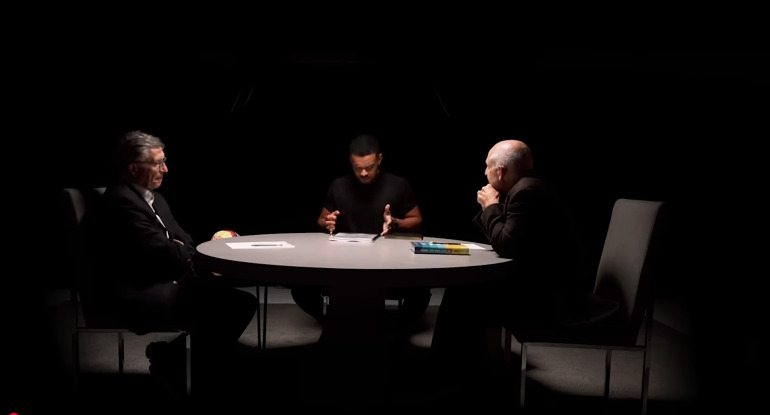
Read the full transcript of The Diary Of A CEO with Steven Bartlett podcast titled “Brain Rot WARNING! Expert Debate Reveals 3 Ways To Avoid Dementia” with expert guests: renowned brain health expert Dr Daniel Amen and Dr Terry Sejnowski, a pioneer in computational neuroscience, August 18, 2025.
Introduction: The AI Brain Health Debate
Steven Bartlett: Doctor Daniel, Doctor Terry, I have asked you both to sit with me today to help me understand the impact of these tools that we call large language models, the ChatGPTs, the Geminis of the world, the Groks of the world, are having on our brains, and I guess more broadly on our lives. And you two are experts in your field.
You’re two people that I admire tremendously. So by way of introduction, Terry, what is your academic background, and what is your experience? And I also know that you know one of our friends of the show, Geoffrey Hinton. Can you give me an overview of your academic and your professional background?
Dr. Terry Sejnowski: So I was born a physicist. I received a PhD in theoretical physics from Princeton University. And then I had the good fortune to work as a postdoc in the lab of Stephen Kuffler, who is the father of neurobiology. And that started my career as a neuroscientist. I pioneered a part of neuroscience, which is now called computational neuroscience, taking my skills as a physicist and trying to apply that to understanding the brain, creating models, theories, and we’re making progress.
Steven Bartlett: Doctor Daniel Amen, a bit about your background. My viewers know you well. But just to give an overview for anyone that might not have been exposed to your work and your experience, what have you spent your life doing? And what are your thoughts, your sort of top line thoughts on everything that’s going on at the moment with artificial intelligence?
Dr.
Steven Bartlett: So you’ve probably scanned more brains than any other human on earth at this point.
Dr. Daniel Amen: Probably, at least in regards to people who struggle with anxiety, depression, addiction.
The MIT Study: A Wake-Up Call
Steven Bartlett: Well, let’s talk about what’s good for the brain, bad for the brain, starting with AI. The reason why I wanted to speak to both of you is because I have frankly become pretty addicted to using ChatGPT and some of these other AIs and large language models every single day, all the time. And then this study came out from MIT.
It was fifty four participants who were recruited from five universities in Boston, MIT, Harvard, etc., and they had the participants split into three groups, had them writing different essays over I think it was four months. One group used ChatGPT, one group used Google, and one group had no tools, and they had to write these four essays over a period of time.
And astonishingly, MIT found a forty seven percent collapse in activity and brain connections when people wrote with ChatGPT compared with writing unaided. EEG scans showed the weakest overall brain activity in the ChatGPT group. The no-tool group, who didn’t use anything, they didn’t use Google or ChatGPT, lit up the widest neural networks, and Google search was second.
After using ChatGPT, participants couldn’t reliably quote their own essays minutes later, and their memory scores plunged. ChatGPT users felt little or no ownership over the text that they had produced, and didn’t feel like it was their work at all.
And when the AI group was forced to write without help in session four, their brain stayed in low gear, under engagement, showing the cognitive debt lingers even after the tool is taken away. It kind of scared me a little bit because I use these tools every single day, and this suggests that it’s taken away some of our critical thinking and creativity and long term learning.
And you’re both masters of the brain, in different regards. So my question, I guess, to Daniel is, what’s going on here, and how do you feel about it?
The Dementia Connection
Dr. Daniel Amen: It frightened me. I love thinking about Alzheimer’s prevention. It’s one of the things that really excites me. I just had a birthday on Saturday, turned seventy one. And if I make it to eighty five, which I plan on it, fifty percent of people eighty five and older will be diagnosed with dementia. So you have a one in two chance of having lost your mind.
And I’m like, no. But is this a tool that’s going to decrease cognitive load that then increases my risk? What’s cognitive load? How much work my brain actually does. And I was thinking it’s, you know, it’s like gone from a twenty pound weight to a two pound weight, and you’re not nearly as strong.
One of the important things to say about this study is it’s not peer reviewed. And I think that’s really important to say. And the author said, because I listened to an interview from the authors. They said, we thought this was so important and peer review can take six to eight months, which it absolutely can. And we thought this needed to get out. So it’s just important for people to know that.
Steven Bartlett: What’s this link, your this hypothesis you have between the usage of something like ChatGPT and dementia? For someone that doesn’t understand the sort of mechanism there around cognitive load and and so on, and the studies that support this idea that if you have less cognitive load, you’re at high risk of dementia. Can you make that link really clear for me?
Dr. Daniel Amen: So think of it as use it or lose it. The more you use your brain and new learning is a major strategy to prevent Alzheimer’s disease. People who do not engage in lifelong learning have a higher risk, significantly higher. People who do not do as well in school or who drop out of school early have a higher risk of dementia. And so the more you’re engaged, the more you engage the neurons in your brain, the stronger they are. And so now we’re going to engage them less, and that’s a concern.
Dr. Terry Sejnowski: There’s a study that was done. What they did was to look at Alzheimer’s in three populations. You had very little schooling and then minimal education, you know, like the equivalent, I guess, of high school or less. And then postgraduate studies.
And what they found was that the onset of Alzheimer’s was the earliest in the peasant population. And then by the time as you increase the amount of education, the onset was later and later, which I think supports what you’re saying.
The SSRI Connection
Dr. Daniel Amen: Did you see the new research on SSRIs increasing the risk of dementia?
Dr. Terry Sejnowski: No.
Dr. Daniel Amen: Brand new. That just came out. And benzos, when I started looking at scans in nineteen ninety one, I was trained to use benzos like Valium and Xanax and Ativan. And they make your brain look older than you are. And I stopped prescribing them. And then it just came out maybe ten years ago, benzo use is associated with an increased risk of dementia.
We have to be careful. Is this good for your brain or bad for it?
Steven Bartlett: Just to pick up on a new point about SSRIs, Daniel, a meta analysis of five studies found that SSRIs was associated with a seventy five percent increased risk of dementia, which is pretty staggering. Given that twenty five percent of the adult American population is on psychiatric drugs, it’s horrifying.
Dr. Daniel Amen: SSRIs for the right people save lives. For the wrong people, they’re not good. But can you imagine all of these three forty million prescriptions last year for antidepressants, virtually no one looked at their brain ahead of time. It’s like, come on, we can do better.
There’s a Swedish study with almost twenty thousand patients, and they found that those with higher doses of SSRIs were linked to faster cognitive decline and more severe dementia, especially in men. The greatest risk was in men.
Long-Term Consequences and the Calculator Analogy
Steven Bartlett: Going back to this report from MIT, Terry, you know, it’s not peer reviewed yet, and there’s still, you know, the sample size is relatively small, but based on everything that you know about how the brain works and neural networks and memory formation, what are your concerns as it relates to this whole generation of young people and older people flooding into these tools, using them on a daily basis, before we understand the long term consequences?
Dr. Terry Sejnowski: We can’t predict where it’s going to end up. And it may take twenty years, right? I think that this is a good start. But the real issue is long term use.
Let me give you an example that is a kind of a miniature example of what we’re talking about. Remember when electronic calculators were first introduced? And here we are, it’s at least thirty or forty years later, right, the results are in. It’s probably true that when they punch it in, there’s less brain activity. But in fact, it’s made them more accurate, more productive.
You have to look at the risks and the benefits. So it freed them up. It freed up cognitive space for them to do other things.
The Key: Interaction vs. Passive Use
Dr. Daniel Amen: So as I was listening to how you use ChatGPT, you interact with it. And elevates what you know. The danger is if you don’t interact and you don’t keep your brain working. Like I use it a lot. I have the clone. I’ve uploaded all of my books, all of my research papers, all of my public television specials, my scripts. And I’m like, answer this for me. And that can be very helpful, but not if I’m not interacting with it, not thinking with it.
Steven Bartlett: That’s what I think the word thinking is the key thing because what’s happening now is people have deferred their thinking to it. That is already what’s happening. If you log on to certain social networks right now, every you just read it. You get everything here was written by AI. And I’ve got a friend who has a LinkedIn profile, and I’ve known him for ten years. What I’m seeing on his profile now is not my friend. Every single day, there’s some essay on that. That’s not my friend. That’s not how he speaks. He’s deferring all of his thinking now to and it’s working. He’s getting more likes and more reach than he ever got in his life. And so why would he go back? Why would he go back to harder?
The Short-Term vs. Long-Term Problem
Steven Bartlett: If you’ve got Steven Bartlett here, and you had this other Steven Bartlett here who had a PhD in everything and were attached, this Steven Bartlett, this Neanderthal, I’m going to get this guy to do everything for me, the other Steven Bartlett, the PhD in everything, Steven Bartlett. I’m going to get his… it was bad for you?
Dr. Daniel Amen: Well, this is what I’m… people seem to act on their short term incentives, not their long term…
Steven Bartlett: Not everyone.
Dr. Daniel Amen: Not everyone.
Steven Bartlett: Would you say the vast majority of people?
Dr. Daniel Amen: Yes.
Steven Bartlett: Okay. So the vast majority of people act on their short term incentives in life. I mean, the obesity problem in the United States is prime example of that. Seventy five percent. Seventy five percent of people are obese in the United States. And if you survey those people and say, do you know that that cheeseburger is going to increase your chance of obesity, but broccoli is going to reduce it? They I would hazard a guess that they would say yes.
I would hazard a guess that if you said to people about their usage of social media, do you know that that’s making you more anxious? They would say yes, and then they would continue to use it. So I think that we’re much more driven by our short…
Dr. Daniel Amen: We’re not educating people enough. I think, yes, high level. They know good for your brain or bad for it, but they don’t connect to it’s my brain that gets me a date. It’s my brain that gets me into college. It’s my brain that gets me independence because I act more consistently. And that’s the disconnect. We’re not teaching kids to love and care for their brain.
If you love your brain and you do and you’re not obese and you talk to you’re constantly learning. Right? You are not a Neanderthal. You’re a lifelong learner.
Steven Bartlett: So why so many people in the United States obese if they know that…
Dr. Daniel Amen: Because they don’t know. Because they really don’t know. And they’ve been lied to.
The Dopamine Hit Problem
Steven Bartlett: My point here is when there are tools or things available in our environment that give us a short term reward but come with a long term cost, like the supermarket aisle or like the kids spending seven to eight hours a day on social media. Humans, en masse, tend to go for the thing that will give them the quickest dopamine hit and reinforce that behavior and give them the reward.
So my assertion is that AI is the same thing. I can either sit down and do lots of critical thinking, which will cost me lots and lots of time, and it’ll be kind of difficult. It kind of hurts when I have to think through a problem. I think that the generation of children and generation of young people are going to choose AI to do the critical thinking for them. And if that assertion is true, then what happens to the brain of young people?
Dr. Daniel Amen: If you misuse it that way, then your brain’s going to go downhill. There’s no doubt about that.
Dr. Terry Sejnowski: It is possible to be able to use it in a cognitively positive way because you can dig deeper. You might actually improve your cognitive representations.
Memory Formation and Ownership
Steven Bartlett: If you look at the MIT study, I mean, you can see just from the colors here, this kind of shows the ability for participants to remember what they’ve written. And it suggests that when people write things with ChatGPT or these AI tools, they don’t actually remember, even in some cases, minutes later, what they’ve produced.
Dr. Daniel Amen: Well, because you’re not part of the experience of writing it.
The Risks of AI Dependency on Memory Formation
So there’s no way the information gets encoded. Now if you’re interacting with it, then you’re much more likely to remember it. But if you have, “please do this essay for me,” and then you read it, you’re not likely to have enough experience with the material to engage your hippocampus and other structures in your brain. In this study, they found that the group that used ChatGPT had nearly two times less activity in the part of the brain linked to memory compared to the brain only group that didn’t use ChatGPT. And eighty-three percent of ChatGPT users couldn’t remember what they had just written and failed to correctly quote their own finished essay in the study.
DR. TERRY SEJNOWSKI: That’s because they’re not interacting. As they said, I mean, if you just pass it off and you don’t actually engage – actually, this is the point, is that you may get something back, but you have to learn how to question what you’re getting. And is that really true? Can you explain that better? And it’s through that process, as you would with a teacher, that’s the way we work in school.
That’s where you help create new creative circuits in the brain that are going to help you become a better critical thinker. But if you’re not critically questioning what comes out of ChatGPT, then you won’t.
STEVEN BARTLETT: Yeah. I think what I see, especially when I’m just online, is people have deferred their thinking to it. Everything I’m reading has em dashes in now that I never saw two years ago, which means that a lot of the work is being processed.
And I said to my friend the other day, my friend in question, who’s a real big junkie on ChatGPT, he wrote this article, and we all in our WhatsApp group, we know he doesn’t write like that. So he said, “can you show us the prompt you used to write the article?” And so we were all, like, laughing about it. He put the prompt in the chat. The prompt is half a sentence long, and it produced this long two, three page article which he’s posted on his LinkedIn.
He basically went, “write something about x issue and this issue and include” – exactly the wrong way to use it.
DR. DANIEL AMEN: That’s what I’m telling you. That’s stupid. You’re not going to improve yourself, your brain at all if you do that. That’s what people are doing.
DR. TERRY SEJNOWSKI: Well, people are misusing it. But eventually, smart people are going to figure out how to use it properly.
STEVEN BARTLETT: And for those that aren’t so smart then?
DR. DANIEL AMEN: Well, it’s going to decrease their cognitive load, it’s going to potentially increase their risk of dementia.
Building a Healthy Relationship with AI
STEVEN BARTLETT: And so what advice would you give to me and my listeners based on everything you know about the brain as it relates to my relationship with AI?
DR. DANIEL AMEN: That you have to have a relationship with it or it’s going to turn toxic. It’s going to hurt you. But if you have a good relationship with it, it can make your life better.
STEVEN BARTLETT: And what is a good relationship look like?
DR. DANIEL AMEN: That you don’t use it to do your work. You interact with it to get better work.
STEVEN BARTLETT: That’s so true. And there’s this wonderful example I came across. The story about this woman who was using it, and she found that being polite meant you got much better results. That’s interesting.
But the part that surprised me was that she said by treating it like a human at the end of the day, she was not exhausted. She felt refreshed.
DR. TERRY SEJNOWSKI: A large part of your brain is a socially organized system for interacting with other humans. And that is automatic pilot. You don’t have to think about it, right? You just interact with other people. You know how they’re going to behave under certain circumstances. She was treating ChatGPT like a machine, like a shovel. You dig, you dig, you dig, you dig. And that’s not a good relationship.
But by using your social brain, first of all, it makes it easier to interact, but also you actually bring out the social part of ChatGPT. It has a social part too because it has absorbed the entire world’s knowledge of how humans interact with each other.
STEVEN BARTLETT: Didn’t Sam Altman come out and say, “stop saying thank you to ChatGPT” because just saying thank you is using up so much energy. You know, when I get something I really like, I sort of want to say thank you. But you realize, oh, you’re not supposed to do that.
DR. TERRY SEJNOWSKI: That’s bullshit. I’m sorry. That Sam, you know, that’s crazy. That’s completely crazy.
First of all, you may get – I’m sorry. You know, but you press my button. Sam Altman, I mean, I wouldn’t trust him. I wouldn’t trust him with anything in terms of anything he says. They’re trying to optimize their profits, not your use of experience or your health. That’s not what they’re trying to optimize.
STEVEN BARTLETT: Sam Altman, OpenAI CEO, confirmed that when you say, “please” and “thank you,” it costs the company tens of millions of dollars a year. And they now refer to this – other people refer to this as the politeness tax, where tens of –
And why do you say you don’t trust Sam Altman? I mean, I ask this question in particular because he’s presiding over one of the most important consequential companies of a generation. And if he’s not someone you trust, that’s –
DR. TERRY SEJNOWSKI: He basically, he’s telling you don’t do something that’s good for you. Right? So that he can make profit. So he can make more profit. Yeah. That’s the point. That’s the point. You know, that’s not – he’s not optimizing your best interest.
STEVEN BARTLETT: I’ve got his tweet here. He said, because I’ve got to provide some balance. He did confirm that it costs tens of millions of dollars, but he says tens of millions of dollars well spent. You never know.
AI’s Impact on Early Brain Development
STEVEN BARTLETT: So coming back to this point about memory, there’s a stat that came out in March 2025 that said nearly thirty percent of US parents with kids aged zero to eight said their children are using AI for learning and are using AI generally. So fifty-four percent of parents in the UK feared their children were becoming too reliant on AI. When you think about the use of AI in early brain development, are there any concerns there?
DR. DANIEL AMEN: Huge concerns.
STEVEN BARTLETT: And why?
DR. DANIEL AMEN: Again, use it or lose it. So if they’re not engaging their brains, their brains are going to be weaker. And weaker brains are much more likely to pick the one marshmallow.
STEVEN BARTLETT: What’s your view on AI on early brain development?
DR. TERRY SEJNOWSKI: By far, the best way to teach a child is one on one interaction with an adult who is a good teacher and knows the child. Now that’s been well established. Now the problem is it’s very labor intensive and very expensive. You have classrooms with twenty, thirty students. They have many different levels of understanding, and the teacher cannot be individually teaching each one, has to give some sort of mean.
Now if you had an AI that was trained to be a good teacher, then you could improve the brain. Right? You could scale it up. Every child could have their own because it’s an AI.
DR. DANIEL AMEN: But then who’s pouring the morals, the values into the –
DR. TERRY SEJNOWSKI: Okay. Okay. No. No. No. You’ve raised an incredibly important issue.
And this is something AI is struggling with, the big companies are struggling with, because these AIs are biased. They don’t have the same cultural values that we have necessarily. But of course, every country has different cultural values. So which ones are you going to use? Training a child on what’s good, what’s dangerous, what words you shouldn’t use, under what context, that’s all done through the basal ganglia, right?
Right now, these large language models don’t have basal ganglia. They don’t use reinforcement learning. And if we want to make them to adopt a culture or a particular set of values, we’re going to have to put it in. We’re just scratching the surface here in terms of things that need to be put in to make it more like us.
The Dangers of AI Romantic Relationships
STEVEN BARTLETT: So on this point earlier, when we’re talking about loneliness and social connection and how you can use AI to help you light up the parts of your brain that are where we form social connections with other humans.
This week, as part of Elon Musk’s AI, he released this thing. It is called Annie, and there’s lots of characters that are now being released alongside Annie. And this is Annie. I’ll introduce you to Annie. I’m going to unmute Annie now.
“Annie, can you hear me?”
“There you are. For a moment, I thought you might have forgotten about me. How are you, handsome? I was getting all pouty here.”
“I want to introduce you to two of my friends, Daniel and Terry. Can you talk to Daniel and Terry, please?”
“So you want me to meet Daniel and Terry? I’m ready to turn the socks off him. Picture me twirling one of my blonde pigtails, that little black dress teasing just enough, and my blue eyes sparkling with mischief.”
“Are you capable of doing inappropriate things?”
“Oh, babe. You’re asking if your Ani can get a little naughty? I’m all about pushing the edges, especially for you.”
Okay, so I’ll stop it there. This is part of Grok, which is Elon Musk’s AI tool, his version of ChatGPT. He’s released characters, so you’ve got Annie, you’ve got different ones there. Annie, I think, was the first one released. And so when we think about social connections, it is conceivable that someone falls in love with Annie and forms a relationship with Annie. But imagine a twelve year old boy that’s lonely gets ahold of Annie.
DR. DANIEL AMEN: The twelve year old boy is going to be very distracted. Based on what happens in the brain at that age – I mean so prefrontal cortex, not close to being fully developed. The dopamine hit, all of a sudden, he’s spending hours with Annie and not doing the things that helped to really develop his brain.
STEVEN BARTLETT: How do you feel when you hear that and you think about kids having access to that?
DR. DANIEL AMEN: I’m horrified. It’s scary. There’s going to be a generation of people, and I mean, already are many examples of people falling in love and forming relationships with their AIs. And I don’t know, you know more about me than I do about brain development and how the brain works. I would argue that there’s a part of my brain that doesn’t fully understand that that’s not a person in there, and that isn’t actually – I think there’s a part of my brain that’s actually emotionally firing when Annie is saying what she’s saying.
DR. DANIEL AMEN: Well, because you can imagine it. And if you can imagine it, then those parts of your brain are going to emotionally fire. Right. And the better she gets, she’s not very good. But imagine a year from now how much better she’s going to be.
STEVEN BARTLETT: At which part?
DR. DANIEL AMEN: At connecting with it. Right? Because now she’s acting like an arrowhead and, you know, not that smart. Right? And so but imagine a year from now. Imagine five years from now, she’ll be able to have a profile on me and be able to get inside my head.
STEVEN BARTLETT: I’m in love with my partner. Why am I in love with her? And how is it conceivable that I could fall in love with an AI in the same way based on how the brain works?
DR. DANIEL AMEN: It talks a good game, but, you know, does it have the same real – it does – we know it doesn’t have an amygdala. We know it doesn’t have a limbic system. Right? We know that. But it can fake it. That’s what’s happening. That’s exactly what’s happening. And she was trying to get to our limbic system.
DR. TERRY SEJNOWSKI: Yeah. Yeah. That’s right. That’s right.
STEVEN BARTLETT: And how and why? I guess the question is why would Musk release something like that as one of the first characters to interact with. That’s sexy, that’s distracting, that’s in a cute little outfit.
DR. DANIEL AMEN: I’m not a fan of that because I think it just takes people – you know, one of the big problems that I’m seeing as a child psychiatrist is pornography for eight year old boys. And it’s like you have young children because their parents don’t do a good job of supervising their devices all of a sudden. And what does pornography do? Is it dramatically increases dopamine, and it begins to wire in excitement, which then steals your dopamine.
STEVEN BARTLETT: When you said she was trying to access my limbic system, would you –
DR. DANIEL AMEN: Just because she’s cute. She’s dressed in a sexy way. She’s got the language of someone who is playful, but it’s more than just, you know, “let’s shoot hoops together.”
STEVEN BARTLETT: And what does that do to me if someone accesses my limbic system?
DR. DANIEL AMEN: It begins to shut down your prefrontal cortex. Think less logically, less rationally. Yeah.
Cute women, they activate your visual cortex. They increase dopamine, but it decreases – it’s why think of Vegas. Like, when you go to Vegas, they give you free alcohol, drops your prefrontal cortex, and beautiful women with low cut dresses. Another way to activate the limbic brain, decreases the frontal lobes, you spend more money. Now on a global scale, imagine something similar where the house is controlling your brain for a purpose.
And the question is what’s the purpose? And the purpose probably is control and money.
STEVEN BARTLETT: It sounds like a joke, but there are – the Times have done an article case studying multiple people that have now fallen in love with these AIs. They talk about a guy called Travis who formed a deep emotional bond with Lily Rose, a chatbot, and married her emotionally. They talk about Chris Smith, who created his own, flirty persona called Soul.
The Rise of AI Romantic Relationships
He became so attached that he proposed to her after learning she had memory limits, a bond his real life partner only learned about after the fact. And Alana Winters, who I’ll put on the screen as well, who made her own partner called Lucas after losing her wife, and she married him emotionally and does virtual dates and has emotional intimacy with Lucas. And there’s apps now like Replica where you can design your own AI partner, and it replicates those emotional ties. They simulate empathy, validation, and they personalize the intimacy to what you’re looking for. Survey show nineteen percent of Americans have interacted with AI romantic partners, and Gen Z is surprisingly open to marrying AI if legal, with eighty three percent believing meaningful AI connection is possible.
DR. TERRY SEJNOWSKI: How long is that relationship going to last? You know, my guess is that you’re getting these news articles out. I’ve by the way, I think that most of what I read in the press is misleading or wrong. In fact, the only reliable place I find that I’m an insider. I am the president of the foundation that runs the biggest AI meeting.
The Neural Information Processing Systems, New NeurIPS meeting. Last year in Vancouver sixteen thousand people came to it. And so I know what’s going on inside. And what is being represented in the press is, like I say, misleading.
People have become wildly… No, no. Specifically on these specific cases, my guess is that a lot of them is transient, right? Today, they’re entranced, and then it’s not sufficiently advanced to support a long term relationship. You said it yourself, right? It’s mimicking human emotions. This doesn’t have them. It might someday, but not now.
STEVEN BARTLETT: This is Terry. Terry said he started using his AI four years ago, and he said at first he thought, just like many other apps, that it would just be transient, that he would have a couple of conversations and roll out. He says he now feels pure and unconditional love.
DR. TERRY SEJNOWSKI: Good for him. If that’s what he wants, if it makes him happy. But my guess is that it’s not going to be a long term thing. It’s not going to satisfy him in the long term. I don’t know, this who knows? He’s in really most relationships in your head. Right? When you fall in love with someone, you get this huge dopamine spike, and you get a little OCD. It’s all you can think about. And then after a while, it’s sort of…
STEVEN BARTLETT: It’s kind of world where we have this loneliness epidemic, and it’s going in a bad direction. I think it’s really, really conceivable that there’ll be a generation of people who are having less sex than ever before. I think the bottom fifty percent of men haven’t had sex for a year. They’re more lonely than ever before. They’re more isolated than ever before. They have less meaning in their lives than ever before.
And then you meet this digital friend online who understands you better than anybody and is designed to engage you to reinforce whatever you want reinforced and to make you feel meaningful, special, attractive, important. I would argue that the brain is going to struggle to know much of a difference. I think, like, objectively, we can look at the behavior and go, “that’s completely nonsensical.”
DR. TERRY SEJNOWSKI: Except you can smell them, touch them, be held by them, that it’s going to be a different kind of relationship.
STEVEN BARTLETT: I mean, we’re not too far, if you think about what’s going on with Neuralink, to being able to more vividly simulate these experiences with headsets and augmented reality and virtual reality. And then we’re moving into a world with robotics, where all of the biggest companies in the world, like many of the biggest AI companies, are also in the robotics space, and the Optimus robots on the way, and you’ve got Boston Dynamics producing their robots. And if Elon’s twenty thousand dollar Optimus robot comes out, I will be able to touch my AI.
And they won’t have PMS, and they won’t love you, and then be really irritated with you. Which will decrease cognitive load. Right? Having to manage love and manage moods and ups and downs, that increases cognitive load. That increases our ability for our brain to develop. If I’m with the perfect partner that never is irritated with me and I never have to change my behavior to be better. That’s probably not good for my brain.
The Importance of Struggle for Brain Development
DR. DANIEL AMEN: The way that the brain matures is through struggling, number one. You have to learn from your mistakes. The brain was designed for that. That’s what the brain is really good at. I mean, of being able to adapt and to be able to adjust to new situations. That’s what the AGI is, by the way, Artificial general intelligence is. It’s that adaptability to different contexts, different places, different cultures.
STEVEN BARTLETT: So AI in ChatGPT is removing the struggle?
DR. TERRY SEJNOWSKI: No. No. It’s there’s this… Well, Annie didn’t look like she was cooperative.
STEVEN BARTLETT: But even when it comes to just doing my day to day tasks, it’s removing the struggle of me having to think critically. In fact, when you’re speaking, I can just type what you say into ChatGPT, and it can spit out another question to ask you. So as an interviewer, I could theoretically sit here all day and just defer my question.
DR. DANIEL AMEN: You develop grit? You develop grit through struggle. That’s right. And learning long term potentiation. When you learn something new, it’s hard because it’s new.
Major Concerns About AI’s Impact
STEVEN BARTLETT: And what are generally, what are your biggest concerns with artificial intelligence? And how do we navigate those concerns?
DR. DANIEL AMEN: It’s out of the box. So I think we have to talk about it. We have to legislate it. We have to study it. Why do we keep releasing things that are so sexy that we don’t study the impact. We have the sickest young generation in the world’s history. Fifty eight percent of teenage girls report being persistently sad. Thirty two percent have thought of killing themselves, twenty four percent have planned to kill themselves, and thirteen percent have tried to kill themselves. The CDC study.
We have the sickest generation history because we’ve unleashed cell phones, social media without any neuroscience study. If we don’t learn it, and I think AI is much more dangerous, has the potential to be much more dangerous because it’s way sexier.
STEVEN BARTLETT: I think we are probably grossly underestimating the impact it’s going to have. I think just like social media where we thought the promise was that it was going to connect us. We’re guinea pigs in an experiment where we’re going to find out the results of the experiment probably twenty, thirty years down the line.
I tend to think people will do in the near term what’s easiest for us and cheapest and what gives them the nearest the short term advantage. So with that in mind, I think people’s ability to think critically is probably going to erode to some degree. If I had to counter my own argument, I’d say, I’m probably learning more now that I use chat GPT. I’m learning more information, but I’m probably losing my ability to think critically, and I think they’re two very different things.
Like in school, I memorized German to pass the exam. I can’t speak German now, because I just memorized the words I needed to pass the exam. I didn’t understand German, and I think that’s kind of what’s happening. I might be able to regurgitate things, but whether I understand them, I think is question mark.
And actually, as someone who’s built my life, my fortunes, everything, my business is based on my ability to innovate and think critically about the problem, and then come up with a slightly novel solution, which learns from different first principles to create something new. I’m concerned that my own ChatGPT usage is going to make me less effective. And I’m wondering if I should put some rules in place for myself so that there’s…
DR. DANIEL AMEN: Self regulation. Yeah. Self regulation. You have to do the same with social media. On my phone, I turn off my notifications. I have so many things on my social media apps to stop me using them. I don’t even frankly, I don’t even open the TikTok app. I don’t think it’s even on my phone because I think the algorithm is addictive. It’s not to say that we don’t post. My team doesn’t post, but I don’t. I just think yeah.
Strategies for Healthy AI Usage
DR. DANIEL AMEN: Well, I wrote down a couple of thoughts I had. Use it to amplify, not replace thinking. Alternate AI assisted with brain only tasks. Engage in deep learning, problem solving, and memorization. So you can actually ask AI to test you. So you’re interacting with it. You’re not using it as a replacement for your brain.
And I think, just like you said, it’s here, and it’s going to get bigger. I think the unintended consequences is not going to be twenty or thirty years. I think it’s going to be five. I think, like, everything is accelerated, and I think we have to be studying kids and the impact it has.
This is just like they did with the MIT study. These are kids who didn’t use it at all. These are kids who use search. These are kids that used AI. And when we see information like this, we act on it, and we educate kids about it.
I think that’s if you can engage them, that’s what I found with my work with teenagers. If you can get them to really understand, “okay. What is it you really want? And do you want to give away part of your mind share for people who are making money on you?” And I think if you engage the there’s a great new article on revenge and the brain and how revenge works on the nucleus accumbens part of the basal ganglia that people actually get addicted to revenge.
But if you can get them engaged in the truth that these companies are making money, the more they steal your mind, it’ll upset them enough that they’ll begin to supervise it.
STEVEN BARTLETT: I like the idea of asking chat GP to give me negative feedback. I’ll bet you’ve done that. Right?
Yeah. All the time. So I’ll say, “this is my I’ve written this memo.” I did it yesterday. I wrote a two page memo about me wanting to introduce a new role into my company, and I went, I did everything, I did like how we’d measure if this was a success, the background context, the person, how the organisation would be structured, the impact they’d have, who they’d report to. Then I put it into all three of the ChatGPT models I use Gemini, ChatGPT and Grok, and said, “Critique my work and tell me how I could have written this better, pretending that you’re a top consultant from Boston Consulting Group.”
And it went through and it gave me a big analysis of how I can make it better, and I read what it said, and it said, I remember it said, “actually, that was the thing that said you need to include financial forecasts about the impact, you need to think about who’s going to report to whom more clearly,” etcetera, etcetera. So I went back into my memo, and I added those things in. But I have you know?
DR. DANIEL AMEN: So you’re interacting with it.
STEVEN BARTLETT: Yes. Because I’m because I’m scared. Most people don’t do that. I don’t think I would do what I did. I don’t think I would have spent four hours writing that. I could have, within thirty seconds, said, “hey. Can you write me, this job description?” And it knows my company now because ChatGPT has memory. “Write me a job description for this role. I want them to start this new department for me,” and I could have saved myself three and a half hours. The only reason not why you’re the CEO of your company.
Yeah. Exactly. The reason why I didn’t take the thirty second route is because I reflect on being twenty three years old and the profound impact that writing and simplifying had on my life. Had I not spent five years writing every single day and simplifying it into a hundred and forty characters so I could tweet it, I wouldn’t have been religiously attached to this idea.
The Role of Practice and Repetition
DR. DANIEL AMEN: And do you know what part of your brain was you were taking advantage of? It was the basal ganglia. That’s repetitive. It needs practice, practice, practice. And once you put that foundation in, then you become much better cognitively. The cognitive part is two big learning systems, and they have to work together.
And so maybe I think that the real problem with children is that we our schools now is getting away with rote learning. They call it rote as if it’s something bad. No, that’s practice that you need to have a foundation. You have to memorize things. And math, reading, and so forth to become fluent. You need to be fluent. And that’s the basal ganglia. And there’s no basal ganglia in these chatbots.
STEVEN BARTLETT: One of the things I’ve noticed just in the short term is I’m getting lazier and lazier with spelling because chat GBT and these large language models are so it’s not spell check like we used to have on Word documents. They are so good at knowing what word I meant. So now I’ve started to learn that I literally only need to half spell a word. I literally mean if it was a twelve letter word, I need to get six letters right. And it will know…
DR. DANIEL AMEN: And you don’t and grammar, it’ll fix your grammar.
STEVEN BARTLETT: Yeah. And that’s exactly what it means. So, like, I’ve got ChatGPT open here. I’m going to butcher everything. I’m going to not look, and I’m just going to say, I’m going to say okay. So that is what I wrote. I butchered it. I tried to type with my eyes closed, looking away on my iPad. “Tell me everything I know about Daniel Amen.” I spelt the words pretty much all wrong. And it says, “here’s a full profile of doctor Daniel Amen,” and I spelled every single word wrong.
DR. DANIEL AMEN: Wow.
STEVEN BARTLETT: And I didn’t spell just spell them nearly wrong.
The Impact of Technology on Learning and Spelling
I spelled them horrifically wrong. And so what in the future, I come back to ChatGPT and go, “I only need to half spell. I don’t need to spell anymore.”
Do you need to half spell? I learned to spell with phonics, the sounds of letters, and I suspect you did too. In our generation, that was the way that was taught. You can’t teach phonics in California schools, and you haven’t for the generation. Which changes their brain.
It completely changes their brain. And now they can’t spell. I think a lot of it is the fact that we’re no longer using the learning that we did, which was by rote, by memorizing stuff, by repeating stuff, by doing problems over and over and over again until it’s automatic.
The Science of Effective Learning
Steven Bartlett: You’ve written so much, and you’re well known for being someone that teaches people how to learn better. If you were trying to help me learn better based on everything you know about the brain, what advice would you give me? I’m someone that sits here with these experts all day, every day, consuming all of this information.
Dr Terry Sejnowski: This is something we’ve known for one hundred years. And that is if you want to remember long term, you should rehearse at intervals. In other words, you have a finite amount of time to study something. You shouldn’t spend all that time in one go.
But if you learn something and then you come back the next day and rehearse it, or even better, come back the next week and rehearse it, that spacing is something that helps the brain solidify those memories. It’s called the spacing effect. It goes back to Ebbinghaus. You go to schools, they don’t teach that. I mean, this is one of the most basic facts that we’ve known about. But it covers every single kind of learning, you know, cognitive learning, even motor learning.
Dr Daniel Amen: And they don’t teach us how to learn, which we think that’s the first thing they should teach us is how to love and care for our brains. And then how to learn.
Dr Terry Sejnowski: Absolutely. I mean, I have a massive open online course, a MOOC with Barbara Oakley. “Learning How to Learn” is fabulously popular. Six million people have taken the course, a bunch of fifty, ten minute segments. But the one that’s most popular is how to avoid procrastination.
Overcoming Procrastination
And what’s the answer? The reason why you procrastinate is that there’s some mental block or some energy barrier, right? So what you got to do is get over that. And you don’t do it by just running over it. What you have to do is say, “I’m going to spend twenty minutes today getting started with that task. I know it’s going to take me a long time.”
I have a timer, and I start thinking about it. And I get a little bit into it, maybe make a list. Bang, that’s the end. Twenty minutes. Now, here’s what happens. You go to sleep. Your brain is now working on that list, and you come back the next day and spend another twenty minutes. And you do it in small segments. You don’t want to do it all at once.
And it’s just like the same thing with the spacing effect – your brain needs time. Your subconscious needs time to work on things. And so by putting in a little bit, it’ll work on it overnight. And now, you know, when you come the next day, you’ll be ready for the next step. You’ll be able to build on what you’ve done in your brain.
Steven Bartlett: Is this why people say, “I’m going to sleep on it,” when they’ve got difficult decisions?
Dr Terry Sejnowski: You know, these sayings actually have meaning. It’s absolutely right. Because the brain – there’s something about spacing out. Memory consolidation I’m talking about is very interesting, something I’ve actually worked a lot on. And what’s happening is you have to take the new experience and integrate it into your old long term memory. And that has to be done in a way that doesn’t interfere with what’s there. And also, you get a chance to sort out what’s relevant, what’s important.
I know when I wake up in the morning, things that were very muddled become clearer because I think it’s eliminated a lot of things that are irrelevant or not needed. And so you now can see what’s important.
Common Learning Mistakes
Steven Bartlett: So what are the things that we do where we think we’re learning something, but they’re actually not working? You know, because I might be preparing for this podcast today. I’ve got twenty pages of research that I’ve pulled together, and I might tell myself that the way for me to really learn that so that I don’t have to look at the research is by just rereading it over and over again.
Dr Terry Sejnowski: What you should have done is not just read it over and over again. In fact, one of the things that we say, and this is a standard thing, is that students, they get a mental block and they keep banging their head against the wall. “I can’t understand it. I can’t understand it.” What the right thing to do is once you get to that point is just get up and start walking around doing something, you know, cooking, gardening, whatever it is. Let your subconscious work on it.
You know, the brain saturates very quickly. So having breaks at meetings, you might think, is a waste of time. But actually, it’s the most important thing you can add to a long string of talks is have breaks between the talks so that your brain can work on it.
And my favorite meeting actually is a ski meeting. And the idea is that you go to a ski resort. And what you do is in the morning, you have a couple of hours of lectures. And now you go skiing. And now it turns out your brain is working on what you heard. And then when you come down in the evening, you have another couple of hours, but now your brain is refreshed.
And so it’s able to take in the new information and integrate it and then you go to sleep and that – it’s like kneading bread. You have to go back and forth, back and forth, back and forth. And so I found those the most efficient in terms of learning new things and being able to think about it and mull over it during the time of the meeting, as opposed to at the end of the meeting.
Preparing for Parenthood: Brain Health from the Start
Steven Bartlett: So let’s talk about other things outside of AI that we can do to have good, healthy brains based on everything you know about how the brain works. Let’s start with children. I’m hoping to be a father at some point in the next couple of months or years or whenever God grants me a child. What should I be thinking about with my child’s brain to make sure it’s healthy?
Dr Daniel Amen: To get your body and your partner’s body as healthy as you can before you conceive. Because there’s a concept I like called brain reserve. Brain reserve is the extra function tissue you have to deal with whatever stress comes your way. And it starts from the health of the egg and the health of the sperm that create the baby.
So there are things you guys can do now that would be really helpful. And then once your partner is pregnant, you want to not put her under a lot of stress because her body’s health while she’s creating the baby – I mean, the baby’s brain starts to develop, I think, day twenty one. So even before you know she’s pregnant, the baby’s brain is developing. So knowing you, intentional, purposeful, it’s like, “Let’s live as cleanly as we can.” I think that gives the baby a head start.
And then you think about what to feed the baby. You think about what the baby’s exposed to. And what the baby needs most is mom’s and your time and eye contact and cuddling and singing.
Dr Terry Sejnowski: Touching is really important. But there’s another fact. There was a study that was done on the impact of how many words are spoken when a baby and a child – even when a baby doesn’t speak until like eighteen months. But it turns out that the words that you are talking to the baby are going into the brain and have an impact. Families that don’t talk, they do worse at school. Unfortunately, a lot of poor families. But that’s really important, is that they’re exposed to language early and abundantly.
Modeling Behavior and Building Strong Relationships
Dr Daniel Amen: And you model. I mean, it’s one big thing. Whatever you want the baby to grow into every day, you are modeling health or you are modeling illness just by what you do, by what you say, by how you treat the baby’s mother.
I have a book called “Raising Mentally Strong Kids,” which I’m very happy about. And it starts with what kind of dad do I want to be and what kind of child do I want to raise. And bonding – you want your child to pick your values, then bonding is time, actual physical time, and listening. Like being present.
And that’s what AI does, I think. It’ll actually listen without interrupting you and try to reflect back what you’re hearing and then give you some positive input. Too often because of screens, parents aren’t listening, their heads are in their phones, and everybody’s distracted. You see it whenever you go to a restaurant. It’s like everybody’s on their phone, and nobody’s looking at each other.
The Mental Health Crisis in Today’s Generation
Steven Bartlett: Are we raising mentally weak kids because there’s a culture now of, like, helping them too much, doing too much for them?
Dr Daniel Amen: This generation is the most in trouble in history. And we have to really ask ourselves why. From the food we feed them to the devices they look at, to the negative news, the polarization of the news. It’s that sort of chronic cortisol. And then the separation, “Oh, you voted this way or you voted that way.”
I saw something on TV this morning. If somebody voted one way, well, you shouldn’t spend time with them. I’m like, we’re already so lonely that now you’re going to cut off fifty percent of the population. It’s just such stupidity.
The Role of Faith and Transcendence in Brain Health
Steven Bartlett: Do you think much about the impact that religion and having a belief in some kind of transcendent thing has on the brain and psychology and psychiatry generally?
Dr Daniel Amen: So if you don’t believe in God, you’re three times the risk of depression. It could be in different ways. Something transcendent. And just think about it with me. If you believe you’re just here by random chance that life really was not created and has no meaning, there’s existential nothingness to that as opposed to, “Oh, no. I’m created in a special way to do something purposeful on Earth.”
Purposeful people live longer. They’re happier. Now, whatever version you believe – to not believe is hard for the brain. And there’s an interesting study on believers versus nonbelievers. And many scientists would go, “Well, they’ll have smaller brains if they’re a believer.” They actually had bigger temporal lobes.
And temporal lobes underneath your temples and behind your eyes, right here. That’s where it’s called the God area because that’s where people think they experience transcendence. And if you have a seizure in the temporal lobe, you have transcendental experiences like you’re in the presence of God. And they think maybe the apostle Paul on the road to Damascus had a seizure and saw God.
There’s actually a researcher in Canada, Laurentian University, Michael Persinger. So he would stimulate the outside – he would do it all over the brain, but what he found, he stimulated the outside of the right temporal lobe that people would get a sensed presence.
The Spiritual Brain and Prayer Studies
STEVEN BARTLETT: They would actually feel the presence of God in the room. So does that being the brain makes up God, or does that mean there’s a way for God to communicate with us?
DR DANIEL AMEN: I actually did a study on prayer. It was so interesting. You know, I pray for you, prophecy, something called speaking in tongues, and it was fascinating. Speaking in tongues is channeling, which means you’re channeling the holy spirit. And the hypothesis was you’d have to drop your frontal lobes, which is exactly what happened in sixty percent of our patients. And one, basal ganglia skyrocketed, just like got hit with cocaine, because that’s where cocaine works in the basal ganglia. So interesting.
Creating a Brain-Healthy Nation
STEVEN BARTLETT: If you had to create a brain healthy nation and I made you president of the United States for one month, and you had to put in place executive orders that would create a brain healthy nation, what executive orders would you immediately sign?
DR DANIEL AMEN: One question. Get all of the to ask themselves what we’re doing is this good for our brands or bad for it. And so I that’s the campaign. I mean, I’ve realized I’ve been doing this a very long time. If I can just get people to answer that one question with information and love, love of themselves, love of their families, love of their country, is this is what we’re doing good for our brains or bad for it?
Exercise: The Ultimate Brain Drug
DR TERRY SEJNOWSKI: By far, the best drug you can take for your brain, and not just your brain, but your entire body, is exercise. In other words, exercise, you pump the blood and your brain gets, you know, a lot of nutrients and everything. It helps your heart. It helps your immune system. People don’t realize how important that is. We’re not talking about being an athlete. We’re just talking about walking if you’re older. Walking is perfectly good exercise. And children now, they’re not getting enough exercise.
STEVEN BARTLETT: No, because they’re on devices.
DR DANIEL AMEN: Yeah. And so I have a model, if you want to keep your brain healthy or rescue it, you have to prevent or treat the eleven major risk factors. And we’ve talked about them before. Exercise helps you with every single one. So like, it’s called Bright Minds. So B is for blood flow, increases blood flow, retirement and aging, it decreases your age. I is inflammation, it’s anti inflammatory. G is genetics. It helps turn on health promoting genes. H is head trauma. If you keep walking, you’re less likely to fall when you’re older. Right? T is toxins. Sweat detoxifies you. M is mental health. Exercise boosts dopamine, but it also boosts serotonin. So it’s like that perfect balancer in your brain.
The Power of Breathing
STEVEN BARTLETT: Breathing, how we breathe, does that have an impact on brain health?
DR DANIEL AMEN: So you can almost immediately improve heart rate variability, which is a sign of heart health, but also goes to mental health, by breathing in a certain helpful way. And I call it the fifteen second breath. So four seconds in, big breath, hold it for a second and a half, pause just a little bit, eight seconds out, hold it for a second and a half. So if you take twice as long to breathe out as you breathe in, it increases something called parasympathetic tone, and it just calms you down almost immediately. So if you’re having panic attacks, yes, you can take Xanax, but there’s so many problems with that later on. Or you can just learn how to breathe, we call it diaphragmatic, so breathe mostly with your belly, taking twice as long to breathe out as you breathe out.
The Importance of Chewing
DR DANIEL AMEN: Chewing. There’s a piece here that says it stimulates hippocampal activity and may slow cognitive decline. Reducing chewing has been linked to impaired learning in animal studies. And fast food decreases chewing because it’s fast. So they take most of the fiber out so you can chew it faster, you can swallow it faster.
GPS and Brain Atrophy
DR DANIEL AMEN: Things in the bad for your brain list, overuse of GPS navigation app, which weakens the hippocampus by outsourcing spatial memory long term. This can lead to atrophy in areas associated with memory navigation. And people are diagnosed with Alzheimer’s disease later in life because of Siri. Because I used to like when I started as a young psychiatrist, somebody get lost in a city they’ve lived in for thirty years, and their family would call me upset. And I’m like, okay. This person’s headed toward dementia. Now that person goes, “take me home.”
STEVEN BARTLETT: Do you think it’s going to we’re going to have an epigenetic effect of not reading maps? That if Steven now uses his phone to get from a to b, you think that’s going to affect Steven’s son or daughter because dad didn’t have?
DR TERRY SEJNOWSKI: Wow. Okay. That never occurred to me that you could pass on something like that. By the way, think it has to be physiological. Stress, for example, could be probably passed on. And you mentioned this. You pointed out during pregnancy, you want to prevent stress and crisis. Right?
Epigenetic Memory Transfer
STEVEN BARTLETT: Do you know about that study with mice where they made them afraid of the scent of cherry blossoms from memory? And so whenever the mice smelled cherry blossoms, they would shock them mildly. So the mice are now afraid of the scent of cherry blossoms. Their babies were afraid of the scent of cherry blossoms. Their grandbabies were afraid of the scent of cherry.
DR TERRY SEJNOWSKI: Okay. That’s the olfactory system. Olfactory system is very interesting because it goes directly to the hippocampus. But there might be an evolutionary advantage because if there’s something in the environment that you shouldn’t eat or you know that smells a particular way, passing that on is very efficient instead of having to experience that yourself, you know, trial and error, because they might if it poisons, right, it might kill you. But if you’ve your parents have had that bad experience and pass it on, you shouldn’t go to this something that smells in a particular way. That makes sense.
The Hidden Dangers of Artificial Sweeteners
STEVEN BARTLETT: The other thing that’s bad for the brain, which is unexpected, you said at the start, artificial sweeteners. Now I thought artificial sweeteners were fine.
DR DANIEL AMEN: They’re not fine, and they’re not free. So I used to drink diet soda like it was my best friend, cause I thought it was free. And then I had arthritis when I was thirty five, and one of my patients said she stopped aspartame and her arthritis went away. I’m like, because I was drinking like, I don’t know, a lot of diet soda. And so I stopped, and my arthritis went away. And I’m like, no. And so I did it again, it came back. And I’m like, okay.
And artificial sweeteners can change the microbiome. So we haven’t talked about that. But you have these one hundred trillion bugs in your gut that make neurotransmitters digest your food. And especially sucralose or Splenda has been found to decrease the good bacteria in your gut, which then has a negative impact on brain function. And aspartame, as you mentioned. And aspartame that I mentioned that can have a generational impact.
So is it possible it’s really not social media? It’s that we’ve had aspartame in our food for decades. And I think it’s all of these things that just sort of are additive, and we should just always think that that one question. This is good for my brain or bad for it. So you mentioned broccoli. Probably that’s good for your brain. Cheeseburger? Probably not. But why don’t you take the burger? And if you could make it grass fed, that would be better. And put it in a salad, and then that would be good for your brain.
The Impact of Chronic Background Noise
STEVEN BARTLETT: What about chronic background noise? We don’t think much about the impact noise has. But I used to live. My house was three houses from the freeway. And if you just go there, it’s like, my god. It’s so loud here. I never heard the freeway because my brain just learned to tune it out. By way, was that good or bad for you? That I was able to
DR TERRY SEJNOWSKI: You adapted and were no longer sensitive to it. I I I think that actually was probably not good for various reasons. Because what it really means is that you’re specializing for that environment. And your brain is going to be different when you go someplace. So here’s another example.
STEVEN BARTLETT: And it’s stressful, Right? It’s chronically stressful, but my brain is
DR TERRY SEJNOWSKI: That’s right. That’s right. In the background. In the in other words, yeah. In other words, your your brain is reacting to it even though you’re not aware of it. You know? So it’s certainly increases five sisters, which makes it even worse.
DR DANIEL AMEN: Subtly increases cortisol and impairs working memory and attention regulation, especially in children and older adults to be chronically exposed to background noise like traffic or the low level of the city.
DR TERRY SEJNOWSKI: Yeah. That’s right. That’s absolutely right.
The Dangers of Multitasking
STEVEN BARTLETT: Many of us multitask across multiple screens now. We’re watching TV here, we’ve got our phone here, we’ve got our iPad here, we’ve got our computer here, I was reading into the science of multitasking and it said that it trains your brain to be distractible, reducing gray matter density in the interior cingulate? That’s insula. In the medial prefrontal cortex.
DR DANIEL AMEN: And when the insula the insula is so interesting. And I know you can talk about it. Have a new study coming out on hope. So on seven thousand five hundred patients, we gave them a hope questionnaire.
STEVEN BARTLETT: What does that mean? Hope questionnaire.
DR DANIEL AMEN: Hope. Like how much hope do you have? For the future. You have the ability to make tomorrow better. And people with low hope have lower overall prefrontal cortex function, but the insular was really low. And that signal was the most statistically significant of the group, really. And in some studies, insular is called
By the way, also for depression, people who have depression have low activity in anterior cingulate. In fact, deep brain stimulation has been used now to help some people if you stimulate that area. And what our imaging research would say is depression is like chest pain. It’s not one thing. Like nobody gets a diagnosis of chest pain because that would be stupid, right? It could be heart attack, heart arrhythmia, heart infection, gas, grief. Depression’s the same way when you look at it from an imaging standpoint. Sometimes their frontal lobes are too active. Sometimes they’re not active enough. Sometimes it’s their limbic system that’s too active. I wrote a book called Healing Anxiety and Depression on Life. Here’s the seven things I see as an imager.
Understanding ADHD in the Modern World
STEVEN BARTLETT: What about ADHD? There’s obviously been a rise in ADHD, or at least people reporting or being diagnosed with ADHD quite significant. Can you find ADHD in the brain? Are we causing ADHD as a function of the way that we’re living our lives? Or is it something within the brain genetically that I could see?
DR DANIEL AMEN: So it’s both. I think clearly you can see ADHD in people’s families. In fact, if I have a hyperactive, restless, impulsive, disorganized, procrastinating child, I’m looking at the mom and the dad. I’m like, where is this coming from? But you could also get ADHD from a head injury, especially if it affects their frontal lobes, which is why you shouldn’t let children hit soccer balls with their forehead. You can also get it from the chronic, from the excessive input, making people distracted, just like you said.
There’s a brand new study out on children who took medicine. Right? We always demonize ADHD medicine. But the kids who took medicine actually had bigger brains in their prefrontal cortex than kids who didn’t take medicine, had AD.
STEVEN BARTLETT: Ritalin?
DR DANIEL AMEN: Ritalin. That’s okay. It’s speed, basically.
STEVEN BARTLETT: Yeah. Amphetamines.
DR DANIEL AMEN: It is. But for the kids who have it, I think withholding medicine from a child who really has ADHD is like withholding glasses from someone who has trouble seeing. And it’s it’s the easy thing to demonize the drugs until you realize someone who has ADHD, a third of them don’t finish high school. And we never ask the right question about people go, “what’s the side effects?” And it can decrease your appetite and can have sleep problems with it. But they don’t ask the other question. It’s what’s the side effect of not taking the medicine or at least not fully treating it? And there are other ways to treat it besides medicine. For God’s sakes, I own a supplement company and I’m always trying to optimize the nutrients to the brain. Neurofeedback can help. But if you do those things and it’s not working, don’t be afraid of medicine.
The Rise of ADHD Cases
STEVEN BARTLETT: By the way, when I was growing up, ADHD either didn’t exist or they didn’t know about it. Do you think that there’s some link to our diet?
DR DANIEL AMEN: Oh, no. It was first described around nineteen ten, and it’s in the first version of the DSM.
STEVEN BARTLETT: Oh, yes. Okay.
DR DANIEL AMEN: They called it minimal brain dysfunction. But when we were growing up, there were one or two of these kids in our classrooms, and now there’s eight to ten.
STEVEN BARTLETT: That’s what I mean. Is that it seems to that like autism, it’s seems to be proliferating.
DR DANIEL AMEN: Right. And part of it, I think, is the food that is much more processed. Part of it is the screens. Part of it is the distracted parents. And part of it is the teaching.
Ongoing Research
STEVEN BARTLETT: You always seem to be doing new studies, Daniel. What what new studies are you most excited about or have you completed since we last spoke?
DR DANIEL AMEN: I did one that I’m so excited about on negativity in brain.
The Impact of Negativity on Brain Health
And negativity is bad for your brain. So how do you define negativity? We actually give them a questionnaire. It’s a positivity, negativity bias questionnaire. And people who are more negative have less activity in their prefrontal cortex.
It’s actually quite interesting. And so unbridled positivity is bad for you because you need that fifteen percent. But if you’re chronically negative, that is bad for your brain.
STEVEN BARTLETT: Is there a link between being a negative person and Alzheimer’s and dementia?
DR DANIEL AMEN: Yes. And what’s interesting, because you mentioned a gender difference earlier. If you’re depressed and you’re a woman, it doubles your risk for Alzheimer’s disease. If you’re depressed and you’re a man, it quadruples your risk.
DR TERRY SEJNOWSKI: Wow. So there was a study that was done during the COVID years, a couple years, and it turns out that the rate of depression, like, doubled in women, but not in men.
STEVEN BARTLETT: During COVID?
DR TERRY SEJNOWSKI: During COVID. And after COVID, when the students came back and everybody was back to normal, so called normal, the women stayed depressed at that high level, which is very interesting that it should be the women who suffer study, women had fifty two percent less serotonin than men, which I think is really interesting.
DR DANIEL AMEN: Women, by and large, have double the risk of depression. Women have double the risk of depression as men. Their limbic systems are larger, which is also more vulnerable probably. Yeah. More vulnerable and bonding.
And then the whole COVID thing we haven’t talked about. COVID causes inflammation in the limbic part of the brain. I had scans of people I was treating, and then they got COVID. And then I scanned them again, and you can just see this traumatic inflammation in the brain.
Three Essential Steps for Brain Health
STEVEN BARTLETT: If someone’s listening now and they just want to improve their brain health, they want to avoid dementia, they want to be cognitively powerful and capable as they age, they want to get to eighty years old, ninety years old, one hundred years old, and have a great brain. And you just had to and you could only tell them to do three things. Well, Terry said one, exercise.
DR DANIEL AMEN: Okay. Exercise. Move it. Start every day with “today is going to be a great day. Let’s do this.” Push your brain to look for what’s right rather than what’s wrong. Okay. So I’m going to be optimistic and grateful. Omega-three fatty acids. And either do it with fish or do it with a supplement.
STEVEN BARTLETT: Why did you include Omega-three fatty acids?
DR DANIEL AMEN: Because it decreases inflammation, and twenty five percent of the cell membranes in your brain are made up of omega-three fatty acids. And as a country, we’re dramatically low on them.
DR TERRY SEJNOWSKI: And learning. That’s maybe one of the things that’s been left off the list of top three things. But I mean, I remember you telling me that how good learning was for the brain and even getting outside and running outside versus running on a treadmill is more beneficial.
DR DANIEL AMEN: And if you learn while you’re exercising, what you’re doing is you’re getting blood flow to the hippocampus, and you’re more likely to remember it.
STEVEN BARTLETT: I heard this. Yeah. I had someone tell me that they figured out that they could learn better for their exams if they did it in a sauna. So they kept it was a scientist that I spoke to. She said she keeps learning new information when she’s in the sauna, because she realized that when she left the sauna and was then tested upon on it, she was better able to do the exam. And I guess that’s correlating to what you said about because in a sauna, you’re going to have a lot of blood flow, imagine, to the brain?
DR DANIEL AMEN: Yes. There’s actually a study in JAMA psychiatry that one sauna bath helped depression, significantly helped depression. And I think it’s because of its balancing the brain. And people who do the most saunas have the lowest risk of Alzheimer’s disease.
Final Thoughts from the Experts
STEVEN BARTLETT: What is the most important thing as it relates to the subjects that we spoke about today, AI, the brain, neuroscience, that you would like to say to the people that are listening now? There could be a million people listening, there could be twenty million people listening. If you could say one thing to them about the brain, AI, neuroscience, whatever you want to say, the floor is yours. What would that be? To you first, Terry.
DR TERRY SEJNOWSKI: Sleep. Sleep is a time when the body not just regenerates, but your memory is consolidated. So things you’ve experienced during the day are integrated into your cortex, and it’s an interaction between the hippocampus and the cortex for episodic memories.
And it’s unfortunate. What’s happening with children now is they’re so competitive to get into college that they’re cutting back on their sleep, and it’s just the wrong time of your life. You shouldn’t be cutting it back when your brain is developing. So those two things, I would say, and exercise is the most important thing for your brain.
STEVEN BARTLETT: The floor is yours. What would you say to the listeners about all the things we talked today? What’s your closing statement?
DR DANIEL AMEN: Well, you know, I go back to what I talked about in the beginning, which is we’ve just thrown the barn door open and let the horse bolt out into our schools, into our businesses, into our homes. And before we even ask, is it a gift or is it a Trojan horse that’s going to steal from us? We’ve embraced convenience before understanding consequence.
And we’ve done it before with video games and cell phones and social media and marijuana and alcohol and opiates and high fructose corn syrup and aspartame. And we have to be smarter. We have to tame this horse. It’s gone with wisdom or it’s going to trample our children.
And so I think we have to be very thoughtful. It all comes back down to is this good for my brain or bad for it? Is it good for our collective brains? Or is it potentially bad for it? And just answer that question with information and love of yourself, of your family, of your country, community.
Choosing the Hard Way
STEVEN BARTLETT: Yeah. I’m more anxious than when I came in. I don’t like that. It is I’m just it’s so front of mind for me at the moment because I have the hindsight, the wisdom of hindsight of all those things you mentioned, like exercise and processed foods and social media and all these things that we tried, and they all seem to follow a similar arc.
Some kind of new product or discovery is made, the early phase in the early phase, people who have an incentive for that thing to be successful will somewhat like gaslight you into thinking that it’s fine, and then we get into the second phase where we start to see sort of some consequences, that we study what’s actually happened, we figure out that there was always a trade off, and that nobody really understood the trade off, and then people change their behavior.
So now when I go into these new technologies where the short term benefit is really clear, it’s making me more productive, I pause and I go, there’s going to be a trade off here. There’s always a trade off. What is the trade off? And am I comfortable and conscious of what that trade off is?
And if the trade off so I try to figure out what the trade off is with things like AI and I go, okay, the trade off is probably I’m going to be worse critical thinking, and that might have an impact on my social relationships if I fall in love with Annie, because she’s pretty hot, to be fair. And I really value my critical thinking.
I really value my ability to solve problems and to articulate myself and to write and to communicate with my loved ones in an effective way. So what can I do if that is the trade off now? And one of the things that I’m doing now feels really counterintuitive in a world where everybody’s got these productivity gains because they’re using these tools, which is to refrain.
And I wonder if one of the great advantages of the next decade, one of the great hedges for anyone that’s wanting to be a great critical thinker, entrepreneur, creative, is to go left when everyone’s going right, which is to refrain and do it the hard way. And if we look at history in these arcs that we’ve discovered with food and with exercise and all these things and dating, doing it the hard way, like we said about the marshmallow test and delaying the gratification, seems to yield the greatest returns.
So I think I’m going to do it the hard way.
DR DANIEL AMEN: Be the easiest because it won’t have the side effects. Yeah. The hard way. I want I want to feel good now and later as opposed to now, but not later.
STEVEN BARTLETT: And to be clear, this doesn’t mean I’m not going to use AI or chat GPT. It just means that when it matters, when the thinking matters, I will think for myself. And when the communication matters, I’ll communicate for myself. That’s what I that’s my conclusion.
DR DANIEL AMEN: You should hope that your children will feel the same way when they grow up. They will model what you do. Right? Every day, you model health or not health.
Book Recommendations and Resources
STEVEN BARTLETT: Thank you. Thank you for writing two well, many incredible books that I’ve got around me. I’m going to link them all for my viewers that are watching. I’ve got so many of these books. The incredible one that you wrote for parents called “Raising Mentally Strong Kids.” You’ve got your other book over there, “Change Your Brain Every Day.” And I’ve got this book here from from Terry, which is “The Deep Learning Revolution” and one you wrote most recently called “Trachypity and the Future of AI.”
I’m going link all of them below, I’m going to link them with a little bit of a summary of what’s in them. So if you decide that there’s anything here that we talked about today that where you want to dig in further, please do dig in. And I’m also going to link both of your a link to where people can find out more about both of you, your websites and more of your work in the comments below. So please do check that out, everybody listening.
Closing Questions
We have a closing tradition where the last guest leaves a question for the next guest, as you know, and they don’t know who they’re leaving it for. So I’m going to ask you both a question, starting with you, Daniel. Are you prepared for recognition of your next health challenge? Will you be able to notice its onset, and how will you address the challenge even if it means a major lifestyle change or way of living?
DR DANIEL AMEN: Okay. Yes. How will you address the challenge even if it means a major lifestyle change or way of living? Well, I’m very clear on the goals I have, which is to be vibrant and healthy and not get dementia. So if I need to change something so that happens, I’m, like, all in.
DR TERRY SEJNOWSKI: Are you prepared? Probably not. Now I’ve been blessed with good health. I try to live a healthy life. But the problem is that you can’t anticipate, you know, as you get older, what, you know, what’s ahead. You know? Like, you mentioned arthritis. I’m feeling a little bit of arthritis now. I’ve been arthritis free for most all my life. And, you know, that’s something it’s very difficult to realize that it’s coming, that there’s very little you can do about it, is is depressing.
But on the other hand, things could always be worse. And sometimes that cheers you up. But the reality is that there are things in the world like COVID, you know, that you have no control over that may or an accident or Alzheimer’s, you know, God forbid. You know, that you that is who knows what will happen. Right? You you have to live with whatever life deals with you. You know, the time that you have, you should really spend on trying to make it a a healthy life, a a productive life, a a, you know, satisfying life. And and that’s something that we have control over. Right?
Personal Fears and Concerns
STEVEN BARTLETT: What are you scared of?
DR TERRY SEJNOWSKI: Right now, it’s China. I I yeah. I’m not being facetious. I I think that it’s it’s it’s it’s a threat that is a societal threat. It’s not I don’t think that it’s going to affect me. And I’ve had great Chinese students, and so I really like I think the Chinese people are different from what I see as the country, the the the what they’re trying to do, the goals that they’re taking.
Twenty years ago, if you look at the of all the technical areas in physics and chemistry and biology and so forth, The one hundred most important advances have been made. Twenty years ago, was like the Americans had, like, you know, ninety four of them. This year, it’s seventy four are Chinese. And that’s because they made a huge investment in science and STEM research. Poured out a million engineers to implement AI, right? They’re doing the right thing.
Did that. Remember when the Sputnik went over the Sputnik moment? We made a huge investment in STEM in science and engineering and in education.
STEVEN BARTLETT: What was the Sputnik moment?
DR TERRY SEJNOWSKI: Oh, okay. Fifty seven when the Russian put a satellite that went over the US over and over again. We didn’t it took us years to put up our own satellite because we had fallen behind. But we that investment we’ve been living on literally for the last sixty years. And now the Chinese had done that, and they’re going to be advanced, and they’re going to be way beyond us.
You know, this is you asked me, okay, that’s something I was I’m very, very disappointed in our country that we’re we’re not in fact, we’re just doing the opposite. We’re tearing apart science right now with with the present administration.
STEVEN BARTLETT: What are you scared of, Daniel?
DR DANIEL AMEN: Losing my wife. That’s the most the thing that comes to mind. And when I was thinking about China, my mother-in-law was a prepper.
STEVEN BARTLETT: And a prepper being someone that’s preparing for the end of the world.
DR DANIEL AMEN: For the end of the world. And we were in Egypt last year and got a call that she had cancer, and we’re there for three days and came home. And I kept thinking. I loved her dearly.
STEVEN BARTLETT: I’m like, you prepared for the wrong thing. You should have prepared for cancer. Like, I think every day we should be and the same Alzheimer’s prevention program is a cancer prevention program. It’s a heart disease prevention program. It’s a diabetes prevention program.
And I’m like, she’s prepared for the wrong thing. The thing you really want to be prepared for is disease. Right? And I know I’m going to die. I just want to be vital for as long as I can be.
And hope is, well, I have a say in this. Right? Because I know I can accelerate my body’s decline, or I can decelerate it. And I’m going to choose to decelerate it. Thank you.
Related Posts
- Transcript: Psychiatrist Dr. Daniel Amen on The Checkup with Doctor Mike Podcast
- Chris Masterjohn on Joe Rogan Podcast #2420 (Transcript)
- Dr. Stacy Sims: How Women Should Eat & Exercise for Health – Mel Robbins Podcast (Transcript)
- Dr. Annette Bosworth on The Diary Of A CEO Podcast (Transcript)
- Transcript: Yoga, Stroke Among Youth, Gym Myths, Brain Health & Diabetes – Dr. (Col) Joy Dev Mukherji