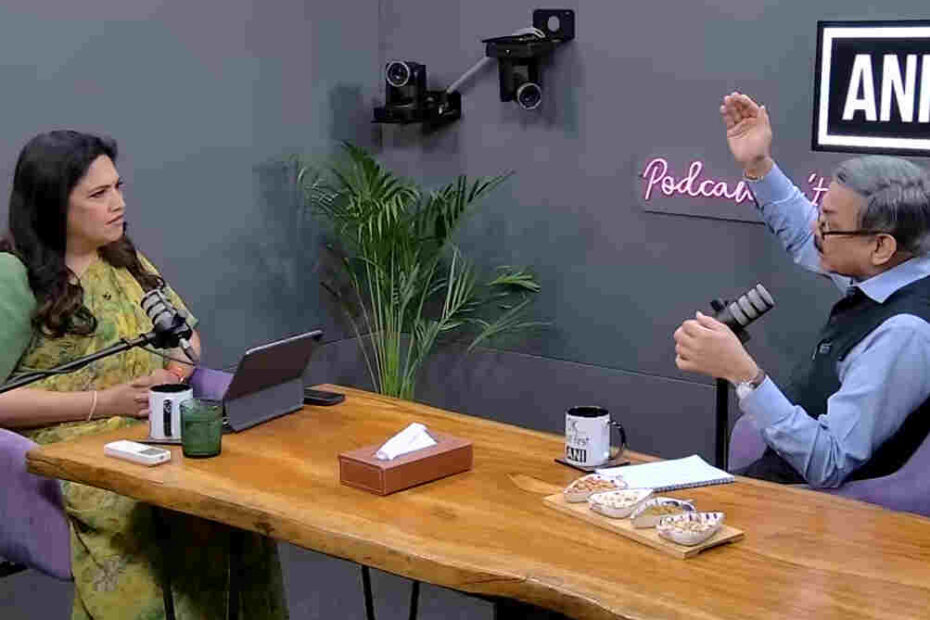
Read the full transcript of neurologist Dr. (Col) Joy Dev Mukherji’s interview on ANI Podcast with Smita Prakash (EP-367) episode titled “Yoga, Stroke Among Youth, Gym Myths, Brain Health & Diabetes”, Premiered November 22, 2025.
India’s Growing Stroke Crisis
SMITA PRAKASH: This episode is powered by easemytrip.com. Namaste. Jai Hind. You’re watching or listening to another edition of the ANI podcast with Smita Prakash.
India records 18 lakh brain strokes a year. My guest today is Dr. J.D. Mukherji, Neurologist, Vice Chairman and Head of Neurology at Max Super Speciality Hospital in Saket, New Delhi. He served for 23 years in the Armed Forces medical service and at the Army Research and Referral Hospital in Delhi.
The conversation today is about why frequent brain strokes are happening. India records a brain stroke every 20 seconds. How to recognize it early, like sudden weakness, difficulty in speaking or loss of vision and what to do about it.
Thank you, doc for coming to the podcast today. Doc, I want to talk to you about the rising cases of strokes which are happening. The latest I’ve read is that 18 lakh new brain strokes every year in this country. So I want to know what is it and why is this increase happening? If there is something that is to be concerned about?
And it was seen that strokes was something which the elderly had. In our office itself, now we’ve had cases where young guys in their 30s, they’re getting strokes and stuff like that. So why is this happening? For people under 40s, what should we look out for? So if you could give me a little bit.
DR. (COL) JOY DEV MUKHERJI: First of all, thank you very much for giving me this opportunity to talk to you. See, stroke has always been the number three killer in the country.
SMITA PRAKASH: Okay.
Understanding Stroke: Traditional and Emerging Risk Factors
DR. (COL) JOY DEV MUKHERJI: And the worst thing about stroke is that it causes a lot of disability and mortality as well. So stroke needs to be seen as an emergency always.
Now the classical causes of stroke were hypertension, diabetes, smoking, sedentary lifestyle, lipids. These are the earlier causes, but there are new causes which are coming in young stroke. We have something called young stroke, stroke in young, which is less than 30 years, 40 years like that.
Now there we are finding that there are many other things which are causing it. For example, there is a blood component called homocysteine. Rise in homocysteine causes clots, clot formation. Then there are other pro-coagulant factors. Pro-coagulant factors means those which promote coagulation in the blood vessels.
Now there’s protein C, protein S deficiency and apolipoprotein. All these can cause clots in the brain. Now these were not identified earlier and now we are identifying them. These are newer risk factors which have come in.
Then there may be a small hole in the heart which has not been detected earlier. We found that many people have that. There’s a called a PFO, perforated foramen ovale, that can also cause a lot of stroke.
Then the sedentary lifestyle and also neck massages. I want to highlight this. People undergo a lot of neck massages at their barber shop and that can cause what we call as a dissection of the carotid artery. What happens is the artery has got a wall. Now if there’s a breach in the wall, the blood enters that wall and there’s no blood supply distally, that means upwards towards the organ. So that can also cause stroke.
SMITA PRAKASH: But you don’t get to know when the massage is happening. You get to know…
DR. (COL) JOY DEV MUKHERJI: But by the time this happens, we can get to know because we take the history properly. So a lot of strokes are happening because of these reasons also.
SMITA PRAKASH: Okay.
Young People and Stroke Risk
DR. (COL) JOY DEV MUKHERJI: I think there are a lot of youngsters who do gym and they think that we are fine, but their lipids may be awfully bad. They may be smoking, even vaping hashish. All these are risk factors for stroke. They may not have been well documented, but we are seeing them every day.
Young people, you are very right. Every day we see 30, 40 years age group coming with strokes. Even while gyming, they may have a dissection of the artery.
SMITA PRAKASH: Yeah, one of my cameramen, he was interviewing a cardiologist talking about heart conditions and happening and suddenly he just fell and he’d had a brain stroke while he was doing the interview. Young guy, looks very fit, but obviously something must have been wrong which happened.
So I want to get this. When you talk about lifestyle problems like you’re saying sedentary work, not realizing lipids, stress factors, how is one supposed to figure out that, okay, I am heading towards this problem area? Where should one watch out for?
Lifestyle Modifications and Prevention
DR. (COL) JOY DEV MUKHERJI: So all the risk factors should be done away with like smoking, alcohol, excessive alcohol. People take a lot of alcohol now. So alcohol, smoking, sedentary lifestyle and good vegetarian diet and avoid all fatty food. All this must be completely eliminated from your day to day life.
SMITA PRAKASH: Most vegetarians think that they are very healthy, no?
DR. (COL) JOY DEV MUKHERJI: But if they take fatty food then the purpose is defeated. So they have to be very, very… You have to do mindful eating. Okay? Mindful eating is eating the right thing at the right time and in time.
Then work-life balance. People are partying till late in the night and early morning they have stroke. The other thing which I just wanted to allude was that hypertension, hypertension is a silent killer. You have no symptoms for hypertension.
So stroke, as I said, were two types. One is the ischemic stroke and one is a hemorrhagic stroke. The hemorrhagic strokes are where there’s a bleeding which happens because of the rupture of an artery. An ischemic stroke is when there’s a clot within the artery and there’s further blood supply is delayed or stopped.
SMITA PRAKASH: Okay, but in which case is it that one doesn’t have time to see the reaction?
Emergency Treatment: The Golden Window
DR. (COL) JOY DEV MUKHERJI: So an ischemic stroke where there is a clot, we have to reach the hospital within four and a half hours because that is the time where we can thrombolyze that stroke. Most people take a very slower route. Either they go to the local physician or they go to the local doctor. And as a result, what happens is timely help doesn’t come in.
Then there is something called wake up stroke. Now this is interesting thing which I’ll tell you. People went to sleep normally, but they wake up with stroke. They can’t speak and one side is weak. Now those patients earlier, we were saying, no, we can’t do anything. But now we have a special imaging technique in the MRI which we call as the FLAIR. If the FLAIR is negative for stroke, we thrombolyze them.
Then those strokes which happen in the back of the brain, which we call as posterior circulation stroke, in certain selected cases, we can thrombolyze them till 24 hours.
SMITA PRAKASH: Explain thrombolyze.
DR. (COL) JOY DEV MUKHERJI: Thrombolyze is basically a clot buster which we inject within four and a half hours for a normal ischemic stroke. And it can blast that clot which is causing the decreased blood flow to the brain. So that is very, very useful.
And we also have something called mechanical thrombectomy which we can perform up to six hours in a stroke. Okay, so if a patient comes well within the time of six hours or four and a half hours, within four and a half hours, we will do thrombolysis. And within six hours we can do thrombectomy.
Now thrombectomy is usually done for a large vessel obstruction. The carotid artery and the first vessel which comes out, we can do a mechanical thrombectomy. That means a catheter is put inside the brain. I mean it goes up to the brain and you will suck out that clot. So all these developments have happened to give you a rough…
SMITA PRAKASH: Doesn’t it damage the brain when you suck out the clot?
DR. (COL) JOY DEV MUKHERJI: No, nothing. The techniques are very refined and advanced and it is very, very great and it is very, very gratifying.
Okay, the problem, I’ll tell you where the problem is. We get approximately 1,000 strokes in Delhi. That’s a very rough approximate. But only about 10% of them get the proper treatment. The lack of information, the lack of education, the lack of knowledge that all this is amenable to treatment is something which is impeding our management of stroke.
Recognizing Stroke: The FAST Protocol
SMITA PRAKASH: A major problem is reaching the hospital on time.
DR. (COL) JOY DEV MUKHERJI: Right.
SMITA PRAKASH: And convincing somebody that they need to reach the hospital on time. What is the process? If suppose one gets to know that your sibling or your father or your mother is exhibiting signs of stroke, they should reach the emergency first or they should seek an appointment with the neurologist? Please explain the steps to be taken.
DR. (COL) JOY DEV MUKHERJI: If four things happen, like your speech gets disrupted, your face droops and your arm droops, these are called the FAST. T is time, F is face, A is arm, S is speech, and T is time.
Please reach the nearest emergency hospital, which is a big hospital where they do stroke work. And every physician today can do stroke management. Every physician, any MD medicine can do a stroke. He can at least diagnose it. Well, a CT scan is all that is required to diagnose a stroke. That means you look, there is no bleeding. You can give that clot buster yourself or you can send it to the nearest hospital where this clot management can be done for strokes.
SMITA PRAKASH: When you say you, you mean the emergency doctor.
DR. (COL) JOY DEV MUKHERJI: Yes. They should not take an appointment. They should go to the emergency.
SMITA PRAKASH: They go to…
DR. (COL) JOY DEV MUKHERJI: The system will take care of it then.
Essential Health Screenings and Prevention
SMITA PRAKASH: Okay, let’s get back to the lifestyle factors, doc, because I don’t want to scare the audience, but I want everyone to understand what are these medical factors like you were talking about? Hypertension, diabetes, cholesterol. So what are the tests that one should do on a regular basis? Is it once in six months, once in three months? The age group that should do it more often.
DR. (COL) JOY DEV MUKHERJI: Anyone above 25 should do an annual medical examination. He should get his blood pressure checked, he should get his sugar checked, he should get his lipids checked. And this is to be done on an annual basis.
And he should get his blood work done. Basic blood work should be done, that is his blood count. Supposing somebody has a hemoglobin of 18, he can get a stroke because the blood is very thick. That is called polycythemia. So those kind of people also need to get their blood test done.
So annual blood work, checking of blood pressure, diabetes is the basic minimum that should be done by every individual.
SMITA PRAKASH: Okay.
DR. (COL) JOY DEV MUKHERJI: And he should not smoke. Alcohol within limits. I think there’s nothing like defined within… What is limit?
SMITA PRAKASH: Limit.
DR. (COL) JOY DEV MUKHERJI: Yeah, there’s no definition for that. And all high risk behavior should be avoided. Sleeping late in the night and partying till late in the night. All this disrupts sleep and that can also ultimately cause, can lead you towards stroke.
The Danger of Sleep Deprivation
SMITA PRAKASH: Yeah, and the other thing which happened was that when those sudden stroke related deaths which happened with celebrities and when I was speaking to some of these trainers and all and they were saying that these celebrities party late night or their meetings, late, after that meetings. So they end up sleeping at 2 o’clock or whatever.
But they book their gym trainers at 5 a.m. or 6 a.m. which means that they have not slept more than three hours or four hours. They reach the gym because they have to, because bodybuilding is part of their requirement. It’s their job. They have to look a particular manner. So with four hours of sleep they book their gym trainers, they come and exercise and very healthy people get their strokes where the heart or brain and collapse.
DR. (COL) JOY DEV MUKHERJI: They apparently look healthy. But they may be having blood pressure, they may be having a cardiac issue. They have not got themselves investigated or got themselves checked up in time. So that, I think that is a factor which troubles them.
Genetic and Environmental Factors
SMITA PRAKASH: Also genetic factors. If you could tell me, do genes play a role in strokes? Like one hears diabetes, “oh, it runs in the family,” those kind of things. What about strokes?
DR. (COL) JOY DEV MUKHERJI: So genetics in stroke is not a direct relationship. They are multifactorial strokes. As I told you, these are multiple risk factors. Directly, if somebody, my father had stroke, I will have stroke. That’s not correct. So that doesn’t happen.
There are very rare conditions in which, probably it’s not required to know, where you can get strokes. They are very rare. The Fabry’s disease is there, for example. The artery itself is defective. That can run in families like that. But those are very rare. So stroke is not a genetic disease by and large for consumption of normal people.
SMITA PRAKASH: Okay. Environmental factors, air pollution, big time.
DR. (COL) JOY DEV MUKHERJI: Air pollution has not been graded as a risk factor for stroke, but for dementia it is proved.
SMITA PRAKASH: Okay, okay. How is dementia related to stroke?
Air Pollution and Brain Health
DR. (COL) JOY DEV MUKHERJI: So exact mechanism is not known, but it has been found. There is a statistical correlation. If there is air pollution, besides other diseases like lung diseases, dementia has been found that places where there is increased amount of particulate pollution, you get dementia.
SMITA PRAKASH: How does that work?
DR. (COL) JOY DEV MUKHERJI: Exact mechanism is still not elucidated, but probably what I can guess, it causes neuroinflammation which leads to neurodegeneration and that causes.
SMITA PRAKASH: So pollution leads to inflammation of your neurological.
DR. (COL) JOY DEV MUKHERJI: Yes, yes, well known.
SMITA PRAKASH: Well, I thought it’s just lungs.
DR. (COL) JOY DEV MUKHERJI: How is it brain too? It goes into the blood.
SMITA PRAKASH: Correct.
DR. (COL) JOY DEV MUKHERJI: It goes into the blood and blood goes everywhere.
SMITA PRAKASH: Yeah. Okay. So what is one supposed to do? Because this is not in your control.
DR. (COL) JOY DEV MUKHERJI: So as I again I’m going to say control your weight, control your blood pressure, control your diabetes, control your cholesterol. Lipid. As of today, lipids are important. Control your exercise. Have decent amount of exercise. Walk every day for 30 minutes or 20 minutes. Don’t smoke, don’t drink too much. These are the simple precautions that one has to take.
The Truth About Yoga and Stroke Prevention
SMITA PRAKASH: But doc, when there are many people, you hear “yoga karo, stroke nahi hoga.”
DR. (COL) JOY DEV MUKHERJI: No, no. Doing Yoga doesn’t say that you will not have stroke. If you have a cholesterol, how will yoga help? And if you have hypertension, how will it help? You have to take medicines for hypertension, you have to take medicines for diabetes, you have to take medicines for lipid. And if you have a heart condition, how will yoga save you? Yoga is good, but it is not going to prevent a stroke.
SMITA PRAKASH: There is also resistance towards medications which are lifelong dependency. Medication in the sense that if you start hypertensive medicine, medicine for hypertension, it’s something that you have to take lifelong, like insulin. For diabetes. We don’t want to go on insulin. We’ll try and manage our weight, we’ll try and manage our sugars.
When the other thing is that, you know, in India, lots of times the doctors, we have very sweet bedside manners. They don’t. They suggest to the patient insulin. Now many times what happens in India, I’ve noticed is that older people have this thing. We don’t want lifelong medication because then it’s money first that they have to spend that much of money. They have to tell their children that, you know, “itna paisa kharchega,” they don’t want that dependency on children. There’s many factors which work. So tell me, at what stage is it that it is a “ye jaan le vahe”? You have to do it.
Lifelong Medication: When It’s Non-Negotiable
DR. (COL) JOY DEV MUKHERJI: So it’s a very important question that you have raised, an important situation also, because there are certain diseases where you have to take medicines for life. For example, if you have hypertension, you have to take more or less. You have to take for life. If you have diabetes, you have to take, you have to monitor your blood sugar. There’s no way on that.
If you don’t monitor your blood sugar, you will have some complications. You will have a neuropathy or a retinopathy or a kidney failure or something like that will happen. So there is no escape from that. What is I think important is the financial part of it. That part of it is really beyond us. It is a part of the federal government to take care of that.
There has to be an opportunity where these lifestyle diseases need to be managed lifelong. So you have to take medications. There’s no, there’s no option. I don’t want to take. Yeah. Whenever doctors tells that you have to take insulin, that means there’s a requirement. He won’t tell you just like that.
SMITA PRAKASH: Yeah. Because diabetes, now they’re saying it’s like an epidemic in this type 1, type.
DR. (COL) JOY DEV MUKHERJI: Type 1 diabetes, you require insulin every day.
SMITA PRAKASH: Yeah.
DR. (COL) JOY DEV MUKHERJI: And there are many type 2 diabetes who fail to respond to normal oral drugs. So they have to take and then.
SMITA PRAKASH: It becomes a neuro issue or a cardio issue.
DR. (COL) JOY DEV MUKHERJI: Complications happen. I mean, diabetes can affect so many things.
The Growing Threat of Substance Abuse
SMITA PRAKASH: It will become, that is the next stage. It will affect some organ or the other. You spoke about substance abuse, alcohol doing, soft drugs, recreational drugs. Yeah. How serious is this now? Because I’ve heard parents talk about this, that school going children. Recreational drugs is very common now.
In my time it used to be at college level that one heard about it or one saw it happening. But now it’s at high school level in India and in states like Punjab and in the northeast and in Kashmir. It’s become, it’s commonplace.
DR. (COL) JOY DEV MUKHERJI: So I will respond to it like this, that in no way can we justify using drugs. Unfortunately it has become so rampant that it is getting a social acceptance which is incorrect. Absolutely harmful to the core. Any kind of drug will cause all kinds of problem. It can cause strokes. Well known. Even cannabis can cause strokes. Well known.
It can cause headache and it can cause lungs problem. It can cause cardiac problems. This is well known and people take it because it is being propagated by the powers that be who are behind these pushing these drugs that it is good and it is harmless and all that. All that is being propagated. I feel there is a ulterior motive behind it. It is clearly unequivocally, it is harmful.
SMITA PRAKASH: And when you say powers that be, you’re talking about Hollywood celebs and all that.
DR. (COL) JOY DEV MUKHERJI: I would not like to allude to that. But whoever they are, I think it’s wrong. It’s absolutely wrong.
SMITA PRAKASH: Party drugs say no.
DR. (COL) JOY DEV MUKHERJI: Absolutely no. Strictly no. Yeah, there’s nothing like a party drug. It is all being pushed as a party drug. It has been colored as a party drug as if it’ll enhance your, some psychedelic mind or something like that. But I think it’s absolutely wrong. It’s dangerous. It’s yeah, unequivocally dangerous.
SMITA PRAKASH: It’s just like I think drinking, which you know all the Punjabi songs and things like that was all about “oh, drink and have fun.” And you know, they made it socially acceptable to be. So you had all the top heroes doing a drunken scene. For certain in every movie which started off in the 80s till the 70s it was not there.
Your heroes were, you know, Mr. Goody Two Shoes who never drank, didn’t smoke. It was the villains who did that. But somewhere that changed. And when your heroes in the films are doing it then it became acceptable to be drinking it. Drinking to be drunk. Not party drinking but drinking to be drunk. And then we’re seeing alcohol related issues in Punjab. It’s very serious in this.
So now tell me, are you seeing a trend of youngsters coming to you with party drug related strokes?
DR. (COL) JOY DEV MUKHERJI: Yes, definitely. Definitely. Okay, I see maybe not too many of them but once in a week we see a patient, young boy, 20 years, 30 years with a party related stroke or a party drug related neurological.
SMITA PRAKASH: Problem which is like what a tremor or seizures.
DR. (COL) JOY DEV MUKHERJI: Seizures, epileptic activity. When we do a urine screening then we come to know he’s been taking this drug.
SMITA PRAKASH: What about energy drinks?
DR. (COL) JOY DEV MUKHERJI: I think they are fallacious. I don’t think they give any energy. It is better to have normal khana pina dal, sabji roti. I think these energy drinks are basically commercial products which are being pushed by the commercial.
SMITA PRAKASH: Are they dangerous?
DR. (COL) JOY DEV MUKHERJI: I will not say they’re dangerous but I will say that they are really not worth it the amount that we spend on it.
Warning Signs: What to Watch For
SMITA PRAKASH: Okay, let’s get to warning signs which all of us should know with regard to our parents, with regard to ourselves and increasingly with regard to children also those who have, you know, if you’re seeing it in dizziness and if you’re seeing drooling like you said. So tell me how does one think of it that dizziness or is it stroking?
DR. (COL) JOY DEV MUKHERJI: So about dizziness, I will tell you there are dizziness has got three causes. One is a ear cause, other is a brain cause and third is a cardiac cause. So as a doctor I will like to delineate between these three things.
Now the clue is that when it is related to a posture, a dizziness which is posture related, when I go to the left side I get dizziness. When I go to the right side it doesn’t happen likely to be ear related. Basically the connection from the ear to the brain is faulty.
Now let me explain this a little bit more. The ear has got three parts, the external ear, the middle ear and the inner ear. The inner ear has got three canals which are at right angles to each other in which some fluid moves. Now due to some reasons there’s a crystals are formed. Now they drag the fluid beyond what it should be moving. When you are moving ahead. Now that gives a false sensation of rotation to the brain. So you perceive that you are having a dizziness.
Now certain strokes, those which happen to the back of the brain, they can also permanently cause this dizziness. But they are not, they don’t change with the posture.
SMITA PRAKASH: Okay.
DR. (COL) JOY DEV MUKHERJI: They are fixed. Cardiac ones happen with palpitations with some cardiac clot going up to the brain that can cause how you know that.
SMITA PRAKASH: It’s not vertigo and it’s just same.
DR. (COL) JOY DEV MUKHERJI: But this is dizziness, vertigo, giddiness. These are interchangeable terms used by people. Interchangeably.
Understanding Migraines
SMITA PRAKASH: Okay, but it’s like you keep hearing women or it’s wrong to say women.
DR. (COL) JOY DEV MUKHERJI: So pain ektarfa is migraine. By and large it is migraine. There are certain rare conditions which can mimic migraine. But ektarfa, pain for a young boy, we will consider that as a migraine, especially if there is no associated redness of eye.
There are many conditions which mimic migraine, but migraine is typically one sided. Headache comes frequently. There are triggers, specific triggers, like you should remember the five C’s. Coffee can cause. I’m giving it down.
SMITA PRAKASH: Okay, okay.
DR. (COL) JOY DEV MUKHERJI: Colas, citrus, food, all this can cause a cheese and chocolate.
SMITA PRAKASH: You just describe my diet to me right now.
DR. (COL) JOY DEV MUKHERJI: So all these called the five Cs, they can manifest with migraine. Migraine is an extremely common disorder. Even I suffer from migraine.
SMITA PRAKASH: Yeah.
DR. (COL) JOY DEV MUKHERJI: And it is, it is ubiquitous. You know, you see any youngsters having one sided headache, you presume it is migraine. Of course, we do certain tests before we.
SMITA PRAKASH: But how do I know that this migraine is just migraine and it’s not.
DR. (COL) JOY DEV MUKHERJI: So this is clinical judgment. Clinical judgment. First of all, it is intermittent. It is not a regular constant thing. It comes and goes and it comes when you are hungry. It comes when you’re sleeping. Late in the night, you are going to bright sunlight. Then it can precipitate migraine. Okay? One sided headache, throbbing. And you don’t like lights. Then you don’t like sounds. You want to sleep it over.
SMITA PRAKASH: Smells, bother.
DR. (COL) JOY DEV MUKHERJI: Smells, yes. Strong odors can cause it. Perfumes, strong perfumes can cause it. The many triggers, but some of the common ones I mentioned is hunger. Bright sunlight, exposure and strong perfumes or strong odors. It could be a petrol, for example. The odor of petrol itself can cause.
SMITA PRAKASH: And it is.
DR. (COL) JOY DEV MUKHERJI: You have to customize the treatment for the patient. Everybody’s is different. Everybody’s different. But there are a lot of new things which have happened in migraine.
Headaches vs. Stroke Symptoms
SMITA PRAKASH: Okay, so when somebody complains of a headache, it’s not necessarily a indication of a stroke, but watch out, would you say?
DR. (COL) JOY DEV MUKHERJI: See, the headache associated with stroke is very different. There you become drowsy, there is altered sensorium, there is confusion. That is called like there’s a leakage of the leakage from the artery that is called subarachnoid hemorrhage. So that headache is like the worst headache of his life.
But if somebody gets a slowly building up headache on one side, it is likely to be migraine. Likely to be migraine. But it needs conclusive.
SMITA PRAKASH: People with fluctuating blood pressure, they also have this dizziness spells and things like that. So how do we know that at that point of time this is a serious situation?
Transient Ischemic Attack (TIA): A Warning Sign
DR. (COL) JOY DEV MUKHERJI: And it’s like what I understand from what you’re asking me is there is something called a transient ischemic attack or a postural hypotension. TIA. TIA is a small temporary stroke. Basically, the blood supply to that part got stopped and restored later on. Restored later on, say after. Officially it is supposed to be 24 hours, but within few minutes, if it gets restored, it’s a TIA because they.
SMITA PRAKASH: Slur for a few minutes.
DR. (COL) JOY DEV MUKHERJI: Yes.
SMITA PRAKASH: And. Or they talk random things and then it comes back.
DR. (COL) JOY DEV MUKHERJI: But that is very dangerous because that is like a sign for an impending stroke.
Understanding TIA and Its Importance
SMITA PRAKASH: Oh, I see.
DR. (COL) JOY DEV MUKHERJI: Yes. So they should be investigated thoroughly. Why is it happening? Does he have a risk factor? Are the arteries blocked? A small clot has gone from one artery to a larger artery to a small artery, or a clot has traveled from the heart to the brain. So they are dangerous and they need to be looked into it.
SMITA PRAKASH: So immediately go and get an MRI or a CAT scan.
DR. (COL) JOY DEV MUKHERJI: Whatever the doctor decides.
SMITA PRAKASH: Whatever the doctor decides. So TIA is not to be ignored.
DR. (COL) JOY DEV MUKHERJI: Not at all. A TIA requires the same treatment as stroke, but not the thrombolysis.
SMITA PRAKASH: Okay.
DR. (COL) JOY DEV MUKHERJI: So that should be done.
Panic Attacks and Stroke Connection
SMITA PRAKASH: And panic attacks, anxiety attacks, how are those connected with strokes? One would presume that it’s connected with cardiac issue.
DR. (COL) JOY DEV MUKHERJI: See, panic attacks and anxiety attacks are emotional issues. Reaction to an emotional situation. That not necessarily mean that there is a stroke happening.
SMITA PRAKASH: You can have a stroke. Does it cause blood supply alterations?
DR. (COL) JOY DEV MUKHERJI: It can raise your heart rate, it can raise your blood pressure, stress and stroke. But necessarily directly, it does not cause stroke.
Prevention and Lifestyle Changes
SMITA PRAKASH: Okay, prevention and treatment. Let’s get to prevention and treatment. You suggested lifestyle changes as a major, major issue. Sleep well, eat well, exercise, life balance. When should this happen? Work life balance. When should one start disciplining oneself? Is it in your 30s? Is it your 40s? And is it too late by your 50s?
DR. (COL) JOY DEV MUKHERJI: At all times, at all age groups. You can’t be disobeying your body. You have to respect your body. You must sleep seven to eight hours. You must eat green leafy vegetables. You must eat a lot of, you should avoid butter, cheese. All this is very clear. It is at all ages.
See, your arteries start getting clogged at 20 years of age. Or maybe the time when you’re born also. Yeah, I mean, depending on what kind of food is there, it starts getting deposited. Okay, so you have to take care of yourself at all ages. By the time you’re 60, 70, then it is already clogged. So we have to prevent it.
Diet Recommendations for Children
SMITA PRAKASH: So what would you tell young parents? What kind of diet should they concentrate on with their children, especially preteens?
DR. (COL) JOY DEV MUKHERJI: Green leafy vegetables are must, absolutely must. Because they have got antioxidants which help in improving the blood supply. They should not eat junk food. They should not eat this ajinomoto type food. Junk food means like fried food and processed food. That’s very bad. They are poison. I know the burger companies and the chicken people.
SMITA PRAKASH: That’s okay. They don’t sponsor me. So go ahead and say whatever you want.
DR. (COL) JOY DEV MUKHERJI: Like this.
SMITA PRAKASH: That’s okay.
DR. (COL) JOY DEV MUKHERJI: I put a dislike to this.
SMITA PRAKASH: I don’t, frankly, I don’t care. I want more people to lead healthier lives.
DR. (COL) JOY DEV MUKHERJI: So I’m hoping that they are dangerous food. I will classify them as dangerous.
SMITA PRAKASH: People don’t realize, and I put myself in that, I’m not trying to be holier than thou, that just adding ketchup, adding mayo to everything that they’re eating. Street food never used to be that.
DR. (COL) JOY DEV MUKHERJI: Absolutely.
SMITA PRAKASH: Street food used to be freshly made imli chutney, freshly made hari chutney. No longer. Every street food now has cheese, mayo, or ketchup.
DR. (COL) JOY DEV MUKHERJI: See all these momos and other things, they come packed with all poisonous stuff. I mean, I will not say poisonous, but they are unhealthy. They’re very unhealthy. Like fried chicken which is distributed and dispersed in bread and all is all very dangerous. It’s not good. See if you once in a while it’s okay. But if you take it on a regular basis, it’s dangerous.
SMITA PRAKASH: Yeah. Which is happening pretty often because there are many parents who say that sabzi and all. And there’s also the Instagram generation. They want to put pictures of their khana on every day basis, daily basis. So your dal chawal and all, it looks pretty messy.
DR. (COL) JOY DEV MUKHERJI: Yeah, you’re right, you’re right.
SMITA PRAKASH: So the prettier the food. So young mothers or whoever’s cooking has to make that effort to make even the leafy vegetable look pretty.
DR. (COL) JOY DEV MUKHERJI: Yes, for that. Yes.
SMITA PRAKASH: So it’s extra effort.
DR. (COL) JOY DEV MUKHERJI: Yes. Fruits, fresh fruits.
SMITA PRAKASH: Yeah.
DR. (COL) JOY DEV MUKHERJI: People are not eating fresh fruits. You eat fresh fruits, you eat fresh vegetables. You can take chicken, you can take fish. You can take other than red meat because red meat has got a lot of this thing. You can eat all that. Who has a non veg? Nobody’s stopping from eating these food. You can take skimmed milk. All this is good for your health.
Work Life Balance and Stress Management
SMITA PRAKASH: Okay. And you spoke about work life balance.
DR. (COL) JOY DEV MUKHERJI: It’s literally impossible.
SMITA PRAKASH: You know it. I mean, I don’t think even you have work life balance. I see you sitting in the hospital all the time. The pressures of work, it’s modern day commuting is a major issue. People take anywhere between one hour to three hours commuting from home to place of work. How can they get rid of that stress at that time?
DR. (COL) JOY DEV MUKHERJI: See, I think the answer again remains the same. These are standard protocols that you have to exercise a little bit. You have to take out time, 20 minutes time you have to take out to do exercise. You eat wisely and control your hypertension, control your diabetes. These things have to be done. If you have, and you need to sleep. People are not sleeping adequately now. You have to sleep seven to eight hours every day. They are not sleeping. That I emphasize these three, four things. Mindful eating, sleeping. Because they are important for all aspects of life.
The Importance of Sleep
SMITA PRAKASH: So if one is not able to sleep naturally, taking a pill to sleep, how harmful is that?
DR. (COL) JOY DEV MUKHERJI: Very harmful. See, I’ll tell you what are the dangers of not sleeping. So if you have insomnia in a short term, it’ll cause disruption in your neurotransmitters. But if you don’t sleep for long period, there’ll be neuroinflammation. And neuroinflammation leads to neurodegeneration. This is a fundamental thing which you have to understand.
Then you get forgetfulness, then you get memory lapses. Then you become irritable, then you are all the time angry. Your decision making process, your ability to understand, comprehend, analyze and judge are all impaired. Okay, if you don’t sleep well, maybe one day, two days, I can understand. But on a regular basis, if you don’t sleep well, this is what is going to happen.
Memory Lapses vs. Dementia
SMITA PRAKASH: Okay, please tell me the difference between memory lapses and dementia. I’m getting into like my issues.
DR. (COL) JOY DEV MUKHERJI: So I’ll tell you, I’ll tell you the difference. It is the intensity. So if I forget your name once and I somehow bring back the name into my mind, that’s not dementia. That is forgetfulness. If I don’t get the right word once in a while, that’s not dementia. If I forget which account from which to give the money, that is not dementia.
Dementia happens like certain serious things. Like for example, I don’t recollect your name for the next one week. That will be dementia. Or I don’t recollect where I’ve kept the keys for the next one week. Or I forget one of my aunt’s name or my child’s name or I forget where my house is. Okay, that would be a harbinger or a beginning of a dementia that one needs to be investigated in detail.
SMITA PRAKASH: Okay. It’s like I’ve noticed with some people, they drive every day from point A to point B. Suppose one day the driver is not there, they are unable to drive from that point A to point B. They are unable to do that. Is it because they shut that part of the brain?
DR. (COL) JOY DEV MUKHERJI: Yes.
SMITA PRAKASH: Or is it dementia?
DR. (COL) JOY DEV MUKHERJI: No, that’s not dementia. That you can’t call it because that’s a procedural kind of a memory. Like I forget about the route, which route to take if the driver is driving. If I have to drive myself, it will be a big, big hurdle for me so that I will not sit. But if he can’t, after driving for one month, suddenly he says, “I can’t drive anymore.” He’s confused. Instead of going east, he goes west. That would require investigation.
Understanding Writing Difficulties
SMITA PRAKASH: Okay, there are some people who, I don’t know if the term for it, suddenly are unable to write with one hand. They say I can type, I can pick up things, but I can’t write. What is that syndrome called?
DR. (COL) JOY DEV MUKHERJI: So let me clarify this part. So if you are not able to write, for example, with your right hand, if you’re a right handed person, then you will think that there is a problem with your left brain that should be investigated. Now, there can be reasons in the brain. There can be reasons in the hand.
Now, for example, the moment you take a pen and your hand starts shaking, that is what we call as a writer’s cramp. That’s a local problem. Local problem in the sense that the brain is not giving the correct signals and therefore the hand muscles are not appropriately working. That will be called a writer’s cramp. Now that is a different. You can’t write then also. And if you have a small stroke or you have a small lesion, or if you have a hematoma or a blood collection in your brain, then also you can’t write. So this requires investigation. Okay, go to a doctor. Go to a doctor. You can’t handle it yourself.
The Golden Hour Rule
SMITA PRAKASH: Okay, does that golden rule or that, does that rule apply still of the golden hour?
DR. (COL) JOY DEV MUKHERJI: Yes, if it happens suddenly, you must go within that 4.5 hours.
SMITA PRAKASH: Why is it called the golden hour or golden whatever?
DR. (COL) JOY DEV MUKHERJI: No, because what we have seen over a period of time, initially it was three hours, then it has been extended to four and a half hours and it may get extended to six hours or 24 hours. We have seen that when we do the thrombolysis, it works well and less complications. The longer that we do, the complications increase and the effectivity is reduced. That is the reason why it is called the golden hour.
Brain Function Myths and Facts
SMITA PRAKASH: Okay docs, some of these frequently asked questions which we have for you. Do we really use only 10% of our brain?
DR. (COL) JOY DEV MUKHERJI: That’s not true. I mean it all depends on what kind of functioning we are doing right now. I am using I think 70% of my brain at the moment. When I am relaxing and I am watching music, maybe I am using just 10% of a brain. I don’t think there is something like this.
SMITA PRAKASH: Okay, but one has often heard like, you know, oh, why is this person. Science has not figured out so much.
DR. (COL) JOY DEV MUKHERJI: Even when you are using 10% of your output, there’s a hell of a lot of things are involved. There’s a coordination. See your vision, then your understanding, then your comprehension, then processing it and then bringing out the information in a jiffy. So I don’t think this is true in the real sense.
Coffee and Brain Function
DR. (COL) JOY DEV MUKHERJI: Okay, coffee, it’s a double edged weapon. It stimulates, well, it can cause migraine and it can take away migraine.
SMITA PRAKASH: Okay, but I’ll tell you honestly, I mean I have migraine too, but coffee makes me alert.
DR. (COL) JOY DEV MUKHERJI: It does. It’s a very good stimulant. It’s a very good stimulant.
SMITA PRAKASH: How harmful is it? Okay, it causes acidity and stuff like that. That I get that it causes stomach related issues if consumed more than that. But for the brain?
DR. (COL) JOY DEV MUKHERJI: No, I will not say directly benefits the brain. But it can cause a stimulation of the brain and which makes you alert under tarrying conditions. And you process well, you understand well, you comprehend well. So there’s no really harm in taking coffee.
Training Your Brain for Better Memory
SMITA PRAKASH: Thank you. I hope my family is watching this. Next. Can we train our brain to have better memory?
DR. (COL) JOY DEV MUKHERJI: That’s true. For example, I read what I’ve written. Now I will forget after three days. But if I read it four times, five times, I will have a better memory. See, short term memory is stored in one place. Long term, same memory. When we want to convert into long term memory, you have to repeat it again and again. Then it gets stored as a protein across the brain.
SMITA PRAKASH: Okay?
DR. (COL) JOY DEV MUKHERJI: Okay. Yes, yes. It has got sense.
SMITA PRAKASH: Okay.
DR. (COL) JOY DEV MUKHERJI: It’s not just like that.
SMITA PRAKASH: Oh, okay. So.
DR. (COL) JOY DEV MUKHERJI: But there are some prodigies who can remember things by reading once. They are brilliant people. But majority of the people need to read it three times, four times and then it becomes the part of the brain. Or if you use it, you read, write, it improves.
SMITA PRAKASH: Correct.
DR. (COL) JOY DEV MUKHERJI: You make notes, then you remember better, isn’t it?
SMITA PRAKASH: Yes. I mean, I’ve always done that.
DR. (COL) JOY DEV MUKHERJI: We all do it.
SMITA PRAKASH: No, there are some people who don’t. I mean who can read a book and then just recite poetry.
DR. (COL) JOY DEV MUKHERJI: They are a different class. They’re a different class. I’m talking of people, ordinary people like me.
Memory and Technology
SMITA PRAKASH: Why is it that we had this, I don’t know what memory issues which are. Now we could remember phone numbers. Now we can’t remember phone numbers.
DR. (COL) JOY DEV MUKHERJI: Because we are not using that part, we are not using it. Earlier we could. We had to. We had to use it. So if you don’t use it, it’ll fade away. See, if I don’t see you for next 20 years, your name may fade away from me and you vice versa. But if I see you regularly, I’ll remember. It’s as simple as that.
SMITA PRAKASH: Okay? It’s not a defect.
DR. (COL) JOY DEV MUKHERJI: No, it’s not a defect. Not at all.
SMITA PRAKASH: But you see, little children who know how to use the cell phone. Immediately they know left swipe right. They know how to do that.
DR. (COL) JOY DEV MUKHERJI: That’s a procedural memory, like driving a car. You don’t think, “Now I’ll have to put this. Now I’ll have to do this.” It’s automatically in your brain.
Aging and Cognitive Decline
SMITA PRAKASH: How to dull with age, what happens?
DR. (COL) JOY DEV MUKHERJI: Yeah, obviously your neurons die. Every day your neurons are dying. So obviously the capacity, the RAM, if I may use the word, is becoming less and less.
SMITA PRAKASH: Okay, so how does one keep it?
DR. (COL) JOY DEV MUKHERJI: How does one increase it? Repetition puzzles, for example, training Sudoku puzzles. You have to stimulate your brain. You have to read, you have to write, you have to use your brain. If you don’t use your brain, obviously it will fade away. The memories which are there in it will fade away.
SMITA PRAKASH: So as we grow older, it’s like, I’ve noticed, we was like, “I can’t use the remote. Don’t buy me this complicated phone, I can’t use it.” Or when we are with the laptop, you ask people to do it. And increasingly in India it is there. But when you go to the west, you will see that people in their 60s and 70s do everything on their own because they don’t have house help.
DR. (COL) JOY DEV MUKHERJI: Correct. So that is, it is a necessity. Necessity is the mother of invention. So when you are going to do something again and again, you learn it. Like somebody teaches you how to use this, how to use this mobile phone. You will come to know how to send an email from a mobile phone. It’s fairly complicated. But if you teach somebody who’s 95 years old and with normal cognition will be able to do it, but requires teaching. But there’s an inherent resistance to do it that is different. Yeah, that’s an emotional, social issue.
SMITA PRAKASH: So as we age, we should pick up more.
DR. (COL) JOY DEV MUKHERJI: Absolutely. We should train continues, continue to train ourselves, continue to read, continue to listen to music, continue to see family albums. Then music, music will soothe you, it’ll calm you down. It’s one of the things, it’s very, very.
SMITA PRAKASH: For stimulating the brain.
DR. (COL) JOY DEV MUKHERJI: Yes, yes.
Brain Cell Regeneration and Neuroplasticity
SMITA PRAKASH: Okay, interesting. Can brain cells grow back once they die?
DR. (COL) JOY DEV MUKHERJI: Never. This is the saddest part. So if a stroke happens, a particular part of the brain is dead. It remains dead. But having said this, I will talk of something very interesting called neuroplasticity.
Neuroplasticity is like the adjoining brain cells or the opposite side. They relearn the processes which were being subserved by their dead cells. It’s a long drawn process. Therefore, you have to stimulate the brain. You must have noticed that people who forget to speak after a stroke, they again start speaking. Not that the brain cells which are dead are activated. It is the surrounding brain cells and the opposite brain cells which take up the function.
That is the beauty of the brain, that it can learn new functions. But it is difficult. Like it’s telling a plumber to become an electrician overnight. It will not happen.
SMITA PRAKASH: Yeah.
DR. (COL) JOY DEV MUKHERJI: It will take a lot of time to happen.
SMITA PRAKASH: And they learn new things.
DR. (COL) JOY DEV MUKHERJI: You relearn things, but not by the cells which are dead. Those are gone forever. So therefore, we try to salvage the brain by this stroke. When stroke happens, brain cells die by the million every minute. We want to salvage it. And that is precisely why the person should reach the hospital, get the stroke treatment done immediately. That is the reason. So we salvage the number of brain cells that we can.
Photographic Memory
SMITA PRAKASH: Okay, next. Is photographic memory real or a myth?
DR. (COL) JOY DEV MUKHERJI: No, I don’t have much information on this, but I feel what you see, you are able to recollect better than what you read or what you hear. Because photography memory is definitely better memory. I can tell you from personal experience. I remember your face, but I may forget your name. So I think this is not a myth. It is a reality. Exact mechanism, we’ll have to read.
SMITA PRAKASH: And there is dissonance sometimes when you can’t.
DR. (COL) JOY DEV MUKHERJI: Yeah. You can’t recollect the name. But you say, “I’ve seen him,” and it’s very frustrating. And you pretend then somehow to gather, find out his name.
SMITA PRAKASH: Yeah. So the brain is relearning that part all the time. So it is important for us to keep giving impetus.
DR. (COL) JOY DEV MUKHERJI: Absolutely.
SMITA PRAKASH: To the brain.
DR. (COL) JOY DEV MUKHERJI: Absolutely. All the time.
SMITA PRAKASH: Okay.
DR. (COL) JOY DEV MUKHERJI: The brain requires stimulation.
SMITA PRAKASH: So aging process.
DR. (COL) JOY DEV MUKHERJI: The aging process of the inability to remember things can be processed, can be stimulated by reading, writing, relearning.
Physical Exercise and Brain Health
SMITA PRAKASH: All this can happen like climbing steps. As people age, I’ve noticed that if they don’t live on a first floor, second floor, whatever. And now almost all societies have lifts. So climbing stairs is also something that people are not doing anymore.
DR. (COL) JOY DEV MUKHERJI: That’s sad. That’s sad because that is a part of inherent exercise. It’ll help you. It’ll boost your blood flow, coordination, and your muscle power will increase. So one should walk as much as you can. Walking and rising and going up the staircase is a very helpful exercise.
Dreams and Brain Health
SMITA PRAKASH: Okay. Can dreams reveal anything about brain health? This I think Naman has inserted. Can dreams reveal anything about brain?
DR. (COL) JOY DEV MUKHERJI: I wish I could say more about this. I don’t have much information. I can tell something very interesting, which family members should know. There is a type of Parkinson’s, Parkinsonism where you, or Parkinson’s or degenerative disease where people speak loud at night, they make noises. They can even attack their partners.
SMITA PRAKASH: No.
DR. (COL) JOY DEV MUKHERJI: Yes. That is called RBD. REM, REM is rapid eye movement behavioral disorder. So this could be the harbinger of a neurodegenerative disease like a dementia or a Parkinsonism, where you get, you start talking loudly at night, talk gibberish, and become violent to the extent that you can strangle your partner. You try to strangle your partner. This is RBD. And if this happens in somebody, one should look out for neurodegenerative disorders like an Alzheimer’s or a diffuse Lewy body disease, something like that. One should look into this.
SMITA PRAKASH: So, okay, several questions.
DR. (COL) JOY DEV MUKHERJI: If this happens, one should be careful.
SMITA PRAKASH: Why does it happen?
DR. (COL) JOY DEV MUKHERJI: Really, we don’t know the reasons for it. But basically it is a degeneration which happens in the brain and which causes this disruption in the neural circuits.
Dementia and Alzheimer’s Disease
SMITA PRAKASH: What’s the difference between dementia and Alzheimer’s?
DR. (COL) JOY DEV MUKHERJI: So dementia is the mother of generic name. All kinds, where you have memory losses are called dementia. Alzheimer’s disease is a particular, specific type of dementia. There are other forms of dementia.
SMITA PRAKASH: And it’s not reversible either dementia or Alzheimer’s.
DR. (COL) JOY DEV MUKHERJI: Alzheimer’s has got a particular type of mechanism. They’re basically abnormal proteins are deposited in between the cells, so the cells don’t talk to each other. The neural circuits are broken and we have no drugs to break those proteins. We are just on the anvil of improving. They are very costly, not very effective. But new drugs have come in which can break these plaques, these amyloid plaques.
SMITA PRAKASH: Okay, okay.
DR. (COL) JOY DEV MUKHERJI: Tau proteins and amyloid plaques can disrupt the neural circuitry wherein this is the way you talk, for example. There’s a lot of processing required. For example, you ask me a question, I understand, comprehend, and I respond, but that circuit is broken by the deposition of abnormal protein, which we call as amyloid protein or this tau proteins. Amyloid plaques, actually. So we have drugs now to that. We just started developing drugs to that.
SMITA PRAKASH: See, there are many people who will say that, “Oh, I tell my mother that I’m traveling on Tuesday. I’m coming back on Thursday. She will think I’m going on Thursday and coming on Tuesday.” And bar bari savage. So this is something that.
DR. (COL) JOY DEV MUKHERJI: It happens, could be the beginning of a dementia. One needs investigation. So you can do a lot of, you can do some psychological tests. There are different lobes, like the frontal lobe, the temporal lobe. We have certain bedside tests by which we can say this lobe is affected more than the other lobe.
I’ll give an example. In Alzheimer’s disease, what happens? You lose your language functions, your vocabulary shrinks considerably. Like, if I have to describe you, I will use certain 10 lines. But if I have to tell you, “smart lady,” yeah, I will, it will just come down.
There are other dementias where your behavior changes. You become aggressive, angry. You become incontinent here and there. You change your clothes here and there. That’s like a frontotemporal dementia where you’re very aggressive. So different dementias manifest differently depending for which part of the brain is affected most.
SMITA PRAKASH: Very interesting, because many years ago, Doc, I think seven, eight years ago, I wrote an article on this. And I got so much of response on that article simply because it was about dealing with dementia, Alzheimer’s. In my grandmother, she became a completely different personality. She started singing Hindi songs, which she had never sung, and she would sing and none of us had ever heard her singing.
And she started singing that. And then we figured out that what is happening is she’s going back in her mind into her youth and where she liked listening to Hindi songs, but because it was not appropriate in her youth, it was considered bad. So she was just storing it in some part of her brain which in her 90s, started coming out.
DR. (COL) JOY DEV MUKHERJI: Correct.
SMITA PRAKASH: And she started singing and smiling and doing certain things which were completely alien. We had never seen her doing that.
DR. (COL) JOY DEV MUKHERJI: So the inhibitions are gone. The inhibitions are gone. And this being an old memory, it is stored well across the brain. So that is coming out now. Now what is inhibition? You’re a newlywed girl. You will keep quiet, you will not talk much, but by the time you’re 90 years, then all that is gone. So something like that. So dementia, this can happen.
Memory Formation and Recall
SMITA PRAKASH: And tell me, since you are the brain guy, why is it that in older people, they have older memories, very clear, but newer ones, they are not able to process?
DR. (COL) JOY DEV MUKHERJI: So I think I just mentioned that also. A fresh memory, for example, some question you asked me, like this question I’ll remember for, this is called instant memory, okay? Recent memory. Instant memory. This is stored in a place called hippocampus, okay? Hippocampus, which is a part of the temporal lobe. If I don’t repeat this, it’ll disappear. But if I repeat the same question again and again and again, they’ll get encoded as a protein in different parts of the brain. So recall is easier. So the registration has to be there. Then recall is happening, okay?
SMITA PRAKASH: Also registration, sometimes what happens is, if you’re watching the news or whatever, it’s registering at that moment. And then by next day, if we are not, we don’t bring that thing back into our conscious thinking, that’s gone. Like so many times we’re watching a movie, we won’t even remember the names or who acted in it the next day.
DR. (COL) JOY DEV MUKHERJI: Because you’re not focused on it. Your subconscious mind is going on with other things. You’re just watching the movie very casually. You’re not concentrating it.
SMITA PRAKASH: Okay.
DR. (COL) JOY DEV MUKHERJI: You’re not focused on it.
SMITA PRAKASH: Okay.
DR. (COL) JOY DEV MUKHERJI: So unless it is registered well, you cannot recall it.
SMITA PRAKASH: So recall. One should exercise one’s brains for recall?
DR. (COL) JOY DEV MUKHERJI: Yes, absolutely. Okay. And what is the way to stimulate your brain? You have to do your quizzes, you have to do your puzzles, you have to do your jigsaw, you have to read, you have to write, you have to color. You can play instrument. Like if you don’t play your guitar for a very long time, you will forget about it. But the moment you do it a little bit and you then recall it. Something like that.
Impact of Mobile Phones on Children’s Brain Development
SMITA PRAKASH: How have modern machines like mobile phones or your iPads, children doing this all the time, how is it impacted?
DR. (COL) JOY DEV MUKHERJI: So I’m glad that you have touched this topic. I want to tell you, mobile phones for a kid is a strict no. I may be very harsh, but I am mentioning that it curtails his language acquisition.
SMITA PRAKASH: Explain.
DR. (COL) JOY DEV MUKHERJI: Language acquisition means the language which is spoken at home. He does not pick it up that much if he’s always all the time on the mobile. There are many disadvantages for a young boy or young girl to look at the mobile.
Language acquisition, that means the language which is spoken at home, is not acquired by him adequately. He suffers from language dysfunction. Then his social and emotional development is marred. Definitely. It is driven by what he sees as a cartoon or whatever he sees. It is driven by that.
What is the social norm at home? Who is the elder person? Who is the younger person? All that development does not happen. Yes, because he is concentrated on the mobile. So mobile is a strict no for children.
If at all it has to be done, it should be with supervision. The parent must be there. Parent must be sitting with the child and explaining everything that is required. And you have to have boundaries. Maybe one hour, half an hour, that’s okay. It should be an entertainment. It should not be a substitute to mothering or parenting. That is what is happening to keep the child engaged, busy. We tell them, okay, see a cartoon or see a movie or things like that, which is very, very dangerous and should not be done.
Understanding Overstimulation
SMITA PRAKASH: There are many who say that this is overstimulation of the brain. So explain this term, overstimulation.
DR. (COL) JOY DEV MUKHERJI: He is stimulating in a particular way. I want him to be stimulated by knowing this is the grandmother, this is the grandfather. This is the pooja room. This is play. This is your friend. This is a game. This is food. He is just doing it because it has to be done as a physiological means. But his brain is focused and concentrated there. So he doesn’t develop the other faculties which are required to be developed.
SMITA PRAKASH: Yeah.
DR. (COL) JOY DEV MUKHERJI: For overall development. So his social emotional development does not happen and language functions suffer. He doesn’t acquire. See, you and I talk so much. He picks up. Yeah, but that cartoon just speaks nonsense.
SMITA PRAKASH: True. Because I remember in the US I was with a family friend and their child was on the table with a seven or eight year old kid, not very young. And Indian food, clove agya long. So he was seeing it for the first time probably or whatever. So he said, what is this? So I said it’s clove. Like you’ve not seen this? And so the mother said that no. So I said it’s used in Indian food quite a bit. And so he says, so where do you get this? So she says it grows in Costco.
I said, grows in Costco? So I said it’s a spice. So it grows in the farms. And so she said, oh my God, I thought you get it in Costco. I was like, they have never been to a farm. They have never been to the fields and seen spices grow. So the mother thought it’s in Costco. The child has never seen spices growing.
DR. (COL) JOY DEV MUKHERJI: You know.
SMITA PRAKASH: So I think Indian families maybe it is necessary. I’ve seen now celebrities taking their children to actual farms and villages to understand this.
DR. (COL) JOY DEV MUKHERJI: It’s very important. It’s very, very important that you get to know the entire 360 degrees around you. See, how will you develop? How does a small child develop? He develops by seeing what is around. If he just sees those ducks and those rabbit and other things only on the video, how will he grow?
SMITA PRAKASH: Yeah.
DR. (COL) JOY DEV MUKHERJI: And in addition to this, it can cause eye problems because all the time.
SMITA PRAKASH: He’s focused like this.
DR. (COL) JOY DEV MUKHERJI: So his distant vision is affected. They get high myopia.
SMITA PRAKASH: Okay. So this overstimulation is the wrong stimulation.
DR. (COL) JOY DEV MUKHERJI: Absolutely. It is wrong to the extent that it should be banned.
Adult ADHD and Restless Leg Syndrome
SMITA PRAKASH: Okay. And also the fidgety attitude that happens, part of this. So the brain is sending signal to constantly do something.
DR. (COL) JOY DEV MUKHERJI: Yeah. They’re restless, then they don’t know how to relax. So if you don’t relax, adult ADHD. I see it so often. Adult ADHD, yes, yes, I see it so often. I mean, I have a neurosurgeon colleague. He’s all the time jittery. I gave him the drug and he’s much better now.
SMITA PRAKASH: That shaking of the leg, which is considered so common, you know, just. I have to physically tell people, stop.
DR. (COL) JOY DEV MUKHERJI: Like you don’t stop. So there’s a condition called restless leg syndrome. But this particularly disturbs people when they are sleeping. It doesn’t happen when they’re walking, but there’s a strong urge to move your legs when you’re lying down. That is called restless leg syndrome.
It happens due to two conditions. When your iron levels in the body are low, that happens. And the other condition which happens is genetic. So if it is low iron, you can correct it very easily.
SMITA PRAKASH: Okay.
DR. (COL) JOY DEV MUKHERJI: And you don’t have to give a medicine. But if it is genetic, it’s difficult. Now I’ll tell you a very interesting family. He’s a pilot with one of the airlines. He has restless leg syndrome. His wife, who has of course come from another family, has restless leg syndrome. And his two children also have restless leg syndrome. All four in the bed. They move their feet round the clock. So I had to give them. And they have a genetic part. So I gave them medicine and they’re much better.
SMITA PRAKASH: But it’s also a behavioral thing, right?
DR. (COL) JOY DEV MUKHERJI: No, no, not really. Not really. Not really.
SMITA PRAKASH: Okay.
DR. (COL) JOY DEV MUKHERJI: Restless leg syndrome has very little to do with behavior. It is more to do with these two things which I mentioned.
SMITA PRAKASH: This erratic.
DR. (COL) JOY DEV MUKHERJI: That is.
SMITA PRAKASH: That is a restlessness.
DR. (COL) JOY DEV MUKHERJI: That is restlessness. But restless leg syndrome is a.
SMITA PRAKASH: But you can tell your brain to stop doing that.
DR. (COL) JOY DEV MUKHERJI: You can. You can stop it.
SMITA PRAKASH: Ballpoint pen.
DR. (COL) JOY DEV MUKHERJI: You can stop it. But it comes again. It comes again. Urge. There’s an urge. It gives relief when you move your legs like this.
Addiction and Smoking
SMITA PRAKASH: It’s also like some people cannot type without a cigarette in their hand. Or they can’t.
DR. (COL) JOY DEV MUKHERJI: They can’t think also without a cigarette.
SMITA PRAKASH: They can’t think without a cigarette.
DR. (COL) JOY DEV MUKHERJI: Old timers.
SMITA PRAKASH: What is it? Is it. I think your brain telling you.
DR. (COL) JOY DEV MUKHERJI: Yeah, yeah, yeah. I think that’s an addiction. There’s an addiction. Unless you take it, you don’t feel comfortable. Nicotine is very addictive.
SMITA PRAKASH: Yeah. So can you get rid of the ill effects of that?
DR. (COL) JOY DEV MUKHERJI: Lot of effort is required. There are certain drugs which have come in which can take you off the nicotine. There are drugs for alcohol addiction also, but people don’t take it. That is a problem.
SMITA PRAKASH: But they say that even 10 years, 15 years after stopping from smoking, people can still get strokes.
DR. (COL) JOY DEV MUKHERJI: See, the average waiting time for it to have the same risk factor as a person who doesn’t smoke is 10 years. If you stop smoking today, your risk capability or your risk ability, your risk becomes the same as a person who doesn’t smoke after 10 years. So you have to wait for 10 years for the risk factor to become zero.
Brain Food and Supplements
SMITA PRAKASH: What is brain food? People keep saying it’s good for the brain.
DR. (COL) JOY DEV MUKHERJI: So the good brain food would be, for example, dark chocolate has got flavonoids. That helps the brain.
SMITA PRAKASH: How?
DR. (COL) JOY DEV MUKHERJI: We don’t know all the vitamin B, they help the brain, thiamine helps the brain. So vitamin E can also probably to some extent help the brain. So these are the good vitamins.
SMITA PRAKASH: I thought vitamin E is for complexion.
DR. (COL) JOY DEV MUKHERJI: Yeah. But it also can help the brain a little bit. Okay, so these are the. But basically you have to eat your vegetables and your dal.
SMITA PRAKASH: So you don’t say supplements, you don’t advise supplements.
DR. (COL) JOY DEV MUKHERJI: You can take supplements if you’re short of vitamin B12, you should take, if you’re short of vitamin B9. Magnesium has now emerged as one of the food. This is the new thing now everywhere it is all magnesium.
SMITA PRAKASH: Yeah.
DR. (COL) JOY DEV MUKHERJI: So and magnesium can be also used for treating migraine. This is the latest thing which has come up.
SMITA PRAKASH: Yeah. So for this do the blood test and then get to know.
DR. (COL) JOY DEV MUKHERJI: Yeah.
SMITA PRAKASH: Only if it’s a deficiency, should you take supplements?
DR. (COL) JOY DEV MUKHERJI: I think so. Otherwise additionally, magnesium is difficult to measure. But you can measure it.
SMITA PRAKASH: Okay.
DR. (COL) JOY DEV MUKHERJI: I mean it’s costly to measure it, but you can take it. Everyone is taking magnesium nowadays.
Policy Matters and Healthcare Access
SMITA PRAKASH: Okay, let me get on to policy matters. Is the government doing enough? Should we have more spent on research on neuroscience? Should we have more awareness? Should the government do something about awareness about neurological issues? What is needed at a policy level in our country?
DR. (COL) JOY DEV MUKHERJI: See, at a policy level, my submission would be that we need more awareness of the neurological conditions. You will be surprised to know deep down in the hinterlands epilepsy is still being treated by jharpuk, whereas it is an easily treatable disorder. Quite some time back epilepsy was a reason for giving divorce, whereas it is easily treatable.
Stroke management is done by putting turmeric and all that in the villages. Now that has to be stopped. That is where the policy intervention is required. And the second thing which I wanted, because the cost of treatment is so high, there has to be a cheaper, more meaningful insurance, health insurance policies for the individual. I think that is what is required so that they can afford the modern treatment.
There’s no reason why somebody who is from a village cannot take a thrombolysis. We don’t have adequate medical evacuation systems. These are the policy decisions that we have to take. Correct medical evacuation for people who are critically ill. Deeper penetration of the insurance, medical insurance and awareness. I think these three things will make a lot of difference.
SMITA PRAKASH: Yeah. Insurance is like, that’s another big issue where it’s not acceptable. They say, “Apne pata hi nahi tha.” People don’t know that they had a precondition because they don’t do annual tests. Those kind of things are there, which.
DR. (COL) JOY DEV MUKHERJI: And it can be done. You know, the penetration of. See 1.4 billion people. It’s not easy to insure everybody.
SMITA PRAKASH: Yeah.
DR. (COL) JOY DEV MUKHERJI: But the insurance penetration is very much required. There’s so many countries who have got universal insurance coverage.
SMITA PRAKASH: Yeah.
DR. (COL) JOY DEV MUKHERJI: We need to at least adopt that kind of policy because our government hospitals are overwhelmed with patients. Too many of them. You can’t do it. You can’t do justice to them.
SMITA PRAKASH: Yeah.
DR. (COL) JOY DEV MUKHERJI: And everyone gravitates to the bigger cities for treatment, which they need not come. For cold and cough, they need not come, but the people do come, still come.
SMITA PRAKASH: Yeah. Is that frustrating for you as a physician?
Healthcare Access and Patient Load
SMITA PRAKASH: Everyone. Everyone. It is frustrating because, for example, our national institutes, they are treating patients who need not come there. Normal epilepsy can be treated at a district hospital, but somehow they gravitate towards the bigger hospital.
DR. (COL) JOY DEV MUKHERJI: Okay. You know, I’ve had people who have come on the show and politicians also, who say that medical thing, doctors and things like that. You guys need a lot of PR work, which let me tell you, just like journalists do, because you say service work at ta tha medical profession, it has become karubar. How do you deal with that?
Defending the Medical Profession
SMITA PRAKASH: So this allegation will always be there. And unfortunately, we can’t employ lobbyists like the government does. So we can’t have a lobbyist to protest about this. But this is absolutely untrue. If it happens, I’m sure it happens. It must be 10, 15, 20%. 80% of us do our work very sincerely, devotedly, and with all gusto.
Nobody is into Karuvar, you know, to see 40 patients in a day and sincerely is not easy. Yeah, it is not easy. And I mean, I’m not trying to say about myself. I skip my lunch so many, so many times. Yeah, because there’s no time for having lunch. Just not there.
Why should I miss my lunch? I do it for everybody. I mean, irrespective of his economic or other background. So I don’t think this is true. 10, 20% may be there, Carver. I can’t deny that. But majority of the doctors are very clean and they work very sincerely and they work very hard to reach the place where they have reached. Yeah, it’s very difficult.
DR. (COL) JOY DEV MUKHERJI: You know, people who travel abroad, especially in Europe and in America, they should know that you can like, you can call your doctor on a Saturday or a Sunday. Here you can call him at midnight, you can call her at midnight. You can just reach your doctor at home. There’s no way you can do that in the US or in UK.
Healthcare in India vs. Advanced Countries
SMITA PRAKASH: So they have a great service. Their population is much less. Probably they can afford to do it. And we here, you go to the emergency, you are attended immediately, except maybe because of sheer number, it may not be attended, but you go to one of the hospitals, you are attended immediately.
Much faster than what is being done in the advanced countries. So I think the medical service, that’s why we are getting so many patients from international patients. We get the CIS countries patients, we get the entire African and to some extent some of the Middle East countries coming to us.
DR. (COL) JOY DEV MUKHERJI: Why did you stay back in India? Tell me one thing. Because your generation of doctors, so many got fabulous offers from the West. Why do you?
SMITA PRAKASH: So let me make this correction here. I was an MNS army officer. So obviously it is natural for me to integrate into the system. I don’t think I missed anything except maybe a better quality of life. But that is all very, very comparable and relative.
So I have had a very good tenure. I have seen the corporate world, I have seen the government machinery. Also very satisfying service I have got. I have no complaints. I don’t think I would have missed anything by being overseas because those guys mint money.
DR. (COL) JOY DEV MUKHERJI: You don’t see money is not the—
SMITA PRAKASH: Ultimate aim in life. Ultimate aim in life is job satisfaction. I have immense job satisfaction and that gives me a lot of happiness and pleasure.
Experience at RNR and Current Practice
DR. (COL) JOY DEV MUKHERJI: What was it like in RNR?
SMITA PRAKASH: And now here, see, RNR is a different experience. This is a different experience. It is an excellent hospital. It is apex hospital of the armed forces and you name it and you can get it. You are seeing a different set of patients.
Of course, what has happened is medicine has improved quite a bit. Investigations have improved. Those things are available here, but they are very costly. Unless you are insured, you pay through your nose. So that’s the difference there. I could ask for it by the right here. I have to see his pockets. Then only can ask for an investigation. So there has been an improvement in services which are available.
AI in Neurology
DR. (COL) JOY DEV MUKHERJI: Okay, Doc. I want to ask you about the role of AI in diagnosing issues with regard to neurological disorders. I’ve done a podcast before on AI and cardio, but I want to ask you about neurology also. How much is it being used?
SMITA PRAKASH: So it is not being used much, but it is going to be having a potential to be used quite a bit. So AI is going to improve our algorithms for managing patients, for example in investigational diagnosis. It is going to be a big change, game changer. It will improve our diagnostics.
For example, if you analyze 1 lakh patients of 1 lakh CT scans, you will get a different information rather than getting it from 10. So that is going to improve our algorithms. The other things which are going to have is implants. Like we are looking at an exoskeleton which will make people who are paralyzed below the waist walk or giving them a robotic arm. He can write, read with a robotic arm, even if it’s paralyzed.
I think those are the changes that I’m looking in the future. A bionic eye, somebody who’s blind and he can have a camera or a chip inserted or a memory chip inserted so that he can remember things. So I think those are the—this is a futuristic. But this is work to be done.
DR. (COL) JOY DEV MUKHERJI: Okay.
SMITA PRAKASH: And progress which can happen over a period of time. I mean maybe beyond me this will happen. But this is what I look at in future.
Robotics in Neurosurgery
DR. (COL) JOY DEV MUKHERJI: How much of robotics is used in your profession in the sense like when surgeries and all happen. How much is it used in neuro currently?
SMITA PRAKASH: Not much. But there is ample scope. Those robotics are being developed where it can do a brain surgery, spinal surgery. I think they will have a place. They will have a meaningful place and they are going to make a lot of difference. More precision will happen. But those are under development.
DR. (COL) JOY DEV MUKHERJI: Okay. Because it is being used in ortho and the other—
SMITA PRAKASH: Yes, ortho, urology. They are being used, but it is a process in development. I think they will have their place in days to come.
Clinical Examination vs. Technology
DR. (COL) JOY DEV MUKHERJI: How much of your medical practice is still meeting your patient and seeing for yourself and figuring out what’s wrong and how much of it is your dependence on AI increasing now?
SMITA PRAKASH: So there is no clinical examination without the patient. I think I will call it 90%. The history, the physical examination that gives me most of the information that I want. 10% to 20%, maximum 20%. I need to fine tune that diagnosis which I make clinically.
So I need robotics or you can say I can use the AI or I use the diagnostics. Only about 20, 25%, 70 to 75%. I make the diagnosis by history and by clinical examination. That is how I have been trained. At least my generation of neurologists were trained like that. So we still depend on that. And I also got students under me. I also try to teach them that because that is the basic. If you miss that, you can go wrong completely.
The Necessity of Medical Tests
DR. (COL) JOY DEV MUKHERJI: There’s another thing which happens is the resistance to go and see a specialist. Is that super specialist test. Bolinge mera bil aye ga dasa zaarse kam or ye hospitals. So clinical examination is only the first step towards ten different tests and another ten thousand rupees of tests.
SMITA PRAKASH: I accept this charge, but there is no way out. See, today the refinement of diagnosis has come such a long way. For example, there are mimics. There are many mimics which we need to—for example, Parkinson’s disease, you can clinically diagnose the moment the patient enters, you can diagnose.
But supposing there is a patient now when he says that you have to do a F. DOPA scan, what’s that? That’s a scan which shows the dopamine is less in particular part of the brain. So I’m just giving an example that that’s a costly test. As of today it is a costly test if the patient doubt. So how do you prove that then? You have to do this test.
There are certain conditions in which it is mandatory to do it. For example, motor neuron disease, which the cells which give the nerves die. You have to do an EMG. You can’t say, I will say this because you know you are giving a death sentence to that patient once you say ALS.
DR. (COL) JOY DEV MUKHERJI: So tests absolutely necessary. This thing is when the doctor says get a test done and if you don’t do it, then you’re risking your life. It’s absolutely even—
SMITA PRAKASH: It is not fair to the patient. Also, if you don’t do at certain tests, in certain conditions, tests must be done. Like for example, somebody is having headache, persistent headache, severe headache. If you don’t do a CT scan, it’s dangerous. You must do a CT scan. If somebody has a stroke, you don’t do a CT or an MRI. It’s not fair to the patient.
Closing Remarks
DR. (COL) JOY DEV MUKHERJI: Thank you Doc for spending this time and explaining to us. And I hope our viewers and listeners take all the suggestions and all the things that Doc has said. Eat sensibly, eat mindfully, sleep, get your rest. Work-Life balance.
SMITA PRAKASH: Not a joke. Take it seriously.
DR. (COL) JOY DEV MUKHERJI: Thank you so much Doc.
SMITA PRAKASH: Thank you.
DR. (COL) JOY DEV MUKHERJI: Thank you for watching or listening to this edition of the ANI Podcast with Smita Prakash. Do like or subscribe on whichever channel you have seen this or heard this. Namaste Jai hind.
Related Posts
- Transcript: Harvard Scientist David Sinclair Interview: FO562 Raj Shamani
- Transcript: Diary Of A CEO Interview w/ Neuroscientist Andrew Huberman
- Mel Robbins Podcast: w/ Gut Specialist Dr. Rajsree Nambudripad (Transcript)
- Transcript of FO556 Raj Shamani Interview: w/ Andrew Huberman
- Transcript of Tukaram Mundhe Interview: Nation Wants To Know With Arnab Goswami