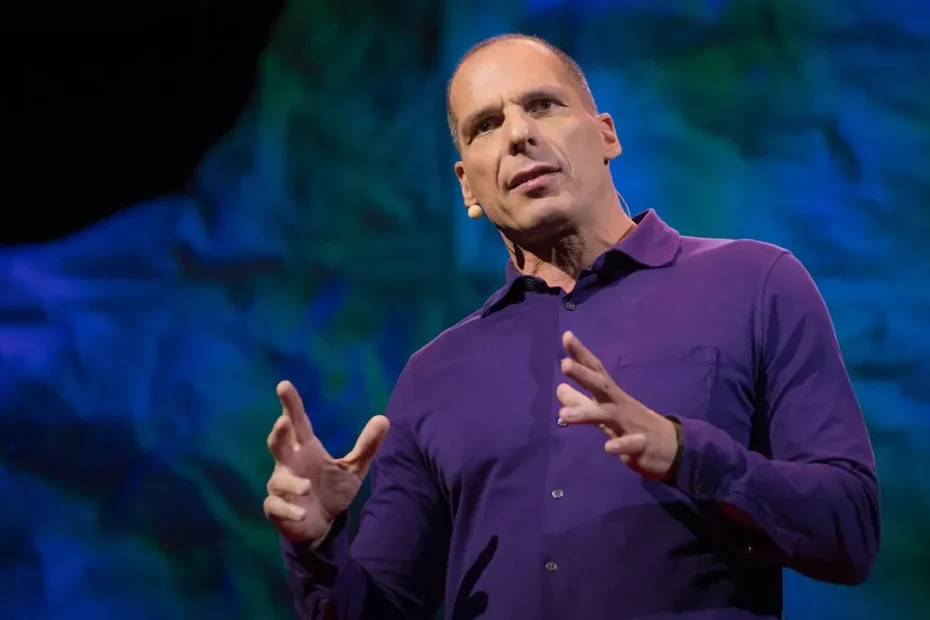
Read the full transcript of Economist Yanis Varoufakis’s talk titled “Capitalism Will Eat Democracy — Unless We Speak Up” at TEDTalks 2016 conference.
Listen to the audio version here:
TRANSCRIPT:
Democracy’s Fragility
[YANIS VAROUFAKIS:] Democracy. In the West, we make a colossal mistake taking it for granted. We see democracy not as the most fragile of flowers that it really is, but we see it as part of our society’s furniture. We tend to think of it as an intransient given. We mistakenly believe that capitalism begets inevitably democracy. It doesn’t.
Singapore’s Lee Kuan Yew and his great imitators in Beijing have demonstrated beyond reasonable doubt that it is perfectly possible to have a flourishing capitalism, spectacular growth, while politics remains democracy-free. Indeed, democracy is receding in our neck of the woods here in Europe.
Earlier this year, while I was representing Greece, the newly elected Greek government, in the Eurogroup as its finance minister, I was told in no uncertain terms that our nation’s democratic process, our elections, could not be allowed to interfere with economic policies that were being implemented in Greece. At that moment, I felt that there could be no greater vindication of Lee Kuan Yew, of the Chinese Communist Party, indeed of some recalcitrant friends of mine who kept telling me that democracy would be banned if it ever threatened to change anything.
Tonight, here, I want to present to you an economic case for an authentic democracy. I want to ask you to join me in believing, again, that Lee Kuan Yew, the Chinese Communist Party, and indeed the Eurogroup, are wrong in believing that we can dispense with democracy. That we need an authentic, boisterous democracy, and without democracy, our societies will be nastier, our future bleak, and our great new technology is wasted.
The Twin Peaks Paradox
Speaking of waste, allow me to point out an interesting paradox that is threatening our economies as we speak. I call it the twin peaks paradox. One peak, you understand, you know it, you recognize it, is the mountain of debts that has been casting a long shadow over the United States, Europe, the whole world. We all recognize the mountain of debts. But few people discern its twin. A mountain of idle cash belonging to rich savers and to corporations, too terrified to invest it into the productive activities that can generate the incomes from which we can extinguish the mountain of debts and which can produce all those things that humanity desperately needs, like green energy.
Now, let me give you two numbers. Over the last three months, in the United States, in Britain, and in the Eurozone, we have invested collectively $3.4 trillion on all the wealth-producing goods, things like industrial plants, machinery, office blocks, schools, roads, railways, machinery, and so on and so forth. $3.4 trillion sounds like a lot of money until you compare it to the $5.1 trillion that has been splashing around in the same countries, in our financial institutions, doing absolutely nothing during the same period except inflating stock exchanges and beating up house prices.
So, a mountain of debt and a mountain of idle cash form twin peaks, failing to cancel each other out through the normal operation of the markets. The result is stagnant wages. More than a quarter of 25 to 54-year-olds in America, in Japan, and in Europe, out of work. And consequently, low aggregate demand, which, in a never-ending cycle, reinforces the pessimism of the investors, who, fearing low demand, reproduce it by not investing.
Exactly like Oedipus’s father, who, terrified by the prophecy of the oracle that his son would grow up to kill him, unwittingly engineered the conditions that ensured that Oedipus, his son, would kill him. This is my quarrel with capitalism. It’s gross wastefulness. All this idle cash should be energized to improve lives, to develop human talents, and indeed to finance all these technologies, green technologies, which are absolutely essential for saving planet Earth.
The Meaning of Democracy
Am I right in believing that democracy might be the answer? I believe so. But before we move on, what do we mean by democracy? Aristotle defined democracy as the constitution in which the free and the poor, being in the majority, control government. Now, of course, Athenian democracy excluded too many—women, migrants, and, of course, the slaves. But it would be a mistake to dismiss the significance of ancient Athenian democracy on the basis of whom it excluded.
What was more pertinent, and continues to be so about ancient Athenian democracy, it was the inclusion of the working poor, who not only acquired the right to free speech, but more importantly, crucially, they acquired the right to political judgments that were afforded equal weight in the decision-making concerning matters of state.
Now, of course, Athenian democracy didn’t last long. Like a candle that burns brightly, it burned out quickly. And indeed, our liberal democracies today do not have their roots in ancient Athens. They have their roots in the Magna Carta, in the 1688 glorious revolution, indeed in the American Constitution.
Whereas Athenian democracy was focusing on the masterless citizen and empowering the working poor, our liberal democracies are founded on the Magna Carta, which was, after all, a charter for masters. And indeed, liberal democracy only surfaced when it was possible to separate fully the political sphere from the economic sphere, so as to confine the democratic process fully in the political sphere, leaving the economic sphere, the corporate world, if you want, as a democracy-free zone.
The Colonization of Politics by Economics
Now, in our democracies today, this separation of the economic from the political sphere, the moment it started happening, it gave rise to an inexorable, epic struggle between the two, with the economic sphere colonizing the political sphere, eating into its power.
Have you wondered why politicians are not what they used to be? It’s not because their DNA has degenerated. It is rather because one can be in government today and not in power, because power has migrated from the political to the economic sphere, which is separate.
Indeed, I spoke about my quarrel with capitalism.
If you think about it, it is a little bit like a population of predators that are so successful in decimating the prey that they must feed on, that in the end they starve. Similarly, the economic sphere has been colonizing and cannibalizing the political sphere to such an extent that it is undermining itself, causing economic crisis.
Corporate power is increasing, political goods are devaluing, inequality is rising, aggregate demand is falling, and CEOs of corporations are too scared to invest the cash of their corporations. So, the more capitalism succeeds in taking the demos out of democracy, the taller the Twin Peaks, the greater the waste of human resources and humanity’s wealth.
Reuniting Politics and Economics
Clearly, if this is right, we must reunite the political and the economic sphere and better do it with a demos being in control, like in ancient Athens, except without the slaves or the exclusion of women and migrants.
Now, this is not an original idea. The Marxists left had that idea a hundred years ago, and it didn’t go very well, did it? The lesson that we learned from the Soviet debacle is that only by a miracle will the working poor be re-empowered, as they were in ancient Athens, without creating new forms of brutality and waste.
But there is a solution. Eliminate the working poor. Capitalism is doing it by replacing low-wage workers with automata, androids, robots. The problem is that, as long as the economic and the political spheres are separate, automation makes the Twin Peaks taller, the waste loftier, and the social conflicts deeper, including, soon, I believe, in places like China.
So, we need to reconfigure. We need to reunite the economic and the political spheres, but we better do it by democratizing the reunified sphere, less to end up with a surveillance-mad hyper-autocracy that makes The Matrix, the movie, look like a documentary.
Star Trek vs. The Matrix
So, the question is not whether capitalism will survive the technological innovations it is spawning. The more interesting question is whether capitalism will be succeeded by something resembling a Matrix dystopia, or something much closer to a Star Trek-like society, where machines serve the humans, and the humans expend their energies exploring the universe and indulging in long debates about the meaning of life in some ancient Athenian-like high-tech agora.
I think we can afford to be optimistic. But what would it take? What would it look like to have this Star Trek-like utopia instead of The Matrix-like dystopia? In practical terms. Allow me to share, just briefly, a couple of examples.
At the level of the enterprise, imagine a capital market where you earn capital as you work, and where your capital follows you from one job to another, from one company to another, and the company, whichever one you happen to work at at that time, is solely owned by those who happen to work in it at that moment. Then, all income stems from capital, from profits. And the very concept of wage labor becomes obsolete. No more separation between those who own
but do not work in the company, and those who work but do not own the company. No more a tug-of-war between capital and labor. No great gap between investment and saving. Indeed, no towering twin peaks. At the level of the global political economy, imagine for a moment that our national currencies have a free-floating exchange rate with a universal global digital currency, one that is issued by the International Monetary Fund, the G20, on behalf of all humanity.
And imagine further that all international trade is denominated in this currency, let’s call it the cosmos, in units of cosmos. With every government agreeing to be paying into a common fund a sum of cosmos units proportional to the country’s trade deficit, or indeed to a country’s trade surplus. And imagine that that fund is utilized to invest in green technologies, especially in parts of the world where investment funding is scarce.
This is not a new idea. It’s what effectively John Maynard Keynes proposed in 1944 at the Bretton Woods Conference. The problem is that back then they didn’t have the technology to implement it. Now we do, especially in the context of a reunified political-economic sphere.
The world that I am describing to you is simultaneously libertarian in that it prioritizes empowered individuals, Marxist, since it will have confined to the dustbin of history the division between capital and labor, and Keynesian, global Keynesian. But above all else, it is a world in which we will be able to imagine an authentic democracy. Will such a world dawn? Or shall we descend into a matrix-like dystopia? **The answer lies in a political choice that we shall be making collectively. It is our choice, and we better make it democratically.**
Thank you.
Q&A Session
[INTERVIEWER:] Yanis. Yanis, you describe yourself in your bios as a libertarian Marxist. What’s the relevance of Marxist analysis today?
[YANIS VAROUFAKIS:] Well, if there was any relevance in what I just said, then Marx is relevant, because the whole point of reunifying the political and the economic, is if we don’t do it, then technological innovation is going to create such a massive fall in aggregate demand. And what Larry Summers refers to as *secular stagnation*. With this crisis migrating from one part of the world, as it is now, that it will destabilize not only our democracies, but even the emerging world that is not that keen on liberal democracy.
So if this analysis holds water, then Marx is absolutely relevant. But so is Hayek. That’s why I’m a libertarian Marxist. So is Keynes. So that’s why I’m totally confused.
[INTERVIEWER:] Indeed, and possibly we are too now.
[YANIS VAROUFAKIS:] If you’re not confused, you’re not thinking, OK?
[INTERVIEWER:] Ah, OK. That’s a very, very Greek philosopher kind of thing to say.
[YANIS VAROUFAKIS:] Well, that’s from Einstein, actually.
[INTERVIEWER:] Yes. During your talk, you mentioned Singapore and China. And yesterday night at the speaker dinner, you expressed a pretty strong opinion about how the West looks at China. Would you like to share that?
On China and Western Hypocrisy
[YANIS VAROUFAKIS:] Well, there is a great degree of hypocrisy. In our liberal democracies, we have a semblance of democracy. It’s because we have confined, as I was saying in my talk, democracy to the political sphere while leaving the one sphere where all the action is, the economic sphere, a completely democracy-free zone.
In a sense, if I am allowed to be provocative, China today is closer to Britain in the 19th century. Because remember, we tend to associate liberalism with democracy. It’s a mistake historically. Liberalism, liberals like John Stuart Mill. John Stuart Mill was particularly skeptical about the democratic process.
What you are seeing now in China is a very similar process to the one that we had in Britain during the Industrial Revolution, especially the transition from the first to the second. And to be castigating China for doing that which the West did in the 19th century smacks of hypocrisy.
Reflecting on Greece’s Economic Crisis
[INTERVIEWER:] I am sure that many people here are wondering about your experience as a finance minister of Greece earlier this year.
[INTERVIEWER:] Yes. Six months after, how do you look back at the first half of the year?
[YANIS VAROUFAKIS:] Extremely exciting from a personal point of view and very disappointing because we had an opportunity to reboot the Eurozone. Not just Greece, the Eurozone. To move away from the complacency and the constant denial that there was a massive and there is a massive architectural fault line going through the Eurozone which is threatening massively the whole of the European Union process.
We had an opportunity on the basis of the Greek program which by the way was the first program to manifest that denial to put it right. And unfortunately the powers that be in the Eurozone in the Eurogroup chose to maintain denial. But you know what happens. This is the experience of the Soviet Union. **When you try to keep alive an economic system that architecturally cannot survive through political will and through authoritarianism you may succeed in prolonging it but when change happens it happens very abruptly and catastrophically.**
[INTERVIEWER:] What kind of change are you foreseeing?
[YANIS VAROUFAKIS:] Well, there is no doubt that if we don’t change the architecture of the Eurozone the Eurozone has no future.
[INTERVIEWER:] Do you do any mistake when you were finance minister?
[YANIS VAROUFAKIS:] Every day.
[INTERVIEWER:] For example.
[YANIS VAROUFAKIS:] Anybody who looks back… No, but seriously. Yeah. If there is any minister of finance or of anything else for that matter who tells you after six months in a job, especially in such a stressful situation that they have made no mistake they are dangerous people. Of course I made mistakes.
The greatest mistake was to sign the application for the extension of a loan agreement in the end of February. I was imagining that there was a genuine interest on the side of the creditors to find common ground. And there wasn’t. They were simply interested in crushing our government just because they did not want to have to deal with the architectural fault lines that were running through the Eurozone and because they didn’t want to admit that for five years they were implementing a catastrophic program in Greece.
We lost one third of our nominal GDP. This is worse than the Great Depression. And no one has come clean from the Troika of lenders that have been imposing this policy to say this was a colossal mistake.
The Future of Europe
[INTERVIEWER:] Despite all this and despite the aggressiveness of the discussion though you seem to be remaining quite pro-European.
[YANIS VAROUFAKIS:] Absolutely. Look, my criticism of the European Union and the Eurozone comes from a person who lives and breathes Europe. **My greatest fear is that the Eurozone will not survive because if it doesn’t the centrifugal forces that will be unleashed will be demonic and they will destroy the European Union and that will be catastrophic not just for Europe but for the whole global economy.**
We are probably the largest economy in the world. And if we allow ourselves to fall into a rut of a post-modern 1930s which seems to me to be what we’re doing then that will be detrimental to the future of Europeans and non-Europeans alike.
[INTERVIEWER:] We definitely hope you’re wrong on that point. Yanis, thank you for coming to TED.