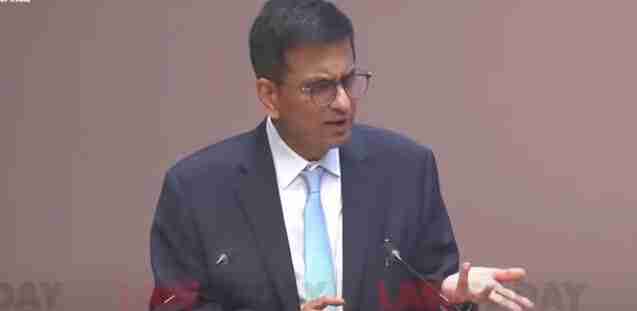
Read the full transcript of Chief Justice of India Dr DY Chandrachud’s farewell speech as the 50th Chief Justice of India.
Listen to the audio version here:
TRANSCRIPT:
DR DY CHANDRACHUD: A very good evening to everyone here this evening. Honourable Chief Justice of India designates my very dear brother and friend, Justice Sanjiv Khanna, distinguished sister and brothers, judges of the Supreme Court, Mr. R Venkatramani, the London Attorney General for India, Mr. Tushar Mehta, the Solicitor General, Mr. Kapil Sibal, the President of the Supreme Court Bar Association, Ms. Rachana Srivastava, Vice President of SCBA, Vikrant Yadav, the Secretary, and all the office bearers of SCBA, and of course, Skoda, Vipin Nair, Amit Sharma, Nikhil Jain, and all the other members, the members of the Registry, all the senior and junior lawyers who have come in such large numbers that you have truly left me humbled, my own family, but last not the least, all the former judges, both of the Supreme Court, I can see Indiradhi in the audience, of the Allahabad High Court who has come here, my dear friend Pradeep Bagel is here in the audience. Thank you so much for such a great honour. What more can I expect from life.
I will begin with a little story about flowers because I was thinking that the second bouquet was for brother Sanjiv and when the second bouquet came for me, and then there were two bouquets for brother Sanjiv as well. When I became Chief Justice of the Allahabad High Court, on an average at every bar functions, there would be about 25 to 30 marigold garlands which were placed on your collar. And of course, when I went home, Kalpana would say that, you know, these marigold flowers tend to damage your shirt and then it is very difficult to get the colour off. So I began by telling the President of the Bar Association, I said, “yeh aap phool dene ka kash na karein, kitna paisa kharsh karte hain aap.”
So he said, “nahi jee aisa nahi hai, itna pyaar hai, sabhi ka pyaar hai.” Then I said, “but Kash, aap na lein itne phool dene ka.” At which point of time he told me the eternal truth. And he said, “yeh phool aapke lein nahi dete hain, Chief sahab yeh hamare liye dete hain. Khoda sa photo-photo bhi ho jata hai aapke saath.” But sach mein, aaj jo phool mile hain mujhe, yeh mein dil se mujhe pata chala ki yeh phool mere liye the. Kyunki dil ki baatein jo chhupa hi nahi jaa sakti.
Well, it’s a moment today of thanksgiving. It’s a little bit of time for looking back in time. But before that, I would like to thank from the bottom of my heart, the Supreme Court Bar Association for organizing this event. And for all the beautiful words which have been said by each one of the speakers who preceded me. Brother Sanjiv Khanna, I mean, I’m really touched to the core by what you’ve said. Thank you so much, Rachna. Thank you Kapilji for these beautiful words in the poem. Thank you so much, Aji. And thank you really all of you for giving me this great honor together with my family.
Early Life and Influences
I don’t want to be very long, but it’s obviously a time when I must acknowledge those who have played a very critical role in my life. And who more or who better to begin with than my own mother. I was a sick child. I was prone to falling sick. My mother must have spent night after night keeping awake to ensure that I get well. And I still remember a little saying or a shloka, whatever you can call it, that she would say, which I was thinking of over the last few days. I must have heard her innumerable times saying, “Aushadhi Janvi Toyam, Vaidhyo Narayana Hari,” which meant that Aushad, medicine is like the Ganges and Vaidhyo Narayana Hari, the doctor is in the position of Narayana. I never knew what the meaning of that phrase was. I never did.
All that I knew was that it was accompanied by the bitter medicine which went into my mouth. She told me when I was born, I was growing up, that “I have named you Dhananjay, but the Dhan in your Dhananjay is not material wealth. I want you to acquire knowledge.” Like most Maharashtrian women, she was very powerful. Ours was a woman-dominated house. My mother dominated everything at home. And I think women from Oriya are in the same pattern. So my lovely spouse Kalpana takes, calls all the shots at home, but never messes around with the judgments.
We had a household help when I was young. Her name was Bhimabai Bhanubhamit. She came from rural Maharashtra, coastal Maharashtra. She was engaged because my mother had contracted typhoid and she was engaged to be with my mother to give nursing care for her. And when I was born, I was a late born child, but not fondled. I was disciplined, but not overly disciplined. I was allowed to live my own childhood without really compelling me to live the dream of my parents. They never tried to live their dreams through me. But Bhimabai Bhanubhamit was completely illiterate. In fact, she learned how to write her name when she joined our family, our household. I was so sick, but she really nurtured me and she taught me so much about life beyond the urban area that I was born into.
From her, I realized the truth about our rural households, rural Maharashtra. Most importantly, she made sure that though my father had become a judge just about a year before, a year after I was born, that I associated with people, with young friends who belong to the margins of our society. My best friend always wore two pairs of shorts. And the reason why he wore two pairs of shorts was not because he had too many, but because he wanted to hide the holes in his shorts.
Years later, I read a judgment of the Supreme Court, actually it was penned by my father about this person who was sentenced to death. And everybody, everybody who gave evidence in that case said that he was such a despicable man. He didn’t even have, he would wear shorts with many holes. But I remembered that story when I was reading that judgment, in so many which ways it reflected the true character of India, at least when I was growing up. But I learned so much from her and there’s really a day of my life when I think both my sister and I don’t remember her.
I’ll say just a few words about my father, who was a mentor, a good friend, a dear friend to me. He taught at the Government Law College and so many of the great doyens of the Bar, Fali Nariman, Soli Swarabji, Anil Deewan, Ashok Desai, all of them were his students. He was very disciplined. But he didn’t discipline us as children. He thought that we should learn the ideals of discipline looking at the way he led a disciplined life.
Two things which I’d like to share with you, otherwise I can go on forever about a parent, as all of us can. He bought this small house in, small flat in Pune. And I asked him, “Why on earth are you buying a flat in Pune? When are you going to go and stay there?” He told me one thing. He said, “I know I’m never going to stay there. But he said, I’m not sure how long I will be with you. But do one thing, keep this flat until the last day of your tenure as a judge.” And I said, “Why is that?” So he says, “If you feel that your moral integrity or your intellectual integrity is ever compromised, I want you to know that you have a roof over your head. Never allow, never allow, never allow yourself to be compromised, either as a lawyer or as a judge, because you have no place of your own.”
When I was young and I was growing up and I was in Delhi University, everyone took to, you had to do a subsidiary subject and he, all my friends were taking either philosophy, most of them were taking philosophy, which was a subject where you read for one evening and passed, you had to only pass. But my father insisted that I should take up Hindi. Now, I knew only Bombay Hindi. But he insisted that I took Hindi and it was a difficult call. But in the course of learning Hindi in college, I came across Mahadevi Verma, Jai Shankar Tripathi, Nirala, Ramdhari Singh Binkar and so many Munshi Premchand, Gabban, I must have read at least a dozen times. Just I read Cry the Beloved Country by Alan Patten later, which really inspired me. So he inspired me to do Hindi.
Almost 30 years later, when I was to go to the Allahabad High Court, I realized how important it was because very often, the advocacy in English would end with, “Please your Lordship.” And then lawyers would accept me so much better because they realized the frailties of my tongue, of my language. But they felt that I had reached out to them in a language which was close to their heart. That’s one of the lessons which I learned of trying to reach out to people in areas which make a difference to their lives.
Experience as a Judge
So the last 24 years of being a judge have been filled with challenges. They’ve been filled with triumphs. They have been filled with personal tragedies. They’ve been filled with unlimited personal happiness.
But as a judge, what is it that really makes you tick? I’ll just tell you a few incidents which have really made me tick in the last so many months. Yes, you write judgments which make a difference to the nation. You write important judgments on constitutional law. We’ve got this complexity of law before us now. The Insolvency and Bankruptcy Code, the Electricity Act, the Competition Act, you just name it and you have new and complex areas of law coming up before us. But truly, what makes us tick as judges is the impact which we have on the lives of common citizens.
Just yesterday, last week, Brother Pardival, Brother Mishra and I had passed an order allowing for two visually challenged candidates to appear at the interview of the Rajasthan Judicial Service Examination. They were ousted on the ground that they were disabled and they didn’t meet the benchmark disability requirement. After they appeared for the interview, we were told that they have qualified and they are in the select list. That’s what makes us tick.
Two weeks back, an aspiring doctor with myopathy of the lower limbs was told that his disability is more than 88%. And therefore, he was told that he cannot become a doctor. But he had scored so well in the NEET undergraduate examination. Two medical boards said that he is not worthy of becoming a doctor because his disability is very high, but his mind was brilliant. We got him examined by a third medical board and then passed an interim order that that student must be enrolled to the MBBS this year and I am sure that the student will do well.
What about the student from the IIT Mumbai, who was admitted to the IIT Mumbai, a child of a daily wager, who was not able to gain admission for the reason that the fee which he had to pay or the documents which he had to upload could not be uploaded within time. We said that he must be given admission. Or a Dalit student who was admitted to the IIT Dhanbad, but couldn’t conjure up Rs. 17,500 to gain admission to IIT Dhanbad. His sister had given him a credit card, but he was not able to operate the credit card. But we gave him admission.
What about, we are talking about now, I don’t know their names, but I will give you one more name which all of you know, about Sara Suni, one of the members of your bar, who is both, she suffers from a hearing and a speech impairment, but who needed a sign language interpreter. We gave her a sign language interpreter. So these are really things where you realize that a judge makes truly a difference to the lives of people.
Facing Fears and Challenges
When you become a judge, the first thing that you come face to face with are your own fears, because as lawyers, we can decide what cases to accept and what cases not to accept. Of course, occasionally judges can recuse, but you can’t recuse every evening. The lawyer can say that, well, I am busy in a part heard before another bench.
You have to take up everything which is dished out into your daily work under the roster prepared by the Chief Justice. And I was confronted with my own fears because I was predominantly a public lawyer, a public law lawyer. And then suddenly I was catapulted into a situation where my first sitting after 11 years as a judge on the division bench was to head the tax bench. I had done a little bit of tax work when I was the Additional Solicitor General of India between 1998 and 2000.
Confronting Fears and Learning Humility
But there I was trying to confront my own fears. How am I going to handle a tax bench, learning how to head a division bench for the first time, or to head the commercial court to deal? We didn’t have commercial courts, but these were what we call the motions court. I had no clue about how to deal with commercial work.
But that’s when you learn to be humble, because you learn the limits of your own knowledge as a judge, and how vast knowledge is, and you realize the importance of the bar in educating you. If we just step back and allow a little bit more time to the member of the bar who is arguing before you, you realize the importance of being patient, because you realize the limits of your own knowledge and the enrichment which you receive as a judge by just allowing different people speak. It may appear to be utterly irrelevant, but in that irrelevance sometimes you realize that there is some human story which is unfolding before you.
Learning from Colleagues
As Chief Justice of the Bombay High Court, I learnt a great deal from judges from the service judiciary, from the district judiciary who came to the High Court. There is a divide in the High Courts between bar judges and service judges. The bar judges are always regarded as cut above everybody else. They go on foreign holidays, which district judges who have come to the High Court cannot do. They have the kind of apparel which district judges do not wear.
But I learnt from my colleagues who are drawn from the district judiciary what a wealth of experience they had about the law actually in motion, because they had come face to face. They had come face to face with trial actions. They had an understanding about witnesses. They had an understanding about what our society is about, because as you go higher and higher into the judiciary, you become separated from and isolated from the real strata of society for whom you are intended to do justice. And I learnt so much from our colleagues who are drawn from the district judiciary. Many of them worked as registrar vigilance or registrar legal or different wings of the High Court and then came to the High Court. And to them I have a great debt of gratitude.
Experience in Allahabad
As Chief Justice of the Allahabad High Court, when I was appointed to the Allahabad High Court, before I was appointed, I was congratulated because I was told that I was becoming Chief Justice of the Delhi High Court. But then this was just the beginning of my insight into the working of the Collegium. For some reason that Delhi High Court appointment never came through, for good or bad or indifferent reasons. Then I was told I was going to be Chief Justice of the Madhya Pradesh High Court and I was delighted because I told Kalpana that we will be able to travel and see some of the good sites in Madhya Pradesh and our relatives will be able to see a lot of Madhya Pradesh. But that didn’t come through.
So we were travelling one evening from our home for an evening out in Mumbai when I got the call from Justice R. M. Lodha and he said, “We are sending you to Allahabad High Court as a Chief Justice.” And when I told my wife that I am going to the Allahabad High Court as a Chief Justice, there was a long silence in the rest of the journey. We ate our meal in absolute silence. But then I came back home and wrote a letter to the Chief Justice of India saying that I am accepting this appointment and I will be delighted to go to the Allahabad High Court. But that experience in Allahabad changed me forever. It changed my life forever.
Growing up in Mumbai, we were fond of going to nice restaurants. As judges we were members of service members of clubs like the US club. US is not United States but the United Services club run by the Army, Navy and Air Force. When we went to Allahabad, we realised that these appendages of urban life are no longer available in Allahabad. But in that little nest which we made our home, we realised how little you need in life to be happy. Kalpana and I made that our home and we gave it our everything. And in the simplicity of Allahabad, the simplicity of the lawyers, the warmth of the judges who didn’t have the artificiality that sophistications in larger cities bring, I learnt a great deal of life in the heartland of India which Uttar Pradesh is.
I travelled across the length and breadth of Uttar Pradesh, made great friends on the bench, not off the bench because as a judge you get isolated off the bench. But Allahabad really taught me such a great amount. It was a court of a sanction strength of 160 judges. When Chief Justice Thakur came for the sesquicentennial of the Allahabad High Court and I introduced him to about 117 judges which was my complement of judges at that time. He said, “Chief Justice, you have just proved me wrong.”
He had come from Patna where there was a celebration going on. And he said, “You have just proved me wrong.” And I said, “Chief, why have I proved you wrong?” He said, “I just said that there are so many judges in the Allahabad High Court that even the Chief Justice doesn’t know all their names and you know the name of every one of your colleagues.”
Well, what I didn’t tell him was the secret and the secret was that I had an album of photographs and every morning over my morning cup of tea, I would keep one hand on the name and look at the photographs and in about a month or so, I had picked up all the names. But there was even a better way. There was even a better way to understand the names of judges. In the morning over a cup of tea, I would talk to all colleagues. Some colleague would tell me, “Chief Sahib hum 80 kilometer motorcycle pe gaye the, Sunday go.” So I would figure out, you know, I would say this was the colleague who went 80 kilometers on a motorcycle on a Sunday. And then you fix the name.
The more interesting part was when during the course of the National Judicial Commission hearings before the Supreme Court, judges were not being confirmed. And a batch of my colleagues was due to end their tenure the next day. The file was with President Pranab Mukherjee. And I get a call, I get a frantic call from my Registrar General asking me. He says, “There’s a call from the President’s House that we have this judge, I will not name the judge, with an end which says Roman 4. And the President wants to know why is this judge called Roman 4? What has happened to the first three?” For instance, if it is Dhananjay Chandrachud 4, what has happened to 1, 2 and 3? So we had to go back to the drawing board, find out whether they were still in service or otherwise, because there were multiple judges with the same names.
Relationship with the Bar
But together with the bar, and how wrong your predilections about the bar can be. I was told that the bar of Allahabad can be very difficult to handle. But my experience about the bar at the Allahabad High Court was exactly to the contrary. It was a wonderfully amicable bar, a very respectful bar. But the one thing which the lawyers in Allahabad taught me is that I didn’t have to be taught this in Mumbai, because the lawyers knew me as a lawyer, as a judge. They took me for granted and I took them for granted. But the one thing which I learnt in Allahabad was that so long as you are objective with the bar, they accept you for all your foibles. All that you have to do is to lift your pen when you have heard the argument and turn to your steno and they will say, “Thank you my lord.”
They did not push their point beyond the point. So that was the kind of bar which we had in the Allahabad High Court. Ready to support the judiciary, ready to support the judges, extremely, extremely supportive of the work which we did and accepting of the change which we tried to bring about in the bar. And I had some very seasoned colleagues, Justice Vikram Nath is here, so if I had a problem I would always go to my seasoned colleagues and say, “Yes strike mitado.” And sure as anything else the strike would be over.
Of course I had my fair share of strikes in Allahabad as well and sometimes you wonder, was I really responsible for this strike? You know one thing which I am sure lot of you know that lawyer’s strikes really start with one reason but then they continue to five or six other reasons which were not the reason why the strike began. Very often lawyers would come stomping into my chamber at four o’clock complaining about something which had happened in the court.
So I would order a cup of tea and they said, “Chief saab yeh nahi baat banti hai, aapko kuch karna hai.” And I would say, “Dushmani chai ke saath toh nahi hai na.” We would sit down, have a cup of tea, discuss things, discuss things and I think these learning lessons which I learnt in Allahabad have taken me here as learning lessons for the Supreme Court. So when the members of the Supreme Court Bar Association would come, members of SCORA would come, I knew that I couldn’t find solutions to every issue that the SCBA raised or the SCORA raised but I could certainly give them a patient hearing.
Limitations of a Judge
In the court you realise that you cannot cure every injustice which comes into your plate every day as a judge. Some injustices are within the realm of the rule of law, other injustices are beyond what the rule of law can lead a judge to a solution. Because we are not knight-errants, as the Supreme Court once called a very distinguished Chief Justice of the Calcutta High Court. We are not knight-errants, we are governed by law.
But you realise that the healing in a court lies in your ability to hear. Your healing in court does not lie in your ability to grant relief. Lawyers know where the balance of a matter lies. Most lawyers accept that this is a difficult case. If they succeed, they are happy because probably the judge blinked a little bit or hadn’t read the brief as well as the judge should have. But these are some of the learning lessons of life which I have learnt.
Learning from Seniors
But there is so much that we have learnt from the bar. As a young lawyer, I began my practice in the Supreme Court but then I went back to Mumbai. It was difficult going from the SCORA to Mumbai because in the SCORA you heard some of the most seminal constitutional cases every afternoon on a Tuesday, Wednesday and Thursday. When I went to Mumbai, my first brief was to mention a case before Justice Sujata Manohar. I asked the solicitor who had given me the brief on how much are you supposed to mark for mentioning a case before the judge. So he said, “You mark, it’s your first docket.”
So I said, “But tell me how much do I mark for this docket?” He says, “Well, you know normally you mark 5 guineas for mentioning a matter but since this is your first brief, I will give you 6 guineas.” Now 5 guineas means 15 times 5 which is 75 rupees. I was allowed to mark 96 rupees which I never really got.
The Supreme Court was a completely different ball game. I remember sitting in the court in the afternoons hearing brilliance, absolute brilliance whether it was Palli Nariman, Soli Swarabji, I remember Attorney General K. Parasaran arguing for 2 hours in the afternoon with nothing but the bare text of the constitution in his hand. He was arguing an issue of legislative competence in the 7th schedule. Absolutely not a scrap of paper, no case, no precedent, just sheer brilliance on the bare text of the constitution. And that’s where we learned whether it was Mr. R. K. Garg, the redoubtable R. K. Garg, unfortunately we lost to an accident, he argued the Bearer Bonds case, whether it was Ashok Anil Deewan, my own senior Mr. Tamsin Andhiyarjuna who a member of the Bar said was ramrod straight. For him nothing but the pursuit of justice justified his existence.
When I went to Goa with Mr. Andhiyarjuna, Mr. Andhiyarjuna would never stay in a fancy 5 star hotel like many other seniors of his ilk did. We always stayed at the very modest Mandovi across from the High Court because he felt that we are not going to charge the client overly for the appearance. But I learnt a great deal of life’s lessons from Tamsin, as we called him.
On the very first day that I entered his chamber I said, “Good morning sir,” and Tamsin looked at me and said, “There are no sirs in this chamber, you better ask, learn to call me by my first name.” So this relationship was a relationship of calling each other by our first names, but obviously a relationship of great respect, of affection, of love.
So these are some of the experiences of my life which have changed me and made me the way I am. I just wanted to tell you that some of the changes we have made are in pursuance of my strong belief that sunlight is the best disinfectant. I know in so many which ways I have exposed my own personal life to public knowledge. And when you expose your own life to public knowledge, you expose yourself to criticism, particularly in today’s age of social media.
Support from the Bar and Colleagues
But so be it. My shoulders are broad enough to accept all the criticism that we have faced. The Bar has responded with tremendous support in all the initiatives which we have taken. My colleagues have responded with tremendous support in all the initiatives which we have taken towards making our courts paperless. The Chief Justice can shout from the rooftops, but if the lawyers don’t support the Chief and the colleagues don’t support the Chief, nothing can happen.
I found when I became a judge of the Supreme Court that this was a Chief Justice centric court. In the High Courts it’s completely different. The High Court works through committees. The Supreme Court is a Chief Justice centric court. The registry looks to one person, the Chief Justice. I thought that had to change. I experimented with constituting committees and my experience was remarkable.
The kind of support which I got, whether it was in terms of translation of Supreme Court English judgments into regional languages, whether it was in terms of the work of the NCMS committee on the attempt to reduce arrears, whether it was for designating senior counsel, whether it was for changing the rules or the categorization of cases. The categorization of cases had not been changed since probably 1997.
Our colleagues sat through evenings on an end and changed the categorization. I am not naming all of them because obviously I don’t want to embarrass them. By taking the names of some colleagues, I will be missing out on other colleagues. But each of my colleagues has worked beyond the call of duty and accepted the work which the Chief Justice has given them and look at what the next result today is and with that I will be wrapping up.
Transparency and Pendency
We decided to put the data of all pending cases on the public domain, all cases whether registered or unregistered. At the time when I took over as the Chief Justice, I found that there were close to 1500 files which had been stashed up in the cupboard of a registrar. I said this has to change. Every case which enters the system has to be tagged with a number.
Now I will give you some figures which will tell you the kind of work which all the colleagues in the Supreme Court have done. Between 9th of November 2022 and 1st of November 2024, 1,11,000 cases were filed. 5,33,000 cases were listed and 1,07,000 cases were disposed of. Now you have probably read somewhere that the pendency of the Supreme Court has gone up to 82,000 cases. I want to tell you the raw data and what the truth of the matter is.
Before as I said 2022, cases which were defective, which were unregistered were never put on the public domain. They were never accounted for. On 1st of January 2020, 79,500 cases were pending before the Supreme Court including what we now call as the unregistered or the defective cases. That number on 1st of January 2022 went up to 93,000 cases. On 1st of January 2024, the number has come down to 82,000 cases. So what the 82,000 cases which are pending does not tell you is that this number includes both the registered and the unregistered cases and the number has decreased in the course of two years by over 11,000 cases.
But look at the kind of support which the bar has given us by the number of cases you have filed. That shows the sense of faith which you and the public have in us. In 2020, 29,000 cases were filed in the Supreme Court. In 2023, 54,000 cases were filed in the Supreme Court. In 2024, I have taken the figures as of the beginning of this month and extrapolated them to the end of the year. About 60,000 cases will be filed in the Supreme Court. So the filing has doubled in the course of two years before the Supreme Court from 29,000 to 60,000 cases.
My colleagues, 28,682 regular cases were pending in November 2022. Today, 22,000 regular cases are pending. Why? Because on Wednesdays and Thursdays, every bench of the Supreme Court has put their heads down and disposed off old cases with your support as a bar. If you ask for adjournments, what would a judge do? But you argued those cases. 21,000 bail cases have been filed over this period of two years. 21,358 bail cases have been disposed off by my colleagues.
Collegium and Criticism
Last but not the least, I owe an eternal debt of gratitude to my Collegium for the way we have worked. To Brother Justice Sanjeev Khanna, to Brother Justice Bhushan Gawai, to Brother Justice Suryakant and Brother Justice Rishikesh Roy, we sat through the Collegium, sometimes making tough choices, tough decisions. As Mr Sibal said, you cannot always assure that a human decision is correct. It at least must be reasoned, it must be spoken to, it must be a decision which is deliberated upon.
We never had a difference of opinion. We never left a meeting with a sense of rancour. All meetings were conducted with a sense of humour, with a smile and some snacks which were thrown in by me as well for good measure. But the important part is that we never lost sight of the fact that we are not here with personal agendas at work. We are here to subserve the interests of the Institution. And in subserving the interests of the Institution, it is that we have really, in that sense, been able to scale many, many heights. I won’t give you all the data on the Collegium.
Last, may I only say this. I am sure all of you are aware of the amount that I have received in my share of trolling. I am probably one of the most trolled individuals and judges across the system. I will only say with a, with a, with a shairi. And the shairi is, “Mukhalif se meri shaksiyat samvarti hai. Mukhalif se meri shaksiyat samvarti hai. Main dushmanon ka bada ehtiram karta hoon.” But on a lighter vein, I am just wondering what will happen from Monday, because all those who trolled me will be rendered unemployed.
Family and Personal Life
Last but not the least, that is the last but not the least, a word for the family. A word for my lovely children, Abhinav and Chintan. I keep on telling them that, “Look, I hardly get to see you. Why don’t you come to Delhi? At least come here and argue your cases in the Supreme Court. I will at least see you once in a month.” And they said to me, “Dad, we will do that after. Why should we bring disrepute to your name and our name by coming here when you are a judge?” I am truly blessed, I am truly blessed to have children who have that ethos.
To our little Priyanka and Mahi, who have taught me that there is so much more to life than what we read in the dry pages of newspapers and our briefs, who really in that sense shone the light on what disability really means and how you can aspire to live a dignified life and your sense of intuition is as important or better than the intuition of any individual.
To my sister, Neema and Dilip, and my brother-in-law Dilip, who have come all the way from the US to be here, they are amazing people. They have helped me to stretch the boundaries of my own capabilities by pushing me to do much more than I could have possibly achieved.
And not finally, but most importantly, my own spouse Kalpana. She is a great friend, what can I say, a great friend, my bestest friend, my bestest friend, a staunch supporter, a fierce protector, sometimes a critic, but I know always, without a reason of bias against me in mind, but a staunch protector and great friend to me. She is a person with values. She thinks about issues and believes greatly in issues. Our little Priyanka and Mahi, in particular Mahi, was responsible for my turning vegan. Kalpana turned vegan and then I turned vegan after her. It’s a quest about leading a cruelty-free lifestyle. And Kalpana always reminds me that veganism is not just about being vegan in food, but about being vegan in lifestyle. There is so much that I learn every day from Kalpana. She has in that sense been a solid source of strength and support to me.
When we got married in 2008, Kalpana had extracted one promise from me. She said that “I’ll not wear any jewellery except the wedding ring that you give me.” She is truly that kind of a woman, a woman of character, a woman of strength.
Conclusion
Today as I am talking to you about all the memories that I have gained in the last 24 years as a judge, I suddenly feel 65 years of age today. I really felt 65 years old when my usher, Rajinder, came and touched my feet. I said, “ab to bude ho gayi hai sach me.”
My brilliant staff in the court, my courtmaster Sanjay, Gulshan, Chetan, Saroj, my brilliant staff at home, Chetan, Anju, Manish, people who would abzal my redoubtable stenographer from Allahabad, would wait till 11 o’clock in the night telling me, I would tell him, “please go home” and abzal would say, “Sir, I am just comparing what you have written with whether the judgments actually say that.” That’s the kind of staff that I have had.
The registry of the Supreme Court has been a source of enormous strength. I got into the registry, district judges who represent the diversity of India, whether it was a person from Jharkhand, somebody from Kerala, somebody from Tamil Nadu, Maharashtra, Madhya Pradesh, Himachal Pradesh, Punjab and Haryana, Assam, Orissa, you just name the state and we gave that registry a sense of diversity, diversity in terms of inclusion as well. And I have learnt so much from my registrars in the Supreme Court. They have worked beyond the call of duty.
As the famous quote goes, when our memories outweigh our dreams, we have grown old. I hope I continue dreaming about the smaller things in life from now. Every person who has had a leadership role in an institution tends to feel after me what? The deluge and how untrue it is. There is never a deluge. Institutions are resilient and they continue. But I leave the institution of the Supreme Court in the confidence and the steadfast confidence, after having worked with Brother Sanjeev for such a long time, that this court is in solid, stable and erudite hands.
My conversations with him have been over judgments, over cases, but the last conversations after his appointment have been about the administration of the Supreme Court. And sharing his ideas with me and learning about his ideas, I know that the Supreme Court has a bright future ahead. And for all my colleagues on the bench who have given me unstinted support and affection, thank you very much. I said in the court this afternoon that if I have hurt anybody, I can only say, “Micchami Dukadam.”