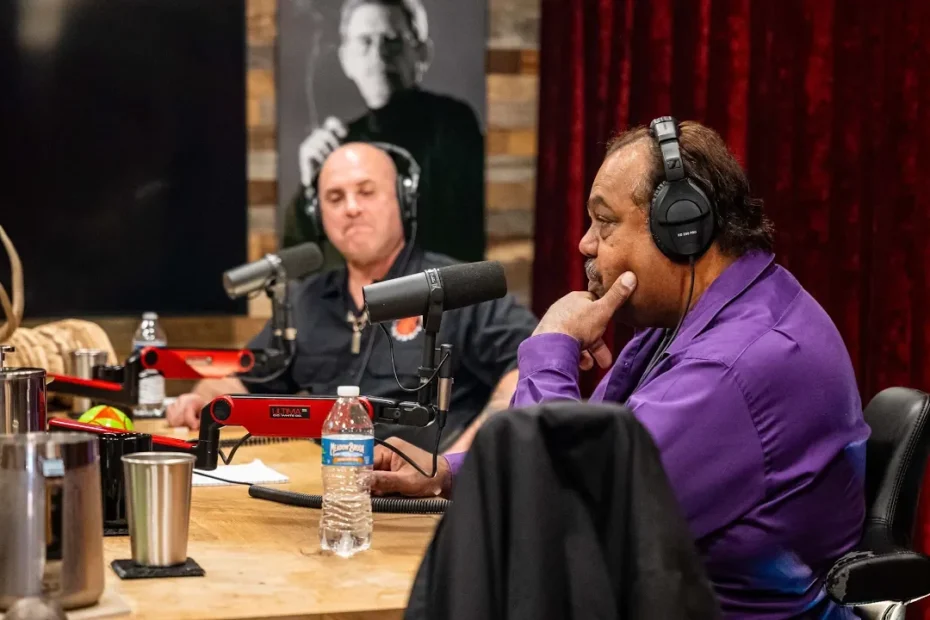
Read the full transcript of Joe Rogan Experience #2399 episode with distinguished guests Daryl Davis & Jeff Schoep on the podcast, Oct 23, 2025.
Guests: Daryl Davis is a blues musician, race relations expert, and author of several books, including “The Klan Whisperer.” Jeff Schoep led America’s largest neo-Nazi organization, the National Socialist Movement, for nearly three decades before renouncing its ideology. He is the author of “American Nazi: From Hate to Humanity.”
Meeting of Unlikely Friends
JOE ROGAN: Gentlemen, good to see you, brother.
DARYL DAVIS: Hey, good to see you again.
JOE ROGAN: How you been?
DARYL DAVIS: Good and hanging, man. How about yourself?
JOE ROGAN: I’m good, I’m good. And Jeff, nice to meet you as well.
JEFF SCHOEP: Nice to meet you, Joe.
JOE ROGAN: This is another one of your very unusual friendships, Daryl.
DARYL DAVIS: I’m trying to make it the norm, you understand.
JOE ROGAN: Well, I mean, you’re a real example of what can be done just by being a nice person.
DARYL DAVIS: Thank you, man, for the mention with Bono.
JOE ROGAN: Oh, my pleasure.
DARYL DAVIS: My pleasure.
Daryl’s Journey: Converting Hate to Humanity
JOE ROGAN: So for people that don’t know, Daryl has—I mean, how many people now have you converted?
DARYL DAVIS: I stopped counting after 200 and some.
JOE ROGAN: Daryl, his journey initially started. You’re a musician. You met a Klansman at a bar, and he couldn’t believe what a nice guy you were. You struck up a friendship, and—
DARYL DAVIS: I played like Jerry Lee Lewis, and he didn’t understand that.
JOE ROGAN: That too, the talent. And then this guy quit the Klan because of you and handed you his outfit and said, like, “I’m done. Obviously, I’m wrong. All this is wrong.” And you then went on to start meeting a lot of other Klan members and a lot of other different neo-Nazi factions. And you got a lot of these people to quit these hateful organizations.
DARYL DAVIS: Well, I got them to rethink because I gave them things, perspectives they had not considered before or not been exposed to, and that caused them to quit. You know, it wasn’t like I wasn’t trying to get them out. I was just trying to show them a different path.
JOE ROGAN: Right, but it’s just your patience and your ability to communicate to people is just very admirable. That’s a very tough path. You know, for people just listening, you’re a black man, you’re meeting a Klansman, and you strike up a friendship. You wind up having dinner at his house, hanging out with him. He’s like, “You’re actually a really nice guy.” He’s like, “F, what the f am I doing with my life?” And just by your own personality and just being a good human, you converted them.
DARYL DAVIS: But, you know, an interesting component to that also happens because, you know, there are people who won’t talk to me, you know, and they want to fight me and stuff, all kinds of crazy stuff. I’ve seen it, all right?
But some of their buddies who are just as hateful as they are, you know, when they talk to me and they end up leaving, their life improves. Hate is exhausting, you know, and hate begets more hate. But so when they leave, their life improves. And then the buddy who want to fight me or didn’t want to talk to me, he sees his buddy’s life improve. Then he reconsiders. So it has that component to it as well.
The Ripple Effect of Change
JOE ROGAN: And so it’s been more than 200 now, which is really amazing. And you brought, I think just these conversations that you’ve had with a lot of people sort of opened up a lot of people’s eyes as well.
You know, you think of someone like that’s a KKK member, neo-Nazi or whatever it is, and you go, “That guy’s got to be a piece of shit as a human being.” And then you realize, like, well, a lot of these people just got f*ed over in life and started off on the wrong foot and were with the wrong people and got indoctrinated to the wrong ideology and experienced the wrong things.
And next thing you know, they have this rigid idea of what the world is and how they fit in, and it’s all f*ed up and it’s all wrong, and they just don’t run into anyone that shows them a different perspective.
Like, if you’re in a small town, you’re around just a bunch of assholes all the time. You’re around the same assholes. Like, you might think everyone’s an asshole, right? And then you go on vacation, you know, maybe in Hawaii, like, “God, everybody’s nice here. What’s going on? Maybe I have a totally different view of the world.”
Well, you could have that with everything. You could have that with geographical locations. You could have that with racial disparities. You could have that with everything.
DARYL DAVIS: Well, I mean, you know, let’s take racism out of the picture for a second. Let’s look at our own country. You know, as a musician, right, I do a lot. I’ve played in all 50 states. Okay.
You know, and when I have a booking in, say, let’s say, New York City, you know, everything’s got to be on paper. Got to sign this contract, and they want things like yesterday. You know, it’s very fast paced. So, you know, you sign a contract and people adhere to it.
My experience in the south, you know, say Mississippi, Georgia, something like that, they don’t care about contracts, even though I get one. You know, a handshake is good enough. You know, they feel that their word is their bond. You know, you present them with a contract, it’s like, “What, you don’t trust me?” You know, that kind of thing.
In the Midwest, which is where I’m from originally, you know, it takes a while for people to get to know you.
Jeff’s Story: From Nazi Leader to Advocate
JOE ROGAN: You know, right now. Jeff, how did you guys meet?
JEFF SCHOEP: So I was contacted by a filmmaker, and they said, “Would you come down and film as part of this program?” So I didn’t know I was meeting Daryl Davis. In the movement, we knew who Daryl Davis was because he was pulling people out of this movement.
JOE ROGAN: Explain the movement. What movement you were a part of?
JEFF SCHOEP: I was a part of the National Socialist Movement, which is Nazis.
JOE ROGAN: For people that don’t—it sounds like socialists. Like, oh, college campuses, you know, you want Marxism, free health care for all. No.
JEFF SCHOEP: Different kind of socialism.
DARYL DAVIS: Yeah.
JEFF SCHOEP: Neo-Nazism. Yeah.
JOE ROGAN: And how did you get indoctrinated into that?
JEFF SCHOEP: So I was a part of that movement for 27 years.
JOE ROGAN: Wow, 27. How old are you?
JEFF SCHOEP: So I’m 51.
JOE ROGAN: Okay. You look young. I thought you were about 40. I was like, what the f*?
JEFF SCHOEP: Well, that’s okay.
JOE ROGAN: No, you look good.
JEFF SCHOEP: Thank you.
JOE ROGAN: Which is crazy for a Nazi. You’d think it’s a lot of stress.
JEFF SCHOEP: You’d think it is a lot of stress. Hate, a lot of stress.
DARYL DAVIS: Yeah.
JEFF SCHOEP: Look, I lost all my hair.
The Seeds of Hate: A Fourth Grade Fascination
JOE ROGAN: So how old were you when you got into it?
JEFF SCHOEP: When I first started, the fascination with it was about fourth grade.
JOE ROGAN: Fourth grade?
JEFF SCHOEP: Fourth grade.
DARYL DAVIS: How?
JEFF SCHOEP: My grandfather fought in Hitler’s army during the war. My great uncles did as well. So my mother and grandparents came over after the war.
JOE ROGAN: Wait a minute. Fought in Hitler’s army?
JEFF SCHOEP: Correct.
JOE ROGAN: Oh, they fought for the Nazis.
JEFF SCHOEP: Yes.
DARYL DAVIS: Wow.
JEFF SCHOEP: Yes. So my mother and grandparents came over after the war, but—so one would think, so he was indoctrinated by his family. Not the truth. Quite opposite, actually. But I was fascinated. I knew that history and I knew that my grandfather had fought, and I looked up to him. So I sought out on a journey myself, you know.
JOE ROGAN: But what attracted you to that? Like, first of all, you have a Made in Detroit shirt. Are you from Detroit?
DARYL DAVIS: Yes.
JEFF SCHOEP: Well, I’m based in Detroit now, so—
JOE ROGAN: Were you living in Detroit at the time?
JEFF SCHOEP: Yes.
JOE ROGAN: So why—what made you fascinated with Nazis living in Detroit?
JEFF SCHOEP: Well, I grew up in rural Minnesota, and I live in Detroit now, is what I meant. But knowing that family history, I just looked up to my grandfather, and I thought, you know this, he’s a strong individual. This is a—I’m just going to say it like I thought it was cool at the time. There’s nothing cool about it.
But I wasn’t taught to hate, I wasn’t raised to hate. And so I seek out this movement. I join as a teenager, quickly rise up through the ranks. Within a couple of years, I was appointed the national leader of that organization. And then I was there for 27 years. I was taught racism and hate and to be an anti-Semite.
JOE ROGAN: Now when you were in the fourth grade, do you remember what your feelings were about people?
JEFF SCHOEP: I wasn’t a racist at that point or anything like that. It was just thinking that it was cool seeing the videos. I remember watching old World War II documentaries thinking, “I’m going to find my grandfather in these footages.” I just looked up to him and I sought out that path.
And once you’re indoctrinated, once you join and you’re overwhelmed with this kind of ideology, it becomes your whole world. It’s your echo chamber. Everything about it, everything that you’re involved in circles around that world.
The Path to Extremism
JOE ROGAN: And so when you’re in the fourth grade, get interested in this. How do you eventually like join up and meet the Nazis? Like how does that happen?
JEFF SCHOEP: Well, at that age you’re not, you know, you’re not meeting the Nazis or anything like that. Today kids are online and they’re—and they are.
JOE ROGAN: That’s a good point.
DARYL DAVIS: Right.
JEFF SCHOEP: But at that point I wasn’t. So I was searching it out and by the time I was 18, then I’m joining.
JOE ROGAN: Yeah, you didn’t have Kanye songs back then, right? This song is so crazy. Like some of these—Napoleon saw how to give them a hug. That sounds crazy. So you, what was the first organization that you like officially became a part of and what did they do?
JEFF SCHOEP: So the National Socialist Movement was the group that I sought out.
JOE ROGAN: How did you find them? First of all, it was all before the Internet, right?
JEFF SCHOEP: Right. This was a really kind of strange story. So I’m looking for books. I’m trying to read everything I can on it. I’m trying to find these books.
JOE ROGAN: Did you have other hobbies or just being a Nazi? No, I had—I liked baseball or anything like that.
JEFF SCHOEP: I was a long haired rock and roll singer.
JOE ROGAN: No f*ing way.
DARYL DAVIS: Right?
JOE ROGAN: You are a rock Nazi. That’s nuts. That seems like—so that’s like jumbo shrimp, right? That’s so counterintuitive. How are you a rock and roll Nazi? Rock and roll is all about like freedom and creativity and expression.
JEFF SCHOEP: I know there’s a lot of counterintuitive stuff in my life.
DARYL DAVIS: Wow. Yeah.
JOE ROGAN: Well, that just shows you people are really complicated.
JEFF SCHOEP: Yeah.
JOE ROGAN: You know, so when you first found these people. So you’re a rock and roll musician and how do you find them?
JEFF SCHOEP: So I found them in a book at the library. I’m ordering all these books and it was written by a sociologist or something and they had all these addresses of everybody that participated in the book in the back of the book. So I’m writing physically writing, not like emailing today, but like writing all these organizations. And then I eventually—
JOE ROGAN: How old were you at the time? Like 18. So you’re 18, you’re writing Nazi groups saying, “Hey, I’m ready, sign me up.” Yep.
DARYL DAVIS: Wow.
JOE ROGAN: Okay. So who responds?
The National Socialist Movement
JEFF SCHOEP: So everybody. Some of the groups were closed down at that point, but most of the groups responded. And I’m looking through all the literature and I meet up with the National Socialist Movement. At the time it was called National Socialist American Workers Freedom Movement. Again, this is the Nazis.
JOE ROGAN: That’s a lot of words.
JEFF SCHOEP: That’s what I thought. Yeah.
JOE ROGAN: So Workers Freedom Movement.
JEFF SCHOEP: Yeah.
JOE ROGAN: That’s a lot of freedom for some people.
DARYL DAVIS: Yeah.
JEFF SCHOEP: Yeah. Another counterintuitive thing there.
JOE ROGAN: Socialist for some people.
DARYL DAVIS: Right.
JEFF SCHOEP: Not that socialism. Not left wing.
JOE ROGAN: Yeah, weird socialism.
JEFF SCHOEP: Yeah.
JOE ROGAN: So like, what were they involved in? Like, so when you meet them, do you have to have like a, is there a vetting process? They make sure you’re not a fed or sit you down and, what are you looking for? Why are you involved? Why are you interested?
JEFF SCHOEP: Yeah. And back then, the group was pretty small. But the reason that I picked up that organization, I mean it was only in a handful of states at the time I joined. It was pretty small. The National Socialist Movement was a continuation of the movement of George Lincoln Rockwell, who was the original founder of the American Nazi Party.
So that’s why I wanted to join that particular organization because it had that history, because I was a fan of history. I always wanted to be as close to the German movement as possible. So that was the group that I sought out. And then there is like a vetting process. You sign up an application. And later on in the group I was doing things like having people sign non-disclosure agreements and doing background checks on people and things of that nature.
The Nazi Rally at Madison Square Garden
JOE ROGAN: I want to point this out because this is a really crazy fact that’s going to blow a lot of people’s minds. Before World War II, there was a Nazi rally in Madison Square Garden.
DARYL DAVIS: American Bund, the German American Bund.
JOE ROGAN: It is nuts when you see it in Madison Square Garden and you see the swastika, the whole deal, and you’re like, this is before anybody had connected this with evil. Like, back then, that was an ancient Hindu symbol. Like, there’s a Hindu temple near my old house in California, and it has swastikas all over it. And because the temple’s from the 1800s, they have to tell people, “Hey, this is a sign. Hey, it’s not that kind of swastika.”
DARYL DAVIS: Back in 2018, the State Department sent me over to India to speak, lecture, and you see these symbols all over the place. It’s a peace, good luck kind of thing.
JOE ROGAN: It was also a symbol for Shotokan karate. When I was a kid, when we would meet these Shotokan karate tournaments, we’d go to tournaments and meet these practitioners. Some of them would have swastika patches. This is in the 80s. This is nuts. Jamie, show that photo again. Oh, okay. Show the video.
It’s really crazy because you see this enormous crowd. And this was before people had associated Nazis with a bad thing. Back then, it was just this National Socialist Party. They thought, okay, we’re good. By the way, that’s how everybody used to salute the American flag. Did you know that?
DARYL DAVIS: Yes.
JOE ROGAN: Which is really crazy. The Nazi salute, now that Elon got in trouble for, that is how you used to pledge of allegiance.
DARYL DAVIS: Right.
JOE ROGAN: And then once the Nazis came along, all right, we got to abandon that.
JEFF SCHOEP: This is…
JOE ROGAN: This is connected. Got to ditch the little mustache and no more of that. But this is, it’s a really crazy video to watch because it really makes you think, like, how things can shift.
German Heritage in America
DARYL DAVIS: Well, you know, the highest percentage of white people in this country are of German descent. Really? Yeah. The second highest are British descent. Yeah.
JOE ROGAN: Wow. I had no idea. German. I would have…
DARYL DAVIS: A lot of people think it’s British.
JOE ROGAN: I would have thought, yeah. God, that’s nuts.
JEFF SCHOEP: And you notice in the video, Joe, they also have George Washington up there. So they’ve Americanized Neo-Nazism.
JOE ROGAN: But it was different back then. Right. This wasn’t a racial cleansing. Like, they weren’t involved in eugenics. They weren’t thinking in those terms. Right.
JEFF SCHOEP: I think that all came later. But this was all part of the movement here in the U.S.
JOE ROGAN: Right, but what was the core tenets of this movement, the American Nazi movement in the 1930s, before the war?
JEFF SCHOEP: Basically, it was German activists, and they were allied with Hitler’s National Socialism. That was…
JOE ROGAN: So was it anti-Semitic? Was it anti-Jewish back then?
JEFF SCHOEP: Sure.
DARYL DAVIS: Yes, it was.
JOE ROGAN: Even so, this whole rally is a big anti-Semitism rally.
JEFF SCHOEP: Yeah. I mean, that was before my time.
JOE ROGAN: But you were a historian on the Nazis?
JEFF SCHOEP: Yes, yes.
JOE ROGAN: Seems like you’re an enthusiast.
JEFF SCHOEP: I was, yeah.
Indoctrination and Reading Materials
JOE ROGAN: So when you first get brought in, you’re 18. Like, what, do they give you tasks to do? Do they teach you about things? Like, how’s it go?
JEFF SCHOEP: Yeah. So a lot of the propagandizing and stuff is books that you’re reading and studying and stuff. But the group had, like, meetings. You would have literature distributions.
JOE ROGAN: It would do, like, “Mein Kampf.” Like, what kind of reading?
JEFF SCHOEP: Yeah, I had already read that by, at 16, I already read that. But the group is recommending books like that or Henry Ford’s “International Jew.”
JOE ROGAN: Other…
JEFF SCHOEP: Other books like that as well.
JOE ROGAN: Is that Henry Ford, the car guy? Yes. He wrote a book called “International Jew.”
DARYL DAVIS: You know, he was very, very anti-Semitic and he supported the Nazis.
JEFF SCHOEP: Mm.
DARYL DAVIS: Whoa. Yeah.
JEFF SCHOEP: Henry Ford had a picture of Hitler on his desk. And Hitler had a picture of Henry Ford on his desk.
JOE ROGAN: Whoa.
DARYL DAVIS: You’d be surprised, man.
JOE ROGAN: I drove here in a Ford. F*.
DARYL DAVIS: You know Walt Disney? Same thing. IBM at the time. Same thing, yeah.
JOE ROGAN: Oh, I knew about Walt Disney. I had heard about Walt Disney. And I heard something about the roots of IBM as well. Well, I mean, so many German automobile manufacturers, right. Like Audi, Volkswagen, all started off as Nazis. Even Mercedes, right. Wasn’t a Nazi owned company.
DARYL DAVIS: I don’t know if it was, if they were owned by the Nazis, but they were definitely a German company. Yeah.
JOE ROGAN: That was one of the craziest things about the Kanye thing because Kanye lost his contract with Adidas because he had said anti-Semitic things. Adidas was started by the Nazis.
JEFF SCHOEP: Wow.
Change and Progress
DARYL DAVIS: But that goes to show people can advance and change. Yes. The Red Cross used to not allow black blood. And then when they finally allowed black blood, they said, “Donate blood.”
JOE ROGAN: What was this?
DARYL DAVIS: Back when the Red Cross first started collecting blood. Because, as you probably know, Charles Drew, a black scientist, was the one who discovered how to give blood transfusions. So Red Cross began collecting blood, and they would not take black blood. And then when they finally took black blood, they segregated the blood.
It doesn’t matter if it’s a black person’s blood, you should segregate it by O positive or B negative or whatever it is, right? But not by the color of someone’s skin.
JOE ROGAN: That’s crazy. So they give you books. They kind of indoctrinate you, like, what is, what is involved in being a member.
JEFF SCHOEP: Basically, meetings. Yeah, you go to meetings.
JOE ROGAN: How often do these meetings?
JEFF SCHOEP: It varied. So sometimes it was once a week, other times it was once a month. It just kind of depends. It depends on the group as well. Some are very active, some are less active.
DARYL DAVIS: How far were the meetings from your home where you lived in Detroit?
JEFF SCHOEP: Well, this was growing up in Minnesota, so in Minnesota, they were pretty close by. I moved to the Twin Cities.
DARYL DAVIS: Were you shocked that they were that close?
JEFF SCHOEP: No, no. I had been looking for them since I was a teenager, but then by the time I was 18, I was able to find them.
JOE ROGAN: Did you move to be close to where the meetings are held?
JEFF SCHOEP: No, I moved to the Twin Cities because I wanted to be close to my band. They started there but then early on, I was doxxed on a radio show. I was going under a fake name at like 19 years old and still have the long hair. I got it tucked up in a hat. And I went on a radio show and I was doxxed early on and that kind of changed the trajectory.
JOE ROGAN: What’d you go on the radio show for?
JEFF SCHOEP: With the movement.
JOE ROGAN: And then you got doxxed as the band member?
JEFF SCHOEP: Well, no, I was like…
JOE ROGAN: Your home address and all that stuff.
The Doxing That Changed Everything
JEFF SCHOEP: My parents. So I was going under the name Jeff Stevens because I didn’t want to—I wanted to separate my music career from the movement and also protect my family because I knew this was a movement that people didn’t like and that could put them in harm’s way.
And so I’m on the air and somehow the host says, you know, your name is not—I’m spewing anti-Semitic drivel, which was pretty typical of how I behaved at the time. And the woman that was running the show, she goes, “Your name is not Jeff Stevens. It’s Jeff Schoep, S-C-H-O-E. And your mother lives in this town. She’s an attorney. She works here. Your father works in manufacturing. He works here. And we’re going to call your mother in the next commercial break.”
And my world just fell apart. And, you know, I look back now and I try not to blame anybody else because these are my choices, my poor choices. So I take responsibility for that. But at 19 years old, that changed my trajectory. I felt like my whole world just collapsed at that point.
JOE ROGAN: Did you think, like, wow, all these people are mad at me. Maybe I’m wrong?
JEFF SCHOEP: No. You know, you would think with this kind of stuff going on in your life, you know, you would reflect on that. But I doubled down. And that’s pretty common in that world. When someone is faced with that kind of pressure, they double down, they become more entrenched.
So it’s like every lash of the proverbial whip—anybody that tried to stop me from being involved in it or tried to dissuade me, it just made me more dedicated to it and more intense in that belief system. So I’m thinking, I’m going to ruin my band’s career now. So I quit the band, I shaved my head, and I put all that energy that I had put into music into the movement. I felt like I had no choice.
What that did, that doxing, it affected my mother’s career. So, I mean, this was—hate has consequences. And hate was something—it was like a downward spiral for me. And it’s just very common for anybody that’s involved in it. It separates you from your family, from those you love. It isolates you.
And what it did to my mother’s career is, as I mentioned, she was a lawyer. She wanted to be a judge. So she had run to be a judge. She was elected to be a judge. And in the state of Minnesota, there’s—at the time, anyways, this was back in the 90s, and there was a formality. And this is the way my mother explained to me at the time. She says, “The governor called me and she said, ‘Mrs. Schoep, your son’s a leader in the Nazi party. Your father fought in the German army during the war. I do not feel you are fit to be a judge in this state.'”
So that—that was just devastating. That’s something I carry that guilt and shame to this day for doing that. But at the time, I was like, okay, the system is after my family. That’s how I felt. And it just made me double down and become more radical.
JOE ROGAN: Did you have a job at the time?
JEFF SCHOEP: Yeah.
JOE ROGAN: What’d you do for a job?
JEFF SCHOEP: I was doing all kinds of jobs. You know, working in factories and Pizza Hut and, you know, just anywhere I could.
JOE ROGAN: But your main focus was on the movement?
JEFF SCHOEP: Well, my main focus was on music until all that happened, and then it became the movement. Yeah.
JOE ROGAN: And so, like, what are the different things that you guys did?
Life in the Movement
JEFF SCHOEP: So the group would organize, you know, social gatherings where people would just hang out and drink and party and give talks. And then there would be formal meetings where people would get dressed up and have these meetings. You would do rallies. One of the first rallies—
DARYL DAVIS: Dressed up?
JEFF SCHOEP: Dressed up in, like, Nazi uniforms.
JOE ROGAN: Yeah, like full on German Nazi uniforms. Armbands, all that?
JEFF SCHOEP: Yep. Back then it was armbands and brown shirts and black ties.
DARYL DAVIS: Yep.
JOE ROGAN: Is that you?
DARYL DAVIS: Yeah.
JEFF SCHOEP: That’s the old uniform. Yep.
JOE ROGAN: Oh, that’s crazy. So at any time while you’re doing this, did you think, what am I doing? I’m on the wrong path. This is crazy.
JEFF SCHOEP: No, no, no. Not until later.
JOE ROGAN: When was later?
JEFF SCHOEP: Around the time when I met Daryl Davis.
JOE ROGAN: Were you already having second thoughts about the direction of your life?
JEFF SCHOEP: That’s a tough one to answer. I was starting to see the humanity in others. Like after I moved to Detroit in December of ’07, and Detroit’s a majority minority city or people of different races, so I’m having more interactions with people of other races. By 2016, you know, I’d met Daryl Davis. And like I said, I didn’t know I was meeting Daryl Davis.
JOE ROGAN: But how’d you guys meet?
The Meeting at Chris’s Hot Dogs
JEFF SCHOEP: It was for a film, for Daryl’s film, Accidental Courtesy.
JOE ROGAN: Okay, right.
JEFF SCHOEP: So they had reached out and they explained the show. And I said, okay, you know, because any opportunity to spread the propaganda of the movement, I’m going to do it. Unless it was like Jerry Springer or something. So it sounded legit. I agreed to it. Didn’t know I was meeting Daryl. I still would have done it, but I would have probably prepared to debate this guy because I knew who he was. I knew he was pulling people out of the movement.
And so this was at a place called Chris’s Hot Dogs in Alabama where Hank Williams had written a song. It was, “Hey, Hey, Good Looking.” You know that one, right?
JOE ROGAN: Yeah.
JEFF SCHOEP: Metal waitress, right? And my girl and I were sitting outside, and Daryl steps out of a vehicle. And I’m thinking, you know, I recognize this guy. He comes up, shakes my hand. We shake hands, and he says, “Hi, I’m Daryl Davis. You must be Jeff Schoep.”
And I’m thinking, where do I know that name from? Where do I know his face? It didn’t quite register because I’m just thinking about, you know, this debate that we’re going to get into. And then after we sat down, it clicked. I was like, oh, this is the guy that gets people out of these organizations.
So at this point, I’m the head of the National Socialist Movement, and Daryl and I are getting along great. We’re talking about music, we’re talking about all these kind of things. And it clicks in my head, oh, wow, I’m getting along too well with this guy. He’s the enemy, you know, or so-called enemy, you know, he’s on the other side, so I better step it up here. So I pound my fist on the table. I said, you know, “Daryl, I’ll fight to the last bullet for my people.”
DARYL DAVIS: Yeah. And Howard, prior to us getting together, the producer and director of the documentary called Accidental Courtesy—they asked me, you know, they followed me around the country. I was conducting interviews with KKK members, Black Lives Matter and different, you know, people. And they said, “Do you know Jeff Schoep?” And I said, “I know who he is. I’ve never met him.” “Would you be open to talking with him and interviewing him?” I said, “Sure.”
So they contacted him, and then they let me know, okay, you know, we were down in Alabama at the time. “He’s going to come down to Alabama, you know, you can interview him tomorrow.” And went to this place called Chris’s Hot Dog Stand or Chris’s Grill, whatever, where Hank Williams made famous. And we’re going to do this interview in there.
So they said they got me a rental car, put me in the hotel and said, “We’re going to get everything set up. We’ll have Jeff here, and we’re going to film you when you first come in and meet Jeff. We want to catch that on camera. Then you’ll sit down across from him in the booth and interview him.” I said, “Okay, fine.”
So I go to the hotel, wait for their call. They call and say, “Okay, we’re ready.” So I get in this rental car and I drive to the grill. And when I pull up, I see who looks like Jeff sitting on this bench out front with this girl. So I’m thinking, well, that can’t be him, because he’s supposed to be inside sitting in the booth. So I just sat in the vehicle looking at him, trying to figure this out. Maybe he came out for a smoke or something like that. I’m watching him. He’s not going inside.
So I got out. And when I got out and started walking towards him, I think that is the dude. I never met him, but I knew what he looked like. I said, I wonder why he’s out here. So I went over, I said, “Hey, are you Jeff Schoep?” He goes, “Yeah.” I said, “I’m Daryl Davis,” shook his hand. He introduced me to his lady friend, and I said, “I thought you were supposed to be inside.” He goes, “Well, I was inside. I just came out or whatever.”
So we walk in. Of course they didn’t get to capture the moment that we met. So they’re all freaked out and stuff. And we sat down in the booth and I started interviewing him. And as he pointed out, you know, he was getting along too well with me, you know, just chit-chatting, talking about music and this, that and the other.
And he’s saying, you know, he was a musician. I said, “I’m a musician.” I said, “What kind of music do you like? What kind of music do you play?” “Well, I play rock.” And I said, “Well, you know, rock was invented by black musicians.” “Oh, let’s not go there. You know, Elvis Presley invented rock.” “No, Elvis did not invent rock, right?” I said, “Chuck Berry invented rock, right?”
And he goes, “Okay, well, you know, you probably know more about music than I do, you know, but what difference does it make, you know, what color the musician is?” I said, “Well, it doesn’t make any difference to me, but obviously it makes a difference to you, because in our history books, we talk about Ben Franklin. Who cares what color Ben Franklin is if he invented electricity? He invented electricity, right?”
And he goes, “Well, yeah, well, I know about the guy who invented peanut butter.” And I said, “Okay.” I’m serious. And I said, “Okay, what’s his name?” He thought about it. He goes, “Carver.” “Carver.” I said, “What’s his first name?” He said, “George Washington Carver.” I said, “Okay, very good.” I shook his hand. Right.
And so then what did he say? He, you know, he runs the NSM, National Socialist Movement. And the whole white supremacy ideology is called the movement. Right. So anyway, I said, well, he goes, you know—I said, “It’s a racist movement.” He said, “No, it’s like a white civil rights movement for white people.” He goes, “You know, you got the NAACP.” And I said, “Yes.” I said, “But there are white members of the NAACP. Can I join the NSM?” He goes, “No.”
And, you know, I said, “Well, why not?” “Well, then it’s a racist movement.” And then we got into—and he goes, “You know, I will fight for the last bullet for my people.” I’m like, whoa. He just kind of, you know, flipped out here. I said, “Okay.”
The Realization
JOE ROGAN: Did you do that because you were realizing that you were getting a little too friendly with him?
JEFF SCHOEP: Oh, yeah. Yeah.
JOE ROGAN: That’s so funny. Like, I’m keeping my ideology no matter what. That’s funny. You’re not going to trick me by being a cool guy.
JEFF SCHOEP: We laugh about it now, but at the time, I was pretty stressed out, I would imagine. Yeah. Because I realized it.
JOE ROGAN: But, you know—so what year was this?
DARYL DAVIS: 2016.
JOE ROGAN: Daryl, what was the first year you came on the podcast?
DARYL DAVIS: Oh, gosh.
JOE ROGAN: Kind of around then, right?
DARYL DAVIS: Yeah. ’15 or ’16.
JOE ROGAN: Yeah. So how many other different things had you done where he had known about you? Had you done, like, a lot of different interviews? A lot of different—
DARYL DAVIS: Yeah. Oh, yeah. I’ve been, you know, doing a lot of interviews. Magazines.
JOE ROGAN: And so you guys were just very aware of anybody who was, like, f*ing up the cause.
JEFF SCHOEP: Yeah.
JOE ROGAN: With their awesome personality.
JEFF SCHOEP: I mean, think about it. You’re in this movement, and you’ve got a guy that’s pulling people out. And he’s not just pulling out just anybody.
JOE ROGAN: Some of these people, grand wizards, grand—
JEFF SCHOEP: Grand wizards, grand dragons, imperial wizards.
JOE ROGAN: Yeah, wizards and dragons is f*ing hilarious, by the way.
The Aftermath and Building Connection
DARYL DAVIS: So after the thing was over, they’re meandering around, putting up, getting their cameras packed up. I pulled Jeff aside and just talked to him. Just one on one, man to man, no cameras, whatever. I mean, we just talked about a couple different things. Talked about women and this, that and the other, and just what guys talk about. Normal. Yeah. And we exchanged phone numbers.
And then the following year, 2006, 17, he was involved in that large white supremacist rally in Charlottesville, Virginia, that turned deadly. And I knew a lot of the people who were involved in there, including—
JOE ROGAN: That was the one when the guy in the car ran over people in the crowd.
DARYL DAVIS: Yes, yes. And I know the guy who organized that thing. He’s been in my house. I’ve sat down with them, I’ve been in some of their homes. And I’ve gotten wind that Jeff was rethinking. I said, you know what, let me stop reading all this stuff and find out for myself.
So I found his number that he had given me, and fortunately he still had the same number. I called him up and he remembered me, of course, and we chatted on the phone. And then I had—we stayed in contact. And then in 2020, I had a gig up in New York City. And they booked me and said, talk about how you meet these people and what you all talk about and what they think about this.
I said, well, wait a minute, I can tell you about how I meet them and how I go about it, but as far as what they think about stuff, I can tell you, but that will be second hand. I say, if you want, I can bring people because every now and then I bring a former Klansman that I took out of the movement or whatever to talk, answer questions. I said, how about if I just bring somebody? You know, whoa, we got to clear that with the sponsors or whoever.
So they got back to me and said, yeah, who do you want to bring? I said, well, let me give you some options or whatever. So I called Jeff. I said, would you be willing to come out and talk about your experiences, what got you in, what got you out? And he said, yeah.
So I called him back. I said, okay, I got this guy. He was the commander of the largest neo-Nazi organization in the country for 25 years. He was a 27 year member. And they said, okay, fine. So I called Jeff back and said, okay, you’re on, man. They’re going to fly you out to New York and you’ll come on.
And this is the first time we’d ever done anything together like that, where we both are on the same page, right? And it went over very, very well. And that was the last gig either of us had before everything got shut down for Covid.
JOE ROGAN: You’re both on the same page. What do you mean by that?
DARYL DAVIS: Well, both in the same mindset. He’s not fighting to the last bullet for his people. He’s fighting for all people. He realizes that what he had experienced for 25 out of the 27 years he was a member, he no longer wanted to do.
The Turning Point
JOE ROGAN: And so when exactly was that shift for you?
JEFF SCHOEP: So I broke free from the movement in early in March of 19. But I was going through this process for several years. So typically, you want somebody in, like the work that we do. We want someone to disengage from the movement, and then we work on the de-radicalization part.
My journey was backwards, so I’m de-radicalizing while I’m still involved. Now, if somebody would have told me that while I was involved, those would have been fighting words. But it was basically like the mind wasn’t catching up with what was going on.
So that’s when I was starting those last years, when I was involved. I’m saying this is a white civil rights group. It’s not a hate group. And from the outside looking in you go, man, this guy’s insane. Of course it’s a hate group. And I see that now, obviously.
DARYL DAVIS: Tell them about your girlfriends. Who told you it was a cult?
JEFF SCHOEP: Yeah. So when I was involved, every girl that I was seeing, I was seeing quite a few different women. Just about everyone, if they would come and check out the movement, they would say, whoa, this is like a cult, and you’re like a cult leader. And I’m thinking in my head, what is wrong with these choices I’m making in women? What is with these poor choices? That’s a serious cognitive dissonance. But that’s the thought that goes through your head is like, it’s not me.
JOE ROGAN: So was it initially meeting Daryl that started this journey for you?
JEFF SCHOEP: Yes, it was one of the major, major first seeds.
JOE ROGAN: But you guys hadn’t seen each other quite a while, and then on your own, you just started exploring these ideas and changing your perspective.
Seeds of Change
JEFF SCHOEP: Well, that. And then not long after meeting Darryl, I met a Muslim filmmaker by the name of Deeyah Khan in her film “White Right: Meeting the Enemy.” And I’d gotten to know Deeyah quite well over the course of that filming. And there was a number of people that left the NSM from interacting with Deeyah.
And she has a very similar approach to how Daryl Davis approaches things. It’s about listening, it’s about being curious. It’s about asking questions and sharing different perspectives. And that curiosity and that sincerity, it can help restructure the way someone thinks and the way they see people.
So, like Deeyah says to me, and this is actually in the film “White Right: Meeting the Enemy,” you can see the change. I show the clip a lot of times at my talks, and I’ll tell the audience, I’ll say, take a look at my eyes in that clip, because you can see it. The cameraman caught it, zoomed in on my eyes.
She’s saying, the ideology that you—instead of telling me that I was wrong, she showed me. She says, the ideology that you stand for, the things that you believe in, they made me feel less than ugly, not worthy. As a child growing up, that’s how I felt. That’s how your ideology made me feel.
And no one aside from Daryl Davis had ever approached me with anything like that. I was told I was wrong. But that human connection, when you dehumanize another human being, you lose your humanity in that process. And I’d lost my humanity a long time ago.
And what Daryl and Deeyah did is they cracked that door open, that window to compassion. And I could see their humanity. Daryl did something very similar. He told me about how racism and hate affected him as a child growing up. That hurt. That hurt. I mean, I’m not going to say it at the time when I’m still in the movement, but on the inside, it really hurt. That bothered me. It’s like, this is not this noble, grand cause that I believed it was. If it’s causing that kind of pain and suffering to other people.
The Process of Leaving
JOE ROGAN: So what were the steps that you had to take before you were ready to leave the movement?
JEFF SCHOEP: I hate to try everything, and I beat myself up over that a lot. But I kept saying, it’s a white civil rights group. I’m telling every press outlet I’m sitting down with when they’re in, don’t call us a Nazi group. It’s a white civil rights organization. Of course, most of them wouldn’t publish that because it is what it is.
But I’m going through these different changes. I’m having rules put into the organization where the last couple years, they changed from the swastika in the public view to using an old runic symbol, the Odal. Today they switched back, they use the swastika again. But I was doing things like that to try to change the image of the group as my own beliefs were shifting. I was trying to shift that into the party.
And eventually I was like—because as a man, I thought, I’m going to fix this. I got to fix this. This mistake that I made, this terrible movement. I’ve got to fix it. And there’s no fixing it. All I was doing was putting lipstick on a pig, dressing up the Nazi Party, trying to make it look pretty. It still is what it is.
So eventually, after 2019 rolls around, I was like, I just have to—I have to get away from this. This is not right. I can’t.
JOE ROGAN: And what was the response within the movement when you left?
JEFF SCHOEP: Not so good. Not so good. You can leave these organizations, and it depends. Different groups operate different ways. What I was involved in was above ground, so it was mostly legal. You’ve got underground groups that operate a little bit differently. They’ll come after you and things like that.
You can leave, but if you walk away and you speak out against it, you’re deemed like a traitor, basically, to that cause. So I knew that was going to happen when I started speaking out. So I didn’t speak out immediately. But by the end of late 2019, it was August or September of 19, I started speaking out and denounced the movement, denounced racism.
JOE ROGAN: So this is before you did that event with Darrow?
JEFF SCHOEP: Oh, yeah, yeah. By that time I was already out.
JOE ROGAN: And so how were you denouncing the movement? Where were you doing this?
JEFF SCHOEP: I did a press release and website and made it public because that’s—that would be seen and understood.
JOE ROGAN: Now, were you concerned at all about retaliation, about you being attacked or them coming for you?
JEFF SCHOEP: You know, there’s always those concerns, but I don’t try to dwell on those things. I was in a high stress, dangerous environment for a lot of years. So this is just another kind of high stress environment. But I don’t want people to be afraid to leave. There’s no reason to be afraid to leave. I mean, obviously you got to be aware of your surroundings and wise to it, but I’m always prepared.
The Exodus
JOE ROGAN: And when you were leaving, when you were on your way out and changing your ideas about the movement and then leaving, did anybody come with you?
JEFF SCHOEP: A lot of people came with me. The National Socialist movement was the largest neo-Nazi organization of its kind. When I left today, it’s quite small. It’s barely hanging on.
DARYL DAVIS: People in the movement began emailing me, people I didn’t even know, and asked me, is this true? Because he’d mentioned my name or whatever else. And I said, yeah. And next thing you know, they’re leaving. And I call him. I said, do you know so and so? Yeah, he was in my movement. I said, well, he called me or he emailed me and wants to get out.
JEFF SCHOEP: Wow.
JOE ROGAN: So how many people do you think left?
JEFF SCHOEP: Oh, hundreds left. Hundreds left.
JOE ROGAN: How many are in—how big is the movement? In total?
JEFF SCHOEP: We never had a solid number on it, but over the years, I could tell you there was thousands and thousands of people that were involved. And then we would work with other organizations. I spoke at Klan functions, skinhead functions, other white nationalist organizations functions. So because I was that high profile in that world, and I wish the most high profile white nationalists ever walk away in the United States. So I felt like not just walk—
JOE ROGAN: Away, but denounce, denounce and completely shift your perspective.
JEFF SCHOEP: So I felt like I needed to do something right to make up for the damage that I had done. And this is one way to do it, is to help other people break free and get out of that world.
Continuing the Mission
JOE ROGAN: And so is this a continual process? Do other people from the movement now start to read your stuff and see you speak and then leave as well? And you also have a book out just to tell everybody. It’s called “American Nazi: From Hate to Humanity.” And there it is. Did you do an audio version of this?
JEFF SCHOEP: It’s in the works.
JOE ROGAN: Okay.
JEFF SCHOEP: Yeah, it’s not out yet.
JOE ROGAN: So do more people continue to reach out to you that are in the movement because of this and try to get out as well?
JEFF SCHOEP: Absolutely. We’re helping people all the time. Daryl and I both are helping people all the time get out. And it’s because of that presence that I had there. A lot of people will say, I knew him then or I knew of him. So they’ll feel comfortable in reaching out. So it’s kind of street cred, I guess. If you were an alcoholic for 20 years, you have more of an ability to help other people.
JOE ROGAN: Yes.
The Challenge of Leaving
DARYL DAVIS: Another thing, people like Jeff and people of that status, the high status, it takes, while they may change themselves, it takes them a while to figure out if they can leave because that’s their job. In Jeff’s case, that was his job. For 25 out of the 27 years he was a member to lead that organization and build it and recruit and bring people in. He brought in numerous people.
So number one, how do you go back to those people and say, I was wrong? You’ve got all this power. Everybody looks up to you. You’re their leader, right? Their cult leader, as your girlfriends would tell you.
JEFF SCHOEP: Thanks, Daryl.
DARYL DAVIS: But you know, that weighs on you. And then, that is your full-time job while you’re in there. The money you make is from selling Nazi merchandise: T-shirts, armbands, whatever else you have, medallions, et cetera.
So now you’re leaving. How are you going to pay your bills? How are you going to support your family? All that kind of thing. You need a job. Well, you’re not trained in anything else, number one. And then what are you going to put on your resume when you go to apply for a job? “I was a Nazi leader for the last 25 years.”
So all of that weighs on you and you need some kind of outside support. Which is a lot of stuff that I provide because you talk to somebody and you give them another perspective and they leave. You can’t just leave them swinging in the wind and you go on about your business because they have to belong to something or enter into society and they can’t go back. They’ve already betrayed their, quote unquote, family. So they’re going to find something else to get into unless you provide that kind of support.
JOE ROGAN: And what support do you provide them?
Providing Support and Breaking Stereotypes
DARYL DAVIS: The shoulder to talk, to connect them. I brought him to New York, had him speak to crowds, and an interesting thing happened. I want you to tell the story about Duke. Show him to other people. Let him know, hey, Daryl Davis is not an exception.
Because what I need to do, I find oftentimes, when I become friends with these people, the mentality becomes, “Daryl’s okay for a black guy.” So all those other black people or all those other Jewish people, that kind of thing.
So when I feel I can trust that individual, that they’re not going to bring harm, I’m not concerned about myself, but I know that they’re not going to bring harm to friends of mine or other people. Then I will invite them to my home, invite some of my Jewish friends, some of my other black friends, some of my white friends who look just like them but don’t agree with them. So that way they can see I’m not the exception. Maybe they are the exception because now they’re being exposed to people who think the same way I do.
JOE ROGAN: Were you doing that for money? Were you running the movement? Was that your job job? Or did you have another job as well?
JEFF SCHOEP: For a lot of years, I was basically running the record label of the movement, and that was my job as well.
JOE ROGAN: Oh, the movement has a record label?
DARYL DAVIS: White Power Rock. Yeah.
JOE ROGAN: Oh, Christ.
JEFF SCHOEP: Yeah. So that was my job. Yeah.
JOE ROGAN: So you’ve got to find another job, too.
JEFF SCHOEP: Yeah.
JOE ROGAN: And you have to find a job where they’re willing to hire a former Nazi.
JEFF SCHOEP: Former Nazi.
JOE ROGAN: Recently.
DARYL DAVIS: Get it right, Joe. Come on, Joe.
JOE ROGAN: Recently, though, I mean, it’s tough on a resume.
DARYL DAVIS: Yeah.
JOE ROGAN: What did you wind up doing for work?
A New Path
JEFF SCHOEP: It was tough. It was tough for a while. Now I help get people out of extremist groups. I speak all over the country, all over the world. I’ve spoken at the Nobel Peace Center with Diacon. I just got back from Australia, did a book tour there. Spoke at Combat Anti-Semitism Movement Today. I do a lot of work with the Simon Wiesenthal Center, educating young people. I’ve done stuff even with the government, the US Government. I’ve advised other governments as well on extremism. So this is what I do now.
JOE ROGAN: What did you do right away? Though, what was the first things you did?
JEFF SCHOEP: I really had to do a lot of self work, a lot of processing.
JOE ROGAN: What’d you do to make a living?
JEFF SCHOEP: I didn’t. I was living off of my savings.
JOE ROGAN: Yeah.
DARYL DAVIS: Are you familiar with Simon Wiesenthal?
JOE ROGAN: Yes.
DARYL DAVIS: Okay, so Jeff now works with the Simon Wiesenthal Center. That’s a complete 180. He was the most famous Nazi hunter. I knew Simon Wiesenthal. I’ve been doing this for 45 years. And back in the 1980s, I went to Vienna, Austria, which is where he lives, and I had dinner with Simon Wiesenthal. Wow. Yeah. And picked his brain.
JOE ROGAN: How old was he back then?
DARYL DAVIS: He was old back then. Yeah. I’m not sure how old he was. He was probably maybe in his 70s, maybe.
JOE ROGAN: You know, a fun fact. Wernher von Braun, the head guy from NASA, the Goddess of the Moon, if he was alive today, the Simon Wiesenthal Center said they would prosecute him for crimes against humanity.
JEFF SCHOEP: Wow.
JOE ROGAN: I did not know that he was a legit Nazi. Yeah. Operation Paperclip. The United States brought over all the best Nazi rocket scientists to structure our rocket program. Fun fact.
JEFF SCHOEP: A lot of people don’t know that, but that’s true.
JOE ROGAN: Yeah, well, they all had those dueling scars on their faces, too.
Duke Schneider’s Story
DARYL DAVIS: So when I got Jeff to do the thing up in New York, he asked me, is this open to the public? And I said, yeah, anybody can come. And he goes, yeah, I’m inviting a friend of mine who lives in New York. He was my chief of security while I was in the movement, and now he’s out. And so you go ahead and tell that. This is an amazing story, right?
JEFF SCHOEP: So it’s okay to say his name because he’s public out with it. But this is Duke Schneider. He was my chief of security for a long time, and he had left the movement before I did. And his story is a love conquers hate story.
So he had some kind of thyroid issues, cancer in his thyroid. And he was in the hospital. And his father’s nurse was a woman by the name of Catherine. She’s an African American lady, and she was there with Duke in the hospital. And he’s like, “Catherine, you don’t have to stay here at the hospital with me. You can leave. I might be here for a while.”
And she says, “I am not leaving your side. I’m going to be here in this hospital until you walk up out of here and you’re better. I’m going to stay here. So don’t argue with me. I’m going to be here.”
And at that moment, Duke looks to her and he says, “When I walk up out of this hospital and get better, I’m going to marry you.” And they have been married ever since. And this is one of the, I mean, this couple, if you see them, you’d swear they’re just high school sweethearts. They’re just amazing, amazing people. There’s Duke Schneider. Yes.
JOE ROGAN: That’s crazy.
The Power of Learned Behavior
DARYL DAVIS: Wow. So, you know, this goes to show, Joe. I mean, we all, you, Jeff, me, anybody we know, when we were kids, we were told a tiger does not change its stripes. A leopard does not change his spots. That’s who they are. And that is true. You know, so why would we think that a Nazi or neo-Nazi or a Klansman would change their robe and hood or their swastika armband or something?
Well, that’s where we’re wrong. The stripes and spots on the tiger and lion are immutable characteristics. They’re born with those. They can’t change them. But the clan robe and hood and the swastika are acquired. That’s learned behavior. And what can be learned can be unlearned. Jeff is an example of that. Duke Snyder is an example of that.
And when I first got into wanting to meet these people, I wasn’t trying to get anybody out. And I still don’t really try to get people out. I just want an answer to that question that plagued me from the age of 10. How can you hate me if you don’t even know me? Just tell me that. And then you go your way, I go my way.
But what happened was during the conversation, you know, you start off this far apart on the ideological spectrum, you talk to somebody for five minutes, that gap narrows because you found something in common. You keep on talking. Now you’re here, you found more in common. At this point, you’re having a cordial relationship with your adversary. You know, you might not be going out to dinner with him or whatever, but you’re having a cordial relationship.
Keep on talking. And you found more in common. And now it’s like a friendship. You don’t agree on everything, but you have found more in common than you have in contrast. And the trivial things that you found in contrast, like skin color or whether you go to a church, a synagogue, a mosque, or a temple, begin to matter less and less because it’s caused a cognitive dissonance.
And so when the first person left, I thought, this person, this is a fluke. You know, this guy probably wasn’t invested in it fully. But then it happened again and again and again, and I thought, okay, well, now something I must be doing when I’m interviewing these people. This is back when I was writing my first book, what am I doing?
The Five Core Values
And I narrowed it down to about five core values that everybody wants. Between traveling with my parents as a child in the U.S. State Department, Foreign Service as diplomats, and now traveling as an adult musician and lecturer. I told you before, I’ve been to all 50 states. I’ve been to 64 countries on six continents.
And I can tell you this. No matter how far I’ve gone from our country right next door to Canada, right next door to Mexico, or halfway around the globe, no matter who I meet, maybe around the world, they don’t look like me or speak my language or worship as I do or not worship at all. I’ve always concluded that every person I’ve met is a human being.
And as such, every human being wants these five core values in their lives. Everyone wants to be loved. We all want to be respected. We want to be heard. We want to be treated fairly and truthfully, and we want the same things for our family as anybody else would want for their family.
And if we can learn to apply those five core values or any of those five values when we find ourselves in an adversarial situation or in a culture or society in which we’re unfamiliar or uncomfortable, I’ll guarantee you that your navigation of that society, that culture, that situation will be much more smooth, much more positive, and much more productive.
And so that’s what was happening, because these people have been interviewed before, but they didn’t leave. So that, you know, is how you talk to people more so than what you say to people and how you listen to them, you know? And when I say respect, it doesn’t mean that I respect what they’re saying. I’m respecting their right to say it. Right.
JOE ROGAN: Right.
DARYL DAVIS: And so I think, you know, that’s been one of the key things that worked with Jeff and worked with other people. And when it started happening more and more, I realized I’d stumbled onto something and I needed to keep doing this, and that’s why I’m still doing it today. And Jeff and I go out, you know, oftentimes. You know, we just came back from Indianapolis a few weeks ago. We were in Orlando speaking to the Holocaust center there and wherever else.
Looking Back at a Different Person
JOE ROGAN: When you look back on your life and you think about the enormous amount of time that you spent in the movement and now being essentially of a completely different mindset. What does that feel like for you when you look back on yourself?
JEFF SCHOEP: It’s like two different people. So, like, a lot of times when I’ll speak about that life, I’ll say, that was my past life. I know it’s not my past life. It’s still the same life. But it is like looking back at a different person.
Like, when I started doing work with the Wiesenthal center, one of the things was, after talks, a lot of people in the Jewish community were like, I don’t get it. You’re such a nice guy. I don’t get it. Doesn’t make sense. So we started showing video clips of my speeches and things that I did when I was in the movement, ahead of those things. And I was always…
JOE ROGAN: And…
JEFF SCHOEP: And then people were like, oh, now I get it. You know, because they could see it. They could see how different that was and how different the person is. Not the person. Nice guy that they met, but that’s who I was.
So. And I. And I always try to get out of showing those clips. I’m like, could I be backstage or somewhere else? Because I don’t want to look at it. Like, it’s hard to. I mean, I can look at it, obviously, do it the time, but it’s tough. It’s tough because it’s like, man, does it feel shame, shame, guilt. You just feel terrible about it. So I think that drives the work. A lot of the work that I’m doing now is to help others and to repair some of that damage that’s been done.
JOE ROGAN: Well, I think your perspective is very important for people to understand that someone can shift their mindset and that just because someone has a hateful, evil ideology they’ve attached themselves to doesn’t mean they’re a hateful, evil person inherently. It’s learned behavior, learned thinking.
And this is the problem with human beings, is we’re incredibly malleable. You know, human beings are. We follow the leader and we adopt ideologies, and we’re also very tribal. So you become a part of a group, whether you call it a family or a team or whatever. You hate the other people because they’re the enemy.
DARYL DAVIS: Now.
JOE ROGAN: It’s us against them, and we’re all in this together, and that unites everybody that’s a part of the movement, and it makes you feel like you’re a part of something bigger. Yep. Yeah, it’s a trap. It’s a terrible trap, and it’s a trap that human beings can easily fall into. And you see it with political ideologies, you see it with religion, you see it with everything. I mean, people just. We are very tribal, and that can manifest itself in some very disgusting thinking.
Growing Up Without Tribalism
DARYL DAVIS: I want to add something to that. I think you’re 100% right for the most part. But the tribal thing never, never came into play with me, and nor did it come into play with other people who were raised the way I did.
I was. I first started traveling abroad overseas at the age of three in 1961. I was born in ’58, so I’m 67 now. And my first introduction to school was abroad. The State Department assigns you to the American Embassy in some foreign country for two years, and then you come back home at the end of the two years. You’re here for a few months, maybe a year, and then you’re back over to another foreign country for two years. Back and forth, back and forth and forth.
My dad’s job as a U.S. Diplomat was to foster better relations between a foreign country and our U.S. government. Right. So which is why, you know, we’re overseas. So my first introduction to school was abroad. I did kindergarten, first grade, third grade, fifth grade, seventh grade, all in different schools in different countries. The in between grades I would do back home here. Right.
My classmates abroad. Now we’re talking about the 1960s. My classmates abroad were from all over the world because anybody who had an embassy stationed where we had our American embassy, all of their kids went to the same school. So this little girl sitting at this little desk here might have been from Czechoslovakia, that kid from Nigeria, that kid from Italy, that kid from Japan. You know, if you open the door to my classroom and look in, you would say, oh, you know, this is a United Nations of little children. That’s exactly what it was.
That became my baseline for what school was supposed to be. But every time I’d come home, I would either be in all black schools or black and white schools, meaning the still segregated or the newly integrated. And just because desegregation was passed four years before I was born in 1954 by the Supreme Court, schools did not integrate overnight. It took years and years. And even in some places today, in 2025, this country is still struggling with integration. Right?
So that became my norm, you know, this multicultural thing. I didn’t know tribes. Everybody was part of my tribe. And that’s why I didn’t understand racism, because, you know, if I had grown up here my whole life and my first experience with somebody who did not look like me was having bottles and rocks thrown at me at the age of 10 in a parade. Maybe I wouldn’t be doing this work today. Maybe I would be, oh, I’m going to stay away from those color of people, that kind of thing. So I didn’t know tribalization simply because of my growing up experience.
JOE ROGAN: Very unique experience.
DARYL DAVIS: Exactly. And most Americans didn’t have that now, today. And back then, you buy your kids from the 1960s, you buy your kids dolls. I had G.I. Joe dolls. Right. I don’t have any siblings, but my friends, they have Barbie dolls. And back then all the G.I. Joes were white. All the Barbie dolls were white. So black kids had to play with little white dolls. There was nothing that looked like them.
Today you have all kinds of color of dolls and nationalities and ethnicities, which broadens the scope of these children. So when they see the real deal walking down the street, you know, well, that’s my favorite doll, so I’m okay with that person. Rather than you reinforce that tribalism by buying your kids the dolls that look like you and your parents.
JOE ROGAN: Yeah, well, that makes sense. And it also sets you up to be uniquely qualified to do what you do, you know, like as a person who did grow up around so many different people.
DARYL DAVIS: So I try to share that, I guess, you know, vicariously with people.
Jeff’s Background
JOE ROGAN: Jeff, did you grow up around, I mean, other than when you moved to Detroit, were you around mostly white people? Like, yeah.
JEFF SCHOEP: So where I grew up is like in the middle of a cornfield, basically. I grew up in a little town. It was barely a thousand people, all white. Basically. The only interactions you had with other races was typically in the summertime, like when farm workers would come up from Mexico and things like that. And a lot of times people just didn’t talk to them. So I didn’t really have any, hardly any interactions with people of other races.
JOE ROGAN: So where did the negative ideas about other races come from?
JEFF SCHOEP: The movement came from the movement.
JOE ROGAN: All from the movement. Not from personal experience?
JEFF SCHOEP: Nope, nope. I did not have bad personal experiences. In fact, even to this day, most of the bad personal experience I had with other people. I mean, I’ve had assassination attempts. I’ve got scars from attacks. All white people.
JOE ROGAN: And this is assassination. Is this post leaving or during? During, during, during. Why are they trying to kill you?
JEFF SCHOEP: Well, Antifa tried to get me. The scar across the back of my head was from tire iron.
JOE ROGAN: What happened there?
Surviving Violence Within the Movement
JEFF SCHOEP: It was. They infiltrated the organization and we had went to a—and this is in my book, “American Nazi,” by the way. But we had went to Rochester, Minnesota, to pass out leaflets, and it was myself and my roommate and then two other guys that had infiltrated. And at the end of the night, to make a long story short, I’m reaching into the trunk of a car, and as I’m reaching down into the trunk of the car to pick up this box of merchandise from the record label, the guy pulls out a tire iron and smashes me across the back of the head and says, “We’re here to kill you.”
And it felt like being scalped. The whole back of my head, scalp was hanging down. And I wouldn’t get knocked out. I would have been killed if I would have been knocked out. I just remember stumbling and putting my hand across the back of my head, and it felt like a wet sponge and just kind of staggering. And my roommate blocked another hit because the guy tried to hit me again because I didn’t go down. And by that time, I’m just kind of, stunned. Staggering, concussion, whatever you want to call it. And started stumbling into traffic in the middle of the street. And then, he had gotten away from the guy and pulled me off to the other side of the street. And yeah, that was one incident.
JOE ROGAN: So there’s multiple times people tried to kill you?
JEFF SCHOEP: I’ve been shot at. Yeah. And this is all stabbing. People try to stab me, too.
JOE ROGAN: This is also why you’re in the movement.
DARYL DAVIS: Oh, yeah.
JOE ROGAN: And who was shooting at you?
JEFF SCHOEP: Gangs.
JOE ROGAN: Yeah. So people that had just found out that you guys were Nazis and they just tried to shoot you?
DARYL DAVIS: Well, we were.
JEFF SCHOEP: I mean, we were wearing the symbols everywhere. Like, I mean, flight jackets with swastika patches and stuff like that. So, I mean, that was going to be. That was pretty volatile, especially in different neighborhoods.
The Process of Leaving Hate Behind
JOE ROGAN: When you talk to other people that have left the movement, do they have, like—is there a pivotal moment in a lot of these people’s lives where they realized that this was the wrong path? Is it accumulation of other people’s experiences that they take into consideration? Like, what is—is there a main factor?
JEFF SCHOEP: It really is different for everybody, but usually it doesn’t happen like a snap of a finger. Like, I could—we were talking about hundreds of people have left the movement. I can think of just, like, on one hand, the people that have left over, like, one act of kindness or one simple thing. Very few people do that. It’s usually a process.
So they’re going through this shift in thinking, kind of like I was. And they’re questioning it. They’re questioning like, well, there’s a lot of cognitive dissonance. There’s a lot of confirmation bias that takes place. And they’re having experiences sometimes with people of other races that helps, where it doesn’t fit the narrative of the movement, what’s being spewed. So they’re fighting with this in their head for a long time. For different people, it’s different things. Sometimes it’s just seeing the humanity and the people that you once dehumanized.
JOE ROGAN: Daryl, this is such a heavy path you’re on. Does it—I know it must feel very rewarding, but interacting with so many people that have been indoctrinated into hate, does it sometimes feel overwhelming?
DARYL DAVIS: No, it doesn’t. I mean, I’ve had some disappointments. People, not everybody’s going to change, on either side. Black, white, you know.
JOE ROGAN: Have you had people that were close, they were close to shifting and they fell?
DARYL DAVIS: Yeah, it’s like alcoholics who fall off the wagon, that kind of thing. But I’ve had some who I never thought would change. I mean, there’ll be people who, on all sides, who will go to their graves being hateful, violent, racist, whatever, anti-semitic. But even some of those I’ve had come back and change, but I know not all would do it. Some just die hard, they’re not going to change for anything.
And so I don’t give up on those people. But I move them down my list of priorities and deal with the ones who are open to talking even though they’re just as hateful and violent and racist or whatever. If they will talk, there’s an opportunity to plant a seed. The seed’s not going to bloom overnight, so when it happens, great, then I move my way down to the ones who didn’t want to talk to me, or we got into some kind of scuffle or whatever, things like that.
But as I was telling you before, when their buddies change and they see that life improve, sometimes it’s a wake up call for them because, initially they think there’s nothing this black guy can do that’s going to help them. “Who the hell is he to even think, I’m the superior one, he’s the inferior one.” But when they compare their life to their buddies’ lives, and now he’s superior, he’s living superiorly and getting along fine, I want that. So now they come around.
JEFF SCHOEP: And for some people, it’s something staggering. I can think of—I’m just thinking of a couple of the cases that I’ve worked on. And, like, one guy, his son committed suicide, and he had brought his whole family into the movement, and he felt like it was the ideology that did that, and that’s what helped shift him. And this was a lifelong guy. Like, this guy’s in his 60s. He’d been in forever. I would have never, like Daryl said, never—you never think some people are going to change. And he changed.
And there’s another family that I helped out this last year, and they’ve got 11 kids under the age of 18. And they started, for them, it was seeing how it was affecting their children. Some of them have disabilities and things like that. And they were seeing how the quality of life, being involved in this, it’s heavy. It’s a great burden. And it’s not something that you wish on your children. It’s not something that you want them to move forward with. So for them, it was seeing how their children were affected.
Music vs. Mission
JOE ROGAN: Well, having children also just changes your understanding of people. You start realizing, like, babies learn from their environment, and they’re all really innocent. They come out of the womb just innocent children, and you see them grow up and evolve, and you realize how much of what makes you a human being is just learned behavior.
Daryl, you’re still a working musician. So how much of your time is dedicated to helping people leave these movements? It seems pretty significant.
DARYL DAVIS: Yeah, it’s really flipped around a lot. When I first started this, it was like, maybe 75% music, 25% other, this work. But now it’s probably the exact opposite. Now I just take the gigs that I want to do. If it’s something that I want, I feel like playing, I’ll take it. I’ve turned down more gigs in the last few years than I have accepted.
JOE ROGAN: And does this feel right to you, or do you sometimes wish that someone else would, like, carry the baton?
DARYL DAVIS: Well, I wish people would carry the baton and improve upon what I’ve done. I’m just one person, and there’s always room for improvement. Somebody can take my template and make amends to it or whatever. I would hope people would be inspired to do that. And there have been some.
JOE ROGAN: But, I mean, would you rather have more time for your music?
DARYL DAVIS: Well, I’ll put it this way. Music is my profession, for sure. But improving race relations is my obsession. And I would much rather, much rather be on stage playing my piano with my band, seeing people smiling and dancing and clapping their hands, than going to a Klan rally and watching people in robes and hoods march around a burning cross yelling “white power.” You laugh, but that’s what I do.
JOE ROGAN: I know. I mean, it’s crazy that you do that and have any feeling of safety while you’re there.
Inside Klan and Nazi Rallies
DARYL DAVIS: Well, I mean, there are people who don’t want me there, and they resent it, and they get into it with their leaders, and their leaders end up banishing them and stuff. But Jeff can tell you, because he’s been to a lot of Klan things, as well as his own organization. It’s run kind of like a paramilitary.
So you have two kinds of rallies. You have public rallies, and you have private rallies. So a public rally is, you want to have your Klan rally or your Nazi rally over here in the park on Main Street. So you got to go to City Hall or wherever and apply for a permit, right? That’s public rally. It’s public park. So anybody can come. You can come, I can come, whatever.
Now, if there’s potential for violence or whatever, there’s going to be a barricade of police in between the ralliers and the protesters, so they can’t meet each other. You can yell and scream over the police head. But if it’s in some rural place like he’s talking about in rural Minnesota, anybody—everybody can go. There’s not a whole lot of police presence. It’s mostly white people.
But if it’s a private rally, it’s on private property. One of the members might have a farm and, okay, we can have the rally on my farm. Well, you just can’t walk on somebody’s farm unless you’re invited. So you have to be invited by one of the higher ups. In his case, the commander, in the clan case, the Imperial Wizard or the Grand Dragon. And so if it’s like as Simon says, if the leader invites somebody, then all the members have to respect that you don’t bother that person, whether you like it or not, otherwise, you’ll suffer some consequences.
JOE ROGAN: And why would those leaders invite you?
DARYL DAVIS: Curiosity. I treated them fairly. I applied those five core values. I’m writing a book. I need to know what goes on at a rally. You all say, you don’t do anything malicious or whatever. Well, show me. Let me come see the rally.
Like, if you’re going to write a book on football, you can go to the library and get tons of books and research it and write it and have never gone to a football game. Right, okay. But if you really want to write an accurate one and from personal experience, you need to go see a football game. So how am I going to write a book on the Klan from A to Z without ever seeing a Klan rally? So that’s why I want to go. And I explained that to them and say, okay, so I’ve been to both private and public.
JOE ROGAN: Who’s easier to convert, Klan people or Nazi people?
DARYL DAVIS: I would say probably Klan people. They are depending upon the individual groups. Because I don’t want to say that a white supremacist of any group or even individual races is stamped out of a standard cookie cutter. They come from all different walks of life, all different educational backgrounds, reasons for joining, et cetera.
But the Nazi movements, not so much the skinheads. The skinheads are very disorganized, disjointed, they go off the rails, they don’t listen to anybody within their own command or whatever. Where the Klan does have some respect for their—or a lot of respect for their higher ups, the Great Titan, the Grand Dragon, the Imperial Wizard, et cetera.
But the Nazi movements, a lot of the larger ones like his, his former movement, is very militarily run and there are quick consequences if you step out of line. So, I don’t like Joe Rogan on my rally ground, but my Grand Dragon wants him here. I’m going to be cool. I’m not going to say a word to him. I’m just going to stand over there because I know if he gets in my face, I might say something and then I’m going to get banished or whatever.
Military Structure and Training
JOE ROGAN: So it’s very much run like a military.
JEFF SCHOEP: Absolutely, in a lot of ways. Absolutely, yes.
JOE ROGAN: Did you guys train? Did you have like training exercises and different things that you did? Yeah.
JEFF SCHOEP: Later on in the group, there was paramilitary training. There was a rank structure, so people, like the military. And it was very, very controlled in that sense.
JOE ROGAN: When you say paramilitary training, what were you preparing for?
The Ideology of Extremist Movements
JEFF SCHOEP: In these movements, they believe that the United States government is going to collapse, whether that’s through a race war or civil war or anything like that. And this goes far right, far left. Most extremist groups have this, or even the jihadi type religious extremism. They have this idea that they’re going to rise up and be the leaders of the future tomorrow.
So groups like this prepare. They do what you call militia training, I guess.
JOE ROGAN: Geez.
The Language of Militias vs. Militants
DARYL DAVIS: Now interestingly enough, he mentioned the word militia. There’s a very subtle nuance here. When you have a bunch of white guys who go out in the woods and practice shooting and they’re in their camouflage and practice survival skills and all that kind of stuff, they’re called militias.
But when you have black guys, black groups that do the same thing, they’re not called militias, they’re called militants. But it’s the same thing. The word militant has more of a negative connotation than the word militia.
JEFF SCHOEP: Really?
DARYL DAVIS: Yeah.
JOE ROGAN: Interesting. Who’s using these terms? By whose standard?
DARYL DAVIS: By the general public standards, especially white people. We use those terms. They refer to blacks as being militant.
JOE ROGAN: Well, you very rarely hear about… When you hear about militias, it’s usually kooky white people. It’s usually white people in Idaho or some groups outside of Coeur d’Alene.
DARYL DAVIS: Right. And the Aryan Nations.
JOE ROGAN: Yeah. The people in Washington, Michigan…
Recruitment Tactics and Modern Extremism
DARYL DAVIS: His state. They have a lot of militias in Michigan. Timothy McVeigh was part of a militia and there are other ones and they have different names to cover up. Like he used Jeff Stevens to cover the thing. There was a Klan group out of Texas. It was the… something ambulance service, just a storefront name to cover up the real organization.
But speak to the recruitment today. I mean, these groups have always, since the beginning of time or the beginning of their inception, recruited law enforcement and military people into the ranks of the group. But now it’s even more concentrated where they really are going after a lot of law enforcement and military, especially those people, veterans who’ve only been in the military, Air Force, Army, Marines, Navy, whatever, for two years.
They feel that if somebody’s in there for more than two years, they’ve become loyal to the government. So it’s harder to pull them. At the two year point, these people have training. They have training in weaponry and bomb making, explosives and survival skills, all that kind of stuff, which is what these people want to prepare them.
So they say, “You all served overseas and fought for the country over there. Now why don’t you come fight for our country right here? Because this is going on in our cities. Look what’s happening in Washington D.C. and Chicago. The Jews and the Blacks are taking over.” They get lured in and then they learn these weapons skills, and then they turn into lone wolves. That’s why we’re seeing so many lone wolves.
A Formative Encounter: 1974
But what’s actually going on here, Joe, is this. I learned this back in 1982. Let me go back a little further than 1982. 1974. I’m age 15 in the 10th grade, sophomore in high school, and we had a class called the POTC, which stood for Problems of the 20th Century. Had a great teacher. It was a class for seniors, 12th graders, but I was taken as a 10th grader.
He’d bring in different controversial speakers, talk about abortion, all kinds of controversial things back then. And one day he brought in the head of the American Nazi Party. Now, as Jeff pointed out, the Nazi Party was founded by a fellow named George Lincoln Rockwell. And by the way, one of Rockwell’s daughters, who long ago disowned her father, was a teacher at my school. But a lot of people didn’t know that.
George Lincoln Rockwell was murdered by one of his own Nazis, a guy named John Patler. He was found about 35 minutes from my house in Arlington, Virginia. John Patler shot and killed Rockwell out there on the street on Wilson Boulevard.
So Rockwell’s right hand guy was a guy named Matt Koehl, K-O-E-H-L. And on this day in 1974, Matt Koehl and his right hand guy, they’re the heads of the American Nazi Party. After Rockwell came to my school, to my class, and they spoke to my class… now, you could never do that today, but I’m glad we were able to do that back in 1974. I wish that kind of thing would happen today so people can see what’s going on, freedom of speech and all that.
Matt Koehl pointed at me and pointed at another black kid in my class and said, “We’re going to ship you back to Africa.” And then he went like this, “And all you Jews out there, you’re going back to Israel.”
Now I’m 15 years old. I just sat there looking at the guy like, what on earth is this man talking about? I didn’t say anything to him, but one of my classmates, a girl, piped up and said, “Well, they live here. What if they don’t want to go?”
And Matt Koehl said, “Oh, they have no choice. If they do not leave voluntarily, they will be exterminated in the upcoming race war.”
Understanding “Race War” Terminology
That was the first time I ever heard the term race war. Now, I was already fascinated by racism since I was 10 years old, but race war… what is this man talking about? And so I began buying books and all kinds of stuff, learning different terminology for it.
For example, the white supremacists have two terms for the race war. One is RAHOWA, R-A-H-O-W-A, which are the first two letters of three words: Racial Holy War. Also they call it the boogaloo. So if you hear that term, they’re not talking about the 1960s dance music, they’re talking about the race war.
And so Matt Koehl talked about the race war. Well, I graduated two years later, 1976, from high school. I graduated from college in 1984, years after that, and racism became my obsession. I did not confront Matt Koehl in school because my peer group back then, we were raised to have respect for your elders as figures of authority. Whether you accept them or not, you still respect them. So I didn’t confront him like that.
Confronting Matt Koehl: 1982
But now I’ve graduated from college. I graduated in 1980 at age 22. In 1982, I’m age 24. I had developed contacts with different people. I knew where some of these groups were. I found out about a demonstration, an unpublicized demonstration by the American Nazi Party that was going to take place in front of the White House.
There is a park right across the street from the White House called Lafayette Park. 24/7, 365 days a year, there is somebody in that park protesting something. Nuclear weapons, the environment, abortion, you name it. They’re there all the time and they face the White House with their billboards and whatever.
So I found out the American Nazi Party was going to have a silent, unpublicized demonstration, which means nobody knows about it, not even the police. So I’m going to go down there and see them. Back then you could drive up and down the 1600 block of Pennsylvania Avenue, which is where the White House sits. And I only live about 30, 40 minutes from there, 15 minutes from D.C. on a non rush hour day.
So I go down there early. They’ll be there at 12 noon. I park my car at catty corner to the White House. I wait. Here comes this van. About 13 to 15 of these Nazis get out. And who do I see? Matt Koehl and Martin Kerr, the same two guys from eight years ago who came to my school.
You never forget the face. I mean, I can look at my hand right now and see his face right there. You never forget the face of somebody who tells you they’re going to ship you somewhere, whether you want to go or not. And if you don’t, exterminate you if you don’t go voluntarily.
So anyway, Matt Koehl gets all his Nazis lined up. They’re not wearing anything that indicates they’re Nazis. They’re wearing just dark black suits. And they’re standing there facing the White House across the street. People… it’s lunchtime in D.C. People are walking by not even knowing who they are. I know who they are. I guess maybe the White House might have known who they were.
So anyway, once he got them all lined up, I walked right over to Matt Koehl and I said, “Matt Koehl?” He jumped like, who is this black person calling my name? And he says, “Do I know you?”
And I said, “Well, you spoke at my high school.”
“And what high school would that be?”
I said, “Wootton High School in Rockville, Maryland.”
And he goes, “Yes, yes, yes, I remember you. That was a long time ago.”
And I said, “Yes, he remembered you.” Yeah, he remembered me. And he said, “Yes, that was a long time ago.”
I said, “Yes, that was eight years ago.”
He goes, “Yes, yes, I remember. What can I do for you?”
I said, “Well, I’m still here.”
He says, “I can see that. How can I help you?”
I said, “Well, you can tell me just who the hell gives you the authority to make permanent travel arrangements for me?”
And he says, “What’s your name?”
I said, “Daryl Davis.”
The Ideology of Racial Purity
And then he did something I’ve never forgotten. He shook my hand, and he held my hand real tight. And he shook his finger with his other hand, shook his finger in my face, and he said, “Mr. Davis, you have to understand one thing. It is in the interest of your race, the black race, to be a strong race. And you cannot be a strong race unless you are a pure race. And you cannot be a pure race if you are miscegenating with other races.
It is in the interest of my race, the Aryan race,” which is what he calls white race, “to also be a pure race. And we cannot be… to be a strong race. And we cannot be a strong race if we are miscegenating with mongrel… I mean, with mud races such as yours. We are becoming a mongrel race.”
So anybody who’s non-white is a mud race. And he’s fearing that his race is dying out, becoming a mongrel race by mixing with other races. So he says, “Until the races understand that they cannot miscegenate, we cannot live side by side. We cannot live together.”
JEFF SCHOEP: And what do you hear there? Fear.
JOE ROGAN: Yeah, fear.
Understanding Nazi Recruitment Tactics
DARYL DAVIS: So I talked to him for about maybe 20, 30 minutes. I wasn’t there to beat him up or cuss him out. I just want to understand where he’s coming from. A few months later, they applied for a permit. They had their national American Nazi Party recruitment rally in Washington D.C., so people came from all over the country. And now this time it was publicized.
So you had about 50 of them show up and there were tens of thousands of people that came to protest from New York, Richmond, Virginia, Baltimore, all over. Every police department was there. And there was rioting, all kinds of craziness going on. You could not get to. I went there with my secretary. You could not get to the Nazis. I saw Matt Cole and them. And now, of course, they’re wearing their Gestapo uniforms with the SS insignias, flying swastika flags and all that kind of thing.
But you couldn’t get to them because the police had their shields and their batons and pushing people back. So then people, they came with bricks and all kinds of stuff and began throwing them over the heads of the police to land on the Nazis gathered in this opening in the park. And so the cops began tear gassing everybody. And then it came a full blown riot. People were turning over police cars, breaking out the windows, kicking out the headlights, setting buildings on fire in Washington DC. You can find it on YouTube.
And so anyway, this is before Internet. 1980s. My secretary and I go home, we watch the news, and there’s Matt Cole sitting in the studio of one of the network TV stations. NBC, CBS, ABC, whatever it was, and he’s talking to the anchorperson and they’re showing the footage of the riot in D.C. that day. “You see, you see, it’s the blacks and the Jews who are turning over the police cars and trying to attack us. You don’t see the Nazis turning over the police cars.”
It was then that I realized what he was doing because he was a pretty smart guy, just smart in the wrong direction. I couldn’t figure out why would he have his national recruitment rally to recruit people into the Nazi party in Washington D.C. Washington D.C. is two-thirds black. There are no Black people in D.C. who want to join the American Nazi Party. There are no Jews in Washington D.C. or Jews anywhere who want to join the American Nazi party.
So why D.C.? Because he knew that would happen. And he has the official footage from CBS, ABC, NBC. He takes that footage, goes out there to Coeur d’Alene, Iowa, Idaho or Washington State, the Pacific Northwest, and says, “You see what’s going on in our nation’s capital. Our country is being run by ZOG.” ZOG is a very common term in white supremacy. Z O G. It stands for Zionist Occupied Government.
JEFF SCHOEP: Oh, boy.
DARYL DAVIS: Yeah. And so he shows this rioting of all these people who he alleges are blacks and Jews, destroying and denying people their right of freedom of assembly, freedom of speech. So then it’s a recruitment tool. So I learned that and I realized what he was doing. And I’ve seen the Klan do the same thing. They will go somewhere where they know there’s going to be some kind of a riot. That’s why they want to march in Skokie, Illinois, which was an all Jewish neighborhood, because they knew it was going to create a disturbance and they used that. But so I learned a lot from Matt Cole.
JEFF SCHOEP: Bizarre.
JOE ROGAN: That someone would be smart in the…
DARYL DAVIS: Wrong way like that.
JOE ROGAN: It’s bizarre.
DARYL DAVIS: It’s bizarre. But you find it in any color, every color. People, divide and conquer is how you gain power.
Manipulating Violence for Recruitment
JEFF SCHOEP: And the first thing, and going back to the fear factor of that, we did the exact same thing every time there was violence. When we clashed with Antifa or something like that, we had people out there filming. NSM had its own media arm, so they’re out there filming that. And we would put out those clips so immediately, especially if there was violence, if there was actual clashes and the police weren’t keeping people separated, those always turned into recruits.
That’s how these groups would utilize that stuff. So you have people that were being like, “Oh man, I’m sorry I missed it. I didn’t know we’d be fighting with the Reds. I’ll be at the next one.” And then you’d have applications coming in from new recruits that would see it on the news.
So these groups are always manipulating the media. Some of the rallies that I organized were at places like Valley Forge, Yorktown, Virginia, historic places that you could use those elements and it would guarantee the press or downtown LA at the City hall, or marching on DC. Places that would guarantee a lot of press. And just like Daryl said, it wasn’t necessarily to recruit people in those areas. It was to whip up chaos because that would benefit these groups.
JOE ROGAN: How do these groups use the media, or rather social media and the Internet, to radicalize people nowadays?
Social Media and Modern Radicalization
JEFF SCHOEP: It’s a double edged sword, the media. Because these groups before, as I was discussing earlier, you had to kind of search them out or a recruiter had to find you or something like that. It wasn’t easy to find. Now a fourth grader can click on a website and go find these groups. They’re easy to find online, and so sometimes they’re very overt.
But a lot of times there’s different censorship things that are in place. So they’ll change the cover of the book. So the propagandists that we had in the group were making stuff look less innocuous, not using swastikas or things like that. So some groups are very prolific at that. And they’ll use podcasts, they’ll use videos.
JOE ROGAN: They have Nazi podcasts.
JEFF SCHOEP: Oh, yeah.
DARYL DAVIS: I would say, don’t get any ideas, man.
JOE ROGAN: They don’t get…
JEFF SCHOEP: They don’t get as many listeners as Joe Rogan.
JOE ROGAN: But I was just saying, thinking, what kind of, how many people are listening to Nazi podcasts?
JEFF SCHOEP: That really varies, but it’s…
JOE ROGAN: Still a large movement in this country.
JEFF SCHOEP: Yeah.
JOE ROGAN: And how does it grow now? Does it grow based on the things Daryl was talking about, like riots and stuff like that, where they’ll use that maybe Black Lives Matter riots from the 2020s?
The Fear of 2042: White Replacement Theory
DARYL DAVIS: Well, one of the things that’s causing it to grow also, which I was leading up to when I talked with Matt Cole. What I learned in 1982 was that these people, meaning the movement, the white supremacy movement, are fearing. He told me this in 1982. They are fearing the year 2042. It’s not a conspiracy. It’s for real.
The U.S. census is taken every decade. I’m 67. It doesn’t matter how old you are, how old he is, or whatever. When we all were children, the black population in this country was 12%. Native Americans, 1%. Latino, Hispanic Americans, almost 2%. Asian Americans, Pacific Islander Americans, almost 3%. Whites were around 86, 87%. This is back in, I was born in 58.
So every decade this is happening. And this is what Matt Cole was telling me, that they were fearing. He used the word fear. He said it has to be stopped. He said in the year 2042, if this trend continues, this country will be 50-50, meaning 50% white, 50% non-white.
The last census taken in our country was 2020. Guess what? Whites went from 80 some percent from the time I was a kid and you were a kid. Now 59%, that was in 2020. It’s less than that right now in 2025. So in 2040, it’s going to be this. It’s predicted between 2045 and 2050, it’s going to flip. And for the first time in the history of the United States, whites will become the minority.
And while there are plenty of white people who say, “Hey, that doesn’t bother me, no big deal, it’s evolution. What’s the big deal?” There is a slice of our population, the ones that I deal with who think it is a big deal and they’re trying to stop it.
And that’s why when I first started, I’ve been doing this for 45 years. When I first started doing this, there was just the KKK, White Power, skinheads, and some neo Nazi groups. That was basically it. Today you got the KKK, the Neo Nazis, the skinheads, the Patriot Front, the Vanguard, the Proud Boys, the Oath Keepers, the National Alliance, on and on and on, a whole slew of groups. And they’re all saying, “Come join us, come join us. We’re going to take back our country.”
So people, out of fear of their identity being erased, as they’re saying, because they’re trying to keep the race pure. Because what they tell me is, “Daryl, I don’t want my grandkids to be brown.” They call it the Browning of America or white genocide through miscegenation.
So these people, out of fear of their identity being erased, because they truly believe that they are patriots and it’s their job to save this country. “We built this country, we wrote the Constitution, and now people are coming into our country who don’t look like us and squeezing us out of our own country.” That’s the mentality.
And as Jeff points out, they’re surrounded by an echo chamber that keeps repeating that. So then it becomes the truth to them. So they run and join these groups to take back the country. But when the group does not act fast enough to take back the country, they get antsy and get frustrated and say, “You know what? If the Nazis can’t do it or the Klan can’t do it, I’ll do it myself.”
And they walk into a black church in South Carolina, boom, boom, boom, boom. And murder nine black people doing Bible study or the Tree of Life Synagogue in Pittsburgh kill off 11 Jewish people. The Buffalo grocery store in New York. The Sikh Indian temple in Oak Creek, Wisconsin, murders seven Sikh Indians doing religious service. The Walmart in El Paso, Texas. 23 Mexican people were murdered by white supremacists a few years ago.
These people are called lone wolves. And every time one of them gets taken out by law enforcement or gets arrested and their property gets searched, law enforcement always finds a cache of automatic weapons that are being stockpiled for RAHOWA or the Boogaloo because they’re looking to have this redo of the Civil War to preserve their lifestyle. And so 2042 is going to be a pivotal year. And we’re only, what, 16, 17 years away from that right now.
JOE ROGAN: So that’s why they walk down the street chanting, “They will not replace us.” That’s what that’s all about.
DARYL DAVIS: Yep.
JOE ROGAN: Yeah. This is white replacement theory.
DARYL DAVIS: Which is bogus. Nobody’s trying to replace anybody.
JOE ROGAN: You guys aren’t f*ing enough. It’s so simple. You’re already the majority. You need to do your work.
DARYL DAVIS: It is just not my sister.
JOE ROGAN: It’s just such a disturbing aspect of society that you would think there’s going to come a point in time where there’s enough education, enough understanding, especially with the access to information we have. With the Internet, this would all go away. But it doesn’t seem like that’s helping because it seems like the more access to information, the more people settle into these echo chambers.
Recruiting the Next Generation
DARYL DAVIS: That. And also a lot of the old guard realized, this is happening and if we want to preserve our culture, our whatever, we need to pass this on to young people. We need to get more young people involved. And they begin recruiting young people to disseminate this information and galvanize more of their peers into this ideology.
And back to the recruitment of military and law enforcement, because they know this is going to happen and they’re going to want those people on board to be on that side. And I mean, you can probably talk about military and law enforcement inside your organization. I can talk about it in the Klan or whatever.
JEFF SCHOEP: Yeah. As far as the military was concerned, we were actively trying to recruit military. So early on in the organization, it was maybe 10% of the members. By the time I left, it was about 50%.
JOE ROGAN: How did you do that?
JEFF SCHOEP: Well, on their applications, we were asking what branch they were in, what rank they achieved, because we were looking at all that for potential leadership. So anybody that had military experience, especially in the higher ranks, those people would be naturally looked at for leadership positions in the party because they had those…
JOE ROGAN: Right? But how did they try to recruit military people?
Military Structure and Psychological Needs
JEFF SCHOEP: So using the same tactics as everybody else. But as far as the organization specifically, having that military structure, like we discussed earlier, having that structure gave them. So somebody that was coming out of the military, that was retired or something like that, it would provide that structure that they were missing.
So a lot of times, for people that are involved in this stuff, it’s fulfilling a psychological need. It’s being part of a mission. It’s having that something that’s driving them and a driving force that’s behind their ideology. So finding a place to fit in, having a mission, a sense of purpose. I think it’s a lot of things. A lot of times people miss that aspect of it.
And I explain it not to excuse it, because there is no excuse for it. These are choices that people make. But if you understand the psychology of it, like why someone’s involved in it, that’s helpful to help pull them out. And also when someone’s coming out of these organizations to have a new mission, have something else. So for a lot of people that might be learning to play guitar or doing an extreme sport or getting involved with the church or just, it could be anything. But there has to be something. Because if they’re missing that, that’s when they really struggle. That’s one thing I’ve seen a lot of.
JOE ROGAN: So what is the protocol? Like, how do you handle? Like, say if someone is leaving and they contact you and say, I know you left, I want to leave too. What are the steps you take to make sure that they do find some sort of a new purpose?
JEFF SCHOEP: A lot of times just kind of asking them questions, asking a lot of questions and seeing what they’re interested in and finding those things, trying to help them find that sense of purpose and that, because that’s missing. So I’ve had a lot of people say, like, when they’ve left, they’re like, I don’t have that. I don’t have that. So a lot of times we’ll talk through that. Well, what interests you? What are you interested in? A lot of times we try to keep them kind of steer clear politics. But for some people, it might be okay, but typically that’s kind of probably one they should stay away from for a little bit.
JOE ROGAN: So politics, because they have this desire to help fix society, so they think they’re going to get involved. I’m not a Nazi anymore, so I’ll get involved in fixing it in a more legitimate way.
The Stigma of Former Extremists
DARYL DAVIS: And one of the problems, Joe, is this. When these people leave the movement, there is a moniker that’s tagged on them and a stigma that follows. Okay? When you see their name in the media, it’s never, Jeff Schoep, blah, blah, blah. It’s always former neo-Nazi Jeff Schoep.
JOE ROGAN: And say former rock musician has some wacky ideas, but let’s not talk about that.
DARYL DAVIS: So that stigma kind of follows. It’s hard for them to break, whereby most people, when they screw up or whatever, is forgiven. Like, say, you and I are friends. I call you and say, hey, Joe, man, you’re not going to believe this. Last weekend, I got thrown in jail for DWI. You’d be like, well, man, you need to quit drinking and driving. Why didn’t you call me? I would have come, picked you up. You don’t have to drive home, whatever. And you and I would still be friends.
But if I call you and say, hey, man, I got arrested for murder or for rape, you’d be like, why are you calling me? Distancing. So even though these people might have been friends with somebody who later became a white supremacist or whatever, the stigma of it, even now that they’re out, they still are a little leery and want to stay clear because you’re judged by the company you keep. So it’s always, ex-con, blah, blah, blah, instead of just saying so and so is working here.
JOE ROGAN: Yeah. I mean, and there’s very few people that even want to believe that someone’s capable of…
DARYL DAVIS: Right, exactly. The tiger stripes and leopard, they would.
JOE ROGAN: Always think, like, this guy’s got to be f*ed up. He was a Nazi.
JEFF SCHOEP: Yeah. And it’s crazy because I had a reporter one time, and I won’t say who or anything like that, but he had said, I visit a murderer in prison, and I’m okay with that, but I’m not so sure about, like, your journey. Like, I mean, like, he, basically, what he was saying in so many words was he was more comfortable with the murderer than somebody. And this is a reporter, somebody, a journalist. And they were more uncomfortable speaking with a former neo-Nazi.
JOE ROGAN: That’s fascinating. Yeah. Were they Jewish? No, no, no. Definitely liberal.
JEFF SCHOEP: Yes.
DARYL DAVIS: Yeah, yes.
JOE ROGAN: I think the stigma of it is just so unforgivable, which is part of the problem.
DARYL DAVIS: But then why, if you’re not going to forgive that person or that ideology, then why do you want to fight it? Why do you want to combat it? Why not just accept it? Because it’s not going to change, or at least you’re not going to change your attitude towards it.
JOE ROGAN: Right. You have to help. If you want these people to leave and reintegrate into society, you have to have forgiveness.
DARYL DAVIS: Exactly. I mean, prison is a penalty institution, not a reform institution, which is why this country has the highest recidivism rate of any country in the world. People go in there and they don’t get reformed and they learn from better people than they were at their crime, and they go back out and they do it again. And people don’t accept them because they have that stigma that follows them. Well, I can’t hire an ex-con, blah, blah, blah, whatever.
JOE ROGAN: Right?
DARYL DAVIS: Where do they go?
JOE ROGAN: Right.
Finding Acceptance in Unexpected Places
JEFF SCHOEP: An interesting side note on that, we talk about, like, some of the hate that I had, and I was a raging anti-Semite, more than a racist, by all points. And the irony of today, working with the Simon Wiesenthal Center, I mean, there’s just so much irony there. And like, the Jewish community was the community that I dehumanized and villainized the most.
And, Joe, they have been the most accepting and welcoming as far as since the change has happened. And that just blew my mind because the first time I went to speak at a synagogue, I thought, man, these people are going to want to stone me to death. Like, what should I say? How am I going to, what is this going to be like? I’d never been in a synagogue before, and this took place in Skokie, Illinois. And I tell you, after speaking there, I got more hugs and more love and compassion than I’d probably any other place I could ever remember being.
JOE ROGAN: That’s really interesting. So did they try to understand, like, why you at one point in time, hated Jews? Did they ask you questions like, what did you think?
JEFF SCHOEP: Yeah, yeah. I mean, well, they have something called teshuvah, which means, like, forgiveness or repentance. And tikkun olam means to heal the world. So these were things that were counterintuitive and contrary to everything that I thought I knew about the Jews.
DARYL DAVIS: Now Jeff is speaking Hebrew, you understand, right?
JEFF SCHOEP: Yeah, so, but it was really bizarre. So it’s like when I speak with kids at schools, I said, you guys remember in elementary school and you had Opposite Day and your shirt’s backwards and all that kind of stuff? I said that was my life. Like everything that I thought that I knew about the Jews and the movement. I was an expert on the Jews, the Jewish question.
JOE ROGAN: Did you have any experience with Jewish people? No. None?
JEFF SCHOEP: No.
JOE ROGAN: So this was all just based on Nazi ideology, huh? So you’d know negative or positive interactions with Jewish people? No.
JEFF SCHOEP: Towards the end of my time when I was involved, I had a few interactions with Jewish people, but that I knew of. But before that. No, absolutely not. Just wouldn’t discuss anything with them, wouldn’t talk to them, and just felt like they were inherently evil. Swallowed the whole anti-Semitic pill, I guess you could say. I mean, I believed all of it. And they were the people that I dehumanized the most. And yet today, they are the people that have been the most open.
Breaking Down Stereotypes
DARYL DAVIS: And for the longest time, Jews have been blamed for everything, things they had nothing to do with. They say, the Jews run the media. They own the media. They run the banking systems and all that kind of stuff. And so people begin believing in that and they become persona non grata, even though they may not even know any Jewish people.
And that’s why I say, when I feel I can trust some individual who trusts me or whatever, around my friends, I will invite them over or whatever, and I bring in some Jewish friends of mine and other black friends or white friends, so that they can see something outside the echo chamber. Another former neo-Nazi who’s a very good friend of mine was telling me that when he was in…
JOE ROGAN: Funny sentence.
DARYL DAVIS: Former neo-Nazi, who’s a very good friend of mine.
JOE ROGAN: A Freudian slave.
DARYL DAVIS: No, it’s accurate.
JOE ROGAN: Exactly.
DARYL DAVIS: So anyway, he was telling me when he was in the movement, he’s from Wisconsin, and their football team is the Green Bay Packers, and they’re just crazy about their football team. And so he would tell me, they’re not allowed to watch football games because it’s interracial, black and white members on the teams playing together, so that’s forbidden. And so he’d have to sneak around and watch, turn the volume down and watch the game because he loved the Packers, right? And when the Packers would score a goal, he’d do like this.
JEFF SCHOEP: Right?
DARYL DAVIS: And so then he tells me that when he got out and other people were getting out, it turns out they were doing the same thing, watching the game.
JOE ROGAN: So crazy.
DARYL DAVIS: But he has a great story telling about the guys from Cameroon.
Identity and Race in America
JEFF SCHOEP: Oh, yeah, yeah. So I had met some embassy people from the country of Cameroon in Africa, and they had come out to one of my talks, and afterwards, they said, it was really fascinating, and America is really far behind on race relations. When we first got here, we didn’t realize we were black. And I was like, what? What are you guys talking about? I said, we got to talk. I got to understand this. What do you mean you didn’t realize you were black?
And he’s like, well, of course we realize we’re black. But you see, in the United States, or where we’re from in Cameroon, we’re Cameroonian, that’s who we are. Like, we know we’re black. But he goes, in the United States, it’s different.
DARYL DAVIS: You’re black American, white American.
JOE ROGAN: Yeah.
JEFF SCHOEP: He says, we’re treated differently in the United States, even by other black people. We were treated differently. So he says, now we know we’re black. I took a minute to wrap my mind around that one.
JOE ROGAN: Well, it makes sense. They think of themselves as Cameroonian. Yeah.
DARYL DAVIS: As they should.
JOE ROGAN: Yeah.
JEFF SCHOEP: As they should.
JOE ROGAN: Yeah.
JEFF SCHOEP: Yep.
JOE ROGAN: Wow. Yeah. That’s what’s crazy. When you experience racism from other black…
DARYL DAVIS: People, you’re like, whoa.
JEFF SCHOEP: Right?
JOE ROGAN: Well, now, hold on now for discrimination, I should say.
DARYL DAVIS: Well, when you, when you experience it from anybody.
JOE ROGAN: Right.
Understanding Shared Experiences and Identity
DARYL DAVIS: But understand something. We have a unique thing here called slavery, and Jewish people have a unique thing called the Holocaust. So if you’re a white guy and you’re walking down the street sidewalk and some other white guy is coming up the sidewalk, you don’t know him, just a stranger, you guys are going to pass and not say a thing to either one of them. Just go on by, right?
If it’s a black guy, two black guys passing, they don’t. They’re going, “Yo, man, what’s up?” They’re going to acknowledge one another because they have a shared experience. They both are descendants of slaves. They both have experienced racism at some point in their life or whatever. If two Jews pass who don’t know each other, they’re going to go, “Shalom.” Because of that commonality, that experience. So unless you’ve had that experience, you don’t react to it.
When I lived in Africa, on the continent of Africa for 10 years, I lived in Ethiopia, Ghana, Guinea and Senegal and visited many other countries in between because of my dad’s job. So I can tell you, all black people don’t look alike. All black people don’t know each other. And that’s a funny thing to say, too. But you know what? A lot of white people think that they do. Especially older ones.
Now, at one time in a city, all black people probably did know each other, because they had to go to the same school and there was only one black school in the town. They couldn’t go to different white schools. So yeah, they would run into each other more often. But today, no, but the stigma is still there. The sentiment, especially with older people.
So anyway, if I’m walking down the street and I’ve had this happen and some black guy from Africa is coming up the street, I go, “Hey, man, what’s up?” You know, I don’t know the guy, he looks at me like kind of strange, like, “I don’t know you. Why are you talking to me?” Because he doesn’t have that experience.
JOE ROGAN: Right, right.
DARYL DAVIS: So we’re not monolithic.
The Failure of Hate-Based Movements
JOE ROGAN: Well, this is the only way these movements like the Neo Nazis work is if you don’t know a lot of people from all over the world and realize we’re all just people. And it is very fear based, right?
JEFF SCHOEP: Yeah.
JOE ROGAN: Because, I mean, think about it. You’re clinging to the lowest common denominator. You all have a certain amount of melanin in your skin and you’re all from a certain part of the world. That’s it.
JEFF SCHOEP: And it’s really not a very good commonality.
JOE ROGAN: It’s terrible.
JEFF SCHOEP: It’s terrible. Yeah.
JOE ROGAN: Especially when you think about the differences in personalities and tastes and just how people behave. And it’s not a good indicator at all. It’s the dumbest.
DARYL DAVIS: It really.
JEFF SCHOEP: It really is.
JOE ROGAN: But now there’s no bearing on your character, no bearing on your intellect, no bearing on any of the things that we find fascinating and attractive about people. It’s just the color of your skin, which is the dumbest f*ing thing on earth. Absolutely.
DARYL DAVIS: And, you know, we all may engage in it somewhat. Like, for example, if I like Chinese food and if I go to a Chinese restaurant, I don’t want to see a bunch of white college kids or Black college kids, for that matter, in the kitchen cooking it for me.
JOE ROGAN: Right.
DARYL DAVIS: You know, I want the authentic real deal.
JOE ROGAN: Right.
DARYL DAVIS: You know, so am I being prejudice?
JOE ROGAN: No, that’s not prejudice. That’s you want to experience the culture. The culture? Yeah. Like if I go to an Italian restaurant, I’m assuming there’s going to be a bunch of old school Italian people back there cooking, you know, I want heavy accents, you know, I want the smell of garlic in the air, you know what I’m saying?
Cultural Origins and Human Evolution
DARYL DAVIS: Do you know where Italians came from originally?
JOE ROGAN: Yeah, I mean, I’m assuming Italy.
DARYL DAVIS: Well, that’s where they live.
JOE ROGAN: I mean, what are you trying to say?
DARYL DAVIS: Well, I’m going to tell you.
JOE ROGAN: Okay.
DARYL DAVIS: So Italians came from Africa. They came from the Moors.
JOE ROGAN: Oh, yes. Well, Sicily in particular. That’s actually where my family’s from.
DARYL DAVIS: Okay, well, there you go. And they’re darker in Sicily than in Rome and Venice and wherever else.
JOE ROGAN: Right, right.
DARYL DAVIS: The further you move from the equator, the darker the skin. The Moors came into there. We all evolved from Africa at some point in time, way back when. But, you know, a lot of people don’t realize that. And they really need to check their DNA and check their history rather than just take it from where they started, where they were born. You know, that’s why I think it’s so important to not ban books and rewrite history.
JOE ROGAN: Of course. Yeah, of course. You know, there is some indication that human beings might have come out of Asia as well. In fact, one of the oldest known human skeletons that they found. Which predates Lucy. No, it’s another one.
DARYL DAVIS: Well, Lucy is out of Ethiopia.
JOE ROGAN: Right. But Lucy wasn’t a Homo sapien. They found something that is a homo sapien that’s 500,000 years older than when they thought Homo sapiens existed. This is very recent, and so it was likely that this was taken place in multiple areas of the world. Just like there’s different animals in multiple places of the world, there’s different primates in multiple places of the world.
And there’s a bunch of different kinds of human being, of course. There’s Denisovans, which have just recently discovered. And then there was the Hobbit people on the island of Flores. Like, there’s a lot of when it comes to the evolutionary history of human beings, it’s very, very odd.
But when you talk about the cultural history of human beings, that’s when things get really crazy, because it was just a lot of people traveling all over the place and just settling into the climate. And the reason why white people are white is just because there is no sun. It’s that simple. And they had to develop essentially like a giant solar panel to suck up vitamin D because they weren’t getting any vitamin D from the sun. It’s really that simple. And that’s when it gets real weird.
DARYL DAVIS: Which has nothing to do with their intelligence or lack thereof.
JOE ROGAN: Zero. Zero. You know, it’s all environmental. And over the course of hundreds of thousands of years, people change their appearance. And you know, when you tell people.
DARYL DAVIS: That, they’re like, wait, what?
JOE ROGAN: We all came from the same source.
DARYL DAVIS: Destroyed.
The Science of Human Unity
JOE ROGAN: That’s why we could all have babies, you know, like other animals that are very different. Like, there’s certain fish that can have babies with other fish, but those fish become infertile, you know, and then like, the same with donkeys. Like donkeys, they can’t have babies. Or mules, rather, can have babies because it’s a cross between a donkey and a horse. And you can do it, but then it can’t make babies. Or a liger can’t make babies.
DARYL DAVIS: But people can make babies with people.
JOE ROGAN: Obviously, because we’re the same f*ing thing.
JEFF SCHOEP: Right?
DARYL DAVIS: Any culture of people. Yes, yes.
JOE ROGAN: Any culture of people can have babies with other cultures of people because we all come from the same source.
JEFF SCHOEP: Kind of wipes out the whole racism argument.
JOE ROGAN: It’s the stupidest f*ing thing ever. Because it’s adaptive to environment.
DARYL DAVIS: Your DNA, my DNA, his DNA is 99.9% the same. And that should be taught in elementary school. Don’t wait to teach it in college when people’s minds are already solidified.
The Power of Exposure and Debate
JOE ROGAN: Yes, yes, yes. I think that thing too, that exposure that you had to that Nazi coming to visit you, even though it’s negative exposure, it’s probably good to see. You know, like, when I was a kid, I was in high school, when I was 14, Barney Frank.
DARYL DAVIS: Oh, yeah, I remember him.
JOE ROGAN: Yeah. He wasn’t openly gay then, but he was like, one of the first openly gay members of Congress.
DARYL DAVIS: He lived near me.
JOE ROGAN: He lived near me as well. I lived in Massachusetts at the time, and he was from Massachusetts or was.
DARYL DAVIS: Representative of Massachusetts when He lived in D.C. as a congressman.
JEFF SCHOEP: Oh, okay.
JOE ROGAN: So this was before that, I guess, then. So he was debating a member of what at the time was the, I believe was the Moral Majority. And it was this really goofy guy who came out and he had, like, an American flag on his Lapel. And I remember I was 14. And you know, when you’re 14 and you see someone who’s got this very, like, he was very anti gay marriage, very anti a lot of things, but he was a clumsy, wasn’t very eloquent, not a very compelling speaker.
And then Barney Frank went up, you know, so they both spoke. This guy spoke and then Barney Frank. And Barney Frank was so much smoother, so much more articulate. It was like, and for every, all the kids that I was in school with who left, they’re like, that guy made more sense. Like, this is a good thing to say. It’s good to see someone with a very narrow minded, bigoted perspective and then someone who is more intelligent, has a much better vocabulary, smoother in their ability to disseminate information and to dissect the bad arguments of the other person.
So we all walked out of there with like, okay. And then, you know, I remember talking about it with my friends, like, yeah, that guy’s a f*ing moron, that first guy. But nowadays instead of that, you would only get one. You would only get the one person talking. But the one person talking without the other person talking is not as good.
And this idea of protecting kids from bad ideas because they don’t want these kids to be indoctrinated by bad ideas, it doesn’t work with human beings. The way to get rid of bad ideas is to confront them with better ideas. Exactly. And the fear of having these kind of debates in schools is really dangerous. It’s dangerous for discourse. It’s dangerous for the development of the ability to have arguments and ideas and to be able to debate.
You have to see it done. You have to see bad thinking, good thinking. I get it, I get it. This guy’s more, he’s more clever, he’s thinking better, he’s got more information. This makes sense. And if you don’t allow people to make those distinctions on their own, if you just baby them and treat them like you can’t expose them to these negative ideas, you miss out on the possibility of accepting nuance and an understanding of how a less sophisticated, less educated person can fall into these traps of these stupid ideologies.
How People Change Themselves
DARYL DAVIS: You just nailed it, right on the head, man. Allowing them to see the difference.
JOE ROGAN: Yes.
DARYL DAVIS: Because you know people. “How did you change those people, Daryl?” No, I didn’t change them. They changed themselves. Because we all know one’s perception is one’s reality. Whatever somebody perceives becomes their reality, even if it’s not real, it’s their reality. You cannot change their reality. And if you try, you’re going to get resistance because they only know what they know.
JOE ROGAN: Right.
DARYL DAVIS: If you keep trying, it’s going to escalate. You’re going to get loud and keep on trying, it’s going to explode. It’s going to be rolling around on the ground, hitting each other or whatever.
JOE ROGAN: Right.
DARYL DAVIS: Because all fights start with yelling and screaming.
JEFF SCHOEP: So.
The Power of Perception Over Reality
DARYL DAVIS: Rather than try to attack somebody’s reality and try to set their reality straight, don’t do that. You’ll fail. What you do is you offer them a better perception or perceptions. And if they resonate with one of your perceptions, like showing them this guy speaks very eloquently, that guy speaks like a moron, just let them see it.
That perception then resonates with them and they change their own reality. So don’t focus on how you’re going to change somebody’s reality. Focus on what kind of perceptions can I offer that person that might resonate?
JOE ROGAN: Right, right. And just by example, but by who you are. Because when people see someone speak and it resonates with them and see someone speak and they, you can sense how they think of things. You can see the thought process, and you go, well, who do I admire more? I admire this guy. He’s like, he’s thinking like, this is an enlightened person.
This is a person who’s thinking in a way that I want to be able to think like that, especially as a young kid. You don’t want to be a moron. When you see someone you think is a moron, you’re like, okay, I’m glad I saw that guy, because that guy looks like a f*ing idiot now. This guy, oh, that guy makes more sense.
The Chris’s Grill Encounter
DARYL DAVIS: Well, you know, when Jeff and I were in that Chris’s Grill and he felt he was getting along too well with the enemy being me, and he started beating his fist on the table, and that’s shown in the documentary. He was trying to get a rise out of me because I wasn’t behaving the way he was expecting me to behave. And so when he went into Nazi mode, I remained the same way. And that freaked him out.
JEFF SCHOEP: Oh, yeah?
JOE ROGAN: Yes.
JEFF SCHOEP: Oh, yes.
JOE ROGAN: What did it feel like to you?
JEFF SCHOEP: Well, normally when you escalate and we call this relational dialogue, and we do talks about this as well.
JOE ROGAN: Oh, so it’s a strategy.
JEFF SCHOEP: It’s a strategy. So when I tried to escalate normally, almost 99.9% of the time when you escalate, the other person escalates. Daryl didn’t escalate. So I’m doing that. And he just goes, hmm. And then just continues the conversation like, I never even raised my voice.
DARYL DAVIS: So I’m like, if you start yelling at somebody, they start yelling back.
JEFF SCHOEP: Right? So I’m blown away by this. I’m like, why is this guy not reacting? What’s going on here? And so now I’m really dialed in because I’m trying to figure him out. And that’s when, it was soon after that that you explained the story about the Cub Scouts and how racism affected him growing up.
And then all of a sudden, I’m thinking about, what if somebody would have done that to one of my kids? And I saw Daryl’s humanity in that moment. So that’s how he cracked that window open.
Breaking Down Walls Through De-escalation
DARYL DAVIS: Jeff just made a very point that I see a lot of times, because when things escalate, when you come in to meet your adversary, you know this person has a different viewpoint than you do, and you’re not going to let them try to change your viewpoint. You’re going to be steeled into what you believe. Right? So your ears are going to be blocking out anything that does not agree with your philosophy.
JOE ROGAN: Right?
DARYL DAVIS: Right. So in order to, if you start escalating stuff, that blockout becomes even greater. All right? So you want that person’s wall to come down, and by not reacting, that person becomes curious. He’s like, where’s this guy coming? What’s up with him? He’s not reacting the way most black people would react when I say, whatever.
So as the wall comes down, the curiosity on his end rises. And so now his ears are unblocked and he’s ready to hear what I have to say. But if I’m escalating and telling him my story while I’m escalating about getting thrown rocks, he’ll probably say, oh, well, it wasn’t me that did it, so what’s the deal?
JOE ROGAN: Well, that’s almost all conversations you have with people when you disagree. If you elevate your language and start yelling and they start yelling, nobody figures out anything.
DARYL DAVIS: Right?
JEFF SCHOEP: Nobody’s ever won an argument.
JOE ROGAN: It’s just a lot of f* you.
JEFF SCHOEP: Yes.
DARYL DAVIS: A lot of f*ing going on.
JOE ROGAN: You don’t get taught that in school. That’s unfortunate as well. You don’t get taught how to control your emotions. And too many people, when people say to someone, hey, shut the f* up, you think that person’s going to listen most of the time? No.
If you’re arguing about something and you do it, it’s almost always a bad idea. It just becomes a thing that people say. Someone says f you to somebody and then the other, it’s not like the person goes, f, oh geez, f me. No, they go f you back. F* you. And then nothing gets done.
And this is when you’re having especially something so heavily charged, like a racial discussion, it’s, as a human being, it’s so important to think of how the other person is viewing your words. Like how, what are they accepting? What do they see in you? And if you turn yourself into an enemy and turn them into an enemy, nothing gets done.
The Highway Analogy: Positivity Breeds Positivity
DARYL DAVIS: So you know the cliche, misery loves company.
JOE ROGAN: Yeah.
DARYL DAVIS: Negativity does promote negativity, right? Yes, positivity promotes positivity. So, quick example, you’re driving down the highway, speed limit’s 55 miles an hour, you’re doing 75 miles an hour, right? And you’re getting ready to go over this hill and the oncoming traffic, some guy comes over the hill before you crest it and the person is flashing the lights. You don’t know who’s in that car, but they’re flashing the lights.
So that means usually there’s a cop on the other side with working radar or it could be construction or an accident, something you need to slow down, something like that, right? So you hit your brakes before you go over the hill and as soon as you crest the hill, oh, there’s a cop with the radar gun, man. You’re going to have a $150 ticket, right? Ruin your day, right?
And that stranger, total stranger, who you don’t know what color he was, what religion he is, who he voted for, who his daddy was, whatever, that person saved you from getting that ticket, right? So as you slowly cruise by the cop, he doesn’t pull you over or whatever, you’re going to start flashing your lights at the oncoming traffic to save them.
But let’s say you’re coming up the hill and people are coming over the hill and nobody’s flashing lights and you go over that hill, right? There he is pulling you over. License, registration, remain in your car, be with you in a moment, comes back, gives you that $150 ticket and tells you, have a nice day. You’re ruined, you lost 150 bucks, your insurance goes up because you got points on your license. Now all kinds of crap. Your day is ruined.
So now, as you continue down the street, you don’t flash your lights either. That’s their problem. So, you know, misery loves company. Negativity promotes negativity. A random act of kindness from a stranger. All right, well, the guy could have been having a bad day, and you flashed your lights and you saved him $150. Now he’s having a better day, he’s going to flash his lights.
JOE ROGAN: That’s a good analogy. Yeah.
DARYL DAVIS: And more humans need to not worry about somebody’s skin color or who’s in the car or who they voted for. Just do acts of kindness. Stop dehumanizing people. The guy in the car is just as human as you are, and you don’t even know who he voted for, but he flashes lights at you and saved you some money.
Hope for the Future
JOE ROGAN: Yeah. Are you hopeful with all the work that you’ve done and all the people that you’ve removed from the Nazi Party and the Ku Klux Klan and seeing how your message resonates with people? And, like, I know every time I have you on, I get all these messages from people go, wow, that guy’s amazing. Like, what an incredible journey.
And so, like, I know it resonates with a lot of people, but there’s still so much f*ing hatred in the world. Do you feel hopeful? Do you think things are moving in a generally good direction?
DARYL DAVIS: I do, Joe. I do. And I’ll tell you what. I think right now we are in the best time. I mean, it may seem like things are very divisive right now, and they are, politically, racially, whatever else. A lot of wars going on, religious wars and racism, anti-Semitism arise in that and all kinds of stuff.
But, yes, we are in the best time right now because people, they don’t want to be in this time. I don’t know if I can have kids and raise them in this environment, that kind of thing. No, listen, we are in the best time because people of the mindset, well, racism is over. We had a black president. There is no more racism. No, there’s still plenty of racism. All right?
Before you could turn a blind eye to it. If I don’t see it, I don’t hear it, then it doesn’t exist. But now, every time you turn your head, it’s there, it’s there, it’s there. So you can’t escape it. Now is the best time to address it, right? When it’s in your face.
You go on vacation, you’re going to drive your car to three states away, and you get 10 miles down the road, and your car is making some weird noise. Well, you don’t want to get out of state and have your car break down. So you turn around, go back to your mechanic, say, hey, man, hop in, ride around the block with me, figure out this noise.
He gets in, rides around with you, the noise stopped. He tells you, well, I don’t hear it. I can’t fix what I don’t hear. Right. But if he hears it, oh, yeah, that’s one of your spark plugs loose or something. Whatever. Today we cannot turn a blind eye. It’s everywhere. So now is the best time to fix it, address it.
JOE ROGAN: Especially because of social media.
Finding Your Line: How Everyone Can Contribute
DARYL DAVIS: Yeah, absolutely. And I tell people, people say, well, Jeff or Daryl or whoever, you guys are on the front line. I want to help, but I don’t know that I could sit down and talk to somebody who hates me. I’d probably go off on that, or I’d be afraid or, whatever. They don’t want to be on the front line. Right. That’s fine. Don’t be on the front line. You can be on the back line. You can be on the sideline. You can be online. All right?
Pick a line that you feel comfortable on and get on it. And no one line is any more important than any other line. And what I mean by that is this. You can probably tell me your favorite movie. You can probably tell me how many Oscars it won. You can tell me who the lead actress and lead actor were. All right, but those are people on the front line, the lead actress and actor. You know who they are. Right.
But do you know who was the guy or guys operating the camera? Probably not. You don’t know their names, even though they’re listed at the end of the movie? Because the credits run on for 10 minutes. Right. Those are the people working on the back line. The person hanging the lights, you know his name? No. How about the makeup artist?
JOE ROGAN: No.
DARYL DAVIS: The person who got the wardrobe together. Those are people working on the sideline who put the trailer on the TV, the commercial to promote the movie or on the Internet. Those are people working online to promote that movie. Every one of those lines was important to that movie, getting that many Oscars and becoming your favorite movie.
So no one line is any more important than any other line. And so I tell people, look, you don’t have to be on the front line. Pick where you feel comfortable, and let’s all work together for the common goal.
JOE ROGAN: So if someone’s listening to this and say, okay, what Daryl’s saying really resonates with me. How do I get started? How do I contribute? What would you suggest?
DARYL DAVIS: Email Jeff Schoep, Beyond Barriers. Email Daryl Davis, DarylDavis.com or I co-founded an organization called the Pro Human Foundation. All right, and you mentioned anti-racist. You talk about people always anti this, anti this, anti that.
JOE ROGAN: Right.
A Positive Message for Change
DARYL DAVIS: You know, I hear so much of that. I say, you know what? People keep talking about what they’re against. Why don’t we talk about what we’re for? That’s more positive.
I am not anti-racist. All right, now what does that mean? People say you’re not anti-racist. What does that mean? If you use it in terms of a noun, the racist being a noun, I’m not anti the person. I am anti the person’s ideology. I’m not anti-racist. I’m anti-racism. I’m anti the “ism.” I am pro-human is what I am.
So I want to talk about what I’m for. Oh yeah, that makes sense. So contact the prohumanfoundation.org, contact Beyond Barriers and Parents for Peace, which I’m a part of as well. You know, and we’ll talk about how you can get involved in being proud and dispel—you know, don’t be against the person, be against the message if you want to disagree with something.
JOE ROGAN: I think that’s a beautiful way to end this. Thank you.
DARYL DAVIS: Thank you, Joe.
JOE ROGAN: Thank you for everything you do. I mean, you’re a really extraordinary person.
DARYL DAVIS: And the line you’re on is the online. So thank you, my friend.
Closing Thoughts
JOE ROGAN: My pleasure. My pleasure. And Jeff, thank you for, you know, first of all, just spreading this message and having the courage to accept these bad decisions that you’ve made and how you got trapped. And just to let people know how a person like yourself, who does seem like such a nice and intelligent guy, could get sucked into such an awful ideology. And I think that that’s going to help a lot of people. I really do.
JEFF SCHOEP: Thanks so much for having us. It’s been an incredible honor to be here.
JOE ROGAN: My pleasure. So your book, “American Nazi,” available now. And Daryl, your book, “Klan Whisperer,” also available.
DARYL DAVIS: I used one of your quotes there. Thank you very much.
JOE ROGAN: Did you?
DARYL DAVIS: I sure did.
JOE ROGAN: Beautiful. Did you do the audio for this?
DARYL DAVIS: Do the audio version of it, like Jeff? It’s a work in progress.
Related Posts
- Transcript: World’s First AI Actress Interview on Piers Morgan Show: ft. Tom Conti, Tom Bilyeu & Prof Jiang
- In Vivo Podcast: w/ Cathy Tie and Prof. Jiang on Editing Embryos (Transcript)
- Transcript of Evy Poumpouras Interview: Read People, Spot Lies & More – FO563 Raj Shamani
- DOAC AI Emergency Debate: ft. Ed Zitron, Andrew McAfee, Nate Soares & Roman Yampolskiy (Transcript)
- Transcript of Norman Finkelstein Interview: Tucker Carlson Show