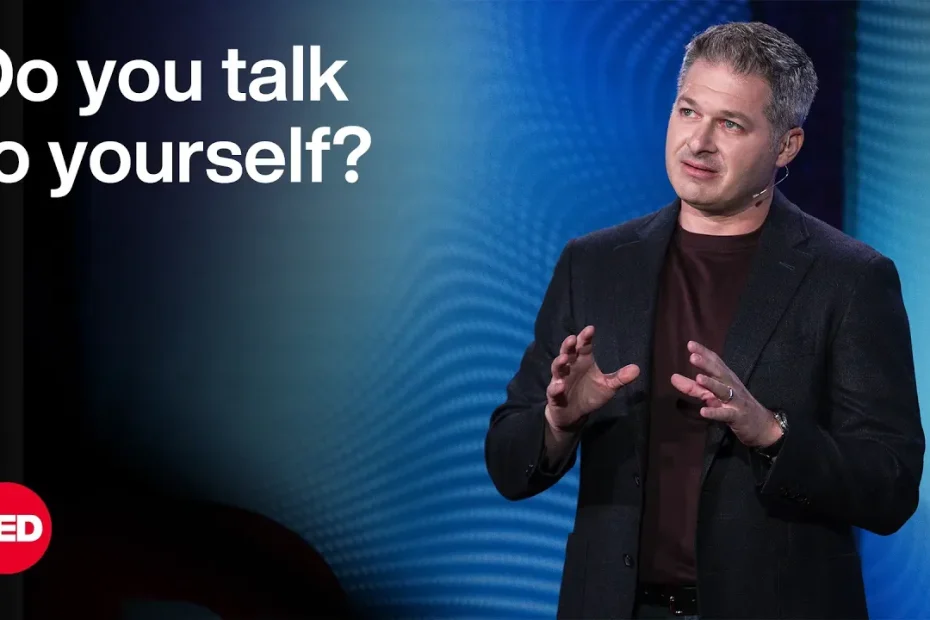
Read the full transcript of psychologist and neuroscientist Ethan Kross’s talk “Do You Talk to Yourself? Here’s How to Harness Your Inner Voice” at TED@BCG CONFERENCE on September 12, 2024.
Listen to the audio version here:
TRANSCRIPT:
ETHAN KROSS: So today what I want to do is talk to you about the most important conversations you have each day, the conversations you have with yourselves. My name is Ethan Kross. I’m the director of the Emotion Self-Control Lab at the University of Michigan.
And for the past 25 years, I’ve been studying how people can manage their emotions. And one of the things that I’ve learned during that time, I’m managing my emotions right now. One of the things that I’ve learned during that time is that a key to managing one’s emotions effectively involves understanding how to harness this mysterious force called the voices inside our head.
Now I realize some of you may be asking yourself right now, what is a purported serious scientist doing talking about a squishy topic like the voices inside our head?
But I want to point out the elephant in the room that, you know, if you’ve just asked yourself that question, you are talking to yourself. And that’s totally okay because the vast majority of us have a voice inside our head. Here’s a scientific fact that I absolutely love. We spend between one half and one third of our waking hours not focused on the present. Between one half and one third of the time, our minds, they are drifting away.
We are thinking about other things. Some of you are doing that right now. Please stop. Once we find ourselves drifting away, one of the things that we are doing is talking to ourselves and listening to what we say.
Understanding the Inner Voice
Now when scientists like myself use the term inner voice, what we are talking about is our ability to silently use language to reflect on our lives. And it turns out this is one of your superpowers. Because your inner voice lets you keep information active in your head for short periods of time. Like when you go to the grocery store.
And if you are like me, 15 seconds into the expedition, you forget what you are supposed to buy. You repeat that list in your head. Apples. Cheese.
Pepto-Bismol. TMI. We also use our inner voice to simulate and plan. Like when we silently rehearse what we are going to say before an important presentation or an interview. And of course, we use our inner voice to control and motivate ourselves.
As I did just before I came on stage. It’s right around the corner over there. I silently said to myself, “Come on, man. You’ve got this.” Deep breath. 45 minutes and you are done. And of course, all of you just said to yourself, this guy thinks he’s talking for 45 minutes. He’s nuts.
Finally, perhaps most magically, we use our inner voice to make sense of this messy world that we often live in. When we experience challenges, we turn our attention inward. We try to work through them.
And our inner voice helps us create those stories that shape our sense of self. Stories that really craft our identity.
The Dark Side of the Inner Voice: Chatter
So your inner voice, this is a remarkable tool.
The problem is, it is a tool that often jams up on us when we need it most. We don’t come up with clear solutions to our problems. We get stuck in negative thought loops instead. We worry. We ruminate. We experience what I call the dark side of our inner voice. Chatter.
How do you know if you are experiencing chatter? If you ever find yourself trying to work through a problem but not making any progress. Or if you find yourself berating yourself incessantly. I’m an idiot. Such an idiot. Those are two telltale signs.
Now, if this description of chatter resonates with any of you here, I’m sure it does not. But if it does, my response to you is, welcome to the human condition, my friends. Chatter is a feature of it. We all have the capacity to experience it at times. It also happens to be one of the big problems we face as a species.
The Impact of Chatter
And I say this because if you look at what chatter does to us, it sinks us in three domains of life that I would argue everyone here cares a great deal about. One thing that chatter does, it makes it really hard for us to think and perform. If you’ve ever had the experience of sitting down to read a few pages in a book, and under oath you would swear to a judge that you have read the words on the screen or page, but you get to the end of the section, the chapter, and you don’t remember a damn thing that you’ve read, you’ve experienced one way that chatter undermines us.
It consumes our attention, leaving very little left over to do the things that we often want and need to do. Chatter also creates friction in our relationships with other people. Because when we experience chatter, we’re often highly motivated to share its glory with those around us. What I mean by that is we often want to talk about our chatter.
So we find someone to talk to, and then we keep on talking over and over again. This can have a really sad consequence of pushing away people who genuinely care about us, because there’s only so much that they can endure before we start to bring them down. Then there’s our health.
So chatter helps explain how stress gets under our skin to impact our physical health, because what it does is it prolongs our stress response. And that creates a wear and tear in our body that is physically damaging, predicts things like problems of cardiovascular disease, inflammation, even certain forms of cancer.
Harnessing the Inner Voice
And when people hear about these findings, the question they often ask me is, how can I silence this inner voice?
Just shut it up. And I don’t think this is the best question to be asking, because your inner voice is a remarkable tool. We don’t want to get rid of that tool. What we want to figure out is how to harness it.
And this is where the really, really good news comes into play. This is precisely the question that scientists like myself have been trying to answer for a few decades now. And we have learned a lot about the science-based tools that exist to do precisely this.
Now, there are many, many tools out there. I’m not going to tell you about each one, because then we would go for 45 minutes.
But I do want to share with you three of my favorites. And we’re going to start with language. Right before Malala Yousafzai became the youngest person to ever win the Nobel Peace Prize for advocating for the rights of young girls to receive an education, she was invited onto The Daily Show with Jon Stewart to talk about her experience. At one point during the interview, she begins to explain what went through her head when she first discovered that the Taliban were plotting to kill her.
I want to present to you a quote right here of how she starts to talk about this experience. “I used to think that the Taliban would come and he would just kill me.” Nothing particularly out of the ordinary here. She’s talking to herself in the first person, the way we typically think about our lives.
But the moment she gets to this part of the experience, right, the Taliban, they’re on my doorstep, right? They’re coming to get me. It’s what is arguably the climax, the most stressful, chatter-provoking event you can imagine. Once she gets to that part, she does something kind of strange. I’m going to show you another quote here and I want you to just look at what she says. “I asked myself, what would you do, Malala?”
“Then I would reply to myself, Malala, just take a shoe and hit him.”
“But then I said, if you hit a Taliban with your shoe, then there would be no difference between you and the Taliban.”
So she starts off in the first person, but then she switches. She’s coaching herself. She’s giving herself advice like she would someone else using her name and the word you. In this instance, what Malala is doing, she’s using a tool that we have studied. It is called distanced self-talk and it is useful because we human beings are much, much better at giving advice to other people than we are taking our own advice.
So if you’ve ever felt like a giant hypocrite, once again, welcome to the human condition. There’s even a name for this phenomenon. It’s called Solomon’s paradox, named after the Bible’s King Solomon, who was famous for being able to give great advice to other people.
But when it came to his own affairs, he stumbled mightily. Using your own name and you shifts your perspective. It gets you to relate to yourself like you were giving advice to someone else. And that makes it much, much easier for us to wisely work through our problems.
The Role of Others in Managing Chatter
Another tool you can use to manage your chatter is other people.
But you have to be really careful about who you go to for chatter support. Many people think that the best way to help someone else is to let them vent their emotions.
But venting doesn’t help us work through our chatter. I want to repeat that again because it’s a really important take home. Venting doesn’t help us work through our chatter. Venting is really useful for strengthening the friendship and relational bonds between people.
It is good to know that someone’s there. They’re willing to take the time to listen and empathize with you.
But if all you do is vent about a problem, you leave that conversation, you feel great about the person you just spoke to, but the chatter is still churning because you haven’t done anything to actually address it. The best kinds of conversations with other people do two things. One, the person they’re talking to does let you express your emotions. It is important for them to empathize with you and validate what you’re going through.
But then once you’ve had an opportunity to share your feelings, they ideally start working with you to broaden your perspective. They’re in an ideal position to help you do that because the problem isn’t happening to them.
So think really carefully about who your chatter advisors are. They should be people who both listen and advise. That brings me to my third and final tool that I want to share with you. It’s my favorite.
The Power of Awe
It’s experiencing awe. About 10 years ago, scientists at Berkeley tracked a group of military veterans and first responders as they paddled down Utah’s majestic Green River. They measured participants’ levels of PTSD and stress, mental states that are infused with chatter, both before and after the rafting trip. Not surprisingly, they found that most of the participants, their stress and PTSD levels declined from the beginning to the end of the experiment.
But what was surprising was the factor that predicted those declines in PTSD and stress. It was participants’ experience of awe. Awe is an emotion we experience when we are in the presence of something vast and indescribable. Lots of people get it from an amazing sunset. I’m a science geek, so I get it when I contemplate outer space and interplanetary travel.
We have an SUV on Mars right now sending us footage back of that terrain. That is awe-inspiring to me. When we experience this emotion of awe, it leads to what we call a shrinking of the self. We feel smaller when we’re contemplating something vast and indescribable.
And when we feel smaller, so does our chatter. I want to wrap things up by sharing with you a set of observations about our times, messy emotional lives that I find myself thinking about quite a bit. And every time I do, it fills me with both dread and I find it inspiring. Between 8 and 10,000 years ago, our ancestors invented the first surgical technique.
The Evolution of Emotion Regulation
Its name was trepanation, and what it involved doing was drilling holes in people’s skulls. One of the reasons why this technique was believed to be used was to help people manage their emotions. Big dysregulated emotional responses let the evil spirits out. Fast forward to 1949, a Portuguese physician wins the Nobel Prize for another emotion regulation intervention.
This one’s name, the frontal lobotomy. We have come a long way, thankfully, from carving holes in people’s heads and sticking ice picks in our frontal cortices to provide people with emotional relief. Our toolbox of science-based skills is vastly improved. What we need to do a better job doing is using these tools in our lives and sharing them with other people. We spend enormous amounts of resources teaching ourselves how to communicate more effectively with other people.
What we need to do is devote an equivalent amount of resources to teaching ourselves how to communicate more effectively with ourselves.