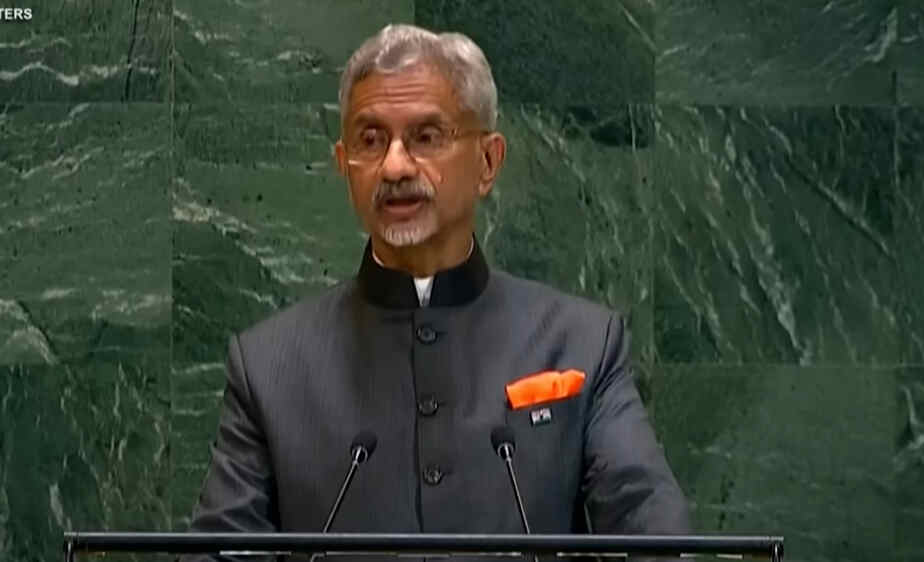
Read the full transcript of Minister of External Affairs of India S. Jaishankar’s remarks at the 80th session of UNGA 2025, Sep 27, 2025.
Listen to the audio version here:
S. JAISHANKAR: Madam President, Excellencies, Ladies and Gentlemen, Namaskar from the people of Bharat.
We are gathered here eight decades since the founding of this unique body. The UN Charter calls on us not just to prevent war, but to build peace. Not just to defend rights, but to uphold the dignity of every human being. It challenges us to stand as good neighbours, uniting our strength, so that generations to come inherit a world of justice, of progress and of lasting freedom.
The Evolution of the United Nations
Madam President, forces unleashed by history since the founding of the UN propelled this body forward. As decolonisation advanced, the world began to return to its natural diversity. The membership of the UN quadrupled, and the organisation’s role and remit grew significantly.
In the era of globalisation, its agenda evolved even further. Development goals took centre stage, even as climate change emerged as a shared priority. Trade acquired greater prominence, while food and health access were recognised as essential to global well-being. Where security was concerned, the UN undertook peacekeeping operations and promoted disarmament discussions. As a result, the UN became a natural platform to debate key global issues.
The State of the World Today
Madam President, we must ask ourselves today, how has the UN lived up to expectations? Just look at the state of the world. There are two significant conflicts underway, one in Ukraine and the other in the Middle East. Innumerable other hotspots don’t even make the news.
The slow progress of the SDG Agenda 2030 presents a sorry picture. On climate change, the reality is of recirculated commitments and creative accounting. If climate action itself is questioned, what hope is there for climate justice?
When a once-in-a-century pandemic hit us, we saw open discrimination in access to vaccines and to travel. Energy and food security have been the first casualties of conflict and disruption, especially since 2022. Better-off societies insulated themselves by having the first call. The resource-stressed ones scrambled to survive, only to hear sanctimonious lectures thereafter.
Economic Challenges and Global Trade
When it came to trade, non-market practices gamed rules and regimes. The resulting concentration exposed the world to leveraging. On top of that, we now see tariff volatility and uncertain market access. As a result, de-risking is a growing compulsion, whether from limited sources of supply or over-dependence on a particular market.
Economic concerns have other dimensions as well. Heightened technology control is one. The grip on supply chains and critical minerals is another. The shaping of connectivity is no less sensitive. Protection of key sea lanes has become a challenge. Restricting the evolution of a global workplace is an issue. Each makes a compelling case for more international cooperation, not less. But are we really headed in that direction? And where has the UN actually made a difference?
Sovereign Equality and Mutual Respect
Madam President, as members of the UN, we meet here as sovereign equals. That is not a formalism, but a recognition of the inherent diversity of our world. Understandably, we have different history, traditions, heritage and culture. For them to co-exist, for them to enrich each other, it is imperative that we foster understanding and respect. This will only happen when we resist political interference and economic pressures, when narratives are free of prejudice, when double standards are opposed and when pluralism is truly appreciated.
The Threat of Terrorism
Madam President, Excellencies, while asserting our rights, we must also firmly face up to threats. Countering terrorism is a particular priority because it synthesises bigotry, violence, intolerance and fear. India has confronted this challenge since independence, having a neighbour that is an epicentre of global terrorism. For decades now, major international terrorist attacks are traced back to that one country. UN’s designated lists of terrorists are replete with its nationals.
The most recent example of cross-border barbarism was the murder of innocent tourists in Pahalgam in April this year. India exercised its right to defend its people against terrorism and brought its organisers and perpetrators to justice.
Because terrorism is a shared threat, Madam President, it is essential that there is much deeper international cooperation. When nations openly declare terrorism a state policy, when terror hubs operate on an industrial scale, when terrorists are publicly glorified, then such actions must be unequivocally condemned. The financing of terrorism must be choked, even as prominent terrorists are sanctioned. Relentless pressure must be applied on the entire terrorism ecosystem. Those who condone nations that sponsor terror will find that it comes back to bite them.
The UN in Crisis
Madam President, an objective report card will show that the UN is in a state of crisis. When peace is under threat from conflicts, when development is derailed by lack of resources, when human rights are violated by terrorism, the UN remains gridlocked. As its ability to forge common ground diminishes, belief in multilateralism also recedes.
Central to the erosion of the UN’s credibility has been resistance to reform. Most members strongly desire change, but the process is being made an obstacle to the outcome. It is imperative that we see through the cynicism and purposefully address the reform agenda. The historical injustice done to Africa should be redressed. Both permanent and non-permanent membership of the Council must be expanded. A reformed Council must be truly representative, and India stands ready to assume greater responsibilities.
India’s Development Partnership With the Global South
Madam President, today the predicament of the Global South is especially acute. Bharat, under the leadership of Prime Minister Narendra Modi, believes that it has both a duty to contribute and an obligation to motivate. That is why we have undertaken more than 600 major development projects in 78 countries, as well as innumerable community-based initiatives.