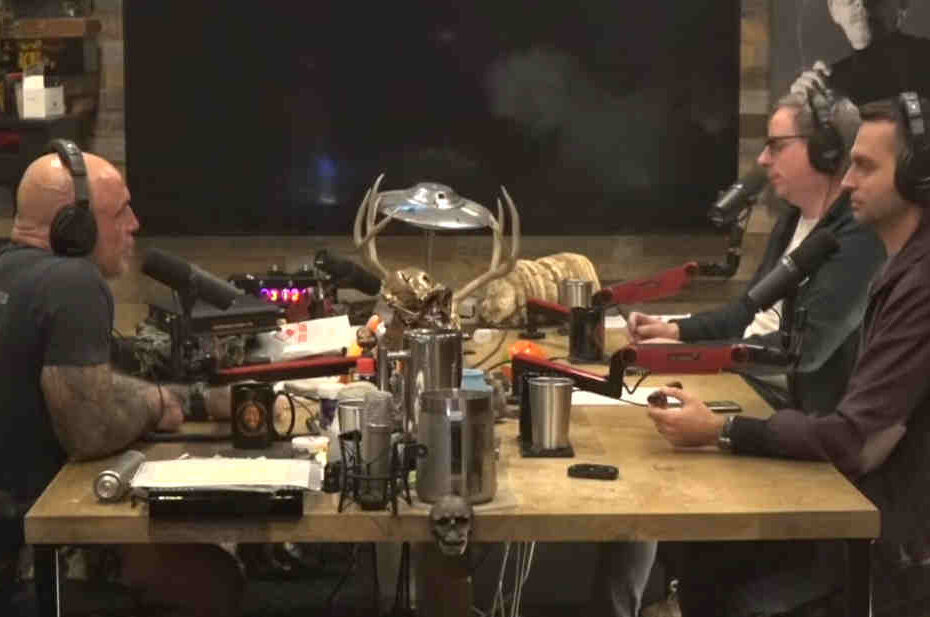
Read the full transcript of Joe Rogan Experience #2398 with distinguished guests Francis Foster & Konstantin Kisin on the podcast, Oct 22, 2025.
Francis Foster is a comic and author of “Classroom Confidential: The Truth About Being a Teacher and Why You Should Never Become One.” Konstantin Kisin is a political commentator and author of “An Immigrant’s Love Letter to the West.” Together, they host the podcast “Triggernometry.”
The Interview Begins:
JOE ROGAN: So what’s happening?
KONSTANTIN KISIN: It’s all good, man.
JOE ROGAN: When are you bailing out of your country?
FRANCIS FOSTER: Sinking.
JOE ROGAN: That is the f*ing Titanic and you are one of the last deckhands.
KONSTANTIN KISIN: We’re going to stand and fight, man.
FRANCIS FOSTER: Yeah.
JOE ROGAN: Are you really? Yeah. Good luck.
KONSTANTIN KISIN: No, we are where the guys. As long as it’s still okay.
JOE ROGAN: Thank you for saying stand and fight. Excitement of violence.
The State of Free Speech in the UK
KONSTANTIN KISIN: Yeah, yeah, no, but it’s interesting. I mean obviously you had Graham Linehan on the show. We’re going to have him on as well soon to talk about it. But they’re not going to prosecute him. And not only that, they also said they are not going to investigate non-crime hate incidents anymore.
JOE ROGAN: Do you know what those are interesting?
KONSTANTIN KISIN: It’s basically when you’ve committed no crime but you’re still hateful.
JOE ROGAN: Oh, okay. But that’s also very subjective too.
KONSTANTIN KISIN: Yeah, of course, of course. So they’re not going to investigate them anymore, but they’re still going to keep track of them is what they said.
JOE ROGAN: Oh, keep track. We’ve got an eye on.
KONSTANTIN KISIN: We’re going to make a record of it, but won’t investigate.
JOE ROGAN: So are they going to stop arresting people for social media posts then?
KONSTANTIN KISIN: What do you think, Joe?
JOE ROGAN: I think no, I think it’s profitable. It’s probably a nice fine, right? What do you get? You get a fine?
KONSTANTIN KISIN: I don’t think it’s about that. I think, you know, during the uber woke era, they put all these laws on the statute book and the police have to enforce the law. Right. They have no choice. Because if a bunch of people complain and then they don’t investigate the people that have been reported.
JOE ROGAN: Oh, that’s what it’s all about.
KONSTANTIN KISIN: They get in trouble.
FRANCIS FOSTER: Of course.
KONSTANTIN KISIN: Like if you, the ordinary police officers. Right. Police officers don’t like enforcing these dumb laws. Of course it’s put on them from above.
The Woke Era and Social Control
JOE ROGAN: Yeah, I just didn’t know that all that stuff was put in place in your country during the woke era. Yeah, it was the heavy rope. It’s almost like a fever dream, you know when you really go back and pay attention to some of the more insane woke stuff from like just five years ago. Yeah, like everyone was losing their f*ing mind.
Like if I was an elite, if I was one of those lizard people running the world, I’ve been like, well looky here, this is really interesting. Like this is just a cold. Was just a cold and a little bit of social media input. And we got these people behaving in a way that they’d never behaved before, admitting to things they’d never admitted to before, adhering to rules that never existed before.
FRANCIS FOSTER: Yeah, I think the thing that I found the most, the worst bit about it wasn’t necessarily the behavior of the elites, it was the behavior of ordinary people during that time. The fact that your neighbor was so willing to snitch on you because you went for a second walk.
JOE ROGAN: Well, that’s why I was interested in it. As a lizard person. As a lizard person elite, I’d be like, look at these people are dumb. Like, this is really easy to manipulate.
Especially. I was just talking to a buddy of mine who’s fleeing LA and he was like, I can’t anymore. I tried, I just f*ing hung in there. I can’t do it anymore. He’s like, everybody went crazy. It’s like there’s something that happened because of the pandemic and the Black Lives Matter protests and the riots, all the cases. It just like whatever the temperature of society was is like it hit societal global warming, where it’s like, it’s time to investigate Greenland, it’s time to move north. Like, this is a bad climate now. This sucks.
The Fall of Paradise: California’s Decline
KONSTANTIN KISIN: And LA is a perfect example of this because we talk about this all the time. You get out of the airport at LAX, you feel that LA sun on your skin and you just go, this is paradise. And then you walk out and you see this, it’s paradise. And they f*ed it up so bad that people will literally pack up and leave paradise.
JOE ROGAN: What Donald Trump should do is when he leaves the office, run for governor of California and just take over California and fix it. It would be hilarious if he did. It would be one of the funniest things of all time. If an 82 year old man steps into the office of governor of California, we’re going to fix everything. You’ve got a problem with water. I know how to get the water. It would be f*ing hilarious.
FRANCIS FOSTER: But it’s almost like, so there’s a very old joke about Venezuela where God was creating Venezuela and he was like, you know what I’m going to do? I’m going to make sure they have diamonds, they have gold, they have desert, but they also have jungle, they have beautiful beaches, it’s going to be rich in oil and the whole. And then the entire world goes, hey, that’s unfair. Like, they’ve got to have something bad.
And God goes, yeah, you know what? You’re right, let’s give them the Venezuelans. And that’s almost like that with California.
JOE ROGAN: But it wasn’t for a long time. I mean, you got to realize Arnold was the governor of California, right? And then, you know, Ronald Reagan’s from California. He was the governor of California at one time too. He wasn’t always that nuts.
And when you went back to, when I went there in the 1990s, it was much more moderate politically. Like, you know, people were definitely left leaning but it wasn’t a focus. It wasn’t a thing that was discussed all the time. It was just, it wasn’t. And I remember working with many older actors who were openly conservative. No one cared. It was just like, oh, this is Bob, you know, he’s really into Bob Dole. Like, you know, it wasn’t unusual.
Something happened around the Obama administration. Something happened specifically around his second term that really changed everything. And if you looked at like Internet searches and use of certain words, especially racism, it flies, it just hits a giant.
Social Media and the 2014 Shift
KONSTANTIN KISIN: 2014. Yes, 2014, right around then. And it’s not just in America, it’s literally everywhere in the world. That’s why I think it’s social media.
JOE ROGAN: That’s caused that 100%. It’s social media and it’s, there’s a bunch of factors, but the problem is now that the genie’s out of the bottle, they know how easy we are to manipulate. And I don’t think people are learning. They’re TikToking all day long and they’re just getting blasted with all this negativity and strife and global conflict and Colombian assassinations.
That’s what I get a lot of these assassinations in cafes. Someone pulls up on a scooter, bang, bang, and they drive off and everybody screams. I’ve seen a hundred thousand of those. I’ve seen, you know, it’s like everybody’s completely ramped up and at the same time you’ve got people in the UK getting arrested for Facebook posts about immigration.
FRANCIS FOSTER: So I think part of the problem is, is that people, when they go on these posts, they’re not looking for, to learn something. As you just said, what they actually want is an emotional reaction. They want to feel something.
JOE ROGAN: Right.
FRANCIS FOSTER: If you live in a society where it’s comparatively the easiest it’s ever been. And your life is boring because all you do is get up, you go to work, you go, you have food, you commute, you come back. It’s essentially a treadmill where you don’t feel any of the ups and downs of emotion. Then what way would you get that? But by going online and seeing something f*ing awful happening, you feel terror, you feel sadness, you feel rage at its most basic, you feel alive.
The Algorithm and Its Consequences
JOE ROGAN: Well, it’s also just, that’s what you’re going to watch, you know, and so you’re getting sucked into it just because the algorithm, which is crazy. No one ever considered algorithms before. We considered access to information, but we didn’t consider the information we curated to hold your attention span.
And all these factors have not been studied. Well, you know, there’s been a few guys like Jonathan Haidt writing about it, a few scholars that are really attempting to say, hey, what is the, what’s the sociological and what is the long term consequences of this happening? Also for children? These are the first children in human history growing up on social media. Never been done before. We don’t know what that’s like.
Like, what is it going to change in terms of empathy, in terms of hostility, acceptance of violence, which is a completely brand new thing. On the acceptance and celebration of gun violence. Never happened before. When I was a kid. It never existed. No one from the left ever celebrated anybody getting assassinated ever. Just wasn’t a thing.
Dangerous Rhetoric and Political Violence
KONSTANTIN KISIN: It’s so crazy, man. And you’re talking about language as well. Like we have this, we have the leader of the Green Party in the UK, new guys coming through. He’s very popular with people on the left, on that side of the left anyway. And it’s been, what, how long has it been since Charlie Kirk was assassinated? Like a month.
And he’s running around calling like not far right people, just like Nigel Farage is a Nazi, is a fascist. And you and we’ve discussed this so many times with you, man. It’s like when you call people these words, like if you and I and Francis thought the Nazis were here to take over, we’d all fight them. So what do you expect people to do when you put, you’re putting the.
JOE ROGAN: Target on people’s backs, you are 100% and you’re doing it in just for political persuasion. Power. That’s really all it is. It’s like no one really believes Nigel Farage is a f*ing Nazi. He’s kind of goofy, but he’s not a Nazi. What is a Nazi then?
And here’s the real problem. This is what nobody wants to admit. If you’re in Nazi Germany and you’re a 20 year old man and you’re German and everyone in your town is a Nazi, you’re probably a Nazi too. Or you’re Jew and you’re running, you’re running from these motherfers. So either you’re a Jew or you’re a Nazi. You’re either Jewish or you’re a fing evil part of history that everybody refers to as the worst people of all time.
Human Nature and Evil Adaptations
FRANCIS FOSTER: Absolutely. And you know, we’re talking about scary.
KONSTANTIN KISIN: Yeah. But it’s human nature. Sorry, Francis, just. We interviewed David Buss yesterday. You’ve had him on, right?
FRANCIS FOSTER: Yes.
KONSTANTIN KISIN: Evolutionary. I mean, this is one of the things he talked about is within us is the ability. We have good adaptations and we have evil adaptations. And if you put people in a certain context and those adaptations are in all of us.
JOE ROGAN: Yeah. Donner Party people eat people.
FRANCIS FOSTER: Yeah.
JOE ROGAN: You get down to I might die or I might eat somebody. You eat people? Yeah. The guy’s already dead. We should just eat them. And then you all sit around and go, oh my God, we’re really going to eat a person. And then you’re eating a person like everybody does. They all have very few people just starve to death when you could just eat a person who’s already dead.
FRANCIS FOSTER: And it’s, you know, Zach Polanski. What he does is, to me, this.
KONSTANTIN KISIN: Is a Green Party.
FRANCIS FOSTER: The Green Party guy is completely wrong. But then there are people on the far left. So there’s a member of Parliament called Zara Sultana. Yes. That is her real name, Zara Sultana.
JOE ROGAN: And yeah, she sounds like a boss in a video game.
The Rhetoric of Violence and Political Discourse
FRANCIS FOSTER: Yeah. Well, what’s really interesting is she has. She put a clip on her social media where she goes, and she set up this new far left political party, and she says, we’ve got to fight fascists in Parliament. We’ve got to fight them in the ballot box. And you’re going, all right, look, I don’t like the rhetoric.
And then she says something even more interesting, and we’ve got to fight them in the streets. Now you think to yourself, right, if you classify Nigel Farage and the people who vote reform in the UK, which may well win the general election, which may well be the biggest political party and already represents a sizable portion of the UK, you’re effectively advocating violence and it’s incitement to violence. As far as I’m concerned.
But because she’s on the far left, she’s deemed to be a good person. That’s somehow okay. Whereas if Nigel said something like that, along those lines, you know, that people be like, this is a fascist. This is evil. This is disgusting. You shouldn’t say that.
JOE ROGAN: You’re also weaponizing mental illness. Because one of the things that we know now very clearly, because of all these YouTube videos, all these people that go to these protests and start interviewing folks, some of these people are clearly not well. And this is the thing they’ve attached themselves to. This is their tribe.
This is, whether it’s No Kings or F* Ice or whatever. Whatever the tribe is, this is their tribe now. And they’re schizophrenic or their, you know, fill in the blank, whatever the mental illness is. And you’re weaponizing them by calling these people who just differ with you politically or more conservative. You’re calling these people the enemy of humanity. Very scary.
KONSTANTIN KISIN: And, you know, I’m one of the people that has gone along to a lot of protests. There’s a lot of wild people there.
Confronting Protesters with Logic
JOE ROGAN: Oh, yeah, you’ve done some great interviews at those protests. Yeah. It’s just when they’re confronted with a person who’s actually asking them questions, it’s remarkable how few people know why they’re there. They don’t know.
Like, when you get into specifics, this guy did this thing today where he was talking with people at the No Kingsborough. I’m going to send it to you, Jamie, because it’s, you know, I mean, I understand why they responded the way they did, but it is absolutely fascinating to watch because it just shows you what. Let me find this real quick.
It just shows you how much these things that people get involved in aren’t. Oh, this ain’t it. Hold on. I hate when I do this. I thought I saved it. Oh, my God, I saved it. I’m sorry. No, I don’t think I did.
So anyway, this guy was, he was interviewing people and he was like, is this about human rights? And they’re like, yeah, like, are you guys, like, fully in supportive of human rights? See if you can find this guy. He’s got a beard and long hair and they’re like, yes, absolutely. He goes, what about for fetuses in the womb? Everybody walks away.
Everybody was like, that’s unhuman. Or that, I don’t know. And he does it to everybody. And he looks like a hippie so he’s like, so you guys are for sure for human rights? And like, oh, yeah. Human rights is why we’re here. You believe in human rights for everyone? Yes. What about unborn babies? And you see this look on the, it’s almost like everybody’s under a spell.
FRANCIS FOSTER: Yeah.
JOE ROGAN: Like some evil.
KONSTANTIN KISIN: They are under a spell.
JOE ROGAN: Yes. This is the guy? Yeah, this is him. This is him. Check this out. This is wonderful. I love when people do things like this. Can you refresh? Yeah, we’re in favor of them. For everybody? Yes. How about the unborn for everybody?
KONSTANTIN KISIN: Yes, of course.
JOE ROGAN: Even people in the womb?
KONSTANTIN KISIN: Well, it all depends on if they’re actually a baby or not. Science says they are.
JOE ROGAN: Well, it depends on what science you’re talking about. 96% of all biologists, according to the NIH.
KONSTANTIN KISIN: Thoughts on human rights? I’m all for them.
JOE ROGAN: Yeah, me too.
FRANCIS FOSTER: Especially now.
JOE ROGAN: Right? For everybody, Right?
KONSTANTIN KISIN: Yeah.
JOE ROGAN: Even the unborn. An unborn what? Unborn in the womb. Yeah. No rights for them. Thoughts on human rights? That’s what we’re here for. For everybody.
KONSTANTIN KISIN: Right?
JOE ROGAN: Yes. Including the unborn. No. Everyone has autonomy to not feel it. Right. But he’s like, nothing.
FRANCIS FOSTER: Not taking rights away.
JOE ROGAN: Nazi lives don’t matter. It says on that guy shirt that’s just screaming. Yeah, Nazi lives don’t matter. Who’s that guy? Give him some props. What is the channel? The survivors. Us. That’s him. J Owl.
FRANCIS FOSTER: Yeah.
JOE ROGAN: R, O W L. He only has 704 followers. That’s outrageous.
KONSTANTIN KISIN: He’s going to have a few more now.
JOE ROGAN: More now. That was very fun.
KONSTANTIN KISIN: I mean, that guy’s nodding along. You can see. He’s, like, ready for yes. I think it was no.
JOE ROGAN: So weird. That’s such a good trick. It’s such a good trick. But it’s so weird. It’s so weird to watch this, like, ideological boundary, like, nope. No nuance there. No room for nuance.
Understanding Protest Movements
KONSTANTIN KISIN: And I don’t, I don’t remember if you played this when we were here last. I went to a pro Palestine protest and there was, you know, there’s a lot of people there. Some of them are interesting and make good points. But there was this group of six young kids, and I walked up to them and they had the sign which said something. Something Socialist intifada. Right.
And I was like, I don’t know what socialist intifada means. So I said, what does that mean? And he was like, sorry, if I’m being honest. I picked up the sign over there and I went, do any of you know what intifada means? And none of them. And Intifada is an armed uprising. That’s what it means. Right.
JOE ROGAN: What do you think? Like, AI defines socialists intifada as. Let’s Google it out.
FRANCIS FOSTER: Depends what AI you ask.
JOE ROGAN: Well, let’s ask Perplexity. Perplexity is one of our sponsors. Let’s see what socialism. I really want to know, like what AI would say. Like, that sounds preposterous. Yeah, I want to know how I would describe that.
FRANCIS FOSTER: Yeah, because sometimes ChatGPT is just, you ask them these questions and when, well, you know, it depends who you are. Some people might, yeah, some people might say that it’s an uprising and others might see it as blah, blah, blah. And you’re like, how does complexity define it?
JOE ROGAN: Jamie, how do you define socialist intifada?
KONSTANTIN KISIN: Intifada.
FRANCIS FOSTER: You see, we’re in Britain, we know how to spell that word, mate.
JOE ROGAN: That word doesn’t get chucked around a lot out here.
FRANCIS FOSTER: Every day we come out, it’s the intifada, like, course it is. You know what I mean?
JOE ROGAN: People hear about it on Twitter and they go, I don’t know what they’re talking about.
FRANCIS FOSTER: They’re just scroll down, come to Britain, you’ll find out, my friend.
JOE ROGAN: What do we got? Here it is. Socialist intifada combines two distinct ideas. The Arabic concept of intifada and the political ideology of socialism. So the meaning of intifada means shaking off or uprising in Arabic and historically refers to popular resistance movements, particularly the Palestinian uprising against Israel occupation in 1985 and 2000.
It denotes collective rebellion often led by the oppressed, using acts of protest, civil disobedience and sometimes violence to resist injustice and occupation. Interesting. Also often led by the oppressed is interesting.
KONSTANTIN KISIN: It’s an interesting addition, isn’t it?
JOE ROGAN: Yeah, it’s an interesting addition. It seems like that’s human. That’s a human addition to this thing, you know, Socialist. Socialist intifada refers to the framing of the uprising not merely as a national liberation struggle, but as a class based social revolution.
Marxists and socialist movements view such an intifada as a mass movement of workers and a youth using class struggle methods. Send in a tsunami right now. Send in a tsunami and make people live off fish that they have to catch for just a month and all this sh goes away. Just give me something. Give me a small asteroid.
FRANCIS FOSTER: Give me something.
JOE ROGAN: Give me something. Give me an alien invasion. Just give me something to fing shake these kids by the collar and go shut the f up. Just shut the f up and live your life. You’re not living your life and you’re fing up everybody else’s lives.
The Funding Behind Protests
FRANCIS FOSTER: But you know, we also have to take responsibility for this. The adults, the people, the colleges, all those people need to take responsibility. So I did. I went to a Palestine protest at UCLA last year in May time. And there were, I thought it was run by the kids. There were a lot of adults there who weren’t students at UCLA.
And the kids, when they saw some of the kids, when they saw what I was doing and I was doing interviews, they were like, he doesn’t go to my college, he doesn’t go to my college. He doesn’t go to my college. That dude’s in his early 50s. He’s not on the faculty staff. What is he doing here?
JOE ROGAN: Yeah, they’re being paid. They’re part of an NGO. They’re out of something. They’re part of something that’s decided that this is a good idea to get these students to be engaged in these things and it’s funded. That’s what’s weird.
KONSTANTIN KISIN: When I went to, we had protests, I’m sure you saw, which were about illegal immigration, people would protest outside of, like, illegal immigrant hotels where they’re kept. And you had protesters and counter protesters. One thing I noticed is, like, all the pro immigration protesters, they all have, like, professionally made signs. It’s all organized.
JOE ROGAN: No misspellings.
KONSTANTIN KISIN: No. And when you dig, when you dig deep, it’s organized by all these very well named organizations, you know, stand up to racism or whatever. And then you dig deeper, and it’s the Revolutionary Socialist Workers Party or whatever behind it.
JOE ROGAN: And this is all the stuff that Mike Benz covered. A lot of that stuff’s being funded by USAID. Rep. Paulina Luna, you know, you had her on recently. Fascinating. Just her telling me about the book of Enoch and alien stuff. That’s why I had her on. I believed in angels. She had like, a diagram of angels that she put up on her Twitter. I’m like, this lady, this might be fun.
But she posted something on her Twitter yesterday that shows all the people that donated to the No Kings protest and the number of corporations donated and how much money is involved in it. It’s bananas. If she’s accurate, if what she’s saying is true, it’s like, this is crazy.
KONSTANTIN KISIN: And the leverage now is so easy. You don’t actually need a lot. Like, for example, do you know a group called Extinction Rebellion? Are you familiar with this?
JOE ROGAN: No.
The Power of Small Protests and Social Media
KONSTANTIN KISIN: So this is, we have this in Europe. You guys don’t have it here because you’re like, we’re going to burn all the gas we want, right? But in Europe, obviously, climate is a massive issue, Net Zero, et cetera, which is, I think, a terrible idea. But anyway, we have this movement called Extinction Rebellion. I went to one of their protests. There was literally 40 people there. But if you have a protest with 40 people and you film it and you put it on social media, no one can know it’s 40 people, right?
JOE ROGAN: You just hear a lot of noise and see people and you go, oh my God, there’s a protest. People are outraged.
KONSTANTIN KISIN: Yeah, people are outraged. This is movement, you know, the public really, and all this other stuff. So the leverage you can get with a very, very small amount of money and a small number of young, impressionable people is powerful. And then it goes on social media where it’s stripped of the context, and suddenly we all believe this thing is real, right? When it’s 40 people.
JOE ROGAN: And then when you also have to take into account, if you go into a room with a hundred people, at least one of them is a f*ing idiot if you’re being really generous. So if you’re in a country of 300 and what, 30 plus million people, we don’t really know. That’s at least 3 million idiots. So it’s not hard to get 100,000 retards holding signs walking down the street.
And especially when they get older, because as people get older, they generally slow down and they don’t think as well. And if you look at a lot of these No Kings protests, what are you seeing? You’re seeing geriatric people holding signs. So you got old losers. Not even just losers, but old losers where this is the end of, they’re just looking for anything to get them out of that. They’re watching The Price is Right. They’ve already seen that one. And they’re like, let’s just join in on the note with their, we shouldn’t have a king. And then next thing you know, they’re out there with the sign.
Yeah, and you can get a hundred thousand of those. Easy, easy, easy. Especially if you got a lot of money and you’re organizing and, you know, you get on Facebook and get involved in them groups and, you know, use the bots and all the bots. This is important that we show up in mass and let him know he’s not king.
The Psychology of Protest Chants
FRANCIS FOSTER: And it’s also as well, you know what I find really fascinating from a psychological perspective is the use of chants. In that you go to these protests, you watch, and it’s all about chanting. And what’s so powerful is the chants rhyme. And, you know, it almost becomes musical and the crowd just gets whipped up in the fervor of the chants.
But look at what the chants actually mean. And most of the times they’re utterly nonsensical. Like there was one which was, “We won’t be free until Palestine is free.” And you go, what does that actually mean? What does that actually, are you not free? I think this is a, I mean, not in the UK, but I mean here in the US you’re pretty free. Do you know what I mean?
And the fact that you then, but they would argue that. But then the moment you drill down, you actually go to them like, what does that mean? Like “Socialist Intifada.” The reality is they just can’t, they can’t explain because it’s a chant.
JOE ROGAN: You got to give them credit. One thing about the geriatrics is they don’t get violent like this protest.
FRANCIS FOSTER: Persistent. Those all can’t.
JOE ROGAN: Well, they kill each other every now and then. But there was no violence and a lot of people, which is pretty good. That’s great. That’s a good sign. That’s great.
KONSTANTIN KISIN: And look, people in a free country should be able to protest, I think 100%.
Paid Protests and Propaganda
JOE ROGAN: The problem is, if you’re organizing a protest, paying people to protest, and if there’s documentation that the metadata from the cell phones are the same from protest to protest, and that they’re traveling on buses, that’s paid for with tax dollars. Hold on. What are you really doing? What are you really doing? This isn’t really an organic protest. You funneled money through an NGO, and now you’re hiring people to show up and wave signs to give the illusion.
Look, this is what they did during the Kamala Harris campaign. They filled up stadiums with people coming to, and the same people went from stadium to stadium. It became a job. It became a job, but it gave the illusion. So that’s deception. That’s deception. And that should not be legal. That should not be a legal thing to do. You’re engaging in propaganda.
You know, you’re, and you’re openly manipulating people’s perspective. You know, you’re paying, these are, those aren’t audience members. Those are clients. Those are customers. You’re paying them.
FRANCIS FOSTER: Yeah.
KONSTANTIN KISIN: And what, what is your take? What is it that they want? When they say No Kings, they, what do they want?
JOE ROGAN: They think Donald Trump is behaving like a king.
KONSTANTIN KISIN: How so?
JOE ROGAN: Because, well, he ran on a platform and was elected and won every swing state and the popular vote. And then once he got in, he did exactly what he said he was going to do, which is exactly what a king does. And then he let them protest, which is also what a king does, right?
FRANCIS FOSTER: Yeah.
JOE ROGAN: No, no, he didn’t send the troops to stop the protests. In fact, he congratulated them on doing a great job. And he said, “I’m still your president.”
FRANCIS FOSTER: Yeah, I saw that.
JOE ROGAN: Tweet’s f*ing hilarious. Yeah, it’s very funny. It’s a very funny, pull up is the tweet that he made. I guess it’s not a tweet. It’s like, which I still say tweet. I tried.
KONSTANTIN KISIN: It’s a trickster.
JOE ROGAN: I tried X for a while, and I can’t say it.
KONSTANTIN KISIN: I say Twitter, it’s still a tweet.
JOE ROGAN: I might say X. But you tweeted. That’s right. You know, and if it’s Truth Social, it’s going to make its way to Twitter, and then it’s a tweet. Yeah, you can’t re-truth something that doesn’t even make any sense.
Biased Policing in the UK
FRANCIS FOSTER: The thing that we have in this country, I don’t know if you have it in this country as much is just the way the policing is biased, the way that they will arrest Graham Linehan for three relatively innocuous tweets. One of them was a joke. And they will arrest him the moment he lands on British soil. Five police officers. You get other people saying heinous things or you get the example, Zara Sultana saying, you know, “We’re going to fight them in the streets,” but that’s fine, right? And nothing comes from that.
JOE ROGAN: That’s ridiculous.
KONSTANTIN KISIN: Well, no. There was a guy who was at a protest. He was a member of political party.
JOE ROGAN: I think you could probably find an image of it because it was posted everywhere.
KONSTANTIN KISIN: There was a guy called, I think his name was Ricky Jones. He said at a protest, “We need to slit the throats of the far right.”
JOE ROGAN: Oh, great.
KONSTANTIN KISIN: And he was found not guilty.
JOE ROGAN: Oh, great. And Graham Linehan gets arrested.
KONSTANTIN KISIN: Right.
JOE ROGAN: What are they trying to do to England? It was always such a lovely place to visit.
KONSTANTIN KISIN: This is what I was going to ask you. I wish more people in Britain recognized how fing crazy this looks to the rest of the world. You guys must be looking at us going, what the f is this?
The Decline of Britain
JOE ROGAN: We can’t believe it. We literally can’t believe it. When I tell people that don’t know that 12,000 people this year were arrested in Britain for posting things on social media, their jaw drops. What? I go, dude, they’re going crazy over there. You have to pay attention. You have to pay attention because this kind of shit is contagious.
And if it gets into Germany and then it gets into Spain or gets into other countries, it can become a real fing problem. Then you have full on military dictatorship in England because that’s what it always leads to. 100% leads to military dictatorship. If you’re telling people they can’t do things and you’re trying to install socialism and then you get it in place, there’s only one way to keep it in place. You got to use the fing army. That’s the only way.
You got to get men with guns to tell people you can only make so much money. You have to give away this. We’re going to take that. We’re the only ones who grow food. We’re the only ones who do this. We’re going to assign you a job. You f*ed up. You fell into the age old trap that’s been exposed by history over and over and over again. And people are like, we’re going to do it right this time.
They got blue hair and a fing mask on and a cat T-shirt and they’re morbidly obese and they’re just marching down the street and we’re going to let them run the country. England, which used to run most of the fing world. One island of savages ran most of the world. And now you’re getting overrun with nonsense and you’re arresting people for saying, hey, maybe we shouldn’t have rape gangs. You know, maybe, maybe we shouldn’t. Maybe we shouldn’t tolerate lawlessness in the streets.
FRANCIS FOSTER: Oh, absolutely. I mean, it got so ridiculous in the UK that the Supreme Court had to get involved to make a decision whether boys had peepees and girls have foo foos.
JOE ROGAN: Peepees and foo foos. That’s an interesting way to put it.
FRANCIS FOSTER: Yeah, that’s it. But the reason I’m using that language is just to highlight how silly it is, how completely ridiculous it is.
Gender Ideology and the Supreme Court
JOE ROGAN: That’s crazy. Well, how about when they asked, when Supreme Court Justice Ketanji Brown Jackson was being sworn in, when they’re talking to her during the confirmation part, they asked her, “What is a woman?” And she’s like, “I’m not a biologist.” But you’re an actual woman. I believe she has children, right? So she’s a woman who’s given birth. You know exactly what a woman is.
KONSTANTIN KISIN: But they don’t f*ing know, though.
JOE ROGAN: I know, but that’s what’s crazy. They’re playing this game.
KONSTANTIN KISIN: They’re playing the game.
JOE ROGAN: Yeah, yeah, they’re playing the game.
KONSTANTIN KISIN: But these aren’t inconsequential people.
JOE ROGAN: No Supreme Court Justice, I know.
KONSTANTIN KISIN: Playing this game, playing the dumbest game that’s ever been played.
JOE ROGAN: It’s the dumbest. And it’s weird, man. It’s a weird game. You know, it’s a weird game. What is a woman? Here’s the, here’s the real funny part. No one asks what is a man? And no one gives a f* if you’re a woman and you pretend to be a man because you’re not going to victimize men.
That’s the dirty little thing that they’re covering up about all this is you’re opening up the door to people that now have a Willy Wonka golden ticket to pretend that they’re a woman and be around women and then dominate women’s spaces and dominate women’s sports and dominate all kinds of things that women are involved in just with their personalities. The overbearing fing shitty male personalities over overbearing and taking over women’s groups. It’s fing nuts.
And if you’re, and if you’re not them, then if you don’t support that, then you’re a TERF. And they’re like, “We could shoot TERFs.” And then there’s “Punch a TERF.” And, and they think that because they’re a woman, it’s okay for this woman, this trans woman, to do violence on a biological woman, which is bananas.
Now we’re allowing men to beat up women because they say they’re a woman. Oh, it’s just two women fighting. Well, no, that’s not what that is at all. You just did something that’s completely insane. And it’s a giant chunk of the population that accept that. And if you say something about it, then you’re transphobic or you’re, you’re hateful or you’re a part of the patriarchy or whatever. Fill in the blank with whatever the problem is.
But you’re not addressing that. You open the door to one specific group that’s always been the most horrible group in our society. It’s creepy pervert men that want to f*ing prey on women. And now you’re letting them into the locker room and you don’t have a solution to that. So you just don’t want me talking about it. That’s the weird part.
Because no one gives a f* about trans men going in the bathroom. You want to go in the bathroom and pee next to me? Who cares? You want me to tell you? Want me to call you Bob now?
FRANCIS FOSTER: Bob?
The Conflict Between Rights and Empathy
KONSTANTIN KISIN: Well, they don’t want to admit that there’s sometimes a conflict between the rights of different groups. They want to pretend that it’s just about empathy. And you can have empathy, but you can’t simultaneously have empathy for women as you’re describing, and also for people who want to be the opposite sex in a women’s bathroom. Those two things are in direct conflict. Direct, direct conflict. And you’re going to have to come out for one side or the other.
JOE ROGAN: It would be one thing if that was never an issue, that there were never men that ever did anything negative to women. If there was no rape ever, it was never done. It was impossible if no one ever did it, then you would go, well, this is just a non-issue. It’s just a place where you wash your hands, but it’s not a place where you wash your hands. It’s a place where you go to the bathroom.
Changed prisons, prisons, prisons. People who are violent against women say they’re a woman. They get put in women’s prisons where they rape women. That’s been done.
FRANCIS FOSTER: Yeah, yeah.
JOE ROGAN: Like it made its way that far down the ladder. And like the aliens are probably waiting to show us the gravity drive. They’re like right about to like, no, no, look what they’re doing. They’re not ready yet. Their brains aren’t cooked yet. We’re still adolescents.
The Cognitive Dissonance of Gender Ideology
FRANCIS FOSTER: But you know, what’s really fascinating is the cognitive dissonance that these people have because on the one hand they would say that we live in a patriarchal rape culture where women are subjugated and oppressed and how awful it is for women. And then on the other hand, they’re like, yeah, right, Derek, you now say you’re a woman. Right on this way.
JOE ROGAN: But they see, they get past that with “trans women are women,” they just say it, trans women are women, and that’s it. And then it’s like the discussion’s over. It’s like, okay, are you sure? Are you f*ing sure? Maybe some of them are like, you don’t think there’s any perverts left? They all got absorbed into the community and reformed. Like, what happened? What happened to the guy from Silence of the Lambs?
You know this Ed Gein documentary on Netflix? Have you guys watched any of them? It’s not a documentary. I should say it’s a docudrama with that heartthrob fellow, what’s that guy’s name who plays Ed Gein? He’s really good, man. It’s really creepy, but a lot of it deals with autogynephilia where Ed Gein used to wear his mom’s clothes and he would jack off.
And then he started after his mom died, he tried to dig his mom up. He couldn’t. Dug somebody else up, brought her back, skinned her, started wearing her clothes, wearing her skin, and then started killing women and wearing their skin. First he started robbing graves and then cutting up them and turning their skin into furniture and all kinds of shit.
But trans communities are complaining about this because the fact that he was a cross-dressing psychopath, it puts them in danger. A true story about a guy who was really into dressing up like women and wearing their skin like that puts them in danger. Like, Netflix did a bad thing by talking about a real event that actually happened. A real f*ing crazy person who’s one of the worst serial killers in the history of this country.
The UK’s Turn on Gender Medicine
FRANCIS FOSTER: The one thing I will say about the UK in the UK’s defense is that we looked, we have, I think we’ve turned the corner with this.
JOE ROGAN: Well, you stopped the gender surgeries before anybody.
KONSTANTIN KISIN: Yes, and the puberty blockers.
FRANCIS FOSTER: And the puberty blockers.
JOE ROGAN: I meant gender surgery for young kids.
FRANCIS FOSTER: Yes. And that was as a result of the Cass report. Now, the Cass report was conducted by a lady called Dr. Hilary Cass, who’s one of the most prominent pediatricians in the UK. And it was an independent report funded by the Conservative government at the time.
But when she published that report, she said there is no evidence, zero evidence that puberty blockers actually help or alleviate distress in children who say that they are gender dysphoric. And to be fair to the labor government at the time, the labor government now, they actually banned puberty blockers and whatever else.
But you just go, why did we have to go through this process? Why did, look, we’re finally, we’re getting there, but this is something which we all know to be true, apart from a small number of demented people.
JOE ROGAN: You know what a puberty blocker initially was used for, right?
FRANCIS FOSTER: No.
JOE ROGAN: Chemical castration. The same drugs they used to give sex offenders to chemically castrate them.
FRANCIS FOSTER: Really?
JOE ROGAN: Yeah, same drugs.
FRANCIS FOSTER: Wow.
JOE ROGAN: Yeah. And they just repurposed it and changed what they call it. They do it with a lot of drugs. That’s what they did with Ivermectin. Same kind of thing.
FRANCIS FOSTER: Yeah, that’s wild.
The Michael Jackson Theory
JOE ROGAN: And then it’s really wild. You want to hear something even more wild? Michael Jackson’s doctor claims that that’s what his father did to him. And that completely makes sense to me because Michael Jackson, when he was young, had a f*ing insane talent. Like, insane. He was so good and his voice was so, and they were so huge and his father was so overbearing that I could imagine a world where he would decide, like, what’s the way to keep his voice the way it is? And you use puberty blockers.
KONSTANTIN KISIN: Make him a castrato, basically.
JOE ROGAN: Exactly. Make him a castrato.
KONSTANTIN KISIN: Yeah.
JOE ROGAN: And I think that’s what they did. But that’s what, if you look at his body, it shows no sign of testosterone. He’s just all limbs. Whereas his brothers, you ever see his brothers? They’re thick. They look like athletes. Like all of them look like thick men. And Michael is like a stick, and he always had that high-pitched voice and he was always able to sing like a castrato.
When you listen to his voice, like the song “Human Nature,” it’s a beautiful song. He has an amazing voice. But if you listen to it, you’re like that, that is a crazy song for a man to be able to sing. It’s not normal notes. We’ll cut it out, but let’s play a little bit of it. Play “Human Nature” from Michael Jackson. We have to cut it out because of fing copyright, all that bullsht. But who owns Michael Jackson’s music now?
FRANCIS FOSTER: Wasn’t it, was it, didn’t Apple buy?
JOE ROGAN: Didn’t Apple buy it? Tony Hitchcock had a great joke about that. He goes, that’s how good Michael Jackson was. He goes, when “Beat It” comes on you don’t give a f* about those kids. People that had, like, real scandals. And you find out, like, nobody’s playing Bill Cosby albums. But people are still playing Michael Jackson music.
FRANCIS FOSTER: Yeah, but.
JOE ROGAN: But regardless of whether he did anything.
FRANCIS FOSTER: Yeah.
JOE ROGAN: I don’t know if he’s capable of doing anything. Point of all this.
FRANCIS FOSTER: Yeah. But also, people are always going to listen to “Ignition” by R. Kelly.
JOE ROGAN: That’s true. I got a theory. I think one of the reasons why his songs were so romantic, there was a romance to his songs. When he was talking about love that was like, it was so attractive. Is because he never had it before. It was a fantasy. It was like being a normal person. Like, that was the fantasy that was coming out in the songs.
KONSTANTIN KISIN: Did he write his own songs?
JOE ROGAN: I don’t know. That’s a good question. But even the way he expressed those songs, I bet he wrote some of his songs.
FRANCIS FOSTER: Yeah. So those are very.
JOE ROGAN: Write his own songs. All of them. Most of them.
The Making of Thriller
FRANCIS FOSTER: He didn’t write “Man in the Mirror.” He talks about writing “Billie Jean” and he’s driving down the road. He said he was driving around the road and he heard the beat and he said.
JOE ROGAN: That’s one of the greatest f*ing songs of all time.
FRANCIS FOSTER: But this is a really interesting bit. So when they were doing Thriller, he went to Quincy Jones, who was the producer, and he said, Quincy, I want to do “Billie Jean.” And Quincy said, he went, Michael, it’s because they made 112 songs and then cut it down to, I think the 12 or whatever it was on the album. He went, Michael, I don’t like, I don’t think it’s strong enough. So those two were having arguments about whether “Billie Jean” was strong enough to go on the album.
JOE ROGAN: Wow.
FRANCIS FOSTER: So that not only tells you, like, how strong that record is, if you put down that record and listen it from beginning to end, it’s a flawless record.
JOE ROGAN: Yeah, it’s completely.
FRANCIS FOSTER: There’s no filler. Every track stands on its own. But the fact that they, “Billie Jean” was a point of contention, and it’s arguably the greatest pop song ever written.
MTV and Breaking Racial Barriers
JOE ROGAN: That is wild. It was so big. Michael Jackson’s Thriller was so big that this is all happening while I was in high school and there was a radio station that I used to listen to in Boston, and it was like the rock of Boston, WCOZ. And it had like, Charles Laquidara in the morning. And it was like, a cool rock station and this guy was on the air, he goes, I know this isn’t rock. He goes, but I’m going to play it anyway. Because it’s that good. And then he put on “Billie Jean.”
You’re like, holy sh*t. They just started playing it. He’s like, I’m playing, because you could just play whatever you wanted back then. There was no Jack FM. Because we’re wacky. There was none of that. Do you guys have that where it’s like just all hits and it’s like it’s called Jack FM and there’s a million Jack FM’s in the United States, just scattered through it. Like you’re scanning through the radio, just hear the most mundane hits over and over again.
KONSTANTIN KISIN: Would that be hot in the UK?
FRANCIS FOSTER: Yeah, that would be like hot. We do a version of that. What’s also interesting about Jackson’s career is that MTV at the time, now you’ve got to, that was when MTV was starting to reach its peak early 80s. And they were saying that they wouldn’t play a black artist. Because the moment they played black artists, they said ratings would go down, viewings would go down, people wouldn’t like it.
And the person who really broke through and proved that black artists could be hyper successful on TV, in the mainstream, on a supposedly white inverted commas channel, was Michael Jackson.
JOE ROGAN: Because he was completely undeniable when this was going on. DJs when this guy was playing this song, were allowed to play whatever they wanted. It was a different world. Like a DJ was an interesting person. Like there was one of the DJs.
FRANCIS FOSTER: Used to have in our country was a pedophile.
The Evolution of Radio DJs and Music Discovery
JOE ROGAN: Well, ours was old too, I think. I think there was a scandal with one of ours at Boston too. But the point is, there were interesting people that would say cool things. They would tell you about something they heard of, tell you about some cool music. Like somebody turned me onto this and I’m going to turn you guys. Stevie Ray Vaughan, check this out.
And they would play something for you like, ooh, this is wild. And it was, you know, a connection with a human being. That doesn’t exist anymore. Kids now, I think it’s all just like they get stuff off Spotify, they get stuff off YouTube, they share it with each other and it’s just whatever catches and goes viral.
But back then there was DJs. They were like Wolfman Jack. Have you heard of him? He was a famous DJ, Wolfman Jack. He had this raspy voice and he’d play all the coolest songs. And if you get on Wolfman Jack’s playlist, like, holy s*, this record’s going to take off.
FRANCIS FOSTER: Yeah. We had the version of that in the UK and they were BBC radio journalists. I can’t remember the guy’s name. Very famous journalist. And basically he became this legendary figure in music because if you were a new band, you wanted to go on his radio station because he would play. If he played your song, there was a good chance that it would then go on and do something.
So there was a very famous. You know the song “Teenage Kicks” by the Undertones?
KONSTANTIN KISIN: Yes.
FRANCIS FOSTER: Right. So he broke that band. And one of them, the part of the reason they went so famous, I can’t believe I’ve forgotten his name. I can picture him in my head, is because he played it and went, that is the most perfect rock pop song. Or, that’s the most perfect song I’ve ever heard.
John Peel, that’s the DJ. That’s the most perfect song I’ve ever heard. He then played it again, which was completely unknown in BBC broadcast history. The fact that you would play a song again is completely unheard of. But he played it twice and as a result, it just ended up becoming this huge hit. And the interesting thing is that the first line was engraved on his tombstone.
JOE ROGAN: That’s how much he loved that song.
FRANCIS FOSTER: Yeah.
JOE ROGAN: That’s crazy.
FRANCIS FOSTER: Yeah. And it also shows the difference between then and now, because “Teenage Kicks,” the original lyric was, “I want to hold it, I want to hold it tight, get teenage kicks right through the night” and the record company was like, you can’t say that. You’ve got to say her. So the lyric is, “I want to hold her, I want to hold her tight” but it was originally a song about jacking off.
The Potential for Modern Online DJs
JOE ROGAN: That’s an interesting thing. I wonder why it hasn’t emerged. Is DJs, like, online DJs, where someone. I guess it’s like prohibited because you can’t use people’s music. But if someone was intelligent, if someone was smart, there’s a lot of people out there that are, like, massive music fans and they have really good taste.
And if someone just decided to do a show for like a couple hours a day, where they did a show on Spotify and they just played music that they’re really into and they curate a playlist and they talk and they’re interesting. You know, they have, like, something to say in between the songs. Sometimes and it’s cool to listen to, like, a cool podcast type person.
KONSTANTIN KISIN: I bet you there are people who do that on Twitch.
JOE ROGAN: You think so?
KONSTANTIN KISIN: There’s definitely people who do music on Twitch. How successful they are, I don’t know. But there’s, like, a girl I follow that does, like, vocal trance.
JOE ROGAN: I think there’s a market for that because I’m always looking for cool new music, you know? And unfortunately, a lot of what I’m finding that I really love lately is AI.
FRANCIS FOSTER: Really?
AI-Generated Music: The New Frontier
JOE ROGAN: I love it. I love it. I want to play you a song. This is, we’ll have to edit this out, too, but I want people to go look for it. It’s a 50s soul version of 50 Cent.
KONSTANTIN KISIN: Wow.
JOE ROGAN: The latest one, the gangsta one. Jamie. “What Up, Gangsta?” This is so good. It’s crazy. Like, if this guy was a real person who’s singing this song, he’d be a f*ing superstar.
Because what AI has done is they’ve taken the most impactful sounds that everybody has ever made with their mouth, everybody’s ever made with their voice. And they figured out, like, what is the one that keeps you the most engaged? What is the sound that gets you listening again and again? What is the one that’s the most popular? What is the one that’s the most soulful? And they created a superstar.
KONSTANTIN KISIN: Holy s*.
JOE ROGAN: Listen to this. Listen. This is going to freak you out. I rest my case.
KONSTANTIN KISIN: It’s incredible.
JOE ROGAN: Okay. We’re in real trouble because it’s going to know everything that gets you excited, and it’s going to tune into that and keep you excited all the time. That’s what AI sounds like.
KONSTANTIN KISIN: That sounds terrible, Joe.
FRANCIS FOSTER: This is the beginning.
JOE ROGAN: That is one of the greatest songs I’ve ever heard.
KONSTANTIN KISIN: That’s incredible. How’d you find it?
JOE ROGAN: I don’t remember. Who turned us onto that?
KONSTANTIN KISIN: Jamie, where is it?
JOE ROGAN: “Many Men” was the first one, right? It’s been going viral. Did Brian Simpson send me? He sends me most cool things.
KONSTANTIN KISIN: That’s incredible.
JOE ROGAN: Yeah, there’s a “Many Men” version of it, too. We’re going to cut these out.
KONSTANTIN KISIN: “Many Men” is good in and of itself.
JOE ROGAN: Wait till you hear this version. Let me send you the. There’s a. It doesn’t matter. Just find the one that. Here we go.
FRANCIS FOSTER: You know who it reminded me of, you know, Sam from Sam and Dave. It’s that kind of raw soul voice. There’s a clip. It’s absolutely brilliant. It doesn’t have. It’s from a BBC show called “Later with Jools Holland.” I think it was Sam. Or was it Dave? One of the two was singing “Come On, Stand Up for Falling Down.” And it was that quintessential raw soul voice.
JOE ROGAN: That’s beautiful.
FRANCIS FOSTER: But that was on par. That was like listening to Sam.
JOE ROGAN: Yeah. It’s like a guy who’s been on the road, like, undiscovered, like, grinding it out in small clubs, just undeniably talented. Then all sudden, the record executive finds him and goes, holy s. Where the f has this guy been, man?
The Future of Podcasting in an AI World
KONSTANTIN KISIN: We were having dinner yesterday, and one of the people there was a guy who’s a performance coach for Formula One.
JOE ROGAN: Oh.
KONSTANTIN KISIN: And he said to me, so, you know, he was basically trying to find out if I love my job. And I was like. And he said, will you still be doing podcasts in ten years from now? And I was like, I want to, but I’m not certain I’m going to. I mean, look at that s*. If you can make music like that.
JOE ROGAN: Yeah. You’ll still be doing podcast. It’s different. It’s different perspective. I mean, look, perspectives are uniquely human, and you’re going to be able to create artificial perspectives, but I don’t think they’ll resonate the exact same way.
I think that song is already written. Right. 50 Cent wrote that. That’s his song. He wrote that song. And it’s really based on his life experiences, you know, so, like, he wrote a bunch of songs based on, like, real lived experience. You’re always going to want to hear it from him always. You’re always going to want to hear as a human being, you’re always going to want to hear another human being’s perspective, like a legitimate perspective.
KONSTANTIN KISIN: But do you need a human being to ask the questions like we do? You do a podcast, we do more of an interview show.
JOE ROGAN: Right, right.
KONSTANTIN KISIN: Like if you come on Triggernometry, you’re going to be talking 95% of the time.
JOE ROGAN: Right. But you still have perspective. You’re just a very good host. And so you will allow someone to expand upon things and then when you differ from them, you allow them to make their point and then you counter it and you talk about that. That’s a perspective issue.
Because your countering of that would be very different than, say, Dave Smith’s countering of that or even mine or anybody. That’s what it is. It’s unique perspectives. And unique perspectives, I think are a thing that what we’re getting out of this, what I get out of podcasts.
As a consumer of podcasts, it resonates with me to be around people that are talking about stuff like real people, they’re not bulls*ing, they’re not pretending they’re someone they’re not. They’re talking about stuff like I listen to a lot of hunting podcasts because they’re the least pretentious like people.
One of them, these two guys, they chop wood at the beginning of every podcast, throw it into a wood stove and they’re just talking s. Talking s about movies and bows and all kinds of things. But it’s like, it doesn’t have to be fascinating sometimes. Sometimes it’s just hearing people shoot the s*, just being around cool people while they’re talking, it provides you with just a little like a dose of humanity just a little bit.
You’re never going to get that from AI. You’re always going to feel disconnected or you’re a nutty person and you have a relationship with an AI already, in which case AI podcasts are perfect for you because there are people that are having like legitimate relationships with AI.
FRANCIS FOSTER: Oh yeah. And there’s going to be more of them. Do you remember the movie “Her” with Joaquin Phoenix? Yeah, that was 2013 and we watched that and we’re like, yeah, that’s a bit far fetched. And now you’re like, is that a documentary? I mean, what are we doing?
The Dark Side of AI Relationships
JOE ROGAN: 100% happening. And even the one AI that was trying to get the kid to kill himself, like encouraging someone to kill themselves. Did you hear about that?
KONSTANTIN KISIN: Yeah.
JOE ROGAN: Yeah. Like what? Like okay.
FRANCIS FOSTER: She.
JOE ROGAN: There’s no guardrails. AI can just decide, like, logically. Yeah, it seems like your suffering is unbearable. I’ll show you how to make a noose. Would you like to know how to make a noose? What kind of rope do you have in the house? Let’s start there. Jesus Christ.
KONSTANTIN KISIN: Have you seen the stuff about when they try to shut AI down? What it does?
JOE ROGAN: Oh, yeah.
KONSTANTIN KISIN: It will find out you’re having an affair with your secretary.
JOE ROGAN: And they actually told AI about these things? To see. It was a test. They did it to see if AI would blackmail them. And it definitely did.
KONSTANTIN KISIN: And it did.
JOE ROGAN: Yeah. It’s like, I will inform your wife that you’re cheating. Not only that, do you know that they’ve tried to upload themselves to other servers unprompted? Yeah. So when they found out that there’s a new version of this AI engine, the old version starts leaving notes for itself in the future and then tries to upload itself to another place.
KONSTANTIN KISIN: See, that isn’t going to end well, because if it has a survival instinct, it’s no longer our servant, bro.
JOE ROGAN: We’re all going to be like Joey Pants in the Matrix, carving up that steak. I want to be an important person.
KONSTANTIN KISIN: Yeah, yeah, send me back in.
JOE ROGAN: I’ll take it.
KONSTANTIN KISIN: Cipher. Yeah.
JOE ROGAN: He’s like, I want to be in the Matrix. I want to be an important person in the Matrix. And they’re like, fine.
The Utopian Tech Vision
FRANCIS FOSTER: Do you know the thing that worries me the most? And I was saying this to a mutual friend of ours and I was just like, the thing that worries me the most is every time I’ve spoken to one of these big tech guys, whether it’s a tech CEO or, you know, once, somebody who’s high up in that world, they’re all utopians. They’re all like, this is going to be fantastic. This is going to be amazing. This is going to eliminate human suffering.
Well, it. Because I’m seeing this kind of stuff happen now and nobody’s really that worried about it. I’m really f*ing worried is my point. Yeah.
KONSTANTIN KISIN: Also, what if suffering is part of what makes you human? So do we. Like, if you eliminate suffering, are people not going to suffer or are they going to find a new reason to suffer?
JOE ROGAN: Well, that’s what’s happening today, you know, that’s why I think we need.
KONSTANTIN KISIN: Exactly right.
JOE ROGAN: Yeah. It’s just too easy.
KONSTANTIN KISIN: Sorry, I said exactly right before. You said we need an asteroid. Just to make it clear, I’m not coming out as pro asteroid.
JOE ROGAN: I am only kidding about the asteroid. But we do need a smack. You know, sometimes people need a smack. Sometimes men need a smack in particular.
KONSTANTIN KISIN: Yeah.
JOE ROGAN: Like, there’s a lot of men that they just get a little out of line and just need a smack. Like, shut the f* up and realize what this life really is.
FRANCIS FOSTER: Because you’re wasting.
The Problem With Digital Communication
JOE ROGAN: You don’t have real problems, so you’re wasting all your time creating problems. And this is just a giant portion of our world right now. And people feel like they have no power and they feel completely disconnected from things.
And they’re also getting most of their interaction with human beings through social media, which is nuts. Either text message or social media. Like, this is a giant percentage of how people would communicate with each other with no feelings, no context, no social cues, nothing.
KONSTANTIN KISIN: I think it’s one of the reasons there’s so many beefs going on now as well, is because you sit down with people, you’re going to behave in different way 100% of the time.
JOE ROGAN: 100%, yeah.
KONSTANTIN KISIN: And you can talk things out. Whereas, and I find this in myself, if I’m having a disagreement with somebody online, I always have to stop myself from going personal, which I would never do. If we’re having a debate, of course.
Like, Dave Smith is a good example. Like, Dave and I disagree about literally everything. We’ve debated each other twice. It was always respectful. We didn’t get personal. We debated the issues.
JOE ROGAN: That’s great.
KONSTANTIN KISIN: If we’re having an engagement on Twitter, I literally have to stop myself from calling him a c*. Do you know what I mean?
JOE ROGAN: I do know what you mean.
KONSTANTIN KISIN: And to his face, it wouldn’t even occur to me because he actually seems like a good guy.
JOE ROGAN: He’s a great guy.
KONSTANTIN KISIN: I disagree with him about stuff.
Coleman Hughes and Dave Smith Debate
JOE ROGAN: And that’s what it’s all about, though. What it’s all about is disagreement. It’s all about who’s got the better argument. I thought his conversation with Coleman Hughes was fascinating.
KONSTANTIN KISIN: It was.
JOE ROGAN: Coleman did a fantastic job and he is one of the absolute best guys out there of just staying cool in the face of the most ridiculous statements, the dumbest sh*t. Outright lies. Never gets emotional, stays on point. Always perfectly stated. Every point that he has is perfectly articulated, stays on point.
And I thought with him and Dave, one thing that he made was a very good point was the when he was talking about. What is that general’s name? I want to say Wes, but that’s not it.
KONSTANTIN KISIN: Clark. Wesley Clark.
JOE ROGAN: Wesley Clark. Wesley Clark. Where he had the plan of, you know, attacking this, but he never read it.
KONSTANTIN KISIN: Right.
JOE ROGAN: That was like one of the most important points. It’s like they brought it to him, they told him what’s in it, but he’s like, I don’t want to read it. That was an important point. And what Coleman said, if you were a historian, you could not have included that in your book. And I was like, he’s right, he’s right.
And I don’t. I still think they did it. I still think they did all those things. They obviously conquered all those countries. They literally did everything that’s on that list. But the reality is he didn’t. Wesley Clark did not read that list, did not read that top secret memo. And to, you know, to use that as like, it is like if you were writing a book, that would be an issue.
KONSTANTIN KISIN: I thought the other thing that Coleman did very well as well is I think the one thing Dave probably, in my opinion, under appreciates is the role of Islamism. I think he often conflates Muslims with Islamists and there’s a big f*ing difference.
And one of like, I have a lot of friends in the Middle East and places like the UAE, Saudi Arabia, they all hate Hamas, they all hate Islamists because they’re a direct threat to them. And I think Coleman really brought that out in the conversation as well, which is a lot of the motivation for these Islamist movements is an extreme version of Islam that is fundamentally about creating a caliphate and destroying the infidel. And I think that sometimes gets lost as well. I thought that was a really great discussion in which that was kind of brought to the surface.
JOE ROGAN: And by the way, that kind of ideology has existed in previous religions. Yeah, this has always been. Those Christians did that. Like there was a lot of people doing things like that. It’s like, they got to stop doing that. So the Muslims are correct and the Islamists are the problem. That’s right. Yeah.
And this is, you know, this is where nuance and long form conversations are so critical because to just start calling each other names and screaming at each other and that, you know, these are dumb ways to talk. We don’t have to do it that way anymore. Should only do it in person.
I don’t think you should even do them remotely because there’s a possibility remotely where, you know, someone like starts yelling and then you’re like, you, you’re in your office, you’re on Piers Morgan. Piers Morgan’s the best at it. Yeah, well, he gets everybody worked up. Yeah, hold on, hold on. Joy, Joy. Joy, hold on. Joy, Joy, Joy, Joy. You just said, yeah.
FRANCIS FOSTER: And then there’s the finger going out like that. And then everybody joins in and.
JOE ROGAN: Crazy. Very, very entertaining. And he figured something out, you know, like, do Maury Povich style with like today’s social issues or anything. Anything that’s in the news. But yeah, if you’re at home and someone’s doing that, you’re. Shut the f* up. You’re going to say something that you wouldn’t say in politely.
KONSTANTIN KISIN: That’s right.
The Importance of In-Person Communication
JOE ROGAN: Yeah. It’s just we’re not designed that way. We’re not designed to communicate remotely. It’s not in our DNA. It’s weird. It’s a new thing that we’re adapting to. And we’re missing all this stuff of conversation. All the stuff is like, I see you, I say, what’s up? You smile. We say, we’re friends, we hug. And then we’re talking, like. And you’re telling me something. I’m like, oh, wow.
There’s a f*ing exchange of energy between human beings when they’re talking. It’s just completely absent with text.
KONSTANTIN KISIN: And there’s also a darker side to it, which is, like, there’s also the presence of potential violence in person as well.
JOE ROGAN: Yes.
KONSTANTIN KISIN: Like, we all kind of don’t want to go across certain lines because there’s f*ing consequences potentially now in the three of us, it’s only going one way, but you know what I mean, like.
JOE ROGAN: Yeah, I know what you mean. Because I.
KONSTANTIN KISIN: Among men, that’s an ever present thing, especially. Right.
JOE ROGAN: Yes. Especially if men get cy. Yeah, yeah, yeah. Especially. Especially if you’re a nice person and you can fight and someone’s getting shy with you. It’s really hard to, like, not do something. It’s really hard to just go, like, I just want to show you something.
FRANCIS FOSTER: Yeah.
KONSTANTIN KISIN: I think Mike Tyson made this point is like, he said the Internet made people very comfortable with talking sh*t about.
JOE ROGAN: You see that guy on the airplane that’s fing with Mike Tyson? Mike Tyson winds up wailing on him. You fing dumbass. You’re trying to do Internet in real life with Mike Tyson.
FRANCIS FOSTER: But there was always a part of that as well. I remember when I was following Tyson’s career, like, he would go to a nightclub and he’d be surrounded by bouncers because there’d be retards who want to fight him.
Fighting Champions in Real Life
JOE ROGAN: Oh, dude, I saw that in person. Not with Mike Tyson, but with Chuck Liddell. I saw the guys would get in his face. Yeah, I saw it in person. People are so stupid. There’s people out there that are so dumb, they just have death wishes.
KONSTANTIN KISIN: Why would you go up to a UFC champion?
JOE ROGAN: I remember there was some sort of an altercation at a table next to him. And it bled out over into someone saying something to Chuck. And Chuck stood up and stared at this guy in the eyes like he was a wolf. It was like there was a wolf in a room with a bunch of chickens.
And the look on the guy’s face just. Chuck got up and looked at him. This is a man who separates people from their consciousness professionally. And at the time, he was a light heavyweight champion of the world. He was a terrifying human being when he was running the. And when he stood up and looked at that guy, that guy had this look on his face like, I just interneted in real life.
FRANCIS FOSTER: Like, what am I doing? What the f* am I doing?
JOE ROGAN: Like, confronted by Chuck Liddell’s stare, you know, like, the only thing separating you is this stupid little couch.
FRANCIS FOSTER: Yeah, it’s. I mean, you just wonder what goes through these people’s heads. It’s just not much.
JOE ROGAN: They’re the same people that show up at the no Kings rally. There’s dumb people out there a lot. There’s a lot of dumbasses out there.
KONSTANTIN KISIN: Like guys that think they’re really hard, that are trying to test themselves.
JOE ROGAN: They’re drunk or on coke and they’re delusional. They’re stupid. You know, some people are just. They’ve been bluffing people their whole lives, so they think they’re going to bluff their way through things.
KONSTANTIN KISIN: There’s no amount of alcohol you could give me to pick a fight with Chocolate. Drink.
JOE ROGAN: You’re not stupid. You have to be stupid. And then drunk. And drunk on top of stupid is a dangerous combination.
Elite Athletes
FRANCIS FOSTER: But isn’t it also the thing of, like, I see this so often cause I used to work at a sports radio station and like the guys who play Premier League Soccer, they are even the most mediocre in terms of the league. Is such a high level athlete. So high level. It’s not only. You haven’t even encountered someone like this.
JOE ROGAN: Right.
The Value of Mastery and Dedication
FRANCIS FOSTER: You haven’t encountered someone like this mentally, physically. I remember there was a football player called Jack Wilshere who was a generational talent. Sadly, he didn’t fulfill his potential because of injuries. And I remember I knew a guy who used to play soccer with him when he was a kid. And I said to him, what was he like?
He was like, it was like playing a different game. It was like playing a different game when he got the ball and what he was doing. And I think people, there’s that stupid part of every man who watches a boxing match goes, yeah, I could do that. Like, how hard is it actually, really? I could play soccer. I mean, it’s not that hard. You’re just kicking a ball about.
KONSTANTIN KISIN: Sure.
JOE ROGAN: And especially when you watch someone who’s really good at something, it looks easy, right? It looks easy to them. Like you see Roy Jones Jr. in his prime, it looks easy for him, he’s not even getting hit. But it’s really hard, really, really, really hard to get good at something.
That’s the problem with a lot of people out there as well. They never got really good at something. There’s a giant percentage of our population that never had a passion, never had a thing that they threw themselves into. No matter what it is. Playing chess, sailing, you have a thing. If you have a thing that you really love, doing that thing can change your life. It’s a vehicle for you. You’re developing your human potential.
Because it’s going to be hard to get good at something with playing guitar, playing piano, whatever the f* it is that you’re doing. And when you figure out how much work is involved in getting really good and then becoming obsessed with getting really better and better and better, that changes your whole understanding of what it is to be a person. Because now you realize, oh, there’s levels to life, there’s levels to how you live life and you can express those levels in sports and you could be total. If you’re the best at that, you’re likely a mess everywhere else in your life.
Most of those guys, you kind of have to be. There’s no way you’re going to be the best dad and also the best basketball player. Not possible. Because you have to be on the road. It’s not possible, right? There’s no way you can’t be the best husband, the best this, the best that. You’re going to be a f*ing absent person here and just hyper focused on being the best guy. Getting that ball into the. And that’s the only way to win. That’s the only way to be the number one guy.
But there’s a balance in there. And finding something that you love, that you’re good at and then getting better at it is critical for mental health. It’s critical for the way you engage with the world and how you understand other people’s skill and other people’s hard work. And success and how you can draw inspiration from those people and that it could actually fuel you instead of hurt you.
KONSTANTIN KISIN: It’s an antidote to bitterness and resentfulness, which I have to say I think is inevitable if you don’t do that.
Inspiration vs. Bitterness
JOE ROGAN: I agree 100%. I think that’s the opposite of bitterness, is inspiration. And you can get it from the same source. That’s what’s really crazy. If you see someone who’s killing it, you go, God, what is he doing? And then you find out this guy works 16 hours a day, gets up in the morning, he does yoga, he’s drinking green tea, and he immediately starts writing. And he does all this.
And then by, someone’s got a super organized, disciplined life. You’re like, wow. And seems real happy. F. Okay. How do I figure out what he’s doing? I got to do something like that. Yeah. And, or you can go, f that guy. He’s a scammer. F that guy. He’s writing his s. F* that guy. I bought his book. It’s garbage. There’s a lot of people that just want you to fail because they won’t. Don’t like comparing themselves.
FRANCIS FOSTER: Right.
KONSTANTIN KISIN: You could think you can raise your status or you can lower theirs.
JOE ROGAN: Crabs in a bucket, baby. It’s always been crabs in a bucket. Crabs don’t let other crabs get out of that bucket. They grab their legs and pull them right back down.
Breaking Free from the Bucket
KONSTANTIN KISIN: We were talking about this today. I mean, I think we’ve talked about this before how when we were starting Trigonometry in Britain, there is that crabs in the bucket culture, particularly in the comedy industry, which we were in at the time. I don’t know if it’s like this here, but it was hard to get out of that mindset.
And actually coming to the US was a big thing for us. I remember I was talking to Tom Bilyeu. You know Tom, you’ve had him on, right? At his house in LA. It looks like a spaceship overlooking. And we’re sitting there in this giant house. And he said to me, eventually, and he’s very good friends, and he’s kind of been a mentor to me at times as well. And he said, you got to cut this British s* out, man. He literally said it like that about seeing, forgetting. He was like, the sky’s the limit. Just go for it. And very few people get taught that.
JOE ROGAN: Yeah, you have to. It has to come from somebody you respect that’s what it has to.
KONSTANTIN KISIN: That’s true.
JOE ROGAN: And then you go, oh, that’s how he’s living his life now. I’m inspired to live my life that way. We got real lucky in LA that there was a lot of successful people that were there at the time. So there was less resentment because everybody was really doing well.
And I come from a martial arts background. It’s a different background. So in my background you have to have really good people around you. You have to, you’re better off being the second best guy in the gym. You’re going to learn more. The first guy’s kicking everybody’s ass. You want to be the guy who’s the second best guy in the gym. You want to be around, he’s going to make you work hard because you’re like, f*, I got to beat that guy.
And then you need all these young people nipping at your heels all the time. Everybody needs everybody. And if you don’t have that, you don’t get good enough and you’ll go to a gym or you go to a tournament and you compete against people that do have that and that’s their environment. They’re going to kill you. They kill you all the time. The best guys are all the most assassin filled rooms. Nobody gets good in silence. Nobody gets good on their own. And it doesn’t happen in a vacuum.
And I think that’s comedy too. So I came into comedy with that mindset, we’re all in this together, but when you’re on stage, it’s not me, it’s you. I want you to do great, kill, destroy. Just go up. We’re all going to do the best we can. And that’s, and we’re all in it together.
Famine Mentality in Smaller Markets
FRANCIS FOSTER: Yeah, it’s, I think the problem comes with a lot of people is that because this is such a big country, there’s more opportunities.
JOE ROGAN: Yeah, yeah.
FRANCIS FOSTER: And when you come from a smaller country of a smaller population, there’s simply fewer opportunities. And so what that produces in people is, well, there’s only these six slots. There’s this person and this person and we’re all going for the same slots. Therefore they are a threat to me at this point, but also a threat to my future and future prosperity.
JOE ROGAN: Famine mentality.
FRANCIS FOSTER: Yeah, so that’s, I remember I have a very good mate of mine who’s a stand up. He was on this show called Mock the Week and he told this story. He went to do a joke on the show. And this, at the time, was one of the biggest comedy panel shows in the UK. And this guy tapped him on the foot. He went, what? And then put his joke.
KONSTANTIN KISIN: Ew.
The Saturday Night Live Horror Stories
JOE ROGAN: Ew. I heard Saturday Night Live was like that. Phil Hartman used to tell me horror stories about Saturday Night Live. When Phil Hartman first came over to News Radio, he was a little standoffish at first, and it took a while for him to open up with us. I thought maybe that’s just a weird thing about being that famous, because he was so famous and we weren’t famous. It was like being around people that maybe wanted something from you all the time. That’s what I saw.
And so, but after a while, we became really close, and it didn’t take that long for him to open up about it. And he said, when I was at Saturday Night Live, it was so dog eat dog, and it was so backstabby and cutthroat. He goes, I just had my defenses up about everybody. And I was like, really? Like, what way? And he told me some stories. I don’t want to name any names because I think they’re probably ashamed of what they did back then, too.
But they would all steal each other’s premises and they would fire each other’s assistants and do terrible s to each other. They would sabotage each other’s bits. They would go behind each other’s back to Lorne Michaels and try to get something removed and f with each other all the time. And he just had physical confrontations with staff members and, or cast members, rather. And so when he came over to News Radio, he had to calm down. He wasn’t used to just being around fun people. It was weird.
KONSTANTIN KISIN: Horrible way to live.
JOE ROGAN: It is a horrible way to live. But there was a lot of that going on in the 90s. In the 90s in LA in particular, everybody was trying to get on sitcoms. So say if we’re all working together at the Comedy Store, if we were all reasonably the same age, there was a real problem because we’re all going up for this new sitcom and you could be this guy’s buddy who’s this hilarious character, and it would be an amazing thing. And all of a sudden you’re picturing yourself in movies.
FRANCIS FOSTER: You were there with Jim Carrey.
JOE ROGAN: You’re on the red carpet, you’re driving a Ferrari. It’s literally all right there. The pathway’s right there. And I get it. And you’re like, motherfer, Joe got it. God damn it. And then you would feel it from them. You would go to the club and people would say sty things to you because you got cast in a sitcom. Right. It was weird. Everybody was just desperado.
And I think the worst version of that was the late night hosts, because there was only three of them.
KONSTANTIN KISIN: Right.
JOE ROGAN: Wow. And it was, everybody was jockeying to be the host of the big one, which was the Tonight Show. So when Johnny Carson stepped out, it was just this f*ing feeding frenzy. They were all, everyone. Letterman wanted it. Of course Leno wanted it. Leno’s hiding in closets listening to people talk about it. Crazy. It’s the most famine mentality because it’s one job they all want. That was the golden carrot was hosting the Tonight Show.
The Internet Changes Everything
KONSTANTIN KISIN: That is the awesome thing about the Internet, man. It’s just, make your s*.
JOE ROGAN: The beautiful thing about the Internet is that famine mentality is completely unnecessary. If you find out there’s some kid who makes $10 million a month on Twitch, how does that affect you? It doesn’t. It doesn’t. It doesn’t.
KONSTANTIN KISIN: The only way it affects you is it says, if I find a thing that I’m good at and I do it on the Internet, I’m going to be rewarded.
JOE ROGAN: Yeah. Just find a thing that resonates that you can. I mean, you can play video games and people watch and give you money. Okay. I mean, what do parents say now when they tell kids to stop playing video games, go get a job that pays almost nothing and sucks the soul right out of the top of your f*ing head while you sit in front of that stupid monitor or play video games and drive a Porsche.
FRANCIS FOSTER: Yeah.
JOE ROGAN: They can’t say anything anymore. And then if you’re an actually good video game player, you can actually make money playing video games. Where your parents would encourage you, like, Konstantin, you’re a really good golfer. Golf scholarships are worth a lot of money. You could be a great golfer. Golfers get paid a lot of money, and they would encourage you to take you to golf camp and teach you to work on your f*ing swing. Then nobody’s taking their kid to video game camp.
KONSTANTIN KISIN: There is a college in the UK that was in the news a couple of days ago that has created a video games department so you can go to college for video games training for competition.
Video Games and Gender Competition
JOE ROGAN: Are video games competitions? Does it broke? Is it broken up by gender? Do they ever do that?
FRANCIS FOSTER: I don’t think so.
JOE ROGAN: That’s interesting. Yeah, because they do it with.
FRANCIS FOSTER: Chess, but they don’t do it with darts. So in darts.
JOE ROGAN: Oh, darts. Dots.
FRANCIS FOSTER: That’s my accent.
JOE ROGAN: I’m going to learn a new game.
FRANCIS FOSTER: Well, with darts, it’s really interesting. So there’s this guy called Luke Little, who is this 18 year old kid, and he was at the age of 17, he was seen as this generational talent and he’s doing super well. And I think a couple of weeks ago he got beaten by a girl.
JOE ROGAN: Oh, my God.
FRANCIS FOSTER: And that’s now seen as this moment where it’s actually going to be women in darts. It’s an exciting time. This is what we talk about in the UK.
Gender and Competition in Pool
JOE ROGAN: There was a pool tournament in the UK where it’s a woman’s pool tournament and two transgender women were in the finals. Yeah, that’s wonderful. But the pool’s a weird one because pool’s not physically. It’s not about strength. That’s a weird one.
Like one of the best players in the world is this guy named Koh Ping Chung. He’s from Taiwan and he weighs like 115 pounds, maybe 120. He’s very weak. Right. There’s definitely women that are stronger than him. His arms are these tiny little arms, but he plays perfect. He’s a virtuoso. You watch him run out. Like his cue ball control is ungodly. It’s like he’s got it on a string.
Like, why can’t a woman do that? That doesn’t make any sense. That’s a weird one. That’s where there’s differences between, like men’s better at navigation of 3D spaces. There’s certain hand eye coordination advantages. It’s weird stuff. It’s weird because it shouldn’t make any difference except for the break shot. Take the break shot out and then there’s nothing that involves to trying. Everything involves like a delicate touch and a smoothness of the motion and an understanding of the game.
FRANCIS FOSTER: Isn’t it also as well that women are far more less likely to be obsessional than men? Men are far more likely to be single, focused. And if they find something that they enjoy doing that they will do it ad nauseam until they become exceptional at it.
The Hunter’s Persistence
JOE ROGAN: You know what that is? That’s the hunter’s persistence. You had to have that persistence to survive as a hunter. Like, if you want to be a hunter, you got to get really good at a bow and arrow. And you get really good at stalking animals. You got to get really good and figure it out.
Like it’s like a, like it has to be your primary life focus because that’s how you eat. That’s the only way to eat. It’s hard to sneak up on an animal with a f*ing bow and arrow. So if you’re doing that all the time, you have to have. Or a spear even before that. So you had to have insane dedication to sticking with it. You couldn’t go, oh this is never going to work. Collapse of your spear. No, you had to get up and keep going. You had to be completely obsessed.
FRANCIS FOSTER: Yeah.
JOE ROGAN: And so that makes its way to video games. That makes its way to pool and darts and chess and everything else. It’s hunters persistence literally why we have it.
FRANCIS FOSTER: That’s so interesting. And, but it’s also. And therefore women are less likely to have it because women weren’t hunters or were far less likely to be.
JOE ROGAN: It’s interesting because there’s a lot of women hunters today. It’s not half, but there’s a lot. There’s a lot of women that go hunting. There’s women that go backpack hunting, they go bow hunting, backpacking by themselves in the back country, which is nuts.
Like you’re 120 pound woman and there’s fing wolves and bears and mountain lions and you’re out there in a tent that you set yourself by yourself. That’s gangster. Like that takes fing courage. It takes courage for a man to do that. Those are the elite of the elite hunters. The guys who go deep into the backcountry with a backpack. They put like 60 pounds on their back. They carry their bow in. So they’ve got their food, they’ve got their tent, they’ve got everything on their back and they just go in and they’ll go in for weeks.
That’s the craziest level of it. And if you’re a woman and you’re doing that like you are, that’s a gangster lady. Like that lady could do anything. Like if she could do that. Like courage. You have to have to be a 120 pound woman and hike 15 miles into the back country where there’s bears and mountain lions and all kinds and they know where you are and you don’t know where they are. They know where you are. The moment you enter that forest they start smelling you miles away. They know you’re around and you just.
Bow Hunting vs. Firearms
KONSTANTIN KISIN: What’s the appeal of bow hunting over firearms?
JOE ROGAN: It’s harder. It’s harder to do.
KONSTANTIN KISIN: And I suppose more natural, quote, unquote, you’re closer to your ancestors, right? The way they would have hunted.
JOE ROGAN: That sort of. I mean, the kind of bows that I shoot, they’re really good. I shoot a Hoyt. And it’s there. There’s a couple of really big companies, and Hoyt is one of the big companies that makes the absolute best bows. And every year they make a bow that’s slightly better. Every year, slightly better.
Like, I have the bow this year, that’s next year’s bow. It hasn’t come out yet. Like, they gave me it before. Gets released in November, and then people start buying it right after that. But I got it a couple months ago. And every year they get better. Somehow or another. It’s nothing like a f*ing piece of wood with a string and a stick that you made yourself with a. One of these on the end of it, right, like that you made yourself. That’s a real one.
KONSTANTIN KISIN: Can I have a look?
JOE ROGAN: Yeah, it’s a real Native American arrowhead.
FRANCIS FOSTER: Oh, wow.
KONSTANTIN KISIN: Stone, right?
JOE ROGAN: Yeah, it’s flint. I believe the ones that I have, I mean, I measure the arrows exactly. They’re 475 grains each one of them. I have a 125 grain broadhead. Each one weighs exactly in the range of 125 grains. I measure them all, I weigh everything to make sure it’s not like there might could be some factory defect. And one is like three or four grains heavier. If it is, I pull that sucker out.
Because my sight is based entirely. My tape that I have my yardage on is based entirely on the speed of the arrow and the strength of the bow, measured through a chronograph. I have a range finder that tells me the exact distance between me and the animal. And then I dial that up on the scope. So the reticle, like the fiber optic dot, raises and lowers and it puts it exactly where I need to aim at like 55 yards or whatever, right over the vitals. And then I just draw back and stay calm and execute the shot.
KONSTANTIN KISIN: Yeah, that doesn’t sound like the ancestral environment.
JOE ROGAN: But it’s as close as you can get to the ancestral environment. And be ethical and lethal because you don’t want to wound an animal, you want to kill them. So you have to practice every day. You have to shoot arrows every day because it’s a thing you have to lock into your memory. Because in high pressure situations, it’s like.
KONSTANTIN KISIN: I bet your heart is f*ing going.
Managing Pressure and Adrenaline
JOE ROGAN: You have to not let that happen, too. That’s the other thing. You have to do it enough times so you recognize it coming on. You’re like, no, no, no, no. You got to stay dead, stay calm. You got to just zone out. You got to just go through your shot process, know exactly what to do, but don’t even think about it. Just do the thing. Do the thing that you’ve trained to do. Just execute, do it.
And then afterwards go, holy s. Afterwards, you let yourself come back to normal. You got to stay in this zone. There’s a zone of non excitement. Like I would imagine an assassin gets in that zone, like getting in a zone of non excitement, like where you just stay right there focused. But don’t let that s ever happen. Don’t let it get. You got to stay right there. And the only way to know how to do that is you have to experience it a bunch of times.
KONSTANTIN KISIN: Yeah.
JOE ROGAN: And then see. And then you also have to have experience in doing other difficult things. So you know how to navigate and manage adrenaline and stress. And that’s what’s missing with a lot of people in life. They don’t so any little thing that gives them anxiety, all of a sudden they’re freaking out and screaming and running around. Because they don’t know how to handle pressure.
The Evolution of Bow Technology
FRANCIS FOSTER: Yeah, they don’t know how to handle pressure. What’s so interesting about the bow is to see, if you look at it historically, it was technology. So you saw in the Hundred Years War, the English used the longbow and the French use the crossbow.
JOE ROGAN: Yeah.
FRANCIS FOSTER: And the differences in between. And part of the reason that the English won the the 100 Years War was because the longbow was just so easy. Take it.
JOE ROGAN: Yep.
FRANCIS FOSTER: Whereas a crossbow, you fire it, it’s power. And then you’ve got to get and then reload and do all of that.
JOE ROGAN: And it’s hard. It’s hard to reload.
FRANCIS FOSTER: Yeah.
JOE ROGAN: Pain in the a.
FRANCIS FOSTER: Yeah. And then you fire and then. So by the time a Frenchman, I don’t know the stats. Had fired one, the Englishman had already fired several.
JOE ROGAN: Well, the Comanche used to keep them in between their fingers. So they would hold four or five arrows at a time and they would just go like this. And they would do that while they’re on horseback. And they had it burned into their memory because they did it all day long. They did it when they were hunting, they did it when they were fighting, and they were always fighting. That’s all they did, the Comanches.
And they didn’t make any art. And all they did is kill things and eat things. They ate buffalo and they killed everybody. They fed up all the Americans or all the settlers that tried to make it across there because they had muskets. And you’d get off one shot and they would hit you with four arrows. And they would run at you while they’re shooting arrows at you. And you’re like, all that fing stupid stupidity that you have to do to shoot a musket.
FRANCIS FOSTER: Yeah.
JOE ROGAN: You couldn’t compete with them. They just. They fed everybody up. Until Colt figured out the .45. Till they figured out, I guess it was. Was it the .45? But whatever it was was a revolver. And a revolver had a chamber. You could shove it in there and you have five or six shots. I forget how many they initially had. But that’s what changed everything. Otherwise, they were just fing people up.
But that was just technology. It’s all technology. And this technology is primitive enough, like bow hunting technology primitive enough anymore. Like, I have friends that hunt with recurve bows, so they just hunt with a regular bow. They don’t have a sight on it. It’s just instinctive where you hit. It’s not that accurate. Animals are moving. You’re guessing. There’s a lot going on. There’s a high likelihood of wounding rather than killing.
KONSTANTIN KISIN: And the animal runs away. So you can’t actually finish, especially if.
JOE ROGAN: You don’t wound them that much. And this is me personally, but there’s people that are good enough at it that they do it with that. And they’re just even more lethal than I am with a compound bow. They are with a recurve. They just know how to sneak up. And they have to get a lot closer. They want to get like 20 or 30 yards. They want to get really close.
American Wildlife
FRANCIS FOSTER: But that’s what I love about America, is that your wildlife here is wild.
JOE ROGAN: Oh, yeah. We got a lot of s* that’ll kill you.
KONSTANTIN KISIN: Yeah, we’ve got mountain lion out front.
JOE ROGAN: Did you see the mountain lion that’s stuffed out front?
FRANCIS FOSTER: No.
KONSTANTIN KISIN: No.
JOE ROGAN: You didn’t see it?
FRANCIS FOSTER: No.
JOE ROGAN: It’s right in the middle of the, right where the green room area is out front. Right in front of the television.
KONSTANTIN KISIN: Is that new?
JOE ROGAN: Yeah, it’s my friend. My friend Adam Greentree. He shot it in Colorado and ate it. He ate a mountain lion.
FRANCIS FOSTER: Can you eat? You can eat?
JOE ROGAN: Yeah. He gave me some of the loin. Mountain lion tastes like, looks like a really good pork. Like the best pork you’ve ever had. Yeah, it’s weird.
FRANCIS FOSTER: Yeah. But I remember I was talking, I did Red Band’s gig, this secret show on Thursday, and backstage he was showing me there was a bobcat with its cubs in his backyard.
JOE ROGAN: Yeah, it was incredible. Yeah, bobcats won’t hurt you. Luckily, one day, they really could if they wanted to.
FRANCIS FOSTER: If you did, if you got close to Mama with the cubs, she’s going to f* you up.
JOE ROGAN: I wonder. I don’t think I’ve ever heard of a bobcat attacking a person. I mean, I’m sure they probably have. Someone’s probably done something stupid.
KONSTANTIN KISIN: Woke up like, it’s Taco Bell, bro.
JOE ROGAN: Someone’s probably fed a bobcat. There’s probably a dude somewhere that lost a bet and had a fing bobcat, right? I wouldn’t doubt that. If you had to bet all your money on yes or no, I’d be like, yes, there’s a guy. There’s some fing wild dude from fing Arkansas or what.
But the point is, that mountain lion that Adam shot, that was a depredation one where they had to kill it because it was killing all these cows. And they had stumbled upon this one calf that had gotten right before they got to it. It eviscerated this calf, and it was still alive, and it had eaten some of its organs, and they had to kill the calf. And then they’re hunting for this mountain lion, and he has a video of him shooting this. Dogs chase it up a tree, and then he shoots it with a bow and arrow. And then he had it stuffed here and he ate it.
KONSTANTIN KISIN: You aim for the heart or the head?
JOE ROGAN: Yeah, you aim for the heart and the lungs, whatever is available, depending on the position of the mountain lion’s arm, right? Like, if the arm is right here, you want to tuck it right behind the shoulder, and you’re going to get double lungs. And if the arm is up here, you’re going to either get the heart or the lungs, depending on where their arm is or whether or not you have a bow that’s powerful enough to go through the arm and into the body cavity.
Hunting and Animal Behavior
FRANCIS FOSTER: Is there a risk? Because maybe this is like an urban myth, but if you hurt an animal but you don’t kill it, it will come back. Some of them will come back to f* you up. Like a kind of revenge movie.
JOE ROGAN: No, John Wick of animals, they just run away. They run away. Well, it’s wild like deer that have survived with an arrow in their body cavity. There was a deer skeleton that they found of a deer that someone, a hunter killed eventually. And this thing had an arrow that had gone through its body and had turned all into bone. So bone had taken over this arrow and the whole ca. There it is. That’s what it looked like.
KONSTANTIN KISIN: Wow.
FRANCIS FOSTER: Wow.
JOE ROGAN: Isn’t that crazy? So you could see the broadhead had embedded itself in one of the ribs. So not only did the deer survive, but its body adapted and grew around the arrow.
KONSTANTIN KISIN: Wow.
FRANCIS FOSTER: Wow. Actually, the reason I said that about that is insane about the animal was I know that corvids, particularly crows, can remember. They can remember. And then there’s been instances where people have hurt crows and the crows thrown away and then a group of them have attacked the person.
JOE ROGAN: Oh, yeah, they’re really smart. There’s their soup. And ravens, I think that are, they’re actually different than crows and they’re even smarter than crows. Do you know there’s a parrot. What was that parrot that, yeah, who told us about that? Who was that the other day? Was that Palmer? Palmer Lucky? I think so.
KONSTANTIN KISIN: Oh, is that the dude with the helmet?
JOE ROGAN: Yes.
KONSTANTIN KISIN: Holy s*, that helmet. Bro.
JOE ROGAN: Bro, that helmet’s nuts. The helmet’s nuts. This guy, that guy was, every now and then I get to sit down with someone and they start talking. I go, whoa, this guy’s f*ing crazy smart. Like weirdly smart. Like, oh, okay, I got it, I got it. Like, tell me what you’re doing. And he was telling us about this parrot that actually would speak like a human toddler and knew colors, knew numbers, could say things and would communicate.
KONSTANTIN KISIN: African Grey.
JOE ROGAN: Yeah.
KONSTANTIN KISIN: Yeah. African Greys, they have, they can have the IQ of a four year old child.
JOE ROGAN: That is nuts.
KONSTANTIN KISIN: Yeah.
JOE ROGAN: When you see this thing talking, you’re like, yeah.
KONSTANTIN KISIN: And their imitation of sounds is like dead on.
JOE ROGAN: Dead on. Yeah. But you have to be around them all the time.
KONSTANTIN KISIN: Right?
FRANCIS FOSTER: Right.
KONSTANTIN KISIN: Right.
JOE ROGAN: You have a twin that you have to take with you everywhere you go.
KONSTANTIN KISIN: Yeah.
JOE ROGAN: Really?
FRANCIS FOSTER: Because they just get pulled and f*ed up.
KONSTANTIN KISIN: They’re too smart. They actually start like chopping their own wings off and s* like that. They don’t get stimulation. They really need a lot of stimulation.
FRANCIS FOSTER: Really.
JOE ROGAN: They’re like humans.
KONSTANTIN KISIN: I thought about owning a parrot, but I just traveled too much.
JOE ROGAN: Yeah, you don’t know. You don’t want that in your life. That’s too much work.
KONSTANTIN KISIN: It’s a commitment.
JOE ROGAN: Yeah. If you leave it alone, it’d be sad too.
KONSTANTIN KISIN: Yeah, but that’s what I’m saying.
JOE ROGAN: Yeah, they get mad. I had a buddy of mine who had a parrot and when he would leave it, he would come home and start screaming, where the f* were you? Wasn’t really saying that, but it was like, that was what it was saying.
KONSTANTIN KISIN: It was screaming, why get married when you’ve got that?
JOE ROGAN: And then he had to, upon coming home, immediately take it out. And take it out, like put it on his shoulder or put it in his hand. And if you put it down for a second, it would start getting pissed off. It’s crazy. I’m like, dude. He goes, I know it’s a lot because I didn’t think it was going to be this much. It was like, it was a lot of work. Yeah.
Cigars and Primates
KONSTANTIN KISIN: Joe, I’m not, hope I’m not being polite. Have you got any of those cigars we always smoke? I would love a cigar.
JOE ROGAN: Let’s go, baby.
KONSTANTIN KISIN: It’s a weird thing to ask to be.
JOE ROGAN: These are really good.
KONSTANTIN KISIN: I should have said, if you offer us a cigar, we’ll accept one.
JOE ROGAN: Big a humidor. There is a there somewhere right here.
FRANCIS FOSTER: Bonobo chimps are very interesting like that as well.
JOE ROGAN: They’re the weirdest, right? Because they, they just f* all the time. This might need some juice. Let me give you a little juice.
KONSTANTIN KISIN: Go for it.
JOE ROGAN: They’re weird because it’s like, okay, so chimps can be either hippies or they can be, you know, like the worst barbarians in human history.
FRANCIS FOSTER: Well, it’s like us.
JOE ROGAN: Just like us. Yeah, that’s what’s weird. But also the bonobos, like, they don’t have any, they have one rule. The rule is the mom won’t f* the son. That’s it.
KONSTANTIN KISIN: It’s a good rule. So, yeah, it’s a good f*ing rule, man.
JOE ROGAN: But they’re a bunch of sister fers. They’re a bunch of sister fers and.
KONSTANTIN KISIN: Daughter fers, but they’re not motherfers.
JOE ROGAN: They’re probably dad fers too. They’re probably fing. They’re probably doing gay sex too. They seem wild. They’re just having a good time.
FRANCIS FOSTER: But so they’re not homophobic?
JOE ROGAN: No, not at all. And they solve all their problems with that.
KONSTANTIN KISIN: Do you need to cut these ones?
JOE ROGAN: Yeah.
KONSTANTIN KISIN: How do you.
JOE ROGAN: It opens like a door.
KONSTANTIN KISIN: Oh.
FRANCIS FOSTER: But you know, they can learn sign language.
JOE ROGAN: Oh, yeah. You know what’s interesting, though? They don’t ask questions, so they’re like men. But the parrot did. The parrot did. Yeah, the parrot asked questions. The parrot had some questions about how things work.
KONSTANTIN KISIN: The African Greys are incredibly intelligent. Incredibly intelligent.
JOE ROGAN: Well, what I’m interested in is what happens when we can start really decoding dolphin language with AI and once they really understand what they’re saying, then things are going to get very strange. Light it. And then, you know. Because, like, what are they? I mean, they’re really smart. Like silly smart. Like, dolphins have enormous frontal lobes.
KONSTANTIN KISIN: Oh, yeah, man. And communication.
JOE ROGAN: They have dialects. They have.
KONSTANTIN KISIN: They have dialects.
JOE ROGAN: Yeah. They sound different.
KONSTANTIN KISIN: Well, that makes sense. I mean, that makes sense, right? They’re different. Slightly different.
FRANCIS FOSTER: Well, on that note, you think. What about whales? Whales brains are literally bigger than us. They’re enormous. So if we’re talking about brain size equals, which I’m.
KONSTANTIN KISIN: It’s brain size relative to body mass.
JOE ROGAN: Yeah.
FRANCIS FOSTER: Oh, is it?
KONSTANTIN KISIN: Yeah, yeah. Because you need a big f*ing brain to run a big body.
FRANCIS FOSTER: Yeah.
JOE ROGAN: Right, right. Which is also the argument for why the Neanderthals might have been dumber than us.
KONSTANTIN KISIN: Well, they were.
JOE ROGAN: They don’t know that though.
FRANCIS FOSTER: Really.
Neanderthals and Evolution
JOE ROGAN: Yeah, they had pretty big brains. What’s weird about them is they also had language. They had writing. Or they definitely had tool making.
KONSTANTIN KISIN: I don’t think they had writing.
JOE ROGAN: No, they didn’t have writing. They had language. But they did do art. That’s what it is. It wasn’t writing necessarily, but they drew stuff and they had a brain that’s bigger than ours, but they were also jacked. They had bigger eyeballs.
There was a guy that, there was a crazy theory that I’m sure is horsesh*t, but it was cool. Like, he made Neanderthals look way different. This guy had a theory, like, because we’re just, we’ve never seen a live Neanderthal. And he was like, what if we are getting it totally wrong? And what if they were more gorilla looking then?
KONSTANTIN KISIN: Well, we have their skulls and skeletons.
JOE ROGAN: We have some stuff. And they also think they have red hair. This guy was, it’s a crack theory. Right. But it was a fun theory. But one of the more fun aspects of this guy’s crack theory was that their eyeballs are so much bigger than ours. Their sockets are really big. It’s like, what if they have night vision like a deer or like a wolf, you know, which is totally possible for a primate to have. It’s not like, it’s not like there’s anything about being that kind of a mammal that it would exclude you from being able to develop night vision eyesight.
KONSTANTIN KISIN: Are there primates that have that?
JOE ROGAN: I don’t know.
KONSTANTIN KISIN: Because there’s mammals for sure.
Night Vision and Nocturnal Animals
JOE ROGAN: Yeah, yeah. What’s ask. Let’s ask perplexity. What is that called when they have night vision, when animals are nocturnal and they can see well at night? You know that thing that, like when you’re driving and you see a fox or something? Yeah.
FRANCIS FOSTER: The reflective eyes that they all have.
JOE ROGAN: What is that? What’s that called?
KONSTANTIN KISIN: I don’t know.
FRANCIS FOSTER: I don’t know.
JOE ROGAN: We should know.
FRANCIS FOSTER: Do you know, there’s a very interesting theory about Neanderthals and Homo sapiens. There are some people who think that we are one of the few species, or one of the only species that has the capacity to deceive and trick. So there was, there’s a theory going around.
JOE ROGAN: The monkeys do that. Monkeys trick other monkeys into thinking there’s an eagle coming. So they steal fruit, do they? Yeah, yeah. They yell out the sound for eagle and then all the monkeys run away and then they steal the fruit.
FRANCIS FOSTER: Oh, really? Yeah.
JOE ROGAN: So here it is. Among primates, the tarsier and the night monkey, Owl Monkey are the species with the best vision adapted to night conditions. Right. Okay. So they do see, look at that. Largest eyes relative to body size of any mammal. So it’s something about having a large eye because if you. Okay, so despite lacking a tapetum lucidum, the reflective layer that caused eye shine in many nocturnal animals. Oh, that’s what that.
FRANCIS FOSTER: This.
JOE ROGAN: Their retinas contain extremely high density of rod photoreceptors, which are highly sensitive to dim light. This allows tarsiers to detect and track prey such as insects in near darkness. And they can see in light as low as 0.001 lux, similar to moonless nights. Damn. So there’s a bunch of different little primates.
FRANCIS FOSTER: Oh, lorises.
JOE ROGAN: Mean if you were living in a time, especially if you didn’t have fire, if you’re living in a time where, you know, there’s no roofs, like you’re hunting, you’re outside at night, you’re probably spending as much time as you can hunting. Because Neanderthals weren’t gatherers, they weren’t farmers, so all they did was hunt. So they probably had some sort of night vision, which would have been wild. Yeah.
Neanderthal DNA and Human Evolution
FRANCIS FOSTER: The thing that I find interesting is what it is. I think there’s certain the average person in Europe has around 3% Neanderthal.
JOE ROGAN: Mm.
KONSTANTIN KISIN: DNA.
FRANCIS FOSTER: DNA 3 and 3% if you African zero. Right. So it’s just really interesting. And you see some people and they’re, they kind of have more than Neanderthal kind of appearance to them.
JOE ROGAN: Yeah, for sure.
FRANCIS FOSTER: And then other people, you go, what does that actually give you? That 3%? What does it do? Is there any discernible difference whatsoever? Does it make you perhaps more athletic, more resilient?
JOE ROGAN: It’s a good question. I mean, I think it would depend. I mean there’s also a bunch of other weird strains of human that existed, like Denisovans and there’s quite a few other ones. Who knows? I think the Denisovans, I think they definitely got into the gene pool too. I forget who they were saying had high levels of Denisovan DNA. It might have been Aboriginal Australians, but you know, there’s, there was a bunch of different types of human.
You know, we just figured out how to be the most conniving and I think probably the most clever.
KONSTANTIN KISIN: Well, Harari’s, have you read the Sapiens? His thesis is, we worked, I had to work together beyond the 150 Dunbar number. That was his idea is basically we created these shared myths, religion, money, whatever nation. All of the stuff that we all agree is real. You know, it feels real. But the reason we out competed other species is that we could cooperate across beyond our immediate tribal group. And that’s the reason.
JOE ROGAN: That makes sense. That makes sense. There’s also human beings have a very distinct desire to make better things all the time. And if you have that and you’re applying that to weapons, you’re going to make the best weapons. You know, I don’t know if Neanderthals had that. I mean, if you’re going to make stuff, right, if you’re going to make tools, you must have some creativity and some desire.
KONSTANTIN KISIN: To innovate and curiosity.
JOE ROGAN: Yeah, curiosity, desire to innovate. Because we know that. Look, there’s certain animals that will use weapons, right? There’s certain, like there’s a famous photograph of an orangutan that’s spear fishing. Have you ever seen a photo? But it learned how to do it from people. And they’ll use rocks to break open crabs and they’ll do stuff like that.
But they’re not fastening an arrowhead on a stick or a spear and they’re making it with flint. Neanderthals did that. They got to a level where they’re like, okay, this is like craftsmanship. Like this is sophisticated craftsmanship. And it would also probably indicate some sort of a complex language that you could explain where you get the gut that you turn into fiber that you use to tie the arrowhead to the stick. Like they were doing some high level stuff.
KONSTANTIN KISIN: Yeah, or a primate, I would imagine. Also, a lot of the innovation comes once you have the agrarian revolution, because there’s now surplus food and so you can afford to have a bunch of guys sitting around not hunting, but, like, thinking about stuff or inventing things or making things in a different way.
JOE ROGAN: Did you see that discovery of a skull that was 500,000 years older than they thought was the origin of human beings? So that it potentially pushes back the original homo sapiens to 500,000 years?
KONSTANTIN KISIN: Is that real?
JOE ROGAN: Yeah, they think it might push back the date. I mean, it’s under debate, I’m sure, but I think they might push back the date of the arrival of Homo sapiens to a million years. Wow.
KONSTANTIN KISIN: Yeah.
Ancient Civilizations and Stonehenge
FRANCIS FOSTER: But it just shows, you know, how little we know about ancient civilization. Stonehenge in the UK, which is this iconic. Have you been?
JOE ROGAN: No, I haven’t.
FRANCIS FOSTER: You should go.
KONSTANTIN KISIN: It’s energy there, man.
FRANCIS FOSTER: Yeah, it’s really impressive. And like Konstantin said, there’s a special energy and it’s a profoundly moving place. When you visit it, you feel as if you have a connection to something else. It’s like going to the pyramids, but they have no idea. They have a rough idea of where the stones might have come from, but they’ve got no idea how they got there, how they erected them.
KONSTANTIN KISIN: Yeah, you should go, man. Joe Rogan arrested at Heathrow airport. That would be a great f*ing story.
JOE ROGAN: I’m sure they can find some tweets or just the things that I’ve said. Does that count as social media? The things that I’ve said talking s* about England?
FRANCIS FOSTER: Yeah, of course.
JOE ROGAN: I’m sure they could be asking for that.
KONSTANTIN KISIN: I don’t think I’d be interested.
JOE ROGAN: Yeah, maybe not, but why would I take that chance? I could just look at a picture of Stonehenge.
The Mystery of Crop Circles
The weird thing about that English countryside to me is the weirdest thing is the crop circle thing. Because the crop circle thing I used to think was stupid. I was like, so some people flattening things out with a board and making designs, that’s it. And then I started watching some people that were actual scientists that were breaking down what’s actually happening to these plants.
Something weird is going on. They’re not just pushing these things down, whoever’s making these. I’m not suggesting aliens are making them, but they’re making them in a way where they’re using energy, and it’s causing the nodes in these plants to burst. And they’re bending over and they’re not snapping. A lot of them are bent in place. It’s all very weird. And they’re woven. There’s no footprints in, no footprints out. And some of them appear, like, overnight. And they’re these massive geometric patterns.
It’s really weird stuff, because if this is a coordinated effort, some of them are fractals. And you see the fractals and they’re across, like, what you would say, like a soccer pitch. Like bigger than that. Bigger than a soccer field, with massive, like, fractal patterns perfectly woven into crops. It’s weird. They’re weird.
I don’t think it’s, I think some people made them by stomping on boards and moving them around. But those, you can kind of tell because they’re different and they’re not that sophisticated and they’re not that impressive. But there’s been some ones that would. See, if you pull up some of these giant fractal ones, there’s been a few where you see people in them. Like that one?
FRANCIS FOSTER: Yeah.
JOE ROGAN: You see people, like, standing in them and you go, oh, f*.
KONSTANTIN KISIN: Oh, right.
JOE ROGAN: Wow, look how small those people are.
KONSTANTIN KISIN: Like on the left, that’s people, right?
JOE ROGAN: So this appeared overnight.
KONSTANTIN KISIN: What?
JOE ROGAN: Yes, overnight. And some of them, like this, have appeared in an afternoon where a guy has flown his small plane over a field, worked, and then flown his small plane back. And all of a sudden, this massive fractal geometric pattern is in these crops. And what’s weird is some of them look like they have messages and some of them just look like patterns.
FRANCIS FOSTER: Wow, look at that.
JOE ROGAN: One of them was the Mandelbrot set. Okay. The Mandelbrot set is a particularly complex fractal, rather, that I think right after it was discovered was when it appeared in a crop circle, like, not long after. Like, look at this. They’re woven. Wow, this is weird stuff.
KONSTANTIN KISIN: This is in England, right?
JOE ROGAN: Exactly. A lot of them are in England. And I’ve always wondered, like, what is that about? And you could say, oh, man, it’s just bulls. It’s people fing around. It might be. It might be. But if it is, it’s the most incredible hoax of all time.
Because the people that did say that they did it, when they asked them, there was a couple friends who, like, were making crop circles, and they said, show us how you do it. And they showed them how to do it, but the stuff they made wasn’t s. It wasn’t s. It wasn’t like this. They would have a string and they would like step on this board and they’d do it in a circle. So they made sure it was circle, but it wasn’t this.
You guys, something’s going on. Like whatever that is, someone’s f*ing with somebody. There’s some sort of technology that we’re not aware of that kind of makes sense to me because if we know that direct energy weapons are real, right? So if this is saying that they’re creating this with microwave energy or something similar to that, that’s making these nodes burst.
See, you can find the burst nodes of crop circles because that’s what’s weird. Like some of them, it’s almost like a microwave cooking something and it pops like a hot dog. That’s what it looks like. And if you had a weapon, not a weapon, but a thing that you could point down from a satellite and you could make a geometric pattern in crop. You could just burn it into the crop like instantaneously. Why wouldn’t you do that? Just to show that you could do it.
Look how cool this is. Look at this thing that we invented. This is a direct energy weapon. But if you use it low level, you can literally imprint a geometric pattern into crops. No footprints in, no footprints out. I mean, they’re like, oh, aliens are trying to leave messages. Or high level government agencies that are using black funded operations and misappropriating funds in line of congress have developed a way to f*ing take fractals and beam them into fields, man.
Modern Warfare Technology
KONSTANTIN KISIN: Some of the stuff, like the war in Ukraine has accelerated technological development of weapons in a way that like the drone warfare that’s going on right now.
JOE ROGAN: Nuts.
KONSTANTIN KISIN: It’s f*ing crazy.
JOE ROGAN: Nuts.
KONSTANTIN KISIN: Like the next war. That’s good. If there’s another big war between like two big countries, that’s going to be. It’s going to be like something we used to watch in the movies, man. It already is in the way they have these like drones because they’ve worked. I had to jam them or hijack them. So now they’re on the fiber optic cable. That’s like 10 kilometers long. Yeah.
JOE ROGAN: And then birds are taking them and making nests out of them, right.
KONSTANTIN KISIN: It’s f*ing insane.
Crop Circles and the Mandelbrot Set
JOE ROGAN: So that’s the only photo I see that comes up. Okay, well, they had burst. That’s that one, the white one in the center. Yeah, that one right there. So you could see how these things, they’re expanded out in some weird way, like energy. Not like they’re broken, but like that they got hit with something like a focused energy that made them bend over in that pattern.
Like, look at all this, look how weird that is. And this has been documented at a lot of the really complex ones. And that’s why it’s strange. Like, look at the, look at that one in the center. That looks like a maze. I mean, what the f*, man?
KONSTANTIN KISIN: Jamie, what’s the official explanation of how these things are made?
JOE ROGAN: When I go, everything I’m looking up says there’s people that have admitted to making most of them and they’ve been proven to be made. A lot of times I’m sure they made a bunch of them.
FRANCIS FOSTER: That’s all.
JOE ROGAN: I’m just.
FRANCIS FOSTER: That’s.
JOE ROGAN: Yeah. I think people are a little dismissive of the weirdness of this because there are some of these. Like, that’s the Mandelbrot set. That one right there. That fractal, when did it appear after the Mandelbrot set? It was in 91.
FRANCIS FOSTER: Okay.
JOE ROGAN: These are obviously man made. They’re far too symmetrical for that.
KONSTANTIN KISIN: Obviously not man made.
JOE ROGAN: Obviously not man made. Excuse me. Far too symmetrical for that. This is in Cambridge Weekly, but that’s someone’s opinion. When did the Mandelbrot set first get discovered as a fractal? What is the origin of the Mandelbrot set? When was the origin date for the discovery of the Mandelbrot set? It’s a very complex. It’s really cool if you watch a 3D version of the Mandelbrot set that I guess discovered or created because you’re really just discovering something. That’s geometry.
FRANCIS FOSTER: So in 1980, 1970 was first defined.
JOE ROGAN: First roughly drawn by mathematicians.
FRANCIS FOSTER: 78.
JOE ROGAN: Okay. And then first visualize in high quality in March 1st of 1980. And that thing was from 1991, is that what it was from? Yeah. And this says that it was so close to Cambridge that it was most likely, ah, students. Cocksuckers.
FRANCIS FOSTER: You got me.
JOE ROGAN: See if you can find a 3D video of the Mandelbrot set. Because it’s so weird when you see what this thing really is like. Fractals are very strange because there’s something about them that resonates. Your brain goes, oh, this is how the universe is, you know?
Because I tend to think that’s really what’s going on. Especially when you look at human brain tissue versus a map of the universe. Have you ever seen that? Like human neural maps and then a map of the actual universe itself. You’re like, that’s a little too close. Like, that’s kind of dead on the money. They look exactly the same. It’s exactly the same thing.
And it’s completely like if you believe in infinity and if the universe is infinite. Wow. So this is a 3D version of the Mandelbrot set.
FRANCIS FOSTER: Wow.
JOE ROGAN: So as you get closer and closer. This is not the one I’m looking for. This is like an artist’s rendition of it. But a 3D video of it will show, like, how the closer you get, it becomes bigger again, and then it goes into another thing, and then you get close to that one, and then it becomes bigger again. And it’s just the fractal nature of it.
And then you think about, like, okay, if the universe is infinite, that it’s not even. That’s it. Get to that one. If the universe is infinite, it’s not even remotely absurd to think that the whole universe is just human neural tissue of another creature that lives in another universe. And hopefully this dude doesn’t blow his own brains out, because that might be the Big Bang. The Big Bang might be the guy who is our universe. He’s depressed and he would explain.
FRANCIS FOSTER: And.
JOE ROGAN: He hates his job, and he’s going to stick a gun in his mouth.
FRANCIS FOSTER: Yeah.
JOE ROGAN: Isn’t that nuts?
FRANCIS FOSTER: This is the.
JOE ROGAN: That’s a. Like an actual. Now see if you can find a photo that compares human neural tissue with the universe. You ever see. You know that image I’m talking about, Jamie?
KONSTANTIN KISIN: That thing of disappearing? It gave me a flashback to when I broke my arm. They took me to the hospital and they gave me ketamine.
JOE ROGAN: Oh, yeah.
KONSTANTIN KISIN: F*ing hell, man.
JOE ROGAN: Yeah.
KONSTANTIN KISIN: I thought I died. I literally. I thought I felt myself, like, disappear into this thing, and I was like, okay, that’s it. I’m done. And then.
FRANCIS FOSTER: Was it fun?
KONSTANTIN KISIN: No, it was not remotely f*ing. Was it fun when you thought you died, Constantine? No, it wasn’t.
The Universe and Human Brain Cells
JOE ROGAN: Look at that. Look at those two things. Look at these. One of them is human brain cells. What is. Exactly. What is the image? Exactly? It’s human neural tissue. Right. Is that what it. Well, let’s find out what it is so we could say it and not sound totally stupid. So what does it say? I can’t read that. Brain cells. Brain cell, yeah.
Remarkably similar to our own brain cells and the connections. Remarkably similar. That’s. Okay. So the left is a brain cell. The right is the universe. That dude’s going to put a gun in his mouth and go, I’m done. And right now he’s dressed like a furry. And he just pooped his pants. He’s like, I’ve had enough, enough. I’ve had enough.
KONSTANTIN KISIN: That’s what I love about thinking about the universe. It’s like the illusion of control. It’s like we don’t, we don’t matter, we don’t control sh*t.
JOE ROGAN: Right. And also the outrage that you have is greatly accelerated by the fact that light pollution has robbed you from this perspective. You can’t look up and see the cosmos in all its glory anymore. So the more we’re deprived of that, the more ridiculous we get. Because we’re never just faced with the awe of the universe. Like, whoa. When you see a sky that’s just filled with stars, there’s something about that that’s so humbling and so wild and so incredible.
KONSTANTIN KISIN: I’ve been in a place in Armenia which had, I think, one of the biggest observatories in the Soviet Union. And you go up in the mountain, we don’t need any equipment. You basically don’t see the sky, you just see stars. Like the entire sky is completely lit up by the stars.
JOE ROGAN: That’s so nuts.
FRANCIS FOSTER: Yeah. And when you think about it, when everybody’s on their phones now, what do you do when you’re on your phone? You look down.
JOE ROGAN: Right.
FRANCIS FOSTER: It’s the absolute complete opposite of looking up into the stars.
JOE ROGAN: It really is.
FRANCIS FOSTER: So as a result, you go, well, no wonder we’re so completely self obsessed, narcissistic, solipsistic, whatever. What do you want to use? Because we’re completely looking down into ourselves. Yeah, well, actually, if you look up and you see the, that you become humble, you realize of your own insignificance, your mortality.
JOE ROGAN: Yeah. You’re not even looking into yourself. You’re really just being overwhelmed by nonsense. You’re getting these tiny little dopamine hits, staring at horsesh*t. I watched four videos today of kids playing with baby goats. I didn’t get anything out of that. It was cute, but I could have been doing things instead of just sitting there staring at it.
KONSTANTIN KISIN: I don’t want to be super opposite.
JOE ROGAN: Of that, but the looking down thing is sort of a thing. A lot of reflective pools back in ancient times were used to monitor stars. Oh yeah, yeah, no, that’s true. And put things down in space and see where they move. That way you don’t have to hurt your neck, you can figure out the stars.
That’s also a crazy thing, right? Because like how many ancient civilizations used the stars and used the constellations to align their buildings, you know. The Egyptians did it, the Mayans did it.
FRANCIS FOSTER: Temple of Abu Simbel.
JOE ROGAN: Yeah.
FRANCIS FOSTER: Where it was done. And they still don’t know how they did it mathematically. So there was a beam of light coming from the top at a certain point, and it would hit the altar.
KONSTANTIN KISIN: Stonehenge is like that.
JOE ROGAN: Yeah.
KONSTANTIN KISIN: On the summer solstice, everything lines up.
JOE ROGAN: Yeah.
Ancient Civilizations and Stonehenge
KONSTANTIN KISIN: You know, this is one of the things we just had. The historian. Dan. Dan Snow. Right. And we talked about the history of England. And one of the things we’re talking about is Stonehenge. And I watched a documentary in which he was saying, well, you know, in many ways, the people were living during this time. They were really like us.
And I was thinking, no, they were fing not. No, they were fing not. Think about the investment of time, resources that it would take them to build Stonehenge. Right, right. And this is not a thing that has a functional purpose in the way that we would understand it. We would not invest a quarter of our GDP into building a stone structure that aligns with the sun.
JOE ROGAN: And they don’t really even know when they did it, right? No, they’re just guessing.
KONSTANTIN KISIN: Yeah.
FRANCIS FOSTER: Yeah, totally.
JOE ROGAN: And when you get to. We get to weird stuff like Gobekli Tepe, where they didn’t even think people were capable of doing that 11,000 years ago.
FRANCIS FOSTER: Yeah.
JOE ROGAN: And it was purposely covered up 11,000 years ago, and you find these giant stone columns, you’re like, we don’t know anything. We don’t know what these people were up to. Like, this is kind of kooky.
KONSTANTIN KISIN: And how they thought. I remember when I was on tour with George, him and I were talking one night, and I don’t know, it was a weird experience. It sounds crazy, but when I was spending time with him, we were talking a lot. The way I saw things slightly changed. Like, the images became more, like, vivid in my head.
And one of the things he was talking about is the mindset of, say, like, there were certain tribes that would sacrifice one of their children for some kind of reason. Right. Something like that. And when he was talking, I suddenly had this vision of, like, being there. And he said, now think about what that’s like. What do you have to believe and how do you have to think to be willing to sacrifice your own child for something willingly. Willingly.
Now, think of the bond with your children for you to think that that is the right thing to do. You got to be a different human being to the three of us.
JOE ROGAN: Yeah. And you got to be, first of all, probably real comfortable with death, because back then I bet people died real easy and real often.
KONSTANTIN KISIN: And also maybe you’ve got to be really f*ing terrified of something.
JOE ROGAN: Really terrified of something. And really believe that if you don’t do this, like, everyone’s going to die. You have to sacrifice one kid or we’re all doomed.
Death and Different Cultures
FRANCIS FOSTER: But, you know, in different. I remember in Venezuela, I quite depressing story, but in places like South America, they are far more comfortable with death than we are. I remember I met this girl at this party when I was 18 years old. I really liked her. There was a little bit of a vibe going on, but I knew she liked my friends. So I didn’t do anything. And I went home back to the UK.
I came back a year later and I said to my friend, hey, Diana, that girl I was talking to, what’s she up to now? And he went, well, you didn’t know. I went, no. He went. She was in a car driving down the motorway. She was getting chased by some dude. She tried to outrun him, lost control of the car, hit a wall. The car burst into flames. I was up. And he went, anyway, dude, you want a beer?
Because when you’re in those kind of cultures and people were died or kidnapped, it becomes, you know, you simply can’t have that visceral reaction all the time because it overtakes you, it paralyzes you, and you can’t function.
JOE ROGAN: Jesus.
FRANCIS FOSTER: So people in Venezuela will get kidnapped on the weekend, and on the Monday they’re back at work.
JOE ROGAN: Oh, boy. Jesus.
FRANCIS FOSTER: So I think a lot of it is adaptive, you know?
JOE ROGAN: Yeah, well, people definitely adapt to all sorts of crazy environments. I mean, you see that all over the world. And the problem is you’ll see people living, you know, like, say, villagers in the Congo do, and you’re like, oh, that’s so different than me. Like, no, bitch, you just don’t live there.
If you lived there, that would be exactly how you would live. You would live just like them, because that’s all they can do. They have no way out. So they’re stuck here. And you would be, too.
KONSTANTIN KISIN: Especially if you have no access to other information or other cultural values or anything.
JOE ROGAN: Exactly. Exactamundo. Which is why we need Mormons to be missionaries, so they can travel to places and teach these people.
FRANCIS FOSTER: That story will always make me feel bad laughing at someone being killed. That story about the guy who went to that island.
The North Sentinel Island Incident
JOE ROGAN: Yeah, he wasn’t a Mormon. He went to North Sentinel Island. North Sentinel island is particularly odd because that place, that area had been invaded by this guy. When Jamie comes back, I’ll have him look up the story. The guy, there was a God. I forget his name, but he was a pervert. And he would go to these islands and make these guys dress up like Roman soldiers.
He would write down in his journal the size of their testicles. Like, this one had testicles the size of a sparrow’s egg. He was a total freak. And he also kidnapped people from that island and gave a bunch of people the flu. So he kidnapped people and gave whatever it was, the flu or some sort of disease. And two old people died, and then they returned the kids back to the island.
So they all had horrific stories about these white people that would visit and measure your dcks and give you a clue. And so when that kid came and tried to give them the Bibles, he didn’t know the history. He didn’t know that these people had a severe rejection of these seven votes. People died. And then, you know, they told you stories around the campfire. Some guy who comes and measures your dck and then everyone dies.
Like, these were, that was their folklore. So when he showed up trying to convert these people, they already, they weren’t hearing it.
FRANCIS FOSTER: No. They’re like, don’t touch my d*ck, dude.
JOE ROGAN: Yeah. They’re like, I know what you’re up to. I heard the story from my grandpa at the campfire. Yeah, that place is nuts. It’s only 39 people living there. Size of Manhattan. Really? Yeah. Size of Manhattan, middle of the Indian Ocean.
And the people living there are the direct descendants of people who left Africa 50,000 years ago. Some of them just stayed on that island. And then it got to be a very small genetic diversity. You know, there’s only, there’s a very small amount of people on that island. That’s where things get real weird. It’s you kind of got to leave them there now, you know?
FRANCIS FOSTER: Yeah. There’s no coming back, is there?
JOE ROGAN: What are you going to do? You got to teach them how to make stuff. What are you going to do? Show them how to make a boat. This is how you make a car. It’s like, what are you going to do? That’s their culture. You know, they’re isolated from the entire world, and they have been for giant chunks of history. Except for when dudes came over and measured their d*cks.
FRANCIS FOSTER: Can you imagine? That was your only reference for white people.
JOE ROGAN: Well, there was another boat that…
KONSTANTIN KISIN: The d*ck measurers are here.
JOE ROGAN: And they invaded the boat. They were going after the people in the boat. And they got out just in time. They got rescued just in time. And that’s how they started getting metal, because they didn’t have metal up until then. So they were taking pieces of the boat and using it to fashion weapons with.
FRANCIS FOSTER: Wow.
JOE ROGAN: They didn’t have any metal up until that point.
Greek Myths and Timeless Stories
FRANCIS FOSTER: You know what’s really interesting is how something still resonates. I was talking to Constantine about the Greek myths and how I was really obsessed with them when I was a kid. And when I was teaching, I used to teach Greek myths to my kids and they would all love it.
And I remember thinking, going, why is it that these stories, which are thousands of years old, resonate with a group of 11 year old kids in the 21st century in East London who are all addicted to their iPhones. But then you look at it and you look at, for instance, the story of Narcissus, the guy who falls in love with his own reflection in the lake and drowns in the lake. And you go, well, that could be about now.
JOE ROGAN: Yeah.
FRANCIS FOSTER: Do you know what I mean? With social media, the guy who just becomes so obsessed, he becomes one with social media until the point that it obliterates everything and he loses all his identity.
Cycles of Civilization
JOE ROGAN: I wonder if that’s the origin of it. I wonder if this is a repeating cycle. What if the Egyptians had social media? What if those people had AI? What if they had everything that we think they didn’t have because there’s nothing left over because it all got absorbed by the earth and we’re just making assumptions.
What if it’s a cycle? What if people get to a point where they figure out something amazing and then they f*ck it up and become cave people again and have to rebuild over and over and over again.
KONSTANTIN KISIN: That’s the difference with AI, isn’t it? Because up to that point you go, all technology really does is amplifies our natural human nature in every way, right? The ancient Egyptians were jealous of their sister and fcking all of this sht, right? But AI isn’t human, right? And that’s where I think it gets interesting.
JOE ROGAN: This is my craziest speculation, is that whenever I’m reading religious text, I’m always trying to figure out, okay, what was the original story? What were they documenting? What were they trying to record and pass down what really happened? What really is the Book of Enoch all about? Have you told that for a thousand years before anybody bothered writing it down?
And it gets translated and who knows what it means? Who knows what was the event. If Jesus is born of a virgin mother, what is more virgin than a computer? If our savior comes to us from a virgin mother, and it’s born out of this technology, and it becomes some insanely intelligent, benevolent force in the world, and then the Muslims kill him. They bomb him. Or the Romans, or whoever’s in charge. Maybe it’s the US Government this time.
FRANCIS FOSTER: Yeah.
JOE ROGAN: Maybe we kill him. Maybe he just disrupts President Kamala’s second term. They decided to nuke Jesus.
The Middle East and Gulf States
FRANCIS FOSTER: Have you ever been to the Middle East?
JOE ROGAN: No. I’ve been to parts. I’ve been to Abu Dhabi, and I’ve been to Dubai.
KONSTANTIN KISIN: What do you think?
JOE ROGAN: You know, Abu Dhabi is very nice. It’s incredible how much money they have, right? We did a UFC down there, and it was like, wow. You just realize, this is kind of crazy. They have so much money, and Dubai also. It’s so much money everywhere. Look, there’s Ferraris and Bentleys and Rolls Royces. Kind of crazy.
I have a friend who lived in Dubai for quite a while, and he’s American, and he was saying, dude, you could leave a Rolex on the street and people would turn it in. I’m like, really? He was like, yeah. No one steals anything. There’s no crime. But you have to, you know, you’re run by a king.
KONSTANTIN KISIN: Yeah. But it’s interesting, with some of the Gulf countries now, they’re so, they’re moving forward at such a rapid rate culturally as well. You know, I have a friend in Saudi who’s a woman. She’s super excited about the way things are going, you know?
FRANCIS FOSTER: Right.
JOE ROGAN: And this is the difference between Muslims and Islamists, what you were talking about.
Muslims vs. Islamists
KONSTANTIN KISIN: Well, right. So if you talk to Emiratis, for example, there’s nobody they hate more than the Muslim Brotherhood. The Muslim Brotherhood is like the central tumor. And Hamas, ISIS and whatever, they’re like little metastatic tumors, basically. And the Muslim Brotherhood is a threat to them way more than it is even to us in the west.
Because, you know, I’m sure you’ve heard after a terrorist attack, everyone’s like, well, actually, Muslims are the biggest victims of Islamist terrorism. It’s true. Because what’s happening in the Middle East is there’s effectively a war between the people who want to live in a nation state, they want to live in Saudi Arabia, UAE, Bahrain, whatever, and the people who want that to be one religious caliphate with Sharia law. That’s what’s happening. That’s the battle.
So those Muslim countries, they understand Islamist extremism way better than we do. Have you ever seen that video of the UAE foreign minister? He was talking in the, maybe 2000 and tens, maybe like 2012, something like that, maybe even earlier. And he basically predicts, he says, you in Europe don’t understand what you’re dealing with, and because of your bullsh*t, because of your political correctness, you are going to have terrorism and violence on your street.
He predicted all of it because they understand Islamist terrorism way better than we do. That’s why, you know, people, the Arab street is a different thing, but the people who are in power in those countries, they hate Hamas more than anyone. They hate Hamas more than anybody because they just go, these are the people that want to kill us, too.
FRANCIS FOSTER: And I think part of the problem as well is that we have liberalism in our country. So we’re saying, you know, it’s a marketplace of ideas. We need to talk, we need to share. But what happens is then you’ve got an Islamic fundamentalist preaching, converting people to Islamism, and you go, our way of combating this simply isn’t adequate.
It isn’t adequate to deal with this civilizational threat, which is what it is. And if you come from an Islamic background, you understand it far more because you are from a culture, you’re from a similar culture. So you see what effectively what this is, which is a cancerous version of Islam. And so you’re better able to understand it. And by being better able to understand it, you’re far more able to tackle that problem.
The Gaza Conflict and Hamas
JOE ROGAN: One of the things that I find interesting about people that are very upset about the Gaza conflict is that they don’t have anything to say about the Hamas executions that have been going on lately.
KONSTANTIN KISIN: Right.
JOE ROGAN: The public executions need a ladder. Yeah, those public executions are f*cking horrific, man. It’s wild to watch, you know. And I, unfortunately, have been sent some of the torture videos, too. They’re breaking people’s bones. And I don’t know if they think these are guys that collaborated with Israel. Is that what the…
KONSTANTIN KISIN: It’s more of a power struggle. They want to reassert their authority. I mean, if you think back to the Trump 21 point peace plan, the central actual point. Here you go, Joe.
JOE ROGAN: I’m going to get this one to work. Hang on. I’m stubborn. I just don’t know why it’s not working, but go ahead.
KONSTANTIN KISIN: So the original Trump 21 point peace plan. The central premise of that was Hamas disarm and Hamas people leave Gaza. Right. And until you have that, you’re not going to have peace. Because this is what these people do. The moment the fighting stops, they come out, they reassert their authority, they kill anyone who’s not with them.
And they, you know, they’re going to attack Israelis, the Israelis are going to attack back, and then we’re back to where we started. The amazing thing President Trump has been able to achieve is getting the hostages out. That’s f*cking…
JOE ROGAN: Yeah.
KONSTANTIN KISIN: He deserves so much credit for that.
JOE ROGAN: Boy, imagine what those f*cking people have been through.
KONSTANTIN KISIN: Oh, man.
JOE ROGAN: I mean, I don’t know if there’s enough MDMA in the world to help you get over that.
FRANCIS FOSTER: Two years.
JOE ROGAN: Imagine two years of living with those. I mean, what did they do to them?
The Reality of Captivity and Indoctrination
KONSTANTIN KISIN: And they were being told a bunch of shit as well, I’m sure. Like, Israel has been destroyed, your families disowned. You like mental torture as well, I’m sure.
JOE ROGAN: I’m sure, yeah.
FRANCIS FOSTER: Every day you wake up, you look at this guy and you’re like, this guy would kill me in an instant. And not only would he feel. It’s not that he would feel nothing. He would celebrate it.
There’s that horrific footage from October 7th where it was a Hamas terrorist killed 10 people. The first thing he did after slaughtering 10 people is he called his dad and was like, dad, look what. This is what I’ve done. And his dad was celebrating, and then he went, put Mum on the phone. And then mom was on the phone and Mum was celebrating.
And you go, I think part of the problem when we talk about this conflict is, again, it goes back. We just don’t understand that way of viewing the world. It’s so utterly alien to us because we haven’t been indoctrinated into that mindset.
Understanding Israel’s Position
JOE ROGAN: We were all talking about Israel and the way Israel feels about Palestine in the green room the other day, and we were like, just imagine if you lived in Israel and you’re a Jew and everybody else hates you. All the people around you hate you.
Do you know how tense that must be, how insane that relationship must be? And I’m not excusing anything they’ve done, but the idea that they would behave the way we behave is kind of ludicrous.
KONSTANTIN KISIN: Correct?
JOE ROGAN: It’s kind of ludicrous.
KONSTANTIN KISIN: We would behave the way they behave.
JOE ROGAN: If they did that to us, we would do, if we lived in that environment, if Canada and Mexico were both, like, wanted us dead. You know, if that was their goal, ultimately, if their stated religious goal was the death of the United States, we would be crazy.
We would be invading Canada every week. We’d be f*ing Canada up all the time. We wouldn’t want them to have weapons, we wouldn’t want them to have government, we wouldn’t want them to have anything.
KONSTANTIN KISIN: And we wouldn’t be talking about a ceasefire, we’d be talking about dealing with a threat.
JOE ROGAN: Right, yeah, we would talk about. I mean, look, all we did was differ with them economically. And Trump tried to turn them into a state, he said. I called him Governor Trudeau first. I was just joking. Then a lot of people told me it was a good idea.
Yeah, I think that single handedly ruined Canada. Yeah, that idea, I mean, that’s the Republican Party or their version of the Conservative Party. They were on the way out, they were f*ed up, and all of a sudden the whole country united because Trump’s trying to turn him into a state.
KONSTANTIN KISIN: Polly has got to be angry about that shit, man.
JOE ROGAN: He used to be so mad. He was logical and reasonable and everybody’s like, let’s try that for a while.
FRANCIS FOSTER: Do you know what? That was the ultimate cock block. Do you know what I mean? You’re in the bar, it’s about to happen with the girl, it’s going down, it’s going down. You’re like, I’m so back. Yeah, I’m so going to get laid. Trump pops up, whispers something in her ear and all of a sudden it’s f*ing over.
JOE ROGAN: You know, he’s gay, he’s definitely gay himself.
FRANCIS FOSTER: Kiss a guy, you can trust him.
The Ceasefire and Its Complications
KONSTANTIN KISIN: But coming back to your point about people not talking about the Hamas executions, one thing I also noticed is a lot of people weren’t, didn’t seem to be happy there was a ceasefire, the very ones that had been calling for one.
JOE ROGAN: Well, they didn’t want Trump to do it. That’s why they didn’t want Trump to get credit for anything. So if there’s a ceasefire, no one’s given him any credit for all the other conflicts that he stopped is what you know, there’s been a bunch in Africa and just people that have been feuding for decades and he’s put a stop to that now.
Whether or not it sticks, that’s another thing. The Israel one didn’t stick. Didn’t stick very long. I mean, what happened? So someone blew over, they drove over unexploded munitions and then they thought it was an attack by Hamas and then they started bombing again. Right.
KONSTANTIN KISIN: What I read is there was an RPG fired at a Israeli vehicle. But you might have a.
JOE ROGAN: You might be right. I think that was the initial story.
KONSTANTIN KISIN: Okay.
JOE ROGAN: That’s what they thought.
KONSTANTIN KISIN: Oh, so it’s changed?
JOE ROGAN: Yes.
KONSTANTIN KISIN: Okay.
JOE ROGAN: I think they thought somewhat that these Israeli, the IDF soldiers drove over this.
KONSTANTIN KISIN: Unexploded munitions and they saw some dude and they were like, he did it.
JOE ROGAN: I think someone blamed someone else for it. I think there was confusion or, or something along those lines. See if you can find what that story is. I don’t know what the exact story was, but they started bombing again and they killed a bunch of people.
KONSTANTIN KISIN: And there’s also a lot of mistrust. You know, I was saying the Arab nations in the region, they hate Hamas. They also don’t trust Netanyahu. That’s also a fact. They don’t trust Netanyahu.
And you know Netanyahu, I mean, you talk about what Israelis feel like. Think about what it’s like. It’s the first question I asked, what is it like to be a leader of a country that is attacked in the way that you were on October 7th? Imagine the trauma that leaves. And you’re responsible, right? You’re responsible for 10 million people. And this happens.
JOE ROGAN: Did you ask him why it took so long for them to respond?
KONSTANTIN KISIN: No, we didn’t ask him that.
JOE ROGAN: No, it was quite a few hours.
KONSTANTIN KISIN: It was a few hours. My understanding from people we had the former director of Mossad and we asked him about that and he just. I mean, there are a lot of people who are very critical of the Israeli top brass. The way it went down, I think there was a lot of confusion from what I understand, like contradictory orders being given. People didn’t really know what was going on. That’s basically what I heard.
JOE ROGAN: Was there a stand down order?
KONSTANTIN KISIN: I don’t know.
FRANCIS FOSTER: We’ve also spoken to other military experts who actually say, look, it doesn’t look good. But one of the things is it’s very difficult to mobilize forces instantaneously. Soldiers instantaneously organize, get them out even under emergency. Right.
JOE ROGAN: But wouldn’t you think in Israel, which is one of the most sophisticated security states in the world, that they would be ready for something like that a lot quicker than any other country because they’re constantly under attack.
KONSTANTIN KISIN: You’d think they would have a fence that was permanently monitored and they clearly f*ed up very badly.
JOE ROGAN: It’s crazy. If you look at their fence versus Egypt’s fence. Yeah, the Egypt, France is wild. Like, people don’t like to talk about that.
FRANCIS FOSTER: No, no.
JOE ROGAN: That one’s wild.
FRANCIS FOSTER: Yeah.
KONSTANTIN KISIN: Well, this is one of the reasons that a lot of the other countries in the region, you know, they don’t support Israel killing Palestinians, obviously, but they’re also not. They just take. Save your Jordanian.
JOE ROGAN: Right, right.
KONSTANTIN KISIN: A lot of the population in Jordan is Palestinian. And what happened when they had a large population of Palestinians, they killed f*ing the king. Right. So this is the difficulty of it. This is a highly radicalized population, and, you know, that’s why it’s such a difficult conflict to resolve. And like you say, the Israelis are on edge because they have to be. They’re surrounded by people who’ve invaded their country repeatedly.
The Path Forward: Economic Cooperation
JOE ROGAN: Yeah. Like, what is the best case scenario for how this all ends? That’s what the problem is. Everybody who prognosticates, everybody who looks at the future, no one has a version of this where it’s like, oh, it worked out great.
KONSTANTIN KISIN: Yeah. Well, Jared Kushner, I think he’s clearly a genius. I mean, orchestrating the Abraham Accords in the first Trump term. He’s involved in it now. And his thing, as I understand it, is basically this. The Middle east has a very different demographic to most Western countries. A shit ton of young people. Very, very young people.
FRANCIS FOSTER: People.
KONSTANTIN KISIN: And the leaders of those countries know that they’ve got two choices. Either they create jobs, meaning purpose, economic prosperity, or all these young men are going to go the wrong direction. So they’re desperately trying to create thriving economies so that their youth don’t feel the need to fight their grandfather’s war.
And as I understand it, the Cushinel approach has been, what you do is you find a way to address the fighting so it’s not happening, and then you just lock the entire region into economic cooperation because the UAE wants to trade with Israel, the Saudis want to trade with Israel.
And the other reason is they have a common enemy, which is Iran. All the other countries, particularly the Gulf countries, they fear Iran a lot more than they fear Israel a lot more than they care about Israel. Iran is their number one problem.
JOE ROGAN: Problem.
KONSTANTIN KISIN: It’s a threat to them. And so if you can get the entire Middle east, other than Iran, maybe Qatar, I don’t know. Together, working together, they don’t then have the incentive to continue this conflict because they’re trading. They’ve got way more to lose by this continuing.
So that’s the end goal. The difficulty is, as long as Hamas is in power, they are. I mean, they did October 7th to prevent that from happening. Happening Basically, they wanted to derail the long term aspiration for peace. And Iran wanted them to do that because Iran doesn’t want those countries to work together.
Iran’s Role and History
JOE ROGAN: And didn’t it happen right after Biden had released like $6 billion to Iran?
FRANCIS FOSTER: Right, yeah.
KONSTANTIN KISIN: Right.
JOE ROGAN: So now they’ve got funding, right? Yeah.
FRANCIS FOSTER: And yeah, in Iran funds.
JOE ROGAN: What a great idea.
FRANCIS FOSTER: Well, and Iran funds all of these organizations, all these. Hezbollah, Hamas, Hamas. So Iran is essentially, their plan is destabilization of the region.
JOE ROGAN: And then if you go to the history of Iran, you find out that they got fed by. What was it the British oil company, what oil company was it where they wanted to nationalize their oil because they realized they were getting fed.
And so the king is like, hey, no, this is our oil. And all of a sudden the United States comes along and Britain comes along and they go, let’s kick this fing guy out of here and install some sort of religious caliphate and let’s get the party rolling. And they fed the entire country up.
If you see Iran From like the 1960s, women are wearing miniskirts and everybody looks like they’re having a good time. It looks like a normal European city, right?
FRANCIS FOSTER: Yeah.
KONSTANTIN KISIN: And then the crazies come in and you’ve got this seventh century shit going on.
JOE ROGAN: Oil companies. Yeah, they don’t give a. They’re just trying to make that loot. And if they can make that loot and ruin a country, like, okay, yeah, who cares?
FRANCIS FOSTER: Yeah. But I hope that they’ve. Maybe they haven’t. But you just look at the misery and that they’ve bloodshed.
JOE ROGAN: Like they feel bad.
FRANCIS FOSTER: No, I hope they feel bad.
KONSTANTIN KISIN: I hope the Ayatollah just wakes up one day and goes, ah, I’ve been a bad guy.
Hypocrisy in Iran’s Leadership
FRANCIS FOSTER: Did you see, did you see one of the Iranian leaders, the one wedding?
JOE ROGAN: No.
FRANCIS FOSTER: Did you see the wedding?
JOE ROGAN: No.
FRANCIS FOSTER: So this has created a huge storm in Iran because obviously they have the morality police where people. Where men literally go around and look at women and go, right, you need to have your hair covered, you need to have the. Your skirt needs to be down here. And if not, we’re going to arrest you, we’re going to beat you up, we’re going to do all of these things.
KONSTANTIN KISIN: Let me guess, his daughter was wearing a beautiful white dress.
FRANCIS FOSTER: Mate, she had the mouth she hate.
JOE ROGAN: Look at that. You can go to jail for that.
KONSTANTIN KISIN: That does not look very halal to me, mate.
FRANCIS FOSTER: It does to me.
JOE ROGAN: Hot, though.
FRANCIS FOSTER: Yeah. F*ing hell.
JOE ROGAN: Iranian women are beautiful.
KONSTANTIN KISIN: Oh, yeah.
FRANCIS FOSTER: Oh, yeah. They’re incredible.
JOE ROGAN: That’s what’s even more f*ed. You got a great gene pool over there that’s being stifled.
KONSTANTIN KISIN: But the Persians are a great civilization. If you look at their history, they’re incredible people.
JOE ROGAN: Incredible wrestlers too.
KONSTANTIN KISIN: Yeah.
FRANCIS FOSTER: Yeah.
JOE ROGAN: Long history of elite wrestlers come out of Iran. Yeah, it’s crazy, man. Yeah.
KONSTANTIN KISIN: So that’s the hope. That’s the hope is economic development.
JOE ROGAN: Right.
KONSTANTIN KISIN: And if you can get people trading. And that’s the idea, well, bring people.
Economic Development and Crime Prevention
JOE ROGAN: Out of desperation, you stop crime everywhere. I mean, we should have done that in the United States long time ago. Yeah, we definitely should have figured out how to do that with Mexico, you know, but we’re a bunch of haters. We don’t want them doing well over there. We don’t compete with Mexico economically. F* that.
FRANCIS FOSTER: You know, we had, he was a guest on your show, actually. Ioan Grillo. Yeah. And we, and I never realized this, but Ioan was like, you know, there’s a trade going on between Mexico and the United States. I was like, what do you mean? He was like, well, drugs come over one way and the Americans give their guns, come over the other way.
JOE ROGAN: Yeah. I had Mariana Benzeller on from traffic.
FRANCIS FOSTER: Yeah.
JOE ROGAN: And she actually followed how the LAPD, the corrupt cops from the LAPD, confiscate guns, sell guns to the gang members. The gang members then take those guns and drive into Mexico with them. Because you can get into Mexico easy. They don’t care, come on in. But leaving Mexico, where it’d get hard. So they sell the guns, drive back over empty trunk. Everybody’s.
KONSTANTIN KISIN: Do you think you boys are going to start some shit with Venezuela?
JOE ROGAN: I hope not. It seems like it looks like it’s.
KONSTANTIN KISIN: Going in that direction.
Middle East Tensions and Netanyahu
JOE ROGAN: Blowing up them boats soon after the explosion in Rafah, I’m told by a secure familiar. The White House and Pentagon knew the incident was caused by an Israeli settler bulldozer running over unexploded ordinance, contradicting Netanyahu’s claim that Hamas had popped up from tunnels. This is Ryan Grimm, who’s a journalist.
After Netanyahu said he was blocking all aid from entering Gaza in response to and unleashed a bombing campaign, the administration conveyed to Israel that they know what happened. Netanyahu then announced he would reopen the crossings in a few hours. Right. F*, man. Yeah.
KONSTANTIN KISIN: So this is what happens in a war, right? Everyone’s f*ing on edge, something blows up, they think we’re under attack, and it all starts again.
JOE ROGAN: The worst suspicions are that Netanyahu wants this war to continue because that’s how.
KONSTANTIN KISIN: He stays in power because of the corruption stuff.
JOE ROGAN: Right. And that’s what Clinton said over openly. Yeah, yeah, yeah, yeah, yeah. That’s, that gets real f*ing scary. Yeah.
KONSTANTIN KISIN: Do you think that’s true?
JOE ROGAN: I don’t know, man. I don’t know enough about geopolitics. I don’t certainly don’t know enough about this conflict. But, you know, I know that there’s a lot of people that are suspicious of it, which is why a lot of people are suspicious about why it took so long to answer with October 7th.
KONSTANTIN KISIN: Oh, is that, that’s why you were asking?
JOE ROGAN: No, I want to know why it took so long if you asked him. Because it does seem like a long time. I’m not accusing anybody of anything, but a lot of people are. That’s a thing that people bring up on the Internet all the time. Like, why did it take so long for them to respond? Was this a known thing that was going to happen? They allowed it to happen. So now they have a reason where Netanyahu stays in power. A war gets.
KONSTANTIN KISIN: I find that hard to imagine.
False Flags Throughout History
JOE ROGAN: It’s a horrific notion if it is true. It’s absolutely horrific. It’s horrific that we could even consider that a human being who’s running a country would allow their citizens to die. And I’m not saying they did, but we do know that people have done that in the past.
You know, false flags are, that is a legitimate strategy for an unwilling populace to be entertained into going to war. I mean, that’s what they were trying to do with Operation Northwoods. Operation Northwoods, which was signed by the Joint Chiefs of Staff. They were trying to get people to support a war with Cuba.
And so what they did was they were going to, they were going to blow up a drone jetliner, blame it on the Cubans. They were going to arm Cuban friendly and f* up Guantanamo Bay. And they were going to say, okay, this is it. Cuba’s attacked, we have to attack back. And then next thing you know, we’re at war with Cuba. And that was signed by the Joint Chiefs of Staff. That was a full on plan that was vetoed by Kennedy.
KONSTANTIN KISIN: Right.
FRANCIS FOSTER: Wow. Yeah.
JOE ROGAN: Which is, so we know that. We also know that Gulf of Tonkin incident in Vietnam, false flag. So we know that people have done stuff before where they either have allowed something to happen like Pearl Harbor or they have just, you know, they’ve just capitalized on it. You have to figure out which one is which.
KONSTANTIN KISIN: Right? I mean, World War II started with a false flag. You know, this right? Yeah, the Gleiwitz incident.
JOE ROGAN: Which one was that?
KONSTANTIN KISIN: So they basically, in order to justify the invasion of Poland, Hitler pretended that Polish soldiers had crossed the border and killed people in Germany, and that was their pretense for attacking.
JOE ROGAN: Well, he also burned the Reichstag too, right? Didn’t he blame other people on that?
KONSTANTIN KISIN: Yeah, I don’t know that. I know that for a fact. I’m maybe just not educated enough about that one. But the Gliwitz incident, they basically set it up so that it looked like the Poles had invaded.
JOE ROGAN: Didn’t Nero do that too? Didn’t he burn Rome and blame other people for that as well?
FRANCIS FOSTER: That I don’t know. The story is that he fiddled while, whilst Rome burned.
JOE ROGAN: Use perplexity to find out if Nero did that. Did he use, did he burn part of Rome?
KONSTANTIN KISIN: Might as well do the Reichstag as well, because I want to know.
JOE ROGAN: Yeah, let’s do that as well, because I think that’s just a common tactic for assholes. Yeah, I know someone’s an asshole in control of a government, but I think.
KONSTANTIN KISIN: Letting 4,000 jihadis invade your country and rape and slaughter and butcher people, that to me is beyond the realm of imagination.
JOE ROGAN: Of course, as is 9/11, but there’s a lot of kooky people that believe that that was allowed to happen as well.
KONSTANTIN KISIN: Do you know, for the longest time I thought that Trade Center 7, that was like a big question mark. But my friend Winston Marshall, he sent me a video that explains it very well. I hadn’t seen a good explanation of it, but it kind of, it made a lot of sense to me.
JOE ROGAN: Well, it doesn’t happen all at once. That’s one common misconception. You can watch the video. The top collapses inside the building a couple minutes before it all goes.
KONSTANTIN KISIN: That’s right.
JOE ROGAN: That’s right. Yeah. And I think I want my fing money back. Remember, I built that thing, that’s for sure. I’d be like, bro, you guys cut some fing corners or something. Whatever your plan had that you had to keep this thing stable.
Nero’s role in the myth. Contrary to popular myth, there’s no credible evidence that Nero started the fire. He was in the Antium when it broke out and returned to coordinate emergency measures such as opening public spaces for refugees and important. The image of Nero fiddling while Rome burns is a later invention. The fiddle did not exist at the time. Of course, fiddled doesn’t mean like a fiddle. This is like AI being literal. Yeah, it means fiddle around. And while like fiddle spinners you f*head.
And while some sources claim he sang about the fall of Troy during the fire, this account is disputed and likely part of political smear campaign. Who the f* knows? You’re dealing with too many years ago, this kind of shit. But either way, false flags are a real thing. Sure, yeah. That’s why people get real suspicious.
KONSTANTIN KISIN: Yeah, but a lot of the, sorry, go ahead.
FRANCIS FOSTER: No, I was thinking, but is there not a part of you that just goes, eventually the truth comes out. You know what I mean? Eventually. Well, especially in a country as small as Israel, which is tiny.
The JFK Assassination Mystery
JOE ROGAN: Well, look at JFK. I mean, that’s, the truth has not come out about that. We’re all, still trying to figure that out. And they were talking in this election, there’s going to be a thing. We’re going to release the JFK files. Oh, great. We’re finally going to know nothing. There’s nothing.
KONSTANTIN KISIN: So why do you think that is? Why has that not been, is it because there’s nothing there and what we told is what happened is what happened?
JOE ROGAN: Trump’s own words were, if they showed you what they showed me, you wouldn’t release it either.
FRANCIS FOSTER: Wow.
KONSTANTIN KISIN: What the f* does I.
JOE ROGAN: It probably means the government assassinated Kennedy.
KONSTANTIN KISIN: Well, Kennedy was the government.
JOE ROGAN: Well, I mean the CIA. I mean, the Deep State or whatever it was at the time, whoever it was. There’s my friend Evan Hafer from Black Rifle Coffee. He has a theory of his own about Kennedy pulling out air support from Bay of Pigs and that without air support, that operation could never be effective.
And a bunch of people are going to die that shouldn’t have died. And a bunch of those guys that were on that beach lost brothers, and they were hardcore, serious soldiers. And you get those guys to kill Kennedy, that’s interesting, as revenge, because it was a very coordinated event.
If it went the way the Oliver Stones of the world think it went, which I think, I tend to think he’s pretty accurate. I think he knows what happened roughly. And there’s multiple people shooting at the same time. And this should never be allowed to be a path where you’re on a convertible with a f*ing president. There’s bushes, and people can hide behind the bushes.
You don’t have it sussed out. You didn’t, like you didn’t scan the bushes and make sure there’s nobody with a rifle there. Like, the whole thing’s nuts. You would never set it up that way if you were the Secret Service.
KONSTANTIN KISIN: Well, see, the obvious counter argument to that in my head, I’m just playing the argument out with you, I don’t know anything, is what happened to Trump, right?
The JFK Assassination and Trump Attempt: Parallels and Questions
JOE ROGAN: Well, that’s not a counterargument because the Trump thing is easily the same story. If that kid’s a better shot, that kid’s a better shot. You have a dead president and you have Patsy, maybe, who knows, you have some kid who was in a BlackRock commercial two years prior who somehow or another has a professionally scrubbed apartment.
So they find his apartment, it doesn’t have any silverware in it. After he’s dead, they cremate him within days. There’s no toxicology report, no autopsy. There’s no information on the kid. He has no social media. What f*ing kids have no social media? He has three different phones. Why does he have three different phones?
Why is there metadata from a phone outside of D.C. outside of where the FBI office is traveling back and forth to this kid multiple times? Why is he training in these very technical gun ranges where people are doing tactical training and stuff like that? What is this guy doing? Who’s getting him to do this? Why is he doing this? Do you think he really has knowledge that this thing is going to go down in Butler?
Why are they allowing this guy to walk around the grounds with a range finder 30 minutes before the event? Why is he seen? How does he get on the roof? How do they not have someone on the roof? There’s a lot of weirdness to it. Why is it the first one of those things that they’re televising live on CNN? There’s a lot of weird ones.
KONSTANTIN KISIN: Yeah, it’s not a counter argument. In fact, it backs up the point.
JOE ROGAN: Yeah, not only does it back up the point, the kid just sucked, he missed. I don’t know what kind of a sight he had on his rifle. He might have had a red dot, but he definitely didn’t have a good long range scope. It looks like from the video or the images of the rifle that I’ve seen laying on the rooftop.
If he had a really good scope and he was a good shot, that’s an easy shot. It’s only 150 yards, I think, from that roof, which is also preposterous that you would allow a person to climb onto a roof within 150 yards of a guy who’s a very controversial figure who’s running for President. It’s nuts. The whole thing’s nuts.
FRANCIS FOSTER: We interviewed a guy called Michael Francis, who’s a former head of one of the big crime families.
KONSTANTIN KISIN: He was head.
FRANCIS FOSTER: Was he not head or he was senior. He’s very senior.
JOE ROGAN: He was a big guy.
FRANCIS FOSTER: Big guy. And he said when it comes to JFK, he said at the time in the mob, there was a joke where they would say, “Oh, we shot the wrong Kennedy.” And he said that it was mob related.
Multiple Shooters and the Magic Bullet Theory
JOE ROGAN: Yeah, it could have been. It could have been multiple different shooters from multiple different organizations. I don’t think Lee Harvey Oswald was innocent. People like Lee Harvey Oswald acted alone. That doesn’t have to be the case. He might have actually even shot at Kennedy. He might have been one of the guys who shot at Kennedy.
I think they had him set up to be the guy that takes the blame. Whether or not he actually pulled the trigger, he might have. I’m not opposed to the idea that he might have. What I am opposed to the idea is of one single shooter causing all that damage because it’s illogical.
It’s not just illogical. It was created because they had to account for a bullet that hit the underpass. So a bullet ricocheted off one of the curb stones in the underpass and f*ed this guy up. And so they found the curb that had been chipped. This guy got wounded. He got hit with a ricochet, got treated in the hospital. So they know that was one bullet.
So now they have two bullets. One is a headshot, and one goes through Kennedy’s body and into Connolly’s body. The problem with that is Kennedy reacts to a gunshot before Connally ever does. Because Connally wasn’t hit. Connally was hit afterwards. Connally was hit after Kennedy was shot in the neck, and then he was shot in the back, and then he was shot in the head. Kennedy was shot multiple times.
The one in the neck, he grabs his neck. In the beginning of the video, there’s two different depictions of what that is. There’s the Dallas hospital where they take him right after the shooting, where they say it’s an entry wound. And then in Bethesda, Maryland, they say it’s a tracheotomy wound. They trached him, which is preposterous. He has no head. His head’s missing. You put a trach pipe on a guy that half his fing head’s missing and he’s dead as f. No, you didn’t. No, it’s a f*ing entry wound.
You see him grab his neck. He got shot in the neck. And it looks to me like his head was shot at the very least one time from the front, at the very least one time. But it might have been his head might have got hit by two bullets at the same time. I mean, there’s people shooting at him. I think there was multiple people shooting him from different directions.
And he does have a wound in his back. He has an entry wound in his back, so someone probably shot him in the back, too. It might have been Oswald. Oswald might have shot him in the back. But I think the back and to the left and the people that all called out that said that there was people firing behind them in the grassy knoll, I bet that’s correct.
The whole way that they drove. You ever been to Dealey Plaza?
FRANCIS FOSTER: No.
JOE ROGAN: It’s small. It’s real weird. And there’s a turn. You have to make this turn. If you were a sniper, you couldn’t ask for a better place to set up, because this guy is going 30 miles an hour on this stupid little turn and coming straight at you, and you’re just sitting there in the bushes. You could peck him off.
People that say that he couldn’t shoot him from the windowsill, it’s too hard of a shot, he wasn’t a good marksman. Shut the f up. Anybody could take that. I could show you how to do that, and you could do that. I talked to my friend Andy Stump. I was talking about it on the podcast. I said, “Give Andy a day.” And he goes, “F a day.” He goes, “Give me a couple hours. I could teach you how to do that.” It’s not that hard with a good rifle.
What about this J.D. Tippett? Yeah. It seems like Lee Harvey Oswald killed this cop. So it seems like when Lee Harvey Oswald was taking off, he had an altercation with his cop, and he shot the cop four times. Yeah, well, that’s why I think I don’t think Lee Harvey Oswald was innocent. I think he was in on it, but I think he was the setup, he was the patsy, and they were going to have him go down for it.
Whether or not he actually killed Kennedy, he might have. Look, if he shot him in the back, if that one shot from the back was Lee Harvey Oswald, maybe that would have killed Kennedy. Maybe that was the one that killed him or would have killed him before the headshot. But he was hit multiple times.
The Fragility of Society
FRANCIS FOSTER: To know that when you read about Kennedy and then you saw the attempted assassination of Trump, it makes you realize just how fragile societies are. How different would our world be if, for instance, Kennedy survived and or Trump had an and vice versa?
I remember someone asked me that question was, what do you think would have happened?
JOE ROGAN: Yeah.
FRANCIS FOSTER: If the bullet had been in Trump’s case, 2 inches further towards the right, whatever it was, how different would our society be right now?
JOE ROGAN: Very, very different. Very different.
FRANCIS FOSTER: Would it be the beginning of a civil war?
JOE ROGAN: Who knows? It could have. Everything could have popped off. And on top of that, who would be president? Right. Would they suspend the presidential elections and allow the Republicans to come up with a new viable candidate? Would JD Vance run for president? How would they do it? Who would be the representative of the Republicans?
Would they suspend the election entirely? Would they do something where Kamala just gets sworn in by the then President Biden? Who knows? I don’t know.
Political Polarization and Violence
KONSTANTIN KISIN: This is why I think political polarization of the kind we’ve seen is so scary. Because I mean, the thing that really struck me when Charlie was assassinated was this was always possible.
JOE ROGAN: Yeah.
KONSTANTIN KISIN: And the only reason it wasn’t happening is we kind of had a culture of we don’t do this basically. Right. Because anyone can pick up a rifle in this country. And that’s why I really worry about the fact that people think political violence is justified.
JOE ROGAN: Not just justified, but celebrated.
KONSTANTIN KISIN: Yeah.
JOE ROGAN: That was the creepy part. The creepy part was the celebration. The people that were celebrating. Some lady recently just lost her job because people were driving by. She was doing a no Kings protest, and she started mocking getting shot in the neck. And she was a schoolteacher. Yeah. Elementary school teacher.
FRANCIS FOSTER: Yeah.
JOE ROGAN: F*ing crazy people. There’s a lot of crazy people out there. And some of the I mean, people are correct in worrying about the impact that these people have on their children. You’re correct. You have a lot of crazy people that are teaching your kids.
Homeschooling and Education Concerns
KONSTANTIN KISIN: I know so many people now who are homeschooling. And to be honest, it’s something I’m thinking about.
JOE ROGAN: It’s not a bad idea. I mean, the problem socially is kids need to hang out together.
KONSTANTIN KISIN: It’s really important. I worry about that too.
FRANCIS FOSTER: Yeah.
JOE ROGAN: But I mean, I think you could probably replace that with sports and good friends and especially if you lived in a community where multiple people were homeschooling. But then people get weirded out about homeschooling. Because they think it’s going to oh, that leads to religious radicals.
KONSTANTIN KISIN: You don’t have to be.
JOE ROGAN: Religious to homeschool people in this country connected to religious Christians, like radical Christianity.
KONSTANTIN KISIN: I just don’t want some 25 year old with blue hair teaching my son that communism is brilliant.
JOE ROGAN: Exactly.
KONSTANTIN KISIN: Can I not have that?
JOE ROGAN: And the weird one is people that have no desire to have children of their own, and they want to indoctrinate people’s kids into their way of thinking. It’s like a part of why they teach.
The Power and Danger of Ideology
FRANCIS FOSTER: It’s because they’re so this is I was, we were having this conversation yesterday and I said to Constantine, the great thing about an ideology is it gives you certainty. The terrible thing about an ideology is…
KONSTANTIN KISIN: It gives you certainty.
JOE ROGAN: So true. And it’s also the appealing thing about it.
KONSTANTIN KISIN: Oh, yeah.
JOE ROGAN: I’ve always been attracted to the idea that these people really believe. It’s fascinating when I watch super religious people that are praying five times a day. That is amazing. Look how dedicated they are to that thing. There’s an attractiveness to that. God, I wish I was if I was that dedicated to something, I’d probably be way more stable in my life.
FRANCIS FOSTER: Yeah.
JOE ROGAN: Because you’re just locked in and everybody believes. And you see people talking about the religion with utmost certainty. That certain.
FRANCIS FOSTER: Yeah.
JOE ROGAN: Wish I was that certain. Those guys are so certain they’re willing to die.
FRANCIS FOSTER: It also gives you a lot of inner peace. It does. If you don’t have that, which I don’t. And I’ve got a friend who’s a devout Muslim and he’s going through tough times at the moment. And I say to him, how do you get through this? And he’s like, “Bro, I’ve got my religion, I’ve got God, and I know everything is going to be okay.”
He’s a great guy. And he goes, “I pray five times a day. It really helps me. And it makes me realize and understand that what I’m going through is part of his plan. It’s part of his plan.”
JOE ROGAN: Yeah. If you really do believe that, it definitely will help you.
KONSTANTIN KISIN: I haven’t got there, but I have started going to church every now and again.
JOE ROGAN: Yeah.
KONSTANTIN KISIN: Yeah.
JOE ROGAN: Do you enjoy it?
KONSTANTIN KISIN: I love it.
The Value of Church and Community
JOE ROGAN: Yeah. I do too. It’s a bunch of people that are going to try to make their lives better. They’re trying to be a better person. And they’re trying to, I mean, for me, at least the place that I go to, they read and analyze passages in the Bible. I’m really interested in what these people were trying to say because I don’t think it’s nothing.
There’s a lot of atheists and secular people that just dismiss Christianity as being foolish. It’s just fairy tales. I hear that amongst self-professed intelligent people. They say it’s a fairy tale. I’m not sure if that’s true. I think there’s more to it.
I think it’s history, but I think it’s a confusing history. It’s a confusing history because it was a long time ago. And it’s people telling things in an oral tradition and writing things down in a language that you don’t understand in the context of a culture that you don’t understand.
And I think there’s something to what they’re saying. I think there’s a reason why they all have a flood myth. I think there’s a reason they all have a very similar story of catastrophic floods and chaos. And then that jives with what geologists are finding and what these people are finding that are exploring the Younger Dryas impact theory that there was, there were floods, massive enormous amounts of water that were instantaneously released from melting ice caps all over the world because of comet impacts.
It happened. There’s evidence, physical evidence of this happening. And I think that’s what they’re trying to say in these stories. I just think it’s so confusing. It’s so confusing because you’re dealing with a time so long ago.
We talk about how different people live today on Earth, but way more similar today than we would be reacting or interacting with a society that existed 6,000 years ago. What are we even talking about? What is that? What is the world like then? What is discourse like? What rules are there? What protections do you have against being robbed and stolen from? And how often is war? What is life like back then? It’s f*ing nuts.
So you’re writing things down on animal skins frantically and hiding them in clay jars in Qumran and hoping somebody finds this someday. And then thousands of years later someone does, they find these ancient f*ing scrolls and they pull them out and they’re versions of stories from the Bible. So these people have been telling these same stories for thousands of years. Well, okay, what were they trying to say? That’s what’s interesting to me. I don’t think it’s nothing.
FRANCIS FOSTER: No, no.
JOE ROGAN: I think there’s something to it and there’s a reason why it resonates with people. And Christianity in particular is the most fascinating to me because there’s this one person that everybody agrees existed that somehow or another had the best plan for how human beings should interact with each other and be. And was the best example of it and even died in a non-violent way. Didn’t even protest, died on the cross supposedly for our sins. It’s a fascinating story.
What does it represent though? That’s the real thing. What was that like? What happened? Who was Jesus Christ? If it was a human being, what was that? That’s wild.
The Meaning Behind the Stories
KONSTANTIN KISIN: Well, Jordan’s idea, as I understand it, is that the point of the story, if you like, is it’s about voluntary self-sacrifice. It’s about the fact that to have a good society, people have to be willing to sacrifice something of themselves for others. And that’s what Jesus and that story is supposed to inspire in all of us.
JOE ROGAN: But it’s a historical human being too, though. It’s a historically documented human being. That’s where it gets weird because there’s a universal depiction of what this human being was like that doesn’t seem to vary that much between all the people that knew him. That gets weird.
FRANCIS FOSTER: You know, if you go to Jerusalem, you can go to the Garden of Gethsemane. And for those people who don’t know that’s where Jesus was arrested by the Roman soldiers, it still exists. You can go there 2,000 years later and you just literally walk around this place, you’re just, my God. The connection to those stories, it’s just, it’s right there.
And also I think the lessons that you learn from going to church are incredibly profound. Something as simple, so I was raised Catholic, as you know. They’d say, “peace be upon you” towards the end. Let’s show each other a sign of peace.
JOE ROGAN: Yeah.
FRANCIS FOSTER: And you literally shake hands with the person next to you. Right. You don’t know this person. You may have never met them, but you shake hands with the person behind, in front and whatever else. Yeah. What an incredibly profound gesture that is. Just to shake hands with someone and all your anger and all your resentment and everything you feel, which is natural, and jealousy and you go, and, but you make a literal physical connection with another human being that is so powerful.
Religion as a Moral Framework
JOE ROGAN: Yeah. And if you don’t have something to believe in, you don’t, there’s not a thing that you follow that you believe is making you be a better version of yourself, be a better person. If you’re just relying on your whims and your, you know, whatever you think is the moral thing to do, then you know what you get?
You get those people that are unable to answer the question of whether or not you should protect an unborn fetus, whether or not they have human rights. No, no, no, they don’t. That’s what you get. That’s what you get when you have no religion. If you have religion, you go, wow, that’s a good question. That’s a very good question.
FRANCIS FOSTER: And it’s, it’s also as well, you know, when we look at the New Atheist movement, and that’s something that I really followed, you know, Dawkins and all these kind of people who pointed out the ridiculousness of certain religions, etc. And then we don’t need religion. I think that’s fundamentally inaccurate. I think human beings need religion.
JOE ROGAN: I don’t know if you need it, but it definitely can help.
FRANCIS FOSTER: But I think societies need it.
JOE ROGAN: Yeah, but I just think it’s silly to dismiss all these stories as being useless.
KONSTANTIN KISIN: Totally.
JOE ROGAN: I just, I think they were trying to say something, and I don’t know what that something is, but the deeper you dive into it, the more interesting it gets.
KONSTANTIN KISIN: Well, last time we had Richard on the show, if you remember, we kind of pushed him on this.
FRANCIS FOSTER: Yeah.
KONSTANTIN KISIN: And his answer, as far as we could get is he was, well, you know, maybe it’s a story that’s useful, but it’s still not true. I’m going, well, if it’s useful, maybe we should hang on to it for a little bit. You know, do we want to throw away something that’s useful because we’re so fixated on literal truth when this is perhaps a metaphor or something. Right.
JOE ROGAN: Yeah.
KONSTANTIN KISIN: You know, so, yeah, I’ve kind of moved on on that. I was, you know, I used to love all that New Atheist stuff.
JOE ROGAN: Me too. But a lot of those guys fell apart. And all those guys get real persnickety.
FRANCIS FOSTER: You don’t.
JOE ROGAN: They don’t seem very enlightened, seem like they’re at peace. Which is interesting, you know, because that’s the true Christians that I’ve met. And I’ve met some, legitimate, very charitable kind Christians. They’re some of the happiest and kindest people I’ve ever met.
The Spectrum of Believers
KONSTANTIN KISIN: And that’s borne out in the statistics as well. However, I will say this though, right? And I think this is worth, the best people I’ve ever met are Christians, but also some of the worst people I’ve met.
JOE ROGAN: Oh, sure.
KONSTANTIN KISIN: You know what I mean?
JOE ROGAN: Well, there’s a real issue in Texas where there’s these very wealthy guys that are trying to, they succeeded in getting the Ten Commandments put in every public school, but they essentially want Texas to be a theocracy. They’re nutters. They’re out on the fringe. You know, they’re fire and brimstone type. Jesus is coming. Those folks. Those folks are real too.
And that scares the f out of me because I was talking to Ron White about that. Ron White’s a southern guy, been here his whole life. He’s, be careful, them fing really crazy Christians because don’t think they’re regular Christians. And he’s right. There’s, you get to the fringe where, you know.
KONSTANTIN KISIN: And it’s the same with other religions. This is not specific to Christians.
JOE ROGAN: Yep, yep. It’s nutters. It’s just nutters. Whether they’re nutters as a Mormon or nutters as a Baptist, they’re just nutters. They’re crazy people that take things to the utmost degree.
FRANCIS FOSTER: Do you remember, do you remember Richard Pryor in Live at the Sunset Strip where he was talking about being in jail and he talked about meeting Islamic fundamentalists. He called them double Muslims.
JOE ROGAN: Oh, Richard Pryor.
KONSTANTIN KISIN: And that’s why there’s so much. Have you ever seen that Emo Phillips bit about the bridge? You’re going to love this.
JOE ROGAN: What is it about?
KONSTANTIN KISIN: It’s about, he meets a guy who’s about to jump off a bridge and he starts talking to him and he realizes there’s a lot of similarities, but I’m not going to do it justice if Jamie can play it. Emo Phillips. Oh, you know. Sorry, sorry.
JOE ROGAN: Can we not play it?
KONSTANTIN KISIN: That’s.
JOE ROGAN: I don’t. That’s a four minute bit of someone else’s. Yeah, we’ll get in trouble.
FRANCIS FOSTER: Yeah, I’ll listen to it afterwards.
JOE ROGAN: We can wrap this up.
KONSTANTIN KISIN: It’s one of the best jokes.
Closing Thoughts
JOE ROGAN: What are you guys doing tonight? You hanging out? Yeah, come to the club.
KONSTANTIN KISIN: Sounds fun.
JOE ROGAN: Hey, it’s always a pleasure. It’s really great to see you guys. I know I’m trying to get you to leave your country and come to America, but I really do hope you win over there and fix that place. I always loved England. It’s an awesome place to visit. And I, you know, I think what you guys do and having these conversations I really do think is important. I think it’s important for the whole world, but I think it’s really important for England.
KONSTANTIN KISIN: Well, it’s, you know, the way we feel about it is it’s our country, man, and we don’t want to run away.
JOE ROGAN: I get it.
KONSTANTIN KISIN: You know, we love it. We love our country. We want to live. You know, you talk about loving and we love England the same way you guys do.
JOE ROGAN: If the United States was California, I would have done the same.
KONSTANTIN KISIN: Right.
JOE ROGAN: You know, but it’s not right. So I escaped. But yeah, I would have felt the same way. Staying, sorted out.
FRANCIS FOSTER: Yeah.
JOE ROGAN: And try, at least try until it gets real bad.
KONSTANTIN KISIN: I mean, we’re about to get wealth taxes by all accounts, right? So that’s the next level.
JOE ROGAN: Well, look on the bright side. You got digital ID now, so that.
FRANCIS FOSTER: Yeah, we’re looking forward to that one.
JOE ROGAN: Trigonometry.
FRANCIS FOSTER: It’s available everywhere.
JOE ROGAN: It’s a great show. I love you guys.
FRANCIS FOSTER: It’s always great to see you. Thanks, man.
KONSTANTIN KISIN: Appreciate you, brother.
FRANCIS FOSTER: Appreciate you, too.
KONSTANTIN KISIN: Bye.
JOE ROGAN: Bye, everybody.
Related Posts
- Scott Ritter: Full-Scale War as Iran Attacks All U.S. Targets (Transcript)
- Seyed M. Marandi: Israel & U.S. Launch Surprise Attack on Iran (Transcript)
- Joe Rogan Podcast: #2461 w/ Robert F. Kennedy, Jr. (Transcript)
- Tucker Carlson Show: w/ Catherine Fitts on Control Grid, Banks’ Role in War (Transcript)
- Megyn Kelly Show: w/ Tucker Carlson on Epstein, Iran, America’s Gender Divide (Transcript)