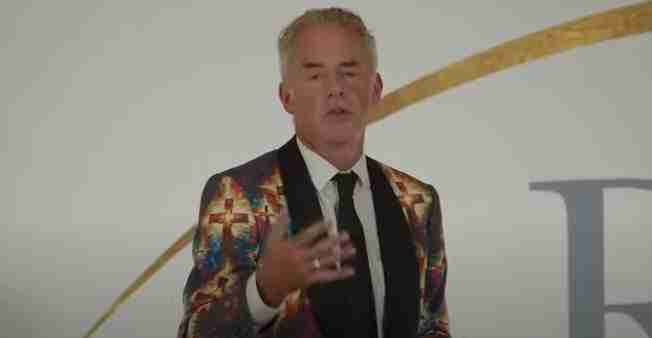
Read the full transcript of renowned psychologist Dr. Jordan B. Peterson‘s speech “Good People Must Not Be Silenced!” at Alliance for Responsible Citizenship (ARC) 2024 conference.
Listen to the audio version here:
TRANSCRIPT:
The Story of Jonah and Its Significance
DR. JORDAN B. PETERSON: So, I’m going to tell you another story, and this time, why this story? Because it brings together themes of the highest possible aim, responsibility, and meaning and cultural renewal, and it’s an amazing story. It’s the story of Jonah, and I like to tell this story partly because it’s one of the stories that cynical, unimaginative, materialist, reductionist, atheists point to when they take ignorant pot shots at the foundation of Western civilization. And so, it’s a useful story to tell as an antidote to that attitude.
So when we meet Jonah, the protagonist of this story, we don’t know anything about him. He’s an ordinary man as far as we can tell, and we can infer that because we don’t know anything about him when the story begins. If his life had been notable with regard to his destiny, then we’d have biographical material, but we don’t, and so we can make the assumption that he’s you, right? He’s another archetypal everyman, and he’s an everyman with a problem.
Finding Meaning in Problems
And that’s actually something useful to know right at the beginning, because people don’t know where to find meaning in their life, and one of the places you find meaning in your life is in your problems. And this is something very much worth knowing, because you have problems, and you have problems, and you have problems, and they’re not the same problems. And there are things that bother you, that bug you, that torment you, that plague your conscience, that don’t plague yours.
If it was voluntary, you’d have something that bothered you, and you’d think, “I’d rather not be bothered by that,” and that would be the end of that, and that’s not how it works at all. If something plagues your conscience, it’s dumped on your lap. That’s a good way of thinking about it, and that can be daunting and irritating. That can make you bitter and resentful.
The Divine Call
Or you can understand that you actually have your problems, and they’re actually yours. And so that is a defining characteristic of your being, and also the calling of your destiny. And that’s what happens to Jonah, this ordinary man. A voice comes to him and says, “You’re aware of a city, Nineveh.”
It’s historically a city full of the enemies of your people, and you really have no regard for them, but I’m God, and I’m unhappy with the citizens of Nineveh. And I’m thinking about wiping them out because of their unwillingness to abide by the appropriate moral order. And the more merciful part of me thinks possibly they could use a second chance, and it’s your duty now to go and have a chat with them, and let them know how I’m feeling. And that maybe they should think twice before all hell breaks loose, and away you go.
Jonah’s Flight
And Jonah thinks, well, if you’re God and you want to deliver the historical enemies of my people a good smiting, I’m perfectly happy with that. And so I’m disinclined on moral grounds to do anything that might be of aid. And also, there’s 150,000 people in Nineveh, they don’t know anything about me, I’m a foreigner and an enemy. And I don’t think I’m going to go there and tell them, king and all, that they’ve wandered off the straight and narrow path, and that God himself is ready to wreak destruction on them. And that they should straighten up, because that sounds like a very bad idea for me.
And so if you read that story and you have any sense, you should be sympathetic to Jonah, because his decision is to make tracks in the opposite direction as rapidly as he possibly can.
He boards a ship and heads to a city whose name I don’t remember, which is as far away from Nineveh that you could get at that time. And so his reaction to the prompting of his conscience is, “I think I’ll do something easier.” And interestingly for him, easier meant uprooting his whole life and vanishing to a new city, and so that’s how much apprehension this call of conscience produced in him. And so he jumps on a boat and makes for fairer climes.
The Storm and Its Consequences
So what happens? Well, he’s on the boat and he falls asleep. And so what does that mean? Well, that’s what you do if you don’t follow the promptings of your conscience. You drift into a kind of, what would you say, wishfully blissful unconsciousness and pretend that you can escape from your destiny by just not being there. And so Jonah now runs from his conscience, he runs from destiny, he runs from God, and he embraces unconsciousness. And that’s not a good strategy, although it’s an attractive one, and the story indicates its ineffectiveness.
So he’s on a ship and the storm comes, and the wind blows, and the waves rise, and the ship is threatened. And so what does that mean? It means if you run from the promptings of your conscience, then not only do you risk drifting into a counterproductive unconsciousness, but you endanger everyone on board the ship that you’re part of.
And so what might that be? Well, that might be your husband or your wife, it might be your family, it might be your community, might be your nation, it’s whatever ship you happen to be protected by and voyaging on.
The Sailors’ Discovery
And so the storm threatens, and the ship is in danger, and Jonah stays asleep, and the sailors are terrified. And they unload the ship, and the waves rise higher, and they have a sense in their superstitious manner that maybe there’s someone on the ship who isn’t right with God. And they cast dice, essentially, to find out who it might be, and the pointer points to Jonah, and they go and wake him up. And they say, “Well, we’re in the midst of a storm, and the ship is threatened, and we cast lots to determine who’s at fault, and it pointed to you. Are you okay with your God?”
And Jonah says, “Well, not exactly,” and the sailors, who are a heathenish lot of pagans and polytheists, say, “Well, who is your God?” And they’re thinking, well, he’s like the God of the local oak tree, or the God of the local, some minor God that you could stumble over in the dark and hardly notice, and Jonah says, “Well, he’s the creator of the oceans, and the land, and the cosmos itself,” and the sailors think, you probably don’t want to piss him off then.
The Descent into the Deep
And so he confesses to his cowardice, which indicates, actually, that he’s fundamentally a decent man, because when there’s a crisis, and it’s possible that he’s responsible, he admits to his error, even though you could imagine doing so under those circumstances might be uncomfortable. And he implores the sailors to throw him overboard, and they refuse, and because they also turn out to be decent people, and so they work as hard as they can to bring the ship to port to escape the storm, but they can’t.
The storm gets worse and worse. And finally Jonah prevails upon them to throw him into the briny deep sea, and so they do. And then you think, well, the story could end there, right? Jonah was called on by the voice that comes to people to tell them that things aren’t exactly right in the world. And that maybe they have something to say, and he refused that call, and he threatened the integrity of the vessel that he was protected by and transported by. And now he’s received his due punishment, but that’s not where the story ends.
Beyond Death: The Belly of the Beast
And the reason the story doesn’t end, even though Jonah is going to die, right, so you might think, well, that’s as bad as it gets. It’s like, that’s not as bad as it gets. I’m dead serious about that. You know, one of the criticisms that’s levied by the Freudians, for example, by the Marxists at the religious enterprise, is that it’s a, what would you say, cowardly and immature defense against death anxiety. And I would say that an ideology and a naive belief can be a defensive mechanism used to protect people foolishly against fear.
But if you think that’s the case for the central stories of the Judeo-Christian culture, then you don’t know anything about the stories, and you don’t know anything about life, because the people who think that religion is a defense against death anxiety are naive enough to think that death is the worst thing, and that’s just where worse gets started.
The Consequences of Silence
And that’s what happens to Jonah, because he holds his tongue when he’s called upon to speak. He ends up in the briny deep blue sea facing death. But then the worst possible imaginable beast rises up from the abyss and grips him in his jaws and takes him down to hell itself.
And you might say, well, that’s an interpolation, Dr. Peterson, and it’s not an interpolation. He spends three days in the belly of the beast, just as Christ is said to spend three days harrowing hell after the crucifixion. It says in the text itself that the beast that takes Jonah in its jaws is from hell in the abyss, and so it’s no interpolation.
What it means is that, well, what does it mean exactly? What does it mean? Well, what does it mean for a country to descend into hell? What does it mean for a country to descend into the grip of the totalitarian nightmare?
Well, it means that every single person who is an inhabitant of that country has decided to hold their tongue when they’ve been called upon to say what should be said. And so then you end up with a country that is in a state so dire that there’ll be many times, if you inhabit that country, where you would pray to drown in the ocean instead of being a citizen of that dread state.
And so if you hold your tongue when you’re called upon to say what you know to be true, it’s not only that you put the ship of state in peril in the most immediate sense, it’s that you doom yourself and everyone you love to a journey to the darkest place you can possibly imagine.
And if you know anything about the rise of totalitarian states and you don’t understand that there’s no difference between a totalitarian state and a state where every single person lies about absolutely everything all the time to themselves and everyone they love, with lies of commission, so outright falsehoods, and lies of omission, which is refusal to say what you know needs to be said, then you know nothing at all about totalitarian states.
The Path to Redemption
So how does a totalitarian state equivalent to hell arise? It’s simple. Good people have a burden on their conscience. The burden requires them to speak, to speak from that, what would you say, the spiritual source of their heart, and they refuse the call. And so Jonah’s in the whale for three days in the depths of hell, and because he’s a good man, fundamentally, he repents. He says, “I made a mistake.”
The Price of Speaking Truth
I understand now the gravity of my error, and I will do as I’m bid despite the threat. Now, the threat is something to understand, because people say to me with a fair degree of frequency, they congratulate me on my bravery. And that’s not a compliment that goes down particularly well with me, because when I rose to public attention in 2016 for opposing my government’s attempts to gain control of my tongue, it wasn’t bravery that had anything to do with it. It was that I knew what to be afraid of, and I was a lot more afraid of losing control of my tongue than I was of anything my idiot state could dream up to do with me. And the reason for that was I knew what happened to people and to societies who lose their tongue.
Jonah’s Redemption and Success
And so Jonah’s in the depth of the abyss, in the belly of the whale, and he repents. And the whale, the dragon, the beast from hell, chaos itself, spits him on the shore, and he goes to Nineveh. And he tells his enemies, who he now loves, or at least acts that way, that they’re pushing their luck with their impropriety and their misbehavior. And I guess spending three days in hell made him a convincing speaker, as it tends to.
And so they listen, and they put on sackcloth and ashes, and the king repents, and the Ninevites sort themselves out, and they return to the straight, narrow path, and the city is saved. That’s not where the story ends. Jonah’s not actually very happy with his success, but I’ll leave that aside.
The Meaning of Responsibility
The story that I’ve just told made the point. What’s the point? Well, this is the Alliance for Responsible Citizenship, and you might ask, well, what does it mean to be responsible? You might ask, well, what does it mean to be responsible in Germany? And this is a country that might well ask what it means to be responsible in this manner.
And one of the things it means is, if you have something to say, you hold your tongue at not just your peril, but the peril of everything, everything you love, everything you know, your state, the world itself, and that’s, what would you say, a function of the fact that you are, in fact, made in the image of God, and that you do, in fact, have something to do, and that it’s real.
The Cost of Silence
And so someone talked to me during this conference and said, for example, “You can’t even initiate a conversation about energy policy in Germany.” It’s like, well, what do you mean you can’t? Exactly. Do you mean it’s okay not to? Well, the poor are further impoverished by the fools who believe that we’ll move to planetary salvation by quintupling energy costs and leaving pollution intact? Is that what you mean by you can’t initiate a conversation?
And then you might say, well, there’s a cost to me, and I would say, don’t be ever thinking there’s no cost, and don’t be thinking that the cost to you for speaking is going to be less than the cost to you for remaining silent, because that’s just not how life works.
The Price of Delayed Action
Now, it might be the case that if you’re on the cutting edge of the discussion, that cutting edge might slice you up, too, but that doesn’t mean that you’ll get away scot-free if you remain silent. It just means that the punishment for holding your tongue will be deferred, and I would also say that anyone with any wisdom whatsoever understands quite clearly that most punishments deferred are much worse than punishments taken when the time is right.
And it might well be the case that you’re in a situation where you can’t say what’s true without running into some dreadful trouble. But if you’re in a situation where telling the truth means that you’ll run into some dreadful trouble, it means you’re already in a pretty damn bad situation, and you better speak up now. I mean it, you better speak up now.
You better speak up now before it gets a hell of a lot worse, which it can and will in precise proportion to your willingness to remain silent when you have something to say. And then I would say as well, and I suppose this ties this story in with the story that I told at the beginning of this conference. Well, if you don’t speak up, you may avert the punishment that would be due you for speaking up at that point. You may avert that or delay it, and maybe it will come at you in magnified form later, as is very likely because problems not dealt with promptly tend to multiply, as we all understand, if we have any sense at all, but there’s somehow other price you pay too.
The Call to Noble Purpose
You know, Jonah was called to be — called upon by his conscience to be the prophetic voice of redemption, even for his enemies. It’s like, well, do you want to do something with your life? It’s a difficult life, you know. You might want something along with it that impels you to rise to the occasion, and being a prophetic voice that could redeem even your enemies, that’s not such a bad destiny. And you’re going to perish anyways, so you might as well do something noble along the way, at least to justify it.
The Adventure of Truth
And so you think, well, I’ll pay a price for speaking. It’s like, well, the price you pay for not speaking is that you’re not even there, but you’ll still have the suffering. So that’s not a good price to pay. And then you might say too, well, if you did have the wise courage to speak when you have something to say, and that did disrupt your life, and you had the faith and courage to tolerate that disruption, it could well be that you would thereby embark on the greatest romantic adventure of your life, because you’ve now thrown yourself out of the domain of foolish security and into the domain of courageous chaos.
The Rewards of Truth
And God only knows what you might encounter there. But if you do that voluntarily, and you call upon yourself to abide by the dictates of your conscience, the best of you will have the opportunity to reveal itself. And then you’ll be the light on the hill that illuminates the world, that invites people up Jacob’s ladder. And whatever price you pay momentarily for speaking when you’re told not to will be, what would you say, the rewards that you’ll obtain by abiding by the dictates of your conscience when you’re true to it will be so much greater than whatever punishment you accrue momentarily for speaking that they’re not even in the same conceptual category.
The Choice of Faith
And that’s actually the definition of a sophisticated faith, precisely that, do you believe in the truth, does the truth set you free? Well that doesn’t mean there won’t be a price paid for it, there’s a sacrificial price paid for everything, you get to — you don’t get to pick whether there’s a price, you get to pick what you’re willing to pay the price for. And since you’re going to pay the price, you might as well pay it for everything that’s holy, because why would you pick anything other than that, especially when the ship of state is in danger and you’ve been called upon to speak.
The Call to Adventure
And so it’s useful to understand this because it could be that you’re apprehensive to make your case known, and it could be that you have reason to be apprehensive. But it might also be that you don’t understand the treasure that waits for you in the realm of that dragon, and you don’t understand that by rejecting that call, you’re rejecting everything about you that would enable you to nobly withstand the slings and arrows of fortune.
And so if you understand that as you should, and that’s the story of Jonah’s, a pointer to that understanding, well then you see that with that wisdom there’s no choice, why would you not do the best thing that you could do? Why would you not do the best thing you could do? And the best thing that you could do is to say wisely what you know to be true. And if you have to pay a price, then that’s the price you pay, knowing that there isn’t a better option than that, no matter what happens to you.
Conclusion: The Best Choice
So that’s the story of Jonah, and that’s the parable, let’s say, of responsibility, and that’s its association with meaning, and that’s the relationship between the voice within you that calls you to speak, and the force that redeems you, and the state, and the nation. And so that’s what you want to serve, you’re going to serve something, you might as well serve that, with your upward aim and your faith and courage intact.
And so one of the things you think when you leave this conference, if you’re inspired by what you heard here, if you want to have the faith and courage of a forthright scout of the future, is say what you think is true, and have the adventure that goes along with that. And the faith that allows you to understand that if you do that, things will turn out as well as the truth would allow them to turn out, which is as well as they can possibly turn out. And so that’s a call to adventure, it’s a call to adventure.
You have no idea what’ll happen to you if you just say what you believe to be true, that’s the life more abundant that’s promised in the ancient texts, right. And the alternative hypothesis is what? You’re going to live a life of falsehood, which means it’s not your life, it’s the life of falsehood, that seems like a bad plan. And that abiding by the falsehood is going to bring to you the security and adventure of your life. Yeah, well that’s a foolish story.
All right everyone, thank you very much for coming today.
Related Posts
- TRANSCRIPT: “Two Things Tyrant FEARS!” – Patrick Bet-David CPAC 2025 Speech
- FULL TRANSCRIPT: ‘Tilt The World Towards Heaven’: Jordan Peterson at ARC 2023
- FULL TRANSCRIPT: Where Do We Go From Here: Martin Luther King Jr.
- FULL TRANSCRIPT: Netanyahu Remarks At 2024 UN General Assembly
- Malcolm X’s Speech: The Ballot or the Bullet (Full Transcript)