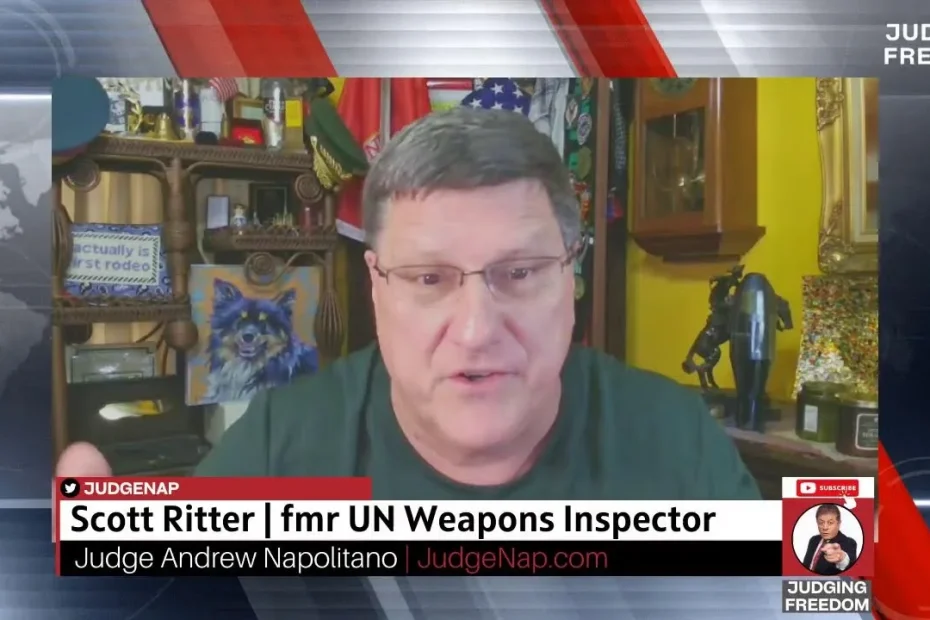
Read the full transcript of a conversation between Judge Andrew Napolitano and former UN weapons inspector Scott Ritter on Judging Freedom Podcast titled “How Foolish to Attack The Houthis” premiered March 17, 2025.
TRANSCRIPT:
Introduction
ANDREW NAPOLITANO: Hi everyone. Judge Andrew Napolitano here for Judging Freedom. Today is Monday, March 17, 2025, St. Patrick’s Day here in the West. Scott Ritter will be with us in just a moment on just how foolish is it, how unwise is it for the Trump administration to be attacking Houthis and civilians in Yemen?
[Advertisement removed]
Trump Administration’s Diplomatic Efforts with Russia
ANDREW NAPOLITANO: Scott Ritter, welcome here, my dear friend. Before we talk about the attack on the Houthis and Yemen civilians over the weekend perpetrated by the Trump administration, I’d like your take on the back and forth between Witkoff, Rubio, Trump, and Putin. That’s been going on, as I understand it from Alistair Crook, Secretary Rubio actually had Steve Witkoff deliver to President Putin a signed copy of the so-called ceasefire agreement signed by Marco Rubio and by Volodymyr Zelensky. That does not strike me as appropriate or standard diplomacy, but this is something relatively new. What’s your take on it?
SCOTT RITTER: Well, I of course, can’t confirm this reporting, so I don’t know. You’re right to point out that that would be a departure from diplomatic norms because the implication is that they’re trying to strong arm Russia into accepting something that would be unacceptable for Russia. And I don’t believe if that tactic was used that it would work.
President Trump’s trying to play a very weak hand right now and the Russians have been, I think, extraordinarily gracious in not holding the president to account for the failures of diplomatic norm, for the failures of common sense, for the failures of decency. The president, on the one hand, will articulate repeatedly how he understands that Russia didn’t start this conflict. He understands how this conflict came about. It’s about the expansion of NATO, which Russia took umbrage to, and the President said that Russia had every right.
Then Marco Rubio turns around and says, rightly so, that this is a proxy war between the United States and Russia. I’ll say that one more time. A proxy war between the United States and Russia. Ukraine is simply the tool for this. If you have that kind of comprehension, then why are you playing the game as if Ukraine has a say in anything that’s going on here? Why are you paying attention to the Ukrainian positions that they must return the borders to 2014, 2022, that Russia must pay reparations?
There’s just an absolute inconsistency in the president’s approach here. And while I don’t want to predict the future, I will say that it will fail because this is an existential issue for Russia. And this is amateur hour in the extreme. To think that presenting a document signed by Marco Rubio and Volodymyr Zelensky is going to somehow twist the arm of a Russian president who’s been at war for three years, who has taken the personal responsibility of the deaths of tens of thousands of his soldiers, who is the leader of his nation, is somehow going to throw that all away because Marco Rubio signed a damn piece of paper along with Zelensky. This is insanity. I’m surprised Witkoff went along with it.
ANDREW NAPOLITANO: Because how can the Russians, as astute as Foreign Minister Lavrov and as astute and patient as President Putin is, how can the Russians look upon Rubio, Waltz and Witkoff as honest brokers? We’re not honest brokers.
We’re co-belligerents. We’re the principal belligerents. By instigating and provoking the war and paying for it.
SCOTT RITTER: Well, I think the difference, again, this is me speaking. I can’t speak on behalf of the Russians, no matter how much the FBI thinks I do. When you look at the words of the senior Russians, they acknowledge that the Trump administration is seeking to move the relationship in a direction that the relationship should be in, that is one where diplomacy is re-established, where diplomatic norms are recognized, and therefore, the Russians are able and willing to differentiate between the sins of the past and the actions of the present.
And I think this is an accurate point. And no matter what we think of the Trump administration, good, bad, ugly, pretty whatever. We do need to acknowledge that this is a distinct departure from past practice, that this is a different administration, that this administration wasn’t in power in February of 2022, that this administration did not make the proxy conflict that’s ongoing since February 2022, that this administration is not responsible for targeting, for directing the assaults undertaken by Ukraine against Russian territory.
So the Russians are willing to overlook a lot of hiccups, stumbles, foibles, mistakes, because they think that this is the better direction to be headed in. But there’s going to be only so much tolerance for incompetence. And at some point in time, if this incompetence seeks to strong arm Russia into doing something that’s against Russian national interests, the Russians are going to say, nyet.
Netanyahu and Israeli Politics
ANDREW NAPOLITANO: Very, very interesting and astute observation, Scott. Jumping to Israel. Netanyahu announced yesterday Sunday that on Wednesday he’s going to fire the head of Shin Bet. Is there more here than meets the eye? Under Israeli law, according to the Israeli Attorney General, he can only be fired for cause. And Netanyahu has not articulated any cause. This is like firing the head of the FBI.
SCOTT RITTER: Yeah. The Shin Bet has several investigations underway against Netanyahu. There is, of course, the years old corruption investigation that Netanyahu has been working very hard to shape the judicial system so that he would never stand trial. And then there are a series of ongoing investigations related to October 7 and Netanyahu’s actions in the aftermath of the initiation of this conflict by Hamas, the failures of leadership that took place.
But I think more critically is the one that hardly anybody’s talking about.
Seymour Hersh has written about it extensively, and that is the absolute violation of law and breach of national security used by Netanyahu in an effort to shape a very politicized argument about the hostages. It was causing him a tremendous amount of political harm to shape that argument in a way that was favorable to him.
But in absolute departure from the facts, he misrepresented a document whose secrecy was such that it was kept locked up in a room. Nobody was supposed to acknowledge its existence. He not only revealed its existence, but took the contents of this document and deliberately misrepresented it to spin it, as if Hamas was the one responsible for sabotaging a hostage release deal, when in fact it was him all along.
And he is now under investigation for lying to the Israeli people and for violating national security by leaking a document he had no authority to leak. And the Shin Bet’s the one that’s investigating this. So he literally has, I believe, brought in the Shin Bet guys. They make us go away. And the Shin Bet guy is saying, no, I’m not doing that. I’m doing my job. And so Netanyahu’s trying to fire him.
ANDREW NAPOLITANO: I guess there’s no way to know what the political ramifications will be to this. According to Alastair Crooke, the Israeli society is deeply divided between the Smotrich-Ben Gvir group, who believe that the Old Testament justifies their slaughter, and the more modern liberal Democrats, lowercase D, who believe in equal protection, equal rights, and a true democracy. I don’t know how you bridge that gap. I really don’t. I don’t know how this is going to end.
SCOTT RITTER: Well, the Israeli president agrees with you. And, you know, Judge, this isn’t a new problem. Prior to October 7, 2023, there are hundreds of thousands of Israelis in the streets demanding the resignation of Netanyahu as he sought to change Israeli Basic Law so that he could take political control of the courts so that his corruption case would never go to trial.
And even reserve pilots said, we will never fly again. And the Israeli president came out and said that Israel is on the cusp of a real civil war. Not a civil conflict, not civil unrest, a shooting civil war between the opponents of Netanyahu and the supporters of Netanyahu. That was before, and a whole lot’s happened since then that has only further torn Israeli society apart.
So Israel is literally a nation that has unbridgeable gaps, and the consequences of this will more than likely be some sort of civil conflict involving armed parties on either side. Jews killing Jews in the Holy Land.
The Houthi Situation
ANDREW NAPOLITANO: Before I ask you about the Houthis, I want to read a portion of the president’s tweet. It’s way too long to read the entire thing, but there you can see it’s President Donald Trump’s tweet about ordering the United States military. The more incendiary stuff is at the end.
To all Houthi terrorists. Your time is up and your attacks must stop starting today. If they don’t, hell will rain down upon you like nothing you have ever seen before. To Iran, support for the Houthi terrorists must end immediately. Do not threaten the American people, their president, who has received one of the largest mandates in presidential history, or worldwide shipping lanes. If you do, beware, because America will hold you fully accountable. And we won’t be nice about it.
That’s very Trumpian language. Can’t you argue that the United States engaged in terrorism, Donald Trump and Pete Hegseth, by killing Yemen civilians over the weekend?
SCOTT RITTER: Oh. Not only can you argue that that’s a cognizable action in any court that would claim jurisdiction.
ANDREW NAPOLITANO: Give us the background and your understanding here.
How Foolish to Attack The Houthis
SCOTT RITTER: Well, I mean, first of all, the American people need to know that the Houthi of Yemen have been in war with America via proxy since 2014. The Saudi Arabian Air Force, using aircraft provided by the United States of America, dropping bombs provided by the United States of America, bombs targeted by the intelligence provided by the United States of America have been pummeling Yemen for a decade, and Yemen hasn’t blinked.
The United States got involved in, participated in these attacks last year or even for over a year now. We’ve been in a quasi war with the Houthi because the Houthi are very principled people. And they said, we will not stand by idly while genocide is taking place. The Palestinian people of Gaza must be allowed access to humanitarian goods. The blockade must be lifted. And until which time those conditions are met, we will prevent Israeli shipping from transiting through the Red Sea into the port of Eilat.
They succeeded in shutting down the shipping. The port went bankrupt. The Israeli economy was devastated. Now, this is a Houthi action against the Israelis. And America stuck its nose in it. And then America said, no, you can’t do this. You have to cease your blockade. And the Houthi said, stick it in your ear. And we started bombing them.
Terrible bombs, according to Trump. I mean, my God. What? Because Donald Trump ordered a bomb, it blows up with greater explosive force than the bomb that was dropped under Biden. Trump is an idiot. I hate to say that, and my wife is going to be very mad at me for saying this, but this is the kind of stupidity that a chairman of the Joint Chiefs of staff has said, “Mr. President, stop, cease and desist.” The Secretary of Defense has to do an intervention, say, “Please don’t do this. You are making us look stupid. You’re putting us in a bad situation. And it’s unbecoming of the commander in chief to speak in this fashion about conflict when American lives are on the line. Treat the Americans with respect. At least use words that impart the dignity of the service they are giving you instead of treating it like a childish video game. Mr. President, shut up.”
And that’s what he needs to do. Shut up. If you’re going to drop bombs, drop bombs, but quit pretending that because you’re Donald Trump the Earth, Shakespeare, greater because you dropped the damn bomb than somebody else. The bomb blows up, and you know who doesn’t care? The Houthi. They don’t give a damn, Mr. President. Going to kick your ass just like they kicked everybody’s ass because you can’t follow through. All you can do is drop bombs, and your bombs won’t stop them from firing missiles.
And then you want to now threaten the Iranian people the same way. It isn’t going to work, Mr. President. And what’s going to happen are one of two things. One, you’re going to look foolish because you’re going to have to back down when your secretary of defense says we can’t escalate any further without putting 700,000 boots on the ground. That’s a major invasion that will cause the entire region to blow up. Oil prices will spin out of control and your economy will crash. And you’re finished, Mr. President. You’re done. Everything you’re trying to do. The American people will not tolerate $120 oil because they can’t economically.
All the changes you’re making are predicated upon a foundation of economic stability, which will not be here if you throw oil security energy out the window by going to war with Iran. Stop it. Or he will actually go to war thinking that somehow American bombs ordered by Donald Trump take on some sort of angelic property and blow up with greater violence and more terror than any other bomb ever made. And then the Iranians will shut down the Strait of Hormuz, blow up American installations, destroy Israel, and invite an American nuclear retaliation. And boom. The man who thought he was going to get the Nobel Peace Prize will go down in history as the greatest warmonger in modern history.
ANDREW NAPOLITANO: So how foolish is it to bomb the Houthis? What conceivable military benefit is there? Or is the only benefit this crazy, as you call it, idiotic boasting for which he is known?
SCOTT RITTER: Look, this could have been solved the easiest way in the world. The President should have sent Steve Witkoff to Benjamin Netanyahu. Punch Netanyahu in the nose, headbutt him in the face, put him in the chair and say, “Lift the blockade against Gaza right now. You’re done. You’re finished. Stop the blockade. Get the humanitarian goods flowing back in.” That’s what should have happened.
But no, we can’t say no to the Israelis, apparently. Or the President just isn’t smart enough to realize the ramifications of what Netanyahu did not realize, that the Houthi linked. The reason why the Houthi stopped firing their missiles last time is that the ceasefire came in as they demanded, and the humanitarian goods flowed. And the Houthi were people of their word. And they said, we’re done. But no, they allowed it to happen again.
Mr. President, you can’t bomb these people into submission. There’s a video of a Houthi fighter going out to recover the wounded body of his friend. The man’s wearing sandals. He’s got his little dish dash on, not body armor. He’s not dressed like an American commando and all this kind of stuff. And he’s running with his body through enemy fire. You see the bullets kicking all around him. They’re trying to get. And he keeps running in the desert under fire with a body on his shoulders, and he recovers his friend.
That’s who we’re fighting. We can make fun of them. We can use all the derogatory terms we want. They wear sandals, they do this, they do that, they do this. They’re the toughest people in the world when it comes to fighting in that area of the world, and we are not going to beat them.
ANDREW NAPOLITANO: Who are they? What does Houthi mean?
ANDREW NAPOLITANO: Is it the name of a human being or is it a geographic location?
Understanding the Houthi
SCOTT RITTER: No, the Houthi, it’s the name of a family that’s head of a tribe that embraces an offshoot of the Shia Islamic faith. They are native to that area in the Arabian Peninsula. They actually, the territory that belongs to them crosses over into Saudi Arabia. Saudi Arabia has been at war with the Houthi in one way or another for many, many decades, and they always lose. Every time they come in, they lose.
Now, the Saudi Arabians drew an arbitrary line on the map. If they continue this fight with the Houthi, one of the reasons why they had to have their ceasefire is the Houthi said, you keep wanting to do this, we’ll just come and take our territory back. Which means they’re going to take the southern part of Saudi Arabia. And they were moving in that direction.
They can’t be beat. They can’t be beat. These are the toughest people in the world when fighting on their own territory, but they are. They’re very insular. They’re extreme loyalty to themselves. They’re used to being treated as outsiders by the non-Houthi. But like I said, these people are very resilient. They haven’t been beaten yet, and they’re not going to be beaten.
ANDREW NAPOLITANO: Here’s somebody who does not understand that. And he should. Cut number six: [Video clip].
What we can’t ignore. And the reason why the President mentioned Iran is because the Iranians have supported the Houthis. They’ve provided them intelligence, they provided them guidance, they’ve provided them weaponry. I mean, there’s no way the Houthis, okay, the Houthis would have the ability to do this kind of, of thing unless they had support from Iran. And so this was a message to don’t keep supporting them because then you will also be responsible for what they are doing in attacking Navy ships, in attacking global shipping.
SCOTT RITTER: Well, it’s curious just a little. When I was a weapons inspector in Iraq, about halfway through, we’d always ask the Iraqis, do you have any missiles you haven’t declared? And then it became apparent that they actually had an SS21 Tochka, which is a short range ballistic missile, but it had been provided by Yemen. And wait a minute, but I thought Yemen doesn’t have any capabilities. Well, the Yemen brought the, provided the missile. They were experts in the missiles.
Yemen had its own ballistic missile manufacturing capability, the Houthi. The Yemenis have scientists trained in Western universities. They’ve produced from scratch hypersonic missiles using their own calculations, their stuff. They may receive some assistance from the Iranians on guidance and control in terms of components that are incorporated.
But no, I would say that it’s a mistake to denigrate the Houthi. Just like when I have people talk to me about Iraq. I was in a conversation the other day with somebody, they said, well, clearly the Iraqis got all their support from abroad because they’re not capable of doing this on their own. I said, you don’t know anything about the Iraqis that extremely well educated, capable engineers, some of the best in the world at what they do, and that’s why they were able to accomplish what they accomplished.
You denigrate the Houthi at your own risk. These are very sophisticated, educated, cultured people. And Marco Rubio would do well to go get advice, maybe sit down with somebody like Alistair Crooke who has experience in the region, and it can set him straight on this.
And the other thing is he needs to be careful about linking Iran and the Houthi together in a way that makes Iran culpable for what the Houthi do, because the United States provides a hell of a lot of weapons to a lot of people around the world who do a whole bunch of stuff with those weapons. We open ourselves up to be treated in the same fashion.
ANDREW NAPOLITANO: So if Iran is morally and legally culpable for what the Houthis do. The United States is morally and legally culpable for what the Ukrainians do and for what the IDF does in its slaughter. Here’s a Houthi spokesperson. Maybe it’s an AI translation, but it’s a legitimate translation. Maybe Secretary Rubio or somebody on his staff will listen.
The American enemy launched a blatant aggression. Against our country in the past hours. With more than 74 airstrikes targeting several areas in the governorates of Sana’a, Sada, Al Baida, Hajja, Dama, Marib, and Al Jawf. The American enemy committed a number of massacres resulting in the martyrdom and injury of dozens in a preliminary toll. In response to this aggression, the armed forces, with the help of God Almighty, carried out a qualitative military operation. It targeted the American aircraft carrier USS Harry Truman and its warships in the northern Red Sea with 18 ballistic and cruise missiles, as well as a drone. In a joint operation carried out by the missile forces, the drone air force, and the naval forces.
ANDREW NAPOLITANO: Did the Houthi strike back at the aircraft carrier Harry Truman?
SCOTT RITTER: 100%. Of course they did. They didn’t succeed. You know, the defensive capabilities of the carrier battle group were sufficient to shoot down these threats, but they struck back and judge. They’re going to continue to strike back. They’re not going to.
ANDREW NAPOLITANO: Why do we pick these fights, Scott?
The Arrogance and Ignorance of US Foreign Policy
SCOTT RITTER: Arrogance. Ignorance. Arrogance, ignorance. I mean, the two are the same. The arrogance again. We could have prevented all of this if we had respected the legitimacy of the Houthi position, which is we are here as Arabs, as Muslims, defending our fellow Arabs and Muslims in Gaza from genocide. So please, cease fire, get the humanitarian goods in. You know, they weren’t asking for Israel to surrender. They weren’t asking for anything unreasonable. They just said, stop the genocide against the people of Gaza. And when the genocide stopped, the Houthi stopped.
That should have been a clear signal to the president. The easiest way to keep the Houthi out of this conflict is to keep the humanitarian goods flowing into the civilian population of Gaza.
Why the president allowed Netanyahu to do this, because now we have a carrier battle group. I mean, come on. Elon Musk and Doge, I’d like you to do a cost comparison of how much it’s going to cost us to go into this military conflict with the Houthi that we’re not going to win versus telling Netanyahu to simply let the humanitarian goods in. I think you’re going to find that we’re going to lose billions, tens of billions, maybe even hundreds of billions of dollars over the course of this effort. And we’re not going to win.
All we had to do is pick up the phone and pay whatever Ma Bell charges for a conversation between the President, Netanyahu or Gab, send Steve Wyckoff over, spend a couple thousand dollars on airfare and tell Netanyahu to cease and desist. You know, for a guy who believes in balancing the budget, this was really the easiest thing in the world. But the arrogance where America, we dictate outcomes. People must listen to us, do what we say. And now we’re trying to dictate to the Houthi who don’t give a damn.
They don’t care about being bombed because they’ve been bombed for a decade. If you don’t think that these people know how to survive in bombing.
And what are we going to do? Escalate. Let me tell you the other reality about the United States right now. We have no clue who or what we’re bombing, okay? These are mobile, relocatable targets. We’re going to hit sites that we think there’s something there. We’re going to bomb them. But look what happened. We’re killing civilians, innocent civilians, and our frustration is going to grow.
This is a repeat of Desert Storm all over again. During the Counter Scud campaign that I played a very big role in. We didn’t blow up a single target because we couldn’t find them. We didn’t know where they were. But we blew up a lot of buses, we blew up a lot of tents, we blew up a lot of trucks. We killed a whole bunch of innocent people in our frustration trying to stop a military problem.
We don’t understand the Houthi problem. And yet we’re going to continue to escalate and bomb. According to Donald Trump, it’s going to be worse than you’ve ever seen. All we’re going to do is kill innocent civilians by the thousands. Putting us on the same page in terms of acts of genocide that the Israelis are.
ANDREW NAPOLITANO: Did something happen recently that provoked this? Or did Trump just wake up on Saturday morning saying, let’s conduct a bombing raid this afternoon?
SCOTT RITTER: I think no. The Houthi announced that they’re going to resume firing missiles against Israeli shipping because Israel had violated its requirement to provide humanitarian goods to the citizens of Gaza. Said if Israel is going to starve the people of Gaza, then we will resume cutting off Israeli shipping through the Red Sea.
ANDREW NAPOLITANO: Scott Ritter, thank you, my dear friend. A superb explanation of what’s going on there, which I haven’t heard from anybody else. I wish the White House would listen to you and Alistair Crook and the others that have a far better grasp of what’s going on there than the people around whom the president has chose to surround himself. Thank you, Scott.
The Importance of Open Communication
SCOTT RITTER: Just a quick. I just want to throw this in there. Until recently, I was actually in contact with a spokesperson from the Yemeni Ministry of Defense. And, you know, this created a dialogue and ability to learn more about them, but also to have discussions trying to explain America to them. But because of the sanctions and the redesignation of the Houthi as a terrorist organization, that channel of communications is now closed to me.
I just want to point out to the American people that when you start shutting down lines of communication because we need information, you’re not going to get accurate information from Marco Rubio or from the Trump administration when it comes to this issue.
It’s going to be highly polarized, incomplete data. I’m not saying that the Houthi are always right. I’m not saying that they always tell the truth. I’m not accusing them of not. But I’m saying it’s imperative that we make sure we have access to all information sources so that we the people can make the best decisions possible. And yet we have the Trump administration shutting down any opportunity to speak with the Houthi directly and find out what their point of view is.
ANDREW NAPOLITANO: Well said, my dear friend. Thank you very much for joining us. We’ll see you again soon.
SCOTT RITTER: Thank you.
ANDREW NAPOLITANO: Of course. And coming up at 3:00 this afternoon on all of this, but also with an emphasis on the repression of free speech in America on college campuses. And he knows of what he speaks. Professor Jeffrey Sachs, Judge Napolitano, for Judging Freedom.
Related Posts