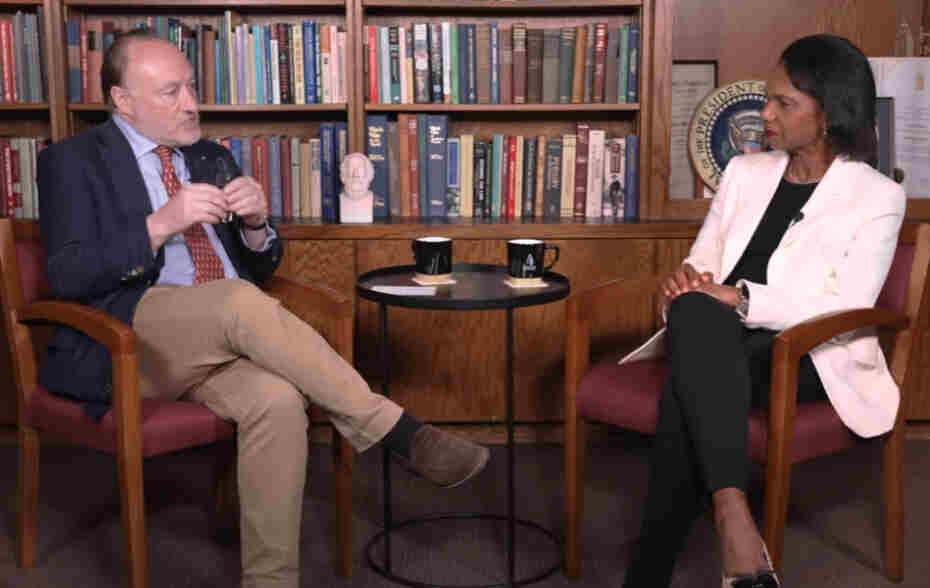
Read the full transcript of former U.S. Secretary of State Condoleezza Rice’s interview on Secrets Of Statecraft with Andrew Roberts podcast taking a deep dive into today’s international hotspots—including Russia’s invasion of Ukraine, rising tensions with China over Taiwan, and the complex relationships among Russia, China, Iran, and North Korea, August 9, 2025.
The Importance of History in Decision Making
ANDREW ROBERTS: Condi, history matters to you, doesn’t it? Your father was a history teacher. You’ve made history. Obviously, you champion it here at Hoover. But how important really is it in decision making at the top? One thinks of 9/11 as having very few precedents, really.
CONDOLEEZZA RICE: Well, I am someone who believes deeply in history because I believe you can’t really understand today’s events unless you understand where they’ve come from. And it gives you a depth of understanding that allows for better decision making.
Now, there are uses and misuses of history. I think the uses are to say, what about this looks different, but what about it maybe we’ve seen before? Our good friend Steve Kotkin often says everything is unprecedented unless you know history. So generally, you have been through something like it before.
I think where it can be misused is everybody loves to analogize, and we’re hearing it now. You know, “Cold War 2.0.” I don’t really think we’re going through a second Cold War, and it can cloud your views of what’s actually going on. So I don’t like analogizing to things that probably don’t fit.
But I do like it as a kind of foundation, a way of grounding your understanding, because human beings are the only beings that we know that know that they had a past, they live in a present, they expect a future. And a lot of leadership is connecting where they’ve been to where they are now to where they want to go. And to do that, you have to understand the history of a people, the history of a country, even the history of certain leaders can be helpful.
Historical Precedents for 9/11
ANDREW ROBERTS: You’ve said that there wasn’t much of a historical precedent for 9/11, except for the War of 1812, which obviously, as an Englishman, I’m rather nervous about even bringing up. But nonetheless, that is something to have two centuries without having something like that to look back to. What were your initial reactions with regard to the historical background?
CONDOLEEZZA RICE: Well, certainly for the United States, which over that period of time had really come to think of security as an external problem, the idea that you would have people inside the country who used something as simple as commercial aircraft to blow a hole in the Pentagon, to kill 3,000 people, it was really unimaginable.
I do think, though, that some of the history of how we had responded did come into play. So I will relate one conversation in the Situation Room that maybe relates to this. We were talking about how to deal with the Taliban. Should there be an ultimatum to the Taliban or should we just attack? Colin Powell said something that will always live with me: he said, “Decent countries don’t launch surprise attacks.” And he had a kind of list of surprise attacks that had taken place.
And so you do, particularly in times of crisis, you tend to refer back to touchstones that can help you. We also knew from the more recent history with the Soviet Union that there were things that we should be concerned about. We wanted to make sure that Vladimir Putin knew that our military forces were going up on alert so that he could de-alert Russian military forces. And we didn’t get into a spiral of alerts. Without knowing our history as countries in the nuclear age, we would not have thought to do that.
So I think the history is quite useful, not the totality of it, but isn’t it often said, you know, that it may not be repeating itself, but sometimes it will rhyme? And I’m very much one who believes in that.
ANDREW ROBERTS: Yes. And I suppose with Colin Powell, he’s absolutely right, isn’t he, that surprise attacks—although Paul Wolfowitz also, of course, said that surprise attacks happen so often in history that the surprising thing is that we’re still surprised by them. And you have Pearl Harbor, I suppose, was the natural sort of template for your response. So even there, history was a useful guide.
CONDOLEEZZA RICE: History was very much a useful guide. And as we were trying to assess after the fact how we had missed the coming of 9/11, other places where the United States had been surprised and probably shouldn’t have been.
Now, one thing that they had in Pearl Harbor that we did not have in 9/11 is what people have called strategic warning. So we knew we were in a tense situation with Japan. We knew that there had been military engagements along the way going all the way back to the mid-1930s. And so perhaps in that sense, Pearl Harbor should not have been such a surprise. Perhaps we should have been better prepared for it.
The problem with 9/11 is it did feel as if it had come out of the blue. It’s absolutely true that there had been an attack on the World Trade Center. It’s true that they had attacked our embassies. But I remember thinking that even though there had been some intelligence that talked about the use of airplanes, the thing we immediately went to was, “Oh, they’re going to hijack an airplane, hold it on the ground for some kind…” The idea that they would use it as a missile, that was truly a surprise.
Why This Isn’t Cold War 2.0
ANDREW ROBERTS: Now, you said, and I think it’s quite controversial, that we’re not in a Cold War situation, because there are plenty of historians, including ones at Hoover who we know well, who have argued essentially that ever since Putin’s invasion of the Crimea in 2014, and especially with regard to China becoming more and more sort of saber rattling in the South China Seas and elsewhere, that actually we are in a Cold War.
So what in your view would tip us into a Cold War situation and also were we to get into one, what in history from Cold War one, would it be useful to learn?
CONDOLEEZZA RICE: Well, I do think there’s some lessons from Cold War one. I’ll come back to that. But let me just tell you the three reasons I think we shouldn’t describe it as a Cold War. And the reason is we have a very specific thing in mind when we talk about the Cold War between the United States and the Soviet Union.
First of all, it was deeply ideological. The United States had a view of how human history ought to unfold and so did the Soviet Union. And the way that you can tell something is ideological is that a great power tries to imprint its institutions on the rest of the world. The Soviet Union was not satisfied with a Czechoslovakia that would be friendly. It was a Czechoslovakia that had to be Communist. Communist Party, deeply ideological response.
Secondly, the Soviet Union was a military giant, but it was a technological and economic midget. And so China is not that country. It is a competitor for the United States on all of those dimensions.
And perhaps most importantly, the Soviet Union was completely isolated from the international economy. At no time did more than 1% of Soviet GDP was accounted for in international trade. China completely integrated into the international economy, the second largest economy. Supply chains integrated, investment integrated. And so I think it misleads us.
ANDREW ROBERTS: Can I just put you up on the first one, the ideological one? You’re quite right. I don’t think that the CCP wants to impose communism on the United States. There’s no sort of universal concept like that. However, they are both, both China and Russia very much want to undermine democracy in the west, don’t they? There’s an ideological, anti-democratic…
CONDOLEEZZA RICE: Well, there’s an anti-ideology that is there, but I think it’s more about American power actually. And from the CCP’s point of view, they really don’t care what your form of government is. They will come in and they will do Belt and Road. I don’t care if you are a corrupt authoritarian or I don’t care if you are the residual of some kind of totalitarian. They will come in.
In a sense, it’s the fact that they don’t try to impose an ideology that makes them so challenging because we come in and we say, “Well, you have to treat your people right. You have to have human rights. You need to have people have a voice.” And they come in and say, “No, no, no, we’ll give you the aid. Just give us your port and we’ll give you the aid.”
And so in a sense, that would be a misleading way of thinking about what China is doing in terms of challenging for Western civilization, if you will, which is how Putin would put it. That’s true, that has an ideological element.
I do think, though, you mentioned the Russian invasion of Crimea. This is also the first time in a long time that we’ve had great power conflict that is truly territorial. We have managed with the Soviet Union essentially to avoid, at least after the major Berlin crises, territorial conflict between us. We’ve certainly had proxies in various parts of the world, but not vital territorial interests like Taiwan. Not vital territorial interests like the reimposition of the Russian empire, which abuts the interest of Article 5 and NATO. And so it has a somewhat more 19th century feel to it.
The Scramble for Africa
ANDREW ROBERTS: Yes, including of course, the scramble for Africa. Garry Kasparov has argued that America is losing badly the scramble for Africa between Russia and China, on the one hand, which is suborning nation after nation, and the United States, which isn’t really engaging. How fair do you think that is?
CONDOLEEZZA RICE: The Bush administration was very involved in Africa, both from the President’s Emergency Plan for AIDS Relief, malaria relief. I think President Bush probably saw more African leaders than five presidents put together. We ended a couple of civil wars, including in Liberia and at least temporarily in Sudan. And so I think we were very engaged in Africa.
I do think it’s fallen off and you can’t be engaged in Africa simply to be the anti-China. If you go to African leaders and say, “Well, we want to engage with you, so you won’t engage with China,” that doesn’t work. If you say “We want to engage with you on your own terms because we understand the issues that you have,” that’s a very different approach and I think we are losing that very much so.
NATO and Article 5
ANDREW ROBERTS: You also mentioned Article 5 just now. President Trump, on his way to the recent NATO summit in June, said that there were different interpretations of Article 5, which sent me to read Article 5. And it seemed perfectly clear to me that there’s only one interpretation which is “all for one and one for all.” This, of course, sent shockwaves through NATO countries. Is it him, in your opinion? Is it him being provocative in that way that he enjoys in order to get a response, or does he genuinely think there are different interpretations? In which case, if you were living in the Baltics, you would be very worried, wouldn’t you?
CONDOLEEZZA RICE: Well, he also said, when pressed about this, he said, “Well, I wouldn’t be here if I didn’t believe in Article 5.” Look, I think our President tends to say things that he does think are provocative. He also has a tendency not to use the very careful language that we as experts have all become accustomed to.
But I would remind that Article 5 is not sustained just by what the American President says. It’s sustained by an American presence in Europe. And even in the days of people like Ronald Reagan or George H.W. Bush, it wasn’t what they said. It was that you had an American tripwire in Europe, in Germany, and kill an American. To get to Germany, you’ll have to kill an American. Do you really want to give the American President that choice?
And so it’s both force posture and it is the declaratory policy. And I myself have always leaned more on force posture than on declaratory policy.
ANDREW ROBERTS: Although American troops are being brought out.
CONDOLEEZZA RICE: Well, American troops are being downsized, but I don’t think you’re going to see a withdrawal of American forces in important places. And I also think that NATO is getting stronger. There is some rebalancing taking place in NATO. I was so pleased to hear the Secretary General say “The United States has carried this burden long enough,” because I do think there’s a feeling in the United States, among the population, among even among experts, that we carried the burden for a long time for what George Shultz, my great friend George Shultz, called “the Security Commons” for everyone else.
And that you would now have the Europeans through some combination of what President Trump has done and what Vladimir Putin has done, to say, “All right, it’s really time now for us to spend on our defense.” And when I hear people say, “Well, Europe says they will, they will spend because they’re not,” I think, fine, I don’t care what the reason is. If we have some rebalancing, that will be good.
And we’ve added Sweden and Finland, real powers. You asked about Africa. A place we’ve ignored is the Arctic. To now have purchase on the Arctic through the Baltic states and the Swedes and the Finns, I think, is a very positive development for NATO.
ANDREW ROBERTS: So there have been increases. Of course they have, especially the Germans with their 85 billion. And the European Union has got a new rearmament fund and so on. How impressed were you with Britain increasing its defence budget from 2.3 to 2.5%?
CONDOLEEZZA RICE: Well, I’m hoping for better.
Ukraine and Putin’s Strategic Miscalculations
ANDREW ROBERTS: Yeah, you’re certainly not alone in that. Turning to Ukraine, you’ve recently been on the record saying that, and I got the quotation here, “Putin has, in effect, made the President look bad.” And this is therefore a cause for essentially hope that the United States might return to its pre-Trumpian levels of support for Ukraine. How do you feel that’s going at the moment?
CONDOLEEZZA RICE: Well, the President’s been very clear that he tried to give Vladimir Putin a chance. I think he may have believed that Putin would take the offer of the ceasefire. I was a little concerned that some of the things that were on the table were so favorable to Russia. If I’d been Vladimir Putin, I would have snapped them up.
But he seems instead determined in his own mind to try to crush Ukraine instead. And so the President is seeing that, I think, that the pictures of the terrorist attacks, and that’s all you could call it, against civilian populations in Ukraine, has gotten his attention.
And now it is both a matter of giving the Ukrainians aid, including Patriot missile batteries, but it’s also the threat that he may do more in terms of sanctions. We’ll see the fighting season here will be over in a couple months or three, and we’ll see what Putin wants to do at that point. But so far he’s been unmoved.
Well, he’s doubling down, essentially, and he’s doubling down now. The Ukrainians are not easy to run over. If he really believes that he is going to use these terrorist attacks against the Ukrainian population to break their will, I think he’s sadly mistaken.
He also is losing. They’ve lost or had a million casualties. He doesn’t seem to care because I’ll tell you, I don’t think they’re the blond boys from Moscow and St. Petersburg. They’re poor kids from Dagestan and Khabarovsk and other places.
And the economy’s starting to show strain, including the energy sector. They’re not reinvesting in the energy sector. Things are starting to break down. Gazprom has said in a leaked memo that they won’t be profitable until 2035. And so a lot around Putin is problematic now, but he seems so intent on trying to break Ukraine’s will that he can’t see that there is a way out for him that the Trump administration offered him.
Secondary Sanctions and Frozen Assets
ANDREW ROBERTS: And if secondary sanctions were placed on Russia, which would discourage China essentially, and other countries from helping out in terms of energy and so on. Would that speed up that?
CONDOLEEZZA RICE: It’s hard to say. And I’m a little concerned. I probably would support the Lindsey Graham bill on secondary sanctions against those who are aiding the Russian war effort. My concern is that this is already a pretty complicated situation with tariffs flying all over the place and trade relations somewhat uncertain to start.
Secondary sanctions on India, for instance, seems a bit problematic. I suspect that if you’re Secretary Bessant, this is not your favorite idea as he’s trying to calm the international economy, calm bond markets and the like. I actually think that what we should do is think about the 300 billion in frozen Russian assets. I would go after that before I would.
ANDREW ROBERTS: In the Euroclear in Brussels.
CONDOLEEZZA RICE: Exactly. And by the way, not the ones for oligarchs. I don’t want the United States to become a place where private investment is not considered safe. But the Russian central bank assets, I would take them in a second and I’d give them to the Ukrainians to fight this war.
ANDREW ROBERTS: Bob Zoellick, the former president of the World Bank, has been arguing for this for some time, and he argues that it would not affect the world economy in the way that some French and German interests claim it would.
CONDOLEEZZA RICE: I think it would not. And I understand that people talk about precedent, but it’s only a precedent if you think of it as a precedent. And hopefully we won’t have another precedent where a large country tries to extinguish its smaller neighbor. If you’ve put your assets in the United States and you don’t try to do them, then they’re perfectly safe. So I don’t consider it precedential. And I do think it would be to my mind, a better option.
The other thing that you might do is on some smaller Chinese banks that the Chinese have stepped over the line, to my mind, in some of the aid to the Russian war effort. So you might be more selective about it. And one of the things that I’ve heard is that the reason that the President has not encouraged the passage of this bill is that they would like to have some flexibility in what the President is allowed to do. If I were in the White House, I would not want a bill that has automatic sanctions of some kind moving.
Palestinian Statehood Recognition
ANDREW ROBERTS: Moving to another area of the world, which is also suffused with history and precedent. The Middle East. The British government has announced, along with the French and Canadian governments that they’re going to recognize Palestinian statehood in the United Nations in September, despite the fact that under the Montevideo Convention, you have to have four different areas, such as a permanent population, recognized government, recognized borders and so on. Ability to create international relations, which it seems to me at least that Palestine has none of those four things. What’s your sense about this?
CONDOLEEZZA RICE: I respect the rights of these governments to do this, but it seems rather…
ANDREW ROBERTS: Performative to me and also rewarding of the 7th of October terrorists frankly.
CONDOLEEZZA RICE: Not likely to do very much good. I worked very hard to bring a Palestinian state. Ehud Olmert offered in November of 2008 what I think might have been a deal to Mahmoud Abbas. He couldn’t take it. We were almost out of office. I said just deposit it. It had territorial arrangements, it had a way to deal with the holy sites, it had a way to deal with the refugees.
And I think the Palestinians have missed many opportunities to have their state, including with President Clinton, with us. And so I think the real problem for the Palestinians is that they need to defang Hamas. They need to get Hamas out of the governance.
And at the same time that Britain and others were doing this, there was a less noted announcement from several Arab states telling Hamas to disarm. So that to me is more likely to bring change because Hamas has lost whatever credibility they had with the Palestinian people. There are polls that show that the long suffering people in Gaza blame Hamas as much as they do Israel for what they are experiencing.
And if you can get Hamas out of Palestinian governance and start to build up a Palestinian Authority that can work, you will get I think a Palestinian state. Now to be fair, I would want to hear Bibi Netanyahu say that he favors a two state solution. All that he has to do is go back and read Ariel Sharon’s Herzliya speech from 2003. When Sharon says “it pains me as a Jew,” he says “but we will have to divide Samaria and Judea because I do not wish to rule over Palestinians.” I would say to Bibi, just say that.
The other point that I would make is that the humanitarian situation is incredibly dire. President Trump himself mentioned the people who are starving. We can’t have that in the modern world. And so whatever needs to be done to relieve the humanitarian condition of the Palestinians I think needs to be done. But I don’t think recognizing a non-existent state really helps.
ANDREW ROBERTS: Abba Eban who said that the Palestinians never pass up an opportunity to pass up an opportunity.
CONDOLEEZZA RICE: And it’s very sad because they are for the most part entrepreneurial, tolerant. I have Palestinian Christian friends and yet somehow they’ve not been able to put the pieces together to govern. And a lot of that is because of terrorists like Hamas. So if you can disable Hamas, then I think the Palestinians have a chance.
ANDREW ROBERTS: And how can that be done militarily in a built up area that has tunnels all over it and where the terrorists are able to hide and attack again later?
CONDOLEEZZA RICE: They’re certainly in a weakened position at this point. And I’ll quote what an Arab leader quoted to me. Maybe you go after the head of the snake, which is Iran in this case.
Iran and Regional Power Dynamics
ANDREW ROBERTS: Well, that brings us on obviously to another place which has 3,500 years of history. What was your sense when President Trump bombed the Iranian nuclear facilities? I mean, that was something that was on the agenda presumably when you were Secretary of State and for many, many years before that. What was your response when he actually did it, unlike any of the previous presidents?
CONDOLEEZZA RICE: Well, I thought it was the right thing to do. And I was particularly glad because I think for those who thought that Donald Trump’s America First meant that he was going to sit on his hands and do nothing, it was a good lesson that he still knows how to use American power.
This came after, by the way, a series of events in which Israel had set the table both in the disabling of Hezbollah through the well known pagers and other elements. I think it must be the case that the amazing penetration of Iran by Israel, where they had a meeting, they called the meeting of the Air Force high command and dropped a bomb on it. So the Iranians, I think are in that “Where are the moles? What’s going on here?” And so it’s a weakened Iranian state.
And if you want to continue to weaken its tentacles, Hezbollah so that Lebanon has a chance for freedom, Hamas so that the Palestinians have a chance for freedom, the horrible Iranian militias operating in Iraq so that Iraq can finally stabilize, then I would say put as much pressure on the Iranian regime in its weakness as you possibly can.
ANDREW ROBERTS: How about the Houthis?
CONDOLEEZZA RICE: They’re harder. The Iranians claim that they can’t control the Houthis, but we know that they give them a lot of assistance. But they seem more like pirates to me. And I think you just kind of have to deal with them on their own terms.
Syria and Regional Transformation
ANDREW ROBERTS: And Syria, what’s your sense? Because that’s another place that has so much history.
CONDOLEEZZA RICE: But what you’re seeing is you’re seeing a lot of the pieces in the Middle East that are suddenly in tremendous change. So we mentioned what’s happening in Lebanon with the weakening of Hezbollah, maybe with the weakening of Hamas, now in Syria. I had hoped that after the fall of the Assad regime, you would start to see a stabilization of Syria. It’s not clear with all of the various factions that that’s possible, but somebody should be paying attention to trying to put together. There’s a Syrian contact group. I would hope that there’s an effort to try to bring something of a governing coalition because Syria seems to be right at the edge.
But I will say going back to the conversation that we were having about the great powers that are emerging, the Russians have lost a lot in very recent times. They lost Bashar al-Assad, who they didn’t lift a finger to help. When the Iranian foreign minister went to Moscow a couple of days after the American attack, Putin came out and said, “Well, he didn’t ask for military assistance.” Well, if you really believe that.
So the weakening of the Russian position in the Middle East is really quite dramatic and I think it’s something that we should take note of. It also to me says something about the friendship without limits between China and Russia, that maybe there actually are limits. We ought to be exploring them.
ANDREW ROBERTS: And it’s very much the junior partner, isn’t it, compared to China.
CONDOLEEZZA RICE: And I’ve always thought that particularly those four, the Russians, the Chinese, the Iranians and the North Koreans who nobody understands, they have so much not in common. Now if you are Russia, you cannot be happy about the Chinese penetration of Central Asia.
ANDREW ROBERTS: Yes. And you’ve got a 4,200 mile border with them, which is extremely nerve wracking.
CONDOLEEZZA RICE: And there are no more xenophobic people about Asians than the Russians. So a lot of people say how can we pull them apart? No, I say slam them together and let them deal with their own internal contradictions.
China and Taiwan
ANDREW ROBERTS: You mentioned China. Again, history plays a tremendously powerful role here, doesn’t it? But in 1949, Chiang Kai-shek’s nationalist forces moved to then Formosa, now Taiwan, and the Chinese do regard it very much as part of China, of the Republic of China. So what do you think they will do to try to reintegrate Taiwan over the coming, not necessarily months or years, but decades?
CONDOLEEZZA RICE: I worry that their plan is not the one that everyone spends time worrying about. I can’t really imagine an all out invasion. Let’s remember that this would be militarily, people will tell you like D-Day plus 100.
ANDREW ROBERTS: Yes, well, it’s much, much wider straits.
CONDOLEEZZA RICE: It’s also the case that we’re seeing that Xi Jinping is not particularly comfortable with his armed forces. He keeps changing out generals and purging these people.
ANDREW ROBERTS: And they haven’t really fought a war since Korea anyway.
Taiwan and the Hong Kong Model
CONDOLEEZZA RICE: No, no. Well, they had the skirmish in ’79 with Vietnam, which they lost. So I think this is not. There is, however, an approach which I think we’re seeing unfold.
Admiral Paparo, our commander in the Pacific, has called the exercises around Taiwan that look like strangulation exercises, that look like quarantine. He’s called it not exercise, but a rehearsal. And I worry about that.
And married with cyber attacks or fiddling around inside the Taiwanese government. And it wouldn’t be that you have to absorb Taiwan physically. You would try to make sure that Taiwan was Hong Kong. While Hong Kong maintains a little bit of economic freedom, its politics, its security are completely Beijing, it’s really another province of China.
And that could lead Xi Jinping to be able to say that he’s reintegrated, that he’s overcome the humiliation and restored China to its original strengths.
ANDREW ROBERTS: That makes much, much more sense, of course, than the taking the risk. Because he’s not a huge risk taker, is he?
CONDOLEEZZA RICE: And if you were to do this, would we respond? How do you respond to what is essentially salami tactics rather than an all out invasion?
Dual Roles in Government
ANDREW ROBERTS: Henry Kissinger, who has been on this podcast, held the posts both of Secretary of State and National Security Advisor. You’ve obviously held both of them as well, but not at the same time. And Marco Rubio now is holding them at the same time and he’s the first person to have done it since Henry. How do you feel? Are the posts not sort of deliberately designed not to be held by the same person?
CONDOLEEZZA RICE: Well, they may have been, but the important thing is the design fits the President and fits the administration. I’ve never thought that you had a way that the NSC had to look a particular way. There are presidents who are more top down. This president is kind of his own action officer, so it’s very top down.
There are NSCs that operate it mostly at the deputies level. That would have been the case with George H.W. Bush, where it was a very powerful deputies committee. Because we were at war, we operated much more at the principals level with the President coming in quite often. So they operate differently.
I think Marco Rubio has done something very smart. This is a different president. He does make a lot of policy in the Oval Office without a lot of process underneath.
ANDREW ROBERTS: Usually when television cameras are on.
CONDOLEEZZA RICE: Usually when television cameras are on and he’ll say we’re going to do this and then the process sort of follows that. And so being down the hall from the Oval Office is not a bad thing.
ANDREW ROBERTS: If you’re Marco rather than miles off in Foggy Bottom.
CONDOLEEZZA RICE: Foggy Bottom. And I think he can run the machinery of state. And I know his deputies. He has very strong deputies. And so I’m not at all concerned about his having both. It may be that the time comes when he will relinquish one or the other. But he seems to me to be doing a very fine job at this point. And so if he wants to do it this way, I’m all for it.
Current Reading and Historical Perspectives
ANDREW ROBERTS: Well, if you’re all for it, I don’t think anybody needs to be worried about it. What book, what history book or biography are you reading at the moment?
CONDOLEEZZA RICE: Well, I’m constantly reading biography because for me that’s the most fun to read. And I’m actually reading right now a biography of Andrew Jackson.
ANDREW ROBERTS: Really? Which one?
CONDOLEEZZA RICE: Yes, that’s the one. John Meacham’s biography of Andrew Jackson. Because our president sometimes talks about Andrew Jackson. I think my next one is going to be of McKinley.
ANDREW ROBERTS: Yes, well, Karl Rove has written.
CONDOLEEZZA RICE: He has, yes. And I told Karl I have to read his book on McKinley. Although I have to say, speaking of history, when you go into the Oval Office, most American presidents, of course, have George Washington, Abraham Lincoln. If you’re a Democrat, maybe it’s Roosevelt. If you’re a Republican, maybe it’s Reagan.
I think the White House archivist had to work quite hard to find McKinley, but he’s now in the Oval Office, so I think I’ll read those. But I’m also reading a lot in the science and technology area at this point, trying to educate myself about AI and frontier technologies.
And if I could recommend to people a book, it’s by my colleague Fei-Fei Li. It’s called “The Worlds I See.” She is one of the preeminent AI specialists in the country and talks about how it’s a civilizational technology that we are facing.
ANDREW ROBERTS: Civilizational as in the sense of the printing press.
CONDOLEEZZA RICE: Exactly. And changing just about everything about who we are and how we do it.
ANDREW ROBERTS: And we’re not ready for that, are we?
CONDOLEEZZA RICE: We’re not ready for that. And we’d better get ready because it’s happening daily as we speak.
Counterfactual History
ANDREW ROBERTS: And what about your counterfactual history?
CONDOLEEZZA RICE: Well, I’m a Russianist by training.
ANDREW ROBERTS: Absolutely.
CONDOLEEZZA RICE: And I really have two counterfactuals, both that relate to Russia. One is what if Lenin had missed that train coming back. But more seriously, if we had not forced the Kerensky government to stay in the war and let him pay attention to what was happening around him, might we not have had a Russian revolution of the kind that we had?
ANDREW ROBERTS: It’s very nice of you to say we, because, of course, it wasn’t the American government that forced him. It was the British and French who forced him. But thank you for making it a wider Western civilizational error.
CONDOLEEZZA RICE: Well, you probably got our support in doing it, but yes, I have, because I think the Russian revolution is one of those hinge points in history that we’ve yet to recover from, and we’re seeing it even today in Ukraine.
And then my other one is more contemporaneous or later in time. When Gorbachev came to power and he had really begun to change a lot about the Soviet Union, he told me once, “I want the Soviet Union to be a normal country.” He said, “We can be the far left of a continuum going all the way out to social Democrats and Christian Democrats.”
And he had this vision of a Soviet Union that would not rely on propaganda and lies and coercion, but would actually give people a reason to be a part of it. Now, it was probably a pipe dream because the Soviet Union was a brutal empire. And it turns out once you got rid of coercion and the lies, nobody wanted to be a part of it.
But I do ask myself, as he was reforming the party, as he was allowing small commerce to grow up through these cooperative restaurants and the like, did we move too quickly on the breakup of the Russian economic system of privatization, where 50% of the Russian population fell below the poverty line practically overnight?
They gave me only one bar of soap for one month. Try to do your laundry with that. That’s what they gave me. One bar. Maybe we could have taken that more slowly. Maybe that would not have brought the kind of dislocation and disruption that Yeltsin reacted to by bringing Vladimir Putin to power.
ANDREW ROBERTS: Yeah. An authoritarianism.
CONDOLEEZZA RICE: An authoritarianism, yes.
ANDREW ROBERTS: Well, on that bombshell, Condoleezza Rice, thank you very much indeed for coming on Secrets of Statecraft.
CONDOLEEZZA RICE: Thank you. It was a pleasure to be with you.
Related Posts