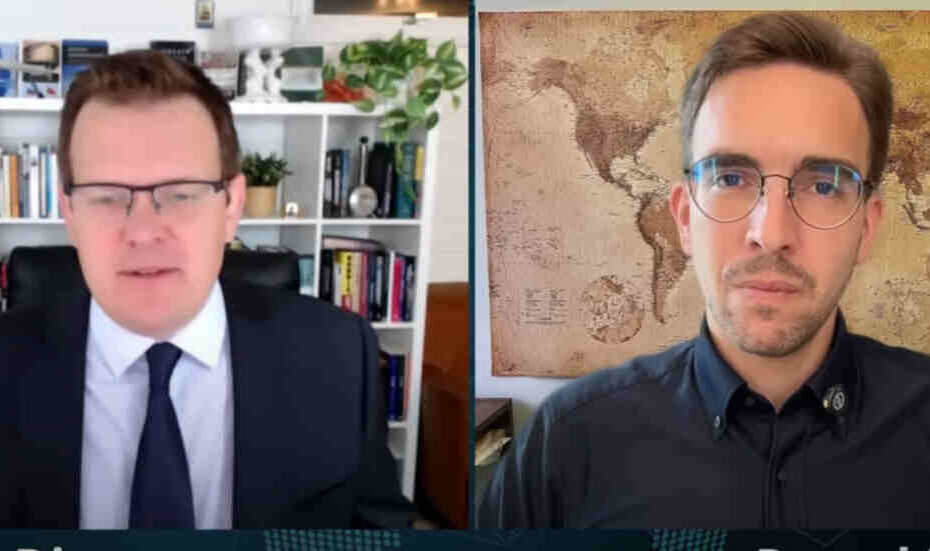
Read the full transcript of professor of international relations Glenn Diesen in conversation with Pascal Lottaz of Neutrality Studies on “US-Russia Summit Destroys 500 Years Of European Geopolitics”, August 16, 2025.
The Significance of Great Power Diplomacy
PASCAL LOTTAZ: Hello, everybody. Pascal here from Neutrality Studies. And today I’ve got with me again Glenn Diesen, professor of International Relations at the University of Southeast Norway, a very good colleague of mine. And I’m very happy to have him back because we want to discuss the Putin Trump summit. I just earlier was on his channel giving him my perspective, and now he’s very kind enough to stick around and give us his perspective. Glenn, welcome back to the channel.
GLENN DIESEN: Thanks, Pascal.
PASCAL LOTTAZ: I’m really glad that we can do this because there’s a lot to unpack. To me, it’s one of these moments when I feel that something is changing, although maybe the summit will be forgotten in a few years the way that we also kind of forget that Biden met Putin and so on, because everything went down the drains anyhow.
But I can’t get around the feeling that, no, this is different. For the first time, we are seeing a new way in which gray powers actually interact with each other. Especially after this, after the west pretended for so long that Russia is isolated, the world is against Russia, and now they’re still pretending that, “oh no, Russia is going to get the feeling that it’s being reintegrated,” as if it had ever been excluded from the world.
The Western solipsism is just very quite fantastic when it comes to this. How do you interpret what we, the process that we are, that we’ve been seeing over the last six months that now culminated in this great power meeting summit in Alaska?
The Collapse of European Security Architecture
GLENN DIESEN: Well, I agree with you, though. I think that the significance, that there’s a huge significance behind this, because if you look at the actual format for, or the discussions we had about Russian security over the past 35 years, there hasn’t been any since the 1990s.
European security entailed integrating the entire continent with the exception of the largest country in Europe. So this is, I think, the source of everything. That is we canceled all agreements for common security based on invisible security in favor of a hegemonic peace which manifests itself through NATO expansion.
And as many predicted back then, this is what would cause conflicts in the future. It kind of makes sense. It would be easy to explain to a child, while the idea of a Cold War military alliance expanding closer and closer to Russian borders and ensuring that it doesn’t have a seat at the table in Europe, that this is somehow the recipe for peace and stability.
But anyways, what I want to get to was for more than 20 years, we refused to discuss Russia’s seat at table in Europe, we didn’t want to discuss their security concerns. Indeed, the whole ideology we built Europe around was that the EU, NATO would be a force for good. So, yes, you might not be part of this club. We might put our military along your borders, your missiles, but this is a source of stability and democracy. So it didn’t make it possible to discuss what Russia wanted.
And of course, took us up to 2014. We could topple the government in Ukraine. But also this is good for democracy and stability. We had fake solutions from. You can already argue from 2015 with the Minsk agreement. This goes up to 2022, the Russians invade. We had three years of no diplomacy at all, not talking to the Russians.
And if you live in Europe and you try to discuss European security architecture, or, sorry, the European security architecture, Russian security concerns, you’ll be crucified. This is almost treason. This is what Russia says. You’re repeating Kremlin talking points.
The Root Causes Beyond Ukraine
So now, you know, the unipolar system has moved to this point where Ukraine was really, you know, the main thing that actually took us now to a hot war. And now that Russia has won this, what we have to discuss is how to resolve the wider problem in Europe. How do we return to some of the things we should have discussed 30 years ago? Again, the principle of indivisible security, you know, stability on the continent.
But we’re not. Instead, you know, some people want to dismiss this as, “oh, we just make them stop shooting at each other. We have a ceasefire.” You know, once a ceasefire in place, we can push in some European troops and, you know, rebuild Ukraine and then there will stability again. So they want to go back to the old format of this hegemonic peace, but the Russians won’t have anything of it.
So, yeah, I think this is where we are. We’re at this point where we, first, we have to be able to identify how we ended up in this conflict in order to assess the possible solutions to actually resolve it. And this isn’t going to be done overnight.
And as you said, to have the President of Russia and United States meeting on the border in Alaska, even though they’re fighting almost a direct war now, and not even proxy war, is a huge achievement. But it doesn’t mean that an agreement can be whipped out this quickly because, yeah, as I always point out, the Ukraine is not the source of tensions between the US and Russia. It’s the product.
This is a consequence of a broken European security architecture. So if you want to solve Ukraine, you have to solve other issues as well. That is the entire European security architecture. You’re going to have to end NATO expansion. If you end NATO expansion, what happens to the transatlantic partnership?
Does it lose its whole function? Will the Americans leave Europe? Will they go to Asia? I mean, there’s a lot riding on this, which is why people are panicking like crazy in Europe.
So. No, sorry, that was a very long answer. But I think it’s important that people appreciate this is not just a territorial territory, territory swap. You know, “we’ll give you some of Dnipro in return for Donbas.” This is not the only issue.
Europe’s Self-Marginalization
PASCAL LOTTAZ: And the Russians said so much, right. They are after root causes and they are after security arrangements. And not just for themselves, actually, also for the Ukrainians and for the Europeans. I mean, they would like to have an architecture that somehow works. And I do hope that this is the first summit that gets us towards an acceptable, somehow balance of power also on the continent.
The fascinating thing, though, is that the way this proxy war implementation war, this conflict, this outright conflict between the US And Russia has utterly and completely sidelined Europe. I mean, it has already made Eastern Europe, Ukraine, a battlefield. It is threatening to make to create an even bigger battlefield. That would be one way of taking this whole thing forward, a very bad way forward.
But you can see how the Europeans would actually prefer that. They prefer the militaristic approach of just double down harder. With all the things that haven’t worked so far. What do you make out of this? How do you, other than the elite, these elite illusions of the Europeans, how we got to the point where Europe is actively working on making itself a battlefield for two great powers to fight it out?
European Submission to American Hegemony
GLENN DIESEN: That’s a great question, and I think it doesn’t really have that many rational answers. Indeed, if you look at Europeans’ statements from the European leaders in the early 90s, a key concern coming especially from countries like France, was there’s too much power concentrated in the United States. We need more strong Europe in order to balance some of this hegemonic ambition, so again, restore some balance.
But then gradually they kind of began to submit. There’s, I guess, many reasons for this. One of them is the role that Europe would have in this hegemonic order. That is, if you have a strong Europe and powerful United States, then you can have a collective hegemony of the world standing on two legs, the US-EU. So the Europeans go then to essentially having the ambition to share this unipolar moment with the Americans have a very privileged position.
Now, you can also look at manipulation. I had spoken to Colonel Wilkerson many times. He was the chief of staff to Colin Powell, and he talks about how they were in the White House. They set up this big whiteboard with all the names of the European politicians, and they say, “Who will do as they’re told, who will not do as they’re told, and which one do we elevate? Who do we push down in order to build the European governments, which we want?”
And interestingly enough, he pointed out that the biggest, the one who will bow to everything we tell them to do is a Norwegian politician, Jens Stoltenberg. He’s the prime minister, and he ended up as NATO Secretary General. So it is interesting, some of this, the American manipulation, but beyond this as well. I think the Europeans kind of transitioned a bit into this.
The 2008 NATO Expansion Pushback
But still, if you go to 2008, when the Bush want to expand NATO to Ukraine and Georgia, the Europeans were pushing back. They realized, as Merkel said, that this would be interpreted as a declaration of war by Moscow. Everyone recognized this was a step too far. It’s the CIA Director, Robert Gates. No, Gates. Yeah, well, Robert Gates has said this was one step too far. Like this would lead, predictably lead to conflict. But you’re right. CIA Director Bill Burns said the same thing. This will create a war. So this is not a controversial thing.
But, you know, I think they got roped into this, the Europeans, because this is salami tactics. Gradually, you know, you push, okay, just let’s push a little bit more, a little bit more. And, you know, instead of taking all of Ukraine into NATO, now we’ll do de facto. You know, we’ll do one. They become de facto members. We slowly integrate their economy away from Russia towards us. We begin to have security cooperation. We disentangle the whole common culture. Get the Russian Orthodox Church out of Ukraine, get rid of the Russian language, and slowly we’ll bring them in.
This is NATO tactics, by the way, the salami tactics. You don’t evoke that fierce of response. But then when the Russians begin to respond, you begin to cultivate a new political class, which is, “Oh, the Russians are evil. They’re bad. They want to restore empire. They want to have the Russian empire. Putin is Hitler.”
And then this is how you create a political community as well. I often compare it to the Prussian versus the Germans versus the France in 1870. Once the French invade the Germans, all these different German states come together. And this is when you create a common national identity. In 1871, you have a German unification when all the German states become Germany, as we know today. So I think this is the way they went.
Europe’s Complete Subordination
And now, of course, if you talk about what the European leaders themselves said only a few years ago about this being very provocative and can start a war, they will call it Russian disinformation. You can quote same people, they will denounce this statement. So I think this was gradual and now, of course, they’re in this position.
And yeah, when you have this much insecurity, you have a huge war in Ukraine. There’s legitimate security concerns. And what is security in Europe? Well, that’s America. So now you completely dependent on America and the US can convert this security dependence into political loyalties, economic loyalties. The Europeans have to cut themselves off Russia, they cut themselves off China. Now Besant says, you know, Europe has to either put up or shut up. That means you also have to cut yourself off a little bit of the Indians because you have to put pressure on them.
So at the end of the day, America will be the only game in town. So Europe are now completely, yeah, total subordinated. This is. We are vassals now. This is. Even Macron recognized this. We’re not the proper independent states anymore. So I think we’re doing things against our own interest. You can have American presidents standing next to the German chancellor are saying, “Yeah, yeah, well, you know, we might blow up your pipeline or, you know, this will be no more.” And there’s this, no, there’s just no pushback.
And so it’s a very dangerous situation. And as I said, if the United States, if the war ends, that could be even worse for the Europeans. Now this Danish prime minister said this peace now, peace might be worse than war. Now, she didn’t really elaborate that much, just, you know, this will be insecurity across Europe. But what happens if the war ends is Russia will no longer be contained and Americans will begin to pull away. So if there’s no conflict, there is no balancing of Russia. So it’s better to keep the conflict going.
Even the German intelligence chief said the same thing. We need to keep the war going for another five years to prepare ourselves. You know, the Ukrainians, they hear this, by the way, and they becoming more and more aware that they’re being used.
Europe’s Strategic Vacuum
But the Europeans really put themselves in a very, very awkward position. And as I began to say earlier, in the unipolar order, the Europeans will be one of the two legs of the collective Hegemon in the multipolar world, what is Europe? The Americans don’t want to be there anymore to the same extent they want to focus on Asia. The Russians don’t want anything more to do with them economically. They’re weakened security wise of course they’re still living with the consequences now of the NATO expansion.
They’re going to have more and more fragmentations within as the economies go south. They’re going to have socio economic disruptions, political instability. Many of the political leadership isn’t really legitimate anymore. At least I argue that we have a legitimacy crisis in the political class. The Starmers, Macrons, Merts, they don’t have a public support.
So this massive crisis coming to Europe and the only thing they’re holding onto is well, if we just keep this war going, the Americans will stay, the Russians will be contained, maybe something can be worked out in the future. And it’s desperation, It’s a strategic vacuum. This is why the Europeans have no plans. They don’t propose anything. All they say is more of the same. Putin is Hitler, more weapons. The only strategy is to get Trump, make him into Biden 2.0 and this is it.
That’s not a solution. It’s just, yeah, a lack of political imagination and we keep digging a deeper and deeper hole and yeah, there’s no way to get out of this. So I’m extremely pessimistic about Europe and Ukraine by the way. I think the two big losers in this war will be these two. Well, they’re not countries but yeah, Ukraine and Europe.
PASCAL LOTTAZ: Yeah.
GLENN DIESEN: So again I have too long answer to your question.
European Posturing and Ideological Delusion
PASCAL LOTTAZ: No, no, I think it’s very important to keep that in mind that you know the, as much as the Europeans try to posture because like it was quite fantastic last week, wasn’t it that they organized a meeting and Zelensky flew to Germany and Zelensky flew to the UK with Starmer. They had these meetings and patting each other on the back and the Germans, you know I get a lot of this German propaganda on Twitter and I don’t know how they do it but it’s being pushed to me.
I get Mertz like the whole time I get like Mertz’s statement. I don’t subscribe to it but I still push to my German speaking Twitter and about like standing together for democracy. Da da da. Good friend Zelensky, we are always with you and we will stand strong together and then formulating a common position for peace which is basically just a render of Russia, including payment of reparations. The victor of the war is going to pay the loser reparations and so on. I mean, it’s quite insane the kind of posture they came up and then demanded that the US implement this, which is another kind of insane thing.
And all the while the US actually tries to keep them as quiet as possible with having JD Vance holding their hand while we know Vance is there, in order to basically just make sure that they talk here and not somewhere else.
The question to me is do they believe it? Do you think they believe it? Because if they swallowed their own ideology, if they, if we are in an ideological moment in Europe where this belief system, this world system is internalized, then we have a very hard, we will have a very tough time coming out of it.
If they are actually aware of the nonsense that they are putting out and it’s all a show in order just to keep the charade going for the elites. You know, the way that the Eastern European satellites back in the 80s were aware that they are completely dependent on Moscow, but they kept the charade of the communist state going until they couldn’t anymore, until they had to accept reality and then have some form of democratic transition going. If they are aware that it is bs, then I think there can be, there can be a rapprochement to Russia.
How important do you think is this element of ideology?
The Role of Ideology and Group Psychology
GLENN DIESEN: Very much so, but I often struggle with the same problem. Do people believe what they’re actually saying or they just faking it, creating narratives? And it’s hard to say. If they just have wrong policies, it would be one thing, wrong ideas. But they need to stifle all dissent and any counter argument. This makes me more suspicious that this is not stupidity, but belligerence.
But I think there’s something in human nature though, that is we often assume that human beings are very rational, but really they’re not. We are group animal. We tend to adjust to the group. I mean, it makes sense. If you’re in Switzerland, Japan, England, there tends to be national consensus forming. We do this often. Naturally we adjust to the group.
And I think for the past, well, not just this past three years, not even the past 11 years, but for a very long time we’ve been fed the same idea that, you know, we are fighting for something good for, you know, either civilization, liberal democracy. The Russians are only after something, you know, evil empire. You know, they’re the exact opposite of us. So once you do this long enough, there’s yeah, I think people might just dismiss all information, which it doesn’t fit the narrative without thinking about it to too much of an extent.
But it is hard. I think ideology, as you said, is a big component of this because after the Cold War, we have this. Fukuyama’s end of history almost became truism, a religion that became the source of our identities being a force for good. That is, yes, we’ll dominate the world and this will be the source of peace, essentially end the Westphalian international anarchy. It will be one central power, but we’ll use it to elevate liberal values and democracy and this will be peace.
Anyone who opposes this, no matter how bad or what evil things the United States or NATO might do, it’s nothing in comparison. This is the foundation of stability. And now, of course, this falling apart, I think people are willing to say anything to prevent it.
Europe’s Irrational Peace Demands
And yeah, so I think now the whole rug below the feet of the Europeans has been pulled away. And if you listen to the Europeans and look what they say, what they want of a peace agreement, not only do they say they want 500 billion to a trillion in reparation, Russia has to walk, get out, give everything back. Ukraine should be allowed to join NATO. So essentially they want Russia’s victory to be translated into full capitulation, which makes no sense.
But you also hear the. They say, you know, in any peace agreement, the sanction has to be maintained against Russia. Zelensky says same, whatever peace agreement, we can’t give up on the punishment. So that’s not peace. This is just, you know, let’s take away the leverage of the Russians and let’s continue to hammer them. So this will be temporary.
So I don’t know. I don’t. Of all places in the world, I usually. I can understand many things. I can understand why Iran might want a nuclear weapon. I can understand why the Russians felt it was necessary to invade. I might not agree with any of these things, but I can understand it. But the European policies these days, it’s just. For me, it is completely irrational. It doesn’t make any sense. Simply because what the same people said a few years ago is now Russian propaganda.
So it’s. No, it’s very frustrating. And I can tell you personal experience being academic in Europe now, it’s ridiculous. You can only repeat what your government say about war. I mean, other areas, you know, democracy is not dead. But on the security issue, on foreign policy, there is no dissent permitted anymore. Either you repeat it or you’re essentially speaking on behalf of the enemy.
The Personal Cost of Dissent
PASCAL LOTTAZ: You’re being attacked quite a lot, aren’t you? Also on the political level because you were also running for parliament and so on. The level of abuse toward you is quite high these days as being a Russian apologist, right?
GLENN DIESEN: Oh yeah. Well, I dropped out of politics because it’s not possible. Because I found out you’re not allowed to discuss your opponents. So all you can do is talk in these slogans and otherwise they go after you.
But no, actually I had a weird experience two, three days ago because we have elections soon and I couldn’t get off the parliament list. I tried, but it’s not possible. They changed the laws for some reason. So they came for one last go after me.
They actually wrote an article which went across all the major papers. They looked at a conference I was in April of 2024. It was the 300th anniversary of Immanuel Kant. It was a philosophy conference. I posted my speech and everything. I just talk about individualism, the possibility for the durability of secular morality, these kind of things which you would at a philosophy conference for 300 year anniversary. This was his hometown, Kaliningrad.
PASCAL LOTTAZ: Yeah, today Kaliningrad, yeah, the Russian.
GLENN DIESEN: Yeah, it was Königsberg. But now this is like the adopted son of Russia. It’s quite fascinating. You go there, it was like a nerd fest, just posters of Kant everywhere. And this is always spoke about.
And then suddenly, a year and a half after, they made up in their minds that because they had a list of people, foreign guests invited and they said, “Well, this is a list now of foreign agents.” So suddenly I’m an influence operation. Because they listed in some of their documents that they’d like to have closer ties with Western academics and all the understanding. So this is interpreted as a hybrid war now. But this is the point of all conferences, isn’t it?
So me talking about liberalism and Kant suddenly made me an agent of Russia. I don’t want to go on about this. It’s just it shows how fanatic and radical it’s become. And this is what happens. There is no discussion if you put forth, “Well, actually, NATO expansion provokes security concerns in Russia. They see it as an existential threat.” You don’t have to agree, but the only answer can’t be, “Well, that makes you a Putinist, an agent of Russia.” It’s so absurd. But this is where we are.
Europe’s Ideological Capture
PASCAL LOTTAZ: And you know, on the one hand, we need to point that out on podcasts like these in order to also explain it to our friends in Africa, our friends in Asia and Latin America, the places that are not ideologically captured, just to make sure that they understand Europe is ideologically captured and in a sense captured itself.
Yes, influenced by the U.S. yes, of course, NED and USAID and the NGOs and so on. Yes, all of that is there. But this has led to a point where the societies in Europe are so engulfed in this one sided, stupid narrative that it’s really questionable whether we’re able to escape that.
Again, historically speaking, societies come out of it. Like the Soviets at some point snapped out of Stalinism, the Chinese at some point snapped out of Maoism, and Deng Xiaoping came and reforms and so on. While not breaking with the past completely, historically speaking, you get out of it. But it will take a very, very long time.
My question then, in regards to the summit is, do you think this will help or do rather more damage to this ideological nonsense of Europe that they are forced to look at it? They’re forced to look at the US President having a discussion with the Russian president and actually also even listen a little bit to the Russian president. I guess that’s the biggest crime actually that Tucker Carlson committed, that he interviewed Vladimir Putin and Vladimir Putin was listened to in the West.
And now we have these diplomatic tools in which the Europeans are forced to reckon with the fact that something has changed. How do you think is this element influencing now European decision making?
The Challenge of Changing Narratives
GLENN DIESEN: Well, I think it can both be positive and negative. The negative is that there has to be a counter reaction. Whenever something, if there’s some efforts to humanize the opponent, make them seem rational, which you kind of have to address the rational demands if you’re negotiating, there will be a counter reaction where you feel, “Well, we can’t normalize this now.” In the next few days we’re going to have to have every media headline being about how evil Russia is to try to make up for the conference, the summit.
But overall I think it can be helpful because if you want peace, there has to be some change in the narrative because once you go to war like we did against Russia, you have to always present everything as good versus evil, because in this instance, you can’t negotiate. You only have peace that’s appeasement. You only have peace when you defeat the opponent.
And Arestovich, again, the advisor of Zelensky, former advisor, he was making this point as well, that they’ve had this huge propaganda machine. He compared it to a huge tanker. And they’ve just been steaming forward. And now that they’re losing the war, they can’t pretend they’re winning. They have to say Russia will destroy all Ukrainians, this kind of propaganda that they need time to steer this around and change the narrative because you can’t suddenly say you want negotiation with Russia after everything else, the narrative you’ve been building up.
So I think the same applies for Europe, but there’s been some developments. I mean, I remember saying that Russia’s winning was Russian propaganda. I remember saying Zelensky was authoritarian was Russian propaganda. All of this is now becoming acceptable in Western media. High casualty rates in Ukraine, they still want to pretend as if Russia is higher. But the abduction of all these Ukrainians off the streets to send them into the trenches without proper training, this is also now acceptable.
And I’ve also seen some news articles, for example in Politico, where they say, “Well, listen, maybe you can take NATO expansion off the table if they can join the EU.” And that’s a reasonable argument to make. But then you have to recognize if you want to look for solutions, you have to recognize that NATO is the source of this problem.
So now they apparently will soon be allowed to discuss that. Possibly, yes, expanding NATO towards Russia, which the Russians have been saying for the past 35 years is unacceptable. We can be allowed to discuss this as well. So step by step, I do think that having this kind of diplomacy where we actually are allowed to talk to the opponent, that this is positive.
People don’t realize how radical this has been. Three and a half years, the EU has refused to even talk to Russia. They don’t want to sit down with the Russians. As the foreign policy chief Kaja Kallas says, “Oh, Putin is a war criminal. Why would we talk to a war criminal?” And this has become mainstream. I had people send me comments on my social media, like military leaders or ambassadors stationed in NATO, saying, “Well, what do you mean, diplomacy? You can’t talk to Russia. They’re the aggressors.”
PASCAL LOTTAZ: Of course.
GLENN DIESEN: How can you say these things? And it’s become normalized. So I think that all of this helps to again, talk to the opponent, realize, “Oh, these are actual countries with national security interests.” We don’t have to agree with everything they’re saying. But we do have to take it into account if we want peace.
So everything has a purpose. And I think overall, I think this was not that much was probably achieved, but this is a good start of a long political process where we again, after 35 years begin to speak about the security concerns of our opponents. It’s going to be a very long path, but at least this is an important step.
Defining Our Historical Moment
PASCAL LOTTAZ: Last question and big picture. We still don’t have a proper name for the thing, the period, the time period we used to call the post Cold War, you know, everything after 1991. Somehow it feels to me that in 2022 that post cold War ended, but we still… What do you call it? How do you conceptualize the time between 1991 and 2022 now?
The Unipolar Moment and Its Inevitable Decline
GLENN DIESEN: Yeah, that’s a good question. I also hate these concepts like post Cold War because it doesn’t encapsulate anything. It just tells you what’s no longer here. It’s like a post war era. It’s like, okay, well it’s. Yeah, it’s not the Cold War anymore, it’s post Cold War. But you have to define what this era was known for.
I think I usually lean on the unipolar moment because this is what Charles Krauthammer and others defined it as. Such a very unique period in history where because since 1648 we had the Westphalian system, we recognized there couldn’t be one dominant state in Europe. So instead we created a security system based on the sovereign state, but with a balance of power.
And in this balance of power, the whole point is to make sure one side doesn’t seek to dominate. But this isn’t all have to be confrontational all the time. It also includes having to recognize the security concern of others in order to mitigate it.
Now, this being said, I think after the Cold War, the Americans will not think, they said very openly, “We’re in a very unique position now. For the first time, there’s only one real center of power in the world, the United States.” Immense amount of power concentrated in the U.S. Why would you go back to a Westphalian system with possible great power politics with again, the international anarchy is what we call it when there’s not one center of power where you have this security, competition, creating tensions.
What if the United States would dominate and indeed hegemony. And this is one of the reasons why the Europeans like the US hegemon is they always functioned as a pacifier in Europe that the French, the Germans don’t necessarily strive for leadership if the US is dominant.
The Appeal of Liberal Hegemony
And I think this was the main goal. You have one center of power. There’s no great power rivalry. And that one center of power will try to transcend power politics by spreading liberal democratic values. So I think this was the post Cold War system, which I think again, makes more sense to call it the unipolar moment or liberal hegemony, given that they had this heavy ideological component to it.
But again, I can see why people would argue for it, why they would fall for it, why this Francis Fukuyama end of history thing was so appealing. Because this was the whole mood of the, you know, if you remember from the early 90s throughout the 2000s, this is kind of what drove optimism and thinking that, you know, we transcended history, all of this. But yeah, we are dominant and our dominance is a source for a force for good. I mean, it’s a great model in many ways.
The Inherent Flaws of Unipolarity
But as many people noted already in the 90s, when the unipolar moment was announced by people like Krauthammer was, it’s inherently temporary in nature because if a power like United States would dominate every corner of the world, it would exhaust all its resources over time. It’s going to be very expensive. So you have all these resources going from the core to the periphery. They’re going to go into debt.
You’re going to have also they’re going to not just expend their material resources, but also their reputation. You know, the US is no longer this huge cultural symbol. You know, everyone loves America like in the 90s now. They’re very much resented in large parts of the world. If you do polling, you find China is much more popular around the world than the United States.
And also once all these resources are depleted, you also have then larger economic divisions within. You have social problems, you have political polarization. And yes, you see in the United States now, a lot of things seems to be falling apart and you can’t really act as a rational actor anymore.
The Rise of Collective Balancing
And the worst of all, as people predicted in 90s, what the unipolar moment would produce, not only would the US exhaust itself, but in order to be only one dominant state, you have to push down the other rising powers. Now, how would they respond? And Russia, China, India, Brazil, all these countries who see themselves as regional leaders, how would they want to live under a unipolar system?
Well, they would likely seek to collectively balance the US especially countries like Russia and China, who would, because the US would still have to lean on the alliance systems such as NATO in order to divide the world into obedient allies versus a weakened opponent. So over time this would all come together in the form of BRICS system and they would begin to decouple from the American led economic system. They would begin to align themselves more politically, then also develop the military capabilities to push against the US.
So at some point you would have, the whole liberal hegemon would fall apart and nothing about the west is no longer hegemon. And these liberal ideals, they’re long gone. We are now backing genocide in Gaza. We’re fighting an unnecessary war against Russia where we don’t even want to do diplomacy. We attack the nuclear reactors in Iran. Instead of looking at how this breaks international law, all they’re doing is making slogans about, oh, how horrible the mullahs in Iran are. I mean, this is one of the disadvantages. And also democracy at home is weakening.
Brzezinski’s Warning and the Path Not Taken
And I know, again, sorry, this is becoming a long answer, but one last quick note. The one who really put the intellectual foundation behind the liberal hegemon was Zbigniew Brzezinski. And he actually did recognize that, yes, this will also eat up our democracies at home because you can’t have an empire and democracy.
But then back in 2012, he actually recognized the unipolar moments coming to an end, even though he was the one who put the intellectual foundations behind it. Now we have one choice. Do we try to transition into multipolar system where we are the first among equals, or do we try to hold on to the unipolar moment a little bit longer, push back against everyone, but then we’ll see a multipolar order nonetheless emerge and this time in opposition to the United States.
So he said maybe we should go for the first one, the facilitator ourself, and be the first among equals. We did not. And this is why I always say this is a bad decision for the US. Is it bad for Europe? It’s bad for the political West. But when you live in Europe, you’re told that this is Kremlin propaganda. This is, you know, “Who’s paying for your plane tickets, you know who, you know where are your loyalties?” You know, this is, yeah, there’s nothing — there’s nothing that can be done. It’s. I think we have a problem in rationality as well. So, again, sorry for my very long answer.
PASCAL LOTTAZ: No, just for everybody who’s listening. The Kremlin is actually pretty bad at paying. I mean, I’m still waiting for the first check.
GLENN DIESEN: Where’s my paycheck?
PASCAL LOTTAZ: Yeah, where’s the goddamn paycheck? Anyhow, Glenn Diesen, anyone who wants to follow you, they should go to your they subscribe to your YouTube channel, which is fantastic. They should subscribe to your substack and to your Twitter, where you are very active. I’m a great fan and I admire your work. Glenn Diesen, thank you very much for your time today.
GLENN DIESEN: Thanks, Pascal.
Related Posts