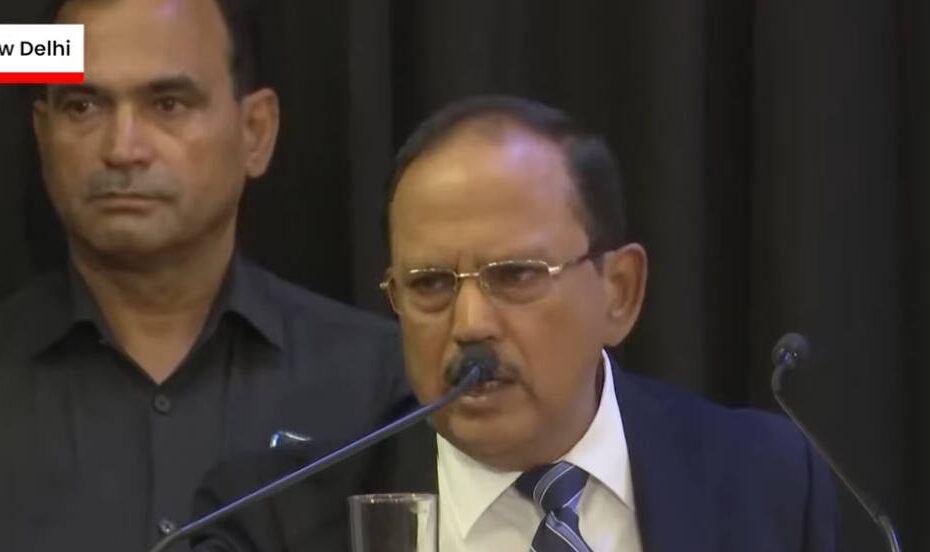
Read the full transcript of National Security Advisor (NSA) Ajit Doval’s speech on “Regime Changes, Shift In Global Order, Governance & Security” at Sardar Patel Memorial Lecture on Governance, on October 31, 2025.
NATIONAL SECURITY ADVISOR (NSA) AJIT DOVAL: Respected Sri Prabhat Kumar ji, former Commerce Secretary, whom the fraternity of Indian civil servants look as a great role model, who has got a very distinguished career and probably was responsible for many of the initiatives that the government had taken. I am very grateful to him for giving me this opportunity to address the sixth lecture of Sardar Patel, which is 150th anniversary. It’s a very special occasion, it’s a very special audience, and I am very grateful for giving me this opportunity.
Sri Mahesh Kapoor ji, former Advisor, Planning Commission, distinguished ladies and gentlemen, it is my proud privilege to talk on a subject about which probably I know the least and probably most of you sitting here have done more, that is about the governance. But still I would like to share a perspective of what a security man looks at the process of governance. I definitely believe that governance has a very seminal role in the process of nation building and in the process of securing a nation and making it achieve its goals and aspirations.
Reinventing Sardar Patel’s Vision
It is indeed very befitting that today, in 2025, we should be reinventing Sardar Patel. Probably the need to understand him, the time to emulate him and understand his vision, his clarity of thought, his vision is required in India today more than ever before. Not only India is in the transition, India is having an orbital shift from a certain type of governance, from a certain type of government structures, societal structures, but also its place in the global order.
The world is also undergoing a great transformation and whenever the change comes, the most important things are your clarity of vision. You are not getting blinded by the dust and the storms, not getting overwrought by the noise and the threats, you are not getting subdued by the adversities and the possible threats. You have to prepare yourself and you have to equip yourself and that is what Sardar Patel’s whole life was all about, whether it was pre-independence when he played a very similar role as a warrior of freedom movement, supporting Mahatma Gandhi and all his ventures, but also in a short time in the post-independent period that he was able not to unify the states but to integrate India.
Integration of India and Strong Governance
Bring up that understanding and 560 princely states that it was in their interest that India as a state survives, strengthens and is able to take care of this old civilization which was experimenting with converting itself into a nation state. Converting the civilization into a nation state is a stupendous task. He knew that it can only be done through very powerful governance mechanism. The government has got to think and do beyond what is normally expected and that is how he envisaged.
And I am grateful that Dr. Harivansh ji told us about how his vision of the old India services, his patron saint, the mentor of that, despite resistance and strong prejudice at that time in the civil services, probably he was able to prevail that without the steel structure we would not be able to create a new India.
Power of Nations Through Governance
Ladies and gentlemen, power of the nations, nations whether they are powerful or weak or they are comprehensive national power, is a very abstract word. In reality it is the power of the governments and it is the power of the governance. When the governments are weak, when the governments are confused, when the governments are imbued by the self-interest, probably the consequences also are similar and these governments work through institutions and the task of nation building. The most important matter are the people who build and nurture these institutions, who strengthen these institutions because these institutions provide the governance and the governance creates the nations and the powerful states. Sardar Patel’s road in that is self-evident.
The rise and fall of the great empires, monarchies, oligarchies, aristocracies or democracies is actually a history of their governance. Edward Gibbon in six volumes on the decline of Roman power, way back about 1788 or something, there he wrote those volumes. The whole book is about the intrigues of the Roman Empire, instances of its bad governance, corruption, economic mismanagement, security failures and the end of it. It all boils down to the Roman Empire fell because it was administered into government badly. Same is the story of the French Revolution, the Tsarist Russia or the Mughal Empire, they declined.
In the post-war period, out of 37 countries that faced various degrees of degradation, 28 failed or got degraded or got balkanized because of their poor governance. And the recent cases of the change of regimes through non-constitutional methods in Bangladesh, Sri Lanka, Nepal and others were actually the gliding cases of the bad governance, and that is how the governance matters.
Why States Rise and Fall
Transcending beyond time and space, there are some commonalities. Why some states rise and why some fall? Why the times when, what is there that happens which leads to bad governance and ultimately the erosion of their powers?
One has been the authoritarianism. Not that I am going in history, but I am telling it because it remains relevant today. It has remained relevant for the past 3,000 years of the recorded history that we know of the states, structures and the governments as they existed, whether it was the Greeks, the states or it was the modern democracies and even the oligarchs and others. So authoritarianism, that is oppressive and discriminating laws, poor delivery of justice, marginalized population, human rights violations—they all constituted or added to the fall of these nations.
Institutional Decay
Second important thing has been the institutional decay. The institutes start decaying, both civil and military.
Security structures, their armies become corrupt or oppressive or their internal security structures collapse. Bureaucracies become inept, slow, corrupt and insensitive. There is no accountability. People do not know why they are doing what they are doing.
I tell you an example that once when Bismarck, before the Russia war, had visited Germany and he went to a forest area for singing and he found a military man standing at a post. He asked him, “What are you here for?” He said, “I do not know, but I have been on this duty for the last three years, so I would have to check up.” And then he checked up. And then he found that his commanding officer also did not know, but he said, “My battalion has been here for the last twenty years. And this is one point that has been given to us to guard.” He said, “What are you guarding against and against whom?” He said, “That I am not aware, but I can check it up and find out whether in my judgment there is some record.”
So he went through that and then after long research and others, Bismarck found that about a hundred and fifty years back when Tsarina had come on a horseback for hunting, and she lost her necklace in that forest. She could not locate it there, so they returned, but asked her ADC to put somebody on the guard duty and send some people tomorrow to search it. Probably some people came or did not come, but that necklace was not found. Necklace was forgotten to everyone. Nobody knows what happened to the necklace, but for a hundred and eighty years the sentry was still on the duty. This is how the decay started and that is when Bismarck predicted that this nation and this regime will not last. And that is what happened.
Economic Failures and State Collapse
Another factor is the economic failures, scarcities, the food. Actually a large number of civilizations collapsed because of the economic meltdown. Harappan, Mohenjo-daro and other civilizations—now increasing evidence is coming forth that probably the essentials of survival became scarce over there. The food, the water, the inflation, oppressive taxes, social unrest—they become the cause of the state failures. They are the old ones, they still exist, they still exist and they continue to bedevil the emerging societies.
New Factors Impacting Governance
But the new ones have cropped up and have made the situation more complex. What are these new factors which have started impacting on the process of governance and has made the task more challenging?
One is the centrality of the common man. The common man has become more aware, he has become more aspirational, he has higher expectations from the state and the state has got a vested interest in keeping him satisfied, particularly in the democracies.
In the same vein, what has happened that while democracy has proved to be one of the most effective and one of the most enduring systems of governance, it has created its own problems. It leads to partisan politics. There are dividends in division. Now this dividend in division is a very strange phenomenon. If there are 100 people and I have got a following of 25, I can come to power if I can divide the rest in groups that each is smaller than 25.
It is not an aspiration to make it 51, but it is an aspiration to divide the rest of the society in as many fragments as you can. And that fragmentation is something which is the danger of this thing. That comes after it is a package. It comes with its good things, but we have got to guard against the possible, the negative side of it.
The Role of Money in Democracies
The third is the role of money. I am not talking about India, I am talking about the world over. Wherever there are these democracies, there is money that plays a role. Now whether there is a legitimate role, illegitimate role, legally approved, illegally approved, whatever is that. But the fact is this, money plays a role. So your idealism, your vision, your thought, your patriotism somehow has got to have a strong support of the money.
And there is often eclipsing of national interest by the vested interest. And by the vested interest I do not mean here purely in a very negative sense of being corrupt or lack of integrity. But vested interest is that you are very, very localized, smaller interest in which the larger national interest becomes probably less important.
Addressing Old and New Challenges
So what do we need to counter it, to address it? Both the old ones and the new challenges that have emerged. One is of course that we have got to look at our entire system of laws and the rules and the procedures and the processes and make them more people friendly by the laws and the rules and the systems which are strong but are people friendly. Our policies and plans should meet aspirations of the people. Basic needs of the people must be addressed and the people must be given a sense of security.
It is not sufficient to say that we have taken sufficient security measures. What is equally important is that we are able to make every Indian feel that he is secure both from forces internal and external. While we can deal with them effectively as per the laws and as per the policies of the government but we can create the deterrence that can convince them credibly that we have got the will and we have got the strength to respond to any threats in a way and in a manner that we consider best for our national security.
Care for the Marginalized and Women’s Empowerment
There is also a very special need for taking care of the deprived, the weak, the marginalized and give them a sense of empowerment and particularly this thing of women is extremely important. The need for protection, the need for safety, the need for giving a sense of equality and empowerment to women is necessary for good governance in the modern day world.
And I think one of the other requirements is that it is not only the capacity of the government to have good laws, good structures and good systems but more importantly an ability to implement them effectively. This is important particularly in the case of India. We find that our implementation capabilities are much short of what they need to be and there are many reasons for that but the fact remains that it is there.
Technology’s Dual Role in Governance
Technology is going to play a very, very important role both in governance and in eroding the power of the state. We have got to exploit the technology that can ensure greater transparency, accountability, deliverance of service to the common man, grievance redressals, also creating awareness in the society and concurrently we have got to protect the civil society from threats like the cyber threats or many other threats that the technology poses.
One study that has been made by an American think tank was about the role of technology in transforming the civilization and the state and their character. It took about one million years for the caveman to find the fire. That was a great transforming technology and then from there it took him another 50,000 years to make, to discover the metal. That is when he found that the fire is able to melt certain stones which become into a solidified metal and then another 30,000 years to invent the wheel and after the wheel the similar things about the steam engine and less than the thing about the electricity and about the plane. So the time gap started getting reduced.
The Revolutionary Impact of Artificial Intelligence
Printing press in 15th century brought another very major thing when there is a revolution in knowledge and informatics. Artificial intelligence is going to condense and transform the society. In two years time what it has taken about two million years for the human beings to change. It will change the way you live. It will change the way you think. It will change the way you dress.
It will change the way that your words are thought. If you put the artificial intelligence in the field of the nuclear, these things will probably—if you have got 31 ingredients, we see that if the nuclear bomb goes automatically, the world will be totally endangered. If the human element starts becoming absent relatively, the dangers of this technology would be very, very high. And now that this is the age of youth, particularly in India, not around the world, probably the youth are becoming less and less, but in the subcontinent at least there are plenty of these things. We have got a great distance about creating new job opportunities and also equally important is about the delivery of justice.
Reality Check on Governance in India
Now let us do a reality check about the governance in India. There are two aspects of it. One is what we think very objectively looking at it—what it is—and secondly, what do people think about it. What are the perceptions? So perceptions are as important as the reality.
I take a capsule of say last 10 years. I know that being a national security advisor in the current position, it may look that probably my figures or my facts are little tilted or little biased, but notwithstanding that, the facts are facts and they cannot be disputed.
Terrorism Effectively Countered
Terrorism in this country has been effectively countered. We had a major incident of terrorism on 1st July 2005, and we had the last one in 2013 in the hinterland, except Jammu and Kashmir, which had been a theatre of a proxy war or a covert warfare against Pakistan, which is a different ballgame. The whole of country has remained secure from terrorist attacks, and it is not that the efforts are not made. It is not that the people were not arrested. It is not the explosives were not recovered. Tons and tons of them have been recovered, even few of them only about two days back, where a very major group targeting certain places in India and targeting this thing, where continuously the new groups have emerged. Enemies have remained very active, but fortunately, and I think it is more of a good fortune of the country, that we can say that we have had no terrorist incident in the hinterland.
Left Wing Extremism Reduced
The left wing extremism has been reduced to less than 11% areas than what existed in 2014. Most of the districts which had been declared as left wing prone, they had been declared as safe. There is a greater integration of the tribal population. Shri Prabhat Kumar ji has been a governor of Jharkhand, rather the creator of the state in a sense, in the formative years. He is the one who guided it. Probably if you go, you will find that there is a sea ocean, there is a change of the sea. Roads, communications, schools, health centers, employment opportunities, jobs that have been created for the even illiterate youth, development of art and handicrafts in the tribal areas have been very high.
North Eastern Insurgency
North eastern insurgency, nobody talks about it. We had a bad incident in Manipur, but that was not insurgency. That was a sectarian conflict between the Meiteis and the Kukis. Of course, not that it is pardonable or it should be something that we say it is good, but the fact remains that I am talking about as far as the insurgencies are concerned. The north eastern insurgency, the very major groups have got—bold and decisive counter actions have been taken against foreign and internal perpetrators of this violence. It has been ruthless but according to law. It has been what the country should be doing to deter its enemies, and I think that deterrence has worked.
Governance Reforms and Legal Modernization
There has been a fast and efficient delivery of services to people. There has been a people centric governance, simplification of governance. There have been repealing of the archaic laws and enactments and the new ones have been made. One thousand five hundred and fifty two obsolete laws have been repealed in the last ten years as against thirteen hundred and sixty years before that.
New criminal laws for the country have been enacted which are simpler, easier, more accountable, makes it mandatory to go for the scientific investigations, makes the forensic science examinations mandatory and also simplifies various processes both in substantive law and the procedural laws. I will give you an example. For example, say all the police stations have been fully computerized. Data of the criminals is available on all Indian businesses. There is a central data center of all the crimes, criminals and the people associated with that.
Any sub inspector sitting in a police station can find access to the information that they want to have. Similarly about issuance of passports. We used to have a long and cumbersome process. The verification used to take very long time. There used to be some corruption. Today twenty-five percent passports are issued in three days or less than that. Sixty percent in seven days and more than eighty-five percent within fourteen days. This has made it easier. There is a digital governance that has been this thing.
In health and Ayushman Bharat, the coverage of five lakh per family. Similarly on the national economy, the GDP from 2.15 trillion dollars in 2015 to nearly four trillion dollars in 2025 has taken its global ranking from tenth to fifth, and most probably more likely very shortly it will be the fourth.
The taxation system, the goods and services taxes. We used to have chungis and the barriers at every point which was a point of corruption. Every point was a point of delay. Every point was a point of hardship both to the producers and the consumers and the shopkeepers and the retailers. And today we find that it is centralized. Well, there are scope for improving and changes have been made. But a great beginning has been made and probably to the consolidated fund of India, the earnings that are coming through the GST are much more and both the states and the center find the system much more effective and useful.
Financial inclusion under Pradhan Mantri Jan Dhan Yojana, providing banking services to unbanked population which had never thought that they could have their bank account. And now it’s in crores. Similarly, the unified payment interface. It has revolutionized and simplified the financial transaction. Even you go to a radio and you give your credit card, he is able to provide you this. So by and large we find that it has been people-centric. It has eased the things. It has reduced the possible avenues of corruption or hardships to the persons. That is one point of view.
How India Is Perceived Globally
But then let us see the other point of view. How are we perceived? World does not necessarily perceive us as an egalitarian inclusive democracy that provides constitutionally guaranteed fundamental rights, has got the adult franchise, has got the equal rights for everyone irrespective of their caste, religion, gender or any linguistic identity. We have got many liberal and pro-poor legislations. We have also got an independent judiciary. Actually very rightly, too independent. And we have got very powerful institutions like the Election Commission, Comptroller Auditor General, the Union Public Service Commission to ensure that there is no governmental interference in these matters.
However, global perceptions and projections do not carry this image of India. Whether it is on that list, you tell me. We had just got one study conducted about, let’s say, last three months. What had been the articles, what had been the thinking, what had been the service that had been conducted against India, about India. And we find that a large number of the global think tanks, some of the scholars, abetted and supported by most of the things, the material that they get, is from the Indian side. The Indian columnists, the Indian journalists, who actually think that the news is only if it is something is a bad news, is the only good news, because that’s the only thing that they can think.
So in corruption ranking, the global ranking, India was ranked 96th out of 180. That is, they said, the society or the government continues to be highly corrupt. They note about it that there is some truth in that, that we have not been able to wipe out corruption from all spheres and all stages. But we have brought about institutional changes to contain and control corruption. And probably many more are in the pipeline.
In the global governance performance, which is measured about the regulatory framework and regulatory and infrastructure facilities, we are ranked 118th among 142 countries, which I think was very unfair. Had it been so, we would not be getting so much of the foreign direct investment at the rate that we are getting. India is a very sought-after destination by most of the global investors, even today.
Rule of law index, the World Justice Project rated India 79th out of 142. Of course, it’s a great improvement from the past, but in spite of that, I think we deserve to be much above that. The press freedom index says India ranks at 151 amongst 182 countries.
I think, I don’t know, what could be more freedom in India than the freedom of press that they can write everything that they think is somebody’s idea, but does not have any substantial facts to support it. But it is all right. And then the social media and the freedoms that the people enjoy.
Need for Accountability and Self-Criticism
Accountability, the Indian rating was 1.47%. It is true that the methodology adopted is not fair. There are certain biases. There are certain other factors, invisible factors also, which play a role in that. But there is also a need for us, for introspection, and to have self-criticism, to identify where are the shortcomings and what needs to be done. Not what the others are telling, but we ourselves experience.
And I would like to allude to some very specific areas where I think the Indian governance needs much greater focus and much concerted efforts to achieve that. One is the need for greater accountability. I think I have already shot my time away. As I just think of the greater accountability, low tolerance for defaulters is necessary. To be misplaced is the worst form of cruelty. Supporting or shielding the people who are wrong should be made as punishable and as the same.
Somebody told me, “How can you bring the change, reduce the corruption in police?” I said it is a very simple method. Nobody will know about a corrupt police officer except his immediate superior. He is the one who comes to know about it first. If there is something adverse against a police officer, then let there be an adverse entry also on his, that he cannot control corruption amongst his subordinates. He will see that he will bring down at least to fifty percent. Because then it is in his interest to see that the people below him do not become visibly corrupt at least. But if it is not, then he becomes a party to that.
Capacity Building and Training
Second is the capacity building. Now capacity building I think is important. Now the new technologies, the new challenges and the new vision of India to become a developed country. We need better training of people in the government at all levels, specialization, greater understanding of the systems and the global practices and incorporating the best practices.
Also, the government’s capacity for perception management and creating awareness. It is important, it is important because national will is affected when the country’s image gets shattered, when people feel that our institutions are not dependable, when the people feel that our electoral system or our financial system and others, there are not that levels of transparency and property and moral standards that are adopted. That is bad for the nation’s will.
Protecting Institutional Credibility
And I think one thing which is very important is that our institutions should be strengthened but at the same time we should also ensure that the credibility of the institutions in the public eye is not eroded by disinformation, by hostile propaganda or by vested political interests. These institutions are sacrosanct, they should be seen, our politics, people’s losing faith in these institutions, whether it is your defense forces, security forces, judiciary, electoral systems, compromise, that will be something which will be very, very disastrous. So I think these are the areas we have to focus on.
Viksit Bharat Requires Modern Governance
Ladies and gentlemen, we are thinking of a Viksit Bharat, we are aspiring, we are doing everything that will go for Viksit Bharat. But let me tell you that you can never have a Viksit Bharat with an archaic governance structure, with the standards of governance which do not measure up to the levels of a developed country.
So we have got to train ourselves, we have to equip ourselves, we have to organize ourselves, we have to bring about a convergence in our policy making and in our program making and also a whole of the government approach in their execution. So our equitative skills and capabilities have got to be enhanced substantially.
Once again, sir, I am very grateful to you for giving me this opportunity.
It had been indeed a great pleasure for me to interact with you and share some of my thoughts with you, but I can definitely tell you that the country is on the ascendancy, is doing very well, and it has got a great future. And with the efforts that every Indian is making today, every Indian who is becoming aspirational, every mother who wants a child to go to the best of schools even when it comes from a very low economic group and others, is something which is extremely boosting, morale boosting.
And I am very confident that the vision of Sardar Patel of a great India, of an integrated India, of a powerful India will be realized by this generation.
Thank you very much.
Related Posts