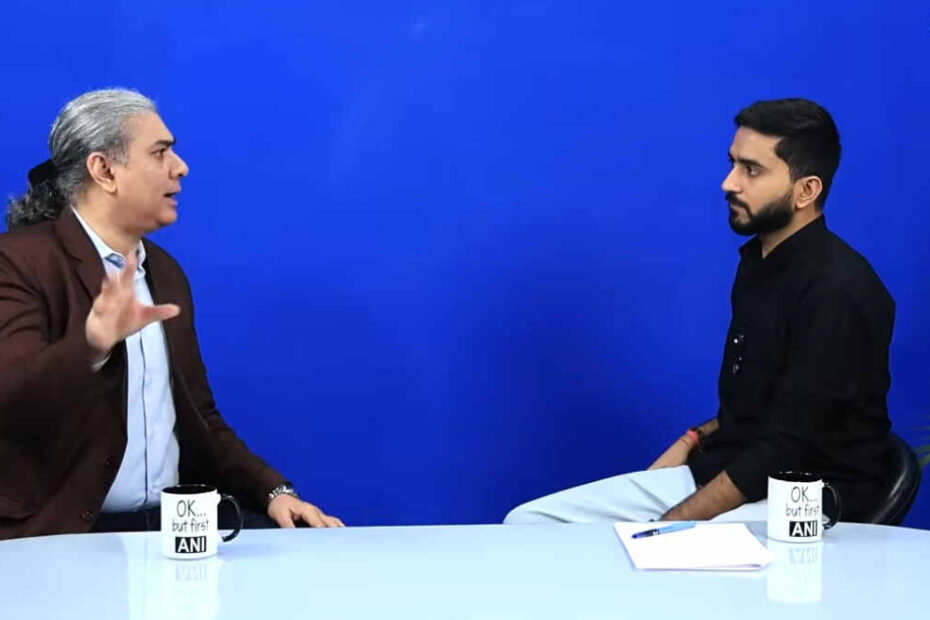
Read the full transcript of geopolitical analyst Abhijit Chavda’s interview on ANI Interviews with host Naman Yadav on “Trump 2.0, Adani, Deep State, Russian Oil, Pakistan & Global Power Play”, Premiered October 25, 2025.
INTRODUCTION
NAMAN YADAV: Welcome to ANI Interviews. I am Naman Yadav. Right now with me is Abhijit Chavda sir. He is a geopolitical analyst, author, writer, podcaster. He wears a lot of hats. We will be having a conversation around Trump, Modi wars, everything under the sun, sir.
I’ll start with the latest. The Prime Minister is not going to be meeting Trump in the ASEAN Summit. He will be attending it virtually. How do you see it? Do you see India-US ties will be facing a lot of trouble till Trump sits at the helm in the United States?
India-US Relations Under Trump 2.0
ABHIJIT CHAVDA: Trump’s coming to power has been an inflection point in global geopolitics and of course for India-US relations. So India-US relations, the past decade, two decades, have been characterized by what they call a strategic alignment, that India and the US are on the same boat. And we have essentially a common threat, common adversary, which we face very clearly at home, which is China.
China’s hegemonic aspirations, China’s expansionism, its expansionist activities, China’s support for Pakistan and so much more. So it made sense for India and US to be aligned together. But the past decade or so, India has kind of transformed itself economically and in other domains. And the US now seems to be regarding India as a potential adversary, maybe in a 20-year horizon.
See, right now India is a 4-point-something trillion dollar economy, right? In the future, when we become a 10 or 15 trillion dollar economy, they expect that India will be a totally different kind of beast because with size comes strength and different aspirations, different ambitions. So they don’t want to see in the future a new challenger rising on the horizon, just like China currently is a challenger which the US itself aided and abetted in its rise.
US Policy Shift: From Cooperation to Containment
So the US now seems to have changed its policy towards India from a policy of cooperation to a policy of containment. What signs and symptoms do we see of containment? They have affected a regime change, first of all, in Pakistan in the year 2022, the ouster of Imran Khan and the installation of Shahbaz Sharif, who is completely pro-US and also the way it’s aligning with Pakistan right now.
Secondly, you had a regime change in Bangladesh in the year 2024, the ouster of Sheikh Hasina, who was very favorably inclined towards subcontinental integration, especially with India. And now you have the installation of Mohammed Yunus, who is very anti-India. So we see all of that. We see also the regime change that happened in Nepal. So we are seeing India being encircled. We talk about the Chinese string of pearls, but we also have this ring of thorns that is being constructed around us.
So the US is now treating India as a future adversary. And even right now, the relationship is becoming more adversarial in nature. And Mr. Trump, who we are talking about, he has this proclivity for making all kinds of statements that are designed to pressurize the target. So he’ll say that India has committed to doing this. India, Mr. Modi has promised that he will do this when no such thing has happened.
And by doing this, it has a twofold effect. First of all, it dares you, it challenges you to claim that Mr. Trump is lying. And if you do that, he’s going to hold it against you and he’s going to be even more, he’s going to impose more pressure on you, maybe more trade restrictions, tariffs, whatever.
So Mr. Trump keeps on doing this. And if Mr. Modi meets Trump, Mr. Trump is going to make all kinds of claims about what Mr. Modi may or may not have said, and that’s going to be a problem for us. So it makes sense for Mr. Modi to not meet Mr. Trump at this point in time. And that’s essentially how I see what has happened, that Mr. Modi is most likely not going to be going to the ASEAN Summit. He’s going to participate virtually, and there’s going to be no Trump-Modi meeting. And yeah, I think it makes sense.
NAMAN YADAV: You briefly spoke about how governments are being toppled in Asia. We have example of Sri Lanka, Pakistan, Bangladesh, Nepal. Do you think is there any sort of US deep state at work in India to destabilize the current government or current regime?
Understanding the Deep State
ABHIJIT CHAVDA: Look, first of all, we have to understand or define what deep state means. There are multiple definitions of what deep state is. If you ask Mr. Trump, he’s going to have a certain definition of deep state. If you ask other entities outside of the US, they will have a different definition of deep state.
When Mr. Trump came to power, he fired lots of bureaucrats and he said that he’s cleaning out the deep state, right? He’s draining the swamp and so on. So according to Mr. Trump, deep state means the unaccountable bureaucrats who serve lifelong positions in the US establishment, maybe the Pentagon, maybe other departments and so on. So that is Mr. Trump’s definition of deep state. The unaccountable bureaucracy. Let’s trim that down and the deep state is taken care of.
From a different perspective, deep state means, or could mean, it comes from a Turkish word. The meaning is that there exists apparently, allegedly, an unaccountable extra-constitutional, extra-democratic, extra-electoral, extra-government center of power in the US or maybe outside the US that controls the clinician. So it is something that is outside of the government so that people can’t affect it.
If you don’t like the president, you can vote him out. But if there’s a deep state that is super-presidential, that even controls your presidents, then what would you do? Does it exist? Does it not exist? Well, most academics would give you the consensus that it is a conspiracy theory, right? But maybe it does exist because you can see signs and symptoms of that.
Sometimes US presidents who don’t align with certain objectives or initiatives, they are either 1963 like Kennedy or maybe something like that, 2020 happens when Trump claims that the election was stolen from him. So clearly there are powers that are clearly more powerful than the US president. The Federal Reserve Bank of the United States.
NAMAN YADAV: Right.
ABHIJIT CHAVDA: Who owns it? Does the US government own it? The US government doesn’t own it. They will say that it has shareholders, stakeholders who are distributed among various other banks in the US and so on, so forth. But that’s very muddy, it’s very muddled. And it’s essentially a private bank that essentially controls and owns the US economy, which means the US is owned by somebody who, we don’t know, maybe a small group of people, maybe a larger group of people.
There have been various business people who have said that there exists maybe, for example, the Sri Lankan-born American entrepreneur Chamath Palihapitiya, he once said, and I’m sure that he regrets saying it, that it’s a small group of maybe 150 men who control the entire world and all the global finances and by extension the global geopolitics all over. So clearly something like this does exist. A deep state.
Color Revolutions and Regime Change Operations
Now the question you asked is about India. Does the deep state seek to undermine India or maybe do a regime change operation in India? So we know that there is something called the color revolution model. That template has been used over and over again. You could see the first signs and symptoms of that in Central Asia, in Kyrgyzstan, et cetera, in the early 2000s. And then you had the Arab Spring which followed the same template. And then you have other color revolutions that happen over and over again.
And you had in the 20th century also different versions of that in various African countries where dictators were installed and they would undermine their country, they would make their country subservient to foreign powers, typically the Western powers, and so on. So clearly this model, the color revolution template does exist.
Now how do you execute a color revolution? You don’t just press a switch and the color revolution executes itself. You need to have assets on the ground in the target country. You need to have funding networks, you need to cultivate individuals in the target country. What kind of individuals do you cultivate? You cultivate business people, you can cultivate politicians, future political leaders, or existing political leaders, you can cultivate media outlets, you can cultivate journalists, academics, teachers, and so much more. So influencers.
NAMAN YADAV: These are the tools that a foreign government can use to destabilize any other government outside of the country. Journalists, media and social media platforms. What else can any government use to destabilize government?
Tools of Hybrid Warfare
ABHIJIT CHAVDA: Right. So by doing all of this, you can create… So what are the means of destabilization, is what you’re asking? It’s called hybrid warfare, which is a very big umbrella term which contains lots of different tools in the toolkit.
One of the tools in the toolkit is manipulation of narratives, disinformation campaigns. So what you do is that if you have in a country, in the target country, let’s say, multiple compromised media assets who you are funding, then I’m sure that all the media outlets in the country won’t be compromised. But some may be compromised. So you use those to propagate certain narratives which erode the credibility of the government, which sow discord in the country and contribute to chaos in the country. They demoralize the country, right? That’s one thing you do.
You use influencers who may be located within the country, maybe outside the country. And these individuals, they read scripts, looking at the camera. There’s a teleprompter there, the viewer doesn’t know it, and they continuously bombard the narrative that the government is ineffective and so on. That’s one thing. That’s the disinformation campaigns.
Another thing you can do is to cultivate individuals who are not in the media. For example, politicians, for example, academics, for example, people who run NGOs. How do you cultivate them? You can appeal to one of two things. One is their personal ambitions, their personal agendas, maybe the personal greed, which means you fund them. Another thing is you target their weaknesses. You blackmail them if you have anything on them. And it’s not difficult to blackmail people if you know what their weaknesses are. So by doing that, you cultivate targets. You cultivate assets that you can use on demand.
Then you can obviously use other kinds of threats. One is tariffs, one is sanctions. In case you are a powerful country that controls supply chains, trade networks, then you can create problems for the target country by cutting off supply chains. Maybe you control a network of ports in the region, and that country is dependent on various kinds of imports. So you block those imports, you create delays, very painful delays. That’s how you can destroy the country’s economy and once again make the government look weak.
Then you can do cyber attacks, you can disrupt the telecommunications sector, you can disrupt the energy grid, you can disrupt the stock market. All of this once again makes the government look bad. It looks like the government has lost control of the country when actually the attacks are coming from outside.
You can disrupt the… In case you control countries that are energy exporters, maybe oil exporters, maybe oil and gas exporters, then you can arm-twist those countries into delaying shipments of oil or energy to the target country, which can create chaos in the country. You can support separatist movements in the country. You can fund and finance countries that are using terrorism against that country. The toolkit can go on and on.
Digital Sovereignty and Data Control
NAMAN YADAV: If you look at Facebook, if you look at YouTube, if you look at all the social media giants and all the apps, nothing is being controlled by India. The data is not stored in India. They do not comply with Indian IT regulations. Should we have our own made-in-India app like Zoho’s messaging app has come up now? Do you think how can government support such apps and support such startups? And should we follow China’s rule and outrightly ban every single app?
Pakistan as a Western Mercenary State
ABHIJIT CHAVDA: Right? So this is a very major issue. Like you rightly say, all these platforms, whether it is Facebook, whether it is YouTube, whether it is Gmail, whether it is Twitter or X, Snapchat, Instagram, whatever you call it, all the means that we Indians use to communicate among ourselves, these are all owned by foreign powers.
See, social media became a thing in the early 2000s, mid 2000s. Orkut became a thing. People don’t even remember Orkut. Orkut was owned by Google. Orkut for the first time brought Indians together, maybe for the first time in a millennium. In a thousand years, Indians could communicate with each other in real time.
And then you had Facebook coming up, then you had YouTube, you had Twitter, and so on. And today Indians take it for granted that we can communicate in real time with anybody across the country, even people we don’t know. We can right now see a snapshot of what’s happening in Assam, what’s happening in Kerala, what’s happening in other parts of India.
This is something we take for granted. But this is also weaponized for spreading narratives, for creating misinformation, and so much more. So this tool that is vital to us, it’s controlled by foreign governments and they can weaponize it in any way they can trend certain sentiments. Earlier we used to have trending. Today we can trend other sentiments.
There are other nations that can create these bot farms. You know, in case you’ve not seen, there were videos that came out that various Pakistani groups and Chinese groups, they have these racks like you have border bookshelves. Similar, they have racks filled with mobile phones, all connected to the Internet. And each of these, through AI, is impersonating a Twitter account or something. And they are all mass producing narratives.
And you will have seen that after 2022, after February 22nd, there’s been this outpouring of negative sentiment towards India on social media. A lot of Indophobia, a lot of Hindu phobia, a lot of anti-India sentiment, disparaging India, portraying India so and so. All of that has suddenly surged after 2022. And right now we are at the peak of that.
Much of this could potentially be done by actors or nations that are inimical to our interests. Maybe Pakistan, maybe China, maybe even somewhere in the West. It could be happening. So this is a very major problem. And let’s say in the future the West decides to cut off access to India, then what do we do? We suddenly rudderless, we can’t communicate with each other.
So it is critical, and I have been trying to highlight this for at least a decade, that India needs to have its own social media platforms. Right? But is it enough to just have social media platforms? We had something called Koo in the past. Koo was an Indian version of Twitter. A substandard version of Twitter. I saw your expression there.
NAMAN YADAV: It didn’t work.
The Need for World-Class Indian Social Media Platforms
ABHIJIT CHAVDA: Well, it didn’t work. It was a terrible user experience. Terrible. It was painful to use Koo when you already are using Twitter. So we not only need to have our own social media apps, but those should be world class. We should not take shortcuts in the “Chalta Hai” attitude and produce substandard apps and then complain when Indians don’t adopt it.
Indians will adopt an app only if it is world class, where it provides a similar experience to existing apps. If not a better experience, then Indians will adopt it. So Indian entrepreneurs need to take up this challenge to create these apps. And the Indian government needs to clear the way for them to do this by creating a conducive business environment. So that’s what needs to happen. It’s very important. It’s critical.
Our data is being harvested by the West, by whoever is controlling these platforms. Tremendous amounts. Indians are some of the biggest users on Facebook, on Twitter, on YouTube, wherever else, and our data freely accessible and harvested by the West. And then that creates all kinds of social engineering scenarios because of that.
So it’s very important. It’s vital. It’s critical for India at some point in time, hopefully sooner rather than later, to create its own apps. Should we emulate the Chinese, like you asked, and create a walled garden, maybe a great firewall of India, like the Chinese of the great firewall of China?
It’s perhaps unfeasible because Indians travel across the world and if we are ring fenced, then we cannot communicate with people who are outside of India. It will be portrayed as undemocratic and it will create an echo chamber within India. So ideally we should have our own platforms.
It is probably not feasible to create a great firewall and cut off India’s access to the Western Internet and create a ring fenced version of an intranet kind of thing. Maybe it’s not that feasible, maybe not that practical. There’s too much penetration already and so on.
Pakistan’s Relationship with Trump 2.0
NAMAN YADAV: Let me shift gears and ask you about Pakistan. How do you see Pakistan handling Trump 2.0? Asim Munir had met Trump a couple of times in the last three or four months. Shahbaz Sharif also met Trump a couple of times. They seem to be having good ties. Rare earth minerals, crypto. The business seem to be doing well. How do you see their relationship? And should India be worried at all?
ABHIJIT CHAVDA: India should be very worried. First of all, why should we be worried? See, Pakistan and India, we are very different nations. Pakistan is a mercenary nation. India is a genuine, vibrant democracy with hundreds of political parties in complete chaos every five years when you have elections and tremendous uncertainty as to what will happen every five years.
That’s a real democracy, which is actually perhaps a problem for India. Pakistan, ever since its inception, essentially since its inception, short time after its inception, became a nation that was ruled by the military. And in Pakistan, you have the semblance of some kind of democracy. You have prime ministers who come and go, but the real power always resides in the hands of the armed forces, the military of Pakistan.
So even when you have a prime minister who is on paper ruling the country, you actually have the military that calls the shots. And the prime minister can’t do a thing that goes against the military. Otherwise you end up with someone like Mr. Bhutto, who was hanged by Zia-ul-Haq and other instances also not that bad, but similar.
So Pakistan’s military, what is its agenda? Its agenda is to stay in power in Pakistan as long as possible. Right. How do you stay in power? With the support of foreign governments. They always play the role of making their nation subsidiary to a foreign agenda so that they can keep on receiving the paychecks and they can stay in power.
So Pakistan, for the longest time, and even now, it conducts terrorist operations against India. It’s not a secret that the US funded and financed Pakistani terrorism against India, essentially since immediately after Christmas Day 1979, which is the Soviet invasion of Afghanistan. So that’s when Pakistan became important.
Pakistan was created as a Western outpost in the Indian subcontinent to cut off India’s access to Central Asia and Europe, our traditional land access, and to create a permanent challenge to India, something that can keep on bleeding India whenever required and keep India permanently off balance.
And now they have given them nuclear weapons. I don’t believe, for one instance, the Pakistani scientists are capable of developing nuclear weapons on their own. They most likely have foreign nuclear weapons on loan to be used against India when required, if required.
So what Pakistan does is that it acts as a Western mercenary, and the objective is to target India. For a decade or so between 2012 to 2022, Pakistan lost the US favor, so it courted China. In 2022, you had a military coup. You had a coup in Pakistan, and it’s again a vassal of the United States.
So Trump, what does Trump seek? Trump seeks to encircle India. Trump seeks to contain India. One of the best ways of doing it is to once again activate Pakistan. So Trump has business interests of his own. Besides being a president, he has a business empire, and they are going full scale into crypto.
And it is very, it’s a coincidence, apparently, that the Pakistani crypto sector also came up just after Trump showed interest in cryptocurrency. There is that. Then Pakistan will be selling its oil and gas to the United States to Donald Trump, because Trump’s business empire will be investing in the oil and gas sector in Pakistan. So whatever reserves they have, they will sell them to the Americans at very good prices, obviously.
Then they have some reserves of rare earths and minerals and so on. That also is all available. When Mr. Asim went to the White House, he came with a crate full of these fantastic goodies that Trump was very pleased to see. So they are willing to sell off their nation piece by piece to the United States, which is why they have an excellent relationship with the US.
So there will be commentators in India saying that, look, India is doing such a bad job of dealing with the US. Look at Pakistan, look how favorably the US treats Pakistan. Well, the US has certain conditions. They will treat you favorably as long as you sell your country off piece by piece.
Can we do that? Can we afford to do that? We are a sovereign nation. We are one of the five sovereign nations on the face of the planet. And we cannot lose our sovereignty. We can’t compromise our strategic autonomy. And that’s why India is right now on the receiving end while Pakistan is receiving all smiles and warmth from the United States. I mean, special treatment.
Shahbaz Sharif and Asim Munir go and visit Washington D.C. and Asim Munir goes there twice. I mean, when did it happen that the leader of a nation’s military was received by Donald Trump in the Oval Office? I can’t remember the last time that happened. As if he’s a head of state and Shahbaz Sharif is like a minion.
So that’s the deal. Pakistan is doing a good job because it’s willing to sell its country and its resources. It’s willing to prioritize foreign interests over the interests of their own people. And that’s why it’s doing great.
Attacks on Indian Businessmen
NAMAN YADAV: Okay, let me come back to India. Do you see a frequent string of attacks against Indian businessmen? Adani and Ambani and all the big businessmen are being attacked. Is it natural or organic criticism or do you think there is something larger perspective here or something that meets more than the eye?
ABHIJIT CHAVDA: Look, for any country to do well, you need private commercial activities to take the forefront. The government, the state cannot be expected to take care of all sectors and do development in all sectors. You know, you have these state backed enterprises, public sector organizations, PSUs and so on that typically in the socialist past of India used to take care of all the sectors, coal mining, this, that, electricity, everything.
But when you are a government entity, it’s not your money that’s at stake so you don’t have that urgency for business efficiency and so on. And that’s why it’s very important for the private sector to become Atmanirbhar for Atmanirbhar Bharat.
And the private sector, it typically is far more efficient in doing business than the public sector and it has the potential to give tremendous numbers of jobs to people, to create infrastructure, to create interconnectivity and so much more.
So therefore, if a foreign country wants to contain you, it makes sense for them to go after the few industries or the few corporations that are aligned with your national interests and are creating infrastructure and jobs that will bolster your economy and also bolster national security, interconnectivity and so much more, strategic autonomy.
And therefore, it is not surprising that Adani etc. have been targeted in whatever way they have been. And is this all organic? It definitely is not organic. Right, because otherwise they would target other industries also. Why is Tata not targeted? For example, Tata sells automobiles. Tata does other things as well. Why are the Tata group not targeted?
Why are certain other businesses not targeted? Why are Birlas, Mahindra, etc. not targeted? But only some of them are targeted. It’s because they are aligned with India’s national interest, which we can discuss in detail. So it’s definitely not organic.
You will have lots of influencers in India targeting, for example, Adani. Right? Adani, Modani, etc. They create that narrative. You will have lots of journalists and media outlets targeting these entities. You will have academics targeting them. You will have potentially perhaps some politicians in India targeting them.
It’s definitely not organic. It is all orchestrated, it is all definitely coordinated in order to erode the public’s trust in these commercial ventures and corporations that are aligned with the national interest.
The US Bribery Case Against Adani
NAMAN YADAV: And how do you see USA case, bribery case against Adani. The Adani Group has called all the allegations against them baseless, but it seems to be sticking with some of the population of India. And criticism comes from that side that Adani pays to the central government and gets central projects, airports, ports, everything is being handed to him at a cheap cost.
The Adani Case: Strategic Importance to India’s National Security
ABHIJIT CHAVDA: Yeah. So let’s discuss this case in detail. There have been allegations against the Adani Group. There was the Hindenburg allegations, I think it was in early 2023. And then there was a US federal court that opened the case against Adani sometime late in 2024.
So the Hindenburg Group, which later disappeared, they shut down. Yeah, because that job was done, apparently. So their allegations were of stock manipulation, crony capitalism, whatever that means. And the US Federal court has alleged that Adani Group is bribing the government of India millions of dollars for whatever benefits and so on.
Now the Security and Exchanges Board of India has done an investigation. I think just last month or so they said that none of the allegations are valid.
NAMAN YADAV: SEBI has given a clean chit.
ABHIJIT CHAVDA: Apparently some other investigations are still ongoing, but the clean sheet has been given after extensive, extensive investigations. Now the question is why is Adani in specific being targeted in this manner? Let’s understand what Adani represents for India.
Okay, Adani has, the Adani Group has various businesses, most of the overwhelming majority of which are not public facing. See, if you ask the people of India about Tata, they know Tata Motors, we buy cars from them. So we know what Tata does. If you think about Reliance, Jio. Yeah, we buy Jio products from Reliance. If you think about Apple, oh, we have a cell phone. If you talk about Samsung, cell phones in various products. But what does Adani do? Nobody understands.
Let me explain what Adani does. The Adani Group is involved in various sectors which are all critical to India’s national security and geopolitical stance and ambitions.
Adani’s Port Operations: India’s Maritime Security
First of all, ports. The Adani Group operates at least 13 ports on both coastlines of India, the east coast and west coast. And these ports cumulatively account for about a quarter of India’s cargo. A quarter of India’s cargo. And because the Adani Group is the largest private port operator in India and this gives India tremendous leverage, it ensures that India’s national security, maritime security is taken care of. It ensures that India is integrated with various trade routes.
The Mundra port gets more than 200 million metric tons every year of cargo inward and outbound. It ensures that India is connected to the West Asian Middle Eastern markets. And India also has tremendous connection with the African markets and African resources. It is vital for India’s national security. The port operations.
The Haifa port that Adani operates is in the northern part of Israel. That has ensured that there is a strategic synergy between India and Israel. It gives India the ability to project power beyond the Indian Ocean region in the Mediterranean region, the Eastern Mediterranean and overall Mediterranean region. It is a vital component of the IMEC, India Middle East Europe Economic Corridor, which is a vital challenger to China’s Belt and Road Initiative. A vital alternative to China’s Belt and Road initiative. Without the Haifa port that Adani controls, how will we do it?
The Adani group controls about 51% of the west container terminal of the Colombo port, which is an incredibly vital transshipment port that serves the entire Indian subcontinent, not just India, but Pakistan, Bangladesh, etc. And this is a direct alternative to the Chinese investments and the Chinese acquisitions of other container terminals in the same port. Imagine China controls the entire ports, all the terminals. They can deny access to India of all the transshipments that we need whenever required. So we need these alternatives. We need to control these things.
The Dar es Salaam port in Tanzania, Adani Group controls the major container terminal of the Dar es Salaam port in Tanzania. This is a pivotal, pivotal port in East Africa. It has connectivity with all the landlocked nations like Congo, Rwanda, etc. in the region through roads, through railways. And it gives India access to the African markets and the vital African resources that we need.
Africa accounts for about half of the world’s resources. We need access to that. And this is a region in which China has tremendous geopolitical leverage. We need to balance that somehow and we need to also have a foothold in these regions. So if you look at all the ports, the Adani Group is going to have a port in Vietnam as well, which will give India a strategic position in Southeast Asia and the South China Sea, where China controls so much. And they want complete geopolitical control in the region.
Energy Security and Green Transition
So we have talked about the port. What about energy? Adani Group is operating various thermal energy generation plants in India, coal fired generation plants. It’s India’s largest private energy generator. Without energy, your economy won’t run. So we need energy, we need private players to step up.
The Adani Green branch of the Adani Power, they are India’s largest alternative energy producers, solar and wind and so on. Khavda is one of the major projects that they are doing. So that not only gives us energy, which will be increasing and more relevant in the long term, it also positions India as a responsible generator of energy. Because of the climate commitments that we have made, it positions us as a very responsible nation. It bolsters our soft power.
So through the coal generation plants, power generation plants, the Adani Group is taking care of our immediate energy requirements. Through the green energy plants, we are taking care of our long term energy requirements.
NAMAN YADAV: Right.
Infrastructure and Regional Integration
ABHIJIT CHAVDA: The Adani Group is building railways, hundreds of kilometers of railways that connect very important things, the ports, the mines and the business centers, which increases economic efficiency in India. So whatever the Adani Group is doing, for example, mines, once again, we’re talking about in Australia, they have the Carmichael Mine, which faced tremendous resistance in protests.
I mean, the Chappell brothers got involved in the protests, Greg Chappell and Ian Chappell, Greg Chappell, the infamous former coach of the Indian national team who created so much trouble for India. So they got involved in this protest and they wanted to shut this mining operation down. But by doing this mining operation, we are strategically integrating ourselves with the Australian economy, which is great for the two nations.
The Adani Group has a power generation plant in Jharkhand which supplies about 10% of Bangladesh’s electricity, which integrates, creates interoperability between the two countries, which integrates Bangladesh into the Indian electric supply, which also gives India leverage over Bangladesh.
Hydroelectric plants in Bhutan and Nepal, these are viable alternatives to existing and future Chinese investments in these nations. China wants to break out these nations from the Indian sphere. So if we have these investments in these countries which will produce electricity and give them local solutions to their problems, then it once again creates interoperability with India. It enhances our neighborhood first policy, which is a vital component of our foreign policy.
And the plants, for example hydroelectric power supply projects in Indonesia, in Vietnam, which may happen in the future, these will once again be a significant component of our Act East policy. So if you look at everything the Adani Group is doing, it is strategically aligned with India’s strategic interests, with our national security.
Defense Manufacturing and Strategic Autonomy
The Adani Group produces arms, ammunition, weapons, more than 150 million rounds of small arms ammunition, which is critical to our defense industry. The Adani Group produces loitering munitions, kamikaze drones, which are used in Operation Sindur in cooperation with Israel, in partnership with an Israeli company, because of which we have technology transfer, because of which we have local arms manufacturing in India.
The Adani Group produces components related to fighter planes, to helicopters, to submarines. So much more. These things, none of these things are public facing.
NAMAN YADAV: Why do you think these two big businessmen continue to be the punching bag of the leader of opposition?
ABHIJIT CHAVDA: I don’t know about the leader of opposition.
NAMAN YADAV: But they are all the political parties. At the end of the day it is being said everything has been given to them. You have justified everything, explained everything, why they are so critical to India’s growth. But why are both of them the punching bag? Why not others?
ABHIJIT CHAVDA: So if we, let’s say, create problems for these groups and if their business operations end, then India loses all these advantages it has. India’s national security suffers tremendously. India’s control of critical trade networks, supply chains suffers and maybe it disappears. India’s port acquisitions go away and then we are completely vulnerable to the Chinese and other major powers who will supply us what we need, but on their terms. And the supply will be capricious.
So if the Adani Group is destabilized, if all kinds of troubles are created for it, then India’s strategic autonomy suffers. India’s economy suffers, India’s national security suffers. And these are the objectives of foreign powers who seek to encircle and contain India. So it makes tremendous sense to go after these, whichever businesses are aligned with our national interest. So it makes a lot of sense.
I am not sure about what’s happening in domestic politics. I don’t comment about that, but maybe there may be some alignment there also with foreign powers, potentially, I don’t know. Hypothetically, allegedly.
India-China Relations: Pragmatism Over Trust
NAMAN YADAV: Okay, you just mentioned China. Prime Minister Modi visited China and met Xi Jinping there. A lot of criticism is coming that one should never trust China. Looking at the history we have had, New Delhi and Beijing, the history that we share, China is not someone you can trust. They are always going to backstab you. They are always going to kill you in a sense at the border. They would do anything to encroach your land. How should India deal with it? In the entire fiasco with Trump and United States, it seems so that China, New Delhi is moving towards China. Is it a good thing or bad thing?
ABHIJIT CHAVDA: So the criticism seems to be that India is trusting China. Is India trusting China is the question I would like to ask. You can’t trust anybody in geopolitics, even your so called best friends. Geopolitics is all about national interest first. So my national interest comes first. And wherever my national interest aligns with another country’s certain national interests in those matters, in those sectors, we can cooperate.
But if you look at the track record of China, it seeks, it’s an adversary of India. We know that very well. We have gone to war with them. In 1962 we had a war. In 1967 we had clashes, in 1987. The last 10 years we had more clashes with the Doklam Chu, 2020 also, Galwan. So we know what China represents for us. And the Chinese military has published in the past that they would like to see India be fragmented, balkanized.
So we know exactly what China seeks to do. First of all, we have to understand the nature of the nation. What is China and what does it seek? What are its ambitions? China’s ambition is to replace and displace the United States as the global superpower by about 2050. And it can’t do that as long as there is another major power in Asia. So it would like to undermine India.
I don’t think Mr. Modi is at all trusting China. You have to deal with your adversaries also. I mean, look at the US and China, they’re always communicating. They have summit meetings from time to time.
NAMAN YADAV: Despite being at loggerheads, despite being at loggerheads.
ABHIJIT CHAVDA: Look at Pakistan and China. Even now that Pakistan is completely in the US camp, the Chinese and Pakistanis are still talking. Shehbaz Sharif still goes to the Shanghai Cooperation summit. You have to be practical and pragmatic.
In geopolitics, China is a long term adversary. As long as the Tibet region is under Chinese control, India and China will never have long lasting peace. Tibet was historically never part of China. Right now it is under Chinese occupation, which is why for the first time in 2000 years, we have a common border between India and Chinese occupied territory. And that is the issue. The Chinese don’t want to resolve the undemarcated border issue, the India-Tibet border. And that is the root cause of all the problems.
Finding Common Ground Amid US Pressure
So right now, why are India and China seeming to align to some extent? Why is that? Because both are facing tremendous pressure from a much more powerful nation, which is the US. The US has gone all out against China. Tremendous tariffs have been imposed on China. The US used to export semiconductors and chips and whatnot to China. They’ve imposed massive restrictions on that. And so much more.
So the US is going all out against China, the US is going all out against Russia and now India also. It makes sense for the three nations at the receiving end to kind of find some common ground. India, Russia, tremendous common ground. India and Russia have no rivalry, no issues where we have disagreements, major issues and so on.
India and China, almost everything is a disagreement. But maybe we can cooperate in some ways. The Chinese recently imposed sanctions that people don’t know of, rare earth sanctions on India. So they are playing a double game. On the one hand we meet and we talk. On the other hand they are stabbing us like that. It’s not like we are not aware of it.
Mr. Modi is not a new player in the game of geopolitics. He understands exactly what’s happening. But we have to talk to our adversaries also. We have to try and find a way to maybe establish some common ground in some places and maybe take the relationship forward, maybe put the rivalry on hold for about a decade or so, etc. So it is not that we are blindly trusting China. We are cautiously seeking the way forward and that is the right thing to do.
Russia-China Relations and Global Power Dynamics
NAMAN YADAV: You just mentioned that China wants to surpass and become the superpower by the end of 2050. But some US lawmakers think, and they are telling people that China has already surpassed USA and they are already number one. As far as ships are concerned, manufacturing are concerned, exports are concerned, they are number one. Do you think they are number one right now?
ABHIJIT CHAVDA: No. Let me tell you why. See, the number one status is not based on one or two indicators. It’s based on cumulative hard power. What is cumulative hard power? What are the components of cumulative hard power?
One is economic power. China could potentially from some measures be ahead of the US purchasing power, parity, etc. PPP. So that’s economic power, secondary military power. Military power. You can calculate by assessing how much does each country spend on defense per year? The U.S. spends about 800, 900 billion dollars per year, China about 200, 300 billion dollars. So China is lower than the U.S.
Thirdly, what’s your population? What’s your land area? China has larger population than the U.S. way larger. Similar land area, slightly less than the U.S. Next, nuclear weapons. The U.S. dominates China and nuclear weapons. Number of nuclear weapons.
Next is power projection capabilities. How many extra territorial military bases do you have outside of your country? China has one or two. The US has 700. The US dominates China overall. China doesn’t even come close to the US in overall hard power and power projection, which is why I will clearly place China unambiguously at number two.
Maybe not even number two. If you talk about nuclear weapons and you assign a score to that, Russia overtakes China. So maybe China is number two or number three. Probably number three actually in terms of actual composite hard power. But economically it’s way ahead of Russia. It is a very close challenger to the US.
Militarily, it is untested. And militarily, when it comes to the defense expenditure, it is significantly below the US. So that’s where China stands. So some people will claim for matters of national urgency, maybe you want to light a fire under the nation so that it will be more vigorous in taking care of the interests. So that’s why you will claim that China is surpassing us, but actually it’s not.
But China seeks to. So maybe by 2050 they want to achieve all the indicators and good scores on all the indicators that will put it cumulatively ahead of the US in hard power. Right now it’s not the case.
India-Russia Relations and the Oil Question
NAMAN YADAV: Let’s come to Russia and India ties. President Trump has been saying for a while that PM Modi or New Delhi has assured him that we won’t be buying more Russian oil. And there’s nothing like that from Indian side. Should India stop buying Russian oil? And if we do so there will be huge impact on domestic politics, on Prime Minister Modi’s stature because all the opposition parties would gun for him that why would you stop buying Russian oil just because Trump told you so? What is the way out from here? Question one.
And question two. Russia seems to be a great friend. They have helped us since independence, all the wars, Bangladesh war and all the wars. They’ve supplied us weapons and ammunitions, but they are still giving jet engines to Pakistan. And India requested them. Please do not do so. But they’re still doing so. How do you see this difference?
ABHIJIT CHAVDA: Okay, let’s take the second question first and then we’ll deal with the first one. Yes. See, India and Russia, we have this long standing relationship back from the days of the USSR. The USSR and India were significantly allied. India, you could, some could allege that India was a junior partner of the USSR back in the 20th century. Whatever you want to say.
But the USSR, see, it has never really harmed India’s national interests in any way. And neither has Russia overall, speaking on a macro perspective. And the USSR came to India’s aid in critical times. For example, in 1970, 1981, when the US sent an aircraft carrier strike group in the Bay of Bengal and so did the UK but the Russians sent nuclear submarines. There was a standoff. And that’s why the Americans in the west could not arm twist India into not liberating Bangladesh.
The Russians have supplied us with all kinds of arms, ammunitions, weapons, fighter planes without any kill switches or back doors. Please understand that. Right. The F16s, the F35s, they will come with kill switches and back doors. It is not a figment of my imagination. See what happened to Australia with their purchases of the F A18 fighter planes. What happened there? F18 or whatever it was. Right.
They could not aim. They could not use the aircraft’s target acquisition systems on targets that they wanted to acquire. The code would not allow them to. And the Americans refused to change the code. The code, the software. The Australians could not make the planes do what they wanted for 20 years until they cracked the code. So that’s what happens when you buy American systems.
The Russians have never done that to India. Once you acquire the fighter plane, MiG, MiG 21, MiG, whatever, Sukhoi, it’s entirely yours. The Russians can’t remote control it or sabotage it. So the Russians have been far more reliable. Right. So we have a long standing partnership with the Russians.
Of course there are some minor irritants. Look, China and Russia, they have a great relationship. We all know that Russia has sold Brahmos missiles to India which are frightfully dangerous to China. Does China do a hue and cry? They understand in the world of geopolitics you have certain things that a nation does for its economic interests or whatever.
And the Chinese also understand that Russia and India have a long standing partnership which is separate from the China Russia partnership. So we have to be a little mature. Russia is selling a few jet engines to Pakistan. It’s not a major irritant in our ties. They will never prioritize Pakistan or India. If there’s a war, they will be on India’s side. They might not come to fight for us, but they will not be on the side of Pakistan. That’s what we have to understand from a macro perspective.
These small irritants here and there will come. For example. Let me give you another example. From 2015 to 2021, the Russians and Pakistani militaries conducted annual joint exercises called the Druzhba exercises. What does druzhba mean in Russian? Friendship. So did India protest? No, let them do it. These are small matters. It’s just, it doesn’t really matter for the larger relationship. Right. So that’s how I see the India Russia relationship. It is a very important relationship with both nations. It is Russia’s most long standing relationship.
Before I come to the oil question, let’s understand the Russia, China relationship. Russia and China are natural adversaries, not allies. Let me explain why, when two major powers have a common border, they can’t be friends. They simply can’t be friends. In the 1960s, in 1969, Russia, the USSR, Russia’s predecessor, and China nearly went to war. There were these massive border clashes, the Usuri river clashes in the far east of Russia and China.
And the Russian, the USSR’s government had decided to launch nuclear strikes on China. And the Americans intervened and said that if you nuke China, we will nuke you. And that’s why the Americans saved China and they brought China onto their side. Right? So that is the deal with Russia and China. They are not natural partners, they are natural adversaries.
The current cooperation understanding that they have is because of the greater threat that they face from outside the US and that’s why they are cooperating. It is not going to last forever. Russia and India, we are natural partners, not natural adversaries. So the India, Russia relationship is very important.
Now when it comes to oil, you mentioned, rightfully so, that Trump has been claiming that Mr. Modi has promised him, given him assurances multiple times that India will stop buying national oil. So what should India do? First of all, Mr. Modi has made no such assurance, has given no such assurance to Mr. Trump. Mr. Trump is trying to pressurize India by making these claims.
What should India do? Should India stop buying Russian oil to placate Mr. Trump, to please Mr. Trump, that will be a severe blow to our relationship with Russia. See, in 2022, February 22, 2022, when Russia launched this special military operation in Ukraine, the West slammed and imposed all kinds of economic and other sanctions on Russia. It sought to crush the Russian economy and Russia became significantly dependent on China. It was in danger of becoming a junior partner or a vassal state of China.
One of the reasons it did this did not happen is because India started buying tremendous quantities of Russian oil and this acted as a pressure release valve for Russia. So we don’t want to undermine Russia’s world standing. Russia is important for us. We don’t want Russia’s economy to suffer because it is very important for us. It gives us leverage over the west and Western pressure.
If we stop buying oil from Russia, it is a blow to the Russian economy. We are buying significant quantities of oil from Russia. So if India stops buying oil from Russia, citing whatever, maybe Trump’s pressure, maybe economic reasons, maybe prices, it will be a blow for Russia and that would be a blow for India also in an indirect second order, third order way. And that’s something which is not desirable for India’s strategic autonomy and national security and overall geopolitical equations.
So we should not stop buying oil from Russia. If the Americans insist that you to buy oil from elsewhere, we can maybe buy some oil from the US. Some extra oil and we can add it to our strategic reserves or whatever. But we should not stop buying oil from Russia. I don’t think we will, looking at.
Threats of Regime Change and Electoral Interference
NAMAN YADAV: The governments being toppled around us. You know, we have spoken about the examples in Nepal, Bangladesh, Sri Lanka and Pakistan. Should India be worried of some sort of, you know, protests or proxy war in near future? Should be worried. Like what should we do right now?
ABHIJIT CHAVDA: We should be very concerned, very concerned. One of the ways of destabilizing a government I failed to mention is electoral interference interfering with the electoral process of a nation. So these color revolutions or regime change operations that you mentioned, Bangladesh, Sri Lanka, Nepal, now we have Madagascar as well. And there’s a whole long list behind that. These all follow the same template, okay?
The nation that carries out the regime changes. It first creates assets in the target country. It creates all kinds of assets. One of the ways is of is by funding NGOs. NGOs are non governmental organizations that purport to serve society, social service and all. But through that you can start activism and whatnot and undermine the government and its credibility.
Another way is by industrial scale religious conversions, industrial scale religious convergence, which is an activity that’s happening in the various parts of India. By doing that, you create an anti national sentiment. Why am I saying such a horrible thing? Well, the Chinese and the Japanese historically have been at the receiving end of this.
The Chinese in the 1850s, around the time of the Opium wars or the Dungan Revolt and so much more. There were attempts to transform the demographics of China through missionary activity. Even during the Mongol Empire. The daughter in law of Genghis Khan, Sorha Thani Becky, she was a Nestorian Christian and her son eventually went on to be the Emperor of China.
So there have been these attempts in the past also even now to use religious conversions to undermine national interest. The Japanese and the Chinese both wrote about this in the past, in the past few centuries, that whenever their populations are converted, they somehow develop extraterritorial loyalties. And the Chinese coined a term for the people who are converted “rice Christians.” This is a matter of historical record. I’m not inventing it.
So one of the ways is to do these religious conversions and then you have those groups support the foreign activity. So you cultivate academics, you cultivate business leaders, you do religious conversions, you support NGOs, you create narratives, you cultivate business people, you cultivate political parties, and you create an astroturfed mass movement. There is something called the no Kings movement that’s happening in the US Right now.
NAMAN YADAV: Against Trump.
Astroturfed Movements and Regime Change Operations
ABHIJIT CHAVDA: Against Trump. Is that a genuine grassroots movement? I mean, it’s in the US we’re talking about India, but let me just explain what that is also. Is that something that’s genuine? Is it something that the people are spontaneously doing?
Well, Fox News and other outlets have reported that the organization Indivisible that is organizing the no Kings protests, it has received more than 10, $11 billion from Soros, George Soros and his organizations, and other organizations like the Rockefeller foundation and Bill Gates and whatnot are also involved in funding these organizations that are organizing the protests.
So when you have billionaires who are funding organizations that are professionally organizing protests, is it really a grassroots movement? To do a movement across the United States, across 50 states, for example, let’s say it’s not full 50 states, but whatever, you need tremendous logistical support. You need a lot of tremendous amounts of money. You need people on the ground, professionals on the ground, who are organizing everybody who are bringing everybody on time to so and so place, giving them food, whatever is required.
This is a professional movement. This is a professionally executed movement. It’s not a grassroots movement. But when a few million people come out on the roads, then other people who are not part of the movement, they will also feel maybe the government is wrong, maybe we should also go and support it. And that’s how you create an artificial movement.
Similarly, these protests that happened in Bangladesh that led to the expulsion of Sheikh Hasina, they were also similarly astroturfed. And eventually Sheikh Hasina had to leave the country. Not because of the protests, but because the Bangladesh military at the last minute gave her 45 minutes to leave the country. Otherwise she would not have left. So who paid the Bangladesh military to do this? It’s always well engineered. It is made to appear like an organic, spontaneous movement. But there’s always professional organization and tremendous amounts of funds that’s behind all of this.
India’s Vulnerability to Foreign Interference
Now, similar things can also happen in India. India, I am sure is significantly penetrated and multiple assets of various kinds would have been cultivated within India. India is a fully transparent country. Foreign organizations and foreign governments can fund various things, not directly, but through subsidies, through intermediaries, etc. NGO funding comes from other organizations that are not related directly to various governments and so on.
So it’s definitely possible in the future that India may be the target of a regime change operation, of a color revolution kind of thing. You may see increasing attacks on India in various ways, more attacks on various business operations, on the credibility of the government of India, of Prime Minister Modi and so much more. It’s going to increase in my opinion. We should be prepared for it. Social media manipulation, so much more.
NAMAN YADAV: Thank you sir. Thank you for having a conversation.
ABHIJIT CHAVDA: Most welcome. My pleasure.
NAMAN YADAV: Nice speaking to you. Thank you.
ABHIJIT CHAVDA: Thank you. Thank you for having me.
Related Posts
- Transcript: President Trump Remarks at Wheeler High School in Marietta, GA
- Transcript: What It’s Really Like Inside Trump’s World w/ Maggie Haberman & Jonathan Swan
- Transcript of Rolling Stone Interview: Zohran Mamdani
- Transcript of Tucker Carlson Interview: The Mishal Husain Show
- Transcript: President Trump Speaks at FIFA Reception in New York City