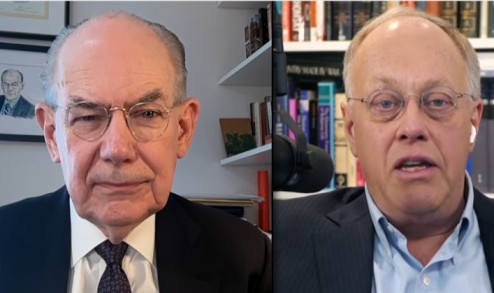
Editor’s Notes: In this episode of The Chris Hedges Report, host Chris Hedges is joined by renowned political scientist John Mearsheimer to dissect the escalating tensions and potential for a catastrophic conflict with Iran. The discussion delves into the Trump administration’s struggle to navigate a fragile ceasefire while facing Iran’s strategic leverage over the global economy through its control of the Strait of Hormuz. Mearsheimer analyzes the “colossal blunder” of U.S. foreign policy in the region, examining how domestic pressures from the Israel lobby and erratic executive decision-making have left the U.S. in an untenable position. Together, they explore whether a meaningful peace is possible or if the world is teetering on the edge of a global economic crisis. (April 21, 2026)
TRANSCRIPT:
Iran’s Demands and the State of Negotiations
CHRIS HEDGES: Iran, after initially balking, will send negotiators to Islamabad for a new round of talks with the United States less than 48 hours before the ceasefire is set to expire. Iran, however, has criticized the U.S. for violating the ceasefire from the beginning of its implementation, citing the U.S. naval blockade of the Strait of Hormuz since April 13th, and the seizure of an Iranian container ship, both they cite as breaches of the truce as well as international law. Iran says that if the U.S. continues to carry out what it defines as acts of aggression, Iranian forces will respond accordingly.
Tehran’s 10-point proposal submitted before the first round of Islamabad talks is the basis for further negotiations. But the 10 points include a number of conditions the U.S. has repeatedly rejected. It demands the lifting of all primary and secondary sanctions on Iran, continued Iranian control over the Strait of Hormuz, U.S. military withdrawal from the Middle East, an end to attacks on Iran and its allies, the release of some $100 billion in frozen Iranian assets, and a UN Security Council resolution making any deal binding.
So where are we? Is the Trump administration ready to make concessions in the face of Iran’s ability to strangle the global economy by shutting down the Strait of Hormuz? What will be the role of Israel, which has threatened to resume attacks on Iran? With perhaps only 5% of the pre-war 20% of the oil and natural gas making its way through the strait, how much more can the global economy, already under severe distress, endure before it triggers a global economic crisis?
Joining me to discuss the crisis in the Middle East is Professor John Mearsheimer. He is the R. Wendell Harrison Distinguished Service Professor of Political Science at the University of Chicago. Professor Mearsheimer, who graduated from West Point and was a captain in the U.S. Air Force, is the author of numerous books including Conventional Deterrence, Nuclear Deterrence Ethics, Liddell Hart and the Weight of History, The Tragedy of Great Power Politics, The Israel Lobby and U.S. Foreign Policy, and Why Leaders Lie: The Truth About Lying in International Politics.
The big question for me, John, is does the Trump administration realize, in your view, that this is a game that Iran controls, that essentially because of their stranglehold on the Strait of Hormuz, they’re largely going to be able to dictate the terms?
Can the U.S. Win by Escalating?
JOHN MEARSHEIMER: Let me just reinforce what you said, Chris. I think there’s no question that if you go up the escalation ladder, which the Trump administration is threatening to do after the ceasefire ends on Wednesday, that we cannot win. And in fact, I would make the argument that it’s in Iran’s advantage for the United States to go up the escalation ladder, because the longer this war goes on and the less oil that comes out of the Persian Gulf and maybe even the Red Sea, the better for Iran.
So I think going up the escalation ladder makes no sense for us. The $64,000 question is whether or not President Trump and his advisers understand that. And my guess is that they do. And therefore, I think that we will go to great lengths to work out some sort of deal on Wednesday, or before Wednesday, so that we don’t have to go up the escalation ladder.
I just find it hard to believe that the administration would be interested in escalating. But, you know, you never know with the Trump administration and with President Trump in particular. So it’s hard to say for sure. But I don’t see them going up the escalation ladder. I think they’ll try to craft a deal. And if they don’t have all of the essentials in place, they’ll just extend the ceasefire. So that’s my surmise as to where this one is headed.
The Complexity of Iran’s 10-Point Proposal
CHRIS HEDGES: I want to ask you about the 10 points because many of these points — the removal of US military bases from the region, continued control of the Strait of Hormuz — these are pretty bitter pills for the United States to swallow.
JOHN MEARSHEIMER: I think there’s no question about that. I often say that if you look at what people are talking about in terms of a settlement this week, what they focus on is the nuclear issue, and what they really focus on is the nuclear enrichment issue. Hardly anybody seems to be saying anything about things like reparations, sanctions, who controls the Strait of Hormuz moving forward, what about American military bases in the region.
And furthermore, the Iranians are deeply interested in getting some sort of security arrangement put in place so that Israel and the United States don’t attack Iran again in 6 months. These are hugely complicated issues. There are a good number of them, and I think they have to be settled as well as the nuclear issue.
But even on the nuclear issue, Chris, it’s not clear to me where this all leads. The United States would like to eliminate Iran’s nuclear enrichment capability completely, but it seems quite clear that the Iranians are unwilling to do that.
Furthermore, it seems that the Americans, or the United States and the Israelis, want all of that enriched uranium that Iran has — the uranium that is enriched up to 60% — they want it taken out of the country. But the Iranians have said very clearly that that’s not going to happen.
Obviously, some compromises are going to have to be made here. But those compromises will not be easy to make. I don’t think they’ll be made quickly. And then the question is, how is Trump going to sell them, especially to the Israelis and to Israel supporters in the United States?
So what we’re saying here, I think, is that even on the nuclear issue alone, it’s a very complicated matter. But when you throw in all the other issues as well, it’s just hard to see how you get any sort of what one might call meaningful peace agreement.
Israel’s Role and the Influence of Kushner and Witkoff
CHRIS HEDGES: You have the Netanyahu government threatening to resume attacks on Iran, even unilaterally. And the other question is how much influence Jared Kushner and Steve Witkoff — two utterly inept negotiators, of course, and let’s call them what they are — they’re Zionist assets. Are they able, as they were with the inception of this war, to sell the Trump administration on resuming — on what Netanyahu wants, which is resuming attacks?
JOHN MEARSHEIMER: Look, I think even without Kushner and Witkoff, who are Israeli assets for sure, there is so much pressure from pro-Israel forces in the United States on Trump that there are real limits to what he can do vis-à-vis Iran in terms of making concessions to the Iranians.
But the problem here is that Trump is also feeling pressure from the other side. And what I mean by that is if he doesn’t settle this, and especially if he escalates as the Israelis would like him to do, then we’re heading on a course where the international economy is going to go off a cliff. The incentive for President Trump to settle this conflict as quickly as possible has mainly to do with economic considerations. There’s a great danger here that if we continue on this path, and again, if we escalate especially, that this will have disastrous consequences for the world economy, which includes the United States. And of course, that will have disastrous consequences for the midterm elections.
So Trump is desperate to shut this one down. So he has that pressure on one side, and then he has pressure from Israel on the other side. And again, we cannot emphasize strongly enough that Israel has no interest in settling this war. Israel wants to see Iran finished, finished off. They want to see Iran decisively defeated. And as we both know, if anyone has won this war at this point and is likely to come out of this war as a winner, it’s Iran, not the United States.
Well, given that reality, the Israelis are going to continue to put pressure on the United States to stay at war. So I would argue that even if President Trump is able to extend the ceasefire and get a framework for a future agreement in place, the Israelis and their supporters in the United States will be working overtime not to make that framework morph into a peaceful agreement. They’ll be working overtime to undermine that framework and get the United States back at war with Iran.
Lebanon, the Ceasefire, and Iran’s Regional Demands
CHRIS HEDGES: One of the fascinating kind of subtexts of this was Lebanon. Israel almost when the ceasefire began, started pounding Lebanon. But Trump said it had to stop. Israel has a very kind of elastic vision of ceasefires. It’s still attacking Lebanon. But this was a fundamental demand on the part of Iran. They said, “We’ve stopped attacking GCC bases in GCC countries with your allies, so you have to stop attacking our allies. This is a regional ceasefire.”
And while Israel has certainly breached the ceasefire in Lebanon, as they do daily in Gaza, nevertheless, it does seem — I don’t know what your take on it is — that that was a huge concession on the part of the Trump administration to Iranian demands?
JOHN MEARSHEIMER: Well, the Trump administration had no choice but to get Israel to stop attacking Hezbollah and Iran for a brief period of time at least, so that the Iranians would open the Strait of Hormuz. That’s what they wanted, and Trump was able to get the Israelis to make a small concession, which is to say the Israelis agreed to a 10-day ceasefire. Just think about it. It’s a 10-day ceasefire. And I’ve been following it, and it’s not even much of a ceasefire in this 10-day period. But the idea that the Israelis are interested in a meaningful ceasefire is not a serious argument.
What the Israelis are interested in is creating a civil war in Lebanon for two reasons. One, to weaken Hezbollah and to take Hezbollah’s attention off of Israel. And number two, to weaken Lebanon overall. This is standard Israeli tactics, and the Israelis will continue to attack Lebanon and Hezbollah in good part not just to weaken Hezbollah, but in good part to undermine any negotiations between Iran on one hand and the United States on the other.
It’s obvious that for Iran, Hezbollah is a very important ally, and they want to do everything they can to help Hezbollah. The Israelis fully understand that, and the Israelis understand that if they continue to attack Hezbollah and continue to keep the situation in Lebanon as a hot conflict, that this will limit how much Iran will be able to concede to the United States. So this is one of the reasons I find it hard to imagine that you’re ever going to settle this conflict in any meaningful way.
The Israel Lobby: Weakened in Discourse, Strong in Policy
CHRIS HEDGES: You wrote the book with Stephen Walt on the Israel Lobby. We’ve certainly seen diminishing of the power of the Israel lobby and AIPAC. Democrats now kind of run from it, whereas they couldn’t wait to get key slots at the AIPAC convention. Do you think the Israel lobby is weakened enough that its kind of death grip on the American political system is no longer as effective?
JOHN MEARSHEIMER: I think in terms of the public discourse in the United States, the lobby has lost. When Steve and I wrote the article and then the book in 2006 and 2007, the lobby was able to basically control the discourse and greatly limit the criticism of Israel, the U.S.-Israeli relationship, and the lobby itself. Those days are gone.
The discourse today about the lobby and criticism of Israel — this is all out in the open in ways that are actually hard for me to imagine, Chris, given where we were at back when Steve and I wrote the article and the book. But that’s at the level of the discourse.
At the level of policy, and especially with regard to the Trump administration, which as you know has 2 more years and 9 months in power, the lobby still has a stranglehold on the Trump administration, and there’s no evidence that Trump has been able to break away from that stranglehold and act independently, to act simply in America’s interest. So in terms of U.S. policy, I think the lobby is as strong as ever.
Now, how that plays out after the next presidential election is a different matter, because you see both in the Democratic Party and in the Republican Party that there are politicians who are beginning to question the relationship with Israel, who are beginning to question whether associating themselves with AIPAC is a good thing, and so forth and so on. But I would still bet that it’ll be a good 10 years before our policy towards Israel is not seriously affected by the lobby.
A Dark Scenario: The Lobby, Trump, and the Path Forward
CHRIS HEDGES: So what does that mean vis-à-vis Iran? So if the Israel lobby retains that kind of power, and in a way Trump was even more obsequious because the Israel lobby has been calling for a war on Iran for 4 decades, and other administrations have resisted for all of the reasons that are now apparent. But how does that play out? I mean, it looks like a very dark scenario.
The Path to a Peace Agreement
JOHN MEARSHEIMER: Well, it’s hard for me to imagine, Chris, that we get a meaningful peace agreement between the United States and Iran because of the power of the lobby. I think the only argument against that position is that the economic consequences of continuing this war against Iran will be so drastic, will hurt the international economy and therefore the American economy so much that we have no choice but to work out an arrangement with Iran that recognizes the fact that Iran is the winner in this conflict and that there’s not going to be any more attacks on Iran down the road.
That may happen. It’s very hard to say just how this is going to play out over the next few months, but I think if that doesn’t happen, in other words, if we don’t get to the precipice and we’re not on the verge of falling off the precipice, I think that Israel will make it impossible for us to have a meaningful agreement with the Iranians.
The Ceasefire and the Strait of Hormuz
CHRIS HEDGES: Let’s talk about the tactic of seizing Iranian ships by the Trump administration.
JOHN MEARSHEIMER: Well, I thought that last Friday when the ceasefire between Israel and Lebanon was in place and the Iranians said that they would open up the strait, and in fact began to open up the strait, that the ceasefire was then fully in place, and that we would begin moving forward in the negotiations in Islamabad. It looked very promising last Friday when these events took place.
Then President Trump said that he was not going to take the U.S. blockade off the Strait of Hormuz, which is another way of saying he was not going to take the U.S. blockade off of Iran. And this is after Iran has just agreed to end its blockade. And he also said that the United States was going to stop and board ships that were headed toward Iran or were leaving from Iran. And the end result is that the Iranians did a 180-degree turn and they said they’re reclosing the Strait of Hormuz, and that’s where we are today.
This is completely counterproductive. Forget the legality of what we did. This is completely counterproductive. You got the ceasefire in place on Friday, and you’re talking about having negotiations in Islamabad early this week in the wake of putting the ceasefire in place, why wouldn’t you just put an end to the American naval blockade on Iran? It just makes common sense. Why would you say you’re going to keep the blockade on? Why would you say that you’re going to board Iranian ships and then actually go out and board an Iranian ship after you shoot it up?
It just doesn’t seem to make any sense to me. And this is one of the principal aspects of Trumpian foreign policy. It is rather bizarre and doesn’t seem to comport with what one would consider sort of rational legal behavior. So I, to be honest, don’t understand what’s going on here.
CHRIS HEDGES: Isn’t it in their interest to have Iranian oil on the market?
JOHN MEARSHEIMER: That’s — I didn’t mention that, but you’re exactly right. That’s why we were allowing Iranian oil to come through the Strait out into the global market. You’re exactly right. And here they are threatening to cut it off. In addition to the fact they’re making it less likely that the other side trusts you, the Iranians trust you, and that you can work out a deal.
It seems that the Trump administration wants a deal. They should want a deal, because as I said to you before, they can’t go up the escalation ladder and win, number one. And number two, they are in danger of taking the international economy off a cliff. So they should want a deal here. And sometimes President Trump acts like he wants a deal. Other times he acts like he doesn’t want a deal. And this is an instance of that. And then you add to it, as you did, the fact that we really do need that Iranian oil out in the global market to do everything possible to keep oil prices as low as possible.
Trump’s Dismissal of Expertise and the State Department
CHRIS HEDGES: Well, the reason great powers have a diplomatic corps is that they’re multilingual, bicultural, they understand their adversary, as well as their allies, and the Trump administration has gutted the State Department. So, one wonders if it’s just an — on the one hand, they may want a deal. On the other hand, they’re utterly unable, perhaps, to read Iranian political power and Iranian culture.
JOHN MEARSHEIMER: I agree with you. I mean, there’s no question that just in a very general level, President Trump does not respect expertise. He thinks he’s a genius. He thinks he knows everything. He doesn’t have to rely on experts, and he doesn’t need anyone from the State Department or any area experts inside the government to tell him what to do. He knows what to do. So there is that dimension to it.
But there’s another dimension to this, Chris, that’s even more worrisome. And that is that it sometimes strikes me that President Trump is a mad king. I don’t know if you read the story in the Wall Street Journal about what life is like inside President Trump’s White House in the course of this War Against Iran. And the story is told in there, and the White House has not refuted this story, that after those two pilots were shot down earlier this month and President Trump was told about this, he was hysterical. He was hysterical for a few hours. He was just beside himself with rage. To the point where his aides had to keep him outside of the room while they decided how to deal with the problem. And occasionally one of the aides would go out and brief him on what was going on.
You want to just think about what’s going on here. Here is the President of the United States in the midst of a serious crisis. An American fighter plane, an F-15, has been shot down inside of Iran. There are two pilots who are missing. They have to rescue them. And this is going to take some careful planning. This is a crisis. The president of the United States is throwing a tantrum, an hours-long tantrum, according to the Wall Street Journal. Again, to the point where he has to be taken outside of the room.
Can you imagine this happening with JFK during the Cuban Missile Crisis? It’s unimaginable. It’s unimaginable to me that any president would act this way. And it’s very interesting how little attention this episode has got in the mainstream media. But it, I think, speaks volumes about the dangers that we face with President Trump in control.
If we get into a really serious crisis, something beyond the actual war that’s now taking place that threatens to escalate, that involves maybe China or Russia, and he’s in charge, this is a very frightening thought. And I would imagine in that circumstance he’ll be pushed out of the room again and his aides will take over. But what does that tell you about the United States?
And just one final point on this: you want to remember that President Trump is the kind of person who thinks he knows everything, and therefore even his aides don’t matter that much. He is the ultimate decider, period, end of story. And if this is our ultimate decider, if this is our sovereign in an extreme crisis, I think we’re in real trouble.
Trump Against the Advice of His Own Intelligence Chiefs
CHRIS HEDGES: Well, he was reportedly against the advice of his military and intelligence chiefs. He believed the Iranians would not seize the Strait of Hormuz.
JOHN MEARSHEIMER: Oh, absolutely. I mean, I think if you go back to the original decision to attack Iran and you read — there were two New York Times stories on this whole matter. The second one was just filled with details. It’s very clear that except for Pete Hegseth, who really doesn’t matter very much because I don’t think anybody, even President Trump, takes him that seriously. But all of his other advisers were very, very skeptical, if not opposed, to this operation. They understood full well that this was playing with fire.
But nevertheless, President Trump dismissed their concerns, and he went along with the Israelis, who basically sold him a bill of goods. It was the head of Mossad, David Barnea, and Prime Minister Netanyahu, who convinced President Trump that we would win a quick and decisive victory. And then just to build on your point, therefore we wouldn’t have to worry about Iran closing the Strait of Hormuz. We would win very quickly.
But the fact is, if Trump had listened to his advisors and he had carefully examined them as to why they were reticent or opposed to going to war against Iran, he might not have done this. In fact, I think it’s highly likely he would not have done it. But again, he didn’t really care what they had to say, and he was willing to listen to the Israelis. And he should have understood that the Israelis were selling him a bill of goods, but apparently he didn’t.
The Global Economic Crisis
CHRIS HEDGES: Let’s talk about the global economy. Some oil is getting out, not a lot. An estimate, maybe 5%. Countries — India, Japan, Philippines — they’re already in serious trouble. And this, if it’s not a total blockage, this trickle is already having seismic ramifications. So talk a little bit about where we are now in terms of the global economy and potentially where we could go. And then there’s all sorts of other factors like fertilizer, which is also passed through the Strait and is an oil derivative, and the effect on food prices.
JOHN MEARSHEIMER: Yeah, I mean, there are a number of dimensions to the economic catastrophe that’s staring us in the face. And again, I like to talk about this as the Titanic hitting the iceberg. And it’s important to emphasize the Titanic has not hit the iceberg. And although there’s no question that serious damage has been done and will be done, catastrophic damage will be done if we hit the iceberg. And of course, this is why President Trump is deeply committed, I believe, to shutting this one down as quickly as possible, because he does not want to hit the iceberg.
First of all, there is the helium, as you point out. There is a significant helium shortage in the world because the strait has been shut down, and helium is very important for producing microchips. Furthermore, there’s been a significant slowdown in the amount of aluminum coming out of the Gulf, and aluminum really matters as well. Then there are the fertilizers. 30% of the world’s fertilizers come through the Gulf, and hardly any are getting out. And this is going to have huge consequences for the production of food around the world.
Remember, we had this thing called the Green Revolution, and the Green Revolution allowed countries around the world to produce sufficient food to feed almost all of their people. And that food, that Green Revolution, was heavily dependent on the coming of abundant fertilizers, right? You used to have to rely on manure and compost instead of fertilizers, but once you get fertilizers and lots of fertilizers coming out of the Gulf, that facilitates the Green Revolution. And then furthermore, you mechanize agriculture, and when you mechanize agriculture, that means that agriculture is dependent on gas and oil and what have you. And therefore, if the amount of oil coming out of the Gulf, the amount of fuel coming out of the Gulf is reduced significantly, that is, along with the fertilizer, going to have a significant effect on the amount of food that’s produced and the price of food. So I think the food crisis that’s looming is great, and it could be even worse if this conflict isn’t shut down sooner.
And then with regard to oil and gas, the Saudis have to some extent got around this problem by shipping oil across a pipeline that crosses Saudi Arabia from the Persian Gulf to the Red Sea, and they’re exporting oil through the Red Sea. And quite a bit of oil too. And that’s alleviated the problem somewhat. The great fear here is that if this escalates, the Iranians working with the Houthis will shut down the Red Sea at Bab-el-Mandeb Strait, and that will really do disastrous things to the world economy.
So at the moment, the damage has been limited somewhat because Saudi oil is getting out through the Red Sea. And as you pointed out before, Chris, Iranian oil has been getting out as well. So I would guess that about 20% of the world’s oil comes out of the Gulf. That’s about 20 million barrels a day. And I think probably now about 10 million barrels is getting out, or when Iranian oil was getting out, it was a total of about 10. So only about 10 million barrels were being held up. But you can imagine a situation where if this war escalates, we’ll go back to where 20 million barrels are not coming out, and that will have devastating consequences.
So what I’m getting at here is a great deal of damage has already been done, most of it in Asia at this point in time. But almost everybody agrees that the effects, the negative effects, are working their way toward Europe and eventually will work their way towards the United States. But in Asia, there’s huge problems already, and there is a real danger that they will get even worse if this war escalates. So to put it in slightly different terms, if this war isn’t settled quickly. And one thing I forgot, by the way, is diesel and jet fuel. That’s where there is a bigger crisis looming than even with regard to normal oil and gas.
CHRIS HEDGES: Didn’t I read somewhere, I think European airlines have about 6 weeks left of jet fuel?
The Path Forward: Frozen Conflict or Catastrophe?
JOHN MEARSHEIMER: Yes. And then they’re in real trouble. And that problem has already manifested itself in Asia, right? And as I say, the problem is beginning to move into Europe, and it’ll eventually move into the United States. And again, this is why President Trump has a deep-seated interest in shutting this war down, and doing everything he can to minimize the damage. And minimize is the important word here. There’s been a huge amount of damage done, and almost everybody agrees that there’s going to be significant damage in the years ahead. That this is not a problem that can be fixed immediately, but you can minimize the damage.
And if President Trump doesn’t cut a deal with the Iranians and get the strait open and get oil flowing, get diesel and jet fuel flowing, doesn’t get fertilizers flowing, and we’re in the same situation, 5 months from now that we’re in now, I believe that the consequences will be catastrophic for the world economy.
CHRIS HEDGES: So you have Trump’s idiocy and impulsiveness. You have, in your words, the fact that the Israel lobby still has a stranglehold on the Trump White House and U.S. policy. And of course, the Israeli government is dead set against any kind of agreement with Iran. You have demands by Iran, and let’s be clear that Iran has been targeted for 47 years — through sanctions, and I think it appears that Iran has said enough. This is going to end. These are big demands for the United States. How do we limp forward? How does it go forward?
JOHN MEARSHEIMER: I don’t know. You raised these issues at the beginning of the program when you started talking about the 10-point plan of the Iranians, which President Trump has said would be the basis for the negotiations moving forward. I mean, just think about Iranian control of the Strait of Hormuz, which effectively means they’re going to treat it as a pathway that has a toll booth, an Iranian toll booth on it.
CHRIS HEDGES: In Chinese currency, not in the dollar.
The Unresolved Questions of a Peace Deal
JOHN MEARSHEIMER: Yes. Are we going to tolerate that? Kind of hard to imagine, but maybe we’ll have to swallow on that one. Then there’s the subject of sanctions. Are we really going to take sanctions off Iran? And are we going to pay reparations to Iran? If that happens, isn’t Iran over time likely to recover from the punishment that we have inflicted on its economy? And won’t its economy flourish? And won’t this lead to it becoming a more powerful state in the Middle East? And how will the Israelis react to that?
We’re not going to do away with their nuclear enrichment capability in toto. I mean, they’re going to keep some nuclear enrichment capability. The Israelis and the hawks in the United States are never going to be happy with that. President Trump, at best, I think, is going to get an improved JCPOA. Can you sell that?
Furthermore, how do you convince the Iranians that you’re not going to pay them a return visit, that there’s not going to be a third war? What do you do in that regard? What do you do with American bases in the region? Are we just going to leave the region as they’d like us to, or are we going to stay there? And if we stay there, are they going to greatly increase their ballistic missile force? I think so. I think one could argue that even if we leave, they’ll greatly increase their ballistic missile force. What are the Israelis going to do then?
So you can go on and on talking about all of the really difficult issues that have to be solved, and the question is, how do you solve them? How do you get some sort of meaningful peace agreement here? And even if you don’t get a meaningful peace agreement, how do you work out a frozen conflict? What does a frozen conflict look like? And how stable is that frozen conflict moving forward?
I mean, I wish I could give you clear answers to this, Chris, but when I look at it, I find it kind of mind-boggling to try and figure out where this is all headed. And the only thing I can say with a high degree of certainty is it looks like one giant mess that’s going to lead to endless trouble.
CHRIS HEDGES: Do you limp forward with a ceasefire, a frozen conflict? Is that perhaps at the moment the best that we can hope for?
A Colossal Blunder: America’s Failed Objectives
JOHN MEARSHEIMER: Yeah, I think that that’s true. As I said before, the one possible factor that offers hope is that if we are headed towards the iceberg and it looks like we’re going to hit the iceberg and we have one last clear chance to veer away from it, we may then put tremendous pressure on the Israelis to just not say anything, to just accept what we do, and then we cut a deal with the Iranians. But that deal we would cut with the Iranians would be a deal that’s very favorable to them. The key point here is that the Iranians are in the driver’s seat.
This is why I said you can’t go up the escalation ladder and win against them. You want to remember, we came into this war with 4 big demands. They had to do away with their nuclear enrichment capability completely. They had to stop supporting the Houthis, Hamas, and Hezbollah. They had to get rid of their missiles. And furthermore, there was going to be regime change. Those were the big 4 demands, the most important of which I believe was regime change. Because if you got regime change, then in their story, you could achieve the other 3 goals. But those were the big 4 goals. We have failed on all 4 counts. You just don’t want to lose sight of this. We have failed to achieve any of those goals.
And in fact, one could argue, Chris, that we have made the situation worse. In terms of missiles, it would seem to me that the major lesson that the Iranians should take from this conflict is that they should build lots of missiles, lots of launchers, and hide them in missile cities. In terms of the nuclear issue, one could argue that they, if anything, should have learned that what they need is nuclear weapons, and this could be pushing them further in that direction.
And then there’s the whole question of the Strait of Hormuz. And it’s important to emphasize that in addition to failing to achieve our 4 objectives, we’re now in a situation where the Iranians control the Strait of Hormuz and have a toll booth inserted in it, which did not exist on February 27th. And this is likely to remain in place. It’s hard for me to imagine them giving up the toll booth or giving up control of the strait. Maybe they will because they’ll get some other goodies in the deal that is worked out.
But we have failed here. This has been a colossal blunder. And Trump is again now in a position where he’s got the Israelis hemming him in on one side, and he has the potential of hitting that iceberg hemming him in on the other side. He has hardly any maneuver room. And it’s hardly surprising, therefore, to see him behaving in more and more erratic ways, looking more and more like a mad king, because he has put himself in an untenable position.
Is This America’s Suez Crisis?
CHRIS HEDGES: Is this our Suez Crisis? Are we not there yet?
JOHN MEARSHEIMER: Is—
CHRIS HEDGES: Does the Suez Crisis happen once we hit the iceberg?
JOHN MEARSHEIMER: It’s not our Suez Crisis. I mean, to understand what happened at Suez, you have to remember that Britain was a declining great power. The decline started around 1900, and it’s pretty much all downhill from 1900 up until the present. And Britain in 1956 was not even a great power. You remember well, Chris, we referred to the world that we lived in during the Cold War as a bipolar system. There were two great powers in the system. We called them superpowers. Those two great powers were the United States and the Soviet Union. Britain was not even a great power.
And you remember in 1968 — this of course is 12 years after the Suez Crisis — the British basically abandoned all their defense commitments east of Suez. East of the Suez Canal. And this is because, again, Britain is a declining great power. It’s losing its military might. Its power projection capability is greatly reduced.
This is not what’s happening to the United States. There’s no question that the United States now has a peer competitor in the system, which is China, and Russia is also a great power. We’re now in a multipolar world. So the United States does have to deal with two other great powers, but the United States is still a great power. It has a tremendous amount of power, and that power is not going to go away.
What’s going on here is that the United States, especially under President Trump, but even under President Biden, has lost its ability to employ that power in smart ways. We behave in remarkably foolish ways. And this is true not just under Trump, it was true under Biden as well. You want to remember that Joe Biden is the president who embraced Prime Minister Netanyahu after October 7th.
CHRIS HEDGES: Yeah.
JOHN MEARSHEIMER: And fully supported the genocide in Gaza. And there were a number of other policies, including US policy toward Iran, where President Biden misbehaved — or behaved in foolish ways, would be a better way to put it.
But the point is the United States is incredibly powerful, and that’s what makes President Trump so dangerous. And it’s also what allows President Trump to whiplash allies and adversaries alike, to ignore international law and international institutions. He can get away with all of this because we are so powerful. We’re not, in my opinion, going to get weaker with the passage of time. The United States is going to remain a very powerful state on the world stage. And the only interesting question is, will we get our act together and act in responsible ways, which we have not been doing for a long time?
I don’t hold out much hope in that regard, but I don’t think it’s a Suez moment. I think the Suez moment was just one giant step in the gradual decline of British power over the course of the 20th century.
CHRIS HEDGES: Great. Thank you, John. And I want to thank Max, Sophia, who produce the show. You can find me at chrishedges.substack.com.
Related Posts