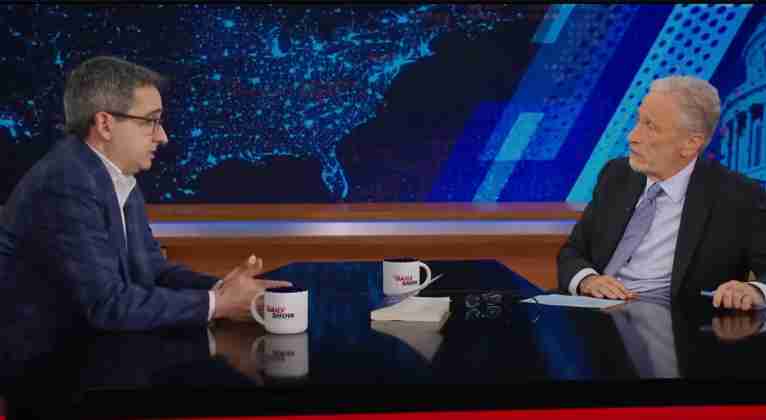
Read the full transcript of The Daily Show host Jon Stewart in conversation with economist Oren Cass on “Understanding Trump Tariffs Through the Lens of ‘The New Conservatives’”, April 1, 2025.
The interview starts here:
Introduction to the New Conservative Economic Approach
JON STEWART: Thank you for joining us.
OREN CASS: Thank you for having me.
JON STEWART: I wanted to have you on. I want to tell you, I really do enjoy your writing. I follow your Substack Blossom. And I read your books. I always find them interesting. I don’t necessarily agree with all of it, but I always find it really interesting and in good faith. This idea of the new right on the economy – can you explain what’s the deviation from previous orthodoxy and sort of what that entails?
OREN CASS: Sure. I think the best way to understand it is that we went through a period of 30 or 40 years where conservatives just had way too much faith in markets. Just trust that you get out of the way and you’re going to get great outcomes. And markets can give you great outcomes, but they don’t guarantee great outcomes.
And so conservatives have been seeing, especially over the last decade, a lot of the things we care about, things everybody cares about. Do jobs pay enough to support a family? Are we too dependent on China for everything? Can we make computer chips in this country? Markets were perfectly happy to give us really bad answers on those questions. And so conservatives are starting to say, wait a minute. We actually have to care about this, and we have to be prepared to do something about it.
Breaking from Traditional Conservative Economics
JON STEWART: Now, when you say this at the meeting with the other conservative economists, do they go, “leave us”? It really seems like that is fundamental heresy. You know, I’ve listened for years. The reason we can’t do sort of social engineering or social policy or redistribution of wealth is the government’s not in the business of picking winners and losers. That is now off. The new right is saying, actually we do.
OREN CASS: Yeah, I think that’s right. The new right is saying, actually, there are some things we really want to see win, and that’s what politics is. What would politics be if you just pretended you sort of didn’t care about anything? You’d sort of have a lot of the very uninspiring Republican politics of the last few decades, I would say.
JON STEWART: Now you started, though, you worked with Mitt Romney, who was considered the avatar of that. Was he open to this idea? Where did it start to find traction for you that a more activist government, this sort of idea of economic policy as kind of social engineering, when did it start to gain traction?
OREN CASS: I mean, I actually started working with then Governor Romney. Like you said, he was conventional in a lot of ways. One of the issues I was responsible for with him was trade policy. And we brought him the very typical, “here’s what Republicans say about trade” briefing. And he said, “well, that’s fine, but what are we going to do about China?”
And to your point about all the other conservative economists in the room, they were like, “what are you talking about? We don’t do anything about China. If China wants to send us cheap stuff, we say thank you very much” in the meeting.
JON STEWART: What does it sound like when the monocles fall out of the eyes? Does it clink? It just feels like one of those… like there was Grey Poupon.
OREN CASS: The gasps can be disturbing. Yes, there’s a lot of religious fervor, frankly, on what I would call the old right about some of these ideas. And when someone says something very common sense, like, “wait a minute, maybe an authoritarian communist government that’s trying to hollow out American manufacturing, maybe that’s not really free market,” I was like, “wow, that’s a really important point.”
And I was the one assigned to go off and try to figure it out. And what I discovered was that on the right of center, really going back to the mid-1980s, there had just been no thinking about this.
The Shift in Conservative Trade Policy
JON STEWART: About protecting that manufacturing base or our industrial center. And then I think in COVID, you saw everyone kind of paused and went, “oh, we don’t have supply lines to make paper masks. We don’t have anything.” Was that where you saw it really get a foothold?
OREN CASS: I think on the right of center, the China problem was active even before COVID. Because I think, and it’s important to say this is a fairly recent conservative phenomenon. If you go back in the history of conservatism, even if you look at Ronald Reagan himself, Reagan was a trade protectionist. He basically started a trade war with Japan because he did care about these things.
JON STEWART: This was in the days of Japanese carmakers making cars that were cheaper. People were preferring them. They were dominating the market in America.
OREN CASS: And Reagan negotiated an outright quota that Japan, not even a tariff. Japan will not increase the number of cars it sends into America. And that’s why we now have the American auto industry in the South. Honda and Toyota make American cars essentially because somebody like Reagan was willing to recognize trade is good if it’s fair and balanced.
JON STEWART: But I’ve read mixed things about whether or not that five years later, it actually gave too much leverage to these Japanese companies and they got to drive very hard bargains for American labor. In the south, for instance, they didn’t build them in Michigan. They didn’t build them where union labor was. They undercut union labor in some respects.
OREN CASS: They did choose to go to states with non-union labor. The way that the unions were behaving at the time was one of the reasons that US automakers were falling behind.
That level of inflexibility was a real challenge. And that’s also something that you saw Reagan really take on and confront.
So I don’t think there are a lot of people in the American south today who would say, “boo, we wish these hadn’t come.” It was an enormous gain, and the investments have led to much higher productivity over time. So I think that’s the story of what we want to see more of.
Trump’s Tariffs and “Liberation Day”
JON STEWART: Bringing that back and giving the country a resilience that losing that base actually cost us. And this brings us to Liberation Day, which is April 2nd. Mark it down. Liberation Day. The Trump tariffs, we don’t know what they are, but we know they’ll work and that we will live on Mars in, what, eight weeks? I don’t know what’s going to happen. Do you know what’s going to happen on Liberation Day?
OREN CASS: I don’t know what’s going to happen. And I think that there has, rightly been at this point, a lot of criticism that the way that the Trump administration has been rolling a lot of this out is just leaving too many questions. If you want to do this right, you need certainty and predictability, clear communication, all core values.
JON STEWART: Of the Trump administration.
OREN CASS: Fair. Fair point. One of the interesting things about the Trump administration is that the team he has around him this time on the economic side – Secretary of State Rubio, Secretary of the Treasury Scott Bessant, his chief economic advisor, the US Trade representative – he’s really surrounded himself, I think, with a quite strong team that thinks consistently about this.
JON STEWART: Does he ever, like, ask them or…?
OREN CASS: That is a fair question. And that’s what I think everybody’s waiting to see is can we sort of get this moving in the right direction? Because it is important to say that the direction is important here.
Really, for 25 years, going back to when we let China into the WTO, we have pursued this model that says more free trade, always, regardless of what happens to American workers, regardless of what happens to American industry. We just want the cheap stuff. And that has been really damaging.
Corporate Incentives and Policy Approaches
JON STEWART: You know, in some respects, though, we regard, I think we’re putting a certain motive on China, when in fact, these were corporations seeking the lowest water of wages and what they could pay people. And certainly labor can’t travel the way that capital does. So, I guess the idea is we levy these tariffs and then these corporations that had been seeking this will all go, “oh, okay, it’s not worth our while anymore,” and they’ll reinvest in the States. Is that kind of the broad theory of it?
OREN CASS: Yes. The idea is that corporations are going to respond to incentives. And you go all the way back to Adam Smith and the wealth of nations and the idea of capitalism, you want people pursuing profit to do that in a way that is also good for the society.
Where I think a lot of economists, and this is left and right of center, got it wrong, was to think that’s just always the case. As long as they’re pursuing profit, it’s going to be good. And it’s only going to be good if it’s within certain constraints. If the things that are most profitable actually are things that are good for the country.
JON STEWART: And the government decides sort of what those constraints are, so they put guardrails around them. I guess the question I have is tariffs feel somewhat, I don’t want to say whimsical in the sense of, he dances downstairs in a tutu and says “25% on whiskey.” But they are executive actions. And if you’re a business making a plan – I assume their plans are 5 year, 10 year, 20 year – if they could just be repealed by the next guy, and it’s not legislation, is that really an effective incentive for bringing back all that manufacturing?
Bipartisan Consensus and Policy Stability
OREN CASS: I think that’s a very fair concern. And ideally it would be done through legislation. I think one of the things that’s very encouraging is to see that we are increasingly now seeing a new bipartisan consensus that we do want to change.
JON STEWART: I’m sorry, I don’t know that phrase. What was that?
OREN CASS: It started when President Joe Biden essentially kept all of Trump’s trade actions. Everything that Trump did on China, Biden kept and then even extended some.
JON STEWART: But wouldn’t, like, the CHIPS Act – wouldn’t that be another way of incentivizing without setting up barriers that might be more unpredictable or might be flimsier depending on the whim of an executive? Why don’t they embrace that in the same way? Doesn’t that add to getting the outcome you want? Incentivizing, bringing those jobs back? Why is that unpopular on the right?
OREN CASS: Well, it’s only unpopular with some on the right. And I think it goes to where we started, which is this historical concern with the idea of sort of picking winners and losers at all.
JON STEWART: Right.
OREN CASS: And a lot of concern that, what’s going to happen if government actually gets involved in giving particular benefits to particular companies. That being said, the CHIPS Act was bipartisan. I think there were maybe 17 senators. J.D. Vance has been a supporter of the CHIPS Act.
JON STEWART: Right.
OREN CASS: And so, I think again, that’s a step in the right direction.
JON STEWART: Would you rather see it through that kind of industrial policy or is it a real balancing of all those various levers?
OREN CASS: I think you have to do both, because if you only do the CHIPS Act kind of thing.
JON STEWART: Right.
OREN CASS: CHIPS Act is great if you’ve got one thing that’s really important. Almost everyone agrees.
JON STEWART: Steel and so, well, so.
OREN CASS: This becomes the question now, right? Do you really want Congress now going through and saying, “oh, well, now we need one for steel? Well, do we need one for aluminum, maybe? Well, do we need one for cars? We need one for airplanes.” That’s both cumbersome and something that’s very difficult to do well politically.
Whereas one of what I think actually the benefits of tariffs is that they are quite blunt. The tariff is, if done well, a much broader policy that shifts the baseline. And so I think you need that if you want to shift the basic decision making that businesses are going to make generally. And if there’s particular things you really care about, that’s when you also want to come in and give them support.
Broader Concerns About Trade Policy Direction
JON STEWART: Did it surprise you? Because we talk about China as being sort of this ascendant economic power. And by the way, it’s not just the manufacturing base of America that has been hurt by that. All the countries near China can’t compete. You know, all around there, Indonesia, they’re struggling with a very similar thing.
But then why go after Canada? It all seems so weirdly vindictive. And then you’re like, “and then we’re going to take over Greenland.” It does feel a little less like rebalancing economic inequities. And we’ve decided on a new world order where big does what it wants and nation states. We go back to a little bit of that colonialist model or imperialist or whatever it was. Is that the concern?
Understanding the New World Order
OREN CASS: I guess it’s a fair concern. I think there’s some truth to it. That’s not all bad. When you talk about this new world order idea, which is that the United States has been sort of championing this liberal world order where we have essentially taken it upon ourselves to frankly absorb a lot of costs from other people. Right. So in the trade world, it’s not just China, it’s also Germany and Japan and Korea. We are absorbing their production. They get the jobs.
JON STEWART: But don’t you think we’re buying influence? I would say so. The Trump view is they’re abusing us and using us. I think the view I have is America wants to tell them what to do. And so by leveraging our military might, we have sway.
OREN CASS: But do we? What have we successfully told Japan or Germany to do?
JON STEWART: I mean, in general.
OREN CASS: Yeah. In the last… Stop wearing lederhosen.
JON STEWART: I think they’ve cut down on it.
OREN CASS: No, no, no, this is a serious point. I appreciate the joke, but there’s a reason you couldn’t answer the question.
JON STEWART: Well, I don’t know what we’d want them to do because I feel like…
OREN CASS: We don’t want them to do anything. Then what are we maintaining the leverage for?
JON STEWART: Because, well, the leverage is on when we want to go into Iraq. I guess what I’m saying is what we want them to do.
OREN CASS: That was great. That…
JON STEWART: Listen, I’m not saying it was right, but you have a guy like J.D. Vance goes to Greenland and shits on Denmark. Like, Denmark lost as many people per capita in those wars as we did. They talk about Denmark’s not defending Greenland enough. Like, and we’ll do it, but aren’t we doing it already? Like, they’re in NATO. So I guess my point is like, that stable world order hasn’t mistreated the United States. I guess I don’t see us as victims of a con game that Europe has been running on us. And like, the idea that we want Germany to be able to fend off Russia on their own places us in very tenuous position, does it not?
OREN CASS: Why?
JON STEWART: I have a book at home about Germany and their position as a global military power where we didn’t have sway and they did what they wanted.
OREN CASS: I mean, it didn’t work out. Frankly, I don’t put a lot of credence…
JON STEWART: I don’t. And by the way, it’s also in…
OREN CASS: No, no, no, I want to pick up on this…
JON STEWART: 20% of the Oscar…
OREN CASS: Winning movies, the fun applause line that like, “Oh, the Germans will just become Nazis again.” Like, that’s a weird racist critique of Germans. I don’t see any reason to believe that. Let’s be honest. It is. Let’s look at the actual German race state. On what basis are you saying this is like something about Germany that we can’t…
JON STEWART: I think there is an element within their society that they’ve deemed… This is not me saying Germans will do that. This is Germany…
OREN CASS: This is…
JON STEWART: I didn’t say they’ll become that. The leaders of Germany are fearful that they have this…
Military Spending and Alliances
OREN CASS: I don’t think they are. I think leaders of Germany really enjoy spending virtually nothing on their military, while the United States spends roughly 4% of GDP on ours, as we have been doing for decades with other countries in NATO.
JON STEWART: You think they’re like freeloading on our military?
OREN CASS: There’s no question they’re freeloading on our military. You can say you like that they’re freeloading on our military, but I don’t think there’s any dispute that that’s what they’re doing.
JON STEWART: I guess I don’t understand the idea that they’re freeloading and we want each nation state to build up their military to the point because to me that makes it more likely. If you build something like that, it’s more likely you’ll use it. Now that seems to be backed by general history. When people rearm, they tend to do it and use it. But I think the idea that Europe needs to… I guess what I’m saying is this is a fine adjustment that’s being made with a sledgehammer, if that makes sense.
OREN CASS: I think that’s a very fair point. I think where we started on…
JON STEWART: I was dying over here.
OREN CASS: I will concede that one to you. Just like my five-year-old gets one point of paint wrong every…
JON STEWART: Yes, see, I’ll take that.
OREN CASS: Look, the New World order point that we started with, I think is very important here because what the Trump administration and I think this is certainly Trump’s view. J.D. Vance has spoken about this. Marco Rubio has spoken about this. Their view is that this world order we tried to establish in which the US does take on these burdens, and in your view we benefit from taking on those burdens.
JON STEWART: I think it’s a mixed bag. I would not say it’s purely benefit. I think what we do spend on defense is kind of insane. And to have 850 military bases to project power across the world, I wholeheartedly agree with that. I think unleashing those forces through vindictiveness and like blaming them for victimizing us is not the methodology.
Like everything else… Like Doge, I always hate that straw man. Like, we go, I don’t like the way this is going. “Oh, you’re not for efficiency,” like that. Same thing. “Oh, you just want Germany to keep freeloading.” That’s not what I’m saying. And I think it’s a misreading of that point and not being fair to the nuance of it.
I understand that there can be adjustments in that and that free trade can be rebalanced and all those other things, but they’re breaking something that did serve us. Maybe not phenomenally, but okay. And we had a really strong hand in building it, and now we’re pretending like they did it to us. And that feels unfair.
OREN CASS: Let me tell you something…
JON STEWART: When I come on your studio show, I realize that’s difficult to handle. It’s not so fair. I didn’t… You know what I mean?
OREN CASS: I saw you prick them and everything.
JON STEWART: Yeah. But talk about that a little bit.
Rethinking Global Relationships
OREN CASS: So, first of all, I think you’re absolutely right that the US did construct this system. And I think that doesn’t mean that the US should not learn lessons, that doesn’t mean that conditions don’t change, but I do think it absolutely creates an obligation for us to be thoughtful in how we proceed. And I think it’s a fair critique if we’re not being thoughtful in how we proceed.
JON STEWART: That felt like a very different answer than “Germany and Japan freeload on us.”
OREN CASS: And, you know, that’s also true.
JON STEWART: All right, would you… What do you think’s going to happen? Or do you worry about the instability of not easing this transition? But is this a… And look, I’ve read the whole, like, Mar-A-Lago accord, and I don’t know if that’s a conspiracy, but is the idea that there’s some master plan, if we create this chaos, we cause all this thing to draw people to Mar-A-Lago where they renegotiate our nation’s debt. Is that something that you think is plausible, or is that what this is all about? Is that why they’re not doing it in a way that seems more thoughtful?
OREN CASS: So let me say two things about it. The first is, I think a lot of the critiques of how it’s being done are very fair. And I think it’s important to distinguish that from the discussion of the principles, because I think the principles are important, and we should want to have the right set of principles and not throw them out just because they’re not being pursued in the way we might like.
When it comes to something like the Mar-A-Lago Accord, I think what you see people talking about and trying to move toward is to say if we think this sort of liberal world order system, first of all, even if it was serving the US well at one point, is not serving it as well anymore, second of all, to some extent may just be going away anyway. China is now rising as a peer competitor. The US cannot be a unipolar hegemon like it was when the Cold War ended.
So if we accept that things are going to change, we should have a perspective on what we want to follow. And something that I’ve been writing about a lot is trying to interpret and decipher what that might look like. Because again, it’s a very fair critique. They have not been as clear about it as we should want them to be.
What I think we should want and what, like I said, folks in the administration like a Marco Rubio or a Scott Besant, who I think do write and speak thoughtfully about it, have pointed toward, is the idea that we absolutely want a strong economic and security alliance. It’s not going to be the whole world because China’s going to have its own sphere as well. But what we want to have within our sphere is a few things that in the past the US didn’t necessarily ask for. We’re going to want balanced trade where in the past we were happy to let the manufacturing go elsewhere. We’re going to want others to essentially own their own defense burdens. That doesn’t mean we’re not partnering and working together, but that everybody takes primary responsibility for their own defense.
JON STEWART: No NATO, no like alliance like that?
OREN CASS: No, no, you can absolutely have an alliance like that. But the alliance is premised on if you are Germany, you are on the front lines of what the concerns in Europe are. If you are Japan, you are on the front lines of the concerns with China. It’s not a matter of everyone simply turning and asking the US what the US is going to do.
And then the third element is keeping China out and recognizing that China, to your point, China’s just been doing China, doing what’s best for China. But that is not consistent with what the US and a US-led alliance would want. And so if you want to get from where we are today to that kind of system, you are asking things of allies that they haven’t been asked before.
And so the question is, how do you make that a credible ask? Because I think it’s fair. I don’t think that those are unreasonable things to ask. But you are going to have to be willing to back that up and say, the old world, the old version is gone. Let’s talk about what the new version could look like.
JON STEWART: Right.
OREN CASS: And I think…
JON STEWART: Do you think they prematurely blew up the old version or you just, you really felt like it just wasn’t functioning in that way anymore?
The Changing Economic Landscape
OREN CASS: I think the old version has been gone a while at this point. That in the economic sphere, the idea…
JON STEWART: That sort of era of cheap goods.
OREN CASS: The era of cheap goods, the era of the US being able to simply sort of exert its military will on the world, the era of the US economy being so much stronger than others that we could afford to absorb everybody else’s production over the last 10 to 20 years. The typical working family has not been well served by that deal, I don’t think.
JON STEWART: No question. And this is where… So it sometimes gets… Listen, people have differing viewpoints and it can get confusing. But here’s where I think there can be great agreement. Working people making living wages. And I think that would be very surprising for someone on the center right to sort of agree with maybe the more progressive wing of the Democrats. But that is absolutely a value that we have lost. And do you think that’s something that the right will follow you along with? Because it’s something I think the left has been screaming about for a very long time.
OREN CASS: Well, I think we’re moving in that direction. You know, I think it is a process of transition. When a party reorients… The term realignment gets used a lot. We’re increasingly seeing working people coming into the Republican Party. We’re seeing Republican leaders, folks like Marco Rubio, J.D. Vance, increasingly, I think, speak credibly and seriously to some of their concerns.
We’re seeing more openness to the labor movement. You have the Teamsters president partnering with someone like Senator Josh Hawley on legislation. And so I really do think that that is happening. I think the politicians will always be the lagging indicator. Right. The folks in their 70s and 80s…
JON STEWART: You’re talking about the junior senators.
OREN CASS: Mitch McConnell is likely to, you know, suddenly adopt all of this. But if you look at…
JON STEWART: Don’t count them out.
OREN CASS: I’m going to go 110.
JON STEWART: He’s going to be ready.
OREN CASS: You have more faith than I do. When you look at younger Republicans, both folks coming into the Senate. So I mentioned Rubio and Vance, folks like Jim Banks from Indiana, Bernie Moreno from Ohio, all of them are more focused on these kinds of issues. And then when you look behind that at the sorts of people I work with, the policy wonks, researchers, writers, journalists, lawyers, folks sort of 40 and under, are overwhelmingly oriented in this way.
And so I have a great deal of hope that as that moves to be the center of the party, you really are going to see a different Republican party that still loves markets and wants them to work, but has a much better understanding of their limitation, has much more concern for what is happening to typical working families and wants to figure out how to keep their conservative principles but apply them somehow to use public policy and make things better.
The Future of American Manufacturing
JON STEWART: So socialism essentially. I appreciate it. One final question and then I’ll let you go because I know we’re busy. The final question is this. Are you concerned if they realign the trade? Look, corporations are, as you said, they’re profit seeking and that’s how they go. Are you afraid that the globalization movement, where they sought the lowest form of regulation and workers wages will just be translated into this country? So in other words, in the way that China might have undercut the United States, are you worried South Carolina and Texas undercut Wisconsin and Michigan and that this revitalizing the manufacturing base will fall prey to the same dynamics that we saw it fall prey to globally? Is that a concern?
OREN CASS: I’m not too concerned about that because that has always been a feature of American political economy. We’ve always had that sort of competition between the.
JON STEWART: We can handle that disagreement.
OREN CASS: We can. And I think that’s the best way to think about more protection of the American market. There’s been this idea for so long that free trade and free markets are sort of synonymous. If you like free markets, you want more free trade. But free trade with China does not advance free markets. It takes everything authoritarian and communist in China and imports it. You know, now your companies have to compete with that. And then now you need more safety net programs to support those who lose their jobs. You need more chips acts and industrial policy. You have to respond in all places.
JON STEWART: And so many people, like so many of the people that use those subsidies are actually working people. They’re not. This isn’t one of those like lazy people sitting on the couch coasting on the government dump. Working people with one, sometimes two jobs that still have to subsidize it because they’re just not paid enough. And it’s very, very difficult. But this is, listen, the book, the ones that future work. This is your old book. What’s the new one called?
OREN CASS: It’s called the New Conservatives. It’s a summary of what we’ve been doing for the last five years at American Compass developing this the conservative economics of the New Right. And it will be out at the beginning of June.
JON STEWART: And when you go back to them and you tell them, how was it? You’ll say, like Stewart was right about at least one.
OREN CASS: I’m going to tell him because I called John Stewart a racist. I’m not sure that was smart.
JON STEWART: It’s all good. The New Conservative is the Dominican.
Related Posts