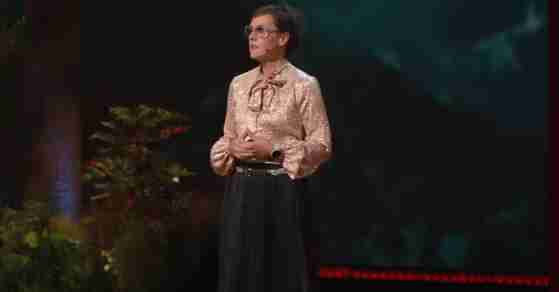
Read the full transcript of filmmaker and sustainability leader Hrund Gunnsteinsdóttir’s talk titled “Listen to Your Intuition — It Can Help You Navigate the Future” at TEDCountdown@BloombergGreenFestival on July 12, 2024.
Listen to the audio version here:
TRANSCRIPT:
The Burden of Overwhelm
HRUND GUNNSTEINSDÓTTIR: You all know that feeling, that sense of overwhelm when confronted with an urgent task, thinking if I only try better, work harder and you put yourself aside time and time again because there are bigger things to think about.
When I started working for the United Nations just after the war in Kosovo, it felt like walking into an open wound, and I was determined to give it all I had, knowing that the people who had suffered war were my priority, while my own well-being was not.
In early 2002, when I was traveling for work from Kosovo to Kazakhstan, I felt this terrible pain and I started to bleed. I didn’t think much of it. I just took painkillers and continued with work. It was only years later that I realized I’d had a miscarriage, and instead of this being a wake-up call, I just kept plowing on, deepening my disconnection with my body and my emotions.
Disillusionment and Change
Soon after, I was in the unique position of having a guaranteed job at the UN for life, which had been a dream of mine. But at the UN in Geneva, the heavy bureaucracy and hierarchy felt all-consuming. My sense of purpose got weaker, and I felt increasingly out of touch with the living world.
So I left my job at the UN, thinking we are serving system instead of serving people and the planet. And I thought something needed to change inside me. And I also felt our systems were out of sync. And maybe this feels familiar to some of you.
Those of us who work in climate and sustainability work on transforming or changing systems. But systems don’t change themselves, right? It’s people like you and me that together change systems. But I don’t think we can help big systems change in the long run unless we connect within and the change starts from within us.
Introducing Innsaei: The Sea Within
And lucky for us, there is this beautiful Icelandic concept that can help us do that. My soul searching brought me to intuition, which in Icelandic is called “innsaei.” And in the company of some amazing colleagues, I’ve been able to practice, research and interview scientists, spiritual leaders and artists from around the world. And I’ve discovered that we all have intuition, and it’s up to us to tune in to it, which can be quite a challenge in today’s world.
Intuition is fundamental to our intelligence, and I don’t think we give it the attention that it deserves. Unconsciously, we process a massive amount of information, sensory data that our body picks up, including the brain. While this is unconscious, it still shapes our actions. Our very focused conscious mind can grasp only a tiny fraction of all this data processing.
Intuition helps us tap into this information. It helps us “read the room,” come up with insights, and tune in to other people and the world around us. Sometimes we dismiss intuition as an irrational impulse that we shouldn’t rely on, or a woo-woo concept that hasn’t been backed by science. But research shows the catalyzing role intuition has for creativity, compassion, mental agility and the human genius.
The Power of Intuition
We actually need good intuition to reason well, and without intuition, there wouldn’t be much innovation. A research on a group of Nobel laureates showed the key role intuition played in their discoveries, and as they shifted between analysis and intuition, it led them to their big leaps.
My search for answers brought me back to my roots and helped me see with fresh eyes the Icelandic word for intuition, “innsaei.” Innsaei helps us reframe intuition because it brings together the scientific and the spiritual, the solid and the poetic.
Innsaei means the sea within, and refers to the ever-flowing unconscious mind. The sea within cannot be put into boxes because then it ceases to flow. Stress, work and financial pressures can block our access to innsaei. And while we can’t get rid of these pressures, we can learn how to clear the way to innsaei when we need it.
Harnessing Innsaei
Meditation and mindfulness practices can help us do that as they regulate our nervous system, and we gain clarity in mind. Intuition picks up information with all our body, so next time you feel something’s off, you get chills down your spine or a gut reaction, ask yourself, “What is my unconscious trying to tell me?”
Innsaei also means to see within, to be self-aware, and one of the most powerful ways to see within is to pay attention to how you pay attention and document it. Attention journaling helps you witness how innsaei plays a role in your life and how best to harness it.
And lastly, innsaei means to see from the inside out and has to do with how we navigate the ocean of life from within with a strong inner compass. Aligning with innsaei is the work only you can do. And allowing innsaei to flow sometimes involves finding the balance between being and doing. And for many of us, it actually takes discipline to simply be and allow the world to come to us.
Innsaei in Action: The Ocean Explorer
One of the most powerful ways I’ve seen innsaei have an impact in the world is through the work of my dear friend, the ocean explorer Enric Sala. When we first met, he was introduced to me as the man who had left academia in order to spend most of his time in the ocean to help save it. I was intrigued, and I have since then interviewed him both for our film and my film and my book about the role innsaei has played in his pioneering work.
Enric’s childhood dream was to become a marine biologist and after having spent seven years as a university professor, Enric felt as if he was writing the obituary of the ocean instead of providing a cure.