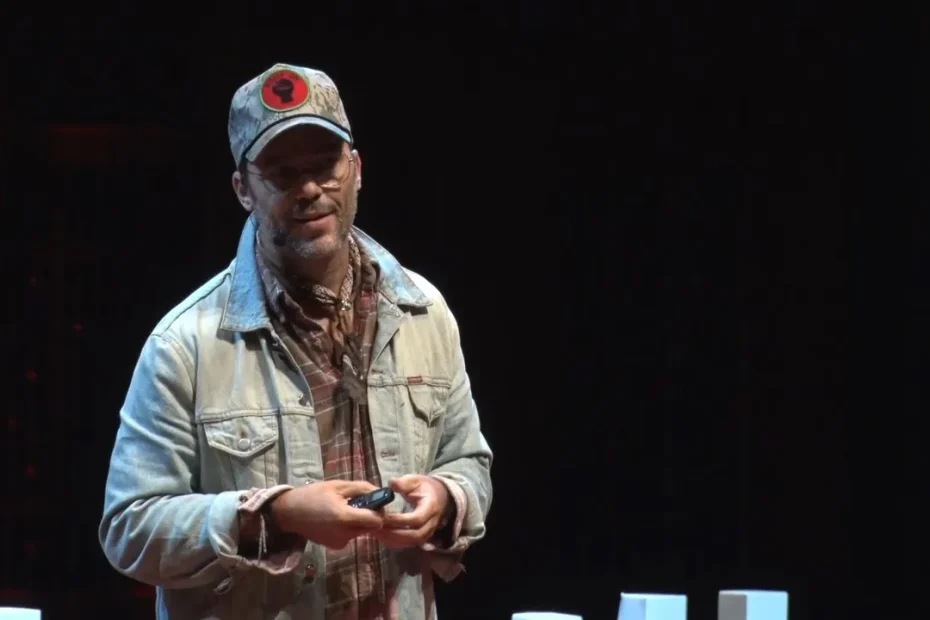
Read the full transcript of photographer Jeremy Cowart’s talk titled “The Light We Let In” at TEDxNashville 2025 conference.
Listen to the audio version here:
TRANSCRIPT:
Introduction
[JEREMY COWART:] So before I begin, before the timer starts, I wanted to let y’all know that I have a neurological disease that affects my speech and affects my balance, so if I look a little unstable up here, that’s why. I’m not drunk, I just have a brain disease. It also affects my sense of fashion, I am so sorry.
Can we try something real quick? Can we just change the lighting real quick, let me see something different. I don’t know that this is the right vibe for my talk. Let me see another vibe. Oh hey, hey, y’all can go home now. I’m just kidding, but isn’t that what that says? Alright, let’s try one more vibe. Yeah, this feels right. We chose this lighting because this is what we want you to see.
The Power of Light
Light is crazy, right? Light changes the way we perceive the world and the way we perceive others around us. Light is powerful. I play with light every single day, it’s literally my day job, as y’all just saw in that video. I love light and I can’t get enough.
This year alone, I’ve done 3,500 photo shoots of individuals coming into my studio. I have a studio out in Franklin called the Portrait Lab, where I do 60-second photo shoots. And as I’m shooting, the lighting is changing, the backgrounds are changing, even the editing is changing. I’m pretty sure I’m the only one in the world doing this. It’s like witnessing ADHD in real life.
I coined a term called a Lydograph, which is the evolution of light through a still portrait. The only motion you’re seeing right now is the light itself. By the way, when I was shooting this, my daughter said, “So wait, you just get to sit here and play with light all day?” She couldn’t believe it. I was like, “Yep, that’s literally my day job.”
So last year, I took playing with light to extreme levels. I did a project called Auras, where I shot 10,000 self-portraits in 20 minutes in front of a live audience. It was insane. Check this out. Images being projected behind me, onto my body, all around me, and nothing was changing but the light itself. And as I sat there absorbing all the light, I had a profound realization. I realized that the human body and the camera body work exactly the same way.
Light Beyond the Physical
But before I keep going, let’s think about light. We think about light as the way you’re seeing me right now – it’s lighting in this room, it’s darker back there, brighter up here. But what if we thought about light beyond the physical, beyond the scientific?
I think about light as everything that’s hitting us all day. The emotions, our feelings, the things we’re experiencing – everything is light.
Cameras and Humans: A Parallel
Let’s look at my camera. This is not an ad for Canon, by the way – all cameras matter, alright? When we point a camera, light enters the lens. It passes through the lens. And behind the lens is something called a sensor, and a sensor is the most important part of a camera. You can’t let dust or dirt enter your sensor; you have to protect it at all costs. So light hits the sensor, sends a signal to the computer to process, and out of the camera comes an image.
The same thing works with us. Our eyes and our ears and our senses – light is hitting that, going through that lens and hitting our heart. The most important part of our body, we must protect at all costs, or else it can get damaged. It then sends a signal to our brain to process, and out of us comes an image.
So whether it’s a camera body or a human body, light works the same way – it informs our image. And the higher quality the light, the higher quality the resulting image. By image, I mean: what does your child think of you? What do your parents think of you? How do your friends perceive you? How do your followers enjoy following you? All the light pouring into our heart, our sensor, forms the image that others see of us.
When I was a kid, I had this terrible self-image. My word was, “I can’t. I can’t do that. I’m stupid.” I thought I was an idiot. But my parents, they just poured quality light into my sensor over and over. Even in college, I thought I was stupid – I made a D in photography, nearly failed photography. But they kept encouraging me, and to my photography professor’s surprise, I was actually a success.
I landed an agent in Hollywood and ended up in Hollywood. And since then, it’s been a wild ride. I photographed Lauren, and Logan, and Mark, and Brittany, and Miley, and Russell, and Kelly, and Chris, and Carrie, and Gwyneth, and Ryan, and Tyler, and Courtney, and Kim, and Sting, and Dolly, and Spike, and Emma, and Stan, and Barack Obama, and the Pope, and of course, Taylor Swift.
Early in my career, I was named the most influential photographer on the internet. It was cool, but I was like, “Is that the image that I want perceived of me? Do I want to be known as the rock star celebrity guy?” And I realized that’s not really what I want. I would rather be known for things that matter, more important work.
Humanitarian Work
And so I poured myself into humanitarian work. I did a wildfire relief project in Gatlinburg, an earthquake relief project in Haiti, a Rwandan genocide project, and a Ugandan project with former child soldiers and art therapy.
Then I did an initiative here in Nashville where we photographed the homeless and told their stories and printed the photos, and that became a worldwide movement. We’ve done over a million portraits around the world since.
I was able to change the image, my perception. Now when I do podcast interviews or people talk about my work, we’re not talking about Britney Spears; we’re talking about the humanitarian work I’ve done, the things that really matter. And of course, I have to give credit to all the people in my life who are the quality light – my family, my friends, my community, many of you here today that are in my life, pouring light into my sensor that helps me come up with these ideas.
Types and Quality of Light
As a photographer, I have to think about types of light, and there’s a lot of those. There’s strobes and gobos and projectors and constant light and natural light – we have to make all those decisions about type of light. In our own lives, we have the same thing: we have friends and Netflix and podcasts and audiobooks and you name it, there’s all kinds of stuff.
In addition to type of light, I have to think about the quality of light. Have y’all ever heard a photographer talk about hard versus soft light? Think about it like the sky. On a clear day, the sun is really small and it’s far away, it’s distant, and it makes everybody look like crap. Really harsh shadows, it’s blinding, it’s just a lot. But on an overcast day, the clouds diffuse the light, they make it one big soft light. In comparison to the sun, those clouds feel really up close and personal; it softens the scene. And by the way, this is why we love car selfies – because it’s softening and diffusing the light.
Have you ever had a fight with a friend or somebody you love over text or over DMs, and it’s getting really intense and bad? It’s easy to be angry when it’s just your phone and they’re far away, and you can’t see emotion, you can’t hear, you can’t get a feel for tone or expression. But you love that person, and you wish that if we had only had that conversation over coffee, it would have gone so much better, because you’re face to face. You understand everything – it’s like soft light. It softens the scene, all the shadows are gone, the harshness is gone. That’s how I think of hard versus soft light.
I’m sure y’all have heard by now about people whose lives are changed when they take a week-long phone break.
Shifting the Light: From Digital Darkness to Intentional Living
A month long, their life is changed. Well, it’s really simple, actually, they change the quality of light, because the phones really can be this just machine of dark, hard light. I saw this tweet years ago, and it’s made me laugh ever since. This guy, I don’t know who it is, but he wrote, “Every once in a while, I’ll stop looking at my phone, and I’ll look out the window, and I’m like, whoa.” So good.
The Mixed Reality of Social Media
Let’s talk about social media for a second. Everybody says it’s either amazing, you have to be on it, or it’s the devil himself – like these two extremes. And I don’t think it’s either. I don’t think it’s good or bad. Recently, I went on Instagram, and I looked at the 1,700 accounts I follow, and I assigned an emotion to every single one. It went just like this: joy, rage, humor, fear, inspiration, heartbreak, lust, envy, entertainment. By the way, it’s crazy that envy is verified.
We are not designed for this constant emotional barrage. Think about it like food – would you eat every type of food at once? Would we sit down for dinner, and I’d give you a burrito, and say, “In this burrito, you’ve got sauerkraut, wasabi, mayonnaise, ketchup, pop rocks, let’s throw some peppers in there.” Would you eat that? No, you wouldn’t eat it, it’d be terrible.
In the same way, what if we listened to all the music at once? Hip-hop, country, pop, rap, EDM, jazz, let’s try it. I’m just going to go on record and say that’s the worst sound ever heard in the Schermerhorn. Like, worst sound ever.
Now let’s do it again, but let’s look at visuals of all the things you can’t afford, all the people sexier than you, all the talents you don’t have. Let’s throw in some puppies, some dogs, some fail videos. Let’s throw in some motivational quotes. Let’s just take a look here. Hello, and then we try to go to sleep. Right?
Young people, if you’ve ever heard us talk about the good old days before phones and the internet, the reason why is everything was up close and personal. We weren’t frying our brains all day. All we had was this right here. It was wonderful. It’s no wonder depression and suicide are at an all-time high. It’s no wonder there’s this mental health epidemic happening.
Intentional Curation
So what do we do? Of course, you could throw your phone in the trash. Of course, you can quit social media, but I’m not the “quit social media” guy. I actually love it. But here’s how, here’s what I did and how I love it. I simply went on Instagram and identified all the things that triggered those negative emotions and I either muted or unfollowed them. No more negativity. I can’t do it.
And now it looks more like paintings that inspire me. Still got to see the dog and cat videos. Still got to have the wisdom. I still love watching sports. All the things that don’t bring me down, but make it an enjoyable experience.
Did you know that a laser can actually harm or destroy a sensor? And it does that by shining light at a really high intensity in a focused beam. Talk about high intensity and a focused beam. What are we doing to ourselves? What is going through those phones into our sensors?
Literally today, try this: Pick your platform – TikTok, Instagram, whatever. Go through and attach an emotion to every single account you follow and mute or unfollow the ones that you don’t need in your sensor. You’re in control. The algorithms are not out to get you. You train them. They don’t train you. So you can do this. You can change the algorithm and curate the light that is entering your sensor.
And then now that you know how to do that, apply that to the rest of your life. Your Netflix queue, your schedule, your friends. Whatever you want. Just go through and do a better, tighter curation. As Jim Rohn said, we’re an average of the five people closest to us. In the same way, we’re maybe the average of the five top social media accounts you follow. Or the top shows you watch.
The Shutter of Life
Now let’s talk about shutter speed. The shutter is the length, the amount of time that your shutter is open before it closes. And during that time, that’s when the light enters your sensor. Your shutter opened the moment you were born. And it’ll close the moment you pass away. And that image that forms, all that light that entered your sensor, that’s what you’re left with. That’s your legacy. There’s no going back. We get one life, one sensor.
Just for a second, think about your mom. Now think about your ex. How about your dad? How about your crush? Isn’t it interesting what formed for you? Whether it’s a visual, a memory, a feeling, a vibe. Like something formed. That’s the image.
I lost my mom in 2020. She was just an amazing, extraordinary source of light for me. And she had such a hard childhood. She was sexually abused as a kid and had a really hard dad. Just had a tough time. And the fact that she had such a damaged sensor and was able to raise me the way she did – I don’t have a single traumatic childhood memory. She poured nothing but quality light into my sensor. My dad is the same way. He’s here today. Nothing but quality light. This man is my hero.
Life’s 45 Million Moments
I just photographed my dad a few days ago. And of course, I shot it with my beloved R5. This camera has a 45 megapixel sensor. Mega, in case you didn’t know, means millions. 45 million pixels in the sensor.
Let’s take a look here. Let’s just zoom into this image. We’re going to keep zooming, keep zooming, keep zooming until you see the actual squares in the image. You are literally looking at 45 million squares that all form together to tell the story of my dad.
I was curious, so I asked ChatGPT, “How many years is 45 million minutes?” And I could not believe the answer. 85 years. That’s a lifetime. So when we look at that image, we’re looking at 45 million pixels. And we’re looking at the same amount of minutes as in a lifetime. 45 million.
All the emotions, all the things that we experience day to day, they’re all pixels in our final image forming what others will see of us. There’s the highlights in our image. There’s your wedding day, and there’s the goals you achieved and the first time you held your child. There’s the mundane pixels, the middle tones. These are the social media scrolls, the interactions with strangers, the long walks, the long drives. And of course, there’s the dark pixels. These are the failures, the regrets, the loss, the loneliness. But the light needs the darkness to truly shine. The image would be flat without the darkness.
A Final Reminder
We get one life. To choose and curate the light that enters our sensor to form our image and be seen.
My question for you today, my final question, is what do you want them to see?