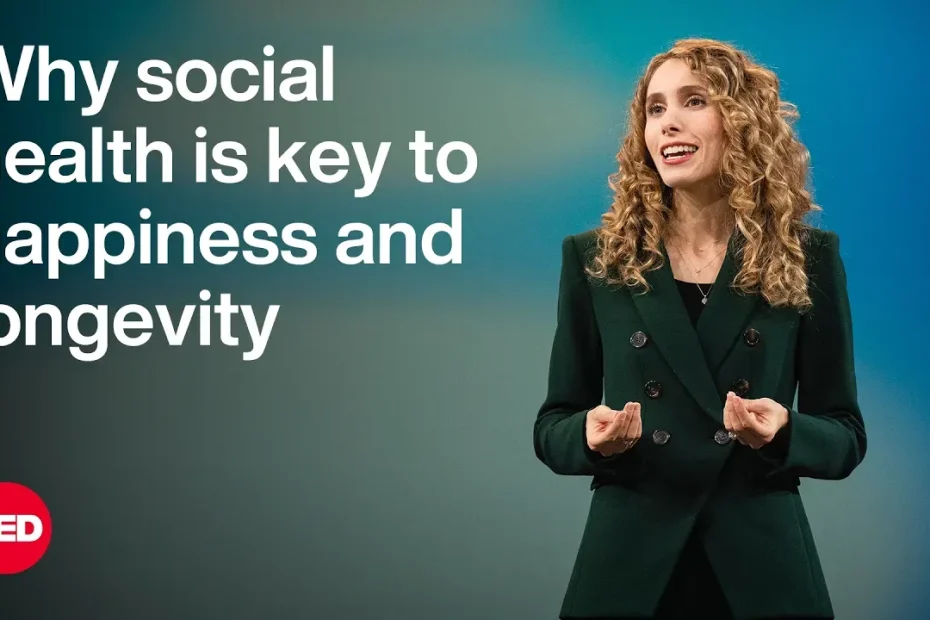
Read the full transcript of Social scientist Kasley Killam’s talk titled “Why Social Health Is Key to Happiness and Longevity” at TEDNext 2024 on October 24, 2024.
Listen to the audio version here:
TRANSCRIPT:
The Missing Element in Our Health
KASLEY KILLAM: A couple years ago, a woman I know, who I’ll call Maya, went through a lot of big changes in a short amount of time. She got married. She and her husband moved for his job to a new city where she didn’t know anyone. She started a new role working from home, all while managing her dad’s new diagnosis of dementia. To manage the stress of all this change, Maya doubled down on her physical and mental health. She exercised almost every day. She ate healthy foods. She went to therapy once a week.
These actions really helped. Her body got stronger. Her mind got more resilient, but only up to a point. She was still struggling, often losing sleep in the middle of the night, feeling unfocused, unmotivated during the day. Maya was doing everything that doctors typically tell us to do to be physically and mentally healthy, and yet something was missing.
What if I told you that what was missing for Maya is also missing for billions of people around the world, and that it might be missing for you? What if I told you that not having it undermines our other efforts to be healthy and can even shorten your lifespan? I’ve been studying this for over a decade, and I’ve discovered that the traditional way we think about health is incomplete. By thinking of our health as primarily physical and mental, we overlook what I believe is the greatest challenge and the greatest opportunity of our time, social health.
While physical health is about our bodies and mental health is about our minds, social health is about our relationships. And if you haven’t heard this term before, that’s because it hasn’t yet made its way into mainstream vocabulary, yet it is equally important. Maya didn’t yet have a sense of community in her new home. She wasn’t seeing her family or her friends or her coworkers in person anymore, and she often went weeks only spending quality time with her husband.
Her story shows us that we can’t be fully healthy, we can’t thrive if we take care of our bodies and our minds, but not our relationships. Similar to Maya, hundreds of millions of people around the world go weeks at a time without talking to a single friend or family member. Globally, one in four people feel lonely, and 20% of adults worldwide don’t feel like they have anyone they can reach out to for support. Think about that. One in five people you encounter may feel like they have no one.
This is more than heartbreaking, it’s also a public health crisis. Disconnection triggers stress in the body, it weakens people’s immune systems, it puts them at a greater risk of stroke, heart disease, diabetes, dementia, depression, and early death. Social health is essential for longevity.
Understanding Social Health
So you might be wondering, what does it look like to be socially healthy, what does that even mean? Well, it’s about developing close relationships with your family, your friends, your partner, yourself. It’s about having regular interaction with your coworkers, your neighbors, it’s about feeling like you belong to a community. Being socially healthy is about having the right quantity and quality of connection for you.
Maya’s story is one example of how social health challenges come up. In my work, I hear many others. Stories like Jay, a freshman in college who’s eager to get involved in campus, yet is having a hard time sitting in with people in his dorm and often feels homesick. Or Serena and Allie, a couple juggling the chaos of young kids with demanding jobs, they rarely have time to see friends or spend time one-on-one. Or Henry, recently retired, who cherishes time with his spouse and yet feels untethered without his team anymore and wishes he could see his kids and grandkids more often.
These stories show that social health is relevant to each of us at every life stage. So if you’re not sure where to start, try the 5-3-1 guideline from my book. It goes like this. Aim to interact with five different people each week, to strengthen at least three closed relationships overall, and to spend one hour a day connecting.
The 5-3-1 Guideline for Social Health
Let’s dig into these. So first, interact with five different people each week. Just like eating a variety of vegetables and other food groups is more nutritious, research has shown that interacting with a variety of people is more rewarding. So your five could include close loved ones, casual acquaintances, even complete strangers.
In fact, in one study that I love, people who just smiled, made eye contact, and chit-chatted with a barista felt happier and a greater sense of belonging than people who just rushed to get their coffee and go.
Next, strengthen at least three closed relationships. Okay, we’ve all heard of a to-do list, but I would like to invite you to write a to-loves list. Who matters most to you? Who can you be yourself with? Make sure that you invest in the names of at least three of the people that you write down by scheduling regular time together, by showing a genuine interest in their lives, and also by opening up about the experiences that you’re going through.
And I’m often asked, does it have to be in person? Does texting count? Studies have shown that face-to-face is ideal, so do that whenever possible, but there are absolutely still benefits to staying connected virtually.
And last, spend one hour a day on meaningful connection. Okay, if you’re an introvert, right now you’re probably thinking one hour sounds like a lot.