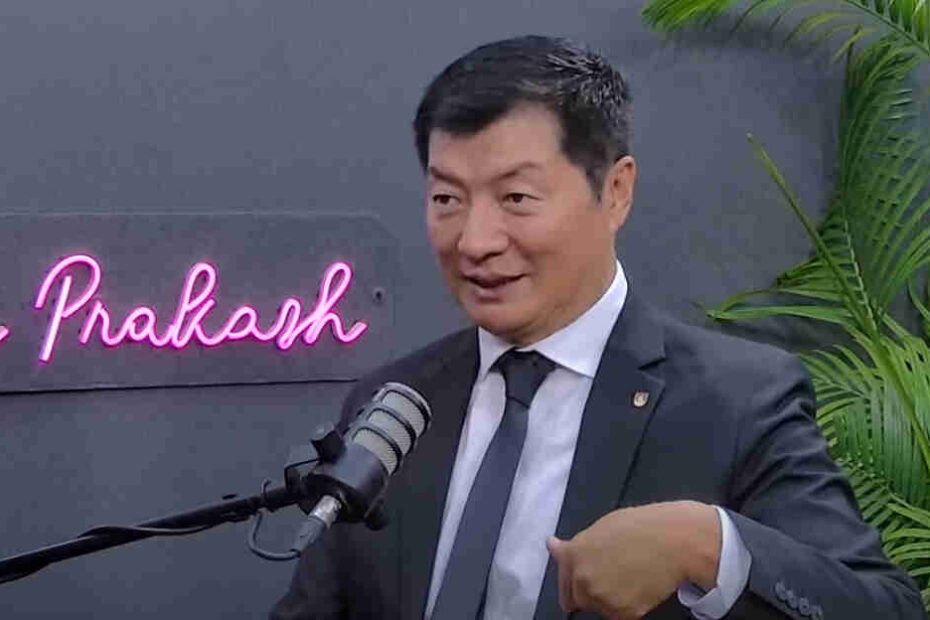
Read the full transcript of Tibetan-American politician in exile Lobsang Sangay’s interview on ANI Podcast with Smita Prakash on “Tibet, India–China Thaw, Brahmaputra Dam, Dalai Lama’s Successor & Nepal”, Premiered September 13, 2025.
Tibetan Perspective on India-China Relations: An Interview with Lobsang Sangay
SMITA PRAKASH: Namaste, Jai Hind. You’re watching or listening to another edition of the ANI podcast with Smita Prakash. My guest today is the former Prime Minister of Tibet in exile, Lobsang Sangay, who earlier appeared in episode 131. He is the first person without a monastic background to hold this position.
Lobsang Sangay was born in 1968 in a refugee community in Darjeeling. For more about his story, do watch episode 131. Lobsang Sangay earned a Bachelor of Law degree from the University of Delhi. Later he studied international law and democracy at Harvard University, eventually becoming an American citizen.
Today’s episode is about understanding where the Tibetan movement is headed in 2025. Mr. Sangay, thank you so much for being on the podcast again. I want to just talk about India-China relations, especially from a Tibetan perspective, especially after this new thaw which has happened between India and China. So I just want to know what is your perspective about PM Modi’s visit to China? How do you see that? And especially from a perspective of a Tibetan.
China’s Expansionist Design in South Asia
LOBSANG SANGAY: You know, as His Holiness always says, India should have good relationship with all the neighbors and even Tibetans. We want to have dialogue with the Chinese government to solve the issue of Tibet peacefully. So engagement, dialogue and diplomacy is the right way to go.
Having said that, how Chinese perceive India and the recent visit of Prime Minister Modi to Beijing is different matter. Their calculation is they have expansionist design. So we all know what they call their “weather tested ally” or all kinds of names of Pakistan. They’re already interfering in Bangladesh and Sri Lanka. And also we know about Nepal and increasingly so in Bhutan.
So South Asia should be India’s domain in the sense, you know, respect that. And from Galwan to Doklam, even in the border of Arunachal Pradesh, the intrusion, and building of now around 300 villages right at the border, that three tier right inside LAC and outside LAC. So their perspective might be different in the sense – coming to Beijing is seen as, I don’t want to say submission, but agreeing to the notion that they are number one in Asia and they aspire to be number one in the world.
SMITA PRAKASH: So this is the Chinese perspective. Does that make Tibetans nervous or does that make it uncomfortable for Tibetans that China is feeling a sense of power over India right now?
Chinese Pressure on Tibetan Activities in India
LOBSANG SANGAY: You know, I know each time there’s a thaw because Chinese government imposes or asks, puts conditions and pressure on Indian government to do certain things. For example, in 2018, we wanted to celebrate “Thank You India” event. And at that time, I don’t want to name names but the Foreign Secretary at that time felt that he could address the Doklam issue by going to Beijing and creating a thaw between Beijing and Delhi.
And at the end he didn’t get any concession and he did issue notice, a rather memo to everybody in India saying no leader can participate in “Thank You India” event. Can you imagine we were organizing events to thank India for hosting us and His Holiness Dalai Lama. It was 60th anniversary of our escape to India and they’re saying no one can come participate in your event. But then no concession on Doklam. Nothing happened.
And finally Prime Minister Modi was kind enough to send the then cabinet minister, Culture Minister Mahesh Sharma and Mahesh Ramadav and then former Chief Minister of Himachal and Minister, then Minister of Himachal and Congress MP all came to Dharamsala and we had a big celebration. And it was unnecessary negative media coverage till that event. And at that event, finally when Indian ministers came, then it had a positive narrative.
So it happens. So when a foreign secretary or minister or a Prime minister goes to China, they will put conditional pressure on us. So that’s a bit of a concern. Other than that, if you look at overall, in 60 years, 60 plus years of Tibetans in India, no matter which party or which person becomes prime minister, which party comes to power, has always treated Tibetans well.
Overall, we always say that we cannot think of any better host for Tibetans. And India has done the most for Tibetans – the largest number of Tibetans were settled in India, educated in India. Our monasteries, our civilization, the survival itself and our identity and culture. Even I studied in Tibetan school in India, funded by government of India. So we are very grateful. That’s why His Holiness always says, “I’m a proud son of India” because of all this. So, yes, temporarily there might be a few issues, mainly because of Chinese government’s pressure. So that will be a bit of a concern.
SMITA PRAKASH: Other than that, how much India can hold up against that pressure.
Geopolitical Chess Moves
LOBSANG SANGAY: It all depends geopolitically, what’s happening at that time. Now, many say that Prime Minister Modi’s visit to China after seven years is partly because of the tariff tension or conflict with America, so it’s just a chess move that you are making. But we know overall, there are so many, there are more areas of conflict with China than cooperation. Not that India doesn’t want cooperation, but China sees itself as number one in Asia and want to be number one in the world. Thereby they want to checkmate all the neighboring countries like Japan, Indonesia, particularly India.
SMITA PRAKASH: Yeah.
LOBSANG SANGAY: So, like we discussed last time, to be number one of the world, first you have to be number one of the region.
Asian Countries and the Tibet Question
SMITA PRAKASH: So speaking about the region, let me talk about Asia. Countries will weigh Tibetan issues against the larger interests that they have with China. Right. So everybody wants to trade with China. Everybody. They don’t want to antagonize Beijing in any manner because everybody has disputes in Southeast Asia. Almost every country has disputes with China, but nobody wants to increase those disputes or add Tibet to that mix. Right. Do you see India doing the same now?
LOBSANG SANGAY: I don’t think so, because India has bigger stake with China. Overall, as I said, just look at not just Tibet, not just the border area. Look at all the neighboring countries in Southeast Asia or Central Asia. Wherever India wants to have its influence or relationship, China is always there to checkmate.
And the larger point that you raised about in Asia, how many people will take up the issue of Tibet because they don’t want to have conflict with China, which is a fact on the one hand. On the other hand, what we say is that what happened to Tibet will happen to you. So if you don’t understand and study Tibet, it will happen to you.
So let’s say Nepal, they didn’t believe. So right now, yes, Chinese Embassy and the officials are interfering in local issues. The Chinese Embassy, perhaps, some of my friends say, is the most powerful embassy in Kathmandu, more powerful than Indian embassy or American Embassy. Some say that. So why? Because now clearly in Bhutan also is happening, in Bangladesh, in Sri Lanka, they come and interfere and influence. And I don’t want to say control you, but they come inside your own house.
So what happened to Tibet? Yes, the difference is their physical control of Tibet. Other than that, political influence of Chinese government and through the embassies in all these neighboring countries and all these Asian countries are fact. So what we say is, yes, what happened to Tibet should not happen to you. So if you don’t speak about Tibet or understand Tibet, it will happen to you.
Restrictions on Tibetan Activism
SMITA PRAKASH: You spoke about in the recent past how India was not allowed or India decided not to take part in one of your celebrations. Do you see that the changing geopolitics which is happening now, China might pressurize India all over again not to encourage Tibetan activism in India, maybe, if that’s a word that I can use.
LOBSANG SANGAY: Again, during my time, I was an activist at Delhi University. So I have seen each time there’s a thaw or pressure from China or Chinese embassy, you can’t hold your protests. So the distance to the Chinese embassy is determined by that present relationship.
SMITA PRAKASH: The barricades move from Shanti Path to further away.
LOBSANG SANGAY: Yeah, yeah, yeah. Whether we can go all the way to embassy or India Gate or ITO, or even come out of sometimes Majnu Ka Tilla or Delhi University is determined by the relationship between Beijing and Delhi.
SMITA PRAKASH: Or whether you can have your seminars and conferences in India International Center or not.
Cultural Censorship and Film Restrictions
LOBSANG SANGAY: That’s it. Even there was a movie, “Rockstar,” remember? In that movie, they showed a Tibetan flag, and then someone intervened, and when the movie was actually released, the Tibetan flag – it was shot in Dharamsala amongst Tibetans – and then it was blurred.
In fact, a friend of mine who produced a movie called “Four River Six Ranges” about escape of His Holiness Dalai Lama and Tibetan guerrillas trained by CIA and helped and fought with Chinese. So this movie is being shown all over the world. And it was supposed to take part in Goa Film Festival. And suddenly I’m sure it’s Chinese embassy and Chinese government, through them, I’m sure someone in Indian government whispered. And then that movie was withdrawn.
It’s a very good movie. My father was part of it. Friend of mine, where I stay now, it’s about his father and it’s about Chushi Gangdruk, the guerrillas, they fought bravely from all three regions of Tibet. It’s that movie, and hopefully when it will be released in India, people in India will welcome it because ultimately it’s a story of escape of His Holiness Dalai Lama, Tibetans settling in India and coming to India as the refuge.
As we say in Buddhism, when you have – whenever we open the Buddhist text, first three lines is in praise of India. The Holy Land is the land of refuge. So that’s how we see India. And this movie depicts that.
Tibetan Feelings of Being Used as Leverage
SMITA PRAKASH: You know, some Tibetans that I spoke to who are skeptical about now the thaw between India and China and say, “We’ve seen this before and what happens then is that we feel let down by India, that you use us as leverage against China when it suits you and when it doesn’t suit you and you want to be friends with China, you want a thaw, then you dump us.” Some of them feel let down that this constant living on the edge for Tibetans in exile, it causes them to feel a sense of hurt. Is that being felt right now?
China’s Strategic Use of Tibet
LOBSANG SANGAY: I look at it as glass half full, you know. I get the same question from Chinese as well, you know, students and scholars. And when I debate, “Oh, you are being used by America or India,” things like that, you know. And some Americans also say that. I said, “Yeah, we want to be used, you know. We want to be out there. We want to be acknowledged, recognized. We want our issues to be raised by American Indian government.” That’s what we want, you know, so used in a good sense. So I look at a glass half full in that sense.
As I said, when India is under pressure, they do reluctantly. That’s how I see it because I do interact with a lot of Indian officials. They all are nice people, they all want to do the right thing. But in given context and situation, they have to act in a certain way. Particularly when Chinese government issues a demarche or Chinese government embassy demands something formally an Indian government, you know, they have to act.
For example, I do remember now, perhaps I can say this may not name names, but during our days in Delhi University the Chinese prime minister was visiting and my name was listed among blacklisted so I could not get out of Delhi University, you know, so. But then we have friends in the Indian government in agencies as well, right? They said, “Lobsang, where are you?” I said, “I can’t get out because you guys have banned me.” “No, no, no, no, no. We have to meet somewhere.” And then literally he gave me the list of movements of Chinese prime minister so that we could have a tactical protest even we couldn’t have a thousand people come out and protest, but we could jump, you know, the barricade.
But you got arrested in front of Mordechai. No, we don’t mind getting arrested because it’s India, you know. You get arrested even the SHO at Chennai Kapuri states “Ajbi, Agya, chalachalo blanket.” There’s nothing, nothing happens. We know that we want to protest, we want to get arrested. But just that when your movement is restricted and you don’t know where to go, somebody in the agency will give you a say. So we hide in the bushes and we come and jump, you know, so we have.
SMITA PRAKASH: Is it the same nowadays?
LOBSANG SANGAY: Yeah, yeah, yeah, I’m sure we have so many friends, but there aren’t so.
SMITA PRAKASH: Many high profile Chinese visits.
LOBSANG SANGAY: I know, I know. So in the last semester, so this thaw I just feel it’s mainly related to tariff. Right. So then after that, Trump said something positive. And Modi ji also had a positive tweet. And Jaishankar also added the Chinese foreign minister coming in. No, no, about. About, you know, the. Trump, you know, he said, “Oh, Modi is my friend.” Yeah, we have some issues, but we.
SMITA PRAKASH: But he even said, “President Xi is my friend.” I wonder what President Xi has to say about that.
Trump’s Diplomatic Style
LOBSANG SANGAY: That’s true. No, I mean, you know, I always feel overall, you know, President Trump says a lot of things on a daily basis, right? And some say that, you know, he watches news and he wants to be in the news and he says things to be in the news. So that way he’s achieving his goal. So we all have to talk about one way or the other. Right. So he’s happy.
So sometimes when he says things like, the Europeans, they’re very smart. He literally scolded them for many. But what they said is they came, kept quiet, cut the deal, cut their losses, maybe make some gains. And they said, “Okay, we have to deal with him for four years. That’s how we’re going to deal with him.”
SMITA PRAKASH: Yeah, but look at the Japanese prime minister. He lost his job.
LOBSANG SANGAY: Now, that’s internal. No, no, I know, I know it’s internal. It’s, you know, within LDP.
Pressure on Tibet and Taiwan
SMITA PRAKASH: But there is a lot of flux going on. Mr. Sangay, that’s what I’m trying to say is that are you feeling the pressure? Just like maybe Taiwan is feeling the pressure. Last episode we talked about, and you said it’s a matter of time before China walks in into Taiwan. I mean, it’s going to happen this summer or whatever. At that time, it did seem like that. Today. Do you feel that Taiwan is feeling threatened? And do you feel that even the Tibetan movement is going to go into some kind of a cold storage? Because countries are like, nobody wants to get into this right now.
LOBSANG SANGAY: Taiwan, I still believe, you know, that no matter who is the president or the General party secretary of China, the nation has been built up. The Communist Party’s manifesto has built up in such a way that what they call reunification of China, it’s inevitable. They have to do. Doesn’t matter, right? So it’s going to happen. The issue is when, whether it’s 2027 or not, you know, so there are a lot of debate.
But since, you know, the bombing of Iran, you know, and then blowing up of this, you know, boat of Venezuela and the declaring now, you know, the instead of defense is Defense Department war. All these have puzzled people, you know, so that might have bought Taiwan sometime because if Beijing acts, they don’t know what Trump is going to decide tomorrow. You know, he wants Nobel Peace Prize, but he wants Department to be Department of War. So.
But then, you know, on Tibet in 2020, we passed the Tibetan Policy and Support Act. It was signed, it was passed by Republican Senate and Democrat House and signed by President Trump as the law. So he assigned Tibetan Policy Support act, which made it a law in America to support Tibet, including on reincarnation, including funding Tibetans and all that, you know, but it’s altogether different matter that Voice America and Radio Free Asia in Tibetan language should be kept, you know, but they have been shut down now so that even though he has signed a law, we say that these two radio, TV stations should be funded, but they have been shut down.
Xi Jinping’s Strategic Tibet Visits
SMITA PRAKASH: I’m going to come on the reincarnation issue later in the show, but I still want to talk a couple of points on China before that. President Xi has visited Tibet twice in the last five years. He’s the only Chinese president to have done so. Now, why, why are these visits significant? What is he trying to signal to the Chinese people with that?
LOBSANG SANGAY: Less with Chinese people, more to the world. More to the world, particularly India, because Tibet borders India, you know, and the largest troops, the Chengdu base, you know, and Tibetan troops are all aiming at India. So in his first visit, the famous speech he gave, you know, to the troops was particularly targeted India. You know, he said we should have prepared, you know, even aggression, right?
But then this time he visited, he gave a speech to the troops, Chinese troops, but the speech was not released because it coincided with Prime Minister Modi ji’s visit to, you know, Beijing. Having said that, I’m sure he gave the same speech. “Prepare yourself for war or incursion,” you know, towards India, I’m sure. It’s just that they didn’t release the transcript, right?
So that way that their preparation, you know, vis a vis India and South Asia is concerned, I think, is very clear. So they want to hold on to Tibet and fortify the border, not just militarily now by building all these, you know, villages so that they have, you know, informers or signal callers all the way right to the border inside LAC, right?
The Brahmaputra Dam Project
And then they’re also building the biggest dam in the world, bigger than Three Gorges Dam, right at the border of India at Arunachal Pradesh, that the big bend that will affect India climatically, you know, all the people who survive and make their livelihoods, you know, the downstream people in Assam and northeast and Bangladesh, you know, so they literally control the flow of water so they can weaponize it during war.
Let’s say they open it, you can flood all the railroads and highways in the lower Iberian and then you can control the flow of water for a few more weeks and it will affect people who survive in fishery and agriculture. And then they’re generating hydropower. Why? Because China has already built 400 plus dams in Tibet. Tibetans don’t need any extra, you know, energy because we have surplus of energy.
They’re building this biggest dam, they’ve already built four on this, you know, Brahmaputra River. They’re building now, fifth one to generate energy for AI. You know, to build data center, you need energy. And China is competing with America and the Western world on AI. So that’s the next move. You dominate AI market and you dominate the next phase of economy and you enrich yourself. You control the world, right? So that’s how they see it. That’s why they’re building.
It’s such a. That belt is the earthquake zone. Recently we had earthquake in Afghanistan. Few years ago in Afghanistan, in Pakistan, in Nepal, Burma and also we had insight in Tibet last October and in Sichuan because this is earthquake prone zone to begin with. Number four, five and more dams. You build more dams will lead to more earthquakes because you know, water seeps in and it cracks open and then each time there’s a movement it leads to earthquakes.
So it’s harming all the neighboring countries, you know, and the famous earthquake of Assam, I think in 1935 or something like that, it just destroyed major portion of Assam. You know, even though all these things are fact and it has happened, it’s scientifically established, but China is building more and more dams to generate more energy for AI. Now America and Europe, western countries including India are constrained because you don’t have, you know, enough space to generate more energy. China already ahead in solar power, right? And you know, battery and electric car and also wind power. They want to have maximum hydrogen power.
Development vs. Exploitation in Tibet
SMITA PRAKASH: Tibet, you know, he China says, or President Xi says that because of Chinese rule in Tibet, there is prosperity out there. What is the truth? Because there’s hardly any reporting. So what are you getting? What is the information you are getting? Is there peace and prosperity in Tibet now?
LOBSANG SANGAY: Let me say yes, first compared to 1950s, Tibet has developed more roads, more railways, more airplanes, more buildings. It’s a fact. So infra is good, infrastructure is good, but who are the primary beneficiaries? It’s the Chinese migrants, right? Their movements are their migration subsidized? Let’s say the business license, even the rickshaw puller’s license, even the small stalls license are primarily given to Chinese first, right? So that’s how they benefit.
SMITA PRAKASH: So Chinese, a complete demographic change has happened in Tibet, you’re saying?
LOBSANG SANGAY: No, no. In urban areas, mainly during summer, Chinese migrants come and they control the business. Winter is so cold that even Tibetans have to go, you know, go somewhere else. So that way, you know, so the politically Chinese are more powerful. Economically Chinese are in control now with all this mining that’s taking place, you know, uranium, you just name it. 75% of lithium reserve of China is in Tibet. Gold, the second largest copper mining in China is in Tibet.
And then, you know, this is like maybe trillion dollars worth of, you know, minerals. 136 different kinds of minerals are in Tibet. And all are being exploited by the Chinese government. That’s why even late Panchen Lama said, right, “China has benefited more from Tibet than Tibetans have.”
The Five Finger Strategy
And also we talked about this Tibet issue, why Tibet is so important. I’ve said this many times last time also perhaps that Tibet is the palm. You control it firmly and you go after five fingers, right? That’s Ladakh, Nepal, Bhutan, Sikkim and Arunachal Pradesh. So this is the expansionist policy. Now Xi Jinping has come once and he has come second time to emphasize that importance, implementation of this five finger strategy.
And clearly there in Doklam, you know, there in Galwan Ladakh, in Sikkim, Bhutan, Doklam, right? And Arunachal, every week they try to get, you know, upper hand, climb up the hills. Thank goodness, you know, Indian Sikh and other, you know, with laathis, they, you know, beat them down. They’re trying to. So this is an expansion design. So that’s why Tibet is very important for China.
Current Tibetan Demands
SMITA PRAKASH: It’s important. Let me get to the. For those who don’t know now, at this point in 2025, what is the realistic demand that Tibetans have? What is it that Tibetans in exile want? I’m not talking about the Tibetans in Tibet now, but Tibetans in exile. What is it that you want in 2025? Is it independence in. Is it autonomy? Is it preservation of culture? What is the main demand?
The Middle Way Approach and Dialogue Challenges
LOBSANG SANGAY: The official demand or aspiration still remains middle way approach to have dialogue with Chinese government, to have genuine autonomy for the Tibetan people, which is the middle way approach. But experience of the last 30 years clearly indicates that dialogue with Chinese government is very difficult. They are not in a mood to have dialogue with anybody. They are in a mood to take from everybody.
Having dialogue and solving the issue of Tibet getting genuine autonomy is becoming more and more difficult. So that’s a fact. Now to switch from that to go to independence is also difficult because the moment you declare independence, so many countries, including India, have bilateral agreements that you will not interfere each other’s sovereignty and territorial integrity. Even international law kicks in. Even UN Charter Article 4 says that one member state cannot interfere in other sovereignty and territorial integrity.
And then recently the US passed an act in which it said that Tibetans are entitled to have self determination. Now self determination can be expanded all the way to independence and can be shrunk to a minimalist autonomy. So yes, officially still middle way, but dialogue is more and more difficult, which is a fact.
SMITA PRAKASH: Is there any dialogue currently on when was the last dialogue that Tibetans had? Formal dialogue?
LOBSANG SANGAY: Yeah. In this book by His Holiness the Dalai Lama. I urge everyone to buy this book because this is His Holiness has published and co authored around 150 some books, but two or three on political aspect of Tibet. This is the book published. In this one, he says that through him the last contact was in 2019.
So not formally, because even I have met some of them, the Chinese, they come, right? In their individual capacity, either as Buddhist or former officials or a friend or friend. They come and they convey messages, right? So 2019 was the last time. And then, even then it was pretty clear.
I’ve met few of them. They always say, “Oh, the door is always open. All you need to do is do this and say this and say that.” And I always told them, “First tell me where the door is. Then we are willing to do and say a lot of things. If you tell us where the door is. You’ve been saying this for 30 years, right?” And then there’s never the door, but there’s promise of a door. But then there are all these expectations and conditions on our part.
SMITA PRAKASH: What is the expectation that they have from you?
LOBSANG SANGAY: They always say this and you should say, for example, India, they should always say Arunachal is part of China, it’s southern Tibet, and Taiwan is part of China, and Tibet has always been part of China and you should not do political activities and Dalai Lama should not travel.
And I always say, first of all, Arunachal Pradesh, Taiwan are unrelated to us, right? This is separate matter. This India’s matter, these Taiwan’s matter. Nothing to do with us. Even if you say or do it doesn’t affect anything. But why are you putting all these conditions? That shows that you really don’t have genuine motivation to have dialogue. You just put conditions after conditions.
And I always say that you want me not to travel to Washington D.C. or Brussels and talk about Tibet. I’m willing to do that. But tell me where and when that door is and dialogue is, then the rest of this will follow, right? But hence, no, no, no, no, no. That Xi Jinping and Chinese leaders are very considerate. That will take time. And I said, “Please take your time and let me do what we do, right?”
Sinicization of Buddhism
SMITA PRAKASH: President Xi is considerate. That’s a nice one. He had said, and I quote, that there’s need to “guide Tibetan Buddhism in adapting to socialist society.” He seems to be saying that you practice your faith, but practice it in the way the Chinese government tells you to practice it. That is the crux of the Chinese way of giving freedom to Tibetans to practice Buddhism. Is that not right?
LOBSANG SANGAY: Yeah, it’s an oxymoron. It’s a contradiction itself, right? You can practice Buddhism, but we will tell you what Buddhism is, right? Socialism is Chinese characteristic. Buddhism is Chinese characteristic, what they call sinicization of Buddhism.
So they said, you cannot teach Buddhism in Tibetan language through Tibetan narrative. You must teach Buddhism in Chinese language, meaning you want to take the national identity out of Buddhism. For example, when we teach Buddhism, what we say is that great translators traveled, journeyed from Tibet to India to Nalanda and Takshashila and other places. They learned Sanskrit and translated all those great texts into Tibetan and brought back the struggle, the survival and death. So many challenges.
Out of, let’s say, out of 10 great scholars, great minds who travel to India, seven or eight of them die on the way, right? Because of jungle, famine, mosquito bites, what have you. Animals, wild animals kill you, and they just die. Only two. That’s why in our civilization, the translators, the scholars are our natural heroes, not military generals or political leaders, right? So they are called great scholars.
So their struggle is part of the narrative of Buddhism. My goodness, look at this great scholar, right? So the kings and the ministers and rich people, they patronize them by giving them silver and gold so that they could travel to India, spend five, 10 years, learn Sanskrit, translate a text, one text, and bring it back to Tibet. And he teaches a great story, very moving, emotionally painful, and lot of sacrifices and great minds. That’s our story.
No, no, no. You can’t teach all that. Just say four noble Truth, compassion, kindness. In Chinese language. Right now, Tibetans, to understand Buddhism, you must learn Chinese. Right now, Tibetan masters, they don’t speak good Chinese. That means whatever they want to teach, even in Chinese, they won’t be able to teach properly. And the Tibetan people, they won’t be able to understand properly.
So essentially, they want to deconstruct and destroy the very essence of Buddhist teaching. They want to make it a part of a control process. For them, it’s just a procedure. How to control it. You speak in Chinese, you listen in Chinese, you use Chinese text so that we can understand, so we can control you.
Religious Persecution in Xinjiang
SMITA PRAKASH: How do they do that with Islam in Xinjiang province? And the others, where there are Muslims out there? And that has to be taught in Arabic, right?
LOBSANG SANGAY: Ruthless. In fact, they’re not allowed to do fasting during Ramadan. Can you imagine? You’re not allowed to name your children, like Muhammad and all the classic Muslim names. Anything associated with Islam, you can give secular names. And party officials are forced to eat.
Also during our Sakadava, which is like Buddha Jayanti month, we do fasting. All the party officials, you are forced to attend your office, sit down together during lunch, and you are forced to eat that controlling. So that’s why there was a huge protest. It continues to have protests in Xinjiang. That’s why the Chinese government found it so unbearable that they put around 2 to 3 million people in concentration camps, essentially labor camps. They don’t allow you to practice.
SMITA PRAKASH: Where are the humanitarian agencies around the world? How come there’s no protest? There’s no talk about this. I believe even the mosques, they’re not allowed to have the green, the mosque. What makes them look like a mosque? It’s just normal building.
LOBSANG SANGAY: Normal building? Not just that they destroy. They come with some excuses. You have violated this rules, that rules, municipality rules, and they just demolish. So it’s amazing that some other Islamic issue, let’s say Palestine, other issues…
SMITA PRAKASH: Or Pakistan keep. They keep quiet. Pakistan keeps quiet about this.
LOBSANG SANGAY: I remember an interview with Imran Khan, he said, “Oh, you talk about Palestine all the time,” which is a legit issue, of course. Everybody deserves human rights. “What about Xinjiang?” “Oh, I can’t talk about.” Look, same Muslim people, same mosques you are talking about, same Allah you are talking about, and then same imam are being present, right? How come one is, you can speak with your loudest voice and one you just keep quiet.
So there is this, interestingly, even Xinjiang issue. There’s less support among Muslim countries because it’s China. So destruction of one monarchy, some mosques in Xinjiang is alright, but not in other places. So it’s a very serious issue. I mean, some good friends, and this awareness needs to be created.
But you have mentioned why other NGOs cannot talk about now. Chinese government is effectively banned for journalists and scholars to enter Tibet or Xinjiang or Inner Mongolia. And they do allow few youtubers now, very controlled, right? They give free access.
In fact, there is a British guy, YouTuber who came to India and he visited Majnu-ka-tilla here and he talks about Dalai Lama and Tibet issue, Tibetan government in exile, very freely. Same guy, he goes to Tibet and he doesn’t say a word. Now YouTubers, they need viewers and to get access, they’ll keep quiet, right? If you’re a journalist, trained journalist, your credibility is at stake and you have to be objective.
So that’s how they control. They don’t allow anybody. So that’s why journalists in Beijing, they say that it is easier to travel to North Korea than to Tibet.
Young Tibetans and Cultural Indoctrination
SMITA PRAKASH: What about the young Tibetans? See, when you left and you studied in Darjeeling, you studied in Delhi University and all, and you have the experience of your father’s stories, your mother’s struggles, your uncles, aunts, all the others. But the younger Tibetans who have not seen all this, who are living in Tibet, do they feel connected at all with the Tibetan cause or have they amalgamated with Chinese?
LOBSANG SANGAY: That’s why the Chinese government has established boarding school to take Tibetan children from primary, from middle school to high school, to a million children. Indoctrination, indoctrination. So normally, even in a village, if there’s a school, right? So in the evening you come back home, they’ve started boarding school, so they don’t come back home. They come back home once a month or something like that.
Now what has happened is that after a few months, children, they look at their grandparents as an enemy and as an outdated, feudal, backward. That’s how they spread the propaganda, brainwash them. Now. So this is the effort, but what it also shows is that in 60 years they have failed. Now they have to resort to such extreme measures to take in a six year old child to a boarding school, to brainwash them.
So on the one hand, for short term, they could. They are taught in Chinese, they are taught about all this propaganda, but because we live in our social media age, right? The moment they see the other side of truth, Tibetan struggle, all the challenges, destruction, loss of country and outside, they switch very quickly. So it’s like a cat and mouse.
So this is what they’re doing now, because I have met many Tibetans from Tibet also, who come to the US to study, even to India. And then once we give them a book like this, they say, “I did not sleep whole night. I just read this book. Tell me about this book.”
This book is by His Holiness. It’s essentially 70 years of his political struggle, how he escaped, how he came to India, and efforts around the world, particularly to have dialogue with the Chinese government. All his efforts. If you read this book, you can clearly see his sincerity in his philosophies and values and his approach towards Chinese government that we want to pursue nonviolence, we want to have dialogue, solve this issue, all the efforts he has made. And then. But at the end, he says the last contact was 2019. He doesn’t say it explicitly, but if you read the tone of that paragraph, essentially he’s saying, that’s the last time I met with them.
The Dalai Lama’s Successor
SMITA PRAKASH: Is he talking about his successor in the book?
LOBSANG SANGAY: Yes. And he says very clearly that his successor or his reincarnation will be born outside of China. Very clearly. So that’s the line he has drawn, because till this book, there was always this issue, right? If we could solve the issue of Tibet, then perhaps His Holiness the Dalai Lama could visit or return to Tibet, and then the next Dalai Lama will be born in Tibet. But then this book says very clearly that he will be born in a free world, not in China.
SMITA PRAKASH: But has he already been born? Is. Has he. When he says will be born outside China, which means that the child will be born only after God give him long life. But after the Dalai Lama passes away, what is the process?
LOBSANG SANGAY: Yes, the reincarnation process. There’s emanation, which is, while he leaves, he could designate a young boy as his successor. But reincarnation means one has to pass away. Then the young boy has to be born.
So now this book also, and the recent statement, he’s leaning towards reincarnation, meaning, yes, after he passes away and he has declared that he will live beyond 100. And we all pray, we recently, I participate in Long Life ceremony in June. They pray that he lives long and he looks quite healthy. He is determined to live long, but after he passes away, the next will be born.
The Dalai Lama’s Reincarnation Process
SMITA PRAKASH: Okay, when he says outside of China, does that mean the child could be born in Tibet, because that’s not China.
LOBSANG SANGAY: No, outside of China means at the moment, outside of Tibet, too, because Tibet is under controlled by China, supposedly controlled by China. So that means to be born in Tibet is to be controlled by the Chinese government. And he doesn’t want Chinese government to have control over his reincarnation.
SMITA PRAKASH: I see. And how will anybody identify that? Yes, the Dalai Lama has been reincarnated in this child. Is there a process to identify a reincarnation?
LOBSANG SANGAY: Yes. In the July statement, he made it very clear that he made a statement in September 2011 where he said he will decide at the age of 90, because in 1969, he made a statement saying it is for the Tibetan people to decide whether his reincarnation should continue or not.
And then during my time, from 2017, 18, 19 on, we organized a lot of meetings, global meetings, and appealed and prayed to him that his reincarnation should continue. And in July statement, he made it very clear that for the last 14 years, Buddhists from inside Tibet, inside China, Southeast Asia, even Russian republics – there are a lot of Buddhists in Russia and Mongolia and around the world – appealed to him that reincarnation to continue. And thereby he has decided that reincarnation will continue.
So the idea of reincarnation is like a guru-disciple relationship. They have to like the teacher so much that they will say, “We want you to continue.” So now that he has decided, normally what happens is that then he, in Tibet, he appoints a regent or a regency – a monk or couple of monks. They form a committee. Now they will form such committees.
The Search Committee Process
So they will in Tibet, they travel all over Tibet and also to India, because the 6th Dalai Lama was from India and 4th Dalai Lama was Mongolia. So it’s international even during those days, now this time it will be more international.
Now, this is very crucial because not many people know this. So now who consists of these groups? There’s a regency. They decide upon such groups. Such groups are headed or participated by people who knows Dalai Lama personally – his personal cook, personal attendant, friend.
So these young boys have to go through familiarity and similarity test in the sense person who knows Dalai Lama very well will come to you and look at the boy and say, “Oh,” the boy will say, “You’re this.” And this is it. The boy has to be familiar, show some familiarity to the person who is in the search committee. “Oh, you are my cook,” “Oh, you are my personal attendant” – this familiarity to test.
SMITA PRAKASH: So what is it? It’s the soul of the Dalai Lama, which goes into the next Dalai Lama. Is that how it will happen?
LOBSANG SANGAY: Now, normally, the soul…
SMITA PRAKASH: Does the soul, like in Tibetan Buddhism, does the soul continue its life? What happens?
Consciousness vs Soul in Tibetan Buddhism
LOBSANG SANGAY: There’s a difference. We say soul and atma, but Tibetan Buddhism, we say consciousness. So soul is more concrete. We all have a soul. Soul, you die, and soul die, and soul goes to other person. We say more consciousness.
Now, there’s a subtle difference between soul and consciousness. And soul is more objective, and the consciousness is little more subtle than that. The soul consciousness passes on from one person to another. So that’s what we believe and based on karma.
Now when this Dalai Lama passes away, he can leave a note, he can give a direction, or he can leave indications. For example, 13th Dalai Lama, when he passes away, he was sitting on a throne. They do this after you’re biologically dead, but your body will be warm actually – your nails will grow, your hair will grow. We call it thugdam. You are in this state of pardo. You’re physically dead, but you are alive.
SMITA PRAKASH: Transition.
LOBSANG SANGAY: A transition. And literally, you sit on a throne. So his face, after a few days, turned towards east. Now something will happen in the east.
The 14th Dalai Lama’s Discovery
And the region goes to this famous lake called Hamulatso, where he prays for many, many days. And in that lake we see a future. And he saw a white house and a green thatch. And there’s a monastery and three letters, akama.
So then there were a lot of translators who interpreted this and say, “aa” means Amdo, the region, “ka” means Kumbhum, the district, and “ka” and “ma” means Karmapa Monastery. That’s what the monastery is. And just below that, there is a house.
And then one group went to that house, and it was headed by Kyushang Rinpoche, who was very familiar with the 13th Dalai Lama. So he dresses himself as a servant, and he dresses servant as the lead. And obviously the lead guy will be taken inside the house, the altar, and the servant will be kept at the kitchen.
But this boy comes running and you say, “Oh, you are Kyushan Rinpoche. You are that monk. I’m familiar with.” And then they display identical items like identical beads, identical walking sticks and identical drums that were those were used by the previous Dalai Lama. And the boy identifies exactly those ones which the previous Dalai Lama used. Personal items. So this is our familiarity test.
So these are the tests went through. And then the region will get all these boys names. And then you have to go through a lot of rituals and the similarity test also and then say, “Oh, this boy’s characteristic, the way he talks, the way he behaves is very similar to the previous Dalai Lama.” So you have to go through series of tests and then finally you’re enthroned.
Timeline and Institutional Structure
SMITA PRAKASH: But if it’s a reincarnation that’s going to happen, that means when the Dalai Lama passes away, then the child will be born and then the consciousness goes into that child. So there will be a time period for search findings. And then the familiarity. So the child cannot be less than about six or eight years old to identify. Okay, this is right. So there will be that gap.
LOBSANG SANGAY: I know it can be as early as 3 years old to 10 years old.
SMITA PRAKASH: Yeah.
LOBSANG SANGAY: So there will be this gap for three or four years. And that’s why in Tibet they used to be regent, who headed the Tibetan government, who headed the institution.
So in this case now His Holiness Dalai Lama has separated the church and the state. So Tibetan government exile is separate from the institution of Dalai Lama. Now the institution of Dalai Lama, which is called Gandhin Podang – Gandhin Podang is a registered trust in India.
So in that statement he says Gandhian Podang trust will handle it. So Gandhian Podang trust will have few lamas who will head this. So they will be like regency. Normally when you say regency has political connotation, but they will represent the Dalai Lama. So they will be the spokesperson for Dalai Lama and they will travel around the world on his behalf and carry on his legacy and carry on his messages.
The Panchen Lama Controversy
SMITA PRAKASH: What happened to the Panchen Lama? Tell me the Dalai Lama had he was endorsed? Where do you think he is? What happened to him?
LOBSANG SANGAY: And that’s a very important issue because in June, the Chinese Panchen Lama, the fake one, met Xi Jinping, Chinese President Xi Jinping. And when Xi Jinping also went to Tibet and there was the Chinese Panchen Lama greeting him. So they are trying to groom him to increase his profile so they could play the role.
When the Dalai Lama passes away in that gap, the Panchen Lama, Chinese Panchen Lama could play a role, but he’s a fake one. He doesn’t have credibility inside Tibet and outside, and especially Buddhists around the world don’t follow him right now.
In 1990, when late Panchen Lama 10th Panchen Lama died in 95 years, the search committee established by the Chinese government headed by Chandanpoche, all Communist Party members, they identified Gendin Shogunyama, a young boy, as a Panchen Lama and sent his name to the Dalai Lama here in Dharamsala. And he also did divination and said, “Yes, he is the Panchen Lama.” And he made the announcement here.
Unfortunately, for that for Gendin Shogunyama for young boy, he was kidnapped. It’s been 30 years. He has completely disappeared. And in his place, they appointed Genzan Nubu to present fake Panchen Lama, who is the son of Communist Party members, as the Panchen Lama. Now he’s taking the place. So this is what has happened. And then unfortunately, Gendin Shogunyama, real Panchen Lama has disappeared since then.
China’s Strategic Mistake
Now, at that time, it looked as though the Chinese government, from their point of view, they did the right thing. They made one disappear. They appointed a fake one, a puppet one. In retrospect, they made a disastrous move.
Because if the Chinese, if the Dalai Lama’s endorse Panchen Lama, Gendin Shogunyama had the Chinese government agreed with that. They had physical control of Gendin Shogunyama, Panchen Lama. And he will be the legitimate Panchen Lama endorsed by the Lama, means accepted by Tibetans inside Tibet outside and Buddhists around the world.
Now the real Panchen Lama could come out and say, “Oh, I will have a say in the selection of next Dalai Lama, because I am also recognized and endorsed by Dalai Lama. So I hereby endorse this Dalai Lama selected by the Chinese government.”
Right now the real one is gone, the fake one is there. Now fake one will have a role to play in selecting a fake one. So they have lost complete credibility. They made a wrong move.
So now even though they are trying to push this, but also, it’s tragic, no? Because the same three year or four year old boy in Tibet will be put through this process. He will say, “You are the real Dalai Lama,” and everybody knows he’ll be the fake Dalai Lama. And then Tibetan inside Tibet will not pay respect and recognize that boy. And then boy is just innocent, and family is also innocent. But the Chinese government, they don’t care about religiosity or they don’t care about spirituality.
China’s Control Strategy
SMITA PRAKASH: So then why do they do it? If they don’t care about religiosity. If they don’t care about Buddhism or the institution of Dalai Lama, then why put up a fake one? Just deny that it exists at all. They can just stop recognizing that entire process, right?
LOBSANG SANGAY: Yeah, it’s control. They just want to control the office. They don’t care about reincarnation, spirituality. They just want to control the office. And then they want, at the same time, they want to destroy the office.
For example, even the fake Panchen Lama, he spent all his years in Beijing. He should be spending his time in monastery in Tibet, studying. When you spend all years in Beijing, you lose your credibility. So they control the office of Panchen Lama, but at the same time, they are trying to dilute and destroy the value of Panchen Lama’s office.
SMITA PRAKASH: And they don’t even believe in the religion.
The Chinese World Order
LOBSANG SANGAY: No, this religion is poisoned. This religion has an enemy, yet they want to control it. So that’s why I say it’s a very dangerous game.
If you allow Chinese government to control the office of Dalai Lama, they might control the office of other Buddhist leaders in Southeast Asia, let’s say in Sri Lanka, Laos, Cambodia, Thailand. Who are you to say if China becomes number one power in the world, they will not just interfere in your political affairs, they will interfere in economic affairs, as we all know. They will interfere in spiritual matters as well.
They’ll say, “No, no, no, no, no. Not this Shankaracharya. This Shankaracharya is what I like.” They’re already doing with Vatican. They had a deal with Vatican whereby they appoint they bishop and Vatican has to endorse it. And who’s to say they will appoint the next cardinal and thereby next time they will say, “Hey, Pope, selection of pope.”
SMITA PRAKASH: Oh, my God.
LOBSANG SANGAY: So this is the Chinese world order we should be aware or we should be careful about. So Chinese world order is what we experience Tibetans. So that’s what we always say. You think you can have relation, you can have deal with the Chinese, but you have no idea what the Chinese system, the Chinese world order is.
They want to control everything. They want to control the selection of Dalai Lama because they want to control, like they’re already doing in Xinjiang. They’re controlling all the imams. They say, “No, you’re not the real imam. People accept this is the guy we like.” And they control Tibetan lamas, they control priests and bishops and soon cardinals in China, similarly, they will tell all the neighboring countries as well, and say, “Not this, not that.”
So this is the Chinese world order and their tentacles are everywhere and they want to control everything. So the selection of Dalai Lama has major geopolitical ramification among all the neighboring countries and around the world.
The Golden Urn and Buddhist Countries’ Awareness
SMITA PRAKASH: So do you think the Buddhist countries or the countries where there are large Buddhist populations, they realize this? The selection of the next Dalai Lama is going to be extremely pertinent for geopolitics, not just for religious affairs.
LOBSANG SANGAY: No, because that’s why I visited the Holocaust Museum, right, in Israel and also in Germany. And there’s a famous saying by these priests, right? “First they came after Jewish, I kept quiet. They came after socialists, I kept quiet, and communists and so on and so forth. When they came for me, there was no one to speak for me,” right?
So everybody thinks they’re exception, you know, okay, let it happen with Tibet, you know, we are exception. And then it happened to Hong Kong. So what, you know, now it’s going to happen with Taiwan, right? And then Nepal says, oh, we are exception. Bhutan says, we are exception. Bangladesh, you know, everybody says we are exception.
No one is exception. It’s the Chinese rule order. It’s the Chinese system you are dealing with. And all these Buddhist countries, they are not aware. Sooner or later they will tell Laos and Sri Lanka and others, they say, “Hey, not this Buddhist leader. This Buddhist leader,” right? “He spoke against me and he’s disinvited. He speaks for me and he’s invited,” you know, so this is how they will treat and shape the Buddhist world. Not just Buddhist world, you know, the matters of faith around the world.
The Golden Urn Controversy
SMITA PRAKASH: This one question which I want to ask you is that there are some reports which one has read about the golden urn. What is that? Can you explain to us the significance of this?
LOBSANG SANGAY: Chinese government is trying to push this, you know, that now they are trying to reinvent and bring some urn from history and say, “Oh, golden urn was used in selecting the reincarnate Lamas.” And they did. We are not saying they did not, right? But it was a political tool, right? Because they are forced on you.
So sometimes we believe that maybe 11th and 12th Dalai Lamas, it was used. But then Tibetans, how we do it is we already pre-selected two Dalai Lamas and we just went with the process of using Golden Urn. We didn’t want to use it. So 13th Dalai Lama, we didn’t use it. 14th Dalai Lama, we didn’t use it. If you look at all the 14 Dalai Lamas, maybe two at most have used and not other 12. So that’s what they’re bringing.
But then justification for that historically is the reincarnation process was corrupt, right? Because they started selecting their own niece and nephews and rich people and aristocrats. So we brought this golden urn to cleanse the corrupt process and you know, bring a better system. But then Chinese Amban’s officers, they were taking bribes anyway using golden urns like lamas. You know, corruption is endemic in China historically even now, right. So the golden urn never removed corruption from the process anyway. So that was useless.
Now they are bringing this. No, no, historically, you know, but then golden urn was never used. From 1950 till 1990, they didn’t bring golden urn at all. All the lamas were selected. Suddenly when Dalai Lama got Nobel Peace Prize, when Panchen Lama died, they said, “Oh, oh, oh, we need some system to select the reincarnate lamas to control them.” They brought up.
So also, even if you assume the golden urn was used historically, you know, it’s 1792, 93. So 1809, 9th, 10th, 11th, 12th Dalai Lamas, right? If it was used, it was used for 9th, 10th, 11th, 12th Dalai Lamas. They all died young at the age of 9, 14, 17 and 21. Meaning golden urn is bad luck. So no matter which system the Chinese government will use in selecting the next Dalai Lama will bring bad luck very sadly, bad luck to that boy. Four out of four, if they have used it. If they so claim they all died young, you know, so, yeah.
Southeast Asian Buddhist Countries’ Response
SMITA PRAKASH: Other Southeast Asian countries where Buddhism flourishes. How are they reacting to that, to the next Dalai Lama, the process of reincarnation. What do the Tibetans expect from them and what are they planning to do?
LOBSANG SANGAY: Yeah, all the Buddhist countries should be aware, you know, should be alert on this. As I said, imams are selected by Chinese government, you know, the bishops and cardinals now with Tibetan lamas, right. Soon it will be them. So that they should know. They don’t know this. They just think, “Oh, Tibet is an exception.” It’s true. From 1970s all the way to 1990s, all. Even in India, they just thought, “Okay, Tibet is an exception. Otherwise we can deal with China, we can be friends with China.” We were very naive.
All the Southeast Asian around the world now, after Tibet and Xinjiang, Inner Mongolia, Hong Kong, now with all the neighboring countries, they interference. They say it’s not an exception. We are the rule to begin with. That’s why you say, what happened to us will happen to you. So that’s why you should know about Tibet. Right?
So Southeast Asian countries are slowly learning about this. They say, “Oh, China is not just business, they’re interfering in our politics.” Right. They favor which party to be in control or which dictator in control. And then they favor which Buddhist priests visit China and not visit China, including Sri Lanka, you know, all these neighboring countries. So they select, they say, you can’t now if you want to go to China, you can’t criticize Chinese government. In fact, you have to praise them. That’s how they control, you know.
So now Southeast Asian countries are realizing. So hopefully India’s policy of going east will not just be commercial aspect, but it will be political and spiritual aspect as well. Because India is the place of Buddha. You know, Buddha got enlightened here. He gave all the major teachings here. Buddhist diplomacy is a low hanging fruit for India. You know, which country can claim in the world about Buddhism, it’s India. And it’s being neglected for far too long.
You know, the oldest Buddhist organization in the world, World Buddhist Congress, established like 40 years ago, is controlled by Chinese government. And every second year top Buddhist leaders from Southeast Asia around the world visit China and they are shown red carpet and Chinese cuisine and all of them sing praises of the Chinese government. Yeah, you can google it.
SMITA PRAKASH: That’s so bizarre.
LOBSANG SANGAY: Yes. They say China is the biggest supporter of Buddhism. Sri Lankan, Laos, Cambodian, Thai. Around the world, including from America, including from Europe as well, because no one was hosting them, no one was showing them respect.
Now we have the International Buddhist Confederation in India, you know, which hosts Buddhist countries, Buddhist leaders from around the world. And I’ve been saying this for long time, it’s just a natural place, you know, Chinese government can, it should be held in Bihar, in Gaya, Bodh Gaya Banaras, right? I always been saying that Chinese government can send them a package, give them business class ticket, you know, and provide limousine and red carpet, right? Then the Buddhist leaders from around the world might visit China, but India, all you need to do is send an email. “Hey, we are having a meeting in Bodh Gaya. Do you want to come?” They all will rush to come because it’s like for Muslims going to Mecca or Christian Catholics going to Vatican, right? Buddhist coming to Bodh Gaya, it’s their once in a lifetime opportunity.
India’s Buddhist Circuit Initiative
SMITA PRAKASH: There are a few things that one is hearing about the Buddhist Circuit. And there are these festivals which are held where we have people coming in from Thailand, Indonesia and the other countries where Buddhism is practiced. Laos, Cambodia, which you talked about, and Sri Lanka. But it’s not to the level that what China does is what you’re saying.
LOBSANG SANGAY: Yes. Now, IBC International, you know, based in Delhi, headed by very capable Mr. Haldar and others. The team is very good. In the last six, seven years it has picked up. And then, yes, Buddha Circuit, you know, Prime Minister Modi also visited Bodh Gaya. And then we have annual Buddha Jayantis being celebrated with participation of Buddhist, you know, the Indian cabinet ministers like Kiren Rijiju, you know. So in Sikkim and Arunachal and other places also, you know, friend Pema Khandu. And everybody is trying to do, but, you know, we are still 20 years behind China. Can you imagine Buddhism?
SMITA PRAKASH: Yeah.
LOBSANG SANGAY: More needs to be done and they need more support, but both from the public and from the government of India as well.
U.S. Support and Diplomatic Challenges
SMITA PRAKASH: You live in the U.S. what can the U.S. do? And where do you feel that they haven’t done enough? Is there loss? I mean, one is hearing of say a Richard Gere and Hollywood doing stuff. But America as the administration, do you feel that they could have done more?
LOBSANG SANGAY: Yes, all the countries, including America could have done more. But as I said, In 2020 we passed a law, Tibetan Policy Support Act, which Europe is yet to do. And we also passed recently Tibet Resolve Act, which calls for self determination of Tibetan people as well. Right. So politically, I think America has been the most vocal on the issue of Tibet.
For example, Tibetan New Year Losar is celebrated in the State Department, you know, and we have Office of Special Coordinator on Tibetan issues in the State Department. It took me 10 years, but finally I managed to enter the State Department and the White House as well. Right. So both in the House and the Congress.
SMITA PRAKASH: What do you mean it took you 10 years? What did you do? Why did it take you 10 years?
LOBSANG SANGAY: I know on the one hand there is this notion that America supports Tibet. When I got elected in 2011, officially I was not allowed to enter the White House State Department because I ran a government exile.
SMITA PRAKASH: Because you were a prime minister, but a prime minister in exile.
LOBSANG SANGAY: In exile. This is Kissinger, Nixon Kissinger’s Legacy. Because in 1970s and they want renewed relationship with China and that eight conditions. One was Tibet. So they said Tibetan government exile thrown out. Don’t recognize them, don’t acknowledge them. So we were not allowed enter State Department. So I knocked I used to go to Washington D.C. three or four times a year, okay? So in 10 years, I must have visited 30 or 40 times. I got rejected all the time by the official subsidy.
SMITA PRAKASH: So you couldn’t give your credentials now?
LOBSANG SANGAY: I couldn’t enter the building of the State Department. I had to meet them outside in cafeterias, you know, in restaurants and hotels and things.
SMITA PRAKASH: So no diplomatic status?
LOBSANG SANGAY: No diplomatic status. Finally, during COVID I was lobbying for this law. And in November, I managed to enter the State Department.
SMITA PRAKASH: What did you do? Did you really like you did in Delhi? Did you just barricade, rush past a barricade?
LOBSANG SANGAY: That’s an activist, right? That’s one more diplomacy every time I go. So I meet these people outside from the State Department, from different agencies, right? And then always say, “Hey, you know, how come I can’t come in?” Right? So ultimately, I think seven in US ultimate nine inter agencies. They have to debate each time I go. And one will say, “Let him come,” you know. And then second time, third time, right?
So there was almost a consensus that there’s only one agency left. That’s the East Asia division of the State Department. Because they handle China, they get scolded by Chinese Embassy. They were the one in the last fort holding saying, “You can’t come in.” And finally, the Special coordinator on Tibet, Robert Destro, said, it’s like any bureaucracy, many of them risk averse. He said, “I’ll take the hit. Let him come. I’ll take the blame.” That’s it. One guy. And then I entered the State Department. And there’s another guy at this White House. I entered the White House.
And then in the Tibetan Policy Support Act, we passed the law in which I made sure that my office and Central Tibetan Administration or Tibetan government exile is acknowledged. So now American law acknowledges Tibetan government exile. And Sikyong as the president of Tibetan exile. And my successor can enter the State Department with no problem now.
SMITA PRAKASH: Okay, that’s nice.
LOBSANG SANGAY: Also, talking of reincarnation, in the Tibetan Policy Act, the biggest chapter was on reincarnation. So it’s a law in America and which clearly says that only the Dalai Lama and his followers can decide on the reincarnation. Chinese government cannot interfere. Those officials who interfere in the selection of Dalai Lama will be sanctioned. Their visas will be banned. So the American government has taken a strong stand on the issue of reincarnation.
Countering Chinese Propaganda
SMITA PRAKASH: But is America able to push back the Chinese propaganda machinery which is so entrenched in America?
LOBSANG SANGAY: Better than 2016, I always say, is the turning point. Before 2016, their propaganda their influence even in universities, very strong. It just tilted since 2016. Now, increasingly their Confucian institutes are shut down, Right? They are like Chinese police stations. You know, can you imagine in 42 countries, 102 Chinese police stations, including New York and Toronto. Now the congressmen go outside and have protests and say, we have to shut this down.
Chinese Influence Operations: Confucius Institutes and Police Stations
SMITA PRAKASH: Explain now, because I think we discussed this once before, but we need to talk about this again. The Chinese police stations and the Confucius Institutes, especially those who are taking the UPSC exams, if they are watching this, they need to know this. So explain these two parts to me.
LOBSANG SANGAY: Confucius Institute, they’re very, very shrewd. So China has this very diplomatic approach. They invested, I don’t know, a couple of billion dollars and said, “Any university which agrees to teach Chinese language for their students and Chinese culture, we provide textbook, teacher, everything for free, and we fund them.”
Now, which university will not want that? Right? Say students would like to know about China, Chinese culture. Do you want to learn Chinese language? And they literally spend anywhere from few hundred thousand dollars to few million dollars and have a permanent program within the university. Everybody welcome it, right? So it’s fully funded, you know, but then once that institute is in your university, they’re the watchtower for Chinese government.
Each time there’s an event, let’s say anti China or protest or Tibetan or pro democracy conference, institute will go and quietly say, “If you do this, our program will be affected, our funding will be cut, we won’t get teachers.” And then, you know, the management in the university will say, “Maybe then this is more important, this few million dollars, free Chinese language and free trips to China. We will not allow these speakers to come.”
They literally stop. They slowly, they stop everywhere. Each time there’s a Confucian institute talk about Tibet or Xinjiang or human rights, Hong Kong is gone, Tiananmen Square, all gone. Now we made it a major issue. You say having a institute is to kowtow into China now, especially our students. Free Tibet. This is an international organization of organized, led by Tibetans. We organized protests everywhere in America, Europe, and out of 140 some countries, if I’m not wrong, we managed to shut down 100 or so because this is the price you pay.
In America, you have freedom of speech. And their presence doesn’t allow freedom of speech because so then Chinese, the US Congressman and the US Government learn about this, you know, and then through this Confucius Institute, they also come to all the Chinese students who come from China. They become the mold they become the informer and they inform on each other. First of all, Chinese students and they inform other American and Tibetans and Taiwanese, other students, right? So they became a, you know, they collect data.
So then the U.S. congress have, you know, has come out and spoke very strongly about. So Tibetans spearheaded this in shutting them down. Now what the Chinese government has done is they have established police station, literally they use an NGO, you know, so there are a lot of Chinatowns, right? There are a lot of Chinese, many of them pro China, mainly because they have business relationship or they have relatives in the government and they have an NGO.
And it’s a service, any kind of service, education, cultural, something like that. And through this NGO, they rent a place and they bring 20 or so Chinese policemen to that building. And their job, what they say is to provide service to Chinese people who come from China, help them, let the tourists, they lost something or they want visas or their passport, things like that. But they have a council of service. But this is an official.
But their job actually is to track down Chinese pro democracy Chinese students, Tibetans and everybody. And then pressure on them. For example, Smita Prakash, you get your bio, right? Then they will go and track all your family members back home in China and they will monitor you and they will say, “You better tell Smita Ji, don’t speak against China, otherwise family will suffer.” They don’t get jobs, they don’t get license. This is a depression tactic. So this is how they do it. And they track you, they follow you, you know, and suddenly you’re.
SMITA PRAKASH: Because not just as students, even when you go to the workplace, it goes there too.
LOBSANG SANGAY: Yes.
SMITA PRAKASH: So mid level executives are told to hire more Chinese.
LOBSANG SANGAY: Yes.
SMITA PRAKASH: And that, I mean, the tentacles are far and wide. And how I know this is because I just heard that the five eyes, you know, the intel countries, they realized that what seemed a very simple, innocuous kind of a thing was actually so deep and that they were indoctrinating people, not just the Chinese, but generations of students who were coming in from China into America, Hollywood.
Chinese Influence in Hollywood and Entertainment
LOBSANG SANGAY: Richard Gere famously made a speech at Academy Awards ceremony on Tibet and he was banned for life. Why? Since then, then and now, increasingly so, so many producers, investors are Chinese and Chinese are very shrewd. That’s what I’m saying. You must understand now, not only they invest money, okay? They make sure that Chinese actors and actresses are playing roles.
So you watch Netflix TV series. And I always wait for the names to scroll. Producers, right? The Chinese sounding name. Then inevitably there’s a Chinese Actor in the movie, they make sure that there’s nothing against China. They say, “If you do this, I will be in trouble.” And the producers and they’ll say, “We don’t want you be in trouble.” Right? How they manipulate you, you know now.
SMITA PRAKASH: Which is why you’ll never find Hollywood movies with Chinese as villains. You’ll only find Russians as the villains and maybe one or two Islamic terror groups or something like that during a war film or something like that. But the villain is always a Russian. But you’ll never find either indulging in smuggling or indulging in any nefarious activities. There’s never a Chinese villain.
LOBSANG SANGAY: Yeah. Also, for example, I mentioned this movie, right? The Four River Six Ranges, a very well made movie acted by Tibetans, all that. And also there’s a movie on His Holiness about happiness, okay? She’s teaching our happiness and kindness and compassion. Two movies. Now they’re not getting OTPs, right? Netflix and you know, all this, they don’t want to show it because they’re Chinese investors that, you know, that kind of. They’re everywhere nowadays.
SMITA PRAKASH: Okay?
LOBSANG SANGAY: So to clean it up. So now US is passing a lot of laws now, right? So, but why is the Hollywood celebrity.
SMITA PRAKASH: Other than Richard Gere, you hardly hear of anybody else.
LOBSANG SANGAY: Money.
SMITA PRAKASH: Why money?
LOBSANG SANGAY: Money. For example, you know, basketball player, the LeBron James, right? You know, there was protest in Hong Kong. During protest Hong Kong, the general manager of I think the Houston basketball team tweeted about, you know, the Hong Kong protest, right? And Chinese were very angry and he came under pressure.
And then Chinese government, essentially what they did is “We will not have any NBA shows,” right? So that means no money and no NBA players can come. Chinese are very ruthless and they get very scared, you know. And LeBron James said, “Hey, you know, we should not talk about issues that we don’t know much about. You know, we are not educated enough.” Something like that.
Soon thereafter, Black Lives Matter happened. He’s all over, you know, and he expects everybody to speak about. And one should, of course. But you, if you want us to speak of Black Lives Matter, people should also speak about Hong Kong and Tibet and Xinjiang. All the issues are, you know, similar about.
Indian Celebrities and Chinese Investment
SMITA PRAKASH: Do you feel let down that Indian celebrities don’t talk? I mean, yes, Indian politicians do. And then you’ll have a number of celebrities who, who will go just to meet with Dalai Lama, but nobody speaks about the Tibetan cause.
LOBSANG SANGAY: Also, there’s a lot of Chinese investment, right? If they want to show their movies in China, they have the largest theater, you know, you want to make money. They are told, “Hey, you want to make money? Don’t…” I always say this? You know, in Indian celebrities and movie actors, look, you have made enough money. You have enough name and fame. Now you want to add a crore, you know, a crore or 2 crore more for that you want to keep quiet, you know, don’t do that.
And especially when you endorse Chinese products, you know why, right? Just for money. Why don’t you endorse, you know, Indian products? You know, also at one time, now it’s changing. Indian cricket team was playing in World cup, right? And you know, do you. If you watch the uniform, all these Chinese companies all over, it looks like they’re playing for Chinese company, you know.
SMITA PRAKASH: I see.
LOBSANG SANGAY: Why doesn’t Indian company, you know, sponsor them? Why doesn’t also IIC prefer Indian companies sponsoring them even though they might give a little less money than Chinese company, you know. So the cricket is the most popular, you know. You know, game sports in India and Bollywood is the most influential, you know, soft power of India. Why? You know, so I just don’t understand.
Just for a little more money, you know, if you want, if you want making India a success, if you want India to be number one in, you know, in 2047, if you really want to support, endorse, you know, Indian companies, Indian products, you know, that way you can use your celebrity status in a much better. And of course, you know, few more theaters in China will watch your movie, you know. Okay. But for that you don’t have to keep quiet, you know.
So that’s, that’s why. So recently Sunny Deol met with the Dalai Lama. I remember Salman Khan. They have. They put their photos, which is good. There are many who come have darshan and they don’t even put their photos. Right?
SMITA PRAKASH: Yeah.
LOBSANG SANGAY: And there’s some very well known names. They say Chinese fan movie, you know.
SMITA PRAKASH: Oh my God.
LOBSANG SANGAY: Yeah, yeah, yeah, yeah. So you know, so if you really want India to succeed, Indian celebrities and Indian cricketers all, you know, we all should come together and celebrate India and support India in that way, you know. And be voice and spokesperson and face for India, you know, that’s the only way.
Identity and Belonging: A Tibetan Perspective
SMITA PRAKASH: Because you live in America, you are a Tibetan. But you’ve lived in India. And you made India your home too. When you come, is there in your mind, do you find dissonance at any point of time about your identity?
LOBSANG SANGAY: Do you feel that we always say this? First of all, as a Buddhist, we believe in notion of impermanence. Right? And I always say once you lost your country you’re nomadic. You have a nomadic mindset. Wherever you put your tent is your temporary home. So we left Tibet, our parents left Tibet and we put a tent in India. India is our home. Now I live in America, you know.
So I always feel, you know, as soon as I come out of Indira Gandhi airport, you know, when you smell of Delhi air, you know, I know the pollution wise is bad for health but for your mind it’s just coming, you know. So you give the peace of mind here, you know. So. So, you know it’s inbuilt, you know, you have this mindset. So I’m so. All these things that I say, I say with my, you know, heart, you know, with. For India also with Prem. So I don’t have any.
SMITA PRAKASH: This impermanence thing does it? Does it. I don’t know how to frame this question but when you say impermanence does it stop you from putting your roots anywhere? Does it make you like a nomad for life?
LOBSANG SANGAY: Now I always say this because there are a lot of you know, young Tibetans in, you know, Europe and they always ask for my advice. I always say “Integrate but don’t assimilate,” you know. So I always say you wake up as a Tibetan and you go back to bed at night as a Tibetan, you know. But during daytime you should integrate into the system, the culture, the country.
For example, you are in India, you should watch movies, cricket, enjoy, have friends and celebrate. Be appreciative, be grateful. But you should always remember you are Tibetan, your Tibet is your cause. So that’s how I always say this. So integrate but don’t assimilate. So even in the US, everywhere that’s how you value like Lee Kuan Yew, you said you should embrace and use opportunities, Western efficiency and education, everything but your values and your brain, your mind should be always Eastern like Tibetan. That’s what I believe.
Buddhist-Hindu Connections
SMITA PRAKASH: Yeah. Because in Singapore you will find even Buddhists, you know, going to a temple and lighting a diya, putting agarbatti. You’ll find Indians and you know, in Singapore going to a Tibetan, sorry, a Buddhist temple, lighting a diya, putting agarbatti, praying in the same manner. The traditions are the same, very similar. The gods almost seem the same. But the process of being one with the spiritual entity also seems to be similar. And there is no conflict in Singapore.
LOBSANG SANGAY: Also Buddhism and Hinduism also. Some say Buddhism is more the reformed version that you have to define reform. Avatar Karma Hai, the Shiva Hai Saraswati, all are in Buddhism To Kali Kali Mata. It’s all on Buddhism, Tibetan Buddhism too, because Buddhism of Tibet, you know, came from the northern belt of India. So along the way they brought Saraswati, Mahakala and Jerusiva along the way. So there is that in Buddhist texts, all these, you know, gods are mentioned.
SMITA PRAKASH: Yeah.
LOBSANG SANGAY: So very similar. And also I don’t mind temple go.
SMITA PRAKASH: Would you. What do you like? Would you say this to your children too? Because they are American. So you’ll tell them that they are Tibetans, but Americans.
Maintaining Tibetan Identity While Integrating
LOBSANG SANGAY: Yeah, yeah. As I said, you know, your value for us Tibet issue is much bigger. You know, it’s issue of survival. It’s your civilization, it’s your country, it’s your identity. So one should never compromise on that.
Having said that, during daytime you are in America. You must have American friends. You must enjoy every American pizza and basketball, what have you, you know. But you know, they, at the same day, they also enjoy now, you know, BTS and Korean movie and Korean drama, K Pop and also Bollywood.
So my daughter, when she wrote her application also she writes, “I’m a Tibetan but also spend many years in India. And I also in America, you know, so I have all this experience. I have Hindu friends, Buddhist friends and other friends,” you know, so multicultural, but not in absolute postmodernist sense that, you know, I don’t have any ideas.
The Challenge of Identity Disconnect
SMITA PRAKASH: You know, Mr. Sangay, the reason I’m asking this also is because of this disconnect that some people have. Like you go to say Europe and you meet with somebody and you say, you look Indian. So then he’ll say, “nai nai, Kashmiri, Kashmiri hum.” And then a little more you converse and you say, why do you say that? I mean, Kashmir is part of India. “I say, no, we are not, we are not Indian. So we need to keep reinforcing that in our brain. That hum Indian nai hai. Hum Kashmiri hai.”
And this is a person who was born and brought up in Europe, but he will insist that because his parents have taught him that, that he’s a Kashmiri. Similarly, you meet with somebody, say, I’m not saying all of them, but you meet somebody in Canada and you say, are you Indian? Because he’s wearing a turban. “India kaba Indiana. My Punjabi hu. I’m a Sikh, I’m a Punjabi.”
They’re a minuscule of them. But what I’m saying is that, that disconnect that doesn’t let you, let you assimilate, doesn’t let you become anything. It just. There’s a conflict all the time. Do you want that conflict to stay with your children?
Integration vs. Assimilation
LOBSANG SANGAY: No, As I said, don’t assimilate, but integrate, you know. So you must integrate into the system. So that way, you know, on a daily basis, you are as American and as European, you know, as you can be. But deep down your values always say, don’t forget who you are.
Even I have met some people who say, “oh, namaste. Why are you saying that I’m American?” You have Indian name, you are Indian. No one should be proud so that I don’t want. They just go from this. I met some Korean also. I said, you’re a Korean. Have you visited Korean? “I’ll never go to the country. I’m American.” I say, you know, you are not, you know.
So even in America, you are America, but you say you’re American. Yes, legally you’re American. The values, culture wise, you’re not, you know. Then once you realize that, even Americans will look at you and say, yes, you are American by citizenship, by your legal rights, but you are not American, American, you know, then we must accept that that’s a reality.
So that’s why, you know, so many people go through this identity crisis, they went to challenges because they don’t have these values and mindset. Right. You know, so that’s why I always say, you know, during daytime, you know, I always say I’m as, you know, person one can be in that particular country, you know.
So now, yes, the challenge, you know, what you said is if you hold on to yourself as too much. For example, let’s say I’m a Tibetan, I dress like Tibetan, wear Tibetan and talk only in Tibetan. No, no, no, I am Tibetan. Then you are in problem.
SMITA PRAKASH: Yeah, right, Exactly.
LOBSANG SANGAY: Don’t do that. You must fully integrate into system. You should be as western as a Canadian as you can be, you know, during daytime. Absolutely, you know, and as friendly as possible. And be grateful.
SMITA PRAKASH: Yeah.
LOBSANG SANGAY: Because you know, you are in that country.
SMITA PRAKASH: But you have to hold on to that dream that you have.
LOBSANG SANGAY: Yes. Values, your identity, you know, you should always be Tibetan. That, you know, if you maintain that balance, then it also is good for you, you know, that you can, you can navigate the society much better.
SMITA PRAKASH: And in your mind too, I guess.
LOBSANG SANGAY: A peace of mind, you know, because you should be appreciative, you know, because I always say this whenever I take, you know, whenever I meet Indians, you know, anywhere, a chaq, as I can say, immediately there’s this connection. Immediately you become friends. And whoever says, “huh, why are you saying this? I’m American.” I just avoid these people, literally.
Closing Remarks
SMITA PRAKASH: Okay, interesting. It’s been a great conversation. Thank you so much, Mr. Sangay, for coming here and explaining. So next time you’re in India, we’ll get to know more. Thank you so much.
LOBSANG SANGAY: Thank you so much. And, you know, I really appreciate to be invited again. And our last program was watched by more than a million people. I know yours is watched by tens of millions. But in the Tibetan world, when it comes to political issues, I think that’s one of the highest viewership in the Tibetan political world.
SMITA PRAKASH: I’m glad. If not just the Tibetans, but also those who are taking the civil services exams because they are going to be the ones who are going to be formulating policies for this country. So for me, that is also, you know, students who are going to be in positions of power in the next 10 years, 15 years, 20 years from now when they make policies for this country. They need to understand our link with Tibet and not forget, okay, certain geopolitics, you know, but long term, we need to be one.
LOBSANG SANGAY: Yes, yes, yes.
SMITA PRAKASH: And understand that.
LOBSANG SANGAY: Yeah, I mean, Tibet is in India’s interest. You know, we discussed this last time after losing Tibet, India is spending so many billions of dollars on the border and China has come all the way, you know, so I hope UPS examiner will put questions on Tibet and, you know, listen to this podcast and put it out there.
SMITA PRAKASH: And so viewers and listeners, to understand this episode, do watch episode 131. Also, if you’re interested in understanding the entire Tibetan cause in continuity, watch these two episodes to understand this better.
LOBSANG SANGAY: And also the reincarnation, yes, it’s going to be a major issue and thanks to you and his solace will live very long. But we need to create awareness and also control the narrative.
SMITA PRAKASH: God, give him long life.
LOBSANG SANGAY: Thank you so much. Thank you.
SMITA PRAKASH: Thank you for watching or listening to this edition of the ANI podcast with Smita Prakash. Do like or subscribe on whichever channel you have seen this or heard this. Namaste Jai Hind. Click here to watch the previous episodes.
Related Posts
- Scott Ritter: Full-Scale War as Iran Attacks All U.S. Targets (Transcript)
- Seyed M. Marandi: Israel & U.S. Launch Surprise Attack on Iran (Transcript)
- Joe Rogan Podcast: #2461 w/ Robert F. Kennedy, Jr. (Transcript)
- Tucker Carlson Show: w/ Catherine Fitts on Control Grid, Banks’ Role in War (Transcript)
- Megyn Kelly Show: w/ Tucker Carlson on Epstein, Iran, America’s Gender Divide (Transcript)