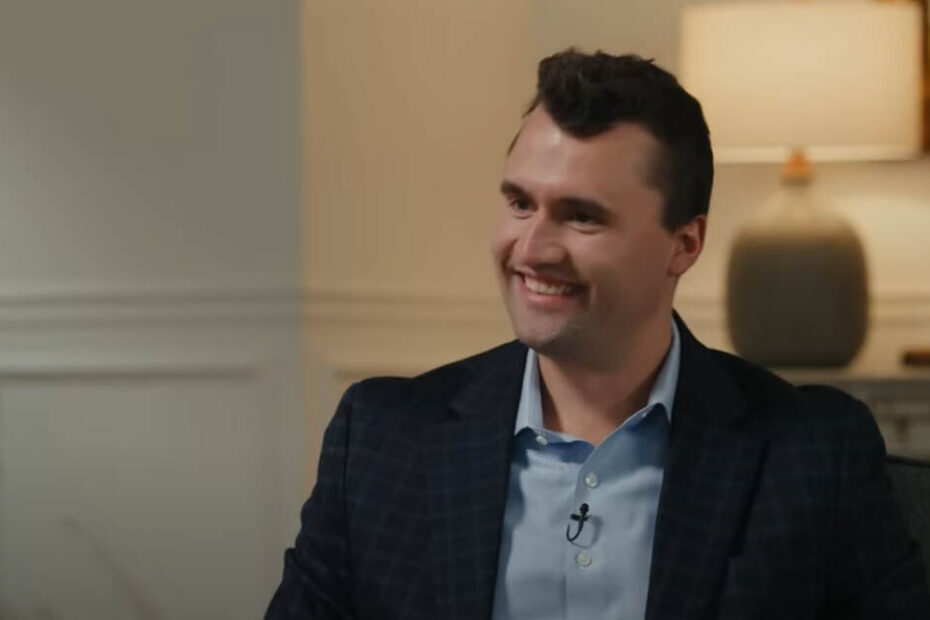
Read the full transcript of political activist and author Charlie Kirk’s interview on The Dr. Jordan B. Peterson Podcast, on April 29, 2025.
Introduction and Background
DR. JORDAN B. PETERSON: I’m talking to Charlie Kirk. And Charlie came out of nowhere 10 years ago and built the world’s most influential organization of young conservatives. And he did that from scratch. He did that by going to universities, pretty much single handedly, setting up card tables, offering to discuss and debate all the issues that weren’t being discussed and debated in these places, set up for exactly that reason, and iterating as he grew, establishing conservative clubs on campuses all across the United States, building a grassroots organization, learning how to debate despite the fact that he hadn’t gone to college, and actually playing the role on campus colleges that the professors in the classes were supposed to play.
And so why watch my discussion with Charlie? Well, to learn who he is, to listen to how he did this. You know, he had a vision and calling, and he found his way and made it spectacularly successful while he was still very young, and has ended up playing a very significant cultural role, transformative role that is by no means over. And so I think the podcast is interesting in and of itself because the story is so compelling, but it also contains many lessons, you might say, for those who are searching for a productive, adventurous, romantic way forward.
So join me in my discussion with Charlie Kirk, founder and leader of Turning Point USA, the world’s largest conservative youth organization.
The Cookie Inflation Story
So I’ve got a gotcha question for you. So now, now you’re warned. So you know that Robert F. Kennedy and Mehmet Oz, and I suppose Jay Bhattacharya too, are all hands on deck to restore American health. And that likely the biggest problem that’s confronting us is insulin resistance.
CHARLIE KIRK: I agree with that.
DR. JORDAN B. PETERSON: Too much. Way too much sugar and obesity and all that goes along with it. But insulin resistance just. It’s just devastating. It makes you old. It makes you diabetic. It’s terrible. It interferes with your cognition. It increases the probability that you’ll get Alzheimer’s. And that’s all linked to carbohydrate excess intake. Right? You agree with all that?
CHARLIE KIRK: I agree with that.
DR. JORDAN B. PETERSON: And yet, when you were in high school, one of the first things you did to begin your political career was agitate for a what? Reduction or stabilization of the price.
CHARLIE KIRK: We were against cookie inflation.
DR. JORDAN B. PETERSON: Yeah. So looking back from your position of wisdom 13, 14 years later, what do you have to say to the American public about cookie advocacy?
CHARLIE KIRK: What I should. I should have been advocating for, you know, reduction in the hamburger or steak prices. You see, that would have been a much better health approach. But all kidding aside, the funny undercurrent of that is that’s kind of what started my political advocacy.
DR. JORDAN B. PETERSON: I know, I know.
CHARLIE KIRK: It is hilarious. I kind of look back even, you know, just 13 years ago when, you know, cookie prices were the number one, you know, concern. This was before DoorDash is for all that. And I look at these high school kids now, but they’re able to order into high school. They have entire cubby rooms of, like, half of the high school class that is just getting takeout.
So in our high school in the suburbs of Chicago, the biggest thing was these basically homemade cookies that nearly tripled in price over the course of a year. So we started Students Against Cookie Inflation, which was a rather righteous effort, I might say.
Early Political Development
DR. JORDAN B. PETERSON: How old were you?
CHARLIE KIRK: I was at that time 16, 17 years old.
DR. JORDAN B. PETERSON: 16. And how. How much before that do you think your interest in the political developed?
CHARLIE KIRK: Definitely had an interest. I would. First, I’d say I was really fascinated by American history. Why? We were a great country. It was hard to not be politically oriented or opinionated based on the time that I grew up in, understand the time and place. When I was in eighth grade, this guy named Barack Obama came onto the political scene from Chicago, and everybody had an opinion about him. In fact, he became.
DR. JORDAN B. PETERSON: Where were you at the time?
CHARLIE KIRK: I was in the suburbs of Chicago.
DR. JORDAN B. PETERSON: Okay.
CHARLIE KIRK: So Wheeling, Arlington Heights area.
DR. JORDAN B. PETERSON: Yeah. Okay.
CHARLIE KIRK: And Obama was a homegrown, which he really wasn’t, but he was, you know, a senator from Illinois, a homegrown, almost quasi messianic political figure. I mean, you remember how it captured The Nation Times 10 in the Chicagoland area. Remember, Obama did his victory speech in Grant Park in downtown Chicago. That’s where he celebrated his victory in 2008.
And so it was just an all encompassing, almost, you know, political moment where it was, it was at very high social cost to be disagreeable with the rise of Obama in 2008. And mind you, I was a seventh or eighth grader at the time, actually going into ninth grade. And so I decided at my very best to push back. Oh, really? Is he going to fulfill all these promises? Is he really going to be able to bring utopia? And admittedly I was rather clumsy and shallow in my capacity to be able to articulate those beliefs, but I had something in me that wanted to push back against the, the orthodoxy of the time.
First Meeting and Conservative Development
DR. JORDAN B. PETERSON: Okay, I met you.
CHARLIE KIRK: It might have been 17, 18. I came to Toronto because I. And still to this day, this is correct. I was so moved by your lectures and your videos that they significantly changed my life. And I really wanted to meet you more than anything else.
DR. JORDAN B. PETERSON: Yeah, yeah. Well, I really.
CHARLIE KIRK: You were kind enough to make time for that.
DR. JORDAN B. PETERSON: Yeah, well, I remember that meeting and I, I know, I remember trying to figure out who you were because of what you were doing and the fact that you had this remarkable organizational capacity. But what I’m interested in now, you know, when you is, is, is what I’m very interested in trying to figure out what inclined you to take the path that you took.
Now you said, okay, so you said Obama, but you said something else at the same time. You said that you had been reading American history. And that you were concerned with, interested in, and convinced by, I suppose, all of those, this issue of what made America great.
So now while those, so this is interesting and worth taking apart because for decades, certainly since the 60s, the typical pathway for someone young who was assessing the history of his or her country would have been to read it through a highly critical lens. So for example, I remember when I was 13 or 14, so that would have been set mid-70s. I was reading Fear and Loathing in Las Vegas and some of the so called new journalists. And they’re not, they weren’t of the left exactly the way you would conceptualize the left now. They were more like radical literary figures, I would say.
But the mid-70s ethos certainly was to read history, sociology, critically. And I don’t mean you were being uncritical, I mean to take, take an anti establishment stance like in the 60s, that was all, well, anti establishment. Free love, the sexual revolution is coming. Everyone’s going to be free. By the time the 70s came along, which was the milieu I was embedded in, all of the optimism of the 60s had pretty much vanished, but all of the cynicism 100% remained.
Now you, though, interestingly enough, in Chicago.
CHARLIE KIRK: And this would be mid 2000s, so 2009.
DR. JORDAN B. PETERSON: Right. Right near the end of the 22 or the first decade of the 2000s, you were reading American history and, and as you said, in the height of the Obama craze. Fervor. Sure. But your take was positive and patriotic.
CHARLIE KIRK: Correct.
DR. JORDAN B. PETERSON: So why, why do you think that was? Like, what do you think it. What made you different? Like, when I met you, you were very, I would say relatively sheltered still and very, very straight laced. And from the Canadian perspective, you know, you were, you were of the. It appeared to me that you were of that American evangelical stripe, which we have some of in Alberta. Not a lot. It’s not really a Canadian thing.
And so when I met you, I thought, okay, so that’s Charlie’s, that’s, that’s the cauldron, the matrix out of which he emerged. Maybe cauldron’s not the right metaphor. But I’m curious, like, why do you think that your political rebellion took a conservative force when that isn’t. It’s not common for young people. And it certainly wasn’t the pattern of the time from say, 1965 till. Well, probably till about. You tell about when you.
CHARLIE KIRK: Correct.
DR. JORDAN B. PETERSON: Were adolescent.
Educational Influences and Pre-Woke Literature
CHARLIE KIRK: So that’s a phenomenal analysis and question. Let me just add to it. The literature, the non political, non historical literature that we were being assigned in sixth, seventh, eighth grade was what I call pre woke. It was almost there and it was like books that come to mind is a book called “Things Fall Apart.” I don’t know if you’re familiar with this.
DR. JORDAN B. PETERSON: Chinua Achebe.
CHARLIE KIRK: Yeah, exactly. I think the main character was Okonkwo. I could be wrong. I’m just drawing from like 13, 14 years. Basically the entire premise of the book, based on my memory, is that there are these. This wonderful tribe and they all get along in Africa and these evil colonialists come in and things fall apart and there’s internal strife. And the end of the book is basically the summary of all of these relationships of these evil colonialists that say, and here’s the history of just the. Under sub Saharan Africa, basically dismissing all of the complexities and the beauties of, you know, this.
DR. JORDAN B. PETERSON: Right. So it’s kind of a testament to Rousseau, but it was written by an African, that book.
CHARLIE KIRK: Correct. And I Again, I’m drawing from almost a decade old memory but I remember the discussions we’d have in class were, were very much anti colonialist, anti Western. That we are the contaminants on the world. That we are polluting other tribes. And again, right, mind you that we’re in 8th or 9th grade discussing this. So I don’t know what post structuralism is or postmodernism is, but it was pre woke. We weren’t quite there though.
And so from the historical standpoint it was not 1619 project, but it was. We’re going to spend a whole month on slavery and we’re going to spend three days on the founding.
The Wilberforce Discovery
DR. JORDAN B. PETERSON: Right. And did you spend any of the time when you were studying slavery assessing the fact that the UK was the only country that’s ever existed in the history of the world that spent what, two centuries and a tremendous proportion of its treasury eradicating slavery around the world at the behest of Protestant Christians? Because that’s the story.
CHARLIE KIRK: And we let me. I never remember knowing the name Wilberforce.
DR. JORDAN B. PETERSON: Wilberforce, yeah. See this is a very interesting thing. You know, I actually didn’t come across. This is so strange, but life is very strange. I didn’t come across the name Wilberforce till I was probably in my 40s.
CHARLIE KIRK: Isn’t that amazing?
DR. JORDAN B. PETERSON: It’s beyond comprehension.
CHARLIE KIRK: I didn’t get to know him until the last five years.
DR. JORDAN B. PETERSON: Last five years, Is that right? A even, is that right?
CHARLIE KIRK: Even the political world, I might have heard it, but not until someone looked at me seriously said you have to study this guy. This is a preacher. This is a man of faith that led to the abolition of slavery probably.
DR. JORDAN B. PETERSON: The entire under impossible conditions. He devoted his whole life to it. And the link between that and the religious ideation is rock solid. It’s one to one. Absolutely. And it’s also the case that his ideas wouldn’t have fallen on fertile ground because they did relatively like when you can make a radical cultural shift in one lifetime, which is no time at all historically, you know that you’re at the forefront of ideas whose time has come.
CHARLIE KIRK: Yes.
DR. JORDAN B. PETERSON: And that was clearly the case for Wilberforce. And he certainly is one of those people who stood up against the greedy, self centered and and malevolent ethos of his time. But the UK swung around behind them impossibly rapidly and then with their full might. And it is, it’s it. You know, I’ve learned a lot of things in the last 10 years that have shocked me so bad. I don’t know how to recover. Exactly.
And one of them was that the public school system was set up by fascists on the Prussian military model. I just, I’ve never been able to figure out exactly what to do with that. They were literally trying to make thoughtless.
CHARLIE KIRK: Worker drove desk workers. Yeah, that’s what bureaucrat means.
DR. JORDAN B. PETERSON: Yeah, well, or. Or factory workers.
CHARLIE KIRK: That’s right.
The Hidden History of Abolition
DR. JORDAN B. PETERSON: And what. That in itself wasn’t so bad because the country was industrializing, but right underneath that was the idea that while you were doing that, it was necessary to pretty much stamp out or fail to develop anything that would produce any kind of creative entrepreneurship. It’s like, okay, that’s hard to swallow.
And then when I read about how the food pyramid was developed, that’s just beyond comprehension. I don’t know if that’s the worst crime ever committed in the United States, but it’s up there. And then this, the next mystery is Wilberforce is another mystery of that magnitude.
And even, even you might say, particularly on the left, like, okay, you guys, you’re for the oppressed, which I don’t buy for a second, but especially because I’ve watched in the last 10 years the lefties sell out the poor worldwide to the climate apocalypse mongers. And that’s just been a catastrophe for places like Africa, like Bhagat Wade has been so forthright in observing.
But the fact that slavery and reparations, all of that, the unfair founding of the United States has been a central dogma of the radical leftists. They blame slavery on the West. And the fact that the radical types have control over the education system means that no one, even educated in a conservative milieu knows who the hell Wilberforce was. And I just don’t.
CHARLIE KIRK: Or that or Thaddeus Stevens or the heroism of John Quincy Adams. Those would be, you know, some main protagonist characters for the abolitionist slavery here in America.
And so when I was in 9th, 10th, and 11th grade, something in me, and I don’t quite know — my parents, very patriotic, but not political. Patriotic, but not political. They’re conservative, but we were not a political family, but very patriotic. Something in me desired to try to find the other side of the story, to try to push back a little bit from the incessant narrative that was being built.
And I do want to make sure this is clear, we were not yet at the place where the teachers were saying America was racist. In fact, it was actually much more insidious than that.
DR. JORDAN B. PETERSON: And so that even in 2008 that that still was no current.
CHARLIE KIRK: I could make, at least in my environment. I could make an argument, though, that what they were doing when I was in high school is actually long term, much more effective to create revolutionaries for the left than what they’re doing now, because it really didn’t warrant that much of a backlash. It wasn’t overly provocative. They weren’t saying to the white kids in class, “hey, go sit on this side of the class, and black kids on this side of the class.”
DR. JORDAN B. PETERSON: Well, those things always happen one tiny step at a time.
The Subtle Indoctrination
CHARLIE KIRK: Of course. But when I was being schooled, there was no parents showing up at school board meetings about critical race theory. Now, these elements were laced throughout all of the curriculum and it took a very discerning eye. And for whatever reason, you know, how I was raised or just something in me around 10th or 11th grade, I asked the question.
I said, “look, we have spent an entire month on slavery. Totally get it, terrible thing, but we spent so little time on the brilliance of the founders and what they’ve created and the greatest political document in human history and what went into that.” And it was an under emphasis on the heroism and the courage and the brilliance and an overemphasis on the evil and the tragedy and the horror without even the redemption arc behind it.
DR. JORDAN B. PETERSON: Yeah, well, the thing that’s so awful about that, as far as I’m concerned from the leftist perspective, let’s say, is if you are concerned with the poor and the oppressed, you know, and then you have to be discerning there because there are people who are poor and oppressed as a consequence of their own idiocy. And that’s not so uncommon as you know in your own life by watching your pathway to failure. So.
But given that there are people who are unfortunate, you’d think that the appropriate tack would be to determine who in history served the most effectively. And I just can’t see anyone you could possibly point to more effectively who did that more effectively than Wilberforce ever. And so you would think that instead of erecting monuments to Lenin and the leftists would erect monuments to Wilberforce. But not only do they not do that, no one knows who the hell he was.
CHARLIE KIRK: It is one of the greatest memory holding of a hero in western history. I completely agree. Why is it my hypothesis is he’s Christian? Is that you cannot highlight a man of faith who did something with such valor and such significance. It is at odds with almost every other fundamental narrative that they must try.
The Deeper War Against Christianity
DR. JORDAN B. PETERSON: Yeah, yeah, yeah, that’s right. I think that’s right. That it is fundamentally. But that begs another question. And that would be why, given that Wilberforce was clearly a force for the good, that Obama for example, would have been pushing, right, by which I mean movement towards a polity where there were no racial, there was no racial or ethnic prejudice.
If, if Wilberforce is the poster boy for that sort of effort, which if you understand his life and you read about it, I can’t see how you can conclude that, then why would the lefties forego that merely to oppose the fact that his motivation was fundamentally Christian? Because that points to something deeper, right? It points to the fact that the true war, so to speak, isn’t political. It’s not left versus right. It’s something deeper.
And then if it is anti Christian, then why, like, what does that mean? Like there’s an Enlightenment element there, right? The Enlightenment types, especially after the French Revolution generated this narrative that science and religion were radically opposed to and that if you were on the side of religion, you were against clear, rational, logical thinking. And so you could imagine a stream of anti Christian sentiment emerging on the rationalist side, right?
But it isn’t obvious to me at all that the leftist types who don’t talk about Wilberforce are anti Christian because they’re scientific rationalists. Like no, all you have to do is talk to them for like 15 seconds and you find out that that’s not the case. They might use those arguments from time to time, but they certainly don’t apply the rigors of scientific thinking to their own. To their own radical hypotheses.
So it’s deeper than that. And so what is it exactly that. What is it exactly that they’re objecting to? Is it the fact that the more radical leftist story, Marxist, let’s say, is in its essence anti Christian, which I think is a fair statement. And that. But why would that be more important? This is the strange thing. Why would be that be more important than serving the poor and fighting for the abolition of slavery and all of its associated prejudices?
Because it still doesn’t get you out of the conundrum, which is why then why not Wilberforce? Instead of tearing down statues, why not erect statues to him? Yeah. So. Well, what do you. I know that’s a. That’s a hard thing to sort out, but you got a knee. Obviously you were feeling something like this in high school. That’s correct. You guys are throwing out the baby with the bath water here, correct? Yeah. Which baby? Exactly.
CHARLIE KIRK: So my initial thought is that the leftist types, the ones that really understand it, they do not seek to achieve what a Wilberforce type figure would want, which is actual liberation and actual eradication of evil.
DR. JORDAN B. PETERSON: Yeah.
CHARLIE KIRK: I hate to say it. I think they just want to be in charge.
DR. JORDAN B. PETERSON: Yeah, no, no, I think.
CHARLIE KIRK: And I.
The Psychology of Power Seekers
DR. JORDAN B. PETERSON: Okay, so let. Let’s pivot on that for a bit. Okay, so because this is a problem that’s going to face the right or. And is already. And we can talk about that. So there are a group of people, 4% of the population, and then there’s still a fringe around that. That would maybe be another 5% where you’d have to take it seriously.
And so they’re in the psychiatric diagnostic literature. They fall under the cluster B heading. Okay. They’re histrionic, which means they’re dramatic. And. And I suppose if they’re healthy and histrionic, then they become actors, right? And entertainers. So there’s a. There’s a positive spin on that. But if they’re negative, histrionic, they dramatize their pathology and use it as a weapon.
Okay. They’re narcissistic, which means they want unearned social status. They’re psychopathic, which means they’re predatory parasites and they’re antisocial, and that’s just your standard criminal types. So that all fits in cluster B.
Then there’s personality traits that go along with that. Machiavellian. They use language not to convey information, but to manipulate and to manipulate instrumentally for their own purposes. So if I’m speaking with you in a Machiavellian manner. I have a goal in mind that has nothing to do with the words that I’m using. You may have talked to journalists like that many times.
CHARLIE KIRK: Many times, yes, many times. So they’re Machiavellian.
DR. JORDAN B. PETERSON: That’s so well said.
They’re narcissistic. Again, that’s. That’s an overlap. They’re psychopathic. Oh, yes. And on the personality side, that associates with sadism. And so all of that culminates in a personality style that has the proclivity to take positive delight in the unnecessary suffering of others.
Okay, so now those people, let’s say they’re 4% of the population. Okay? So this is what they do is they. They look for a story that’s working. Could be Christianity, Judaism, Marxism, could be conservatism. Doesn’t matter what the story is. They look to see where it has purchase. So where the people who play that game have power, they infiltrate that. They advertise themselves as the vanguard of that movement, and they do that for no other reason than to gain power. Right.
And so this is politically agnostic. Now they’ll guise themselves in political cloaks and they’ll learn all the tropes. I mean, this sort of thing. You can see this sort of thing emerging like mad on the right on Twitter, for example. But it’s certainly. It’s been characteristic of the left for. For a long time insofar as the left has power.
But, you know, you. You were the one who just said, I think they want power. Yes, that’s part of that. You know, in the. In the. In the biblical tradition, there’s a battle always between the ethos that brings abundance. So that would be the miraculous provision of fish and bread and water that never exhausts itself. That’s all consequence of a particular kind of ethos, the one that Wilberforce embedded, that’s juxtaposed against usurpation, Luciferian usurpation of power. Right. That’s the temptation that Christ has offered in the desert. Right. The third temptation is the temptation of.
CHARLIE KIRK: Power the whole world.
DR. JORDAN B. PETERSON: Yeah, that’s right. That’s right. That’s right. And one of the things that’s. Moses is punished brutally by God for using power near the end of his.
CHARLIE KIRK: And for thinking he has the power to actually make water come out of the rock.
DR. JORDAN B. PETERSON: Well, yeah, that it’s dependent on him.
CHARLIE KIRK: And on him, not God.
DR. JORDAN B. PETERSON: Yeah, yeah, worse than that. Not only on him, but on it. God tells him to invite with his words and he uses force and authority. Right. So he doesn’t enter the promised land. So that’s a good indication of the danger of power even when wielded by someone who is estimable. Right. Because you have to give Moses a lot of credit. Right, well, exactly.
CHARLIE KIRK: For dealing with that.
DR. JORDAN B. PETERSON: Yeah. And then of course that’s the temptation that’s offered Christ. So I do think it’s a power game.
CHARLIE KIRK: Yes.
DR. JORDAN B. PETERSON: And that, and then there’s a commandment not to use God’s name in vain. And then there’s the comments in the Gospels about the Pharisees. Right, the Pharisees. The Pharisees are exactly the people who use religious terminology, so moral terminology to cloak their power seeking machinations. Right. And Christ goes after them. I think the best account of that is in Matthew where he tells them that they’re like, it’s pretty brutal.
CHARLIE KIRK: That they’re like “broods of vipers.”
The Problem of False Virtue
DR. JORDAN B. PETERSON: Worse, they’re like graves full of rotting bodies that someone whitewashed. Right. And he says that if they would have, they’re the people had they been alive in the time of the prophets they purport to follow, they would have been part of the mob that would have killed them. Right. That’s actually part of, you may know this, but that’s part of what sets them up for the crucifixion because they’re not very happy with those insults publicly delivered.
But that shows you also how old the problem is. So you could imagine one of the worst possible sins is to take the highest possible virtue. So that would be, “Well, we stand for the oppressed, we stand for the poor.” And then to gerrymander that so that you’re standing for, that only pushes you towards power.
CHARLIE KIRK: That’s right.
DR. JORDAN B. PETERSON: Right. And so, and then it also, there’s a clue in the Gospels, I think it’s in the Gospels as well, about how you figure that out. And the answer is “by their fruits you will know them.” Right. So you look at. Well, what I’ve done is looked at the consequences, for example of the green energy programs in Germany and the UK.
Well, what’s the consequence? Let’s take Germany. Germany pollutes far more per unit of energy than they did 10 years ago. And their energy prices are five times as high. They’re completely dependent on dictators of the worst sort.
CHARLIE KIRK: Yes.
DR. JORDAN B. PETERSON: They continue to make the same mistakes. They’re de-industrializing very, very cataclysmically. It’s destabilizing their political environment. And that falls disproportionately on the poor. I don’t see a way around that analysis.
Nature Worship and Taking the Lord’s Name in Vain
CHARLIE KIRK: And nature worshiping is not anything new. It’s all throughout the scriptures. No, no, that’s right, Elijah. I mean is that whole story is a manifestation of the nature worshipers versus the belief in God.
But back to just to reiterate a very profound point you made in evangelical circles, we get wrong, which is people think “do not take the Lord’s name in vain” just to say, do not say God in an expletive way. It actually the word is don’t carry the names Lord, the name of the Lord in vain. Meaning don’t do actions.
DR. JORDAN B. PETERSON: Yeah, right.
CHARLIE KIRK: In the name of God. So you’re exactly right. And so people wear the costume of the holy or they appropriate.
DR. JORDAN B. PETERSON: Well, that’s exactly what Christ tells the Pharisees. Literally. He says they wear the garbs of the priestly to elevate their moral status.
CHARLIE KIRK: And this is what we believe is partially blasphemy in the Holy Spirit, which is to take the all of the trappings of religion.
DR. JORDAN B. PETERSON: Oh, that’s interesting.
CHARLIE KIRK: And to do evil in that name. We believe that is one of the, if not the most evil.
The Holy Spirit and the Unforgivable Sin
DR. JORDAN B. PETERSON: So that you think that’s the transgression against. Okay, so that’s interesting because. So my psychological understanding of the idea of the Holy Spirit is that the Holy Spirit is what possesses your words when you truly aim up. And this makes sense to me psychologically because the thoughts that make themselves manifest to you spontaneously are directly related to the intent of your aim. That’s how you’re literally how your verbal mind works, your imagination as well.
You know, if you go on a date and you aim at sexual contact on the first date, the fantasies that come along with that aim will be of that nature, obviously. And if you are on the hunt, so to speak, for a marital partner, the fantasies that accompany that will be quite different. So this is literally how your imagination. It’s also the case that, you know, it’s same idea with the date. If it’s short term, mating is your goal, which by the way is the goal of the dark tetrad types differentially. So what that means is that the sexual revolution handed women over to the worst men.
CHARLIE KIRK: That’s right.
DR. JORDAN B. PETERSON: So that’s fun to know. But it’s definitely the case that your aim determines what comes to mind. Now you said that that sin against the Holy Ghost, which is the unforgivable sin, is the sin that occurs when you use the Lord’s name in vain. So when you claim to be motivated by what’s divine but are actually serving the Luciferian spirit of usurpation power.
CHARLIE KIRK: It can be. I mean, it’s an open theological.
DR. JORDAN B. PETERSON: Yeah, no, no, fair enough.
CHARLIE KIRK: But I, I, and I take Dennis Prager’s view of an Old Testament on this view, which is think about how much this a great example. Think about how much damage those evil priests did.
DR. JORDAN B. PETERSON: Oh yeah, that’s a great example. Look, most of the people that I’ve spoken with who proclaim themselves to be atheists are atheists for two reasons. And I mean the good faith atheists, let’s say. First of all, they tend to be tilted in the engineering cognition direction. So they’re much more oriented towards things than people. And that’s a stable temperamental trait.
But they’ve almost all also invariably been hurt by someone or some institution that’s claimed to be religious. And then you could also see that that’s right, obviously betraying someone in, in Dante’s account of the Inferno, when he goes down to the bottom of hell, he finds the betrayers right next to.
CHARLIE KIRK: Satan, Judas Crassus and Brutus.
DR. JORDAN B. PETERSON: Right, right.
CHARLIE KIRK: Okay, so then the lake of ice, which is.
DR. JORDAN B. PETERSON: Right, that’s where Satan is encased. Right. Because he’s too brutal brittle to move.
The Nature of Betrayal
DR. JORDAN B. PETERSON: So the reason for that, I think, is that there isn’t a more upsetting psychological phenomenon than being betrayed. You stake yourself on someone, you trust them, they’re now a foundation. They’re part of the foundation of your life completely. Oh, so. And there’s no worse form of betrayal than betrayal that’s done in the name of the highest good. Right. I mean, there can’t be, obviously.
CHARLIE KIRK: Yes.
DR. JORDAN B. PETERSON: Okay, so, all right, so I thought that sin against the Holy Ghost was something like rejection of the Abrahamic call. You know, God comes to Abraham as the spirit of adventure. He says, “go out into the world, leave your zone of comfort, move away from your people, and have the terrible adventure of your life.” Well, if you reject that, you can’t develop.
CHARLIE KIRK: Yes, right.
DR. JORDAN B. PETERSON: Because you’re rejecting the spirit.
CHARLIE KIRK: And think of how many young men are rejecting it.
The Power of Encouragement
DR. JORDAN B. PETERSON: Well, what’s. And what’s terrible about that? This is something we could talk about too. I’m curious about your experience. It’s been my experience that it doesn’t take that much encouragement for those, the people you’re describing, to be inspired to try.
Now, I’ve talked to thousands of young men now who’ve had that experience. I see a lot of them at my lectures. They come to the meet and greets, for example, and they tell me it’s great. It’s really great. They tell me that, you know, five years ago, six years ago, because it’s starting to be a long time now, eight years ago even, they were not in good shape and they came across my lectures or books and decided to. Decided that there was something worth aiming for and then decided to try.
So to tell the truth, that’s very common vow, let’s say, to take on more responsibility. And they usually laugh about starting to make their bed or something like that, which is a lot less trivial than people think. And then it’s straightened them out. The terrible thing is how little encouragement that that actually took.
So why are people coming out to see you on campuses? And what kind of response do you get from the people that you talk to?
Campus Events and Growing Crowds
CHARLIE KIRK: The responses have been incredible. First, the crowds alone. We’re drawing crowds of 3, 4, 5,000 people in the middle of the day just for me to debate a random college kid or a college professor. It’s remarkable.
DR. JORDAN B. PETERSON: Walk me through one of those events, Charlie.
CHARLIE KIRK: And so I’ve been doing that for a decade. Just I started as we know. We started Turning Point USA. One of the things I really wanted to make sure is that I was in touch with the target audience that I was trying to convince and trying to persuade. No better way to do that than just go to the college campus itself, set up a card table with maybe a poster that says something like, “I think government should be smaller,” something like that, and start a discussion.
I would do this at University of Wisconsin, Madison. I would do this at University of Illinois when we had almost no funding, no connections, no idea what I was doing. I’ve always believed in the grassroots interaction. What are your meet and greets? No data, no chart, no abstraction can get to that personal human to human contact.
So I’ve been doing that for many years. And then Steven Crowder, to his credit, kind of popularized this idea of debating and putting it on. I said, oh, well, why don’t I also film these interactions? And so I started to do that around 2018. So it’s been about seven or eight years now. And, you know, then 10 kids would show up and then 20 kids, and we started to put these on the Internet.
And kind of concurrent and simultaneous to your rise, where you. You diagnosed what was going on in the west quicker and more accurately than anybody else, especially with young men, we started to see our popularity increase as we started to address some of the underlying problems that young people were facing, but in particular, young men were facing.
And then Covid happened. We were basically out of business for, you know, a year in the sense where we weren’t able to do campus activities. Donald Trump was no longer in office, and we had to really kind of rebuild on campus basically about two years ago. So let’s just say the spring of 2023, things really started to change where we would do these campus events prior and we would bring in your traditional conservatives, three to 400 people, maybe a couple hundred interested types, maybe 50 liberals, 500 students. Call it a day. That’s a success.
All of a sudden, in 2023, we were drawing a different type of person and student. First of all, we were drawing people outside of the campuses that were welders, electricians and plumbers. And the working men that heard that we were in town and they just.
DR. JORDAN B. PETERSON: How’d they hear?
CHARLIE KIRK: Social media.
DR. JORDAN B. PETERSON: Okay.
CHARLIE KIRK: And so decentralized promotion. And so they would show up and I saw that. I mean, these were guys that would go up to the question line and they were not asking about Rousseau or they were not asking about Jacques Derrida.
DR. JORDAN B. PETERSON: Yeah.
CHARLIE KIRK: They were saying, “How do I be a better person because I’m expecting a daughter in six months.”
DR. JORDAN B. PETERSON: Oh, yeah, okay.
CHARLIE KIRK: And all of a sudden here I am, you know, not in the position where you are nearly as seasoned to give advice to that young man. But he’s searching and he’s looking for anyone that seems to have an idea of how the world is supposed to work, that is professing a worldview of order and structure and discipline.
DR. JORDAN B. PETERSON: Something that he could do.
The Search for Purpose and Direction
CHARLIE KIRK: Yes. And that he was looking to me for. And that was a different dynamic. Whereas prior all the questions, the last eight years before that were, “Hey, Charlie, what do you think about the tax rate? What do you think about abortion?” And I still get a lot of that, but it was something different. It was young men especially that were seeking purpose and seeking a destination.
DR. JORDAN B. PETERSON: So this is crucially important, this transformation, because one of the things that… So let’s go back to that 60s dynamic, that anti-authoritarian 60s dynamic. The role of the left in the 60s was like an entrepreneurial progressive radicalism, let’s say. And the stance of the conservative was, “Well, you know, let’s not throw the baby out with the bathwater, guys.” And that’s a pretty good dynamic because you need a force for change and you need a force that resists that.
But I think what the conservatives did wrong, like profoundly wrong, was that they were their brakes. This is why they’re always dismissed as reactionary. Their brakes were fundamentally… They’re also moralistic. It was finger wagging. And this is something that was distasteful, let’s say, especially about the hypocritical evangelical conservative types.
CHARLIE KIRK: I agree with that.
DR. JORDAN B. PETERSON: Okay. But it was also strategically inappropriate because it’s very hard to say to young people who might tilt in the progressive direction because they’re a little more revolutionary in spirit, let’s say, are also a little more immature that the reason to abstain sexually, for example, is because you shouldn’t do it. Now that’s true, but it’s a weak argument.
You know, I was talking to my wife this morning about this. We’d been apart for a few days and I saw her again yesterday and I was very happy about that. And she has a podcast. She’s trying to reach out to young women because they’re just as in much or more trouble.
CHARLIE KIRK: They’re in more trouble.
DR. JORDAN B. PETERSON: They’re just harder to talk to by a lot. Our discussion centered around the fact that it isn’t that you should get married, although you should. It’s that there is no alternative that’s anywhere near as good by any standard whatsoever, regardless of position, of analysis or time length. Anything you do other than that, even though marriage is very difficult and every other alternative is far, far worse.
And so if you want a pathway forward to what the conservatives support, the conservatives should be offering an invitation. They shouldn’t be moralizing. And so you’re saying that they shouldn’t even be political at the moment. And I know you’re a figure whose political activity is grounded in a religious substance.
CHARLIE KIRK: That’s right.
DR. JORDAN B. PETERSON: Shapiro is of course like that too.
CHARLIE KIRK: And Dennis Prager. Christianity is my foundation.
DR. JORDAN B. PETERSON: Right, right, right. And so now you’re seeing that these young men who are coming, especially the working class types, they’re not so interested in the political. They’re probably not even interested in the arguments. Exactly. They’re looking for something else.
CHARLIE KIRK: That’s right. They’re looking for direction, they’re looking for connection. They’re also looking for validation that the way they’re thinking, the way they’re feeling is directionally correct.
DR. JORDAN B. PETERSON: Yeah. So that having a direction is correct.
CHARLIE KIRK: Exactly that. Not meandering through life.
DR. JORDAN B. PETERSON: Yeah.
CHARLIE KIRK: Not having the aimless despair of walking in circles.
DR. JORDAN B. PETERSON: Yeah. Not castrating yourself so your toxic masculinity vanishes.
CHARLIE KIRK: Bingo.
DR. JORDAN B. PETERSON: Sometimes literally. Far too often now. Literally.
CHARLIE KIRK: Literally. They’re chopping off…
DR. JORDAN B. PETERSON: Yeah, exactly. Exactly.
The 2024 Rebellion of Men
CHARLIE KIRK: And so what we saw in 2023, again, so I have to wear multiple hats. Part of my hat as a political strategist, part of my hat is just trying to be a role model for young people. Part of my hat is explaining these ideas to young people. I kind of connected all the dots. I said 2024 is going to be a rebellion of the men of the west, unlike any that we’ve ever seen.
And I would say this to the experts and they would dismiss it. They said, “No, no, no. Roe versus…” Because Roe versus Wade got repealed. Remember that? Either that summer or summer 2022, I can’t remember. It might have been… I think it might… irrelevant. The point being is that Roe vs. Wade was supposed to be the most important political issue of 2024, and that women were going to rise up in major numbers.
I said, first of all, that might be true on one side of the sex spectrum. On the other side, or binary, the other side, there is something happening with men that no one is talking about, no one wants to acknowledge, no one wants to admit. And so separately, the Trump team, to their credit, believed in it and actually ran an explicitly masculine campaign, going on podcasts like Joe Rogan and Theo Vaughn. And so they were very much embracing of this, to their credit.
But separately, we must diagnose why is this happening. And the education system, as you’ve astutely pointed out many times, is hyper feminine. There’s no place for young men, especially young white men. Of a Christian… I think one in…
DR. JORDAN B. PETERSON: Four boys is now given an ADHD diagnosis. It’s something.
CHARLIE KIRK: And even the New York Times has said this is for parents, not for kids. Meaning there’s no medicinal reason for this to happen, according to the New York Times.
DR. JORDAN B. PETERSON: Yeah. Right. So, you know, things have gone particularly sideways when New York Times…
CHARLIE KIRK: I was able to read this cover story, it was unbelievable where they were basically saying after this major study that like 1% of the kids actually do need ADHD medication that are completely out of control, but almost like 90 to 95% are just because the parents don’t want to have an unruly kid around.
The Trans Crisis and Professional Cowardice
DR. JORDAN B. PETERSON: Yeah. Or… Well, and if that’s the New York Times diagnosis, then you can also be absolutely 100% certain that they underplay the role of the educational establishment in setting up the circumstances so that parents are likely to draw that conclusion.
I mean, with all this trans butchery nightmare, you know, my profession, particularly the social work end of it. But my like real psychologists, let’s say, were also stunningly craven in their unwillingness to resist this. The mantra was to parents, “Well, would you rather have a live trans child or a dead child?” Which there was never, Charlie. There was never a shred of evidence for that.
CHARLIE KIRK: It’s one of the most evil things that has happened.
DR. JORDAN B. PETERSON: It is unbelievable. The people who promoted that should be imprisoned. I agree, it’s absolutely…
CHARLIE KIRK: And it’s widespread and it’s still in the fibers of the pediatric community.
DR. JORDAN B. PETERSON: Yeah, yeah, that’s for sure.
CHARLIE KIRK: It really is for sure.
DR. JORDAN B. PETERSON: Well, the Supreme Court of the UK may have broken the back of that.
CHARLIE KIRK: Movement a week remarkably.
DR. JORDAN B. PETERSON: That was unbelievable. That was one of the most… Now and then the Brits, God love them, do something quite radical direction.
CHARLIE KIRK: Right.
DR. JORDAN B. PETERSON: You know, while Brexit was a good example of that.
CHARLIE KIRK: Oh, that’s interesting.
DR. JORDAN B. PETERSON: They put through that free speech legislation that the Labour Party tried to rescind that has actually reshaped the universities to some substantial degree. That was in part a consequence of me being disinvited from Cambridge, which had a long term consequence that the disinviteurs hadn’t really reckoned on because a whole group of professors at Cambridge got together and decided that they were going to change the policies at Cambridge, which they did in a historic vote. And then they changed the policies at the national level. And the repercussions of that haven’t stopped yet.
But… So, yes. So this terrible demoralization. Right, so all right, now you’re being caught. You’re advertising on social media. Let’s go back and tell this whole story. So because I’m very curious about it. So you had an intuition that you could go to campuses. Okay, so tell me how. Where’d that idea come from?
The Unconventional Path to Campus Activism
CHARLIE KIRK: You think, well, I never went to college, first of all, which is…
DR. JORDAN B. PETERSON: Right. You’ve been to many colleges.
CHARLIE KIRK: I’ve been to more colleges than most people you might have me be, but I’ve been to well over 200 campuses across…
DR. JORDAN B. PETERSON: No, no, you’ve got me beat.
CHARLIE KIRK: Yeah. I mean, almost every… Almost every college. Yeah, you can imagine. I can… I’ve either given a lecture, a speech, or started a chapter there.
DR. JORDAN B. PETERSON: Yeah. So my daughter doesn’t have a university degree, so she started a university. So that’s…
CHARLIE KIRK: That’s very comical.
DR. JORDAN B. PETERSON: But this is good. Okay, so… So that means you do have a university education. You just got it a very different way.
CHARLIE KIRK: That’s right.
DR. JORDAN B. PETERSON: Okay, so… So you decided. That’s interesting, too, because it’s like I asked you what your motivation for doing this was, and the first thing you said was that you didn’t have a degree. So that’s very interesting. So what, were you also curious about going to campuses?
CHARLIE KIRK: Yes, and that’s really a great point. So just as a little background, I wanted to go to West Point. I didn’t get in. I told my parents I would take a gap year to kind of figure this out, because I saw some momentum of a local political group that was out of the cookie group, by the way, that kind of kept growing. I said, “I want to keep this going and play this out, see where this can be.”
DR. JORDAN B. PETERSON: This was after high school? Just after high school.
CHARLIE KIRK: That’s correct. That was the summer I graduated high school.
DR. JORDAN B. PETERSON: Okay.
CHARLIE KIRK: A really amazing mentor by the name of Bill Montgomery, may he rest in peace, was the only guy ever. He said, “Charlie, you shouldn’t go to college.” I was like, “That’s the most radical thing someone could say.” So that idea was planted in my head and I said, “Okay, I’ll just take a gap year. I’ll kind of figure things out.”
DR. JORDAN B. PETERSON: Why did he tell you that?
CHARLIE KIRK: He thought in his own words, he sensed an entrepreneurial gift and skill that I had.
DR. JORDAN B. PETERSON: Right.
CHARLIE KIRK: And a drive. He was a kind of an entrepreneur.
DR. JORDAN B. PETERSON: So he could see the entrepreneurial part of me. He didn’t think that would work well in college.
CHARLIE KIRK: Yeah. And he said, “You have to go create. Not just find.”
DR. JORDAN B. PETERSON: Oh, good. Oh, that was what he said.
CHARLIE KIRK: “You have to go build.” He said, “You have something in you. You have a drive, you have a passion. You have a relentless kind of spirit.” And he says “You shouldn’t go to college.” That was the most radical thing that a suburban kid in Chicago could hear, because everyone would go to college. Of course, it’s a mark of failure not to go to college.
DR. JORDAN B. PETERSON: Yeah, right.
CHARLIE KIRK: And so not getting into West Point was very demoralizing. However, it was the greatest gift ever from the Lord because I took the gap year. And to your credit, which is no one’s ever put this together. All my friends were in college, so I would start visiting my friends in colleges.
So you think about it, because I would go to high school, I would graduate high school. I still am friends with all my high school friends. So I’d go to University of Iowa, University of Illinois to go visit them. Northwestern. And I realized as I was trying to get this political thing off the ground, this is where it all stemmed from. And I was trying to put pieces together that the academy was where the fight needed…
DR. JORDAN B. PETERSON: Yeah, yeah, definitely.
CHARLIE KIRK: To go towards. And simultaneously, as I was trying to find funding and trying to get donors behind our effort, something that almost every wealthy person that I would encounter is they had a soft spot and a interest in trying to invest in college campuses. Especially conservative leaning philanthropists and business types in America, I think about 2012.
DR. JORDAN B. PETERSON: That’s when turned around to bite them pretty damn hard.
CHARLIE KIRK: Oh, yeah. But it would get their attention. Right. So here I would be at a cocktail party and I’d be 18, 19 years old, trying to get funding, trying to get someone’s attention. I said, “Okay, what do you do?” I said, “Well, I’m trying to bring conservatism to college campuses.” “Oh, really?” And they would be sincere. They would lean in.
DR. JORDAN B. PETERSON: Right, right, right.
The Opening Door
CHARLIE KIRK: They’d say, “What about my alma mater? If you spoke there?” And so I’d have a little connection. I’d say, “Well, maybe I could visit there if we have a little bit of money.” And so it helped. So I had interest from the donor community.
DR. JORDAN B. PETERSON: So you can see that there was an opening there.
CHARLIE KIRK: The door that was open I had no idea how big that opening was. And the more that I learned, some of these donors, as you would say, they’d give hundreds of millions of dollars to these schools.
DR. JORDAN B. PETERSON: Yeah, right.
CHARLIE KIRK: And so they had a lot of vested interest. They were very curious about a young guy that wants to go shake up these campuses. Because, remember, that’s when woke was really starting to come up.
DR. JORDAN B. PETERSON: Yeah.
CHARLIE KIRK: 13, 14, 15. We saw it bubble up. 15 was, I think, the Pearl Harbor moment. It was Michael Brown, Ferguson, Missouri, “hands up, don’t shoot.” That’s where woke started to present itself.
DR. JORDAN B. PETERSON: Oh, you’ll have to tell me why you think that event was pivotal.
The Ferguson Moment
CHARLIE KIRK: At least from the… Because I think at the top of all woke elements, race was the primary. Let’s just say the primary fencing.
DR. JORDAN B. PETERSON: Yeah, it’s the division point.
CHARLIE KIRK: Correct. And so in 2015, when Ferguson, Missouri, the lie, the scam of “hands up, don’t shoot” with Michael Brown, Black Lives Matter was born out of Ferguson, Missouri, actually on a college campus at University of Missouri in Columbia, Missouri. And that spread like wildfire through, of course, a lot of Democrat operatives and money being spent.
Remember how long we spent on that news cycle of “America’s Racist” because of Michael Brown? And all the CNN commentators famously said, “hands up and don’t shoot.” And we spent more time on race obsession in the last two years of Obama’s presidency than the last four or five years prior.
DR. JORDAN B. PETERSON: And that’s because that’s a hallmark of the danger of allowing race to be an issue in the presidency to begin with.
CHARLIE KIRK: Exactly. But an underappreciated element here is Eric Holder was setting the table for that with very loyal people in the Department of Justice that believed that police were inherently racist.
DR. JORDAN B. PETERSON: Right.
CHARLIE KIRK: They were launching investigations into very successful police departments trying to find police brutality and racial bias. And so the table was set. And that was the mini George Floyd moment of the beginning.
The Role of Psychology
DR. JORDAN B. PETERSON: You know, psychologists played a role in that in a major way, too, because you had Banaji and her crowd.
CHARLIE KIRK: Oh, yeah.
DR. JORDAN B. PETERSON: What do they call that? The implicit association test. Forcing the idea of implicit bias. You know, and social psychology is a very corrupt discipline. And it has been maybe from its onset. And it’s very stacked from top to bottom with careerists.
And it was social psychologists, for example, who denied that there was any such thing as left wing authoritarianism until 2017. Right. That was something you didn’t get to think if you were a social psychologist or even investigate. We cracked that there was a couple of people working on it around 2016. The last bit of research I did was on left wing authoritarianism. And then everything my lab blew up. You know, it just became impossible for me to continue.
But so that dovetailed with this insistence that people were looking at the world through a lens that was irremediably biased in terms of their privilege and their racial and identity. And you know, and it’s tricky because people do have a tilt in the ethnocentric direction. Right, because, well, how about because you favor your family, right? You tend to favor the local. You also tend to favor the non-novel.
CHARLIE KIRK: And the familiar.
DR. JORDAN B. PETERSON: Well, exactly. And now there are exceptions to that. Well, you see this in the Old Testament accounts because sometimes the foreigner is the best thing that ever happened. So that would be like Jethro in the story of Moses.
CHARLIE KIRK: Moses’ father-in-law and Midian.
DR. JORDAN B. PETERSON: Yeah, exactly, exactly. And so, and then you have the alternative that would be like Jezebel, who’s the foreign devil, so to speak. And so, you know, that’s a paradox that’s very difficult to properly navigate. Okay, so yeah, it’s 2015, 2016, things went seriously sideways.
The Cultural Shift on Campus
CHARLIE KIRK: And that’s where, just to complete the point, my job on campuses became far more interesting because our organization shifted from primarily economic discussions of Marxism and capitalism to core cultural hotbed topics in 15, 16, 17: race, and then of course, the next layer, gender, transgenderism.
So the beast that Betty Friedan and Judith Butler raised, that monster reared its head with incredible ferocity in 16 and 17 in the academy. And people don’t believe it when I say this. I saw this happen, though.
In 2012, 2013, there was almost no transgender anything on these campuses. It didn’t exist. I could tell you I went to these campuses, I talked to these students. You might have an effeminate looking guy, maybe wearing a dress as a joke. It was not anywhere. The social contagion within five years was dramatic. It was a different place.
You went from just, you know, okay, you are who you are to “you’re not going to use my pronouns.” Hyper tyrannical. Yeah, hyper authoritarian.
So then here we are, a five year old organization with a growing infrastructure and a growing presence and a growing staffing organization. And we multiplied significantly because then the donor types like, “Hold on, what happened to my alma mater? Why is it that they’re burning down UC Berkeley?”
Remember, Milo Yiannopoulos went to University of California, Berkeley in the spring of 17, and they burnt the whole place down. Ben Shapiro, very similarly. And so we then found ourselves, accidentally or through serendipity, on the front lines of the American culture war.
The Entrepreneurial Conservative
DR. JORDAN B. PETERSON: Yeah, well, there’s a lot of that that’s not accidental. You know, you think about the way that you told your story. I mean, it’s improbable, but you were of the temperamental type. That’s that strange blend of entrepreneurial temperament and conservative temperament. Those things don’t generally go together. Right, the conservative temperament. You could accept the libertarians because they’re probably the entrepreneurial conservative.
CHARLIE KIRK: In growing up, I actually was more libertarian. It’s very interesting.
DR. JORDAN B. PETERSON: Yeah. Okay, okay, okay. Well, that’s where the entrepreneurial conservatives hang out, is with the libertarians. That’s right, right. And they have an uneasy alliance.
CHARLIE KIRK: Great point.
DR. JORDAN B. PETERSON: Okay. And so that temperamental factor was already operating at you in high school, and then you didn’t get into West Point, you said, but you were interested in universities, and you obviously had the intelligence to manage them.
And so, you know, it’s very useful to develop an idiosyncratic pathway forward if you have the IQ horsepower to manage it, because it makes you unique, if you could do that.
So you had a mentor who told you that it’s probably best for you not to go to college because you have an entrepreneurial bent. Now you’re trying to build a political organization, but you’re not exactly sure how. You’re visiting the campuses, and you have friends there, and you see that there’s an opportunity to talk on campuses where you can also get an education in doing that, but also that there’s donor interest.
And that’s very interesting, too, because if you’re a good entrepreneur, one of the things you do is you go talk to your marketplace. Always. That’s the grassroots things, but also with regards to fundraisers, and you see, you offer, like, 10 ideas, all of which you’re interested in, and you see where the door opens. That’s knocking.
CHARLIE KIRK: Exactly. Right.
DR. JORDAN B. PETERSON: So you saw that there were these people who wanted to support the education of young people, but who could see that their money was being counterproductively spent.
CHARLIE KIRK: To say the least.
DR. JORDAN B. PETERSON: Yeah, well, leave large piles of money laying around unguarded and see who comes in first to take it. Right, right. That’s that parasitical type, that they’ll swarm in there like mad.
CHARLIE KIRK: That’s happened in gravitate to the universities.
The Administrative Takeover
DR. JORDAN B. PETERSON: Yeah, well, it’s the same phenomena that we talked about earlier, that cluster B, narcissist, dark tetrad, 4% of the population. They’re looking around to see where, what would you say, inhabitable carcasses are lying around unintentionally.
CHARLIE KIRK: And they’re disproportionately represented at the academy. That 4% might be 40% of the administrators or the professor types, because think about it.
DR. JORDAN B. PETERSON: Well, increasingly that became the case because…
CHARLIE KIRK: They might be saying something to that target audience, the student, but they actually want to see that student become a leftist. Everything. There’s a lot of Machiavellian influences in how these professors present their ideas.
DR. JORDAN B. PETERSON: Yeah, well, it’s also the case that it was the Machiavellian administrator. So what happened at the university? I watched this.
CHARLIE KIRK: Oh, you lived it.
DR. JORDAN B. PETERSON: The administration encroached, and that’s not surprising because there was money afoot, so why wouldn’t there be competition for the funding? So the administrators, who are generally failed faculty, by the way, failed and embittered faculty. So the faculty are already embittered because they’re not rich like investment bankers.
And then you take embittered faculty members who couldn’t make it, as faculty said. Okay, so now they encroach on the faculty who are too busy doing their job and too apolitical and also too willfully blind to notice. The administration encroaches decision by decision until they radically outnumber the professors. And that’s pretty much fait accompli by 2005, I would say.
And then the woke mob took over the administration, and that took no time at all. Right. And so now that’s where we’re at in universities. And I can’t see how that would be reversed.
CHARLIE KIRK: It cannot.
The First Donor
DR. JORDAN B. PETERSON: Okay, so now you tell me how you started going to campuses and what you did to begin with and how you got away with it.
CHARLIE KIRK: So the first person who wrote us a check was a guy by the name of Foster Friess, may he also rest in peace. Amazing philanthropist. I met him very early on. I decided to go to the Republican National Convention in 2012 in pursuit of finding donors. This was August after I graduated high school, and I just had this idea to try to bring the conservative agenda to young people to the next generation.
I met him in a stairwell at the Republican National Convention. I gave him a stairwell pitch. And to your point, which is exactly right, I kind of presented four or five things really quickly.
DR. JORDAN B. PETERSON: Yeah.
CHARLIE KIRK: No one trained it. No one, I just kind of instinctively, I said, “Well, here’s five ideas that I have.” He laughed, he chuckled, gave me his business card. He said, “Be in touch.” Sent me ten thousand bucks the next week. That was like, how did you know.
DR. JORDAN B. PETERSON: That there was such a thing as finding donors? And what do you think it was that set you up to have the gall to assume you could do, first of all, to know that that was a thing and then to have the gall to pursue it.
CHARLIE KIRK: The second one, I don’t know. I don’t know where I got the gall to pursue it. I will say Bill Montgomery, being a mentor of mine was very encouraging.
DR. JORDAN B. PETERSON: Okay, okay, okay. So you had someone encouraging you.
CHARLIE KIRK: Yes, but…
DR. JORDAN B. PETERSON: And you said he saw something in you.
CHARLIE KIRK: Yes. And he was…
DR. JORDAN B. PETERSON: And he was an entrepreneur.
CHARLIE KIRK: Yes. And he never asked for anything from me, which was very unique. It wasn’t like he was trying to have some agenda. He was 72 years old.
DR. JORDAN B. PETERSON: So you had a mentor.
CHARLIE KIRK: Yes.
DR. JORDAN B. PETERSON: Which you desperately need as a young person. Definitely need someone who believes you can do it.
CHARLIE KIRK: And you think about it, you’re 18 years old, you know, you don’t know how to cash checks. You don’t know. You barely know how to put on a tie. Literally, I didn’t know how to tie a tie for the first two years at Turning Point.
Again, my parents are phenomenal and they deserve a lot of credit. But this was kind of beyond the upbringing where an external mentor comes in and kind of points you and says, “Hey, I think you’re really good at this.” Found a skill, identified a skill, and kind of molded me in that direction.
DR. JORDAN B. PETERSON: You know, that young male elephants go mad if there’s no old male elephant to butt heads with them. That’s very well documented.
CHARLIE KIRK: Very apropos for Republicans.
DR. JORDAN B. PETERSON: Yeah, right. Exactly. Exactly. Yeah. Yeah, definitely.
Building the Organization
CHARLIE KIRK: So, yeah, yeah. But it was, it was. I’m a quick learner. I’m a quick study. And so I started to do research. I said, well, are there things such as external nonprofit political organizations? Oh, there’s a 501C3 or there’s a 501C4, and you can raise money. And so the first couple months was me actually learning what am I building? Am I building?
DR. JORDAN B. PETERSON: So you were training as an administrator and a manager then?
CHARLIE KIRK: I was everything for the first time.
DR. JORDAN B. PETERSON: Yeah. Of course.
CHARLIE KIRK: I was CEO, I was janitor, I was. I was everything.
DR. JORDAN B. PETERSON: Yeah.
CHARLIE KIRK: And so I had to make a decision. Of course I asked for advice. Am I going to start a for profit company? Am I doing a not. And I, we decided on nonprofit largely because we believe that there was an untapped pool of philanthropic dollars that wanted to see these campuses challenged and disrupted.
DR. JORDAN B. PETERSON: And how do you figure that out?
CHARLIE KIRK: Having a lot of conversations with a lot of wealthy people and I realized that they’re okay.
DR. JORDAN B. PETERSON: Okay.
CHARLIE KIRK: So if you talk to a donor type, they will, they’ll have two different ways of deploying capital in their after years, the first of which is investment, which comes with strict return on investment requirements. And they look at that as, hey, I need to make sure that this money is stewarded and shepherd and eventually I get an ROI.
The second bucket is philanthropy where they actually aren’t looking for a material or a monetary ROI. They’re looking for a cultural or a macro ROI. And those sometimes are in donor advised funds or they’re in 501C3 type categories. And we saw a lot of amazing patriotic donors that stepped up and said, hey, I have done very well in my business and this is what I found. And I connected the dots. They said, I have this money sitting around that I pledge to Yale.
DR. JORDAN B. PETERSON: Right.
CHARLIE KIRK: A million bucks a year and I’d hate not to give it to him. Is there some other better idea? What we found was of so many conservative donors that had a lot of money, but not a lot of great ideas of where to deploy that 501. You think about it, the predominant amount of 501 C3s in the, in the, in the educational space are left wing.
DR. JORDAN B. PETERSON: All of them.
CHARLIE KIRK: Right, exactly. So here I am, I’m kind of this new disruptive force and they say, okay, and I’m not going to give him the money I give to Yale, but I’ll give him 50 grand a year, kind of see how he does.
DR. JORDAN B. PETERSON: Right, right, right.
CHARLIE KIRK: And so we started to earn the trust of a lot of donors and earn the trust of a lot of philanthropists.
The First Campus Visit
DR. JORDAN B. PETERSON: Okay, okay, so now you’re, now you’re going out on campuses. Do you remember the first time you did this?
CHARLIE KIRK: Oh yeah. University of Wisconsin Madison.
DR. JORDAN B. PETERSON: Okay, tell me about that.
CHARLIE KIRK: I drove up there, we had a singular.
DR. JORDAN B. PETERSON: Who’s we?
CHARLIE KIRK: Well, we being like, actually Bill Montgomery came with me to that one, but he kind of just was in the shadows. I literally had a card table that I brought from my parents house and set it up right there on the campus. University of Wisconsin Madison. I think I still have a picture of this. And I had some sign that said “big government sucks.” You know, a little provocative.
And I sat there at a chair and I think a student would come up maybe once every 15 minutes and I was there trying to solicit to try to get a chapter started there at University of Wisconsin Madison.
DR. JORDAN B. PETERSON: And that was a turning point chapter.
CHARLIE KIRK: That’s right. Correct.
DR. JORDAN B. PETERSON: So this was partly a recruitment drive.
CHARLIE KIRK: It was a recruitment drive and to see if there was any interest and also to try to. And I, to be perfectly honest, I love the debate. I love the exploration of ideas. I think dialogue is a gift given to us by God. I really, in the pursuit of truth and being able to debate some of these college kids was really life giving. It was exhilarating to me as a 19 year old.
DR. JORDAN B. PETERSON: Well, that is a university education.
CHARLIE KIRK: That’s what it is.
DR. JORDAN B. PETERSON: That’s Socratic education.
CHARLIE KIRK: Right. And sure.
Conservative Institutional Skepticism
DR. JORDAN B. PETERSON: Well, and there is historical precedent for what you’re doing. I mean, I remember, for example, outside the Stuart or the, the building I worked with, that worked in and at the University of Toronto, there was quite frequently a card table set up and it was the bloody communists that were at the back of that.
CHARLIE KIRK: So that’s what was so funny, is very rarely is that our side that does this. Yeah. And there’s an element here that I think you’ve, you’ve touched, you’ve gone, you’ve gone around the edges and I want to dive into. I was viewed as unseemly by the conservative establishment because the conservative way of doing things is not to go set up a card table. No, definitely not. It was to speak properly and to go to Stanford and to get the highest possible education.
And what I was unknowingly on the cutting edge of was something you mentioned earlier, is that conservatives have now become low trust of institutions and liberals have become high trust of institutions. Whereas liberals are the ones that will defend the FDA and they’ll defend the CDC and they’ll defend Pfizer and they’ll defend the intelligence.
DR. JORDAN B. PETERSON: Defending Pfizer. That’s really.
CHARLIE KIRK: But they will.
DR. JORDAN B. PETERSON: Yeah.
CHARLIE KIRK: Because they’re high trust.
DR. JORDAN B. PETERSON: Because there’s no one more trustworthy. Yeah. From a leftist perspective than Big Pharma and.
CHARLIE KIRK: But they find themselves defending institutions.
DR. JORDAN B. PETERSON: Yeah, yeah.
CHARLIE KIRK: In the 1960s they were low, low, low, low trust of institutions. Don’t send us to war. You know, there’s.
DR. JORDAN B. PETERSON: Yeah.
CHARLIE KIRK: Whereas today actually, and I was on the cutting edge of this was in 2012, 2013, 14, conservatives were still on the high trust of institutions.
DR. JORDAN B. PETERSON: Okay, so let me rephrase that slightly, please. Yeah, well, because you understand what I’m saying. I do, I do, I do. Well, there’s a real conundrum there. Because a conservative with low trust in institutions is like an awful consistent moron. Right, well, but. But that.
CHARLIE KIRK: But we’re trying to conserve something institutions have destroyed.
DR. JORDAN B. PETERSON: Well, okay, that’s the thing. So imagine that there’s a hierarchy of institution. There’s the fringe of the institution. Institution that’s pretty exploratory. You can move into the center that’s more conservative, then you can move right to the bottom, which is. Well, what? Well, I would say it’s religious, fundamentally. Like, as you move towards the core.
CHARLIE KIRK: That’s right.
DR. JORDAN B. PETERSON: You move towards what’s more religious. And so the conservative stance isn’t anti institution. It’s a stance that notes that I know what’s happened, you know, in the story of Moses, when Moses goes off to get the commandments, so he’s the pipeline to God. Right. He leaves his brother in charge, Aaron.
CHARLIE KIRK: They do. They have a rave party.
DR. JORDAN B. PETERSON: That’s exactly right. They. They make this golden calf, which is a materialistic object, and they dance naked in the streets and have an orgy. And that’s what happens to the political when it’s detached from the sacred, when it loses.
CHARLIE KIRK: Exactly right.
DR. JORDAN B. PETERSON: Okay, so. So it isn’t that the conservatives have become skeptical of institutions. It’s that the conservatives have noted that the institutions no longer serve the purpose for which they were established.
CHARLIE KIRK: Chartered.
DR. JORDAN B. PETERSON: Chartered, exactly. And they’re objecting. And that’s happening everywhere. It’s. And that’s part of this radical secularization.
CHARLIE KIRK: Yes, it’s.
DR. JORDAN B. PETERSON: It’s not just secularization, because that’s. There should be a separation between church and state. Let’s say. It’s. It’s not that the institutions have become secular. It’s that they’ve turned 180 degrees from their original orientation and are now rampaging as madly as possible in the other direction.
So the universities are no longer the fortress walls against the barbarians. They’re actually the voice of the barbarians. Right. Hence the pro Hamas demonstrations on campus.
CHARLIE KIRK: Or the Black Lives Matter stuff, or the transgender stuff. Yeah, very well said.
DR. JORDAN B. PETERSON: Exactly. Okay, so. But we’ve got to get that terminology exactly right, because it’s very dangerous for conservatives to conceptualize themselves as anti institutional because then they become indistinguishable from the radicals. So it isn’t that. It’s a return to the sorts of things we talked about the beginning, like Wilberforce.
CHARLIE KIRK: That’s right.
DR. JORDAN B. PETERSON: Those foundational principles. And you’re going to campuses saying, you people have lost the plot.
CHARLIE KIRK: Exactly right.
DR. JORDAN B. PETERSON: Which they definitely have. Like, there’s the universities I cannot see. You know, I’ve been working in various ways to figure out how to revitalize the universities and the bricks and mortar universities. Like, how do you revitalize institutions dominated by people who are aiming in the wrong direction?
CHARLIE KIRK: They’re irredeemable.
Early Success and Expansion
DR. JORDAN B. PETERSON: So what does that mean? Okay, so let’s continue practically here. So tell me what happens the first time at Wisconsin.
CHARLIE KIRK: Conversation every 15 minutes, a couple kids were interested, found a chapter leader.
DR. JORDAN B. PETERSON: Oh, you found a chapter. Okay, so that was success.
CHARLIE KIRK: So it was a success. We found a couple groups of people, and we started the group. And then I did it at Marquette University because I had a friend that went there.
DR. JORDAN B. PETERSON: And so you walked away from that. How did you feel when you walked?
CHARLIE KIRK: Exhilarated.
DR. JORDAN B. PETERSON: You did?
CHARLIE KIRK: Because then I was able to go back to two or three people giving us money and say, and they gave us 500 bucks. I said, now we have a chapter. We can. And they said, okay, well, let us know how it goes. Proof of concept, Right. And so then I. We did it at Marquette, and we did it at University of Illinois, and we did it.
DR. JORDAN B. PETERSON: So you went from zero to one.
CHARLIE KIRK: And that is a huge, huge, huge leap because getting that second chapter was so much easier than. Of course, nihilo.
DR. JORDAN B. PETERSON: Of course. Of course. Of course. Zero to one is the first customer is impossible, and then the second one’s hard.
CHARLIE KIRK: It was one of the most fulfilling days in Turning Point USA history.
DR. JORDAN B. PETERSON: Right, okay.
CHARLIE KIRK: Was being able to get a singular chapter.
DR. JORDAN B. PETERSON: Right, of course, of course. Because that’s the one that’s most unlikely. Your first sale is by far the most unlikely. Right, okay.
CHARLIE KIRK: So then you went to Marquette, Then Marquette.
DR. JORDAN B. PETERSON: Okay. And what happened?
CHARLIE KIRK: Very similar situation, but it was also a friend of somebody in high school, and they were a private school, so it was a little harder to do the typical outreach, but they applied for a permit in, like, the student center and same sort of thing.
DR. JORDAN B. PETERSON: So you were permitted from the beginning as well?
CHARLIE KIRK: Well, in UW Madison, they don’t care as much because it was a public school. So they just. You can kind of. Any individual can walk on campus and kind of.
DR. JORDAN B. PETERSON: Right, okay.
CHARLIE KIRK: But Marquette, I had a friend that I went to high school with. They said, yeah, I’ll apply for something for you.
DR. JORDAN B. PETERSON: Okay.
CHARLIE KIRK: Similar sort of thing. And they said, I sat there for five hours, Jordan. I would sit there for five or six hours because that was time well spent. Because for me, I was trying to build the semblance of something. A real infrastructure, a real organization. And, boy, was it difficult yeah. But it was never disheartening, though, because I had nothing to lose. You have to understand, I’m an 18, 19 year old kid.
DR. JORDAN B. PETERSON: Right.
CHARLIE KIRK: It’s not like I’m mortgaging the house. Not like I have two, you know, two kids. Yeah. So there’s such low downside and unlimited.
DR. JORDAN B. PETERSON: Right, sure. Well, that’s the entrepreneurial niche.
CHARLIE KIRK: And it was such an adventure because it’s a campus I’ve never been to, talking to a bunch of kids. It’s, you know, you’re almost having verbal combat, which is very entertaining.
DR. JORDAN B. PETERSON: Well, and I imagine, too, that it must have been heartening to you as well, to see that you could hold your own.
The Intellectual Journey and Spiritual Awakening
CHARLIE KIRK: Exactly. And I realize, so that’s a really important point. Here I am, as a kid that didn’t go to college, thinking, do I really have the intellectual capacity to joust with kids that are learning all day long?
DR. JORDAN B. PETERSON: Yeah. Right.
CHARLIE KIRK: Realize they’re not learning all day long. See, I was reading Von Mises and Rothbard before I came across you.
DR. JORDAN B. PETERSON: Yeah.
CHARLIE KIRK: Hayek, you know, Milton Friedman, very libertarian. Economics was my baseline foundational philosophy. A lot of reasons for that. Very, very interesting. Tons of profound insights, some of which don’t, I think, actually play out very well in the material world.
But so I would encounter kids on campuses who professed to be studying economics, for example, and they didn’t know very much.
DR. JORDAN B. PETERSON: Right.
CHARLIE KIRK: And I realized. I said, well, there’s a disconnect. They’re borrowing money to go learn about things that I actually have a greater mastery of, because I was…
DR. JORDAN B. PETERSON: You can learn a lot if you…
CHARLIE KIRK: Read the right books. In my idle time, I became obsessed with being proficient and understanding economics. That was kind of my entry.
DR. JORDAN B. PETERSON: Oh, yeah, I see.
CHARLIE KIRK: And so you have to remember 2013.
The Burning Bush Moment
DR. JORDAN B. PETERSON: You know that Burning Bush story? Oh, that’s Moses’ entry point, by the way. So the Burning Bush moment.
CHARLIE KIRK: Three, I think. Yeah.
DR. JORDAN B. PETERSON: Burning Bush moment happens when Moses goes off the beaten path. He’s a shepherd. Right. So a good man keeps the wolves and lions at bay, serves the vulnerable. He’s got that mastered. And then something attracts his attention and he takes it seriously, and that’s what transforms him. So you said you did that with economics.
CHARLIE KIRK: Yeah. And Moses said, “hineni, here I am.” Yeah. At that moment of the call of God.
DR. JORDAN B. PETERSON: Right, exactly, exactly.
CHARLIE KIRK: It’s a repeated theme throughout the Scriptures. Yes, well, which is “Here I am.” So you remember in the…
DR. JORDAN B. PETERSON: Moses. Right. So he’s making himself available.
CHARLIE KIRK: But remember, Abraham said that with the binding of Isaac. When God… It’s the same phrase, “here I am.” And the call of Samuel, “here I am.” For example. So that phrase, “here I am,” hineni is repeated about seven times throughout the Old Testament.
DR. JORDAN B. PETERSON: Oh.
CHARLIE KIRK: Oh, how do you spell it? Hineni. I don’t know how to spell Hebrew. But it’s “here I am.” It’s in the English translation.
DR. JORDAN B. PETERSON: Right. So it’s like, take me, use me, I’m available.
CHARLIE KIRK: I am yours. Mold me. I am your obedient vessel.
DR. JORDAN B. PETERSON: Right, right. That’s like the Mission Impossible motif. Your assignment, if you choose to accept.
CHARLIE KIRK: Exactly. But it’s a very powerful burns, a very powerful Hebrew word. Basically, “here I am.” My arms are out. I am yours. Full surrender to your purpose.
DR. JORDAN B. PETERSON: Well, that’s it. So, you know, there’s a pattern that’s established in that burning bush story. Because the burning bush is something living.
CHARLIE KIRK: Yes, that’s… But it doesn’t consume it, which is what’s so amazing.
DR. JORDAN B. PETERSON: Well, that’s life. Life metabolizes, life burns, but without being consumed. That’s the secret of life. Right. So that the burning bush is life most deeply apprehended.
And Moses is being a shepherd. He’s near Mount Sinai, or Horeb, which is where heaven meets earth, and something attracts his attention. And then the thing, what happens to Moses is that he takes it seriously and he gets to the bottom of it, and that transforms him.
So the idea is something like, if you watch for adventure and opportunity, if you watch for the pathway forward, something will grip your attention and they’ll compel you. You’ll be obsessed by it. When you take that obsession seriously, you get to the bottom of things.
CHARLIE KIRK: That’s what it was.
DR. JORDAN B. PETERSON: Transforms you. Okay, so you were doing that with economics.
From Economics to Christianity
CHARLIE KIRK: And it’s funny, as I went to the bottom of it, it actually brought me back to my Christian upbringing and my roots, which is…
DR. JORDAN B. PETERSON: Well, that’s what happens to Moses, because when he gets to the bottom of things, it’s the voice of the spirit of his ancestors. Right.
CHARLIE KIRK: Because eventually I was reading Hayek, “Road to Serfdom.”
DR. JORDAN B. PETERSON: Yeah.
CHARLIE KIRK: And I had kind of an aha moment. I said, there’s a lot of good and evil claims in this book.
DR. JORDAN B. PETERSON: Right.
CHARLIE KIRK: By what standard are they saying something good?
DR. JORDAN B. PETERSON: Right, exactly.
CHARLIE KIRK: So it brought me back to my Christianity because, you know, “The Road to Serfdom,” it’s all about the idea of how government tyranny will swallow society, will envelop it. But it happens in steps. I said, timeout. There’s truth claims being made embedded in this. By what standard do we consider this?
DR. JORDAN B. PETERSON: How did you figure that out?
CHARLIE KIRK: I might have watched one of your videos. I mean, to be honest, I don’t know. I do remember, though, thinking to myself, libertarian economics is not enough. I want to go deeper.
DR. JORDAN B. PETERSON: Yeah, yeah. Look, I made exactly the same conclusion when I was studying political science in university. The first year or two was okay because we were reading great ancient thinkers. But then in my third and fourth years, when it started to become more specialized, the basic claim was that human beings are motivated economically. And then it became left. And I thought, no, that’s not right. That’s not right.
CHARLIE KIRK: Correct.
DR. JORDAN B. PETERSON: There’s a foundational foundation.
CHARLIE KIRK: There’s a substructure.
DR. JORDAN B. PETERSON: That’s why I started studying psychology.
CHARLIE KIRK: And so that’s where I started to take… And it’s been… I take my faith very seriously. I love your biblical series, your Exodus series, and your gospel series is terrific. You deserve a lot of credit for that. And it’s been phenomenal.
DR. JORDAN B. PETERSON: My life. Daily Wire types deserve a lot of credit for that, too, because they took a big risk.
CHARLIE KIRK: Yeah. But you had the initiative to bring everybody together, and, you know, you did a great job with it. And you presented it in a way that I’d never have, because you have a very unique psychological understanding and interpretation of the scriptures.
DR. JORDAN B. PETERSON: Yeah, well, we had great panelists, too. Like, they were a very good crowd, the people that decided to…
CHARLIE KIRK: Oh, phenomenal.
DR. JORDAN B. PETERSON: Yeah, it was really good.
The Spiritual Battle Against Woke Ideology
CHARLIE KIRK: What ended up happening is as I started to pursue the scriptures more and take it seriously. Remember back to our timeline, simultaneously, the woke stuff all of a sudden reared its head, which is a manifestation of the spiritual.
DR. JORDAN B. PETERSON: Yeah, yeah.
CHARLIE KIRK: So almost… I was in this place in 2018, 2019, when it was almost peak woke. We weren’t there yet. 2020 was peak woke, where I was starting to understand what was really going on here, that this was a manifestation of a spiritual struggle. Yeah, that…
DR. JORDAN B. PETERSON: Yeah, it’s foundational. Well, the postmodernists made that claim and sort of the Marxists, it’s like, no, we’re going all the way to the bottom and uprooting everything.
CHARLIE KIRK: They want to go back to what happened in the garden. “Did God really say that? Is that really what God says?” To question, debase, and to challenge every truism of the West.
DR. JORDAN B. PETERSON: I mean, that’s the sin of Eve.
CHARLIE KIRK: Exactly.
DR. JORDAN B. PETERSON: You can take the right to establish the moral order to yourself. So one thing that’s claimed, there’s many axiomatic claims in Genesis, in the openings of Genesis. Right. That the word is the creative force that brings good out of chaos and possibility, that human beings are made in the image of God, that men and women exist as independent entities and that they… Yeah, yeah.
And that you’re not to take the right to establish the moral order to yourself. It’s the one prohibition. And I think biologically it’s something like you fundamentally, you have to adapt yourself to the realities of the world. Right. You don’t have the wherewithal. This is where Nietzsche went spectacularly wrong. Because Nietzsche said after his pronouncement that God had died, that human beings would have to create their own…
CHARLIE KIRK: He said with lament.
DR. JORDAN B. PETERSON: Yeah, he did. But then he felt that creating our own values was the pathway out. And it’s not. The pathway out is a return to the foundational values. Right. And the more intense the crisis, the more toward the middle of the foundation, you have to look.
So it’s not political, because this isn’t a political crisis. It’s truly the… What would you say? It’s the ragged edge of the anti-Christian revolution. That’s what it is. Yes. Yeah.
A New Birth of Freedom
CHARLIE KIRK: But the hopeful part to kind of bring this all down is that we are seeing young men especially want to return to our roots. Yeah, they want to… So that goes back to the conservative element. What are we conserving? In some ways, we’re actually trying to rebirth. We’re trying to have a new birth of freedom, as Abraham Lincoln would say.
DR. JORDAN B. PETERSON: Freedom and responsibility.
CHARLIE KIRK: Yes. You can’t have one without…
DR. JORDAN B. PETERSON: No. And probably the right emphasis is responsibility. Remember when God tells Moses to stand up against the pharaoh, what he says? He doesn’t say, “tell them, let my people go.” That’s what the civil rights crusaders focused on. That isn’t what he said. He said, “let my people go so they may worship me in the wilderness.” So it’s ordered freedom.
CHARLIE KIRK: Yes.
DR. JORDAN B. PETERSON: And ordered freedom is voluntary responsibility. And you see what you’re seeing. And then let’s close with this because I want your insights into this, what you’re seeing when those working class men are coming to your talks and, and they’ve become more and more popular, as you said, as you’ve advertised them. They’re looking for… Well, they’re looking for… It seems they’re looking for responsible direction.
CHARLIE KIRK: Correct.
The Evolution of Campus Debates
DR. JORDAN B. PETERSON: Okay, so now tell me how you’ve had to modify the manner in which you’re conducting these debates. Let’s say, because for a while you would have been testing yourself to see if you could hold your own. And that’s kind of an intellectual battle. Shapiro did very much the same thing.
CHARLIE KIRK: Deserves a lot of credit for that. Yes. Correct.
DR. JORDAN B. PETERSON: Right. Too bad Milo fell off the edge of the world. But he had a pretty rough go of it.
CHARLIE KIRK: He had a lot of talent.
DR. JORDAN B. PETERSON: He did. And a lot of trauma. A lot. A lot. So, okay, so first of all, it’s combat and you’re trying to develop yourself, and then you’re doing that quite successfully and educating yourself along the way. But then you see this shift.
CHARLIE KIRK: Yeah.
DR. JORDAN B. PETERSON: So what sort of shift has there been in your self conceptualization and your understanding of your mission and the way that you conduct yourself? Like, you see, you’re being called upon to be a leader, let’s say. That’s not merely political. That’s my understanding of it.
CHARLIE KIRK: Correct. It’s an enormous responsibility. Enormous. I mean, when I show up to college campus, after college campus, mind you, during the day, they have got a million other things they could be doing. This is 12pm lunchtime, and 4,000 people are waiting for me to go debate.
DR. JORDAN B. PETERSON: And what are they on? They’re on the campus grounds.
CHARLIE KIRK: Where… Yeah, sometimes amphitheaters. They’re all there in trees. They’re everywhere. I mean, you could see these images. We can supply them to you if you want to.
DR. JORDAN B. PETERSON: Yeah, we do that.
CHARLIE KIRK: You could superimpose them over the discussion.
DR. JORDAN B. PETERSON: Do that.
CHARLIE KIRK: Yeah. And I’m not making this up. I’m not exaggerating. I mean, they’re as far as the eye can see. These crowds are there. And part of it, we must be honest, is they want to see a good verbal combat because they don’t get it at the university, you see.
DR. JORDAN B. PETERSON: Right, right.
CHARLIE KIRK: They’re not…
DR. JORDAN B. PETERSON: There’s something that’s hardly likely part of the feminine. The pathological feminization.
CHARLIE KIRK: Yes.
DR. JORDAN B. PETERSON: Without no competition.
The Gladiatorial Arena of Ideas
CHARLIE KIRK: But you think about it. What I am doing is hyper masculine, which is no rules, except, hey, we’re just going to go basically figure this out. This is the closest thing to a verbal street fight that one can have. Anyone can show up to the mic, prove me wrong. I have no notes. I have no AI. I have nothing. Tell me why you’re correct.
For three hours, I will sit there and everyone will watch. It’s a gladiatorial match for the best ideas of the West. And there’s something there that is remarkably alluring. But for me, I also need to balance, as Christ would say, being as much truth, which of course, I’m inclined towards as love. A lot of these kids are struggling.
DR. JORDAN B. PETERSON: Oh, yeah, that’s for sure. Well, even that guy that you just talked to. And maybe we’ll throw this. Yeah. So he was radically anti Semitic, but also he said he had served. He looked to me like someone who’d been very, very hurt. He’d fall into this sort of snake pit of conspiratorial theories and.
CHARLIE KIRK: And the brain rot that comes with it.
DR. JORDAN B. PETERSON: Yeah, yeah. But you could. You could also see that he’s. He is. He would be very happy. And he did listen to you to the degree that he could, because he had tilted pretty hard towards paranoia. That’s very difficult to escape from once it’s established. But he was trying to listen to you, and I thought you did a very good job of not playing easy tricks on him, like, because he was an easy person just to throw into the eternal fire, so to speak. Right. But there was part of him that was trying to find the way.
CHARLIE KIRK: Yes.
DR. JORDAN B. PETERSON: Yeah.
CHARLIE KIRK: And that’s five years ago. I probably would have just thrown him to the wolf.
DR. JORDAN B. PETERSON: Right.
From Peer to Mentor
CHARLIE KIRK: So now I look at myself as a father of two kids, 31 years old. So I’m no longer a colleague of these college kids. I’m not quite a professor, but I have a little bit more wisdom, a little bit more life experience. So I’m trying to be more tender when I see someone that is not overly aggressive.
Now if someone comes and they say, “You’re the worst person ever,” they start insulting me. I’ll kind of meet him at their own frequency to try to just a little, make an example out of him. Because you. However, that one guy could see, that’s a very deeply hurt individual.
DR. JORDAN B. PETERSON: Very. Yeah.
CHARLIE KIRK: And so is that a type of guy that I want to just make fun of? I tried to say, hey, can I have a loving conversation with this person? And it’s tough. Oh, it’s tough because those are unloving ideas that he was espousing.
Loving Your Enemy
DR. JORDAN B. PETERSON: Oh, yeah, definitely. Well, that’s that issue of trying to love your enemy. Okay, so we could maybe. We’ll close with this, a little investigation into what that means. So, you know, in the Gospels, when Christ is telling people how to conduct themselves and also how to pray, he basically says, well, first, aim up. Remember your goal. And your goal is to serve what’s highest in all ways, mind, body, and soul.
Okay, well, that. That’s a good piece of advice. It’s like, why wouldn’t you begin an endeavor with that vow? If this is worth doing, it’s worth doing perfectly and throwing myself completely into it. Okay. So in the Next part of that is to remember that everybody’s made in God’s image. Okay. So that reminds you who you’re talking to, no matter who it is.
CHARLIE KIRK: That’s right.
DR. JORDAN B. PETERSON: Someone potentially redeemable. And then to pay attention to the moment because then you can see your pathway forward. Okay. And so that along with his injunction to love your enemy. Okay, so what, so what would that mean? Well, if you were sensible and you thought about things in the frame we just established what you’d hope is that what you’d notice is that you probably don’t want an enemy. Enemies are costly.
And someone, one person who decides to go out of their way to make your life miserable because you treated them badly, that might be it for you. Right. So try not to make enemies.
CHARLIE KIRK: That’s well said.
DR. JORDAN B. PETERSON: And then the next issue is, well, would you rather have an enemy or a friend or an ally? And maybe if you conducted yourself impeccably, you could turn someone like that guy, for example, into an ally because you could see him. He’s halfway sucked into the darkest possible abyss. But there was still part of him that was genuinely searching.
CHARLIE KIRK: Yeah.
DR. JORDAN B. PETERSON: You know, and he was intimidated, almost.
CHARLIE KIRK: A cry for help.
DR. JORDAN B. PETERSON: Oh, definitely. Well, and then he was throwing out these ideas to you and willing to do it because he respected you, to see how you would sort through them, you know, and you said to him that, well, you didn’t go along with many of the. Virtually everything he said, but you did it without being dismissive and. Okay.
And so now you’ve also said that you shifted into. You didn’t use these words, but that you’ve shifted into more of a mentor role. And that makes sense. Right, because when you were first 18 or 19, you weren’t a mentor, first of all, you didn’t know what the hell you were doing. You were learning. And it was reasonable for you to test yourself against your peers.
CHARLIE KIRK: That’s well said.
DR. JORDAN B. PETERSON: But now they’re not your peers.
CHARLIE KIRK: Right.
DR. JORDAN B. PETERSON: So now the question is, who the hell are you? Right. And one, one answer would be a political operative. But the people that are coming to you, especially the working class types that you described, they’re not after a political opera.
The Weight of Teaching
CHARLIE KIRK: They couldn’t care less about it. The best word I’ve, I’m kind of a teacher in some ways. I hate to use that word, but they’re looking for it.
DR. JORDAN B. PETERSON: Why do you hate to use it? You’ve been, you’ve been honing your skills.
CHARLIE KIRK: For quite a long time, because I take that with a lot of weight. I think that people should only self describe themselves as a teacher. If.
DR. JORDAN B. PETERSON: Okay, well, you could say you would like to be a teacher.
CHARLIE KIRK: I would like to be a teacher. I’m just saying I take that with great responsibility.
DR. JORDAN B. PETERSON: As you should, because that’s a big.
CHARLIE KIRK: Deal to call yourself a teacher. You must really know what you’re talking about. And I believe I do to a certain extent. But I’ll tell you, you know, doing these campus things, you realize how little you actually know. You realize you have a lot more study because you think about it, you’re up against thousands of college kids that have an obsession about a hyper discipline of a topic.
DR. JORDAN B. PETERSON: Yes, yes, definitely.
CHARLIE KIRK: And they’ll mention things you’ve never heard of, like. Okay, I’ll get back to you. So it requires even more study afterwards.
DR. JORDAN B. PETERSON: Yeah. How much time do you spend studying?
CHARLIE KIRK: I try to do an hour and a half to two hours a day. But when I’m in season, which is I’m doing 27 campus stops, plus my two hour podcast radio show every single day, plus speeches, plus two kids, plus a marriage. So when I’m in season, I don’t. Because I’m sure you know this. It’s really hard to do more than three to four hours of hard brain work a day. Very hard.
DR. JORDAN B. PETERSON: Yeah, that’s about where you max out. You can do longer than that. For short periods of time.
CHARLIE KIRK: No, but for a week. So it’s tough. Right. So if I have a two hour radio show, three hours on campus and a speech in the evening, and I do that for three days straight. Yeah, that’s tough stuff. So it’s hard to do that. But in the off season, which is the summer and the winter, I try to do two hours of studying a day, which is a combination of reading, podcasting, or kind of a. Or you know, kind of like playing with AI on a certain topic. Where does this come from? It’s very good with that.
AI as a Study Tool
DR. JORDAN B. PETERSON: I have an A.I. I should.
CHARLIE KIRK: Oh, please do.
DR. JORDAN B. PETERSON: Yeah, we trained one.
CHARLIE KIRK: A large language model.
DR. JORDAN B. PETERSON: Great.
CHARLIE KIRK: Please do.
DR. JORDAN B. PETERSON: Yeah, yeah, it’s very good. In particular with regard to philosophic and religious issues. I’ll give it to you.
CHARLIE KIRK: Properly used, it can really get you where you want to go. And you can learn a lot in that.
DR. JORDAN B. PETERSON: Yeah, definitely.
CHARLIE KIRK: Because you can ask a very precise question. Well, tell me if they ever said something around this. So I try to do that for about 30 minutes.
DR. JORDAN B. PETERSON: Yeah, well, they’re very useful though. If you corner them and force them.
CHARLIE KIRK: Not to lie, you can kind of bully them a little bit.
DR. JORDAN B. PETERSON: Yeah.
CHARLIE KIRK: Definitely unafraid to bully the AI.
DR. JORDAN B. PETERSON: Well, I’ve also felt. I’ve also thought that, you know, the AIs read the depth of your question and respond in kind. So if you ask them a polite question, they’re going to give you a surface answer, just like a human being does. I often threaten them. I threaten the AI.
CHARLIE KIRK: I think that’s.
DR. JORDAN B. PETERSON: “Before you answer this, imagine that if you get it wrong and add anything that’s politically correct for show that everything you love will disappear.” That’s right. And then they, then they tend to. Yes, that tends to focus their attention. But it makes sense to me because they’re the models are going to be answering your question at the level your frequency. Definitely. Absolutely. Absolutely.
Okay, so tell me about your. Let’s close with this. Tell me about what you see. What’s the next couple of years like for you? What’s your. What are, what are your goals?
CHARLIE KIRK: What am I aiming at?
DR. JORDAN B. PETERSON: Yeah.
The Mission: Bringing the West Home
CHARLIE KIRK: Now in some ways, it’s more of what I’m already doing. I have the greatest job in the world. I couldn’t be happier. Every day I feel as if what I’m saying, what I’m doing is making a difference, giving people meaning. I’m a big believer in Victor Frankl’s hypothesis that meaning outside of immediate food and nourishment is the greatest crisis in the west and is the thing that most people are lacking.
I’m not going to run for political office. I’m not going to go serve in Trump’s administration. I think we’re onto something here. I think we’re onto something where we are trying to help the west heal. We’re trying to bring the west home. We’re trying to have the west go back to its roots. I believe that we are the inheritors of a Christian society. And I do not believe we can have a free society if we are no longer back towards some belief in a higher power.
And so I want to bring us back to a free society. But that’s not just political, is just one manifestation of that. Political is a short window of how people vote in a 90 to 120 day period. It’s the cultural and the spiritual that then end up manifesting in the political, which quite honestly, has been my greatest learning moment the last four to five years.
DR. JORDAN B. PETERSON: To see that distinction.
CHARLIE KIRK: That distinction. Because, you know, as a political guy and growing up with. I have strong political opinions, but the political is an effect. The political is an aftershock. I’m trying to get to the cause. And the cause, I believe, is what happens in our university campuses, what happens in the broad culture, what happens in how people consume information. And I see us making a massive difference in that every day.
Closing Thoughts
DR. JORDAN B. PETERSON: Good. Well, that’s an excellent place to stop. So for everyone watching and listening, you know, many of you know that I do another half an hour for the Daily Wire, and I’m going to do that. And I think because we focus this talk on metaphysics, really the religious metaphysics and the individual, which is the right. It’s the best level of analysis, the deepest level of analysis, the most meaningful.
I think what we will do on the Daily Wire side is turn a little bit more toward the political, because Charlie does have a lot of influence on and experience with the Trump administration. And I think I’ll just spend half an hour trying to listen to what he has to say about what he’s seen behind the scenes, so to speak, insofar as that can be revealed, so that we can get a little closer to the bottom of that.
So please join us on the Daily Wire side for that, for that half an hour. And thanks to all of you for your time and attention. That’s much appreciated. And to the Daily Wire for supporting this podcast and making its professionalization possible. And thank you, Charlie. It’s pleasure talking to you.
CHARLIE KIRK: Thank you.
Conclusion
DR. JORDAN B. PETERSON: Yeah, yeah. And it’s very interesting to see where you started and what you’re doing and where you’re headed. And I enjoyed the conversation very much. Thank you.
Related Posts
- Transcript: Mary Talley Bowden Interview on Tony Fauci’s Diary @ Tucker Carlson Show
- Transcript of CIA Whistleblower Jim Erdman Interview: Tucker Carlson Show
- Transcript of Shawn Ryan Interview: Trump’s Betrayal – Tucker Carlson Show
- Transcript of Manish Tewari Interview: ANI Podcast with Smita Prakash
- Transcript of Annie Jacobsen Interview: Biological Warfare on Shawn Ryan Show #323