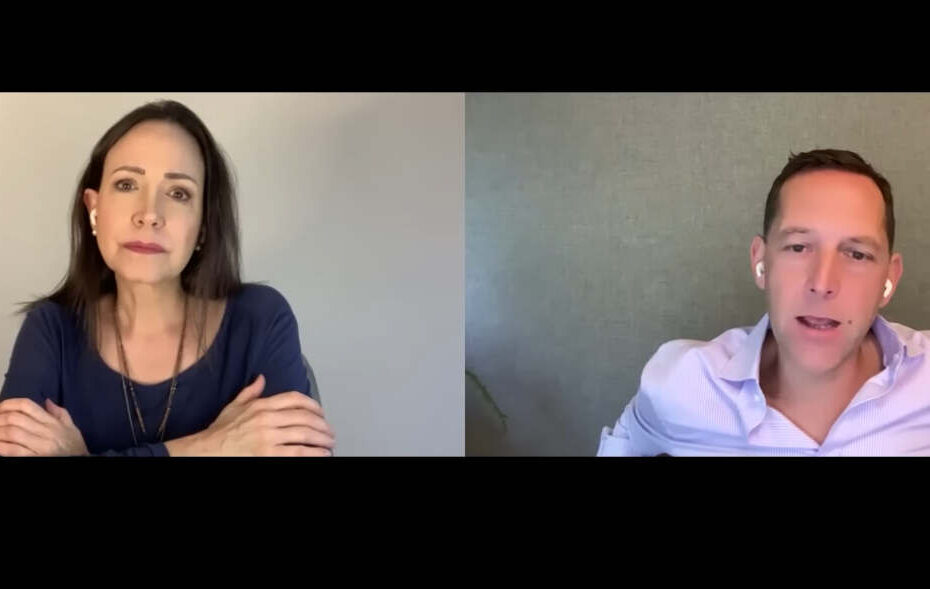
Read the full transcript of Nobel Peace Prize winner María Corina Machado’s interview on All-In Podcast with host David Friedberg on “Defeating Maduro, Socialism & Freeing Venezuela”, October 28, 2025.
Introduction and Background
DAVID FRIEDBERG: María Corina Machado, welcome to the All-In interview and thank you for being here with me today. And congratulations on winning the Nobel Peace Prize two weeks ago.
MARÍA CORINA MACHADO: Thank you very much, David. It’s my pleasure.
DAVID FRIEDBERG: Today you are in hiding. In October of 2023, you won the presidential primary election in Venezuela. Last March, you were disqualified from running in the general election. You appointed ultimately a surrogate, Edmundo González.
After the vote for the general election for the presidency, your party presented evidence that claimed that you had won 69.5% of the vote, while Maduro, through the National Electoral Council, declared that he was the winner with 51% of the votes.
This is the recap of a very long story of the Maduro regime and prior to that, the Chávez regime and its effect on the people of Venezuela, which you have tried to bring to light on the global stage.
I was hoping to frame up the story for our audience who may not know the history of Venezuela very well by talking a little bit about the background of the country and how your childhood and your youth brought you to the stage that you’re on today.
And just to provide a little bit of background, and forgive me for my lengthy introduction, but I think it’s important for folks to understand that the discovery of oil in Venezuela in 1914 began an economic boom that really kicked off in 1922.
Today, Venezuela has proven oil reserves of 300 billion barrels, the number one proven oil reserve in the world. Saudi Arabia is number two at 266 billion and the US is at 48 billion.
Over the decades that followed the discovery of oil in Venezuela, there was initially an improvement in the economy through the investment by the Seven Sisters, which are a group of seven oil companies. And ultimately there was a transition in the country to nationalize oil production. And that led to, I think, the story that brings us here today.
So, María Corina, again, thank you for being here. Maybe you could tell us a little bit about your youth.
Growing Up in Venezuela
MARÍA CORINA MACHADO: Well, first of all, I have to thank you because this is a unique, decisive moment in Venezuela. We’ve been under this tyranny that has turned into a real criminal structure for 26 years that have turned what used to be one of the freest and richest countries in the Americas into one of the poorest and with a third of our population forced to flee. So imagine what a tragedy.
It shows that you can have huge, unique natural endowments, but that’s not wealth. You need talent, you need institutions, and you need freedom in order to turn that into the well-being of your people.
I was born in an incredible family. I thank the Lord because we have a huge family, like Latin American families like to be together, hanging around all the time. My father was an incredible industrial entrepreneur. He is perhaps the smartest and most generous and honest individual I’ve met in my life. And he taught us the responsibility that comes with that, with your family values and the opportunity life gives you.
And that’s why I only imagined my life in Venezuela and in freedom. And we grew with that sense of responsibility. But to be honest, I’m part of a generation that lived, you know, politics with rejection or even contempt. I said I would do anything in my life but politics.
We thought that we had inherited democracy forever. We took it for granted. And when Chávez arrived, our lives were turned over. And we realized that we need to exercise citizenship if we wanted to live with freedom. That’s how it all started. I never thought I would be sitting here with you talking about politics or democracy.
DAVID FRIEDBERG: I never thought I would be sitting on a podcast. But life takes us down strange paths.
What were the conditions in the country when Chávez came to power? What sort of life were you living? What were you seeing in the country that enabled Chávez to come to power? And what did he promise the people?
The Rise of Chávez
MARÍA CORINA MACHADO: Look, we had a period of democracy that brought Venezuela huge opportunities, you know, widespread education and health. Unfortunately, we stopped short of a real free economy.
But the state control, not only of institutions, but as you mentioned, when the oil companies were turned into the government’s, terrible incentives started being created, and more and more people felt excluded from that wealth that the society, Venezuelan society was getting or the country was getting because it was all in hands of the state.
So we’ve always known the state-controlled economy. We’ve always seen nothing but that kind of socialist procedures in place. When Chávez arrived, we had gone through a political crisis, and there were growing tensions and claims of corruption in the political system, the party system. And also the price of oil was around $8 a barrel.
So he came with a populist narrative offering everyone to be equal and to revenge against all those that were guilty of poverty in the country. And he aligned with actors such as Fidel Castro in Cuba and other international interests to access those huge resources Venezuela has. And of course, in a super strategic geographic position.
So that’s how he got there. And that populist system turned into autocratic and then into a criminal structure.
DAVID FRIEDBERG: And this was 1999 that he came to power.
MARÍA CORINA MACHADO: That was in 1999.
DAVID FRIEDBERG: And at the time, I think when he took office, oil was at around $14 per barrel.
MARÍA CORINA MACHADO: Up to $100, even less. Yeah, that’s true.
DAVID FRIEDBERG: Just to contextualize all of this, prior to his coming to power, the oil companies had been nationalized. So to your point, the government was really the economy. And he promised this sort of equality and redistribution of value for all of the people of Venezuela. Is that what he promised? And the economy was really depressed because of the oil price being down.
MARÍA CORINA MACHADO: Yeah. And that he would take, you know, resources from the rich, the companies, and he would distribute in poor quarters and in the most vulnerable parts of society.
And at the end, we learned the hard way that effectively, this kind of socialist approach does get everyone equal in absolute misery, because there’s nothing for free in life. I mean, you give away your choices, your decisions, supposedly to receive, but actually what you are getting is into a slave situation in which the state decides for you, and only if you behave accordingly, you will get what they had offered.
So that’s what we’re seeing right now. Imagine this, David, the country that has the largest oil reserves in the world. I’ve been walking around those areas where that oil is actually beneath the ground, and you see children eating from garbage.
Socialism is Slavery
DAVID FRIEDBERG: It’s unbelievable. And I think to your point, and I was going to bring this up later, but there’s such a powerful lesson to be learned for the West, for America, for Europe. Socialism is slavery.
And I think the story that you bring to the world is one of slavery driven by this kind of socialist tyranny. There is no socialism without tyranny.
But I just want to walk through that a little bit, because as Chávez came to power, oil went up to $100 a barrel. Suddenly, Venezuela’s oil reserves made the country very wealthy. And he then engaged in a series of what some people have described to me as petrodiplomacy, where he gave away 300,000 barrels of oil per day to the Cubans at a 50% price discount in order to make the Cubans a surrogate, in order to make other island nations in the Caribbean, in the African island states, surrogates.
And that’s how Venezuela expressed their political influence around the world, was through the power of the oil reserves, but in such a way that it excluded the people from participation. It seemed to be very centralized to the government.
Maybe you could share a little bit about how folks in the government, in the military under Chávez lived these incredible lives with wealth and luxury while the people were impoverished. Any anecdotes you could share on that?
The Destruction of Democratic Institutions
MARÍA CORINA MACHADO: Yeah, sure. Look, this is the playbook that’s been tried in Venezuela and elsewhere. You get into power through elections, and then from within you start undermining every single democratic institution.
You go against the media, you control the media. And you can see this pattern in Venezuela, how Chávez started pressing or buying space and publicity and then buying the whole media outlets and through censorship and changing the laws in order to be very, very risky to speak out.
And then it went also with the private sector in every single area of production. And of course it took the military as well. I mean, all those that were the most competent individuals were put aside, and only those that were absolutely loyal to the regime were promoted.
So this is to destroy merit, so that anybody realizes that if you want to be part of the system, if you want to work for the state or the academy or in the military, it has nothing to do with your competence or knowledge or talent, but you have to be absolutely loyal and bow your head to the regime. And this progressively.
Imagine all the resources that were coming in because you said something very important that some people do not realize. I mean, the barrel of oil was around $10 or $8 when Chávez arrived, it went up to $150. Imagine the amount of resources, it was all the money in the world that they used effectively to buy loyalty and to lobby around the world and to support ideological groups all over the Western hemisphere and elsewhere.
And these groups, and let’s say these funds get in contact with each other. They exchange technology, they exchange information, they support each other in international forums. And that’s why they get so powerful in their different areas and countries.
On the other hand, what we have seen is that democracies and democratic movements in our side of the world are very isolated. We don’t help each other, we don’t support each other as we should. I think this is one of the great lessons that we’ve learned in these 20 years.
Regarding the amount of resources, look, there are estimates that the amount that Venezuela was robbed is over $2 trillion. Imagine what we’re talking about in these 26 years. And this was all either for corruption, as I said, or for this kind of obscene fortunes these very few individuals have.
While 86% of our population nowadays lives in poverty, the pensions in Venezuela are less than $1 a month, David. $1 a month.
The Drug Trade Connection
DAVID FRIEDBERG: Yeah. And so under Chávez, there was also this embracing or tie-up with the drug trade, the FARC, ELN in Colombia. What is the alignment? What was the reason that the Chávez regime, and now the Maduro regime aligns with the drug cartels?
Given the oil wealth, given the international diplomatic ties because of the oil trade, why is there also a drug tie-up? And what is the motivation and the incentive and drive there?
MARÍA CORINA MACHADO: Well, the drug business is not new actually. It started before Chávez arrived and many individuals in the military had ties to them. But they realized it could be even much more. The margins are even larger than in oil. And the greed in these individuals in this criminal structure is unlimited. It’s infinite.
So they not only went into drugs and drug trafficking, they went into gold smuggling, arms smuggling, even human trafficking. I mean, every single criminal network in the world has converged into Venezuela. That has been turned into a safe haven for the enemies of the West and the enemies of the United States.
Imagine, I mean, Caracas is three hours away from Miami. So having a satellite of Russia, of Iran operating in the heart of the Americas, it’s something that these regimes around the world have always dreamt of. Even terrorist groups such as Hezbollah, Hamas, to which Chávez and Maduro have given thousands of Venezuelan identities and passports to travel around freely around the world.
The Human Cost
DAVID FRIEDBERG: So under Chávez, the GDP declined 70%, there was mass starvation, highest crime rates in the world, 90% poverty rate. Much of the stories and anecdotes that you’ve shared have been reported publicly by international organizations.
You are 32 years old when Chávez comes to power. Three years later, you start a civil organization called Súmate. What were you doing when Chávez came to power professionally? And what motivated you to get involved in the civic engagement that carried you forward to today?
The Birth of Sumate and Entry into Politics
MARÍA CORINA MACHADO: Well, I had been working in the private auto parts and steel industry, following my father’s steps. And also I was involved in an NGO that took over a children’s shelter for abandoned and abused children. And, you know, as I say, I never thought I would get involved into politics.
But once this individual arrives, and it’s evident for us that he was promoting the division of our country to create tensions, to divide even families, even my own family. The degree of hatred, of violence in his speech, the way he wanted to create tensions among religions, races, he realized that that was going to turn apart our country.
And a group of friends, all engineers, decided that we will work to gather petitions for a recall referendum. We thought it was going to be a super easy task to get 6 million petitions in a few weeks. And we learned the hard way it would require a totally new kind of citizen organization. And that’s how Sumate, which means “join up,” finally was managed to gather the petitions in just one day.
People, millions of people came out and signed these petitions. It’s a long story. Chavez eventually committed fraud in the referendum and stayed empowered and got even more and more autocratic as the years passed by.
DAVID FRIEDBERG: So were you doing Sumate full time? Did that become your life’s work at that point? And then how did you make the decision to run for the national assembly, which was in 2011? Fast forward nine years after founding Sumate.
MARÍA CORINA MACHADO: Sumate was like an awakening for me and for many, a renaissance. We realized that we could not rely our citizenship in political parties and that you cannot be complaining about politics if you are not willing to do your part. And that’s why, you know, it came a day when I said, “Look, you know, I know how politics are doing, how it works. I don’t like it. So I cannot complain if I’m not willing to take my own steps.”
So I took this fellowship to a program of leadership at Yale University. And it was like seeing my life from above. And I made that huge decision that I was going to go for it. I was going to run for Congress. I had no political party. I had no experience. Everything was against me. Everybody told me, “You are crazy. You are never going to win. You are never going to get support. Nobody’s going to support someone whose family has resources, who’s a woman. You are not a socialist.”
I mean, I have every single condition to fail. And I decided, you know, I felt it was my responsibility. I could not get afraid. And I had to trust my own feelings. And it was impressive. You know, volunteers started contacting me, and in a matter of months, with no money whatsoever, no organization, no media, nothing, I won. I won the primaries, and then for the national assembly, that was in 2000. And then I won the election with the highest number of votes in Venezuelan Congress history.
The Role of the Internet in Democratic Movement
DAVID FRIEDBERG: Amazing. How much of a role did the Internet play? I worked at Google a long time ago, and we always had this conversation that the Internet is going to create a democratization of information, that you no longer had centralized control of information through media, and in the case of Venezuela, media that is effectively controlled by a government that wants to stay in power. Did the Internet play a role in giving you the ability to reach people around the country in 2010 to be able to get elected?
MARÍA CORINA MACHADO: Absolutely. And not only that, in 2010, I wouldn’t have won if it wasn’t for the Internet, right? I mean, no media outlet would dare to interview me. And it was a way in which we could organize because we have no resources.
But further ahead, let me tell you, I know how there are so many concerns about the use of technology by bad guys and by the regimes that are autocratic. And Venezuela is a textbook case of how you get infiltrated, persecuted, manipulation, and so on. But if it wasn’t for technology, we wouldn’t be here as a threshold of freedom. And this is something that we need to really highlight.
Expulsion from the National Assembly
DAVID FRIEDBERG: So you are, like all great revolutionary leaders, speaking truth to power. You have a seat at the table. Now you’re in the National Assembly. And then in March of 2014, you address the Organization of American States about Venezuela’s human rights. And then a few days later, you were expelled from the Assembly. And then there was all this legal stuff that happened, which we don’t need to get into. But can you just frame up what happened in that moment? Kind of what your narrative is on the transition, where they said you can no longer be a representative here anymore?
MARÍA CORINA MACHADO: Well, I had had a previous experience just one year before, because we went for a presidential election and we won against Maduro when Chavez died and they committed fraud, and we weren’t able to prove it that we had won. And that was in April 2013.
And I went back to the National Assembly. I stood up and I said, “Maduro is not the legitimate president. We won.” And suddenly I hear someone calling my name. I turn around, and there was this member of the Parliament of the Chavista regime that hit me in the face, and she broke my nose in five pieces. And we were locked in Congress. I was thrown to the floor. I was kicked by this and Maduro was watching everything. He was the president of the National Assembly.
So this was an evidence that violence had gotten out of control. Imagine if you can do that on TV. It was seen on TV throughout the country and the world while they were assaulting us.
So next year, we started peaceful protest, and the regime ordered young people that were in the streets just with placards to be shot at. So I went to the OAS, Organization of American States, and it was the first time Maduro was accused of human rights violations internationally. As soon as I came back, they just ejected me from the national assembly and by force prohibited me from going back into my seat.
So it was a very hard moment, but at the same time, it was a great opportunity because I realized that I needed to reach out personally to our country and create a totally new organization that promoted our ideas and prepared for the next stage of the struggle.
The Rise of Maduro
DAVID FRIEDBERG: And this was in 2014. Can you share about the Maduro transition? Maduro is, on paper, seemingly wouldn’t have been the natural successor to Chavez. He started out as a bus driver and then he was a union leader. It’s unclear from the outside what makes Maduro the selected successor to Chavez. What is it about him as a man, as a person, his character, that made him the successor to the Chavez regime?
MARÍA CORINA MACHADO: Well, Maduro was trained in Cuba, so it was the Cubans who chose Maduro. It was a very easy option for them, totally loyal to the communist Castro regime. And Maduro has no, you know, nothing restricts him from exercising violence and force for his ideas. And he certainly doesn’t have Chavez’s charisma nor the degree of control in the other groups.
So they were creating a group of individuals at the control of the regime, the strategy, the structure that control the military, the financial enablers, the criminal networks and the political sectors. And that’s how he went over, taking more and more control and turning Venezuela, as I mentioned before, into this safe haven of criminal activities. And he himself turned into the head of these structures.
When we heard about El Tren de Aragua, about the Cartel de los Soles, the Cartel of the Suns, I mean, these are structures that we have denounced for years and we have tried the world to understand that this was not a conventional dictatorship anymore. This is a very complex structure that produces obscene amounts of resources, not only for them, but also for very dangerous allies that come from very far, such as the ones I mentioned before, terrorist groups and so on.
They turned Venezuela into one of the Russians’ main buyers of army and weapons and also one of the, I would say the major stronghold of the Iranian regime abroad. I mean, they used Venezuelan financial system to bypass financial sanctions and they use our territory to operate freely.
International Alliances and Economic Ties
DAVID FRIEDBERG: And what about China? Can you share a little bit about China’s relationship with Venezuelan leadership in Maduro? And when that became a more kind of intimate economic tie?
MARÍA CORINA MACHADO: Well, Venezuela turned out to be China’s main debtor with over $60 billion in debts that accounted for all kinds of different projects that were never built. And certainly China realized that Venezuela’s natural endowments are unique, absolutely unique. It was strategical.
Nonetheless, the degree of corruption in the system, in this system is so big that China stopped funding Maduro about seven years ago and simply getting the oil to pay for the debts that are still pending. I believe China understands the strategic importance Venezuela has also for its geographic location, but has been more prudent because of the degree of corruption that they have suffered from Maduro and the regime.
But there’s also the side of the intelligence, espionage and technology and satellites from China that have been installed in Venezuela. That’s a very important dimension for them as well.
The Venezuelan Exodus
DAVID FRIEDBERG: Venezuela is a country of, I think, 28 million people. By some estimates, 8 million people have fled the country. Does that feel accurate to you? And can you provide some anecdotes of why people leave, where they go, and what it’s like in the country that’s causing this mass exodus of the population?
MARÍA CORINA MACHADO: Look, we’re a nation of a little over 30 million. I mean, this is a country where you have no information whatsoever. Imagine living in a country where you don’t know how many you are. You don’t know what’s the size of your debt or your GDP or inflation. Nothing. It’s a black box. That’s why it’s also a challenge in terms of what’s coming up.
But roughly 9 million people have left. It is, you know, around 30% of our population. Imagine if 30% of American people left, what it would mean. It’s devastating because we’re seeing our young people, our children, doctors, engineers, scientists, nurses, teachers.
And of course they go because the situation from an economic perspective is horrible, but mostly because you don’t see a future in your country, because you feel there’s no possibility to survive. So women that have left their young children back only to send something for them to eat, children that have left their parents alone. I’ve met so many, so many, so many grandparents that have not met their grandchildren yet.
And they try and help me and ask me, “Please, please bring my grandchildren back.” And we all know that the only possibility for that to happen is that we have a transition to democracy. And when that happens, David, you will see the day Maduro goes, hundreds of thousands of Venezuelans voluntarily coming back, even though they know it’s a hard moment that we’ll have to work really hard.
But we know the potential, that unique potential, and they want to be part of this. It’s much more than a political struggle for us. It’s an existential struggle as a nation and also spiritual struggle as well.
Mechanisms of Repression
DAVID FRIEDBERG: A lot of people will say, why don’t they go on the streets today? Can you talk a little bit about the intimidation of the Maduro regime and why it’s so difficult for people to rise up in the way that we have seen other revolutions historically around the world? What keeps that from happening? What are the mechanisms that are used to stay in power by the Maduro regime?
The Reality of State Terrorism in Venezuela
MARÍA CORINA MACHADO: Look, and we have seen that in Venezuela many times as well. I mean, we’re talking about thousands of times in protest, in peaceful rallies, in people going out, tens of thousands and even hundreds of thousands. But the regime has developed, this regime, Maduro, with its human intelligence mechanisms to infiltrate. And anyone who goes out is either detained, harmed, killed, disappeared.
When we won the election last year in July 28, thousands of people went to the streets while we were counting the votes, which I’ll want to tell you a little bit more ahead. And you know, in a matter of 24 hours, 2,500 people were in prison, including young people, children, women that were even sexually assaulted, abused, just because they had gone out to the streets to peacefully claim for their right for popular sovereignty to be respected.
But they went beyond that, David. They went to the houses of our activists that had been taking care of the election, that worked as witnesses, that they took care of the townships, and they took them away. And if they weren’t there, then they would grab their families, their mothers, their children, their couples, and every single person who even posted my picture on their Instagram account or X account, whatever, they would go and take them as well.
So it was so brutal that the Inter-American Commission of Human Rights labeled it as state terrorism. And the fact-finding mission of the United Nations has said those are crimes against humanity. It was so wide, so systematic that what they wanted is to terrify society.
So we’ve had these last 15 months a period of darkness as we’ve never seen before. I was accused of terrorism. Maduro is searching for me. He said I would spend the rest of my life in prison. Some people, I think it would be even worse. But, you know, all my team, which, you know, manage the campaign, this campaign that took place, are either in prison or they had to leave the country.
So this is a moment in which, you know, fear has been imposed by brutal force. But that doesn’t mean that Venezuelan society is neutralized. On the contrary, as we managed to organize for an incredible, epic episode when we won the election. Now we have been organizing underground and preparing for the day in which democracy will come and people will make sure it is an orderly process.
Addressing Claims of Western Interference
DAVID FRIEDBERG: Maduro has publicly said many times that you are a puppet of the west, that the US and its allies are trying to interfere in Venezuelan politics because of their economic interest in the Venezuelan oil reserves. I want to give you a moment to respond to those claims. I think you’ve done an amazing job highlighting your motivation and the on-the-ground experience. But can we counter or have a conversation about this belief, which, by the way, many have made because of the US involvement in Middle East and Middle East politics and the US’s absence of involvement in politics in countries that are not oil rich. Maybe we could talk a little bit about the importance of this for the west, not just the economic interest, but what else is motivating this? And why is the US interested in supporting your cause?
MARÍA CORINA MACHADO: That claim is not very original. I mean, that’s what all of these guys say to anyone that speaks out, even if it’s, you know, a union leader, student, or a priest. And frankly, you know, I couldn’t care less for what they say. You know, we know what we are, what we believe, and what the people and why people trust us.
We have managed to build the strongest citizen movement in our country’s history, starting in 2023, when Venezuela looked hopeless and divided and without a chance to move ahead. We reached out to every single. I went to every single corner of my country. Look, I went with my car because I’ve been banned from leaving Venezuela for over 12 years. I’m not even allowed to buy a local flight ticket.
So they thought they were hiring me, but actually they gave me that biggest opportunity to, you know, go through my country from one point to the other and to talk to people, to listen, to learn, to understand, to get really close in terms of what we are and what we believe. To turn down those barriers the regime had built to divide us and to find out that this is not about left or right, which are black or white. It is about human dignity. It’s about respect, solidarity, cooperation, freedom. And love. And love, which is the strongest force that has brought us together.
You know, I’ve seen people that were close to the Chavista for years coming to me, crying, hugging me, asking for forgiveness. And I said, no, I have nothing to forgive. You know, we have a common goal now. We have a common vision. We all want our kids back home. And that’s precisely what’s happening right now.
So, look, Venezuela is, for me, the country with the largest opportunities, not only for the United States and the rest of the West. I mean, imagine. And I’m not talking about our natural endowments, which are huge. We’ve already addressed that. Or infrastructure, or even our geographical position. It’s our people. What if we have endured and the way we have come together, and I’ve heard recently some people talking about that, you know, once Maduro goes out, because it will leave soon. You know, there’s this risk of, you know, civil war or unrest? Give me a break.
We’re talking about a country where 90% of the population, we all want the same. There are no religious differences, there are no racial tensions, no social or political differences. We all want the same. And we have fought so hard for freedom that we are the ones who are guaranteed that this will be an orderly transition.
And yes, we are close to the United States values and culture. Yes, we are. We admire a nation that has strong democratic institutions, that feels proud for their achievements, their history, their legacy, and so are we. So, you know, those kind of socialist rhetoric nowadays is useless in Venezuela. You know, we only know socialism. And Venezuela today is a country. I believe that, you know, most people embrace open markets, respect for private property, merit and collaboration.
The Historic Primary Victory
DAVID FRIEDBERG: I want to just talk about the election, and then I’d like to ask your view on the United States today. But let’s talk about the election. Two years ago, you ran for president. You won the primary with a resounding victory in October 26, 2023. Today you’re sitting in a basement. You’re not in the office of the president. Can we walk through what happened? What was that campaign like? How did you reach the people, given that you didn’t have access to the state media and then maybe share a little bit about that primary victory and what happened afterwards?
MARÍA CORINA MACHADO: Yeah, you know, we realized, as I said in January 2023, that we needed to get trust back in the Venezuelan people, trust ourselves and trust each other. And the primary at this incredible opportunity of giving power to the people and not the political parties that used to decide, you know, which candidates were. So we decided to push for a primary and a primary in which the regime would not get involved.
In Venezuela, in previous primaries process, the regime electoral entity would organize their primaries. And we said, this time, no way we’re going to do it organized by citizens. It was a huge challenge and a great risk. And we believe the regime totally underestimated us. They thought that perhaps, you know, 100,000, 200,000 people might appear and vote and so on. And that’s why they let it go, let it run.
And when October 22nd. You know, it’s two years ago. Exactly. They came. I was a candidate, there were 10 candidates. And I thought, well, it’s a miracle that it’s just this is happening as we’re seeing it mid-morning, around 10 or 11 in the morning, I start getting calls from all around the country saying we run out of ballots. I said, what do you mean? I mean, it’s only three hours of the process. What do you mean? We ran out of ballots. So many people showed up, over 3 million Venezuelans. And it was such a courageous act, David, because going out meant that you were voting for the opposition.
DAVID FRIEDBERG: No.
MARÍA CORINA MACHADO: So this was huge. I’m talking about remote towns that we need to have river boats in order to get the results. And also when it swarms around the world, because I insisted, and many of us, that Venezuelans abroad, our diaspora, should be allowed to vote. So that day our country came together. I am humbled, I am grateful. I got 92% of the votes and Maduro realized that they wouldn’t be able to stop me, so they banned me from participating.
Confess to you that it was one of those really tough days in your life because it was so unfair. I mean, I had a mandate, but, you know, I could have blown everything, but I decided, no, we have to keep on going and we’re going to have to find someone that is willing to take my place. And once again, the regime underestimated us because they accepted a 74-year-old diplomat that nobody knew who he was. A super honest, loyal, intelligent, good person. No one knew who he was.
DAVID FRIEDBERG: This is Edmundo González.
MARÍA CORINA MACHADO: Edmundo, exactly. Edmundo González, our president-elect. And I had a poster with his face. So I went all over the country telling, if you want to vote for me, you have to vote for him. And this is the guy. And at the same time, remember, we had had over 30 elections that progressively were more and more and more and more fraudulent.
DAVID FRIEDBERG: I mean, sorry, Edmundo González, he became your candidate in July of 2024 last summer.
MARÍA CORINA MACHADO: Just to be clear, right, in May. The elections were in July.
DAVID FRIEDBERG: Yep. Okay, elections were in July.
Building a Grassroots Movement Against Fraud
MARÍA CORINA MACHADO: So imagine at this time, I mean, nobody knew who the candidate was, and everybody knew we were facing the most fraudulent system in the world. I mean, the concept of fraud collections that are being spreading around the world, it was born here in Venezuela with the electronic machines and all the stuff they’ve been creating around it. Fear manipulation, altering the register, this and so on.
So we realized that we needed to use technology in our favor. And that’s why we managed to create a legion of volunteers. We trained them without origin noticing that we were training them. There were 5,000 sessions in person and over 300,000 people trained by the Internet. We develop apps for cell phones in which we will monitor every single polling station around the country.
DAVID FRIEDBERG: How many people did you recruit to this legion for the ballot monitoring?
MARÍA CORINA MACHADO: It ended up being more than 1 million volunteers, everyone with a specific task. David, we had no money. We could not print flyers or posters. You know, how much was our publicity budget? Zero. We didn’t pay for one ad. Nothing.
When we went around the countries and we stayed in hotels, the regime would come the next day and close the hotel. If we went and stopped in the street to buy some food, then they will punish the restaurant or the snack place. I mean, they blocked streets, they got our people in prison, persecuted those that were in control of the electoral and organization departments. I mean this was huge. But they turned this into an epic. And citizens decided that it was going to be their own epic, their own victory.
So we train all these people with our diaspora, we had these apps designed and we knew, and this is a very important part, that we had to prove our victory for the first time. We needed to prove the results. So we designed a system through which we would collect the original tally sheets, we would scan them and we will publish them in a digitized webpage, super robust for the whole world to see.
And in order to do this, imagine we are in a country where 60% of our territory doesn’t have access to the Internet or even cellular phones. So we needed to geo-optimize, you know, process centers to process the physical tally sheets. And we did that. We smuggled Starlink and tenants into the country. Generators, laptops, cell phones. And without origin noticing it, we installed these 130 operational places.
And in less than 24 hours we were able to prove our victory with the images, original images of the tally sheets being seen and scrutinized by the whole world. They were audited by over 20 different independent technicians and universities and they all concluded that those were the real. So to be honest, I think we do have set a new standard for electoral integrity. Not only in dictatorships, even in New Eden, for democracies.
What Comes Next
DAVID FRIEDBERG: And the data that you shared show that you won a resounding victory. Your party won the presidency and Maduro declared himself the winner. Since then he’s issued a warrant for your arrest. What is next for you? What is next for the country?
The Long Road to Freedom
MARÍA CORINA MACHADO: Look, it’s been such a long way. I have so many colleagues and friends that are currently in jail, that are very far away or even killed. This has been very painful, but at the same time we have grown so much. We’re a different society, but also we’re different and better individuals.
We’ve learned the value of living in democracy and being free. And now we’ve come such a long way with defeating Maduro in the hearts and minds of the Venezuelan people, with defeating Maduro in the ballot boxes. We defeated Maduro in the spirit of Venezuela, and now the only thing he’s got left is his violence.
And there’s few top brass individuals and financial enablers that have terrified those in the military that still are supporting him. But these last 15 months of resilience and resistance created more and more pressure from within. And now, finally, we’re seeing a reaction from abroad.
For years, we have asked the world to understand that this is a criminal structure. And as such, in order to break it down, you need to cut the inflows of criminal money that comes from drug trafficking, from gold smuggling, from human trafficking, or the black market of oil. You need to cut those inflows. And that’s precisely what President Trump is doing right now.
And we are very grateful to see this international coalition that is applying the law, the enforcement of the law on this criminal structure, which is what we need. Maduro, for these long years, has felt that he could disappear, kill, torture people with absolute zero cost. But the time of impunity has ended.
And I believe the regime is in its weakest position ever. They understand it is serious. There is a real threat. And we are seeing defections, betrayals, and more and more people from within the regime reaching to us. And what we’re saying is, look, we had offered a possibility of a negotiated transition, and now that that day is closed, we offer everybody that decides to step on the side of the law that they can be part of this huge transformation of Venezuela.
American Support Across Administrations
DAVID FRIEDBERG: Can you highlight the moments of the American presidencies, the American administrations, Obama, Biden, Donald Trump, and how they have supported the cause. And what’s different today?
MARÍA CORINA MACHADO: I do have to say that we’ve had bipartisan support. And you see that in Congress even yesterday, because there are sensible individuals in the Senate, in the House that understand that it’s for humanitarian reasons, because of millions of lives at risk in Venezuela, but it’s also for the national security of the United States. I think that’s pretty well proven at this point.
But so far, there were only words, only statements, and no actions. And when you face a criminal regime, you have to understand that the way to reach peace is through freedom. And freedom requires strength. And that is moral strength, spiritual strength, and physical strength. And that’s what finally the regime is facing at this point.
So we are very, very grateful to President Trump and his administration for the visionary and decisive way he has acted. Calling things by their names requires courage. Not a lot of people were willing to do that before.
So now look, we are prepared for an orderly transition. We know what we need to do in the first 100 hours, 100 days to take control of the institutions and our territory. Venezuela has been destroyed in every possible way you see it, in our economy, in our security, in our national sovereignty, in the public services, basic services that people require.
But our people are tougher and stronger than heaven. And we are determined to be free. So this is going to be a rebirth. We’re going to turn Venezuela from the criminal hub of the Americas into the energy hub, the technology hub and the democracy hub of the Americas.
And we will need to do that from scratch, from ruins. But we have our huge incredible diaspora that are willing to come back. Imagine with all the resources we have, the energy, the capacity to produce energy, not only natural gas and hydroelectricity, solar and so on. We’re going to be so attractive for those who want to invest, not only in energy, but in technology, AI, data centers. We have everything to turn Venezuela into a bright and proud nation very fast.
A Warning About Socialism to American Youth
DAVID FRIEDBERG: And before we wrap, María Corina, I’d love to just ask you an important question, which is we are seeing a rise of interest in socialism that’s unprecedented in the history of the United States, largely fueled by what some would argue is a challenging income growth situation, student loan debt. I mean, it’s a very different situation than Venezuela.
But many middle class American children are finding themselves unable to progress like every generation before them in US history. They cannot seem to create better lives for themselves than their parents. And as a result we are seeing in cities like New York, Zoran Mamdani being the favorite to become mayor and presidential candidates being discussed that maybe also have a socialist agenda and socialist interests.
I want to give you an opportunity to speak to the youth of America about the lessons learned with what Venezuela has gone through with its socialist cycle here. And maybe something that you could share that could help them think a little bit more differently about the choices ahead for the American democracy.
MARÍA CORINA MACHADO: Yes, we went through the same experience 26 years ago. People would warn us and say, watch out what socialism and communism could bring to you. And we would always answer, “Venezuela is not Cuba. That’s not going to happen to us.”
At the end, look at the disaster, devastation we had. Nine million of our people spread around the world. And the fact is that you can only live in peace and prosperity if you have freedom and democracy. That’s our lesson.
And those who offer to give you for free what you need to get on your own with hard work, end up charging you with the most valuable asset you could have, which is your freedom, your capacity to decide and to make your own decisions. And that’s a great lesson.
When you have the state on top of you, that means the whole society will probably be equal in misery and poverty. So I do trust the American institutions and American spirit and American dream. And I think these temptations come many times and they are good because they make societies reflect on what they have and understand that freedom and democracy ought to be defended, taken care of every single day of your life.
When you lose it, it’s very hard to get it back. And that’s a lesson we’re going to give to our children and our grandchildren. And I believe the American people value what they have. And I hope that having so many Venezuelan people around you can also give you an idea of the threats and dangers of these systems.
Closing Remarks
DAVID FRIEDBERG: María Corina, courage is speaking truth to power. I cannot think of a more powerful regime to speak truth to. And I thank you for your courage, for your leadership. Congratulations on winning the Nobel Peace Prize and thank you for joining me here today.
MARÍA CORINA MACHADO: Thank you. It was a pleasure. And I look forward to hosting you in Free Venezuela where you will see great investment, great prosperity, and also peace and freedom from Venezuela to the rest of the region. Thank you so much, David.
DAVID FRIEDBERG: Thank you.
Related Posts
- Transcript: President Trump Addresses the 81st Session UN General Assembly
- Maggie Haberman: Trump’s ‘Unreality Bubble’ Meets the Midterms (Transcript)
- Transcript: President Trump Remarks on Healthcare, Sep. 18, 2026
- Transcript: Jonathan Swan’s Dive into Trump’s Reality: The Weekly Show
- Transcript: President Trump Remarks in Dublin, Ireland – Sep 12, 2026