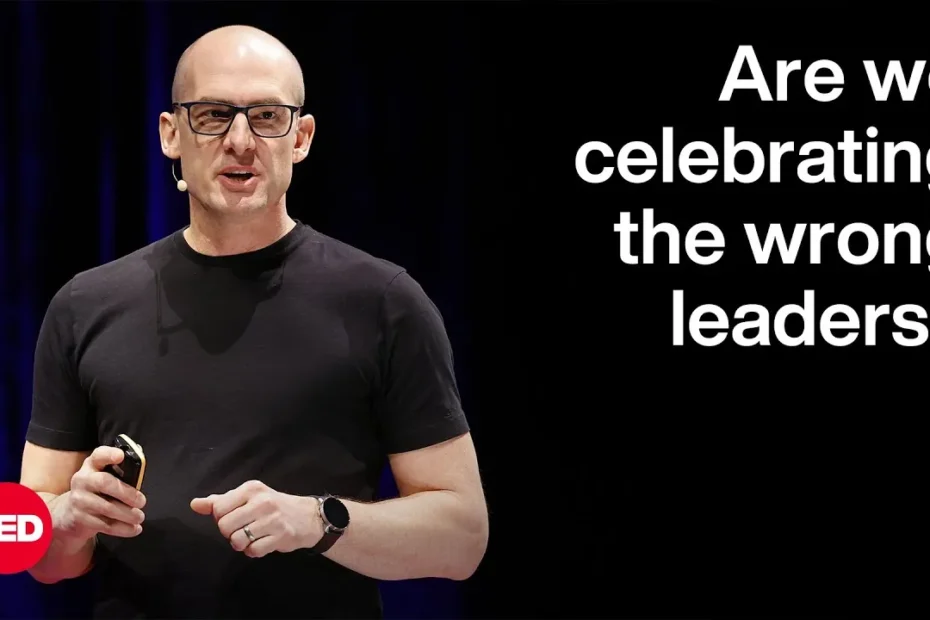
Read the full transcript of historian Martin Gutmann’s talk titled “Are We Celebrating the Wrong Leaders?”, at TED Talks conference, May 28, 2024. This talk explores why we often celebrate the wrong leaders and what this means for leadership development today.
Listen to the audio version here:
A Thought Experiment: Choosing the Right Captain
Martin Gutmann: I would like to invite you on a little thought experiment. Let’s pretend that we’re going on a polar expedition together, all of you and me, and we need to hire a captain. And we have two resumes in front of us.
One comes from a man who has already successfully achieved all four of the major polar goals: the North Pole and the South Pole, and the Northeast and Northwest Passage. In fact, three of these, he was the first person to accomplish. Let’s call him Candidate A.
Candidate B is a man who set off for the Antarctic four times, three times as the man in charge, and every time resulted in failure, catastrophe, or death.
Who should we hire? It’s not meant to be a trick question. I think it’s obvious we want Candidate A. He’s the man for the job. But in reality, we often trick ourselves into hiring Candidate B or someone like him.
The Shackleton Paradox
How do I know? Well, both of these men were real polar explorers who lived during the so-called heroic age of polar exploration. And in the centuries since, one of them has been consistently celebrated as a leadership role model in best-selling books, blogs, documentaries, podcasts, and an endless stream of social media posts.
But surprisingly, shockingly, this is not Candidate A, but Candidate B, the very much disaster-prone Anglo-Irish explorer, Ernest Shackleton.
Meanwhile, Candidate A, the Norwegian Roald Amundsen, by any metric, the most successful polar explorer to have ever lived, has been largely forgotten. I did a quick search in my university’s library catalog before this talk, and I found no fewer than 26 books that celebrate Shackleton’s leadership qualities. For Amundsen, I found four, two of which I wrote.
What is going on here? Why are we obsessed with a mediocre-at-best leader and overlooking a truly gifted one?
We Celebrate the Wrong Leaders
Well, I’m a historian who studies leadership, and I’m here to tell you we celebrate the wrong leaders, and not just in the realm of polar exploration.
Have you heard of Toussaint L’Ouverture? You probably discuss him around the coffee machines in the mornings. Maybe not, but you should. He was born an illiterate slave and rose to become one of the most influential revolutionaries ever and outsmarted the biggest empires of the day, including Napoleon’s.
What about Francis Perkins? He was the pillar in U.S. President Franklin Delano Roosevelt’s famous New Deal.
We celebrate the wrong leaders, and this is not just an academic or a trivial insight. Leadership development today is the $60 billion industry. For good reason. We need leaders. All the challenges that we face today require people to work together, and this in turn requires somebody who can motivate them, inspire them, coordinate the work, deal with whatever hiccups might arise along the way.
But for this reason, it’s important that we celebrate the right leaders, because the leaders we celebrate are the leaders we learn from. And so in this sense, the leaders we celebrate has a direct impact on the success, or as it may be, failure of our greatest endeavors today.
So why do we celebrate the wrong leaders? Sometimes it comes down to pure racism and sexism. We have a well-documented bias for associating leadership with white men. But there’s another culprit at work as well, what I like to call the action fallacy, our mistaken belief that the best leaders are those who generate the most noise, action, and sensational activity in the most traumatic circumstances.
In other words, we confuse a good story for good leadership. But the two are not the same. As a matter of fact, very often, good leadership will result in a bad story.
Let me explain. Imagine leadership for one moment, not as a polar explorer charting a new course or a CEO motivating her staff, but as the simple act of swimming across a river. And not just any river. Imagine a violent river with waves crashing together and rocks lurking somewhere below the surface.
If a swimmer ventures in haphazardly, without being aware of his own capabilities or the currents, and nearly drowns, but splashes around wildly, fights with all his strength, and somehow, miraculously, manages to drag himself back to safety, those of us looking on will notice him. And we will probably say, “Wow, what a guy. He really fought hard to get himself out of that crisis.”
And if instead we have a swimmer who has studied the river for years and knows just where and when to enter the water, and how to turn her body in subtle ways, and so lets the current carry her across, we probably won’t notice her. And if we do, we would probably say, “Eh, that looks pretty easy.”
Shackleton vs. Amundsen: A Case Study
Shackleton and Amundsen are a case in point. Shackleton, our candidate B, is best known for his ill-fated Endurance Expedition, which set off in the summer of 1914 and saw his ship become trapped and eventually crushed by the ice off Antarctica. And he and his men were then forced to undertake a dangerous trek across the ice and brave some of the stormiest seas on earth before finally reaching the safety of South Georgia in the summer of 1916.
Now, Shackleton was a tenacious man, no doubt. And his is a captivating story fit for Hollywood. In fact, it was made into a TV series starring a young Kenneth Branagh. But it is not a story fit to draw leadership lessons from. Because admirable those efforts were, the crisis that beset him was largely self-inflicted.
He overlooked the advice from local whalers who told him the ice was particularly dangerous that season.
And he overlooked massive deficits in his equipment, preparation, crew selection, and training. And it gets worse. Rarely highlighted in the many books that celebrate his leadership qualities is the fact that the expedition’s other ship, the Aurora, suffered an even graver crisis, the result of which was three lost lives.
In contrast, the expeditions of a Roald Amundsen make for boring reading, not because he was lucky, but because based on his intimate knowledge of the polar environment, his careful and deliberate planning, and his authentic and innovative leadership in the field, he managed to reduce the problems that his team encountered to a bare minimum.
In 1905, he achieved in a tiny fishing vessel what the mighty British Navy had failed to do the previous eight decades, to find and navigate the Northwest Passage above the Canadian mainland. In 1911, he reached the South Pole, a journey of 3,000 kilometers across hazardous and uncharted terrain, and arrived back at his camp after 99 days, just one day off his planned schedule.
If Shackleton is the swimmer who rushes recklessly into the water without understanding the currents or his own capabilities, Amundsen is the swimmer who has spent a lifetime humbly studying the river before entering the water in just the right spot at just the right time, and so makes it look easy.
The Action Fallacy in Today’s Offices
Now the action fallacy causes real problems, and not just for our interpretation of the past. I arrived at it through my work as a historian, interested in why we celebrate some leaders of the past, but not others. But it’s a dangerous feature in our offices today as well, because after all, the same biases and misconceptions that we bring to our reading of the past are one and the same with which we view leadership in our offices today.
It is the Shackletons of our offices, rather than the Amundsens, who serve as role models, who get promoted, and who get rewarded. In fact, this is something studies in organizational psychology have confirmed. We see leadership potential in people who speak more, regardless of what they say. In people who appear confident, regardless of how competent they are. And we have an unyielding admiration for people who are perpetually busy, regardless of what they’re actually doing.
I see some of you are imagining specific people in your office right now. Don’t worry, we won’t tell them.
In other words, appearing to be a good leader, rather than actually being one behind the scenes, is the path to fame and bonus and promotion today. And this causes all kinds of problems.
With the wrong leaders in charge, organizations are obviously not performing at their full potential. And it creates a toxic culture in which those actually doing good work feel overlooked and demotivated. And perhaps worst of all, it’s a self-perpetuating cycle, because by celebrating these flawed action-oriented leaders, we’re actively creating more of them.
The Solution Starts with Reimagining Leadership
So this is a problem that we need to solve. The good news is, we can. And it starts with reimagining what good leadership looks like. And there’s two sides to this. First, we have to learn to ignore what we can call the captains of crisis, the Shackletons, those who are lurching from one dramatic circumstance to another.
While some crises can’t be avoided, many are self-inflicted or amplified by poor leadership, or sometimes just a figment of their imagination. Keith Grint, the preeminent scholar of leadership today, brilliantly summarizes this problematic dynamic. Since we reward people who are good in crises and ignore people who are such good managers that there are few crises, people soon learn to seek out or reframe situations as crises. We need to disincentivize this style of leadership by refusing to give these people the attention they crave.
And that’s easy when we’re confronted with the sober facts: Amundsen’s four successes, Shackleton’s four failures. But as soon as it’s embedded in a story, the dramatic details pull us in like a magnet and give us a false sense of inspiration—false because there’s no real substance there. Instead, we need to learn to celebrate those who mitigate rather than promote drama.
The Power of Boring Management
And this can be challenging because often they do so in very subtle ways, below the surface of the water, in the case of our swimmer. They’re obsessive planners. They build processes that align the organization’s strength with the unique challenges they face. And they’re authentic and create cultures that bring out the best in people.
Harvard Business School professor, Rafael Estadun, has studied the profound impact this behind-the-scenes work can have. And she has given it a name. I don’t want to give you too many technical, academic terms here, but this is an important one. She calls it “boring management.” But as she tells us from her research, the evidence is clear that boring management matters. It may not be as exciting as leading a cavalry charge from the front or giving a brash pep talk, but it’s the real toolkit of good leaders.
And to me, making a difference from behind the scenes, unconcerned with what other people are thinking, unconcerned with spilling self-aggrandizing words or exaggerating—such people are truly inspirational.
Overcoming the Action Fallacy
Let me summarize. The action fallacy tricks us into celebrating the wrong leaders. And this comes with huge costs. We can overcome it. I would say we must overcome it. And this starts with reimagining what good leadership looks like.
So the next time you’re in a position to judge or reward a leader, or maybe just the next time you’re trying to figure out whose efforts actually guided your team or organization to success, resist the temptation to be dazzled by tales of adventure and daring do. And take a moment to look below the surface or in the quieter corners of your team.
And this is important because the next time your organization is faced with the equivalent of the ice pack looming on the horizon, who do you want in charge? The leader who responds to the ship freezing in place by frantically cranking the engine, unpacking the crates of dynamite, and pushing his men to their breaking point? Or the leader who avoids getting stuck in the ice in the first place?