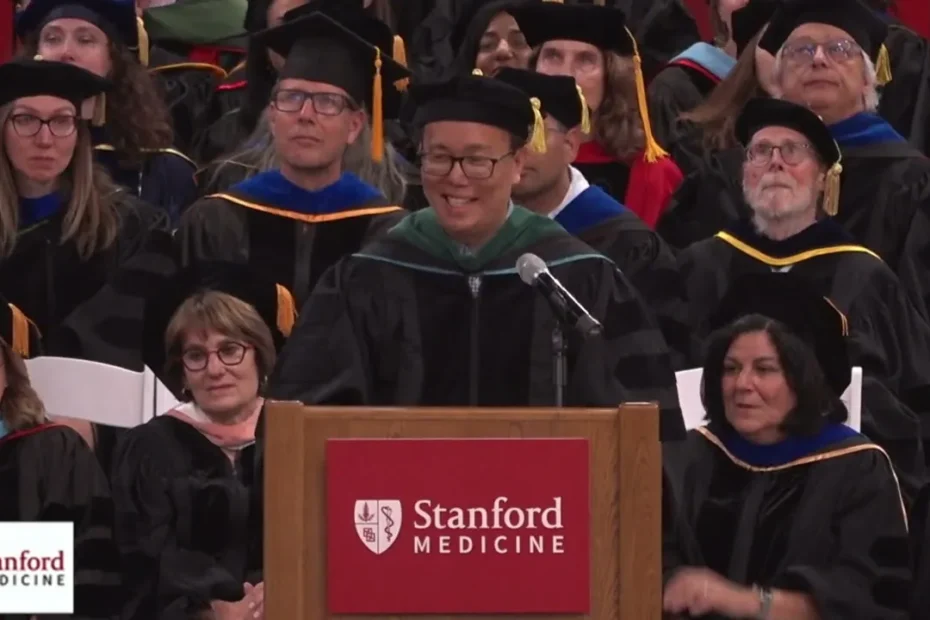
Read the full transcript of physician, educator and researcher Bryant Lin’s commencement speech at 2025 Stanford School of Medicine Graduation, (June 15, 2025).
Listen to audio version here:
Introduction by Dean Minor
DEAN MINOR: It is now my sincere honor to introduce this year’s keynote speaker, Dr. Bryant Lin. Bryant is the best combination of optimist and problem solver. He sees opportunities where others just see problems. He sees gifts where others just see challenges. If there is no silver lining to be found, he creates one.
He’s a physician, an electrical engineer, and a computer scientist. And he brings all those skills and mindsets to play as a doctor, teacher, researcher, and entrepreneur. Even as he gets excited by new technologies and algorithms, he remains laser-focused on the people, his patients, his colleagues, and his trainees.
In 2018, he co-founded and still co-directs the Center for Asian Health Research and Education. The Center aims to predict, prevent, and cure diseases that disproportionately affect Asian communities worldwide. It remains the only one of its kind among top universities in the United States. And it’s an excellent example of how Bryant works. Identify need and address the need.
And do you remember those early weeks and months of the pandemic as we all stayed home to mitigate the spread of the still mysterious disease? It was pretty grim, and we were isolated. We were anxious. But for Bryant, it was another challenge to be met. So in conjunction with our Medicine in the Muse program, he helped launch the Stuck at Home concert series. It was a delight, bringing our community back together virtually when it needed it most.
Now I would say the shocking health diagnosis that followed in 2024 made things more personal for Bryant. But that would be a disservice to all of his prior achievements, because he holds dear all of his projects. Indeed, his strength is the very fact that he puts his entire being into everything that he does. So last year, when he was diagnosed with Never Smoker Lung Cancer, it surprised no one near him that he would turn this dreadful event into an opportunity to teach, to research, to share.
With grace and generosity and courage, he has seized every chance to raise awareness for Never Smoker Lung Cancer, including through a one-of-a-kind medical course focused on his own patient experience. Which brings him here today to speak to you, the Class of 2025, and your friends and family. So please join me in welcoming Dr. Bryant Lin.
Opening Remarks
DR. BRYANT LIN: You know, it’s funny. I wasn’t nervous until waiting to come here, and then 50 people said, “Hey, I’m looking forward to your speech today.” You know, it’s funny. I should be an expert at this. In sixth grade, I was asked to give the graduation, like, five sentences to the elementary school class. And I was chosen, I think, because I was the loudest kid in the school. Not for any other reason. And I think I’m probably the loudest faculty, so that may be another reason I was chosen today.
But thank you, Dean Minor, for the kind introduction. I’m really deeply honored to be invited to speak to you today. Stanford has been a place I’ve been at for the past 20 years. It’s been my home, and it’s just been an incredibly unique place to be. I know you guys are anxious. This is kind of the lull in the graduation, where you’re eager to get your degree, so I’ll keep it short and sweet.
The first part of my talk is about gratitude. It’s really an opportunity for me to express my thanks to the many people who have made my life just so amazing. Like Lou Gehrig, I consider myself the luckiest man on the face of the earth, and that is in no small part due to so many people here today. The second part of my talk is about three hopes and a dream I have for all the graduates today. And you’ll hear, coincidentally, some of the themes in my talk actually were already discussed by our excellent student speakers.
Gratitude to Colleagues
First, I would like to thank colleagues who have been instrumental in my 20 years here. I would not be at Stanford were it not for Dr. Paul Wang, head of cardiac EP, who has been my mentor for 27 years. Paul, where are you at, Paul? Stand up, Paul. I hope you are as lucky as I am to have a mentor. I met him first year of medical school at Tufts, and I’ve been in contact ever since, and he’s the reason I’m here. So I hope you’re all lucky as I am to have such an incredible mentor. And if you don’t have a mentor like that, find one, seek one out.
I would also like to thank Dr. Latha Palaniappan, who founded the Center for Asian Health Research and Education with me in 2018. Where are you at, Latha? Stand up. See, keynote speaker’s prerogative, I can recognize all these people. So Latha, thank you so much. I’m so lucky to have such an amazing collaborator in our endeavor to improve the health of Asians everywhere.
And unfortunately, Jackie Genovese couldn’t be here tonight. Many of you know her. She works with a lot of the students. She’s executive director of Medicine and the Muse, and she’s really patiently and thoughtfully tolerated my dozens of crazy ideas since those Stuck at Home concerts. Jackie, looking at you over the internet, thanks for your endless patience and hard work. And actually, coincidentally, I think this is the first year my first class of Biomedical Ethics and Medical Humanities students are graduating, so congratulations to those students.
Gratitude to Stanford’s Medical Team
Second, I would like to thank the amazing care and research at Stanford that has enabled me to stand in front of you a year after being diagnosed with lung cancer.
I feel like a million bucks, maybe a billion bucks because of inflation. I think all the researchers up here can tell you a million dollars doesn’t get you very far. Great thanks to my whole care team of doctors, nurses, and other staff, led by our amazing chief of oncology, Dr. Heather Wakely.
But just as important as clinical care and the research that has enabled me to survive progression-free with a high quality of life, I don’t think I’ve coughed once, I don’t feel short of breath, I’ve got cancer all over the place, but I feel great, research really has enabled me to be here. If you had told me when I was a medical student in your shoes in 2002 that a patient with metastatic lung cancer that had spread to 50 spots in my brain would be giving a full-throated graduation address, I would not have believed you at all. I would say, “No way, that person is going to go and pass within a year,” right?
And as our PhD student speaker, you know, much better than I can say, that’s the power of research, that’s the power of technology, I’m the direct beneficiary, so all of these things that are in danger, I’m the direct beneficiary, so when you think of NIH funding, when you think of NIH funding being cut, think of patients, think of people like me, I will be directly impacted by that generational loss of science and scientists. I’m not going to say any more about that, but you can leave to the imagination how many choice things I could say about what’s going on in NIH right now, but I think Elyse said it much better than I could ever.
Gratitude to Students
Thirdly, I would like to thank you, all the current and graduating students. You have opened my mind to the joys of teaching. I came to Stanford, I really thought of myself as a clinical teacher, not as a classroom teacher. I came to Stanford to figure out how to design medical devices and discover new ways to treat AFib. As a resident attending, I enjoyed teaching in the clinic, but never thought I would enjoy teaching in the classroom.
I know of no other university in the world that would empower me, a clinical faculty, to start new classes open to students across campus. Being a teacher, like being a physician, is a great privilege, and I wanted to thank all of you on the part of the faculty for allowing us to be part of your lives. It is really our privilege that you’re here with us.
As a token of thanks, my wife and I, my wife is over here somewhere, there she is, we decided to give you all a gift today, so if you look, there was on your seat a red notebook, so this is a personal gift from me and my wife to all of you. This is something that I find. Unfortunately I am not a billionaire, so I could not pay off all your student loans. I wish I could, maybe next year’s keynote speaker, right? I’m also not Oprah, so nobody’s leaving with a free car today, so sorry about that, but you know, I hope you’ll accept this modest gift. Why a notebook? It’s the physical embodiment of memories, it’s encoded in graphite and ink, instead of ones and zeros, memories of knowledge, personal thoughts, of experiences, of artistic expression. I strongly believe that a great education hinges on great memories and not great memorization.
You may have thought your class time was over, but I’m going to put you guys to work. That’s another reason to get your notebooks today. There are going to be some in-graduation exercises today, so maybe you can think of this as the final class. I hate to say last lecture, because that’s very foreboding. Final class for you of the year. So please take out your notebooks, you should all have a pen, and open to the first page, and there’s a line that says name. I want you all to write your name with your new, hard-earned credential right next to it. This is the first time you can officially do that.
I was wondering if the audience and the faculty could join me in standing, and give a standing ovation to all the graduates today. You see, I have an ulterior motive. This is my evil way of making sure you never throw that notebook away.
Before I start, we get to my first hope for you. Let me tell you about my patient, Charles Betts. I’ve had the great privilege of taking care of Mr. Betts as his primary care doctor, and bonded with him, singing old songs like “Church in the Wildwood” at his visits. I was curious about his life in World War II, and found out that he was a chief petty officer in the U.S. Navy. On a bombing run in the South Pacific, his Catalina was shot down by Japanese fighters. The crew survived several strafings, and they lived for a week on the raft, and they survived by wringing the rainwater out of their shirts for fresh water. They landed on a remote island and were cared for by its inhabitants. I still remember he got so sick of eating bananas that he stopped eating them for the rest of his life until he died at the age of 101.
As his 100th birthday approached, I asked him and his daughter what they planned to do to celebrate. Not wanting to make a fuss, Mr. Betts only wanted a quiet dinner at home, kind of fit his very quiet personality. I felt obligated to honor his milestones and contributions in a different way. One patient of mine was a Navy recruiter, and I asked him for his help. He had several chief petty officers of the U.S. Navy Recruiting Command flown in from all around the country to wish him happy birthday in our clinic. The petty officers lined up to present him challenge coins. So these are these little tokens, I don’t know if any of you have been in the military, but little tokens that are small in size but great in significance. There was not a dry eye in the house.
If I had not been curious about Mr. Betts, if I was too tired to learn more about him as a person and not just as a patient, I would have missed out on one of the momentous experiences of my life, and I would have missed out on the chance to celebrate his.
First Hope: Stay Curious
So next exercise for you, you still got your notebooks? Take a minute to write down what you’re curious about. Take a minute to write down what you want to learn about in the next one year, in the next five years, in the next 20 years when you’re up here on stage with the rest of us. Please pause for a minute to do that. And hopefully, again, you’ll keep it because you wrote your name on it with your credential, and you can look back at this years from now.
So while you’re doing that, I wanted to tell you my first hope for you is that you don’t forget to be curious. So Jay had a theme of memory and not forgetting, I also have this theme. You are all curious as scientists, as clinicians, as researchers, but it’s easy to forget to be curious. When you’re tired, when it’s late in the day, when 50 things are going on in life that are out of your control, it’s easy to forget to be curious. I hope you don’t forget to be curious.
The Wood Shop Story
Let me tell you another story before I get to my second hope for you. Years ago, when we first moved to the Bay Area, my wife and I ran a kind of after hours small custom wood shop, furniture building shop in Mountain View. For two years, we designed and built home furniture out of hardwood. We got great satisfaction producing pieces drawn from our imagination, rendered in cherry, walnut, maple, and finished with wax and oil. As our first son Dominic was soon to arrive, we quickly realized that a wood shop is no place for a young child. With spinning saws and reciprocating blades, we were becoming parents, so it was time to put away childish things. We stowed our tools away.
A few weeks ago, we rekindled our love of sawdust, clamps, and glue, and built our youngest son Atticus, who’s a huge chess fan. We built him a chessboard out of walnut and maple. I do plenty of creating at Stanford, new inventions, new programs, new classes, but nothing beats satisfaction creating something drawn straight from your imagination. I should never have put away my childish things.
Second Hope: Stay Creative
My second hope for you is that you never forget to be creative, to plumb the raw depths of your imagination. You are all creative, but it is easy to forget when life gets in the way. Please, okay, next exercise. Please pick up your notebooks again and draw a picture as you would have drawn, so no excuse, draw it as you would have when you were five years old. Stick figures are okay, I know there’s this big obstacle, big barrier, I’m a terrible artist, I’m happy to draw, but draw a picture of where you will be and what you will be doing 20 years from now. And again, if you can draw, great, draw as you would, but if you say, hey, I can’t draw, I’m giving you permission to draw it as you would when you were in kindergarten. Nobody argues that kindergartners are not creative, right? Somehow, we feel that we lose that on the way.
So let me tell you a final story before I get to my last hope for you. My mother is here in the audience. She has advanced dementia and no longer recognizes most people around her, including my father, who is her husband of 57 years. Hi, mama, mama.
My mother is the kindest person I have ever known. She’s unfailingly kind to friends, families, and strangers alike. I remember one day she came home crying and frankly quite angry because she was speaking with my grandmother in the supermarket with her, she was speaking with my grandmother at the supermarket in Taiwanese. Some lady came up to her and screamed at her, “Speak English, speak English.” But you know, although she was upset and angry at the time, she didn’t hold those experiences against strangers. She assumed most people were good people and she always treated people with kindness and respect. Even today, with her memory leaking away, she’s always polite, thanking everyone for their help with providing her food, with moving her to her chair, and taking off her shoes as she gets ready to leave.
Third Hope: Stay Kind
My third hope for you is that you never forget to be kind like my mother. One of the few things that my mother responds to is music. Her favorite song that she sang to me and my siblings growing up is “You Are My Sunshine.” I sang the same song to my own kids who are here today when they were babies. Since my mother is here today, I was wondering if you could do me a favor and if you could do me a kindness and join me in singing “You Are My Sunshine” to my mother. If you don’t want to sing it for my mom, that’s okay. Sing it for your own mom, sing it for your own dad, sing it for your own kids, or sing it for someone who’s special here today because we’re all here today, not by ourselves. We’re all here due to the support of so many people. So let’s sing it twice. I think most of you probably know this song. Sing the chorus twice. One, two, ready, go.
♪ You are my sunshine, my only sunshine ♪
♪ You make me happy when skies are gray ♪
♪ You never know, dear, how much I love you ♪
♪ Please don’t take my sunshine away ♪
Second time.
♪ You are my sunshine, my only sunshine ♪
♪ You make me happy when skies are gray ♪
♪ You’ll never know, dear, how much I love you ♪
♪ Please don’t take my sunshine away ♪
Funny, they have happy tears Kleenex ready for us. So thank you so much. That really meant the world to me.
Three Essential Reminders
I hope you don’t forget to be curious. I hope you don’t forget to be creative and I hope you don’t forget to be kind. You know, in this world with so many things going on, so much negativity, it’s really easy to forget.
My Dream for You
I would like to close with my dream for you. On a whim, I went to the Coldplay concert a few weeks ago at Stanford Stadium. I’m a huge nerd for anybody who knows me and have never been to a non-classical music concert. And even though it was their 165th concert of the series, they looked like they performed with the same delight that they did during their first concert. I mean, maybe that’s because they were getting paid a billion dollars to do it, I don’t know.
Even though this is the 18,626th day of my life and even though I have an incurable cancer, I embrace each day and try my best to find the happiness and joy in it. My dream for you is that you all find the same happiness and joy that I have. I hope you can find happiness through curiosity, creativity, and kindness like me. I wish for you to seek out and find happiness and not wait for it. Look for it every day.