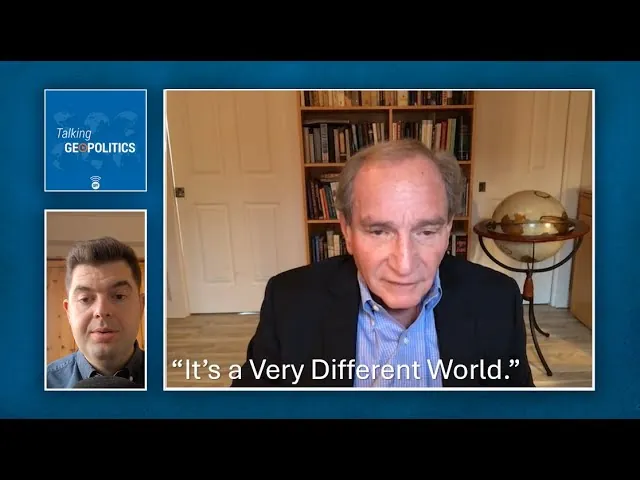
Read the full transcript of Talking Geopolitics host Christian Smith interviews GPF Chairman George Friedman on Mar 1, 2025.
Listen to the audio version here:
TRANSCRIPT:
Introduction: A World in Flux
CHRISTIAN SMITH: One month into Donald Trump’s second term, and even those who closely followed his last time in office are struggling to keep up. Foreign policy shifts alone include tariffs, attacks on allies, and the idea of taking control of the Gaza Strip. Now an apparent rapprochement with Russia has the potential to, in the words of Kamran Bokhari, a GPF contributor, revolutionize US strategy. So what to make of it? What is the US trying to achieve in its negotiations with Russia? And is this all just the new norm for a world without an anchor? I’m Christian Smith, and to make sense of it, I am joined on this podcast by Geopolitical Futures founder and chairman George Friedman. George, hello. Nice to see you.
GEORGE FRIEDMAN: It’s very nice to see you.
A World Without an Anchor
CHRISTIAN SMITH: George, every year Geopolitical Futures produces a forecast for the world. You’ve called it this year a world without an anchor. Obviously, you’re referring to the anchor that was or is the USA there, but expand on that. A world without an anchor.
GEORGE FRIEDMAN: Since for 80 years, two great powers dominated the world, the United States and the Soviet Union. Each country plotted its course with the consideration of, I am with the Americans, I am with the Russians, I’m neutral. These are the categories and foreign policy of all these countries were clear. It’s now 80 years since this system was in power. It’s almost a century. These systems shift as the realities of the nation states and the reality of the world shifts.
It is now undergoing, and usually it goes through a war, World War I, World War II, the Napoleonic Wars. We’re not peaceful in this process. So we are now in a period where the post-World War II model is obsolete. It is not relevant to the world. That’s considered the norm. It cannot sustain the world, cannot organize the world. NATO, Russia is different. Other countries are rising, India and so on. So the world is reorganizing itself.
What occurs in this place is that each country has an internal crisis because the norms are being broken on all levels. I mean, how can you be friends with Russia? How could we be friends with Japan? How could we be friends with Germany? We built both of them. And this was appalling. So we are in the period where people are appalled because it’s not what they used to. And all countries are going through this.
The English, British are certainly thinking, what happened to our American friends? They know what happened to French friends. What will Germany now do? All the old questions are rising, but the new questions aren’t being faced.
The US Response to Global Shifts
CHRISTIAN SMITH: I mean, obviously, as we’re talking about the USA is fundamentally changing or may well be changing how it sees the world and how it wants to interact with that. Why in particular is the USA doing this right now?
GEORGE FRIEDMAN: The USA is not seeing the world differently. The world is different and the U.S. is taking note of it. Russia lost the war in Ukraine. The Russian army, the Red Army could not defeat what is nearly a third world country. For three years, it failed. This is a massive failure by the Russians. This changes the fundamental anchor of the world.
The United States and Russia are about to say, we lost Vietnam, but that was not as clearly important to us. So Russia’s position in Europe is up in the air. Russia itself is up in the air. That means the world has changed. The difference is that the Europeans don’t want the world to change. They’re looking at the world and saying, look, we’re doing everything differently. You can’t make peace with Russia, but if you can make peace with Germany, you certainly can make peace with Russia.
What Putin has done has failed. What America is doing is taking advantage of that failure and realizing that the post-Cold War, the post-war relationships that led to the Cold War are no longer relevant. It’s not what he wants, it’s what he must do.
Is the American Century Over?
CHRISTIAN SMITH: Well, I mean, speaking of the post-Cold War world and that era, some people are saying that the American century is over. Now, of course, that sort of depends on how you define the American century. Perhaps another way of putting it is what the British ambassador or former ambassador to the U.S. said last week, which was the era of Pax Americana is over. Do you agree? Is the American century over?
GEORGE FRIEDMAN: They have been saying that since Vietnam, it’s wishful thinking. The United States is by far the strongest military power. It is by far the strongest economic power. China made a good try, but didn’t quite get there. So the idea that the United States Pax Americana is over means that no one wants access to the American market. No one wants American investment. No one wants an alliance.
The reason we know the American era is not over is the Europeans are panicking over the fact that the United States is not there. So in fact, what they’re saying is the old world order is ending, a new one is emerging, and therefore anything can be said about what it’s doing. The United States is organizing it, and this summit is a very important summit between not just the U.S. and Russia, but Saudi Arabia. The three great powers, the great power of the Middle East, the great power, Russia, the great power, America, are sitting down at the same table and discussing the world. So this is a very different world.
American Leadership in a Changing World
CHRISTIAN SMITH: And let’s come on to – I want to come on to Saudi Arabia in a moment because that is a really interesting question that you’ve been writing about as well.
Just sticking with America for the moment, I suppose the question that people are asking as well is, is the idea of American leadership over as well as the leader of the Western world and the kind of unilateral post-Cold War world, or is leadership just going to change the way it looks?
GEORGE FRIEDMAN: We don’t want to be leaders of the world. It costs too much, it puts too much responsibility. We have to be leaders of the world because the rest of the world was in shambles. Now the Europeans can lead the world. They can build an army, they can build an economy, they might even build a nation, you know, a European nation, but they can’t lead.
The point is the United States is leading. It is leading it in a direction that shocks everybody, but the world has to be shocked by the most important event that happened. The Russians failed in this war. Russia is not what it is. Now China has to reconsider its relations.
One of the most important things to look at is the Xi made a speech last week saying that it is the private sector that must drive China, essentially abandoning communism. Now that represents panic on the part of China. Russia is an enemy of China historically. It’s now caught between Russia and the United States, so everybody is now trying to figure out what the United States is doing. That is not the end of leadership, otherwise they wouldn’t be wondering.
The Ukraine Situation
CHRISTIAN SMITH: And let’s come on to China in a minute as well because that is, of course, very interesting. I mean, let’s drill down into Ukraine and what’s going on there. I think everyone listening probably knows the story on the ground there. The front lines are broadly stalemated, although moving slowly westwards. The U.S. and the West have been supplying Ukraine and now seem less interested, and at least the U.S. is. How did we get to the point, George, where the U.S. decided to pull the plug, so to speak, if that is what happens? Does this end in victory, not negotiations, or in stalemate and negotiations?
GEORGE FRIEDMAN: When the U.S. realized this war was a stalemate, the Russians were not going to overrun Ukraine. Ukraine could not defeat, only the Europeans thought that it was valuable because it helped the Europeans block the Russians. The Americans looked at the war and said, look, who are our allies? NATO is obsolete. There is no function in it. The Europeans are reverting to the pre-Cold War model of nation states competing against each other. China is a problem and must be isolated, but not so much of a problem.
They asked the question, what is the fundamental issue between the United States and Russia? It was Europe. That question is settled by the fact they can’t invade Europe if they can’t take Ukraine. Now is the time not to deal about Ukraine per se, that was merely the example, to recognize that the balance of power in the world has shifted and reframe the world.
CHRISTIAN SMITH: Of course, as anybody who has been following this will have seen in the last week or two, a lot of the reaction to what is going on between the U.S. and Russia and the kind of comments from the administration about Ukraine have caused a significant amount of outrage in the U.S. as well as other places. I guess the question I want to ask is, putting aside the realpolitik as you are really talking about here, George, at the moment, what are your thoughts on the sort of ethical question of dealing with this Russian administration? I suppose earlier you talked about dealing with Germany and dealing with Japan after the war, but I suppose the point there might be they changed their administrations because they lost. People are wondering ethically, morally, is this wrong?
GEORGE FRIEDMAN: Can Putin survive after this defeat? I mean, everybody is talking about the power of Russia. This proved the lack of power of Russia and the lack of prudence by Putin. Now, if you want regime change in Russia, this is the moment. There are many people who don’t like Putin. There was an attempt at coup d’état during the war against Putin. So this is not a leader who’s in a firm position because he committed his country to a war he couldn’t win. Lyndon Johnson did the same thing and this did not end well for him, but the regime stabilized.
But what are the Russians going to stabilize on? So we have to reconsider what Russia is. We are imagining Russia as if it were 1960 and somehow it is a superpower, but it couldn’t take Ukraine and that ends that. And so the problem is that people cannot understand change. They keep the pieces on the chessboard with the same power, the same thing, but in geopolitics power changes and there’s been a massive shift in power due to Ukraine.
The Changing World Order
And now the world has to ask the question, what is Europe? The Europeans have the French declared a summit and deploying forces, Poland said go to hell. So Europe, there is no Europe. That’s a huge change in the world. The United States now wants a different role in the world and the world will run differently. So it is not Trump disrupting the world. He came into presidency with a disrupted world and his administration tried to make sense of it. And his personality is not the most charming. So, you know, but for us it wasn’t either. He was considered this sleazy rich guy who was doing this as a hobby. American presidents are always loathed at all times. That is the foundation of American democracy, the division.
So there’s the wording in America, which is essentially money talks and excrement walks. If I may put it that way. The critical thing to understand is that when Russia invaded Ukraine and failed, the world changed. It was not the other way around.
Ukraine’s Future
CHRISTIAN SMITH: And before we move on from this topic, from Ukraine’s perspective, do you think they’ll come out of this with a semblance of their country still intact? Do you think they’ll still have their independence?
GEORGE FRIEDMAN: I’ll be ruthless. Ukraine is a sideshow that doesn’t matter. It was a stage on which the ballet was played out. And now the next act, the stage, well, the Russians don’t really care. They like it. We don’t care, the Poles may care, but the great powers that are left, the United States is the superpower, truly this time, and they, Ecuador triggered this affair, and I suppose it will end with a division of Ukraine in some way.
Some forces in Ukraine, you know, will send British forces to monitor the borders and fight any Russian intrusions, take casualties, so the point is about Europe, is they want to be in Ukraine, but not take casualties, therefore they’re irrelevant, they run themselves irrelevant, and much of the rest of the world feels morally superior because they don’t have to dirty their hands with the transition, and that’s what’s going on in the public, especially with the elite, who’s committed to the post-Cold War, post-war order, world order, to NATO, to the European Union, to all sorts of conceptions of how the world works, and this looks obscene to them.
CHRISTIAN SMITH: And of course we’ll probably hear a lot from Germany over the coming days, the election there is going to take place after we’ve recorded this podcast, but I think before it goes out, so there’ll be plenty going on there since, with that.
GEORGE FRIEDMAN: I will simply say, what does Germany matter? Germany matters in Europe for economic reasons. It’s not a military power. If it has a massive change of government, it will take a decade to stabilize Germany. If this government remains, it’s already so unstable it can’t move. Therefore, the countries that 10 years ago were pivots are now irrelevant. They don’t realize it yet, but they are. So a German election used to be important. It’s important to the French, and it’s important to the Poles, and not important to us. And the Europeans are furious about this.
CHRISTIAN SMITH: I mean, is the fate of Ukraine then a matter of geopolitics at its most fundamental, neutral core?
GEORGE FRIEDMAN: History is ruthless. It’s not filled with pity. Individuals are. The consequences of geopolitics is power. It is not what you want to do, or what you think is moral, is what you must do, and what you can do. And so in this particular case, as in many cases where nations were victimized by geopolitics, like Vietnam, which we fought not because we cared about Vietnam, but because we wanted to stop communism and signal that we would not stop at anything to do it. So they’re victims when systems change. And mercilessly, Ukraine is the victim.
CHRISTIAN SMITH: And does it really matter to Britain what happens to Ukraine?
GEORGE FRIEDMAN: I think it does in the sense of being someone who’s sitting in London. I think that there is a significant sentiment towards Ukraine here. It has been since the war started.
Yes, but there’s not enough sentiment to mobilize the British Army, which is substantial, the British Navy, which still matters, and go to war. So money talks and excrement walks.
The Reality of International Relations
CHRISTIAN SMITH: Do you think, George, that this is sort of a fundamental, as some people are saying, a fundamental change in the way international relations works, where we’re moving away from, say, a liberal approach to the world? Or do you actually think this is how it’s always worked? And sort of liberal international ideology has always been a bit of a cover?
GEORGE FRIEDMAN: It’s been nonsense. The wars that have raged during the period of this have been massive. The lack of interest in these wars by the liberal elite is massive. The Balkan wars, for example. The question of the liberal unit is an ideology shared by a certain segment of Western society. It gave them a platform to consider themselves able to maximize their well-being by manipulating certain minor systems. World Economic Forum was a meeting of those who won the world liberal system.
But the liberal system emerged out of a terrible reality. World War II. It created a political structure. What made liberal democracy, the liberal system possible was the Cold War. It was the alliance of non-communist nations, and they called themselves liberal. Well, it wasn’t a liberal world. China wasn’t liberal, and Russia didn’t follow a liberal policy, and Africa was certainly not liberal. The idea of the liberal world order was a fantasy that was useful to some, but not reality.
Saudi Arabia’s Role
CHRISTIAN SMITH: Let’s talk about Saudi Arabia. In some ways, George, you think they are central to all this. The question, of course, in some people’s minds are why are these negotiations taking place there? Why are they there? Saudi Arabia is a massive oil producer, but why there? Why not Hungary or somewhere else?
GEORGE FRIEDMAN: Well, Hungary would have been the logical place because Viktor Orban was close to Putin, close to Trump, and I thought it would be in Budapest. But the fact is the world is ignoring there’s another war going on in the Middle East between Israel and the Arabs, which threatens to join the United States and used to threaten to join the Russians during the 1973 war, it was the Russian-American war. Now the Russians can’t play.
The threat to Gaza was insane, it appeared, but it really was the announcement, this can’t go on. This region cannot, every five, ten years, spasm. The country that did not involve itself in this war in Middle East was the most powerful country. It was Saudi Arabia. Saudi Arabia needs this to stop. It’s part of the Abraham Alliance, which, by the way, Trump invented, and now Azerbaijan wants the war joined and everything.
GEORGE FRIEDMAN: He wants to create a NATO in a place where NATO matters, the Middle East, not Europe now. NATO would be very different and not the same, so I just used that name. So how will the world look? Well, Russia will not decline, it will decline, but not lose its power. China is struggling. It made a play for greatness, and it’s not going to be serious, but not serious enough.
The Middle East has to be organized. It is the real root of war, the real question that should be asked, the real horror that happened was in the Middle East, and it’s always the Middle East, and this is an economically vital area. So the Russians are going to be talking, and Americans will be talking about more than Ukraine. They’ll be talking about the Middle East, and they’ll be talking about how these world powers, but really great powers still, are going to handle the Middle East.
Saudi Arabia has to be at that table, because if you see a new model of the world, it’s American power, Russia still a major power, and Saudi Arabia, the guardian of the Middle East. The United States wants to stop the war in the Middle East, perhaps more than it wants to stop the war in Ukraine. And what do the Saudis want there? Saudis want to be the dominant power in the Middle East. They need to be sponsored in this role.
Let Saudi Arabia be responsible for Gaza. So the whole Gaza play was a bluff, of course, because these are negotiations and you bluff. We’re going to take Gaza like crazy. We’re not going to take Gaza. We’re telling the Saudis, somebody’s got to stop this. If it’s got to be us, it’s got to be us. But then you’re going to be junior to us. How’s about you taking the lead, reaching an understanding with Israel, and being responsible for the Palestinians? And this is what’s going to be discussed.
That’s why it surprised me terribly that he decided to hold the meetings in Riyadh. Why Riyadh? Geneva, yeah, okay. Riyadh? Because this is more than just a discussion of Ukraine. This is a discussion of the new world order in which new nations will emerge and other nations will decline.
U.S.-Russia Relations
CHRISTIAN SMITH: Tacking back to Russia then, and of course, a major oil producer itself, what does the U.S. want with Russia going forward?
GEORGE FRIEDMAN: Nothing. Economic relations, look, the Cold War didn’t end with the fall of the communists. Russia remained Russia and was trying to reassert itself without the ideology of communism, but with the power of Russia. Having demonstrated that Russia’s power is limited, but still there in some form, Russia now does not represent a threat.
We formed NATO for one reason. Russia was a threat. If Russia is not a military threat, then NATO is irrelevant. Europe is different. So the war there and the war in the Middle East changed an understanding of the international system. The idea that Russia is a fixed figure as a threat declined. The American perception of the world changed as a result. The European perception of the world did not. They did not realize that the Russian threat, the Cold War, was a threat to the world, that the Russian threat, the Cold War ended in Ukraine.
In Ukraine, Russia demonstrated its limits. And so the organizations, the concepts that were built around the Cold War are not there anymore. Conceptions die hard. Trump, for all his bizarreness, grasped that and he wanted to construct a new world stable order in which the United States and Russia have no real, what do we want for each other? Russia wanted Europe, it’s failed to get Europe, let’s do business.
Saudi Arabia doesn’t care about Israel. So why are you supporting these Palestinian movements? Let’s do business. Trump is trying to reform the world around reality. The world has not yet accepted this new reality. So everything seems obscene to them. The Israelis will go crazy, by the way.
CHRISTIAN SMITH: Oh, yeah, I would certainly expect that. I’m conscious of time, George, so to finish, I want to, we could talk about Israel on a whole other podcast in that sense, I think.
China’s Position
CHRISTIAN SMITH: But we want to talk about China to wrap up in particular. Obviously, the Trump administration sees China as the main threat to the US. You’ve written as well, though, that China is far, far from being, well, is not what you would consider a great power. Given what’s going on with Russia, given how the Trump administration see this, how does this impact China? I mean, some people have suggested that what’s going on is that Nixon visits China moment, but in reverse. I mean, how do you see it?
GEORGE FRIEDMAN: Well, when Nixon went to Russia, to China, Russia attacked the Ussuri River, the border between Russia and China. China and Russia have a very complex marriage. They’re historic enemies, bound together by an ideology, which if anybody watched carefully, Xi abandoned last week, calling on that.
China did not invade Taiwan because they couldn’t. It takes 10 hours for landing craft to cross the straits. American satellites would have seen them. Submarines and missiles would have blocked it. The Chinese, they must control the seas. They don’t. Otherwise they’re fighting India or someone else.
The Chinese economy is in shambles. And the major reason the Chinese rose was the United States. American imports from China, investment in China. China must have those investments. Some come from Europe, but that’s not the key. So in a way, the Chinese American confrontation ended when the US stopped investing and cut investments. And the Chinese have been loose.
Now the Chinese were never really aligned with the Russians. There was hostility between Russia and China always. And the Chinese did not endorse the Ukraine war. In the United Nations, they abstained, did not vote for it, didn’t vote against it.
So we have to look at China as it is. It is a vast country, undergoing traditional stresses. With a government that has failed to surge the economy forward, the economy is actually declining. Its military is powerful in the region, but not against the United States. That’s not going to happen.
So China is now terrified. A Russian American entente is the worst thing that could possibly happen to China. There’s old enemy Russia back, that’s ours back in a way, the Americans back, what will they do? Well, the Americans will do nothing. We don’t want to invade China. The Russians don’t want to invade China. But now there’s the possibility that China will reform internally. And that was the signal sent when they said that it’s the economic future of China to be a capitalist country, that it’s the private sector will drive it.
So look everywhere for internal changes in their understanding of the world and external relations changing. Those who believe that this era, any era is irrevocable, the British Empire, the sun cannot set on it. Well, it’s set and history goes on. But in these moments, people get nervous.
CHRISTIAN SMITH: George, I’m sitting in London and the sun is setting and I think we’d better wrap it up there. Thank you very much for coming on the Geopolitical Futures podcast.
GEORGE FRIEDMAN: I’m sitting in Texas where the sun is just rising. See you soon, bye-bye.
CHRISTIAN SMITH: Bye.
Talking Geopolitics is brought to you by Geopolitical Futures, your source for geopolitical forecasting and analysis.