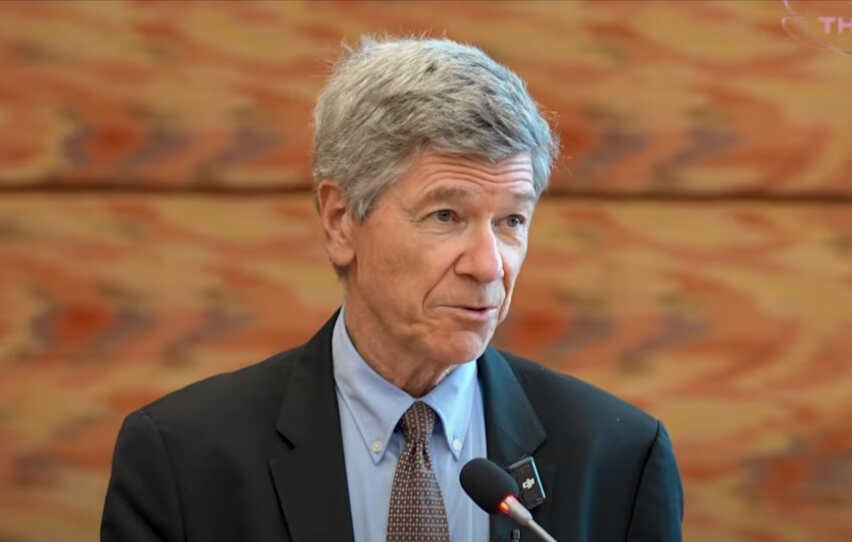
Read the full transcript of Professor Jeffrey Sachs’ keynote speech titled “Doomsday Clock Is Ticking: US Foreign Policy &the Global Crisis”, at China Institute at Fudan University in Shanghai, China on July 21, 2025.
INTRODUCTION
PROFESSOR JEFFREY SACHS: Thank you so much for that very kind welcome and also for this wonderful invitation, and thanks to all of you for the chance to spend a couple of hours together to talk about the world situation.
Indeed, while the title is about Israel and Iran, and therefore the Middle East crisis, I’d like to be a little bit more general than that, and to talk about geopolitics more generally. Geopolitics, the relations among especially the major powers – The United States, China, Russia, India, Europe – are at a very difficult and fraught time. And we’re in a crisis that is very serious.
The Nuclear Age Crisis
It’s a crisis because we’re living in the nuclear age. There are nine countries that we know of that have nuclear weapons, maybe some others also do, but nine that we know of. Most of those nine are in conflict with at least one other country that has nuclear weapons in geopolitical or diplomatic terms, and in the case of The United States and Russia, in open conflict in Ukraine, because that’s actually a war between The US and Russia, and a very dangerous war.
So my view is that we need to understand the global scene well so that we avoid terrible, terrible mishaps. And I often refer to the doomsday clock of the Bulletin of Atomic Scientists. This is a US publication that was started in 1947 after the atomic bombing of Hiroshima and Nagasaki, and it was started by the atomic scientists who had their journal, and they wanted to tell the world “this is very dangerous indeed, and the risks of this new age of nuclear weapons is unprecedented, because the power of destruction is something unlike any time before.”
So they started this clock, and the clock puts the hands of the clock closer or farther from midnight. And when the clock was started, it was seven minutes from midnight. And the message to the world was, “We are close to destruction because of these new weapons.” And that was in 1947, when The US alone had the atomic bomb.
But then, of course, in 1949, that monopoly was broken by the Soviet Union, developed its atomic bomb, and then in the 1950s and 1960s by Britain, France, China, and then we know Israel sometime in the 1960s, though never announced exactly, and then India, Pakistan, North Korea. And the clock has gone back and forth depending on geopolitics.
The Post-Cold War Deterioration
It went away from midnight at the end of the Cold War in 1991. The Soviet Union ended. It seemed that there was no more threat, no more Cold War. The US and China were on good relations. The Soviet Union under Gorbachev and then Russia under President Yeltsin said, “We just want good relations. We want to rebuild. We want decent relations.”
So the scientists put the hand of the Doomsday Clock seventeen minutes from midnight. Every US presidency since then has experienced the clock coming closer to midnight. I don’t think that’s an accident. I think that is the mistake of American foreign policy, which, though The United States is the most secure country in world history, in being able to avoid an invasion from outside, because we’re not afraid of Canada. We’re not afraid of being invaded by Mexico, though there once was a war with Mexico in 1846, but they lost. So this is not a big threat. And we have two big oceans.
So The US should be very calm, and the only threat that The US faces to its security at all is the possibility of a nuclear war, which should not be hard to avoid. You just have to be cooperative with other nuclear powers.
But, as I said, from seventeen minutes to midnight, Bill Clinton came, it moved closer. George W. Bush Jr. came, it moved closer to midnight. Barack Obama moved closer to midnight. Trump won, moved closer to midnight. Biden, closer to midnight. Now it’s eighty nine seconds to midnight. So less than one and a half minutes to midnight from seventeen and a half minutes.
What is going on? That every administration is moving the hands closer to midnight.
The Western Misunderstanding of Global Reality
Of course, there are many possible interpretations, but mine centres on The United States and centres on the Western world more generally, by which I mean The US, the European Union, Britain, Australia, New Zealand, if I could add those together, because those are offshoots of Britain as well. And in my view, what is going on is a serious misunderstanding of global reality by the leadership of my country that has persisted now for more than thirty years.
You had a wonderful debate, Professor Zhang, with Francis Fukuyama, which I just had the chance to read from fourteen years ago. And as you told me, you’re right, you won the debate. But the idea of Professor Fukuyama already back in the early 1990s was that the West had triumphed, and it was the “end of history.”
And my basic understanding of the reality is something different. And that is that with the end of the Cold War, the world had triumphed in the sense that we had the chance to escape from nuclear war and from confrontation, and we had the chance for rapid economic development in all parts of the world, which China led and China exemplified.
China’s Development Model and Global Potential
So from the forty years from 1980 to 2020, China experienced the fastest economic development in world history for a large country. And it showed what’s possible in our world today because of technology, education, infrastructure, how big an advance can be made.
And I watch this, by the way, with my own eyes personally, because my first visit to China was 1981. And so China was not a rich country in 1981. China was very poor in 1981 because of the history of the previous one hundred and fifty years.
And over that forty year period, which is the period of my professional life, China experienced this rapid development. And my view is that’s what’s possible in all parts of the world. So while I completely hail China’s accomplishment, and know that it draws on deep roots of China’s history and civilization, I do believe it’s something that all regions of the world can accomplish. Maybe not at the same speed, maybe not with all the same success as China, but I do not write off any part of the world – Africa, or India, or South Asia, or Central Asia, or Latin America.
This idea that we could all live in peace, in mutual prosperity, with rapid economic development in poor countries, I think is the reality of our world in its potential, but obviously not the reality of our world in its actuality. So we need to understand the world as it could be, and then aim to achieve that world.
The American Choice for Dominance Over Cooperation
Unfortunately, this was not the idea of The United States at the end of 1991, when Mr. Fukuyama, Professor Fukuyama, declared the end of history. The idea was that the Western world would lead the world from now onward, and especially The United States within the Western world would lead the world onward. Whether other regions developed or not was of modest interest, but if they did develop, they needed to develop under the wing of The United States.
In other words, what was important at the end of the Cold War was dominance, not cooperation or peace. And this is why I think the world has remained and become more and more dangerous over the last thirty five years.
The Western Mindset of Superiority
So to my understanding, we have a mindset problem. And the mindset problem is that the Western world dominated the world economy and world politics and finance for about two hundred fifty years, roughly from 1750 to roughly the year 2000. And during that period, the ideology in the Western world explained that dominance as an inherent rightful feature of the world.
And it explained that dominance in a number of different ways. Some very extreme, some a little bit less extreme, because there were theories of racial superiority, there were theories of social superiority, there were theories of cultural superiority, there were theories of religious superiority, that this was a Christian world after all. But whichever theory one subscribed to, there were theories of genetic superiority, biological superiority. Whichever view one took, the idea was deeply embedded in the mores, the stories, the beliefs, the institutions, and the politics of the Western world.
And two countries dominated most of all, and most of the world’s problems today can be traced to them actually. One was Britain, and China had quite an interesting experience with Britain, starting from 1793 up through probably the end of World War II, and the other has been The United States, which is a successor to Britain in both the Western world and the Anglo Saxon world.
British Imperial Legacy and American Inheritance
So the British definitely had an arrogance of power, and they used that arrogance of power in China, in India, in Russia, in every part of the world, because the belief was that Britain was the empire on which the sun never set. This was the era of Pax Britannica, although it wasn’t so peaceful, but it was the era of British dominance. And the nineteenth century was really defined by British dominance internationally.
Europe experienced two disastrous civil wars in the first half of the twentieth century, which we call World War I and World War II, but in Europe they were really civil wars within European countries. And at the end, Britain was no longer able to maintain a global empire, but The United States took over at that point, and The US inherited the mindset and the institutions of British imperial rule.
The Regime Change Strategy
The main geopolitical institution of British imperial rule was to control regimes of different parts of the world. So Britain mastered what we call regime change operations. If you don’t like a government, replace it. It’s a different kind of foreign policy from diplomacy. In diplomacy, if you don’t like a government, sit down and negotiate. If you’re British in the nineteenth century and you don’t like a government, threaten it, kill the person, the ruler, or overthrow it. And this was the main mode of British action.
In the second half of the twentieth century, The United States took over that method of operation. Indeed, the British taught it to the Americans, I would say. And in 1953, we did a joint venture together, the British and the Americans, the British MI6, the spy agency and the CIA, to overthrow the government of Iran, which brings us to our current situation.
Iran had a functioning democratic government in 1953, led by Prime Minister Mosaddegh. He had a very radical idea. Mosaddegh’s idea in 1953 was that the oil that was under the ground actually belonged to the Iranians, where the British knew that it belonged to the British. So when the Iranian prime minister, democratically elected, said, “This is our oil, it’s under our ground,” The British government knew that it had to overthrow him.
It connected with the US government and they made a secret operation to overthrow Mosaddegh and to install the Shah of Iran, a Pahlavi dynasty, and to make a police state under US control.
The Scale of American Regime Change Operations
If you add up all such regime change operations by The United States, between 1945 and 1989, at the end of the Cold War, one scholar, Lindsay O’Rourke, in an excellent book in 2017 called “Covert Regime Change,” and she was a student of John Mearsheimer at the time. She counted 64 covert regime change operations by The United States, mostly CIA led, and six overt regime change operations, meaning an open war to topple another government. So 70 regime change operations.
This is a very distinct kind of statecraft. It is the opposite of diplomacy. You don’t have to deal with the other side, you have to control it, or overthrow it, kill it, assassinate the leader, make a coup, fix an election, buy an election, create unrest to topple a regime. And this happened 64 times covertly.
What does covert mean? Covert means that The US denied its role, even though it was obvious to the people there. So when these events occur, they’re not really covert in the sense of who did this. Everyone says The United States did it, but The United States said “we didn’t have anything to do with it. That wasn’t us, that was a local unrest.”
The Cold War Justification and Rejection of Neutrality
So I mention all of this because that kind of arrogant statecraft, which is imperial mentality, was The US mentality from 1945 to 1991. It was justified to the American people as necessary because of the war against global communism. So that was the explanation that was given. And especially against the Soviet Union. And The United States accused the Soviet Union of wanting to take over the world, and it used that as an explanation to try to take over the world, every other place.
And very importantly and interestingly, The United States rejected neutrality by any country, and used the expression, “If you are not with us, you are against us.” So The US also actively opposed neutrality. This is also a very interesting, peculiar idea, because many countries said, “We don’t want to choose. We want to trade with the Soviet Union. We want to trade with The United States. We don’t have the big army. Don’t attack us, but we don’t want bad relations with either side.”
And The US said, “no, that’s not good enough. You’re either with us or you’re against us.”
The Thucydides Trap and Historical Parallels
And very interestingly for scholars here, and this is a room of scholars, if you read the Peloponnesian War by Thucydides, which has become famous again because of Graham Allison’s book, in the dialogue called the Melian Dialogue, which is a dialogue between Athens and the leaders of Melos, a small island, The Melians said, “We want to be friends with Athens and we want to be friends with Sparta.”
And the Athenian says, “No, you can’t. You are with us against them.”
And the Melians said, “no, no, but we want to be just neutral. Just leave us alone. We like you, but we don’t want to be part of your empire. We don’t want to be part of their empire.”
And the Athenian says, “No. If you do that, you will weaken our power in our realm. You will show to all of the allies of Athens that we’re weak. So you must submit to us. Otherwise, we’ll have to kill you.”
And actually, in history, apparently, in 424 BC, Melos said, “no, we will be neutral.” And the Athenians invaded, and they killed the Melian men, actually.
The Lessons of Ancient Athens and American Arrogance
Of course, what the Peloponnesian War really shows is that just twelve years later, Athens was defeated. So all that arrogance led to nothing but defeat. It even shows something more. Sparta, which won the war, disappeared from history also. So neither side won in the end.
The war exhausted both sides, and Greece was invaded by Macedonia in the next century. So both sides lost from this ongoing war. But the arrogance of Athens is the arrogance of The United States. And by the way, Athens was a great democracy, and it had a great arrogance, and it made a great self disaster by that arrogance. And by being a democracy, they elected a lot of stupid people that were very demagogic, and that told them, “Why don’t we invade Syracuse? Why don’t we continue the war?” And they had no sense, and they were defeated in the end.
Post-Cold War Optimism and Economic Cooperation
So I began much of my work during this period from 1989 onward. I was already working in Latin America, but then came the end of the Cold War. And just to say I was an advisor to President Gorbachev, not personally, but through his chief economist, and then I was personally an advisor to President Yeltsin, And I was personally an advisor to the President of Ukraine and to many of the other leaders.
And I thought, well, this is wonderful. The Cold War is over. We’re all now in a market economy worldwide. We can all share in prosperity. The poorer countries can grow faster and close the income gap with the richer countries.
And the richer countries should help the poorer countries to catch up. And then we’ll have a safe, prosperous world. And I also believed, and believe today as an economist, there’s enough to go around. Because another theory of economics, the Malthusian theory, is there’s not enough for everybody. So the fighting is inevitable.
There will always be those who lose in the end because there’s not enough for everybody in the world. We could discuss that, but I reject that on economic grounds. In other words, not out of moral theory, but out of practical theory, we could have everybody living a good life, as long as they’re using solar power, not if they’re using fossil fuel. So as long as we make the right technological choices, then there’s enough to go around in the world for everybody in the world. That’s what I argued in the early 1990s.
The Rise of American Hegemonic Ideology
The United States, however, maintained and even intensified its imperial idea. Instead of viewing the end of the Cold War as the opportunity for a new world order that was balanced, fair, peaceful, The United States viewed the end of the Cold War as the opportunity for hegemony. And that’s very explicit. This became the ideology of the so called neoconservatives, who dominated American politics from 1991, basically until today. And the neoconservative idea is the world can only be safe if The US leads the world.
Because The US is a power for good, and so The US should set the rules, it should be the world policeman, it should determine what happens in each part of the world, and then things will be fine. This is a very arrogant position, of course. It’s a very delusional idea. But it is really the idea that was espoused by government after government, starting in 1991. And I witnessed it close-up, because my argument as an economist was that we should help Russia to get back on its feet.
We should help Africa to achieve development. We should make sure that poverty is overcome everywhere. And none of those ideas was accepted in the American political leadership, even by my own colleagues who were in positions of power temporarily, they viewed such ideas as naive, and as contrary to American interests. America’s interest is to be number one, not to be cooperative in an open world in which there is shared prosperity. So the ideology was, in my view, made even worse by the end of the Cold War.
It turned out, by the way, and it’s relevant for China also, during the Cold War all of The US rhetoric was, “We fight the Soviet Union because of world communism.” Word, as you know, in the American scene, is viewed as something completely shocking. When Russia became independent and declared, “we are in a market economy, post communist, this is another age,” it made no difference to American politics. This is quite interesting. In practice, Russia was still an enemy, even afterwards, because it wasn’t really communism or ideology.
It was simply big powers. And in this, John Mearsheimer is right about the American mentality, which is that The United States sees Russia as a threat, not because of any specific ideology, but because it is big. And The United States sees China as a threat, not because of anything that China does or is other than being big and successful. And therefore, China’s only offense is that it threatens American dominance. And that, I think, is a succinct description of the viewpoint of the American leadership.
The Economic Reality of Global Development
Now to come back to my view of economics, this is a terrible mistake, not only on a moral level, but on a practical level. The United States has 4% of the world population, three thirty five million people. How could 4% of the world dominate the world? It’s not possible, except if all the rest of the world were to remain poor, unsuccessful, backward, and so forth. But there’s no, not only no moral reason for that, there’s no practical reason why that should be the case.
So I long believed that poorer countries can grow faster and catch up, and China of course is the greatest success story in history of that, but China follows a basic pattern that Japan followed previously, that Hong Kong, Singapore followed previously, because catching up is possible. If the leadership is good, if the planning is good, if the strategy is good, there’s all this headroom for rapid economic growth possible, and China proved the case once again at a scale unprecedented in history. So The US viewpoint about dominance makes no sense, not only not morally, and not practically in terms of security, because the world’s not safe if The US is rich and Russia is unstable with nuclear weapons. Why does that make The US secure? That makes The US more dangerous.
But it’s also wrong economically. Because Russia will catch up. China will catch up. Africa will catch up. And The United States will find out that being 4% of the world population is just 4%.
It’s not enough to rule the world. The US will have to learn to be cooperative, and will have to learn that statecraft is more than overthrowing governments. But, and here I will come to the point about current politics, The US still does not understand this, till today. And the wars that we see, and the crises that we see, are still crises of the old imperial mentality.
The Ukraine Conflict: A War of Imperial Expansion
So the war in Ukraine is a war that The US caused, not a war that Putin caused, but a war that The US caused by expanding the military alliance, NATO, eastward, and trying to set up a military base or bases in Ukraine and in the South Caucasus, especially the country Georgia.
And the Russian government said, “No, you can’t have military bases on our border. We don’t accept that. That’s a real security threat for us.” And the American position was, “it’s none of your business, Russia, what we do. If Ukraine says yes, we’re going to put our missiles next to you.”
And President Putin said, “no, you’re not. That’s dangerous for us.” And The United States said, “it’s none of your business.” And so this is the essence of the Ukraine conflict, which is that The US said we can expand our military reach anywhere. The Russians said not on our border.
And it finally came to war. Before it came to war, the government in Ukraine in 2010 was very clever. It said, “We want neutrality.” Well, read Thucydides. The Americans did not accept Ukraine’s call for neutrality.
What did The United States do to the president who wanted neutrality? It overthrew that president in February 2014. So The U. S. Made a coup together with Ukrainian forces.
The US role was quite obvious, though it was denied, so we can call it a covert regime change operation. I happened to have been told by some of the participants just how much The U. S. Played a role. And at a crucial moment, a phone call by The U.S. Diplomat, Victoria Nuland, was intercepted by the Russians and posted online. And that call said the next government should be so and so, which was the next government, actually. So The US chose the next government. And where is Victoria Nuland today?
She is my colleague at Columbia University. So this is the route to success: make a coup, and then you get to be a Columbia professor. So this is the Ukraine conflict. President Trump came into office saying, “I want to stop this war because it’s useless and the Russians are winning on the battlefield.” But interestingly, president Trump does not have the power or the logic to stop the war because he can’t say publicly the obvious.
He can’t say to the American people, “NATO will not expand.” If he says that, he’s declared, “you’re a weakling, you’re a traitor, you’re making a concession to President Putin, You’re giving up. You’re, on the payroll of the Russians.” And so the imperial logic still prevails even if the individual as president might want to do something different. Of course, of us can figure out Donald Trump’s mentality.
Not even Donald Trump. So we don’t know what he really truly thinks, but what I know is that he seems to want to end the Ukraine war, but does not have the political strength and the individual leadership to end it because all around him is the military industrial complex that says The US can go where it wants.
The Middle East Crisis: A Legacy of British Imperialism
Then comes the Middle East conflict, second conflict. This is also an imperial conflict. It started, of course, as so many conflicts do, with the British.
And the conflict with Ukraine, by the way, started with the British because in 1853, Britain went to war against Russia for exactly the same reason that The United States went to war against Russia in 2014. Britain said we need to weaken Russia in 1853. So the war in Ukraine is like the nineteenth century Crimean War, almost the same actors, but The United States wasn’t involved in the first one, but Britain was involved in both of them. When it comes to the Middle East, this is also a crisis made by Britain, And it comes from World War I, as you know, when Ottoman Empire, which ruled the Middle East, was defeated by the Allied powers, The US, France, and Britain. And Britain was the dominant imperial power of the age, especially in the Middle East.
It ruled over Egypt. It ruled over Aden, which is Yemen today, because this was the route to Britain’s empire in India, the sea route. And so Britain was very careful to control the whole sea lane from the Mediterranean to India. And India was the crown jewel of the British Empire. So at the end of World War I, when the Turkish Empire was defeated, Britain aimed to control all of this territory.
And it made many promises and many contradictory promises to other powers. Britain told the Arabs, “You will control this region.” Britain told the French, “You will control this region.” Britain told the Jews, “You will control this region.” And of course Britain ultimately wanted to control the region.
So this was typical British imperial deceit or duplicity, but one of the outcomes was the Balfour Declaration, in which Britain called for the establishment of a Jewish homeland in what was a province of the Ottoman Empire, and which became known as Palestine after World War I, which was the ancient Roman name that was used for this territory also. So Britain took over Palestine under the League of Nations, and it said that this would be a Jewish homeland. This is a very complicated, weird story, because the Jewish faith had its main temple in this place two thousand years earlier. But it had been banished from this place by the Roman Empire in the year January. And now it was recreating this ancient state.
The only problem was that 95% of the population was Arabs who did not want a Jewish homeland in this territory. But Britain used its imperial power to force the in migration of people of Jewish religion, especially from Eastern Europe, to claim a part of British controlled Palestine. And a very long story: that has led to a hundred years of crisis. Because there was a local population, the local population resisted the incoming migrants from Europe especially, and then after the State of Israel was established from other regions of the world, including the Middle East and South Asia, and the mentality of the Jewish state, which was established in 1948 by the United Nations, was “our security depends on having no Arab state next to us that opposes us.” And so the idea of sharing the land, which was a UN idea, was actually rejected by both sides in a way.
The Arabs said, “We’re the majority, we should rule.” And the Jews said, “We’re the minority, we need to dominate, because otherwise we won’t be safe.” And so this has led from 1948 until today to an unresolved war. But remember, this was a state created by the British Empire, and now backed by the US Empire. So Israel could not survive without The US being the imperial power that enforces Israel’s power in the region.
Because Israel’s just 8 million people, the Arab world is about 400 million people, And Israel therefore depends on its security entirely on The United States. The United States has seen this as an imperial project that’s good for The United States, because if The US has control over The Middle East through Israel, well, that gives The US control effectively, militarily, in the region. So The US has backed Israel for many decades during this period. It’s a very dangerous ongoing conflict, because it is very unjust, and Israel needs to use more and more force in order to repress the aspirations of the Palestinian people. And the more force that Israel uses, the more resistance there is.
The Middle East Crisis and Imperial Mentality
And we’ve reached a point of violence that is unprecedented in modern times. Israel is committing a genocide in Gaza right now, which is one part of the Palestinian lands, and every day they’re slaughtering tens or hundreds of innocent people with open fire. And today there was another massacre. People came for food and they were just shot by the Israeli Armed Forces.
Iran, as you know, which is a long empire that has five thousand years of history, backed the Palestinian cause and it supported resistance to Israel, both Hamas and Hezbollah, two groups, and in Yemen also the Houthi militants.
So Israel has always had the idea “we need to topple the Iranian regime.” Instead of saying “we need to settle the Palestinian crisis by giving a state of Palestine next door to a state of Israel,” Israel has said “we need to overthrow the Iranian government so that they don’t bother us.”
And Israel actually made a long list of governments that it wanted overthrown by The United States, because those governments were resisting Israel’s attempt to control the region. And the list actually was made, literally made, “we want seven governments overthrown.” And that list was unveiled in February 2001.
The Seven-Country War List
And one of our generals, General Wesley Clark, talked about this in an amazing set of interviews. And the seven countries are Lebanon, Syria, Iraq, Iran, Somalia, Sudan, and Libya. So seven countries that were supporting the Palestinian cause. And the Israeli government said to the Americans, “You overthrow those seven governments.” Well, it’s not so easy.
Those turned into seven major wars. We had the war in Lebanon for many, many years. We had a fifteen year war in Syria, which is still going on because the US tried to overthrow, or did overthrow the Syrian government. We had the US invasion of Iraq in March 2003. We had The US bombing of Libya in 2011, which created a civil war in Libya.
We had The US supporting an insurgency in Sudan to break Sudan into two countries, Sudan and South Sudan, both of which are in civil war now. And we have had The US supporting interventions in Somalia, which is an ongoing battleground as well.
So The U.S, the one that was missing up until two weeks ago, or up until last month, was Iran. And the Israeli government was always begging The U.S, “Bomb Iran! Bomb Iran! Bomb Iran!” And finally, Trump, who’s again not very smart, not very effective, not very capable of resisting these kinds of demands, said, “Okay, we’ll bomb Iran.” And the war, such as it was, lasted twelve days.
Israel went in and assassinated dozens of people through its Mossad, the secret service or the spy agency, but basically it’s an assassination unit. And the idea was to create a regime change. But it failed. The government is intact, and the situation is more dangerous than ever, because Iran is a country of 100 million people almost. It’s a major country, it has big missile systems, it has a real military capacity, and it has an alliance with Russia.
And it has friendship with other nuclear powers like Pakistan. So even if it doesn’t have its own nuclear weapons, maybe Pakistan will give it nuclear weapons. Maybe Pakistan would defend Iran if there was a full fledged war with Israel. So this is the second region where imperial mentality lasts until today. The US is unwilling to compromise on the imperial prerogatives.
The U.S.-China Confrontation
So the final point that I want to raise and then close is The U.S.-China confrontation, and how dangerous it is. As I said, The US got along well with China from the 1970s to around 2010, in my estimation, because China was viewed by America as poor, lots of villages that grew rice. “You could make our components for our products, make our smartphones, and so forth.” But China wasn’t a threat.
And it was a good counterweight to the Soviet Union or to Russia. That was the attitude. Not too much more. So not too much attention given, and not too much concern. And ideology played no concern, because during the Cultural Revolution period, which was not exactly American ideology. This is when the relationship was formed between Mao and Nixon.
Then came the opening, and that was an opportunity for investment in trade. That’s fine. But ideology played no special role. Starting around 2010, the American leaders that were watching this said, “Oh, this is China’s getting awfully big and rather successful.”
And then I think two announcements by China really opened up American eyes. One was the Belt and Road Initiative, which was suddenly an economic financial infrastructure initiative that had suddenly a 100 partner countries, and The U.S. didn’t have anything like that. And then the Made in China 2025 program, which was a really brilliant initiative of China, to identify 10 major technology areas and set policies to make a major advance in these areas.
And this is one of the most successful industrial policies I know of in history, the Made in China 2025, because it really worked. It really produced the EV revolution. It really produced the digital revolution here. It really produced the renewable energy revolution. So it was very successful. But it terrified the Americans suddenly.
The Shift to Containment
So starting around 2015, the whole view changed almost suddenly in The United States. The view went from economic partnership to the need to contain China, the need to do something to slow down China’s economic advance.
All of this is quite dumb, in my view. You don’t get ahead in this world by stopping someone else, and there’s no reason to. You’re not going to be better off. You’re not going to be safe. It’s just lose lose proposition if it’s successful, and it probably wouldn’t be successful in any event.
It started under Obama, by the way. It didn’t start with Trump. It started definitely under Obama. And the Trans Pacific Partnership idea, which was the dumbest idea of trade policy that I know of, which was to make an Asian trade system without China. How can you do that? China is the main trade country for all of Asia, but The United States had the idea “we’ll make an Asian trade system without China.” This is only in America could you have such delusions.
In any event, it started with Obama, it continued with Trump, and it also implicates Taiwan issue of course.
The Taiwan Flashpoint
This is the most dangerous flashpoint of all, maybe the most dangerous in the whole world, because the American politicians, because of this mindset, do not know how to stay out of China’s internal issues. And so rather than saying, “That’s not our problem. You settle this peacefully, but it’s not our issue.” The United States, of course, is providing large flows of armaments to Taiwan. And the American political leaders are talking openly about defending Taiwan, and militarily defending Taiwan.
If China said, “We’re going to militarily defend the state of Missouri, or we’re going to militarily defend Texas, or we’re going to militarily defend California,” it would not play very well in The US. But The US, because of the imperial mentality, cannot put itself in China’s position or doesn’t care to, because The US can determine what should be done.
So just to conclude, I view this issue as extremely dangerous. And peace actually depends on the good sense of the Taiwanese leaders, which is fragile. Because if a Taiwanese president were to declare independence, all hell could break out. Because The United States would not necessarily have any responsibility. And this is why the situation is so dangerous.
And if Taiwan were smart, and my feeling is Taiwan could end up like Ukraine, destroyed in between two fighting giants. And if Taiwan were smart, the first thing they should say is to the “Don’t send us any weapons, please. We don’t want a fight here. We’ll handle our own diplomacy across the Taiwan Straits. Please, don’t defend us, because we don’t want to end up like Ukraine, caught between two giant powers.”
Conclusion: Danger and Hope
So I’ll conclude here for our discussion to say that the world really is dangerous right now, because of this mindset on the one hand that I’ve described in The US, and at the same time because of changing reality.
I want to end on an optimistic note. If we can avoid conflict, because of the technological revolution, we really could have a world of shared prosperity. And other regions of the world that seem hopeless right now, like African countries, could really have forty years of economic development if they would follow China’s roadmap for how to do this. And they would end up as a high income continent alongside the rest of the world.
So I’m actually basically optimistic. Worried, but optimistic. Thank you.
Related Posts